



Looking to buy? See our books on amazon.com Get Reading Now! Age of Aces Presents - free pulp PDFs

“Hell’s Skyway” by Ralph Oppenheim

Link - Posted by David on March 25, 2022 @ 6:00 am in

TO ROUND off Mosquito Month we have a non-Mosquitoes story from the pen of Ralph Oppenheim. In the mid thirties, Oppenheim wrote a half dozen stories for Sky Fighters featuring Lt. “Streak” Davis. Davis was a fighter, and the speed with which he hurled his plane to the attack, straight and true as an arrow, had won him his soubriquet. And time is of the essence when Streak is sent on a bombing mission. He must destroy the Krupp Machine works at Luennes before they unleash German’s newest secret weapon at noon! From the July 1934 issue of Sky Fighters it’s “Hell’s Skyway!”

The Fate of the Allies Depends on a done American Flyers Speed and Skill in this Rip-Roaring Novel of Whirling Props and Screaming Struts!

“Sky Writers, October 1936″ by Terry Gilkison

Link - Posted by David on March 23, 2022 @ 6:00 am in

FREQUENT visitors to this site know that we’ve been featuring Terry Gilkison’s Famous Sky Fighters feature from the pages of Sky Fighters. Gilkison had a number of these features in various pulp magazines—Clues, Thrilling Adventures, Texas Rangers, Thrilling Mystery, Thrilling Western, and Popular Western. Starting in the February 1936 issue of Lone Eagle, Gilkison started the war-air quiz feature Sky Writers. Each month there would be four questions based on the Aces and events of The Great War. If you’ve been following his Famous Sky Fighters, these questions should be a snap!

Here’s the quiz from the October 1936 issue of Lone Eagle.

If you get stumped or just want to check your answers, click here!

“An Ace of Spads” by Ralph Oppenheim

Link - Posted by David on March 18, 2022 @ 6:00 am in

THROUGH the dark night sky, streaking swiftly with their Hisso engines thundering, is the greatest trio of aces on the Western Front—the famous and inseparable “Three Mosquitoes,” the mightiest flying combination that had ever blazed its way through overwhelming odds and laughed to tell of it! Flying in a V formation—at point was Captain Kirby, impetuous young leader of the great trio; on his right was little Lieutenant “Shorty” Carn, the mild-eyed, corpulent little Mosquito and lanky Lieutenant Travis, eldest and wisest of the Mosquitoes on his left!

We’re back with the third and final of three Ralph Oppenheim’s Three Mosquitoes stories we’re featuring this March for Mosquito Month! And this one’s a doozy! Kirby gets the unenviable job of test flying the new type Spad and putting it through its paces—including trying it in combat and shooting down a plane. But, under no circumstances should he take the new plane over the lines! Unfortunately that’s just what Kirby did! Read all about it in Ralph Oppenheim’s “An Ace of Spads” from the April 12th, 1928 issue of War Stories!

Kirby’s eyes glowed when he saw the new-type Spad, one of the most beautiful ships ever delivered to the Front. It was to be his job to try it out in action. But he was not to go over the lines—the Germans would lose no opportunity to get their hands on the new ship. Once in the air, however, with a Fokker in sight, Kirby—forgot. One of Oppenheim’s best flying yarns!

“An Ace in the Hole” by Ralph Oppenheim

Link - Posted by David on March 11, 2022 @ 6:00 am in

“LET’S GO!” Once more, The Three Mosquitoes familiar battle cry rings out over the western front and the three khaki Spads take to the air, each sporting the famous Mosquito insignia. In the cockpits sat three warriors who were known wherever men flew as the greatest and most hell raising trio of aces ever to blaze their way through overwhelming odds—always in front was Kirby, their impetuous young leader. Flanking him on either side were the mild-eyed and corpulent Shorty Carn, and lanky Travis, the eldest and wisest Mosquito.

We’re back with the second of three tales of Ralph Oppenheim’s Three Mosquitoes we’re featuring this March for Mosquito Month! This week, the intrepid trio is tasked with getting valuable information from behind German lines—but it’s a job for only one man which unfortunately turns into one man at time as each of the Mosquitoes is sent off to garner the information when the previous one fails to return. From the March 29th, 1928 issue of War Stories, it’s The Three Mosquitoes in “An Ace in the Hole!”

Once more the famous “Three Mosquitoes” go out on a dangerous and thrilling special flight—but this time one of them led the way, alone, while the other two waited—waited until human nerves could stand it no longer.

And check back next Friday when the inseparable trio will be back with another exciting adventure!

“Challenge of the Air” by Ralph Oppenheim

Link - Posted by David on March 4, 2022 @ 6:00 am in

MARCH is Mosquito Month! We’re celebrating Ralph Oppenheim and his greatest creation—”The Three Mosquitoes! We’ll be featuring three early tales of the Mosquitoes over the next few Fridays as well as looking at Mr. Oppenheim’s pre-pulp writings. So, let’s get things rolling, as the Mosquitoes like to say as they get into action—“Let’s Go!”

The greatest fighting war-birds on the Western Front are once again roaring into action. The three Spads flying in a V formation so precise that they seemed as one. On their trim khaki fuselages, were three identical insignias—each a huge, black-painted picture of a grim-looking mosquito. In the cockpits sat the reckless, inseparable trio known as the “Three Mosquitoes.” Captain Kirby, their impetuous young leader, always flying point. On his right, “Shorty” Carn, the mild-eyed, corpulent little Mosquito, who loved his sleep. And on Kirby’s left, completing the V, the eldest and wisest of the trio—long-faced and taciturn Travis.

Let’s get things off the ground with an early Mosquitoes tale from the pages of the premiere issue of War Birds from March 1928! Kirby returns to action after having been shot down and spending 5 weeks in a hospital recuperating. That German had taken the starch out of him, had shattered his morale. In the past he had had planes shot from under him, had escaped perhaps even more certain deaths than this, but always he had come through the victor, had triumphed in the final showdown. Never before had he been beaten, battered to a pulp like this. The German had knocked him down, and he couldn’t get up. It had all given him the awful feeling that his reign as an unbeatable ace was over, that he must relinquish the crown. That was why he looked older now; he felt older, the old champion bowing to the new. It was indeed, almost a sense of going stale—and to an ace nothing could be worse. Can Kirby overcome his “Challenge of the Air!”

Nothing more terrible can happen to a great ace than to realize suddenly that he is suffering from shock—”that the old nerve won’t answer the call. Kirby was in this condition when the Fokker came over, gained valuable information—and was flying back triumphantly. Like a man half mad, he cursed himself fought with himself. The next time they came over—

And check back next Friday when the inseparable trio will be back with another exciting adventure!

“Zuyder Zee Zooming” by Joe Archibald

Link - Posted by David on February 25, 2022 @ 6:00 am in

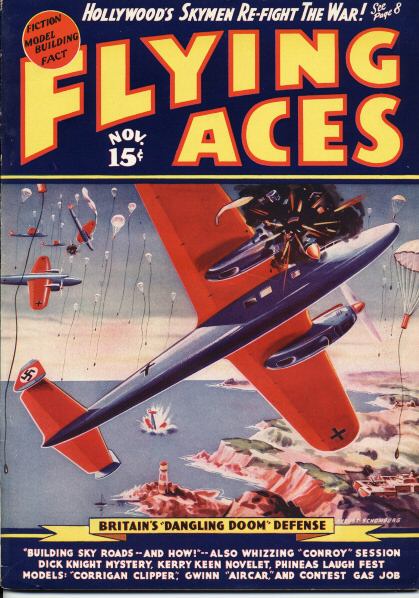
“Haw-w-w-w-w!” That sound can only mean one thing—it’s time to ring out the old year and ring in the new with that Bachelor of Artifice, Knight of Calamity and an alumnus of Doctor Merlin’s Camelot College for Conjurors—Phineas Pinkham. The Boonetown miracle is misdirected to the wrong train in Paris coming back from leave and finds himself knee-deep in tulips and treachery! It’s a Dutch treat special—it’s Phineas in Holland! from the July 1938 issue of Flying Aces, it’s “Zuyder Zee Zooming!”

Ludendorff was well satisfied. He already had his sand and gravel on the Holland canals, and now his eye was on the Hollanders’ ports. But when he began putting ants in their pants, Phineas raised the ante. All of which proved that there’s a limit—even to Dutchman’s breeches.

“Sky Writers, September 1936″ by Terry Gilkison

Link - Posted by David on February 23, 2022 @ 6:00 am in

FREQUENT visitors to this site know that we’ve been featuring Terry Gilkison’s Famous Sky Fighters feature from the pages of Sky Fighters. Gilkison had a number of these features in various pulp magazines—Clues, Thrilling Adventures, Texas Rangers, Thrilling Mystery, Thrilling Western, and Popular Western. Starting in the February 1936 issue of Lone Eagle, Gilkison started the war-air quiz feature Sky Writers. Each month there would be four questions based on the Aces and events of The Great War. If you’ve been following his Famous Sky Fighters, these questions should be a snap!

Here’s the quiz from the September 1936 issue of Lone Eagle.

If you get stumped or just want to check your answers, click here!

“Flyers of Fortune” by Ben Conlon

Link - Posted by David on February 18, 2022 @ 6:00 am in

THIS week we have a exciting air adventure from the pen of Ben Conlon. Conlon was quite the prolific author contributing stories in many genres and under a number of pseudonyms. He’s maybe best remembered for his many exciting Pete Rice western tales. He wrote all the full-length Pete Rice stories under the name Austin Gridley. Others used the pen name for the shorter Pete Rice stories in Wild West Weekly.

When Webb Foster sacrifices his new plane to save a man in trouble, a wealthy Mr. Charlton hires him on to pilot his new plane on his expedition to Biplane Island to find a fortune in gold! From the July 1929 Air Trails, it’s Ben Conlon’s “Flyers of Fortune!”

Whispering death wings spread above a tropic sea—as flyers face destruction for the lure of sunken gold!

“The Greater Glory” by Ace Williams

Link - Posted by David on February 11, 2022 @ 6:00 am in

THIS week we have a story by “Ace Williams.” I put his name in quotes because Galactic Central believes Ace to be a house pseudonym. Either way, what we have is a ripping good yarn—and one that is related to R.S. Bowen’s “How The War Crates Flew” feature this month.

Captain Saunders has never failed to return with photos from an observation flight—that is until he’s paired with Lieutenant Bert Wheeling, a replacement just up from the pilot’s school at Orley. Bert is suddenly stricken with a paralysis when Saunders asks his to go down so they can snap the crucial shots. To make matters worse, a few Fokker show up with their guns yammering. What’s a green pilot to do?

A Gripping Yarn of Singing Steel and Valorous Action in the Battle-Scarred Blue!

“Lost Aces” by Joel Townsley Rogers

Link - Posted by David on February 4, 2022 @ 6:00 am in

THIS week we have a story by Joel Townsley Rogers. Born in 1896 and studied at Harvard, Rogers saw The Great War as an adventure and joined the Navy Air Corp and became one of it’s first few hundred pilots. Unfortunately, the war ended before he saw action and ended up as a flight instructor at Pensacola instead. After the war, he turned his experiences into stories for the pulps. In addition to air stories, Rogers also wrote numerous mystery and science-fiction stories as well.

Zep-strafer extraordinaire, Kenny Blair of the 19th Camels and Captain of the dreaded Gallows Birds, Anton Glick—Two Aces, mortal enemies in the air, find themselves both marooned on an ever-shrinking sandbar in the sea.

Two aces flew to the edge of the world, one toying with treason, one fighting for life in a circle of death. Two aces, two bullets—and only one plane to break a deadlock of doom!

For more info on Rogers, check out “Joel Townsley Rogers—Fiction House Ace” over at the PulpFest website!

“The Spider and the Flyer” by Joe Archibald

Link - Posted by David on January 28, 2022 @ 6:00 am in

“HAW-W-W-W-W!” That sound can only mean one thing—that Bachelor of Artifice, Knight of Calamity and an alumnus of Doctor Merlin’s Camelot College for Conjurors is back to vex not only the Germans, but the Americans—the Ninth Pursuit Squadron in particular—as well. Yes it’s the marvel from Boonetown, Iowa himself—Lieutenant Phineas Pinkham!
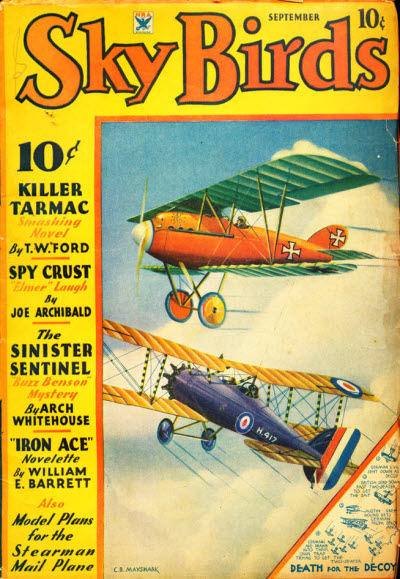
The Boonetown miracle man, Lieutenant Phineas Pinkham, is attached to help Captain McSniff over in the Isle investigate rumors of Kraut skullduggery rife on his home soil. Apparently, Scottish folk along the Firth of Solway had begun to get the jitters and that a fisherman had claimed to have seen a Heinie pigboat slipping through the fog that always hung over the Firth as thick as porridge.

When that bonnie braw Kraut shooter, Captain Gregory MacSniff button-holed Lieutenant Phineas Pinkham regarding an “Annie Laurie” journey, that jaunty jokester didn’t appreciate it. He scowled about going to Scotland. And he groused about going grousing. But the flying headache of the 9th quickly found out that orders are orders, and cordite is cordite—even though fish aren’t always just fish.

“Sky Writers, May 1936″ by Terry Gilkison

Link - Posted by David on January 26, 2022 @ 6:00 am in

FREQUENT visitors to this site know that we’ve been featuring Terry Gilkison’s Famous Sky Fighters feature from the pages of Sky Fighters. Gilkison had a number of these features in various pulp magazines—Clues, Thrilling Adventures, Texas Rangers, Thrilling Mystery, Thrilling Western, and Popular Western. Starting in the February 1936 issue of Lone Eagle, Gilkison started the war-air quiz feature Sky Writers. Each month there would be four questions based on the Aces and events of The Great War. If you’ve been following his Famous Sky Fighters, these questions should be a snap!

Here’s the quiz from the May 1936 issue of Lone Eagle.

If you get stumped or just want to check your answers, click here!

“Sky Code” by Captain John E. Doyle

Link - Posted by David on January 21, 2022 @ 6:00 am in

THIS week we have a story from the pen of British Ace, Captain John E. Doyle, D.F.C. Born in 1893, Captain Doyle was a successful fighter pilot in WWI with 9 confirmed victories with 56 & 60 Squadrons. Near the end of the war, he was shot down and taken prisoner where they amputated his leg. After the war, he wrote three books, one of which was an autobiography, and 31 short stories for magazines like War Stories, The Scout, Popular Flying, The Aeroplane, Flying, Boys’ Ace Library, Mine, Modern Wonder and Air Stories. Five of those stories were for the British version of Air Stories and featured one Montgomery de Courcy Montmorency Hardcastle, M.C. In Scotland he was usually referred to as “His Lordship,” for he was the fourteenth Viscount Arbroath as well as the sixth Baron Cupar. Out in France he was just “Monty” behind his back, or “The Major,” or “Sir” to his face.

99 Squadron R.F.C. seems to have hit a bad patch—they always seem to run into trouble on all their patrols. It’s almost as if someone’s been tipping them off. Major Monty tries to find out just who the spy on his ‘drome is. From the September 1937 issue of the British Air Stories, it’s Captain John E. Doyle’s “Sky Code!”

Ordeal by Combat, with a Flaming End for the Loser, was the Grim Sky Trial staged by a Monocled Major to end the Strange Hoodoo that was fast Annihilating a British Scout Squadron! A Great Long Major “Monty” Story of War-time Mystery and Adventure in the Royal Flying Corps!

“Mushing Down the Air Trail” by Frank Richardson Pierce

Link - Posted by David on January 7, 2022 @ 6:00 am in

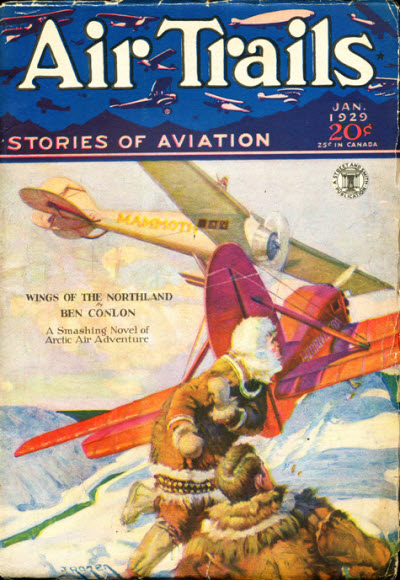
THIS week we have another exciting air adventure with Rusty Wade from the pen of Frank Richardson Pierce. Pierce is probably best remembered for his prolific career in the Western Pulps. Writing under his own name as well as two pen names—Erle Stanly Pierce and Seth Ranger—Pierce’s career spanned fifty years and produced over 1,500 short stories, with over a thousand of these appearing in the pages of Argosy and the Saturday Evening Post.

This time around, gold has been found at an old claim up north and Rusty’s in a race with an unscrupulous pilot to reach the site and stake the claim and get back first to register said claim. Can Rusty outwit and outfly Pratt and get Old Man Dorsey back to the registrar’s off first. From the pages of the February 1929 Air Trails, it’s Frank Richardson Pierce’s “Mushing Down the Air Trail!”

High-powered planes and battling pilots above the snow fields of Alaska!


And as a bonus, here’s “The Landing Field” column from the January 1930 number of Air Trails where we get to know more about Frank Richardson Pierce, Rusty Wade, Alaska and the Air Musher!


THE LANDING FIELD
AIR TRAILS • January 1930 v3n4

IN THESE crisp winter days with snow streaking through the sky, it seems right and proper to introduce Frank Richardson Pierce to you folks. Pierce lives up in the Northwest, up in Seattle, Washington—and he spends a good deal of his time hopping around Alaska. He is an outdoor man in every sense of the word. There are few writers in America who can catch the spirit of the frozen North as he can. His interests lie out under the open sky, with snow fields, fir forests, Canyons and great rivers. It was natural, therefore, that he took to flying.

For the past year you’ve been reading the “Rusty” Wade stories by Pierce. They’ve made a hit with Air Trails readers all over the country. The reason is that they ring as true as the roar of a Whirlwind motor on the nose of a new sport model ship. Pierce knows all about the Rusty Wade country.

He just recently came back from a trip over Alaska. Here’s what he says: “I get a great kick out of flying over some place I’ve walked. It gives me a chance to laugh at myself in comfort. But mostly I prefer flying in Alaska—the walking is tougher there.

“Alaskans lead the nation in air-mindedness. They have been flying for years—not for sport, but for business reasons. Why should a miner pole a boat for days up a river and fight mountains and glaciers when he can fly there with his outfit for a few dollars and still have the whole season ahead of him in which to prospect? Where in previous years it required weeks and months to bring out a load of fur, now it comes out in hours.

“An Eskimo may be popeyed when he arrives in Seattle and sees street cars, automobiles and skyscrapers, but he’ll not even blink at an airplane. He’s seen them before and probably has ridden in one.

“Rusty Wade is a typical Alaskan pilot. Landing fields are few and far between. If a pilot is forced down he has to walk out and it may take him days. And yet, right now, I can’t recall a single crash in which any one was killed. There may have been some, you understand, but I can’t recall them.

“At times, in Rusty Wade stories, I have tried to describe Alaska from the air. Thus far I have failed utterly. I doubt if there is in the whole world, anything more beautiful than flying over ice fields and glaciers studded with mighty peaks and set with lakes of the rarest blue. If any of the readers make a trip next summer, cable ahead to Juneau and make arrangements to see a bit of Alaska from the air while the steamer is lying over.

“At the present time a surveying party is working out of Juneau in planes. They are surveying a waterpower project discovered by the Alaskan air-mappers—a navy outfit. The lake is two thousand three hundred feet above the sea in a rough country. It would take many hours of the hardest work to reach the spot with equipment. The plane leaves Juneau and is on the lake within twenty minutes. It has even taken up a fourteen-foot skiff to the lake.”

A NUMBER of readers have written in, wanting to know what type of plane the Air Musher that Rusty Wade uses is. Well, that’s easy, and it gives us a chance to do a little “ground flying” here in front of the hangars. There’s nothing that a pilot likes so much as to talk about different types of ships.

The Air Musher is a Fokker Universal Monoplane equipped with ski landing gear. It is a type of plane that has stood the test of time. Ask any flyer what he thinks about the Fokker Universal. It has been used for prospecting, forest fire patrol, exploring, crop dusting, and for mail and passenger transportation on most of the air routes of this country and Canada.

With a pilot, four passengers and eighty pounds of mail or baggage, the Fokker Universal can carry enough gas to cruise for six hundred miles. It is generally powered with a Whirlwind motor, and, carrying a fair load, can reach a ceiling of sixteen thousand feet. Fully loaded, the landing speed is forty-five miles per hour and the high speed one hundred and eighteen m.p.h. One of the good things about this crate is the perfect vision provided for the pilot. He sits ahead of the leading edge of the wing and can look forward, right, left, overhead and downward. This is a big feature when you have to set down in rough Alaska country, where landing fields are not made to order.

The Fokker Universal will almost never spin or nose dive when stalled. It glides downward on an even keel while remaining under full control. With its wings of semi-cantilever construction and its strong cabin the Fokker Universal is just the type of ship for work in rough country where flights are made in all kinds of weather. There are bigger ships, more powerful ones, and faster ones; but there are few that can stand up under all conditions like the type of which Rusty’s Air Musher is representative.

If the Air Musher ever cracks up against the side of a glacier, Rusty Wade will probably be getting one of the Fokker Super-Universals to take its place. They are slightly larger ships, with a wing span of fifty feet seven inches, and powered with a Pratt & Whitney four hundred h.p. motor. They can carry as many as eight passengers, and, with a fair load, can reach a service ceiling of eighteen thousand feet. Their top speed is one hundred and thirty-eight miles per hour.

“Balloon Bait” by Captain John E. Doyle

Link - Posted by David on November 12, 2021 @ 6:00 am in

THIS week we have a story from the pen of British Ace, Captain John E. Doyle, D.F.C. Born in 1893, Captain Doyle was a successful fighter pilot in WWI with 9 confirmed victories with 56 & 60 Squadrons. Near the end of the war, he was shot down and taken prisoner where they amputated his leg. After the war, he wrote three books, one of which was an autobiography, and 31 short stories for magazines like War Stories, The Scout, Popular Flying, The Aeroplane, Flying, Boys’ Ace Library, Mine, Modern Wonder and Air Stories.

Doyle wrote a half a dozen stories for the British version of Air Stories featuring one Montgomery de Courcy Montmorency Hardcastle, M.C. In Scotland he was usually referred to as “His Lordship,” for he was the fourteenth Viscount Arbroath as well as the sixth Baron Cupar. Out in France he was just “Monty” behind his back, or “The Major,” or “Sir” to his face. “Balloon Bait” from the November 1935 issue introduces us to the character.

When the top flights under his command in 99 Squadron fail to take out an observation balloon, The Monocled Major developed a theory as to it’s protection and takes off in the night to prove his theory.

Grim Guardians of a Balloon of Death, three Fokkers Lay in Wait for the Prey that Came with the Dawn and Never Returned—Until “The Major” Sacrificed his Beauty Sleep to Spring a Trap for Camels and Got Away with the Bait.

« Previous PageNext Page »