Looking to buy? See our books on amazon.com Get Reading Now! Age of Aces Presents - free pulp PDFs

“Sleuthing Syrup” by Joe Archibald

Link - Posted by David on May 29, 2026 @ 6:00 am in

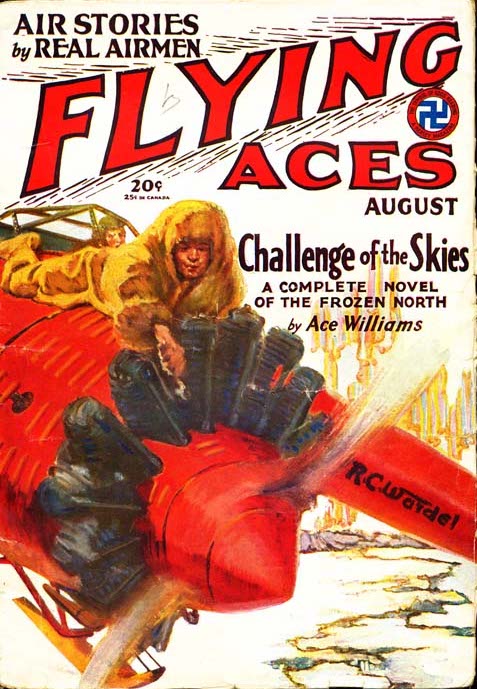
“HAW-W-W-W-W!” That sound can only mean one thing—that Bachelor of Artifice, Knight of Calamity and an alumnus of Doctor Merlin’s Camelot College for Conjurors is back to vex not only the Germans, but the Americans—the Ninth Pursuit Squadron in particular—as well. Yes it’s the marvel from Boonetown, Iowa himself—Lieutenant Phineas Pinkham!

Solemnly The Who’s Who of the Kaiser’s Cabinet gathered together and made a momentous decision. Since Phineas “Carbuncle” Pinkham could not be brought down by force in the air, he must be gotten by tricks on the ground. But we all know tricks were Phineas’ meat––he always had better ones up his sleeve!

From the February 1933 number of Flying Aces! it’s Joe Archibald’s Phineas “Carbuncle” Pinkham in “Sleuthing Syrup!”

Nick Royce in “Showdown In The Sky” by Frederick C. Davis

Link - Posted by David on May 22, 2026 @ 6:00 am in

THIS week we have a short story by renowned pulp author Frederick C. Davis. Davis is probably best remembered for his work on Operator 5 where he penned the first 20 stories, as well as the Moon Man series for Ten Detective Aces and several other continuing series for various Popular Publications. He also wrote a number of aviation stories that appeared in Aces, Wings and Air Stories.

This week’s story features that crack pilot for World News Reel, the greatest gelatine newspaper that ever flashed on a silver screen—Nick Royce! Davis wrote twenty stories with Nick for Wings magazine from 1928-1931.

Tip-Top, the biggest photoplay production corporation in the world, finally makes a choice as to which newsreel service to go with and feature in all their theaters. Will it be the double dealing Compass outfit or the square-shootin’ World News Reel service? It all comes down to a “Showdown in the Sky!” From the August 1928 Wings.

“Get those shots and the reel’s made!” And Nick Royce, World News Reel flyer, hurtles his plane into the clouds to get them. But a man must play the air-game square—even when blazing skies bring strange showdown!

“The Shadow of Death” by Andrew A. Caffrey

Link - Posted by David on May 15, 2026 @ 6:00 am in

THIS week we have another story from Andrew A. Caffrey. Caffrey, who was in the American Air Service in France during The Great War and worked for the air mail service upon his return, was a prolific author of aviation and adventure stories for both the pulps and slicks from the 1920’s through 1950.

Here, Caffrey tells a simple and short tale of a flight leader, low on gas, trying to bring his green recruits, also low on gas, home without running into any enemy planes. From the February 1929 Flying Aces, it’s Andrew A. Caffrey’s “The Shadow of Death!”

Lost in the fog on their first flight over enemy lines, two Yank flyers thought to be unreliable, prove what manner of men they are in the Shadow of Flying Death!

“Sky Room” by Raoul Whitfield

Link - Posted by David on May 8, 2026 @ 6:00 am in

THIS week we have another of Raoul Whitfield’s ‘Buck’ Kent stories from the pages of Air Trails magazine. Whitfield is primarily known for his hardboiled crime fiction published in the pages of Black Mask, but he was equally adept at lighter fair that might run in the pages of Breezy Stories. ‘Buck’ Kent, along with his pal Lou Parrish, is an adventurous pilot for hire. These stories, although more in the juvenile fiction vein, do occasionally feature some elements of his harder prose.

Buck Kent and Lou Parrish arrive at the Crissville Field for an air show only to find another couple of pilots had arrived earlier claiming they were Buck Kent and his pal Lou Parrish! In an effort to get to the bottom of the whole mystery, Buck and his pal say they’re someone else to give the faux Buck and Lou some “Sky Room” in order to see what they’re after. From the September 1929 Air Trails, it’s Raoul Whitfield’s Buck Kent in “Sky Room!”

They crowded “Buck” Kent—and learned what it was to dare the anger of a master pilot!

The reviews are in…

Link - Posted by David on May 1, 2026 @ 6:00 am in

THIS week we have a follow-up to the post about Ralph and the Old Orchard School. As you may recall, in that article they talked about Ralph creating a puppet stage and puppets to mount a production of “Androcles and the Lion.” I’ve just come upon a review of the public performance the children of the school put on. It was a big todo at the school with all the children involved. There was fancy dancing and music and readings and displays of things the kids had made. The featured event of the night were the little plays the children mounted. And the highlight of those was little Ralph’s puppet presentation of “Androcles and the Lion!”

From the page 2 of the February 19th 1916 edition of the Palasdian (Palasade, NJ):

“The Bull Flight” by Joe Archibald

Link - Posted by David on April 24, 2026 @ 6:00 am in

“HAW-W-W-W-W!” That sound can only mean one thing—that Bachelor of Artifice, Knight of Calamity and an alumnus of Doctor Merlin’s Camelot College for Conjurors is back to vex not only the Germans, but the Americans—the Ninth Pursuit Squadron in particular—as well. Yes it’s the marvel from Boonetown, Iowa himself—Lieutenant Phineas Pinkham!

You all know Phineas “Carbuncle” Pinkham—that past master at throwing the bull. But here’s the story of one time when the bull threw Phineas—a bull named Rittmeister von Holstein!

From the January 1933 number of Flying Aces!

“The Sky Salt” by Syl MacDowell

Link - Posted by David on April 17, 2026 @ 6:00 am in

THIS week we have a story by Syl MacDowell! MacDowell was an inveterate traveler—traveling across and all over the country many times—even living for a time in a trailer. Born June 16,1892, in Denver, Colorado, MacDowell found transitory homes on both coasts when not on the road. He worked as a foreign correspondent for the UPI and a free lance writer and rewrite man on various newspapers in New York and on the West Coast. He had a large following as a magazine columnist and general adviser on matters concerning Western travel, traditions, attractions, and opportunities. Somehow he found the time to also write numerous pulp stories. Although he’s best known for his westerns—the Painted Post series is probably his most well known—he was a regular in the pages of Navy Stories, War Birds, Sky Riders, War Aces, The Lone Eagle, Sky Fighters, and Flying Aces from the late twenties through the mid thirties.

This week we have Sly MacDonald’s “The Sky Salt” from the March 1933 Flying Ace!

“Sky skimmers”—that was what 1st Class Gunner Weaver of the U.S. Navy called the seaplanes that patrolled the English Channel. But that was before a certain morning when an old freighter met up with a U-boat in the choppy seas off the coast of France.

“Hard-Boiled Wings” by Raoul Whitfield

Link - Posted by David on April 10, 2026 @ 6:00 am in

THIS week we have a story from Raoul Whitfield. Whitfield was a prolific pulp writer primarily known for his hardboiled crime fiction published in the pages of Black Mask, but he was equally adept at lighter fair that might run in the pages of Breezy Stories. We’ve featured a number of his Buck Kent stories that ran in Air Trails, but this time we have a WWI tale!

“Bing” Burks didn’t give the new recruits sent down to the squadron much of a chance. How good could a kiwi be? But he found out when Lt. Dunning found himself at the squadron and on Bing’s bad side—but Bing found out when it counted, that the Lieutenant also wore “Hard-Boiled Wings!” From the August 1929 number of Over The Top.

It was a case of rough meet tough when “Bing” Burks and the fighting newcomer declared war.

“Hell’s Crate” by Ralph Oppenheim

Link - Posted by David on March 27, 2026 @ 6:00 am in

TO ROUND off Mosquito Month we have a non-Mosquitoes story from the pen of Ralph Oppenheim. In the mid thirties, Oppenheim wrote a half dozen stories for Sky Fighters featuring Lt. “Streak” Davis. Davis—ace and hellion of the 25th United States Pursuit Squadron—was a fighter, and the speed with which he hurled his plane to the attack, straight and true as an arrow, had won him his soubriquet.

The Krupp munitions factory near Metz, some fifty kilos across the lines, has been secretly manufacturing sixteen-inch howitzers. Howitzers of the Skoda, Austrian type—the same type which, early in the war, reduced all those seemingly impregnable forts in Belgium! They were abandoned when the Skoda plant ran out of materials. But now the Krupps have evidently taken over the design. They’ve managed to rush out a whole batch of those guns. And just one shell dropped from a single Skoda is sufficient to smash an entire fort and its complete personnel!

“Those howitzers and the shells for them must be destroyed tonight!”

Streak had hoped he’d get the job in his lightning Spad loaded down with bombs—slip in, drop the bombs, get out. Instead an enormous Handley-Page was brought in to do the job. Seven other members of the Squadron were picked to crew it. But when they failed to return home, Streak sets out to find what went wrong.

From the March 1937 Sky Fighters, it’s Ralph Oppenheim’s “Hell’s Crate.”

Streak Davis Takes Up the Torch of a Grim Sky Crusade Against Von Kobar’s Staffel—While Hun Espionage Institutes a Crafty Plan of Sabotage! A Complete Novel of Sky-High War-Air Action!

Ralph and the Old Orchard School

Link - Posted by David on March 23, 2026 @ 6:00 am in

YOUNG Ralph Oppenhiem was a curious and inventive boy who was educated in various public and private schools. The most unique school he attended was, without a doubt, the Old Orchard School in Leonia, New Jersey.

The Old Orchard School was a day and boarding school for little boys and girls between the ages of four and eight. Run from 1912 to 1925, there were never more than twelve children enrolled at any one time. The children were given every opportunity to develop all their capacities to the fullest extent possible. Special attention was paid to health, music, dancing, handicrafts and the care of pets with regular school work systematically pursued as the child was ready for it.

While at play or in the process of daily living, those habits that are always valuable in life were stressed—concentration, construction, self-reliance, helpfulness, thrift, forming right judgments, organizing a democratic society, and the like were engendered in an atmosphere of a well-organized home, where each child could pursue his own interests, or where all could pull together to achieve some communal task.

The school was run by Anna G. Noyes out of her own home. Anna had been raising and educating her own boy Leonard since birth—what had started out with Anna keeping track of young Leonards health and aspect every minute of every day since birth in an effort raise a healthy boy—the results published in a book, “How I Kept My Baby Well” (Warwick & York, Inc. 1913)—had become something more as Leonard got older and was in need of constructive and systematic training.


HERE HE IS! An article about Leonard, age 2, The Scientifically Raised Child. From the St. Louis Post Dispatch’s Sunday magazine. February 6th, 1910.

She was determined that her son would not be handicapped by the environment of the city so Anna, the boy, and her husband William Noyes, a professor at Columbia University, took up residence in Leonia on the New Jersey side of the Palisades, and continued educating young Leonard in a scientific way.

Since young Leonard is an only child, Mrs. Noyes formed a little school with a few children from the neighborhood, for she says that no child should be brought up alone, as It makes for selfishness.

“I intend,” she said, “to have three other children come and live with me and then get ten more to attend my school in the garden and in this porch room. That will give Leonard the proper association, for no child should be In the continual company exclusively of adults.”

Mrs. Noyes says that it is an era of Individualism, and that it should start at the very beginning of life.

“Public schools keep a child’s mind back to the level of the dullest scholar in the class, and that’s why we left New York, where my boy would have been in a class of forty-six children and in a school where the windows and doors had to be closed in order that the street traffic would not interfere with the teacher hearing their lessons.

“We are only just beginning to understand the necessity of the individually and specially trained child, and until it becomes generally understood and adopted we may continue with the mediocre minded and have the education problems which have been with us in the past.”

During the summer and at gardening time Mrs. Noyes takes the children out of doors and teaches them the values of color and of size through the practical methods of making them pick the peas, beans and other garden truck.

“Children,” she says, “are too soon put In an abstract world, and the only way to make the child mind fully comprehend and grasp things is in the physical way. A child can much sooner know shades of reds through watching cherries or berries grow ripe than through placing before him blocks of various colors. Every act of childhood can be made pleasant and agreeable and at the same time serve a useful, practical purpose.”


THE OLD ORCHARD SCHOOL, 223 Leonia Avenue. From 1912 to 1925, Anna G. Noyes operated an exclusive day school for city children out of her Leonia home, which overlooked the Hillside Avenue brook.

Ralph Oppenheim attended the Old Orchard School as a boy. Living in New York at the time, he boarded at the school from roughly 1914 to 1916 or ‘17. in fact, he’s even mentioned in an article about the school that ran in the Duluth News Tribune in 1916 doing what else—putting on a puppet show!

SCHOOL FOR CHILDREN OF INTEREST TO DULUTH

Mrs. Anna G. Noyes Wife of Local Educator, May Transfer Unique System of Training From New Jersey.
The Duluth News Tribune, Duluth, MN • 17 September 1916 • p.7

Old Orchard school at Leonia N.J. has taken on a peculiar interest for Duluthians for there is a distinct possibility that it will be transferred to this city. The school is a novel one, the direct outcome of some original ideas of the owner. Mrs. Anna G. Noyes, the wife of William Noyes, who is the new director of manual training in the city schools. It was this school that kept Mrs. Noyes from coming to Duluth this year but Mr. Noyes is so enthusiasitic about the wonders of this northwestern city that Mrs. Noyes may come with her school In another year.

Mr. and Mrs. Noyes have a small son, Leonard, whose active mind Mrs. Noyes undertook to train herself. While she was about this absorbing task she thought she might as well Include some active minds of children belonging to other parents and in this way the school has grown until now it has its own specially designed house built to foster the widest range of childhood development.

Mrs. Noyes is well known as an educator and she has followed with enthusiasm Professor Dewey’s famous Idea that a child only learns by doing. The center of the school is a workshop and all the teaching centers around human activity. It is not the Montessori system and it is not a kindergarten. The Montessori method is recognized but there are distinct improvements over that. The children are taught to write by a series of blocks and they learn color design by constructing things with another series of wooden blocks with each side painted a different color. All the children are under 10 years of age. It is both a day and boarding school and the odd part of it is the children all clamor to stay all day though the school hours are only from 9 to 12 in the morning. They are permitted to stay as long as they like. There are two assistants. A teacher of nature study and an artist who attends to color and design work.

Everything that a child wants to investigate is in the house or grounds to use. Mr. Noyes receives letters from his son. aged eight years, and from a three-year old pupil which are written on a typewriter. There is a brook and a playground in the orchard and the boys are busy building every kind of sea craft and have just pulled off a regatta. A pergola was recently completed which was the work of the pupils entirely, from the three-year-old who calls it “the burglar” to Leonard, who drew the plans, the boys who constructed it, painted it and planted the vines.

Mr. Noyes says that the mistake of considering all children alike is a grave one. In this school there are three distinct types that could never be developed without free activity. His own son is mechanical. Anything in the machinery line draws him like a magnet. The small Noris boy from Philadelphia is mathematical and Ralph Oppenheim, the son of James Oppenheim the novelist, is an artist. The Norris boy used to write down the street car numbers all day long and arrange them inter order at night. Now he remembers without writing them down. When Mr. Noyes told him he thought it would be more interesting for him to figure out how long it took a street car to go to the end of the line and back again he said. “O, I figured that out long ago.” He has difficulty in nature study. “If those birds only had numbers I could remember them,” he wails.

Ralph Oppenheim built a little stage two feet long and staged the first and last act of “Androcles and the Lion.” He made the little puppets, painted them vividly, with the Roman emperor in royal purple, and works them, with the aid of Mrs. Noyes.

A pianola is one of the school assets and little tots get up and thump away on Beethoven sonatas. All the best music is in the library, but not long ago some one presented the school with a ragtime roll entitled “Tillie’s Nightmare.” Before the day was over Ralph had organized the school, and ‘’Tillie’s Nightmare” had a realistic performance with Lyman Beecher, grandson of Dr. Henry Ward Beecher, as Tillie. Ralph as the fearful parent and all the other children as spooks.

Each child has his own garden and sandpile. As to discipline the children attend to each other. A child who is selfish or rather, flagrantly so, is exiled until he is willing to play fair.

Every phase of household or play activities are used as the keys that interpret the world to the child. The three “R” are picked up happily and systematically, but the children are not overstimulated to figure abstractly nor to read early. It is an open air school and the schoolroom is open on three sides, heated only on the coldest days by an open air fireplace.

Mr. and Mrs. Noyes, their son and one pupil made a walking trip through the Katskllls in June. It took them two weeks and they often walked 17 miles a day. The youngsters were as fit for the 100 miles or more as the grownups. for their school sports are carefully arranged to give them strength and endurance.


AD FOR THE SCHOOL run in the Hackensack Evening Record November 25th, 1921.

“No-Man’s-Sky” By Ralph Oppenheim

Link - Posted by David on March 20, 2026 @ 6:00 am in

THE greatest fighting war-birds on the Western Front are once again roaring into action. The three Spads flying in a V formation so precise that they seemed as one. On their trim khaki fuselages, were three identical insignias—each a huge, black-painted picture of a grim-looking mosquito. In the cockpits sat the reckless, inseparable trio known as the “Three Mosquitoes.” Captain Kirby, their impetuous young leader, always flying point. On his right, “Shorty” Carn, the mild-eyed, corpulent little Mosquito, who loved his sleep. And on Kirby’s left, completing the V, the eldest and wisest of the trio—long-faced and taciturn Travis.

Were going to get things off the ground with Oppenheim’s very first Three Mosquitoes tale from the pages of War Stories from July 1927! This premier tale finds the inseparable trio separated following a stunting attack on the front line trenches that resulted in Carn and Travis going down behind enemy lines and captured and an humiliated Kirby being sent down to ferrying new ships to their assigned fields. Mindless, boring work for the beaten Ace—his instructions are to avoid all altercations and steer far clear of any action what so ever. Especially since the plane he’s flying and those of the other ferried ships have no guns! But that doesn’t stop Kirby when he sees the Block brothers sniffing around the very secluded forrest the Allies are amassing troops and supplies—he tries to find a way to stop them from getting that information back across the lines without the benefit of guns!

Kirby felt his blood turn to ice, while sheer horror paralyzed him in every muscle. His eyes continued to stare wildly—there, right in front of him it had happened! The Spad of Shorty Carn had vanished—vanished in the same mysterious fashion that had already claimed the lives of those other American flights. Here was a ruthless and bloody mystery which the best minds in the Allied armies were at a loss to fathom, and which those three daredevil mosquitoes set out to combat single-handed!

If you enjoyed these tales of our intrepid trio, check out some of the other stories of The Three Mosquitoes we have posted by clicking the Three Mosquitoes tag or check out one of the four volumes we’ve published on our books page! And come back next Friday or another exciting tale.

“Roof of Treachery” By Ralph Oppenheim

Link - Posted by David on March 13, 2026 @ 6:00 am in

THEIR familiar war cry rings out—”Let’s Go!” The greatest fighting war-birds on the Western Front are once again roaring into action. The three Spads flying in a V formation so precise that they seemed as one. On their trim khaki fuselages, were three identical insignias—each a huge, black-painted picture of a grim-looking mosquito. In the cockpits sat the reckless, inseparable trio known as the “Three Mosquitoes” Captain Kirby, their impetuous young leader, always flying point. On his right, “Shorty” Carn, the mild-eyed, corpulent little Mosquito, who loved his sleep. And on Kirby’s left, completing the V, the eldest and wisest of the trio—long-faced and taciturn Travis.

Were back with the second of three Three Mosquitoes stories we’re presenting this month. This week it’s “Roof of Treachery” from the March 1930 issue of Sky Riders. The city of Remiens could not be taken. It is continuously ranged and shelled and whole battalions of crops are sent in to take it, but they all die in the undertaking. Pilots are sent over during these skirmishes, but they never return. The Brass turn to The Three Mosquitoes to try to find the secret behind Remiens’ invulnerability just hours before a great push is set to take the town. Can they discover it’s deadly secret in time?

Fate had thrust upon Kirby, valiant leader of the famous Three Mosquitoes, a staggering responsibility. One lone Yank among thousands of the enemy, he had been placed suddenly in a position where the whole show depended on him. He alone held the secret of Remiens in his grasp. And yet, here he was with his plane disabled and only twenty minutes to spare!

If you enjoyed this tale of our intrepid trio, check out some of the other stories of The Three Mosquitoes we have posted by clicking the Three Mosquitoes tag or check out one of the four volumes we’ve published on our books page! And come back next Friday or another exciting tale.

“Crashing Through” By Ralph Oppenheim

Link - Posted by David on March 6, 2026 @ 6:00 am in

MARCH is Mosquito Month! We’re celebrating Ralph Oppenheim and his greatest creation—The Three Mosquitoes! We’ll be featuring three action-packed tales of the Mosquitoes over the next few Fridays as well as another Streak Davis story. So, let’s get things rolling, as the Mosquitoes like to say as they get into action—“Let’s Go!”

Their familiar war cry rings out—“Let’s Go!” The greatest fighting war-birds on the Western Front are once again roaring into action. The three Spads flying in a V formation so precise that they seemed as one. On their trim khaki fuselages, were three identical insignias—each a huge, black-painted picture of a grim-looking mosquito. In the cockpits sat the reckless, inseparable trio known as the “Three Mosquitoes.” Captain Kirby, their impetuous young leader, always flying point. On his right, “Shorty” Carn, the mild-eyed, corpulent little Mosquito, who loved his sleep. And on Kirby’s left, completing the V, the eldest and wisest of the trio—long-faced and taciturn Travis.

Were back with the first of three Three Mosquitoes stories we’re presenting to celebrate Ralph Oppenheim’s inseparable Trio this month. To get the ball rolling, it’s “Crashing Through” from the pages of the September 1928 War Birds in which Kirby is tasked with delivering a much needed load of ammunition to a rag tag group of troops valiantly trying hold a ridge until reinforcements arrive!

Their C.O. explains:

    “Of course there is some danger of such a thing. But it’s up to you, Kirby, to drop the stuff from a low enough altitude to make the impact harmless. Yes,” he repeated, grimly, “I admit the whole thing is extremely perilous. I admit that if you run into Jerry planes, there’ll be hell to pay—their incendiary bullets could set that cargo off. But just remember that the dangers you have to face are nothing compared to the dangers which that handful of men down in that trench are facing.
    “Put yourself in their places—stuck in a muddy, filthy ravine, cut off from the rest of our troops, surrounded on all sides by Germans, getting killed off like flies until only two dozen of that whole valiant company remain—perhaps even less now. Yet they refuse to be daunted; they’re clinging stubbornly to the little strip of ground which they were ordered to hold, despite the fact that their ammunition is practically exhausted.
    “They need food, drink, clothing, and yet when, by sheer luck, one of our wireless planes found them and managed to communicate with them, they asked only for ammunition, nothing more. They’ve done more than could be expected of any soldiers, and now it’s up to you fellows to help them through. As I told you, Kirby, I don’t know just how you’ll manage to drop that ammunition to them, but I’m convinced you can do it, provided you other two fellows protect him from above with your scout planes. You must get to them before daybreak. The Germans are sure to spring another attack on them at that time. Without ammunition, they’ll be slaughtered. Even with ammunition,”—he shook his head—“it is hard to believe that they can hold out until our troops break through and save them.”

Kirby, the daring leader of the “Three Mosquitoes,” had been on some strange flights, but this looked almost impossible—and more dangerous than ever. Of course he would have his two flying buddies with him, but carrying ammunition to those surrounded doughboys was no easy job—in a heavy De Haviland plane!

If you enjoyed this tale of our intrepid trio, check out some of the other stories of The Three Mosquitoes we have posted by clicking the Three Mosquitoes tag or check out one of the five volumes we’ve published on our books page! And come back next Friday or another exciting tale.

“Shower Kraut” by Joe Archibald

Link - Posted by David on February 27, 2026 @ 6:00 am in

“HAW-W-W-W-W!” That sound can only mean one thing—that Bachelor of Artifice, Knight of Calamity and an alumnus of Doctor Merlin’s Camelot College for Conjurors is back to vex not only the Germans, but the Americans—the Ninth Pursuit Squadron in particular—as well. Yes it’s the marvel from Boonetown, Iowa himself—Lieutenant Phineas Pinkham!

They’d threatened Phineas Pinkham with Blois before—and he’d lived to laugh at them. But this time the future of the ace of Boonetown, Iowa, was in the hands of a Brigadier who didn’t exactly like being pushed in the face!

“The Death Turn” by E.W. Chess

Link - Posted by David on February 13, 2026 @ 6:00 am in

THIS week we have story of air intrigue by E.W. Chess. Elliot W. Chess was a prominent author in the pulps—his name frequently appearing on the covers to entice readers. His pulp career spanned from 1929 to 1940, but a majority of his output was in the early thirties. Equally adept at both westerns having grown up in El Paso, Texas and air war stories having served in the Royal Flying Corp in the First World War and the 7th Squadron of the Polish Air Force afterward when Russians tried to invade the country.

Fourteen years before, when men fought each other and skies were red with their blood. Allied pilots over a hundred-mile sector of the Front had known von Kruger’s Death Turn—and feared it. Now no one remembered that dread maneuver—until one day a stranger with a deep scar across his face walked up to a little Texas flying field—and gave it a new meaning.

From the pages of he February 1932 number of Sky Birds, it’s “The Death Turn” by E.W. Chess!

Next Page »