“One Blue Flare” by O. B. Myers
When the Blue Flare tore through the skies, no pilot ever failed to answer that signal for help. But sometimes someone answers it who shouldn’t. Then a baited trap is the only answer.
“The Frying Suit” by Joe Archibald
Phineas Pinkham had given Major Rufus Garrity two cigars in a week—and they’d both been good! What was behind this sudden bout of good behavior? Something was very wrong at the drome of the Ninth Pursuit.
“The Flying Fortress” by Arch Whitehouse
A Yank pilot said too much at a Paris estaminet, a British airman said too little on the way to the Front. And a battle that began at twelve thousand feet hurtled to a hangar door. Will this be the end of The Casket Crew?
“Transpacific Plunder” by Frederick C. Painton
Tony Blaine knew it was a bad idea to be in that Manilla bar in the first place—after all his first take-off as chief pilot of the Pacific Cruiser was less than four hours away. And when that girl approached him, deep down in his gut, he knew trouble was also going to be aboard this flight
“Medals for Josephine” by Oscar J. Friend
To the brass hats Josephine was just a bomber in an American squadron cooperating with the R.A.F. in the Burma campaign. But to her crew she was a gallant old girl of the air who had been through many hazardous flying hours with her four boyfriends.
“Hell’s Hangar” by Donald E. Keyhoe
Save for some strange, organ-like trills that had sounded from his radio, Dick Knight’s flight had been uneventful. But Knight did not know that those weird tones he had heard were the ominous notes of an overture to a drama of death. Nor did he know that just five minutes before, a gaunt Prussian, with feverish eyes on a black clock, had whispered: “Five more minutes! Only five more minutes to wait after all these years!â€
“The New Zeppelin” by C.B. Mayshark
On May 6, 1937, the airship Hindenburg caught fire and was destroyed while attempting to dock with its mooring mast at the Lakehurst Naval Air Station. But one year earlier the Hindenburg was preparing to make its first voyage to North America, and “Flying Aces†was heralding its arrival with an article and cover painting in the June 1936 issue by C. B. Mayshark (which would have been on the stands in May).
“The Flying Saucers Are Real” by Donald E. Keyhoe
One of our favorite writers here at Age of Aces is Donald E. Keyhoe, but he is as well known for his UFO research as he is for the air war stories he wrote for the pulps. Here is one of his earliest books on the subject, published in 1950.
Keyhoe is a graduate of the U.S. Naval Academy at Annapolis. He flew in active service with the Marine Corps, managed the tour of the historic plane in which Bennett and Byrd made their North Pole flight, was aide to Charles Lindbergh after the famous Paris flight, and was chief of information for the Aeronautics Branch, Department of Commerce.
 The Harry Ransom Center at The University of Texas at Austin has a collection of The Mike Wallace Interview shows on line including the one he conducted with Major Donald E. Keyhoe in 1958.
The Mike Wallace Interview:
Maj. Donald E. Keyhoe
(March 8, 1958)
“Bomb Voyage” by Joe Archibald
That idea Phineas had for trapping half the German Air Force was good. G.H.Q. liked it. Even Major Rufus Garrity took to it. Oh, yes, there was a catch. Half the German Air Force had to fall for it, too.
“Vultures of the Lost Valley” by Donald E. Keyhoe
In the November 1936 issue of Flying Aces, Donald E. Keyhoe introduced Richard Knight, ace pilot and secret agent of the U.S. government. Along with his dame-chasing assistant Larry Doyle, he confronts evil-doers around  the world, flying his specially equipped (and heavily armed) blue Northrup.
Down upon the flood-lit Washington Airport came a sleek Douglas transport. And from it ran a strangely costumed girl wielding a glittering dagger in spirited attempts to protect herself from the burly men who sought to stop her. Only the lightning decision of a tall, well-built man in a car on the driveway saved her. That man was Richard Knight. And this surprising incident was destined to send him upon the most startling adventure of his career—an adventure which, wholly unknown to him, had begun more than half a century before he was born.
“Hawks From the Smoke” by Arch Whitehouse
In this adventure, two of Arch Whitehouse’s most popular flying duos team up to foil a Japanese invasion of the Phillipines. Tug Hardwick and Beansie Bishop are joined by Coffin Kirk and his simian assistant, Tank.
Peculiar white wisps on the ocean below! What sinister thing did they hide? Tug had to know. But Beansie had no time for that mystery—what with gun-bristling Mitsubishis swarming down the skies to face his twin Brownings. What’s more, he now was encountering a mystery of his own. For a strangely-marked Breda had suddenly dived in among those vengeful “Rising Sun†fighters. And the gunner aboard that Breda was too efficient to be human!
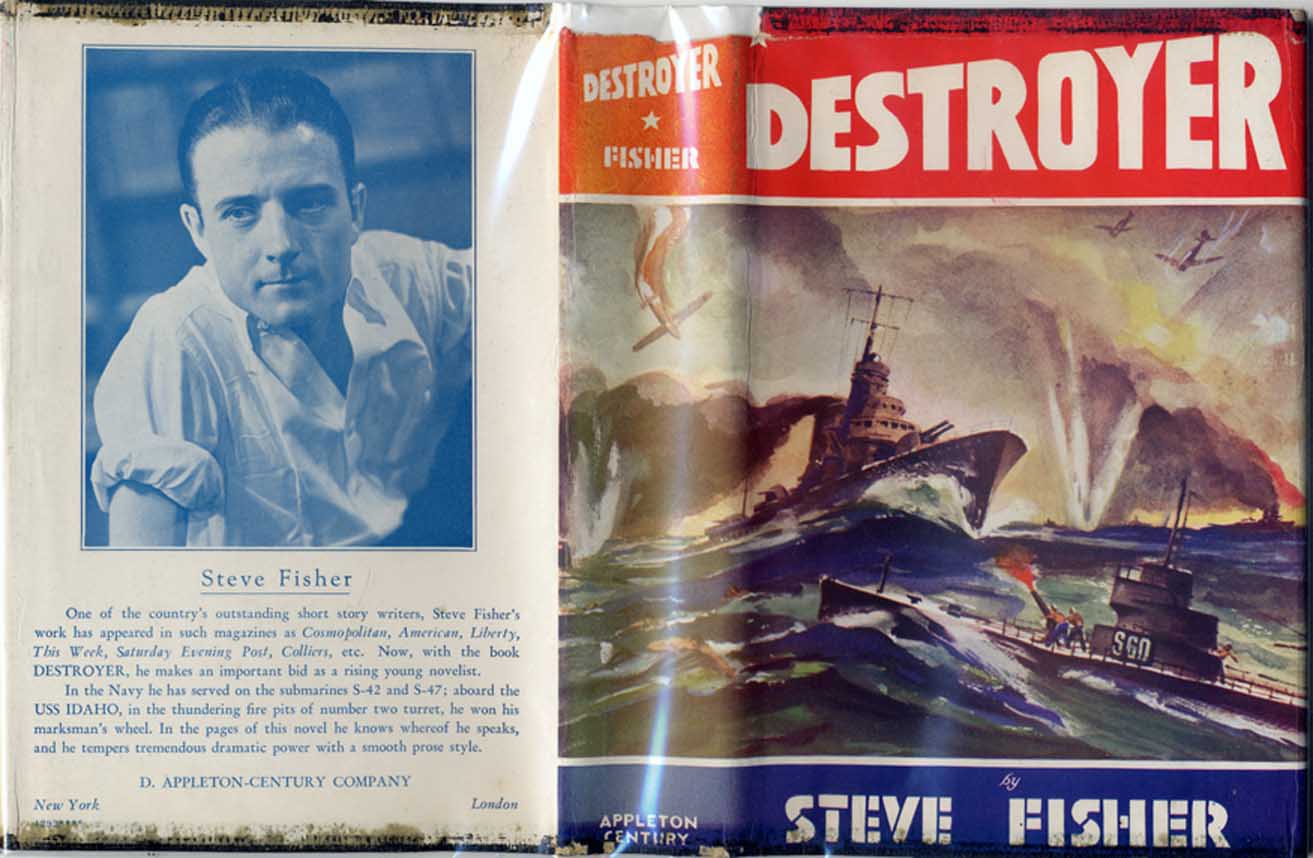
“Destroyer” by Steve Fisher
 Here is the starkly realistic story of an obsolete American submarine in war time—trapped by the thundering herd of depth-charging destroyers overhead. . . . The poignant, profoundly emotional account of men inside the firing pits of a battleship’s 14-inch turret guns—fighting the last desperate fight for Democracy.
It is the love story of a young naval officer, a girl correspondent, and an embittered novelist who has been to all the wars. The story is unfolded during what may be the most important hour in American history.
The United States has declared war on Germany, Italy, and Japan. The invading navies of these countries prepare for an advance on the Panama Canal. A terrific naval battle takes place. The result hangs in balance. And the suspense in this story is tremendous as the action shifts from the high seas where the U.S. Fleet is battling the enemy might—to intrigue-ridden Cristobal, where foreign agents strive to undermine the power of the U.S. in the Canal Zone, and where the unusual love story of the three principal characters reaches a surprise climax.
“Rip-Cord Ruse” by Arch Whitehouse
The Griffon is in the air to solve another high flying mystery. When is a good dollar counterfeit? That was only one of the baffling riddles that faced Kerry Keen after he attended that fashionable night club—by request. Sure, bad money is queer, but some things are a lot queerer—getting offered half a million bucks just for putting on a 200-mile air express act, for instance. Certainly, that was one for the book. And as for the silk-hatted man of mystery who had invaded Graylands—well, that was already in the book!
“The Squadron in Scarlet” by Donald E. Keyhoe
Here is another high flying adventure of “Cyclone” Bill Garrity and The Devildog Squadron. For months the grim spectre of that German staffel had stalked up and down the Front, dropping its sinister messages of death upon British and French squadrons. And now at last it struck at the flying Marines. For out of the cloud mists over that Devildog drome a white-winged German plane swooped low, and from it came the threat of doom—a black coffin holding the body of a Devildog pilot.
“The Varnishing Americans” by Joe Archibald
If you thought Elmer Hubbard and Pokey Cook were a couple of wild Indians before, just wait until you see them with their war paint and feathers on! Even C.O. Mulligan had to listen to their war whoops with a smile.