WE’RE celebrating the holidays with Harold F. Cruickshank—creator of those great Aces of the Western Front’s Hell Skies—Red Eagle, Sky Wolf, and Sky Devil. But this holiday season it’s going to be a down home Christmas featuring Cruickshank’s Pioneer Folk stories from the pages of Range Riders Western (1945-1952) on Mondays and Fridays; and Cruickshank’s own recollections of homesteading life from The Edmonton Journal’s The Third Column on Wednesdays.
The Edmonton Journal regularly set aside the third column on its editorial page for submissions from freelance writers, of which Cruickshank was an occasional contributor over the years. His columns frequently focused on his life growing up as a homesteader with his father and brother who had all immigrated from Scotland in 1905 to Barrhead, Canada along the famed Klondike Trail, just to the northwest of Fort Edmonton.
It’s Wednesday, so here’s another of Cruickshank’s Third Columns—this time Cruickshank tells of his first Christmas homesteading.
The Third Column
by Harold F. Cruickshank • Edmonton Journal, Edmonton, Canada • Tuesday, 23 December 1952
Homestead Christmas
MY FIRST Christmas Day in the bush country was intensely cold. But let me begin with Christmas Eve. I had been at the home of our nearest neighbors for a week, doing chores during the absence of the men of the family in Edmonton. My father had joined the party. In fact it a was our team of horses which made that trip, then a long, cold one over inadequate trails—our team, and the neighbors’ sleigh.
I cut firewood, fed and watered the stock. These duties today might sound light, but then, they involved much effort. I had to cut a fresh hole in heavy creek ice each morning, for water for the stock. When the creek suddenly went dry, we had to melt snow for ail the stock, as the supply in the well was only sufficient for household requirements.
* * *
It was a time of homesickness for me; so far away from home, this first Christmas season in the wilds.
In the crisp, early dusk of Christmas Eve, as the skies were changing from their sharp claret, or plum shades to that steel-grayish purple which in winter precedes the cold, metallic blue of night. I had a scarcely finished my evening chores when I heard the musical jangle of sleigh bells and the screech and grind of sleigh runners.
The folk were indeed on schedule, and how I thrilled to it!
After taking over the team for stabling and care, I joined the happy group in the shack, where many gifts were being passed round.
As a boy of only thirteen, I could have been excused a bit of covetousness as I saw those gifts being handed out, with none for me. At last, though, one of the party, a man I had never previously met, a contractor in town who had just come out to be with his wife and daughter, took from his pocket an old dollar watch and gave it to me.
I was speechless. This was my very first watch and my only present on my first wilderness Christmas away from home. How I treasured that worn old timepiece!
Supper over, we were asked to sing some Christmas songs and hymns, and were invited to join our neighbors for Christmas dinner the following day.
Then came the time to hitch up and move back to our own shack.
Never did I see a more uninviting place—a colder shack! I can still remember the sight of its two small south windows, leering at the bush from either side of the wretched door.
A day or so later, I brought in a huge sack of Christmas mail for all the neighbors. and was severely kicked and cut up by the wild bronc I rode.
Out of the batch of mail there was one piece for me—a large and beautiful Christmas card from my mother overseas.
* * *
I was too busy for a time to pay much attention to this card, as I nursed my leg injury, and life indeed seemed very dreary as winter intensified.
Now and then, though, the sun would burst forth for a moment or so, and here and there on hillsides or in valleys one saw many beautiful Christmas cards—patches of sheer beauty: tinseled clumps of handsome birches, flanked by red willows, and backed by the inevitable and grandiose spruce belts. It was a glittering panorama, whose stage appearance was often all too brief.
Still, I treasured that lone Christmas card. A few years later, when the good news came that my mother and the other members of our large family were coming to join us, I hit upon a plan to use the lovely card as a greeting token. I went into a stand of fine, small, silvery dry spruce and selected four slender sticks for legs for a stand for the card. To the four which I had cut to size, or so I thought, I nailed the end of a dried-apple box, but to this, my first creation, my first attempt at carpentry, wobbled. I began to cut this leg and that until my original stand of about three feet in height, measured only about sixteen inches. I decided to call a halt, placing a chip under the too-short leg.
I cannot recall that my mother even noticed the effort on her arrival, but it was an expression of the Christmas spirit . . . a very sorry job indeed, but well intended.
Today in the clamor and glamor of the Christmas season, I often think that somewhere along the way we have slipped away from this spirit which first motivated the celebration and observance of Christmas.
We must, of course, move on with the times and the trends, but still I feel that it might not hurt us if now and then we could return to the humbleness and humility of such a Christmas as I have illustrated above—in thought, at least—for, after all, the very first Christmas was born in humility and humbleness.




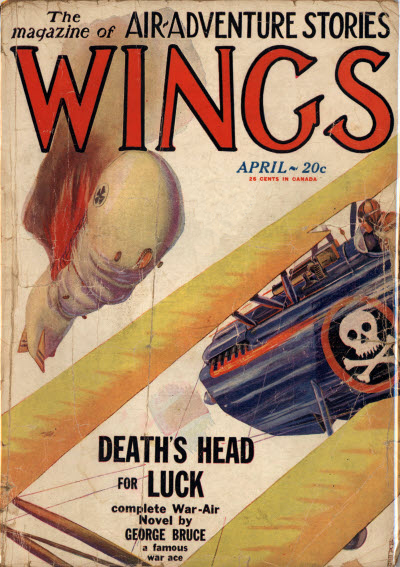 a short story by renowned pulp author Frederick C. Davis. Davis is probably best remembered for his work on Operator 5 where he penned the first 20 stories, as well as the Moon Man series for Ten Detective Aces and several other continuing series for various Popular Publications. He also wrote a number of aviation stories that appeared in Aces, Wings and Air Stories.
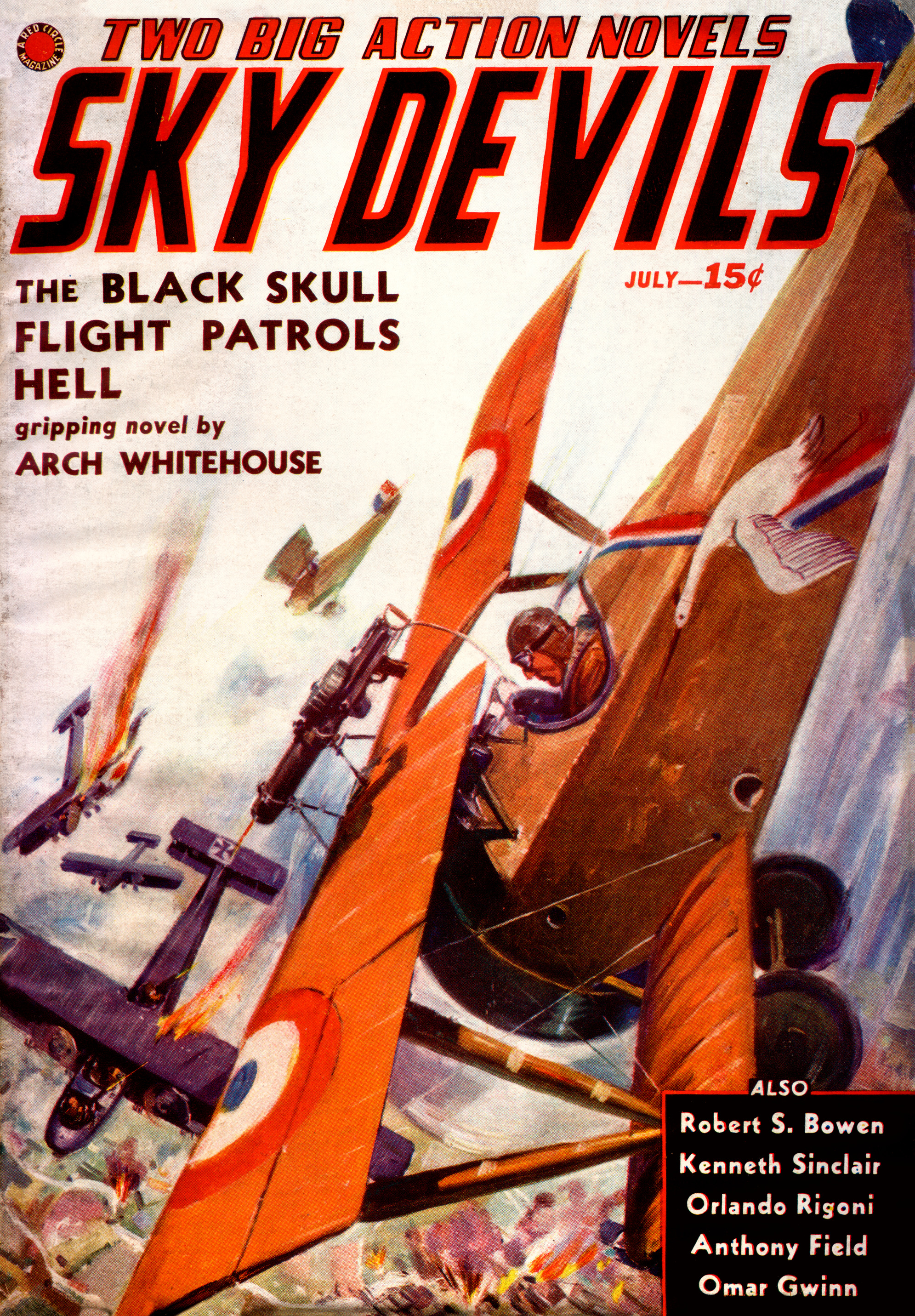 a story from the short-lived Sky Devils magazine by Anthony Field. Anthony Field was a pseudonym used by Anatole Feldman who specialized in gangland fiction—appearing primarily in Harold Hersey’s gang pulps, Gangster Stories, Racketeer Stories, and Gangland Stories. His best-known creation is Chicago gangster Big Nose Serrano. But he also wrote a number of aviation stories including four stories for Sky Devils featuring Quinn’s Black Sheep Squadron—this is the second of those four stories!
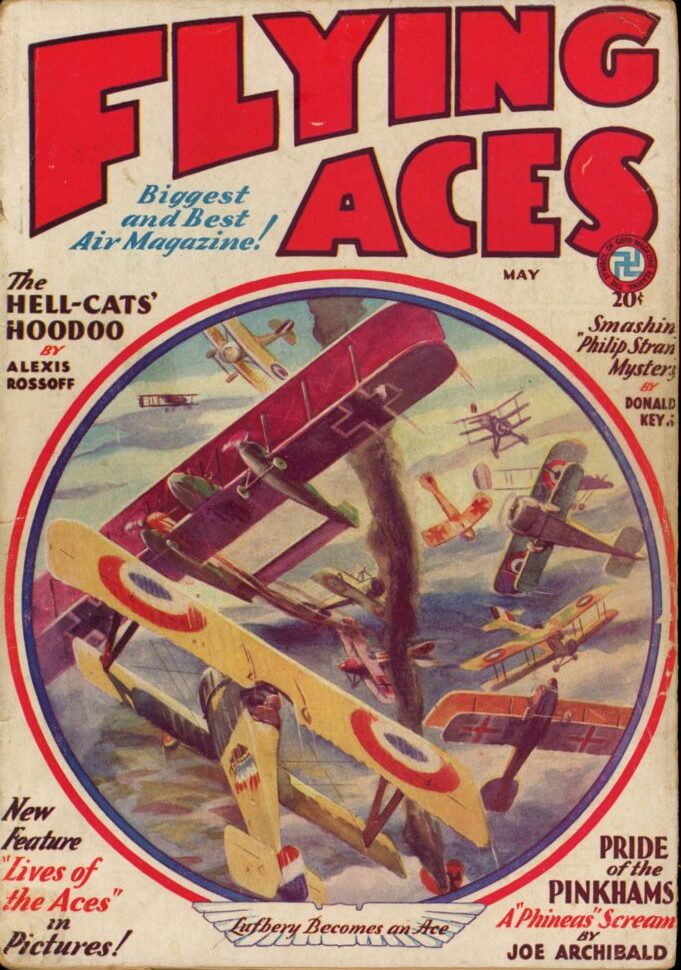 That sound can only mean one thing—that Bachelor of Artifice, Knight of Calamity and an alumnus of Doctor Merlin’s Camelot College for Conjurors is back to vex not only the Germans, but the Americans—the Ninth Pursuit Squadron in particular—as well. Yes it’s the marvel from Boonetown, Iowa himself—Lieutenant Phineas Pinkham!
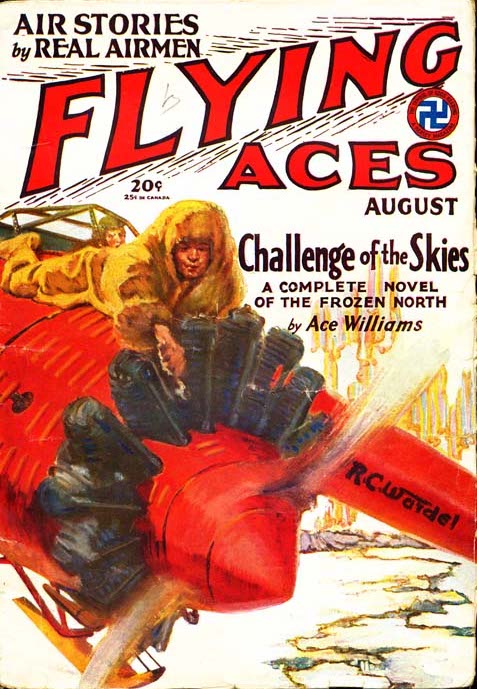 a story by J.D. Rogers, Jr. Rogers is credited with roughly fourteen tales from the pages of Flying Aces, Sky Birds and Sky Aces. “The Yellow Ace” from the August 1929 Flying Aces was his first published tale. In it James Lawrence arrives on the tarmac of the 23rd Squadron R.F.C. with his newly designed fighter plane. In the make-up of this plane was the knowledge and experience of a young man who had played and worked in his father’s aeroplane factory since age permitted. Prompted by zealous patriotic duty he had built this super fighter for his country, a country which the warring nations had far surpassed in the art of building aircraft. Refused a fair demonstration of his plane by a very inexperienced air board, the youth, with his flame of patriotism quenched, turned from his own country to England whose air board was frantic for a plane fast enough and maneuverable enough to successfully combat the German demons who had held the air supremacy through the war.

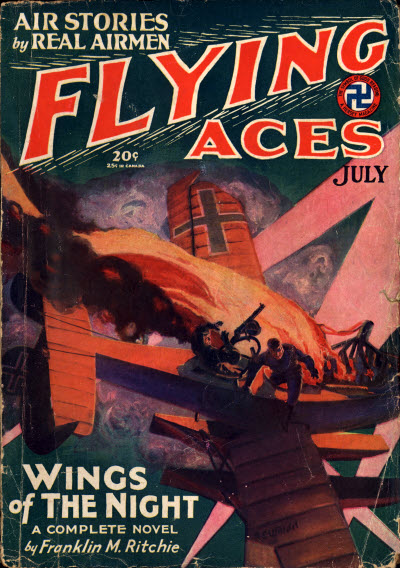 another story by Alfred Hall Stark. Stark wrote a dozen or so stories for the pulps, frequently dealing with aviation, in the late twenties and early thirties before building a reputation for writing well-researched, fact-based articles for The Reader’s Digest, Popular Science, Saturday Evening Post and others.
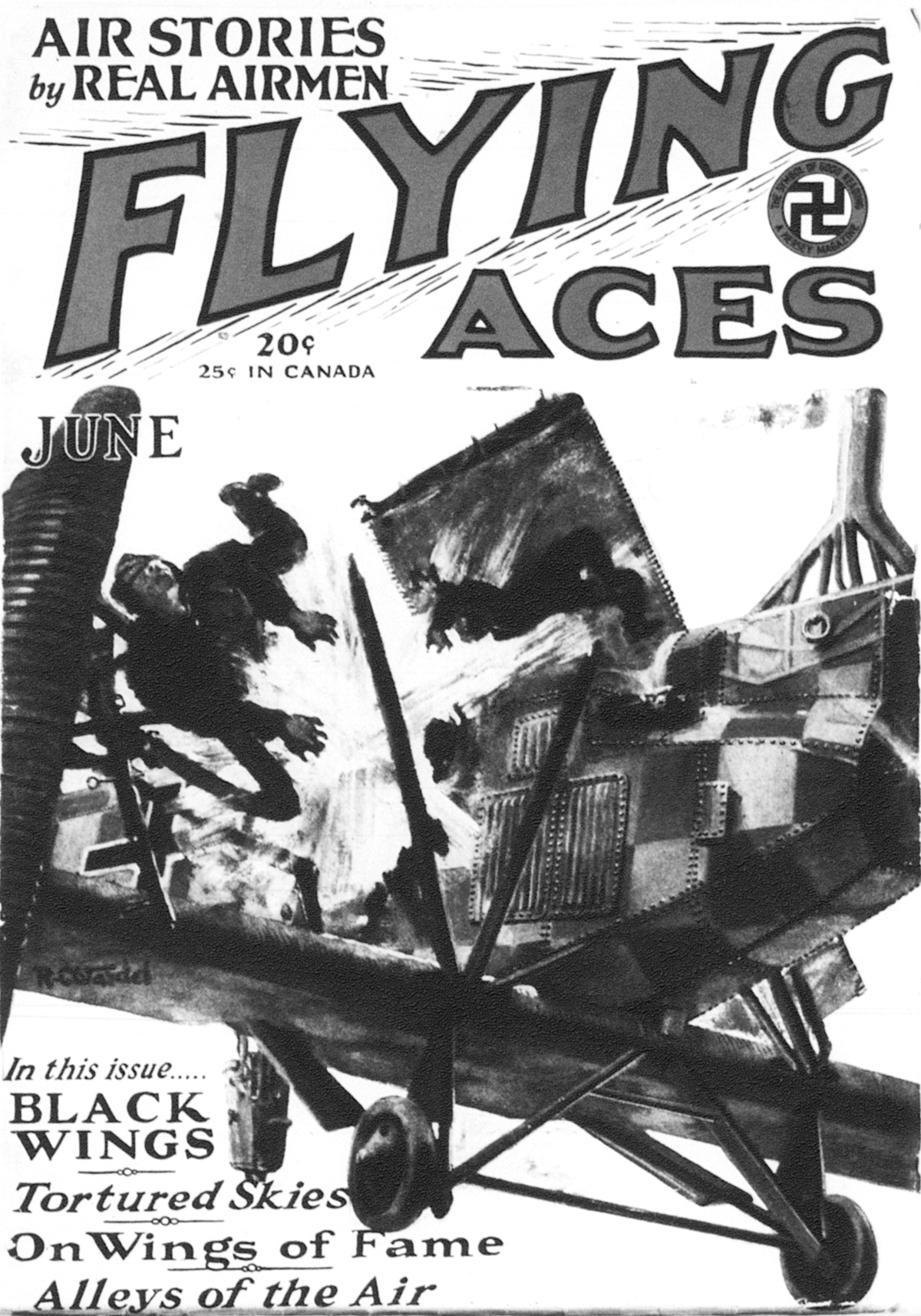 a story by Alfred Hall Stark. Stark wrote a dozen or so stories for the pulps, frequently dealing with aviation, in the late twenties and early thirties. Stark was a pseudonym for Afred Halle Sinks. Sinks was a native of Ohio, who won his reportorial spurs in New York before heading to Porto Rico to work on the Porto Rico Progress published in San Juan. When sinks returned to the US, he was a staff writer for Popular Science and The Reader’s Digest building a reputation for writing well-researched, fact-based articles for those publications as well as others and newspapers.
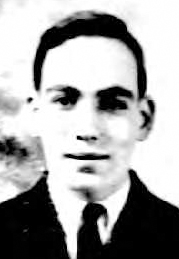 In a brief biographical paragraph from an article in 1963, Alfred Halle Sinks was said to be living in Philadelphia and responsible for the public information program that launched Bucks County’s open space conservation program. By that time he had been editor of the Bucks County Traveler, as well as a staff writer for Popular Science and Reader’s Digest, and had contributed articles to the Saturday Evening Post, Collier’s, Ladies Home Journal, and other leading national magazines.
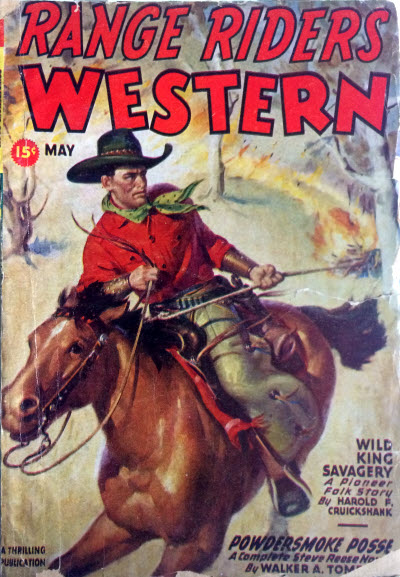 the trials and tribulations of Dal and Mary Baldwin as they carved out their piece of the Wilderness in Sun Bear Valley, Wyoming and establish a growing community. King, the great stallion Dal had fist glimpsed when he arrived in Sun Bear Valley, has returned and Dal is determined to try and breed one of his mares with the great one, but an unsavory outsider has arrived in the valley to cause trouble and sets his sights on Nan.
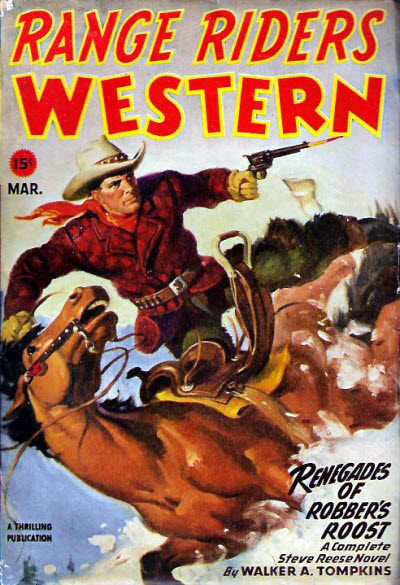 the trials and tribulations of Dal and Mary Baldwin as they carved out their piece of the Wilderness in Sun Bear Valley, Wyoming and establish a growing community. Doc gets injured as the Sun Bear Valley men work to build a cozy cabin for Phil and school-marm Nan to move into when they finally tie the knot, but Bart Manning, one of the Boxed D wranglers, has eyes for Nan and sets about to cause deadly mischief.
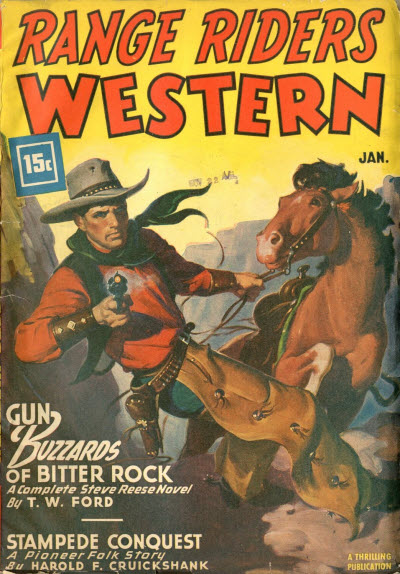 the trials and tribulations of Dal and Mary Baldwin as they carved out their piece of the Wilderness in Sun Bear Valley, Wyoming and establish a growing community. Rankin and the Box D crew try to jump the Sun Bear Valley settler’s claim on the neighboring valley by moving their cattle in to graze. The Sun Bear Valley crew try to solve their problem without any violence by bringing their sheep into the valley.
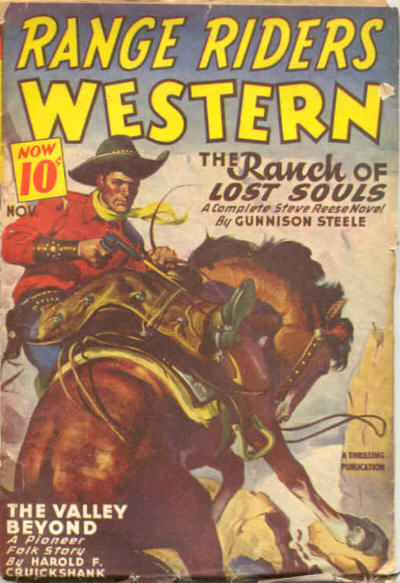 the trials and tribulations of Dal and Mary Baldwin as they carved out their piece of the Wilderness in Sun Bear Valley, Wyoming and establish a growing community. The Morrison’s young friend Phil Cody arrives with a view to squatting at the new valley Dal had discovered westward through the pass while Quirt Malotte’s brother arrive with two fellow horse thieving owlhoots to get even with Dal once and for all.