Looking to buy? See our books on amazon.com Get Reading Now! Age of Aces Presents - free pulp PDFs

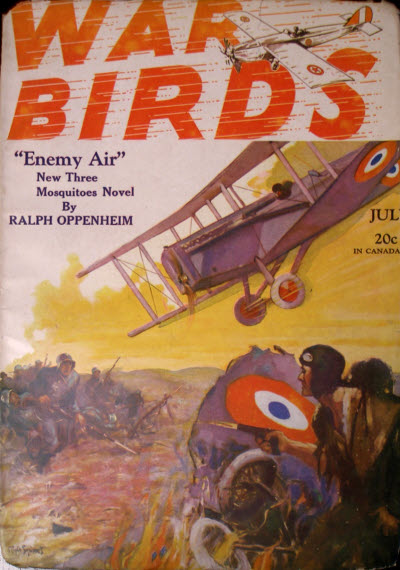
“Enemy Air” by Ralph Oppenheim

Link - Posted by David on March 18, 2016 @ 6:00 am in

THROUGH the dark night sky, streaking swiftly with their Hisso engines thundering, is the greatest trio of aces on the Western Front—the famous and inseparable “Three Mosquitoes,” the mightiest flying combination that had ever blazed its way through overwhelming odds and laughed to tell of it! Flying in a V formation—at point was Captain Kirby, impetuous young leader of the great trio; on his right was little Lieutenant “Shorty” Carn, the mild-eyed, corpulent little Mosquito and lanky Lieutenant Travis, eldest and wisest of the Mosquitoes on his left!

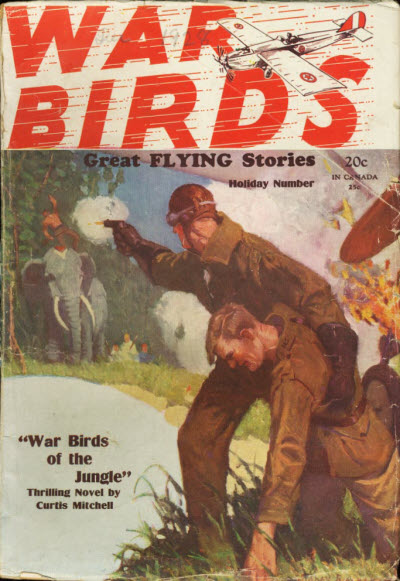
We’re back with the third and final of three Ralph Oppenheim’s Three Mosquitoes stories we’re featuring this march for Mosquito Month! And this one’s a doozy! Kirby and the boys stumble upon a German spy ring and find themselves in one of their most dangerous missions yet that takes them all the way to a face to face meeting with Kaiser Wilhelm himself! You don’t want to miss it—it’s a true group effort as Travis gets to shine in this tale from the pages of the July 1929 issue of War Birds—when the boys find themselves in”Enemy Air!”

Espionage! That sinister, silent net of war that caught men ruthlessly in its grip and crushed them. Now, in the innocent shape of a Fokker, it challenged insolently to those three sky warriors—the Three Mosquitoes. A story with a most thrilling and startling climax.

“Lives of the Aces in Pictures – Part 10: Captain Ball, British V.C.” by Eugene Frandzen

Link - Posted by David on March 16, 2016 @ 6:00 am in

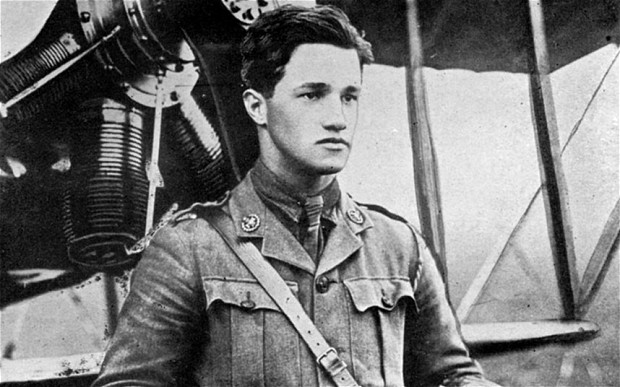
Starting in the May 1932 issue of Flying Aces and running almost 4 years, Eugene Frandzen’s “Lives of the Aces in Pictures” was a staple of the magazine. Each month Frandzen would feature a different Ace that rose to fame during the Great War. This time around we have English Ace—Captain Albert Ball!

Captain Albert Ball was the first of the Royal Flying Corps pilots to make a distinguished record. Unlike the French, the British made no mention of their air pilot’s victories. One day Ball wrote home that he had just counted his 22nd victory. His mother proudly showed this letter to her friends. Ball was disbelieved.

It was beyond belief at that time that any single pilot could have shot down so many enemy planes. Ball was finally vindicated. From that time on the British publicized the exploits of flying aces. Ball shot down 43 enemy planes and one balloon, being at the time of his death the Ace of Aces of all the armies.

He received every decoration the British Army could give him, including the Victoria Cross. He was killed in a new British triplane by the younger von Richthofen the day after America entered the War.

(Editor’s Note: These early installments of Frandzen’s “Lives of the Aces in Pictures” that were published in the pulp-sized issues have been reformatted from a two page spread into a one page feature.)

“Mosquito Luck” by Ralph Oppenheim

Link - Posted by David on March 11, 2016 @ 6:00 am in

“LET’S GO!” Once more, The Three Mosquitoes familiar battle cry rings out over the western front and the three khaki Spads take to the air, each sporting the famous Mosquito insignia. In the cockpits sat three warriors who were known wherever men flew as the greatest and most hell raising trio of aces ever to blaze their way through overwhelming odds—always in front was Kirby, their impetuous young leader. Flanking him on either side were the mild-eyed and corpulent Shorty Carn, and lanky Travis, the eldest and wisest Mosquito.

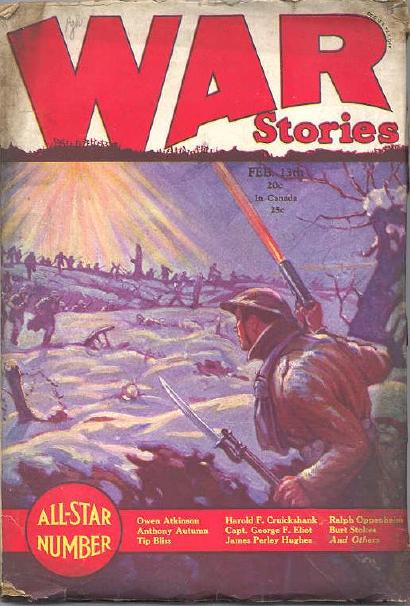
We’re back with the second of three tales of Ralph Oppenheim’s Three Mosquitoes we’re featuring this march for Mosquito Month! This week, the germans are advancing troops to the front on road 12, but all reconnaissance flights report no activity on road 12! So it’s up to the inseparable trio to unravel the mystery of road 12—all they need is a little “Mosquito Luck!” From the February 13th, 1930 issue of War Stories—

Hordes of gray-green troops were being moved up to the Front in broad daylight, yet Allied intelligence had failed to find out how. That was the baffling mystery the colonel set before the “Three Mosquitoes.” And Kirby answered the challenge with their famous war whoop: “Let’s go!”

And check back next Friday when the inseparable trio will be back with another exciting adventure!

“Sky Fighters, June 1934″ by Eugene M. Frandzen

Link - Posted by David on March 7, 2016 @ 6:00 am in

Eugene M. Frandzen painted the covers of Sky Fighters from its first issue in 1932 until he moved on from the pulps in 1939. At this point in the run, the covers were about the planes featured on the cover more than the story depicted. On the May 1934 cover, Frandzen featured the German Junkers and D.H.4!

ON THE cover this month th_SF_3405you will find the German Junkers biplane and the American Liberty-motored D.H.4. The D.H.4 was our one and only contribution to the front. That plane took nearly a year to produce.

It was designed after the famous British D.H., which earlier in the war; could stand up to any of the enemy planes. But the war moved fast. The Germans and the Allies changed and improved their planes so often that it was hard for this country to keep up with the advancement made on the other side of the pond.

A Difficult Task

We sent over commissions to nose around and pick out a few types of planes which could be put into mass production in this country, built around the bulky twelve-cylinder Liberty motor.

It took the boys on the commission several weeks to make up their minds as to which of the Allies* planes could be copied and be satisfactory. When they finally got back to Washington and got the designers busy it took three weeks of night and day work for them to complete their work.

They Were Obsolete

Just as the duplicate sets of plana were ready to go to the manufacturers word came from abroad that the planes the Americans planned to build were obsolete. Another commission hopped the ferry for Europe and went through the same stunt.

Again the designs were drawn; again they were pitched over because they were out-dated. Finally, after nearly a year of discouraging experimenting and disappointments the cumbersome American D. H. 4 started to roll off on the production line in an endless stream. In the first quarter of 1918 the first shipments were delivered to the Yanks at the front. They took ‘em, gritted their teeth and did what they could with a type of ship which the British had abandoned as obsolete some months before.

There were 23,000 screws holding that old D.H. crate of ours together, also 600 separate pieces of wood in a single wing; possibly that’s one of the reasons that delayed the boys back home from delivering the planes before they were listed in the antique class.

Well, the pilot and observer in the D.H. on the cover got a break when they got in a scrap with the German Junkers biplane. It was also a crate of earlier vintage, but a good one. The Junkers outfit was associated with the Fokker Company. This thick-winged job shows the Fokker influence.

The Fight Is On!

Returning from a reconnaissance expedition the D.H. ran across the Junkers. Both pilots decided that he could outsmart the other; the fight was on. The planes, evenly matched, tore in at each other like a couple of hungry wolves, ripped bullets through each other’s wings and squared off for another round. Again and again they tangled.

The D.H. was getting the worst of it. Suddenly a Fokker D.7 comes in from the distance. The Yank gunner spots it, points it out to his pilot. But a passing Frenchman in a Spad sees the set up and kicks his fleet plane into the show. He is in a position to pop the Fokker down. The Junkers zooms up under the D.H.’s tail.

It Looks Like Curtains

It looks like curtains for the Americans. The Yank pilot flips his tail down. The German tries to miss a collision. He succeeds, but the tip of his propeller blade grazes the aft part of the D.H.’s fuselage; just barely touches it, but that is all that is necessary.

Bingo, his prop flies to pieces. He is gone, through, licked. And the D.H., with its 23,000 screws, shakes its ruffled tail feathers and sails proudly for home—victorious.

The Ships on The Cover
Sky Fighters, ,June 1934 by Eugene M. Frandzen
(The Ships on The Cover Page)

“The Phantom Zeppelin” by Ralph Oppenheim

Link - Posted by David on March 4, 2016 @ 6:00 am in

MARCH is Mosquito Month! We’re celebrating Ralph Oppenheim and his greatest creation—The Three Mosquitoes! We’ll be featuring three early tales of the Mosquitoes over the next few Fridays as well as looking at Mr. Oppenheim’s pre-pulp writings. So, let’s get things rolling, as the Mosquitoes like to say as they get into action—“Let’s Go!”

The greatest fighting war-birds on the Western Front are once again roaring into action. The three Spads flying in a V formation so precise that they seemed as one. On their trim khaki fuselages, were three identical insignias—each a huge, black-painted picture of a grim-looking mosquito. In the cockpits sat the reckless, inseparable trio known as the “Three Mosquitoes.” Captain Kirby, their impetuous young leader, always flying point. On his right, “Shorty” Carn, the mild-eyed, corpulent little Mosquito, who loved his sleep. And on Kirby’s left, completing the V, the eldest and wisest of the trio—long-faced and taciturn Travis.

Let’s get things rolling with a tale from the pages of the December 24th, 1928 issue of War Birds.
London is being mercilessly bombed night after night by some unseen craft. The Three Mosquitoes are called in to find out what is bombing London and how they have managed to do this without being seen. It’s a puzzling mystery that Kirby manages to unravel when he finds unwittingly finds himself a stowaway on “The Phantom Zeppelin.”

London was being mysteriously bombed by this “Phantom.” Forty miles within the German lines winged the famous Kirby. He was on the trail of the invisible raider.

And check back next Friday when the inseparable trio will be back with another exciting adventure!

“Lives of the Aces in Pictures – Part 9: David Putnam” by Eugene Frandzen

Link - Posted by David on March 2, 2016 @ 6:00 am in

Starting in the May 1932 issue of Flying Aces and running almost 4 years, Eugene Frandzen’s “Lives of the Aces in Pictures” was a staple of the magazine. Each month Frandzen would feature a different Ace that rose to fame during the Great War. This time around we have American Ace—Lt. David Putnam!

David Endicott Putnam, a descendant of Revolutionary War General Israel Putnam, was a Harvard student before running off to join the French Foreign Legion in may 1917. From there he transferred to the air service. Putnam has thirteen confirmed victories, but his unconfirmed totals could range as high as twenty-six or thirty—he’s known for shooting down five planes in one day (although only three were confirmed).

Putnam was awarded the Croix de Guerre, with palms and stars, The Medaille militaire, the Cross of the Legion of Honor, the American Areo Club Medal and the Distinguished Service Cross—the last posthumously. Putnam was shot down in September 1918 by German Ace Georg von Hantelmann and laid to rest in Toul beside Luftbury, Blair and Thaw.

(Editor’s Note: These early installments of Frandzen’s “Lives of the Aces in Pictures” that were published in the pulp-sized issues have been reformatted from a two page spread into a one page feature.)

“Cinema Bums” by Joe Archibald

Link - Posted by David on February 26, 2016 @ 6:00 am in

“Haw-w-w-w-w!” You heard right! That marvel from Boonetown, Iowa is back with a tale of starry-eyed colonels with visions of Hollywood and hidden german gun placements. Can that Knight of Calamity manage to find the Boche’s long-range guns while placating a colonel who thinks he’s the next Cecil B. DeMille all while avoiding landing in a dank cell in Blois? Find out in “Cinema Bums” from the pages of the May 1935 Flying Aces.

Can a Pinkham reform? A certain high and mighty Wing colonel thought so. But the Ninth shook in its shoes. For the Boonetown wonder’s eyes were entirely too friendly when they rested on the colonel—friendly like the eyes of a surgeon when he hovers over a guinea pig with a meat axe in his hand.

My Most Thrilling Sky Fight: Lieutenant Roland Garros

Link - Posted by David on February 24, 2016 @ 6:00 am in

Amidst all the great pulp thrills and features in Sky Fighters, they ran a true story feature collected by Ace Williams wherein famous War Aces would tell actual true accounts of thrilling moments in their fighting lives! This time it’s France’s Lieutenant Roland Garros’ Most Thrilling Sky Fight!

Roland Garros was one of the world’s foremost airmen before the World War began. When the French army was mobilized, Garros joined his squadron, the Morane-Saulnier 23, just as it was leaving for the front. He built up a wonderful record for himself in respect to scouting.
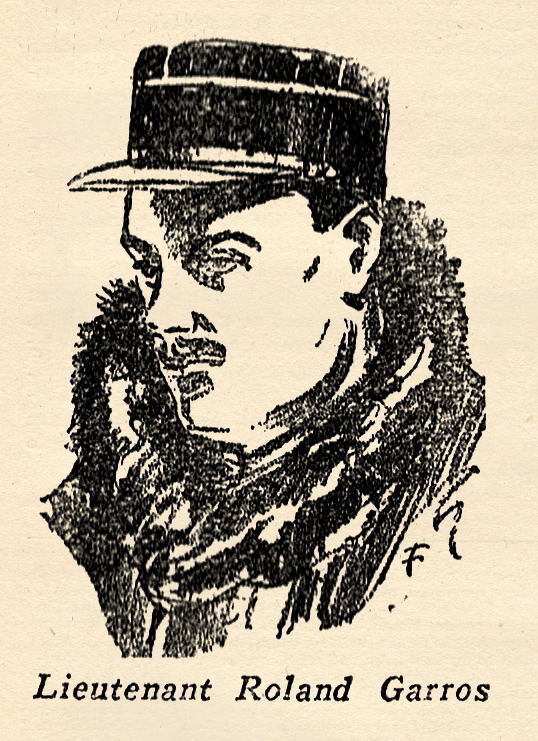
Garros was an inventor as well as an aviator, and from the beginning of the war he set about improving the airplane as a fighting machine. On February 5th, 1915, he mounted a machine-gun on his airplane in such a manner that it fired through the whirring blades of the propeller, and thus changed the whole course of aerial warfare. His gun was not arranged to fire in synchronism with the propeller, so to save it from being shot through with holes, he armored it with steel tips. The bullets hitting it would thus be deflected harmlessly.

Improvements came later, but Garros, with his crude invention, shot down the first enemy airplane to be winged from the air. And from February 5th to April 19th, 1915, he succeeded in shooting down four others, becoming the first flying Ace.

The Germans learned his secret and equipped their planes in the same manner as his.

The account below is taken from an interview he gave the day after he shot down his first victim.


WINGS OF DEATH

by Lieutenant Roland Garros • Sky Fighters, March 1934

NATURALLY, the question in my mind was whether it would work in the air or not. I had tried it on the ground, and the gun functioned perfectly. I was able to hit a small target at a range of 100 meters. That success made me anxious to take off immediately. But mon commandant, Capitaine de Beauchamp, restrained me until the next morning.

Then he patted me on the shoulder and smiled: “Come back, mon enfant and tell the rest of us how it worked.” I waved and shot down the field, taking off lightly as a feather, despite the added weight of machine-gun and ammunition.

I flew towards Germany, until I came to a German drome. Three ships were on the ground getting ready to take off. I slanted off when I saw them, knowing that they saw me. too. But I wanted them to come up and fly after me.

I would let them chase me until they got close, then I would turn suddenly and fire on the leader.

I knew I could duck their bombs and rifle fire, then would come the surprise. All three Taubes came up and started in my direction. I slowed down. They circled trying to herd me back towards my own trenches. I let them get closer. The leading Taube was less than a hundred meters behind. “Now is the time!” I said, and threw my little ship around swiftly. The German darted past. I had banked so swiftly he couldn’t follow. I banked again, lowered my nose, until it sighted right on the German pilot’s back. I pressed the gun trigger.

Clackety-clack—clack-clack!

The gun stuttered, shook. The bullets spewed out. Linen stripped from the Taube, blasting back in the wind stream. I moved my controls slightly, pulled the trigger again. The pilot wilted. The Taube went up on one wing, began slipping sideways. Then it nose-dived and plunged into the ground.

I wheeled then to attack the others. But one had been forced down with motor trouble. The other was running away towards his own drome. I chased him clear to the ground, and fired my last rounds as it landed. I had no more bullets, so rushed home to make my report to Captain de Beauchamp. I was breathless! My invention had worked in the air!


“Sky Fighters, May 1934″ by Eugene M. Frandzen

Link - Posted by David on February 22, 2016 @ 6:00 am in

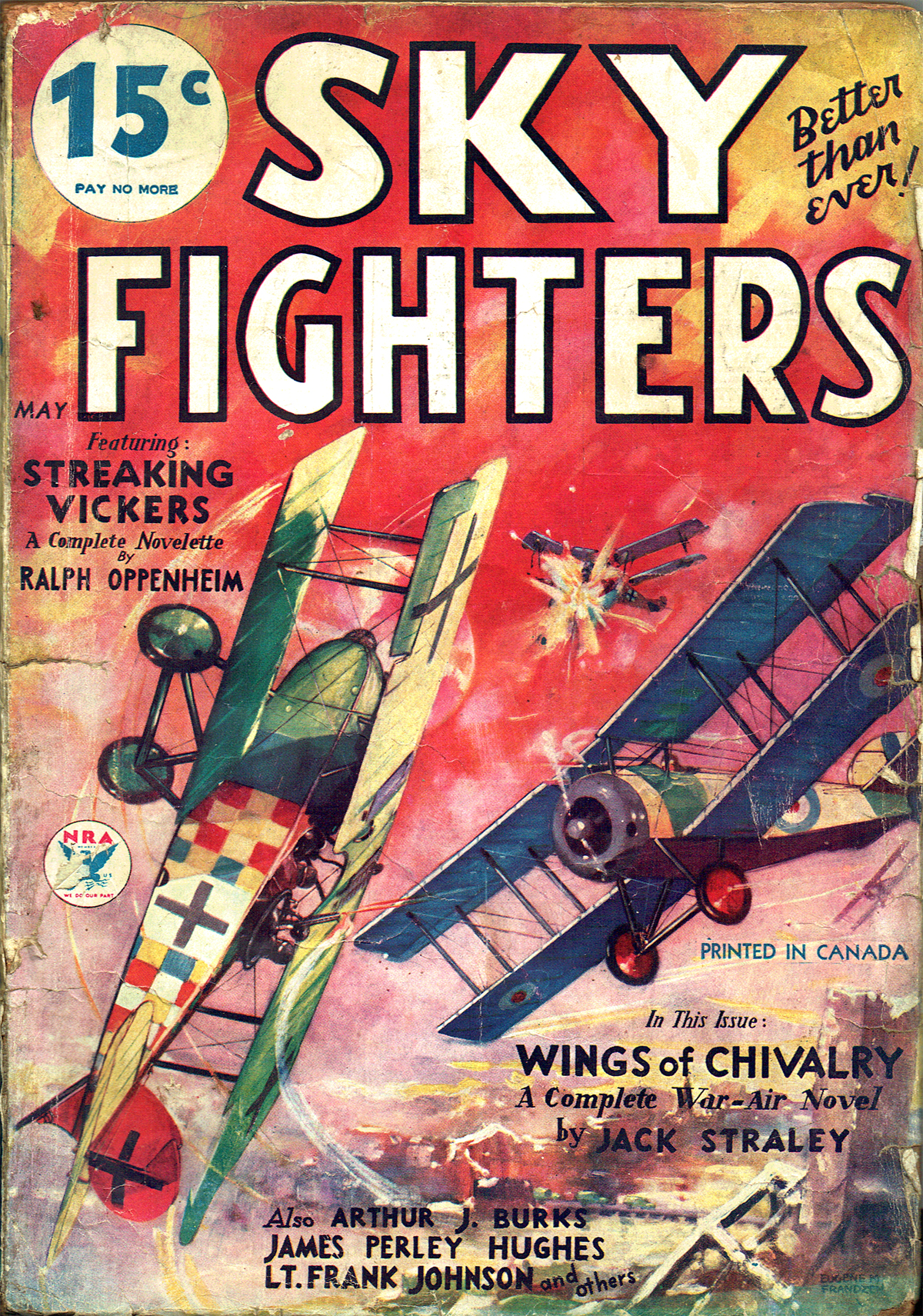
Eugene M. Frandzen painted the covers of Sky Fighters from its first issue in 1932 until he moved on from the pulps in 1939. At this point in the run, the covers were about the planes featured on the cover more than the story depicted. On the May 1934 cover, Frandzen featured the Sopwith Snipe and the Halberstadt C-4!

ON THIS month’s cover th_SF_3405the two types of ships shown are the Sopwith Snipe and the Halberstadt C-4.

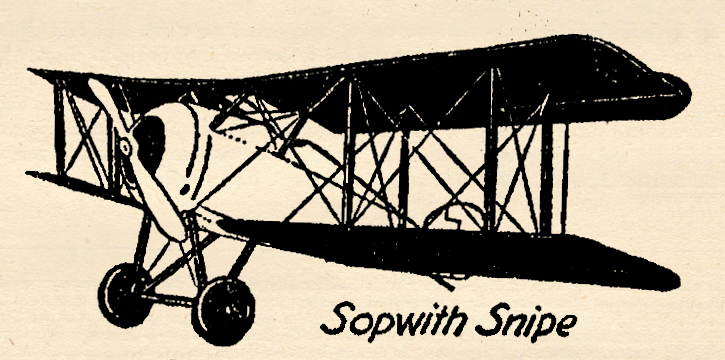
The Sopwith Snipe was considered by many to be the finest job turned out by the Sopwith Company. The 1918 Snipe knocked the Germans out of the skies with system and precision. In four days a single Snipe squadron accounted for thirty-six enemy planes. In one day alone they smacked down thirteen.

Major Barker, of Canada, pulled the outstanding feat of his career in a Snipe. Attacked by fifty Boche planes he fought back, downed four and lived to tell the tale. He gave lots of credit to his Snipe.

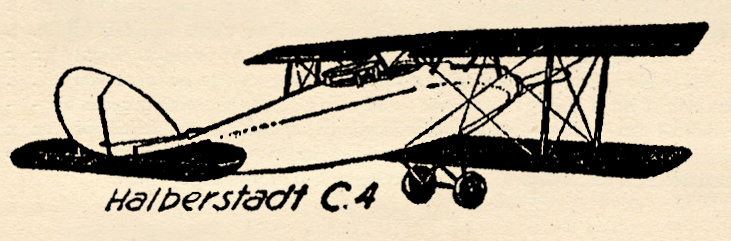
The Halberstadt C-4 was a good all round fighter-reconnaissance plane. Its bulky forward fuselage and its thin, tapering short section behind the cockpits gave it a nose-heavy appearance. Despite its awkward proportions it had good flying characteristics and was a dependable ship when not forced beyond the limits of its class.

One of the pastimes indulged in by the retreating Germans during 1918 was blowing up bridges they had crossed. And one of the best little things our hard-worked engineers did was to smack down pontoon bridges to replace them.

Of course then the Boche artillerymen came out of their dugouts and popped over a few tons of steel-cased shells, which, if nicely directed had the nasty habit of destroying the engineers floating road. Now the obszrvers in the two-seaters had to direct this demolition fire by wireless. They were usually protected by several scout plinos flying above and capable of giving even battle to anyone asking for an argument.

A little mix-up of this sort is happening in the picture on the cover. The Halberstadt has spotted the pontoon bridge. He gets his wireless going. The German artillerymen start ranging their shells. Above are his protecting planes, Fokkers. Hardly had the German observer warmed up his dot-dash key than two Sopwith Snipes swooped down on the Fokkers, sent two of them down. One Fokker remained. One Snipe started after him while the other Snipe tore in at the Halberstadt.

The German reeled in his aerial and un-limbered his Parabellum gun. He signalled his pilot to fight his way out. Above he saw the lone Fokker coming down to his assistance.

The Snipe roared in on the two-seater, guns blazing. The Halberstadt pilot flipped his ship up and over. His gunner all set for this maneuver pressed his trigger as the plane started up. He kept the gun chattering as the Halberstadt started over on its back. He hoped to catch the Snipe in his spraying arc of fire.

Twin Vickers bucking in their mounts on the Snipe; the Parabellum vibrating in the hands of the German observer. Three streams of lead slicing through the air, perforating fabric, ricocheting off metal parts.

The diving Fokker abruptly disintegrates in mid-air. A ranging German Shell hunting the pontoon bridge hits his ship, explodes; blows the ship to bits.

The odds are now too great for any two-seater, no matter how good it, or its crew, may be. A matter of minutes remain till it will be all over. Trucks, cannon and infantry will continue to pass over the pontoon bridge, shelled of course, but not as accurately as would have been the case had the artillery-directing Halberstadt been allowed to remain on tha job five minutes longer.

The Ships on The Cover
Sky Fighters (Canadian Edition), May 1934 by Eugene M. Frandzen
(The Ships on The Cover Page)

Next time, Mr. Frandzen features the German Junkers and D.H.4!

“Lives of the Aces in Pictures – Part 8: Edmond Thieffry” by Eugene Frandzen

Link - Posted by David on February 17, 2016 @ 6:00 am in

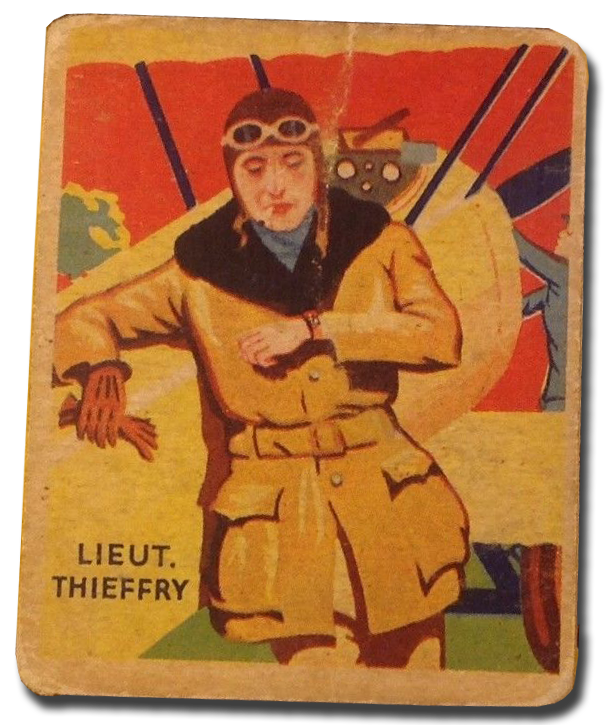
Starting in the May 1932 issue of Flying Aces and running almost 4 years, Eugene Frandzen’s “Lives of the Aces in Pictures” was a staple of the magazine. Each month Frandzen would feature a different Ace that rose to fame during the Great War. This time around we have Belgium’s favorite Ace—Lt. Edmond Thieffry!
Thieffry was Belgium’s daring ace who entered the war as an orderly and worked his way up to being King Albert’s leading sky fighter—preferring to fight alone, crashing at the enemy ships from high above. A strategy that worked well for him leaving him with 10 victories on his balance sheet by the end of the war.

After the war, Thieffry resumed his pre-war job as a lawyer, but kept his hand in aviation—helping to found Sabena (Societé Anonyme Belge d’Exploitation de la Navigation Adrienne) in 1923 which would remain Belgium’s national airline until 2001.

Thieffry was killed in a crash close to Lake Tanganyika during a test flight while trying to set up an internal air service in the Congo on April 11th, 1929. He was 36 years old.

(Editor’s Note: These early installments of Frandzen’s “Lives of the Aces in Pictures” that were published in the pulp-sized issues have been reformatted from a two page spread into a one page feature.)

“Coventry” by Lt. Frank Johnson

Link - Posted by David on February 12, 2016 @ 6:00 am in

This time around we have a tale from the anonymous pen of Lt. Frank Johnson—a house pseudonym. Sky Fighters ran a series of stories by Johnson featuring a pilot who who was God’s gift to the Ninth Pursuit Fighter Squadron and although he says he’s a doer and not a talker, he wasn’t to shy to tell them all about it. Which earned him the nickname “Silent” Orth.

In the first of the Silent Orth stories, Orth arrives at the Ninth Pursuit as a replacement and sets about to eliminate their pesky boche problem—seems a Baron Schmidt has been hammering their sector and the Ninth has been making little headway. In trying to do so, Orth finds out what happens when the new guy doesn’t stay in line—he ends up in “Coventry,” from the pages of the February 1934 Sky Fighters.

His wingmates couldn’t stand Jason Orth’s opinion of himself—But he certainly knew his stuff in the air!

My Most Thrilling Sky Fight: Lieutenant Alan Winslow

Link - Posted by David on February 10, 2016 @ 6:00 am in

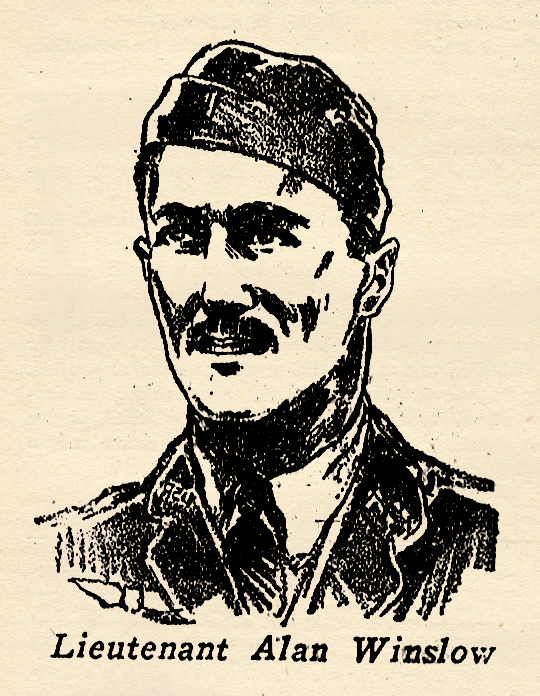
Amidst all the great pulp thrills and features in Sky Fighters, they ran a true story feature collected by Ace Williams wherein famous War Aces would tell actual true accounts of thrilling moments in their fighting lives! This time it’s American Lieutenant Alan Winslow’s Most Thrilling Sky Fight!

Alan Winslow first went oyer to France as a member of tho American Ambulance Section serving with the French Army. After America entered the war he was transferred to the American Army. When the American Air Service under command of Colonel Mitchell began definite duties on the Western Front, Alan Winslow had won his commission as a First Lieutenant and was assigned as a pilot in the 94th Aero Squadron, the famous “Hat in the Ring” outfit later made famous by Captain Eddie Rickenbacker.

Lieutenant Winslow and Douglas Campbell were both inexperienced battle flyers, but it fell to their lot to be the first American flyers in an American Squadron under American command, to engage the enemy in actual combat. Winslow and Campbell downed their respective enemies within two minutes of one another in the same dogfight. Wlnslow’s opponent fell first, hence he is credited with the first American air victory.

The account below was taken down by one of Winslow’s squadron mates.


FIRST AMERICAN VICTORY

by Lieutenant Alan Winslow • Sky Fighters, February 1934

I DON’T know yet just how it happened. Our Spads were lined up on the deadline ready for a practice flight over the lines when the field sirens began to scream raucously. All of us rushed out to see what was the matter, looking naturally towards the front lines. Then the anti-aircraft guns began to pop and I saw white mushroom puffs just over the northern border of the field.

Right in the midst of the archie bursts were two black winged planes flying towards our field. They weren’t more than 2,500 feet high. Campbell and I both rushed for our planes.

When I got in the air I kited off towards the front in a climbing turn to get the Boche between me and their home lines.

The Boche didn’t appear to be at all disturbed about us taking off after them. They flew serenely on towards Toul, snapping their pictures, I suppose, while Campbell and I clawed for the ceiling behind them. The archies kept up a continual fire, and only ceased when Campbell and I swung about and pointed our Spads for the two Rumplers. I picked one, Campbell
took the other. I fired a short burst from my guns to make sure they were clear, then dived in to the attack.

The Boche gunner in the rear seat calmly swung his guns on me and opened up with a stream of tracer.

I don’t know just what I did, but I ducked that burst somehow by agile maneuvering. When I redressed he was out of my sights, so I nosed up, renverscd and went back again with my fingers trembling over the Bow-dens, ready to fire the instant I lined him.

Again the Boche tracer stream came and I ducked, but not without sending out a few of my own. I nosed down and slid under Mm; zooming up on the other side. Banking quickly to line the Rumpler again, I was surprised to see it go tumbling down the sky. My first nervous burst had been effective,

But fearing a trick, I followed down after it until it crashed. Only then did I think about Campbell and the other Boche. I banked and climbed back to go to his assistance, and saw his Boche going down just like mine.

“Sky Fighters, April 1934″ by Eugene M. Frandzen

Link - Posted by David on February 8, 2016 @ 6:00 am in

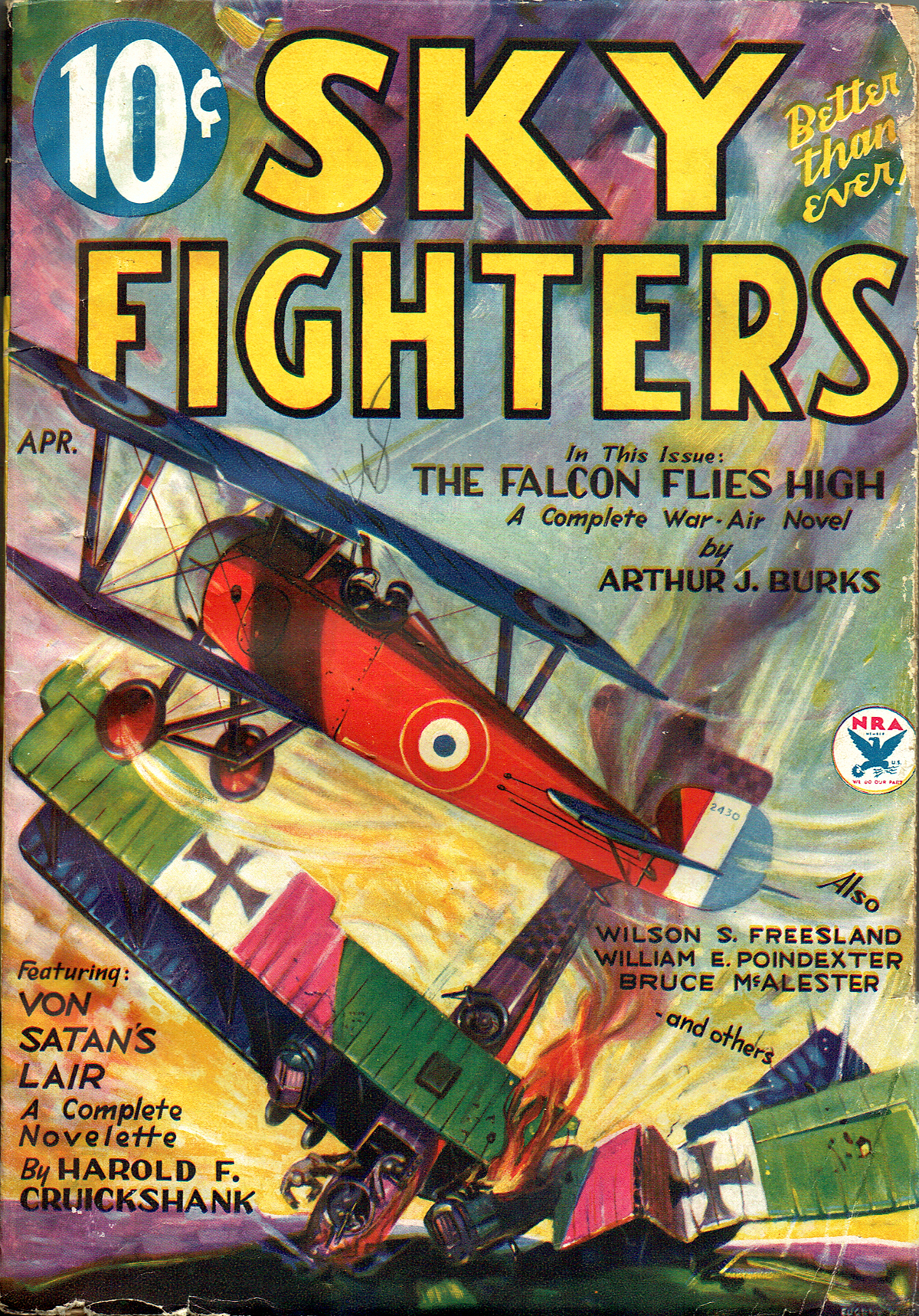
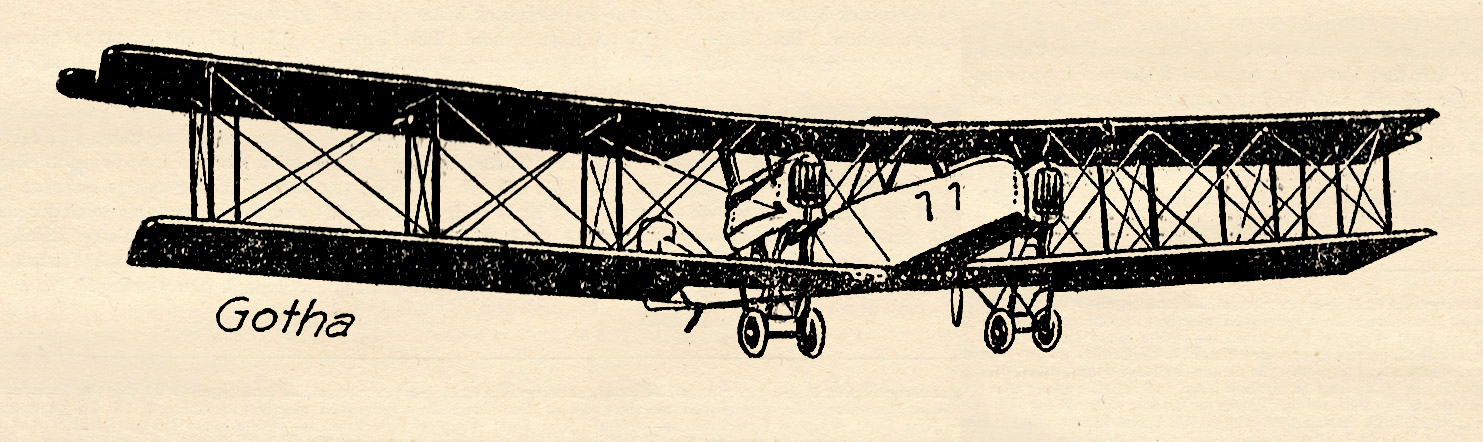
Eugene M. Frandzen painted the covers of Sky Fighters from its first issue in 1932 until he moved on from the pulps in 1939. At this point in the run, the covers were about the planes featured on the cover more than the story depicted. On the April 1934 cover, Frandzen featured the Nieuport 17 and the giant Gotha bomber!

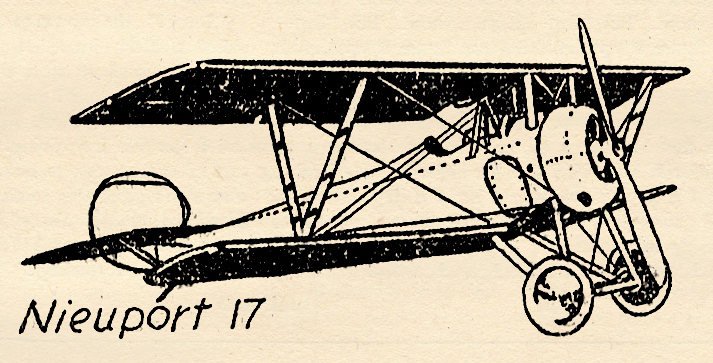
ON THE COVER this month th_SF_3404you will find two ships as radically different in design as you could wish for. The fleet little scrapper, the Nieuport 17 and the cumbersome engine of destruction, the Gotha bomber. The Nieuport was one of the most effective scouts that the French turned out. Owing to its high speed and maneuverability it was very popular with the French flyers. It was really a parasol in that the lower wing was so small that its chief function was to give girder strength to the upper wing. The Nieuports of this type were commonly called “one-and-a-half-planes.”

The big Gotha smacking the ground was just the last word in bombers as far as Germany was concerned. She built some bigger ones and stuck more engines on them than this 77 ft. twin-engined job, but in the case of the larger bombers they had plenty of trouble lifting them off the ground.

Slip back a few hours and take off with this broken Gotha as it leaves its home drome with a half a ton of bombs snuggled against its belly. With its two 160 horse power Mercedes churning the two pusher props more than four tons of ship and load are eased into the air. Two other giant bombers follow. The field is circled twice and then the three ships with their motors blasting orange streaks of flame from six exhaust stacks point their noses westward, toward the English Channel. The vibrating motors are laboring like mogul locomotives pulling a heavy train over a steep mountain grade—they are climbing. At last they reach twelve thousand feet, level off and throttle down to about sixty-five miles per hour. It is a clear night with high clouds scudding just below. Finally the nose of the leading Gotha is pointed downward. The other two follow. They slip down through the clouds. The Channel is below, now it has been passed. Again the bombers level off, wing slightly to the left. Scattered houses, the outskirts of London are below. Now the dwellings are bunched together. The gunner in the front pit has his eye glued to a Georz bomb-dropper’s sight. The pilot is watching his galvanometer, his left hand is on his bomb releases. Government buildings are now below at an angle of about twelve degrees.

Two giant bombs drop flatly from beneath the Gotha, lazily point their noses downward, then gathering momentum they go streaking down at their target. Buildings rock, flames spurt from shattered windows. Sirens from tops of buildings wail their eerie warnings through the chill before dawn air. AIR RAID. Again the bombs go racing toward the sleeping city. A ton and a half of high explosive has been released.

The British home defense planes are in the air, sweeping up to engage the giant destroyers, but already those dark shapes have slunk off into the blackness and are well out over the Channel.

The British were taken by surprise. They had not adequate speed in their protection planes. The advantage of the raiders was too great, they escaped across the Channel. But did they get back to their hangars behind the German lines? They did not! One was forced down with a balky engine. The two others ran into a dawn patrol of French airmen out looking for big game. Spandaus and Vickers snarled and spat lead as the eastern sky burst gloriously into color as the sun rose over the torn and twisted battle fields. A Vickers’ bullet found a vulnerable spot in the left engine of the Gotha pictured on the cover. Another killed the pilot. Flames, a dive, oblivion for the raiders. The Nieuport pilot circles the flamer once, salutes his fallen foe. It’s all in the day’s work.

The Ships on The Cover
Sky Fighters, April 1934 by Eugene M. Frandzen
(The Ships on The Cover Page)

“Lives of the Aces in Pictures – Part 7: René Fonck” by Eugene Frandzen

Link - Posted by David on February 3, 2016 @ 6:00 am in

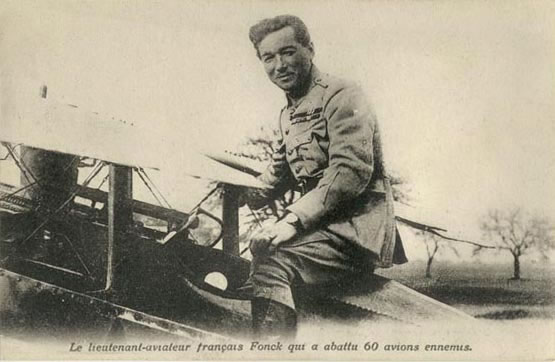
Starting in the May 1932 issue of Flying Aces and running almost 4 years, Eugene Frandzen’s “Lives of the Aces in Pictures” was a staple of the magazine. Each month Frandzen would feature a different Ace that rose to fame during the Great War. This time around we have France’s Ace of Aces—Lt. René Fonck!
Lt. René Fonck is recognized as one of the greatest French air fighters since Captain Guynemer and is credited with bringing down no less than 75 enemy planes, out of a claimed 142—bringing down six in one day (twice)! As his fame grew, sadly, so did his ego and he never really gained the admiration and popularity of Guynemer.

After the war, Fonck returned to civilian life, but kept his hand in aviation even trying to win the Orteig prize by being the first person to fly across the atlantic—he unfortunately crashed on take-off, killing two of his three crew members. Charles Lindbergh would win the prize seven months later.

He return to military aviation and from 1937-39 he acted as Inspector of fighter aviation within the French Air Force. However his later record of working with the Vichy government following the fall of France in June 1940 later besmirched his reputation. A French police inquiry about his supposed collaboration with the Vichy regime completely cleared Fonck after the war. The conclusion was that his loyalty was proved by his close contacts with recognised resistance leaders such as Alfred Heurtaux during the war—and he was awarded the Certificate of Resistance in 1948.

Just five years later Fonck suffered a fatal stroke and died in 1953 at the age of 59.

(Editor’s Note: These early installments of Frandzen’s “Lives of the Aces in Pictures” that were published in the pulp-sized issues have been reformatted from a two page spread into a one page feature.)

“Hunbugs” by Joe Archibald

Link - Posted by David on January 29, 2016 @ 6:00 am in

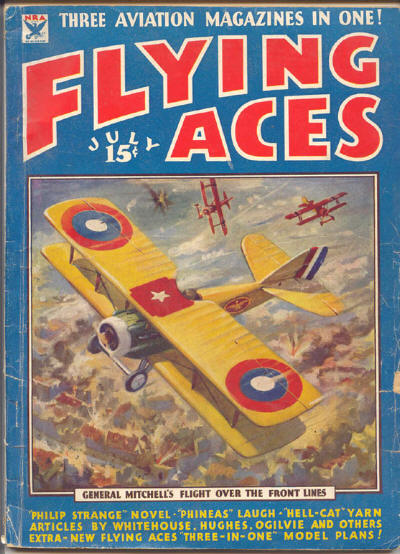
“Haw-w-w-w-w!” That sound can only mean one thing—that Bachelor of Artifice, Knight of Calamity and an alumnus of Doctor Merlin’s Camelot College for Conjurors is back and this time he’s fighting the war on two fronts—there’s a Boche Bat Patrol running riot in the Moselles and at the Ninth there’s a new recruit who wins every bet—that is until he comes up against the marvel from Boonetown, Iowa. From the July 1934 number of Flying Aces it’s “Hunbugs!”

Meet Lieutenant Ignatius Moots, newest member of the famous Ninth Pursuit. You may like him or you may not, but let us give you a tip—don’t ever bet with him. Phineas did!

« Previous PageNext Page »