


My Most Thrilling Sky Fight: Major Charles J. Biddle
Amidst all the great pulp thrills and features in Sky Fighters, they ran a true story feature collected by Ace Williams wherein famous War Aces would tell actual true accounts of thrilling moments in their fighting lives! This time we have Major Charles J. Biddle’s most thrilling sky fight!
Major Biddle was one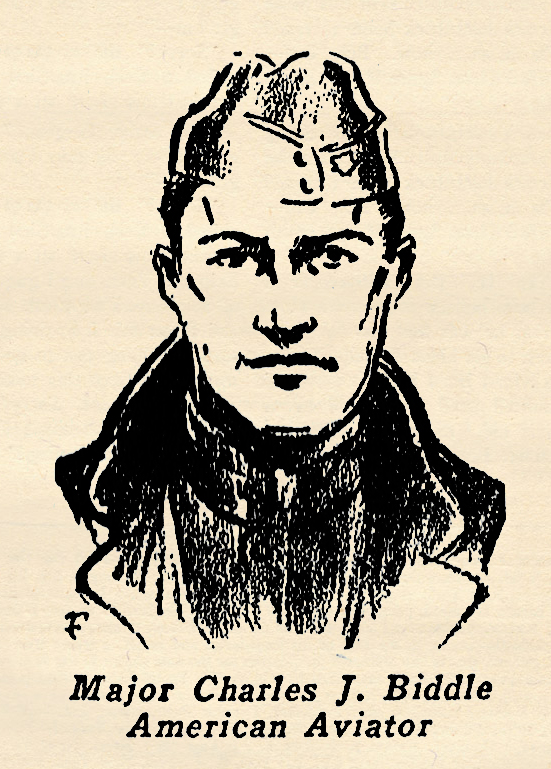 of that small number of American aviators who had actually had front line battle experience when his own country entered the war. Even before there were any indication* of his own country taking part, he sailed for France and enlisted in the French Army, where he was eventually transferred for aviation tralning. When the La Fayette Escadrille was formed, he wan invited to become a member. In that organization he won his commission as a Lieutenant in recognition of his ability and courage.
When General Pershing formed the American Air Service and put Colonel William Mitchell in command of the air squadrons on the front, the able Colonel promoted Biddle to major and save him command of the 13th Pursuit Squadron, which he formed, organized and took to the front to make a distinguished record.
Though not supposed to lead his men in battle, he always did so. Just before the armistice, he left the 13th Squadron to become commander of the 4th Pursuit Group. The account below is taken from one of his letters when he was in command of the 13th Squadron at Toul.
MY FOURTH VICTORY
by Major Charles J. Biddle • Sky Fighters, May 1934
A GERMAN plane had been coming over our airdrome every morning just about daybreak. I decided to set a trap for him one night.
I took off at 3:30 A.M. I had cruised around idly for almost an hour and a half before I saw my friend, Mr. Boche.
I circled around behind him. He was flying at about 4,500 meters and I had plenty of ceiling on him.
I let him go until he got almost over Toul. Then with the sun at my back, my plane intervening between his and the sun, I went at him in a long power dive. Getting closer I saw it was a two-place Rumpler, so I dived under his tail and came up beneath, letting go with a burst, then pulling off to one side to see what happened. The observer swung his guns around, aimed them at me. I dived again, got my guns on him from beneath, withheld my fire until I was at a 10 yard range and let go. My tracer tore through the bottom of the pit.
The pilot dived for some seconds, went down to 2,000 meters, then straightened out, headed for home. I headed him off, trying to get in a burst from in front, but the Boche fooled me, giving me a burst, then banking out of my range, and diving again. I renversed and got behind him, my guns leveled on his back. I sent in a burst that splintered through his upper wing. He ducked. We were down to a thousand meters now. He tried once more to shake me off, but didn’t succeed. I sent out another burst, purposely high. I didn’t want to kill him, now, I wanted to force him down, and capture his plane. Finally a green field alongside a river showed beneath and he dipped down.
I kept close on his tail, fearing a trick. But he drifted down nicely, landing light as a feather alongside the river. I circled around him and fired my guns some more to attract attention in a near-by village. French poilus came running out and surrounded the plane. I set down then in a field next to him, hit the only rough place in it, and nosed over in a crash. I ran over, however, and captured my prisoner. He seemed glad it was all over, smiling when I shook his hand. Blood soaked one of his sleeves. One of my bullets had nicked him in the shoulder. The observer was Fatally wounded by bullets through his chest. He died as we were laying him out on the ground. I tell you at such moments, when you see your opponent die before your eyes, war becomes far from a glorious thing. It is different in the air.
It was my fourth victory. We got much information from both plane and pilot.
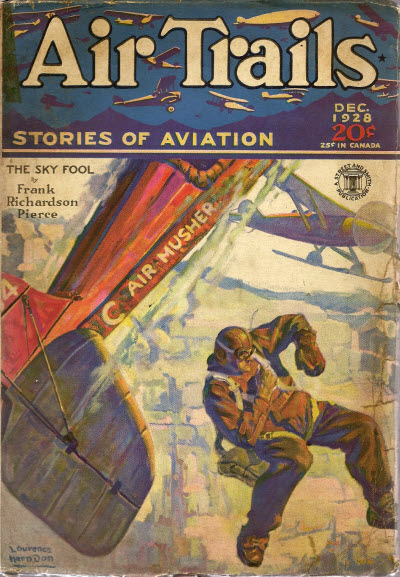 probably best remembered for his prolific career in the Western Pulps. Writing under his own name as well as two pen names—Erle Stanly Pierce and Seth Ranger—Pierce’s career spanned fifty years and produced over 1,500 short stories, with over a thousand of these appearing in the pages of Argosy and the Saturday Evening Post.
 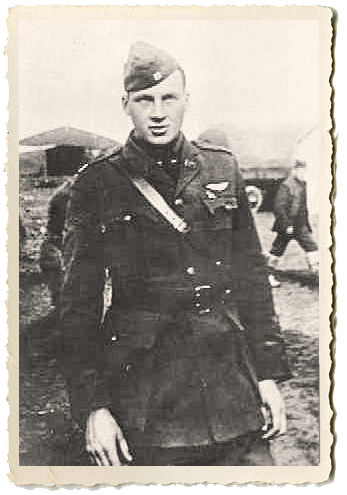 was born on September 1st, 1895, in Brookline, Massachusetts. He enlisted in the Aviation Section of the U.S. Army Signal Corps in July 1916, and began flight training at the School of Military Aeronautics at the Massachusetts Institute of Technology in June the following year.
 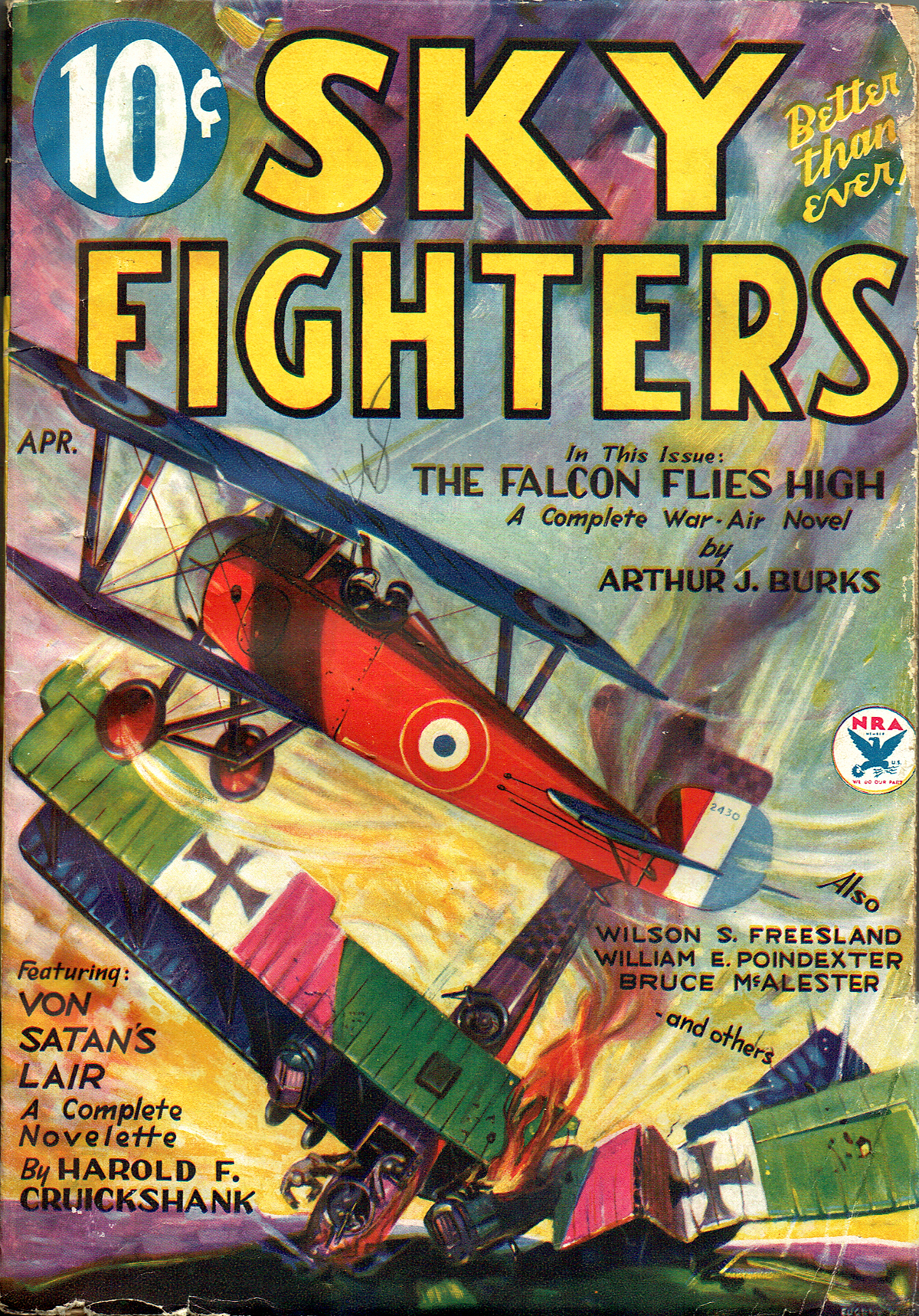 we have a tale from the anonymous pen of Lt. Frank Johnson—a house pseudonym. Sky Fighters ran a series of stories by Johnson featuring a pilot who who was God’s gift to the Ninth Pursuit Fighter Squadron and although he says he’s a doer and not a talker, he wasn’t to shy to tell them all about it. Which earned him the nickname “Silent” Orth. This time Silent Orth goes after Baron Rapunzel—a Boche Ace who’s already claimed 51 victories—and Orth doesn’t plan to be the 52nd!
 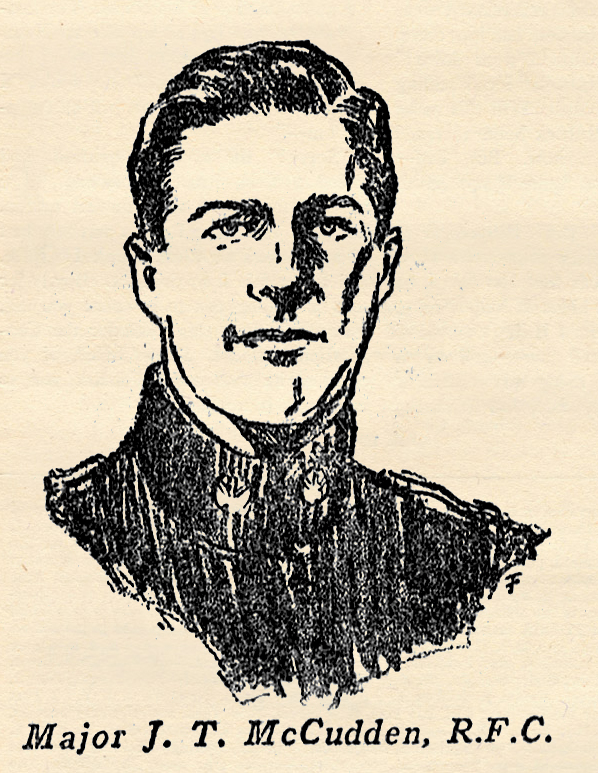 one of the most modest and unassuming of the great flying aces. When the war began he was an engine mechanic with the then recently formed Royal Flying Corps. After flying training he became a Sergeant pilot, and began, piling up the string of victories which eventually placed him at the top of all the British aces. He was progressively promoted to Lieutenant, Captain and Major, and won every medal possible, including the Victoria Cross.


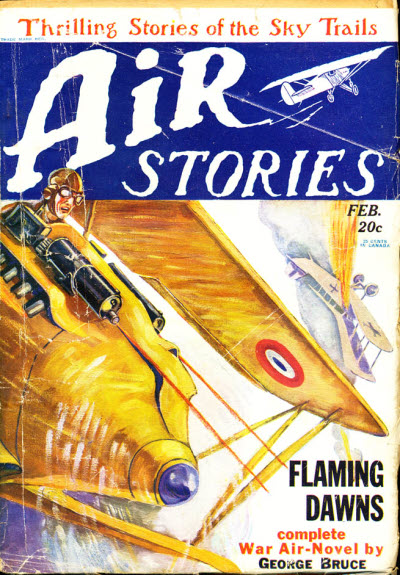 the Black Mask school of pulpsters, penned a popular series about the vagabond pilots Gales and McGill—free-lances of the air, birdmen of fortune, the wildest brace of adventurers that ever came out of America. They were notorious on the coast, known from Shanghai to Surabaya for a brace of wild, reckless adventurers, ripe at all times for anything short of murder.
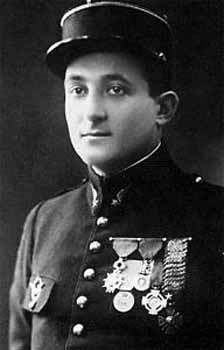 was one of the most famous of the French flying aces. Along with Guynemer, Navarro and Nungesser, he furnished the spectacular flying news that filled the newspapers in the early days of the World War. He was credited with forty-one victories—only the great Guynemer topped him in the list of French aces during his time on the battle front—and awarded the Legion d’Honneur, Medaile Militaire, and Croix de Guerre.
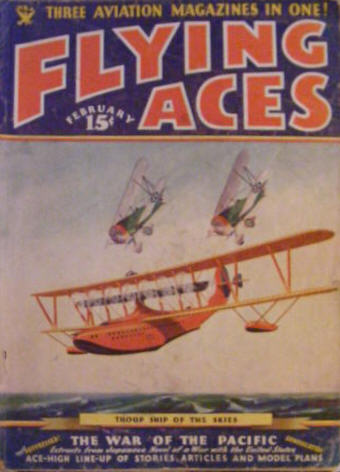 That sound can only mean one thing—that Bachelor of Artifice, Knight of Calamity and an alumnus of Doctor Merlin’s Camelot College for Conjurors is back and this time the marvel from Boonetown is suffering from “yeller jaundice” as he puts it and makes the most of his condition by assuming the coolie guise of Flew Man Hooey in order to bring down RIttmeister von Beerbohm and his Flying Circus.
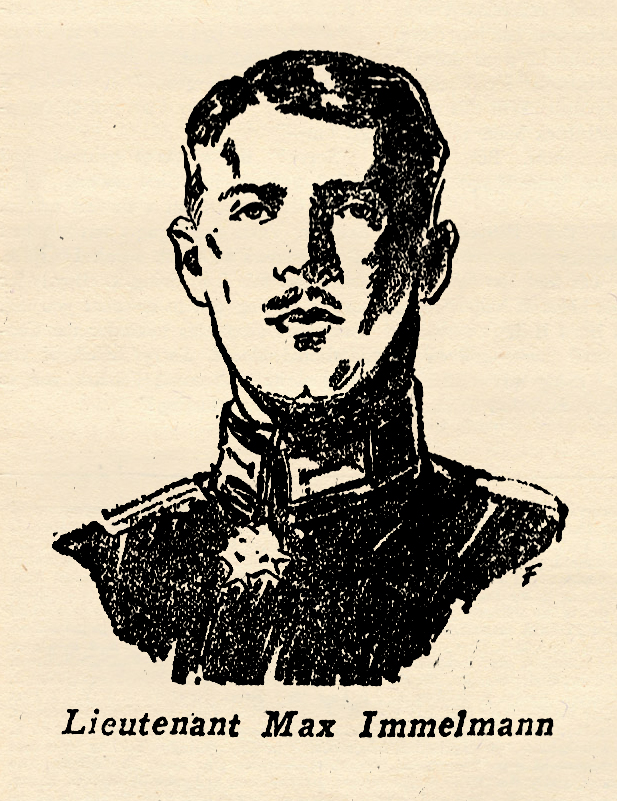 Immelmann was the first of the great German Aces. Immelmann scored victory after victory over the Allied flyers until his total score mounted higher than that of any of the Allied Aces.


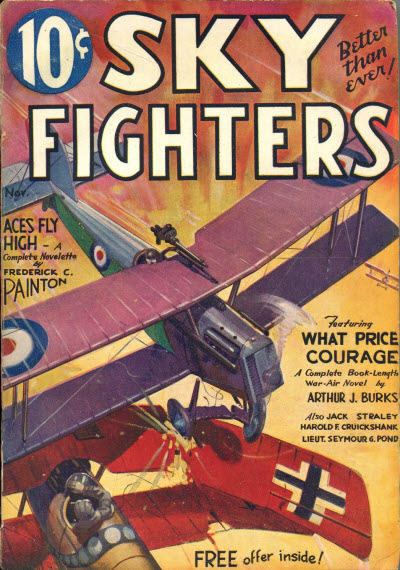 another exciting air adventure from the pages of the pulp magazines of the 1930’s. This week we have a tale from the pen of that Canadian stalwart—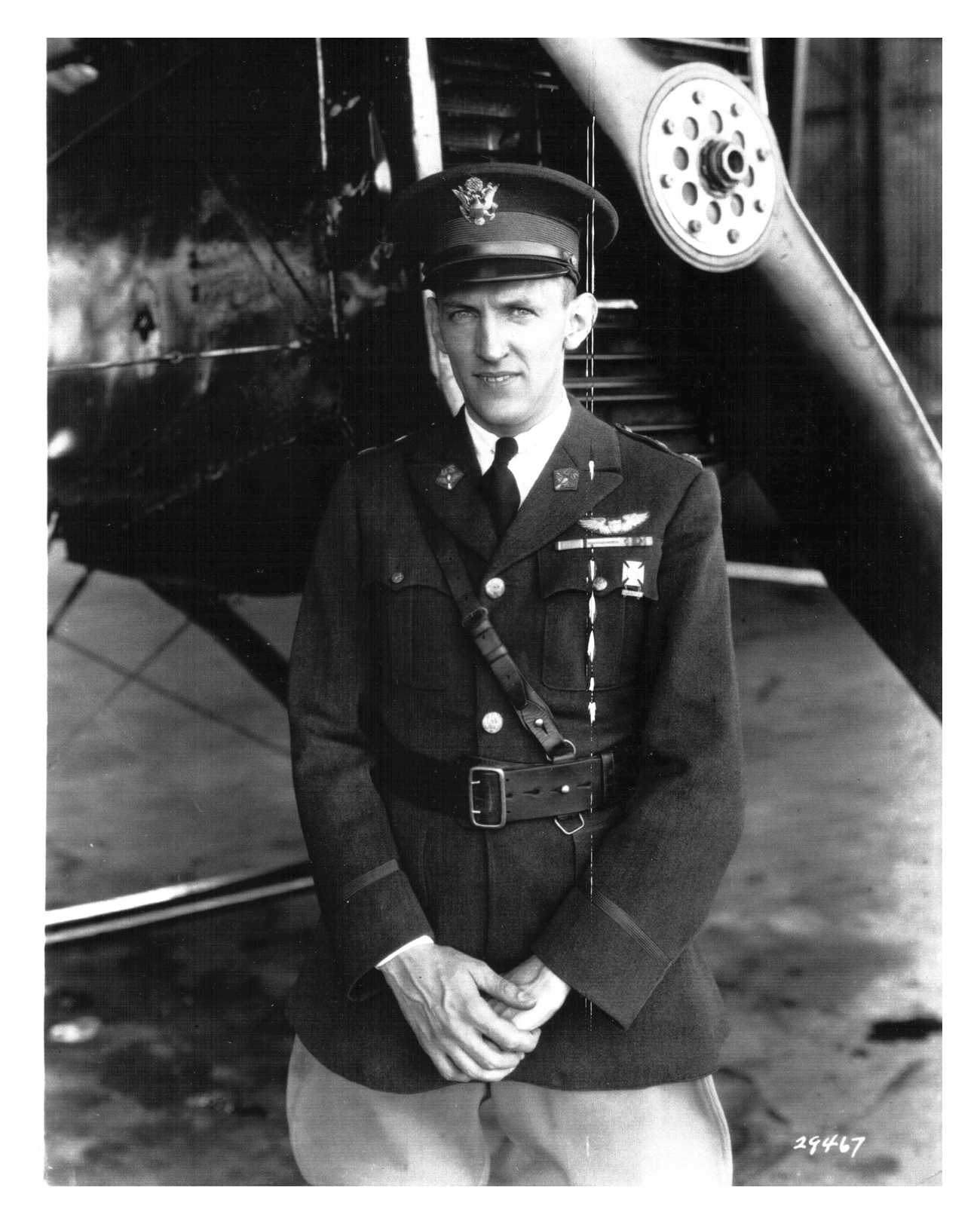
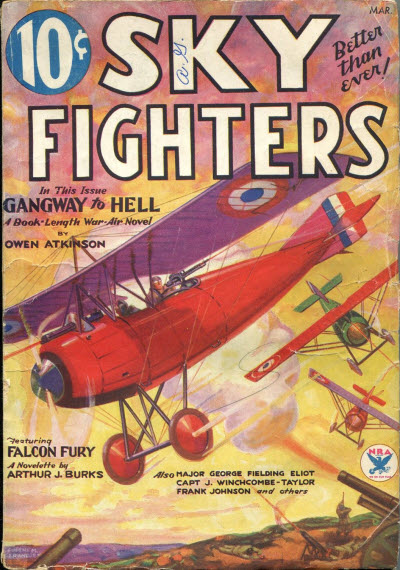 we have a tale from the anonymous pen of Lt. Frank Johnson—a house pseudonym. Sky Fighters ran a series of stories by Johnson featuring a pilot who who was God’s gift to the Ninth Pursuit Fighter Squadron and although he says he’s a doer and not a talker, he wasn’t to shy to tell them all about it. Which earned him the nickname “Silent” Orth.