


Looking to buy? See our books on amazon.com Get Reading Now! Age of Aces Presents - free pulp PDFs

“Falling Leaf” by Lt. Frank Johnson

Link - Posted by David on February 10, 2017 @ 6:00 am in

This time around we have a tale from the anonymous pen of Lt. Frank Johnson—a house pseudonym. Sky Fighters ran a series of stories by Johnson featuring a pilot who who was God’s gift to the Ninth Pursuit Fighter Squadron and although he says he’s a doer and not a talker, he wasn’t to shy to tell them all about it. Which earned him the nickname “Silent” Orth. This time Silent Orth goes after Baron Rapunzel—a Boche Ace who’s already claimed 51 victories—and Orth doesn’t plan to be the 52nd!

Baron Rapunzel Was the Mystery Man of German Air—And A Tough Bird to Tackle in Combat!

My Most Thrilling Sky Fight: Major J.T. McCudden, R.F.C.

Link - Posted by David on February 8, 2017 @ 6:00 am in

Amidst all the great pulp thrills and features in Sky Fighters, they ran a true story feature collected by Ace Williams wherein famous War Aces would tell actual true accounts of thrilling moments in their fighting lives! This time we have Major J.T. McCudden’s most thrilling sky fight!

MAJOR James T. McCudden was one of the most modest and unassuming of the great flying aces. When the war began he was an engine mechanic with the then recently formed Royal Flying Corps. After flying training he became a Sergeant pilot, and began, piling up the string of victories which eventually placed him at the top of all the British aces. He was progressively promoted to Lieutenant, Captain and Major, and won every medal possible, including the Victoria Cross.

In the air he was absolutely fearless and could handle a plane as well as the best of his fellows. But his ability in using the machine-gun made him superior to all others. He was a crack gunner. He was killed in an accident when taking off to fly back to the front after one of his infrequent leaves. The account below is taken from his book, “Five Years in the Royal Flying Corps.”


ONE AGAINST FIVE

by Major J. T. McCudden, R.F.C. • Sky Fighters, January 1934

I WAS out stalking alone at a 19,000 foot level over Cambrai when I caught sight of five Hun scouts over Bourlon Wood. They were cruising several thousand feet below me. I sized up the situation for a moment, then went down swiftly in a screeching dive, aiming right through the middle of the formation.

After driving through the formation, I pulled up abruptly directly behind and beneath the leader, in his blind spot. I withheld my fire as long as possible, then let go with a short burst at very close range. His ship, an Albatross, went streaking down with plywood strips shredding and crackling from the fuselage. My tracers had almost ripped his fuselage in two. I didn’t have time to watch him crash for the four other scouts jumped me from behind.

I maneuvered quickly, however, and managed to get behind one of them, a Pfalz. One short burst took care of him. He went down in a spiral dive. The other three now began to show signs of alarm. They spread in all directions. I got my guns on an Albatross, pumped a long burst at him, but he spun and got away. I had been so intent firing at him, I didn’t notice the Albatross that slid in behind me pumping lead, until I heard the bullets crackling through the fuselage at my back.

I reversed more quickly than I ever had. Got my sights in line again, and was feeding him a lovely burst from Vickers and Lewis when both my guns stopped. On looking, I saw that the Lewis drum on the top gun was empty, the Vickers belt below was broken.

So there I was with no guns. But my two quick victories had given me confidence. I felt awfully brave, so went chasing after them with no guns. The two Albatross pilots weren’t very lively on either the stick or trigger, and I almost ran into the tail of the remaining Pfalz. I got so close that I could have popped the pilot in the eye with a rotten egg—if I had had any.

I chased those two fellows as far in as Cambrai, then growing cautious because of my failing petrol supply, I turned back and left them. I had got two of the formation and chased the other three away without any bullets. Of course, if the Huns had known that, it wouldn’t have been so easy, the three of them might have ganged on me.

When I got home and made my report my flying mates kidded me about not having a ready supply of rotten eggs handy in the pit.

“Sky Fighters, February 1935″ by Eugene M. Frandzen

Link - Posted by David on February 6, 2017 @ 6:00 am in

Eugene M. Frandzen painted the covers of Sky Fighters from its first issue in 1932 until he moved on from the pulps in 1939. At this point in the run, the covers were about the planes featured on the cover more than the story depicted. On the February 1935 cover, It’s a battle of the Bristol Fighter F2B and the Siemens Halske D4!

The Ships on the Cover

THE Bristol Fighter F2B th_SF_3502was a plane which any Englishman can remember with justifiable pride. It was a two-seater fighter brought out during 1917 and some of them were still flying a few years back. As a war bus this square fuselage job was in a class by itself. One man could take it into a mixup and outfly most of the enemy scouts.

With the rear gunner in the Bristol Fighter it was about the most dangerous thing slicing through the skies. It mowed down its enemies in such great numbers that the German flyers gave it the right of way whenever possible.

The British and Colonial Aeroplane Co., manufacturers of the Bristol was formed in 1910 by the late Sir George White, Bart, who incidentally was the pioneer of electric tramways in Great Britain.

The Bristol Fighter was the first ship of any country which could match single-seater scouts in speed, maneuverability and ease of handling.

Four-Bladed Propeller

The sleek little red plane zooming underneath the Bristol on the cover is a Siemens-Halske D-4 pursuit ship. It was made by one of the many branches of the great Siemens Electrical Company of Germany, comparable to our own General Electric Co. The motor was a 200 h.p. Halske rotary. To get greater efficiency with the geared down motor a four-bladed propeller was used. The ailerons were actuated by torque tubes. The Siemens firm also produced those multi-engined giant bombers, the Siemens-Schuckert and Siemens-Steffen.

The Bristol Fighter was made by the firm that had been founded by a pioneer of the electric street car; the Siemens-Halske by the electric moguls of Germany. Therefore it was fitting and interesting that these two ships should be pitted and allowed to scratch and tear at each other as war planes are in the habit of doing.

The Battle Opens!

With the Siemens having a slight edge in speed the battle opened. The Bristol back gunner was a menace to the German who used his slight extra speed finally to maneuver so that he placed his streamlined little job under the tail of the larger Bristol. Two spitting streams of bullets poured from his Spandaus. One of those tiny pellets tore through the British observer’s body.

He slumped in his pit, out. Down dove the Siemens, came back from under and in front of the Bristol. Slugs spattered through the two-seater’s floorboards. The Bristol pilot quickly lashed his controls, turned, and holding his buddy from slipping overboard brought the twin Lewis guns over the side. The Siemens, a streak of red, flashed by so close that the left elevator of the Bristol and the left wing tip of the Siemens nearly brushed together.

A Short-Lived Grin

The German looked up, grinned. The grin didn’t last a shaved part of a split second. A single Lewis gun churned slugs at point-blank range into the German ship. One smashed the pilot’s left shoulder.

Rapidly the ships flew in opposite directions. They had fought a draw. Each carried a wounded man to be patched up and flung again into the arena where knockouts are daily events and draws are few and far between.

The Ships on The Cover
Sky Fighters,February 1935 by Eugene M. Frandzen
(The Ships on The Cover Page)

Next time, Mr. Frandzen features the French Deperdussin vs. the German D.F.W.!

“Sky-High Nerve” by Frederick L. Nebel

Link - Posted by David on February 3, 2017 @ 6:00 am in

Frederick L. Nebel, a member of the Black Mask school of pulpsters, penned a popular series about the vagabond pilots Gales and McGill—free-lances of the air, birdmen of fortune, the wildest brace of adventurers that ever came out of America. They were notorious on the coast, known from Shanghai to Surabaya for a brace of wild, reckless adventurers, ripe at all times for anything short of murder.

Frederick L. Nebel, author of the Gales and McGill stories, says of his partners of the skies:

“Gales and McGill have flown before in Air Stories, and I know they’ll fly some more. I like Gales and McGill. They’ve sort of become friends of mine.

“I don’t have to tell you that McGill is a pretty hard-boiled egg. Nor is Gales particularly soft-boiled. But what one lacks, the other has, and, taking them together, they’re no boobs.

“McGill has no tact. He’s a wild hombre and will haul off and pop a fellow on the slightest provocation. Gales, on the other hand, has tact. He can sock, too, but he has a level head and a lot of canny stuff inside of it. And, of course, a lot of his time is spent getting McGill out of trouble.

“However, the main thing is that they play the game. They’re soldiers of fortune out to make the money and take the chances. But they play the game. There’s no double-crossing, and they don’t hire out as murderers.

“And so they zoom in “Sky-High Nerve,” an episode of their fortune hunting in the East. In all their flights they’re Gales and McGill; McGill reckless, Gales planning, both fighting. That motive is behind “Sky-High Nerve” and behind every flight they make. At least I try to make it that.

“Surely you’ve met guys like ‘em somewhere, some time.”

From the pages of the February 1928 number of Air Stories, it’s Gales & McGill in “Sky-High Nerve!”

Gales and McGill, free lances of the air, seek adventure—and get rapid-fire action as Gales plays out his hand against the sinister menace of the Tong. Another smashing Gales-McGill yarn!

“Lives of the Aces in Pictures – Part 16: Georges Madon” by Eugene Frandzen

Link - Posted by David on February 1, 2017 @ 6:00 am in

Starting in the May 1932 issue of Flying Aces and running almost 4 years, Eugene Frandzen’s “Lives of the Aces in Pictures” was a staple of the magazine. Each month Frandzen would feature a different Ace that rose to fame during the Great War. This time around we have French flying Ace—Capitaine Georges Madon!

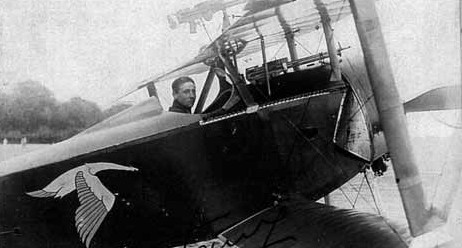
Capitaine Georges Madon was one of the most famous of the French flying aces. Along with Guynemer, Navarro and Nungesser, he furnished the spectacular flying news that filled the newspapers in the early days of the World War. He was credited with forty-one victories—only the great Guynemer topped him in the list of French aces during his time on the battle front—and awarded the Legion d’Honneur, Medaile Militaire, and Croix de Guerre.

Cool, courageous and audacious, he kited the battle skies, making short shrift of all the enemy flyers who were unfortunate enough to encounter his specially gunned Nieuport fighter.

Unlike the great Guynemer, Capitaine Madon survived the war. Sadly, he died in a plane crash on 11 November 1924—the sixth anniversary of the end of the First World War—while flying in tribute to the deceased French aviation legend Roland Garros. His aircraft having malfunctioned he deliberately crashed his aircraft into the roof of a villa rather than hit watching spectators. He was 32.

(Editor’s Note: These early installments of Frandzen’s “Lives of the Aces in Pictures” that were published in the pulp-sized issues have been reformatted from a two page spread into a one page feature.)

“Rice and Shine” by Joe Archibald

Link - Posted by David on January 27, 2017 @ 6:00 am in

“Haw-w-w-w-w!” That sound can only mean one thing—that Bachelor of Artifice, Knight of Calamity and an alumnus of Doctor Merlin’s Camelot College for Conjurors is back and this time the marvel from Boonetown is suffering from “yeller jaundice” as he puts it and makes the most of his condition by assuming the coolie guise of Flew Man Hooey in order to bring down RIttmeister von Beerbohm and his Flying Circus.

It was a red-letter day for Garrity. The Ninth Pursuit had bagged a Gotha, and Phineas had been shipped off to the hospital. The major lit a cigar and relaxed—but he should have known better. You would, wouldn’t you?

My Most Thrilling Sky Fight: Lieutenant Max Immelmann

Link - Posted by David on January 25, 2017 @ 6:00 am in

Amidst all the great pulp thrills and features in Sky Fighters, they ran a true story feature collected by Ace Williams wherein famous War Aces would tell actual true accounts of thrilling moments in their fighting lives! This time we have Lieutenant Max Immelmann’s most thrilling sky fight!

LIEUTENANT Max Franz Immelmann was the first of the great German Aces. Immelmann scored victory after victory over the Allied flyers until his total score mounted higher than that of any of the Allied Aces.

He was an excellent gunner and as a flyer had no peer during his time. He was the first to use the quick Climbing reverse turn, which was the fastest method of changing direction while in full flight. The maneuver first demonstrated by Immelmann in his sky battles over the Western front has since been named after him, the Immelmann turn. It was a very effective maneuver and enabled him to gain many victories. He and Oswald Boelke served in the same Squadron. When he was killed Boelke went on to surpass his records, only to be surpassed himself after he was killed, by Baron von Richthofen.

None of the American flyers, except those flying with the French, ever encountered Immelmann in the air. He was killed in 1918 before America entered the war. The account below was told to a newspaper correspondent.


TWO OUT OF THREE

by Lieutenant Max Immelmann • Sky Fighters, January 1934

AIR fighting is like any other kind of fighting. Victory goes usually to the strongest and best prepared. The French have tried to make it more romantic, like the fighting of the knights of old, man to man in bold, open fighting on mounted chargers. That is spectacular and picturesque. I do not believe it the best method. The object in war is to down as many of the enemy planes as is possible without losing any of your own. Thus you may obtain the mastery of the air, which is necessary in this modern war, if the ground troops are going to win success.

For that reason I have adopted tactics which seem on the surface prudent. I aim to destroy the enemy without letting them destroy me. My methods are best explained by giving an example. Three days ago, I was out cruising the lines with my patrol. We were in layer formation. One was far below, leading. Two others were further back of him and higher up, one on either side. I brought up the rear, directly behind the leader, and higher up than any of them.

While flying in that formation, the leader encountered a patrol of three Frenchmen. His instructions were to fly on until attacked, which he did. My patrol never even let on that they saw the approaching formation. They flew along parallel with the lines in steady flight without changing elevation. I throttled down my machine and dropped back, until the rest of my patrol was just mere specks. Then I shoved on full throttle and climbed for the sun.

The Frenchmen drove in for the attack on the three German planes below. My men kept their formation until the bullets began to get too close, then they returned the fire and adopted defensive tactics. At the same time, they retreated back over our lines, to draw the enemy over our territory. They were making a running fight of it, according to instructions, diverting the attackers’ intentions all to themselves; but knowing all the time that I would be diving down unawares from the disc of the sun behind to pounce upon the enemy in surprise.

And I did. I dived straight down from the well of the sun, my fingers poised over the gun trips. At one hundred yards I opened up on the first Frenchman. My tracers bored through his cockpit and he went spinning down. But not before I had dived underneath him to zoom up again with my guns pointed at his nearest comrade.

I opened up on him, saw my tracers eating into his belly. One plane was down now. I had the position on the second, and the first shots in. My comrades then, all banked and raced in for attack on the third Frenchman. He fought them bravely, I must admit, returning burst for burst. But he was doomed from the first with three against one.

My opponent slipped from my tracer stream, and nosed down towards his own lines. I zoomed up, half-rolled (Immelmanned—Ed.), changed direction and went streaking after him, still pouring tracer. Glancing back over my shoulder I saw the second enemy break apart beneath the guns of my mates. His plane fell to pieces and went fluttering down.

When I looked forward again, my opponent had dived and won away from me. I nosed down and went after him, but he went even faster for a forced landing just on the other side of his own lines where his ship upended in a shell crater and smashed one wing.

That was the end of the fight. Two French ships had been destroyed in our own territory. The other had been forced down to a crash landing just out of our reach. That was poor strategy on my part. I should have headed him off, making him land on our side. However, my patrol was still intact. Next time, I vowed I would not make such a slip. With perfect strategy and tactics properly executed, we would have accounted for all three enemy ships over our own territory.

“Sky Fighters, January 1935″ by Eugene M. Frandzen

Link - Posted by David on January 23, 2017 @ 6:00 am in

Eugene M. Frandzen painted the covers of Sky Fighters from its first issue in 1932 until he moved on from the pulps in 1939. At this point in the run, the covers were about the planes featured on the cover more than the story depicted. On the January 1935 cover, It’s a battle of the experimental Morane-Saulnier up against the mighty Fokker Tri-Plane!

The Ships on the Cover

A FLYER who goes out th_SF_3501of his way to tackle three enemy ships and down the bunch in one fight is called a “Three in One.” Meaning, of course, three in one fight. But that said flyer, before barging into a seemingly hopeless scrap, must have more than mere courage. My guess would be: courage, exceptional flying ability and nerves of steel.

Andrew McKeever and Francis Quigley and James McCudden were “three in one” Aces. McKeever, a Canadian, made three kills in one fight. The odds against him were nine to one and just to make it more interesting, the fight occurred far behind the German lines. The Cannuck charged into the mass of attacking Germans and tore their morale to pieces by blasting three of them out of the skies. The remaining six Hun pilots were so dazed by McKeever’s audacity that they allowed him to slip away from them and he returned home without a scratch.

Tangling Them Into Knots

McCudden, whose score was high at the time, hopped a squadron of German ships. He tangled them into knots with his brilliant flying and marksmanship. Four of the German ships crashed to earth under his guns. Dozens of German slugs tore through McCudden’s plane but he was unharmed and landed safely.

That gives you a look-see at a couple of the famous aces of the war whose official records are now history. Now take a look at the cover to see a Frenchman qualifying for the “Three in One” club.

The Fokker triplane was a ship which stood out boldly on the German roster of famous ships. Some of the Fokker tri-planes were slow. Fokker built these tripes originally around the 100 h.p. Oberursel rotary motors and had to be content with the speed this engine delivered. Later when more powerful motors were installed his tripes climbed well into the first division for speed. What they lacked in miles per hour they made up in maneuverability. They could “turn on a dime.”

This super-maneuverability was due to the shortness of the fuselage bringing the tail close up to the wings and also to the short span of the wings. The experimental Morane-Saulnier is the exact opposite to the triplane design and cannot get into a change of direction as quickly as the tripe. It is built more for slashing attack. Having a single wing against the three of the German ship makes the scrap all the more interesting.

Under the Guns!

One of the quick darting Fokkers has already fallen under the guns of the Morane pilot. Another is taking its death potion from the blazing guns of the French plane as it zooms up under its nose. The third Fokker pilot is so rattled that he is firing more at his colleague in the foremost Fokker then at the Morane-Saulnier. It’s finis for him as soon as the speedy Morane-Saulnier can swing it’s guns in his direction.

Flyers didn’t go out every day or two and engage superior numbers of enemy ships just to show how the trick was done. It was rather a once-in-a-lifetime stunt for a very few of the best. To zoom into sky conflict with a single enemy plane takes courage. But to tangle with a gang of your foes, down three or more of them and come through the show with colors flying, takes courage PLUS.

Plus what? I’ve already made my guess. What’s yours?

The Ships on The Cover
Sky Fighters, January 1935 by Eugene M. Frandzen
(The Ships on The Cover Page)

Next time, Mr. Frandzen features the Bristol Fighter F2B and the Siemens Halske D4!

“Jinx Peelot” by Harold F. Cruickshank

Link - Posted by David on January 20, 2017 @ 6:00 am in

WE’RE back with another exciting air adventure from the pages of the pulp magazines of the 1930’s. This week we have a tale from the pen of that Canadian stalwart—Harold F. Cruickshank. Cruickshank was a prolific writer. He wrote all manner os stories for the pulps—war, aviation, westerns, even animal stories!

Cruickshank gives us a tale of Sam Tenby, a young Peelot with a jinx that may be sending him back to Issoudun unless he can break it.

Every Time Sam Tenby Went Up in the Air to Chase the Boche, Something Went Wrong— Until. . . .

“Lives of the Aces in Pictures – Part 15: Major Vaughn” by Eugene Frandzen

Link - Posted by David on January 18, 2017 @ 6:00 am in

Starting in the May 1932 issue of Flying Aces and running almost 4 years, Eugene Frandzen’s “Lives of the Aces in Pictures” was a staple of the magazine. Each month Frandzen would feature a different Ace that rose to fame during the Great War. This time around we have American Ace—Major George Vaughn!

Major George A. Vaughn is credited with 13 victories—12 German planes and one balloon—and awarded the American Distinguished Service Cross, the British Distinguished Flying Cross and Silver Star with two citations. He was shot down twice, but managed to escape uninjured both times.

A student at Princeton when the war broke out, Vaughn returned and finished his degree after the war. He became a reearch engineer for Western Electric and later a slea engineer for Westinghouse.

Vaughn was asked by the Governor of New York, Franklin Roosevelt, to help organize the New York Air National Guard—the 102nd Observation Squadron—in the early 1920s. He served as it’s commander for nine years. In 1933 he was promoted to lieutenant colonel and assigned to the 27th Division Staff as Air Officer until he retired in 1939.

Vaughn was on of the organizers of the Casey Jones School of Aeronautics along with Lee D. Warrender and Casey Jones in 1932. The School, based at La Guardia Airport, would become the College of Aeronautics. In 2004, the name was changed to the Vaughn College of Aeronautics and Technology.

George Vaughn passed away in 1989 at the age of 92 of a brain tumor.

(Editor’s Note: These early installments of Frandzen’s “Lives of the Aces in Pictures” that were published in the pulp-sized issues have been reformatted from a two page spread into a one page feature.)

“High Explosives” by Lt. Frank Johnson

Link - Posted by David on January 13, 2017 @ 6:00 am in

This time around we have a tale from the anonymous pen of Lt. Frank Johnson—a house pseudonym. Sky Fighters ran a series of stories by Johnson featuring a pilot who who was God’s gift to the Ninth Pursuit Fighter Squadron and although he says he’s a doer and not a talker, he wasn’t to shy to tell them all about it. Which earned him the nickname “Silent” Orth.

In this, the second of the Silent Orth stories from the pages of March 1934 number of Sky Fighters, Orth doesn’t quite understand why the other pilots of the Ninth Pursuit Fighter Squadron are giving him such a hard time. The C.O. doesn’t mind as long as Orth keeps shooting down the untouchable Boche Aces. In the process Orth comes to realize that you don’t always have to crow about your accomplishments.

Chattering Vickers and Screaming Spandaus in A Gripping Story of a Hell-Busting Pilot’s Savage Determination to Down Death-Dealing Sky Foes!

My Most Thrilling Sky Fight: Lieutenant Frank Baylies

Link - Posted by David on January 11, 2017 @ 6:00 am in

Amidst all the great pulp thrills and features in Sky Fighters, they ran a true story feature collected by Ace Williams wherein famous War Aces would tell actual true accounts of thrilling moments in their fighting lives! This time we have Lieutenant Frank Baylies’ most thrilling sky fight!

FRANK BAYLIES volunteered in the American Ambulance section, serving in that unit attached to the French armies from February 26th, 1916, to May 11th, 1918. In the early spring of ‘18 he transferred to the aviation. He became a member of the famous Stork squadron of the French Flying Corps.

He made an exceptional record there which he carried on to the Lafayettes.

After a short blasting meteoric career he disappeared in action on June 17th, 1918. He and Edwin C. Parsons, his American flying mate in the Storks, went out on a late afternoon patrol that day.

Soon after they took off at 5 p.m. Parsons lost sight of Baylies who was flying a much swifter machine. But he caught up with him later when it was almost dark. Baylies was far back in Germany in a dog fight with four Huns. Parsons saw his plane go down with smoke issuing from it.

Baylies never returned. Afterwards a German plane flew low over the French lines and dropped a weighted Streamer, carrying a simple message from the Germans: “Pilot Baylies killed in action. Burled with military honors.” Thus he died after marking up a record of over 20 Victories, 13 of which were officially observed. The account below is taken from one of his letters home.


STOPPING A PHOTO MISSION

by Lieutenant Frank Baylies • Sky Fighters, January 1934

I WAS out on solo patrol looking for Hun scouts who were supposed to clear the skies for a following photo mission. I had been zigzagging across the lines for some time when I got a glimpse of my prey, spewing down from a cloud formation.

I turned and started climbing. Number One passed me overhead. Number Two was vertical, standing on a wing-tip and heading me off. I pulled back on my stick, stood my Spad on its tail, and pressed my trigger trips, letting Number One Hun have it from both guns. He didn’t have much to say in reply—his ship went spinning down without a moment’s hesitation. His plane hit the ground with a terrific smash, flattened out there a crumpled mass of debris.

“Poor devil,” I thought. “That’s his last ride!” Still I had the consolation of knowing that he’d have got ten men if he could. I wheeled around to attack the second, but both my guns jammed on the first burst.

I went home to clear them, then I tried out again. I was nearly five miles in when I spied the four Hun two-seaters out after photos, flying very low in perfect formation, with rear guns elevated for perfect cross fire. I dove at the last ship, shooting as I passed, but my burst missed.

The gunners in the rear seats swung their guns down, opened up full blast. But I pulled up through the fire, swiftly, hung right under the Hun’s belly and let him have it. Tac-tac-tac! My tracer streams scorched through the pilot’s seat. He crumpled. I pulled back further on the stick, still firing. The slugs stitched up the fuselage to the gunner’s pit. Then the two-seater slid off on a wing, went sliding down. That Hun would fight no more!

By that time the others figured they had enough, I guess. I chased them clear back to their field, dodging archies all the way. Then calling it a day, I wheeled about and went racing for home, landing just in time to douse my face and hands with water, change my shirt and dash into the mess. Happy as hell, but famished with hunger. You know I have an appetite like a bear, I eat more, and more often, than any of the other boys in the squadron.

“Sky Fighters, July 1934″ by Eugene M. Frandzen

Link - Posted by David on January 9, 2017 @ 6:00 am in

Eugene M. Frandzen painted the covers of Sky Fighters from its first issue in 1932 until he moved on from the pulps in 1939. At this point in the run, the covers were about the planes featured on the cover more than the story depicted. On the July 1934 cover, It’s a battle of David and Goliath—a Belgian Hanriot 3 C.2 going after a L70 Class Zeppelin!

The Ships on the Cover

THIS month on the cover th_SF_3407 is shown one of the type of planes used during the World War by Belgium, that tiny country sandwiched in between France, Germany and Holland.

The plane with the Belgian insignia (red, yellow and blue) is the Hanriot 3 C.2, a French job powered by a Salmson radial motor.

Belgium’s refusal to let the German hordes pass through her country is probably the most important single event of the whole scrap. And while the ground troops of the plucky little country were holding back the rolling waves of German shock troops the Belgian airmen were doing things up in the clouds.

Real Fighting Spirit

The Belgians had observation machines spotting strategic points behind the German lines. But as the war progressed and machine-guns appeared on airplanes Belgium’s air fighters drove their machines, usually of French construction, into the teeth of the Boche ships. Odds seemed nothing to them. The fighting spirit of their beloved king and leader, King Albert, seemed to burn in the breast of every Belgian flyer.

The Belgians repeatedly bombed the Boche Zeppelin hangars. The hangars were moved beyond the range of the Belgian planes. But the Belgian flyers continued to hunt the Zeppelins slipping through the high clouds on raiding expeditions.

On the cover the Hanriot prowling alone in search of trouble roars through the scudding clouds thousands of feet above the crash of artillery fire and the rattle of rifles. Two guns with cartridge-filled belts poke wickedly from under the top wing. The rear gunner is ready for action with his Lewis gun. At one moment the sky is deserted except for the Hanriot. Then a great shape, with straining engines forcing its ominous bulk forward, breaks through the clouds. It is heading eastward, returning from a bomb dropping raid on the English seacoast towns; returning after releasing an avalanche of death and destruction.

A Matter of Seconds

A flip of the rudder and the Hanriot tears in at the bloated raider like an angry wasp. Vickers blasting sizzling incendiaries at the hydrogen-filled airship. The range shortens, the Hanriot’s Salmson motor labors as it climbs. The Zeppelin points its nose up fighting for altitude; altitude which means safety. The Hanriot’s greater speed shortens the gap. The Belgian rear gunner swings his Lewis into position. They are not to be denied—it is only a matter of seconds.

A roaring blue meteor slams down out of the clouds with guns spitting. It is between the climbing Zeppelin and the attacking Hanriot. Its wings are black-crossed. It is a matter of minutes before the Zeppelin will be above the altitude the Hanriot is capable of reaching. It will escape.

The Hanriot’s pilot opens fire on the German plane as Spandau bullets tear past his ears. Behind him the Lewis gun jerks on its scarf mounting. Incendiary bullets scream into the side of the Zeppelin. A thin tongue of flame licks at the torn fabric; a tiny spot of flame which will spread rapidly from bow to stern and will send the Goliath of the skies hurtling down toward the poppy fields of Flanders.

The Ships on The Cover
Sky Fighters, July 1934 by Eugene M. Frandzen
(The Ships on The Cover Page)

Next time, Mr. Frandzen features the Morane-Saulnier and Fokker Triplane!

My Most Thrilling Sky Fight: Lieutenant David Putnam

Link - Posted by David on November 30, 2016 @ 6:00 am in

Amidst all the great pulp thrills and features in Sky Fighters, they ran a true story feature collected by Ace Williams wherein famous War Aces would tell actual true accounts of thrilling moments in their fighting lives! This time we have Lieutenant David Putnam’s most thrilling sky fight when he scored five victories in one flight!

Lieutenant Putnam was one of the American flying aces who saw service under two flags. He began his career with the French before America entered the war. At first he served with the Ambulance Corps, but was later transferred to aviation, where he established a reputation as one of the most daring flyers on the front.

As late as July, 19I8, he was still flying with the French, but transferred to the American Forces in August. He was officially credited with 10 victories, but his actual record was over twice that number. Confirmations for his victories were hard to get, for he always flew alone and operated far within the German lines. But flyers who flow in the same squadron with him acknowledged his ability and superiority. The account, given below was secured from him when he was still a Sergeant with the French Flying Corps.


FIVE VICTORIES IN ONE FIGHT

by Lieutenant David Putnam • Sky Fighters, November 1933

My most thrilling air fight is hard to pick. All of them are thrilling in one way or another. Some maybe more than others. I hesitate to choose the most thrilling, so I shall give an account of my most successful flight.

That is the time I knocked down five Boches in a single fight. It was during the big push of the Germans on the Marne on June 5th, 1918. I was still flying with the French, and was cruising alone far behind the enemy lines in the region of Fere-en-Tardenois, when I glimpsed five, six, seven—yes, ten black specks slightly above the horizon line four or five kilometers farther in.

I circled slowly and watched the specks while they grew and took shape. As they approached closer to me I saw that they were German Albatrosses flying in layer formation. For an instant I debated with myself whether to run for home or stay and attack. The odds of ten to one were against me. I came to a snap decision, poured on all throttle, and raced right for their midst.

I figured that my sheer audacity would momentarily disrupt them. In that moment I might have a chance to get in some telling blows.

I kited right for the middle of the formation, aiming to get my plane between the ten enemy ships in such a position that they couldn’t shoot at me without danger of shooting down their own comrades.

My tactics were successful.

The Albatrosses spread and let me in their net; then they all turned as one and came in at me with guns blazing. It was what I wanted. I banked tightly, letting the bullets spray around me until the Albatrosses came in very close. The German guns suddenly stilled, however, when they saw their tracers streaming perilously close to their own comrades’ planes.

That was the moment I was awaiting. I opened up with both guns. One Albatross fell immediately. It was my seventh victory. I banked quickly and lined on another. It burst into flames.

The Germans began to scatter now, darting every way, up and down and to both sides, to get out of their own lines of fire. I followed two who wheeled away from me, got my sights on one, pressed the Bowdains. It fell off quickly. I lined the other instantaneously, still holding my triggers down. The plane burst into flames. Both went down together.

My slugs couldn’t seem to miss. I was just lucky, I guess. I felt a crackle behind my back. I turned my head quickly, saw a Boche hanging on my tail and peppering me with lead. His tracer was close, too close!

I dived, then reversed.

Again I was lucky. I came out right under his belly and gave him both guns. He fell off in a slow spin. It was my fifth victory in that single dog-fight. The Germans must have had enough. The five Albatrosses turned and ran away.

I let them go, certain that I couldn’t rely on sheer luck any longer; for sheer luck it most surely was. I looked at the clock on my dash as I kited for home. The whole flight had lasted only about eighteen or twenty minutes!

But when I got back, I found that only one of my victories had been observed. It was the only one I got credit for—officially. Yet, what did it matter? Actual results are what count. Whether it is a matter of record or not is unimportant.

My Most Thrilling Sky Fight: Capitaine Georges Madon

Link - Posted by David on November 16, 2016 @ 6:00 am in

Amidst all the great pulp thrills and features in Sky Fighters, they ran a true story feature collected by Ace Williams wherein famous War Aces would tell actual true accounts of thrilling moments in their fighting lives! This week we have Capitaine Georges Madon, another great French Ace, telling of his most thrilling sky fight!

Capitaine Georges Madon was one of the most famous of the French flying aces. Along with Guynemer, Navarro and Nungesser, he furnished the spectacular flying news that filled the newspapers in the early days of the World War. He was credited with over forty victories and only the great Guynemer topped him in the list of French aces during his time on the battle front.

Cool, courageous and audacious, he kited the battle skies, making short shrift of all the enemy flyers who were unfortunate enough to encounter his specially gunned Nieuport fighter. Yet, when asked to describe his most thrilling air battle, he hesitated some moments before giving an account of the air collision described below. Such a collision three miles above the earth was something that was feared by every front line pilot.


AN EIGHTEEN THOUSAND FOOT FALL

by Capitaine Georges Madon • Sky Fighters, November 1933

I was flying high over the front lines. The altimeter showed 6,000 meters to be exact. I looked down over one side of my lower left wing and saw a Boche. I dived down to attack him immediately. He didn’t see me until my tracer began to crackle through his fuselage. Then he maneuvered quickly to avoid my charge. But he must have been a new pilot for he did the wrong thing. He zoomed right up into the path of my Nieuport.

There was a thunderous crash, then all went still as death. My right lower wing was torn off. The enemy plane was completely pulverized. In some manner we fell apart as we started to drop. The minutes that followed gave me some thrills, I tell you. I looked at my sick plane. The propeller was broken. Struts were torn out. Guy wires fluttered back in the growing air stream. The wing that had torn off fluttered down beside me. All was in ruins, I saw that.

But it was the atrocious, horrid thought of the fall, which was bound to end soon with a smash on the ground, that set my nerves tingling and put my mind to work.

The wreck of my plane dropped nose down for several hundred meters. Then it went into a slow spin that lasted for about 4,000 meters.

I moved my control stick, convulsively, frantically, but uselessly. The control wires had sheared away. A sickening sensation gripped me. My mind went aflame with multiple thoughts. In turn, I seemed to review in my memory, scenes of my family, of my duty in the chasse squadrons, of my captivity in Germany, of my escape, and a thousand other things. One’s memory works fast at such moments. But what was co-existent with these scenes and towered above all else was my fear of falling among the Boches.

Suddenly, by some miracle of fate, the spinning ceased. I had done nothing with my controls. Nevertheless, my sick plane slowly but surely righted itself. And miracle of miracles! It headed right toward our own lines.

I ponder with my heart still in my chest. Perhaps I shall escape death? I’ll fracture my legs! I’ll break my back! I shall surely become an invalid—but I shall live!

I shall live! Words of hope, divine words that often were, alas, the last ones faintly uttered by so many of my comrades. A shadow crosses my vision. I look, barely see some poplar trees. I try to steer through them, hit them in order to break the impact of my fall. But the stick dangles loosely in my grip. The rudder bar is pressureless beneath my feet.
I shoot beyond the poplar trees. A darker shadow looms. It is the ground!

There is a terrific crackling. A sinister thud. Flying debris. A rude jolt and jar. It is the end!

But no! From the tangled heap I succeed in extricating myself. And I had only broken my finger!

« Previous PageNext Page »