Looking to buy? See our books on amazon.com Get Reading Now! Age of Aces Presents - free pulp PDFs

“Von Satan’s Lair” by Harold F. Cruickshank

Link - Posted by David on June 2, 2017 @ 6:00 am in

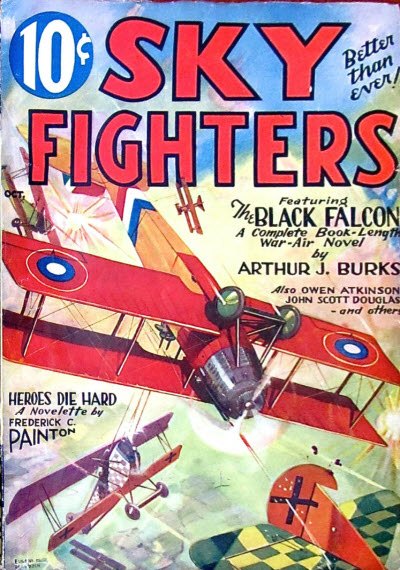
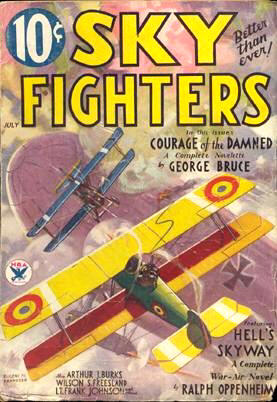
THIS week we have a story by another of our favorite authors—Harold F. Cruickshank! Cruickshank is popular in these parts for the thrilling exploits of The Sky Devil from the pages of Dare-Devil Aces, as well as those of The Sky Wolf in Battle Aces and The Red Eagle in Battle Birds. He wrote innumerable stories of war both on the ground and in the air. Here we have a tale of Captain Jack Malone, the last of his squadron not to be downed by the evil von Satan. Malone learns that his fellow flyers were not killed by von Satan, but captured and had their brains operated on to turn them against their countrymen! To save his pals, Malone must free them from “Von Satan’s Lair!” From the April 1934 Sky Fighters—

Captain Jack Malone Sails the Sky Lanes Grimly in this Gripping Drama of Sinister Secrets of Hun Hate!

My Most Thrilling Sky Fight: Captain Ernst Mathy

Link - Posted by David on May 31, 2017 @ 6:00 am in

Amidst all the great pulp thrills and features in Sky Fighters, they ran a true story feature collected by Ace Williams wherein famous War Aces would tell actual true accounts of thrilling moments in their fighting lives! This time we have German Zeppelin Commander Captain Ernst Mathy’s most thrilling sky fight!

Very few stories of the Zeppelin raiders as told by the raiders themselves have come out of the Great War. Captain Ernst Mathy was one of the most famous of all wartime Zeppelin commanders, having made before he was killed in his final raid over London, six successful night raids over that well protected city, more than any other Zeppelin commander. It was Captain Mathy who developed and perfected most of the strategy of attack for the giant Zeppelins operated by the Imperial
 Flying Corps.

It is not generally known, but it was a fact that there were two divisions of Zeppelin raiders; those operated by the German navy and used for scouting of the British battle fleet on the North Sea, and those operated by the army and used for bombing raids on the capital cities of England and France. The last being, of course, the most spectacular and dangerous duty. Captain Mathy was the ace of aces of all Zeppelin commanders, and despite his army affiliation, his most thrilling fight in the air was with five submarines of the British navy. The story of this strange fight between the monsters of the sea and air as told in Captain Mathy’s own words, follow below.


SINKING A SUBMARINE

by Captain Ernst Mathy • Sky Fighters, January 1935

I HAD taken the L-31 over the North Sea, but was balked in my attempted raid on London by heavy rain and low-hanging storm clouds, so had to turn back. I did not want to return with a full load of bombs and without doing some damage, so I dropped down low and skirted the coast line in a northerly direction, looking for enemy surface craft as possible targets.

Upon coming out of a cloud I was surprised to spy a cluster of five enemy submarines floating on the surface. I circled back into the cloud and descended, coming out again at an altitude of about 2000 feet over the subs. They, of course, saw me then and went into immediate action with their deck guns. One shell put my forward starboard motor out of commission. I ruddered in against the window and dropped lower.

Shells were popping up now like spouting geysers and the subs were moving in ragged circles. I dropped a demolition bomb. It landed a hundred yards from the nearest sub. A shell exploded now in my port gas tanks, ripping the framework on that side to shreds, but happily causing no fire. I got still lower, then dropped another bomb. It missed, also, but only by a few yards.

The submarines began to submerge now and travel away from each other in tangential paths. I immediately loosed another bomb. There was a terrific explosion when it hit a huge fountain of water that hid the diving submarine from my vision temporarily. But when the cataract subsided, I saw the sub nosing slowly downward.

A few minutes later its stern lifted free from the water, a third of the hull exposed. In another minute it sank. Five minutes later it had disappeared completely, leaving nothing but an oily slick on the surface. The other subs by this time had managed to submerge and were rapidly running away. I could not pursue them because my gas balloonets were sieved full of holes and the L-31 was fast losing buoyancy.

I headed for home, just managed to make the German coast when I was forced to land with my badly crippled craft. There I discovered that one shell had missed severing my elevator and rudder controls by a single foot. If that one had been a foot closer, it would have been the submarine which would have been the victor. As it was, the L-31 had another successful mission to its credit.

“The Gloster Gauntlets” by Frederick Blakeslee

Link - Posted by David on May 29, 2017 @ 6:00 am in

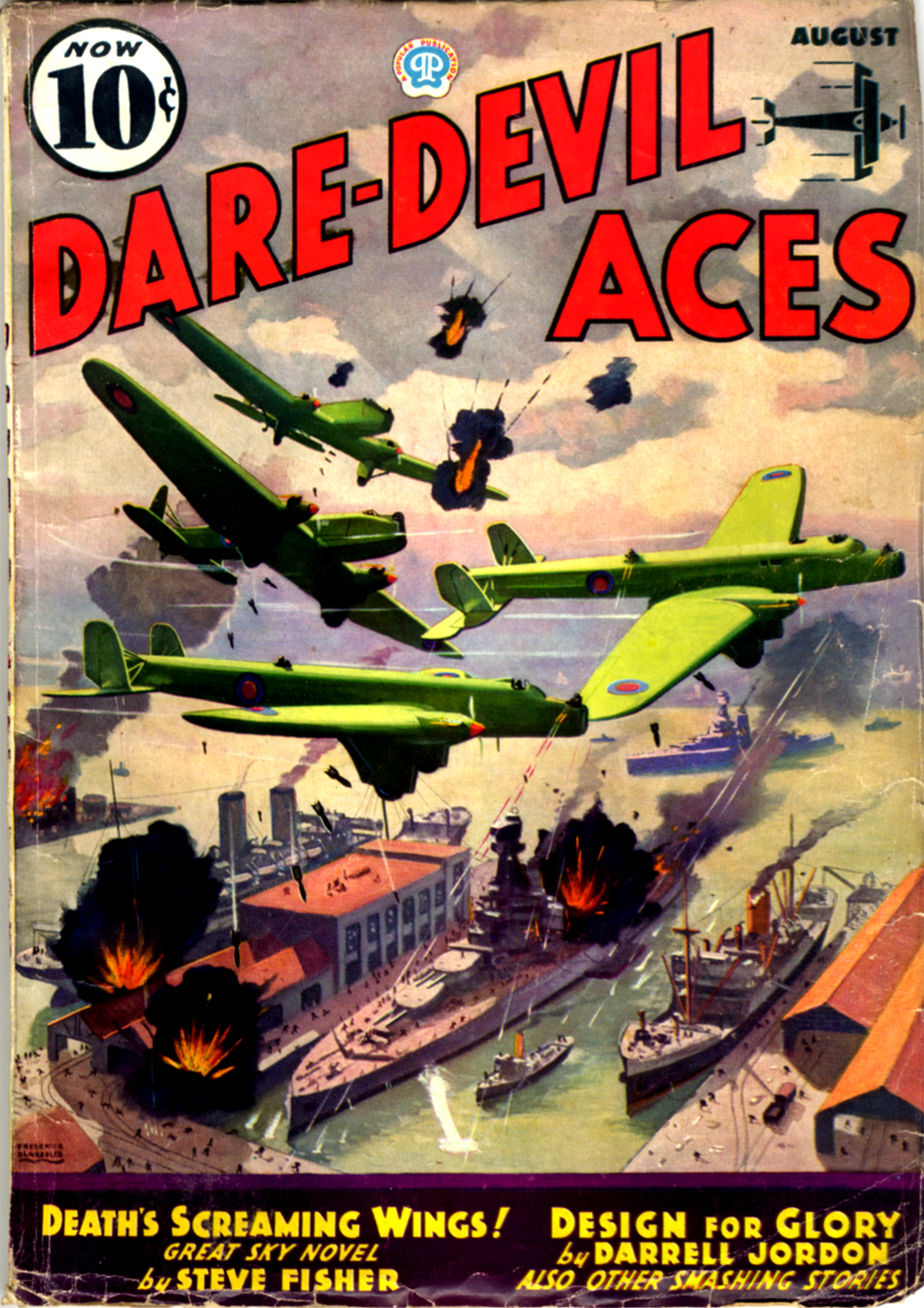
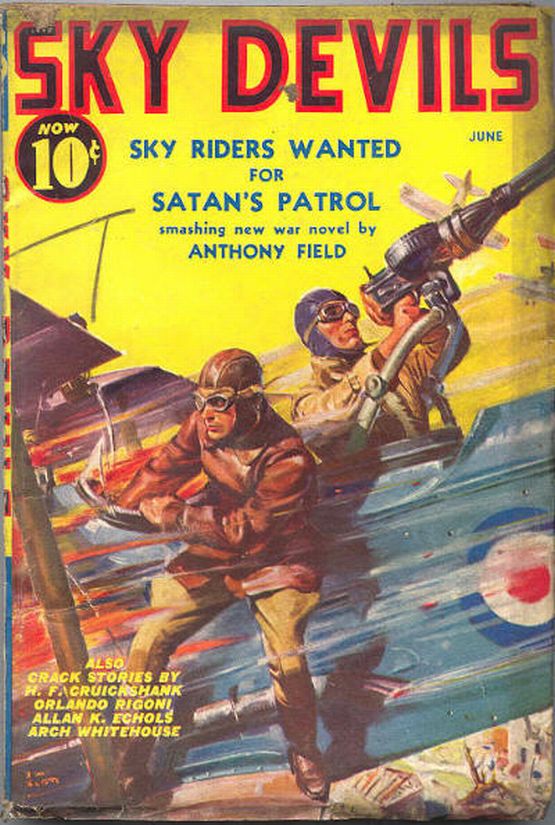
Frederick Blakeslee painted all the covers for the entire run of Dare-Devil Aces. And each of those covers had a story behind it. On Dare-Devil Aces’ April 1936 cover, Mr. Blakeslee has painted a flight of Gloster “Gauntlets” protecting a Handly-Page Heyford on a bombing mission!

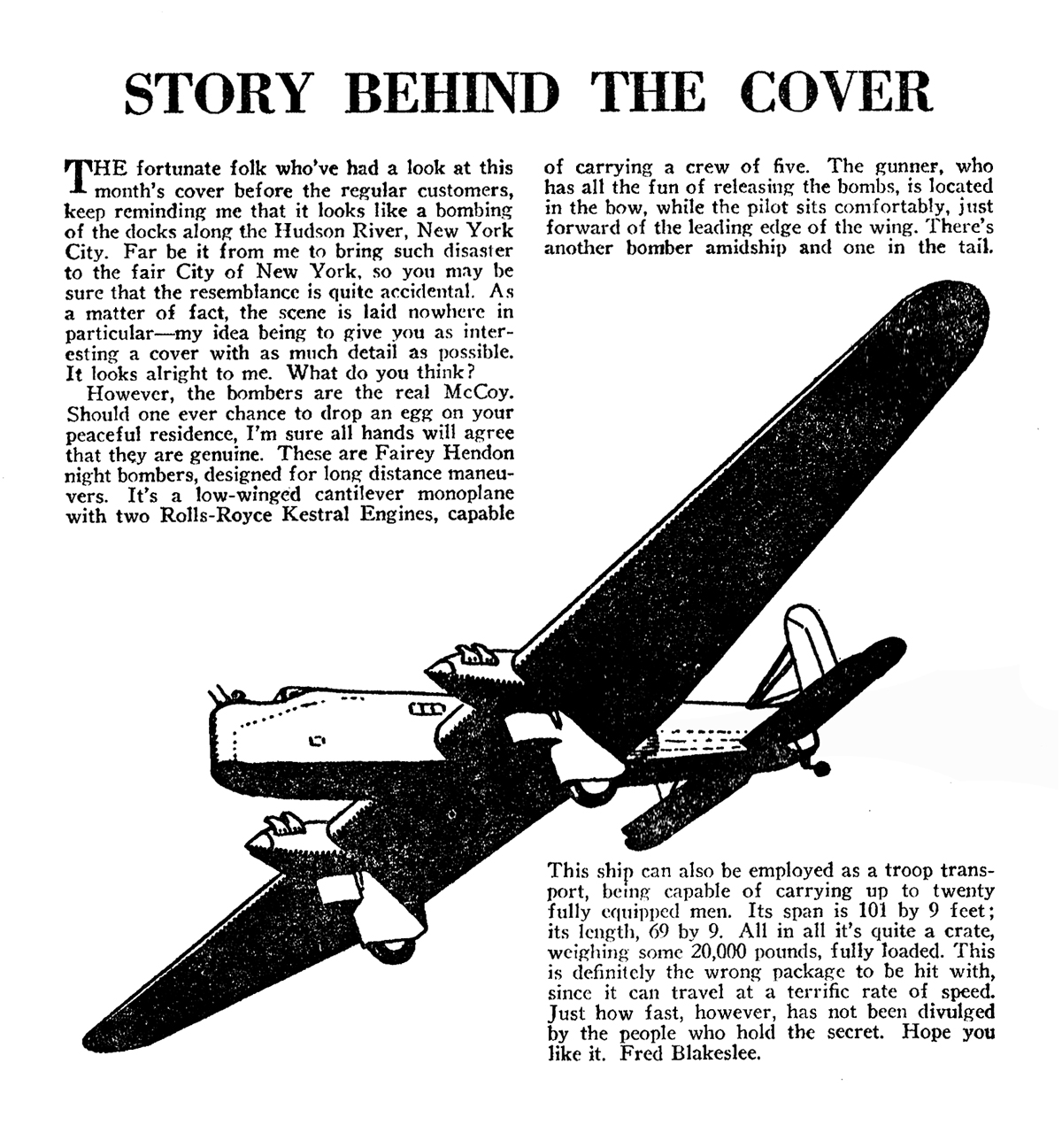
th_DDA_3604THE STORY behind this month’s cover concerns the Gloster “Gauntlets”— and their particular job is the protection of a flight of “Heyfords” which has been sent to bomb an enemy drome. On the cover, the Heyfords have been shown at a very low altitude, so that we might also depict their target. But in reality, they would drop their eggs at no less than 10,000 feet. And at that height, would roar over their target at approximately 143 m.p.h., approaching their objective at a service ceiling of 21,000 feet.

For their protection, some ship had to be selected which would fly well over the Heyford’s maximum 21,000 feet, and be capable of a good scrap regardless of altitude. There simply couldn’t have been a better ship for this job than the Gauntlet, whose service ceiling is 35,500 feet! That is really going up!

At even 15,800 feet the Gauntlet’s speed is 230 m.p.h., and at this and higher altitudes, there is nothing with wings that can give it a decent scrap. At lower altitudes, however, the Gauntlet does not do so well, as its “Mercury” VI.S engine only delivers full power in the upper regions. But in power dives and fighting aerobatics, the Gauntlet is without a peer.

Note the sturdy arrangement of the wing structure, which places the question of wind rigidity beyond all doubt. In our cover, as may readily be seen, the Gauntlet has dropped down to the carpet to mop up the enemy ground crew with its Vickers, and to drop its four 20-lb. bombs, along with the larger shells being dropped by the Heyfords.

The Story Behind The Cover
“The Gloster Gauntlets: The Story Behind The Cover” by Frederick Blakeslee
(April 1936, Dare-Devil Aces)

“One Hun, One Hit, Three Errors” by Joe Archibald

Link - Posted by David on May 26, 2017 @ 6:00 am in

“Haw-w-w-w-w!” You heard right! That sound can only mean one thing—that Bachelor of Artifice, Knight of Calamity and an alumnus of Doctor Merlin’s Camelot College for Conjurors is back. Yes it’s the marvel from Boonetown, Iowa himself—Lieutenant Phineas Pinkham—and he scores with bounders and grounders!

The English team finds the diamond rather wet, and Phineas sacrifices to France the first time at bat. But hang around, fans, the game isn’t over yet! Von Bountz is the next one to fly over the plate—and he gets hammered into left field.

“Flaming Skies” by Raoul Whitfield

Link - Posted by David on May 19, 2017 @ 6:00 am in

THIS week we have another of Raoul Whitfield’s ‘Buck’ Kent stories from the pages of Air Trails magazine. Whitfield is primarily known for his hardboiled crime fiction published in the pages of Black Mask, but he was equally adept at lighter fair that might run in the pages of Breezy Stories. ‘Buck’ Kent, along with his pal Lou Parrish, is an adventurous pilot for hire. These stories, although more in the juvenile fiction vein, do feature some elements of his harder prose.

In the November 1929 issue of Air Trails, ‘Buck’ and his pal Lou have been called in to help rescue some errant Movie men lost in the woods as a raging wild fire bares down on them! Can Buck and Lou find them before the fire does? Find out in “Flaming Skies!”

A groundling’s life and an airman’s code—Fate held the whip and “Buck” Kent fought for both.

My Most Thrilling Sky Fight: Corporal Edmond C. Genet

Link - Posted by David on May 17, 2017 @ 6:00 am in

Amidst all the great pulp thrills and features in Sky Fighters, they ran a true story feature collected by Ace Williams wherein famous War Aces would tell actual true accounts of thrilling moments in their fighting lives! This time we have American Flyer Corporal Edmond C. Genet’s most thrilling sky fight!

The great-great-grandson of Citizen Genet, who served as the revolutionary ambassador from France during George Washington’s term as president, Edmond C. Genet had a distinguished heritage. Mild-mannered and handsome he was a typical soldier of fortune at heart, possessing an astonishing courage. At 10 he missed an appointment to Annapolis and immediately enlisted in the navy where he participated in the taking of Vera Cruz. A year later he was in battle in Haiti. Later on after the war in Europe broke out, he sailed for France to enlist in the Foreign Legion. He served for some years in the trenches as a simple poilu, then was transferred to aviation and assigned to Escadrille N-124, better known as the Lafayette, where he was the youngest American in a company of famous men. Genet’s flying time on the front was short. He was one of the few airplane pilots to be killed in the air by enemy shrapnel. He was the first American to die in action under the stars and stripes, his death occurring just ten days after America entered the war. The account below is from one of his letters home.


HOLDING THE HUNS AT BAY

by Corporal Edmond C. Genet • Sky Fighters, December 1934

I WAS flying along with McConnell at a very low altitude behind the German lines. Mac and I were making a survey of the enemy troop concentration. Intelligence had brought word that the Germans were preparing for a push in our area. We were to check on this, and as the country was hilly and wooded, we had to fly low to make the proper observations.

Being so engrossed with our ground work, both of us had neglected to watch the sky lanes. Suddenly we were jumped by a whole flight of Huns who took us completely by surprise! A burst of Spandau lead crackled through my plane from the rear! I glanced back, saw three Huns on me, throwing lead! At the same instant my right cheek began to sting and something scorched across my hip.

I swept up on one wing tip, whirled around. Two other Hun planes confronted me there. Their Spandaus were smoking. I looked over at McConnell, waved at him to go on with the mission while I attempted to hold off the Huns. I thought I could hold them off by making a bold, dashing frontal attack at first one, then the other. Mac banked off and swept down lower toward the ground.

I charged my first Hun with Vickers chattering. He turned aside and I plunged for the next. The second Hun clung to me and we began going round and round ineffectively. But a third Hun from above dived down, raked my turtleback with tracer. I was forced to pull out, but did not run away. I sneaked further inside the German lines drawing the Hun planes with me.

They had apparently forgotten Mac. Our strategy had been successful so far, but I wasn’t so sure that I was going to figure in the picture much longer. For the Huns had the speed on me and it was only a matter of minutes before I was entirely surrounded again. Bullets came from all directions at once. I was cornered. There was nothing to do but fight my way out boldly.

I dived for speed, then zoomed at my nearest antagonist. My tracer raked across his nose, puffed holes in his upper wing. He rolled off to one side to let me pass, for I was determined I would not turn out for him. That gave me an opening and I streaked through with the whole flight of Huns after me.

Presently I was rejoined by Mac, and what a relief! He was smiling, so I knew he had finished his mission successfully. We fought clear back to our lines where the Huns left us. I had just enough strength left to set down on the squadron drome safely, but my squadron mates had to lift me from my seat. It was a hot fight, but Mac and I got what we went out after—information that enabled our corps commander to forestall the German push!

“H.P.47″ by Frederick Blakeslee

Link - Posted by David on May 15, 2017 @ 6:00 am in

Frederick Blakeslee painted all the covers for the entire run of Dare-Devil Aces. And each of those covers had a story behind it. This time Mr. Blakeslee brings another of his “scrambled time” covers pitting planes of the great war against modern day planes (those from the 1930’s), from the March 1936 issue of Dare-Devil Aces it’s a plane so new it doesn’t have a name yet—The Handly-Page 47!

th_DDA_3603THE HANDLY-PAGE has steadily progressed in design, since before the war to the present day. The pre-war Handly-Page would be a joke today, but in those early days, it was looked upon as the last word in aircraft. It was a two place biplane, but so queer in construction that it would be impossible to describe it. But still, if you want a laugh, look up the pre-war Handly-Page and you’ll get the idea.

Then came the war, and with it, the big twin engined Handly-Page 0/400, which was so far superior to the earlier ship that comparisons would be ridiculous.

It was considered the wonder ship of its day, and with its span of one hundred feet, it would still be considered large, even today. However, with its top speed of only 97 m.p.h. it would hardly be in the same class as the same sized ships of today.

The next step in the design of the Handly-Page was the V/1500, which was still larger. It had a span of one hundred and twenty-six feet, while its four engines gave it a speed of 103 m.p.h. This ship was originally built to bomb Berlin, but the signing of the Armistice, of course, removed the opportunity.

Not much was heard from Handly-Page after the war until 1933, when type 38, more generally known as the “Heyford,” made its appearance : We have already shown this ship on the January cover, so we shall not discuss it here.

This month we have painted the very last word in the Handly-Page series. So far this ship is known as H.P.47, as it has not as yet been officially christened by its designers. It is so new at the time of this writing, that no performance figures are as yet available.

However, it is known to have a very high top speed and a low landing speed. There is a tendency for the monoplane to supplant the biplane in military flying in England and several monoplane types are coming into favor. Midway between the huge Fairey night-bombers and the small high-speed fighters, is the H.P.47.

It is a general purpose ship, and has to perform a variety of duties, such as bombing, photography, long distance reconnaissance, and so on. It can even carry torpedoes, to operate with the fleet. But it must also be able to fight, and towards that end, presents a unique feature, notably the slim fuselage, which gives the gunner an unobstructed field of fire.

On our cover we have scrambled time a bit in order that you may compare the H.P.47 with a war-time ship.

We have shown them in combat with the Pfalz DIII and we will say at the outset that it was a mean trick to play on the Germans. In this instance, the Pfalz wouldn’t stand the ghost of a chance against these big ships, because as big as they are, they could have flown circles around the Pfalz, with its mere 125 m.p.h.

The Story Behind The Cover
“H.P.47: The Story Behind The Cover” by Frederick Blakeslee
(March 1936, Dare-Devil Aces)

“Hell Flies High” by Donald E. Keyhoe

Link - Posted by David on May 5, 2017 @ 6:00 am in

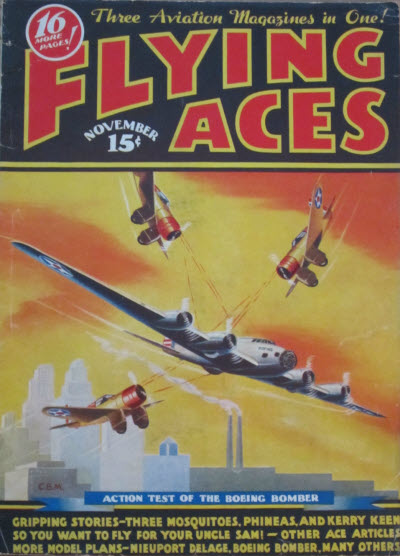
THE unstoppable Donald E. Keyhoe had a story in a majority of the issue of Flying Aces from his first in January 1930 until he returned to the Navy in 1942. Starting in August 1931, they were stories featuring the weird World War I stories of Philip Strange. But in November 1936, he began alternating these with sometime equally weird present day tales of espionage Ace Richard Knight—code name Agent Q. After an accident in the Great War, Knight developed the uncanny ability to see in the dark. Aided by his skirt-chasing partner Larry Doyle, Knights adventures ranged from your basic between the wars espionage to lost valley civilizations and dinosaurs. This, his second tale from January 1937, is more espionage than lost civilizations (like his first).

“Washington to Gray, Flight Eight . . . Washington to Gray . . . Report your position . . .” No sooner had that message rung across those leaden skies when just ahead of his speeding Northrop Richard Knight glimpsed a huge Douglas transport roaring through the snowy blur. And as he saw that ship he cringed. Gray had reported for the last time. For out of that craft’s windows there stared dilated, terrified eyes—the unseeing eyes of the dead. And the faces from which they peered were—a hideous green!

Editor’s Note: His first story, Vultures of the Lost Valley (November 1936, Flying Aces) can be found here.

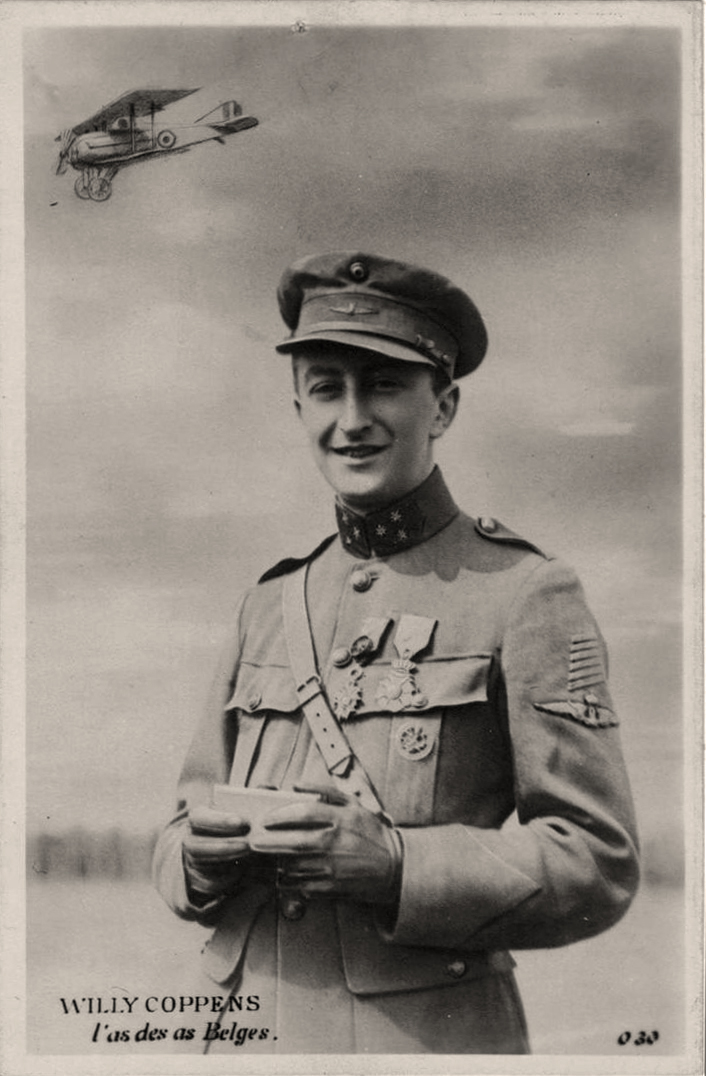
My Most Thrilling Sky Fight: Lieutenant Willy Coppens

Link - Posted by David on May 3, 2017 @ 6:00 am in

Amidst all the great pulp thrills and features in Sky Fighters, they ran a true story feature collected by Ace Williams wherein famous War Aces would tell actual true accounts of thrilling moments in their fighting lives! This time we have Belgian Ace, Lt. Willy Coppens’ most thrilling sky fight!

Willy Coppens was the Belgian Ace of Aces. He got his initial training as a soldier and officer in the cavalry division of the army. He transferred later on to the Flying Corps and began immediately to compile the record of victories that gained him top ranking among sky fighters.

Because the German armies had overrun all but a narrow strip of his own country, he did all of his flying from foreign bases, usually being stationed in the sectors in Flanders occupied by the British forces. Flying foreign machines from foreign bases, he nevertheless built up a remarkable record of successful combats. When his time on the front was ended, unhappily but gloriously, he was officially credited with 32 victories. The account below is from his diary.


TRUSTING TO FATE

by Lieutenant Willy Coppens • Sky Fighters, November 1934

FIGHTING great odds is not an uncommon thing. But today I felt for a time that, at last, I had run into a situation where the odds were too great for me.

I was cruising alone over La Chapelle on solo patrol at a very low altitude because of the low hanging clouds.

A full flight of Fokkers, six in all, came down at me like a lightning bolt. I was bottled up before I fully recovered from my first surprise.

I decided to open the attack myself and fight it out if I could. I dived for speed with throttle wide open, then banked swiftly, aiming for the Fokker below. I pressed both trigger trips, sent out a vicious double burst the instant I lined him. But he had pulled back and swept into a swirling vertical bank at the same instant. My burst passed harmlessly beneath the Fokker’s trucks. And instantly bullets began to clatter and zing through my instrument board. I glanced back up, saw one Fokker bearing down on me not more than 10 meters off my tail.

I jerked into a desperate loop, whined out with my attacker just ahead of me. Again I pressed my triggers. This time my bursts literally tore the Fokker to pieces. The vertical rudder shattered, sheared away. Only a quick maneuver on my part saved me from being hit by it. Next the whole tail seemed to disintegrate, and the following moment the Fokker nosed abruptly earthward. First blood was mine. It gave me confidence. But too soon!

When I looked up again, another Fokker was charging at me head on, both Spandaus yammering. The smoke streams parted my wings. Then a second stream of tracer rattled in from the rear. I was getting it fore and aft. I decided to plunge straight ahead.

I did so, gripping both trigger trips and sending out twin streams of tracer as I roared in toward the first Hun. Bullets from the following Hun still rattled around me. But I knew that if I held my ground, the oncoming Hun would have to swerve to escape being rammed in midair. But my senses would not stand the sight. I could not look at the Fokker charging at me, so I closed my eyes and decided to keep them closed until I counted off ten seconds. I kept my guns firing all the time, for the Fokker was centered directly in my sights.

I expected in be killed, and trusted only to fate. The seconds passed interminably in the darkness I had willed. Still I lived! At the count of ten I opened my eyes. The Hun who had been flying at me from in front was spiralling down toward the ground, his plane a mass of red flame and black smoke trails.

God had been with me I knew then. I had got that Hun with my eyes closed. My bullets had exploded his gas tank. Charged now with a renewed vigor and desire to live, I wheeled and attacked my pursuer. But the three remaining Fokker pilots did not stay to fight any longer. They ran for home. I would have chased them, but when I looked at my ammo supply, I saw that I had none, so I went home myself.

“The Vickers Vampire” by Frederick Blakeslee

Link - Posted by David on May 1, 2017 @ 6:00 am in

Frederick Blakeslee painted all the covers for the entire run of Dare-Devil Aces. And each of those covers had a story behind it. On the February 1936 cover of Dare-Devil Aces, Mr. Blakeslee brings to our attention a plane that sounds like it’s straight out of the pages of G-8 and his Battle Aces or Captain Philip Strange—The Vickers Vampire!

th_DDA_3602NEARLY every reader has heard the merits of the Spad, Camel, S.E.5 and Fokker DVII drummed into their ears by fiction writers. Authors, of course, write about the ships with which they are most familiar. The authors of the stories in this magazine were war fliers, and as the United States did not have combat ships in France, the Americans used the French ships, mostly Spads. That is why, in the majority of stories, the Spad figures so prominently and since the Germans had practically washed out the Phalz and Albatross in favor of the Fokker DVII by the time the American aviators became effective at the Front, naturally the DVII figures largely in these stories, since they were the ships the authors fought against.

However, we have painted on this month’s cover a little ship that happens to be a pet of ours, and I think you will agree that she’s a beauty. We recommend to authors the Vickers “Vampire”, which is, by the way, rather a sinister name. This ship is rarely heard of in fiction. It was a trench strafer and the first ship to make a name for itself in France.

Its low altitude speed was 121 m.p.h., which made it a pretty speedy target for the dreaded ground machine guns. Machine guns on the ground, however, were more dreaded than those of enemy planes. It also took a high order of courage to attempt it.

The “Vampire” was a pusher, driven by a four-bladed propeller. It was an attempt to solve the forward field of fire. The pilot was out in front of the top wing with the motor behind and machine guns in front, a nasty bus to crash, but then, aren’t they all?

The Story Behind The Cover
“The Vickers Vampire: The Story Behind The Cover” by Frederick Blakeslee
(February 1936, Dare-Devil Aces)

“Pfalz Teeth” by Joe Archibald

Link - Posted by David on April 28, 2017 @ 6:00 am in

“Haw-w-w-w-w!” That sound can only mean one thing—that Bachelor of Artifice, Knight of Calamity and an alumnus of Doctor Merlin’s Camelot College for Conjurors is back—Yes it’s the marvel from Boonetown, Iowa himself—Lieutenant Phineas Pinkham! Red Riding Hun has been terrorizing the trenches and the Boonetown marvel concocts an ingenious plan to bring an end to their reign of terror!

Mice are bad. Trained mice are worse. But trained mice in the hands of Phineas Pinkham made even the long-suffering Garrity turn the color of an Irish flag.

My Most Thrilling Sky Fight: Lieutenant Adolphe Pegoud

Link - Posted by David on April 19, 2017 @ 6:00 am in

Amidst all the great pulp thrills and features in Sky Fighters, they ran a true story feature collected by Ace Williams wherein famous War Aces would tell actual true accounts of thrilling moments in their fighting lives! This time we have Lt. Adolphe Pegoud of the French Flying Corp’s most thrilling sky fight!

Adolphe Pegoud was a famous flyer before the war began. In 1913, flying a tiny Bleriot monoplane, he astonished the world by doing a series of intricate air maneuvers. Later, he made an upside down landing, the first and to this day the only aviator deliberately to perform such a stunt.

With Pourpe, Garros, Vedrines, and several others, he made up the first French air squadron to see action in the World War. In those days planes, frail contraptions of wood, linen and wires, were not armed. The pilots usually carried a rifle or shotgun when going aloft, and sometimes darts and hand grenades. Plane to plane fighting was unknown. The crafts were used for scouting. Pegoud changed all this when ho initiated the first air battle. He tells about it in the account below.


THE FIRST AIR BATTLE

by Lieutenant Adolphe Pegoud • Sky Fighters, October 1934

WHILE I had always carried arms while on my trips over the Boche lines and many times had passed within fifty or a hundred meters of Taube pilots, I had never thought to try out my marksmanship on the flying targets. But on this day when I was ordered aloft, I decided that I would allow no more Taube pilots to pass me by so nonchalantly. At least, I was going to let them know that there was a war taking place.

And lucky for me, I encountered my first Taube the same day I was filled with that resolve. I met him just beyond the Fortress of Verdun. He was just a speck when I first glimpsed him off to my right, but I ruddered toward him, flying as fast as my machine would carry me. At one hundred meters distance, the Taube pilot stood up in his seat and waved at me. That fact made me mad. Here I had come to kill him (if possible) and he greeted me with that friendly gesture. I waved my Lebel in the air over my head and shouted at him in French to beware. Of course, he could not hear because of the noise of the engines.

He continued on past me and I swung around and followed him. This maneuver seemed to surprise him. I continued on, coaxing my machine to its greatest speed. Finally I was not more than ten meters to the rear of his. I shouted again, made faces, then put the rifle to my shoulder and fired a bullet over his head to let him know my intentions. Though I had firmly resolved to shoot at the pilot, I realized now that I could not, for he wan apparently unarmed and had been so friendly.

When I fired at him, he must have seen the smoke from my Lebel or saw it flash. He knew then that I was not fooling and tried to escape from my plane by streaking down toward the earth. But I followed intently, my mind occupied now, not on shooting the pilot, but damaging his machine so it would have to land, thus ha would be unable to accomplish his mission.

I stood up in the pit and fired two shots at his gas tank, but nothing happened. Then I had to sit down and maneuver my plane again. The Taube pilot was zigzagging. I got closer and stood up again. This time, he too, stood up, and hurled a hand grenade back at me. But his aim was wild. It hit on the ground far below and exploded there sending up a puff of blue smoke. I aimed my rifle and rapidly fired all my remaining shells at the gas tank again.

Now I saw that something had happened. The Taube began to wobble crazily. The Boche pilot seemed frantic. Finally the motor stopped turning. Then I saw what had happened. One of my bullets had cracked the propeller, and it had shattered, throwing the Taube into terrific vibration and forcing the pilot to cut his engine.

He had to go down. I wished then that I had not been so hasty, for as it was he landed inside his own lines. If I had waited, I could have captured him by forcing his landing on our side. A fresh Taube and its Boche pilot would have been a great trophy to take home and show my mates.

“The Handly-Page Heyford” by Frederick Blakeslee

Link - Posted by David on April 17, 2017 @ 6:00 am in

Frederick Blakeslee painted all the covers for the entire run of Dare-Devil Aces. And each of those covers had a story behind it. This time Mr. Blakeslee brings another of his “scrambled time” covers pitting planes of the great war against modern day planes (those from the 1930’s), from the January 1936 issue of Dare-Devil Aces it’s The Handly-Page Heyford!

th_DDA_3601ANOTHER scrambled time cover. As you see, it is an impossible situation. We mean, a war-time Albatross and a modern bomber! But in order to show the comparison between the ship used during the World War and the ship of today, we have taken liberties with Father Time. The Albatross seems to be on the top of a loop, how he got there we’ll let you figure out. And of course, the Albatross could never have overtaken the bomber from the rear. Note the size of the pilot in the bomber, it is a huge ship, the little Albatross (big on the cover because it is nearer) could almost land on the wing of the bomber. Huge as this ship is, it could have flown circles around the Albatross. As a matter of fact, there are few pursuit ships even today that could overtake it, which fact, at the time of writing, seems to be worrying a few countries. If a modem pursuit ship cannot overtake a modern bomber, what chance would the war-time ship have? How can these big bombers be intercepted? Well, that remains to be seen, we may be finding out by the time this magazine is in your hands, what with all this war talk.

But to return to the cover, I suppose you have recognized the bomber, but who would ever guess that it is the offspring of the war-time Handly-Page? It no more resembles its “parent” then the first Handly-Page resembled the war-time Handly-Page. If you want a laugh some day, look up pictures of the first Handly-Page.

This ship is the Handly-Page “Heyford” previously known as type 38. It appeared on the scene in 1933 and is still being produced. Its most striking characteristic is the way the fuselage is slung immediately beneath the upper wing. This arrangement gives an unrestricted field of view to the pilot. Machine gunners are located in the nose of the ship and behind the top wing. To protect the ship underneath there is an ingenious device, a retractable and rotatable gun turret, directly under the rear gunner. The machine is thus completely protected and the chances are that should the Albatross be so unfortunate as to get within range, it would be just too bad.

The Story Behind The Cover
“The Handly-Page Heyford: The Story Behind The Cover” by Frederick Blakeslee
(January 1936, Dare-Devil Aces)

Silent Orth Returns in “Sunset Song” by Lt. Frank Johnson

Link - Posted by David on April 14, 2017 @ 6:00 am in

SILENT ORTH—ironically named for his penchant to boast, but blessed with the skills to carry out his promises—comes up against a trio of skilled acrobatic flyers that manage to elude the most skilled flyers while downing three enemy planes in every encounter, but Orth asks for one day to do the impossible and take down the trio! From the May 1934 issue of Sky Fighters it’s Silent Orth in “Sunset Song!”

Three Acrobatic Fokkers Work Havoc in the Air In This Zooming Yarn Packed With Thrills and Action!

“The Bluff Buster” by Lester Dent

Link - Posted by David on April 7, 2017 @ 6:00 am in

LESTER DENT is best remembered as the man behind Doc Savage. But he wrote all number of other stories before he started chronicling the adventures of everyone’s favorite bronze giant. Here we have an action-packed tale of the air—The Boche have developed an even faster and better plane and Major Sam Flack has been called in to double bluff a captured Boche agent into taking him behind enemy lines to the prototype!

They played the double-cross both ways from the middle—when it boomeranged on the major none knew which way the fire would fall.

If you enjoyed this story, Black Dog Books has put out an excellent volume collecting 11 of Lester Dent’s early air stories set against the backdrop of World War !. The book includes this story as well as others from the pages of War Birds, War Aces, Flying Aces, Sky Birds and The Lone Eagle. It’s The Skull Squadron! Check it out!


And as a bonus, here’s another article from Lester’s home town paper, The LaPlata Home Press, this time reprinting a feature on Dent originally published in The Daily Oklahoman!


Oklahoma Biographs Lester Dent,

The Wizard Of The Pulps
The LaPlata Home Press, LaPlata, MO • 29 June 1939

Lester Dent

Lester Dent is one of the most valid of cosmopolitans. He was born in Missouri. Was taken to and lived on a series of farms near Broken Arrow (Oklahoma). Just in time to avoid having oil struck on his place. Dent’s father sold out and the family moved to a godforsaken cow ranch in the Wyoming sagebrush.

Then back to Missouri, in 1918, when Dent was 12 years old. Only 33 years old now, he has lived almost everywhere. Recently he returned from a treasurer hunt in the Caribbean on his schooner, “The Albatross”. His home, he says, is wherever he happens to be sitting at his typewriter at the moment. Just at present, that is New York. However: “I guess I’m more Oklahoman than anything else, having lived there longer than anywhere else by about five years.”

Dent got to the fifth grade, moved to another place, and entered high school. There he flunked English for four consecutive years, after which a disgusted teacher asserted that he was hopeless along that line. Graduated from high school in 1923, and took a course in telegraphy. Got a job at $45 a month, later worked nights for the Associated Press in Tulsa.

While on that job, Dent started writing adventure stories. Sent one of them to George Delacorte of the Dell Publishing Company. Delacorte wired him to come to New York if he was making less than $100 a week. “But,” says Dent, “I thought he was nuts. I’m still not sure—” Anyway, after telegraphing friends in New York to inquire about the publisher’s sanity, he went to New York. He was given two magazines (”Scotland Yard” and “Sky Riders”) to fill. Dent cleaned up 4,000 bucks the first month, and as much monthly for three more magazines. Then both magazines went broke. That was in 1931—the depression had arrived. For the next six months he would sell a story to a magazine and before he could sell it another one, that magazine would fold up. Finally he found some that were on an even keel.

Dent’s work has been for the pulp magazines. He has sold to over 30 publications, of the cowboy, detective, adventure, air, and mystery types. Also to writers’ magazines. He uses a dozen pen names, including Kenneth Robeson, Maxwell Grant, H.O. Cash, Tim Ryan, and various others. Has long ago lost track of just how many years he has sold, although he knows the total is more than 1,000. For the last three years he has received not one rejection slip; in fact, the stories were contracted for in advance.

Dent is the second most prolific author in the world. For a year his output was an average of 200,000 words a month, all of which he sold. That, he says, is not his limit. Here’s how he works: Out of bed at 11 a.m., works until about 4 p.m.; reads the papers, takes a walk, naps for an hour; then works until 3 or 4 a.m. Does this five days a week. Biggest production for a day: On dictaphone, 32,000 words; on typewriter, 24,000 words. Most words turned out in a continuous session: 45,000 words (a book). This required a night, day, and part of night. He never revises. His copy comes out of machine and goes in “as is”.

Under the nom de plume of Kenneth Robeson, Dent writes monthly a 60,000-word (book-length) “Doc Savage” story. The “Doc Savage Magazine” was the most successful pulp magazine in the world the sec-year of its existence. Dent claims his character, Doc Savage, is an unconscious composite of the physical qualities of Tarzan of the Apes, the detective ability of Sherlock Holmes, the scientific sleuthing mastery of Craig Kennedy, and the morals of Jesus Christ. He has written perhaps 50 novels about his creation, at present being over a year ahead of the magazine which prints them.

The following should encourage embryo writers. Dent swears it’s true: “Pulp magazines are more widely open than ever for new writers. Just send them a half-way printable story and they’ll buy it. . . The pulps are an excellent training field. When I started writing for them, less than eight years ago, T.S. Stribling and MacKinley Kantor were only pulp hacks.”

Dent regrets that be has written under so many pseudonyms, instead of building up one name—his own—in the pulps. The mistake was made partly because of the fact that editors don’t like to carry more than one story under the same name in a single issue of a magazine. So Dent would sign one with his real name, and others with noms de plume. Occasionally, he has written entire issues of magazines in this manner. Consequently, although his output ranks among the greatest, his name is not especially well known.

Asked if he entertained any unrealized literary ambitions. Dent replied. “One million of them, all made of silver called dollars, and in banks, preferably several banks.” Everything considered, this is not a vain desire at all—for Mr. Dent.

(Copied from The Daily Oklahoman. Sunday, July 19, 1936.)

« Previous PageNext Page »