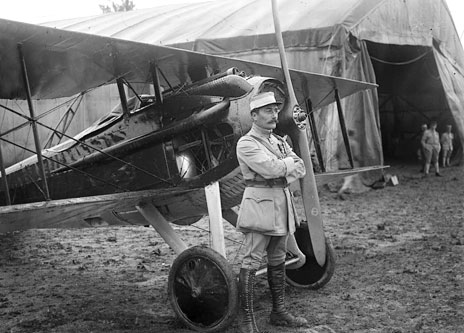
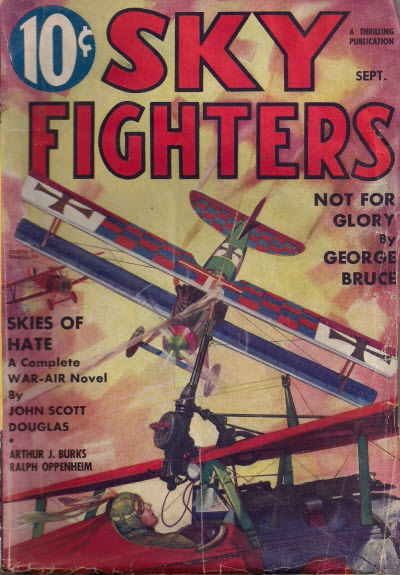
Amidst all the great pulp thrills and features in Sky Fighters, they ran a true story feature collected by Ace Williams wherein famous War Aces would tell actual true accounts of thrilling moments in their fighting lives! This time we have French Flyer Captain Charles Nungesser’s most thrilling sky fight!
Of all the great French Aces, 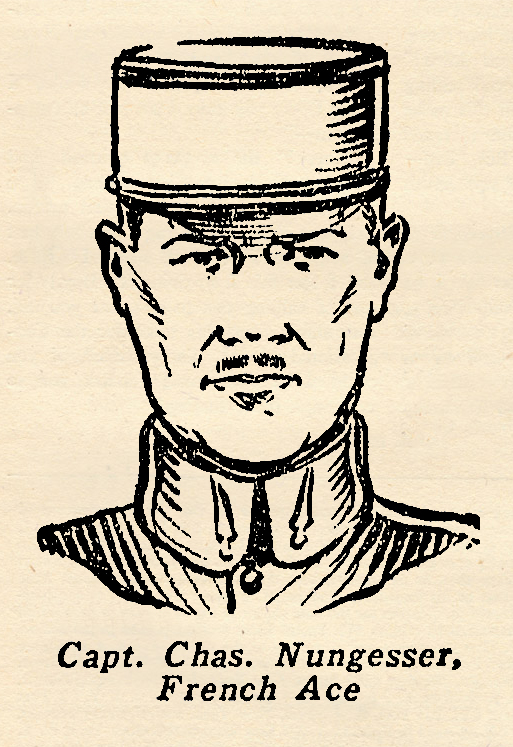 none is more poignantly remembered than Charles Nungesser, who began his flaming war career as a Lieutenant of Hussars and was one of that famous lighting band of cavalrymen that stopped the German Uhlans at the gates of Paris. For his exploits in this heroic stand he was awarded the Medal Militaire, the highest combat award.
But horses were too slow for this daring, dashing young officer. He transferred to aviation and was trained as a bombardment pilot, after which he took part in thirty-eight bombing raids across the German lines, before his unusual flying ability was recognized and he was sent on to a chasse squadron—Nieuport 65.
Nungesser was wounded seventeen different times, but in between times in the hospital managed to run up a score of forty-one victories and was awarded every decoration possible.
Ten years after the war’s end, Nungesser, with a colleague, Major Coli, took off from Paris on an attempted non-stop flight to New York. His plane disappeared into the blue and no trace of either Nungesser, his colleague, or the wreckage of the plane has ever been found. Thus ended the flaming career of one of the greatest of all sky fighters. His own story of a thrilling battle as recorded by a French journalist, follows.
A STRANGE VICTORY
by Captain Charles Nungesser • Sky Fighters, June 1935
ALL duels du ciel are thrilling—some in one way, others in another. It is thrilling to down an enemy after pouring burst after burst into his avion. Many times I have done that, but I think it is even more thrilling, more exciting, and certainly more unique when one downs an enemy avion without firing a single shot. I have done that—in fact, I didn’t even have guns on my avion, let alone bullets. I shall tell you about that.
The motor of my avion had been acting up. The mechanic came to me when he had repaired it, and I said I would take it off for a test flight. I did, went way up into the blue above the clouds to 5,000 meters. The motor was splendid. I sailed around absent-mindedly enjoying the beautiful view, when lo and behold, a Boche avion breaks into the clear space beneath me.
Ready for Battle
It is a two-seater, less than thousand meters away. I dip and go for him, but he sees me before I reach firing range. The gunner in back stands up and swings his mitrailleuse on me. Tack-tack! He puffs a short burst. I slip under it and dive faster, my own fingers poised on the trigger trip—ready to give it to him when I get closer.
I get closer, close enough! The Boche is clear in my sight. I press the trigger— but nothing happens! Another burst from the Boche gunner flicks through my wings. My own gun is jammed, I think. I reach up to clear it, still holding on the Boche’s tail.
But Mon Dieu—I have no gun! The cradle is empty!
I am almost about to crash the other’s tail now. He has to dive to get away. I see the rear gunner standing up in his seat. He is fumbling with his gun. It has jammed. Terror is on his face. The Boche pilot dives and zig-zags to get out of my range. I keep pressing close on top, pushing him down in a long steep spiral.
Waiting for the End
The rear gunner gives up, folds his hands complacently and waits for my bursts to snuff his life out. Down and down we spiral, through the clouds, out underneath. The gunner fumbles at his mitrailleuse again, I decide to run my bluff, hoping that I can force them to land before the gunner clears.
Voila! I do. The Boche pilot spies a clear space and sets down. I circle and land beside them, but I am helpless when they set fire to their machine. I have no guns to prevent it.
Poilus surrounded the burning avion and took the two Boches prisoners. Both were very mad and swore profanely when they found out I had no guns on my avion. But it was another victory for me, the most unusual one! The armorer had removed my gun to clean, when my avion was laid up for repairs. I had neglected to see that it was in place before I took off.




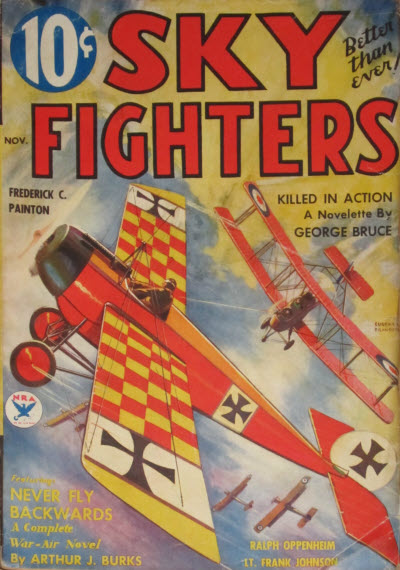 a story from the pen of a prolific pulp author and venerated newspaper man—Frederick C. Painton. In “Flaming Death” Painton gives us a pulse-stirring war-air novelette—”B” Flight’s mascot, Babe Norwood, the squadron’s youngest flyer, is shot down with incendiary bullets! All of the fighting nations had agreed to ban their use—so rigidly were they banned that any flyer caught using them was instantly stood against the wall with barely the mockery of a drum-head court-martial. The squadron uses all avenues of the services to hunt down the culprit and bring him to justice! From the November 1934 Sky Fighters it’s Frederick C. Painton’s “Flaming Death!”
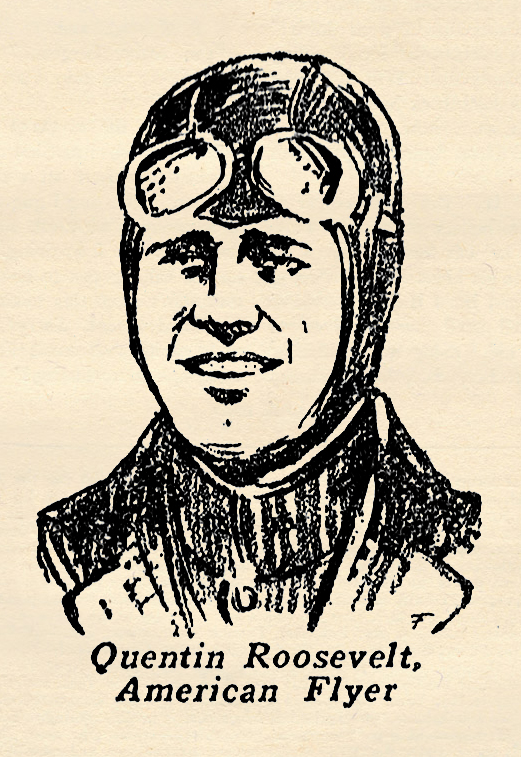 at Oyster Bay, N.Y., the fourth and last son of a famous fighting family, November 19th, 1897, six weeks after his illustrious father, Theodore Roosevelt, had left to fight for the freedom of Cuba. Although handicapped by a permanently injured back, he succeeded by dint of cunning and painful effort in fooling the medical examiners and being accepted for training as an aviator.
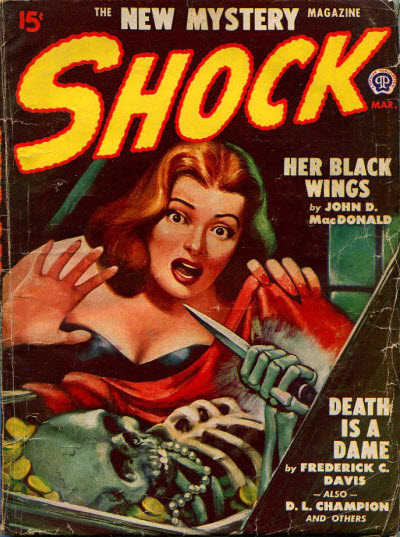 an illustrated feature Blakeslee ran in the pages of New Publications’ weird mystery magazine SHOCK.This was “Adventures Into The Unknown”. “Adventures Into The Unknown” was a two page illustrated feature that explored weird and eerie mysteries and tales.
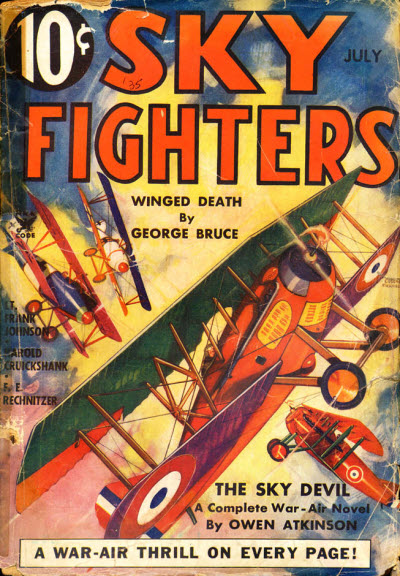 a story from the pen of a prolific pulp author—F.E. Rechnitzer. In “Errant Flight” from July 1935 Sky Fighters, Rechnitzer presents a tale of a pilot who feels he’s washed up and going to be sent stateside any day until fate intervenes and a mistaken order sends him to a British bombing squadron—only problem is Lt. P.T. Garner who can barely land a Spad without cracking up, must now pilot a large Handley-Page Bomber!
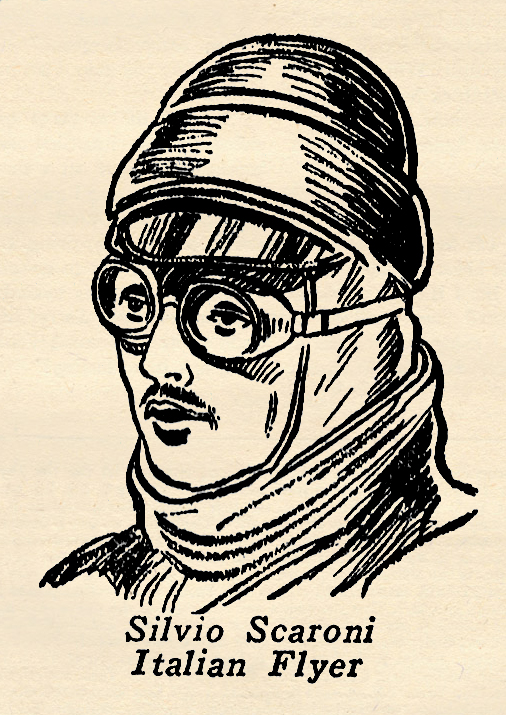 born at Brescia, Italy, and entered the aviation corps at the beginning of the war. As a bomber he was recognized as one of the best in the Italian Flying Corps and he was very adopt in handling big three-engined Capronis. But the big ships were too slow to satisfy Lieutenant Scaroni. He wanted to fly single Heaters and eventually managed to secure his transfer to a combat squadron on the morning of November 14, 1917.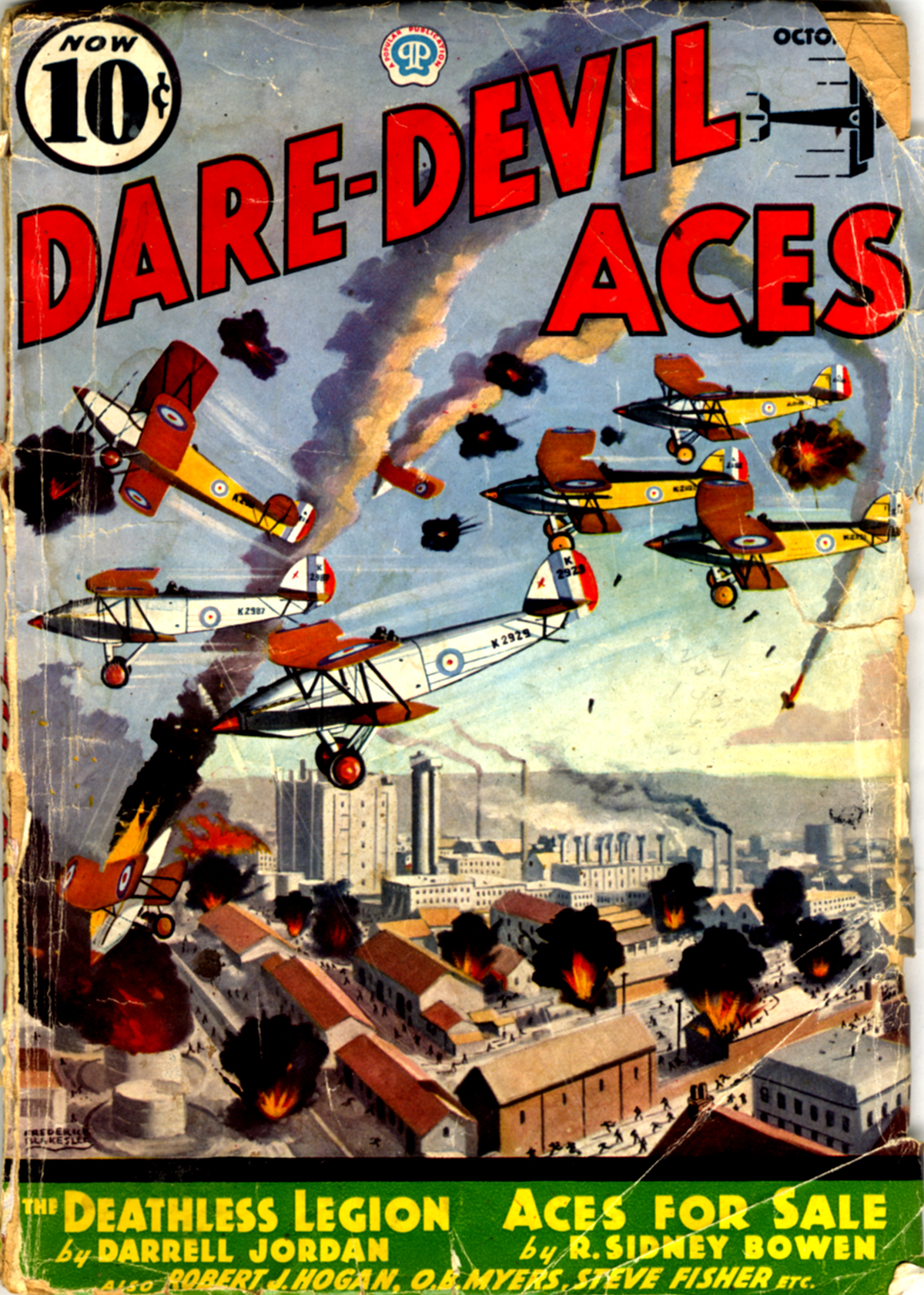
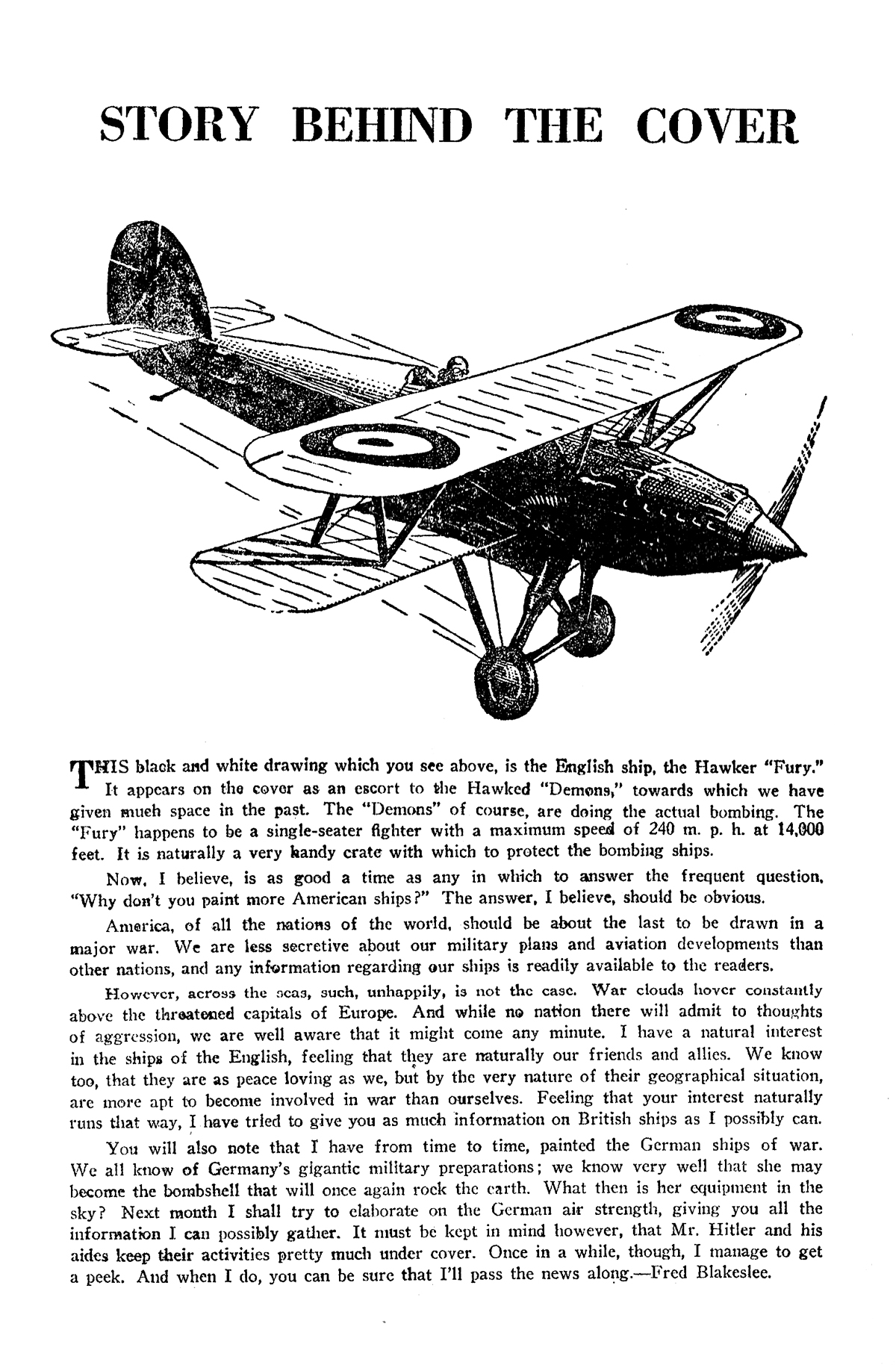
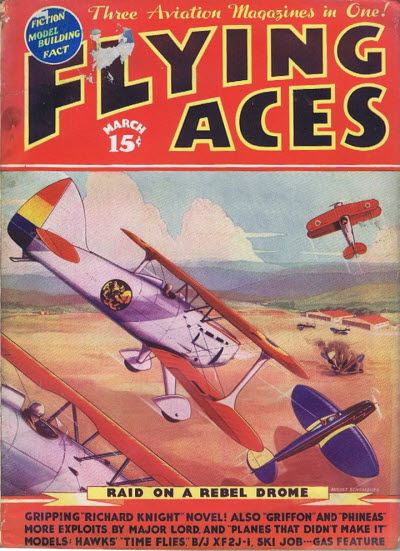 had a story in a majority of the issue of Flying Aces from his first in January 1930 until he returned to the Navy in 1942. Starting in August 1931, they were stories featuring the weird World War I stories of Philip Strange. But in November 1936, he began alternating these with sometime equally weird present day tales of espionage Ace Richard Knight—code name Agent Q. After an accident in the Great War, Knight developed the uncanny ability to see in the dark. Aided by his skirt-chasing partner Larry Doyle, Knights adventures ranged from your basic between the wars espionage to lost valley civilizations and dinosaurs. In this, his third adventure, Knight and Doyle come up against the mysterious Four Faces—a criminal cabal that seek to control all crime on the earth.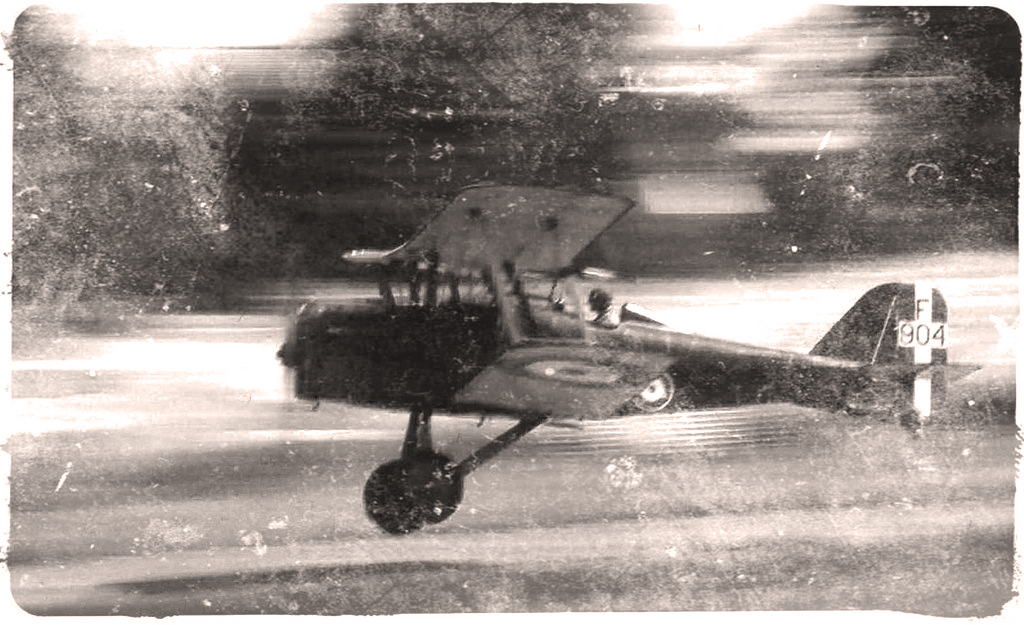
 a story from the one and only creator of The Three Mosquitoes—Ralph Oppenheim! Mickey Rand trained pilots to be Aces using his infallible techniques of air combat. That is until it seemed the German Ace Kemmerer had found a way to beat these tricks, downing three of Mickey’s star pupils and he wasn’t about to let his latest protege, Jim Conway be next!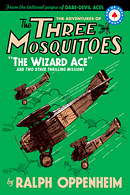
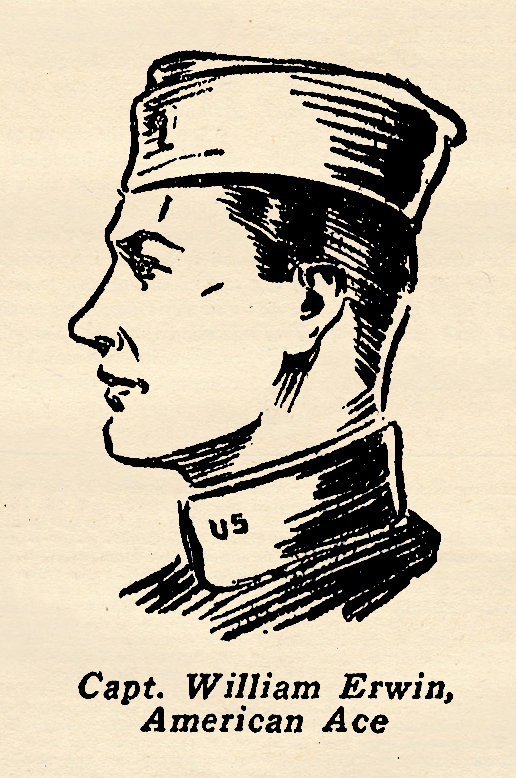 a unique record. He was the only accredited American observation ace, and piled up a string of 9 official victories while flying slow ungainly two-seaters. A Texan, William Erwin enlisted for training the day after war was declared. He received his commission as a Lieutenant after a bare forty hours of flight and was immediately sent overseas and assigned to the First Aero Squadron which he joined on its first day at the front. Before his first week he had downed an enemy plane and the French awarded him the Croix de Guerre. He was awarded additional recognition by the French and also received the American Distinguished Service Cross with Oak Leaves. Through the war safely, without ever having been wounded despite his rare courage and daring, he came to an untimely end while flying the Pacific in a futile search for the missing Dole flyers in 1923. Erwin, himself, recounted the following experience to the compiler of these records on a grey day in the Argonne many years ago.
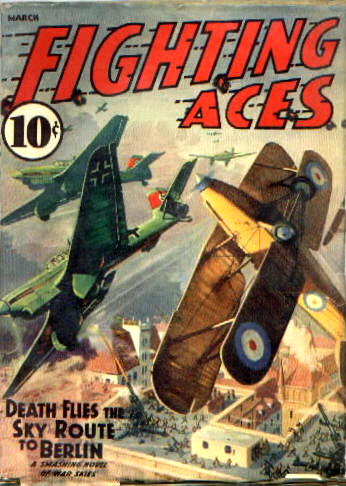 flew through the Hell Skies of 29 adventures in the pages of Dare-Devil Aces from 1932-1935. Cruickshank returned to the savior of the Western Front in six subsequent stories several years later. The first two were in the pages of Sky Devils (June 1939) and Fighting Aces (March 1940). The other four ran in Sky Fighters (1943-1946); and like Oppenheim had done with his Three Mosquitoes, so Cruickshank did with Sky Devil—he moved him to the Second World War where Bill Dawe changes his name to get into the air service and flys along side his son!
 of Sky Devil and his Brood by Harold F. Cruickshank, check out our new volume of his collected adventures in
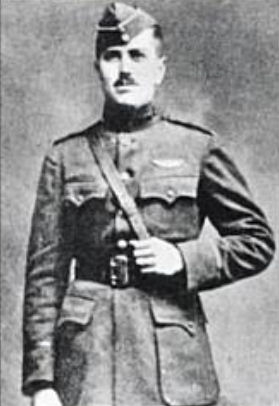 Flight Commander in the 95th Aero Squadron. He is credited with seven victories and was awarded the Distinguished Service Cross with oak leaf cluster, the French Legion of Honor, the Croix de guerre and the Order of the Crown of Belgium. Sewall was the first American aviator whose machine had been
 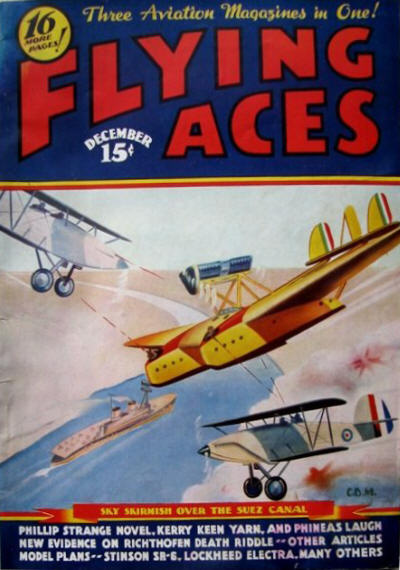 That sound can only mean one thing—it’s time to ring out the old year and ring in the new with that Bachelor of Artifice, Knight of Calamity and an alumnus of Doctor Merlin’s Camelot College for Conjurors—Phineas Pinkham.