Looking to buy? See our books on amazon.com Get Reading Now! Age of Aces Presents - free pulp PDFs

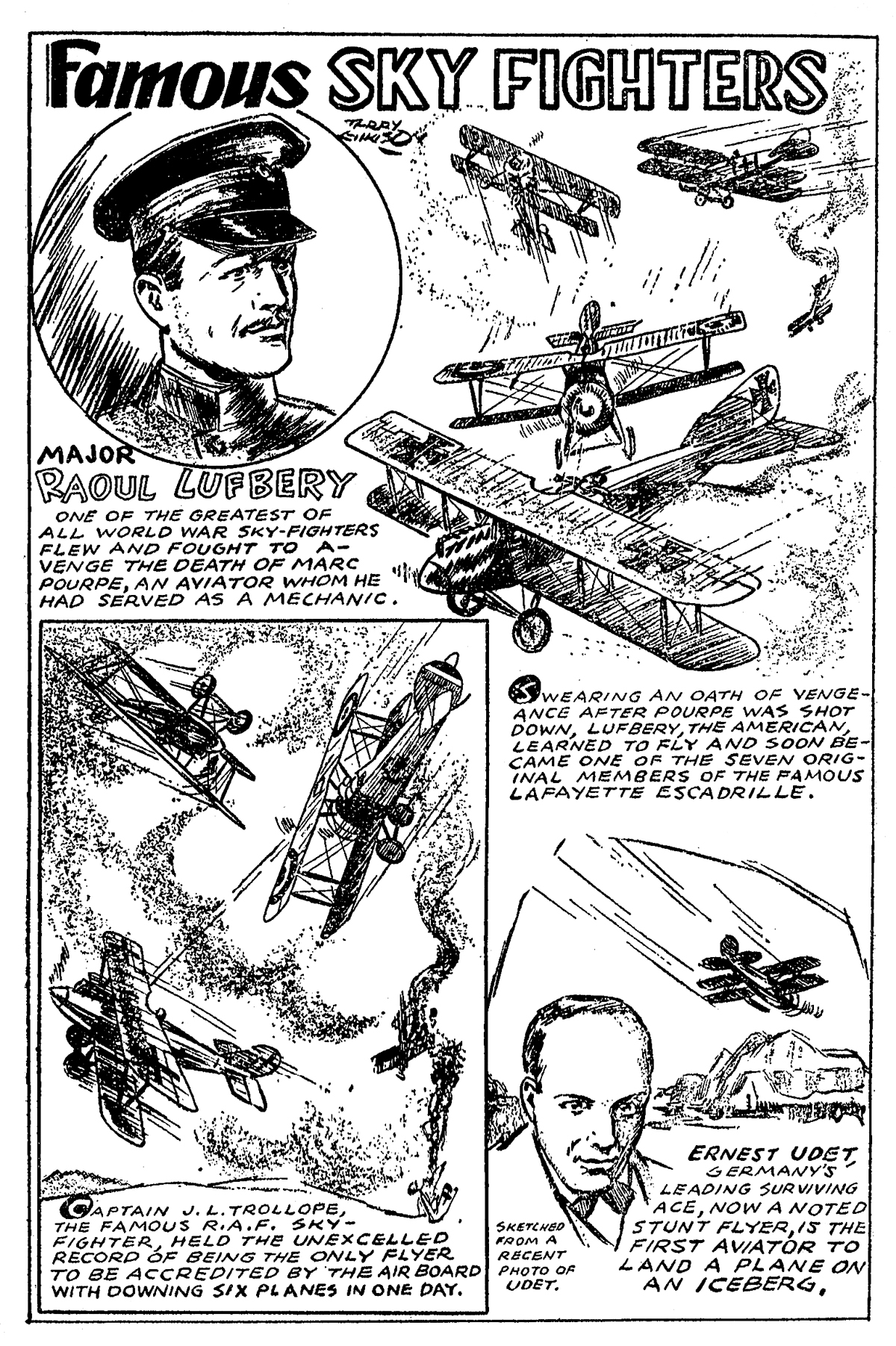
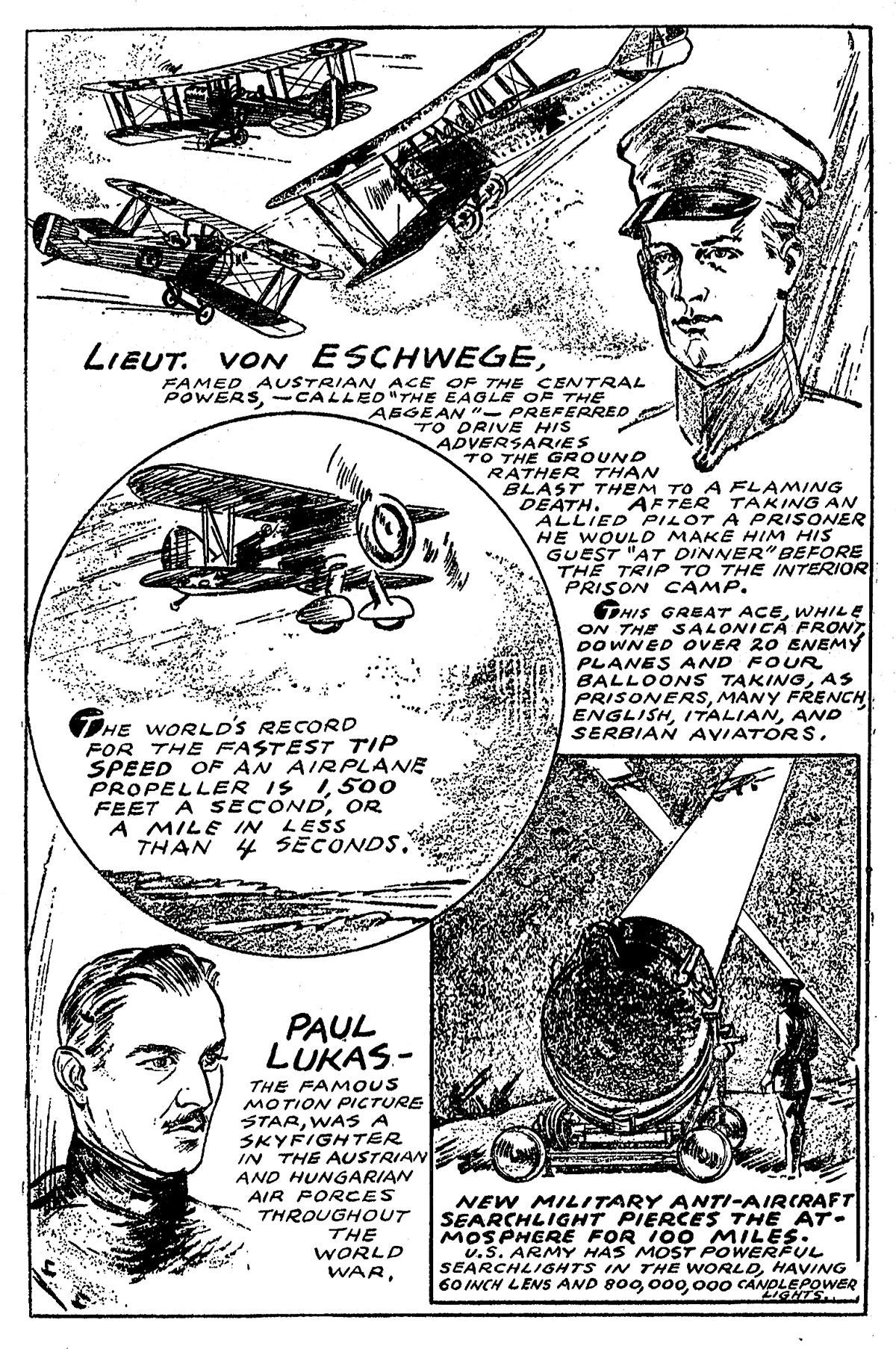
“Famous Sky Fighters, February 1934″ by Terry Gilkison

Link - Posted by David on March 28, 2018 @ 6:00 am in

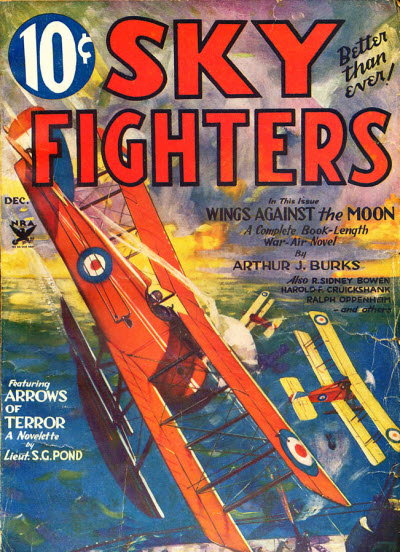
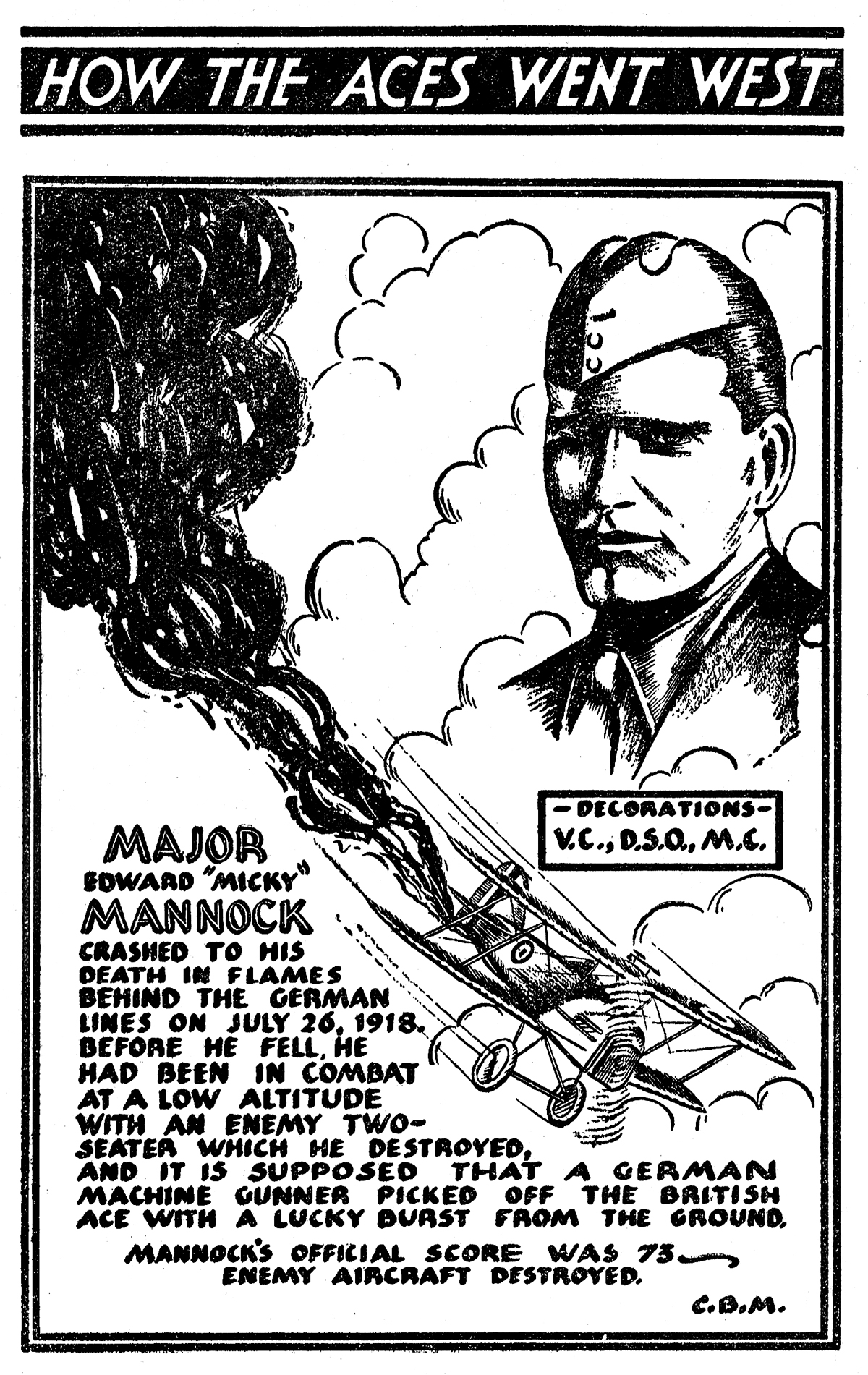
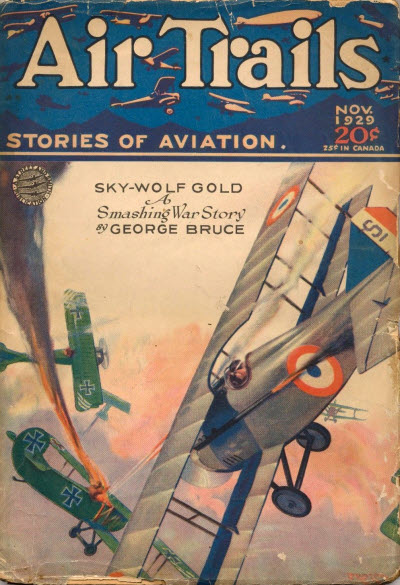
Starting in the October 1933 issue of Sky Fighters and running almost 5 years, Terry Gilkison’s “Famous Sky Fighters” was a staple of the magazine. Each month Gilkison would illustrate in a two page spread different Aces that rose to fame during the Great War.

Although Gilkison was probably better known for his syndicated newspaper work, he also provided black and white story interior illustrations for pulp magazines. His work appeared in Clues, Thrilling Adventures, Texas Rangers, Thrilling Mystery, Thrilling Western, and Popular Western. Gilkison provided similar features in a few other Thrilling Publications—there was “Famous Soldiers of Fortune” and later “Adventure Thrills” in Thrilling Adventures, Famous Crimes” in Thrilling Detective, and the fully illustrated air adventure stories of Buck Barton “The Flying Devil” in The Lone Eagle! He signed most of this work with only his initials “T.G.” to maintain a low profile and preserve his reputation as a syndicated newspaper cartoon artist.

The February 1934 installment, from the pages of Sky Fighters, features American Ace Major George Vaughn, the R.F.C.’s Lt. Malloch, and the great Major Oswald Boelcke!

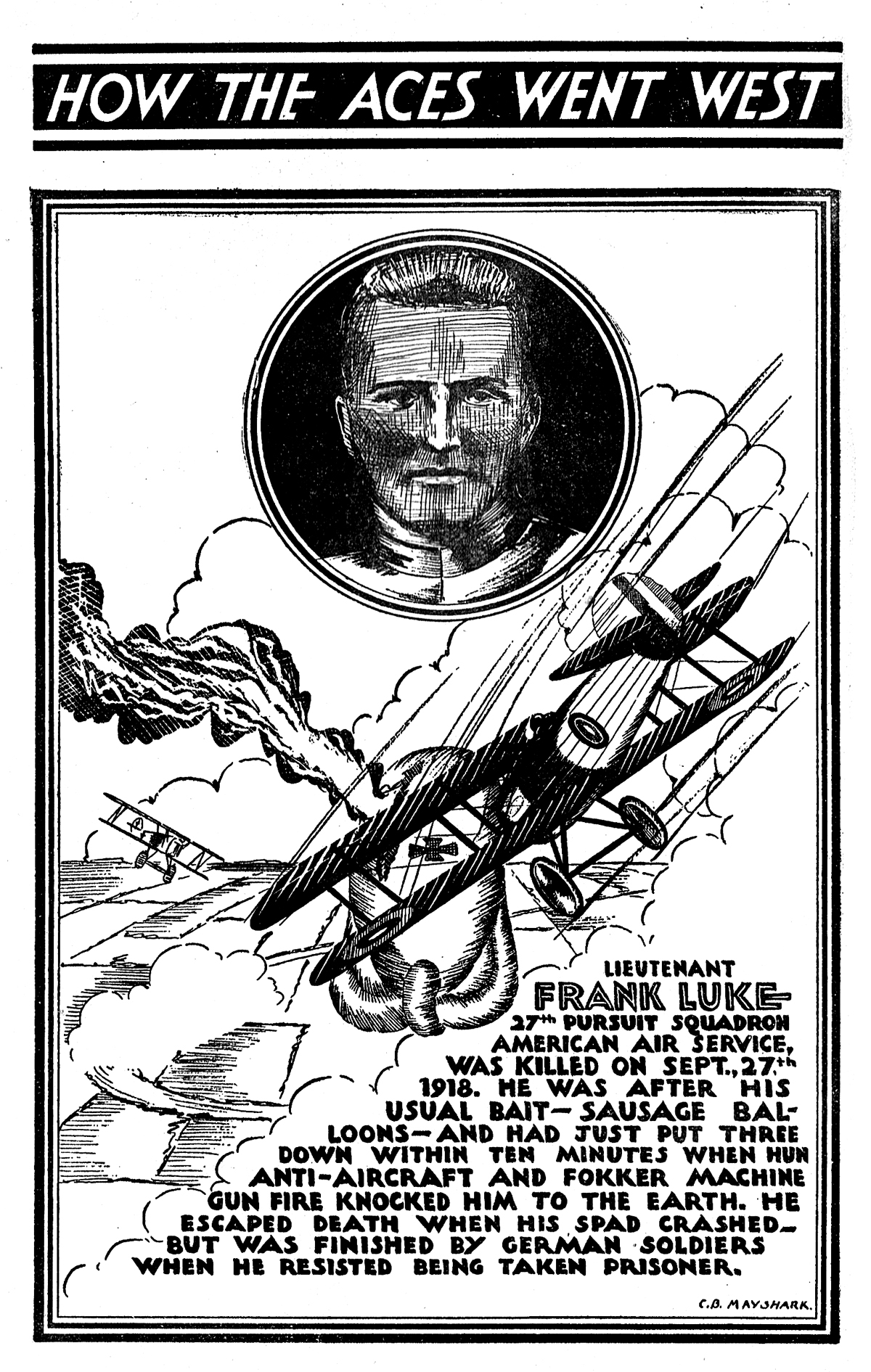
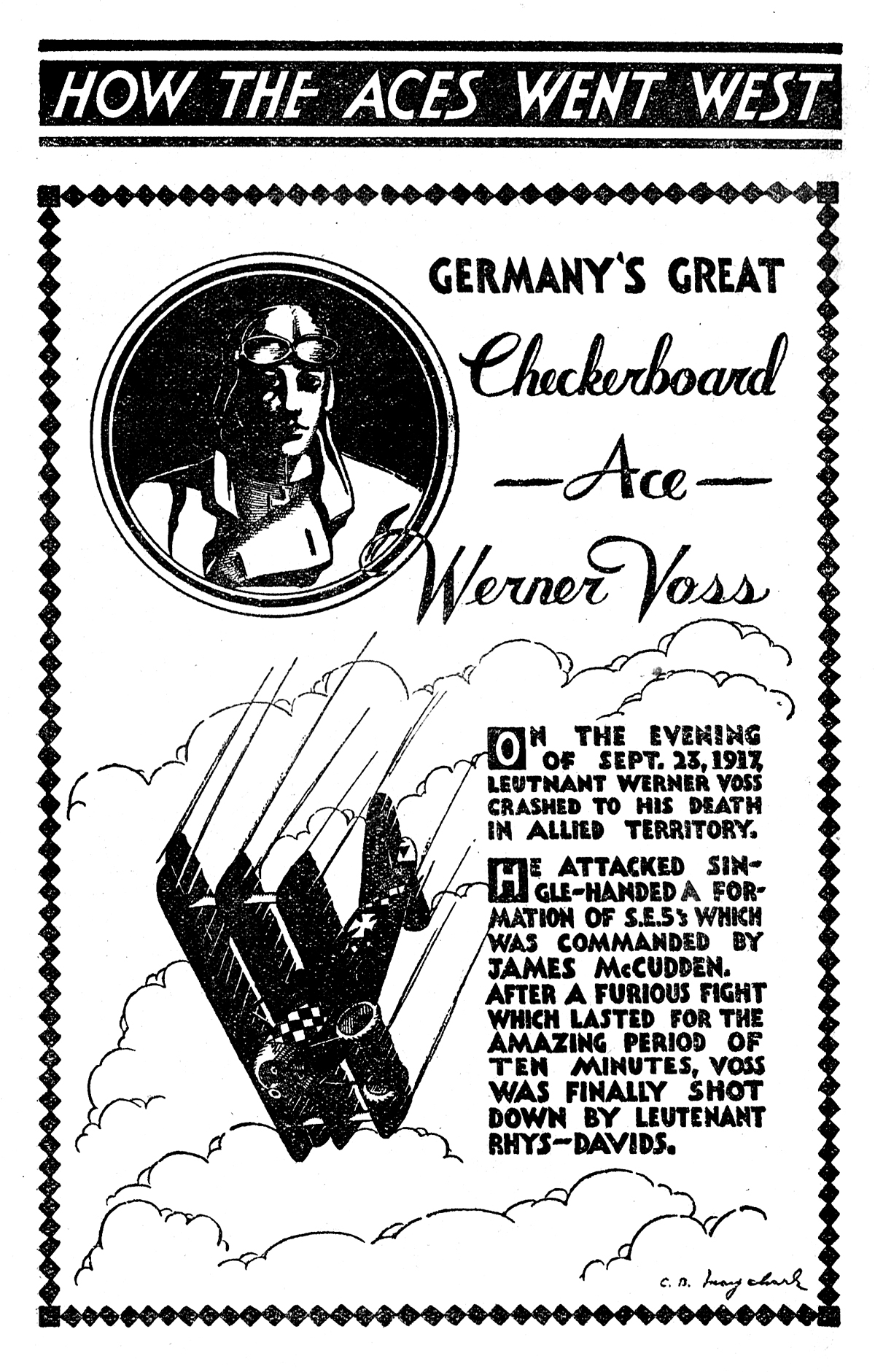
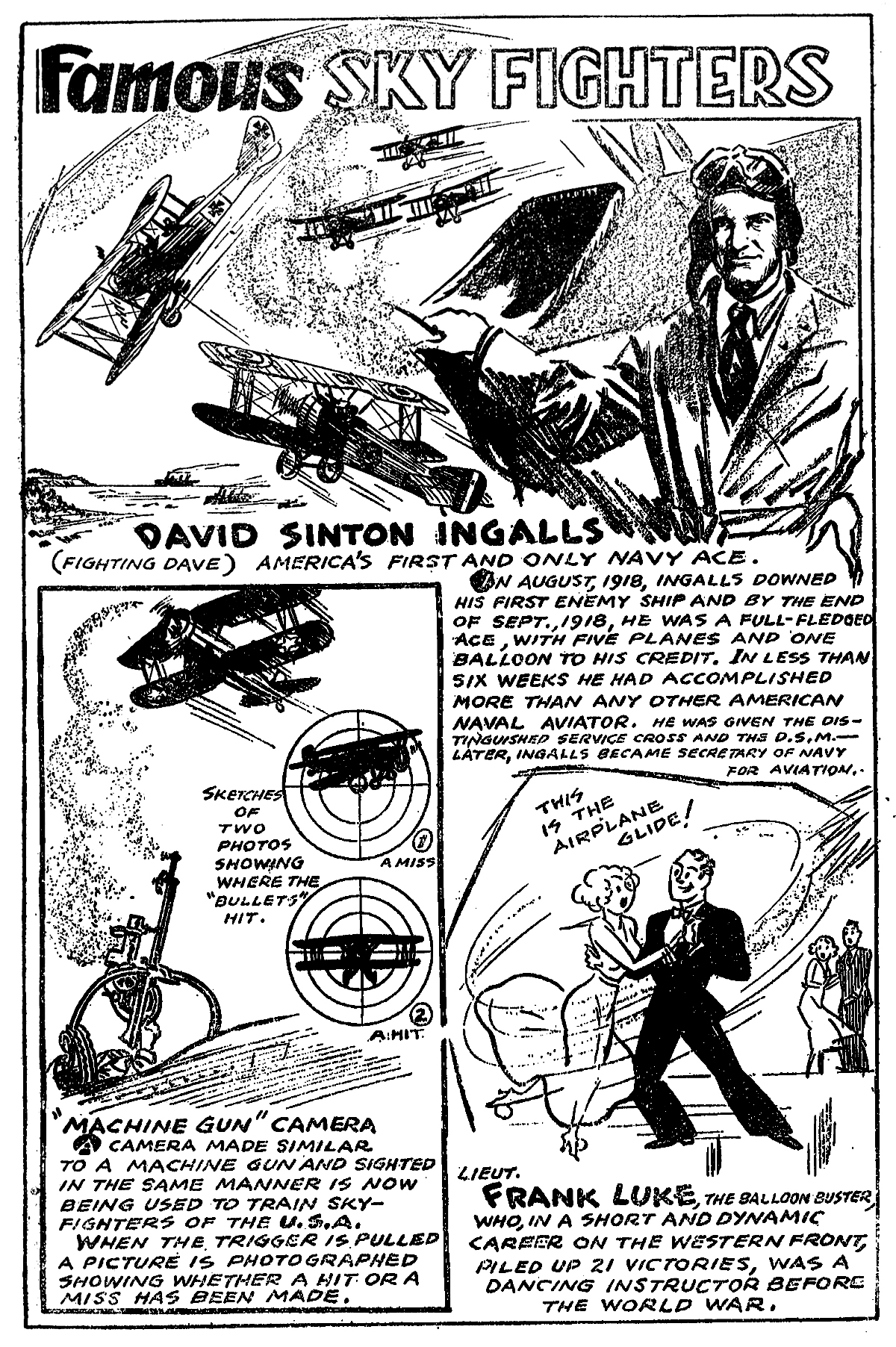
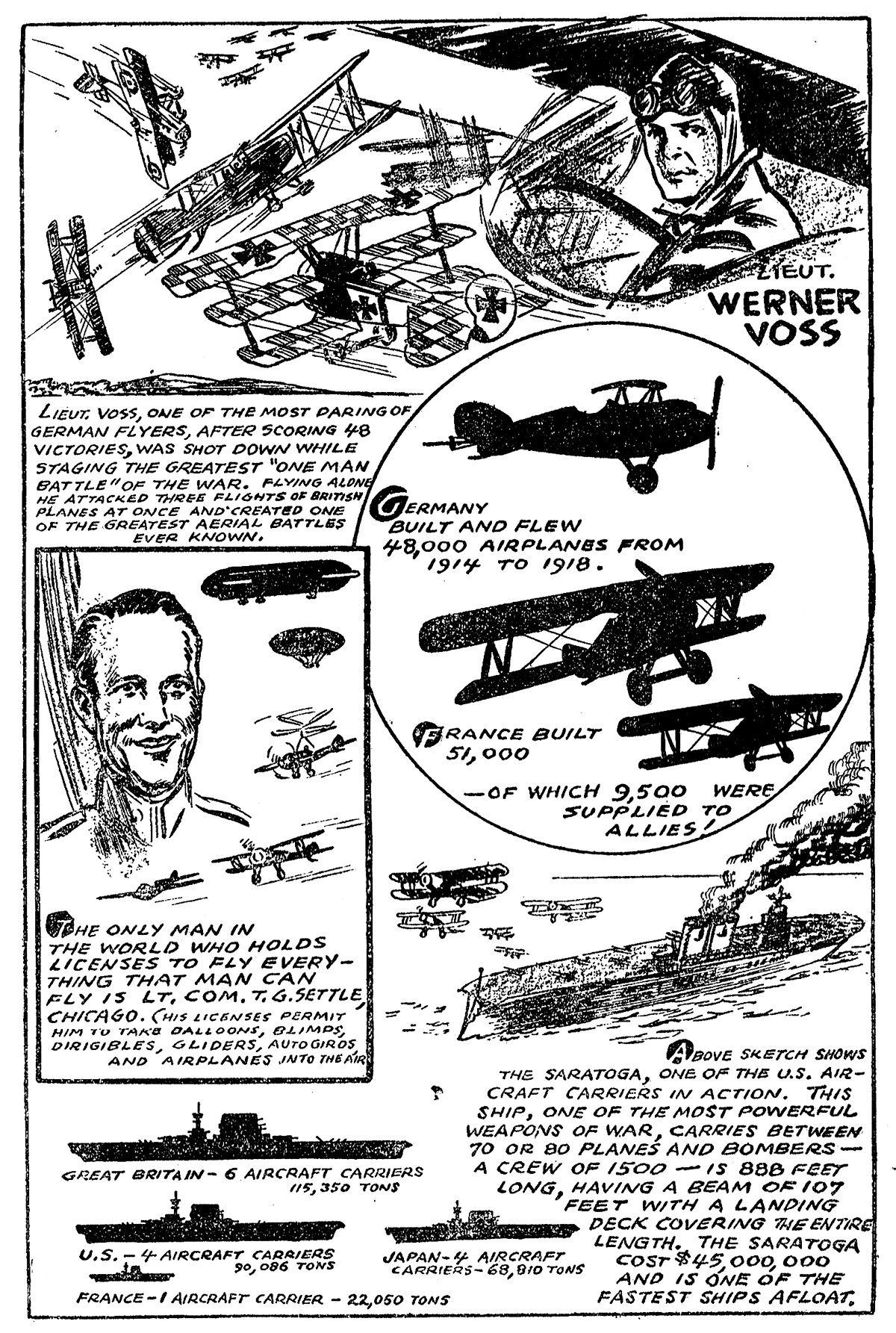
Next time in “Famous Sky Fighters,” Terry Gilkison features “Fighting Dave” himself—David Sinton Ingalls, Lt. Frank Luke, and Germany’s Lt. Werner Voss. Don’t miss it!

“Burning Wings” by Ralph Oppenheim

Link - Posted by David on March 23, 2018 @ 6:00 am in

TO ROUND off Mosquito Month we have a non-Mosquitoes story from the pen of Ralph Oppenheim. “Streak” Davis must stop Erich von Hartwig, Germany’s master flying spy—the craftiest and most underhanded Boche in the war! Von Hartwig just murdered three Allied officers at Chaumont in cold blood—then made off with a dispatch cylinder containing most vital information of our troop movement. His orders: “Head him off and burn von Hartwig and his black Albatross in the sky so there’s no chance of those papers falling into German hands!”

From the February 1935 issue of Sky Fighters it’s “Burning Wings.”

Follow “Streak” Davis on the Perilous Pursuit of A Fiendishly Cunning German Super Spy!

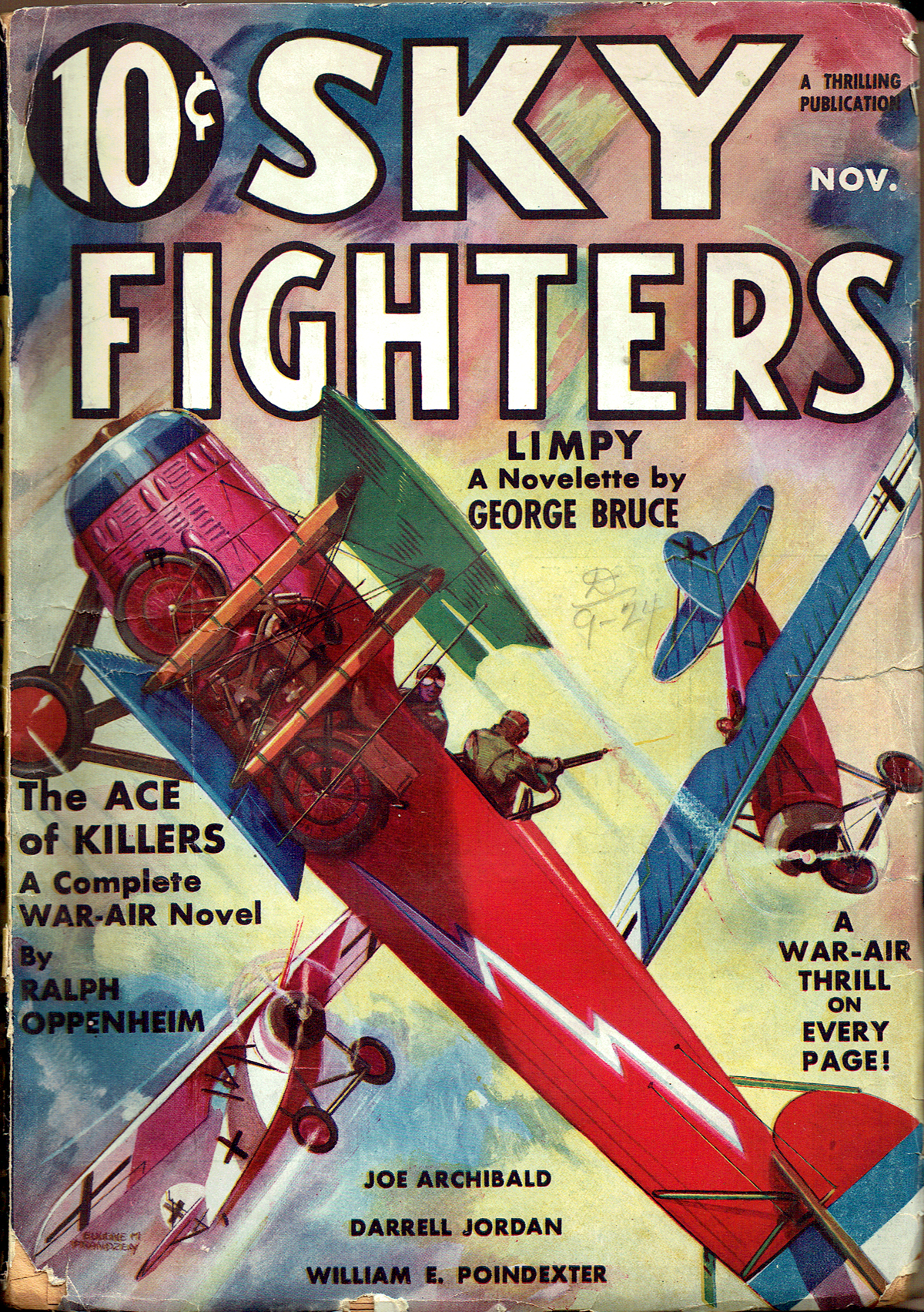
“Sky Fighters, October 1935″ by Eugene M. Frandzen

Link - Posted by David on March 19, 2018 @ 6:00 am in

Eugene M. Frandzen painted the covers of Sky Fighters from its first issue in 1932 until he moved on from the pulps in 1939. At this point in the run, the covers were about the planes featured on the cover more than the story depicted. For the October 1935 cover, Mr. Frandzen features the classic age old battle of Spad 13 C1 vs Fokker D7!

The Ships on the Cover

THE first Spad made its debut in 1916. th_SF_3510It was a heavier ship than the French manufacturers usually turned out. They were prone to seek speed by making engine, wings and fuselage all as light as possible.

Then up popped the first Spad with its heavy Hispano-Suiza motor and its rigidly braced body and all around husky construction. It knocked the spots out of the lighter type of machines. Each succeeding model got heavier and each engine had more power.

Aviators put these husky Spads into prolonged power dives that other machines could not possibly make.

The Finest Fighting Plane

The Lafayette Escadrille swung over from Nieuports to Spads and any French squadron that could beg, borrow or steal them parked themselves in Spads and went up into the skies confident that they had the finest fighting plane in existence.

Of course there was a difference of opinion over on the German side of the line. The Fokker D7 made its appearance and the Heinie flyers just knew that they had the finest machine that ever sprouted wings. Therefore when the confident opposing war flyers, one in a Spad 13 C1 and the other in a Fokker D7 decided to smack each other with a few well placed slugs, it was an interesting show. And doubly interesting if two men happened to be aboard a one-place Spad.

Story of the Cover

Fifteen minutes before the action depicted on the cover, the Spad pilot set his ship down on German territory at a prearranged spot. A figure crawled from a clump of brush, raced to the Spad and shinned onto the right wing. Up zoomed the Spad with its precious wing passenger, an A1Iied intelligence operator who had documents that were important enough to cause three generals to be waiting at that moment at the Spad’s drome.

At a thousand feet the German archies started bursting in profusion. One lucky she11 sheared the undercarriage nearly off the Spad. It lurched and staggered with the swaying encumbrance. The wing passenger inched his way to the cockpit the pilot handed out a small hunk of iron.

Bullet Hemstitching

The passenger went to work just as a Fokker went into action. Three minutes of scientific prying on the shattered undercarriage released it and the Spad leaped forward with ten miles extra speed. It turned on the Fokker and hemstitched it from stem to stem.

The German with two minor wounds admitted the Spad, if it didn’t carry wheels, was the better ship.

He dove out of the fight cursing the anti-aircraft gunners who had ruined a sure kill for him. His only consolation was that his foe’s landing would be about as soft as a racing locomotive hitting the rear end of a cement train.

The Ships on The Cover
Sky Fighters, October 1935 by Eugene M. Frandzen
(The Ships on The Cover Page)

The Three Mosquitoes take on “The Flying Tank” by Ralph Oppenheim

Link - Posted by David on March 16, 2018 @ 6:00 am in

THEIR familiar war cry rings out—“Let’s Go!” The greatest fighting war-birds on the Western Front are once again roaring into action. The three Spads flying in a V formation so precise that they seemed as one. On their trim khaki fuselages, were three identical insignias—each a huge, black-painted picture of a grim-looking mosquito. In the cockpits sat the reckless, inseparable trio known as the “Three Mosquitoes.” Captain Kirby, their impetuous young leader, always flying point. On his right, “Shorty” Carn, the mild-eyed, corpulent little Mosquito, who loved his sleep. And on Kirby’s left, completing the V, the eldest and wisest of the trio—long-faced and taciturn Travis.

Were back with the third of three Three Mosquitoes stories we’re presenting this month. This week the inseparable trio and sent to destroy an indestructible allied tank that has been stolen by a german spy. Kirby, Shorty and Travis must stop the germans from stealing all the secrets of the X Tank by any means possible and at all costs! From the June 1930 issue of Sky Riders, it’s “The Flying Tank!”

With a roar the Three Mosquitoes were off—off on one of the strangest and most perilous raids ever planned. They were off to bomb a British tank as it stood in the center of a German town. And down on the secret field they had just left, a worried brigadier general was glancing at his wrist watch. Just one hour and fifteen minutes to go!

If you enjoyed this tale of our intrepid trio, check out some of the other stories of The Three Mosquitoes we have posted by clicking the Three Mosquitoes tag or check out one of the three volumes we’ve published on our books page! And come back next Friday or another exciting tale.

“Famous Sky Fighters, January 1934″ by Terry Gilkison

Link - Posted by David on March 14, 2018 @ 6:00 am in

Starting in the October 1933 issue of Sky Fighters and running almost 5 years, Terry Gilkison’s “Famous Sky Fighters” was a staple of the magazine. Each month Gilkison would illustrate in a two page spread different Aces that rose to fame during the Great War.

Although Gilkison was probably better known for his syndicated newspaper work, he also provided black and white story interior illustrations for pulp magazines. His work appeared in Clues, Thrilling Adventures, Texas Rangers, Thrilling Mystery, Thrilling Western, and Popular Western. Gilkison provided similar features in a few other Thrilling Publications—there was “Famous Soldiers of Fortune” and later “Adventure Thrills” in Thrilling Adventures, Famous Crimes” in Thrilling Detective, and the fully illustrated air adventure stories of Buck Barton “The Flying Devil” in The Lone Eagle! He signed most of this work with only his initials “T.G.” to maintain a low profile and preserve his reputation as a syndicated newspaper cartoon artist.

The January 1934 installment, from the pages of Sky Fighters, features America’s first Ace Lt. Douglas Campbell of the 94th Aero Squadron, observer Captain J.H. Hedley, and the incomparable Baron Manfred von Richthofen!

Next time in “Famous Sky Fighters,” Terry Gilkison features American Ace Major George Vaughn, the R.F.C.’s Lt. Malloch, and the great Major Oswald Boelcke. Don’t miss it!

The Three Mosquitoes vs the “Spawn of Devil’s Island” by Ralph Oppenheim

Link - Posted by David on March 9, 2018 @ 6:00 am in

“LET’S GO!” Once more, The Three Mosquitoes familiar battle cry rings out over the western front and the three khaki Spads take to the air, each sporting the famous Mosquito insignia. In the cockpits sat three warriors who were known wherever men flew as the greatest and most hell raising trio of aces ever to blaze their way through overwhelming odds—always in front was Kirby, their impetuous young leader. Flanking him on either side were the mild-eyed and corpulent Shorty Carn, and lanky Travis, the eldest and wisest Mosquito.

Were back with the second of three Three Mosquitoes stories we’re presenting this month. The Mosquitoes fame had spread to such an extent on the Western Front that the German high command had issued a general order to get them, alive or dead. To cool things down, our impetuous trio has been temporarily reassigned to the British East African front. While on patrol the trio is hit by a violent tropical storm and separated. Kirby finds himself swept out over the Indian Ocean. After a confrontation with a Zeppelin he tried to take with him, Kirby is forced to land on a scraggy rock in the middle of the ocean. Marooned. His only company the skeletons of the island’s previous visitors, until—it turns out he did bring down the zeppelin, unfortunately the german crew of said zeppelin find themselves marooned on the same rock! From the December 1st, 1929 number of War Birds, it’s The Three Mosquitoes vs the “Spawn of Devil’s Island!”

He was done for, Kirby knew—in one more minute he would be hurtling down into the raging sea. Then a wild, savage fury was upon him, and his eyes narrowed to slits. For he was not going into the sea alone—he would take that Zeppelin with him.

If you enjoyed this tale of our intrepid trio, check out some of the other stories of The Three Mosquitoes we have posted by clicking the Three Mosquitoes tag or check out one of the three volumes we’ve published on our books page!

My Most Thrilling Sky Fight: Capt. Allan R. Kingsford

Link - Posted by David on March 7, 2018 @ 6:00 am in

AMIDST all the great pulp thrills and features in Sky Fighters, they ran a true story feature collected by Ace Williams wherein famous War Aces would tell actual true accounts of thrilling moments in their fighting lives! This time we Australian flyer—Capt. Allan R. Kingsford!

Captain Kingsford enlisted as a simple private in the Australian Army. The troop ship carrying his contingent was torpedoed by a German submarine and he was cast adrift in a heaving sea at midnight with only a frail spar to buoy him up. He served for over a year as a Lance Corporal of Infantry in Mesopotamia, he determined upon obtaining a transfer to the Hying corps, and after many setbacks he finally was ordered for flight training and sent to England, He became pilot of the Zeppelin night patrol guarding London, later joining that strange organization, the British Independent Air Force, as a bombing pilot attached to 100 Squadron. As a member of that group which served under no army, but roved about from point to point, he took part in 270 night bombing raids and became known as the Ace of night bombers. This account of his most thrilling flight is taken from his private memoirs.


DESTROYING THE BOULAY AIRDROME

by Captain Allan R. Kingsford • Sky Fighters, November 1936

BOULAY! That is a name to conjure up grim thoughts. Boulay Airdrome … the home nest of the Hun Gothas that rained so much terror on Paris and London! When our C.O. told us Intelligence had discovered that the Hun Gothas were planning to put on a massive parade over Paris that bright August night and that 100 Bombing Squadron had been ordered to forestall their show, Bourdegay (my observer) and I danced with glee.

We had tried to destroy Boulay before but something had always been against us . . . bad weather, tricky engines, faulty bombs or too many enemy planes and archies for protection, that we had failed in our efforts. Still Bourdegay and I thought it could be done.

Loaded with sixteen bombs I took off with my flight at midnight and flew over the valley of the Moselle River toward Boulay 90 kilometers behind the front lines. Because of the great distance there and back (180 kilometers) I knew it would have to be a short show on a hot spot. We would have no time to waste when we got there, and we would have to go down through hell fire and brimstone to lay our iron eggs.

Lights Flash on!

Flying at a great height, masked by a convenient layer of clouds that hid our approach from the enemy, I managed to guide the formation intact right over Boulay. Our “Fees” (slang for F.F. 2B’s, the type of bomber they flew) were running perfectly that night.

Just as we appeared over the airdrome the take-off lights on the field flashed on. There were the flights of Gothas running across the field in take-off just below us! And all lit up conveniently like churches for us to pepper at!

Bourdegay hooped and yelled at me to dive down on the nearest one. I threw the Fee into a steep dive. A searchlight flashed on, another and another. The landing field went suddenly dark! The wind whined through the brace wires and struts of my diving plane like shrieking demons, A searchlight beam caught us full. Archie puffs blazed clear as Christmas lights around us. I slipped the Fee, tried to get out of that dazzling light, but the searchlight crew held us in their beam. “I’m going for them!” Bourdegay yelled, swinging his Lewis around and spewing out a long burst.

There was a dazzling flash. The searchlight seemed to explode, spread apart like a pinwheel in a million dazzling fragments. The Gotha ahead of us showed its red exhausts. I was down to three hundred feet now and almost over it. Other “Fees” were following behind me. I could hear the snort of the motors above the roar of my own. Machine-guns on the ground opened up in murderous volley, their tracer streams shooting up like light rays from a setting sun. “Pull her up!” Bourdegay yelled, bending over his bomb sights while his fingers tensed on the trips. I pulled back and he let go. A direct hit! The Gotha exploded in red flames.

I zoomed for the ceiling with all the sauce I had, managed to get up to a thousand feet before another probing finger of light caught up. Bourdegay had dropped two more pills on the way up. One set a hangar on fire. Another exploded on the field and hurled up a geyser of earth which a running Gotha tore into and up-ended on its nose.

Crashing Bullets

I slid the Fee again, but couldn’t escape the beam. Bullets crashed through my wings. Archie blasts rocked us mercilessly. I banked and zig-zagged, stood on my wingtips and dropped three hundred feet, but I couldn’t shake that light; so I determined on a ruse. I dropped a landing flare through the tube, cutting my engines at the same time. It exploded in flame beneath the plane. The Hun gunners thought they had made a direct hit on my ship. They ceased firing and the searchlight beam swung away seeking my mates.

All was bedlam now below on the earth and in the skies above. Boulay Airdrome was in flames. Fed by a fitful wind the flames leaped this way and that, igniting one hangar after another. Several of the Gothas, however, had succeeded in getting into the air.

Bourdegay spied one of these and yelled at me to go for it. He still had two bombs left.

A Fountain of Flame

I sent the Fee around in a split air turn, straightened out and streaked for the running Gotha. Just as I got over it a fountain of flame blossomed under my wings—flaming onions! Up they came like luminous dumbbells in their crazy, erratic trajectory. I lifted the nose and leaped over them, then piqued for the Gotha. Bourdegay tripped his first bomb. It missed.

But the second made a direct hit. The Gotha fell apart in the flame-ridden sky. And just in time—for a formation of night flying enemy fighters thundered in from the east, swarming around my flight like bees and attempting to cut off our return.

Boulay was destroyed, however! We had accomplished our mission. Not a Gotha reached Paris that night, nor any night thereafter. We had scotched that last parade before it began.

How Bourdegay and me got back, I don’t know. I guess we were just lucky, for most of the boys with us did not return.

The Three Mosquitoes in “Early Birds” by Ralph Oppenheim

Link - Posted by David on March 2, 2018 @ 6:00 am in

THROUGH the dark night sky, streaking swiftly with their Hisso engines thundering, is the greatest trio of aces on the Western Front—the famous and inseparable “Three Mosquitoes,” the mightiest flying combination that had ever blazed its way through overwhelming odds and laughed to tell of it! Flying in a V formation—at point was Captain Kirby, impetuous young leader of the great trio; on his right was little Lieutenant “Shorty” Carn, the mild-eyed, corpulent little Mosquito and lanky Lieutenant Travis, eldest and wisest of the Mosquitoes on his left!

Yes! The Three Mosquitoes—the unseasonably warm weather has brought the Mosquitoes out of hibernation to help get through the cold winter months, at Age of Aces dot net it’s our fourth annualMosquito Month! We’ll be featuring that wiley trio in three early tales from the Western Front. To start things off we have a tale featuring Travis from 1928. There are no secrets between The Three Mosquitoes—if that’s the case, then what’s Travis been doing on his early morning test runs? That’s what the impetuous Kirby and his pal Shorty want to find out. And they get more than a proverbial worm when they’re up with the “Early Birds.” From War Novels, October 1928—

These three fearless flyers had sworn never to have any secrets, never to do anything alone. Yet here was one of them sneaking off on mysterious before-dawn flights. Why? Where? The best yet of the gripping “Three Mosquitoes” yarns.

If you enjoyed this tale of our intrepid trio, check out some of the other stories of The Three Mosquitoes we have posted by clicking the Three Mosquitoes tag or check out one of the three volumes we’ve published on our books page! And come back next Friday or another exciting tale.

“Famous Sky Fighters, December 1933″ by Terry Gilkison

Link - Posted by David on February 28, 2018 @ 6:00 am in

Starting in the October 1933 issue of Sky Fighters and running almost 5 years, Terry Gilkison’s “Famous Sky Fighters” was a staple of the magazine. Each month Gilkison would illustrate in a two page spread different Aces that rose to fame during the Great War.

Although Gilkison was probably better known for his syndicated newspaper work, he also provided black and white story interior illustrations for pulp magazines. His work appeared in Clues, Thrilling Adventures, Texas Rangers, Thrilling Mystery, Thrilling Western, and Popular Western. Gilkison provided similar features in a few other Thrilling Publications—there was “Famous Soldiers of Fortune” and later “Adventure Thrills” in Thrilling Adventures, Famous Crimes” in Thrilling Detective, and the fully illustrated air adventure stories of Buck Barton “The Flying Devil” in The Lone Eagle! He signed most of this work with only his initials “T.G.” to maintain a low profile and preserve his reputation as a syndicated newspaper cartoon artist.

The December 1933 installment, from the pages of Sky Fighters, features aviation’s Ace of Nations Lt. Bert Hall, Balloon Buster Lt. Frank Luke and Captain Rene de Beauchamp!

Next time in “Famous Sky Fighters,” Terry Gilkison features America’s first Ace Lt. Douglas Campbell of the 94th Aero Squadron, observer Captain J.H. Hedley, and the incomparable Baron Manfred von Richthofen. Don’t miss it!

“The Other Cockpit” by Robert J. Hogan

Link - Posted by David on February 23, 2018 @ 6:00 am in

THIS week we have a story from the prolific pen of Mr. Robert J. Hogan—the author of The Red Falcon and Smoke Wade as well as G-8 and his Battle Aces! In fact, all three of those characters had a published story the same month this tale was published in The Lone Eagle—March 1934. In “The Other Cockpit”, Hogan gives us the story of Bat Benson, a blow-hard observer pilot that blames all his short comings on his observer. That is until he comes up against his latest observer who sets him straight!

Bat Benson, Flight Leader, Always Panned His Observers—But Lieutenant Nash Just Wouldn’t Take It!

My Most Thrilling Sky Fight: Sergeant Kiffin Rockwell

Link - Posted by David on February 21, 2018 @ 6:00 am in

AMIDST all the great pulp thrills and features in Sky Fighters, they ran a true story feature collected by Ace Williams wherein famous War Aces would tell actual true accounts of thrilling moments in their fighting lives! This time we have member of the LaFayette Escadrille—Sergeant Kiffin Rockwell!

Kiffin Rockwell was a true soldier of fortune. Born and raised In Aaheville, N. Carolina, young Rockwell got the wanderlust soon after graduating from the University of Virginia. When the Germans made their surprise move on the forts of Liege, Rockwell was serving in the ranks of the Foreign Legion. For a heroic exploit in hand to hand bayonet fighting, he was awarded the Medaille Militaire. For a whole year he served with the Foreign Legion in the trenches, then transferred to the aviation and went into training at Avord. When Norman Prince formed the first American Flying Squadron in Paris, Rockwell was one of those invited to join. He proved out to be one of the best and most daring pilots of that original band. His career was cut short by his untimely death on September 23rd, 1916.

Rockwell ran up a score of three official victories before being killed in action and was awarded the Croix de Guerre with additional citation for his Medaille Militaire. The following is taken from a letter to his brother in Asheville.


WHY WE CALL THEM LES BOCHES

by Sergeant Kiffin Rockwell • Sky Fighters, August 1936

YOU asked why we call the Germans les Boches, or butchers, in our language. There are many reasons. I shall relate a recent experience so you can determine for yourself.

Captain Thenault, Prince and I had taken young Balsley out for his second trip over the front. We were cruising along behind the Boche lines when we suddenly found ourselves face to face with about 40 Boches. They were grouped together in a close formation but at different altitudes. On our level there were about 12 or 15 Aviatiks.

These Aviatiks had about the same speed as our Nieuports, but they carried a gunner behind the pilot. The pilot shoots as we do, but the gunner has a movable gun which enables him to fire in all directions.

A Mêlée of Battle

We were but four and on the German side of the lines, but none of us turned and ran away. For ten or fifteen minutes we flew over and around the Aviatiks, being fired at constantly, some of their bursts being at very close range. Finally we saw an opening. One of their machines raced toward our lines. The rest were behind us.

We plunged after this isolated Boche. A general mêlée resulted, for the whole swarm of Boches pounced on us, coming from above and all sides.

One of our planes dived and fell as though streaking to death. I wondered if it were Prince or Balsley. Tough in either case, I thought. Then in the mêlée I lost sight of another of our little Nieuports. Now both Prince and Balsley were gone. Only Captain Thenault and myself remained and the Boches were giving us plenty.

Thenault signalled to draw away and we ran for our lines, confident that both Balsley and Prince had been shot down.

An Exploding Bullet

We managed to run the gauntlet. Later Prince showed up. He had followed down after Balsley when he saw the youngster falling. It appeared that poor Balsley had darted in on a Boche and just as he pressed his Bowden to fire his gun, it jammed.

He swerved off to clear and just at that instant a bullet struck him in the stomach and exploded against his backbone!

Balsley’s machine went into a dive as he fainted over the stick. But the rush of air in the dive revived him. And as he had kept his feet on the rudder he was enabled to redress and land right side up. The machine, however, smashed to bits. Prince got Balsley out. Twelve pieces of the exploded bullet were removed from Balsley’s interior. Balsley will live but he will never fly again.

So, you see why they are called les Boches? This is the second time we have run into explosive bullets. First it was me, and I am not entirely recovered yet, now it is poor Balsley.

“Sky Fighters, September 1935″ by Eugene M. Frandzen

Link - Posted by David on February 19, 2018 @ 6:00 am in

Eugene M. Frandzen painted the covers of Sky Fighters from its first issue in 1932 until he moved on from the pulps in 1939. At this point in the run, the covers were about the planes featured on the cover more than the story depicted. For the September 1935 cover, Mr. Frandzen features the Nieuport 17 taking on a Albatross D1!

The Ships on the Cover

PLANES kicked through the air at th_SF_3509 the first of the war and were laughed at by the ground troops and their commanders. Toys, things to wonder at and possibly admire; but to be taken seriously as an offensive weapon. Never!

Weapon? That’s exactly the right word that keys the whole advance of the airplane from a trick war sideline to a major cog in the wheels of war. On the Nieuport in the foreground the weapon blazing from the top wing is the Lewis gun with a revolving metal drum which fed shells into the gun breech. But let’s slide back to the first part of the war when machine-guns were not thought possible. In August, 1914, cavalry carbines were occasionally tucked into a cockpit and the observer or even a pilot of a single seater optimistically pushed the snout out over the side of the fuselage and took a pot shot at a Boche flying parallel to his plane. With the vibration from the engine, the bumpy air and the back pressure from the slipstream it was all the would-be assassin could do to hold the rifle from jerking out of his hands and barging back into the empennage, let alone draw a bead on the enemy who had ideas of his own about remaining in focus.

Bags of Bricks

Finding this method useless the sharpshooters of the air dragged out, believe it or not, good old bags of bricks. The trick was to get above your opponent, mentally calculate the trajectory of a brick from your shaking hand to the whirling prop of the enemy plane. Of course there was always the chance of ringing the bell by a super-lucky throw if the falling brick made direct contact with the enemy’s head. About the only casualty from this duck on the rock technique was a direct hit on a high official’s private cow. Orders went out immediately: No more bricks.

Small steel darts, diminutive bombs and hand grenades were hurled down at ground troops and supply trains but the damage was small. Then came the machine-gun firing from the back pit or from the front nacelle of the pusher type.

In January, 1915, the Lewis gun was first mounted on the top wing of a Nieuport firing over the top of the propeller in the line of flight. A few months later the Roland Garros gun appeared, shooting through the propeller arc, but not synchronized. Triangular steel plates deflected bullets that would otherwise have shattered the wooden propeller.

Finally the Fokker synchronized guns blazed a devastating hail of bullets through the prop arc. The Allied airmen were battered and smashed from the skies. Fast pusher type planes were thrown against the German’s super gun. And then a German plane crashed behind the Allied lines. The interrupter gear secret was out. Synchronized Vickers guns were mounted on Allied cowlings. The Germans’ advantage had been lost. The war in the skies blazed forth with accelerated tempo. Toy ships of a few months past had blossomed into major weapons of war.

An Old Stunt

However, the top gun firing forward was not discarded by many Allied aviators. Nieuports and S.E.5s used it, up until the Armistice. The Nieuport on the cover has its top gun and a synchronized Vickers which has jammed hopelessly. Only a few shells remain in the pancake drum above. The French pilot is wounded and attacked by two German Albatross D1s. He knows he cannot get them with front gun fire, but he remembers an old trick. Painfully he reaches up, yanks back the Lewis butt, jams the Bowden wire on the trigger as he zips under the belly of one German plane. A direct engine hit. Down goes the enemy. The remaining German sees the tricky gun work of the wounded Frenchman and feels the wind from the bullets of a second Nieuport coming to the rescue. He veers off and streaks for home allowing the Frenchman to get away, land and become a confirmed booster for the old top gun Lewis.

The Ships on The Cover
Sky Fighters, September 1935 by Eugene M. Frandzen
(The Ships on The Cover Page)

“The Lone Eagle, February 1934″ by Eugene M. Frandzen

Link - Posted by David on February 17, 2018 @ 10:21 pm in

Eugene M. Frandzen painted the covers of The Lone Eagle from its first issue in September 1933 until the June 1937 issue when Rudolph Belarski took over with the August issue of that year. At the start of the run, Frandzen painted covers of general air action much like his Sky Fighters covers. Here, for the February 1934 issue, Frandzen has a British Bristol monoplane taking on a cornered German L.V.G.!

The Story of the Cover

THE planes pictured on this th_LE_3402month’s cover are the Bristol monoplane, one of the prettiest little jobs turned out by the famous British and Colonial Aeroplane Co. The German ship is an L.V.G. type C.V.

High above the ground, against a background of blue, these two planes have met. The German pilot was heading back into German territory when the prowling Bristol pilot hopped the German. The Bristol, only rating one gun, was outclassed in armament at the start of the scrap by the L.V.G. which had two guns in perfect working order; one Spandau up front and a Parabellum at the back pit.

For ten or fifteen minutes the two guns on the L.V.G. have kept the Bristol at bay, but the L.V.G. being the slower and bulkier of the two has been more or less driven into maneuvers by the Bristol. And after each maneuver the German has found himself closer to the Allied lines. Also he has been forced to allow his ship to lose considerable altitude.

Over No Man’s Land

They have passed over No Man’s Land with its writhing lines of battered trenches and shell-torn fields. The Allied pilot signals the German to land—gives him to understand that he will be given a safe passage to the ground. The reply from Fritz and his observer is an assorted spray of slugs.

“O.K.,” the Allied pilot yells. And slamming the gas into the hungry carburetor he starts to really do his stuff.

The Bristol slashes back and forth across the back of the L.V.G. like a fighting shepherd dog ripping the hide from a bulldog’s back. In and out of ring-sights— short bursts—few of them, but effective. The German observer shudders, claws at his chest and stiffens, then slumps against the ring of his pit, mortally wounded.

Little Chance of Escape

The German pilot knows now that his tail is unprotected; his chances of escape amount to very little. Still, that small chance is better than nothing. He kicks his ship around and blasts at his enemy, his Spandau hammering out sizzling slugs.

Far below, carefully hidden from keen-eyed Boche airmen, a battery of Yank anti-aircraft guns have been trained on the aerial combatants.

Suddenly the commanding officer sees the Bristol dive away from the spurting gun of the German plane.

“Fire!” barks the artillery officer.

The drone and roar of the fighting planes is drowned by the sharp bark of the “75s.”

The Bristol pilot coming out at the top of a loop sees two blossoms suddenly burst on either side of the L.V.G. He pours a steady stream of lead into the German plane.

An Exciting Moment

That is the spot in the fight pictured on the cover; just that one moment when the unlucky German is beautifully bracketed by a couple of archie bursts and is getting a broadside from the Allied Vickers gun. One second later the German raises his hands above his head. The Bristol closes in on his tail. The anti-aircraft guns cease firing.

“Just in time for lunch, Fritz,” chuckles the victor. He points toward a cleared space flanked by tent hangars far below. The German nods solemnly, shrugs his shoulders—and obeys orders.

The Story of The Cover
The Lone Eagle, February 1934 by Eugene M. Frandzen
(The Story of The Cover Page)

Richard Knight in “Masks Over Madrid” by Donald E. Keyhoe

Link - Posted by David on February 16, 2018 @ 6:00 am in

THE unstoppable Donald E. Keyhoe had a story in a majority of the issue of Flying Aces from his first in January 1930 until he returned to the Navy in 1942. Starting in August 1931, they were stories featuring the weird World War I stories of Philip Strange. But in November 1936, he began alternating these with sometime equally weird present day tales of espionage Ace Richard Knight—code name Agent Q. After an accident in the Great War, Knight developed the uncanny ability to see in the dark. Aided by his skirt-chasing partner Larry Doyle, Knights adventures ranged from your basic between the wars espionage to lost valley civilizations and dinosaurs. Knight is sent to Spain to get the American military men out of the Spanish Cival War, only to find the mysterious Four Faces—a criminal cabal that seek to control all crime on the earth—trying to turn La Guerra Civil into another World War with America taking all the blame!

Above those barrage – battered buildings of Madrid, vengeful Heinkels had hemmed in a lone flyer, were pouncing in for the kill. Fascinated, Richard Knight stared up at that grim drama, saw the doomed airman cast from his lead-flailed cockpit an oddly-fashioned chest bound to the chute that would have saved him. But when Richard Knight pried the lid from that strange box, he halted, transfixed. Inside was naught but a yellowed human skull! Why had a man given his life for this?

“Sky Herdin’ Heinie” by Frederick C. Painton

Link - Posted by David on February 9, 2018 @ 6:00 am in

THIS week we have a story from the pen of a prolific pulp author and venerated newspaper man—Frederick C. Painton.
Painton gives us his take on the cowboy war bird. In it, the cowboy in question is the mesquite Midget, Billy Sanders, from Jim Sills’ Bar-Bee Ranch. An old hand at rounding up the Boche in the air, he finds Jim Sills’ boy Harv now in his squadron. The two come up against Boche air ace von Steffen who seems to have a charmed life and cannot be touched, but when he shoots down yung Harv, the Midget is left with no choice than to break his sky-jinx!

From the pages of the November 1928 issue of Triple X Magazine—so called because it featured air, western and war stories each month—it’s Frederick C. Painton’s “Sky Herdin’ Heinie!”

They called the German ace a Sky-Jinx and said his plane couldn’t be shot down. But Midget, the cowboy-flier, didn’t believe in jinxes and he swore to kill the man who had shot down his friend and old range buddy.

« Previous PageNext Page »