Looking to buy? See our books on amazon.com Get Reading Now! Age of Aces Presents - free pulp PDFs

“Adventures Into The Unknown: The Haunted Tanker” by Frederick Blakeslee

Link - Posted by David on October 8, 2018 @ 6:00 am in

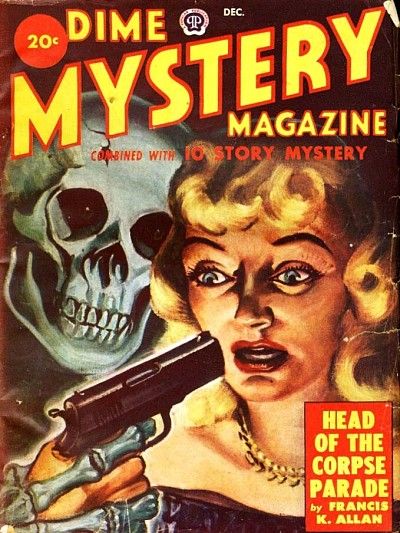
BACK with another of Frederick Blakeslee’s “Adventures Into The Unknown!” Blakeslee published fourteen installments of his two-page illustrated looks into the Unknown between March 1948 and October 1950. This time around Mr. Blakeslee tells us about the SS Watertown, a gasoline tanker, that was haunted by two crewmen who perished on board in 1925 and were buried at sea. Their heads were clearly visible just off the bow, following the ship as it continued on it’s course! From the December 1949 issue of Dime Mystery Magazine it’s “Adventures Into The Unknown: The Haunted Tank!”


ADVENTURES INTO THE UNKNOWN: The Haunted Tanker
by Frederick Blakeslee (Dime Mystery Magazine, December 1949)

“The Hun Hunter” by Arch Whitehouse

Link - Posted by David on October 5, 2018 @ 6:00 am in

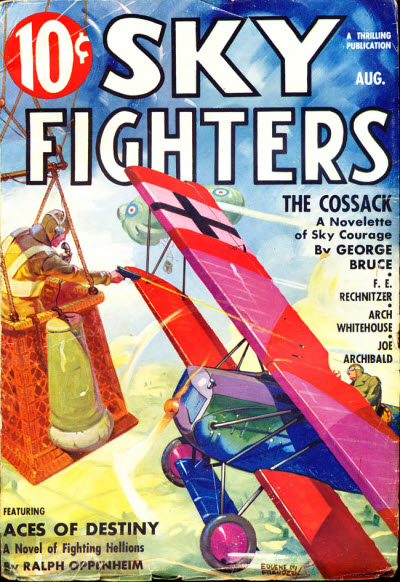
THIS week we have a short, but gripping tale from the prolific pen of Arch Whitehouse! Whitehouse gives us Len Stallard, a natural pilot and a keen hunter. He had a one-track mind and, once mounted in an active service squadron, he went to work with inevitable results—Four Huns the first week, a citation and a Croix de Guerre. Unfortunately, as good as he was in the air, he was equally poor on the ground—and found himself unable to mix with the rest of the gang at No.76. He discovers how his fellow pilots feel about him when his plane goes down behind enemy lines! From the August 1936 issue of Sky Fighters, it’s Arch Whitehouse’s “The Hun Hunter!”

Hated alike by friend and foe, Len Stallard lights out for Boche territory to end it all!

“Adventures Into The Unknown: Death Above and Below” by Frederick Blakeslee

Link - Posted by David on October 1, 2018 @ 6:00 am in

IT’S no secret that we’re big fans of the work of Frederick Blakeslee here at Age of Aces Books. He did the covers for all of Popular Publications’ big Air titles—Dare-Devil Aces, Battle Aces, Battle Birds, Fighting Aces, Dusty Ayres and his Battle Aces, and, of course, G-8 and his Battle Aces. In addition he did the interior art for Dare-Devil Aces, Battle Birds and Fighting Aces. But Blakeslee did art for other titles as well.

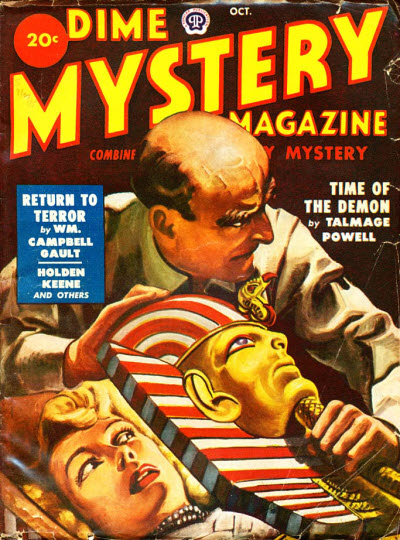
Last year we featured the first seven installments of Blakeslee’s Adventures Into The Unknown. That was just the first half of the series. This October we’ll be presenting the remaining seven installments. First up, Mr. Blakeslee relates a story of an innocent man cursing the very ground over his grave—stating before being hung, that in proof of his innocence no grass would grow on his grave for a generation! And sure enough, no grass would grow over his grave for one hundred and twenty years! From the October 1949 issue of Dime Mystery Magazine it’s “Adventures Into The Unknown: Death Above and Below!”


ADVENTURES INTO THE UNKNOWN: Death Above and Below
by Frederick Blakeslee (Dime Mystery Magazine, October 1949)

“Watch Your Steppes” by Joe Archibald

Link - Posted by David on September 28, 2018 @ 6:00 am in

“HAW-W-W-W-W!” That sound can only mean one thing—it’s time to ring out the old year and ring in the new with that Bachelor of Artifice, Knight of Calamity and an alumnus of Doctor Merlin’s Camelot College for Conjurors—Phineas Pinkham.

A peace between Russia and Germany was impending. Chaumont, Downing Street, Pennsylvania Avenue, and Versailles were in more than a dither as rumors flew hither and yon over the map of Europe to the effect that the Heinies were trying to get the Russkys to throw in with them and start cleaning up on the Western Front.

The situation was more of a mess with left wing and right wing revolutionists brawling on the Steppes. Trotsky and Kerensky were making faces at each other and tweeking each other’s beards. Red and White Russians were at loggerheads. The Czar and his family had been chased out of St. Petersburg. The Czechs were getting to be a nuisance, and Cossacks were pulling straws to see which side they would fight on.

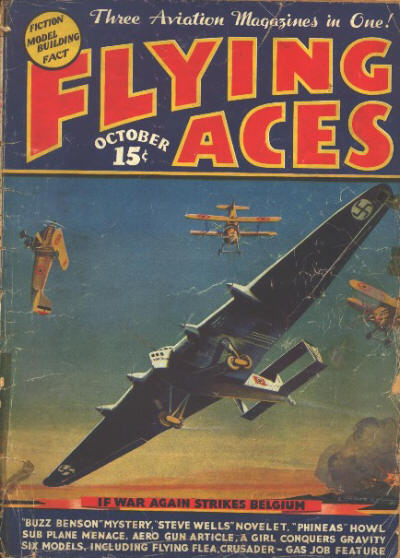
Add into this one Phineas Pinkham and stir! From the pages of the October 1936 Flying Aces, it’s Joe Archibald’s “Watch Your Steppes!”

Things certainly looked tough for the Allies! The Wilhelmstrasse quoted 2 to 1 that the Russkys would join up with the Krauts—and the 9th Pursuit laid 3 to 1 that Phineas would join up with the angels. But when the Vons ordered caviar, Carbuncle served greased bird shot. And when Rasputin rose from the grave ….

“Famous Sky Fighters, October 1934″ by Terry Gilkison

Link - Posted by David on September 26, 2018 @ 6:00 am in

STARTING in the October 1933 issue of Sky Fighters and running almost 5 years, Terry Gilkison’s “Famous Sky Fighters” was a staple of the magazine. Each month Gilkison would illustrate in a two page spread different Aces that rose to fame during the Great War.

Although Gilkison was probably better known for his syndicated newspaper work, he also provided black and white story interior illustrations for pulp magazines. His work appeared in Clues, Thrilling Adventures, Texas Rangers, Thrilling Mystery, Thrilling Western, and Popular Western. Gilkison provided similar features in a few other Thrilling Publications—there was “Famous Soldiers of Fortune” and later “Adventure Thrills” in Thrilling Adventures, Famous Crimes” in Thrilling Detective, and the fully illustrated air adventure stories of Buck Barton “The Flying Devil” in The Lone Eagle! He signed most of this work with only his initials “T.G.” to maintain a low profile and preserve his reputation as a syndicated newspaper cartoon artist.

The October 1934 installment, from the pages of Sky Fighters, Features Capt. Hamilton Coolidge, Lieut. Constant Soulier, and the evil genius who thought up the Zeppelin air raid—Baron von Buttlar Brandenfels!

Next time in “Famous Sky Fighters,” Terry Gilkison features General William Mitchell, Lieut. Colonel Pinsard, Lt. George Madon, and the incomparable Max Immelmann! Don’t miss it!

“Night Bird” by Syl MacDowell

Link - Posted by David on September 21, 2018 @ 6:00 am in

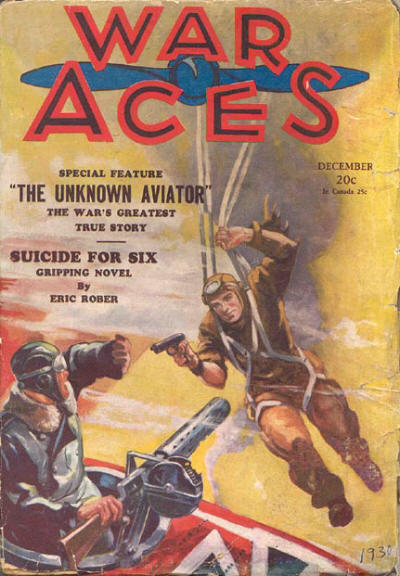
THIS week we have a story by Syl MacDowell! MacDowell is probably best known for his westerns. Here, MacDowell gives us a aviation yarn with a western twist—the title character is an albino Navajo who is able to see clearly in the dark! From the December 1930 issue of War Aces, it’s “Night Bird.”

He was an Indian and proud of the red blood than ran in his veins. When other wings failed to smash the force of that attacking horde, he tried in his own way and showed them that the redman knew the meaning of courage.

Richard Knight faces “Hell Over China” by Donald E. Keyhoe

Link - Posted by David on September 14, 2018 @ 6:00 am in

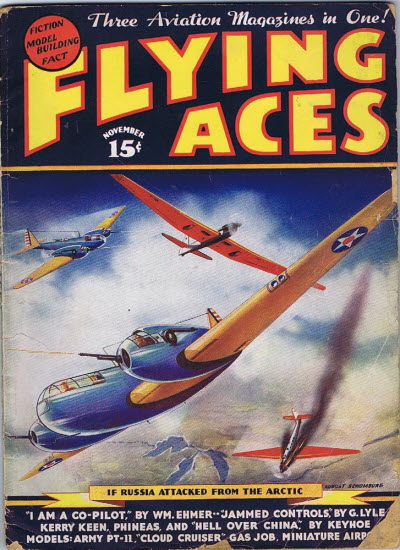
THE prolific Donald E. Keyhoe had a story in a majority of the issue of Flying Aces from his first in January 1930 until he returned to the Navy in 1942. Starting in August 1931, they were stories featuring the weird World War I stories of Philip Strange. But in November 1936, he began alternating these with sometime equally weird present day tales of espionage Ace Richard Knight—code name Agent Q. After an accident in the Great War, Knight developed the uncanny ability to see in the dark. Aided by his skirt-chasing partner Larry Doyle, Knights adventures ranged from your basic between the wars espionage to lost valley civilizations and dinosaurs. In their seventh outing from the pages of the November 1937 issue of Flying Aces, Knight and Doyle are sent to China and find themselves embroiled in a dramatic oriental sky mystery confronted by a death-ray that destroys all in it’s path! Can Agent “Q” avoid a mutated death within that eerie ray as he faces “Death Over China!”

On the twisted body of that ruthless killer they had gunned from the skies, Richard Knight found an ominous message. “I will call again,” those brush-written characters announced, and appended was the dread symbol of Mo-Gwei—the sign of “The Devil”! Then “muted death” whipped across those gloomy heavens to fulfill that satanic threat. And as the shattered bodies of wretched airmen plunged to the earth, there came an infernal laugh. The cone of silence had found new victims!

“Famous Sky Fighters, September 1934″ by Terry Gilkison

Link - Posted by David on September 12, 2018 @ 6:00 am in

STARTING in the October 1933 issue of Sky Fighters and running almost 5 years, Terry Gilkison’s “Famous Sky Fighters” was a staple of the magazine. Each month Gilkison would illustrate in a two page spread different Aces that rose to fame during the Great War.

Although Gilkison was probably better known for his syndicated newspaper work, he also provided black and white story interior illustrations for pulp magazines. His work appeared in Clues, Thrilling Adventures, Texas Rangers, Thrilling Mystery, Thrilling Western, and Popular Western. Gilkison provided similar features in a few other Thrilling Publications—there was “Famous Soldiers of Fortune” and later “Adventure Thrills” in Thrilling Adventures, Famous Crimes” in Thrilling Detective, and the fully illustrated air adventure stories of Buck Barton “The Flying Devil” in The Lone Eagle! He signed most of this work with only his initials “T.G.” to maintain a low profile and preserve his reputation as a syndicated newspaper cartoon artist.

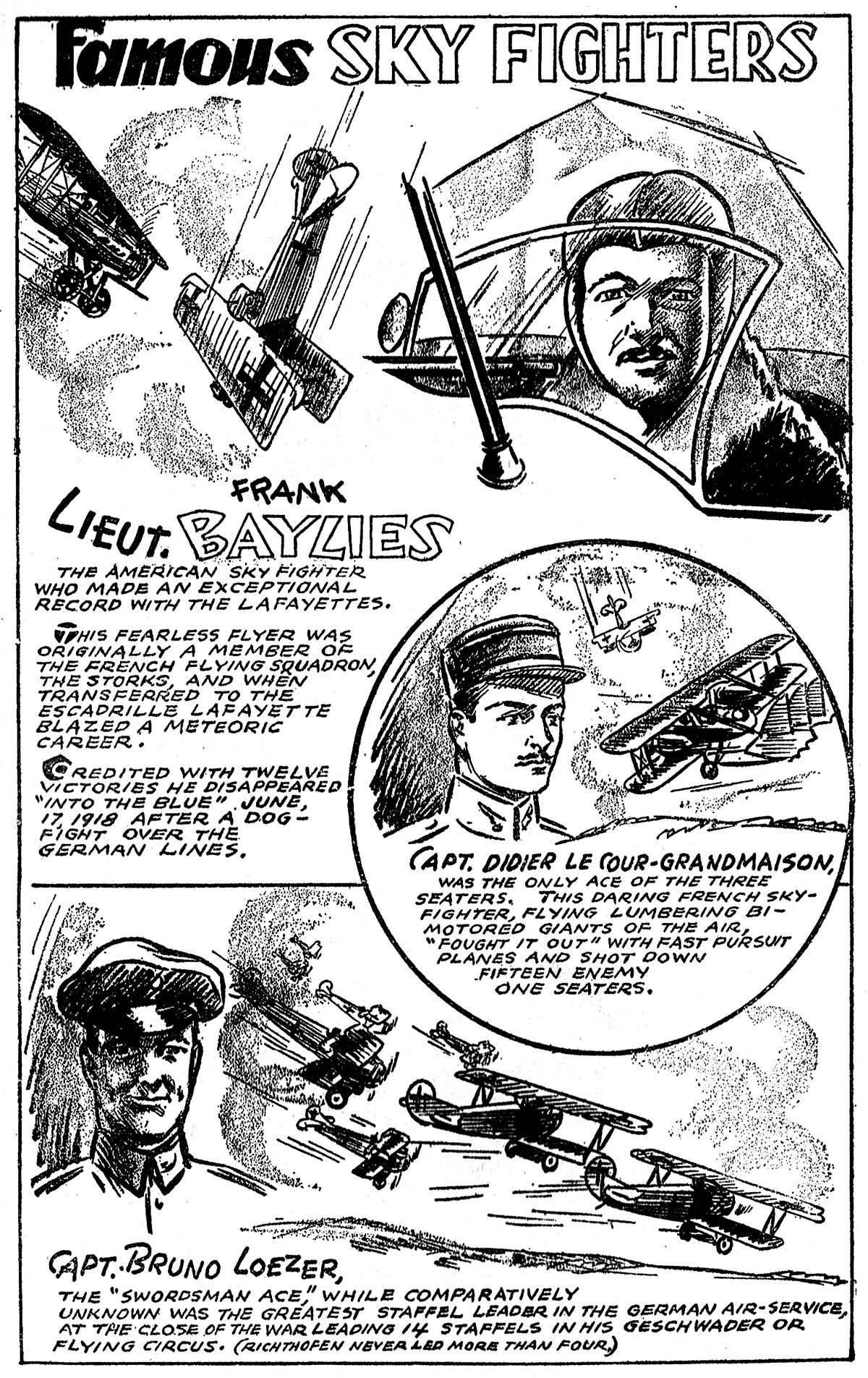
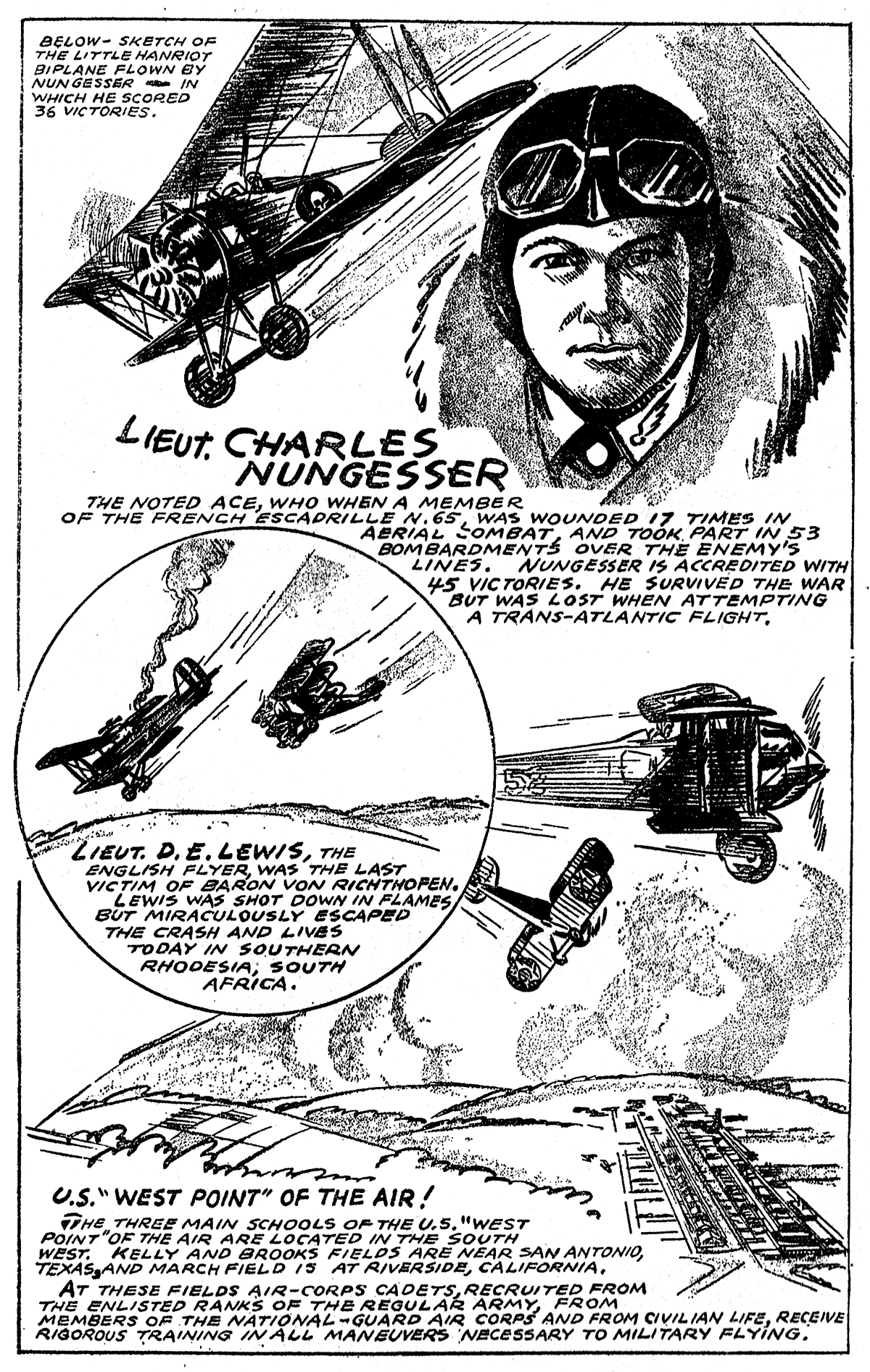
The September 1934 installment, from the pages of Sky Fighters, Features Lt. Frank Baylies, Lieut.Charles Nungesser, and Capt. Bruno Loezer—”The Swordsman Ace”!

Next time in “Famous Sky Fighters,” Terry Gilkison features Capt. Hamilton Coolidge, Lieut. Constant Soulier, and the evil genius who thought up the Zeppelin air raid—Baron von Buttlar Brandenfels! Don’t miss it!

“Grapes Grabber” by Lester Dent

Link - Posted by David on September 7, 2018 @ 6:00 am in

LESTER DENT is best remembered as the man behind Doc Savage. But he wrote all number of other stories before he started chronicling the adventures of everyone’s favorite bronze giant. Here we have an action-packed tale of the air—Nobody likes a glory hog, and Pilot Shack March sets out to teach the company Grapes Grabber a thing or two and stop a Boche spy ring in the process! From the pages of the June 1934 The Lone Eagle it’s—”Grapes Grabber!”

The Boche have developed an even faster and better plane and Major Sam Flack has been called in to double bluff a captured Boche agent into taking him behind enemy lines to the prototype!

Pilot Shack March Shows a Glory Glutton a Thing or Two in this Zooming Yarn of Exciting Action in Hunland!

If you enjoyed this story, Black Dog Books has put out an excellent volume collecting 11 of Lester Dent’s early air stories set against the backdrop of World War !. The book includes this story as well as others from the pages of War Birds, War Aces, Flying Aces, Sky Birds and The Lone Eagle. It’s The Skull Squadron! Check it out!


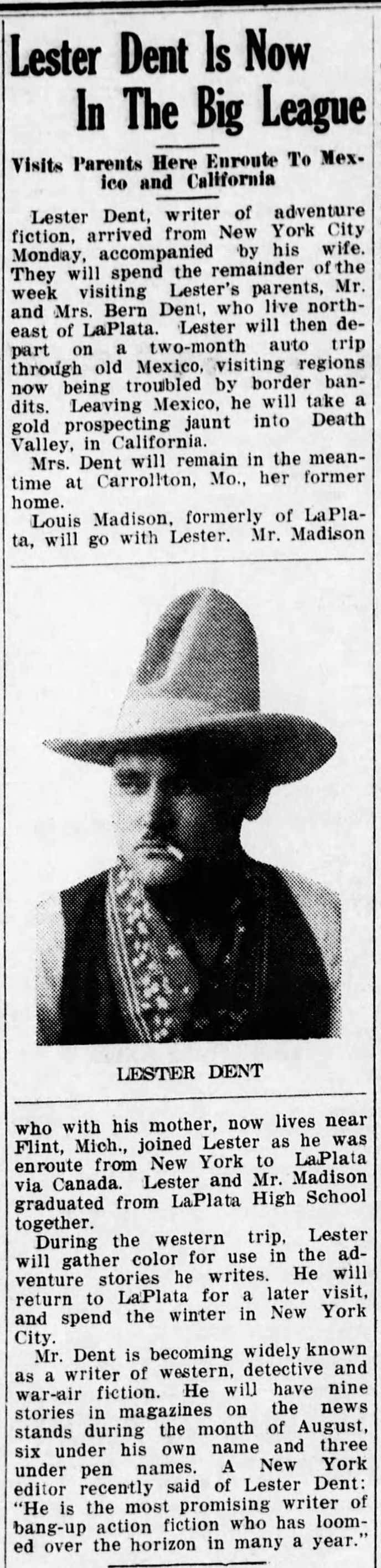
And as a bonus, here’s another article from Lester’s home town paper, The LaPlata Home Press, this time with heads-up on Lester passing through town on his way to Mexico and California!


Lester Dent Is Now In The Big League

Visits Parents Here Enroute To Mexico and California
The LaPlata Home Press, LaPlata, MO • 4 August 1932

Lester Dent, writer of adventure fiction, arrived from New York City Monday, accompanied by his wife. They will spend the remainder of the week visiting Lester’s parents, Mr. and Mrs. Bern Dent, who live northeast of LaPlata. Lester will then depart on a two-month auto trip through old Mexico, visiting regions now being troubled by border bandits, leaving Mexico, he will take a gold prospecting jaunt into Death Valley, in California.

Mrs. Dent will remain in the meantime at Carrollton, Mo., her former home.

Lester Dent

Louis Madison, formerly of LaPlata, will go with Lester. Mr. Madison, who with his mother, now lives near Flint, Mich., joined Lester as he was enroute from New York to LaPlata via Canada. Lester and Mr. Madison graduated from LaPlata High School together.

During the western trip, Lester will gather color for use in the adventure stories he writes. He will return to LaPlata for a later visit, and spend the winter in New York City.

Mr. Dent is becoming widely known as a writer of western, detective and war-air fiction. He will have nine stories in magazines on the news stands during the month of August, six under his own name and three under pen names. A New York editor recently said of Lester Dent: “He is the most promising writer of bang-up action fiction who has loomed over the horizon in many a year.”


Humpy & Tex in “Hell and Highwater” by Allan R. Bosworth

Link - Posted by David on August 31, 2018 @ 6:00 am in

THIS week we have a story from the pen of the Navy’s own Allan R. Bosworth. Bosworth wrote a couple dozen stories with Humpy & Tex over the course of ten years from 1930 through 1939, mostly in the pages of War Aces and War Birds. The stories are centered around the naval air base at Ile Tudy, France. “Humpy” Campbell, a short thickset boatswain’s mate, first class who was prone to be spitting great sopping globs of tabacco juice, was a veteran seaplane pilot who would soon rate two hashmarks—his observer, Tex Malone, boatswain’s mate, second class, was a D.O.W. man fresh from the Texas Panhandle. Everybody marveled at the fact that the latter had made one of the navy’s most difficult ratings almost overnight—but the answer lay in his ability with the omnipresent rope he constantly carried.
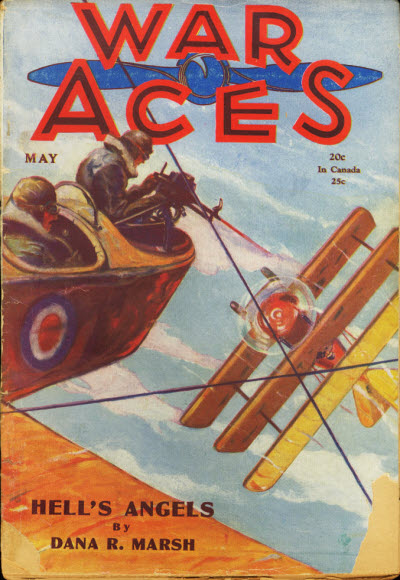
Humpy & Tex find themselves in “Hell and Highwater” when they find themselves heading toward the front in a seaplane looking for some water to land in! From the pages of the May 1930 issue of War Aces—

Action was slow over the English Channel and the demon sea plane pilots had a yen for the Front and hot combat. When their gas ran out there was only one river to land on, and that was lined with machine guns. They couldn’t land, and they couldn’t fly, so—

“Famous Sky Fighters, August 1934″ by Terry Gilkison

Link - Posted by David on August 29, 2018 @ 6:00 am in

STARTING in the October 1933 issue of Sky Fighters and running almost 5 years, Terry Gilkison’s “Famous Sky Fighters” was a staple of the magazine. Each month Gilkison would illustrate in a two page spread different Aces that rose to fame during the Great War.

Although Gilkison was probably better known for his syndicated newspaper work, he also provided black and white story interior illustrations for pulp magazines. His work appeared in Clues, Thrilling Adventures, Texas Rangers, Thrilling Mystery, Thrilling Western, and Popular Western. Gilkison provided similar features in a few other Thrilling Publications—there was “Famous Soldiers of Fortune” and later “Adventure Thrills” in Thrilling Adventures, Famous Crimes” in Thrilling Detective, and the fully illustrated air adventure stories of Buck Barton “The Flying Devil” in The Lone Eagle! He signed most of this work with only his initials “T.G.” to maintain a low profile and preserve his reputation as a syndicated newspaper cartoon artist.

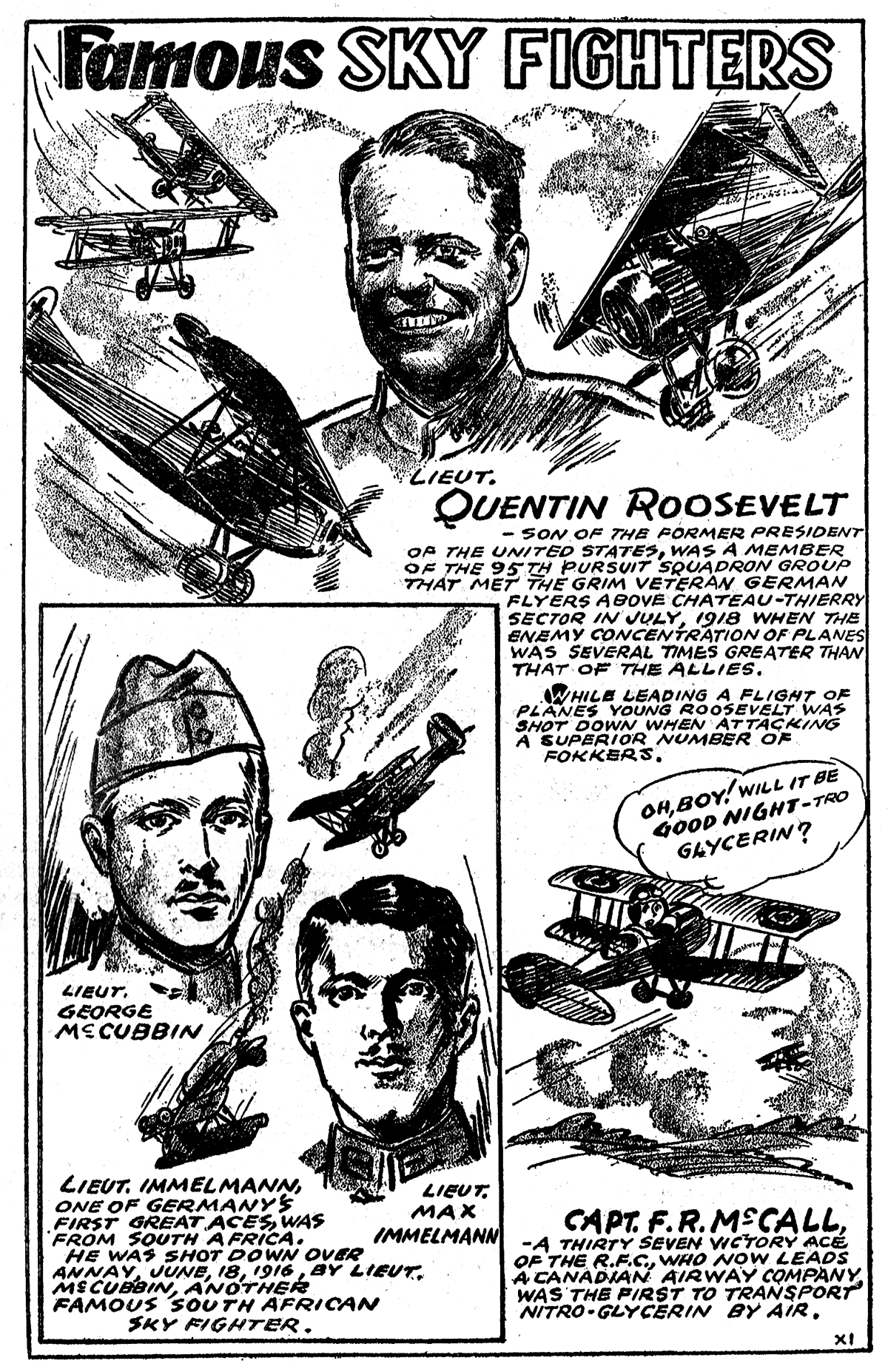
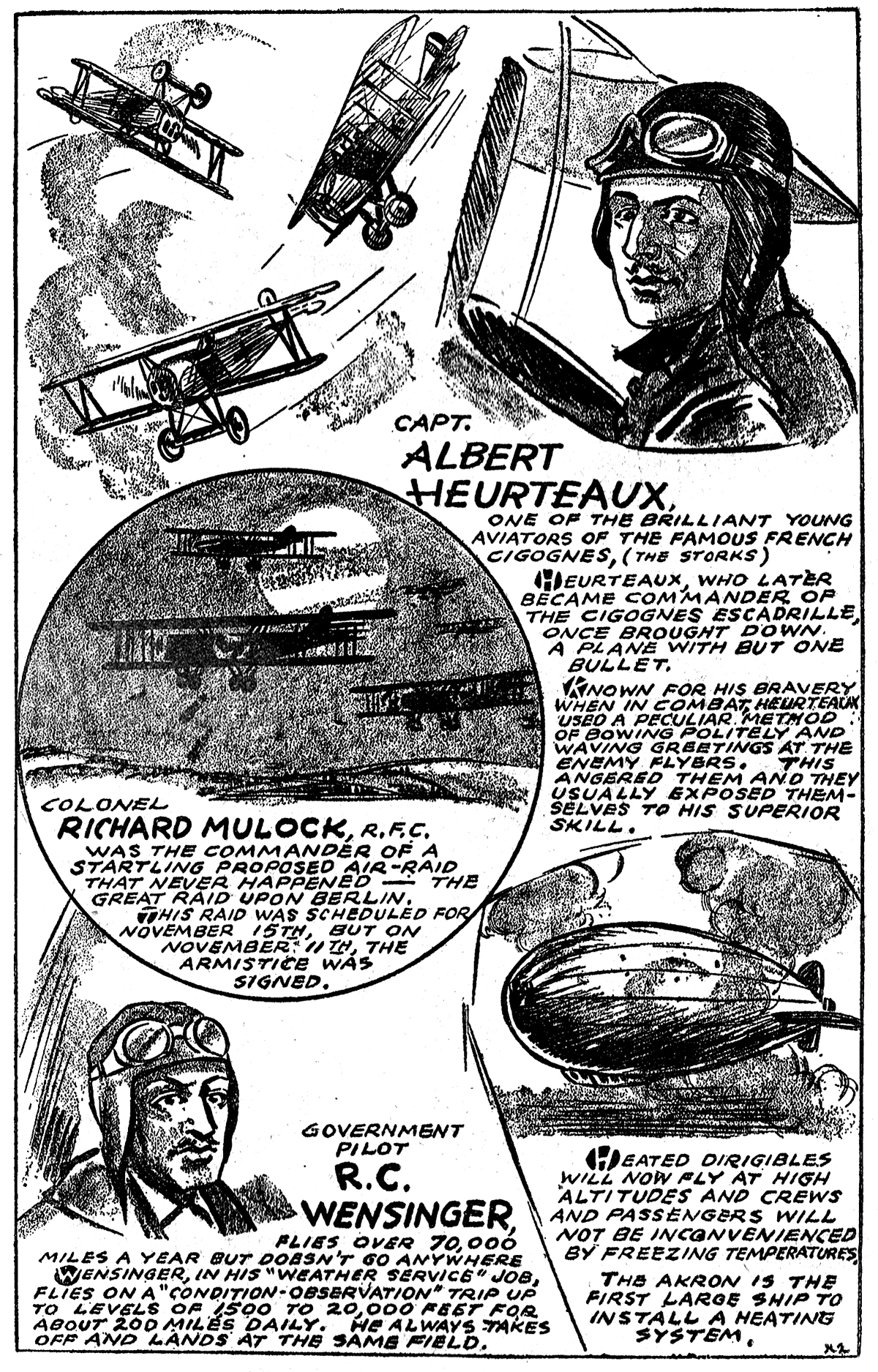
The August 1934 installment, from the pages of Sky Fighters, Features Lt. Quentin Roosevelt and Capt. Albert Heurteaux!

Next time in “Famous Sky Fighters,” Terry Gilkison features Lt. Frank Baylies, Lieut. Charles Nungesser, and Capt. Bruno Loezer—”The Swordsman Ace”! Don’t miss it!

“Fish and Gyps” by Joe Archibald

Link - Posted by David on August 24, 2018 @ 6:00 am in

“Haw-w-w-w-w!” That sound can only mean one thing—that marvel from Boonetown, Iowa is back causing more trouble than he’s worth! That miscreant of Calamity brings down a well-known Von and the higher-ups feel he should be sent Stateside to go on the lecture circuit to drum up enlistees. Problem is, he only makes it as far as Jolly Ol’ England where he comes upon a Boche Zeppelin. It’s “Fish and Gyps” with a “flying cigar” for dessert! It’s another Phineas Pinkham laugh panic from the pages of the September 1936 Flying Aces!
“Hail, the Conquering Hero Comes!” To those rousing strains, the Brass Hats paraded Phineas back to the States. And so, Garrity rejoiced as peace finally reigned once more on the drome of the 9th. But how was the Major to know which way the Pinkham parade was headed? And who’d have expected the von Sputzes to supply that parade with its main “float”?

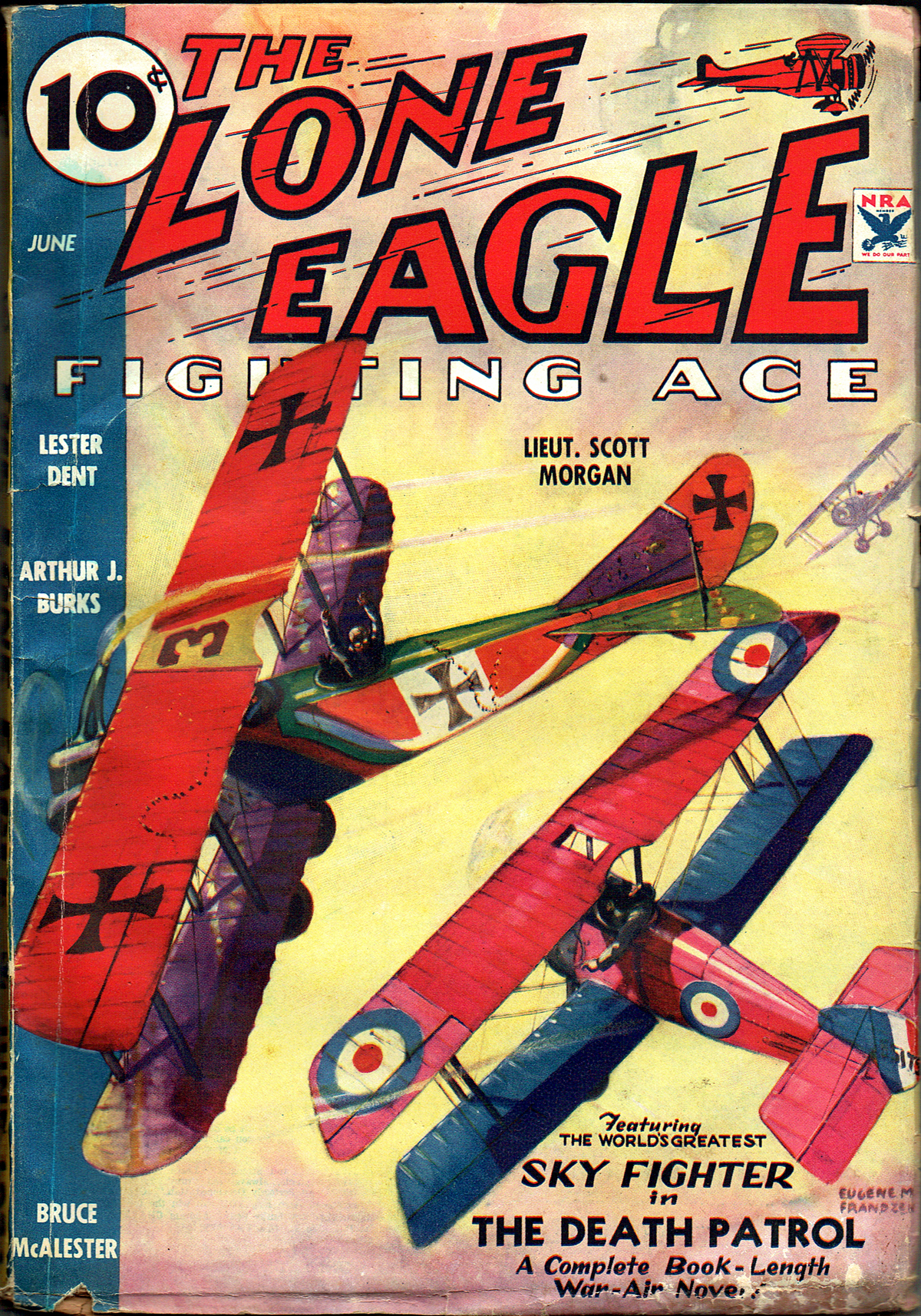
“The Lone Eagle, June 1934″ by Eugene M. Frandzen

Link - Posted by David on August 20, 2018 @ 6:00 am in

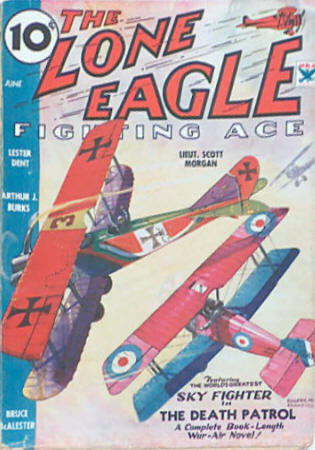
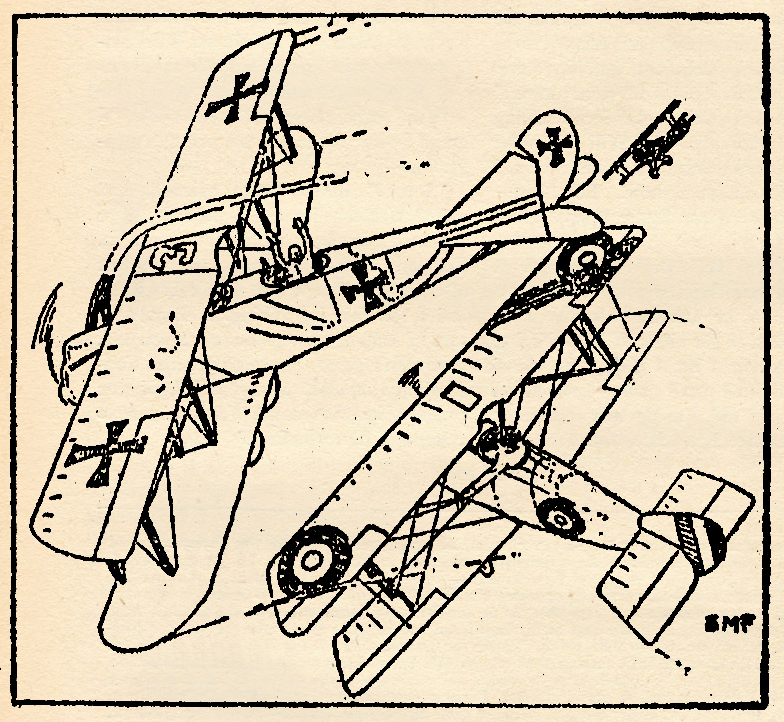
Eugene M. Frandzen painted the covers of The Lone Eagle from its first issue in September 1933 until the June 1937 issue when Rudolph Belarski took over with the August issue of that year. At the start of the run, Frandzen painted covers of general air action much like his Sky Fighters covers. Here, for the June 1934 cover, Frandzen has a couple Sopwith Camelss in a scrap with a D.F.W. Aviatik type C.V.!

The Story of the Cover

THE scrap depicted on the cover this th_LE_3406 month is between two Sopwith Camels and a D.F.W. Aviatik, type C.V. The initials “D.F.W.” stand for quite a mouthful; Deutsche Fregzeug Werke. This company, formed before the war, carried on with contracts from the government through the World War. This model of the D.F.W. is often confused with the L.V.G. It is an easy mistake to make, for they both have many of the same characteristics of construction. It carried a 228 h.p. Benz motor in its nose. It needed all this power for its forty-three foot wing span.

The Sopwith Camel was manufactured by the Sopwith Aviation Co., Ltd., founded in 1911 by Mr. T.O.M. Sopwith, a well-known aviator. Even before the war the Sopwith planes were famous, one of them, a seaplane, similar to the later Sopwith “Baby” seaplane which did such fine work for the R.N.A.S., having the distinction of winning the Schneider cup races.

It Delivered the Goods

The Camel was designed for extreme maneuverability and high performance. It made its appearance at the end of 1916, and during 1917 it was the outstanding single-seater of the British. Its high rate of climb made it particularly good for defense against Zeppelin raids. In the hands of a competent pilot it could out-maneuver any ship of its class on the front, but put a pilot used to a sluggish-controlled ship at the stick of a Camel and he was lost. The Camel was tricky to fly, but once used to the controls veritable wonders could be performed by a pilot who knew all the tricks of sailing the sky lanes.

This ship delivered the goods from the time it made its appearance right up to the end of the war, and that is something that cannot be said for many ships that were used during the Big scrap.

A Technique of Their Own

Two Anzacs who had done considerable cattle-herding in their beloved Australia had changed their mounts from shaggy ponies to “Camels.” But in the cockpits of their Camels their old habit of cutting out one animal from a herd was not forgotten. They developed a technique of their own of cutting an enemy plane from a flight and harassing it with cross-fire. Anticipating every move of the enemy plane they would gradually work it toward the Allied lines, then over the lines and finally force the unhappy German pilot, whom they had flattered with their undivided attention, to land on their own airdrome.

Now look at the picture on the cover again and you’ll get the drift of the situation. That D.F.W. Aviatik has been picked by our friends in the Camels as a hostage and they are herding him off the range into the corral. And it won’t be long now till all three planes will be making a landing. The back gunner of the D.F.W. is shy his Parabellum gun. He unhooked it from its swivel mount and pitched it overboard at the request of the Camel pilots delivered in sign language and punctuated with a drizzle of Vickers slugs that literally wrote their initials in the side of the Boche ship.

Following the Leader

As the home drome looms ahead the closest Camel pilot sends a short burst across the tail of the German ship. He points down, identifying the drome on which the unhappy Germans must land or be blasted out of the sky. As he flips his Camel under the bulky two-seater the German gunner raises bis hands high above his head, signifying his willingness to play follow the leader.

All three ships nose downward. The Anzacs have brought home the bacon again; just another stray cut out of the sky pastures and jriven private grazing ground for the duration of the emergency.

The Story of The Cover
The Lone Eagle, June 1934 by Eugene M. Frandzen
(The Story of The Cover Page)

“Guns of Mystery” by Harold F. Cruickshank

Link - Posted by David on August 17, 2018 @ 6:00 am in

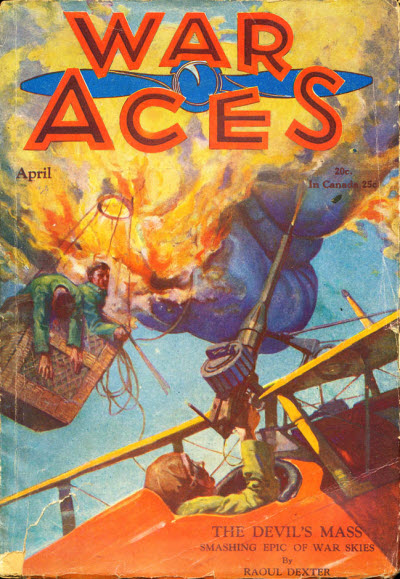
THIS week we have a story by another of our favorite authors—Harold F. Cruickshank! Cruickshank is popular in these parts for the thrilling exploits of The Sky Devil from the pages of Dare-Devil Aces, as well as those of The Sky Wolf in Battle Aces and The Red Eagle in Battle Birds. He wrote innumerable stories of war both on the ground and in the air. From the premier issue of War Aces, Mr. Cruickshank gives us a story of the first installation of machine guns on planes—while not strictly factual, it’s a ripping good read! From the April 1930 issue of War Aces, it’s Harold F. Cruickshank’s “Guns of Mystery!”
It was the unpardonable sin to mount a gun on a plane, but when a blazing path of steel traced itself across his wings Kelly felt icy fingers on his heart and knew that a new horror was winging through the air.

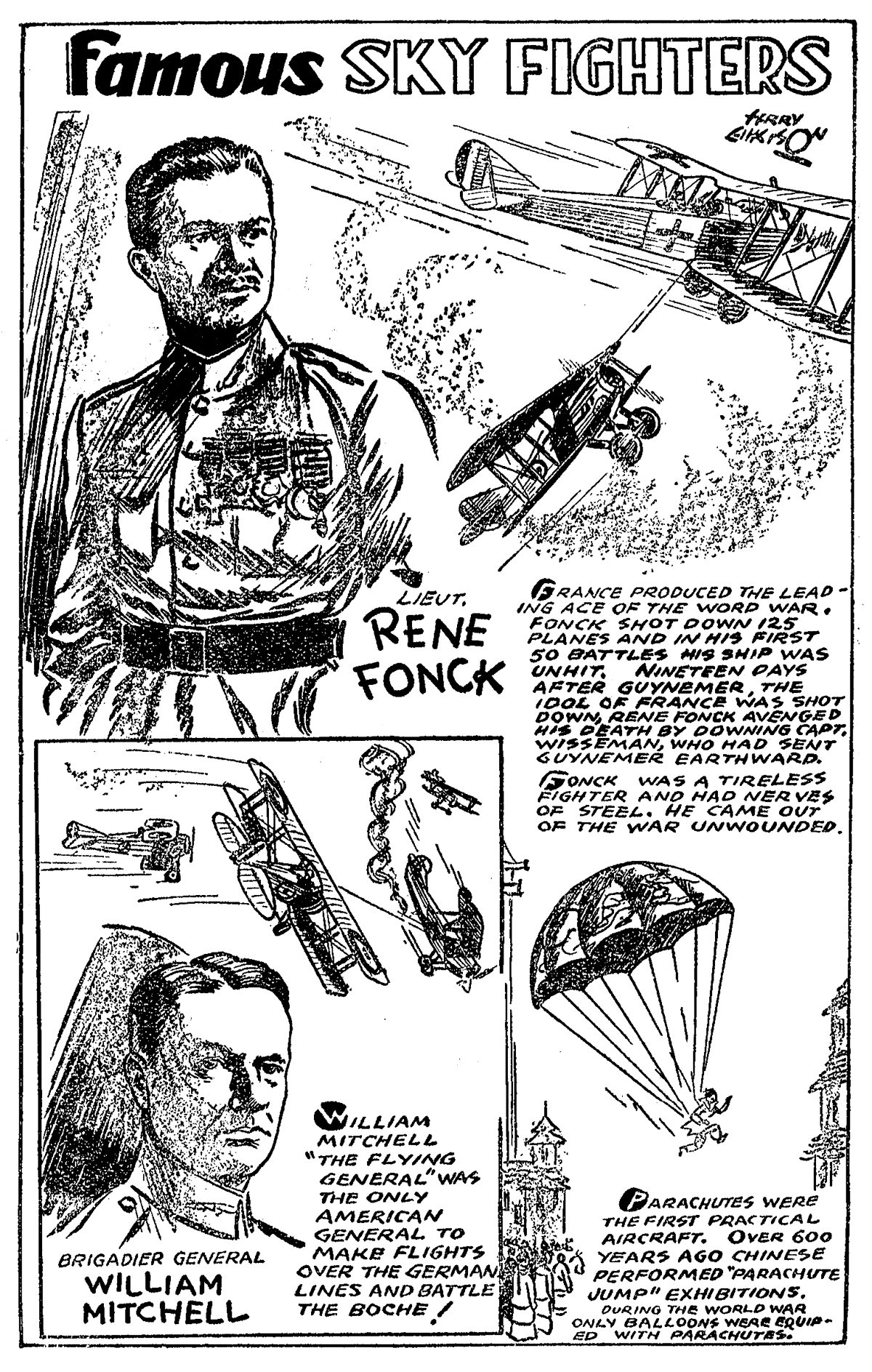
“Famous Sky Fighters, July 1934″ by Terry Gilkison

Link - Posted by David on August 15, 2018 @ 6:00 am in

STARTING in the October 1933 issue of Sky Fighters and running almost 5 years, Terry Gilkison’s “Famous Sky Fighters” was a staple of the magazine. Each month Gilkison would illustrate in a two page spread different Aces that rose to fame during the Great War.

Although Gilkison was probably better known for his syndicated newspaper work, he also provided black and white story interior illustrations for pulp magazines. His work appeared in Clues, Thrilling Adventures, Texas Rangers, Thrilling Mystery, Thrilling Western, and Popular Western. Gilkison provided similar features in a few other Thrilling Publications—there was “Famous Soldiers of Fortune” and later “Adventure Thrills” in Thrilling Adventures, Famous Crimes” in Thrilling Detective, and the fully illustrated air adventure stories of Buck Barton “The Flying Devil” in The Lone Eagle! He signed most of this work with only his initials “T.G.” to maintain a low profile and preserve his reputation as a syndicated newspaper cartoon artist.

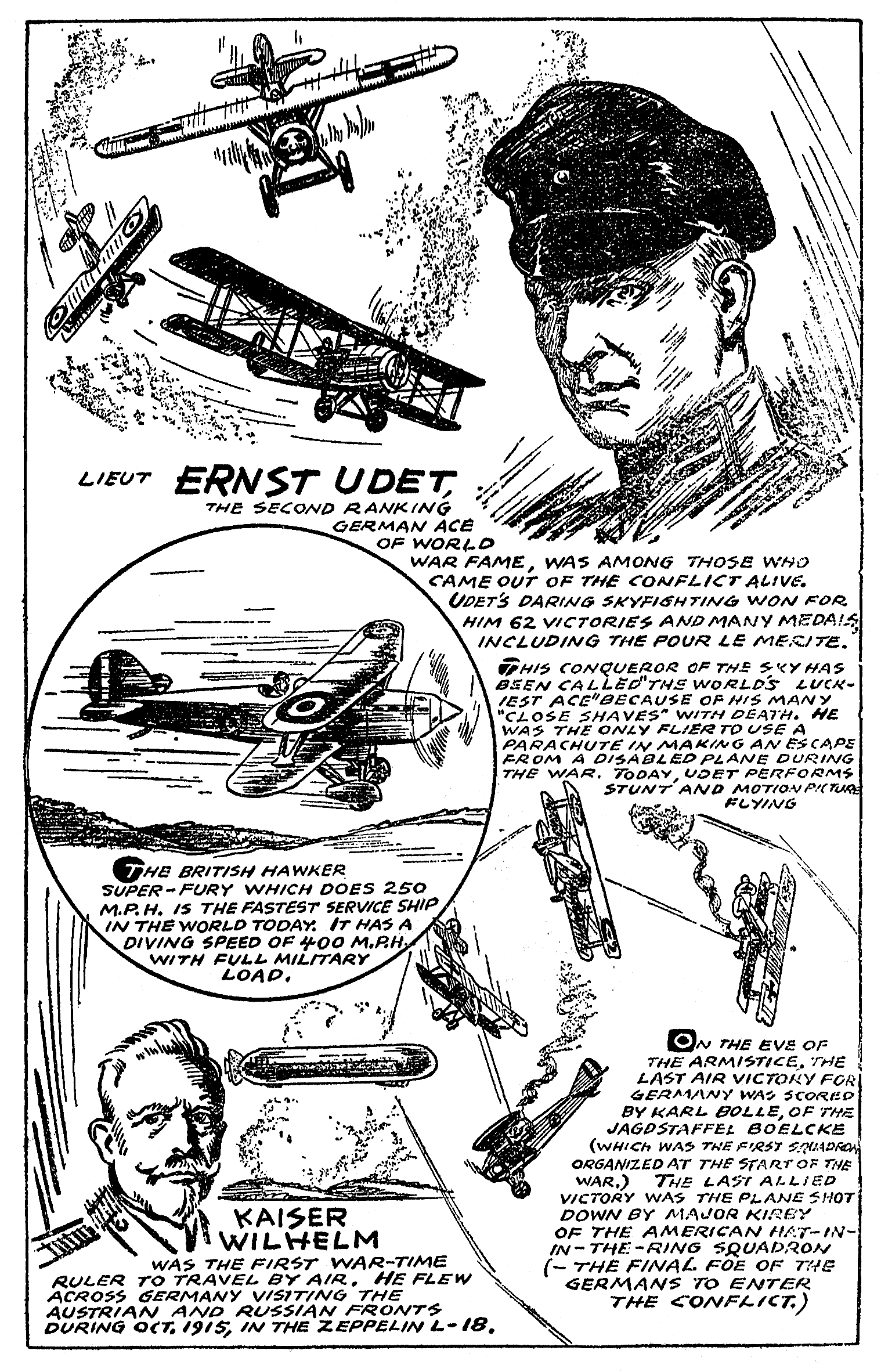
The July 1934 installment, from the pages of Sky Fighters, Features Lt. Rene Fonck, Brigadier General William Mitchell, and Lt. Ernst Udet!

Next time in “Famous Sky Fighters,” Terry Gilkison features Lt. Quentin Roosevelt and Capt. Albert Heurteaux! Don’t miss it!

« Previous PageNext Page »