



“Famous Sky Fighters, March 1936″ by Terry Gilkison
STARTING in the October 1933 issue of Sky Fighters and running almost 5 years, Terry Gilkison’s “Famous Sky Fighters†was a staple of the magazine. Each month Gilkison would illustrate in a two page spread different Aces that rose to fame during the Great War.
Although Gilkison was probably better known for his syndicated newspaper work, he also provided black and white story interior illustrations for pulp magazines. His work appeared in Clues, Thrilling Adventures, Texas Rangers, Thrilling Mystery, Thrilling Western, and Popular Western. Gilkison provided similar features in a few other Thrilling Publications—there was “Famous Soldiers of Fortune” and later “Adventure Thrills” in Thrilling Adventures, Famous Crimes” in Thrilling Detective, and the fully illustrated air adventure stories of Buck Barton “The Flying Devil” in The Lone Eagle! He signed most of this work with only his initials “T.G.” to maintain a low profile and preserve his reputation as a syndicated newspaper cartoon artist.
The March 1936 installment, from the pages of Sky Fighters, features Lt. Alan McLeod, Lt. Heinrich Gonterman, Captains Jimmy McCudden, Frank Hunter,and John Towers and Adolph Pegoud!


Next time in “Famous Sky Fighters”, Terry Gilkison features Commandant Marquis de Turenne, Lt. Karl Schafer, Lt. Silvio Scaroni and Lt. R.A.J. Warneford who brought down the first zeppelin! Don’t miss it!


 Silent Orth had made an enviable record, in the face of one of the worst beginnings—a beginning which had been so filled with boasting that his wingmates hadn’t been able to stand it. But Orth hadn’t thought of all his talk as boasting, because he had invariably made good on it. However, someone had brought home to him the fact that brave, efficient men were usually modest and really silent, and he had shut his mouth like a trap from that moment on.


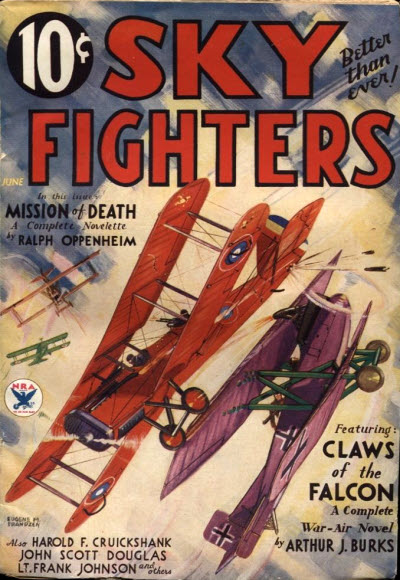 Mosquito Month we have a non-Mosquitoes story from the pen of Ralph Oppenheim. It was always his observer, Jim Evans, who judged the dive, who directed Haskell as the latter worked controls, who told Haskell the precise moment to jerk back his stick and pull up—the same moment when Evans would release the bombs. And due to this uncanny judgment of Evans, and also to Haskell’s flying skill and strength, the two had never failed. Oh, they had been a team—Bomber Dan Haskell, big, husky, two-fisted—and Jim Evans, smaller, but lithe and agile and just as ready for action. An inseparable team, Which co-ordinated like a machine—which could do bombing work as no other unit. With Haskell as reckless pilot, and Evans in the rear as gunner and observer—though he wore a pilot’s full two wings—they had fought their way through all odds, dived upon their target hellbent, and blasted it right off the face of the earth. But Jim had been lost the day before on a run leaving Dan to set off on a daring mission alone—He must bomb bridge K-100 to keep the Germans from advancing on the Allied lines! From the June 1934 issue of Sky Fighters it’s “Mission of Death!”
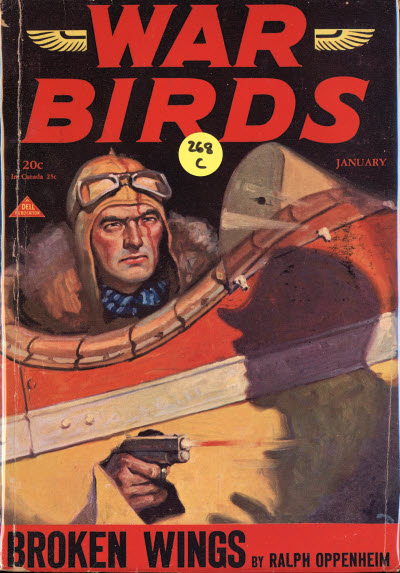 the third of three Three Mosquitoes stories we’re presenting this month. The Three Mosquitoes disband! The darker side of notoriety rears it’s ugly head—is Kirby a “Glory Grabber” taking all the glory and sharing none of the credit—easily picking off the other’s adversaries out from under them? Does he take Shorty Carn and Lanky Travis for granted? Yes, that inseparable threesome have it out and go their own ways! Each sinking the lowest a man can go without the others—and just as the big German offensive is about to kick off! Can the Kirby, Carn and Travis fix their “Broken Wings” or is this it for the intrepid trio? In what is probably their darkest tale, from the pages of the January 1931 issue of War Birds!

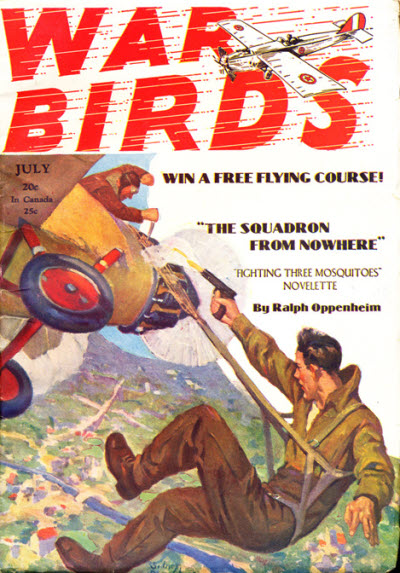 the second of three Three Mosquitoes stories we’re presenting this month. The Three Mosquitoes have been dispatched to the Scottish Highlands to investigate sightings of German Gothas! Equipped with brand new Sopwiths, the Three Mosquitoes take on The Black Raiders and try to fathom how these planes could even be this far from their Fatherland and so perilously close to the shipbuilding yards of Deemsgate! It’s a mystery whose answer lies in the craggy mountains of Scotland!