


Painton’s Letters Home from WWI | 2 March 1918
THIS month we’re featuring Frederick C. Painton’s letters he wrote home while serving with the American Expeditionary Forces in WWI. Portions of these letters were published in his hometown paper, The Elmira Star-Gazette of Elmira, New York. Before the war young Fred Painton had been doing various jobs at the Elmira Advertiser as well as being a part-time chauffeur. He was eager to get into the scrap, but was continually turned down because of a slight heart affliction and was not accepted in the draft without an argument. He was so eager to go that he prevailed upon the draft board to permit him to report ahead of his time. Painton left Elmira in December 1917 with the third contingent of the county draft for Camp Dix but was again rejected. He was eventually transferred to the aviation camp at Kelly Field as a chauffeur, and in a few weeks’ time was on his way to England in the transport service with an aviation section, where he landed at the end of January 1918.
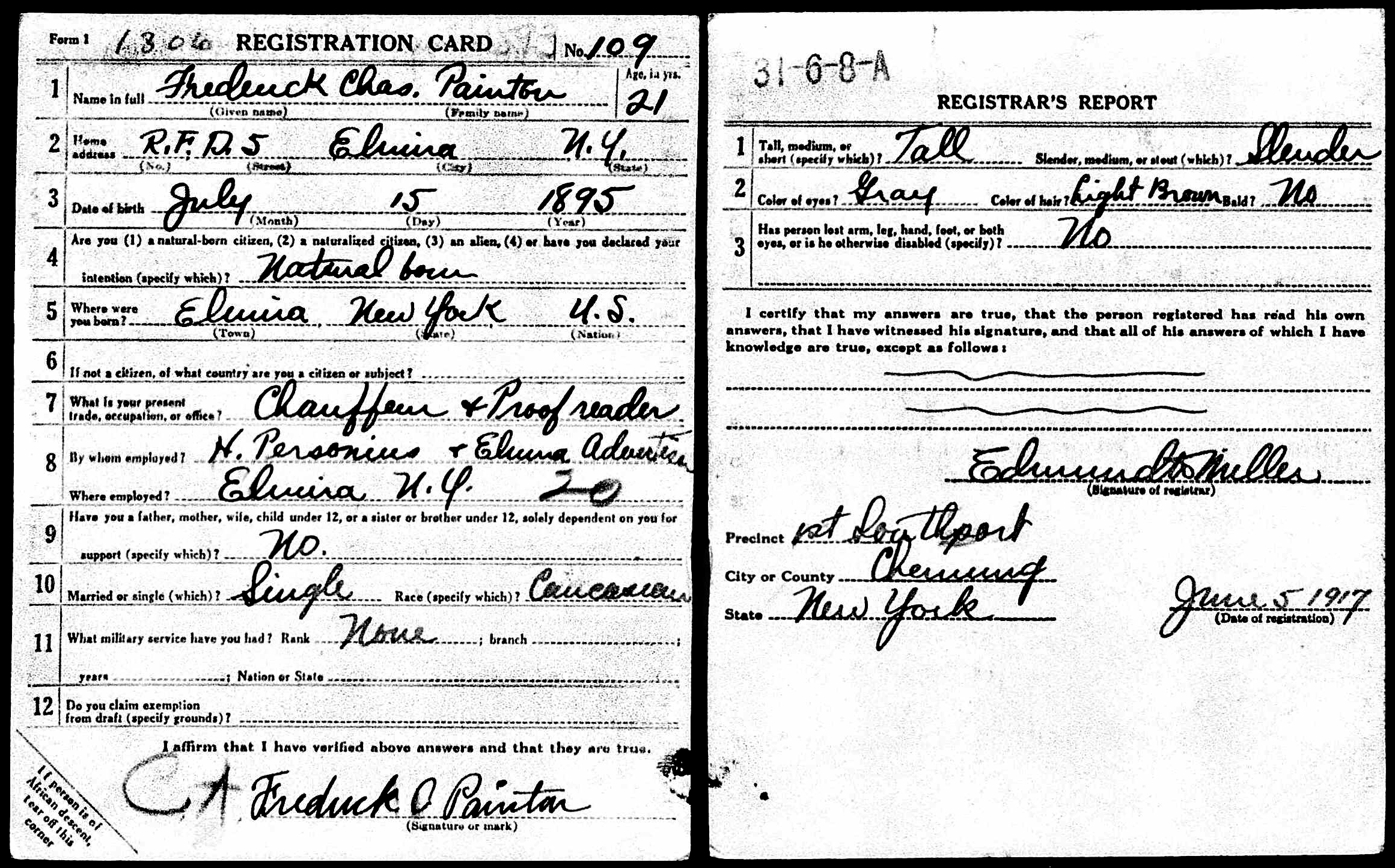
FREDERICK C. PAINTON’S Armed Forces Registration Card. June 5th, 1917
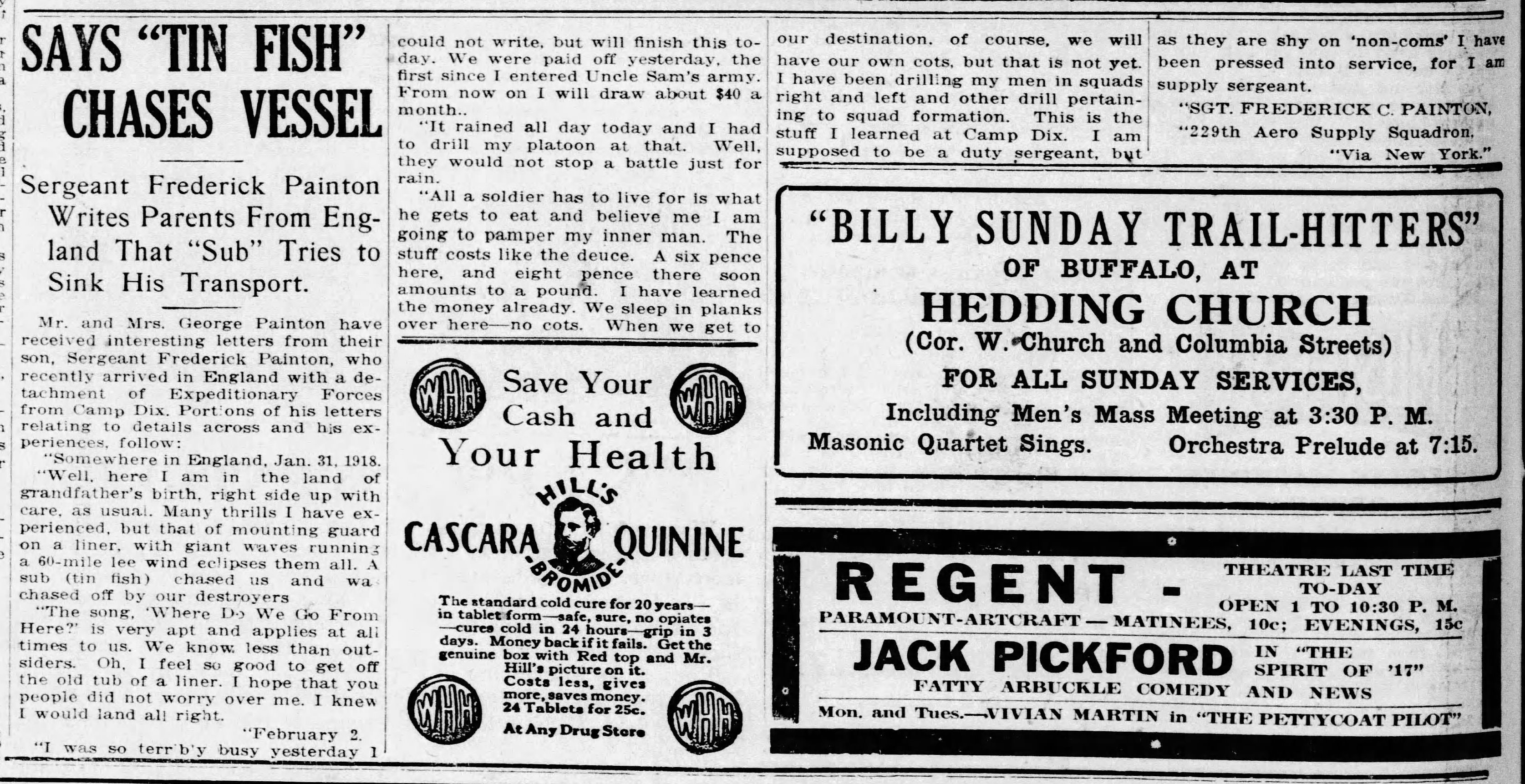
SAYS “TIN FISH” CHASES VESSEL
Elmira Star-Gazette, Elmira, New York • 2 March 1918
Sergeant Frederick Painton Writes Parents From England That “Sub” Tries to Sink His Transport.
Mr. and Mrs. George Painton have received interesting letters from their son, Sergeant Frederick Painton, who recently arrived in England with a detachment of Expeditionary Forces from Camp Dix. Portions of his letters relating to details across and his experience follow:
“Somewhere in England. Jan. 31. 1918.
“Well, here I am in the land of grandfather’s birth, right side up with care, as usual. Many thrills I have experienced, but that of mounting guard on a liner, with giant waves running a 60-mile lee wind eclipses them all. A sub (tin fish) chased us and was chased off by our destroyers.
“The song, ‘Where Do We Go From Here?’ is very apt and applies at all times to us. We know, less than outsiders. Oh, I feel so good to get off the old tub of a liner. I hope that you people did not worry over me. I knew 1 would land all right.
“February 2.
“I was so terribly busy yesterday I could not write, but will finish this today. We were paid off yesterday, the first since I entered Uncle Sam’s army. From now on I will draw about $40 a month.
“It rained all day today and I had to drill my platoon at that. Well, they would not stop a battle just for rain.
“All a soldier has to live for is what he gets to eat and believe me I am going to pamper my inner man. The stuff costs like the deuce. A six pence here, and eight pence there soon amounts to a pound. I have learned the money already. We sleep in planks over here—no cots. When we get to our destination, of course, we will, have our own cots, but that is not yet. I have been drilling my men in squads right and left and other drill pertaining to squad formation. This is the stuff I learned at Camp Dix. I am supposed to be a duty sergeant, but as they are shy on ‘non-coms’ I have been pressed into service, for I am supply sergeant.
“SGT. FREDERICK C. PAINTON,
“229th Aero Supply Squadron,
“via New York.”
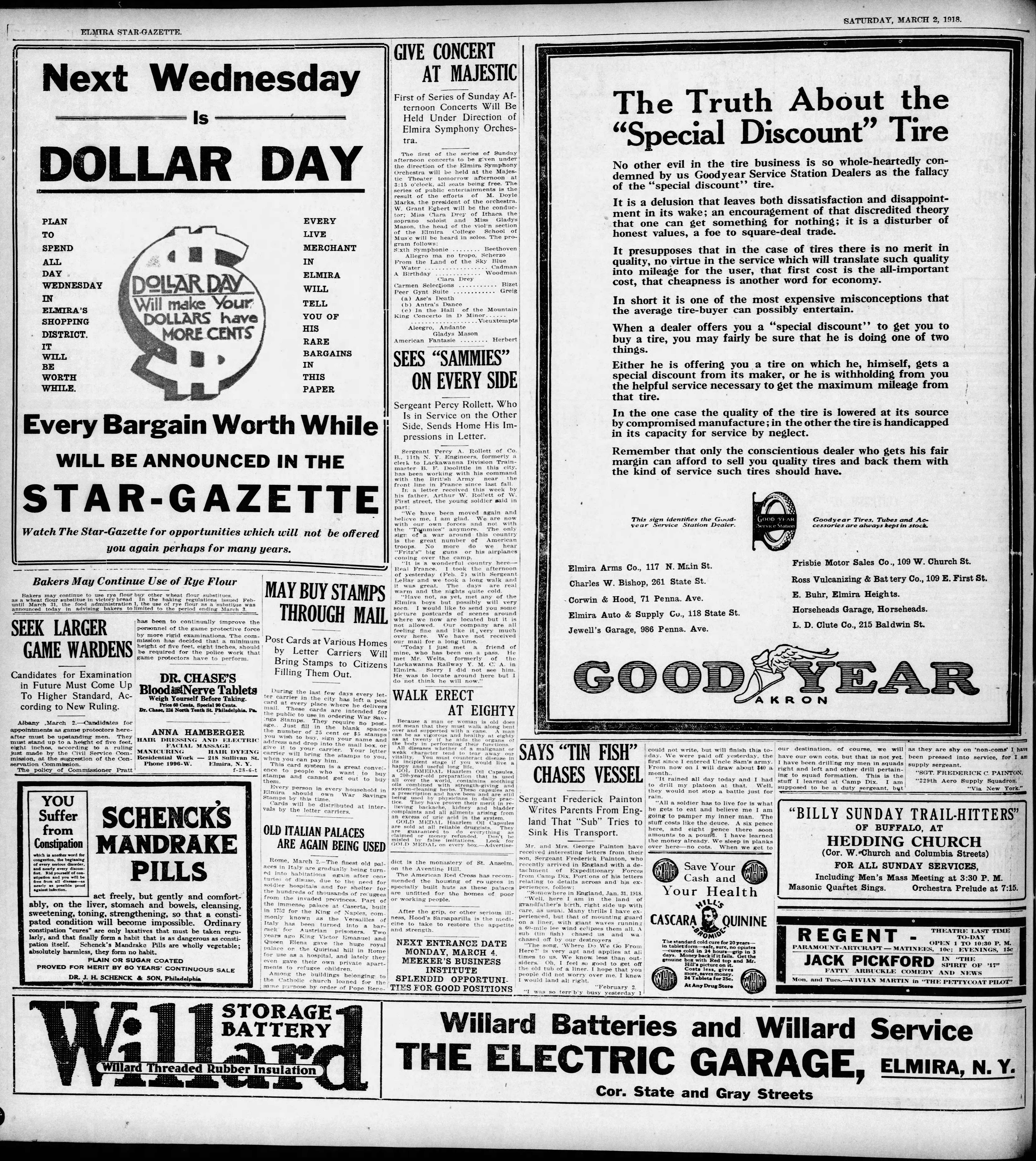
- Download clipping (2 March 1918, Elmira Star-Gazette)
- Download full page (2 March 1918, Elmira Star-Gazette)
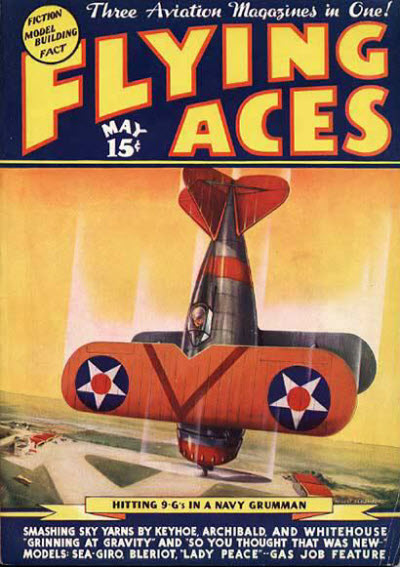 That sound can only mean one thing—it’s time to ring out the old year and ring in the new with that Bachelor of Artifice, Knight of Calamity and an alumnus of Doctor Merlin’s Camelot College for Conjurors—Phineas Pinkham.
 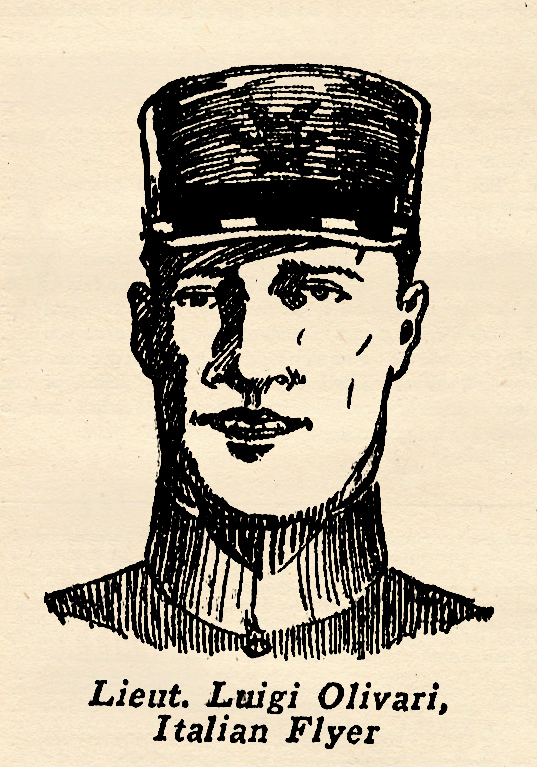 Milan and educated in Switzerland in a military school. Although but a boy in his minority when the war began, he left home and school immediately and enlisted in the ranks of the Italian Army. He rose swiftly in the ranks and was commissioned a Lieutenant in tho Alpine Corps, those rugged mountain troops that did so much to protect the fertile Italian plains from Austrian army raids. After brief service as an officer in that branch he was transferred to the flying corps. Sent to the front he was assigned to a squadron flying little Pomilio monoplanes with Fiat engines. These were the fastest but trickiest of front line lighting machines of their day. Luigi Olivari downed three Austrian planes in his first sky battle. When killed on October 15, 1917, he had run his score to 12 official and was the third ranking Italian ace. The account below is taken from an interview he gave to an American correspondent.
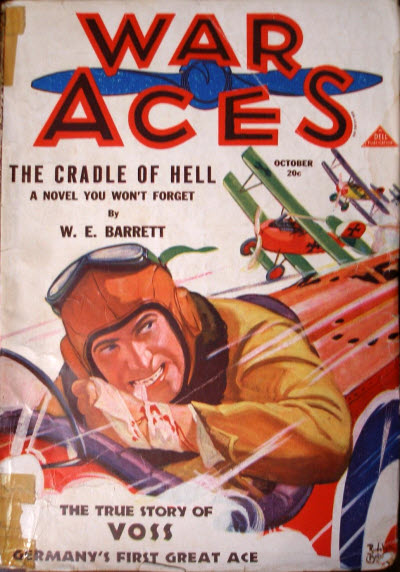 the month we have the story of Captain Jim Fogarty, a Montana Irishman in the service of Britain. He was Youth triumphant, a, veteran of six weeks on the fighting Front, commander of a squadron, and officially credited with victories over sixteen enemy airmen. The twin Ds of Death and Defeat had not touched him—but when it did, they brought him straight down into the cradle of hell and nearly cost him his life!

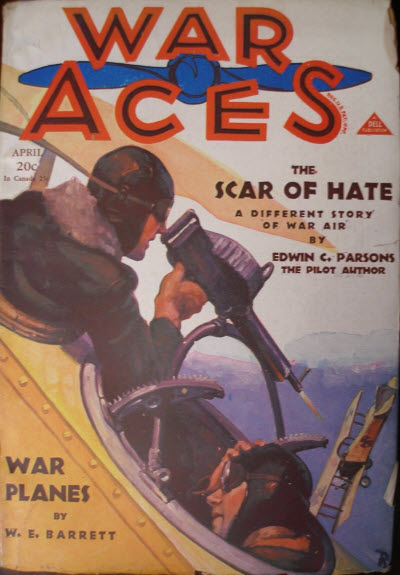 of Captain Frederick Dietterich who is being relieved of his temporary command as captain and squadron leader to serve under a Prussian, Hauptmann von Kopf. Dietterich was an Alsatian and that had been a handicap. The Imperial Government accepted great service from Alsatians but withheld its trust while accepting them. His reputation on the other side of the line had hurt, too. He had been known as a clean sportsman. H.Q. had frowned at that. It favored officers who were feared. The last touch was his popularity with his men. The men of his jagdstaffel spoke of him as “Fritz”. The Imperial command could not associate authority with familiarity and Dietterich was going back to the flying ranks.

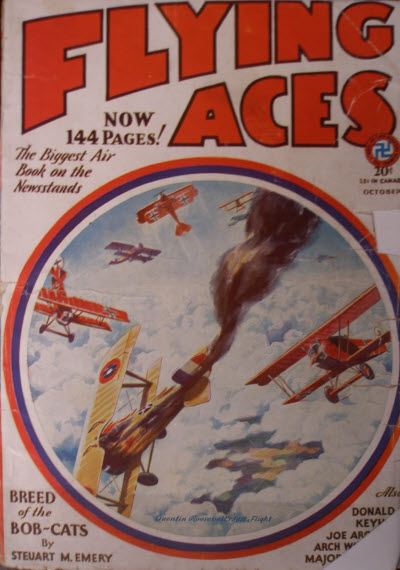 of Jack Kane, a pilot with the 17th Squadron’s C Flight who’s in over his head. Turns out C Flight plays hand after hand of poker in between patrols and young Kane has been doling out I.O.U.s to cover his debts and the time to settle up those debts is fast approaching. Problem is, he doesn’t have the money to cover those I.O.U.s. Kane believes it would be better to perish in battle and die a hero than face disgrace when his debts come due!


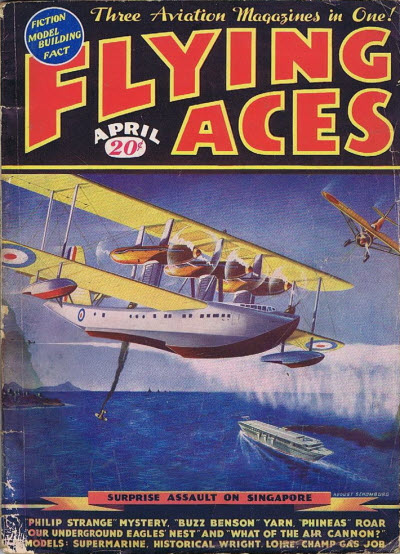 That sound can only mean one thing—that marvel from Boonetown, Iowa is back causing more trouble than he’s worth! During the last year of the colossal fuss the Italian board of strategy powwowed at Padua and came to the conclusion that something had to be done about the Austro threat across the Piave and sent out an S.O.S. to the western front calling for a triple threat airman who would be able to cope with one Baron von Zweibach who had become widely known from the Dardanelles to the Dover Straits as “The Caproni Crusher.” The only way to fight a triple treat is with a triple threat, so Wing sent that jinx to Jerries to Italy! It’s another Phineas Pinkham laugh panic from the pages of the April 1937 Flying Aces!