Looking to buy? See our books on amazon.com Get Reading Now! Age of Aces Presents - free pulp PDFs

Painton’s Letters Home from WWI | 23 October 1918

Link - Posted by David on December 16, 2019 @ 11:00 am in

THIS month we’re featuring Frederick C. Painton’s letters he wrote home while serving with the American Expeditionary Forces in WWI. Portions of these letters were published in his hometown paper, The Elmira Star-Gazette of Elmira, New York. Before the war young Fred Painton had been doing various jobs at the Elmira Advertiser as well as being a part-time chauffeur. He was eager to get into the scrap, but was continually turned down because of a slight heart affliction and was not accepted in the draft without an argument. He was so eager to go that he prevailed upon the draft board to permit him to report ahead of his time. Painton left Elmira in December 1917 with the third contingent of the county draft for Camp Dix but was again rejected. He was eventually transferred to the aviation camp at Kelly Field as a chauffeur, and in a few weeks’ time was on his way to England in the transport service with an aviation section, where he landed at the end of January 1918 as part of the 229th Aero Supply Squadron. He was transferred to the 655 Aero Squadron in France shortly thereafter.

FRED PAINTON WRITES HOME OF HIS FIRST AIRPLANE TRIP

Elmira Star-Gazette, Elmira, New York • 23 October 1918

Former Elmira Newspaper Man, Now Serving in France, Gives Detailed Descriptions of Sensations Experienced in First Air Voyage.

Sergeant Fred Painton, former Elmira newspaper man. now attached to the 496th Aero Squadron, with the American Expeditionary Forces in France, in his latest letter describes his “most wonderful experience,” a trip in an airplane. His account of the journey through the air makes the reading almost as thrilling as the ride itself.

Sergeant Painton recently enjoyed a furlough in Paris, an experience to which he had long looked forward to, and, next to Elmira, he declares it the most beautiful city in the world. It was shortly after his trip to Paris that he was given the opportunity to ride in an airplane.

His letter follows:

“496 Aero Squad. Amexforces. France.
“Oct. 1, 1918.

“Dear Friend:—

“Well I shall have to tell you the many experiences that have happened to me since I wrote from Paris.

“To begin with I have made my initial trip in an airplane and that to me is the most wonderful thing that could happen to anyone. The day after I wrote you from Paris, I took some high officials of the air service to a aviation camp. After the business, which called them there was transacted they decided to take a “joyhop.” Forthwith we proceeded to the flying field, where they made ready for the trip.

“I waited my chance and then when one of the aforementioned high officials came close to me, I heaved a deep sigh and remarked to the empty atmosphere that I would give my right arm, if only I could get a chance to take a trip in a “ship.” The said H.O. turned to me and asked if I had ever been up, and upon my answering ‘no’, he yelled to one of the pilots, and told him that it would be all right for him to take me up in the next two seater he flew. The ‘airgnat’ said that he was going to fly one of the two sealers right away and motioned for me to follow him. I did and you can believe that I was all afluter. To think that I was going up there, where all the rest of those white winged planes were lazily running in circles. It seemed almost to good to be true.

“As they had no helmets to spare, I simply took off my overseas cap and left on my goggles. The pilot told me that it would give me a good shampoo. They are glad to take anyone up at this field, when they have occasion to fly a two-seater, as it does away with the necessity of putting in a two hundred pound sack of sand. I very gingerly climbed into the rear cockpit and waited for them to crank the motor. This is done very carefully as the slightest mistake means the life of the mechanic, who is cranking. The pilot calls out “coupe.” The mechanic repeats it after him so that there can be no mistake. That means that the switch is off and then the propeller is turned over to draw a charge of gas into the cylinders. Then the mechanic yells “contact,” and again the pilot repeats after him. Then with one foot braced that he may jump away from the terrific suction caused by the churning of the propeller, the mechanic gives a quick twist and with a roar the powerful motor starts. The noise was deafening and the wind from the propellor seemed more than likely to tear the hair from my head. Eventually the pilot nodded his head and then by means of long ropes, the blocks were withdrawn from in front of the landing wheels and we “taxied” across the field for the start.

“I have no distinct remembrance of the exact moment, when we left the earth, but suddenly saw the tops of the hangars and the trees drop away beneath me. Then I knew that I was actually for the first time in my life off of terra firma, with nothing but a bit of canvas and wood between me and—what? There were no straps, as the observer usually stands up. All I had to rest on was a little folding seat on the side and a couple of grips. We were then about 600 feet up. and climbing all the time in wide spirals. The sensation is something that I shall always remember. The view itself was wonderful, of course, but it reminded me of the time when I first saw a moving picture taken from an airplane. But then came the realization that it was I, really I, in this machine, and that there was the earth below me, falling away gradually as we continued to climb. At 800 feet the buildings, trees and hills stood out somewhat, and made the scene unequalled for grandeur, but when the little dial on the dash registered 1,200 feet, things became flat, and the earth resembled a multi-colored checker board. The wind was terrific. I had to keep my neck and head craned forward to overcome the terrific pressure.

“The roar of the motor was deafening, but after a few moments I paid no attention to it; my mind being taken up with the different emotions that assailed me. I had no sense of fear, this machine being a large roomy craft, with a wireless key, clocks and other intricate machines for telling the aviator where he was and how high. No more did I have that qualmy feeling in the “basement” that so many fellows tell about, who have taken their first ride. This, however, may be explained by the fact that it was about five-thirty when we went up and at this time there are no “air pockets,” or diverging stratas of air that cause the ‘plane to sway. When we would bank around the ‘plane would roll gently like a ship in a heavy sea, although the former rolls more quickly. After twelve minutes had elapsed the roar of the motor ceased and we “peeked over” for the long volplane to the field. The wind whistling through the wire braces sounded like a thousand ghosts trying to shriek at once. The earth still resembled a flat, many colored checkerboard, but when we had dropped to about seven or eight hundred feet, the hangars, buildings and trees began to assume depth. This is a very strange phenomenon and is truly wonderful to watch. It seemed to me as we rapidly neared the earth that we would not clear the hangars, but suddenly they passed beneath me and the next thing I felt was a slight bump. We bounced into the air, but the pilot turned on the motor in order to keep her nose up and we came down again with another bump, this time to stay. I had been in the air just fourteen minutes, that is counting the time that we started “taxiing.” The experience is one that will ever be green in my memory and although it is just possible that I may get a chance to go up again, the sensations experienced will never be the same as they were on this, my initial trip.

“I was going to tell you about Paris, too, so will do my best. Aside from Eimira, N.Y., it is the most beautiful city in the world, at least I think so, and so do all the rest. The bridges across the Seine are beautiful examples of architectures and the goldened domed invalides when viewed from the Place de la Concorde, is magnificent beyond description. Unfortunately the Arch de Triumph has been divested of most of its wonderful sculptoring for fear of destruction in raids but even what is left is very wonderful.

“Paris in war time is the most cosmopolitan city that one could ever see. Uniforms of all nations are to be seen on its boulevards at all times. There are representatives of all the relief societies, that I ever heard of and some that I or anyone else never heard of. There are associations for the relief of all the ailments that mankind is heir too and a few that we are not. Bizarre and gaudy uniforms are worn by these people. I really believe that thev have got a “society for the rehabiliation of asphyxiated cooties” and an association for the education of shell shocked trench rats. No disease misses their eagle glance

“If the night life of Parts is called quiet
now, I certainly would have liked it here 
before the war. The life centers mostly
 around the “Folies Bergere” and the 
Casino des Paris. I really enjoyed myself
 six days there very much. As It Is time 
for “taps” I must close. Your friend.


FRED.

“Cloud Trap” by Lt. Frank Johnson

Link - Posted by David on December 13, 2019 @ 6:00 am in

ORTH is back! Silent Orth had made an enviable record, in the face of one of the worst beginnings—a beginning which had been so filled with boasting that his wingmates hadn’t been able to stand it. But Orth hadn’t thought of all his talk as boasting, because he had invariably made good on it. However, someone had brought home to him the fact that brave, efficient men were usually modest and really silent, and he had shut his mouth like a trap from that moment on.

When Silent Orth’s flight takes a real beating from a swarming mass of Fokkers, Orth takes no time to lick his wounds before putting his retaliation into action. From the pages of the June 1935 Sky Fighters, Silent Orth sets the “Cloud Trap!”

A Sinister Pall of Smoke Hangs Over the Heavens—and It’s Up to Orth to Dispel Its Fiendish Effect on His Wing-Mates!

Painton’s Letters Home from WWI | 13 May 1918

Link - Posted by David on December 11, 2019 @ 6:00 am in

THIS month we’re featuring Frederick C. Painton’s letters he wrote home while serving with the American Expeditionary Forces in WWI. Portions of these letters were published in his hometown paper, The Elmira Star-Gazette of Elmira, New York. Before the war young Fred Painton had been doing various jobs at the Elmira Advertiser as well as being a part-time chauffeur. He was eager to get into the scrap, but was continually turned down because of a slight heart affliction and was not accepted in the draft without an argument. He was so eager to go that he prevailed upon the draft board to permit him to report ahead of his time. Painton left Elmira in December 1917 with the third contingent of the county draft for Camp Dix but was again rejected. He was eventually transferred to the aviation camp at Kelly Field as a chauffeur, and in a few weeks’ time was on his way to England in the transport service with an aviation section, where he landed at the end of January 1918 as part of the 229th Aero Supply Squadron. He was transferred to the 655 Aero Squadron in France shortly thereafter.

TELLS HORRORS DONE BY “HUNS” WITHIN BELGIUM

Elmira Star-Gazette, Elmira, New York • 13 May 1918

Sergeant Painton Learns Much Regarding Atrocities Accomplished as Result of German Invasion—German Posters Given Publicity.

Sergeant Frederick Painton, who was a member of one of the Chemung county draft contingents, and who is now in active service with the expeditionary forces in France, has written to friends in this city telling of the horrors inflicted upon the Belgians by the German hordes during the latter’s first rush toward Paris. He says:

“I suppose that you think that the letters are following themselves very fast, but honestly, there has been so much of interest that has happened that I must tell you about it. After my adventure with the Harley, I went to the Y.M.C.A. with the intention of seeing the movies. The show had started when I got there. The first reel was the world’s series photoed by the Universal. It was good. Then came the surprise. The Y. secretary introduced Countess De La Tours San Marie, who showed up the most wonderful collection of German posters that has ever been gathered together. A collection is being made for the British museum. Her’s is the only other one in existence, besides that one, and is to be presented to an American museum at the end of the war. These were posted in Belgium and invaded France at the beginning of the war. As she exhibited them to us she translated the meaning of each one and some of them were enough to make a man’s blood run cold, or hot.

“The first one was headed “Proclamation,” and signed by Von Der Golz, that inventor of exquisite torture. It was put out in the first advance of the Germans into Belgium at the time that the tiny but heroic Belgian army was contesting every foot of the ground given. The Belgians had been destroying railroad bridges, tearing up railroad tracks and barricading everything that would impede the advance of the Boche. That of course, was war, and countenanced by all articles of war. But it was not in the Huns code. Speed was necessary above all things so Von Der Golz, not being able to get at the plucky little Belgian army, tried different tactics. He immediately had printed thousands of posters stating that all villages within the immediate vicinity of railroads would be held to strict accountability for the preservation of the railroads and bridges. If the latter were, in any way damaged, all the inhabitants of the village would be shot. At the time such a proceeding was unheard of, so it was thought to be a scare, so the destruction still continued. Then without any pretext or excuse other than this infamous order, Belgian peasants were shot down in cold blood. Not hundreds, but thousands. There it was in black and white. No denial is possible.

“The next poster, when explained, proved to be the most senseless thing I that the Germans ever done. For some reason or other that was not mentioned, they suddenly became suspicions of French chickens. Not the chickens in the sense that we mean, but real hens with feathers. The proclamation said, in part, that ell the inhabitants within the jurisdiction of the German imperial government should immediately render to the local headquarters an accurate list of all chickens that they owned. This was to be kept up-to-date, and at any time one died, the remains should be brought in to headquarters to find the cause of death. All eggs from the hens should be surrendered to the Germans and if, upon examination, any were found to have been needlessly cracked, the owner of the hen should be severely punished. If at any time the German officials in charge, thought that a hen was not laying enough eggs, the owner of the former should immediately put the fowl to death. Sounds crazy, don’t it? It is. However, if any one reading this piece should know of a way whereby a hen can be made to lay more eggs than she wants to, that person can save many Belgians severe punishment.

In all the principal villages of Belgium, the most prominent citizens were sent to Germany as hostages for the good behavior of the town. Most of these will never return. You can take it from me, this dame had my goat for fair by this time. This stuff seemed to get home.

For the first few months that the Germans occupied the invaded country, they were half way reasonable in their demands. All they required was six pounds of wool per person from every one. Recently they confiscated everything of any value whatever. The populace is destitute.

There were lots of other posters, including the one put out by the German government announcing the capture of Paris. There was another one announcing the fact that poor Germany had been picked on by the British pigs and it was the Imperial command of the German Emperor, that Germans fight to the last that they may strafe England. It also mentioned they had with them the help of God, who had especially appointed him (Kais Bill) to wipe the British off the map.

Well, I must close. I gotta go to work.

      Your friend.
        PAINTON.

Painton’s Letters Home from WWI | 23 April 1918

Link - Posted by David on December 9, 2019 @ 6:00 am in

THIS month we’re featuring Frederick C. Painton’s letters he wrote home while serving with the American Expeditionary Forces in WWI. Portions of these letters were published in his hometown paper, The Elmira Star-Gazette of Elmira, New York. Before the war young Fred Painton had been doing various jobs at the Elmira Advertiser as well as being a part-time chauffeur. He was eager to get into the scrap, but was continually turned down because of a slight heart affliction and was not accepted in the draft without an argument. He was so eager to go that he prevailed upon the draft board to permit him to report ahead of his time. Painton left Elmira in December 1917 with the third contingent of the county draft for Camp Dix but was again rejected. He was eventually transferred to the aviation camp at Kelly Field as a chauffeur, and in a few weeks’ time was on his way to England in the transport service with an aviation section, where he landed at the end of January 1918 as part of the 229th Aero Supply Squadron. He was transferred to the 655 Aero Squadron in France shortly thereafter.

FORMER ELMIRA NEWSPAPER MAN IS IN MOVIES

Elmira Star-Gazette, Elmira, New York • 23 April 1918

Sergeant Frederick C. Painton Near General Pershing in France When Picture Is Filmed—Says Pershing Is “Big” All Around.

Sergeant Frederick C. Painton of the 655th Aero Squadron in France, formerly engaged in Elmira newspaper work, has written to friends in this clty, telling of his experiences in France.

Sergeant Painton was recently close to General Pershing, when a motion picture camera man “shot” the latter as he was leaving a hotel. His letter follows:

Headquarters 655 Aero Squadron,
Amexforces, France,
March 15, 1918.

“Yesterday was a regular day around this man’s town. We all had the honor of seeing General Pershing and Secretary of War Baker. In fact, I stood so close to him that I could have reached my hand and touched him on the shoulder. I had been down to the station to see about something or other and got back to the Hotel—just after he had gone inside. So being right on the job I got right up on the door step and waited until the first full-fledged General since Grant should come out.

“While looking around I saw that there was a moving picture camera up in the window ready to start the minute that the General came out. I was right in the direct range and there is no doubt but what I registered joy on the celluloid. Then he came out.

“Black Jack Pershing” looked just like his pictures, Except that they never do him justice. He is a big man. Big in physique; big in mind; big in heart and is holding down a big job.

“We are organizing a baseball team in our squadron and in the near future intend to play the flying cadets. When we do I will have something interesting to write about as it promises to be some game. We have several near pro’s on our team and several of the cadets have been playing pro’ ball.

“I guess that that is all this time as I have got to get to work. I will have something more of interest to write when I get on my other Job that I told you about. For the present bunch that I say ‘comment allez vous mes amis,’ which same means ‘Har hunch, how’s tricks.’

“So Long.      
“PAINTON.”  
WEBB-CANNAN.

“In The Dark of The Sea” by Frederick C. Painton

Link - Posted by David on December 6, 2019 @ 6:00 am in

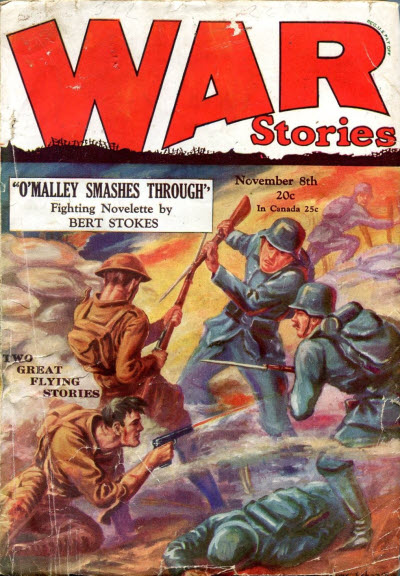
SINCE we’ve been featuring Frederick C. Painton’s letters he wrote home while serving with the American Expeditionary Forces in WWI, this week we feature a short tale Painton had in the pages of War Stories. It’s the tale of the Schmidt brothers—one had left home in 1912 and eventually found himself in the German Navy having risen the ranks to become their most feared submarine captain. The other brother remained at home and signed up when America entered the war, putting his talents to use for the US Navy listening for subs never thinking he would one day be hunting down his own beloved brother!

The German sub U-74 was out to ruin Mediterranean shipping, and its commander, the “Fox,” was famous for his cleverness. It was up to Carney to stop him—Carney and his listener at the hydrophones—and it meant close, quick work. Dolph Schmidt was that listener, and he knew things—but said nothing.

From the November 8th, 1928 issue of War Stories, it’s Frederick C. Painton’s “In The Dark of The Sea!”

Painton’s Letters Home from WWI | 12 March 1918

Link - Posted by David on December 4, 2019 @ 6:00 am in

THIS month we’re featuring Frederick C. Painton’s letters he wrote home while serving with the American Expeditionary Forces in WWI. Portions of these letters were published in his hometown paper, The Elmira Star-Gazette of Elmira, New York. Before the war young Fred Painton had been doing various jobs at the Elmira Advertiser as well as being a part-time chauffeur. He was eager to get into the scrap, but was continually turned down because of a slight heart affliction and was not accepted in the draft without an argument. He was so eager to go that he prevailed upon the draft board to permit him to report ahead of his time. Painton left Elmira in December 1917 with the third contingent of the county draft for Camp Dix but was again rejected. He was eventually transferred to the aviation camp at Kelly Field as a chauffeur, and in a few weeks’ time was on his way to England in the transport service with an aviation section, where he landed at the end of January 1918. Fellow Elmiran “Jake” Golos, a well known newsboy, also arrived in France on January 31st.

FRENCH TROLLEY LIKE ‘SAND CAR’

Elmira Star-Gazette, Elmira, New York • 12 March 1918

Sergeant Painton Says the Trolleys “Over There” Remind Him of Elmira’s Work Cars—Meets Elmiran.

Sergeant Frederick Painton, Elmira boy, now attached to the 655th Aero Squadron in France, has written an interesting letter to friends in this city describing his experiences in France. Sergeant Painton left Elmira with the third contingent of the county draft for Camp Dix and was later transferred to the aviation camp at San Antonio, Tex. After a short period of training, he was ready for the trip across to England, where he landed a few weeks ago.

In one part of the letter he speaks of meeting Jacob Golos, an Elmira boy, who is “over there.” Sergeant Painton says In part:

“I think that since leaving the states I have traveled by every mode of conveyance except airplane and submarine. The most excruciating of those was a two-day trip in a French freight car with a flat wheel and me riding over the flat wheel. Though I was not seasick on the trip this certainly made me feel funny. I met Jake Golos a short time back, but was separated from him shortly after. Since then I have not seen a single Elmira fellow. We are at present quartered in a city of some size which has a history that would fill a book. One of the cathedrals was built in the 15th century and is a wonderful structure. There are many points of interest which, believe me. I am going to get to see before coming back to the old home town.

“Streets are not streets here such as we know. They are alleys. The road, especially the middle of the road, is the walk. It is a good thing, too, because as I was going back to the barracks the other night I walked along the sidewalk. By the time I got to the barracks I had a cheap skate on from trying to follow the crooks in said sidewalk.

“Oh, I almost forgot the trolley cars. Those razzle dazzle things of beauty which are identical with the E.W.L. & R.R. Co.’s sand car and made in the same year. They are called a tram car. Two or three times I have seen one going at full speed, which is about nine miles per hour. I don’t mind riding on them. however. Peachy-looking dames come to garner in the sheckles. Whenever we get on one we always remark that we don’t know where we’re going but we’re on our way.”

Painton’s Letters Home from WWI | 2 March 1918

Link - Posted by David on December 2, 2019 @ 6:00 am in

THIS month we’re featuring Frederick C. Painton’s letters he wrote home while serving with the American Expeditionary Forces in WWI. Portions of these letters were published in his hometown paper, The Elmira Star-Gazette of Elmira, New York. Before the war young Fred Painton had been doing various jobs at the Elmira Advertiser as well as being a part-time chauffeur. He was eager to get into the scrap, but was continually turned down because of a slight heart affliction and was not accepted in the draft without an argument. He was so eager to go that he prevailed upon the draft board to permit him to report ahead of his time. Painton left Elmira in December 1917 with the third contingent of the county draft for Camp Dix but was again rejected. He was eventually transferred to the aviation camp at Kelly Field as a chauffeur, and in a few weeks’ time was on his way to England in the transport service with an aviation section, where he landed at the end of January 1918.

painton_WWI_enlistment
FREDERICK C. PAINTON’S Armed Forces Registration Card. June 5th, 1917

SAYS “TIN FISH” CHASES VESSEL

Elmira Star-Gazette, Elmira, New York • 2 March 1918

Sergeant Frederick Painton Writes Parents From England That “Sub” Tries to Sink His Transport.

Mr. and Mrs. George Painton have received interesting letters from their son, Sergeant Frederick Painton, who recently arrived in England with a detachment of Expeditionary Forces from Camp Dix. Portions of his letters relating to details across and his experience follow:

“Somewhere in England. Jan. 31. 1918.

“Well, here I am in the land of grandfather’s birth, right side up with care, as usual. Many thrills I have experienced, but that of mounting guard on a liner, with giant waves running a 60-mile lee wind eclipses them all. A sub (tin fish) chased us and was chased off by our destroyers.

“The song, ‘Where Do We Go From Here?’ is very apt and applies at all times to us. We know, less than outsiders. Oh, I feel so good to get off the old tub of a liner. I hope that you people did not worry over me. I knew 1 would land all right.

“February 2.

“I was so terribly busy yesterday I could not write, but will finish this today. We were paid off yesterday, the first since I entered Uncle Sam’s army. From now on I will draw about $40 a month.

“It rained all day today and I had to drill my platoon at that. Well, they would not stop a battle just for rain.

“All a soldier has to live for is what he gets to eat and believe me I am going to pamper my inner man. The stuff costs like the deuce. A six pence here, and eight pence there soon amounts to a pound. I have learned the money already. We sleep in planks over here—no cots. When we get to our destination, of course, we will, have our own cots, but that is not yet. I have been drilling my men in squads right and left and other drill pertaining to squad formation. This is the stuff I learned at Camp Dix. I am supposed to be a duty sergeant, but as they are shy on ‘non-coms’ I have been pressed into service, for I am supply sergeant.

“SGT. FREDERICK C. PAINTON,
“229th Aero Supply Squadron,
“via New York.”

“Wrong About Face!” by Joe Archibald

Link - Posted by David on November 29, 2019 @ 6:00 am in

“HAW-W-W-W-W!” That sound can only mean one thing—it’s time to ring out the old year and ring in the new with that Bachelor of Artifice, Knight of Calamity and an alumnus of Doctor Merlin’s Camelot College for Conjurors—Phineas Pinkham.

It was reported that plans vital to the Allied cause had been stolen from a certain general in a hotel in Bar-Le-Duc. Potsdam’s spies had been out-snooping the Allied slewfoots. Things were known on the German side that should not have been known—and wouldn’t have been unless there was skulduggery on the Democratic side of the lines. Washington, London, Rome, and Paris were getting inklings here and there anent a mysterious Teuton Intelligence Dynasty. The scions of a well-born family irrigated with blue Dutch blood were spread all over the Western Front. A lot of practical brass hats called it an Old Wives’ tale. They said that it was propaganda to irk the morale of the Allies. But when a certain concentration center or important dump was shellacked with deadly precision, the same brass hats began to bite their finger nails and believe in anything—even a pilot called Patrick Henry the Third!

From the pages of the May 1937 Flying Aces, it’s another sky-high “Phineas Pinkham” mirthquake from the Joe Archibald—It’s “Wrong About Face!”

When Patrick Henry the Third shoved his super-schnozzled pan into Major Rufus Garrity’s flight office, the ozone above the drome rang with the patriotic cry of “Give me a Liberty or give me a Hisso!” But before long someone started to play a game that called for an aunt instead of an ante. And Phineas? Well, he played a Pat face against a Pat hand.

My Most Thrilling Sky Fight: Lt. Luigi Olivari

Link - Posted by David on November 27, 2019 @ 6:00 am in

AMIDST all the great pulp thrills and features in Sky Fighters, they ran a true story feature collected by Ace Williams wherein famous War Aces would tell actual true accounts of thrilling moments in their fighting lives! This time it’s the inimitable Italian flying ace, Lt. Luigi Olivari’s Most Thrilling Sky Fight!

Luigi Olivari was born in Milan and educated in Switzerland in a military school. Although but a boy in his minority when the war began, he left home and school immediately and enlisted in the ranks of the Italian Army. He rose swiftly in the ranks and was commissioned a Lieutenant in tho Alpine Corps, those rugged mountain troops that did so much to protect the fertile Italian plains from Austrian army raids. After brief service as an officer in that branch he was transferred to the flying corps. Sent to the front he was assigned to a squadron flying little Pomilio monoplanes with Fiat engines. These were the fastest but trickiest of front line lighting machines of their day. Luigi Olivari downed three Austrian planes in his first sky battle. When killed on October 15, 1917, he had run his score to 12 official and was the third ranking Italian ace. The account below is taken from an interview he gave to an American correspondent.


DOWNING A NIGHT RAIDER

by Lieutenant Luigi Olivari • Sky Fighters, October 1936

FIGHTING by day and fighting by night are not at all similar. Of course, one uses his guns in the same manner in both cases; but tactics and strategy are entirely different. In day time one maneuvers to secure the advantage of the sun, so that he may come down in the path of the sun’s rays unseen by his antagonist. To try the same tactics at night, say to maneuver into the path of the moon’s rays, would be fatal. For instead of being hidden you would only succeed in revealing your presence to the enemy. Then another thing, in day fighting one usually tries to gain position behind and above the enemy. In night fighters against bombers such a position is fatal. The glare of your exhausts gives your presence away, and the night bombers are so arranged that many guns can be brought to bear on the rear, in front and to all sides. The only proper way to attack is from directly beneath.

One has to unlearn most of his day fighting tactics when he goes on night patrol. I had had good schooling before I ever went on night patrol. That accounts, I believe, for my success in my first night flight, when I succeeded in bringing down an Austrian Gotha that was attempting to bomb one of our ammunition factories,

A Moonlit Night

Front line patrols had reported that a formation of three Gothas had crossed our lines, proceeding in the general direction of T——. The night was one of bright moonlight, ideal for bombing. And I must also say helpful to us, the flyers of the night patrol, who were supposed to keep them from laying their eggs—and down them if possible.

With Captain M——, Lieutenants S—— and G——, and Sergeant T——, I took off from our airdrome and flew to intercept the night raiders. Even in moonlight one cannot see far at night, hence the Gothas passed us unseen. They came over at a much higher level than they had been reported. It is only when the anti-aircraft battery protecting the factory at T—— began to fire at them, that our formation located them.

We all dashed in then with full power. Our instructions were to split the formation if possible. That we managed to do even before the night raiders had a chance to drop their bombs. Captain M—— and two others went for the Boche leader. Sergeant T—— and I then attacked the Boche on the right. The sergeant went up above and the Boche gunners opened up on him with a heavy fire which he returned. I could see the tracers from both ships racing back and forth like a streaking shuttle in power loom.

Firing at Close Range

Taking advantage of the Boche gunner’s momentary distraction with Sergeant T——, I dived down and came up with full power immediately beneath, my sights fastened on the Boche’s black belly. Knowing that they were armored in places beneath I waited until I was very close before firing. Then when I did, I rooked my stick fore and aft, so that my tracers traversed the whole length of the fuselage.

The Boche gunners saw me now, however, and they switched their fire to me. But their tracers went harmlessly through my outer wings. They couldn’t reach me in a vital spot, for parts of their own plane intervened. I was hovering under their blind spot.

With speed lost, my ship began to wobble. I had fired a whole belt of ammunition into the Boche’s belly and still nothing had happened. I thought my surprise attack from beneath was going to fail and was sick at heart. But no!

A little tongue of fire began to lick along the fuselage. Fanned by the air blast it leaped into a giant flame, the heat of which I felt against my cheeks as I fell off into an uncontrolled spin. Then there was an explosion. My own plane seemed to suddenly thrust sideways. It groaned under the sudden strain and the braces crackled.

But my motor was roaring, so I soon managed to regain control.

There below and to one side of me was a night raider falling in flames. The other two Gothas were streaking homewards with my comrades darting in at them and sniping from all sides like swallows attacking a hawk.

The bombs that were dropped did not do any damage, and I had succeeded in gaining my first victory over a night raider.

“Is That a Fact?” April 1932 by William E. Barrett

Link - Posted by David on November 25, 2019 @ 6:00 am in

THIS November we’re celebrating William E. Barrett’s Birthday. Before he became renown for such classics as The Left Hand of God and Lilies of The Field, Barrett honed his craft across the pages of the pulp magazines—and nowhere more so than in War Birds and it’s companion magazine War Aces where he contributed smashing novels and novelettes, True tales of the Aces of the Great War, encyclopedic articles on the great war planes as well as other factual features. Here at Age of Aces Books he’s best known for his nine Iron Ace stories which ran in Sky Birds in the mid ’30s!

Among those factual features was “Is That a Fact?” which ran frequently in the pages of War Birds. It was an aviation themed version of a Ripley’s Believe It or Not kind of feature with hard to believe they’re true facts. Although written by Barrett, the feature was illustrated by noted cartoonist Victor “Vic Vac” Vaccarezza.

The April 1932 installment, from the pages of War Birds, features Major Raoul Lufbery, Captain F.R. McCall and the R.F.C.’s 56th Squadron!

“The Cradle of Hell” by William E. Barrett

Link - Posted by David on November 22, 2019 @ 6:00 am in

THIS November we’re celebrating William E. Barrett’s Birthday with one of his pulp stories each Friday.

Before he became renown for such classics as The Left Hand of God and Lilies of The Field, Barrett honed his craft across the pages of the pulp magazines—and nowhere more so than in War Birds and it’s companion magazine War Aces where he contributed smashing novels and novelettes, True tales of the Aces of the Great War, encyclopedic articles on the great war planes as well as other factual features. Here at Age of Aces Books he’s best known for his nine Iron Ace stories which ran in Sky Birds in the mid ’30s!

In this final Barrett story for the month we have the story of Captain Jim Fogarty, a Montana Irishman in the service of Britain. He was Youth triumphant, a, veteran of six weeks on the fighting Front, commander of a squadron, and officially credited with victories over sixteen enemy airmen. The twin Ds of Death and Defeat had not touched him—but when it did, they brought him straight down into the cradle of hell and nearly cost him his life!

At the mercy of those taunting Boche guns, Fogarty learned that there can be a worse end than death. Only when Death’s substitute pointed her hand at him did he know the terrific cost of his ransom.

From the October 1931 War Aces, it’s the novel you won’t forget—William E. Barrett’s “The Cradle of Hell!”

“Famous Firsts” June 1932 by William E. Barrett

Link - Posted by David on November 20, 2019 @ 6:00 am in

THIS November we’re celebrating William E. Barrett’s Birthday. Before he became renown for such classics as The Left Hand of God and Lilies of The Field, Barrett honed his craft across the pages of the pulp magazines—and nowhere more so than in War Birds and it’s companion magazine War Aces where he contributed smashing novels and novelettes, True tales of the Aces of the Great War, encyclopedic articles on the great war planes as well as other factual features. Here at Age of Aces Books he’s best known for his nine Iron Ace stories which ran in Sky Birds in the mid ’30s!

Among those factual features was “Famous Firsts” which ran frequently in the pages of War Aces. “Famous Firsts” was an illustrated feature much along the lines of Barrett’s “Is That a Fact?” that was running in War Birds, only here the facts were all statements of firsts. And like “Is That a Fact?” in War Birds, this feature was also taken over by noted cartoonist Victor “Vic Vac” Vaccarezza in 1932.

The June 1932 installment, from the pages of War Aces, features George Washington (who witnessed the first Air Journey in America—really!), The 94th Squadron, the 185th Pursuit Squadron and The Second Balloon Company!

“Is That a Fact?” March 1932 by William E. Barrett

Link - Posted by David on November 18, 2019 @ 6:00 am in

THIS November we’re celebrating William E. Barrett’s Birthday. Before he became renown for such classics as The Left Hand of God and Lilies of The Field, Barrett honed his craft across the pages of the pulp magazines—and nowhere more so than in War Birds and it’s companion magazine War Aces where he contributed smashing novels and novelettes, True tales of the Aces of the Great War, encyclopedic articles on the great war planes as well as other factual features. Here at Age of Aces Books he’s best known for his nine Iron Ace stories which ran in Sky Birds in the mid ’30s!

Among those factual features was “Is That a Fact?” which ran frequently in the pages of War Birds. It was an aviation themed version of a Ripley’s Believe It or Not kind of feature with hard to believe they’re true facts. Although written by Barrett, the feature was illustrated by noted cartoonist Victor “Vic Vac” Vaccarezza.

The March 1932 installment, from the pages of War Birds, features the R.F.C.’s first casualty, the great Manfred von Richthofen and his Circus and the Monument at Neuilly!

Next Monday Barrett features Major Raoul Lufbery, Captain F.R. McCall and the R.F.C.’s 56th Squadron!

“Breed of Angels” by William E. Barrett

Link - Posted by David on November 15, 2019 @ 6:00 am in

THIS November we’re celebrating William E. Barrett’s Birthday with one of his pulp stories each Friday.

Before he became renown for such classics as The Left Hand of God and Lilies of The Field, Barrett honed his craft across the pages of the pulp magazines—and nowhere more so than in War Birds and it’s companion magazine War Aces where he contributed smashing novels and novelettes, True tales of the Aces of the Great War, encyclopedic articles on the great war planes as well as other factual features. Here at Age of Aces Books he’s best known for his nine Iron Ace stories which ran in Sky Birds in the mid ’30s!

Today we have the story of Captain Frederick Dietterich who is being relieved of his temporary command as captain and squadron leader to serve under a Prussian, Hauptmann von Kopf. Dietterich was an Alsatian and that had been a handicap. The Imperial Government accepted great service from Alsatians but withheld its trust while accepting them. His reputation on the other side of the line had hurt, too. He had been known as a clean sportsman. H.Q. had frowned at that. It favored officers who were feared. The last touch was his popularity with his men. The men of his jagdstaffel spoke of him as “Fritz”. The Imperial command could not associate authority with familiarity and Dietterich was going back to the flying ranks.

Von Kopf biggest problem upon assuming command is an American flyer known as The Angel who has already downed four of the Jadgstaffel’s Fokkers and seven others. When Dietterich manages to shoot Angel down, it is von Kopf who underestimates the Yankee flyer!

There was a new breed of angel in the sky one that used Vickers instead of a flaming sword; and the tracer stream of his vengeance spelled death to Prussians!

From the April 1931 War Aces, it’s William E. Barrett’s “Breed of Angels!”

“Famous Firsts” April 1932 by William E. Barrett

Link - Posted by David on November 13, 2019 @ 6:00 am in

THIS November we’re celebrating William E. Barrett’s Birthday. Before he became renown for such classics as The Left Hand of God and Lilies of The Field, Barrett honed his craft across the pages of the pulp magazines—and nowhere more so than in War Birds and it’s companion magazine War Aces where he contributed smashing novels and novelettes, True tales of the Aces of the Great War, encyclopedic articles on the great war planes as well as other factual features. Here at Age of Aces Books he’s best known for his nine Iron Ace stories which ran in Sky Birds in the mid ’30s!

Among those factual features was “Famous Firsts” which ran frequently in the pages of War Aces. “Famous Firsts” was an illustrated feature much along the lines of Barrett’s “Is That a Fact?” that was running in War Birds, only here the facts were all statements of firsts. And like “Is That a Fact?” in War Birds, this feature was also taken over by noted cartoonist Victor “Vic Vac” Vaccarezza in 1932.

The April 1932 installment, from the pages of War Aces, features Lt. Alan McLeod, The Sopwith Tabloid, and the Number One Battle Squadron!

Next Wednesday Barrett features George Washington (who witnessed the first Air Journey in America—really), The 94th Squadron, the 185th Pursuit Squadron and The Second Balloon Company!

« Previous PageNext Page »