Looking to buy? See our books on amazon.com Get Reading Now! Age of Aces Presents - free pulp PDFs

“Famous Sky Fighters, December 1936″ by Terry Gilkison

Link - Posted by David on March 11, 2020 @ 6:00 am in

STARTING in the October 1933 issue of Sky Fighters and running almost 5 years, Terry Gilkison’s “Famous Sky Fighters” was a staple of the magazine. Each month Gilkison would illustrate in a two page spread different Aces that rose to fame during the Great War.

Although Gilkison was probably better known for his syndicated newspaper work, he also provided black and white story interior illustrations for pulp magazines. His work appeared in Clues, Thrilling Adventures, Texas Rangers, Thrilling Mystery, Thrilling Western, and Popular Western. Gilkison provided similar features in a few other Thrilling Publications—there was “Famous Soldiers of Fortune” and later “Adventure Thrills” in Thrilling Adventures, Famous Crimes” in Thrilling Detective, and the fully illustrated air adventure stories of Buck Barton “The Flying Devil” in The Lone Eagle! He signed most of this work with only his initials “T.G.” to maintain a low profile and preserve his reputation as a syndicated newspaper cartoon artist.

The December 1936 installment, from the pages of Sky Fighters, features Major David McKelvy Peterson, Werner Voss, and Captain Charles Guynemer!

Next time in “Famous Sky Fighters”, Terry Gilkison features three Lieutenants—Rene Montrion, George “Lucky” Kyle, Max Ritter von Mulzer—and a Major—the incomparable Raoul Lufbery! Don’t miss it!

“Down from the Clouds” by Ralph Oppenheim

Link - Posted by David on March 6, 2020 @ 6:00 am in

MARCH is Mosquito Month! We’re celebrating Ralph Oppenheim and his greatest creation—The Three Mosquitoes! We’ll be featuring three early tales of the Mosquitoes over the next few Fridays as well as looking at Mr. Oppenheim’s pre-pulp writings. So, let’s get things rolling, as the Mosquitoes like to say as they get into action—“Let’s Go!”

The greatest fighting war-birds on the Western Front are once again roaring into action. The three Spads flying in a V formation so precise that they seemed as one. On their trim khaki fuselages, were three identical insignias—each a huge, black-painted picture of a grim-looking mosquito. In the cockpits sat the reckless, inseparable trio known as the “Three Mosquitoes.” Captain Kirby, their impetuous young leader, always flying point. On his right, “Shorty” Carn, the mild-eyed, corpulent little Mosquito, who loved his sleep. And on Kirby’s left, completing the V, the eldest and wisest of the trio—long-faced and taciturn Travis.

Let’s get things off the ground with an early Mosquitoes tale from the pages of the August 19th, 1927 issue of War Stories. A new C.O. has been assigned to the squadron and he can’t stand pilots who “grand-stand” which is the Mosquitoes stock-in-trade and boy do they catch hell when they get on the C.O.’s wrong side—that is until the C.O. gets in a jam and it’s trick flying that’ll save him when the Boche come “Down from the Clouds!”

The C.O. of the flying field was sore—the Three Mosquitoes, dare-devils supreme were doing their “grand-stand stuff” again. But when the C.O. found himself in difficulties, with Boche planes swarming all around him—things were different. The best flying story of the month.

And check back next Friday when the inseparable trio will be back with another exciting adventure!

“Fairey Hendons and the Gladiators” by Frederick Blakeslee

Link - Posted by David on March 2, 2020 @ 6:00 am in

FREDERICK BLAKESLEE painted all the covers for the entire run of Dare-Devil Aces. And each of those covers had a story behind it. For the June 1937 Dare-Devil Aces, Mr. Blakeslee’s paints a flock of Fairey “Hendons” bombing a big gun emplacement along with a flight of Gloster “Gauntlets”.

th_DDA_3706ON THE cover this month you will find a flock of Fairey “Hendons” bombing a big gun emplacement. They’ve come over just around dusk, when everything is quiet, and they’re giving the boys below plenty of hell.

As an escort, they have a flight of Gloster “Gauntlets,” those fast, speedy jobs that we’ve heard so much about recently. One of the most feared types of planes in the world, the “Gauntlet” is a tough baby to mingle with.

But we’re not concerned for the moment with the “Gauntlets.” We’ve devoted our attention to the nearest plane, the one without the streamlined pants on the wheels. It’s a “Gladiator” and gentlemen, what a job!

The “Gladiator” is a development of the “Gauntlet” and it’s really a better ship. You will notice that the “Gauntlet” is a two-bay wing job. Well, the designers saw fit to make the “Gladiator” a single-bay ship, and I think they were right.

Another deviation from the “Gauntlet” is the single-strut cantilever undercarriage. They constructed these babies so that they’d last and this single-strut business is a testimonial to their confidence.

When it comes to throwing steel around the sky, the “Gladiator” can take fine care of itself. Its armament consists of four machine guns, and they speak a language of their own. Personally, I wouldn’t want to speak with any of them.

When you talk about power, the “Gladiator” must be considered. In its motor-bed is a Bristol “Mercury IX,” a nine cylinder radial job. This power-house is air-cooled and supercharged, and when you give it a bit of throttle it goes places!

Do you want speed? This baby will do 255 m.p.h. at 14,500 feet, and it has a service ceiling of 32,800 feet.

The “Gauntlet” isn’t far behind in performance. It’s equipped with a Bristol “Mercury V.I.S.,” another radial, air-cooled engine. It boasts of speed of 230 m.p.h. at 15,500 feet and has a service ceiling of 33,500 feet.

Frederick Blakeslee.

The Story Behind The Cover
“Fairey Hendons and the Gladiators: The Story Behind The Cover” by Frederick Blakeslee
(June 1937, Dare-Devil Aces)

“Bagged in Bagdad” by Joe Archibald

Link - Posted by David on February 28, 2020 @ 6:00 am in

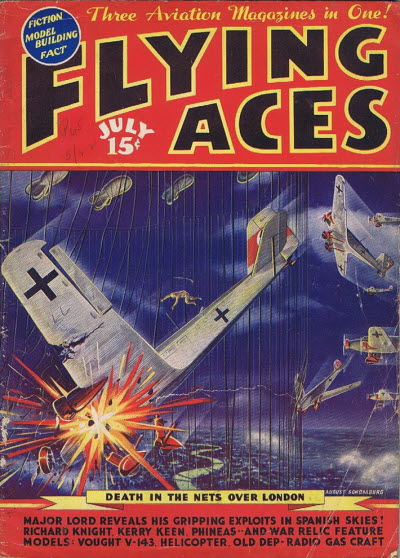
“Haw-w-w-w-w!” That sound can only mean one thing—it’s time to ring out the old year and ring in the new with that Bachelor of Artifice, Knight of Calamity and an alumnus of Doctor Merlin’s Camelot College for Conjurors—Phineas Pinkham. The Boonetown miracle is sent to Bagdad to find out the lay of the land between Bagdad and Mosul—the strength of Turkish troops, the number of guns, and all that sort of thing. But most important of all, he is to ferret out the Turkish spy—Mustapha Murad. It is a dangerous job, that Phineas accomplishes in his own inimitable style. It’s the Arabian Nights a’la Phineas Pinkham! From the pages of the June 1937 issue of Flying Aces, it’s “Bagged in Bagdad!”

Off in Harun Al Raschid’s sinister land of mystery, Mussulman musclemen had muscled in, hence the Limeys’ battle layout didn’t look so lush. As for Phineas, both teams in the Big Scrap were after his scalp. For even though Beni Sentmi had scored a neat outfield assist, Mustapha Murad and Rancid Bey were next on the batting list. And they were ready to knock a Bagdad four-bagger right over the fez.

“Famous Sky Fighters, November 1936″ by Terry Gilkison

Link - Posted by David on January 29, 2020 @ 6:00 am in

STARTING in the October 1933 issue of Sky Fighters and running almost 5 years, Terry Gilkison’s “Famous Sky Fighters” was a staple of the magazine. Each month Gilkison would illustrate in a two page spread different Aces that rose to fame during the Great War.

Although Gilkison was probably better known for his syndicated newspaper work, he also provided black and white story interior illustrations for pulp magazines. His work appeared in Clues, Thrilling Adventures, Texas Rangers, Thrilling Mystery, Thrilling Western, and Popular Western. Gilkison provided similar features in a few other Thrilling Publications—there was “Famous Soldiers of Fortune” and later “Adventure Thrills” in Thrilling Adventures, Famous Crimes” in Thrilling Detective, and the fully illustrated air adventure stories of Buck Barton “The Flying Devil” in The Lone Eagle! He signed most of this work with only his initials “T.G.” to maintain a low profile and preserve his reputation as a syndicated newspaper cartoon artist.

The November 1936 installment, from the pages of Sky Fighters, features Major Edward Mannock, Lt. Clyde Balsley, and Lt. Victor Chapman!

Next time in “Famous Sky Fighters”, Terry Gilkison features Major David McKelvy Peterson, Werner Voss, and Captain Charles Guynemer! Don’t miss it!

“The Blackburn Shark” by Frederick Blakeslee

Link - Posted by David on January 20, 2020 @ 6:00 am in

FREDERICK BLAKESLEE painted all the covers for the entire run of Dare-Devil Aces. And each of those covers had a story behind it. For the March 1937 Dare-Devil Aces, Mr. Blakeslee’s paints a tale of British planes catching a battleship docked in a small seaside town.

th_DDA_3703THE scene of this month’s cover is any place your imagination cares to place it. For my own part, I thought a little seaside view might be pleasant and just took a stab at some water and somebody’s city. But the story behind the cover is obvious enough.

The British planes have caught a battleship in dock and are doing a job on it. I imagine the most interesting crate to the reader would be that torpedo carrier, number 720. This is the Blackburn “Shark,” though I imagine the side drawing of it above looks a bit different than the three-quarter rear shot on the cover appears. Its speed is 152½ m.p.h. maximum at 5,500 feet and a landing speed of
62½ m.p.h. The torpedo it lugs around through the sky weighs no less than 1500 pounds.

All the other ships but one, of course, are of the Hawker family. And if you’ve been guessing what that tricky little blue job might be, here goes:

It is the Swedish Svenska “Jaktfalk” single-seater fighter. In an imaginary war, you would naturally pick this ship to be allied with the British, especially when you consider the close relationship between these two nations. Its British-made, supercharged motor gives it a speed of 208 m.p.h. and its ceiling is 19,680 feet. Hope you liked it, and see you next month.—Fred Blakeslee.

The Story Behind The Cover
“The Blackburn Shark: The Story Behind The Cover” by Frederick Blakeslee
(March 1937, Dare-Devil Aces)

“Famous Sky Fighters, October 1936″ by Terry Gilkison

Link - Posted by David on January 15, 2020 @ 6:00 am in

STARTING in the October 1933 issue of Sky Fighters and running almost 5 years, Terry Gilkison’s “Famous Sky Fighters” was a staple of the magazine. Each month Gilkison would illustrate in a two page spread different Aces that rose to fame during the Great War.

Although Gilkison was probably better known for his syndicated newspaper work, he also provided black and white story interior illustrations for pulp magazines. His work appeared in Clues, Thrilling Adventures, Texas Rangers, Thrilling Mystery, Thrilling Western, and Popular Western. Gilkison provided similar features in a few other Thrilling Publications—there was “Famous Soldiers of Fortune” and later “Adventure Thrills” in Thrilling Adventures, Famous Crimes” in Thrilling Detective, and the fully illustrated air adventure stories of Buck Barton “The Flying Devil” in The Lone Eagle! He signed most of this work with only his initials “T.G.” to maintain a low profile and preserve his reputation as a syndicated newspaper cartoon artist.

The October 1936 installment, from the pages of Sky Fighters, features Colonel Charles Kerwood, S.A. Andree, Rene Fonck, Major Christopher Draper and the first licensed woman pilot in the US, Harriet Quimby!

Next time in “Famous Sky Fighters”, Terry Gilkison features Major Edward Mannock, Lt. Clyde Balsley, and Lt. Victor Chapman! Don’t miss it!

Dare-Devil Aces, February 1937 by Frederick Blakeslee

Link - Posted by David on January 6, 2020 @ 6:00 am in

Frederick Blakeslee painted all the covers for the entire run of Dare-Devil Aces. And each of those covers had a story behind it. The February 1937 Dare-Devil Aces’ cover is the first of Mr. Blakeslee’s “Planes by the Numbers” covers where he has so many planes on the cover, he explains which plane is what with a legend on the story behind the cover page. He featured the Hawker Fury on the previous issue—on this issue he featured the other planes in the Hawker line of fighters.

th_DDA_3702SOME very particular gent wrote to me the other day. complaining about the covers. He yelled that I took too much liberty with facts, and grouped planes that seldom, if ever, are seen together. He must be a new reader, for I have oft stated that, as this magazine is a fictional enterprise, the covers try to keep pace with the contents. Of course the covers are slightly screwy! I’m afraid that they wouldn’t be very interesting if I showed you a squadron of planes that were exactly alike in every respect.

This month’s cover is an example of what I mean. About seven types of planes are represented, and although some of them are slightly out of place, I don’t think you’ll mind. Let me tell you about them.

You’ll notice that the silhouettes on this page are really ships on the cover, set in exactly the same positions.

No. 1 is the Hawker “Osprey”, a Fleet fighter that ordinarily operates from aircraft carriers and other ships of the Royal Navy. I don’t know just what it’s doing over the city. Maybe the guy is on leave. It has a top speed of 240 m.p.h.

No. 2 is a Hawker “Hart”, the standard single-engined day bomber of the R.F.A. It is the basic type for most of the other Hawkers, and does 184 m.p.h.

No. 3, there are two of them, are German Ardo fighters.

No. 4 is a Fairey “Hendon” night bomber, and don’t ask me what it’s doing out in the daytime. Maybe it hasn’t been home yet. You’ll notice that it has left the rest of the flight and is off by itself. Ginsburg is probably at the wheel, and you know that guy!

No. 5 is a Hawker “Hardy”, a general purpose biplane that is particularly adapted for use in India and the Near East. Details are lacking on this, however.

No. 6 is a Hawker “Audax”, an Army cooperation crate with a speed of 152 m.p.h., which is practically walking. The way it’s heading now, the pilot would have done better to stay in bed.

No. 7 is a Bristol “Bulldog”, a really high-class piece of business. It does 175 m.p.h. at sea level, and 218 m.p.h. at 20,000, which is really lugging the mail.

So look them over, gents, and remember that I warned you.

The Story Behind The Cover
“The Story Behind The Cover” by Frederick Blakeslee
(February 1937, Dare-Devil Aces)

“Famous Sky Fighters, September 1936″ by Terry Gilkison

Link - Posted by David on January 1, 2020 @ 6:00 am in

STARTING in the October 1933 issue of Sky Fighters and running almost 5 years, Terry Gilkison’s “Famous Sky Fighters” was a staple of the magazine. Each month Gilkison would illustrate in a two page spread different Aces that rose to fame during the Great War.

Although Gilkison was probably better known for his syndicated newspaper work, he also provided black and white story interior illustrations for pulp magazines. His work appeared in Clues, Thrilling Adventures, Texas Rangers, Thrilling Mystery, Thrilling Western, and Popular Western. Gilkison provided similar features in a few other Thrilling Publications—there was “Famous Soldiers of Fortune” and later “Adventure Thrills” in Thrilling Adventures, Famous Crimes” in Thrilling Detective, and the fully illustrated air adventure stories of Buck Barton “The Flying Devil” in The Lone Eagle! He signed most of this work with only his initials “T.G.” to maintain a low profile and preserve his reputation as a syndicated newspaper cartoon artist.

The September 1936 installment, from the pages of Sky Fighters, features Captain John Blair, Lt. Paul Neibling, and French sky fighter Lt. M. Navarre!

Next time in “Famous Sky Fighters”, Terry Gilkison features Colonel Charles Kerwood, S.A. Andree, Rene Fonck, Major Christopher Draper and the first licensed woman pilot in the US, Harriet Quimby! Don’t miss it!

Painton’s Letters Home from WWI | 24 January 1919

Link - Posted by David on December 30, 2019 @ 6:00 am in

THIS month we’re featuring Frederick C. Painton’s letters he wrote home while serving with the American Expeditionary Forces in WWI. Portions of these letters were published in his hometown paper, The Elmira Star-Gazette of Elmira, New York. Before the war young Fred Painton had been doing various jobs at the Elmira Advertiser as well as being a part-time chauffeur. He was eager to get into the scrap, but was continually turned down because of a slight heart affliction and was not accepted in the draft without an argument. He was so eager to go that he prevailed upon the draft board to permit him to report ahead of his time. Painton left Elmira in December 1917 with the third contingent of the county draft for Camp Dix but was again rejected. He was eventually transferred to the aviation camp at Kelly Field as a chauffeur, and in a few weeks’ time was on his way to England in the transport service with an aviation section, where he landed at the end of January 1918 as part of the 229th Aero Supply Squadron. He was transferred to the 655 Aero Squadron in France shortly thereafter and then to the 496th and eventually attached to the staff of The Stars and Stripes just before the end of the war and stayed on with the occupying forces.

armistice
A PANARAMA. Old Glory flies over Ehrenbreitstein fortress looking down on Coblentz, lying peacefully on the juncture of the Rhine and Moselle. Germany 1919.

SERGEANT FRED PAINTON WRITES OF THE AMERICAN OCCUPATION OF COBLENTZ ON THE RHINE

Elmira Star-Gazette, Elmira, New York • 24 January 1919

Elmiran Sends Interesting Description of Chief City in American Sector and Portrays Feeling of the Doughboys When They Show That Kaiser Had the Wrong “Dope.”

Sergeant Frederick C. Painton, former Elmira newspaperman, writes an interesting account of the American army’s crossing of the River Rhine and the occupation of Coblentz. the chief city in the American sector of occupation. Sergeant Painton is now attached to “The Stars and Stripes,” the official paper of the American soldiers in France and is afforded an excellent opportunity to see the things which he describes.

He writes:

“Coblentz, Germany,
“Dec. 13, 1918.

“Today, in a very quiet undramatic marched into Coblentz, the chief and by far largest city included in the territory of occupation. Facing me not fifty yards away is the historic and much sung Rhine, not the German Rhine in our sector, but the American Rhine for the time being. By nightfall the streets swarmed with doughboys. To them came no emotion, this was an everyday job: the Argonne. Chateau Thierry, it was all the same. To the list of tiny unknown French villages, whose names later on were blazed across the papers through the deeds of the A.E.F. is now added that of Coblentz. To those who have never toured Europe. Coblentz is as much of a secret as is La Ferte.

“As Coblentz has been made the headquarters of the 3rd Army and everything of importance centers here, it would not go amiss to give a brief description. Coblentz, with Treves or Trier as the Germans call it, rate as two of the oldest cities in Germany, dating back to the time of Caesar. Although situated at the junction of the Rhine and Moselle, it has never grown much in population. In the Thirty Years War Coblentz was, in turn, besieged and garrisoned by the Swedes, French and Prussians.

“Slipping quickly to the era of Napoleon we find it, after Valmy, made the capital of the new French province of Meurthe et Moselle. It is thus that we can account for the dual names that are horn by all the towns rivers and departments. They have, after Waterloo, been all Germanized. Now, for the first time in over a hundred years, a foreign flag Old Glory, now flies from the City Hall and also from the Ehrenbreitstein, the fortress guarding Coblentz. Does this not give one a feeling of passionate pride in our country?

“I can not resist the temptation to describe for you the Ebrenbreitstein as it looks at the moment perched high on the rugged cliffs on the opposite bank of the Rhine. As I look out the window, the sun, which shines today for the first time in weeks, sets off this monstrous fortress in all its grim and powerful lines. On its highest tower, gently waving in the springlike breeze is “Old Glory.” flaunting in the Kaiser’s face a refutation of his remark that “The Americans will take no important part in this war as they will arrive too late.” We were late, but American speed brought the train in on time.

“Ehrenbreitstein—the name is reminiscent of three balls—has been called and rightly “The Gibraltar of the Rhine.” It was commenced about the time that Napoleon made his exit from the European stage and has been strengthened and improved from year to year as new modes of killing came into vogue. In a way it resembles Verdun, in that it has been hollowed out of the rock. The huge underground chambers will easily billet one hundred men. Monstrous supply rooms occupy the base and by means of spiral stair cases one finally rises to the height of 385 feel and gazes from the cement battlements down on the fair city of Coblentz, lying peacefully on the juncture of the Rhine and Moselle. On clear days one can see Andernach lying further down the Rhine. Up to the time we took possession of the fortress, no foreign soldiers had ever made its will resound with the tread of their footsteps. Now the case is reversed: No German soldiers are allowed inside.

“The city proper lies on the peninsula formed by the juncture of the Rhine and the Moselle. We were much impressed with the civic upbuilding. Each building and private residence were beautiful examples of German architecture and everything was scrupulously neat and clean. The city is laid out very beautifully, with long gardens and promenades running along the banks of the Rhine. Being on that great inland waterway, there is considerable business done in cargo carrying.

“It is rather amusing to run into a newcomer and have him ask eagerly, “Is that there river the Rhine” Upon receiving an affirmative answer, he usually stares long and thoughtfully at it and then with a smile and shake of the shoulders, remark: “Well, that’s sompen to tell the folks at home, by Gosh. I saw their old German Rhine.”

“You can well imagine our thoughts when, as we stood on the now historic pontoon bridge, about ten o’clock at night, we heard the sweet strains of “Taps” wafted over the swift flowing waters beneath. That we would eventually stand here none of us had any doubts, but who would have thought a few short months ago that the curtain would have been rung down so quickly?

“Today is the 14th of December, a day that will go down in the annals of historv as the day on which our olive drab columns crossed the Rhine to finish occupying our area. We were all up before daybreak, eagerly awaiting the moment when the advance would be sounded. The streets were crowded with the boys of the gallant First. As the dim gray crept across the sky announcing the approach of another dismal, rainy day. the brief command. “Forward March” was given to the leading battalion and the great moment had arrived. Who can say what emotions pierced our breast as battalion after battalion swung into line and the boards began to rattle with the impress of hundreds of steel shod boots? Who can say that we had not received our reward for all the hardships endured as we watched the grim, gaily painted guns go thundering over the bridge quaking beneath their weight? What could we think when we remembered that the remnant of Germany’s fighting machine were slinking away a few short hours ahead of these boys, whose deeds at Monfaucon, Cantigny and Soisson will live forever in the memories of all Americans? All felt the same desire to yell with joy, toss their caps, anything to give vent to their superexuberant spirits brought on by witnessing such a show of a nation’s power as was this. Further up on another bridge of more substantial construction, the lads of the famous second were also taking their place in line. Hundreds of the civilian population left their beds to witness this great event. To those who took stock in Kaiser Wilhelm’s statement that aside from two or three regular divisions, there were no American troops in France, this sight must have been well nigh incredible. Can you wonder that, instead of being angry at having to remain a few months longer, we are intensely proud?”


A few weeks later, The Star-Gazette reported that Sergeant Painton was to be shipped home after suffering injuries from gas attack in the St. Mihiel Drive.


SERG. PAINTON ORDERED HOME SUFFERING FROM GAS EFFECTS

Elmira Star-Gazette, Elmira, New York • 18 February 1919

Elmira Soldier Collapses Several Months After Having Been Gassed in St. Mihiel Drive—Has Been Attached To Staff of the Stars and Stripes.

Sergeant Frederick C. Painton, son of Mr. and Mrs. George Painton, former Elmira newspaperman, whose interesting letters from France have been widely read, is enroute home, suffering from the effects of gas, which he received during the St. Mihiel drive by General Pershing’s troops. Painton has lately been attached to the staff of The Stars and Stripes and was having a most interesting experience as a reporter with the American Army of Occupation when he suddenly collapsed and was forced to give up his work.

He writes: “A year ago today I landed in Glasgow, England, and now, on the anniversary, I find myself scrapped, war’s cast-off and en-route home.” Painton was gassed several months ago. and at the time paid no attention to the matter. He says “now I am getting the real effects, my stomach is gone, my nerves are gone, and, as you know, I already had a bad heart, so here I am feeling as bad as the Kaiser. I expect to sail in about a week and should be in Elmira by the first of March.”

Painton was evacuated from Coblentz on the Rhine and was forced to leave all effects in his trunk at Paris. He says he fears he will have to spend his first month home in bed, but he hopes to soon be tearing off copy for local papers before very long.

Painton was thrown by the concussion of a shell while at Troyon, during the St. Mihiel drive, and believes that he suffered an injury to his side. Because of the condition of his nerves, he is unable to sleep at times without the aid of an opiate. The former reporter declares he dislikes very much to leave at this time, because he was having a wonderful experience with the American Army. However, he looks forward to the trip home as a tonic, although greatly disappointed because he must leave his trunk full of war souvenirs behind. He hopes to have a friend take care of it for him until he can have it sent home.

Painton was a reporter in Elmira at the time the United States entered the war. He was eager to get into the scrap, but was continually turned down because of a slight heart affliction. He was not accepted in the draft without an argument, and so eager was he to go that he prevailed upon the draft board to permit him to report ahead of his time. He was again rejected at Camp Dix, but finally was allowed to go to Kelly Field as a chauffeur, and in a few weeks’ time was on his way across in the transport service with an aviation section.

Finally an opportunity came to him, after the armistice was signed, to become attached to The Stars and Stripes, the official publication of the American soldiers, published in Paris. His articles, which have appeared in the local papers, have been widely read.

“McClarnin Shoots a Natural” by Allan R. Bosworth

Link - Posted by David on December 27, 2019 @ 6:00 am in

THIS week we have a story from the pen of the Navy’s own Allan R. Bosworth. Being a Navy man, Bosworth’s stories primarily dealt with the Navy. In this week’s story from the pages of War Novels, Bosworth gives us the story of some sailors who try to get a game of Craps in and get caught below deck when the ship is torpedoed by a German sub!

Stealthily the four men entered that water-tight storeroom and dogged down the door. Yet they soon found a fifth one among them, grimly smiling at their little game.

From the pages of the June 15th, 1929 issue of War Novels, it “McClarnin Shoots a Natural!”

Painton’s Letters Home from WWI | 3 January 1919

Link - Posted by David on December 26, 2019 @ 6:00 am in

THIS month we’re featuring Frederick C. Painton’s letters he wrote home while serving with the American Expeditionary Forces in WWI. Portions of these letters were published in his hometown paper, The Elmira Star-Gazette of Elmira, New York. Before the war young Fred Painton had been doing various jobs at the Elmira Advertiser as well as being a part-time chauffeur. He was eager to get into the scrap, but was continually turned down because of a slight heart affliction and was not accepted in the draft without an argument. He was so eager to go that he prevailed upon the draft board to permit him to report ahead of his time. Painton left Elmira in December 1917 with the third contingent of the county draft for Camp Dix but was again rejected. He was eventually transferred to the aviation camp at Kelly Field as a chauffeur, and in a few weeks’ time was on his way to England in the transport service with an aviation section, where he landed at the end of January 1918 as part of the 229th Aero Supply Squadron. He was transferred to the 655 Aero Squadron in France shortly thereafter and then to the 496th and eventually attached to the staff of The Stars and Stripes just before the end of the war and stayed on with the occupying forces.

armistice
TREVES. Locals turn out to watch the allied occupying forces come through town.
1 December 1918

SEGT. PAINTON TELLS OF TREVES

Elmira Star-Gazette, Elmira, New York • 3 January 1919

Boy Tries to Sell Helmet for Meat—Entire A.E.F. Envious of Those Who Make Up the American Army of Occupation—Does Not Expect to Be Home for Several Months.

“It is tiresome work, this making history for our kids to study.” is the apt way in which Sergeant Frederick Painton writes of his experiences, in one of the first letters received from Germany since the American Army of Occupation took up its march to the Rhine.

Sergeant Painton, who is now attached to the Staff of “The Stars and Stripes,” the official paper of the American Epeditionary Forces, writes from Treves, one of the tirst of the German cities occupied by the Americans, he writes that the German people appear glad to see the Americans and are quick to barter souvenirs for something to eat. Sergeant Painton writes:

“Treves, Germany,

“December 6, 1918.


“Dear Friend:

“When I walked out of the office a little over a year ago who could have said that a year later I would be in a German city, sleeping in a German Hotel, and not a prisoner? But such is the case, which proves that truth is stronger than fiction. At present I rest, covered from head to foot with the mud of two nations and the Duchy of Luxemburg. We drove all the way from Verdun, which we left early this morning.

You cannot imagine the mental sensation of being actually in Germany and seeing German soldiers walking down the street unguarded. And what irony of fate to order and eat a meal in a German hotel and pay for it with French money! In spite of all that has been written in the negative, there is not a doubt but what the lower classes are in a hard way for food, which I will prove by the following incident:

We entered Treves at S o’clock, French time, swearing like pirates. It was blacker than Hades, foggy, slippery, and to cap the climax we had two flat tires and an empty stomach. Wc stopped to try and find some place to cache the car for the night and while my companion was trying to find one a little German lad came up to me and offered to sell one of those Dutch picklehaubes, or spiked helmets, which the boys are so crazy to get as souvenirs. I asked him how much, and he said “Das Fleisch,” which means meat. He did not want money, as money will not buy meat in this country. In this hotel, however, we had plenty to eat for five marks and 30 pfennig.

German money is used entirely, which means learning a new money system and I am becoming a shark when it comes to rates of exchange. I talk in halting German, so halting, in fact, that it stands still most of the time. I have become so used to talking French that the little German I learned in school has completely left me. It is like a Ford, though, it may start again at any time.

I can’t say when I will be home. Being with the Army of Occupation means not within three or four months at any rate. I don’t mind though, this is a privilege and the whole A.E.F. is envious of us. As we came across the bridge over the Moselle, which is the frontier. I saw by the dim light a tall, grey-cloaked, spike-helmeted man walking down the road. As we came closer I also saw that he wore an up-turned mustache a la Kaiser. As the swirling fog eddied around him I was forcibly impressed with the likeness to the ex-Kaiser and also that we were victors. This was doubly brought home when he glanced over his shoulder and then slunk out of the road. Vanished hopes and bitter memories, indeed. Here was the incarnation of them.

In the city, however, the people are gay without being noisily so. Children laugh and imitate our salute as we walk down the street. The people are for the most part well dressed and have a relieved air about them.

I am enclosing a German identification tag which you may wish for a souvenir. In our Ford at present we have ten or twelve helmets, six guns, paper bandages, caps and the Lord only knows what else. But how to get it home, that’s the question.

German time is an hour later than French and it now registers 11 o’clock, so here is where I hit the hay. It is tiresome work this making history for our kids to study. I prefer to sleep just now.

Auf wiedersehn, as they say here!

Painton’s Letters Home from WWI | 24 December 1918

Link - Posted by David on December 24, 2019 @ 6:00 am in

THIS month we’re featuring Frederick C. Painton’s letters he wrote home while serving with the American Expeditionary Forces in WWI. Portions of these letters were published in his hometown paper, The Elmira Star-Gazette of Elmira, New York. Before the war young Fred Painton had been doing various jobs at the Elmira Advertiser as well as being a part-time chauffeur. He was eager to get into the scrap, but was continually turned down because of a slight heart affliction and was not accepted in the draft without an argument. He was so eager to go that he prevailed upon the draft board to permit him to report ahead of his time. Painton left Elmira in December 1917 with the third contingent of the county draft for Camp Dix but was again rejected. He was eventually transferred to the aviation camp at Kelly Field as a chauffeur, and in a few weeks’ time was on his way to England in the transport service with an aviation section, where he landed at the end of January 1918 as part of the 229th Aero Supply Squadron. He was transferred to the 655 Aero Squadron in France shortly thereafter and then to the 496th and eventually attached to the staff of The Stars and Stripes just before the end of the war and stayed on with the occupying forces.

SERGEANT FRED PAINTON LEARNS IT COSTS TO EAT IN LUXEMBURG

Elmira Star-Gazette, Elmira, New York • 24 December 1918

Writes That One Day’s Meals Cost $12, but the People of the Duchy Appear to Eat Well Just the Same—Is Attached to Third Army.

Sergeant Frederick C. Painton, former Elmira newspaperman, now a member of the staff of The Stars and stripes, the official paper of the American Expeditionary Forces, was in Luxemburg November 26, the date of his last letter. According to the Elmira soldier, Luxemburg is no place to sojourn on a private soldier’s salary, unless the latter carries his own canteen along with him. One day’s meals cost about twelve dollars.

Sergeant Painton writes:
November 26, 1918.

“Dear Friend:

“I think that my presence in Luxemburg will take you by surprise, but, anyway, here I am enroute for Paris. This is sure some beautiful city, but talk about the high cost of living, this takes the brown derby. The Alaskan gold rush couldn’t even touch it. Here are some of the prices in American money that I had to pay today: Two dollars for breakfast, four-dollars for lunch, and five-fifty for dinner. Remember, this is for one only. There is a candy shop near here where a bar of chocolate of ordinary size costs $16 each. Beer is fifty cents a small glass, and four sticks of licorice costs two dollars. Ice cream is fifty cents a glass and ordinary wine like we buy in Paris for three franc a bottle costs twenty here. These were the prevailing prices before we came and in some cases they were even higher.

“All the citizens have a sleek, well-fed appearance, and, as I found no signs of paper clothes or wooden shoes here, I think I will have to go further into Germany to find them I shall go further as I shall be attached to the Third Army. There is a great deal to tell you, so I shall put most of !t off until I get back to Paris. That trip following the German retreat was the greatest thing in my young life.

“I saw Jack Wilkinson in Paris and have a date with him for Wednesday night if all goes well. If you would like a Boche helmet for a souvenir I can send you one. We came upon hundreds of boxes of new helmets that were ready to be Issued. We all had Mauser rifles for souvenirs and plenty of “ammo.” so shot holes through some of them for practice.

“Well, it is time to hit the hay, so will close. This is the first time I have slept in a bed in two weeks, so I will make it a good one. I was stationed in Verdun for three or four days and had to sleep in an old shack on the floor.

“Every sign in this town is painted in both French and German, although the latter language is in more use.”

“How Barker Won the V.C.” by Paul J. Bissell

Link - Posted by David on December 23, 2019 @ 6:00 am in

THIS week we present another of Paul Bissell’s covers for Flying Aces! Bissell is mainly known for doing the covers of Flying Aces from 1931 through 1934 when C.B. Mayshark took over duties. For the February 1932 cover Bissell put us right in the action as Major Barker fights his way through Hell skies to down five German planes in a single day!

How Barker Won the V.C.

th_FA_3202JUST four years before, it had been Barker. W.G. Private 106074, First Canadian Rifles. Today, October 17, 1918, it was Major Barker, D.S.C., M.C., with forty-six Germans to his credit, who was waving good-bye to his squadron mates as in his Snipe machine he took off for England. The day was clear, and those on the ground smiled as they saw the little machine climb higher and higher. Yes, Billy Barker was obeying orders and “proceeding to England,” but via Germany, and one last scrap.

He was four and a half miles up when he met his first enemy, a double-seater machine, with a good pilot and a scrappy observer. Twice Barker attacked before he sent this plane down. Then, when the machine burst into flames, he pulled out of his dive, leveling off just as a burst from above caught him completely unawares.

He slipped away on a wing, but not soon enough to avoid an explosive bullet which completely shattered his left thigh. Turning to the attack, his fast-maneuvering Snipe quickly got him into a position where, with deadly coolness, he finished his second German of the day.

Dizzy from loss of blood, he suddenly found the sky around him literally black with German pjanes. The watching Tommies on the ground estimated that the planes numbered no less than sixty.

Without hesitation Barker dived at the nearest enemy. Number three went down.

Now the Germans were firing at him from every direction. His machine was hit repeatedly and he himself was wounded again, this time in the right thigh. His machine out of control, he fell into a spin, followed down by the whole German circus. After a few thousand feet, however, the rush of air revived Barker, and savagely he returned to the attack.

A quick tight loop—his favorite maneuver—one short burst, and the fourth German went down in flames. But again Barker pays dearly. This time another explosive bullet takes away his entire left elbow joint. Once again he goes into a spin, down he twists, the Boche diving after and riddling his machine. The gas tank is demolished. Fighting desperately to maintain consciousness, he switches his engine to his auxiliary tank, and once again turns on his foes.

But the battle is over. Faint from loss of blood, scarcely conscious, Barker, with one last effort, turns his plane toward the west, and dives headlong toward the shell-pocked earth, piling up in a barbed wire entanglement just inside the British lines.

Downed at last, but still alive and smiling. Sixty to one were the odds. Five German planes was the toll he took.

The best that England could give in medical attention was his. Slowly they nursed him back to health, and Major Barker became Colonel William George Barker, V.C., D.S.O., M.C., with fifty-one official air victories to his credit—and he was less than twenty-four years old!

The Ships on The Cover
“How Barker Won the V.C.”
Flying Aces, February 1932 by Paul J. Bissell

Painton’s Letters Home from WWI | 30 November 1918

Link - Posted by David on December 18, 2019 @ 6:00 am in

THIS month we’re featuring Frederick C. Painton’s letters he wrote home while serving with the American Expeditionary Forces in WWI. Portions of these letters were published in his hometown paper, The Elmira Star-Gazette of Elmira, New York. Before the war young Fred Painton had been doing various jobs at the Elmira Advertiser as well as being a part-time chauffeur. He was eager to get into the scrap, but was continually turned down because of a slight heart affliction and was not accepted in the draft without an argument. He was so eager to go that he prevailed upon the draft board to permit him to report ahead of his time. Painton left Elmira in December 1917 with the third contingent of the county draft for Camp Dix but was again rejected. He was eventually transferred to the aviation camp at Kelly Field as a chauffeur, and in a few weeks’ time was on his way to England in the transport service with an aviation section, where he landed at the end of January 1918 as part of the 229th Aero Supply Squadron. He was transferred to the 655 Aero Squadron in France shortly thereafter and then to the 496th and eventually attached to the staff of The Stars and Stripes just before the end of the war.

armistice
ARMISTICE DAY Parisians flood the streets and party hard after hearing the war was over.
11 November 1918

ELMIRAN GIVES AN ACCOUNT OF CELEBRATION IN PARIS WHEN ARMISTICE IS SIGNED

Elmira Star-Gazette, Elmira, New York • 30 November 1918

Sergeant Frederick Painton Tells of Being in Paris, When Good News Is Received—City Declares Three Day Holiday and Wild Scenes Are Enacted.

Sergeant Frederick Painton, formerly of the 496th Aero Squadron and now attached to the staff of The Stars and Stripes had the enjoyable experience of being in Paris when the news came that the war was over. His description of the seen that followed in the French capital gives an indication of the great joy the end of the war brought to the Frenchmen, and not the least enjoyment for the American soldiers, who happened to be in Paris was the enthusiasm of the girls, or the “flappers,” as Sergeant Fred calls them. With their streets lined with war material captured from the Huns and the street lights operated again after four years of darkness, the Frenchmen gave themselves to celebration in utter abandon.

Fred Painton is a son of Mr. and Mrs. George Painton of this city, and a former Elmira newspaperman. He was among the first Elmirans to land in France, being attached to the aviation service as an automobile driver. As a result of his newspaper experience, young Painton has secured a place on the American soldiers’ official paper, The Stars and Stripes.

His description of the celebration in Paris, written the day after the armistice was signed, follows:

“I arrived in Paris Sunday night, so I was here yesterday when the announcement came that hostilities were over and that the armistice had been signed. From that moment yesterday morning, when the Parisians were informed that the war was over, they went mad, simply mad, with joy.

“Never before have I witnessed such a demonstration as took place, commencing yesterday afternoon, and still in progress. As I sit here typing, this letter to you, I can hear the yells and cheers of the people as they promenade ceaselessly back and forth on the Boulevard Des Italians. It has been said that the French government has declared a three days holiday, and I can well believe it, as I doubt much whether anyone would work at any price.

VEHICLES DECORATED.

“The town, the people and the vehicles are bedecked with streamers, flags and ribbons of the colors of the various allied countries. Yesterday afternoon about 5 o’clock as I left the office, the boulevard was a seething mass of swaying, demonstrative humanity in the midst of which were several taxicabs and fiacres stalled and unable to move. Impromptu parades were formed and the howling mob chanted the national anthems of the Allied powers. To use a hackneyed phrase, the scene was beyond description. If you can picture Elmira on an election night and then magnify it a thousandfold, you may perhaps be able to visualize the sight I have witnessed for the past two days. Coincident with the announcement of cessation of warfare, the lights of Paris, which have, for the past four years been turned off or darkened, were turned on full blast and tonight, the boulevard almost puts in the shade our “Great White Way.”

“On both sides of the Champs Elysee, the place de la Concorde and the Fuileries Gardens have been placed captured artillery and airplanes. They range from a machine gun to a grim siege mortar and from a giant Gotha bombing plane to the tiny dragon fly of a Fokker. There are literally thousands of pieces and to one unaccustomed to seeing large displays, perfectly appalling.

TAKE THE “BROWN DERBY.”

“When it comes to “taking joy out of life”, a Frenchman takes the “brown derby”. After four years of repression, they have cut loose with an abandon which, if tried in the United States would land them all in jail. As I was walking down to the hotel in company with another chap, we were violently assaulted by vivacious French girls and strenuously kissed to the intense enjoyment of the bystanders and our distinct embarrassment(?) It’s said, and I can well believe it, that two hours after the glad news was unknown that one could not buy a flag or piece of bunting in Paris. It is very amusing to us, who take our enjoyments more or less quietly, to watch the violent and hysterical manifestations of joy of these volatile French. All places of business were closed except the cafes and restaurants which did a pre-war business.

“It has been one of the great moments of my life, and I would not have missed it for any amount of money and will always owe The Stars and Stripes a debt for being instrumental in getting me here in time.

“The intense enthusiasm seems to be catching, for Italian, American, British, Aussies, Canadians, Portuguese and other soldiers yell as loud as the French and festoon themselves just as fantastically. In a way it reminds one of the Mardi Gras of New Orleans, as there is no limits placed on anyone’s wildest eccentricities. The kissing of the very pretty French “flappers,” at any rate, is contagious to say the least.

“Of course, with my change in stasix for which I am in a way genuinely sorry, as the old girl and I covered 10,000 miles of French soil ranging from end to end, on good roads and bad. I can at least say when I come back I have taken a personally conducted tour of France which covered everything very thoroughly.

« Previous PageNext Page »