
The Courier-News, Bridgewater, NJ, Friday, 15 November 1918, page 11.
F.E. RECHNITZER tells of his harrowing encounter with a Boche prison camp after his plane was forced to land on the wrong side of the lines. A prisoner of the Germans, this war aviator was given a strange third degree—and made the victim of a Boche Colonel’s grim joke!

Three Tough Days
by F.E. RECHNITZER
FLYING a Sopwith Camel in good weather was a job which kept a pilot on his toes every minute of the time. But in bad weather, with visibility almost zero, and rain driving in over the cowling—well, that was just plain hell.
And that was just the sort of thing I faced on the morning of September 28th, 1918—the day the Belgians started their drive to rid their country of the grey-clad army of the Kaiser.
We’d lined up earlier in the morning for patrol duty only to be called back by our C.O., who said that it was murder to send men into the air in that sort of weather. But no sooner had we changed into dry outfits than we were ordered into the air again by the Wing commander.
So off we hopped at intervals to ground-strafe the enemy from the air while the Belgians hammered away from the ground.
The first thing I did on reaching the storm-curtained battle in the muck was to look for a target on which to unload my four twenty pounders. For those four bombs nestling under the fuselage didn’t help the flying qualities of my Camel a bit.
I finally spotted a cluster of transport trucks bogged down in the mud. I circled above them and pulled the bomb toggles. I saw the muck fly, but when the smoke settled the transport was still there. An Aldis sight wasn’t so hot as a bomb aimer even in clear weather.
I circled over the battlefield again, hiding my head behind the low windshield to escape the impact of the rain.
Among the things the brass hat had lectured us on back in the mess was the activities of the R.A.F. during the coming drive. We were to take notes on them when the different outfits were to take off—bombers, fighters, ground strafers, photography jobs and the balloon burners.
I made notes and took the paper back to the hut in an effort to memorize them. Some of the fellows got theirs down pat and burned the paper according to instructions. But I was slow and by bedtime I still wasn’t sure of them, so I put the paper in my pocket, meaning to review it before breakfast, just before shoving off. I hadn’t had a chance, however, and the piece of paper was still in my pocket.
I thought of it now as I flew along in the storm, fighting the stick every minute of the time to keep my little Camel right side up. I tried to find a target for my machine guns on the ground, but I couldn’t tell a Belgian from a German. Everything was covered with mud. The men I saw traveling northeast might be Huns retreating, and then again they might be Belgians advancing.
THEN suddenly the storm slackened. The driving rain changed to a drifting mist and the ceiling dropped another hundred feet or so.
Diving lower, I found myself welcomed by a crew of Hun machine-gunners. They poured it into me plenty, so back into the soup I ducked.
vHow long that ducking business kept up I don’t know. But I soon discovered that I was well lost, muddled, befuddled and all the rest of it. My compass was spinning like a top and everything on the ground looked alike. And every time I went down below the ceiling to take a look around, the Germans on the ground made it hot for me. At least I knew I was still over enemy-held territory.
I tried my best to get straightened out, but it was no go. I might as well have been flying in China for all I could recognize on the plastered terrain below.
Presently I swept low, and much to my relief not a shot was fired at me. Not a single tracer steamed through the swirling mist. Right then my old heart settled back to normal revs. That would mean that I was back within my own lines.
But where? I didn’t hanker to get caught in another grey wall of mist and then find myself out over the North Sea. So I decided to set down in one of the fields below and ask where I was, locate some landmark and dig for home.
I picked out a field, slid in for a landing and glanced around as I unfastened my belt. Somebody shouted. I looked over my shoulder to see three grey-clad figures break out of the bushes alongside the road bordering the field.
THEY were Huns! 
I slammed the throttle up against the post. The Clerget picked up the beat and dragged the Camel over the far hedge.
Wham! Something hit the ship with a crash. The Clerget coughed, and I had a hunch I knew what had happened. Soon my nose told me I was right. A lucky shot from one of those Hun rifles had smacked my fuel tank.
In a flash I reached for the valve of my reserve tank. Wonder of miraculous wonders, it began to feed right away. I heard another volley as the Camel dug for the low-hanging mists, while I wiped the sweat off my forehead with my sleeve. What a story I’d have to tell!
Then it dawned on me that I still had to find my way back to the squadron before I could tell anybody anything.
I tried blind flying, but it was no go—not with just a compass, an airspeed indicator and a tachometer to help me. Well, to save time—I mean in telling what happened—I ran out of gas. My reserve tank, holding a half hour’s supply, went dry and I had to land.
Snapping off the switch, I headed for a beet field, set my trucks down in the mud. I was about to congratulate myself on making a good landing when the wheels dropped into a ditch and the Camel stood up on its nose. I jumped to the ground—and turned to face three civilians.
THEY all started to talk at once in a language that didn’t mean a thing to me. I soon decided that they were Belgians talking Flemish. But it might as well have been Arabic for all it meant to me.
So I went into a pantomime act, trying my best to inform them that I wanted to reach a telephone. At last one of them nodded that he understood and pointed across the field to a road.
I grinned and sighed with relief. Evidently, I thought, I had landed on my own side of the lines.
Just as we reached the road we met a girl and two youngsters who were evidently hurrying to see the plane which had landed on its nose.
The girl, a kid of about seventeen, stopped and spoke to me. I recognized a German word or two, but couldn’t quite get what she said. Then she tried French. I shrugged my shoulders, and muttered something in English. She laughed and replied in well-accented English.
“You are an English aviator?†she asked, apparently surprised. “What are you doing here on the road?â€
“Going to telephone my squadron an’ tell them to send a tender for me,†I replied. “But I’m American, not English.â€
“Do you not know that this is Boche territory?†she said.
“Boche!†I yelped. “You—you mean that I’m down on the wrong side of the lines?â€
She nodded and the rest of them shook their heads in agreement, and began to point in all directions.
I was finally convinced and started back to perform the rite of burning my ship before it fell into the hands of the enemy. To do this, I had to lug some sheaves of wheat from a bordering field. I refused to allow the willing Belgians to help me for fear of getting them into a jam.
Now a bus will catch fire quite easily when you don’t want it to burn. But try to get one perking on purpose. That’s a different story. I had to break open my oil tank with my Very light pistol, finally pounding for dear life with the heavy barrel, and then smear oil over the fuselage, before I finally managed to get the fabric to curling merrily.
Then we hustled away from there, with the girl in the lead.
THE Belgians and the kids disappeared after we left the field, but the girl stayed, and motioned me toward a house just at the edge of the village which was now in sight.
We entered the house and I took off my fur-lined flying suit which I had put on in place of the one that had gotten wet earlier in the day. Just as I handed it to the young chap who seemed to be the man of the house, a steady rattle of shots reached our ears.
The boy and girl turned pale and glanced at each other fearfully. For a moment I could picture the house being raided by half the German army. Then I realized what had happened. In my hurry to burn the Camel and get away I had forgotten all about the ammunition left in my Vickers belts. Now they were popping way in the fire just a few fields away. Those Belgians were plenty scared and they had a right to be. Helping Allied soldiers to escape was a serious offense. The noise of those shots would surely attract attention. I cursed myself bitterly for my forgetfulness.
Through the window of the steamy little kitchen we saw a group of Germans hustle by in a few minutes.
“I’ve got to get away from here before they begin to search,†I said to the girl. “How far is it to Holland?â€
“About ten kilometers,†she said, pointing toward the north. The man interrupted. She spoke to him a moment and then continued. “He says you must be careful of the electric wire if you plan to make an attempt to get into Holland.â€
I’d heard plenty about that hellish wire, but I was determined to try.
The old lady of the house fixed me up a cup of strong black stuff that passed for coffee and gave me a couple of slices of black bread smeared with lard.
“I’ll save that for later,†I said, pocketing the bread. “I’m going to try and make the Border tonight, and slip through the wire at dawn. I’ll be hungry by then.â€
The young fellow went upstairs and came back down with a coat and a pair of trousers in his hand. The clothes weren’t new but fitted fairly well.
As I slipped the coat on the girl handed me a half dozen lumps of sugar. “Smuggled from Holland,†she smiled.
I thanked her and slipped the sugar into the pocket of my Bedford Cords, little realizing the part that sugar would play before the day was over. Then I put on the trousers, wrapped my scarf around my neck and put on an old cap the young fellow had taken from a nail. I transferred the two slices of bread to my coat pocket, and turned to the girl.
“If you can,†I said, “notify my folks that I’m all right.†I gave her the address, which she wrote down.
“The Burgomaster will see that your people get word,†she said as she folded the paper and slipped it into her dress.
I thanked the people in whose house I had rested, through the girl, and then started out, hoping to get to the Dutch Border by dark.
The boy had informed me that a brook about a kilometer west of the village ran due north to the Border and that if I followed that I would have little trouble keeping my direction. I found the brook and turned my face toward Holland and freedom.
I DON’T think I had traveled three miles before I was startled out of my wits by a man stepping out from a clump of bushes. He didn’t say a word as he handed me three raw eggs. I was a little suspicious as I took the eggs, but when I saw the light in the old man’s eyes I knew that he was trying to do his bit toward helping the cause. He had recognized me as a stranger and evidently guessed the rest.
Putting the eggs in my coat pocket I hustled on, keeping to the brook and crossing under roads by walking in the water under the low bridges.
Presently I came to a bridge with a wire across it which forced me to cross the road. I crawled up the bank, and just as I started across I saw an old woman come out from behind the walls of a barnyard. Now I hate to think that that old Belgian woman had anything to do with what occurred a couple of minutes later. But this is what happened: She looked me over from the other side of the bridge. Her eyes took in the thick flying boots I had partly covered with my tattered trousers. Then she turned around and went back into the barnyard.
By the time I was across the road I heard a shout. I looked back to see two Germans wearing brass breast plates dangling by a chain on their chests. These plates, I found out later, denoted that the men were military police.
One of them fired a shot as I jumped into the brook and started to splash through the water. Another shot and they were in the brook too. I jumped up on the bank and then back into the brook as I ran trying to duck the slugs cutting through the bushes. As I went I ripped the two slices of bread from my pocket and threw them into the bushes, hoping to shield the Belgians if I were caught.
I came to a wall. I thought of jumping over, running along the wall on the other side, then popping back again. I’d seen that done once in the movies. But, as usual, things didn’t happen the way they happen in the movies. For as I jumped over I dropped right into the arms of a German who was walking along the path inside the wall.
He said something which I did not understand, but I did understand the language of the gun he held against my belly. I reached for the clouds, which were beginning to lift, by the way, but a couple of hours too late.
The only funny feature of my capture was the eggs. One of the other Huns began to frisk me the minute he came over the wall. When his hands touched the eggs he jumped, and began to point with lots of excited words at my pocket. I was sure he was saying something about grenades, so I reached in and took out the eggs. He looked so sheepish I had to laugh.
After a little discussion they took me to a village, got a two wheeled cart and loaded me on. There I sat, a guard on either side with ready rifles and two following along on bicycles. I was feeling low and pretty desperate by now.
It was almost dark when we reached the next village. I wouldn’t have known where I was if it hadn’t been for the girl. I saw her standing beside the road as we passed. As she saw me her face paled and she turned hurriedly away.
“You know this town?†asked one of my guards in broken English.
I shook my head.
He asked me that same question in a dozen different ways while the cart stood in the village square, and each time I insisted that it might be any one of the hundreds of villages in Belgium as far as I was concerned.
At last an automobile appeared on the scene and in a few minutes I was being whisked away to headquarters in Eecloo. It was here that the fireworks really started.
AFTER a few preliminary questions by a major, the coat and trousers which I had put on over my flying togs were taken away from me, together with the cap. Then I was led in to a high ceilinged office, to face a square-faced old colonel “Sit down,†he growled. For a few moments he looked me over. “So,†he finally went on, “we catch a British flyer behind our lines wearing civilian clothes over his uniform.â€
Right then the dumb trick I had pulled hit me right between the eyes, and he knew what I was thinking. He took off his glasses and sat playing with them as he looked at me. I felt like a cornered rat looking at a cat.
“You have had help on this side,†he finally snapped.
I shook my head.
“Then where did you get these?â€
He motioned toward the coat and trousers.
I had my story ready. I’d been thinking about those clothes on the way. So I looked him straight in the eye and went to it.
“Why,†I said, “I went into an old barn this morning to get out of the rain. They were hanging on a peg so I stole them. Thought they would make it easier for me to get into Holland.â€
The old fellow glared. “And the eggs?†he barked.
“Got them in the same place,†I bluffed. “Just as I was leaving I saw a hen on a nest and kicked her off and there were those eggs. If I’d waited a couple of minutes I might have had four.â€
The colonel’s eyes glowered at me across the desk. “That’s a lie,†he thundered. “These Belgians must be taught a lesson and I mean to find out who aided you.â€
I shrugged my shoulders. “Who would help a flyer to escape, especially give him clothes?†I argued.
The colonel leaned back in his chair. I can see him yet in that dimly lighted room, his stubby fingers touching together under his chin. I can see the sly smile steal across his face as he leaned forward suddenly.
“How can you prove that you are an aviator who was trying to escape?†He pointed toward the coat and trousers. “Remember, you were caught wearing these.â€
“But you found my plane, didn’t you?†I asked.
“My dear fellow,†he grinned. “A dozen or more of your planes came down in our territory today. Have you any particular plane in mind?â€
I sighed in relief at this bit of news. I said:
“I burned the ship I came down in; that’s orders, you know. It was a Camel.â€
He picked up a slip of paper, glanced over it for a moment, then turned to me. “We have three burned Sopwith Camels on our list. Could you by any chance name a town near which you came down? Surely you know the country well.†I shook my head and settled lower in my chair. His questions were getting awkward.
“You realize that if you cannot prove that you are a pilot there is a severe penalty for being found behind our lines in civilian clothes?†he said steadily.
I couldn’t think of an answer to that one. I was pretty worried by now.
HE BEGAN to write on a paper he had before him. For a while there wasn’t a sound except the scratching of the pen. He seemed to have either forgotten me or was giving the words he had just spoken a chance to sink in. And believe me they were sinking. So was my heart.
I slumped lower in the chair, and stretched my tired legs and put my hands in my pockets. My fingers touched the sugar, then something else that made my heart flop over. It was paper! I knew in a flash that it was the notes I had taken down as the brass hat outlined the air activities for the first two days of the push. One day had passed, but there was another to come. And the information on that slip of paper would be very clear to this German officer.
The information would not have much bearing on the outcome of the war. But it did mean that with that information in their possession the German airmen might be at the right place at the right time, and some Allied pilot might go west because of my negligence.
Now I was glad that they had been so busy asking me questions which they hoped would allow them to vent their spleen on some unfortunate Belgian or two, that they had overlooked searching me.
I had to get rid of that paper before somebody thought of going through my uniform!
Then I got an idea. Taking a piece of sugar from my pocket I sat toying with it, tossing it into the air and catching it.
“What is that?†snapped the colonel looking up,
I tried to be casual as I held it out to him, and more casual as I said, “Just a lump of sugar. Always carry it with me. Fond of sweets.â€
He took it, examined it and then handed it back with a growl, I slipped it into my mouth and began to chew, making as much noise as possible.
While I ate the first lump I squirmed around in my chair restlessly. While I wriggled I tore off a fair sized piece of the paper and wrapped it around a lump of sugar.
I slipped it quickly into my mouth and went on with my crunching, and at the same time wrapped up another lump in the precious notes. Once or twice the colonel looked up in annoyance as I ground the sugar between my teeth. But I remained impervious to his glances and continued to munch my sugar.
It took four lumps and a lot of swallowing, but I did away with the notes and believe me, wet paper sure can stick in a person’s throat.
After a while he turned his attention to me again and began to ask questions about what was going on over on the other side. When I told him that he more than likely knew more about what was going on than I did, he got peeved. I tried to explain that we got our war information from the papers and that they were usually three or four days old. When I offered to bet him a pound that he had already seen that day’s London papers, he got mad. He finally ordered them to take me to another room and search me.
They did. that. But all they found after stripping me to the hide, was two lumps of sugar, a package of cigarettes and fifteen francs. They were half an hour late.
Then they gave me something to eat and left me to myself. I had nothing to do but think and do a lot of wishing. I did plenty of both.
About ten o’clock I was called into the colonel’s office. He seemed quite friendly. Offered me a cigarette and I countered by offering him one of mine. He put his away and took mine. Then the questions started again. He wanted information about who had helped me. When he drew a blank there he went after war information and again discovered that when it came to knowledge about the activities of the Allies I was a numskull of the first water.
Then things took an ugly turn. He began to talk about trading. It was my life for information against my Belgian friends or information about the Allied activities.
I TRIED to convince him that I didn’t know a thing about the Allied maneuvers and that no one had helped me. He persisted that I had at least heard rumors, and that he didn’t believe I had stolen the clothes.
“We can shoot you as a spy for masquerading behind enemy lines/’ he threatened.
I had a hunch he was bluffing. I realized that I had done wrong in putting on those clothes. Perhaps they did have a right to put me up in front of a firing squad. But I didn’t think they’d dare. The Belgians had seen me come down. I had been paraded through two villages whose inhabitants would no doubt tell the British that I had been seen alive in the hands of the Germans.
My line of reasoning might have been all wrong. I’m not sure yet that it wasn’t. And what happened a morning or so later had me convinced at the time that it was.
Day and night were the same. Questions at ungodly hours, until I began to ponder over the feasibility of giving the old boy some false information.
On the morning of the third day a young officer came into the room and told me to dress. Wondering what was up now, I followed him downstairs. But instead of going to the colonel’s office, we went outside.
There, lined up on the garden path was a squad of soldiers, six of them. I had lots of time to count them before I was through. The men fell in at my side and led by the officer we walked down the garden path.
I thought of a million things as the officer told me to step from the path and stand by the wall.
There was the way. There was the officer. There was the firing squad. And there was I, scared to death.
The officer offered me a cigarette, but I shook my head.
I’ve often seen pictures and movies of men facing a firing squad and they always refused a bandage for their eyes. They were supposed to be brave men, not afraid to look down the long barreled rifles from whose blazing muzzles slugs would fly and tear their manly chests to shreds.
Perhaps that’s the way a brave man should act, but I didn’t feel that way about it. If there had been a potato sack handy I would gladly have crawled in and then asked somebody to tie me up.

I glanced up at the back window of headquarters. There stood the old colonel, grinning as he looked down where I stood with my back against a garden wall quaking in my rubber-soled flying boots. The boots were lined with sheep’s wool, but my feet were cold.
I heard a motor stop outside, and wondered if there were going to be witnesses. My heart looped and then went into a side-slip as the officer shouted a command.
The rifles rattled, but instead of pointing at me they dropped to the men’s shoulders. Bewildered, I turned to the officer. He smiled and pointed to the gate, where the soldiers waited. My knees were like fresh putty as I walked through that gate.
“Get in.†The officer pointed toward the car. I crawled in, and in a few minutes we were standing on the platform of a railroad station.
“You were frightened back there in the garden, yes?†grinned the officer.
“Frightened!†I almost yelled. “What do you think? Say, what was the big idea?â€
THE officer laughed. “It was just the colonel’s little joke.
“Yes, you see he had been threatening to have you shot as a spy when you would give him no information. Last night he thought of this as a farewell as you leave for the prison camp at Rasstatt. It was not funny to you, was it? I could not help, could not tell you, for he stood in the window.â€
For a moment I was speechless. “Listen,†I said, tapping the young officer on the chest. “If he likes jokes, tell him this one and see if he thinks it’s funny. Maybe he’ll decide the joke’s on him.â€
Then I told the young German about what I had done with the notes and how I had used the sugar to accomplish my purpose. His eyes opened a bit wider as I spread it on, stretching the importance of the paper a point or two.
“Be sure an’ tell him everything,†I snapped.
“I shall tell him,†the officer smiled.
“But I do not think he will consider it funny.†He paused and glanced at the guards. “But I do,†he whispered.
The train came in. I left for Rasstatt in company with an armed guard sitting on either side.
I’m certain that the officer must have given the colonel my message, for no word about me reached either the States or England until after I had been released and sent into Switzerland a couple of months later. Evidently the colonel was having a last crack at getting even.
At home I was given up for dead. Letters of condolence came to my people as word of my supposed demise spread. I’ve read those letters. They were nice, but they raised the devil with my ego.

Sky Fighters art department knocked up this facsimile of an official
communication regarding the Rechnitzer’s fate.
And quite a while later, news of Rechnitzer’s safe release is reported in The Courier-News!

The Courier-News, Bridgewater, NJ, Friday, 10 December 1918, page 6.






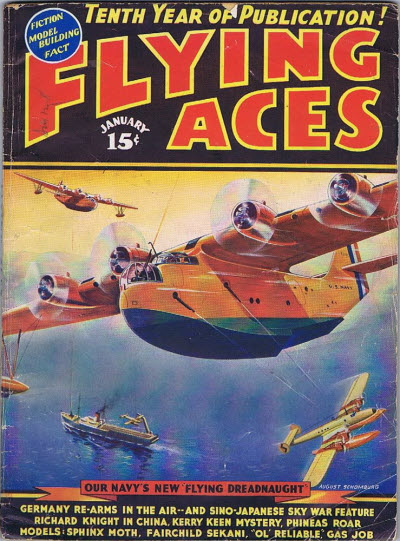 That sound can only mean one thing—that Bachelor of Artifice, Knight of Calamity and an alumnus of Doctor Merlin’s Camelot College for Conjurors is back to vex not only the Germans, but the Americans—the Ninth Pursuit Squadron in particular—as well. Yes it’s the marvel from Boonetown, Iowa himself—Lieutenant Phineas Pinkham!
 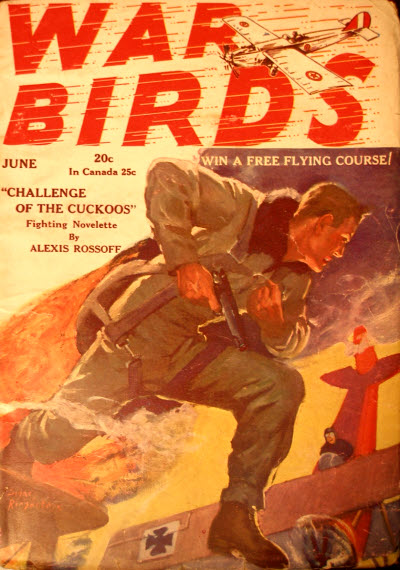 tale of the Cuckoo’s Nest from the prolific pen of Alexis Rossoff. The Cuckoo’s Nest stories ran in War Birds in 1930. The Cuckoo’s are an outfit a lot like Keyhoe’s
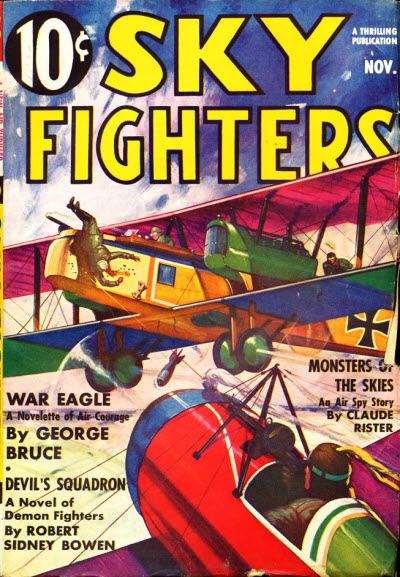 a story from the highly prolific George Bruce. Bruce, a former pilot, began writing in the 1920’s and became noted for his aerial war stories—several publications even bore his name. In the 1930’s and ’40’s he transitioned into screenwriting for Hollywood action films and then into tv in the 1950’s and ’60’s.

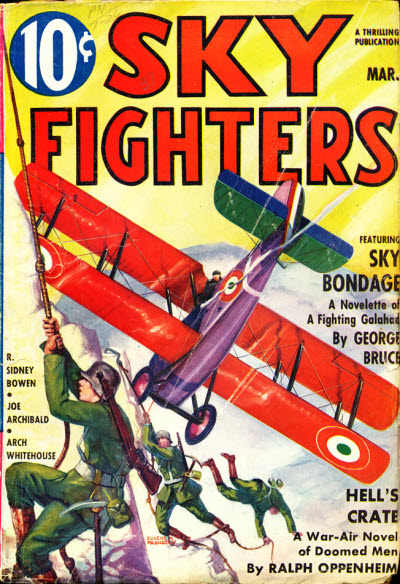 a short, but gripping tale from the prolific pen of
 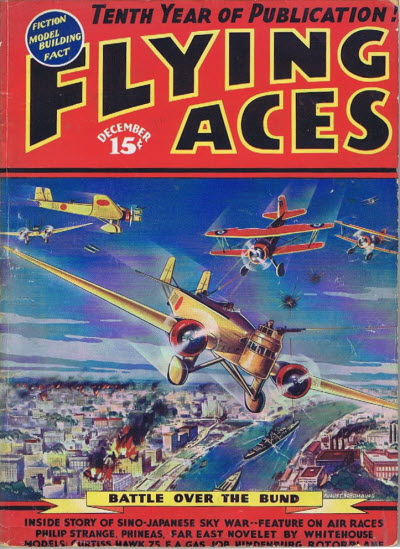 That sound can only mean one thing—that Bachelor of Artifice, Knight of Calamity and an alumnus of Doctor Merlin’s Camelot College for Conjurors is back to vex not only the Germans, but the Americans—the Ninth Pursuit Squadron in particular—as well. Yes it’s the marvel from Boonetown, Iowa himself—Lieutenant Phineas Pinkham!
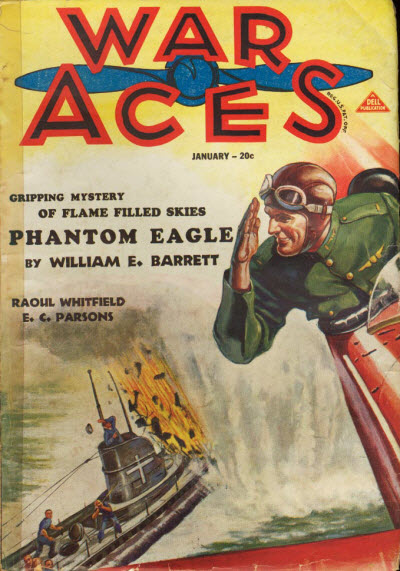 a story by Raoul Whitfield! Whitfield is primarily known for his hardboiled crime fiction published in the pages of Black Mask, but he was equally adept at lighter fair that might run in the pages of Breezy Stories. We’ve posted a few of his Buck Kent stories from Air Trails. While the Buck Kent stories were contemporary (1930’s), “The Singing Major” from the January 1932 issue of War Aces is set in The Great War and, in fact, based on a real person. At the time of publication, Whitfield told the editors of War Aces that the legends of this major are still talked about among the peasants in one locality. His was a temperament they couldn’t understand, hence many are the wild stories about him.
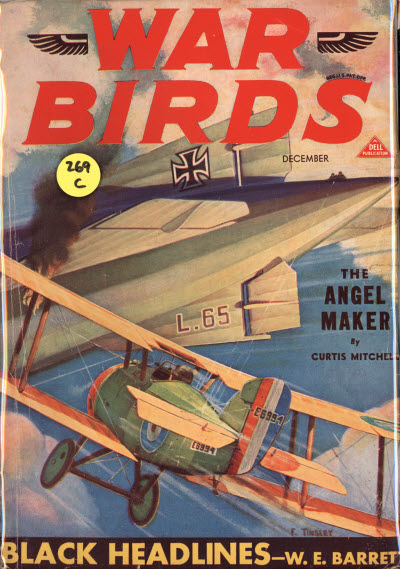 pen of the Navy’s own

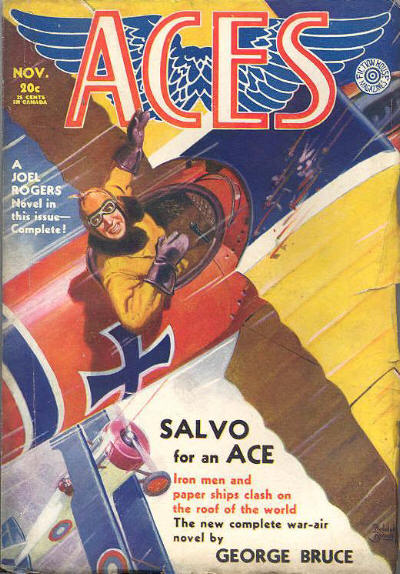 a story by Syl MacDowell! MacDowell is probably best known for his westerns. This time, MacDowell gives us brief tale of the mysterious Black Bat—is he man or beast? From the November 1931 issue of Aces, it’s “The Black Bat.”
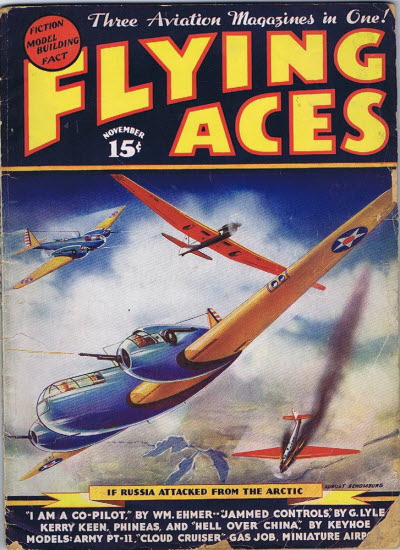 That sound can only mean one thing—that Bachelor of Artifice, Knight of Calamity and an alumnus of Doctor Merlin’s Camelot College for Conjurors is back to vex not only the Germans, but the Americans—the Ninth Pursuit Squadron in particular—as well. Yes it’s the marvel from Boonetown, Iowa himself—Lieutenant Phineas Pinkham!