




“Mushing Down the Air Trail” by Frank Richardson Pierce
THIS week we have another 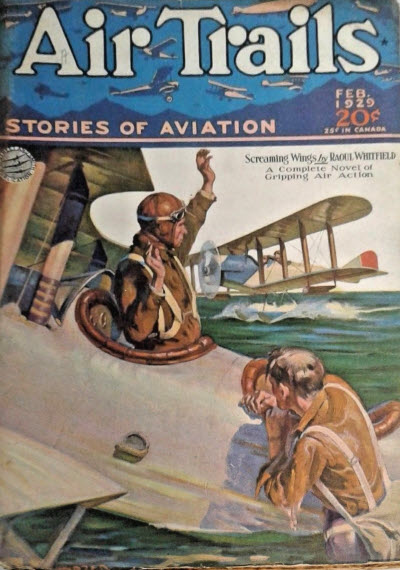 exciting air adventure with Rusty Wade from the pen of Frank Richardson Pierce. Pierce is probably best remembered for his prolific career in the Western Pulps. Writing under his own name as well as two pen names—Erle Stanly Pierce and Seth Ranger—Pierce’s career spanned fifty years and produced over 1,500 short stories, with over a thousand of these appearing in the pages of Argosy and the Saturday Evening Post.
This time around, gold has been found at an old claim up north and Rusty’s in a race with an unscrupulous pilot to reach the site and stake the claim and get back first to register said claim. Can Rusty outwit and outfly Pratt and get Old Man Dorsey back to the registrar’s off first. From the pages of the February 1929 Air Trails, it’s Frank Richardson Pierce’s “Mushing Down the Air Trail!”
High-powered planes and battling pilots above the snow fields of Alaska!
- Download “Mushing Down the Air Trail” (February 1929, Air Trails)
And as a bonus, here’s “The Landing Field” column from the January 1930 number of Air Trails where we get to know more about Frank Richardson Pierce, Rusty Wade, Alaska and the Air Musher!
THE LANDING FIELD
AIR TRAILS • January 1930 v3n4
IN THESE crisp 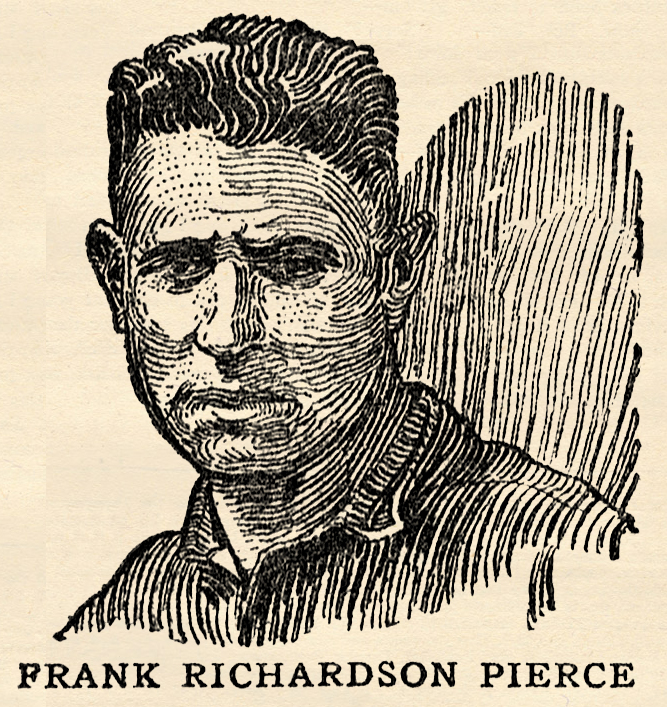 winter days with snow streaking through the sky, it seems right and proper to introduce Frank Richardson Pierce to you folks. Pierce lives up in the Northwest, up in Seattle, Washington—and he spends a good deal of his time hopping around Alaska. He is an outdoor man in every sense of the word. There are few writers in America who can catch the spirit of the frozen North as he can. His interests lie out under the open sky, with snow fields, fir forests, Canyons and great rivers. It was natural, therefore, that he took to flying.
For the past year you’ve been reading the “Rusty” Wade stories by Pierce. They’ve made a hit with Air Trails readers all over the country. The reason is that they ring as true as the roar of a Whirlwind motor on the nose of a new sport model ship. Pierce knows all about the Rusty Wade country.
He just recently came back from a trip over Alaska. Here’s what he says: “I get a great kick out of flying over some place I’ve walked. It gives me a chance to laugh at myself in comfort. But mostly I prefer flying in Alaska—the walking is tougher there.
“Alaskans lead the nation in air-mindedness. They have been flying for years—not for sport, but for business reasons. Why should a miner pole a boat for days up a river and fight mountains and glaciers when he can fly there with his outfit for a few dollars and still have the whole season ahead of him in which to prospect? Where in previous years it required weeks and months to bring out a load of fur, now it comes out in hours.
“An Eskimo may be popeyed when he arrives in Seattle and sees street cars, automobiles and skyscrapers, but he’ll not even blink at an airplane. He’s seen them before and probably has ridden in one.
“Rusty Wade is a typical Alaskan pilot. Landing fields are few and far between. If a pilot is forced down he has to walk out and it may take him days. And yet, right now, I can’t recall a single crash in which any one was killed. There may have been some, you understand, but I can’t recall them.
“At times, in Rusty Wade stories, I have tried to describe Alaska from the air. Thus far I have failed utterly. I doubt if there is in the whole world, anything more beautiful than flying over ice fields and glaciers studded with mighty peaks and set with lakes of the rarest blue. If any of the readers make a trip next summer, cable ahead to Juneau and make arrangements to see a bit of Alaska from the air while the steamer is lying over.
“At the present time a surveying party is working out of Juneau in planes. They are surveying a waterpower project discovered by the Alaskan air-mappers—a navy outfit. The lake is two thousand three hundred feet above the sea in a rough country. It would take many hours of the hardest work to reach the spot with equipment. The plane leaves Juneau and is on the lake within twenty minutes. It has even taken up a fourteen-foot skiff to the lake.”
A NUMBER of readers have written in, wanting to know what type of plane the Air Musher that Rusty Wade uses is. Well, that’s easy, and it gives us a chance to do a little “ground flying” here in front of the hangars. There’s nothing that a pilot likes so much as to talk about different types of ships.

The Air Musher is a Fokker Universal Monoplane equipped with ski landing gear. It is a type of plane that has stood the test of time. Ask any flyer what he thinks about the Fokker Universal. It has been used for prospecting, forest fire patrol, exploring, crop dusting, and for mail and passenger transportation on most of the air routes of this country and Canada.
With a pilot, four passengers and eighty pounds of mail or baggage, the Fokker Universal can carry enough gas to cruise for six hundred miles. It is generally powered with a Whirlwind motor, and, carrying a fair load, can reach a ceiling of sixteen thousand feet. Fully loaded, the landing speed is forty-five miles per hour and the high speed one hundred and eighteen m.p.h. One of the good things about this crate is the perfect vision provided for the pilot. He sits ahead of the leading edge of the wing and can look forward, right, left, overhead and downward. This is a big feature when you have to set down in rough Alaska country, where landing fields are not made to order.
The Fokker Universal will almost never spin or nose dive when stalled. It glides downward on an even keel while remaining under full control. With its wings of semi-cantilever construction and its strong cabin the Fokker Universal is just the type of ship for work in rough country where flights are made in all kinds of weather. There are bigger ships, more powerful ones, and faster ones; but there are few that can stand up under all conditions like the type of which Rusty’s Air Musher is representative.
If the Air Musher ever cracks up against the side of a glacier, Rusty Wade will probably be getting one of the Fokker Super-Universals to take its place. They are slightly larger ships, with a wing span of fifty feet seven inches, and powered with a Pratt & Whitney four hundred h.p. motor. They can carry as many as eight passengers, and, with a fair load, can reach a service ceiling of eighteen thousand feet. Their top speed is one hundred and thirty-eight miles per hour.
 a story from the pen of British Ace,

 a story from the pen of a prolific pulp author—F.E. Rechnitzer.
 one thing—that Bachelor of Artifice, Knight of Calamity and an alumnus of Doctor Merlin’s Camelot College for Conjurors is back to vex not only the Germans, but the Americans—the Ninth Pursuit Squadron in particular—as well. Yes it’s the marvel from Boonetown, Iowa himself—Lieutenant Phineas Pinkham!
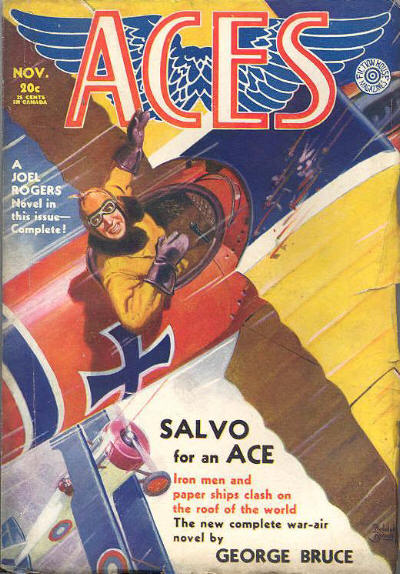 by H.P.S. Greene. Henry Paul Stevens Greene wrote aviation tales from the late 20’s to the early 40’s for magazines like Wings, Air Stories, Sky Fighters and, the magazine this story appeared in—Aces.
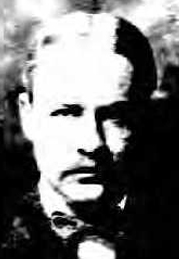 Henry Paul Stevens Greene was born in Boston, Massachusetts, on October 28, 1892, the son of Amy Bodwell Stevens and Henry Brooks Greene. (According to his own genealogical research, both the Bodwell and Stevens families were active in the American colonial and revolutionary periods.)

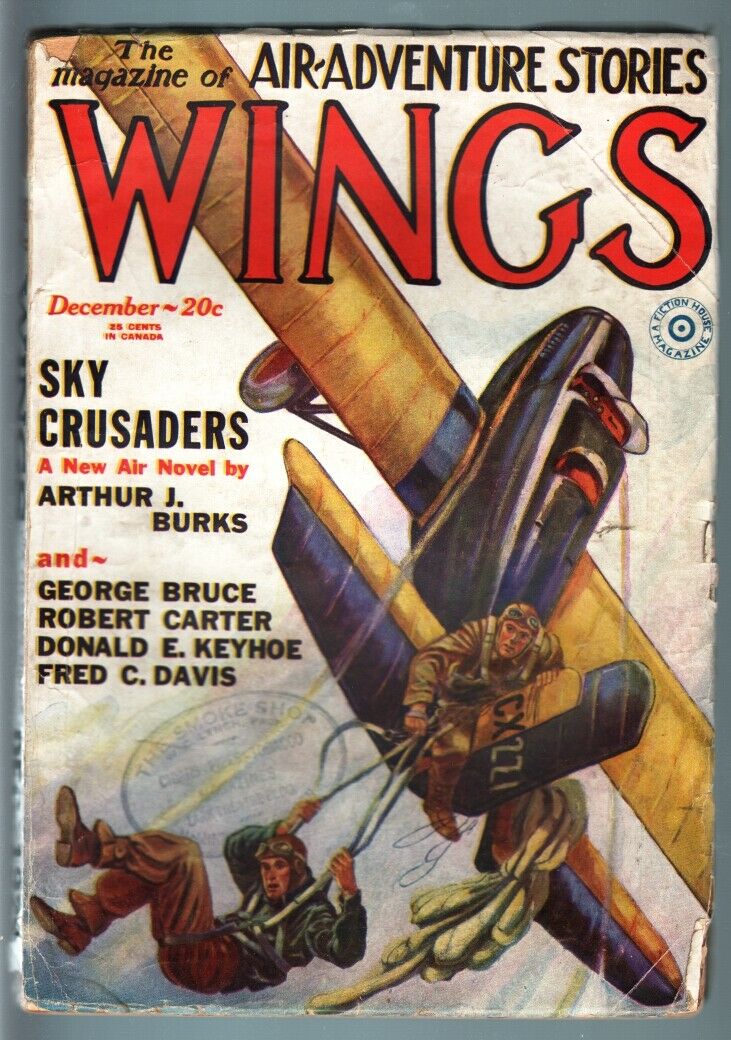 a short story by renowned pulp author Frederick C. Davis. Davis is probably best remembered for his work on Operator 5 where he penned the first 20 stories, as well as the Moon Man series for Ten Detective Aces and several other continuing series for various Popular Publications. He also wrote a number of aviation stories that appeared in Aces, Wings and Air Stories.


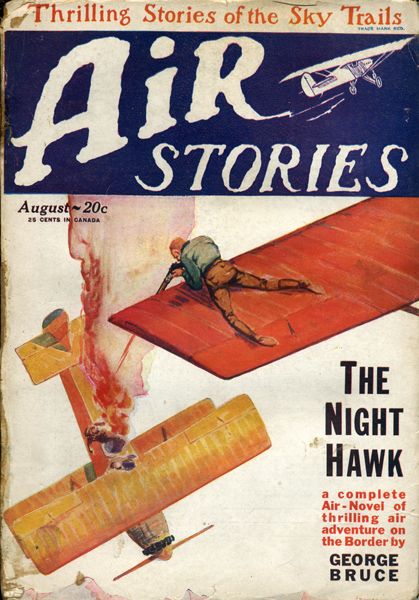 a short story by renowned pulp author Frederick C. Davis. Davis is probably best remembered for his work on Operator 5 where he penned the first 20 stories, as well as the Moon Man series for Ten Detective Aces and several other continuing series for various Popular Publications. He also wrote a number of aviation stories that appeared in Aces, Wings and Air Stories.
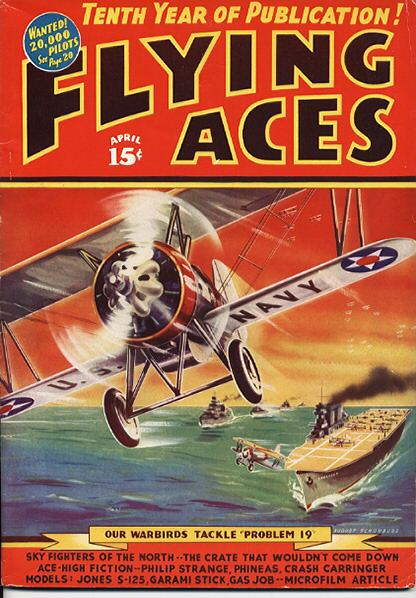 and there’s no bigger April fool than that Bachelor of Artifice, the Knight of Calamity, an alumnus of Doctor Merlin’s Camelot College for Conjurors himself—Lieutenant Phineas Pinkham, the marvel from Boonetown, Iowa!
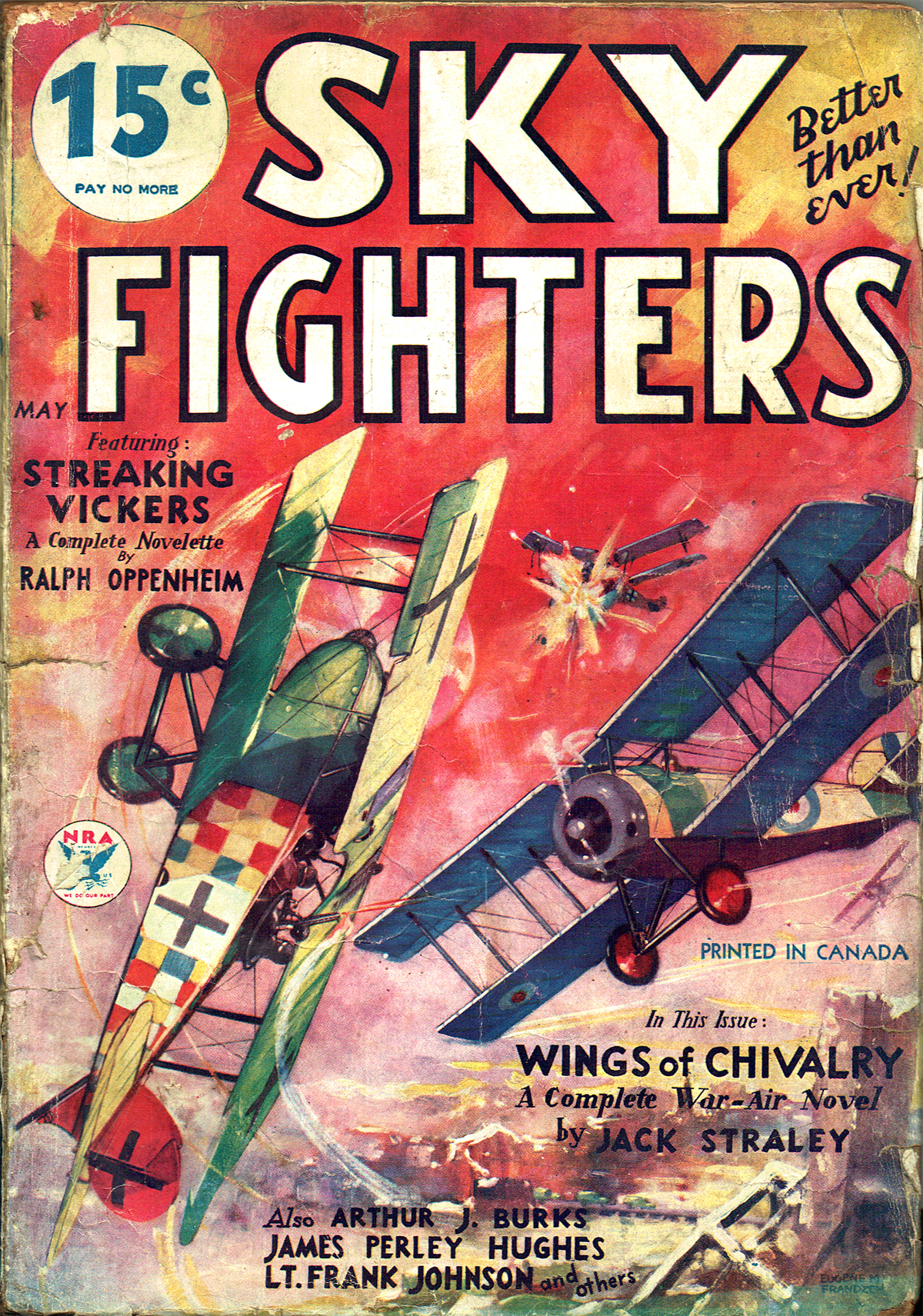 Mosquito Month we have a non-Mosquitoes story from the pen of Ralph Oppenheim. In the mid thirties, Oppenheim wrote a half dozen stories for Sky Fighters featuring Lt. “Streak” Davis. Davis was a fighter, and the speed with which he hurled his plane to the attack, straight and true as an arrow, had won him his soubriquet. Operating out of the 34th Pursuit Squadron, his C.O. sends him out to range the big guns to take out the enemy’s supply dump before the Hindenburg Push. From the May 1934 issue of Sky Fighters it’s “Streaking Vickers!”
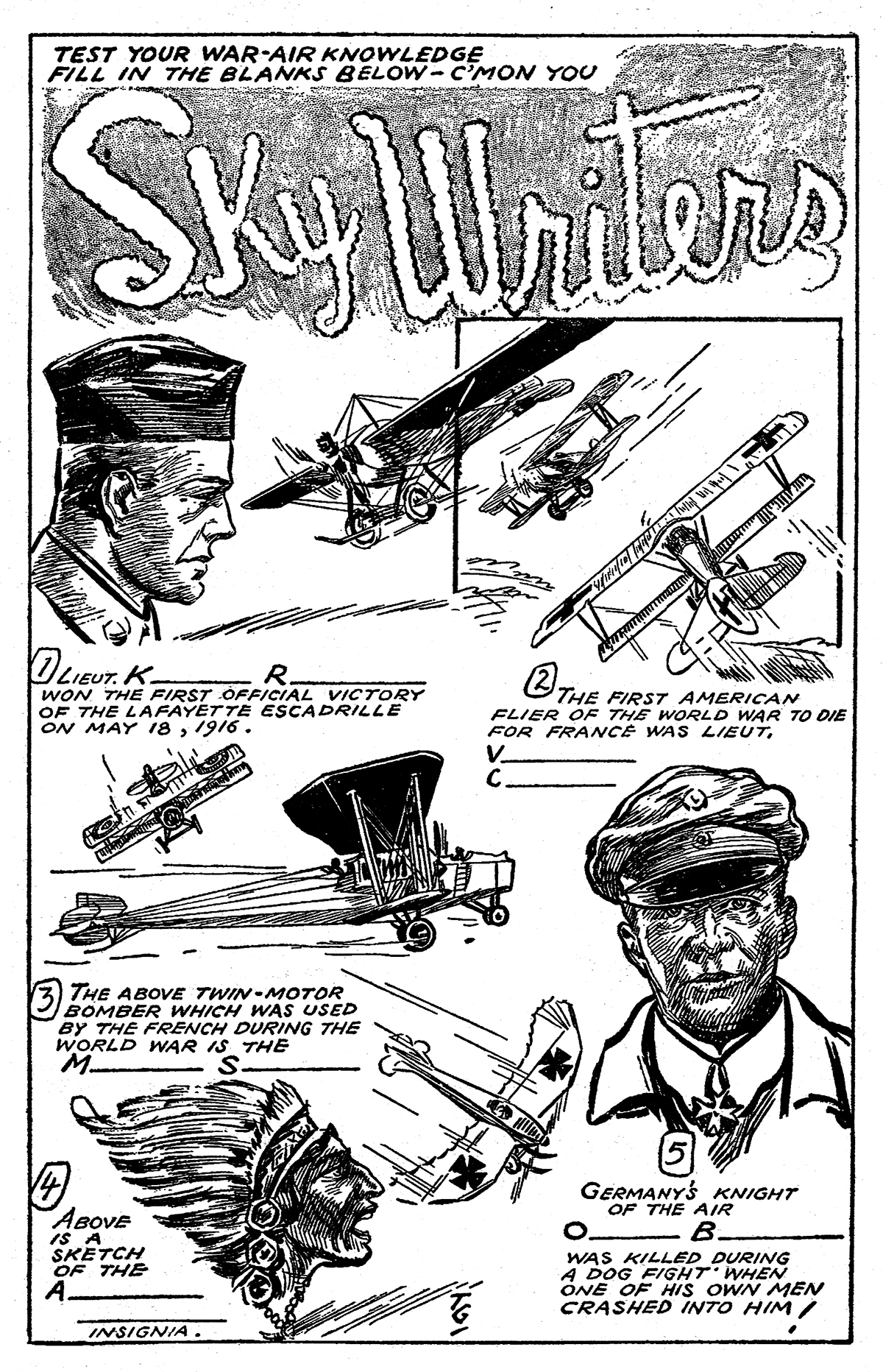
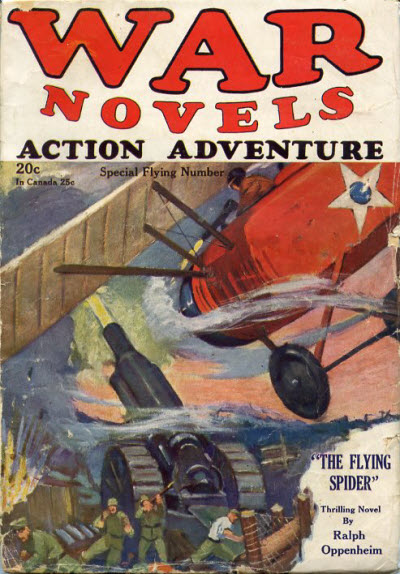 the third and final of three Ralph Oppenheim’s Three Mosquitoes stories we’re featuring this March for Mosquito Month! And this one’s a doozy! Who had not heard of that grim nickname—”The Spider”? It was the nickname of Germany’s most notorious spy—the plague and dread of the Allied powers. The whole Allied intelligence system was after this man, but they had never been able to catch him; he seemed to bear a charmed life. Kirby and his comrades had heard many rumors of his wild, hairbreadth escapades, but they had not known how truly deadly he was! And now the Three Mosquitoes found themselves caught in The Spider’s web! From the pages of the June 15th, 1929 issue of War Novels it’s Ralph Oppenheim’s “The Flying Spider!”