


Looking to buy? See our books on amazon.com Get Reading Now! Age of Aces Presents - free pulp PDFs

“Terror Tarmac” by Arthur J. Burks

Link - Posted by David on April 22, 2022 @ 6:00 am in

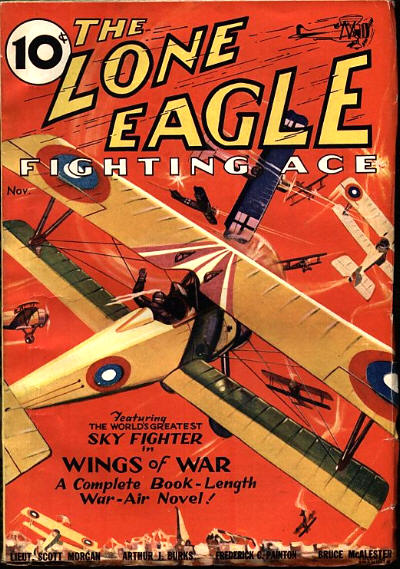
THIS week we have a story by prolific pulpster—Arthur J. Burks! Burks was a Marine during WWI and went on to become a prolific writer for the pulps in the 20’s and 30’s and was a frequent contributor to the air war pulps like The Lone Eagle.

Lieutenant Dan Healy from Intelligence has been sent to the so-called “Terror Tarmac” to find a solution to the terror that grips the drome. Pilots have been killed in the air by being stabbed with a bat handled knife! An impossiblity, but Lt. Healy joins the squadron on patrol until the knife-wielding terror can be found and put out of commission. From the pages of the November 1933 issue of The Lone Eagle, it’s Arthur J. Burks’ “Terror Tarmac!”

A Savage Menace of Whirring Death Hovered Over the Twelfth Pursuit Group—and Dan Healy Set Forth to Find Out All About It!

“Sky Writers, December 1936″ by Terry Gilkison

Link - Posted by David on April 20, 2022 @ 6:00 am in

FREQUENT visitors to this site know that we’ve been featuring Terry Gilkison’s Famous Sky Fighters feature from the pages of Sky Fighters. Gilkison had a number of these features in various pulp magazines—Clues, Thrilling Adventures, Texas Rangers, Thrilling Mystery, Thrilling Western, and Popular Western. Starting in the February 1936 issue of Lone Eagle, Gilkison started the war-air quiz feature Sky Writers. Each month there would be four questions based on the Aces and events of The Great War. If you’ve been following his Famous Sky Fighters, these questions should be a snap!

Here’s the quiz from the December 1936 issue of Lone Eagle.

If you get stumped or just want to check your answers, click here!

How the War Crates Flew: Take-Off Chin Music

Link - Posted by David on April 6, 2022 @ 6:00 am in

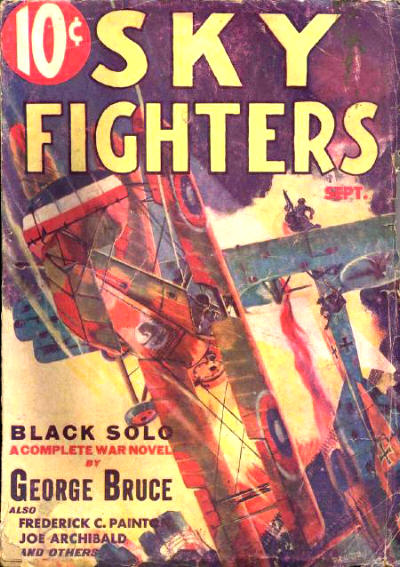
FROM the pages of the September 1932 number of Sky Fighters:

Editor’s Note: We feel that this magazine has been exceedingly fortunate in securing R. Sidney Bowen to conduct a technical department each month. It is Mr. Bowen’s idea to tell us the underlying principles and facts concerning expressions and ideas of air-war terminology. Each month he will enlarge upon some particular statement in the stories of this magazine. Mr. Bowen is qualified for this work, not only because he was a war pilot of the Royal Air Force, but also because he has been the editor of one of the foremost technical journals of aviation.

Take-Off Chin Music

by Robert Sidney Bowen (Sky Fighters, September 1932)

“CHUCK” SEAVER, two fisted Skipper of the 56th Pursuits, legged into the cockpit of his Camel, rammed the throttle open wide, and went thundering across the drome to zoom up over the bordering trees. . . .

How many times have you read that in a yarn? Sure, plenty! But how many times have you actually seen it done in real life? You’re right, never! What’s that? . . . why not? Well, listen, Fledgling, next time the old man lets you take the car out for a spin, just shift into low and jam the accelerator all the way to the floorboards and see what happens! Sure, if you don’t tear the gears out, the car will stall on you anyway. Of course there are no transmission gears on a plane, but to shoot a full load of hop to an airplane engine from a standing start would cause it to konk out every time.

And, as a matter of fact, there were several things for Chuck to do before he took off. What about revving up his engine to see that the oil and engine temperature was okay? What about signaling to the grease-balls to pull the chocks away from in front of the wheels? And what about taking a look at the wind-sock to see which direction was correct for a take off? And what about a lot of things?

But that’s the idea of this month’s meeting. That question-asking Fledgling is here again, and he’s just loaded up to the eyes with questions. He shot ’em along to me air-mail, and I’ve got ’em all here. What he wants to know is all about the trick hobbies, hunches and superstitions, etc., of pilots during the war. And as a lot of you other clucks asked the same thing, I suppose I might just as well begin my chin-music right here and now.

Of course I can only give you some of the high points. If I were to chin about all the idiosyncrasies of pilots, I’d be chinning until the next Armistice. War pilots, you know, were a funny breed, so you’ll have to take it or leave it.

But to get started, let’s begin with a peelot having coffee, and maybe a small shot of cognac in the mess before taking off on a dawn patrol.

Well, it’s time to go, so he wanders out to his ship on the line. The mecs have got the engine started, and the prop is ticking over nice and easy like. Our peelot has on his Sidcot suit. You know, one of them teddy-bear things all lined with wool. If it’s winter he’s probably wearing knee-high, rubber-soled sheep skin boots. And may be he’s got a scarf wrapped around his neck. And if he’s going to do a high patrol he’s wearing silk gloves under his leather flying gloves. Real silk gloves (like Mother wears to the theatre) are about the warmest-things there are for the hands. Maybe he’s got his helmet and goggles on, or maybe he’s carrying them in his hand.

And so he gets to his ship. First he takes a look at the elevator and rudder wires just to make sure they’re okay. A friend of mine in France used to spit over the rudder for good luck after he’d finished such an examination. Then the peelot puts on his helmet and goggles and makes sure the helmet strap is fastened nice and snug. And then he climbs aboard, and fastens the safety belt. Some pilots used just the regular safety belt that went around the waist. But others also used safety belts that went up over the shoulders. The idea was so that they would be held in the seat, and their eyes still on a level with the gun sight, when they went over on their backs in a scrap.

OF COURSE, before the pilot left the mess he made sure that he did not have any papers or things in his pockets that would be of value to the enemy in case he was forced down and taken prisoner. But to make doubly sure, a non-com goes to every pilot sitting in his plane and asks him if he has forgotten to look through his pockets.

And now that the peelot is seated in the ship, he takes a look to make sure that his ammo belts are fed into his Vickers gun in okay style. Then he grabs the loading handle (often called cocking handle) and loads the guns. If he has a Lewis on the top wing (when flying an old S.E. 5), he makes sure that it is loaded. And then he pulls up the handle of the oil reservoir of his gun gear (see July issue of SKY FIGHTERS). The idea of that, of course, is to build up pressure in the secondary pipe line so that his guns will fire when he presses the trigger trips on his joystick.

Now, some pilots used to use the well known ring sight for aiming, while others used what was known as the telescopic sight. A long telescope, maybe twelve or fifteen inches, mounted right between the guns. The guns are set to converge with it, according to the likes of the pilot. By that I mean that some pilots want their bullets to meet with the line of sight at one hundred yards, some one hundred and fifty, and some two hundred yards, etc. It all depends upon the wishes of the pilot in question.

What’s that? What am I talking about? Well, listen. You have a gun mounted on the right side of the engine cowling. And you have a gun mounted on the left. Now naturally you want those two paths of bullets to come together at a certain point so that there will be one big burst going into your target. And so the left gun is pointed a bit to the right, and the right gun is pointed a bit to the left. And the ring sight or telescopic sight is set right in the middle between the two. Now, the distance from the muzzles of the guns that you want those two paths of bullets to meet is simply regulated by the amount you set your guns to the left or right, as the case may be. Now don’t get the idea that the guns are re-set for every flight. When the pilot first gets his plane and tests it out, he has the guns mounted the way he wants them, and then they stay that way. Now do you get the idea?

BUT to get back to this telescopic sight. When the plane is on the ground, there is a little leather cup that can be fitted over the two ends of the telescopic sight so that the lenses will be kept clean. Of course the pilot takes them off. Sometimes only the rear lens is covered.) And then, to make sure the lens is all nice and polished, the pilot takes a silk stocking tied to the top of his flying helmet and polishes the lens.

Oh? So you thought war peelots used to tie a silk stocking to the top of their helmets just to look trick, eh? Well, maybe that was part of the idea. But that silk stocking came in plenty useful many times. One use was to clean the telescopic sight lens, as I just related. But the main use was to wipe off your goggles when they got spattered up with oil when you were in the air. In other words, it was just a handy cleaning rag always within reach because it was trailing off the top of your helmet.

What’s that? Where did war pee-lots get silk stockings? Now listen, Fledgling! They bought them in a store. Or maybe a peelot’s sister sent him one of her old ones in a Xmas box. Or maybe . . . well, never mind. You’ll find out soon enough in the next war!!

And now the peelot is fastened in, his guns are okay, and the telescopic sight is cleaned, and the handle of the oil reservoir has been pulled up. So next he moves the rudder bar and waggles the stick just to make sure that there isn’t any slack in the controls that has developed over night.

Then he signals to the waiting mechanics. A couple of them brace themselves against the leading edge of both the right and left lower wings. A third drapes himself over the fuselage just where it is joined by the tale plane. And the peelot pulls the stick all the way back to get the elevators tilted up as far as they will go. Of course the chocks are still in front of the wheels. Then the pilot eases the throttle forward slowly until the engine is roaring full out. And as he does that he looks at his various instruments to see that everything is functioning in proper style. He just lets the engine roar full out for say half a minute, and then pulls the throttle back.

NOW he is set to take off. (Of course we assume that his instruments showed everything to be okay when he revved up the engine.)

If it is a Flight patrol, the leader goes first. Then the next in rank, and then the next, and the next, and so forth. Sometimes they all taxied out to formation position on the field and took off together. But most times the field was too small for that, and they took off one at a time, and formed formation at a certain pre-determined height above the field, or a nearby village.

But we’ll let this peelot we’re chinning about take off by himself.

The grease ball who has been draping his manly form over the tail moves himself, and the pilot waves his hand in a left to right motion. That means . . . pull the chocks away. The mechanics do that, and then, if the plane is already headed in a correct take-off position (into the wind), the pilot gives the grease balls a chance to step clear and then pushes the throttle forward slowly and pushes the stick forward to get his tail up . . . and away he goes. Now, if he isn’t headed into the wind he taxies out, with the help of the grease balls hanging onto the wings, and swings around into a correct takeoff position. But don’t let fiction story writers kid you . . . the peelot doesn’t slam his throttle home! He eases it forward and gives the engine a chance to pick up full revs without tearing itself apart.

And, incidentally, the pilot seldom takes off right from the hangar line. Even if the wind is blowing toward him, he taxies out a bit. Why? Well, because an open hangar is right behind him, and when he takes off he blows half the drome right back into that hangar and all over any planes that might be there. And when he does that, why the C.O. usually has seventeen fits and chews his ear off when he gets back.

Yes, yes, I know, I know . . . you want to hear about hunches and hobbies, etc. Well, the C.O. of this mag is handing me some mighty tough looks. Guess he wants to get a word in about something that is interesting, so I’ll have to make it short.

The first is . . . the old superstition about lighting three cigarettes on a match. Bunk! But we used to like to live up to it just for the heck of it. Some other war peelot may call me a liar for that crack . . . but it really was just a superstition we liked to follow. It originally started in the Boer war. The English Tommies were short of matches, so several of them used to light their pipes on the same match. For no reason at all the Boer snipers opposite them used to try and pick off the third guy who lighted his pipe. And that’s how it came to be an omen of tough luck when a soldier took the third light off a match.

Sometimes you used to get hunches that it wasn’t so hot to fly on a particular day. Most times you just lived it down and went ahead with the job to be done. I got a hunch like that once and went just the same. Well, the engine konked out, a skyful of smoke belched out of the engine cowling, and I forced landed and wrapped myself around a tree. Well, was it because of the hunch? It was . . .but in this way. I didn’t want to fly that day, so I was looking for trouble . . . all nerved up, and all that sort of thing. And when you get that way, something usually does happen, believe you me.

A pal of mine once got a no-flying hunch on a day in training school when he had to take a test in target shooting. He was all goose pimples about it, and asked me to double for him. Well, it wasn’t an important test (no instructor around to watch), so I said, “Sure.” And I went up and shot off the rounds for him. When the score of hits was checked, and his instructor got hold of it, said instructor bawled the pants off him for being such a lousy marksman. So that gives you an idea of how good I was.

All right, C.O., all right . . . just a few more words. And they are about mascots, or lucky pieces, pilots used to carry. The famous ones were the two little French wool dolls, Nanette and Babbette. And of course there was the face of the girl-friend stuck on the crystal of your wrist watch. And maybe, if you were brave at some time, a pretty little pink garter, or maybe a stuffed teddy bear, or a monkey, or a doll, or most anything that you could lay your hands on. In other words, pilots used to go visiting and bring back anything that wasn’t nailed down and use them as luck charms.

And of course, there . . . ouch! See you again, Fledgling! The C.O.’s got my shirt tail, and pulling hard. S’long!

“Frozen Controls” by Frank Richardson Pierce

Link - Posted by David on April 1, 2022 @ 6:00 am in

THIS week we have another exciting air adventure with Rusty Wade from the pen of Frank Richardson Pierce. Pierce is probably best remembered for his prolific career in the Western Pulps. Writing under his own name as well as two pen names—Erle Stanly Pierce and Seth Ranger—Pierce’s career spanned fifty years and produced over 1,500 short stories, with over a thousand of these appearing in the pages of Argosy and the Saturday Evening Post.
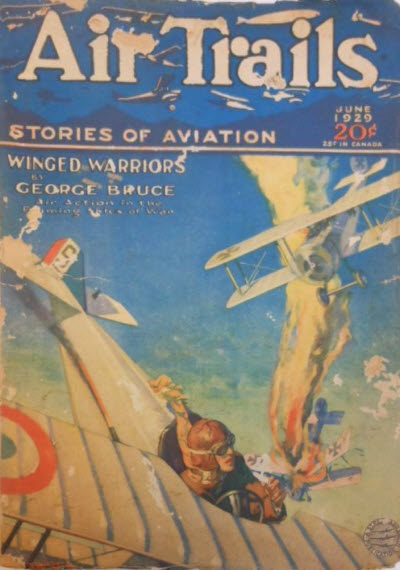
This time around, on a stop over in Seattle, Rusty os approached by a a good friend to pilot his experimental plane in order to achieve a new altitude record and get some dynamic shots of the eclipse that will be happening. Rusty agrees, if he can have his old pal Steve Branleigh as his copilot. Problem is, Steve was the last pilot to try in this plane and had to bail out before the record was achieved. Can Rusty clear his friend’s name while pushing the experimental plane to its limit? From the pages of the June 1929 Air Trails, it’s Frank Richardson Pierce’s “Frozen Controls!”

“Rusty” Wade makes a momentous decision and leaps into space forty thousand feet above the earth.

“The Youngest V.C. Flyer” by Paul Bissell

Link - Posted by David on March 28, 2022 @ 6:00 am in

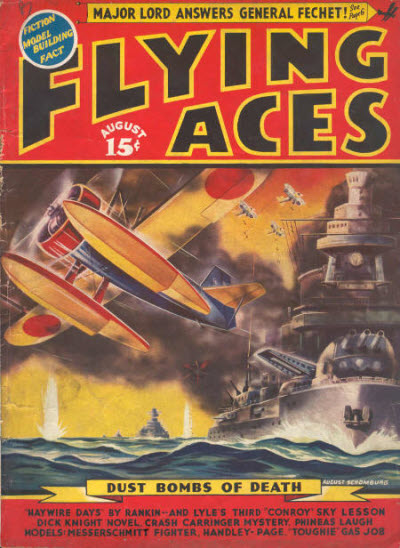
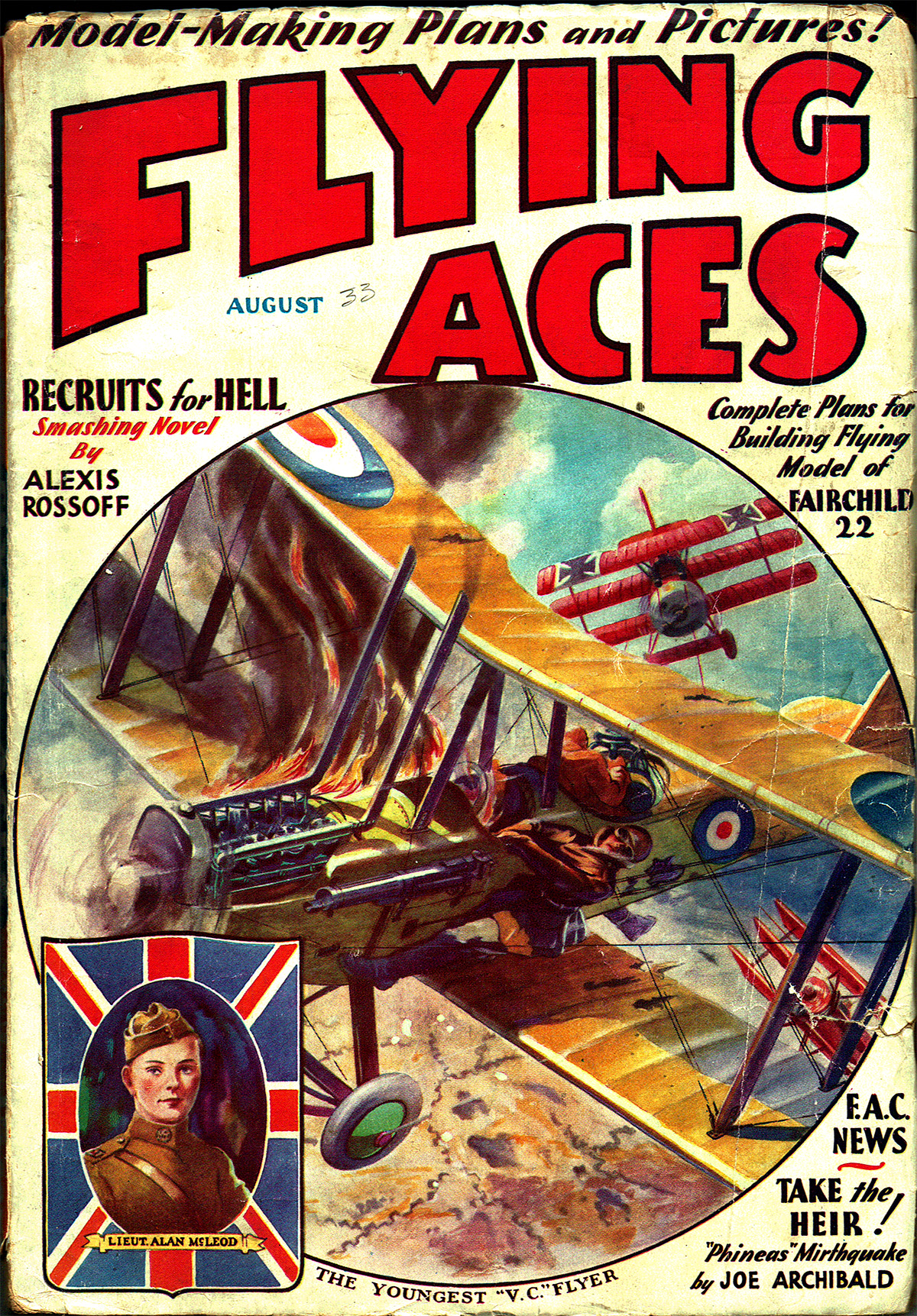
THIS week we present another of Paul Bissell’s covers for Flying Aces! Bissell is mainly known for doing the covers of Flying Aces from 1931 through 1934 when C.B. Mayshark took over duties. For the August 1933 cover Bissell put us right in the action with…

The Youngest V.C. Flyer

th_FA_3308SOME wise man has said that to every man, once in life, comes his big moment. Then he must make a quick decision or choice and, whether he be king or peasant, the real man is judged by how he meets this test.

Such a moment came to Alan McLeod, the young Canadian flyer. Always he was in the thick of it, eagerly taking chances, thumbing his nose at death until that day in March, 1918, when he came face to face with his big moment, made his choice and, himself wounded, gambled his life a thousand times over to save a comrade already wounded almost past saving—gambled and won, and took his place among the “Incredibles” of the World War.

McLeod was just fifteen years old when the war began. Twice rejected because of his youth, he enlisted on his eighteenth birthday, in April, 1917. By July he had qualified as a pilot, and by September he was in England. When his squadron, the 82nd, was ordered to the Front, his Commanding Officer refused to take him along—again on account of his youth.

However, on Home Defense in England with the 51st, during a bitter duel with a Gotha over London, he displayed such heroism, although shot down, that Headquarters posted him to France with the 2nd Squadron, in November, 1917. This squadron boasted no fast pursuit ships, but was engaged principally in observation, bombing, and artillery spotting, and flew the Armstrong-Whitworth, a good ship for these purposes, but slow.

It was with this ship that McLeod went “a-hunting” beyond and outside of his daily routine, strafing the trenches, attacking troops in movement, machine-gun emplacements and batteries. No one had ever thought to attack a sausage in one of the old crates. Nevertheless McLeod coolly destroyed a German balloon and then, when attacked by a flight of Albatross pursuit planes, shot one of them down and held the others off, returning safely to his airdrome. Soon none but the most daring observers would fly with him, but there were always enough of these so that he did not lack for companions. Besides, he always brought them back—and how!

The morning of March 22, 1918, seemed to McLeod much like any other day. With Lieutenant A.W. Hammond in the observer’s cockpit, he had started out on a patrol to Bray sur Somme. He got lost in the heavy, low clouds but, at last finding a hole, he had dropped down to let his bombs go when a Fokker tripe rode his tail down from the same clouds. A half-roll saved him from the Fokker’s burst, and a zoom put Hammond in position to prevent that particular German from ever firing another burst.

But seven other tripes had come down after their leader and were now bent on revenge. Like red hawks they darted around the two Canadians, raking them with machine-gun fire from every direction until one, more daring than the others, dived in from the front.

McLeod beat him to the shot and Fokker No. 2 joined his leader far below. At that instant, however, McLeod felt his first bullet. One of the tripes, attacking from below, had put a full burst into the British machine. Hammond was hit twice, and the entire bottom of his cockpit collapsed. Then the gas tank burst into flames. The Armstrong-Whitworth plunged down, out of control, with McLeod dazed in the front seat, and Hammond clinging desperately to the rim of what had been his cockpit.

THE flames licked up, burning McLeod back to consciousness. To stay in the front seat was no longer possible. McLeod stepped out on the wing, reaching back into the burning cockpit for the controls and sideslipping the plane so that the flames were blown away from Hammond. Although two more bullets had found him by now, he succeeded in keeping the ship in fair control and getting rid of his bombs. The Germans were following the helpless Canadians down, pouring burst after burst into them.

Hammond now had three bullets in his body, while one arm hung limp. Almost unconscious, with his feet braced against the sides of the fuselage to keep from falling through the bottomless cockpit, he still had strength enough for one last burst at the Boche. Almost point-blank he emptied his drum into the nearest tripe. A burst of smoke and screaming wires told that Fokker No. 3 had joined the other two victims, crashing below almost at the same instant that McLeod, leveling off his blazing ship as best he could, piled up in No-Man’s-Land.

The crash threw them both clear of the wreckage, about ten yards apart in the middle of No-Man’s-Land, three hundred yards from the British trenches. For an instant they lay there, unconscious, but the Germans were already sniping at them and McLeod, who lay in a more exposed position, was roused to consciousness by a bullet nipping his leg. Rolling into a shallow hole, his senses returned, and with them came his “big moment.”

To stay where he was was impossible. The whole area was too much exposed. He must make the trenches. But outside lay Hammond, wounded, perhaps dead. Should he leave him and try for the trenches alone? In another instant he was out of the hole and at Hammond’s side. The poor observer was alive but completely unconscious, with six wounds.

How McLeod dragged and carried Hammond those three hundred yards he himself never knew. But the Tommies in the trenches saw him coming. They watched him as, inch by inch, he dragged himself and his observer across the torn earth, with the enemy raking him with bullets. They watched and helped all they could by laying down a deadly fire on the German trenches.

With just six yards to go, another bullet got McLeod, and the Tommies went over the top and dragged the two unconscious flyers in, still breathing—but not much more. All day they lay in those exposed trenches without medical aid. But the gods must have smiled, for they both got well eventually—Hammond to get a D.S.O., and McLeod the V.C.

The Ships on The Cover
“The Youngest V.C. Flyer”
Flying Aces, August 1933 by Paul J. Bissell

“Hell’s Skyway” by Ralph Oppenheim

Link - Posted by David on March 25, 2022 @ 6:00 am in

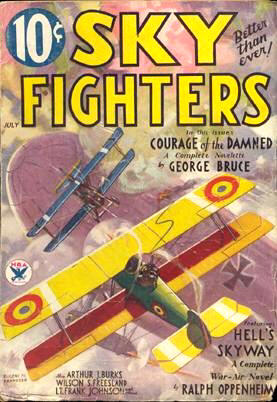
TO ROUND off Mosquito Month we have a non-Mosquitoes story from the pen of Ralph Oppenheim. In the mid thirties, Oppenheim wrote a half dozen stories for Sky Fighters featuring Lt. “Streak” Davis. Davis was a fighter, and the speed with which he hurled his plane to the attack, straight and true as an arrow, had won him his soubriquet. And time is of the essence when Streak is sent on a bombing mission. He must destroy the Krupp Machine works at Luennes before they unleash German’s newest secret weapon at noon! From the July 1934 issue of Sky Fighters it’s “Hell’s Skyway!”
The Fate of the Allies Depends on a done American Flyers Speed and Skill in this Rip-Roaring Novel of Whirling Props and Screaming Struts!

“Sky Writers, October 1936″ by Terry Gilkison

Link - Posted by David on March 23, 2022 @ 6:00 am in

FREQUENT visitors to this site know that we’ve been featuring Terry Gilkison’s Famous Sky Fighters feature from the pages of Sky Fighters. Gilkison had a number of these features in various pulp magazines—Clues, Thrilling Adventures, Texas Rangers, Thrilling Mystery, Thrilling Western, and Popular Western. Starting in the February 1936 issue of Lone Eagle, Gilkison started the war-air quiz feature Sky Writers. Each month there would be four questions based on the Aces and events of The Great War. If you’ve been following his Famous Sky Fighters, these questions should be a snap!

Here’s the quiz from the October 1936 issue of Lone Eagle.

If you get stumped or just want to check your answers, click here!

“An Ace of Spads” by Ralph Oppenheim

Link - Posted by David on March 18, 2022 @ 6:00 am in

THROUGH the dark night sky, streaking swiftly with their Hisso engines thundering, is the greatest trio of aces on the Western Front—the famous and inseparable “Three Mosquitoes,” the mightiest flying combination that had ever blazed its way through overwhelming odds and laughed to tell of it! Flying in a V formation—at point was Captain Kirby, impetuous young leader of the great trio; on his right was little Lieutenant “Shorty” Carn, the mild-eyed, corpulent little Mosquito and lanky Lieutenant Travis, eldest and wisest of the Mosquitoes on his left!

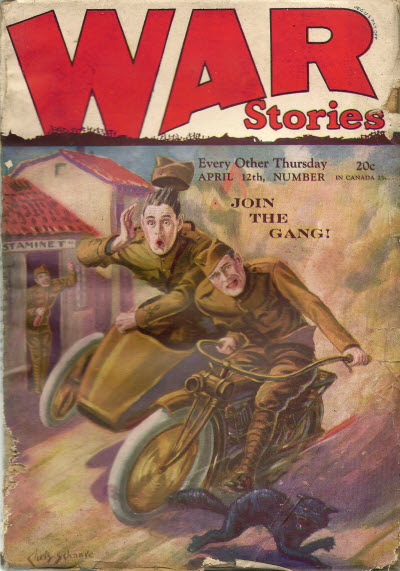
We’re back with the third and final of three Ralph Oppenheim’s Three Mosquitoes stories we’re featuring this March for Mosquito Month! And this one’s a doozy! Kirby gets the unenviable job of test flying the new type Spad and putting it through its paces—including trying it in combat and shooting down a plane. But, under no circumstances should he take the new plane over the lines! Unfortunately that’s just what Kirby did! Read all about it in Ralph Oppenheim’s “An Ace of Spads” from the April 12th, 1928 issue of War Stories!

Kirby’s eyes glowed when he saw the new-type Spad, one of the most beautiful ships ever delivered to the Front. It was to be his job to try it out in action. But he was not to go over the lines—the Germans would lose no opportunity to get their hands on the new ship. Once in the air, however, with a Fokker in sight, Kirby—forgot. One of Oppenheim’s best flying yarns!

The Magic Puppet World Revisited

Link - Posted by David on March 15, 2022 @ 6:00 am in

BACK in 2015 during our first Mosquito Month, we ran a series of articles from The Pocono Record that covered Oppenheim’s Magic Puppet World. In 2019 we ran an additional article from the nearby Allentown Morning Call. But what celebration of the Three Mosquitoes and their creator and chronicler Ralph Oppenheim could go by without a mention of Oppenheim’s Magic Puppet World? Especially since we just came upon an artifact from the time!

Yes, just recently we stumbled upon one of the hand-made pennants that they used to sell at the gift shop at Oppenheim’s!

It’s a small orange felt pennant measuring 3¾” x 8¼” with heavy dark blue yarn ties. Emblazoned upon it are the words “Magic Puppet World” and a joyous printed figure with a wooden ball head and red body with arms up and legs spread.


While the hair is painted with a fine brush; Mrs. Oppenheim paints the eyes, nose and mouth with a cellophane cone filled with lacquer.

So in celebration of finding the pennant, we’re presenting another article from The Pocono Record we passed over due to it’s poor picture—but it does have lots of good information.

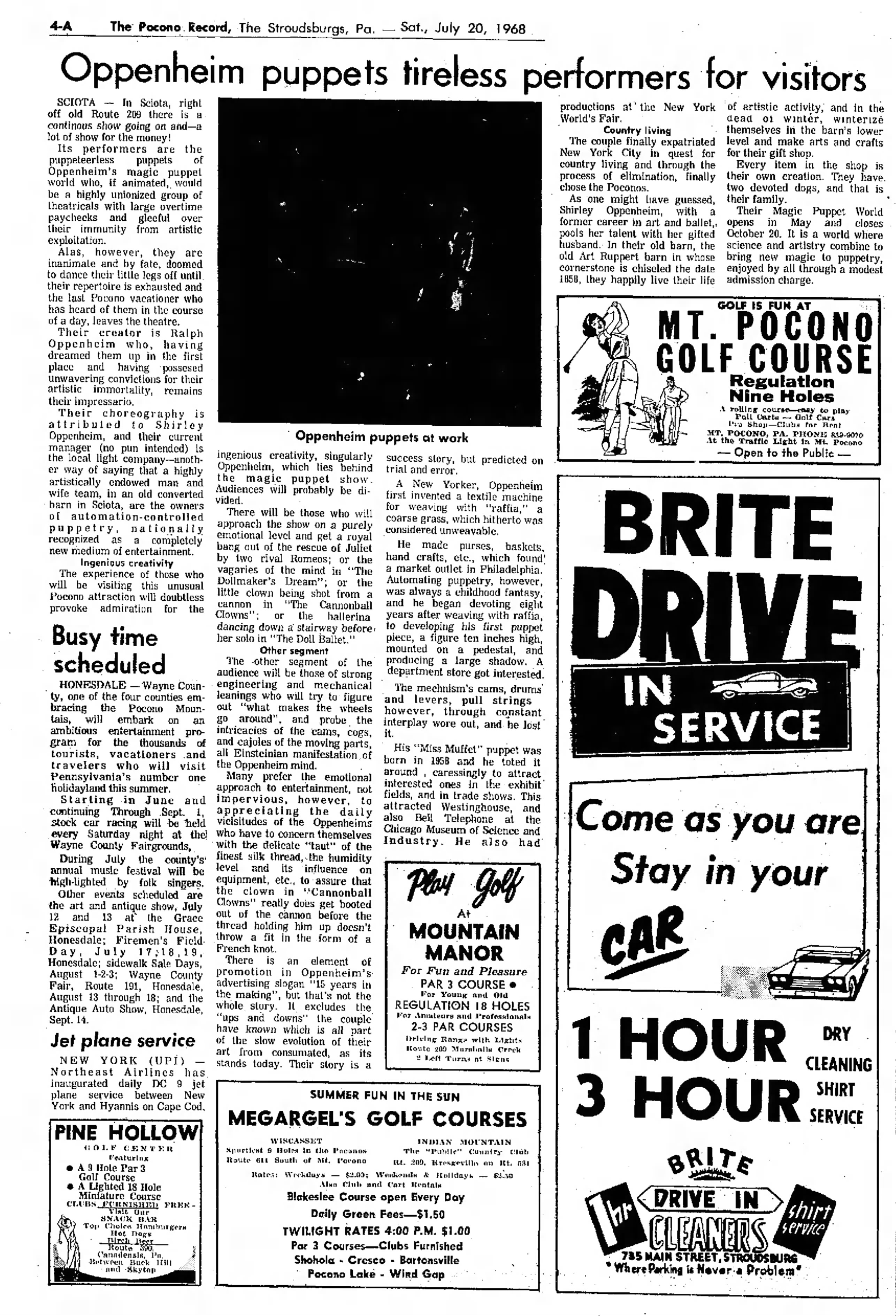
Oppenheim puppets tireless performers for visitors

The Pocono Record, Stroudsburg, Pa • 20 July 1968

SCIOTA — In Sciota, right off old Route 209 there Is a continuous show going on and—a lot of show for the money!

Its performers are the puppeteerless puppets of Oppenheim’s magic puppet world who, If animated, would be a highly unionized group of theatricals with large overtime paychecks and gleeful over their immunity from artistic exploitation.

Alas, however, they are inanimate and by fate, doomed to dance their little logs off until their repertoire is exhausted and the last Pocono vacationer who has heard of them in the course of a day, leaves the theatre.

Their creator is Ralph Oppenheim who, having dreamed them up in the first place and having possessed unwavering convictions for their artistic immortality, remains their impressario.

Their choreography is attributed to Shirley Oppenheim, and their current manager (no pun intended) is the local light company—another way of saying that a highly artistically endowed man and wife team, in an old converted barn in Sciota, are the owners of automation-controlled puppetry, nationally recognized as a completely new medium of entertainment.

Ingenious Creativity

The experience of those who will be visiting this unusual Pocono attraction will doubtless provoke admiration for the ingenious creativity, singularly Oppenheim, which lies behind the magic puppet show. Audiences will probably be divided.

There will be those who will approach the show on a purely emotional level and get a royal bang out of the rescue of Juliet by two rival Romeos; or the vagaries of the mind in “The Dollmaker’s Dream”; or the little clown being shot from a cannon in “The Cannonball Clowns”; or the ballerina dancing down a stairway before her solo in “The Doll Ballet.”

Other Segment

The other segment of the audience will be those of strong engineering and mechanical leanings who will try to figure out “what makes the wheels go around”, and probe the intricacies of the cams, cogs, and cajoles of the moving parts, all Einsteinian manifestation of the Oppenheim mind.

Many prefer the emotional approach to entertainment, not impervious, however, to appreciating the daily vicisitudes of the Oppenheims who have to concern themselves with the delicate “taut” of the finest silk thread, the humidity level and its influence on equipment, etc., to assure that the clown in “Cannonball Clowns” really does get booted out of the cannon before the thread holding him up doesn’t throw a fit in the form of a French knot.

There is an element of promotion in Oppenheim’s advertising slogan “15 years in the making”, but that’s not the whole slury. It excludes the “ups and downs” the couple have known which is ail part of the slow evolution of their art from consumated, as its stands today. Their story is a success story, but predicted on trial and error.

A New Yorker, Oppenheim first invented a textile machine for weaving with “raffia,” a coarse grass, which hitherto was considered uneavable.

He made purses, baskets, hand crafts, etc., which found a market outlet in Philadelphia. Automating puppetry, however, was always a childhood fantasy, and he began devoting eight years after weaving with raffia, to developing his first puppet piece, a figure ten inches high, mounted on a pedestal, and producing a large shadow. A department store got interested.

The mechanism’s cams, drums’ and levers, pull strings however, through constant interplay wore out, and he lost it.

His “Miss Muffet” puppet was born in 195B and he toted it around, caressingly to attract interested ones in the exhibit fields, and in trade shows. This attracted Westinghouse, and also Bell Telephone at the Chicago Museum of Science and Industry. He also had productions at the New York World’s Fair.

Country Living

The couple finally expatriated New York City in quest for country living and through the process of elimination, finally chose the Paconos.

As one might have guessed, Shirley Oppenheim, with a former career in art and ballet, pools her talent with her gifted husband, in their old barn, the old Art Ruppert barn in whose cornerstone is chiseled the dale 1858, they happily live their life of artistic activity, and in the dead of winter, winterize themselves in the barn’s lower level and make arts and crafts for their gift shop.

Every item in the shop is their own creation. They have, two devoted dogs, and that is their family.

Their Magic Puppet World opens in May and closes October 20. It Is a world where science and artistry combine to bring new magic to puppetry, enjoyed by all through a modest admission charge.


“An Ace in the Hole” by Ralph Oppenheim

Link - Posted by David on March 11, 2022 @ 6:00 am in

“LET’S GO!” Once more, The Three Mosquitoes familiar battle cry rings out over the western front and the three khaki Spads take to the air, each sporting the famous Mosquito insignia. In the cockpits sat three warriors who were known wherever men flew as the greatest and most hell raising trio of aces ever to blaze their way through overwhelming odds—always in front was Kirby, their impetuous young leader. Flanking him on either side were the mild-eyed and corpulent Shorty Carn, and lanky Travis, the eldest and wisest Mosquito.

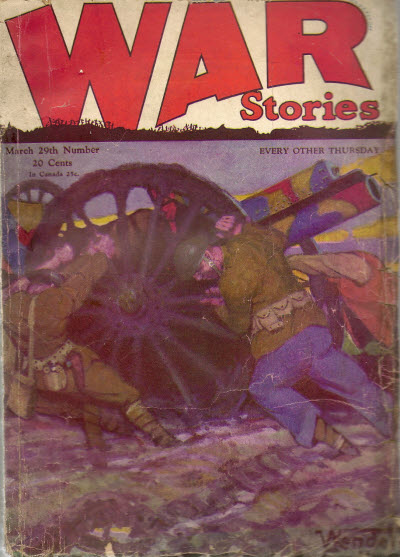
We’re back with the second of three tales of Ralph Oppenheim’s Three Mosquitoes we’re featuring this March for Mosquito Month! This week, the intrepid trio is tasked with getting valuable information from behind German lines—but it’s a job for only one man which unfortunately turns into one man at time as each of the Mosquitoes is sent off to garner the information when the previous one fails to return. From the March 29th, 1928 issue of War Stories, it’s The Three Mosquitoes in “An Ace in the Hole!”
Once more the famous “Three Mosquitoes” go out on a dangerous and thrilling special flight—but this time one of them led the way, alone, while the other two waited—waited until human nerves could stand it no longer.

And check back next Friday when the inseparable trio will be back with another exciting adventure!

Ralph Oppenheim—Eyewitness to History

Link - Posted by David on March 8, 2022 @ 6:00 am in

WHEN the first issue of War Birds hit the stands in February 1928, it not only contained an exciting tale of Ralph Oppenheim’s inseparable trio The Three Mosquitoes, but it also had a rare factual piece by Mr. Oppenheim. Ralph and his younger brother Garrett had taken a trip to Europe the previous year and just happened to be there at the right time to be able to get to Paris and be there at Le Bourget Field on the 21st of May when Charles Lindbergh successfully ended his trans-Atlantic flight!

The editor of WAR BIRDS considers it an outstanding honor to be able to give you this little sketch. Mr. Oppenheim, besides being the most brilliant flying story writer in America, had the priceless privilege of being an eyewitness of one of the most historic moments of modern times—when the great Lindbergh landed the “Spirit of St. Louis” on Le Bourget Field that memorable night in Paris.


Lindbergh uses the lights of Paris to guide him around the Eiffel Tower to Le Bourget Field. (image © lookandlearn.com)

Author’s Note—The following is taken, for the most part, from notes written at Le Bourget Field before and after Lindbergh’s arrival. We (“we” in this case meaning my brother and myself) had come early in the afternoon and had thus secured a wonderful position, on the flat roof of a cafe which was right at the edge of the big field. After a long windy, raining afternoon, during which the crowd grew to a size of about 100,000, the hour when the American should arrive began to draw closer.


When “Lindy” Dropped on Paris

MAY 21st, 1927. 9 to 9:20 P.M. What a mob of people! The roof here is packed behind us, and we are being pushed so hard against our concrete wall (which comes up to our necks) what we’re afraid that either the wall will give or we’ll be crushed into a “shapeless mass.” At our right, in the corner, are three newsreel men, getting movie cameras set. Somewhere in back a Frog newsboy is croaking shrilly: “L’Americain Volant! L’Americain Volant!” A former senator from Missouri says that means that Lindbergh is now over the English Channel. . . . Down below, along the edge of the field, is the real mob—the biggest crowd I’ve ever seen. They are kept from the field itself by a big, strong iron fence. Out on the field, in front of this fence, about two hundred gendarmes are forming a long string to check the crowd if it should attempt to get over that fence. There are no more planes landing or taking off on the field now. The big air-liners which have been coming and going regularly all afternoon, discharging slightly dismal looking passengers and taking on happy, eager ones, are no longer to be seen. They have cleared the field. They have floodlights to illuminate the ground, but they only turn them on every now and then. Economical, these French. Also there are parachute flares. These are shot up like sky-rockets, and the blazing phosphorous comes floating down on a little parachute. Only trouble is these frogs have rotten aim. Some of those damn flares are falling right into the crowd. Each time it happens there’s an excited, panicky shriek. And the idea that one of those flares might fall on our roof is enough to keep us in good suspense. But we don’t need anything to keep us in suspense now. As the moment when the brave American should arrive draws closer and closer, the excitement rises to the highest pitch. Everybody is yelling, shouting, and it seems that everybody has suddenly become a great authority on the subject of aviation. Gosh, these French certainly know how to get excited! There goes that newsboy again: “L’Americain Volant! L’Americain Volant!” And a school-ma’m from Iowa says that means the poor boy’s been lost at sea.

9:20 to 9:30—They are cheering! It seems they hear a plane overhead. We listen. Does sound like a drone up there. More flares—and more suspense. They have the floodlights on again. The cheers are increasing. The gendarmes on the field look worried as the iron fence begins to shake ominously under the pressure of the surging mob behind it.

9:30 to 10:15—Look! Look! Voila! Nom de nom! Everyone is screaming at the top of his or her lungs. We can all hear the drone now. Off to the left it is. We stare in an effort to pierce through the murk. Nothing yet, nothing yet. Then—

The earth shakes with a mighty reverberating cheer. In the darkness up there appears a floating, whitish shape. It is coming down, gliding for the field! It is Lindbergh! God Almighty!

Now we can clearly distinguish the graceful silver monoplane. The crowd is going crazy. The plane is landing. The great pilot, cool and collected, carefully keeps away from all signs of the crowd. He brings his ship down way across the field, just opposite our roof. It is a wonderful and an astonishingly quick landing—the best we’ve seen on this field. And there was something incongruous about the way that plane, having just come way from New York, simply dropped out of the sky and landed.

Before the Spirit of St. Louis rolls to a stop hell breaks loose at Le Bourget. With a mighty shove, the people surge right through that iron fence like a tremendous tidal wave. The gendarmes? Drowned, swallowed in that flood. It is a sight indeed, that mob rushing out towards the plane. It makes you feel insignificant to see all those people. All over flashlights are popping, cameras clicking, and men and women shouting like mad. The cameramen tackle the mob like football players in their efforts to get to the plane. The people on our roof are—well, they’re raising the roof. Some Frog is using my back as a step-ladder, and another is trying to make a foot-stool out of my neck. Tables collapse as people try to stand on them to get a look. One or two crazy fools actually jump off the roof, onto the shed below. A fifteen foot drop! The plane out there is surrounded now. And it seems almost that the mob is lifting that big monoplane on its shoulders and carrying it around. They’re bringing the great Lindbergh in. Cheers! “Vive l’Americain! Vive Londberje (as the Frogs pronounced it)!” Where is he? We think we catch a glimpse of him in the midst of a little circle, around which the crowd is thickest. How they bring him in is a mystery, but they get him to the building right next to ours, and hold the crowd out. The crowd storms outside, yelling in a mighty chorus: “Let us see! Let us see!” From our roof we can see the lighted, curtained window of the room where they have him. We see lots of people in there, and often we think we get glimpses of the American—but we will never know if we really did, though we saw him twice on future occasions (both in Paris and on the day of his arrival in New York).

Now the French windows are opened over in that building, and a man steps out on the balcony. It is the American ambassador. He makes a speech, which nobody hears. But nobody has to hear, because all realize that an epoch-making event has just occurred, and that Charles A. Lindbergh, later to be known as “Plucky Lindy” and “The Lone Eagle” and “Slim,” has succeeded in making the first non-stop flight from New York to Paris.

For a sense of the scene at the time you can check out some newsreels from the whole journey—AP (British Pathé)—or just the day—British Pathé and Periscope Film. And the USA Today actually has a decent article with some good photos from the 90th anniversary of the historic flight.

“Challenge of the Air” by Ralph Oppenheim

Link - Posted by David on March 4, 2022 @ 6:00 am in

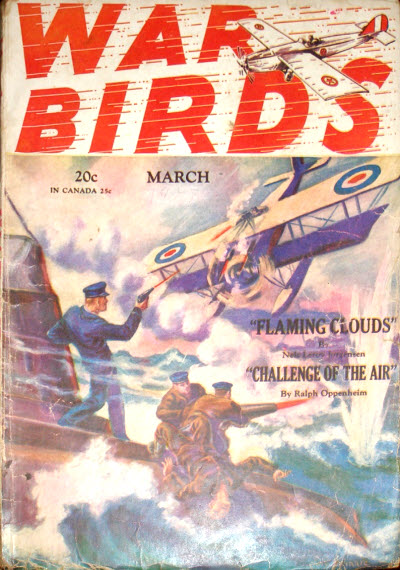
MARCH is Mosquito Month! We’re celebrating Ralph Oppenheim and his greatest creation—”The Three Mosquitoes! We’ll be featuring three early tales of the Mosquitoes over the next few Fridays as well as looking at Mr. Oppenheim’s pre-pulp writings. So, let’s get things rolling, as the Mosquitoes like to say as they get into action—“Let’s Go!”

The greatest fighting war-birds on the Western Front are once again roaring into action. The three Spads flying in a V formation so precise that they seemed as one. On their trim khaki fuselages, were three identical insignias—each a huge, black-painted picture of a grim-looking mosquito. In the cockpits sat the reckless, inseparable trio known as the “Three Mosquitoes.” Captain Kirby, their impetuous young leader, always flying point. On his right, “Shorty” Carn, the mild-eyed, corpulent little Mosquito, who loved his sleep. And on Kirby’s left, completing the V, the eldest and wisest of the trio—long-faced and taciturn Travis.

Let’s get things off the ground with an early Mosquitoes tale from the pages of the premiere issue of War Birds from March 1928! Kirby returns to action after having been shot down and spending 5 weeks in a hospital recuperating. That German had taken the starch out of him, had shattered his morale. In the past he had had planes shot from under him, had escaped perhaps even more certain deaths than this, but always he had come through the victor, had triumphed in the final showdown. Never before had he been beaten, battered to a pulp like this. The German had knocked him down, and he couldn’t get up. It had all given him the awful feeling that his reign as an unbeatable ace was over, that he must relinquish the crown. That was why he looked older now; he felt older, the old champion bowing to the new. It was indeed, almost a sense of going stale—and to an ace nothing could be worse. Can Kirby overcome his “Challenge of the Air!”

Nothing more terrible can happen to a great ace than to realize suddenly that he is suffering from shock—”that the old nerve won’t answer the call. Kirby was in this condition when the Fokker came over, gained valuable information—and was flying back triumphantly. Like a man half mad, he cursed himself fought with himself. The next time they came over—

And check back next Friday when the inseparable trio will be back with another exciting adventure!

“Zuyder Zee Zooming” by Joe Archibald

Link - Posted by David on February 25, 2022 @ 6:00 am in

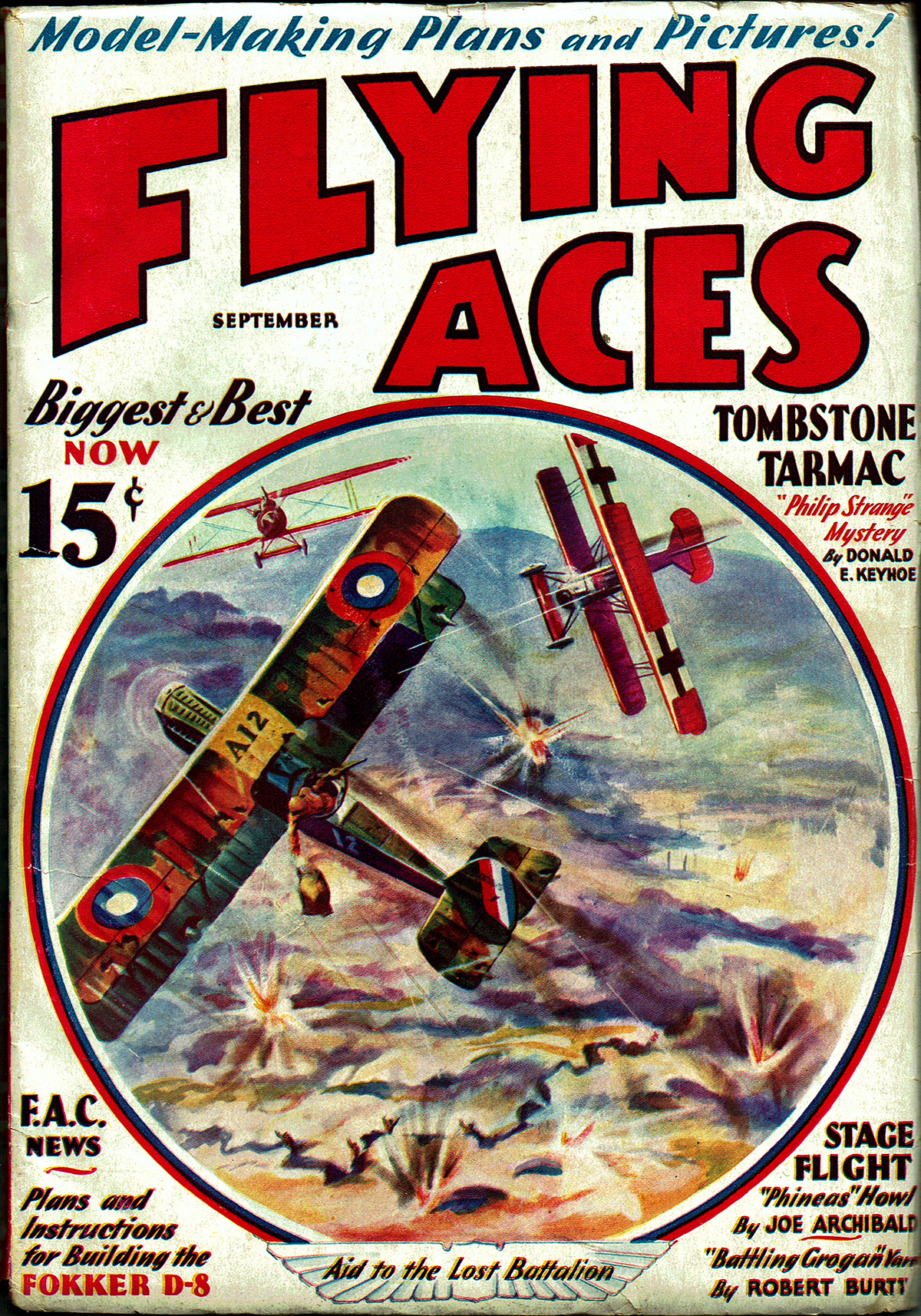
“Haw-w-w-w-w!” That sound can only mean one thing—it’s time to ring out the old year and ring in the new with that Bachelor of Artifice, Knight of Calamity and an alumnus of Doctor Merlin’s Camelot College for Conjurors—Phineas Pinkham. The Boonetown miracle is misdirected to the wrong train in Paris coming back from leave and finds himself knee-deep in tulips and treachery! It’s a Dutch treat special—it’s Phineas in Holland! from the July 1938 issue of Flying Aces, it’s “Zuyder Zee Zooming!”

Ludendorff was well satisfied. He already had his sand and gravel on the Holland canals, and now his eye was on the Hollanders’ ports. But when he began putting ants in their pants, Phineas raised the ante. All of which proved that there’s a limit—even to Dutchman’s breeches.

“Sky Writers, September 1936″ by Terry Gilkison

Link - Posted by David on February 23, 2022 @ 6:00 am in

FREQUENT visitors to this site know that we’ve been featuring Terry Gilkison’s Famous Sky Fighters feature from the pages of Sky Fighters. Gilkison had a number of these features in various pulp magazines—Clues, Thrilling Adventures, Texas Rangers, Thrilling Mystery, Thrilling Western, and Popular Western. Starting in the February 1936 issue of Lone Eagle, Gilkison started the war-air quiz feature Sky Writers. Each month there would be four questions based on the Aces and events of The Great War. If you’ve been following his Famous Sky Fighters, these questions should be a snap!

Here’s the quiz from the September 1936 issue of Lone Eagle.

If you get stumped or just want to check your answers, click here!

“Flyers of Fortune” by Ben Conlon

Link - Posted by David on February 18, 2022 @ 6:00 am in

THIS week we have a exciting air adventure from the pen of Ben Conlon. Conlon was quite the prolific author contributing stories in many genres and under a number of pseudonyms. He’s maybe best remembered for his many exciting Pete Rice western tales. He wrote all the full-length Pete Rice stories under the name Austin Gridley. Others used the pen name for the shorter Pete Rice stories in Wild West Weekly.

When Webb Foster sacrifices his new plane to save a man in trouble, a wealthy Mr. Charlton hires him on to pilot his new plane on his expedition to Biplane Island to find a fortune in gold! From the July 1929 Air Trails, it’s Ben Conlon’s “Flyers of Fortune!”

Whispering death wings spread above a tropic sea—as flyers face destruction for the lure of sunken gold!

« Previous PageNext Page »