Looking to buy? See our books on amazon.com Get Reading Now! Age of Aces Presents - free pulp PDFs

“An Ace of Spads” by Ralph Oppenheim

Link - Posted by David on March 18, 2022 @ 6:00 am in

THROUGH the dark night sky, streaking swiftly with their Hisso engines thundering, is the greatest trio of aces on the Western Front—the famous and inseparable “Three Mosquitoes,” the mightiest flying combination that had ever blazed its way through overwhelming odds and laughed to tell of it! Flying in a V formation—at point was Captain Kirby, impetuous young leader of the great trio; on his right was little Lieutenant “Shorty” Carn, the mild-eyed, corpulent little Mosquito and lanky Lieutenant Travis, eldest and wisest of the Mosquitoes on his left!

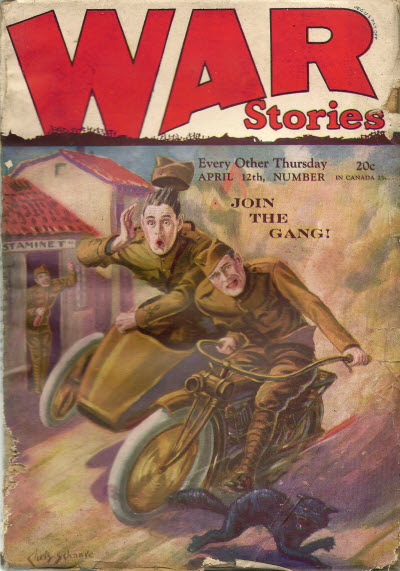
We’re back with the third and final of three Ralph Oppenheim’s Three Mosquitoes stories we’re featuring this March for Mosquito Month! And this one’s a doozy! Kirby gets the unenviable job of test flying the new type Spad and putting it through its paces—including trying it in combat and shooting down a plane. But, under no circumstances should he take the new plane over the lines! Unfortunately that’s just what Kirby did! Read all about it in Ralph Oppenheim’s “An Ace of Spads” from the April 12th, 1928 issue of War Stories!

Kirby’s eyes glowed when he saw the new-type Spad, one of the most beautiful ships ever delivered to the Front. It was to be his job to try it out in action. But he was not to go over the lines—the Germans would lose no opportunity to get their hands on the new ship. Once in the air, however, with a Fokker in sight, Kirby—forgot. One of Oppenheim’s best flying yarns!

The Magic Puppet World Revisited

Link - Posted by David on March 15, 2022 @ 6:00 am in

BACK in 2015 during our first Mosquito Month, we ran a series of articles from The Pocono Record that covered Oppenheim’s Magic Puppet World. In 2019 we ran an additional article from the nearby Allentown Morning Call. But what celebration of the Three Mosquitoes and their creator and chronicler Ralph Oppenheim could go by without a mention of Oppenheim’s Magic Puppet World? Especially since we just came upon an artifact from the time!

Yes, just recently we stumbled upon one of the hand-made pennants that they used to sell at the gift shop at Oppenheim’s!

It’s a small orange felt pennant measuring 3¾” x 8¼” with heavy dark blue yarn ties. Emblazoned upon it are the words “Magic Puppet World” and a joyous printed figure with a wooden ball head and red body with arms up and legs spread.


While the hair is painted with a fine brush; Mrs. Oppenheim paints the eyes, nose and mouth with a cellophane cone filled with lacquer.

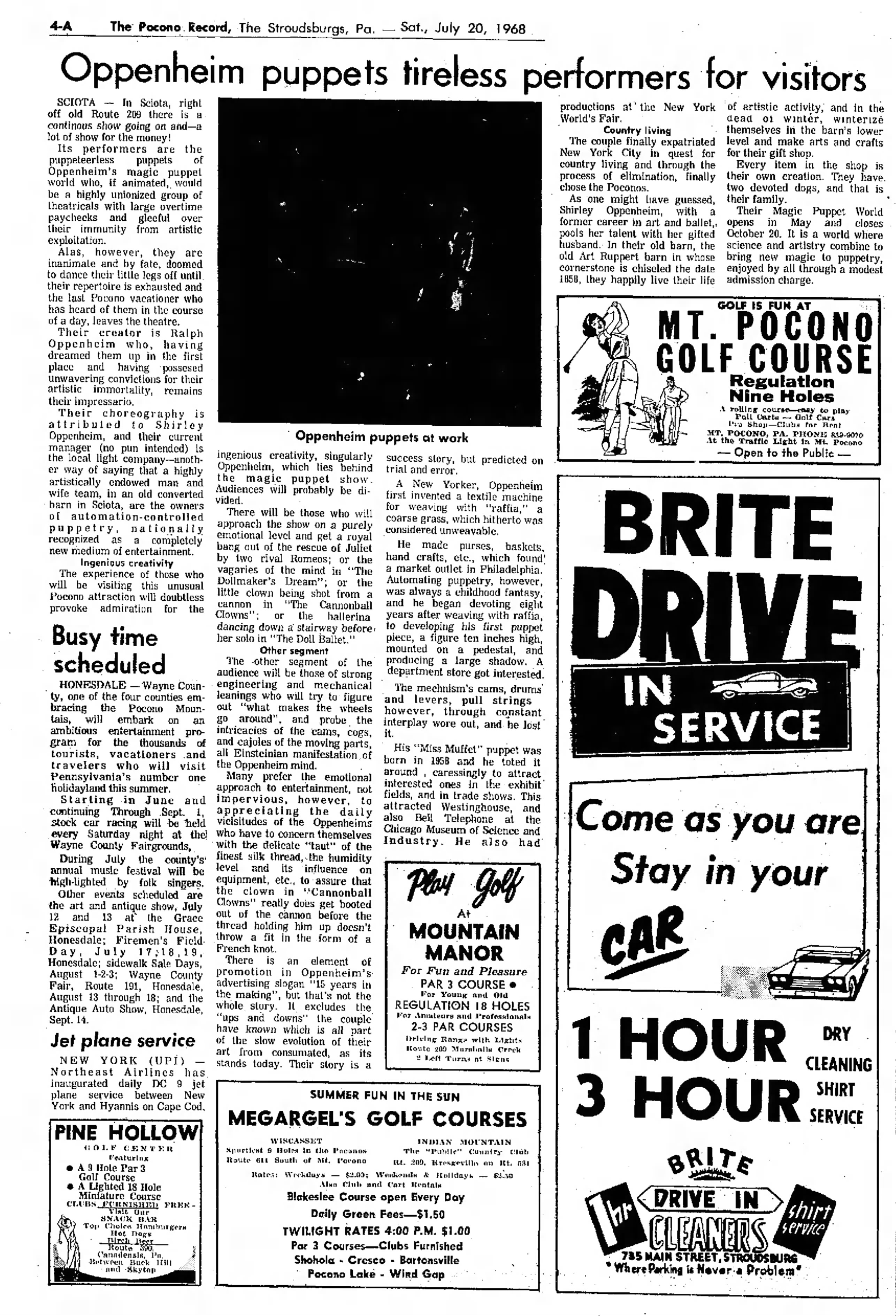
So in celebration of finding the pennant, we’re presenting another article from The Pocono Record we passed over due to it’s poor picture—but it does have lots of good information.

Oppenheim puppets tireless performers for visitors

The Pocono Record, Stroudsburg, Pa • 20 July 1968

SCIOTA — In Sciota, right off old Route 209 there Is a continuous show going on and—a lot of show for the money!

Its performers are the puppeteerless puppets of Oppenheim’s magic puppet world who, If animated, would be a highly unionized group of theatricals with large overtime paychecks and gleeful over their immunity from artistic exploitation.

Alas, however, they are inanimate and by fate, doomed to dance their little logs off until their repertoire is exhausted and the last Pocono vacationer who has heard of them in the course of a day, leaves the theatre.

Their creator is Ralph Oppenheim who, having dreamed them up in the first place and having possessed unwavering convictions for their artistic immortality, remains their impressario.

Their choreography is attributed to Shirley Oppenheim, and their current manager (no pun intended) is the local light company—another way of saying that a highly artistically endowed man and wife team, in an old converted barn in Sciota, are the owners of automation-controlled puppetry, nationally recognized as a completely new medium of entertainment.

Ingenious Creativity

The experience of those who will be visiting this unusual Pocono attraction will doubtless provoke admiration for the ingenious creativity, singularly Oppenheim, which lies behind the magic puppet show. Audiences will probably be divided.

There will be those who will approach the show on a purely emotional level and get a royal bang out of the rescue of Juliet by two rival Romeos; or the vagaries of the mind in “The Dollmaker’s Dream”; or the little clown being shot from a cannon in “The Cannonball Clowns”; or the ballerina dancing down a stairway before her solo in “The Doll Ballet.”

Other Segment

The other segment of the audience will be those of strong engineering and mechanical leanings who will try to figure out “what makes the wheels go around”, and probe the intricacies of the cams, cogs, and cajoles of the moving parts, all Einsteinian manifestation of the Oppenheim mind.

Many prefer the emotional approach to entertainment, not impervious, however, to appreciating the daily vicisitudes of the Oppenheims who have to concern themselves with the delicate “taut” of the finest silk thread, the humidity level and its influence on equipment, etc., to assure that the clown in “Cannonball Clowns” really does get booted out of the cannon before the thread holding him up doesn’t throw a fit in the form of a French knot.

There is an element of promotion in Oppenheim’s advertising slogan “15 years in the making”, but that’s not the whole slury. It excludes the “ups and downs” the couple have known which is ail part of the slow evolution of their art from consumated, as its stands today. Their story is a success story, but predicted on trial and error.

A New Yorker, Oppenheim first invented a textile machine for weaving with “raffia,” a coarse grass, which hitherto was considered uneavable.

He made purses, baskets, hand crafts, etc., which found a market outlet in Philadelphia. Automating puppetry, however, was always a childhood fantasy, and he began devoting eight years after weaving with raffia, to developing his first puppet piece, a figure ten inches high, mounted on a pedestal, and producing a large shadow. A department store got interested.

The mechanism’s cams, drums’ and levers, pull strings however, through constant interplay wore out, and he lost it.

His “Miss Muffet” puppet was born in 195B and he toted it around, caressingly to attract interested ones in the exhibit fields, and in trade shows. This attracted Westinghouse, and also Bell Telephone at the Chicago Museum of Science and Industry. He also had productions at the New York World’s Fair.

Country Living

The couple finally expatriated New York City in quest for country living and through the process of elimination, finally chose the Paconos.

As one might have guessed, Shirley Oppenheim, with a former career in art and ballet, pools her talent with her gifted husband, in their old barn, the old Art Ruppert barn in whose cornerstone is chiseled the dale 1858, they happily live their life of artistic activity, and in the dead of winter, winterize themselves in the barn’s lower level and make arts and crafts for their gift shop.

Every item in the shop is their own creation. They have, two devoted dogs, and that is their family.

Their Magic Puppet World opens in May and closes October 20. It Is a world where science and artistry combine to bring new magic to puppetry, enjoyed by all through a modest admission charge.


“An Ace in the Hole” by Ralph Oppenheim

Link - Posted by David on March 11, 2022 @ 6:00 am in

“LET’S GO!” Once more, The Three Mosquitoes familiar battle cry rings out over the western front and the three khaki Spads take to the air, each sporting the famous Mosquito insignia. In the cockpits sat three warriors who were known wherever men flew as the greatest and most hell raising trio of aces ever to blaze their way through overwhelming odds—always in front was Kirby, their impetuous young leader. Flanking him on either side were the mild-eyed and corpulent Shorty Carn, and lanky Travis, the eldest and wisest Mosquito.

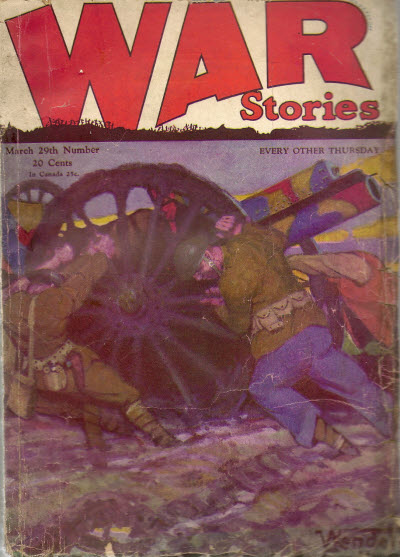
We’re back with the second of three tales of Ralph Oppenheim’s Three Mosquitoes we’re featuring this March for Mosquito Month! This week, the intrepid trio is tasked with getting valuable information from behind German lines—but it’s a job for only one man which unfortunately turns into one man at time as each of the Mosquitoes is sent off to garner the information when the previous one fails to return. From the March 29th, 1928 issue of War Stories, it’s The Three Mosquitoes in “An Ace in the Hole!”

Once more the famous “Three Mosquitoes” go out on a dangerous and thrilling special flight—but this time one of them led the way, alone, while the other two waited—waited until human nerves could stand it no longer.

And check back next Friday when the inseparable trio will be back with another exciting adventure!

Ralph Oppenheim—Eyewitness to History

Link - Posted by David on March 8, 2022 @ 6:00 am in

WHEN the first issue of War Birds hit the stands in February 1928, it not only contained an exciting tale of Ralph Oppenheim’s inseparable trio The Three Mosquitoes, but it also had a rare factual piece by Mr. Oppenheim. Ralph and his younger brother Garrett had taken a trip to Europe the previous year and just happened to be there at the right time to be able to get to Paris and be there at Le Bourget Field on the 21st of May when Charles Lindbergh successfully ended his trans-Atlantic flight!

The editor of WAR BIRDS considers it an outstanding honor to be able to give you this little sketch. Mr. Oppenheim, besides being the most brilliant flying story writer in America, had the priceless privilege of being an eyewitness of one of the most historic moments of modern times—when the great Lindbergh landed the “Spirit of St. Louis” on Le Bourget Field that memorable night in Paris.


Lindbergh uses the lights of Paris to guide him around the Eiffel Tower to Le Bourget Field. (image © lookandlearn.com)

Author’s Note—The following is taken, for the most part, from notes written at Le Bourget Field before and after Lindbergh’s arrival. We (“we” in this case meaning my brother and myself) had come early in the afternoon and had thus secured a wonderful position, on the flat roof of a cafe which was right at the edge of the big field. After a long windy, raining afternoon, during which the crowd grew to a size of about 100,000, the hour when the American should arrive began to draw closer.


When “Lindy” Dropped on Paris

MAY 21st, 1927. 9 to 9:20 P.M. What a mob of people! The roof here is packed behind us, and we are being pushed so hard against our concrete wall (which comes up to our necks) what we’re afraid that either the wall will give or we’ll be crushed into a “shapeless mass.” At our right, in the corner, are three newsreel men, getting movie cameras set. Somewhere in back a Frog newsboy is croaking shrilly: “L’Americain Volant! L’Americain Volant!” A former senator from Missouri says that means that Lindbergh is now over the English Channel. . . . Down below, along the edge of the field, is the real mob—the biggest crowd I’ve ever seen. They are kept from the field itself by a big, strong iron fence. Out on the field, in front of this fence, about two hundred gendarmes are forming a long string to check the crowd if it should attempt to get over that fence. There are no more planes landing or taking off on the field now. The big air-liners which have been coming and going regularly all afternoon, discharging slightly dismal looking passengers and taking on happy, eager ones, are no longer to be seen. They have cleared the field. They have floodlights to illuminate the ground, but they only turn them on every now and then. Economical, these French. Also there are parachute flares. These are shot up like sky-rockets, and the blazing phosphorous comes floating down on a little parachute. Only trouble is these frogs have rotten aim. Some of those damn flares are falling right into the crowd. Each time it happens there’s an excited, panicky shriek. And the idea that one of those flares might fall on our roof is enough to keep us in good suspense. But we don’t need anything to keep us in suspense now. As the moment when the brave American should arrive draws closer and closer, the excitement rises to the highest pitch. Everybody is yelling, shouting, and it seems that everybody has suddenly become a great authority on the subject of aviation. Gosh, these French certainly know how to get excited! There goes that newsboy again: “L’Americain Volant! L’Americain Volant!” And a school-ma’m from Iowa says that means the poor boy’s been lost at sea.

9:20 to 9:30—They are cheering! It seems they hear a plane overhead. We listen. Does sound like a drone up there. More flares—and more suspense. They have the floodlights on again. The cheers are increasing. The gendarmes on the field look worried as the iron fence begins to shake ominously under the pressure of the surging mob behind it.

9:30 to 10:15—Look! Look! Voila! Nom de nom! Everyone is screaming at the top of his or her lungs. We can all hear the drone now. Off to the left it is. We stare in an effort to pierce through the murk. Nothing yet, nothing yet. Then—

The earth shakes with a mighty reverberating cheer. In the darkness up there appears a floating, whitish shape. It is coming down, gliding for the field! It is Lindbergh! God Almighty!

Now we can clearly distinguish the graceful silver monoplane. The crowd is going crazy. The plane is landing. The great pilot, cool and collected, carefully keeps away from all signs of the crowd. He brings his ship down way across the field, just opposite our roof. It is a wonderful and an astonishingly quick landing—the best we’ve seen on this field. And there was something incongruous about the way that plane, having just come way from New York, simply dropped out of the sky and landed.

Before the Spirit of St. Louis rolls to a stop hell breaks loose at Le Bourget. With a mighty shove, the people surge right through that iron fence like a tremendous tidal wave. The gendarmes? Drowned, swallowed in that flood. It is a sight indeed, that mob rushing out towards the plane. It makes you feel insignificant to see all those people. All over flashlights are popping, cameras clicking, and men and women shouting like mad. The cameramen tackle the mob like football players in their efforts to get to the plane. The people on our roof are—well, they’re raising the roof. Some Frog is using my back as a step-ladder, and another is trying to make a foot-stool out of my neck. Tables collapse as people try to stand on them to get a look. One or two crazy fools actually jump off the roof, onto the shed below. A fifteen foot drop! The plane out there is surrounded now. And it seems almost that the mob is lifting that big monoplane on its shoulders and carrying it around. They’re bringing the great Lindbergh in. Cheers! “Vive l’Americain! Vive Londberje (as the Frogs pronounced it)!” Where is he? We think we catch a glimpse of him in the midst of a little circle, around which the crowd is thickest. How they bring him in is a mystery, but they get him to the building right next to ours, and hold the crowd out. The crowd storms outside, yelling in a mighty chorus: “Let us see! Let us see!” From our roof we can see the lighted, curtained window of the room where they have him. We see lots of people in there, and often we think we get glimpses of the American—but we will never know if we really did, though we saw him twice on future occasions (both in Paris and on the day of his arrival in New York).

Now the French windows are opened over in that building, and a man steps out on the balcony. It is the American ambassador. He makes a speech, which nobody hears. But nobody has to hear, because all realize that an epoch-making event has just occurred, and that Charles A. Lindbergh, later to be known as “Plucky Lindy” and “The Lone Eagle” and “Slim,” has succeeded in making the first non-stop flight from New York to Paris.

For a sense of the scene at the time you can check out some newsreels from the whole journey—AP (British Pathé)—or just the day—British Pathé and Periscope Film. And the USA Today actually has a decent article with some good photos from the 90th anniversary of the historic flight.

“Challenge of the Air” by Ralph Oppenheim

Link - Posted by David on March 4, 2022 @ 6:00 am in

MARCH is Mosquito Month! We’re celebrating Ralph Oppenheim and his greatest creation—”The Three Mosquitoes! We’ll be featuring three early tales of the Mosquitoes over the next few Fridays as well as looking at Mr. Oppenheim’s pre-pulp writings. So, let’s get things rolling, as the Mosquitoes like to say as they get into action—“Let’s Go!”

The greatest fighting war-birds on the Western Front are once again roaring into action. The three Spads flying in a V formation so precise that they seemed as one. On their trim khaki fuselages, were three identical insignias—each a huge, black-painted picture of a grim-looking mosquito. In the cockpits sat the reckless, inseparable trio known as the “Three Mosquitoes.” Captain Kirby, their impetuous young leader, always flying point. On his right, “Shorty” Carn, the mild-eyed, corpulent little Mosquito, who loved his sleep. And on Kirby’s left, completing the V, the eldest and wisest of the trio—long-faced and taciturn Travis.

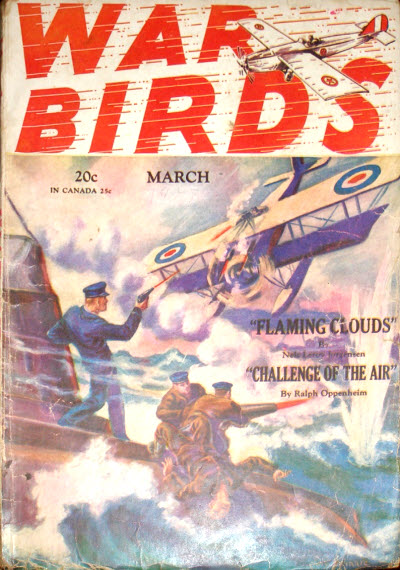
Let’s get things off the ground with an early Mosquitoes tale from the pages of the premiere issue of War Birds from March 1928! Kirby returns to action after having been shot down and spending 5 weeks in a hospital recuperating. That German had taken the starch out of him, had shattered his morale. In the past he had had planes shot from under him, had escaped perhaps even more certain deaths than this, but always he had come through the victor, had triumphed in the final showdown. Never before had he been beaten, battered to a pulp like this. The German had knocked him down, and he couldn’t get up. It had all given him the awful feeling that his reign as an unbeatable ace was over, that he must relinquish the crown. That was why he looked older now; he felt older, the old champion bowing to the new. It was indeed, almost a sense of going stale—and to an ace nothing could be worse. Can Kirby overcome his “Challenge of the Air!”

Nothing more terrible can happen to a great ace than to realize suddenly that he is suffering from shock—”that the old nerve won’t answer the call. Kirby was in this condition when the Fokker came over, gained valuable information—and was flying back triumphantly. Like a man half mad, he cursed himself fought with himself. The next time they came over—

And check back next Friday when the inseparable trio will be back with another exciting adventure!

“Zuyder Zee Zooming” by Joe Archibald

Link - Posted by David on February 25, 2022 @ 6:00 am in

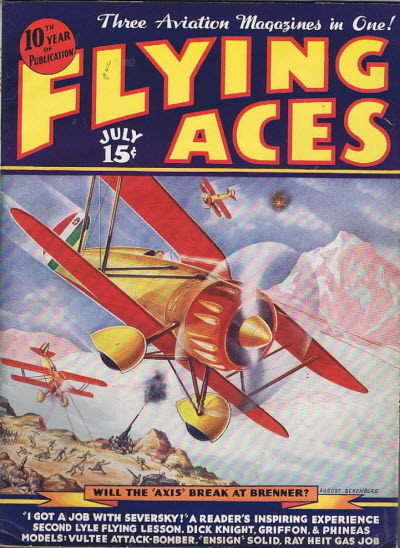
“Haw-w-w-w-w!” That sound can only mean one thing—it’s time to ring out the old year and ring in the new with that Bachelor of Artifice, Knight of Calamity and an alumnus of Doctor Merlin’s Camelot College for Conjurors—Phineas Pinkham. The Boonetown miracle is misdirected to the wrong train in Paris coming back from leave and finds himself knee-deep in tulips and treachery! It’s a Dutch treat special—it’s Phineas in Holland! from the July 1938 issue of Flying Aces, it’s “Zuyder Zee Zooming!”

Ludendorff was well satisfied. He already had his sand and gravel on the Holland canals, and now his eye was on the Hollanders’ ports. But when he began putting ants in their pants, Phineas raised the ante. All of which proved that there’s a limit—even to Dutchman’s breeches.

“Sky Writers, September 1936″ by Terry Gilkison

Link - Posted by David on February 23, 2022 @ 6:00 am in

FREQUENT visitors to this site know that we’ve been featuring Terry Gilkison’s Famous Sky Fighters feature from the pages of Sky Fighters. Gilkison had a number of these features in various pulp magazines—Clues, Thrilling Adventures, Texas Rangers, Thrilling Mystery, Thrilling Western, and Popular Western. Starting in the February 1936 issue of Lone Eagle, Gilkison started the war-air quiz feature Sky Writers. Each month there would be four questions based on the Aces and events of The Great War. If you’ve been following his Famous Sky Fighters, these questions should be a snap!

Here’s the quiz from the September 1936 issue of Lone Eagle.

If you get stumped or just want to check your answers, click here!

“Flyers of Fortune” by Ben Conlon

Link - Posted by David on February 18, 2022 @ 6:00 am in

THIS week we have a exciting air adventure from the pen of Ben Conlon. Conlon was quite the prolific author contributing stories in many genres and under a number of pseudonyms. He’s maybe best remembered for his many exciting Pete Rice western tales. He wrote all the full-length Pete Rice stories under the name Austin Gridley. Others used the pen name for the shorter Pete Rice stories in Wild West Weekly.

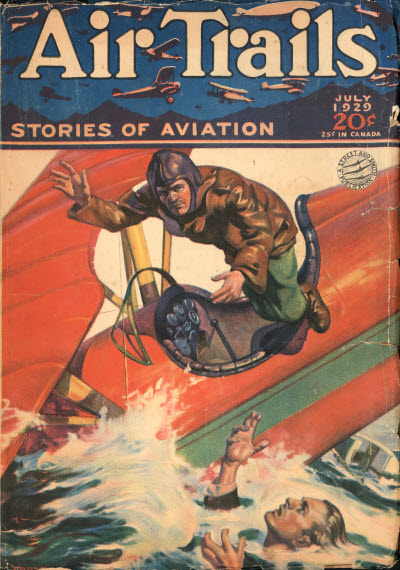
When Webb Foster sacrifices his new plane to save a man in trouble, a wealthy Mr. Charlton hires him on to pilot his new plane on his expedition to Biplane Island to find a fortune in gold! From the July 1929 Air Trails, it’s Ben Conlon’s “Flyers of Fortune!”

Whispering death wings spread above a tropic sea—as flyers face destruction for the lure of sunken gold!

“The Invulnerable Dormé” by Paul Bissell

Link - Posted by David on February 14, 2022 @ 6:00 am in

THIS week we present another of Paul Bissell’s covers for Flying Aces! Bissell is mainly known for doing the covers of Flying Aces from 1931 through 1934 when C.B. Mayshark took over duties. For the January 1933 cover Bissell put us right in the action with

The Invulnerable Dormé

th_FA_3301“AND, Adjutant, get that request of transfer off to headquarters today, s’il vous plait?”

“Certainement, mon Capitaine, but why so vite? There is not an aviator in all France who does not desire to be one of Les Cigognes. So with all the aviators to choose from, why do you ask for Dormé? He has had but little experience in le Chasse.”

“Mon ami,” said the captain affectionately, “when a lad stationed at Paris flies an old Caudron up so close to the Front that he runs into a German squadron of six planes, he shows himself an ambitious and aggressive aviator. But when he then attacks them single-handed, brings one of them down and puts the rest to flight, he shows he has the stuff we want in Squadron 3. Don’t let’s lose him.” And the captain’s tone left no room for further argument.

So, early in July, 1916, René Dormé came to Squadron 3, better known as the Flying Storks, from the insignia painted on the side of their ships. This squadron had been formed by Captain Brocard and was already well known at the Front. It was destined later to enjoy a fame greater, perhaps, than that of any other French flying unit, and Dormé was to play no small part in helping to earn that fame.

In fact, he had been with the squadron but a few weeks when it was very evident that he was, as the French said, “un pilot extraordinaire.” He was quiet and gracious in manner, and was soon affectionately dubbed “Père” by his comrades, not because of his age—he was only 21—but because of the esteem and affection in which they held him.

Though he became one of the nation’s heroes, he remained always modest and unassuming. Twenty-three official victories were finally credited to him, but this was by no means his complete score. He often fought alone, far in the enemy’s territory, and his comrades knew that he had gained many a victory which went unrecorded. Once when a superior officer mentioned this fact in front of Dormé, Père quietly replied, “But the Germans know, mon Capitaine, and that is all that really matters.”

Guynemer considered Dormé the greatest flyer of the war. The ability with which he maneuvered his little Nieuport was nothing short of miraculous. He helped develop air fighting tactics and is credited with being the first to make use of the great defensive stunt, the wing slip.

Battle after battle he would carry through to victory and emerge untouched. To the poilus he was known as “Dormé the Unpuncturable.” They said he could see the bullets and dodge between them. Certain it is that after his tenth victory his mechanics, going carefully over his plane, could not find one single bullet hole. Yet it was this ability to quickly maneuver which almost cost him his life, one morning in the summer of ’16.

JULY was almost over and Dormé was up early to bag himself a Boche to add to his record before the month’s end. He soon spotted a Fokker and swung around in a circle to prevent the black-crossed plane from turning back toward the German lines, at the same time tipping the nose of his little Nieuport up to gain altitude for the attack.

He reached his desired position, and with that quickness which marked all of his maneuvers in the air, swooped down in a power dive, his guns blazing. But here Fate took a hand to save the hapless German from Dormé’s deadly fire.

Completely absorbed in his maneuvers on the tail of the Fokker, Père had not noticed an Aviatic that had swung in from the left and been steadily creeping up under his tail. Evidently the pilot of this ship had just gotten himself in a position to fire on the unsuspecting Dormé when the Frenchman’s quick dive caught him so completely unawares that he was unable to twist his own ship out of the way and avoid a crash. The wheels of the little Nieuport struck the leading edge of the upper wing of the big Aviatic just where it joined the center section.

Luckily for Dormé, the Nieuport, ordinarily considered rather frail in its construction, this time proved the sturdier of the two planes. Though one wheel and part of the landing gear were crushed, a quick jerk of the stick on Dormé’s part yanked the little Nieuport out of danger while the Aviatic’s upper wing, broken at the midsection, swung away, carrying the lower wing with it, and the plane started in its mad dive earthward, the pilot finally jumping to avoid death by flames, the dread of all aviators.

Through the many months that followed, Dormé kept steadily gaining victories over the enemy. He ran neck and neck for many weeks in friendly rivalry with his fellow Cigogne, Captain Heurteaux, for the distinction of the premiere place of the squadron, until at last, when Heurteaux had gained a lead of a few victories, Dormé in a tremendous spurt shot down eight of the enemy in one short week and took a lead that he maintained until that day in May which was ever remembered as a black day for the Storks—the day when Dormé took off in the early morning light, never to be seen or heard from again.

For days the Cigognes kept secret the fact that he had failed to return, hoping against hope that Dormé would yet come back safely. It was more than a fortnight later when the Germans dropped a message on his field saying that Pilot Dormé had been killed in combat.

No data or particulars were given, and to this day there are thousands who refuse to believe that Dormé was brought down by the enemy. Père Dormé, the Beloved, the Unpuncturable, brought down by a German bullet? No! To the French this is unthinkable. But the fact remains that Dormé never came back.

The Ships on The Cover
“The Invulnerable Dormé”
Flying Aces, January 1933 by Paul J. Bissell

“The Greater Glory” by Ace Williams

Link - Posted by David on February 11, 2022 @ 6:00 am in

THIS week we have a story by “Ace Williams.” I put his name in quotes because Galactic Central believes Ace to be a house pseudonym. Either way, what we have is a ripping good yarn—and one that is related to R.S. Bowen’s “How The War Crates Flew” feature this month.

Captain Saunders has never failed to return with photos from an observation flight—that is until he’s paired with Lieutenant Bert Wheeling, a replacement just up from the pilot’s school at Orley. Bert is suddenly stricken with a paralysis when Saunders asks his to go down so they can snap the crucial shots. To make matters worse, a few Fokker show up with their guns yammering. What’s a green pilot to do?

A Gripping Yarn of Singing Steel and Valorous Action in the Battle-Scarred Blue!

“Lost Aces” by Joel Townsley Rogers

Link - Posted by David on February 4, 2022 @ 6:00 am in

THIS week we have a story by Joel Townsley Rogers. Born in 1896 and studied at Harvard, Rogers saw The Great War as an adventure and joined the Navy Air Corp and became one of it’s first few hundred pilots. Unfortunately, the war ended before he saw action and ended up as a flight instructor at Pensacola instead. After the war, he turned his experiences into stories for the pulps. In addition to air stories, Rogers also wrote numerous mystery and science-fiction stories as well.

Zep-strafer extraordinaire, Kenny Blair of the 19th Camels and Captain of the dreaded Gallows Birds, Anton Glick—Two Aces, mortal enemies in the air, find themselves both marooned on an ever-shrinking sandbar in the sea.

Two aces flew to the edge of the world, one toying with treason, one fighting for life in a circle of death. Two aces, two bullets—and only one plane to break a deadlock of doom!

For more info on Rogers, check out “Joel Townsley Rogers—Fiction House Ace” over at the PulpFest website!

“The Spider and the Flyer” by Joe Archibald

Link - Posted by David on January 28, 2022 @ 6:00 am in

“HAW-W-W-W-W!” That sound can only mean one thing—that Bachelor of Artifice, Knight of Calamity and an alumnus of Doctor Merlin’s Camelot College for Conjurors is back to vex not only the Germans, but the Americans—the Ninth Pursuit Squadron in particular—as well. Yes it’s the marvel from Boonetown, Iowa himself—Lieutenant Phineas Pinkham!

The Boonetown miracle man, Lieutenant Phineas Pinkham, is attached to help Captain McSniff over in the Isle investigate rumors of Kraut skullduggery rife on his home soil. Apparently, Scottish folk along the Firth of Solway had begun to get the jitters and that a fisherman had claimed to have seen a Heinie pigboat slipping through the fog that always hung over the Firth as thick as porridge.

When that bonnie braw Kraut shooter, Captain Gregory MacSniff button-holed Lieutenant Phineas Pinkham regarding an “Annie Laurie” journey, that jaunty jokester didn’t appreciate it. He scowled about going to Scotland. And he groused about going grousing. But the flying headache of the 9th quickly found out that orders are orders, and cordite is cordite—even though fish aren’t always just fish.

“Sky Writers, May 1936″ by Terry Gilkison

Link - Posted by David on January 26, 2022 @ 6:00 am in

FREQUENT visitors to this site know that we’ve been featuring Terry Gilkison’s Famous Sky Fighters feature from the pages of Sky Fighters. Gilkison had a number of these features in various pulp magazines—Clues, Thrilling Adventures, Texas Rangers, Thrilling Mystery, Thrilling Western, and Popular Western. Starting in the February 1936 issue of Lone Eagle, Gilkison started the war-air quiz feature Sky Writers. Each month there would be four questions based on the Aces and events of The Great War. If you’ve been following his Famous Sky Fighters, these questions should be a snap!

Here’s the quiz from the May 1936 issue of Lone Eagle.

If you get stumped or just want to check your answers, click here!

“Sky Code” by Captain John E. Doyle

Link - Posted by David on January 21, 2022 @ 6:00 am in

THIS week we have a story from the pen of British Ace, Captain John E. Doyle, D.F.C. Born in 1893, Captain Doyle was a successful fighter pilot in WWI with 9 confirmed victories with 56 & 60 Squadrons. Near the end of the war, he was shot down and taken prisoner where they amputated his leg. After the war, he wrote three books, one of which was an autobiography, and 31 short stories for magazines like War Stories, The Scout, Popular Flying, The Aeroplane, Flying, Boys’ Ace Library, Mine, Modern Wonder and Air Stories. Five of those stories were for the British version of Air Stories and featured one Montgomery de Courcy Montmorency Hardcastle, M.C. In Scotland he was usually referred to as “His Lordship,” for he was the fourteenth Viscount Arbroath as well as the sixth Baron Cupar. Out in France he was just “Monty” behind his back, or “The Major,” or “Sir” to his face.

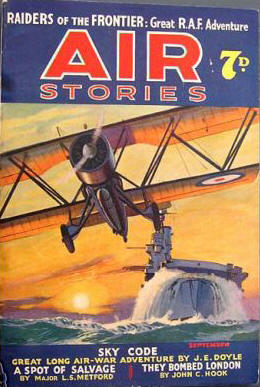
99 Squadron R.F.C. seems to have hit a bad patch—they always seem to run into trouble on all their patrols. It’s almost as if someone’s been tipping them off. Major Monty tries to find out just who the spy on his ‘drome is. From the September 1937 issue of the British Air Stories, it’s Captain John E. Doyle’s “Sky Code!”

Ordeal by Combat, with a Flaming End for the Loser, was the Grim Sky Trial staged by a Monocled Major to end the Strange Hoodoo that was fast Annihilating a British Scout Squadron! A Great Long Major “Monty” Story of War-time Mystery and Adventure in the Royal Flying Corps!

How the War Crates Flew: The Constaninesco Interrupter Gear

Link - Posted by David on January 12, 2022 @ 6:00 am in

FROM the pages of the July 1932 number of Sky Fighters:

Editor’s Note: We feel that this magazine has been exceedingly fortunate in securing R. Sidney Bowen to conduct a technical department each month. It is Mr. Bowen’s idea to tell us the underlying principles and facts concerning expressions and ideas of air-war terminology. Each month he will enlarge upon some particular statement in the stories of this magazine. Mr. Bowen is qualified for this work, not only because he was a war pilot of the Royal Air Force, but also because he has been the editor of one of the foremost technical journals of aviation.
The Constaninesco Interrupter Gear

by Robert Sidney Bowen (Sky Fighters, July 1932)

ALEC WATSON, leading Hun getter of the 23rd Pursuits, crouched over the stick, glued his eye to the ring-sight, and tripped the triggers. . . .

Now just a second, Alec old sky eagle! What do you mean, tripped the triggers? Generally speaking, that is correct. But technically speaking it is not so correct. You, personally, Alec, do not trip the triggers. Of course, being an A1 Hun getter, you realize that. But there are a lot of fledglings around here who don’t. So I think it would be a pretty good idea if we went into this question of tripping triggers, and found out just what it was all about.

Alright, fledglings, gather ’round, and let’s go!

The pilot of any pursuit plane used in the great war, could only shoot in one direction . . . that was forward. Sometimes he had one Vickers gun mounted on the engine cowling, and one Lewis mounted on the top center section. Sometimes he had two Vickers and one Lewis. And sometimes he had just two Vickers. But regardless of what he had in the way of guns, they were always mounted on something and pointing straight forward. We’ll just forget about the Lewis gun because that was mounted on the top center section and therefore was able to fire clear of the top peak of the propeller disc. Now when I say propeller disc I simply mean the circle inscribed by the revolving propeller.

But, the Vickers gun being mounted on the engine cowling, just forward of the pilot’s cockpit, must fire through the prop disc, if it’s going to fire at all.

I just heard some one ask: “What about hitting the revolving propeller blades?”

Well, fledgling, that’s just what I’m getting at. We don’t want to hit the prop blades, do we? I’ll say we don’t! So some way we’ve got to work things so that the shots from our gun will pass between the prop blades on their way to that Hun johnnie sitting up there in the sky.

And here is how we do that little thing.

As a matter of fact, it has already been done for us. A gentleman by the name of Constaninesco invented what was known as the Constaninesco Interrupter Gear. It was composed of four parts. 1. The generator. 2. The trigger motor. 3. The reservoir with Bowden control. 4. Pipe lines, main and secondary.

The generator is simply a small* cylinder affair with plunger attached, which is mounted forward on the engine, and in a vertical position. The drive for the generator is generally taken (on stationary engines) from the boss of the propeller by means of gears which engage with a cam shaft leading to the vertical generator. To put it another way, the generator is just a small cylinder with a plunger at the top which is forced down every time the revolving cam on the cam shaft strikes it. And that cam shaft is not the cam shaft of the engine itself, but a separate cam shaft which is revolved by means of gears which attach it to the boss of the propeller. And, of course, when I say boss, I mean the metal plates and bolts which hold the propeller on the crankshaft of the engine.

Now, the next thing is the trigger motor, as it was called. As you all probably know, the Vickers gun operates (briefly) by, what is cabled, the lock moving forward and backward inside the gun. The lock is about three inches by four inches and maybe an inch or so thick, and contains all the trigger mechanism of the gun. Now, one of its actions as it moves forward in the gun is to cock the trigger which is a part of it. Then as it rides back again in the gun the trigger, which projects up out of the top a bit hits against a movable pin fitted at the rear of the gun casing. And of course that action trips the trigger and the gun fires.

IT IS that movable pin that I’m yarning about now. It is simply a round slender piece of metal which projects out of the rear end of the gun and is fastened to a thumb lever. In other words, when firing a Vickers on the ground you simply grip the spade handles of the gun and press your thumbs against the thumb levers. That forces the pin forward so that the end of it trips the trigger as the lock slides back. Now, when you don’t press the gun naturally doesn’t fire because the pin, which is really like a plunger on a spring, is forced back by the spring action so that the trigger doesn’t touch it as the lock slides back.

Now, what we’ve got to do is attach something to the rear end of that pin to take the place of the thumb levers. The reason being, that running from our generator up front to the pin at the rear of the gun is a length of quarter inch copper tubing which is filled with oil. Ah, you’re guessing it already. That’s right . . . as the cam rotates and strikes the plunger in the generator it sends a pulsation back along the copper pipe full of oil and forces forward the pin in the rear of the gun so that it trips the trigger of the lock. So what we really do is fit another plunger to the rear of the gun to take the place of the pin with its thumb levers.

Now, so far, we have a plunger at the forward end of the copper tubing, and another plunger at the rear end. The forward plunger is set so that the revolving cam will hit it. And the rear plunger is set so that as a pulsation of oil forces it forward it will trip the trigger lock.

Just oil (nine parts parafine and one part BB vacuum oil in the copper tubing isn’t going to do us any good unless we put that oil under pressure. So we use what is called the reservoir. The reservoir is something like a double bicycle pump. In other words, a plunger and chamber inside of a larger chamber. At the end of the inner chamber there is a copper pipe-line running to the one we’ve just been talking about. Just so we won’t get too mixed up, the copper tube running from the generator to the trigger motor is called the main pipe-line. And the tube running from the reservoir to the main pipe-line is called the secondary pipeline.

Now, the plunger in the inner chamber of the reservoir is attached to a handle at the top, and there is a strong spring around the stem of the plunger to keep it forced down. In other words, when the handle of the plunger is pulled up and released the spring tries to force it down. And of course the reservoir is attached to the inner right side of the cockpit, at an angle of forty-five degrees, so that the pilot can grab it when he wants to put the oil under pressure.

So now let’s see just how we work the thing.

OF COURSE we assume that there is oil in the main pipe-line, in the secondary pipe-line and in the outer chamber (low pressure chamber) of the reservoir. There isn’t oil in the center chamber (high pressure) because the plunger is down at the bottom. But all of this oil is under atmospheric pressure. In other words, not enough pressure to force the generator plunger up so that the revolving cam will strike it.

Okay, let’s go. We pull up the handle of the reservoir. In doing that we suck oil from the low pressure chamber into the high pressure chamber. Then we let go the handle and the spring tries to force the plunger down, and that action puts the oil under a pressure of 150 lbs. per square inch. Now the oil in the high pressure chamber and the oil in the secondary pipe-line is under pressure. The oil in the main pipe-line is not, because where the two pipe-lines join is a three-way valve. To get pressure in the main pipe-line we have got to open that three-way valve.

We do it this way. From the joy stick to that valve is a movable wire in a metal casing. (Something like the choke wire on your car.) On the joy stick that wire, called the Bowden control, is attached to a clamp you can press. Oftentimes it is attached to a thumb lever you push forward. But squeezing the clamp, or pushing the thumb lever, pulls the Bowden control wire and opens the three-way valve. Of course then the oil in the main line is put under pressure. And in being under pressure the plunger in the generator is forced up so that the revolving cam will strike it.

Alright, the cam strikes the plunger and forces it down. A pulsation, traveling at the rate of 4,000 ft. per second, starts back along the main pipeline. It reaches the point where the main pipe-line is joined to the secondary line. But because of the three-way valve it can’t shoot up the secondary line and hit against the reservoir plunger. So it carries right on along the main pipe-line and hits against the plunger in the trigger motor, and of course shoves it forward. And when the trigger motor plunger is forced forward, it of course trips the trigger of the lock and the gun is fired. Now, that pulsation after it has hit the trigger motor plunger naturally wants to bounce back along the main pipe-line. But we stop that by putting a check valve in the trigger motor. Then, of course, the pulsation can’t bounce back and interfere with pulsation coming forward.

We have yarned about this step by step. But of course you understand that these pulsations are traveling at the rate of 4,000 ft. per second, and things happen fast. And whenever the lock slides back again with its trigger cocked there are always pulsations to slap the trigger motor plunger forward and trip the trigger again.

IN CASE you’ve forgotten, all this is happening because we are still pressing the Bowden controls. Once we let go, the three-way valve closes and the main pipe-line goes back to ordinary pressure and the generator plunger sinks down where the revolving cam doesn’t hit it. To fire again we simply press the Bowden control and that opens the valve again. The 150 lbs. per square inch pressure is maintained for about ten bursts of any length. And then we have to pull up the handle again and renew the pressure. In order to get it clear in your minds about those pulsations, the oil being under pressure, a single pulsation is like a solid rod moving through the main pipe-line. And the number of pulsations is determined on how the cam shaft is geared to the prop boss. In other words, according to the speed of the revolving cam shaft.

And there you are.

No, we’re not. That young fledgling is checking on me again. “How about hitting the prop blades?” he asks.

Alright, it’s like this. The cam is set so that it strikes the generator plunger when the trailing edge of the prop blade (two-bladed prop) is one inch past the bore of the gun. In the case of a four-bladed prop the cam should be set when the center of the blade is right opposite the bore of the gun. That is, of course, assuming that the muzzle of the gun is four feet from the revolving prop blades. The nearer the gun is to the prop the nearer you set the cam to the trailing edge.

The Editor of this mag of yours has just looked over my shoulder and reminded me that I’m not writing a book, so I’d better quit.

And so, you fledglings, when these leading Hun getters trip triggers again, don’t let ’em kid you. They are just pressing the old Bowden control to open that three-way valve to put the main pipe-line under pressure so that the oil pulsation will trip the triggers. Can you beat it? . . . These sky birds are just a bunch of oil pumpers!


« Previous PageNext Page »