


Looking to buy? See our books on amazon.com Get Reading Now! Age of Aces Presents - free pulp PDFs

The Story Behind The Cover


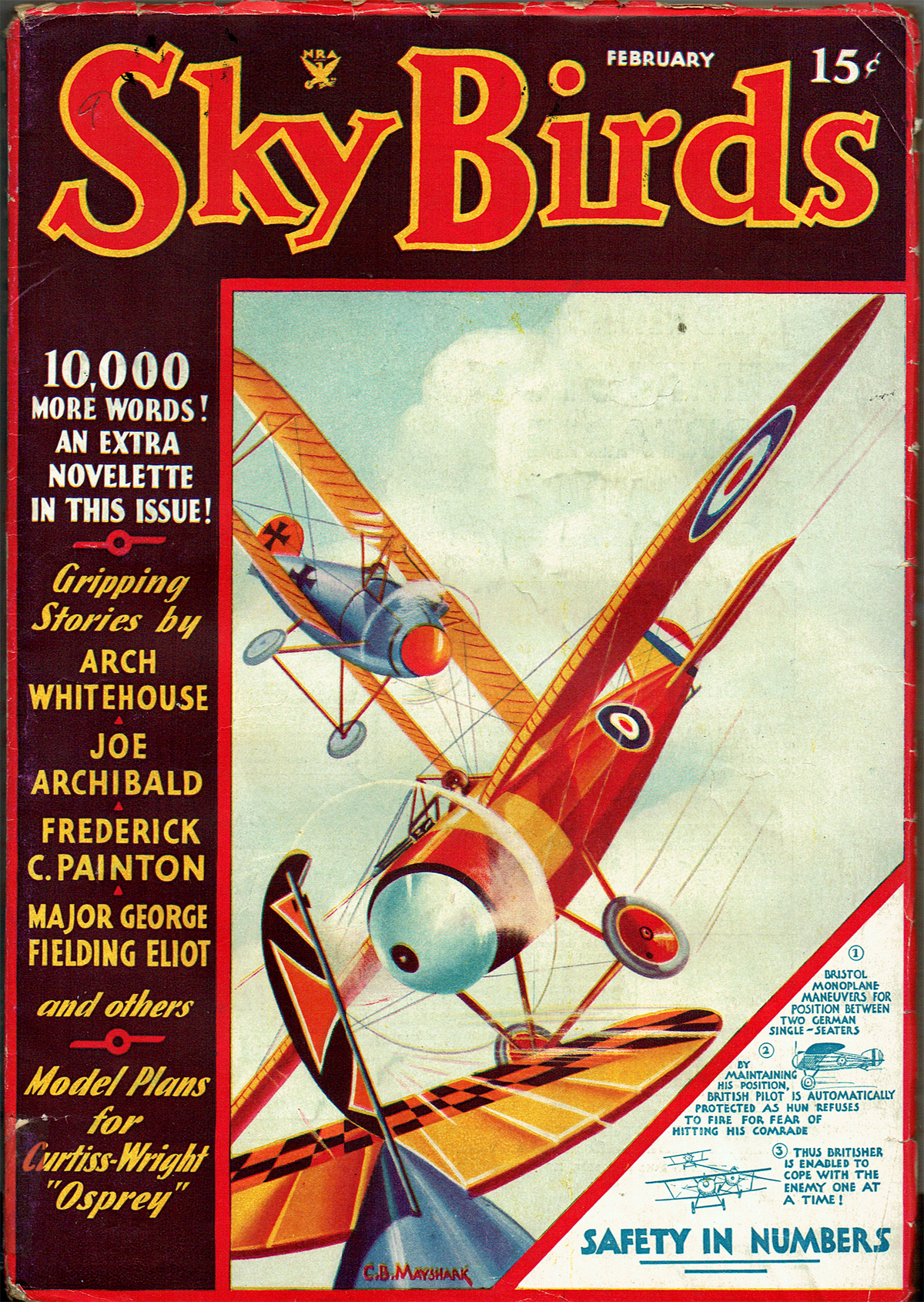
“Sky Birds, February 1935″ by C.B. Mayshark

Link - Posted by David on May 13, 2019 @ 6:00 am in

THIS May we’re celebrating the genius that is C.B. Mayshark! Mayshark took over the covers duties for Sky Birds with the July 1934 and would paint all the remaining covers until it’s last issue in December 1935. At the start of his run, Sky Birds started featuring a different combat maneuver of the war-time pilots. The lower corner presenting a play-by-play of that month’s maneuver with the remainder of the cover illustrating it. For February 1935 issue Mayshark gives us “Safety In Numbers!”

Combat Maneuvers of War-Time Pilots:
Safety In Numbers

UNDER ordinary circumstances, th_SB_3502 when you get one ship in combat with many, you have a very one-sided battle. Of course, there were instances during the war when a single combatant came out the victor over overwhelming odds, but these cases were few and far between.
Usually, when one lone ship came upon a flight of enemy planes, the solitary plane made a decided effort to duck out. A pilot who was seen streaking for home with a flock of Germans on his tail was never considered a coward. On the contrary, he was thought to be displaying a lot of good common sense. Foolhardy exposure never drew praise.

On this month’s cover, we have illustrated an air battle which, at first glance, looks like a victory for the enemy. A Britisher who was trapped between two Huns got nothing but sympathy and prayers from nonparticipating onlookers, if the combat happened to be taking place over Allied soil. If the Germans were viewing the fight, the Britisher didn’t get even that much of a break. But in our cover, the British pilot is fooling them all, whether they be enemy or Allied bystanders.

Diving full upon a German scout, the British pilot is just ready to line up his target when he suddenly becomes aware of the fact that another German is bearing down upon him from behind. His first impulse is to abandon the prey before him and attempt to get away. He almost carries out his impulse, but in a second he foresees the possible outcome of the battle if he sticks where he is. He is taking a long chance, and he knows it. The only alternative is almost certain defeat.

Having decided that he has a fifty-fifty chance of disposing of these Huns one by one, the British pilot pulls up closer onto the tail of his adversary. The German ship which is bringing up the rear also pulls up closer, but the Hun finds himself in a fit of indecision. There is a chance that he can fire upon the Allied ship before him and register a hit with the first burst. But if he misses, the chances are ten to one that his comrade ahead will get it in the neck. What to do?

Then, suddenly, he sees it is too late to do anything. The British pilot has opened fire, and one short burst proves adequate to knock the German out of the sky.

As his ship falls away in a spin, the remaining German is blinded with rage. Why hadn’t he drilled this British pilot when he had a chance? He has been duped, and, as a result, his comrade has fallen to his death. Now the only thing left is revenge.
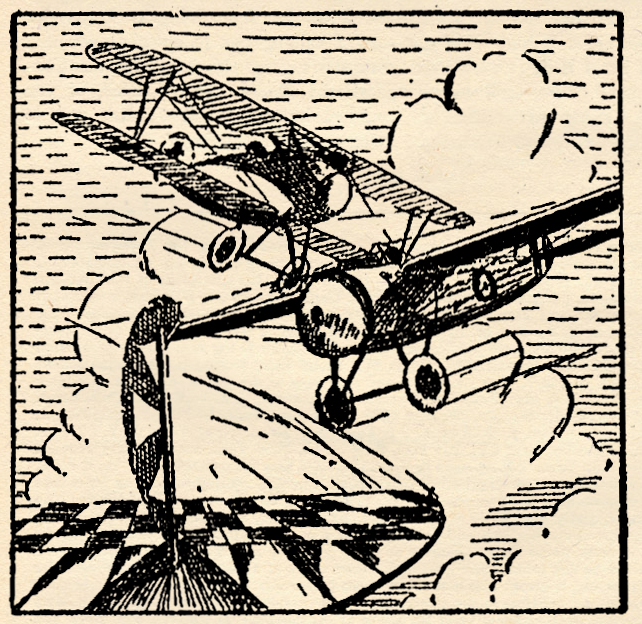
But the Britisher is as wary as he is smart. As soon as he sees that his bullets have found their mark, he spins away from the remaining Hun with the speed of lightning. And now he finds himself free to engage the enemy on even terms.

But what is this dropping out of the clouds on his left? A whole flight of enemy scouts! The Britisher knows when he has had enough. Losing altitude quickly, he gains speed and streaks for home.

Thus a victory is won. An Allied pilot has fought bravely and smartly, and when the odds mount too heavily against him, he quits. A courageous but cautious airmanl

The planes on the cover this month are high-performance single-seater fighters, one of which is comparatively unknown.

The Bristol monoplane was built late in the war by the British and Colonial Aeroplane Co., Ltd. Incorporated in its design are found what was then the latest ideas in airplane construction. As can be seen, it is a high-wing, wire-braced monoplane. The fuselage is circular in construction, the shape of the cowling being preserved down to the tail by fairing. The ship is powered with a 110-horsepower Le Rhone engine, and a large spinner is fixed to the propeller boss. The ship has a top speed of 130 m.p.h.

The German planes pictured on the cover are the well-known Albatross D-3’s.

The Story of The Cover
Sky Birds, February 1935 by C.B. Mayshark
(Combat Maneuvers of War-Time Pilots: The Story Behind This Month’s Cover)
“Sky Birds, January 1935″ by C.B. Mayshark

Link - Posted by David on May 6, 2019 @ 6:00 am in

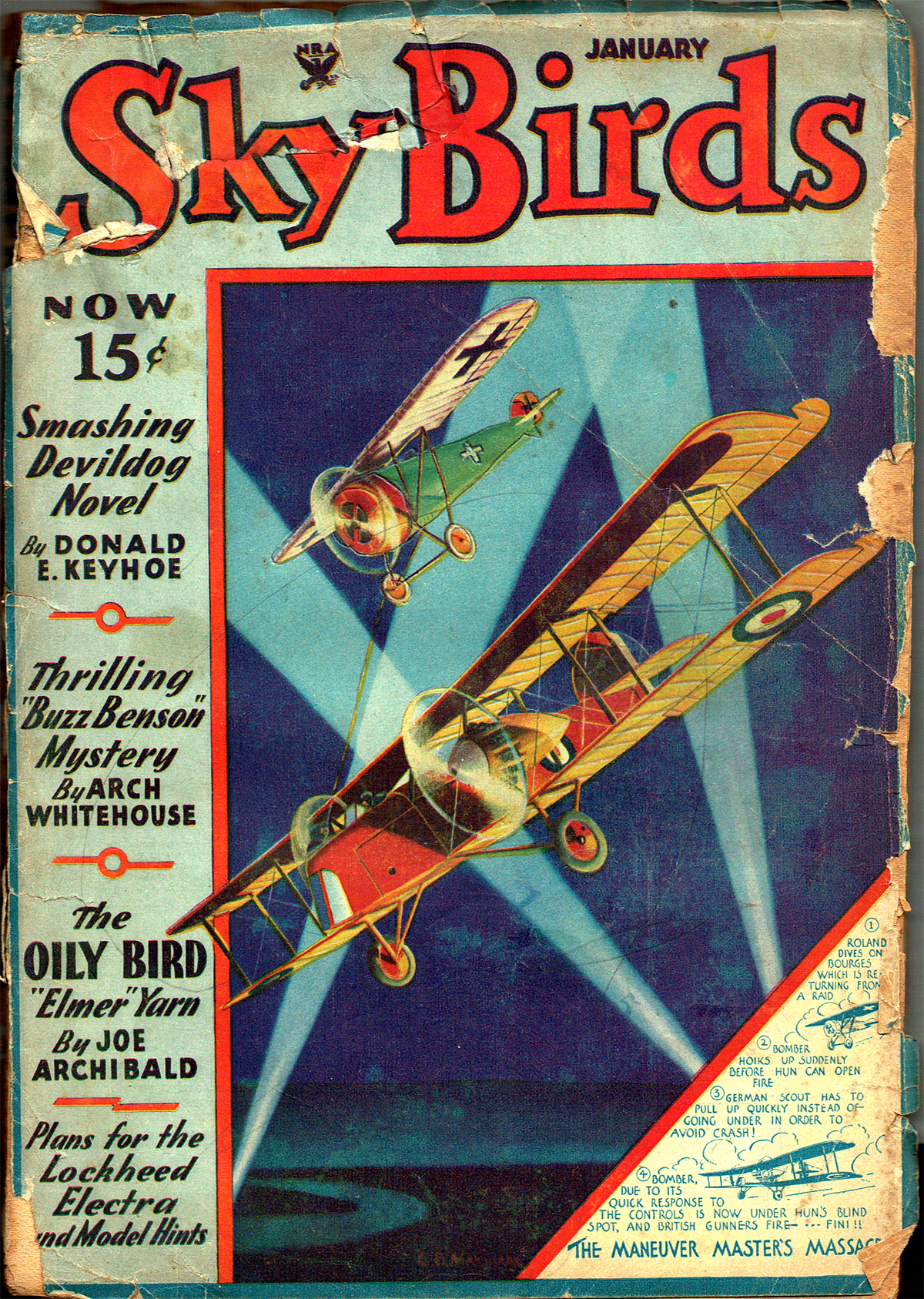
THIS May we’re celebrating the genius that is C.B. Mayshark! Mayshark took over the covers duties for Sky Birds with the July 1934 and would paint all the remaining covers until it’s last issue in December 1935. At the start of his run, Sky Birds started featuring a different combat maneuver of the war-time pilots. The lower corner presenting a play-by-play of that month’s maneuver with the remainder of the cover illustrating it. For January 1935 issue Mayshark gives us “The Maneuver Master’s Massacre!”

Combat Maneuvers of War-Time Pilots:
The Maneuver Master’s Massacre

IT IS the concensus of th_SB_3501 opinion that the Handley-Page bombing plane was the most efficient machine of its type ever to lift its wings above the shell-torn vistas of France for the Allied cause. There is no doubt that this opinion is correct in every respect. However, Boulton and Paul of Norwich, England, constructors of fighting aircraft, built late in the World War a bomber which might even have surpassed the famous Handley-Page if it had had time to prove its merit.
The Boulton and Paul “Bourges” bomber, pictured on this month’s cover, is one of the most remarkable wartime aeronautical engineering feats ever accomplished. The most amazing feature of the ship is the small overall dimensions. Bombers have always been thought of as huge, clumsy-looking craft, with none of the sweet lines of grace usually associated with the Sopwith Camel or the Bristol Fighter. Not so with the “Bourges.”

This machine combines the speed, climb, and maneuvering abilities usually connected with a small single-seater, with the range and fuel carrying capacity expected of a large bomber. The essential measurements of the “Bourges” are as follows: Span, 54 feet; overall length, 87 feet; gap (uniform), 6 feet, 6 inches; and chord, top plane, 8 feet, bottom plane 6 feet, 6 inches.

The ship is powered with two 300-horsepower A.B.C. “Dragonfly” stationary radial engines. These motors attain for the ship a speed at ten thousand feet of 124 miles per hour and a landing speed of 50 miles per hour. The fuel tank capacity in hours is 9.25. Besides the pilot, the ship carries gunner-observers in the forward and aft cockpits.

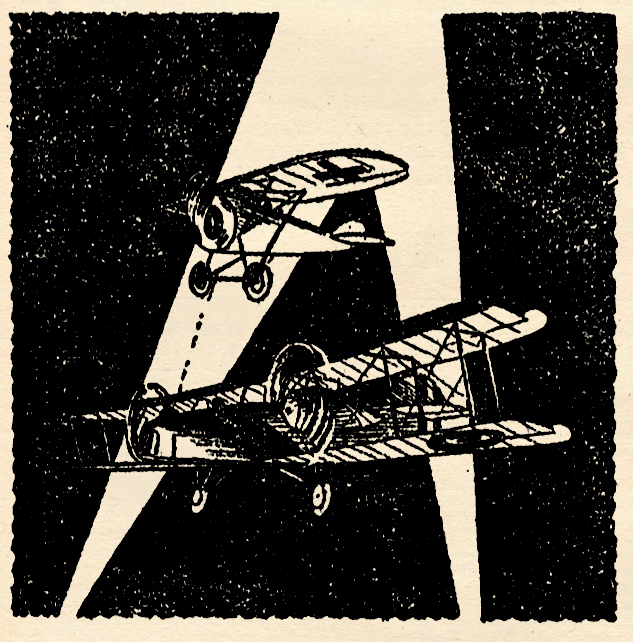
The maneuver on the cover depicts the method by which the bomber might be expected to get itself out of a tight spot. Bombers returning from night raids must be constantly on the lookout for surprise attacks.

As the German Roland dives on the bomber, it falls away, slowly waiting until that time when all airmen, by means of a sort of sixth sense, know that they can expect to feel tracer splashing through their fabric.

Suddenly the “Bourges” jerks up, taking the chance that the Hun will pull up, too, rather than crash. Of course, the German does pull up frantically, thinking only of getting his wheels away from the tail assembly of the Britisher. As his ship gains a little altitude, the German pilot is thinking that he has never seen a big ship move so fast. He has been tricked completely, and as he looks down over the side into the glare of his own searchlight beams to get his bearings, he realizes that he is whipped. British bullets are already smashing his plane to pieces. With controls shot away the Roland sinks over into a flat spin. A few minutes later, it crashes in German territory, and a very lucky Hun pilot hurries back to his airdrome to tell in wide-eyed amazement of how a certain British bomber, the equal of which he had never seen, was as maneuverable as his own single-seater.

The ship in which the German had such a narrow escape was a Roland parasol monoplane which was built by the L.F.G. firm. It was a high-performance single-seater scout, built primarily for patrol and escort duty, and designated as type D XVI. This ship was very smoothly streamlined, and the absence of wires facilitated in cutting down resistance. The power plant consisted of one 200-horsepower, eleven-cylinder Siemens engine.

The Story of The Cover
Sky Birds, January 1935 by C.B. Mayshark
(Combat Maneuvers of War-Time Pilots: The Story Behind This Month’s Cover)
“Sky Birds, December 1934″ by C.B. Mayshark

Link - Posted by David on April 29, 2019 @ 6:00 am in

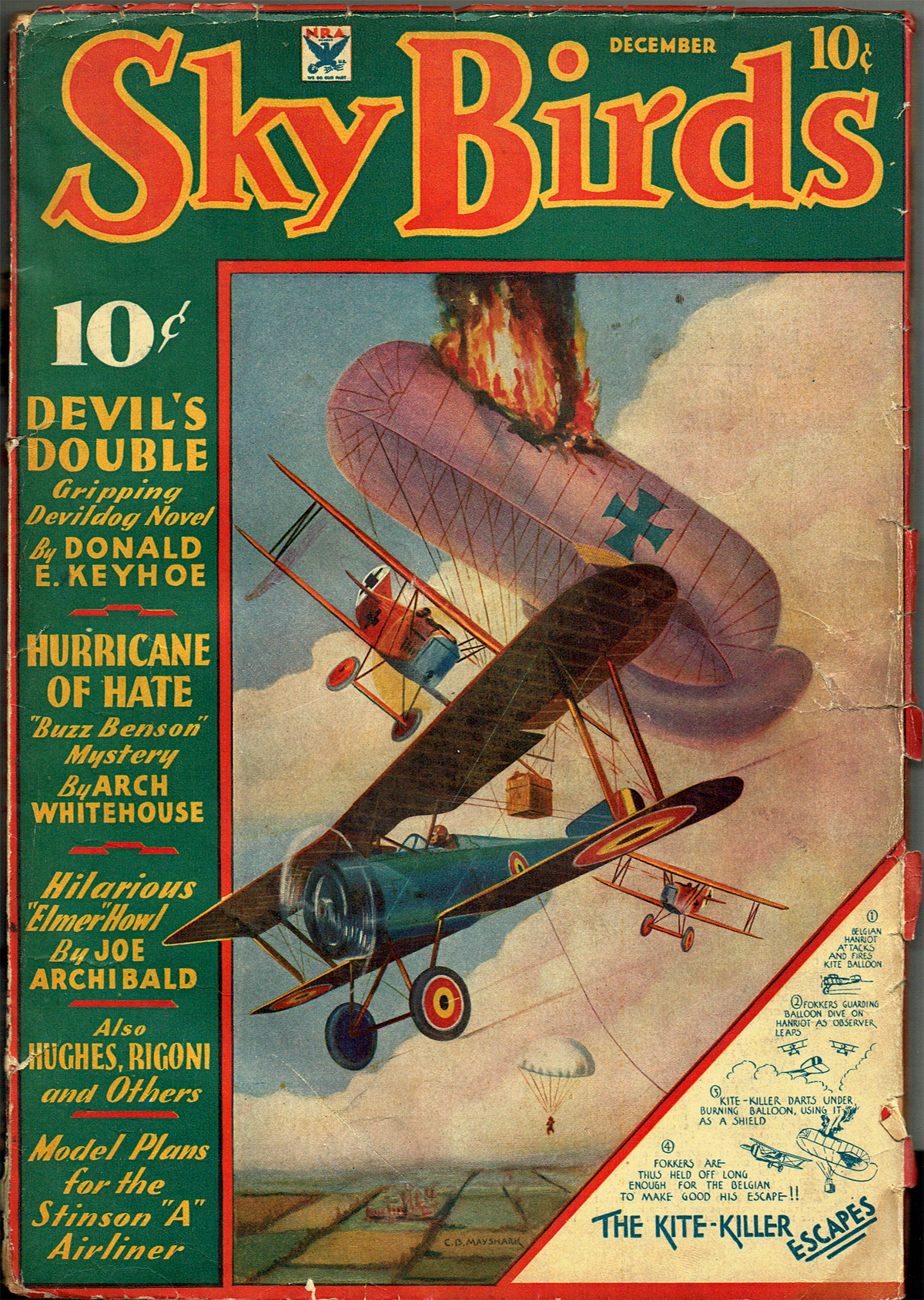
THIS May we’re once again celebrating the genius that is C.B. Mayshark! Every Monday in May we’ll be featuring one of his great covers—in order to get an extra cover in, we’re starting a few days early! Mayshark took over the covers duties for Sky Birds with the July 1934 and would paint all the remaining covers until it’s last issue in December 1935. At the start of his run, Sky Birds started featuring a different combat maneuver of the war-time pilots. The lower corner presenting a play-by-play of that month’s maneuver with the remainder of the cover illustrating it. For December 1934 issue Mayshark gives us “The Kite Killer Escapes!”

Combat Maneuvers of War-Time Pilots:
The Kite Killer Escapes

DURNG the war, balloon th_SB_3412 strafing was one of the most hazardous and thrilling aerial sports in which a pilot could take part. And before the shells stopped bursting over the ruins of France, most of the Allied pilots had been initiated into the gameful art of balloon firing.

Of the few who attained fame in this branch of the air offensive, perhaps the most renowned is Willy Coppens. Balloons were his meat, and he attacked always with such fury and determination that the enemy defense ships usually went scuttling home, their pilots satisfied with the conclusion that here was a devil not to be denied by the German Imperial Air Corps.

At the time of his activity on the Western Front, Coppens was a very exacting and painstaking individual. He planned every engagement from the moment he first sighted his enemy, and he never deviated from his own original systemaof precautionary safety measures, which on more than one occasion tricked his enemy into foolhardy exposure and certain death. But Coppens did more than plan his fights. He planned his escapes, when a quick getaway was necessary, and quick getaways were necessary when balloon strafing was the business at hand.

On this month’s cover, we have shown you how the Belgian ace employed skill and cunning to effect his escape from the bullet-riddled air around the German kite balloon which he has just fired. As the Belgian makes a bee-line for home after the balloon has begun to burn, two Fokker D-7′a swoop down on him, determined to cut off his escape and avenge the defeat of their two fallen comrades.

The Belgian finds himself in a tight spot, but instead of losing his head and fighting blindly, he makes a wide turn and heads back towards the burning balloon. The two Germans stick with him.
As the trio nears the mass of flame and smoke, the Germans become puzzled and a little leery of their reckless enemy. Can it be that this fool is going to lead them to destruction? But the Belgian has his eyes open, and he is laughing up his sleeve. Suddenly the cable which anchors the balloon to the ground looms up. The Belgian succeeds in dodging it, but one of the Fokkers is not so lucky. The German plows headlong into the atrands of steel, the propeller splintering into a thousand fragments. The impact is so terrific that the burning balloon lurches downward as the Fokker sticks fast to the cable.

As the Belgian ducks around the front end of the balloon, the remaining German skids off to the right, expecting to pick up his enemy at the tail end of the burning craft. But the Belgian, piloting his ship almost mochanically, goes up in a steep climb. Gaining altitude, he slides over into the loose smoke some five hundred feet above the doomed balloon, settling there momentarily while his wide-eyed adversary frantically combs the hot air around the falling balloon. Suddenly the Belgian darts out into the open, and with his advantage of altitude, it is impossible for the Hun to reach him. Thus the Kite-Killer escapes.

The ship carrying the Belgian cocardes is a French-built Hanriot single-seater scout. Very few of these ships were built, although their performance was good and their response to the controls was as active as that of the Camel. It was powered with a 130-h.p. Clerget rotary motor. The curious arrangement of the center-section struts is the most distinctive feature of the plane.
The two German ships, as has been said, are the well-known Fokker D-7’s, and the balloon is a Perseval type observation bag with stabilizing flaps on either side.

The Story of The Cover
Sky Birds, December 1934 by C.B. Mayshark
(Combat Maneuvers of War-Time Pilots: The Story Behind This Month’s Cover)
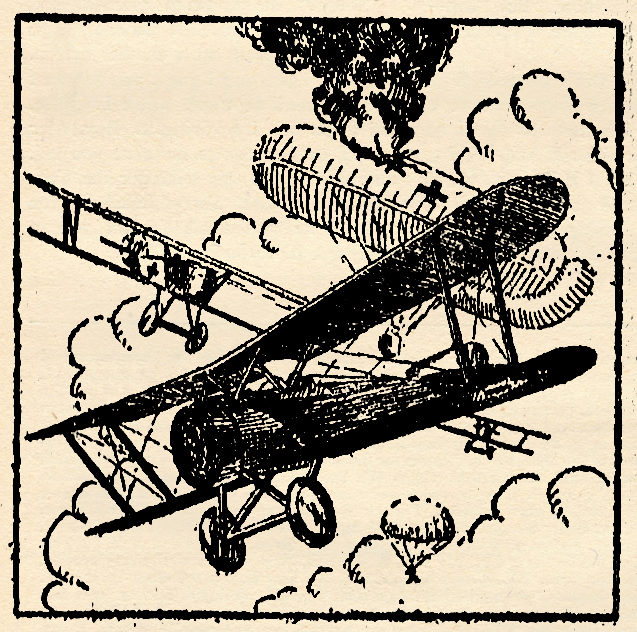
“The Night Bomber” by C. Heurlin

Link - Posted by David on April 15, 2019 @ 6:00 am in

THIS week we present a cover by Colcord Heurlin! From 1923 to 1933 Colcord Heurlin painted covers for a wide range of pulp magazines. His work appeared on the covers of Adventure, Aces, Complete Stories, Everybody’s Combined with Romance, North-West Stories, The Popular, Short Stories, Sky Birds, Sea Stories, Top-Notch, War Stories, Western Story, and Flying Aces!

The Night Bomber

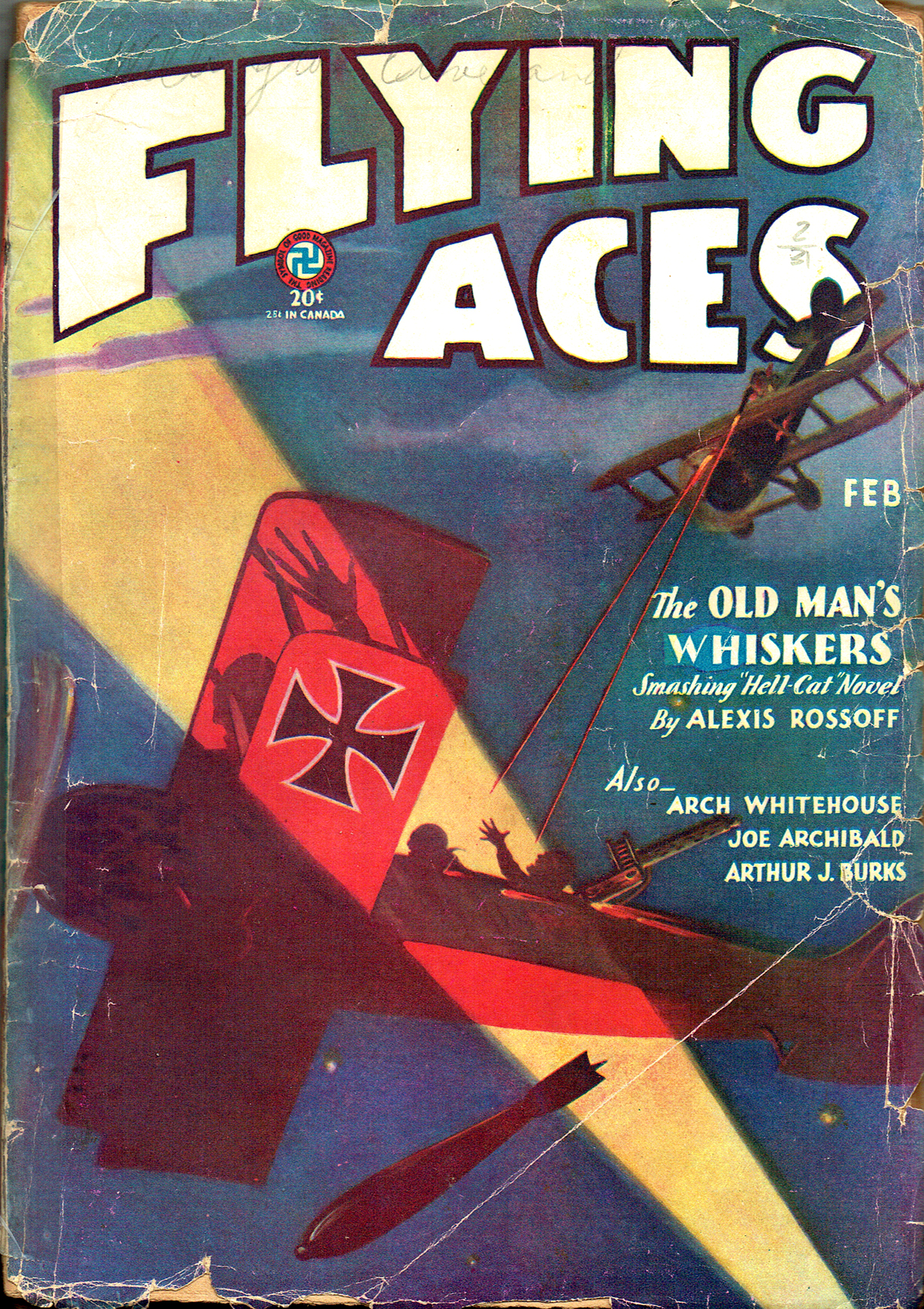
th_FA_3102THE tense drama of night bombing is clearly shown in the cover of this month’s issue. Many stories of these Boche bombing raids have been told. First the ominous whir of enemy wings sounded through the night. In the drome below, lights were hastily put out, and helmeted figures scurried to their ships to take to the air and ward off the dreaded danger. Streaks of Archie fire felt futilely through the black night sky for the range—and then the bombs fell, hurtling downward through the darkness on the tarmac beneath.

Sometimes, as in our cover, an Allied ship took off in time to get above the bomber, and a powerful searchlight caught the German ship in its merciless glare. Then, though the Archie shells burst harmlessly about, death tracers from the sputtering Vickers above caught the German gunner. That was one ship that did not flee to Germany unscathed, leaving death and destruction behind.

The Ships on The Cover
“The Night Bomber”
Flying Aces, February 1931 by C. Heurlin

“Sky Fighters, April 1936″ by Eugene M. Frandzen

Link - Posted by David on April 1, 2019 @ 6:00 am in

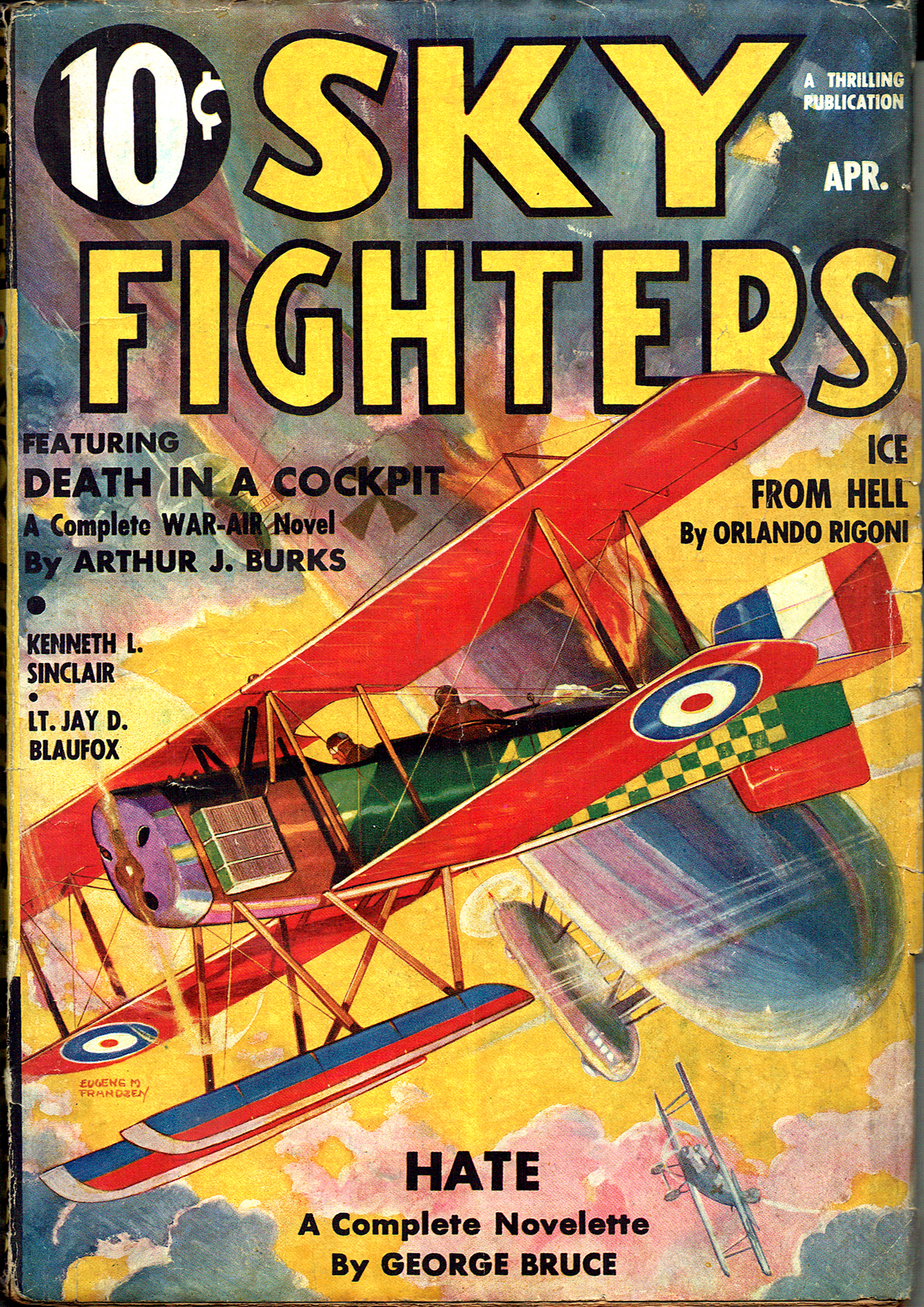
Eugene M. Frandzen painted the covers of Sky Fighters from its first issue in 1932 until he moved on from the pulps in 1939. At this point in the run, the covers were about the planes featured on the cover more than the story depicted. Mr. Frandzen features Fairey F127 Seaplane making an escape after an attack on a giant Zeppelin on the April 1936 cover!

The Ships on the Cover

GOTHA and Friedrichshafen th_SF_3604 bombers of World War time ventured forth on daylight raids over England. They swooped down on the great cities dropping every conceivable type of bomb. But the slow-moving Zeppelins chose night as their time for harassing the enemy. Flying at tremendous heights with muffled engines they were often directly over their predetermined target before the defenders were aware of their presence.

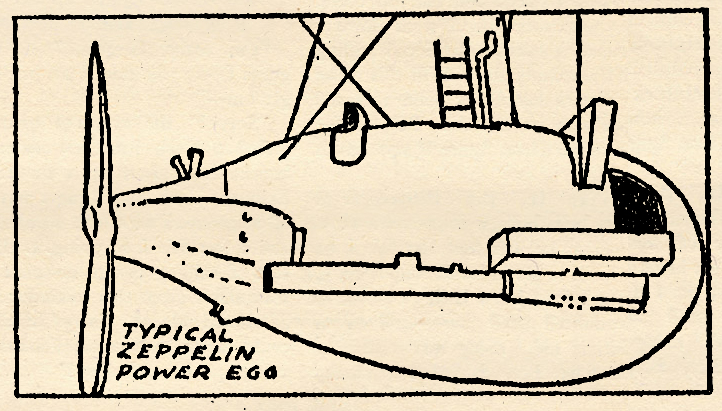
Count von Zeppelin didn’t let size or weight bother him. There was fifty tons to be lifted into the air when the ship was fully loaded. The crew of twenty-two men could scramble through the big bag on a narrow catwalk running along the keel from one gondola to the others.

Aside from the navigation of the Zep they had to man nine machine-guns and release their cargo of about sixty bombs. Two of the machine-guns were mounted on top of the Zep in a small fenced platform. Her metal lattice work girder formation held twenty-four ballonets filled with inflammable hydrogen gas, within the framework. The big bag was around 650 feet long and 72 feet in diameter at its widest point.

Above London

The Zeppelin pictured on the cover nosed its way through the clouds of night towards the English Channel. Below faint splotches of flame marked the muzzles of roaring Allied cannon. Higher and higher climbed the air monster; Maybach engines pushed her toward her goal at around 50 m.p.h. Altitude was about 15,000 feet as she neared the Channel.

“Higher” ordered her commanding officer as the clouds disappeared and clear starlit skies opened ahead. The three men directly behind him glanced at each other with apprehension. Already the thermometer had dropped below freezing. It was going down fast. The great bag’s nose continued to point upward. The thermometer slid lower. Below zero. Hands froze at the control wheels. They were above London.

Bomb after bomb screamed down on the sleeping city, flames broke out, airplane motors roared as they lifted defense planes into the sky. Not a sign of the Zeppelin could they find. Altitude had again done the trick, and with dawn breaking in the east they pictured the high flying raider far back toward its home base.

The siren’s “All’s well” signal echoed through the darkened streets of London. The air raid was over. Householders could once more return to their broken slumbers. Those who had not perished.

But the Zeppelin was wallowing uncontrollable over the North Sea with a crew of men and officers nearly frozen to death. Control wires coated with ice from the morning mists, water ballast frozen in tanks. Even the engine radiators, although raised into cars, were frozen, and the motors were very nearly useless. Gradually the giant bag was settling.

The North Sea Patrol

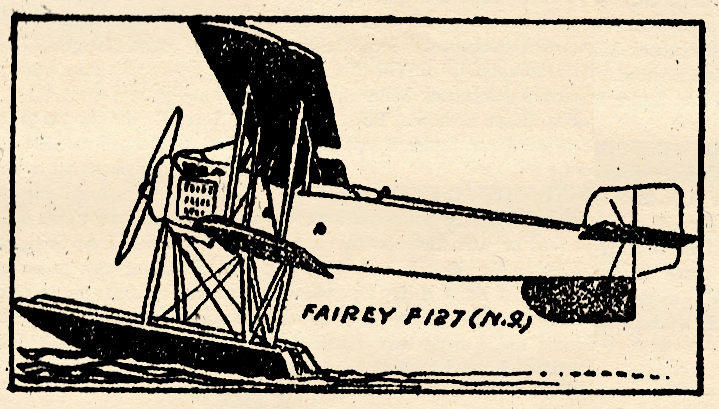
Patroling the North Sea were the R.N.A.S. seaplanes. One of these, a Fairey F127 N9 was the first seaplane to begin flight by being catapulted from a warship. It was a big plane with a 50 foot span. The top plane had a large overhang. The machine had a 190 h.p. Rolls-Royce engine but these power plants were in such great demand for other planes that the N9 could not be put into quantity production. The original N9 was in service until a few months before the Armistice.

A surprised observer in the British Fairey seaplane rubbed his eyes and pounded his pilot on the back. Up shot the pontooned patrol boat. A nearly stationary Zeppelin hovering directly over the Channel in broad daylight was unbelievable. They soon realized it was the real thing as a barrage of machine-gun fire greeted their approach. A sharp bank brought the seaplane’s tail around. Lewis slugs streamed into the gut-covered ballonets. The great bulk of the raider shuddered as the first explosion racked her ribs.

Fire wrapped the envelope in clutching tentacles, ate into the canvas-covered sides of the control car and slashed at the three men and their commanding officer still fighting their controls. The fire engulfed the Zeppelin crew, just as flames had engulfed scores of non-combatants in London homes a few hours before.

The Ships on The Cover
Sky Fighters, April 1936 by Eugene M. Frandzen
(The Ships on The Cover Page)

“The Hawker Fury” by Frederick Blakeslee

Link - Posted by David on March 18, 2019 @ 6:00 am in

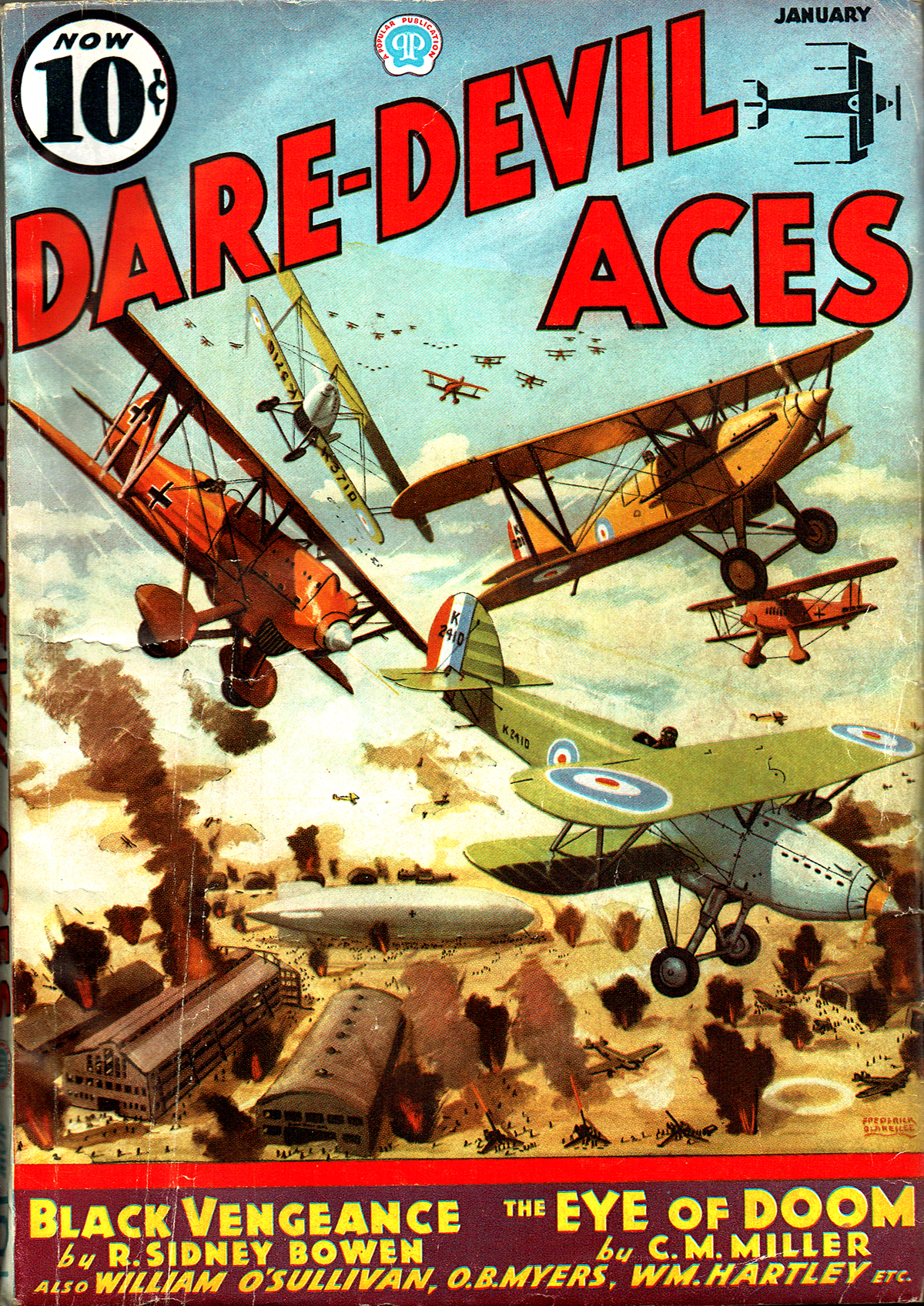
Frederick Blakeslee painted all the covers for the entire run of Dare-Devil Aces. And each of those covers had a story behind it. On Dare-Devil Aces’ January 1937 cover, Mr. Blakeslee gives us a couple of Avia ’34’s trying to drive a bunch of Hawker “Furys” away from their Zeppelin base!

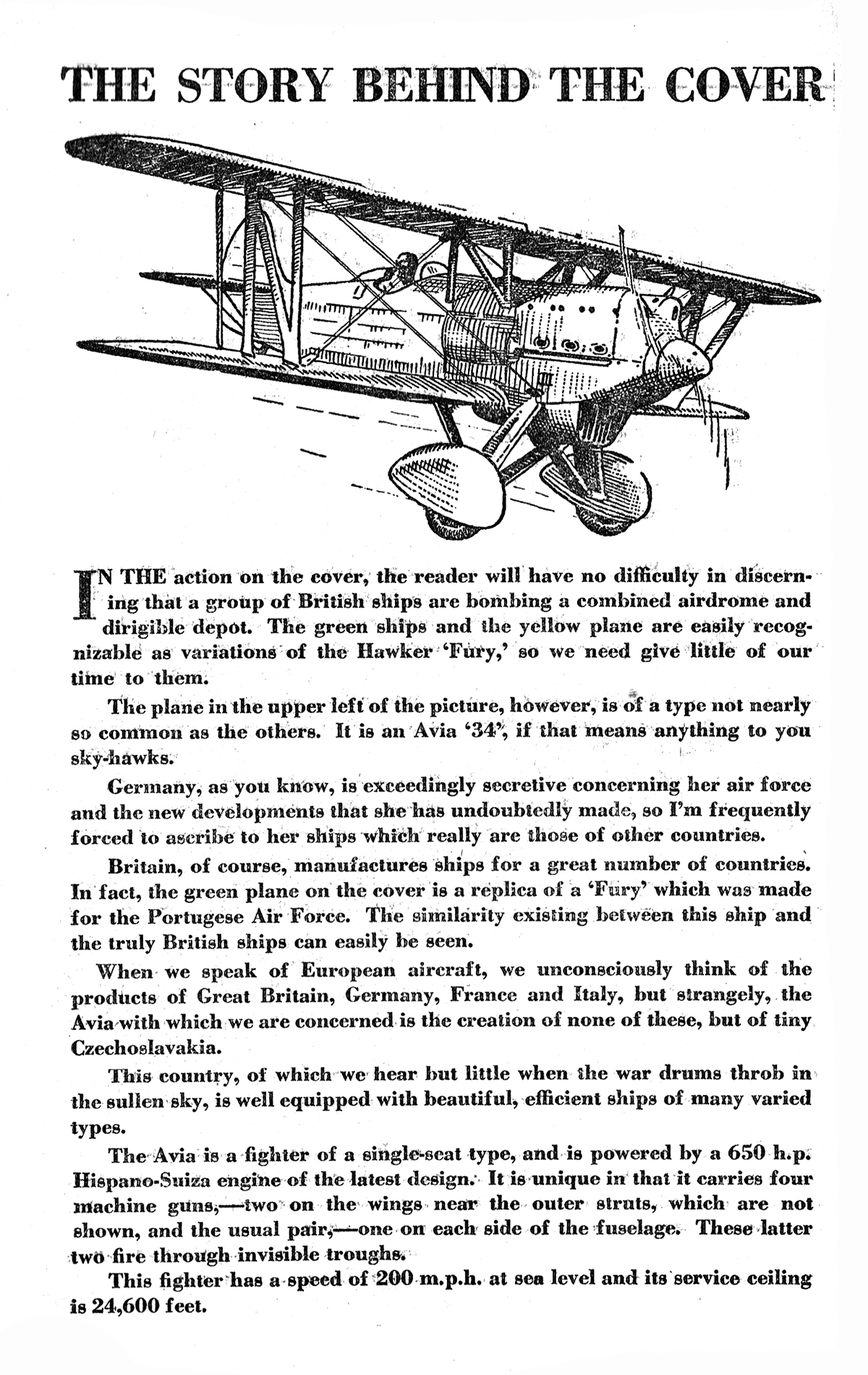
th_DDA_3701IN THE action on the cover, the reader will have no difficulty in discerning that a group of British ships are bombing a combined airdrome and dirigible depot. The green ships and the yellow plane are easily recognizable as variations of the Hawker ‘Fury,’ so we need give little of our time to them.

The plane in the upper left of the picture, however, is of a type not nearly so common as the others. It is an Avia ‘34’, if that means anything to you sky-hawks.

Germany, as you know, is exceedingly secretive concerning her air force and the new developments that she has undoubtedly made, so I’m frequently forced to ascribe to her ships which really are those of other countries.

Britain, of course, manufactures ships for a great number of countries. In fact, the green plane on the cover is a replica of a ‘Fury’ which was made for the Portuguese Air Force. The similarity existing between this ship and the truly British ships can easily be seen.

When we speak of European aircraft, we unconsciously think of the products of Great Britain, Germany, France and Italy, but strangely, the Avia with which we are concerned is the creation of none of these, but of tiny Czechoslovakia.

This country, of which we hear but little when the war drums throb in the sullen sky, is well equipped with beautiful, efficient ships of many varied types.

The Avia is a fighter of a single-seat type, and is powered by a 650 h.p. Hispano-Suiza engine of the latest design. It is unique in that it carries four machine guns,—two on the wings near the outer struts, which are not shown, and the usual pair,—one on each side of the fuselage. These latter two fire through invisible troughs.

This fighter has a speed of 200 m.p.h. at sea level and its service ceiling is 24,600 feet.

Fred Blakeslee

The Story Behind The Cover
“The Hawker Fury: The Story Behind The Cover” by Frederick Blakeslee
(January 1937, Dare-Devil Aces)

“The Heyford” by Frederick Blakeslee

Link - Posted by David on March 4, 2019 @ 6:00 am in

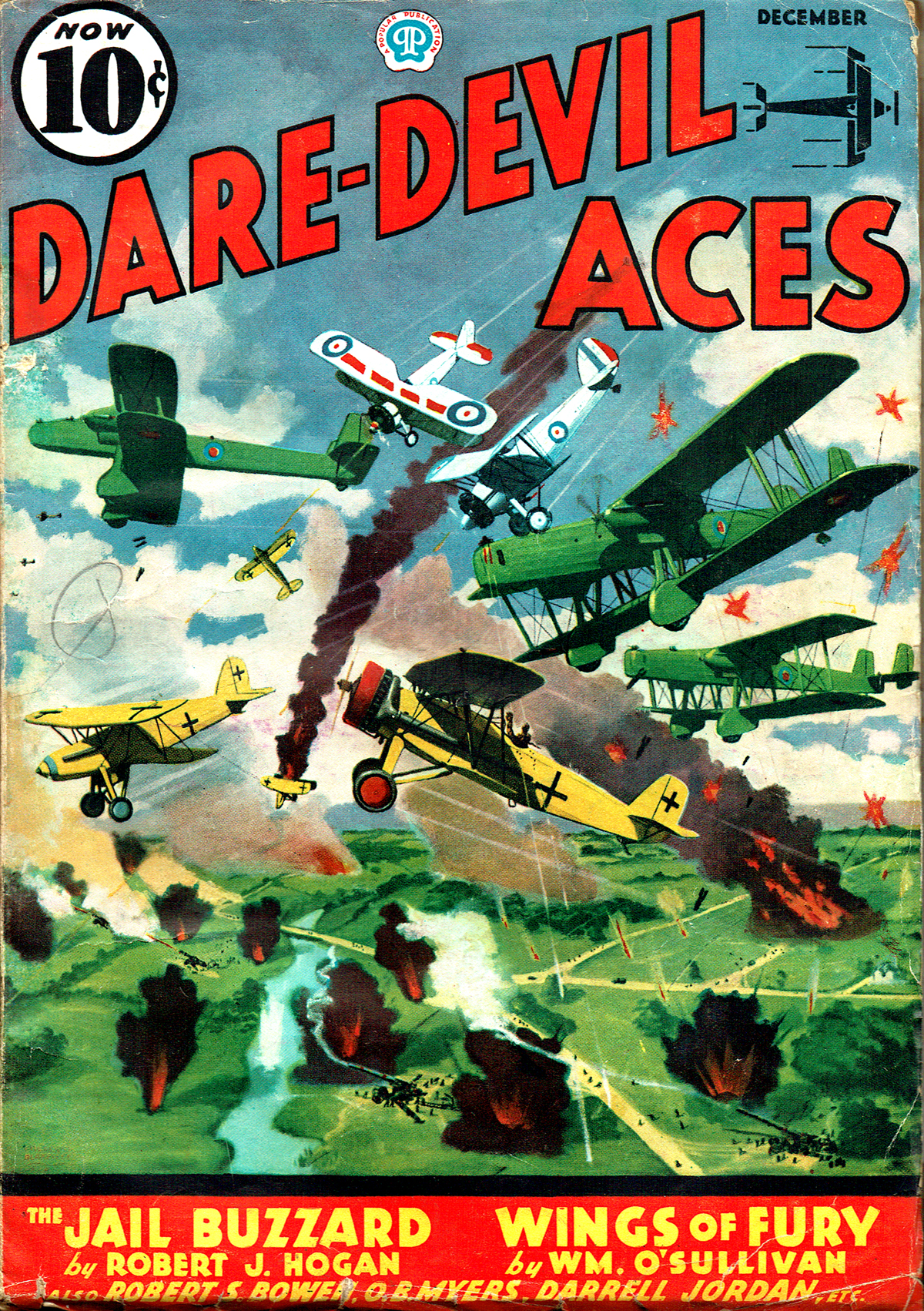
Frederick Blakeslee painted all the covers for the entire run of Dare-Devil Aces. And each of those covers had a story behind it. On Dare-Devil Aces’ December 1936 cover, Mr. Blakeslee gives the modern take on a couple of old classics—the Handly-Page Heyford and the french Morane-Saulnier!

th_DDA_3612THE world war produced many excellent fighting ships—ships that have become world famous. These world war types are now, of course, obsolete and except for those in museums and a few which are privately owned have practically disappeared. The R.F.C. display this year was unique in that several war-time ships were on the field. Flying over head were the direct descendants of some of those war-time ships. Most of the modern ships are known by other names while some carry the same name by which they were known in war days.

The difference between the modern ship and its war-time ancestor is enormous. For instance, take the war-time Handly-Page 0/400 and the modern Handly-Page “Heyford”. Quite a change!

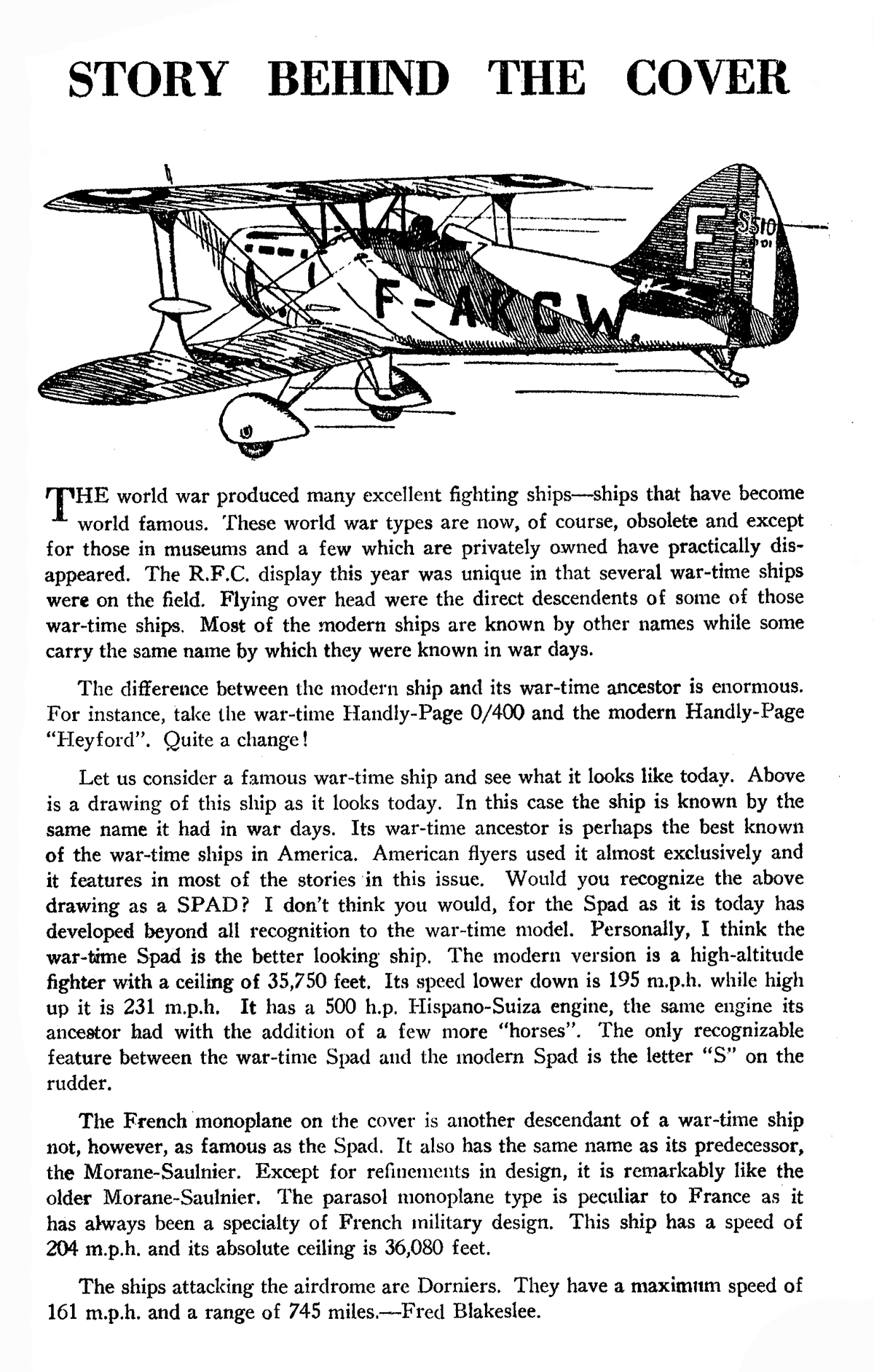
Let us consider a famous war-time ship and see what it looks like today. Above is a drawing of this ship as it looks today. In this case the ship is known by the same name it had in war days. Its war-time ancestor is perhaps the best known of the war-time ships in America. American flyers used it almost exclusively and it features in most of the stories in this issue. Would you recognize the above drawing as a SPAD? I don’t think you would, for the Spad as it is today has developed beyond all recognition to the war-time model. Personally, I think the war-time Spad is the better looking ship. The modern version is a high-altitude fighter with a ceiling of 35,750 feet. Its speed lower down is 195 m.p.h. while high up it is 231 m.p.h. It has a 500 h.p. Hispano-Suiza engine, the same engine its ancestor had with the addition of a few more “horses”. The only recognizable feature between the war-time Spad and the modern Spad is the letter “S” on the rudder.

The French monoplane on the cover is another descendant of a war-time ship not, however, as famous as the Spad, It also has the same name as its predecessor, the Morane-Saulnier. Except for refinements in design, it is remarkably like the older Morane-Saulnier. The parasol monoplane type is peculiar to France as it has always been a specialty of French military design. This ship has a speed of 204 m.p.h. and its absolute ceiling is 36,080 feet.

The ships attacking the airdrome are Dorniers. They have a maximum speed of 161 m.p.h. and a range of 745 miles.

Fred Blakeslee

The Story Behind The Cover
“The Heyford: The Story Behind The Cover” by Frederick Blakeslee
(December 1936, Dare-Devil Aces)

“The Lone Eagle, August 1934″ by Eugene M. Frandzen

Link - Posted by David on February 4, 2019 @ 6:00 am in

Eugene M. Frandzen painted the covers of The Lone Eagle from its first issue in September 1933 until the June 1937 issue when Rudolph Belarski took over with the August issue of that year. At the start of the run, Frandzen painted covers of general air action much like his Sky Fighters covers. Here, for the August 1934 cover, Frandzen has a couple of S.V.A. biplanes and an Austrian Lohner flying boat!

The Story of the Cover

ITALY, a country producing no th_LE_3408 steel or coal and an insufficient amount of foodstuffs, took a mighty walloping from Austria for over two of her three years in the Great War. But during that time, in the face of defeat after defeat, they put up a mighty sweet scrap against the Austrians.

Caught without sufficient airplanes, they tore into the job and produced some of the finest made by any country. During the war they were even supplying their allies with engines and planes.

The Adriatic does not appear to be much of a puddle when compared to other seas and oceans but it took all the ingenuity and vigilance of every available Italian flyer to patrol it.

Lurking Perils

German and Austrian submarines were lurking beneath its surface, laying in wait for cargo ships laden with iron ore and coal enroute to Italy’s foundries. Austrian airplanes roared down on seacoast cities; left a trail of ruins in their wake. Brandenburg and Lohner flying boats were continually a menace.

Gradually the speed and reliability of the Italian airplanes, seaplanes and flying boats increased. Outstanding among these were the S.V.A. types of planes. One of these, the S.V.A. biplane fitted either with pontoons or wheels, was a flying killer which the Austrians dreaded to meet.

On the cover two S.V.A. biplanes have caught an Austrian Lohner flying boat as it has finished dumping its load of bombs into a cargo ship laden with coal bound for the Italian coast.

A Devastating Bomb

One after another the bombs slipped from their racks and smashed through the steamer’s deck, down into the hold. The crew were mowed down with machine-gun fire from the Lohner’s front cockpit. Fire, the dreaded foe of all at sea, burst through the shattered deck. Dense masses of greasy opaque smoke billowed upwards. A bomb had ripped plates from the side of the ship below the water-line.

The gunner in the Lohner grins, points to the listing, stricken ship. His pilot laughs, shrugs his shoulders and looks at his gas indicator. It is low, just enough to reach home. Still smiling, he kicks his ship around to scram.

No Smile Now

The smile of victory is wiped from his lips. He yanks at his controls like a novice, nearly pitching his gunner into the briny. Bearing down on the Lohner are two S.V.A.’s tearing across the skies at a hundred and thirty-five mile clip, their 220 h.p. motors roaring. With hardly enough gas to see him home the Austrian pilot is forced to fight. To try to escape with his slower ship would be suicide.

A hail of bullets blast at the Austrian plane. Up flips the flying boat’s nose. The gunner in the bow, crouching over his gun, sends a stream of lead back at the S.V.A. The range is great but a lucky shot damages an aileron control.

The other S.V.A. coming up from below rakes the gunner and pilot of the Lohner with deadly effect. The bulky flying boat flutters, noses over and dives straight into the Adriatic, carrying a dead crew and a heavy 300 h.p. Austro-Daimler engine to use as a sinker.

The Story of The Cover
The Lone Eagle, August 1934 by Eugene M. Frandzen
(The Story of The Cover Page)

“Sky Fighters, May 1936″ by Eugene M. Frandzen

Link - Posted by David on January 21, 2019 @ 6:00 am in

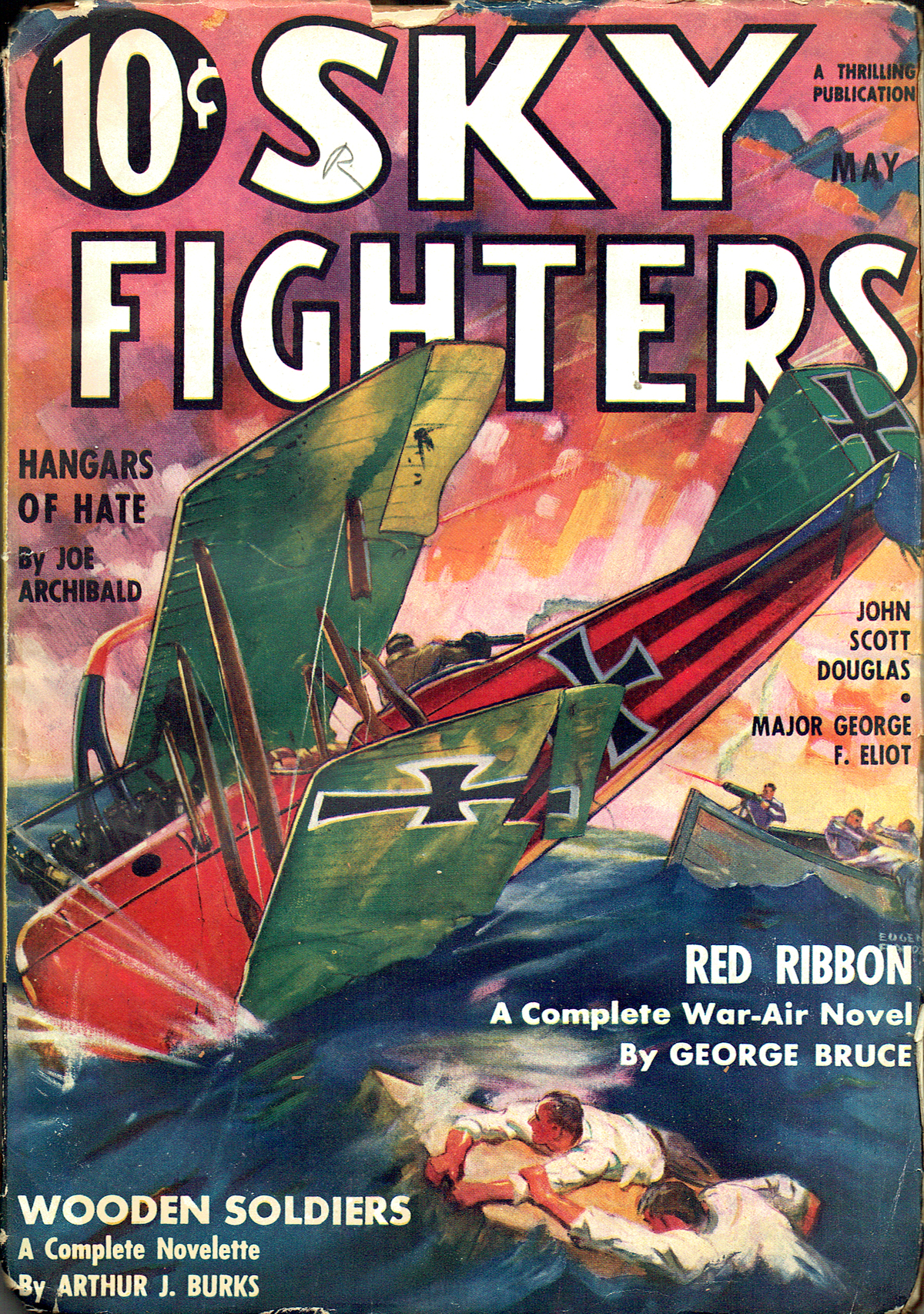
Eugene M. Frandzen painted the covers of Sky Fighters from its first issue in 1932 until he moved on from the pulps in 1939. At this point in the run, the covers were about the planes featured on the cover more than the story depicted. Mr. Frandzen features A.E.G. on the May 1936 cover!

The Ships on the Cover

BEFORE the World War airplanes th_SF_3605were more scoffed at than praised as a possible military weapon. Capitalists invariably put an extra knot in their purse strings when approached by optimistic promoters or inventors.

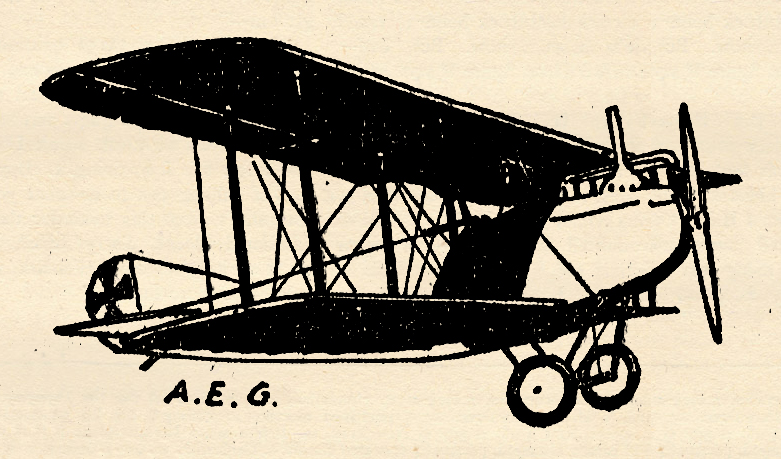
Firms that did any manufacturing to speak of were those who built airplanes as a side line, having large established plants already at their disposal. Such was the Allgemeine Elektricitats Gesellschaft, A.E.G. for short. This firm was one of Germany’s big electrical manufacturers. Their first entry into aircraft was naturally engines. They secured the option for building Wright motors and made some of their own design. Later when they branched into airplane design and manufacture they stuck rigidly to military planes principally of metal construction and some armour plating.

The ship on the cover smacking the water, is an A.E.G. of 1917 and ‘18 vintage. It has armour plating protecting the under-part of the fuselage and sides of the cockpits. But the A.E.G. firm was up against a tough proposition. Heavy armour plate protected the pilots perfectly but the engines were not fine enough to carry this added weight satisfactorily. Light armour had very little satisfactory results, but could be lifted okay. Therefore the pilots kidded themselves that they were pretty safe from enemy bullets with the light armour till a few rounds of Allied ammunition tore through and made more jagged wounds than a clean sharp bullet.

Used for Trench Strafing

A Benz 200 h.p. motor was up front and managed to yank the ship along at around 100 m.p.h. with favorable wind conditions. Primarily used for trench strafing it was fairly successful if protected by fast scouts, but for any other type of work it couldn’t take any first prizes.

The German lines ran from a chicken wire fence backed up against Switzerland all the way to the North Sea. Now any place along that line the A.E.G. could have got in some good licks. But when it stuck its nose straight out over the water and ambitiously went about a little job of work in conjunction with a German submarine it just didn’t make the grade.

An Allied Freighter in Sight

Through a series of prisms a clear image of an Allied freighter loomed before the periscope observer in the submerged submarine. He ran his periscope up another foot, got a better view and barked the information into the stifling air. The commanding officer leaped to the instrument. He grinned in anticipation, as he saw thr flag of the merchantman. “Verdammter Amerikaner.”

Terse orders snapped to the crew. Engines whirred into added power, down to within a foot of the water came the protruding periscope. The sleek underwater raider slipped through the water toward its victim. Ten torpedo tubes were available to sink the plodding ship carrying supplies to the American forces. Grins wreathed the faces of the crew as they learned the freighter’s nationality. The U-Boat steadied, slowed up, pointed its nose then it flattened out. A shudder raced through the ship as a torpedo was shot by compressed air out through its tube. Another shudder of greater volume caught the undersea craft. A detonation shook the boat. A wreath of smoke hovered over the freighter’s 3-inch gun. It had made a direct hit.

hen the torpedo smashed into the Yank vessel. It listed and began to sink. Up came the sub, its wireless calling for help. The message picked up on the German shore was given to the A.E.G. crew. Up soared the plane, the only one available. “Kill all survivors of the freighter,” were their orders.

Wildcat, Do Your Stuff!

One Yank in the bow of the freighter’s lifeboat was a crack shot with anything from a bean shooter to a siege gun. He unhurriedly unlimbered a machine-gun. “Wildcat,” he crooned to his pet gun of guns, “do your stuff.”

He waited till the German plane had hailed them with bullets. And then at just the right moment “Wildcat” started spitting.

One burst was enough. It tore jagged holes through the thin protecting armour. The German pilot sagged, the plane nosed down and smacked the water. Armour plate in addition to the heavy Benz pulled the crate down into Davy Jones’ checkroom in fifteen seconds.

The Yank patted “Wildcat” affectionately. He looked longingly back at the spot where his 3-inch gun had sunk with the freighter.

“Cheer up,” chided one of his companions, “we’ll take up a purse and buy you a Skoda howitzer for your next birthday.”

The Ships on The Cover
Sky Fighters, May 1936 by Eugene M. Frandzen
(The Ships on The Cover Page)

“Lufbery Becomes an Ace” by Paul Bissell

Link - Posted by David on January 7, 2019 @ 6:00 am in

THIS week we present “Niebling’s Phenomenal Feat”—The story behind Paul Bissell’s April 1933 cover for Flying Aces! Bissell is mainly known for doing the covers of Flying Aces from 1931 through 1934 when C.B. Mayshark took over duties. For the May 1932 cover Bissell presents the moment in the battle of Mauser raid where Raoul Lufbery became an ace!

Lufbery Becomes an Ace

th_FA_3205“PROCEED to their objective, the Mauser Munition Works at Oberndorf; there drop their bombs at points most destructive to the enemy positions; and then return to their home airdromes.”

So read the orders for October 12, 1916, at all Allied airdromes located back of the front line and south of Verdun. Orders of Brass Hats, “—and then return”! What a chance! With the objective one hundred and fifty kilometers inside the enemy lines and the sky filled with Boche. Well, anyway, it would be a great show, and at least one pilot smiled, thinking that tomorrow might bring death, but most surely would bring the opportunity of becoming an Ace.

This was Sous-Lieutenant Raoul Lufbery, of the Lafayette Escadrille, with four official victories to his credit, who, with three companions, Lieutenants Masson, de Laage and Prince, had been ordered to fly guard patrol for the bombing planes and protect them from attack.

Arriving at the appointed rendezvous, they saw a sight then strange to any eye. Perhaps the largest concentration of air forces the world had yet seen was spread below them. Farnums, Breguets, Caudrons, Sopwiths and Nieuports, almost every type of plane yet developed by the Allies for work at the Front, was in this huge flying armada, which would strike desperately at one of the main centers of German munition supplies.

Turning east, the whole group passed through a terrific archie bombardment, but it was not until they neared Oberndorf that the real show began. Here the Germans seemed to come from all directions. A general alarm had been spread, and every available German ship had been pressed into service.” Single-seated scouts, double-seaters, and even big three-placers, planes seldom seen on the Front at that time, were massed ahead of the advancing bombers.

The larger enemy ships would charge in, boldly maneuvering to bring their swivel guns into play, only to find the sky suddenly raining lead as Nieuports and Sopwiths dived headlong from the blue, their guns blazing in defense of their bombers. Then flashes of crimson and black, as Albatrosses and Fokkers and Pfalzes attacked fiercely, striving to gain that deadly blind spot underneath the tail of the slow-moving bomber, or twisting and squirming to evade the fire of some Nieuport, and, by some quick renversement, bring the tri-colored cocarde full in their sights.

IT WAS from such a mêlée that Lufbery, pulling out for an instant to clear a jam of his gun, saw a German go down in flames before the withering fire of Norman Prince.

“Yeow! Number one for the Lafayettes! Good old Nimmie! Now for number two!” And he pushed his stick over. But that dive was never to be finished. At that instant a sudden impact in his cockpit told him that a German was on his tail. Instinctively he yanked his stick back hard against his chest. Up he zoomed, his head twisted around to find his enemy.

There it was, a huge three-place Aviatik, with three guns, and all of them’ blazing at him. A flip of his ailerons—a kick of his rudder—then down hard on his stick, and in an instant he was away from the fire of the Boche. A sharp climbing bank would, he thought, bring him back under the tail of the larger ship, but here the German pilot, an old hand at the game, was too crafty to be caught. Banking up sharply on his right wing he exposed Lufbery again to the open fire of his three gunners.

This was entirely too hot a spot to stay in, and Lufbery turned the nose of his little Nieuport sharply away, out of the line of fire, climbing rapidly to gain altitude, from which he might dive down on the larger machine. As he turned, a flash of red went by, followed by a streak of silver—de Laage on the tail of a Boche!

Now, below him, Lufbery could see the three-seated Aviatik, the gunners all set for his attack. Over he nosed his ship and hurled down at the enemy, but at the same instant the big plane banked around and he overshot his mark. In a fury he twisted back in a sharp renversement, this time approaching the plane from the most dangerous position, open to the fire of the gunners.

But the Germans were square in his sights, and straight on he flew, feeling a thrill as the pulsing guns answered to the squeeze of his hand on the stick. He could feel the German bullets spattering his plane. Another instant, and he turned to avoid a crash, just as the huge Aviatik, the pilot dead, slipped crazily off on one wing. A telltale whisper of smoke, and then a burst of flame as it headed down to where falling chimneys and bursting roofs showed that the Allied bombers had
found their objective with fearful accuracy.

THAT was one hundred and fifty kilometers inside the German lines, and it meant one hundred and fifty kilometers of scrapping to win their way back through. The Germans took their toll. However, it had been a great show, and very successful from the Allied viewpoint. Much havoc had been wrought to the munitions center, and the Allies, too, had taken their toll in German ships. Three more victories were to the credit of the Lafayette Escadrille, for de Laage had brought down his German also.

A happy reunion awaited them, had not Fate here taken a hand. The four pilots, blown slightly off their course, and running short of gasoline, were forced to land at the French field of Corcieux, a field strange to all of them. It was almost dark as they eased their ships down, and Prince, unaware of some high tension wires strung across one end of the field, crashed into them as he glided in. With characteristic courage he refused to have his comrades move him until flares had been lighted to prevent some other pilot crashing as he had done.

Two days later he died in the hospital. The famous Mauser raid was history. Lufbery was an Ace, and Norman Prince an international hero.

The Ships on The Cover
“Lufbery Becomes an Ace”
Flying Aces, May 1932 by Paul J. Bissell

“Niebling’s Phenomenal Feat” by Paul Bissell

Link - Posted by David on December 24, 2018 @ 6:00 am in

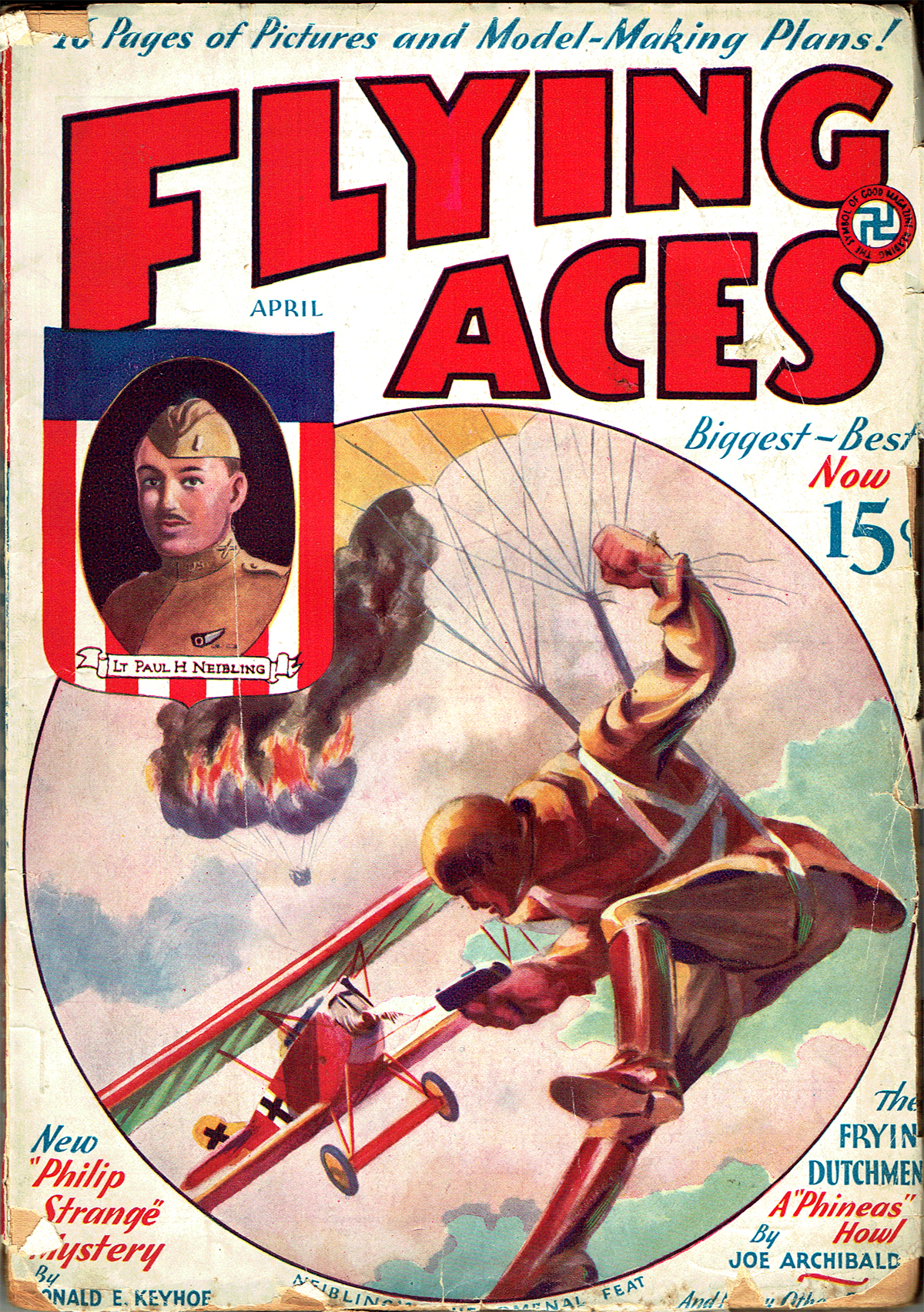
THIS week we present “Niebling’s Phenomenal Feat”—The story behind Paul Bissell’s April 1933 cover for Flying Aces! Bissell is mainly known for doing the covers of Flying Aces from 1931 through 1934 when C.B. Mayshark took over duties. For the April 1933 cover Bissell put us right in the action as Lt. Paul H. Niebling shoots his Colt .45 at an oncoming Fokker while parachuting to the ground!

Niebling’s Phenomenal Feat

th_FA_3304UNSWERVING and terrifying, like a messenger from hell, the red plane, its guns blazing, bore down on the hapless young American swinging dizzily in his parachute harness. He heard the whine of the German bullets as they whizzed by, cutting another of his shroud cords. He clutched desperately at one of the loose ends as the wind began to spill out of his chute, at the same time twisting in his leg straps to empty the rest of his magazine into the red machine as it roared by him in a wild zoom.

Five times the Colt .45 spoke sharply, and then the mechanism jammed . . . .

Less than two minutes before, this young American, Lieutenant Niebling, and his companion observer, Lieutenant Carroll, had been quietly watching the enemy positions from their basket, some two thousand feet above Maixc. Not a plane had bepn in sight. The clouds hung low. Then, without warning, nosing out of a cloud, its motor picking up with a full-throated roar, had come this red devil, spitting flaming bullets into the big silken bag above.

At Niebling’s command, Carroll had jumped. But Niebling, an old hand at the game, had decided to stick to the last minute. Three times before this, he had gone overboard as the balloon above him went up in flames. He was sick of just going over and putting up no fight. So this time he had swung out of the basket that he might be in the clear if he felt the whole balloon give suddenly, as it does when it finally explodes. He was determined to get in a few shots at the Boche before he let go.

So, as the red plane had banked up sharply and came back for another go at him, Niebling had freed his automatic. If only he could put a bullet in that damned red nose, that came on relentlessly, shooting flaming darts which bit into the silken folds above! Damn him! And Niebling’s automatic had pulsed as he squeezed the trigger. Like a trip-hammer he felt it kick in his hand. The plane, apparently untouched, had nosed up and put a last fierce burst into the big bag. “Great God, how futile!” had thought Niebling, and in anger almost threw the partly empty automatic at the German plane. A sudden return of caution, however, had warned him that he had hung on as long as he dared. He released his hold and dropped like a stone, turning over and over in his plunge down.

The first seconds of a jump, even to the most experienced old jumpers, are seconds in which life seems suspended. Whether or not it will go on depends on the chute. If it opens—good! If not—well, c’est la guerre. So with Niebling, for a few seconds life stopped.

He himself, when first at the Front, had seen a French lieutenant carefully tuck the parachute into its carrier, demonstrating just how it should be done, had seen the parachute attached to sand-bags placed in the balloon basket, had seen the balloon ascend three thousand feet. Then, from the ground, he had seen the bags pushed over the basket’s edge, drop and rip the chute from its container—had watched breathlessly and vainly for the chute to open, only to see those bags plunge three thousand feet down, to crash in a cloud of dust with the folded chute trailing hopelessly behind. Yes, sometimes it didn’t open.

But this time it did, and with a rush and a snap, life was on again for the young lieutenant, and he found himself floating gently earthward, still gripping his automatic. Above him, and to one side, his balloon, now a mass of flames, was falling slowly to pieces. The Fokker had swung off and was attacking the other balloons. Even as he watched, Niebling saw the second, third and fourth bag explode, and then the German banked up in a sharp turn and headed back toward him.

ONCE before when Niebling had been shot down, the enemy had returned to the attack and passed so close that the American had made some excellent snapshots of the German plane with a tiny vest-pocket kodak. This time, however, Niebling longed not for pictures, but for blood. So he had waited for the German to get closer. Already the fixed gun, shooting through the Fokker’s prop, flashed steadily. What a chance! Just a service .45 against a Spandau.

Yes, but if only he could get one bullet in the right place—one, just one! And Niebling’s teeth gritted as he squeezed the trigger and butt of his Colt. Five times the automatic spoke, square into the red body, so close now that Niebling could almost have touched it with a fishing pole.

That was the moment when the mechanism jammed. The plane, apparently untouched, turned and headed back toward Germany, while the American, cursing with rage, worked feverishly to clear his gun. Watching the fast-retreating Fokker, he saw something suddenly go wrong.

Slowly at first, then more rapidly, the plane headed downward. Quickly it was apparent that the headlong dive was uncontrolled, as if death’s hand were on the stick. The motor roared, pulling the ship into a tight spin from which it never came out. Twisting faster and faster, it finally crashed, burying its nose deep in a hillside.

Yes, Niebling got down. With the wind still spilling out of his chute, he landed fast but safely. Modest always, he says that he was never able to prove positively that his bullet brought down the German. But evidently America and France thought that he had done a good job, for First Lieutenant Paul H. Niebling, 1st Minnesota Field Artillery, A.E.F., attached to the 73rd Company, French Balloon Corps, today wears a D.S.C. and Croix de Guerre, with Palm for exceptional valor, and is, we believe, the only man of the war who, in a head-on duel in the air, with only a sendee automatic against a Spandau, came away the victor.

The Ships on The Cover
“Niebling’s Phenomenal Feat”
Flying Aces,April 1933 by Paul Bissell

“Sky Fighters, March 1936″ by Eugene M. Frandzen

Link - Posted by David on December 10, 2018 @ 6:00 am in

Eugene M. Frandzen painted the covers of Sky Fighters from its first issue in 1932 until he moved on from the pulps in 1939. At this point in the run, the covers were about the planes featured on the cover more than the story depicted. Mr. Frandzen features a battle between a De Haviland Pusher and a German D.F.W. C4 on the March 1936 cover!

The Ships on the Cover

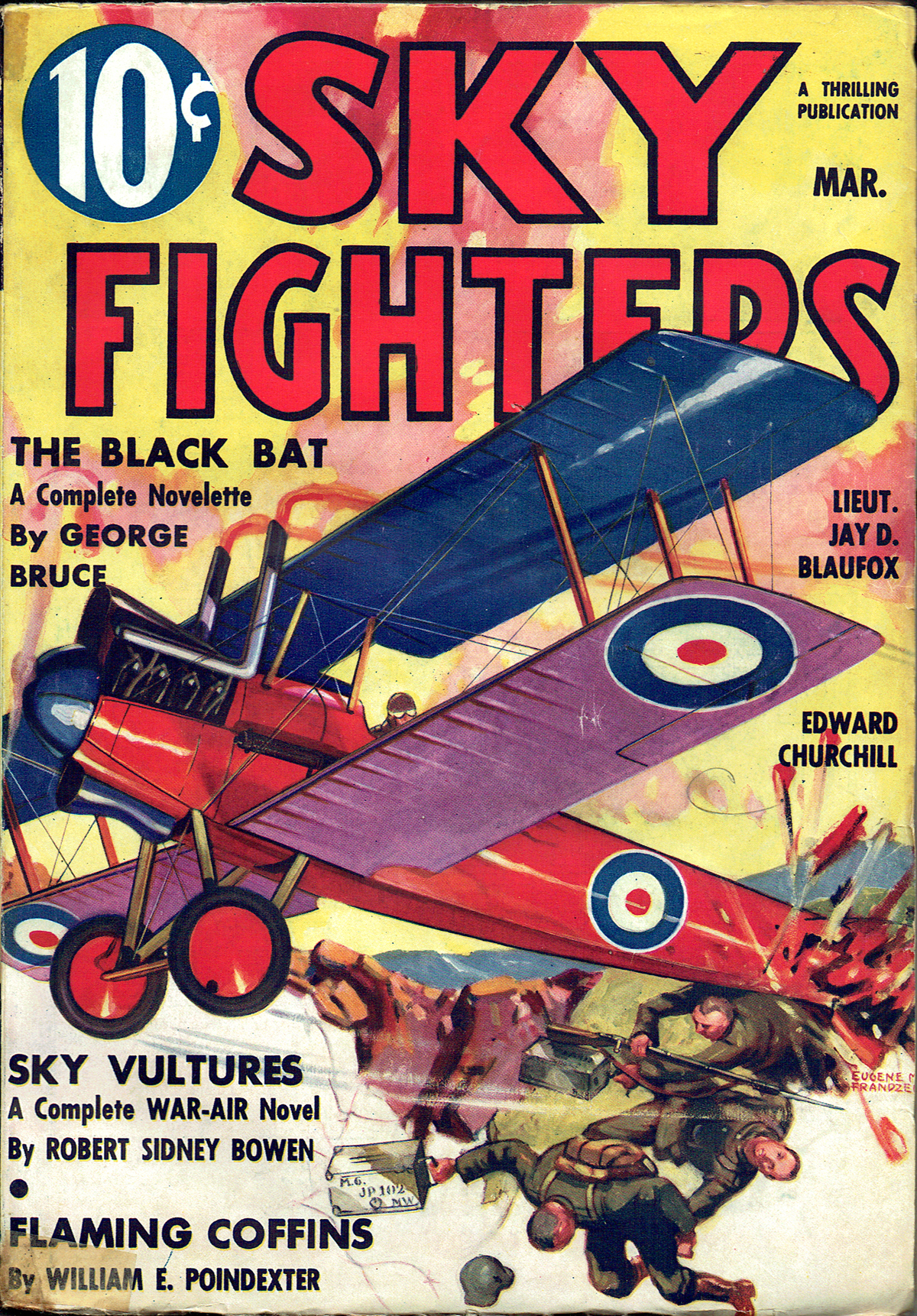
THE R.E.8 had the title th_SF_3603“Reconnaissance Experimental” but there was not so much experimental in her as good old fighting spirit. Since the line of R.E.s preceding the 8 had worked out most of the defects in actual combat flying rather than in the brain of designers, the old girl had been pretty well refined when she made her debut. The British Royal Aircraft Factory was responsible for some lesser lights in their production but the S.E.5 came out on their wartime stage to end the show in a round of applause from the aviators who flew them. But even when the S.E.s were starring at the front the R.E.8s were holding up their end of the show patrolling the sky lanes dropping bombs In the darkness of night to the end of the war.

Backstage at the training schools the R.E. put the young novices through the groundwork, in this case groundwork of the sky of fancy turns, pauses for leveling out between steep dives, pirouettes, all maneuvers to make sky hoofers for the chorus of war.

Never a Has Been

The R.E.8 did her work so well carrying on in any job that she could never have the slurring title of “Has been.” A ship that could look back on the glories of such a career need never slink away when the applause was for newcomers. It had the quiet reserve to serve gracefully, giving of its experience while treasuring in the heart of its big engine the memory of such days as the one when it flew back in 1918, the scene pictured on the cover.

An army is said to march on its belly. That’s a good old bromide and gets past first base, but marching never brought in a home run. The same can be said for a plane with only gas to feed it. It can go places but it can’t do things. The one thing needed above all others to ground or air forces is ammunition.

Silencing a pair of machine-guns in a bombproof hillside dugout commanding a pass was the problem confronting “Crackup” Jones of Texas and points West. Now “Crackup” came by his name because he had smashed more planes in landing and taking off than any other three living flyers in the A.E.F. He’d cracked his way through two schools and left a trail of splinters that ran up the national debt considerably. But that didn’t bother Mr. Jones for he and every one else who had seen him fly knew that once he got into the air no other two-legged mortal could swap lead with him and live to tell the story.

Wotta Man!

One guy swore he’d seen Jones crack a Nieuport full speed into a hangar roof. Thrown clear he sailed through the air a hundred feet and landed gracefully on the top of a grounded captive balloon. When they finally got him down he’d written a thousand-word account of the experience with diagrams for the “Stars and Stripes.” Wotta man!

“Crackup” is in the pilot’s pit of the old R.E.8 he borrowed from the British. He’d dropped all his bombs on the bombproof dugout at the head of a narrow pass just in front of his own lines. He’d sprayed every round from his machine-guns. His gas was nearly exhausted when he spied three Boche lugging up ammunition to the machine-gun nest. If those men got their cargo to the guns safely it meant the Yanks couldn’t push through.

“Crackup” Thinks—and Acts

“Crackup” thought fast. A narrow river was below the cliff. If he could smash his plane into those Germans and his luck held out he’d be catapulted into the water safe on the Allied side. Having thought, “Crackup” acted. Down he swooped, gave the last drop of gas to his coughing engine and smacked his enemies and their dangerous ammunition over the edge of the cliff with his empennage.

His tailless plane leaped through the air like a ski jumper, cleared the river and smashed head on into a jagged mass of rocks. “Crackup’s” luck had deserted him at last. When they pulled him out of the wreckage it was found that the wind had been knocked completely out of him and he had suffered a severe fracture of the left little finger.

The Ships on The Cover
Sky Fighters, March 1936 by Eugene M. Frandzen
(The Ships on The Cover Page)

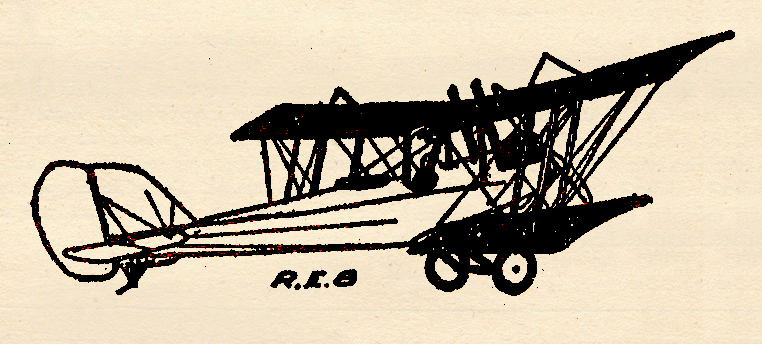
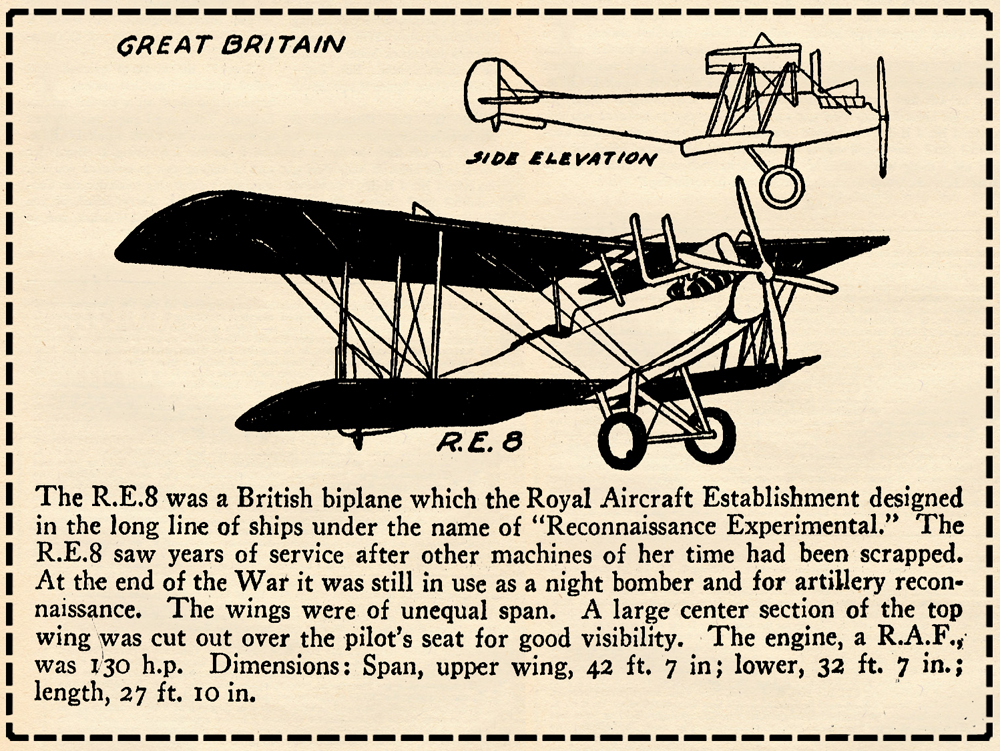
Full specifications of the R.E.8 were featured in the LIBRARY OF WAR PLANES in this issue.

“Downing the L-22″ by Paul Bissell

Link - Posted by David on September 17, 2018 @ 6:00 am in

THIS week we present “Downing the L-22″—The story behind the cover of Paul Bissell’s June 1933 cover for Flying Aces! Bissell is mainly known for doing the covers of Flying Aces from 1931 through 1934 when C.B. Mayshark took over duties. For the June 1933 cover Bissell put us right in the action As Galpin and Leckie’s Phoenix Cork flying boat is caught in the searchlights of the mighty L-22 Zeppelin!

Downing the L-22

th_FA_3306 FROM the very outbreak of the World War it was apparent to the British that with an aggressive foe only a comparatively few miles across the water from them, England would be subjected to constant and continued air raids. With this in mind the Air Ministry attempted to build up an adequate defense, but with aviation in its infancy, and no past experience to help them, this task proved much more difficult than was at first apparent. The inadequacy of the defense first built up was quickly evident when the Germans began seriously to raid England in the early summer of 1915.

Almost every dark night one or more of the huge Zeppelins would slip through the blackness, drop its bombs, and disappear again—untouched. To be sure, the alarm would have been given, and plane after plane would be up searching for the enemy, while the night would be pierced by hundreds of bright beams trying vainly to find the giant ships. Often the huge shapes of the Zeps, silhouetted against the lighted sky above, would be clearly visible to those on the ground, but quite invisible to those high in the air, groping vainly for them.

And even if spotted, the Zep was by no means an easy prey. It had a flying speed almost equal to most of the planes of that time, while its ceiling was higher than could be obtained by the majority of them. And, even if caught at lower altitudes, merely by dropping its water ballast it could rise with a rapidity that made pursuit almost hopeless.

It was well-armed, too. Machine guns were mounted in each gondola, and in the main cabin, while on top; of the envelope at either end was a gun platform.

To be sure, not every raid was carried out successfully, or without serious losses. The difficulties offered to the defenders of the British coast only served to increase the determination of the British pilots, and more than one story of dare-devil bravery and achievement crowned with victory was written in flames against the night skies above England, as some huge Zeppelin hurtled down through space to destruction, the victim of one of Britain’s air heroes—Robinson, Warneford, Tempest, Brandon, Cadbury — just to mention a few of them.

There was probably not a pilot who, no matter what his individual mission might be, did not hope that some time, slipping out of a blinding fog bank, he might find himself face to face with a Zeppelin. They perhaps said little about it, and daily carried out whatever job was assigned to them. But they quietly longed and waited for that day when fate would be kind and give them their big chance.

AND so it was with the crew of the Phoenix Cork flying boat, H12-8666, of the Great Yarmouth station. They had gone out to drop a few eggs on the enemy hangars over in Belgium, but on the way high adventure overtook them.

With Flight Lieutenant Galpin as navigator, and Sub-Lieutenant Leckie as pilot, they left Great Yarmouth station at three o’clock on the morning of May 14, 1917. Four one-hundred-pound bombs were strapped beneath their wings, and they carried three Lewis machine guns—a double one mounted in the forward cockpit, and one aft in the side door.

They had proceeded about eighty miles toward their objective and gained about six thousand feet of altitude when they plunged suddenly into a dense fog bank. Until now the. trip had been uneventful, just a careful watch out as they sped along, searching the scarcely visible horizon for the first suggestion of daylight. Now, however, there was no horizon, no top, no bottom—above, below, to either side—just a dark mass of nothingness through which they winged their way, guiding themselves only by their instruments.

Lieutenant Leckie kept the plane climbing gradually until he had finally reached an elevation of ten thousand feet, and figured that he must be nearing the Belgian coast. He cursed the thick fog that made him as helpless as a blind man. The blackness around had faded to a dirty gray, heralding the approach of day. Then suddenly, like slipping from a dark room, they shot out into the clear air. Off in the east, dawn pushed its long fingers up into the heavens. Below were the waters of the channel, still black as seen between other fog banks and huge cloud formations which extended interminably, billow on billow, off into the distance.

But straight ahead, and some six thousand feet below them, was a shape that sent the hearts of the Britishers into their throats. Scarcely visible in the early light, but with each second making their hope more and more certain, was the silvery shape of a German Zeppelin.

Instantly all thought of their objective was forgotten. Their big chance was here. Without need of a command, the pilot altered his course, and headed directly for the big ship. Galpin manned the forward twin gun, while Whatling, the wireless operator, manned the aft gun. With throttle wide open and nosing over slightly to gain speed, the flying boat tore ahead. Had the Zep seen them? Would she turn and run for it? Or would she ascend rapidly and wireless for help? Quickly they crept up. Only a mile separated them—then only half a mile.

On the side of the Zep the numerals L-22 and the Black Cross now stood out boldly. Then the Zep seemed suddenly to come to life. She changed her direction, at the same time dropping volumes of water as she discharged her ballast, and her nose shot violently upward. But Leckie had anticipated just this maneuver, and though he had sacrificed some of his altitude, he was still some five hundred feet above the Zep. Without hesitation Galpin dropped three of his four bombs. Every pound counted. Now they must have every bit of speed that was possible.

Already the Germans from the top platform were raking them with machine-gun fire. Then Leckie turned her over in one last headlong dive, pulling her up just under the rear fin and not forty yards from the back gondola. Immediately they were met by a terrific fire from the two gondolas. Bullets whizzed by, tearing pieces of fabric from their wings.

But now Galpin’s guns were also in action. Burst after burst of incendiary bullets he saw bury themselves in the rear end of the big envelope. Leckie piloted the machine skilfully, swinging from one side to another under the big dirigible, offering as difficult a target as possible and at the same time tipping up on one wing so as to give Whatling a chance to bring the rear gun into action.

The Zep was climbing rapidly, and Leckie strove desperately to hold his position in spite of the backwash from the German’s five propellers. Another burst of fire from Galpin, and then his guns jammed. Now they were in a perilous position. Scarcely twenty yards separated them from the German gondolas from which a withering machine-gun fire was pouring.

Leckie turned away to starboard to give Galpin time to fix his guns, intending to sweep around and come up under her again when the jam was cleared. But this was not necessary. Already a faint red glow was discernible in the rear of the huge silver envelope, where Galpin’s bullets had buried themselves—a glow which quickly increased as tongues of flame leapt out and swept upward.

For a few seconds the great ship hung quivering, then, like a meteor, rushed flaming down to the sea. Her engines, burned out of their fittings, dropped ahead of her, sending up great columns of water as they crashed. Then, with a hissing scream, the great burning mass plunged out of sight into the dark waters below. All that remained of the L-22 and its crew of twenty-five men was a patch of oil and black ash upon the restless surface of the channel.

The Ships on The Cover
“Downing the L-22″
Flying Aces, June 1933 by Paul Bissell

“Collishaw’s Black Hawks” by Paul Bissell

Link - Posted by David on September 3, 2018 @ 6:00 am in

THIS week we present “Collishaw’s Black Hawks”—The story behind the cover of Paul Bissell’s March 1933 cover for Flying Aces! Bissell is mainly known for doing the covers of Flying Aces from 1931 through 1934 when C.B. Mayshark took over duties. For the March 1933 cover Bissell put us right in the action on that June day in 1917 as Canadian Ace Raymond Collishaw and his Black Flight tangle in a deadly dogfight with Richthofen’s Flying Circus—now lead by his deputy, German Ace Karl Allmenroeder who already had 30 victories to his name!

Collishaw’s Black Hawks

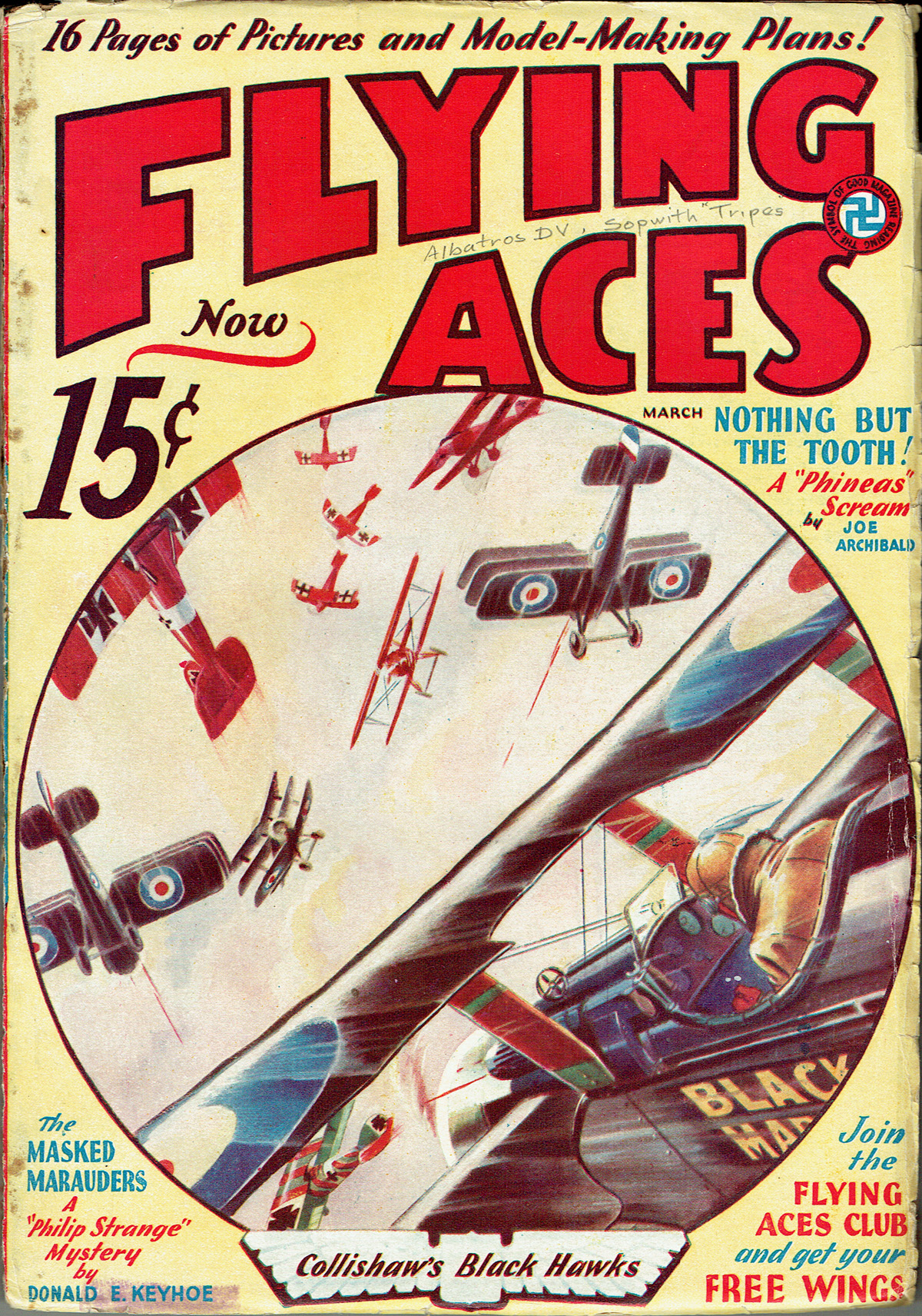
th_FA_3303 DOWN from the blue sky like four black hawks they dropped, diving recklessly into the rant midst of the famous red squadron of Richthofen himself. Sopwith tripes they were, all black, and one red ship went down before the fury of their first attack. Then, an instant later, all eleven planes were in a mad dogfight.

To the watching Tommies below this was now almost a daily occurrence for, though this British flight had for the first time appeared over the Ypres sector less than ten days before, it was already famous. Those ten days had been crowded with battles. With the other flights in Squadron 10, this one had been ordered to clear the sky of German planes so that the British troops might be concentrated for the final drive on Messines Ridge. In seven days twenty-four German planes had been accounted for.

The Black Flight had done its full share, and in weeks to come was to hang up a record unchallenged by any other flight in the squadrons of any air force. In two months this all-Canadian flight brought down 87 enemy aircraft, and lost but one of its own members.

The leader, Lieutenant Collishaw, was a naval flyer who had found time to become an ace outside of his routine duty of protecting warships. When help was needed over Ypres, he was selected by the high command and formed his own squadron, choosing four other Canadians as pilots, and Sopwith tripes as their ships. These they painted all black. Collishaw flew “Black Maria”—Reid, sub flight commander, flew “Black Roger”—Shaman, “Black Death”—Nash, “Black Sheep”—and Alexander, “Black Prince.”

These five ships were soon known to the Tommies of this whole sector, and it was with a feeling of consternation that the watching lads in the trenches saw that on this day only four flew to the attack. One must have gone West. Perhaps that was why the attack seemed fiercer than usual, and a cheer rose from the trenches as another German, caught at the top of a loop by the deadly fire of Reid, slipped off on a wing and crashed in flames.

But from the main dogfight two planes had pulled off to one side, and were fighting each other with that relentlessness that would end only in death for one or both. One was an Albatross scout, red with green stripes and black crosses—the other, a Sop tripe, all black with British circles.

In the former was a German ace, Allmenroeder, striving to add o»e more name to his already long list of victims—a list which had only the day before been increased by the name of the missing member of the Black Flight. In the other was Collishaw, whose face, usually ready with a bright winning smile, was today grim, his jaw set. Today he was an ace who sought not just a victory, but a victory which might help to erase the memory of yesterday, when he had seen this same green-striped Albatross send Nash in “Black Sheep” crashing to earth.

Furiously, yet with caution, they fought for an advantage, a caution not apparent to the watching Tommies because of the dexterity, sureness and ease with which these two masters of air fighting executed breath-taking maneuvers. Banking, looping, and sideslipping, they doubled and twisted high up in the sky. One instant the red plane seemed to be chasing the black one, and the next the black would seem to have the advantage. Burst after burst came from their guns as for a brief instant a near chance offered itself, but not until they were over Lille did the break come.

HERE the powerfully engined Albatross, coming out of a steep climbing vrille, found itself in that one deadly position above and over the black tripe’s tail. With motor on, Allmenroeder dived for the kill. His guns spat, and for an instant death was less than half a hand’s breadth from the young Canadian.

But Collishaw had one more trick in his bag. A push of his stick sent his little tripe square up on her wing tips where, with nose down and slipping violently off to the side, he offered small target for the German’s fire.

For a brief eternity they hung thus. Bullets spattered around Collishaw, and then the terrific power-dive of the German took his Albatross beyond and below the British plane. In a split second the little tripe had righted itself, and now it was the black plane that rode like death behind and above the red Albatross. Tracers shot out from the twin Vickers. They were to the left. Another burst was nearer in, and then came the steady rat-a-tat as the two guns pulsed to the grip of the young Canuck.

A strut splintered as a bullet cut through. Then the windshield shattered. The red ship staggered; its tail shot straight up, then kicked around violently, and the “green-striper” started on its last spin.

And so Nash was avenged, though months later it was learned that he had not been killed, but was a prisoner in Germany.

The Black Flight went on to pile up its astounding score, while Collishaw was made a squadron commander, gaining sixty official victories before he was recalled to London to help in the formation of the Royal Canadian Air Force, and made a Lieutenant-Colonel.

Collishaw still lives. After the World War he fought with the “White” troops of the old Czarist cause against the Bolshevists—then in Poland, Persia, Mesopotamia, and against the Arabs in Palestine. He has risen to Flight Commander. Besides his D.S.O. and bar, D.S.C., and D.F.C., he has been awarded the order of “Commander of the British Empire.”

He was a sailor, and as he himself once said, after coming out unhurt from a crash in No-Man’s Land, “Sailors die at sea.” May he stay always on land—or in the air!

The Ships on The Cover
“Collishaw’s Black Hawks”
Flying Aces, March 1933 by Paul Bissell

“The Lone Eagle, June 1934″ by Eugene M. Frandzen

Link - Posted by David on August 20, 2018 @ 6:00 am in

Eugene M. Frandzen painted the covers of The Lone Eagle from its first issue in September 1933 until the June 1937 issue when Rudolph Belarski took over with the August issue of that year. At the start of the run, Frandzen painted covers of general air action much like his Sky Fighters covers. Here, for the June 1934 cover, Frandzen has a couple Sopwith Camelss in a scrap with a D.F.W. Aviatik type C.V.!

The Story of the Cover

THE scrap depicted on the cover this th_LE_3406 month is between two Sopwith Camels and a D.F.W. Aviatik, type C.V. The initials “D.F.W.” stand for quite a mouthful; Deutsche Fregzeug Werke. This company, formed before the war, carried on with contracts from the government through the World War. This model of the D.F.W. is often confused with the L.V.G. It is an easy mistake to make, for they both have many of the same characteristics of construction. It carried a 228 h.p. Benz motor in its nose. It needed all this power for its forty-three foot wing span.

The Sopwith Camel was manufactured by the Sopwith Aviation Co., Ltd., founded in 1911 by Mr. T.O.M. Sopwith, a well-known aviator. Even before the war the Sopwith planes were famous, one of them, a seaplane, similar to the later Sopwith “Baby” seaplane which did such fine work for the R.N.A.S., having the distinction of winning the Schneider cup races.

It Delivered the Goods

The Camel was designed for extreme maneuverability and high performance. It made its appearance at the end of 1916, and during 1917 it was the outstanding single-seater of the British. Its high rate of climb made it particularly good for defense against Zeppelin raids. In the hands of a competent pilot it could out-maneuver any ship of its class on the front, but put a pilot used to a sluggish-controlled ship at the stick of a Camel and he was lost. The Camel was tricky to fly, but once used to the controls veritable wonders could be performed by a pilot who knew all the tricks of sailing the sky lanes.

This ship delivered the goods from the time it made its appearance right up to the end of the war, and that is something that cannot be said for many ships that were used during the Big scrap.

A Technique of Their Own

Two Anzacs who had done considerable cattle-herding in their beloved Australia had changed their mounts from shaggy ponies to “Camels.” But in the cockpits of their Camels their old habit of cutting out one animal from a herd was not forgotten. They developed a technique of their own of cutting an enemy plane from a flight and harassing it with cross-fire. Anticipating every move of the enemy plane they would gradually work it toward the Allied lines, then over the lines and finally force the unhappy German pilot, whom they had flattered with their undivided attention, to land on their own airdrome.

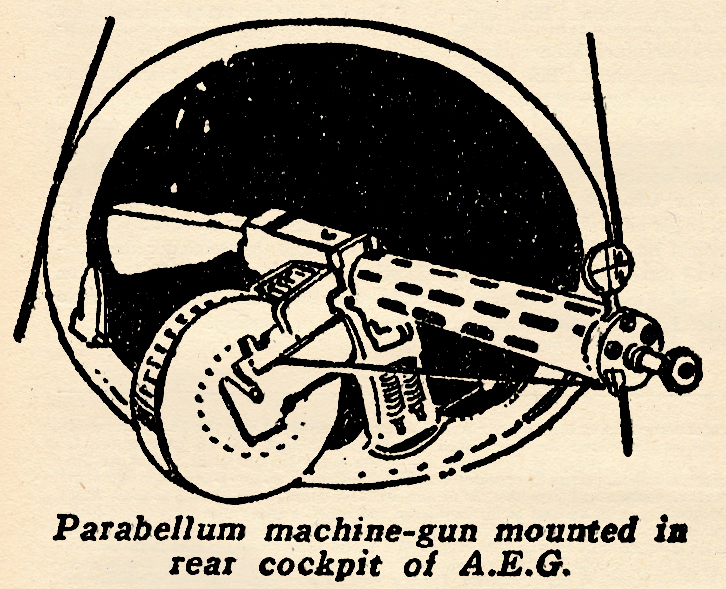
Now look at the picture on the cover again and you’ll get the drift of the situation. That D.F.W. Aviatik has been picked by our friends in the Camels as a hostage and they are herding him off the range into the corral. And it won’t be long now till all three planes will be making a landing. The back gunner of the D.F.W. is shy his Parabellum gun. He unhooked it from its swivel mount and pitched it overboard at the request of the Camel pilots delivered in sign language and punctuated with a drizzle of Vickers slugs that literally wrote their initials in the side of the Boche ship.

Following the Leader

As the home drome looms ahead the closest Camel pilot sends a short burst across the tail of the German ship. He points down, identifying the drome on which the unhappy Germans must land or be blasted out of the sky. As he flips his Camel under the bulky two-seater the German gunner raises bis hands high above his head, signifying his willingness to play follow the leader.

All three ships nose downward. The Anzacs have brought home the bacon again; just another stray cut out of the sky pastures and jriven private grazing ground for the duration of the emergency.

The Story of The Cover
The Lone Eagle, June 1934 by Eugene M. Frandzen
(The Story of The Cover Page)

« Previous PageNext Page »