Amidst all the great pulp thrills and features in Sky Fighters, they ran a true story feature collected by Ace Williams wherein famous War Aces would tell actual true accounts of thrilling moments in their fighting lives! This week we have the legend that is Baron Manfred von Richthofen!
Captain Manfred von Richthofen 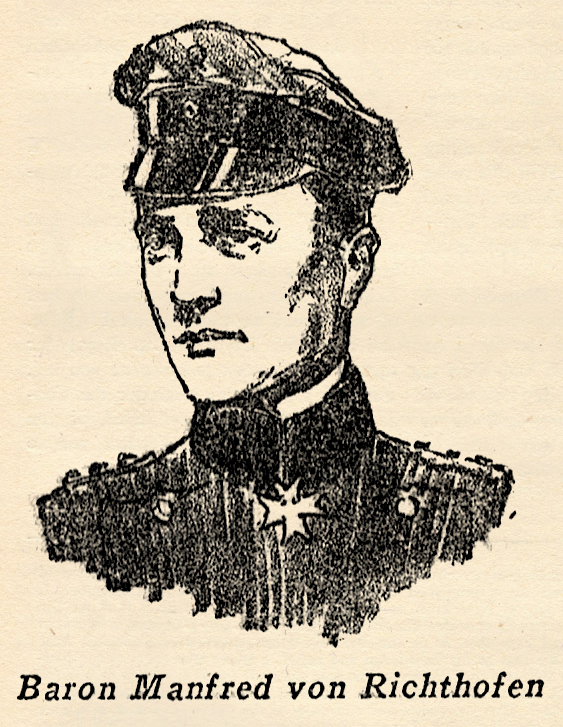 was the greatest of all the German flyers. He had more victories to his credit than any other battle flyer. He began in the Imperial Flying Corps, on the Russian Front. Soon afterwards he was transferred to the German North Seas station at Ostend, where he served as a bomber. Backseat flying never appealed to him, so he took training, soon won his wings, and was sent to join the jagdstaffel commanded by Oswald Boelke. After his sixteenth victory, he was promoted to Lieutenant and assigned to command a squadron. This became the Flying Circus, the most famous of all the German squadrons, the scourge of the western skies.
The account below, in which he describes his flight with Major Hawker, the famous British Ace, on November 3, 1916, is from Richthofen’s personal memoirs. For this victory he was awarded the order of Pour le Merite. Only Immelmann and Boelke before him had gained this honor, and no air fighter following him over received it. In his scarlet red battle plane he coursed the Western Front from end to end, strewing death and destruction in his wake—until that fatal day when bullets from a British flyer’s gun brought him to his end, as he had brought upwards of a hundred others.
DOWNING A BRITISH ACE
by Baron Manfred von Richthofen • Sky Fighters, February 1934
I WAS flying along with my patrol of three wing-mates when I noticed three Englishmen. They looked me over keenly in the manner of stalkers looking for cold meat. I was far below the rest of my patrol flying above, so I sensed that they had only spied me and not the others. I let them think I was flying alone and boldly flaunted my wings in challenge.
They had the ceiling, so I had to wait until one of them dropped on me before shifting for attack myself. Down one came presently, streaking in a line for my tail. At a close range, he opened up. But I banked swiftly and escaped the burst, intending to nose back and get in one of my own as he swooped past. But he banked, too, sticking on my tail. Round and round we circled like madmen, each trying to catch up with the other at an altitude of 10,000 feet.
First we circled about twenty times to the left. Then reversed and circled thirty times to the right, each trying to tighten the circle sufficiently to line in a burst—but without success. I knew then this fellow I had so boldly tackled wasn’t any beginner. He had no intentions of breaking or running. And his machine was a marvelous stunter (D.H.2 with 100 h.p. mono-soupape motor—Editor). However, mine climbed better than his, so I succeeded finally in getting above and behind my dancing partner.
When we had settled down to 6,000 feet with the battle still a draw, my opponent should have had sense enough to leave, for we were fighting over my own territory. But he held on like a leech.
At 3,000 feet we were still battling for position with guns silent, neither of us having been able to line the other in his sights. My opponent looked up from his pit, smiled. He was a good sportsman.
We made twenty or thirty more circles, getting lower and lower. Looking down in my opponent’s pit I sized him up carefully, expecting some trick. He had to do something, for I was continually pressing him down, and he had to decide between landing in German territory or making a run for his own lines.
He looped suddenly trying to get on my tail. His guns blasted simultaneously. Bullets flew around me, crackling and whining. Coming out of the loop just off the ground he darted off in a zig-zag course. That was my most favorable moment.
I pounced on his tail, firing with all I had from a distance between 150 and 250 feet away. His machine simply could not help falling. My bullets poured through it in a steady stream.
At that the jamming of my guns almost robbed me of victory, but just at that moment his plane toppled off on one wing and slid into the ground just 150 feet behind our lines.
When I landed, I found that one of my bullets had passed through his head. How he managed to duck all but that one was more than I could understand—until I learned later that my victim was the famous Major Hawker!




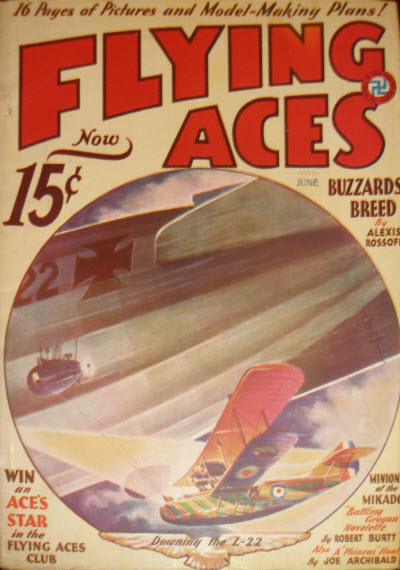
 issue of Flying Aces and running almost 4 years, Eugene Frandzen’s “Lives of the Aces in Pictures” was a staple of the magazine. Each month Frandzen would feature a different Ace that rose to fame during the Great War. This time around we have American Ace—Lt. David Putnam!
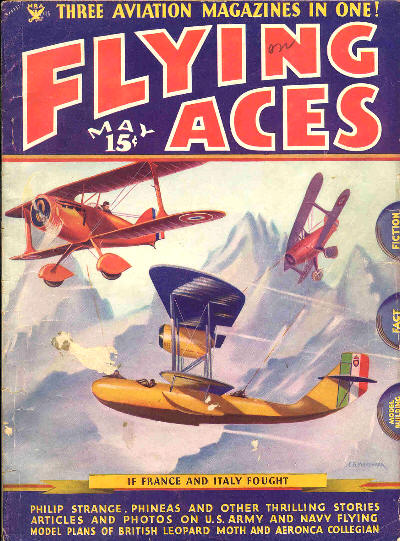 You heard right! That marvel from Boonetown, Iowa is back with a tale of starry-eyed colonels with visions of Hollywood and hidden german gun placements. Can that Knight of Calamity manage to find the Boche’s long-range guns while placating a colonel who thinks he’s the next Cecil B. DeMille all while avoiding landing in a dank cell in Blois? Find out in “Cinema Bums” from the pages of the May 1935 Flying Aces.
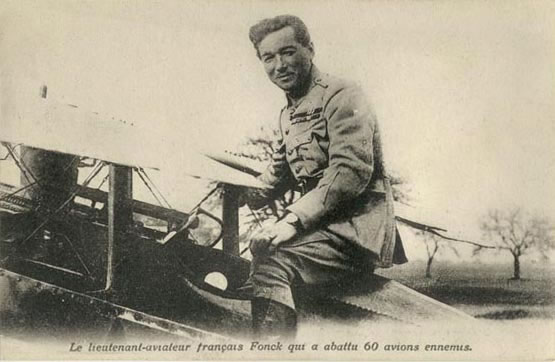
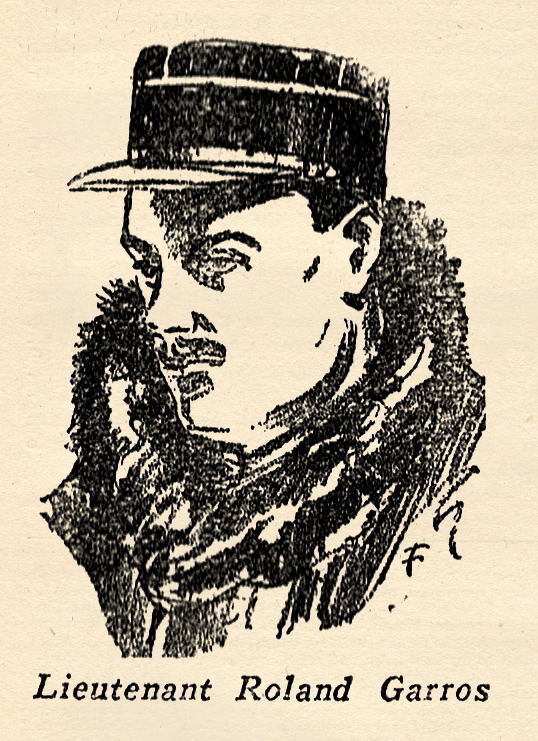 one of the world’s foremost airmen before the World War began. When the French army was mobilized, Garros joined his squadron, the Morane-Saulnier 23, just as it was leaving for the front. He built up a wonderful record for himself in respect to scouting.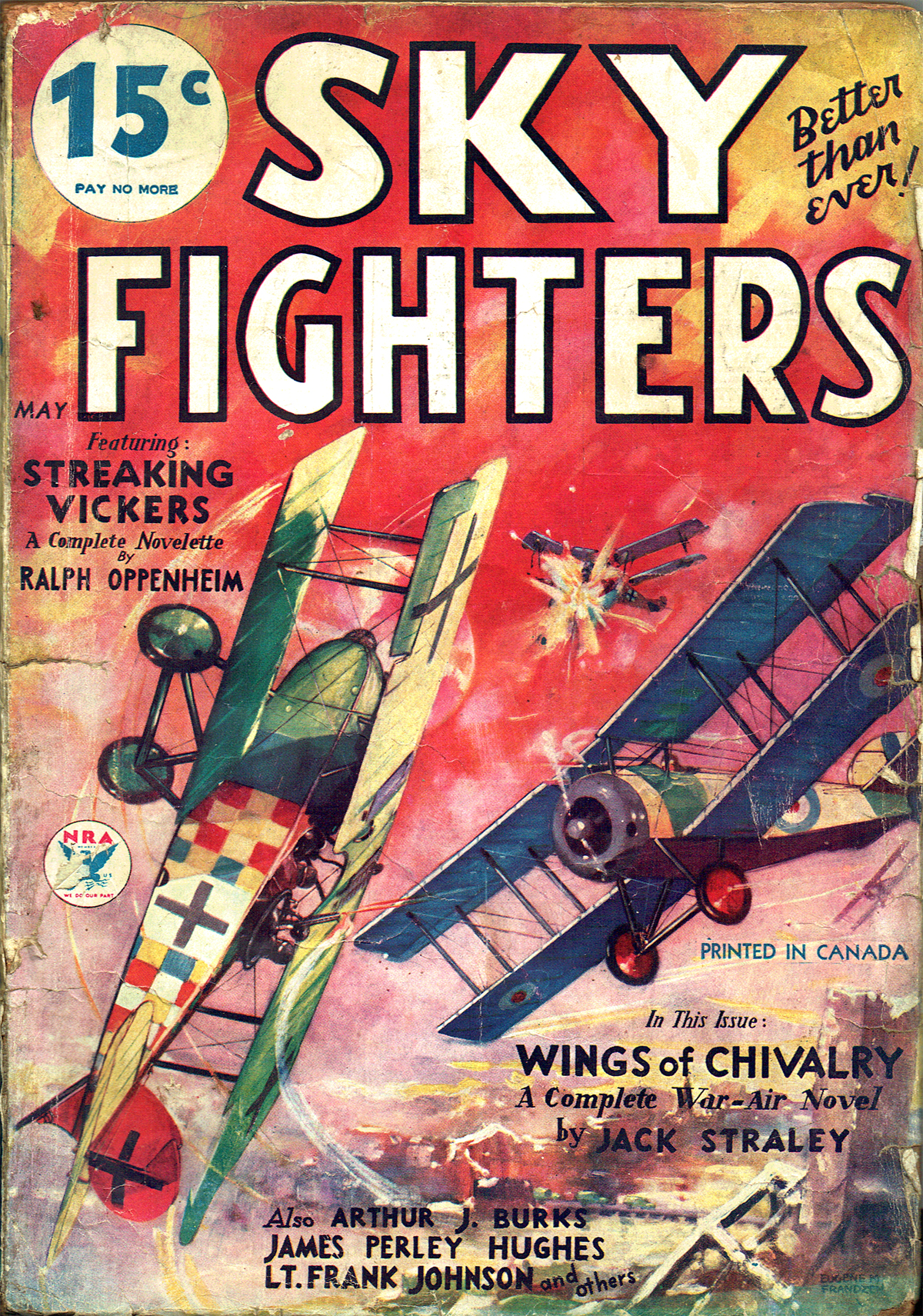
 issue of Flying Aces and running almost 4 years,
 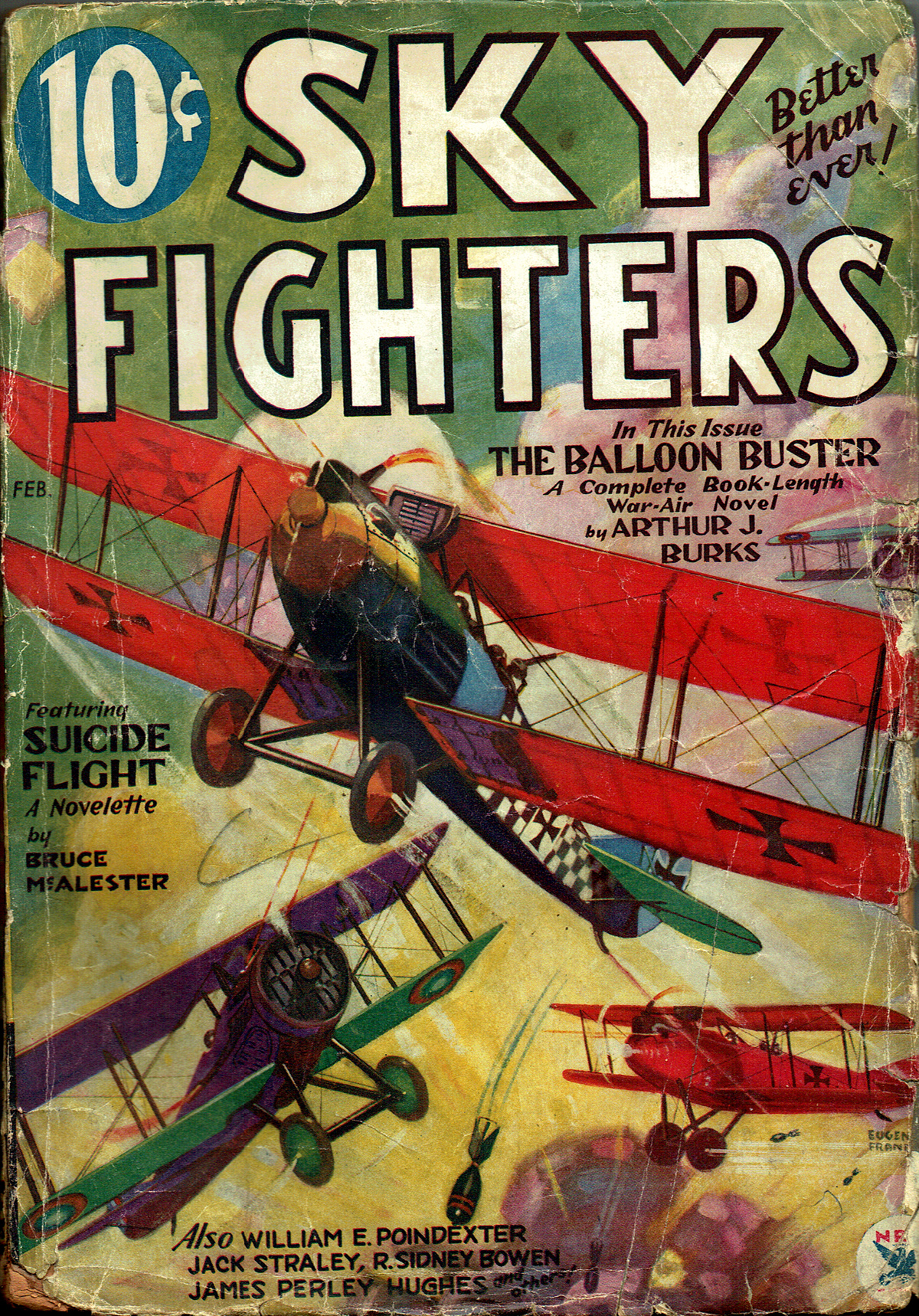 we have a tale from the anonymous pen of Lt. Frank Johnson—a house pseudonym. Sky Fighters ran a series of stories by Johnson featuring a pilot who who was God’s gift to the Ninth Pursuit Fighter Squadron and although he says he’s a doer and not a talker, he wasn’t to shy to tell them all about it. Which earned him the nickname “Silent” Orth.
 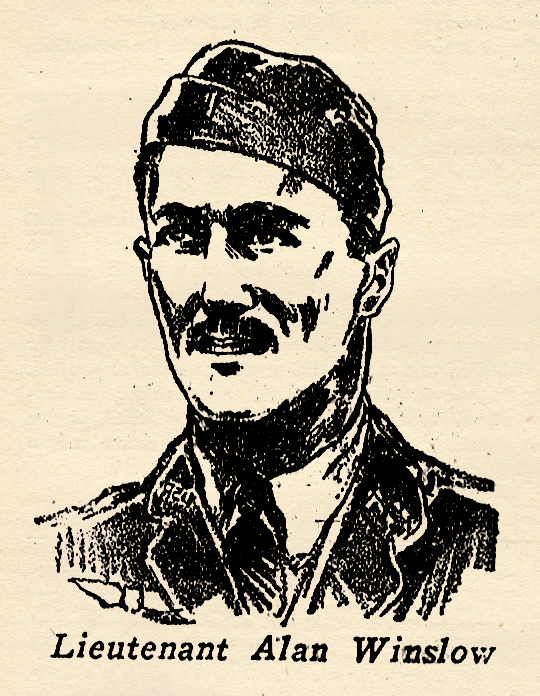 went oyer to France as a member of tho American Ambulance Section serving with the French Army. After America entered the war he was transferred to the American Army. When the American Air Service under command of Colonel Mitchell began definite duties on the Western Front, Alan Winslow had won his commission as a First Lieutenant and was assigned as a pilot in the 94th Aero Squadron, the famous “Hat in the Ring” outfit later made famous by Captain Eddie Rickenbacker.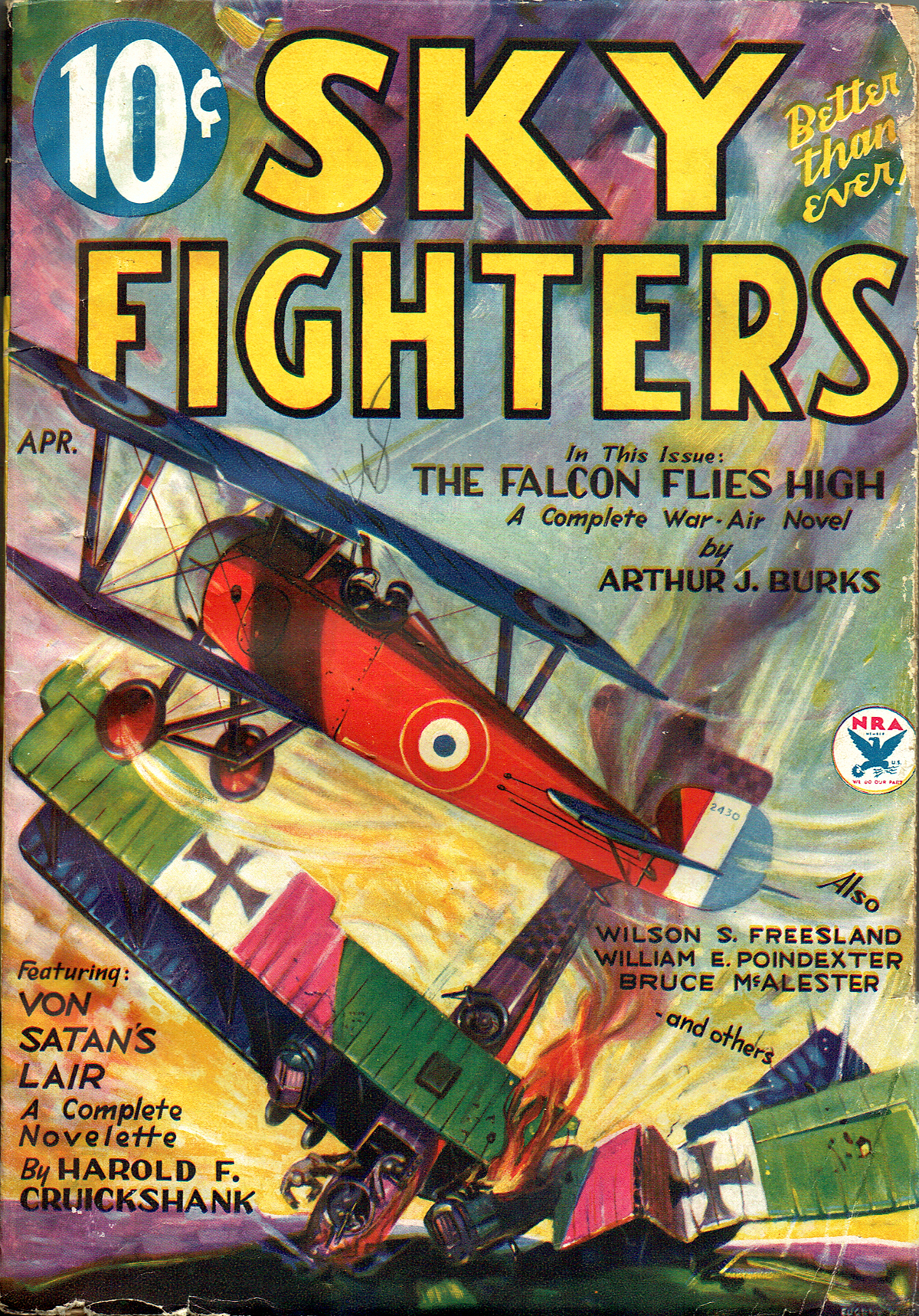
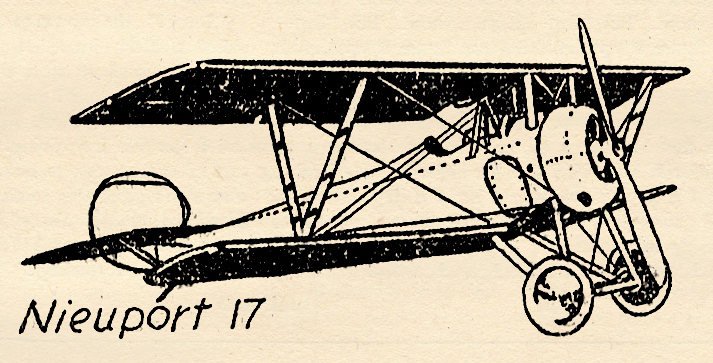
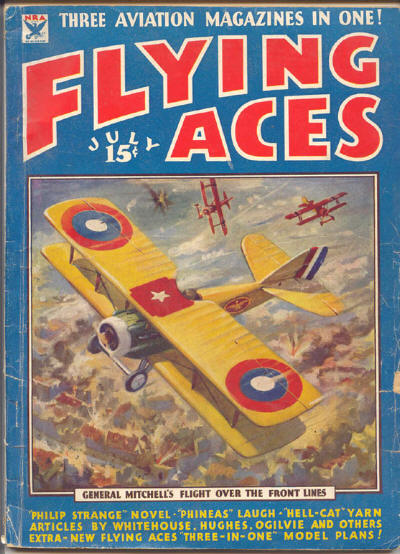 That sound can only mean one thing—that Bachelor of Artifice, Knight of Calamity and an alumnus of Doctor Merlin’s Camelot College for Conjurors is back and this time he’s fighting the war on two fronts—there’s a Boche Bat Patrol running riot in the Moselles and at the Ninth there’s a new recruit who wins every bet—that is until he comes up against the marvel from Boonetown, Iowa. From the July 1934 number of Flying Aces it’s “Hunbugs!”
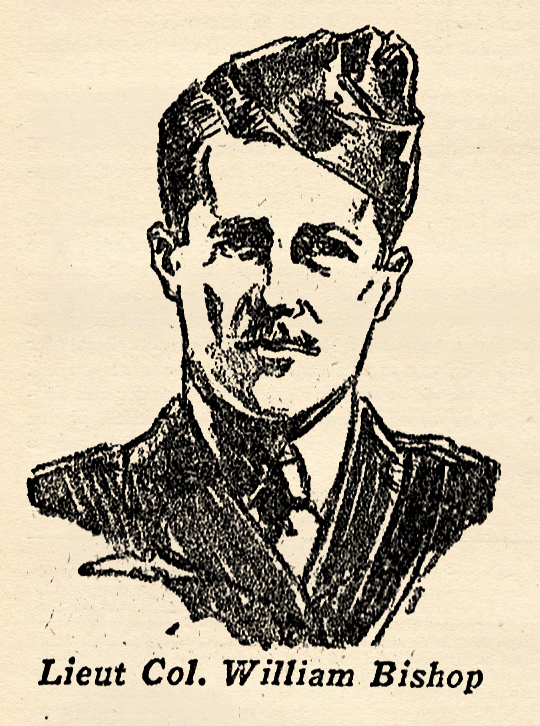 is one of the few great war Aces still living. And he probably owes his life to the fact that the British General Staff ordered him to Instruction duty in London while the war was still on. Bishop first served in the Second Canadian Army as an officer of cavalry, but tiring of the continuous Flanders mud, he made application for transfer to the Royal Flying Corps. He was first sent up front as an observer. When he went up later as a pilot he immediately began to compile the record which established him as the British Ace of Aces. He won every honor and medal possible. He was an excellent flyer, but attributed most of his success to his wizardry with the machine-gun. When the war ended he was officially credited with downing 72 enemy planes and balloons. The account below is from material he gathered for a book.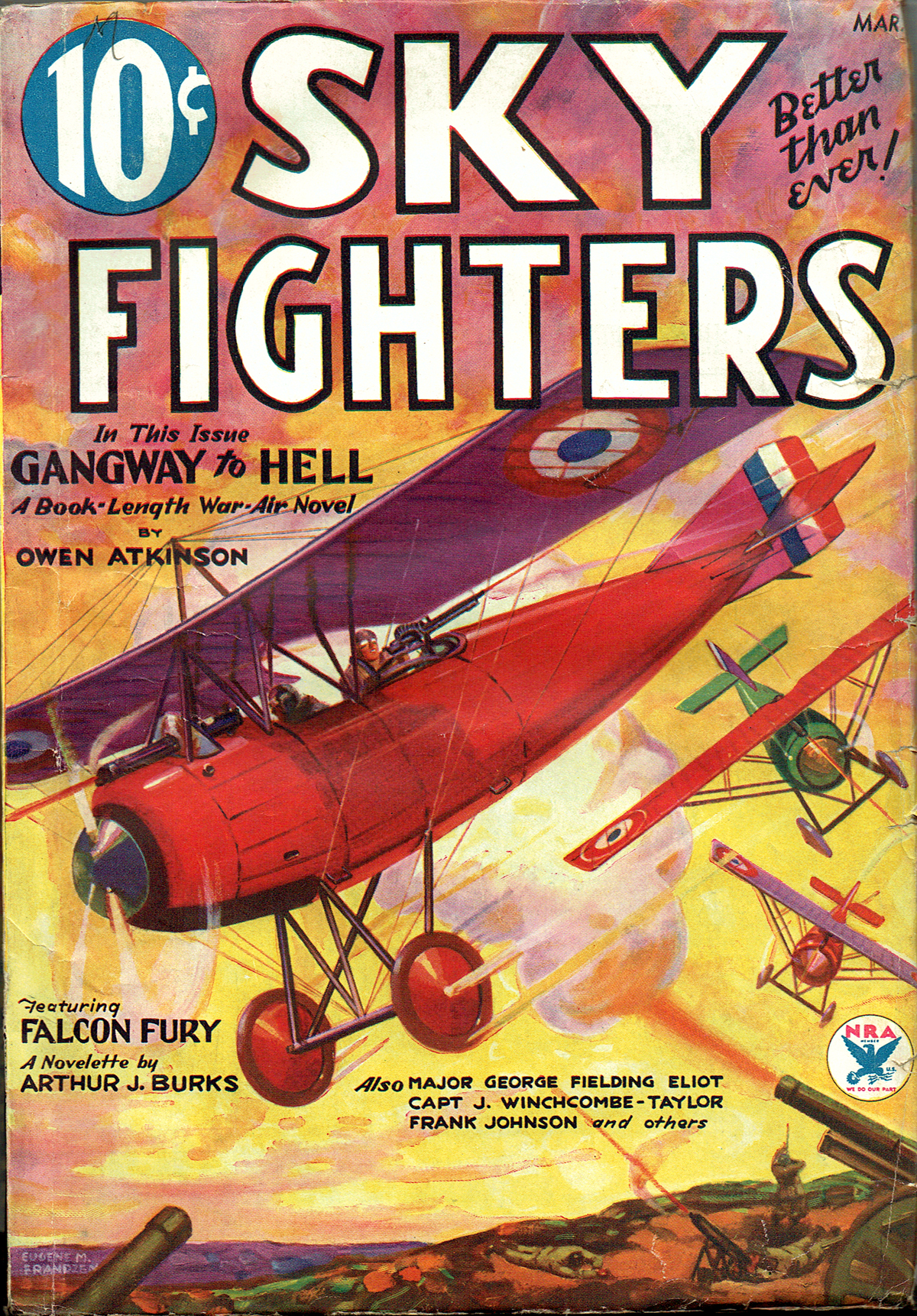
 we have a tale from the man that brought us