Looking to buy? See our books on amazon.com Get Reading Now! Age of Aces Presents - free pulp PDFs

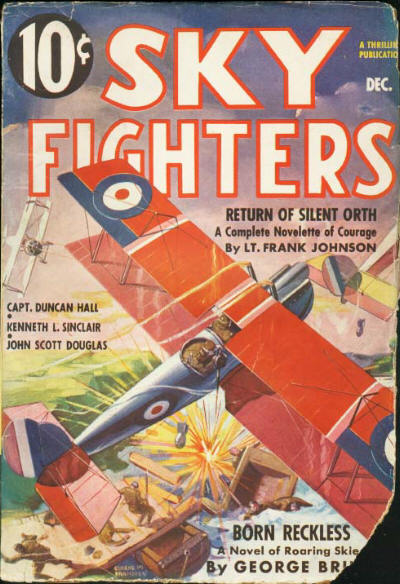
“The Return of Silent Orth” by Lt. Frank Johnson

Link - Posted by David on August 14, 2020 @ 6:00 am in

ORTH is back for one last battle! Silent Orth had made an enviable record, in the face of one of the worst beginnings—a beginning which had been so filled with boasting that his wingmates hadn’t been able to stand it. But Orth hadn’t thought of all his talk as boasting, because he had invariably made good on it. However, someone had brought home to him the fact that brave, efficient men were usually modest and really silent, and he had shut his mouth like a trap from that moment on.

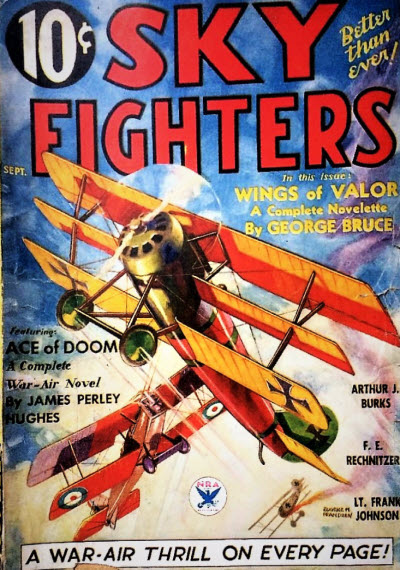
it had been nine months since the previous Silent Orth story graced the pages of Sky Fighters, but the quiet pilot has returned for one final dogfight in Hell skies! Seriously injured and captured by the Germans, Orth finds his way back to an Allied hospital only to be blown back into action by German bombs—and it’s pure retribution for the trio of German Aces who tried to stop him! It’s “The Return of Silent Orth” from the pages of the December 1936 Sky Fighters!

A Hun Bomb Blasts a Wounded Yank from a Hospital Cot to the Middle of Battle!

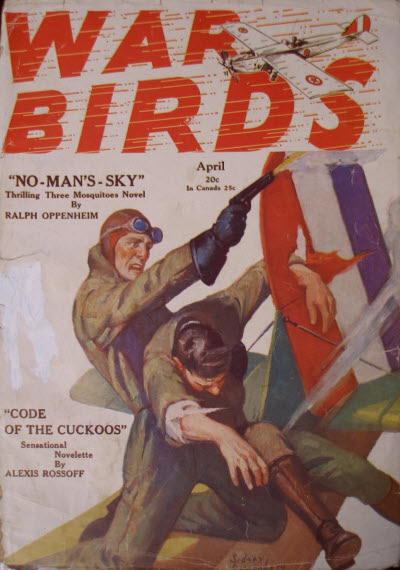
“Code of the Cuckoos” by Alexis Rossoff

Link - Posted by David on August 7, 2020 @ 6:00 am in

THIS week we have a fun tale of the Cuckoo’s Nest from the prolific pen of Alexis Rossoff. The Cuckoo’s Nest stories ran in War Birds in 1930. The Cuckoo’s are an outfit a lot like Keyhoe’s Jailbird Flight—a group of hell cats who found themselves afoul of military rules who have been given another chance to die fighting rather than rotting in Blois cell.

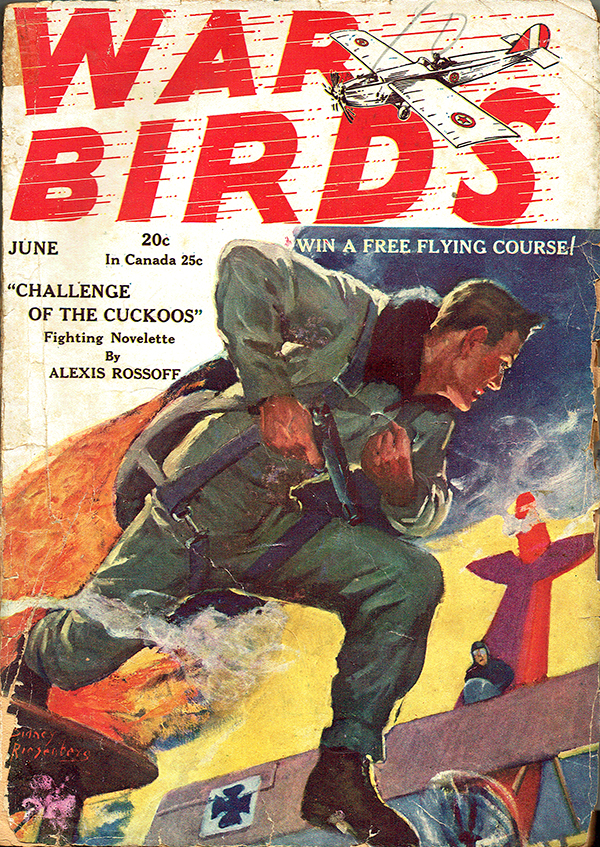
Twenty saddened Cuckoos stood with heads uncovered and bowed in the eerie ghost dampness of the new dawn, paying their last respects to all that remained mortal of Jerry Coyne. A sorrowful grease-ball smoothed the surface of the fresh mound while Johnny Walker—his voice husky with emotion—intoned the war-bird benediction. “God, be kind to Jerry Coyne. He was a good scout and our buddy.” The Cuckoos added their earnest “Amen,” and the ordeal was at an end. One more of the flock had gone West to paradise on spirit wings. Who would be the next to follow Jerry Coyne? That was the question. From the April 1930 issue of War Birds it’s Alexis Rossoff’s “Code of the Cuckoos!”

Already the throbbing sky in the distance was heavy with dire promise. It was a grim, spectacular game—the cards were dealt out to a strange group of fighting war birds—as strange as that part of the Front had ever heard of, and the stakes were the now-worthless lives of those men. Johnny Walker winged on to an ominous rendezvous with death. A yarn about an outfit you will never forget!

“His Last Salute” by Colcord Heurlin

Link - Posted by David on August 3, 2020 @ 6:00 am in

THIS week we present a cover by Colcord Heurlin! Heurlin worked in the pulps primarily over a ten year period from 1923 to 1933. His work appeared on Adventure, Aces, Complete Stories, Everybody’s Combined with Romance, North-West Stories, The Popular, Short Stories, Sky Birds, Sea Stories, Top-Notch, War Stories, Western Story, and here, the cover of the August 1931 Flying Aces!

His Last Salute

th_FA_3108THE chivalry of the clouds—the code that persisted even in moments of grim tragedy—is depicted on this month’s cover. The German plane, riddled by Allied bullets, is going down—a flaming coffin. Its pilot, about to take the leap that means death, turns to make one last gesture—a salute to the Allied pilot who has sent him down—and his conqueror answers the salute. Fighting for different causes though they were, those two airmen, like all the true knights of the air, held one thing highest—Courage, in life or in death!

The Story Behind The Cover
“His Last Salute”
Flying Aces, August 1931 by Colcord Heurlin

“Scot Free-For-All” by Joe Archibald

Link - Posted by David on July 31, 2020 @ 6:00 am in

“HAW-W-W-W-W!” That sound can only mean one thing—that Bachelor of Artifice, Knight of Calamity and an alumnus of Doctor Merlin’s Camelot College for Conjurors is back to vex not only the Germans, but the Americans—the Ninth Pursuit Squadron in particular—as well. Yes it’s the marvel from Boonetown, Iowa himself—Lieutenant Phineas Pinkham!

France and England borrowed plenty from Uncle Sam during the years of the Big Fuss and citizens on this side of the big pond are still wondering why they have not paid up. There was one thing which the Limeys returned in 1918, however, that certain taxpayers wished they had kept. This was an aviator by the name of Lieutenant Phineas Pinkham, exponent of legerdemain, prestidigitation, black magic, ventriloquism, and all other such doubtful arts that have been nurtured through the centuries to plague the civilized world.

It was the Kaiser’s dread “Ogre of the Ozone” who was causing all the trouble. He’d introduced a game of hop-scotch that the Ladies from Hades hadn’t bargained on. And when the bullets began to fly, split skirts came back into style. So when the Brass Hats tossed Lieutenant Pinkham in with the kilties, said Pinkham found himself in a tight spot—and you can take that two ways.

As a bonus…some fan art of the Boonetown Treasure!

“Five Gobs” by C.M. Miller

Link - Posted by David on July 24, 2020 @ 6:00 am in

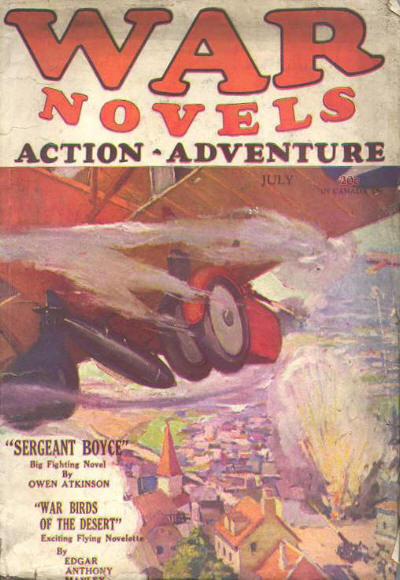
THIS week we have a story from the pen of C.M. Miller! Miller is known to Age of Aces readers as the author behind Chinese Brady, an old war horse who’s fought in most every scrap there’s been. This time it’s a little something different than our usual aviation tale. Miller gives the story of five sailors in a launch separated from their boat trying desperately to get back. Only trouble is, a German Uboat is using them to get their at the U.S.S. Leichester too! From the pages of the July 1929 issue of War Novels, it’s “Five Gobs!”

Five gobs stranded in a motor boat didn’t amount to a tinker’s damn when that periscope sneaked up. The U.S.S. Leichester turned seaward and ran like the devil—leaving those five to play with a Heinie sub.

“Creased!” by Arnold Lorne Hicks

Link - Posted by David on July 20, 2020 @ 6:00 am in

THIS week we present a cover by Arnold Lorne Hicks! Hicks worked in the pulps primarily from the late ’20’s to the mid 30’s, producing covers for such magazines as North-West Stories, Navy Stories, Police Stories, Detective Dragnet, Sky Birds, Golden West, Western Trails, Love Adventures, and a couple covers for Flying Aces!

Creased!

th_FA_3106THE deadliest wound possible to receive in the air, outside of a bullet through the heart, is the “creaser.” Many an airman has gone west in a crash as the result of a bullet wound across the head that stuns him long enough to allow the plane to get completely out of control. The same wound, received on the ground, would result in nothing more uncomfortable than a numbing headache after a surgeon had attended it. Hundreds of aviators have received serious wounds in the stomach, lungs or limbs and have been able to bring their ships down in safety, but a “creaser” leaves the pilot unconscious and unable to save himself. Captain Ball, who fell after winning the Victoria Cross, and Major Hawker, another British ace with a long list of victories, both went down to their deaths after receiving slight head wounds—wounds that, compared to their actual deaths, were mere pin scratches. Our cover this month shows us a war pilot in a similar difficulty.

The Ships on The Cover
“Creased!”
Flying Aces, June 1931 by Arnold Lorne Hicks

“Flying Mad” by Donald E. Keyhoe

Link - Posted by David on July 17, 2020 @ 6:00 am in

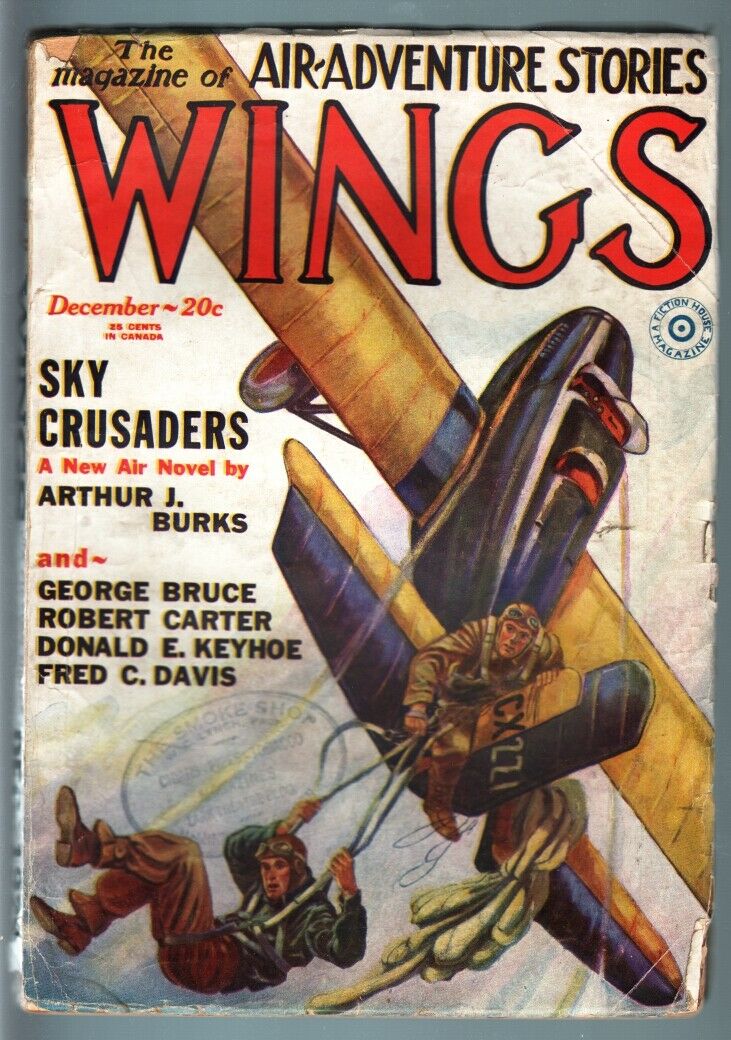
THIS week we have a story from the pen of Donald E. Keyhoe—in fact, I believe it is his first aviation story he had in the pulps! More soap opera than dashing wartime aviation thriller, Keyhoe tells the story of Harvey Masters, Dizzy Jim Boyd, and the girl unwittingly caught between them! The strangest part is that nobody ever suspected the truth about Dizzy Jim Boyd, though there was a lot of guessing when he first showed up at Western Airways Field, until the day when Harvey Masters came through and stopped for gas. . .

From the pages of the December 1929 issue of Wings, it’s Donald E. Keyhoe’s “Flying Mad!”

They called him “The Sheik” until he took the air and danced his crazy crate. And then they dubbed him Dizzy Jim. Nobody knew where he came from or why, but he came a-roaring . . .

“Famous Sky Fighters, September 1937″ by Terry Gilkison

Link - Posted by David on July 15, 2020 @ 6:00 am in

STARTING in the October 1933 issue of Sky Fighters and running almost 5 years, Terry Gilkison’s “Famous Sky Fighters” was a staple of the magazine. Each month Gilkison would illustrate in a two page spread different Aces that rose to fame during the Great War.

Although Gilkison was probably better known for his syndicated newspaper work, he also provided black and white story interior illustrations for pulp magazines. His work appeared in Clues, Thrilling Adventures, Texas Rangers, Thrilling Mystery, Thrilling Western, and Popular Western. Gilkison provided similar features in a few other Thrilling Publications—there was “Famous Soldiers of Fortune” and later “Adventure Thrills” in Thrilling Adventures, Famous Crimes” in Thrilling Detective, and the fully illustrated air adventure stories of Buck Barton “The Flying Devil” in The Lone Eagle! He signed most of this work with only his initials “T.G.” to maintain a low profile and preserve his reputation as a syndicated newspaper cartoon artist.

The September 1937 installment, from the pages of Sky Fighters, features Major Jimmy Doolittle, Armand Pinsard, and Captain Bruno Loerzer!

Next time in “Famous Sky Fighters”, Terry Gilkison features Captain Donald MacLaren, Captain W.D. “Bill” Williams, Roland Garros and Anthony Fokker! Don’t miss it!

“Solo Show” by F.E. Rechnitzer

Link - Posted by David on July 10, 2020 @ 6:00 am in

THIS week we have a story from the pen of a prolific pulp author—F.E. Rechnitzer. Tip Hunley was a forgetful sort—he would even forget his commanding officer’s direct orders. The result of which found him grounded the night before his squadron was to set to bomb the ammunition dump at Roulents early the next morning. However, he neglected to remember that he had been grounded when he took a Sopwith Camel up and took on the Roulents dump all on his own! Surely an unforgettable story he could one day tell his grandkids! From the pages of the September 1934 issue of Sky Fighters, it’s F.E. Rechnitzer’s “Solo Show!”

Tip Hurley Was Grounded for Disobedience—But No Brass Hat Could Stop That Hell-Bent Sky Rider from Taking a Crack at the Roulents Dump!

The Lone Eagle, November 1933 by Eugene M. Frandzen

Link - Posted by David on July 6, 2020 @ 6:00 am in

Eugene M. Frandzen painted the covers of The Lone Eagle from its first issue in September 1933 until the June 1937 issue when Rudolph Belarski took over with the August issue of that year. At the start of the run, Frandzen painted covers of general air action much like his Sky Fighters covers. Here, for the November 1933 cover, Frandzen gives us the classic match-up—the Nieuport Type 27 vs. the Fokker D7!

The Story of the Cover

THE ships pictured on this th_LE_3311 month’s cover are the Nieuport Type 27 and the Fokker D7.

The Nieuport Type 27 was a single-seater biplane manufactured by Soc Anonyme des Etablissements Nieuport. The firm was established by Edouard de Nieuport in 1910.

When the War broke out they were ready with a fighting machine, the small two-seater Nieuport. The Type 27 was a real fighting craft of later war years, 1916 and 1917 to be exact. It had high speed and plenty of quickness in action compared to the early Nieuports, but it was closely patterned after the early machines.

The majority of Nieuports were the planes which were noted for their “V” strut design. The Germans swiped the “V” strut idea for two of their best fighting machines, the famous Albatros and Pfalz. The Nieuport 27 had a neat streamlined fuselage. It carried a Vickers synchronized with the airscrew. The ship was shot along at 105 m.p.h. by a 120 h.p. Le Rhone engine. Bishop, the British Ace flew Nieuports and swore by them. Lufbery, the American, was flying one when he fell in a spin to his death.

The Nieuport flashing into the cover to go to the assistance of his buddy in another Nieuport, is not alone. Behind him is his gang. He is waving them to follow him into the fight. In a few seconds hell will break loose around the Fokkers ganging the lone Allied plane.

Ganging was a great game in the Big War. Both sides did it, but the Germans deliberately waited for such situations and often shunned a sporting proposition of an equal scrap. The Yanks, French and English didn’t go out of their way to run down a lone foe. But, of course, if one happened to flounder into a mess of Allied planes he wasn’t handed a bouquet and told to run along home.

If a quick burst from the nearest Fokker doesn’t smash the zig-zagging Nieuport, its pilot has an even break of getting out with a whole skin. It’s a matter of seconds till it will be “Everybody for himself.”

The Fokker D7 was the most popular of Fokkcr’s many models. It deserved this popularity for its fine fighting qualities. Its unusual features were the entire metal inner construction of the fuselage and the interplane bracing members, the thick wings, and the absence of external bracing wires between the wings. These were radical changes in airplane design, but they worked. There were one hundred and sixty horses neighing in its ugly, blunt nose. They pulled it along at 110 m.p.h. at 10,000 feet. The big Mercedes engine was a heavy load so the D7 was a little nose heavy, but it had enormous power with the ability to hang on the prop in a position of 45 degrees while pushing forward. This was a life-saver for many German fliers.

The Nieuport and the Fokker both blasted themselves a niche in the Hall of Fame of World War ships. Both were husky war horses. They gave real speed, and they held together, which is more than can be said of many of the War’s flying coffins.

The Story of The Cover
The Lone Eagle, November 1933 by Eugene M. Frandzen
(The Story of The Cover Page)

“The General’s Glasses” by O.B. Myers

Link - Posted by David on July 3, 2020 @ 6:00 am in

THIS week, he have a story from the pen of a prolific pulp author O.B. Myers! Myers was a pilot himself, flying with the 147th Aero Squadron and carrying two credited victories and awarded the Distinguished Service Cross.

When the visiting General sent Jake Munns back to his headquarters to fetch his binoculars, he had no idea that t would be those same glasses that would save his life! From the June 1930 issue of War Birds, it’s O.B. Myers’ “The General’s Glasses!”

The cockeyed general sent Jake Munns winging for his field glasses. But when Jake went to look for the general again he found him in the center of No-Man’s-Land, and what they didn’t find out about those glasses!

“Famous Sky Fighters, July 1937″ by Terry Gilkison

Link - Posted by David on July 1, 2020 @ 6:00 am in

STARTING in the October 1933 issue of Sky Fighters and running almost 5 years, Terry Gilkison’s “Famous Sky Fighters” was a staple of the magazine. Each month Gilkison would illustrate in a two page spread different Aces that rose to fame during the Great War.

Although Gilkison was probably better known for his syndicated newspaper work, he also provided black and white story interior illustrations for pulp magazines. His work appeared in Clues, Thrilling Adventures, Texas Rangers, Thrilling Mystery, Thrilling Western, and Popular Western. Gilkison provided similar features in a few other Thrilling Publications—there was “Famous Soldiers of Fortune” and later “Adventure Thrills” in Thrilling Adventures, Famous Crimes” in Thrilling Detective, and the fully illustrated air adventure stories of Buck Barton “The Flying Devil” in The Lone Eagle! He signed most of this work with only his initials “T.G.” to maintain a low profile and preserve his reputation as a syndicated newspaper cartoon artist.

The July 1937 installment, from the pages of Sky Fighters, features Major James Meissner, Lt. Dudley Tucker, Lt. Col. Robert Rockwell, Lt. Gustav Leffers!

Next time in “Famous Sky Fighters”, Terry Gilkison features Major Jimmy Doolittle, Armand Pinsard, and Captain Bruno Loerzer! Don’t miss it!

“Peck’s Spad Boys” by Joe Archibald

Link - Posted by David on June 26, 2020 @ 6:00 am in

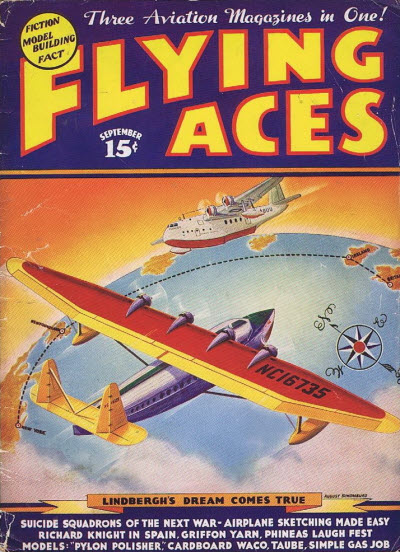
“HAW-W-W-W-W!” That sound can only mean one thing—it’s time to ring out the old year and ring in the new with that Bachelor of Artifice, Knight of Calamity and an alumnus of Doctor Merlin’s Camelot College for Conjurors—Phineas Pinkham. From the pages of the September 1937 Flying Aces, it’s another sky-high “Phineas Pinkham” mirthquake from the Joe Archibald—It’s “Peck’s Spad Boys!”

A peck of trouble! That’s what was stirred up when C. Ashby Peck lugged his typewriter onto the drome of the 9th. But Phineas Pinkham, the Boonetown Bam, was right ready with a hunt-and-peck system counter-attack. And when von Liederkranz showed his face, Carbuncle showed his hand. In fact, he did more than show his hand—he dropped it!

“The Fairey Fantome” by Frederick Blakeslee

Link - Posted by David on June 22, 2020 @ 6:00 am in

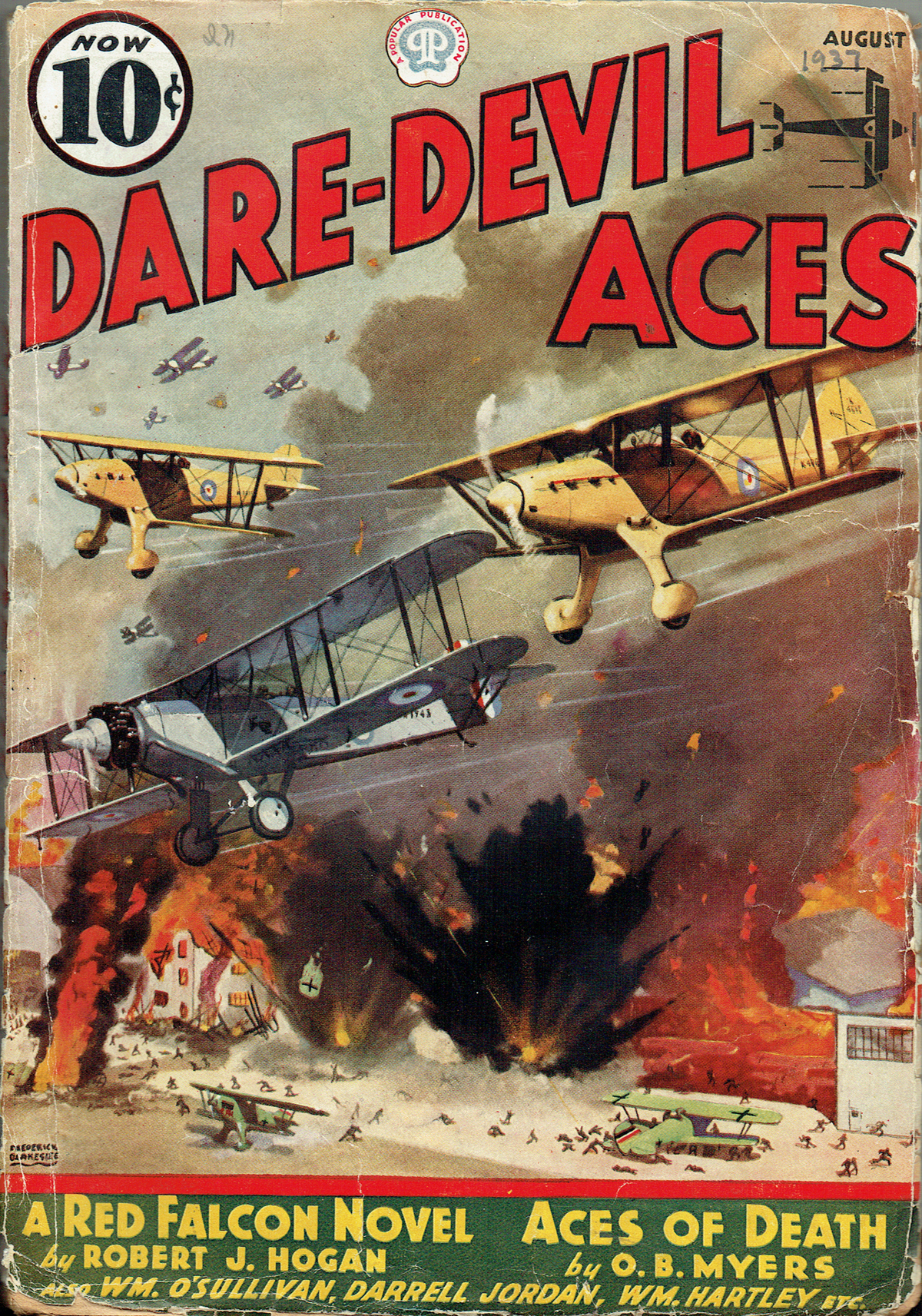
Frederick Blakeslee painted all the covers for the entire run of Dare-Devil Aces. And each of those covers had a story behind it. At this point in the magazine’s run, Mr. Blakeslee had started doing his “Planes by the Numbers” covers where he has so many planes on the cover, he had to explain which plane is what with a legend on the story behind the cover page. For the August issue we get a bit of a throwback where Mr. Blakeslee turns his attention to the Fairey Fantome!
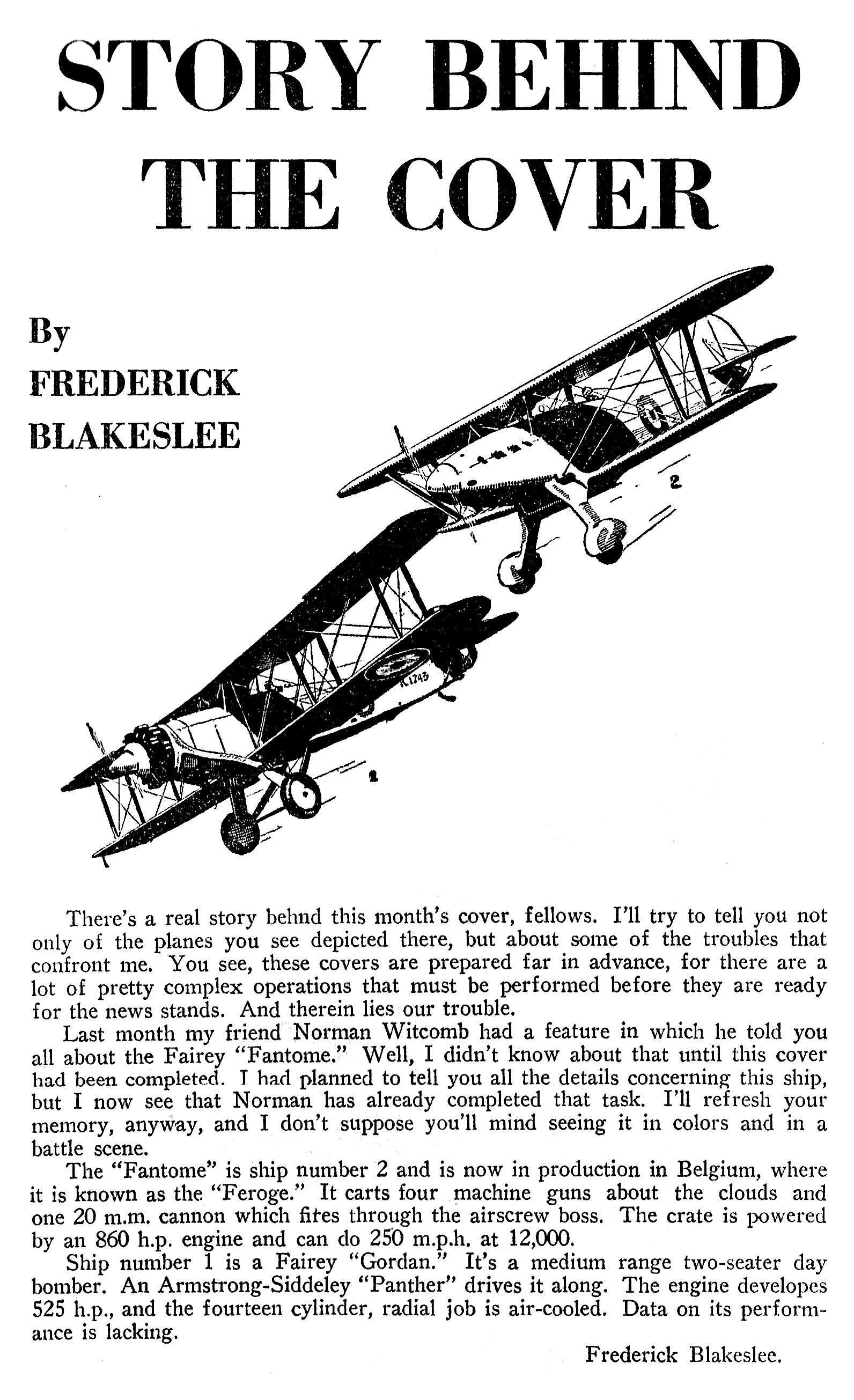
th_DDA_3708THERE’S a real story behind this month’s cover, fellows. I’ll try to tell you not only of the planes you see depicted there, but about some of the troubles that confront me. You see, these covers are prepared far in advance, for there are a lot of pretty complex operations that must be performed before they are ready for the news stands. And therein lies our trouble.

Last month my friend Norman Witcomb had a feature in which he told you all about the Fairey “Fantome.” Well, I didn’t know about that until this cover bad been completed. I had planned to tell you all the details concerning this ship, but I now see that Norman has already completed that task. I’ll refresh your memory, anyway, and I don’t suppose you’ll mind seeing it in colors and in a battle scene.

The “Fantome” is ship number 2 and is now in production in Belgium, where it is known as the “Feroge.” It carts four machine guns about the clouds and one 20 m.m. cannon which fires through the airscrew boss. The crate is powered by an 860 h.p. engine and can do 250 m.p.h. at 12,000.

Ship number 1 is a Fairey “Gordan.” It’s a medium range two-seater day bomber. An Armstrong-Siddeley “Panther” drives it along. The engine develops 525 h.p., and the fourteen cylinder, radial job is air-cooled. Data on its performance is lacking.

Frederick Blakeslee.
The Story Behind The Cover
“The Story Behind The Cover: The Fairey Fantome” by Frederick Blakeslee
(August 1937, Dare-Devil Aces)

As an added bonus, we present Norman Witcomb’s breif write-up on the Fairey Fantome that Mr. Blakeslee references from the July 1937 issue of Dare-Devil Aces.
Fighting Faireys

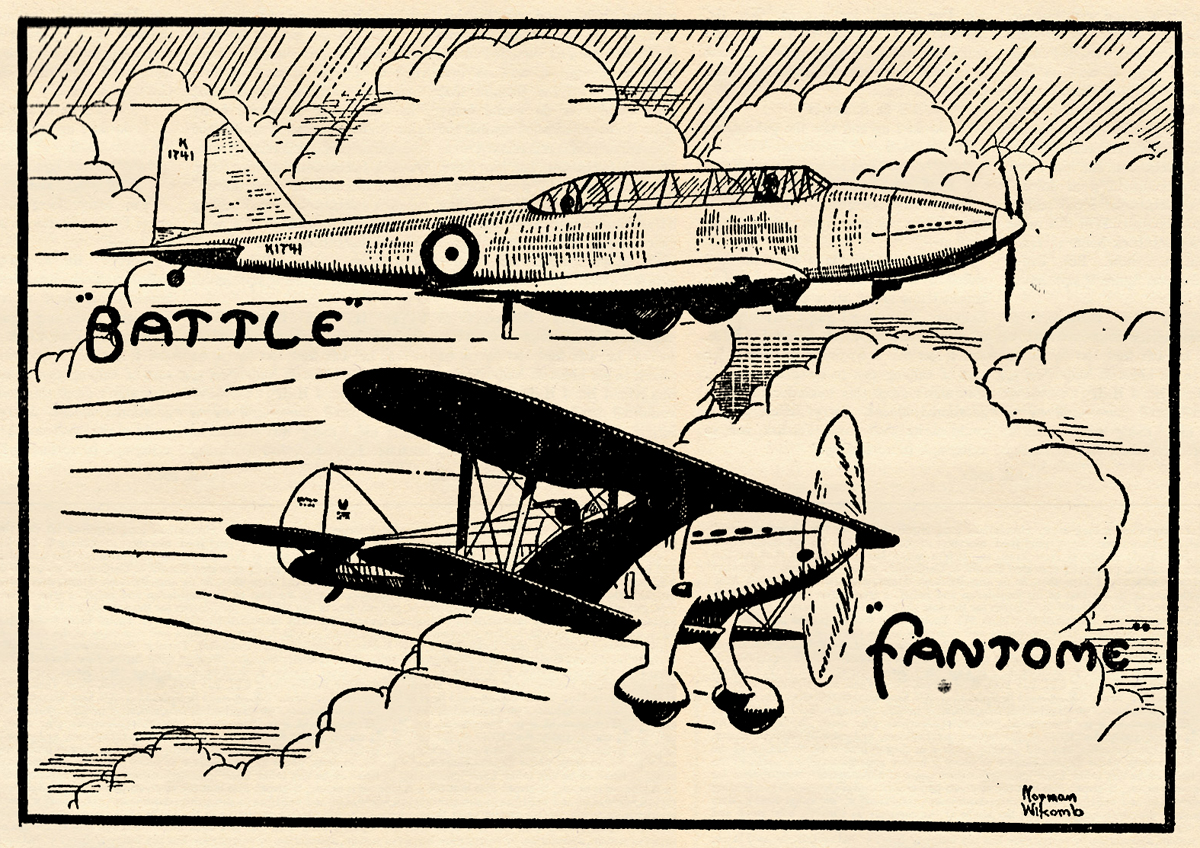
THE Fairey firm is one of the oldest in the aircraft industry. It has furnished planes for the R.A.F. for as long as that service has existed. It also turns out the equipment for the Belgian Royal Air Service. For this purpose, Fairey has a factory in Belgium.

Shown above, are two of the latest products of this famous firm. One, the Fairey “Battle,” is a veritable masterpiece. It is designed as a medium bomber, the fastest of its kind in the world. The ship is pulled through the air at about 300 m.p.h.! This is done, of course, by another sweet job, the Rolls-Royce “Merlin” of 1,065 h.p. This motor was so successful that it caused the plane to perform beyond the fondest expectations of its designers. The “Battle” is metal-covered and is equipped with all latest devices, such as flaps, two-way radio, special high-flying equipment, and what not. The armament is secret, but two heavy guns can be seen in the wings. The British government, knowing a good thing when they see one, has ordered several hundred of these planes.

The single-seater fighter below, is the Fairey “Fantome” which has been adopted by the Belgian government as a highspeed fighter. It has a “Hisso” Cannon engine of 860 h.p. and the pilot can open her up to more than 250 m.p.h.! It is a sturdy biplane of rugged construction, and is also completely equipped with radio, etc.

The Belgian Air Force, while small, is well equipped with modern aircraft. No doubt she is anxious not to be caught defenseless again, should serious trouble break out around her borders.


“The Cloud Cracker” by Frederick C. Davis

Link - Posted by David on June 19, 2020 @ 6:00 am in

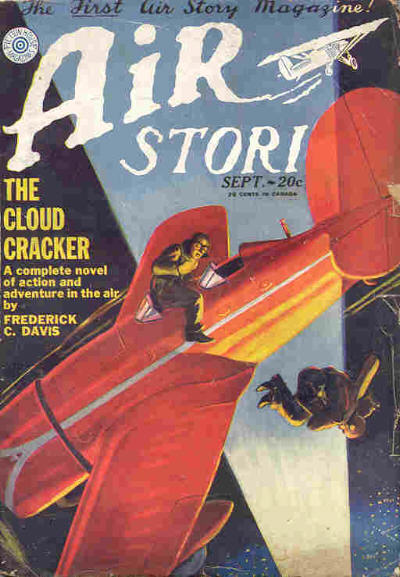
THIS week we have a short story by renowned pulp author Frederick C. Davis. Davis is probably best remembered for his work on Operator 5 where he penned the first 20 stories, as well as the Moon Man series for Ten Detective Aces and several other continuing series for various Popular Publications. He also wrote a number of aviation stories that appeared in Aces, Air Stories and Wings. “The Cloud Cracker” was published in the September 1930 issue of Air Stories magazine.

A phantom flew with the Fourteenth’s patrols. Norton laughed when Fokkers lashed with fangs of steel at another Yank—for he played a double game to win doom wings.

« Previous PageNext Page »