Looking to buy? See our books on amazon.com Get Reading Now! Age of Aces Presents - free pulp PDFs

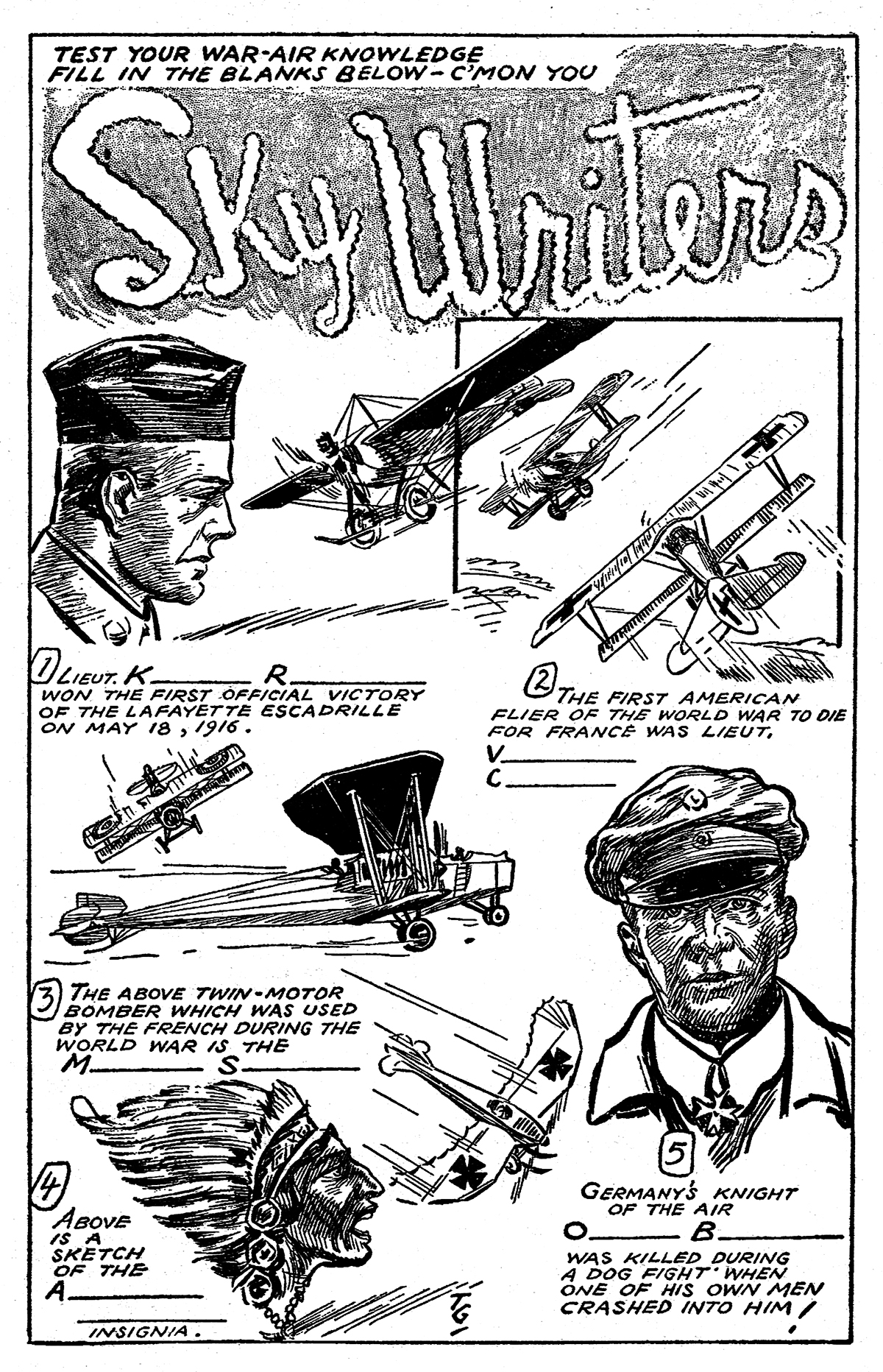
“Sky Writers, December 1938″ by Terry Gilkison

Link - Posted by David on March 24, 2021 @ 6:00 am in

FREQUENT visitors to this site know that we’ve been featuring Terry Gilkison’s Famous Sky Fighters feature from the pages of Sky Fighters. Gilkison had a number of these features in various pulp magazines—Clues, Thrilling Adventures, Texas Rangers, Thrilling Mystery, Thrilling Western, and Popular Western. Starting in the February 1936 issue of Lone Eagle, Gilkison started the war-air quiz feature Sky Writers. Each month there would be four questions based on the Aces and events of The Great War. If you’ve been following his Famous Sky Fighters, these questions should be a snap!

Here’s the quiz from the December 1938 issue of Lone Eagle.

If you get stumped or just want to check your answers, click here!

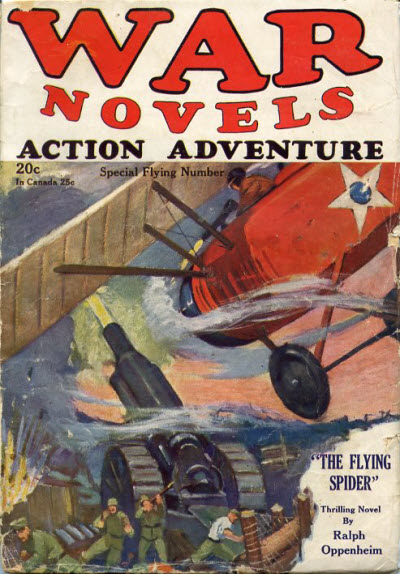
“The Flying Spider” by Ralph Oppenheim

Link - Posted by David on March 19, 2021 @ 6:00 am in

THROUGH the dark night sky, streaking swiftly with their Hisso engines thundering, is the greatest trio of aces on the Western Front—the famous and inseparable “Three Mosquitoes,” the mightiest flying combination that had ever blazed its way through overwhelming odds and laughed to tell of it! Flying in a V formation—at point was Captain Kirby, impetuous young leader of the great trio; on his right was little Lieutenant “Shorty” Carn, the mild-eyed, corpulent little Mosquito and lanky Lieutenant Travis, eldest and wisest of the Mosquitoes on his left!

We’re back with the third and final of three Ralph Oppenheim’s Three Mosquitoes stories we’re featuring this March for Mosquito Month! And this one’s a doozy! Who had not heard of that grim nickname—”The Spider”? It was the nickname of Germany’s most notorious spy—the plague and dread of the Allied powers. The whole Allied intelligence system was after this man, but they had never been able to catch him; he seemed to bear a charmed life. Kirby and his comrades had heard many rumors of his wild, hairbreadth escapades, but they had not known how truly deadly he was! And now the Three Mosquitoes found themselves caught in The Spider’s web! From the pages of the June 15th, 1929 issue of War Novels it’s Ralph Oppenheim’s “The Flying Spider!”

Here it is, gang—the greatest flying yarn of the year! Kirby, Travis and Carn, that famous trio of war birds, thought they were going to have a rest. They flew that important visiting Limey, Colonel Haley-Shaw, to England—and then all hell busted loose, for they had landed in the web of the infamous and powerful “Spider.”

“Coppens, Belgium’s Greatest Ace” by Paul Bissell

Link - Posted by David on March 15, 2021 @ 6:00 am in

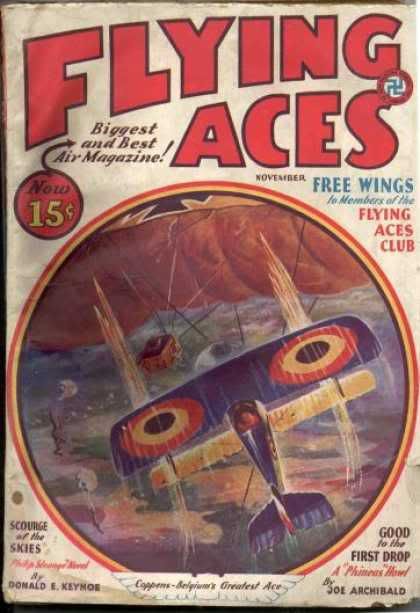
THIS week we present another of Paul Bissell’s covers for Flying Aces! Bissell is mainly known for doing the covers of Flying Aces from 1931 through 1934 when C.B. Mayshark took over duties. For the November 1932 cover Bissell paints one of Belgium’s greatest Aces in action—Lt. Willi Coppens trying to take down a balloon!

Coppens, Belgium’s Greatest Ace

th_FA_3211THE sun had set, and soon night for a few short hours would throw her peaceful blanket of darkness over the gaping wounds of war that now scarred the once beautiful fields of Flanders.

Above, where the sun’s rays still shone from beyond the far horizon, a tiny speck could be seen. Below, on the shell-torn earth, a crew was slowly hauling down a huge yellow sausage with black crosses painted on its sides. Anxiously the officers in charge watched the sky above until sudden recognition of the tiny speck brought hurried orders from their lips. Coppens, the little black devil of the Belgians, was on the wing!

Since the outbreak of the war, Willi Coppens had been in the service of his country. He had enlisted on the 28th of July, serving first as a despatch rider for the 6th Division, and then in other positions of both danger and trust but always with his eyes to the sky, his heart set on the “chasse.”

Three long years of this, then six months of observation, reconnaissance and artillery fire direction, until, in April, 1918, his great ambition was gratified at last. In the past six months he had made himself the terror of the Huns and the idol of his nation. Thirty-three balloons and two planes had fallen to his attack. He was premier ace of the Belgians and premier balloon-buster of the world.

NOW, October 14, 1918, his .small, dark-blue plane with the red, yellow and black circles of Belgium on its wings was once again bringing death and destruction to the invaders of his beloved country.

Down he swooped through the hail of shrapnel and machine-gun fire, his gun spitting incendiary bullets into the great yellow bag below. . . . At the last moment he veered off, banked up on one wing, then as quickly reversed, executing a tight S, his nose down and hugging the balloon as closely as he dared, to gain what little protection might be had through the enemy’s fear of hitting their own observers.

His throttle shot forward as he gave his little Nieuport the gun and dived down under the balloon with terrific speed. Back came the stick—the tiny blue plane shot upward—higher—higher—up into a stall when another instant would have sent it crashing into the swinging balloon.

Now a shift of the release lever, and from the chute on either side six flaming rockets, like meteors against the late afternoon sky, soared through the air with deadly accuracy toward the sausage. In their wake a trail of sparks showered downward, and the plane hung for an instant on the prop. Then its nose flopped down through the drifting sparks. A quick kick of the rudder avoided collision with the big cable by which the Germans were desperately trying to haul the clumsy bag to the ground.

The plane dropped like a plummet. Coppens eased up on his throttle slightly, then leveled off, at last clear of the balloon—and none too soon. The rockets buried themselves in the bulging silk and then, an instant later, there was a terrific burst of flame and smoke. Great fiery tongues leaped hundreds of feet into the air, and the big bag collapsed, falling to the ground and burning fiercely.

Machine guns clattered madly while high explosives and shrapnel once again rent the air in their effort to find the tiny plane. He was almost away, a tiny speck against the darkening sky, when a shrapnel burst squarely in his path. His left leg went numb. The Nieuport shivered as he almost lost control. The little black devil was winged at last!

THE war was over. The invader had been driven out and peace once again reigned. In the warm July afternoon, on one of Belgium’s great air fields, a small army had drawn up in battalion formation. To one side, an area roped off was filled to overflowing by a crowd in holiday attire. Flags were flying and bands playing. On the line a row of planes stood ready, their wings and bodies shining from careful grooming. For on this day a grateful nation was honoring one of its heroes.

A large plane could be seen in the distance. Quickly it approached, circled the field, then landed easily and taxied down near to wrhere a small group was standing in front of the battalions.

The crowd surged restlessly, then broke into tumultuous acclaim as a tall figure stepped from the plane and the bands crashed into the national anthem of the Belgians.

“—And a grateful nation and King salute you, Captain Coppens, Officer of the Order of Leopold.”

The King stepped forward to pin a small ribbon on the breast of the slim aviator in front of him, an aviator whose face was still pale from recent illness and whose left trouser leg flapped loosely against wood instead of bone and flesh. This lad supported himself with two canes, but one of these fell to the ground when he held out his hand to His Majesty.

Several officers started forward to recover the stick, but the King was first. He retrieved the stick quickly and with a gracious, “Permit me, mon Capitaine,” he handed it to Coppens. The crowd roared. A king had stooped to serve a humble subject—and a monarch had proved himself regal.

The Ships on The Cover
“Coppens, Belgium’s Greatest Ace”
Flying Aces, November 1932 by Paul J. Bissell

“Flaming Cockpits” by Ralph Oppenheim

Link - Posted by David on March 12, 2021 @ 6:00 am in

“LET’S GO!” Once more, The Three Mosquitoes familiar battle cry rings out over the western front and the three khaki Spads take to the air, each sporting the famous Mosquito insignia. In the cockpits sat three warriors who were known wherever men flew as the greatest and most hell raising trio of aces ever to blaze their way through overwhelming odds—always in front was Kirby, their impetuous young leader. Flanking him on either side were the mild-eyed and corpulent Shorty Carn, and lanky Travis, the eldest and wisest Mosquito.

We’re back with the second of three exciting tales of Ralph Oppenheim’s Three Mosquitoes we’re featuring this March for Mosquito Month! This week, The Three Mosquitoes past comes back to haunt them when the brother of the Black Devil, whom they dispatched in last week’s story, sends a challenge to Kirby in hopes of avenging his death!

Dear Captain Kirby:
    One month ago you shot to death a German flyer known as the “Black Devil.” You killed him in fair, clean combat, and he died a worthy death. But I am his brother, and in accordance with a family code dating back to feudal times, it is my duty and desire to avenge his death.
    I am going to shoot you down in flames just as you shot down my brother.
    I have transferred from two-seaters to fighting single- seaters since my brother’s death, and am considered an ace—so we will be fairly matched. I cannot disclose my identity for fear this letter will fall into the wrong hands, and a trap will be set for me. I know, however, that if it falls in your hands you will act like a true sportsman. Therefore, if you will fly over Rois Forest, within your own lines, at five o’clock this afternoon—alone—I shall be waiting in the clouds. If I see that it is you, I will come out. Otherwise, I shall bide my time until we meet elsewhere—which, pray God, will be soon, before either of us gets killed.
    You will know my plane, a Fokker, by the skull painted on its fuselage—similar to my brother’s insignia.
                                            Respectfully,
                                        The Black Devil’s Brother.

From the November 11th, 1927 issue of War Stories—It’s The Three Mosquitoes in “Flaming Cockpits!”

The Black Devil’s brother was seeking revenge. He was after Kirby, the famous leader of the “Three Mosquitoes,” and for the first time in his great career, though he fought on frantically, Kirby was losing his nerve. Oppenheim at his best in a splendid, breath-taking flying story.

And check back next Friday when the inseparable trio will be back with another exciting adventure!

“High Diving” by Ralph Oppenheim

Link - Posted by David on March 5, 2021 @ 6:00 am in

MARCH is Mosquito Month! We’re celebrating Ralph Oppenheim and his greatest creation—The Three Mosquitoes! We’ll be featuring three early tales of the Mosquitoes over the next few Fridays, so let’s get things rolling. As the Mosquitoes like to say as they fly into action—“Let’s Go!”

The greatest fighting war-birds on the Western Front are once again roaring into action. The three Spads flying in a V formation so precise that they seemed as one. On their trim khaki fuselages, were three identical insignias—each a huge, black-painted picture of a grim-looking mosquito. In the cockpits sat the reckless, inseparable trio known as the “Three Mosquitoes.” Kirby, the D’Artagnan of the group, led the formation. Though the youngest, his amazing skill in handling a plane, especially when it came to diving (he could dive upon an enemy with a speed and precision which made him feared and envied by the whole German air force), had won him the position of flight commander of the trio. On his right flew “Shorty” Carn, bald, stocky, and mild of eye, but nevertheless a dead shot with the machine gun. On his left flew Travis, the oldest and wisest of the trio, whose lanky legs made it difficult for him to adjust himself in the little cockpit.

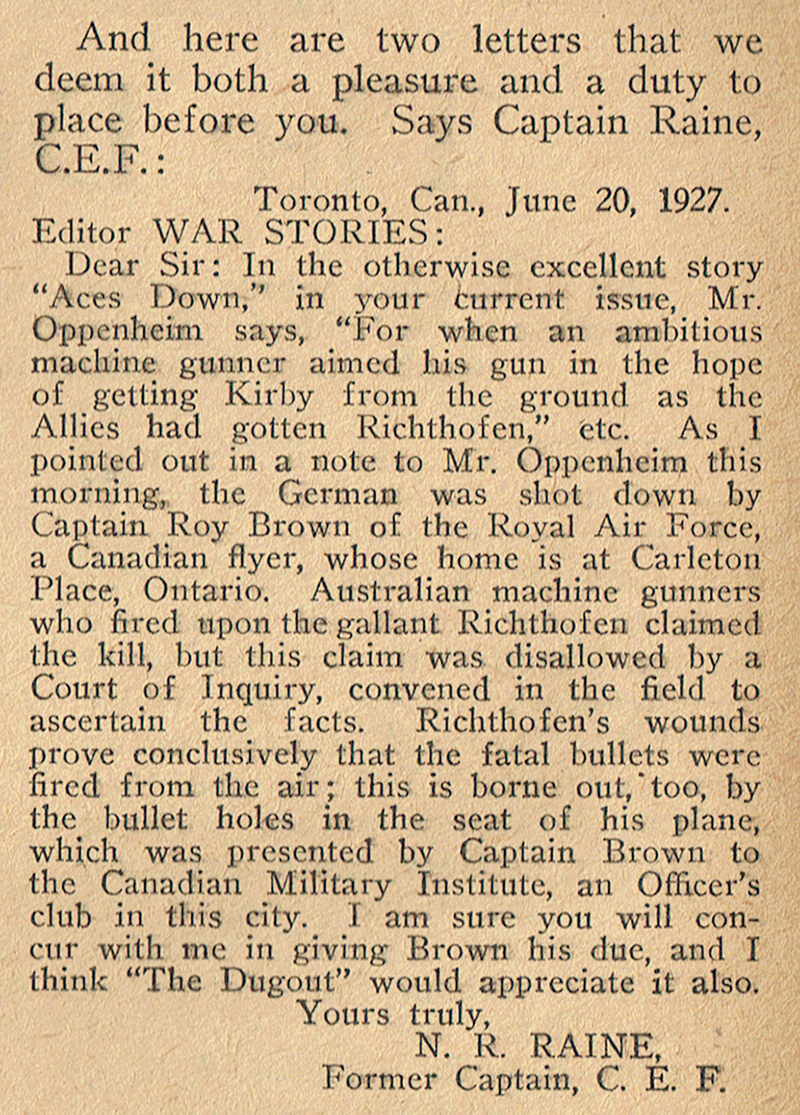
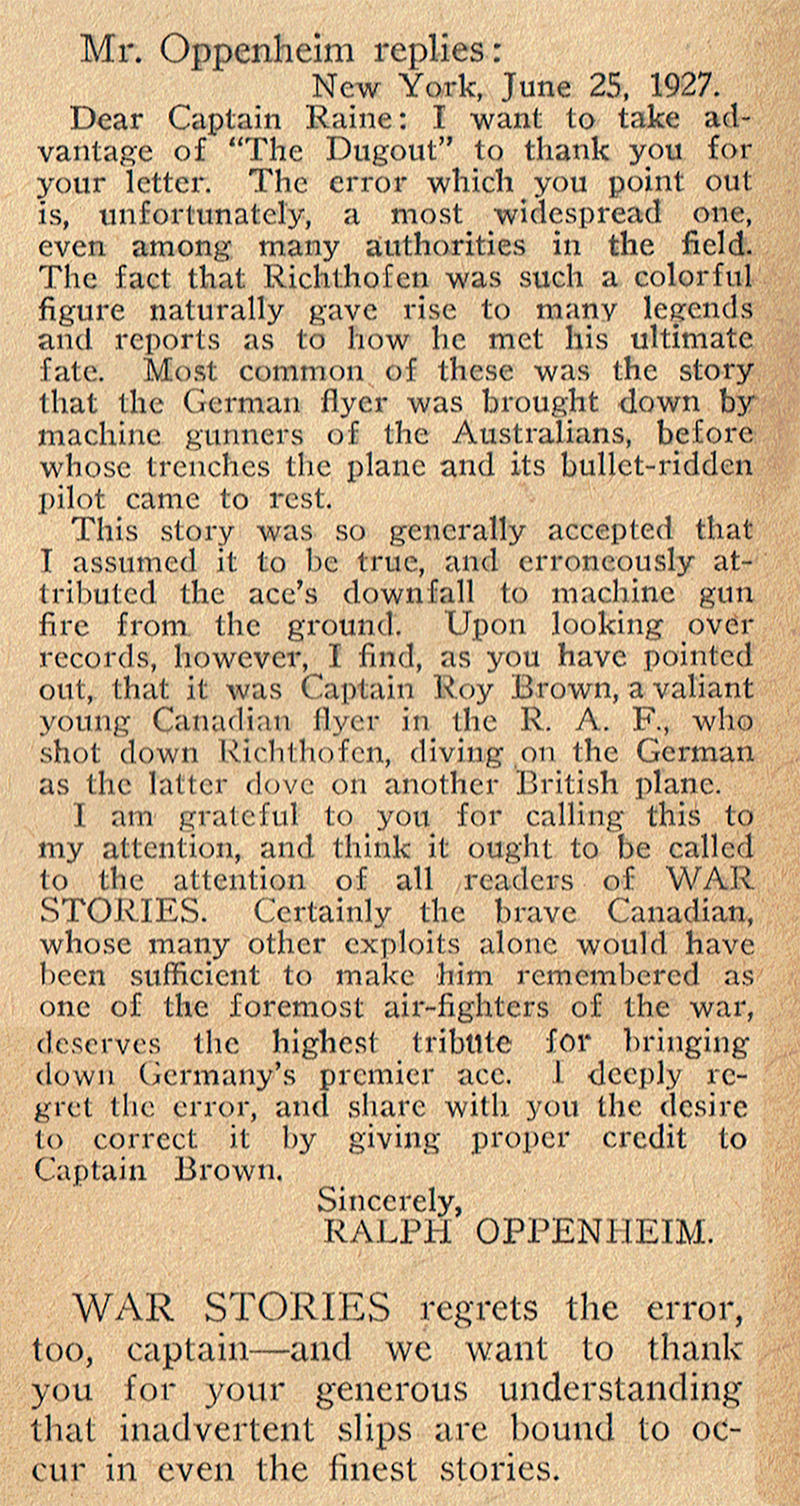
Let’s get things off the ground with what was believed to have been the first flight of the Three Mosquitoes. I say believed because according to both Robbin’s Index and the online FictionMags Index run by Contento and Stephensen-Payne, “High Diving” is listed as the first appearance of Oppenheim’s inseparable trio. However, a letter in “The Dugout” section of the August 19th, 1927 issue of War Stories features a letter about a previously published Oppenheim story in the July 1927 War Stories which apparently features a character named Kirby. Now I don’t know for certain since I haven’t seen the issue, but it seems highly likely that that story, “Aces Down,” may be the first Three Mosquitoes story, and not “High Diving.”

Exhibit A: The letter by Captain N.R. Raine, C.E.F. in the letters column of the August 19th, 1927 issue of War Stories.

And the response from Mr. Oppenheim himself!

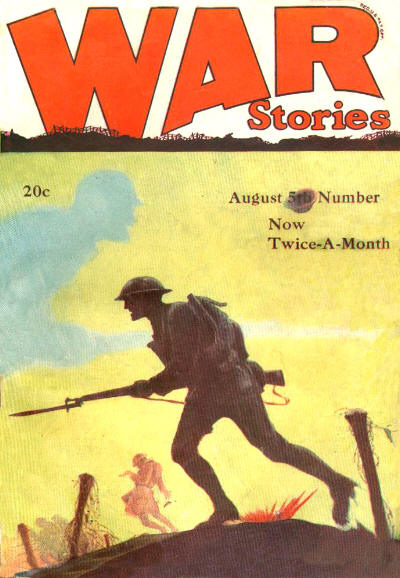
With that cleared up, It’s on with this week’s adventure—When Kirby answers the C.O.’s phone, he neglects to tell him of big Hun doings over towards Dubonne. He’s hoping to keep this info to himself in hopes the “Black Devil” would be there and the Three Mosquitoes would hopefully put an end to his reign of sky tyranny. Who is the Black Devil you ask? Nobody knew just who the Black Devil was. The mystery which shrouded his name made him all the more impressive. They only knew that he was a lone scout flier, who sat in a black Fokker and, appearing in the midst of a dog-fight out of God knows where, picked off the Allied pilots one after another, like flies. This alone would have been enough to make Kirby want to get him, but he had an even more personal reason. The Black Devil was the only man, though Kirby wouldn’t openly admit it, who had ever shot him down!

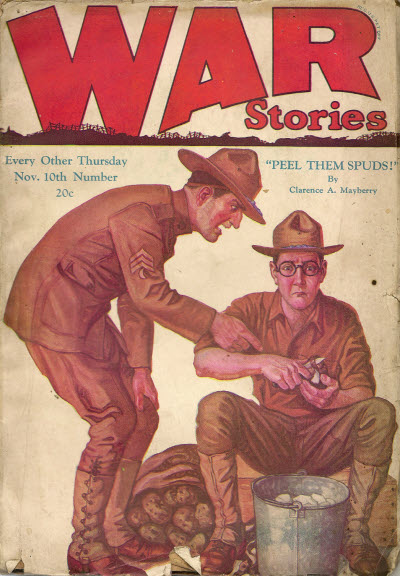
From the pages of the August 5th, 1927 War Stories, it’s Ralph Oppenheim’s The Three Mosquitoes in “High Diving!”

It was against orders, but Kirby and his pals weren’t worrying about that. They wanted to meet that big German formation—and Kirby wanted to give battle to the “Black Devil,” the famous German Ace. A splendid flying story.

And check back next Friday when the inseparable trio will be back with another exciting adventure!

“Mannock, The Mad Major!” by Paul Bissell

Link - Posted by David on March 1, 2021 @ 6:00 am in

THIS week we present another of Paul Bissell’s covers for Flying Aces! Bissell is mainly known for doing the covers of Flying Aces from 1931 through 1934 when C.B. Mayshark took over duties. For the December 1932 cover Bissell put us right in the action as Major Edward Mannock gives his all

Mannock, the Mad Major!

th_FA_3212FROM the war have come many nicknames which have since been applied rather freely to others besides those who originally earned them. “Crashing Colonels,” “Red Barons,” etc., are now commonplace, and to definitely determine the originals of these titles is almost impossible. However, there is one man, who, if we judge by the consensus of opinion in those places where airmen gather, enjoys his soubriquet without argument or question.

He was a man who started the war as a prisoner of the enemy, was repatriated because of defective eyesight, and lived to prove his eyes the most deadly, searching, and accurate of those of all the airmen who flew for the British, while his irrepressible humor and daredevil recklessness earned for him the name of the “Mad Major.”

On May 7, 1917, the failure of Captain Ball to return from a patrol held the attention of the Allied world. On the same day, unnoticed, the reports show the destruction of an enemy balloon by a Lieutenant Edward Mannock of Squadron 40. No one cried, “The King is dead, long live the King!” Yet well they might have, for this was the first victory of “Micky” Mannock, the “Mad Major,” one of the mysteries of the World War.

Micky, who was to tear through the skies of France like a thunderbolt, leaving a trail of victories surpassing even Captain Ball’s. Micky, who was to become Britain’s ace of aces, with 73 planes to his official credit, and who was to die, known only to his comrades, unfeted and unsung, with only an M.C. as a decoration from his country.

To be sure, the D.S.O. was going through at the time, and posthumously two bars and the V.C. were finally awarded, but even to this day this great ace is little known to the public at large, and it is difficult to learn a great deal about him.

Mannock’s comrades knew that he had been imprisoned by the Turks at the beginning of the war. He had been repatriated, and enlisted at once with the British, serving first with the R.A.M.C., then with the engineers in France, and coming finally to Squadron 40 in April, 1917.

It was soon evident that he was a Hun-hater, one of the few among all the aces. He was not the sportsman type, to whom war was just a game with death as the stake. Nor was he the hunter type, seeking only the joy of the kill. To him the war was “open season” on Germans, and he was out to exterminate them as he would rats or other vermin. He asked no quarter nor gave any, and yet his irrepressible sense of humor and love of a joke was constantly bobbing up.

He it was who, after failing for several days to get the Germans to engage him in battle, dropped a pair of boots on their airdrome with the note attached, “If you won’t come up and fight, maybe you can use these on the ground.”

With his M.C. came his captaincy, and he was made squadron commander. He was older than most aces, being thirty at his death, and he was noted for the care he took of his “new” men. He watched over them carefully, and tried to arrange it so that they would get a victory the first time over. Failing this, he would take them out alone and, finding their victim, he would maneuver the German into a good position for the new pilot’s fire. Then, making sure by a few bursts from his own guns, he would return to the drome, where he would enthusiastically congratulate the fledgling on getting his first German. It is said, in fact, that more than one ace-to-be had his first victory handed him by Micky.

IT IS told, also—and this story is pictured on this month’s cover—that on one of these excursions he gave the mud-covered Tommies in the trenches the thrill of their lives. He and his fledgling had spotted their victim and after some maneuvering Micky had finally forced the German into a position for his youngster to make the kill.

At this instant from the clouds dropped a red Albatross—motors on, and its-tracers already reaching hungrily for the new pilot below. A yank of the stick and Micky had thrown himself square into the line of the Albatross’ fire to save his companion. Bullets crashed through his cockpit and seared holes in his wings, but the German’s dive had been headed off, and a moment later, coming out of a mad vrille, the little S.E.5’s nose was square on the red tail with the black cross.

The Vickers rattled, and the German sped on down to pile up in a trench, while Micky turned back to the battle above. The youngster had failed to get his opponent at the first burst, and the more experienced German by clever flying had gotten himself into a good position for attacking the kid pilots.

However, seeing Micky return to the fray, the German decided to run for it, and turned toward Germany, but little did he know his opponent. The Irishman seemed to go wild. He flung his little S.E.5 after the fleeing Boche and quickly overtook him. Then, to the astonishment of those who watched below, Micky held his fire. Steeply he dived in from the side, forcing the German to turn. But again the Vickers were silent. Apparently the German decided that Micky’s guns were jammed, for he made a desperate attempt to turn to the attack.

Immediately, however, the twin Vickers spoke, spitting hot lead, and forcing him to swing back around. Then to the watching Tommies the game became evident. Like a cat with a mouse the Irishman was playing with the German. Slowly he was forcing the Albatross down.

Lower and lower they came. They were scarcely 100 feet up, and below them was the wrecked remains of the first plane, when suddenly the twin Vickers began chattering. The desperate Jerry swung right and left, only to be met by the deadly hail of bullets from the S.E.’s gun. Then one last burst and those below saw the German jerk from his seat, clawing the air madly in his death agony as his plane crashed, its wings touching the wreckage of the first Albatross.

Two more for Micky! No wonder they called him the Mad Major! And so it went, until, on a similar expedition in July, a machine-gun bullet from the ground found him. At least that’s one version. A second story says that he crashed a German to save one of his fledglings. It was another mystery, but the fact remains that no more would his comrades see him tuck his violin under his chin, and while they sat enthralled, play, “Where My Caravan Has Rested.” For the Mad Major had led his last caravan home.

The Ships on The Cover
“Mannock, The Mad Major!”
Flying Aces, December 1932 by Paul J. Bissell

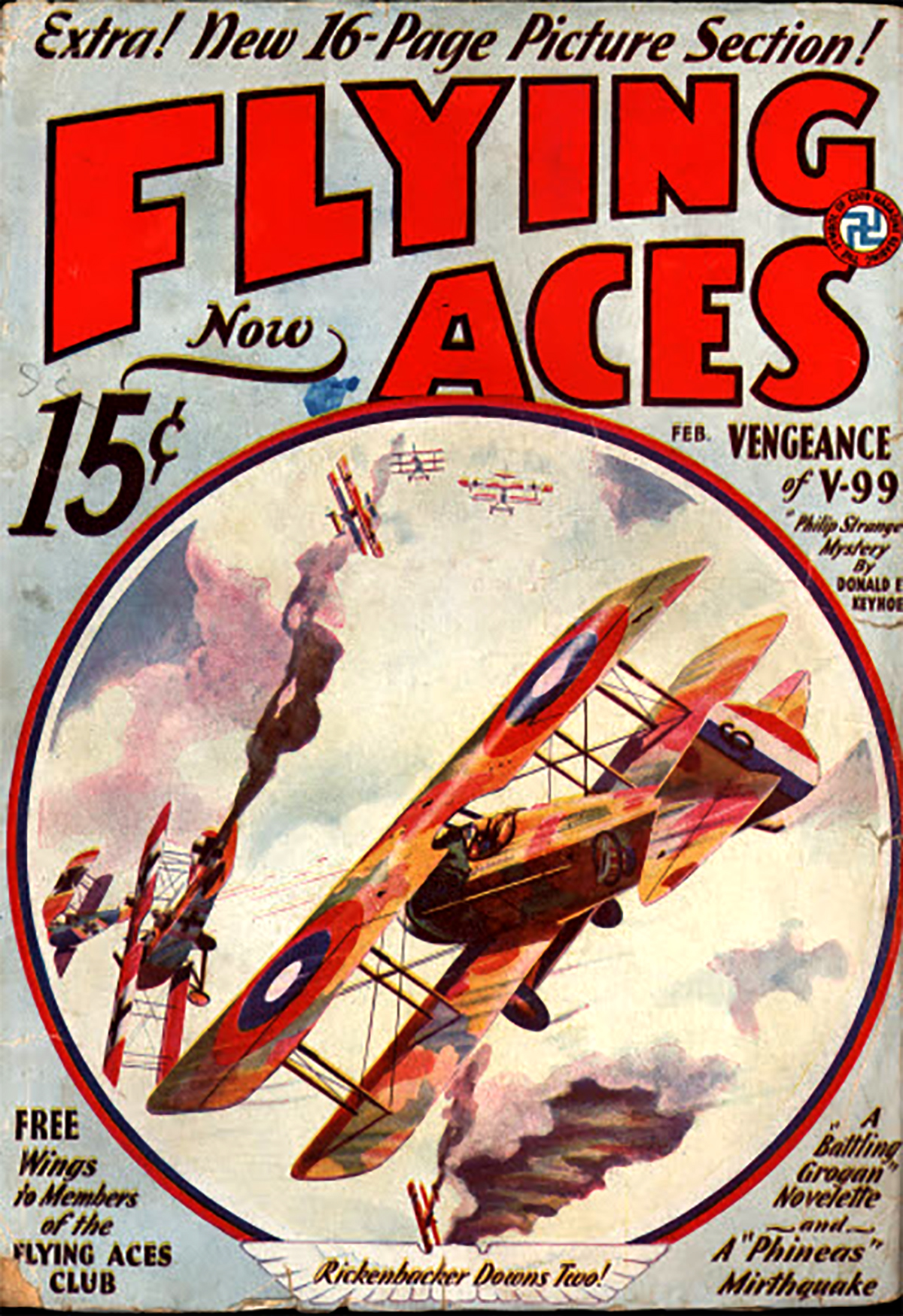
“Rickenbacker Downs Two” by Paul Bissell

Link - Posted by David on February 28, 2021 @ 6:00 am in

THIS week we present another of Paul Bissell’s covers for Flying Aces! Bissell is mainly known for doing the covers of Flying Aces from 1931 through 1934 when C.B. Mayshark took over duties. For the February 1933 cover Bissell put us right in the action as

Rickenbacker Downs Two

th_FA_3302“Sure he can fly, I’ll hand him that. But what’s the idea of making us hang around on the ground? We don’t come to this flyin’ school nowadays to watch exhibition flyin’.”

“Oh, well, some guys get all the gravy,” and the speaker petulantly kicked a hole in the turf of the flying field. “Probably he’s somebody’s bright boy whose daddy gave him his own plane. Pretty soft, I call it. What do you say, Sarge?”

The man thus addressed was much older than the students and was evidently in charge of them. He was a hard-bitten mechanician and evidently an ex-army man.

“Soft!” he exclaimed scornfully. “You damned babies make me sick. Say, don’t you know who that guy was?”

“I don’t see that it matters a damn who he was,” spoke up one youngster. “We’re here to learn to fly and—”

“Oh, you don’t, don’t you?” and this time the sergeant’s voice was hard. “Well, get this, youngster. There are certain men who’ve done things for their country that you can’t pay for in dollars and cents, see? You—and I mean everybody in the country—can just try to give them a little courtesy and special treatment whenever you get a chance to, and be damned glad for the chance.

“If we was in the army, you know what I’d ’a’ done, don’t you? I’d ‘a’ marched every damned one of you out on that field and kept you at attention the whole time he was here so that the next time you’d know a good man when you saw him. Say, don’t you guys know who that feller was?” The sergeant’s tone was one of complete exasperation that such ignorance could exist.

“No? Then listen, buzzards. I’m goin’ to tell you a true bedtime story. Once upon a time when you babies were still wearing didies there was a war. Maybe you never heard of it, what with peace societies and all those sort of things these days, but, everything considered, it was quite a little war at that. Now I was sort of young and foolish about then, and seeing a nice poster displayed ’bout how you could join the air service and learn to fly, I goes in and lets them take my fingerprints. I guess that was a mistake. They must’ve read my palm or something at the same time and decided I was an advance model of you birds and never would learn to fly, so they didn’t even try to teach me. But anyway, they sent me over with a squadron to see that the Frogs didn’t get any vin rouge by mistake into the gas tanks ’stead o’ gas.

“The outfit I finally pulls up with was the 94th Squadron. I s’pose you ain’t never heard of the 94th, eh? Guess they just omitted mentionin’ that at your schools. Well, believe me, the Germans knew about the 94th, and when they saw a ship with old Uncle Sam’s hat with a ring around it painted on the sides, they knew that hell was going to be poppin’ loose in just about a minute. That was the first real Yank squadron to cross the Front. Ninety-one Germans they got before the show was over. Americans, every damned one in the 94th. And the guy that just went off in that limousine was the boy that led them through the last lap.

“PRETTY soft, you said, didn’t you, Buck?” And he spat scornfully to one side as he squinted at the embarrassed youngster in front of him. “Well, it wasn’t always soft. Once before I saw him come out on the field, sort of like today, only dif’rent. He was a captain then, and it wasn’t a limousine, but a damned poor motorcycle and side-car, with the corporal sittin’ in the side-car, holding on like he was in a rollercoaster, and the captain tearin’ across the field like he was tryin’ to hang up another speed record.

“It was the day he took charge of the squadron, and he was just hell bent to get up and get himself a Boche. We were just outside of Toul then, and the Germans were damned fresh in that sector, so he didn’t have to look very hard before he located two observation crates quietly gettin’ in their work with five Fokkers playin’ nurse to ’em up in the clouds. Right then the captain started climbin’. The old game—up into the sun.

“Maybe they would see him, and then maybe—well, anyway they didn’t. And he got just where he wanted to, sittin’ up on the last German’s tail with the sun square behind him.

“You ain’t ever seen a Spad dive, buddies, have you? Well, we used to call them the ‘flyin’ bricks’ over there, and when you turn one over on its nose and give her the gun, she moves so fast she damn near catches up with the bullets out of her own guns. And that’s the way the captain went down at that first German. The poor Fritzie didn’t have a chance. Here was the captain lettin’ both guns go, and comin’ down right behind the bullets themselves.

“The bullets must’ve beat the Spad a little, at that, ’cause the Fokker started spoutin’ smoke and slipped off sort of cockeyed, headin’ for the ground, just as the captain and his Spad dived by and right through the whole formation. Then a zoom, and he was back above them again, hangin’ on his prop, lookin’ them over. Fritzie must’ve thought there was another dozen or two comin’ behind him, because they got their wind up and broke.

“Quick as a flash the captain kicked his rudder over, shot his stick to neutral, and down he dropped like God’s judgment on the two L.V.G.s below. They saw him comin’, and the gunners were plenty ready for him, too. Hell’s bells, how they peppered him! I know, ’cause I helped to put the patches on when he got back. But none of those pills landed where it hurt, and before those Fritzies could turn or twist, he was past them, and zooming back for another crack at them.

“The other Jerries had got their nerve back by now and were divin’ in. It had to be a quick job, and the captain knew it. He slipped the bus off on a wing, and, holding her in the slip, slowly eased his nose around until he had both the two-seaters in range at the same instant. Then he cut loose, both guns pumpin’. You could see the tracers zippin’ through the air and buryin’ themselves in the Jerry machines.

“It was a queer spot the captain was in, and a couple of seconds was all he could hold it. But he had the Boche dead on the spot, and these seconds were plenty. The nearest ship tailed up and a couple of German aviators were just German heroes. The other Jerries seemed sort of discouraged, too. They weren’t crowdin’ any more, but had gone into a huddle around the photo-bus, and all were headin’ for the Vaterland.

“Gas and ammo were about out, so the captain came on in. Two minutes—two Germans. Not bad, eh? Well, he got twenty-five before that mess was over, and waded through a hundred bits of hell to get them.

“Soft!” The sergeant spat disgustedly into the dust again. “You birds weren’t close to him, were you? You didn’t see that little blue bar he wears with the silver stars on it? Well, you probably wouldn’t have recognized it, anyway. They ain’t many of them around. Maybe you don’t even know what it means—maybe you don’t know yet who the captain is. Well, remember this, ’cause after all, you’ve got to get over some o’ your dumbness and not be forever shootin’ off your mouth and showin’ your ignorance. That little blue bar is the Congressional Medal of Honor. Only two aviators in the whole war won it. One was Luke, the Balloon Buster. He’s dead, and can’t wear his. But the other man can, and he’s the guy that you birds called soft. He’s Eddie Rickenbacker, ex-captain of the Hat-in-the-Ring Squadron, and America’s ace of aces!”

The Ships on The Cover
“Rickenbacker Downs Two”
Flying Aces, February 1933 by Paul J. Bissell

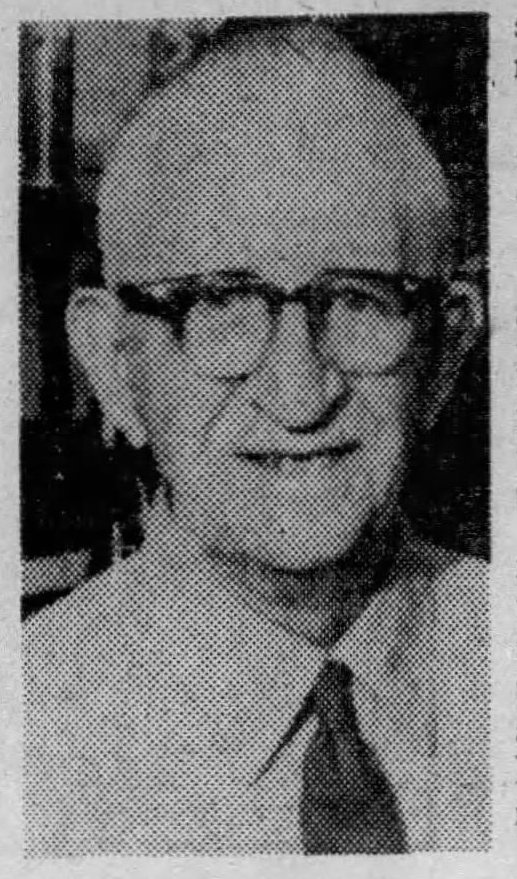
Harold Fraser Cruickshank (1893-1979)

Link - Posted by David on February 26, 2021 @ 6:00 am in

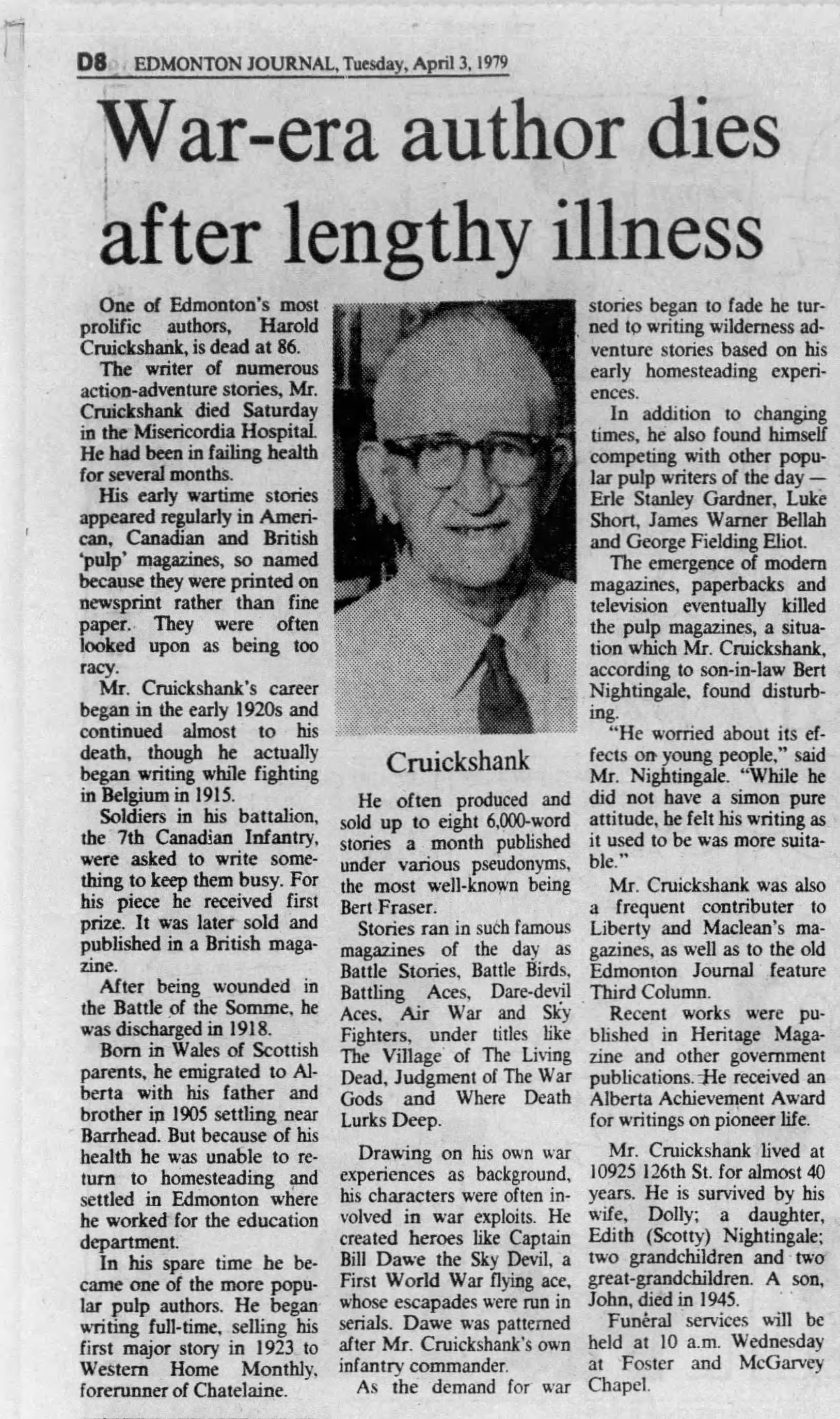
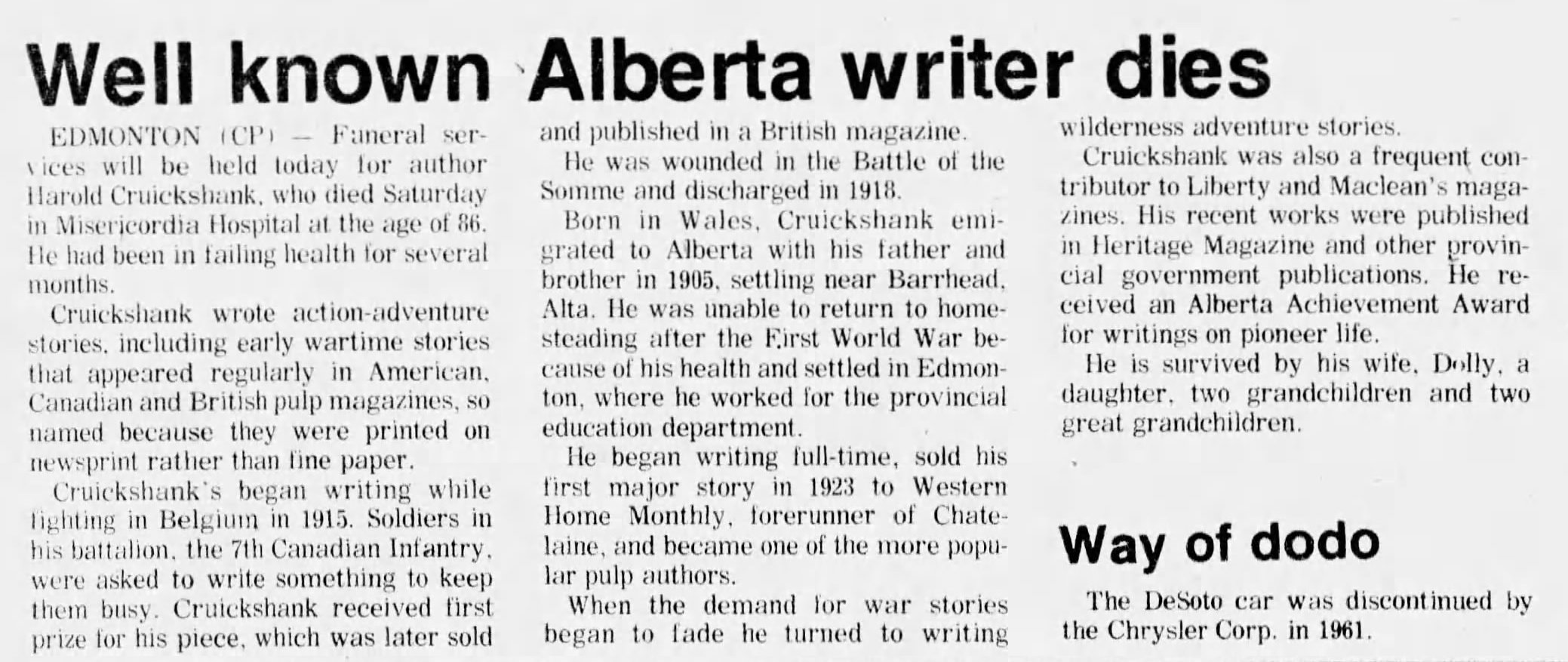
THIS month we’re spotlighting the work of Canada’s favorite son, Harold F. Cruickshank. We’ve had some good stories the past couple weeks spanning his pulp career. Unfortunately, like all great things, it must come to an end. And we’re ending our month devoted to Harold F. Cruickshank with his obituary.

In finding his obituary, we discovered that his lifespan as listed around the internet is wrong. He did not pass in 1965, but fourteen years later on March 31st, 1979—ten days after his 86th birthday!

So, without further ado—

War-era author dies after lengthy illness

Edmonton Journal, Edmonton, Canada • Tuesday, 3 April 1979, pD8

One of Edmonton’s most prolific authors, Harold Cruickshank, is dead at 86.

The writer of numerous action-adventure stories, Mr. Cruickshank died Saturday in the Misericordia Hospital. He had been in failing health for several months.

His early wartime stories appeared regularly in American, Canadian and British ‘pulp’ magazines, so named because they were printed on newsprint rather than fine paper. They were often looked upon as being too racy.

Mr. Cruickshank’s career began in the early 1920s and continued almost to his death, though he actually began writing while fighting in Belgium in 1915.

Soldiers in his battalion, the 7th Canadian Infantry, were asked to write something to keep them busy. For his piece he received first prize. It was later sold and published in a British magazine.

After being wounded in the Battle of the Somme, he was discharged in 1918.

Bom in Wales of Scottish parents, he emigrated to Alberta with his father and brother in 1905 settling near Barrhead. But because of his health he was unable to return to homesteading and settled in Edmonton where he worked for the education department.

In his spare time he became one of the more popular pulp authors. He began writing full-time, selling his first major story in 1923 to Western Home Monthly, forerunner of Chatelaine.

He often produced and sold up to eight 6,000-word stories a month published under various pseudonyms, the most well-known being Bert Fraser.

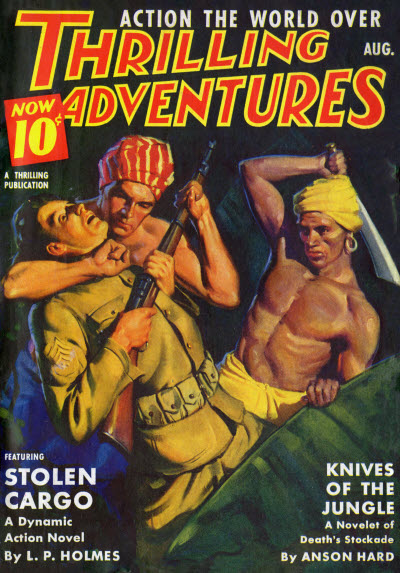
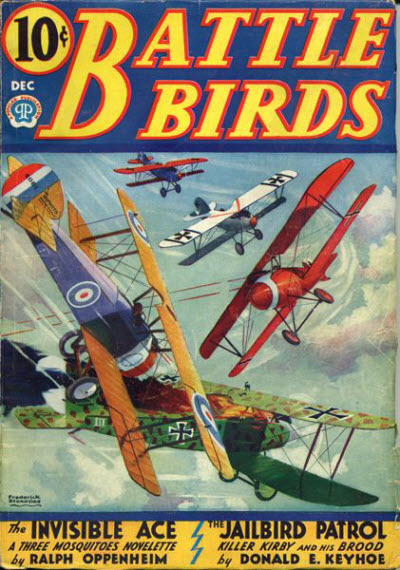
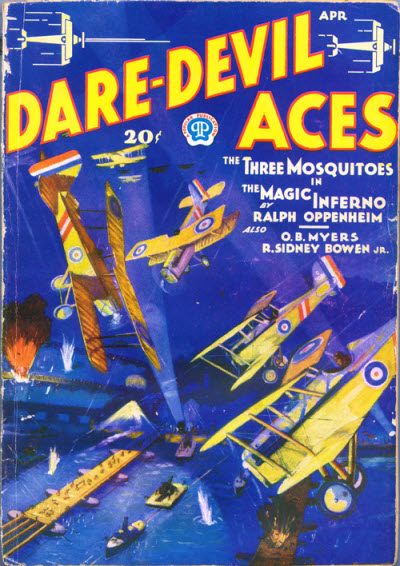
Stories ran in such famous magazines of the day as Battle Stories, Battle Birds, Battling Aces, Dare-devil Aces, Air War and Sky Fighters, under titles like “The Village of The Living Dead,” “Judgment of The War Gods” and “Where Death Lurks Deep.”

Drawing on his own war experiences as background, his characters were often involved in war exploits. He created heroes like Captain Bill Dawe the Sky Devil, a First World War flying ace, whose escapades were run in serials. Dawe was patterned after Mr. Cruickshank’s own infantry commander.

As the demand for war stories began to fade he turned to writing wilderness adventure stories based on his early homesteading experiences.

In addition to changing times, he also found himself competing with other popular pulp writers of the day — Erie Stanley Gardner, Luke Short, James Warner Bellah and George Fielding Eliot.

The emergence of modem magazines, paperbacks and television eventually killed the pulp magazines, a situation which Mr. Cruickshank, according to son-in-law Bert Nightingale, found disturbing.

“He worried about its effects on young people,” said Mr. Nightingale. “While he did not have a simon pure attitude, he felt his writing as it used to be was more suitable.”

Mr. Cruickshank was also a frequent contributor to Liberty and Maclean’s magazines, as well as to the old Edmonton Journal feature Third Column.

Recent works were published in Heritage Magazine and other government publications. Tie received an Alberta Achievement Award for writings on pioneer life.

Mr. Cruickshank lived at 10925 126th St. for almost 40 years. He is survived by his wife, Dolly; a daughter, Edith (Scotty) Nightingale; two grandchildren and two great-grandchildren. A son, John, died in 1945.

Funeral services will be held at 10 a.m. Wednesday at Foster and McGarvey Chapel.

“Wild King Savagery” by Harold F. Cruickshank

Link - Posted by David on February 24, 2021 @ 6:00 am in

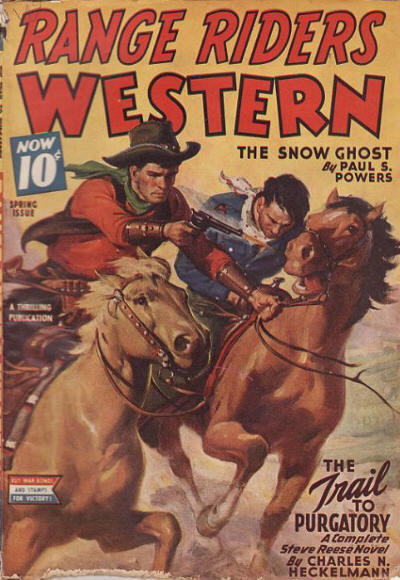
WE’RE celebrating the works of Canada’s very own Harold F. Cruickshank this month. Mr. Cruickshank launched his career writing stories based loosely on his war experiences. As tastes turned from straight out battle field stories to air war stories, Cruickshank shifted his setting from the trenches to the cockpit. After the Second World War, taste again shifted toward westerns, Cruickshank was right there cranking them out for magazines like 10 Story Western Magazine, Western Short Stories, Texas Rangers, Dime Western, Popular Western, Thrilling Western, New Western Magazine, Wild West Weekly, North-West Romances, Thrilling Ranch Stories, Big Book Western, Rodeo Romances, .44 Western, West, Exciting Western, and Range Riders Western!

Cruickshank wrote 35 stories chronicling the trials and tribulations of Dal and Mary Baldwin carving out their piece of the Wild West in Sun-Bear Valley, Wyoming. Cruickshank was born in Wales and emigrated to Alberta with his father and brother in 1905, establishing a homestead when they settled near Barrhead. Ill health would drive him off the farm when he returned and into Edmonton where he worked for the education department and wrote in his spare time. Cruickshank drew on those years on the farm for his Pioneer Folk stories for Range Riders Western.

Here are the first two in the series:

First we have “Wild King Savagery” from the Spring of 1945 issue in which Dal and his wife find the ideal place to start their life in the wilds of Sun Bear Valley. A perfect spot with everything they could want including the most magnificent wild stallion Dal had ever seen—and a half-breed horse thief who wants to catch it.

Dal Baldwin and His Young Wife Face Bitter Hardships as They Strive to Carve a Home for Themselves Out of the Wilderness!

Cruickshank followed this up with “Challenge of the Wilds” from the Summer issue. Dal and Mary try to get everything in order at their homestead before winter comes when tragedy strikes!

Dal and Mary Baldwin Face Disaster When Their Horse Dies and Their Traps Are Robbed—but Their Courage Lives on!

A listing of Harold F Cruickshank’s PIONEER FOLK stories.

title magazine date vol no
1945
Wild King Savagery Range Riders Western Spr 13 1
Challenge of the Wilds Range Riders Western Sum 13 2
Spring Borning Range Riders Western Fal 13 3
Red Harvest Range Riders Western Dec 14 1
1946
Terror Neighbors Range Riders Western Feb 14 2
Wilderness Justice Range Riders Western Apr 14 3
Squatter’s Law Range Riders Western Jun 15 1
Wild Hoof Warfare Range Riders Western Aug 15 2
The Valley Beyond Range Riders Western Nov 15 3
1947
Stampede Conquest Range Riders Western Jan 16 1
Frontier Courage Range Riders Western Mar 16 2
Wild King Savagery Range Riders Western May 16 3
Death Loops a Widelooper Range Riders Western Jul 17 1
Satan Tugs the Jerkline Range Riders Western Sep 17 2
Hell and High Water Range Riders Western Nov 17 3
1948
Good Neighbor Gunfire Range Riders Western Jan 18 1
Frontier Timber Wolves Range Riders Western Mar 18 2
The Devil’s Eye Range Riders Western May 18 3
Courage in the Craglands Range Riders Western Jul 19 1
Death Rides the Freight Trail Range Riders Western Sep 19 2
Satan Dabs a Wide Loop Range Riders Western Nov 19 3
1949
Drum Thunder Range Riders Western Jan 20 1
Showdown Range Riders Western Mar 20 2
Satan’s a Bad Neighbor Range Riders Western May 20 3
Wild Hoof Battle Loot Range Riders Western Jul 21 1
Satan’s Shroud of Death Range Riders Western Sep 21 2
Tough Test Range Riders Western Nov 21 3
1950
According to Colt Range Riders Western Mar 22 2
Rescue Range Riders Western May 22 3
The Scars of Victory Range Riders Western Aug 23 1
Backfire Range Riders Western Oct 23 2
Cupid Packs a Gun Range Riders Western Dec 23 3
1951
Buckaroo Bridge Gang Range Riders Western Feb 24 1
Dauntless the Pioneer Range Riders Western Apr 24 2
1952
Phantom Hoofbeats Range Riders Western Jan 25 3


“Wolf Worship” by Harold F. Cruickshank

Link - Posted by David on February 22, 2021 @ 6:00 am in

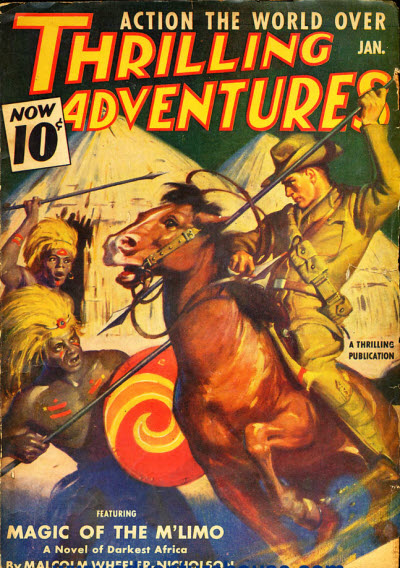
WE’RE celebrating the works of Canada’s very own Harold F. Cruickshank this month. One of the most successful series of animal wilderness stories Cruickshank produced was the “White Phantom” series which primarily ran in the pages of Thrilling Adventures and West magazines.

Olak, the White Phantom, is an extraordinary wolf. He is large, handsome and is an albino. Because of his unusual coloring, the superstitious natives, Indians, think of him as allied with the spirit world and as such influences their hunting, the weather elements, famine conditions and so forth.

In the January 1940 issue of Thrilling Adventures, Tuc Cramer’s brother-in-law Tan goes searching for his lost friend Sa, son of Olak, the great White Phantom wolf king of Nahanni. Along the way he finds himself in the next valley over where the strange tribe there worships Olak-Achak—and about to be sacrificed to the spirit of the White Phantom!

Tan, the Indian Youth, Follows the Trail of the Son of the White Phantom!

As a bonus, here’s an article Cruickshank wrote about writing his animal stories that ran in the pages of the October 1944 issue of Writer’s Digest!

“The Fangs of Otan” by Harold F. Cruickshank

Link - Posted by David on February 19, 2021 @ 6:00 am in

WE’RE celebrating the works of Canada’s very own Harold F. Cruickshank this month. As the winds of war swept across Europe, Cruickshank continued to crank out aviation stories for the pulps, but he also started to write animal stories. These stories proved to be very popular in the pages of western and adventure magazines.

Otan, a proud she-cougar, fights to save her precious liter of three cubs from the likes of Yeepek, a great bald eagle, and Mishi, a sour-tempered old barren she-grizzly! From the August 1939 Thrilling Adventures, it’s “The Fangs of Otan!”

A She-Cougar Fights for Life and Safety in the Untracked Wilds!

“The Red Eagle” by Harold F. Cruickshank

Link - Posted by David on February 16, 2021 @ 6:00 am in

WE’RE celebrating the works of Canada’s very own Harold F. Cruickshank this month. Mr. Cruickshank launched his career writing stories based loosely on his war experiences. As tastes turned from straight out battle field stories to air war stories, Cruickshank shifted his setting from the trenches to the cockpit. With stories appearing in such titles as War Birds, War Aces, Sky Birds, Airplane Stories, Flying Aces, and Sky Fighters.

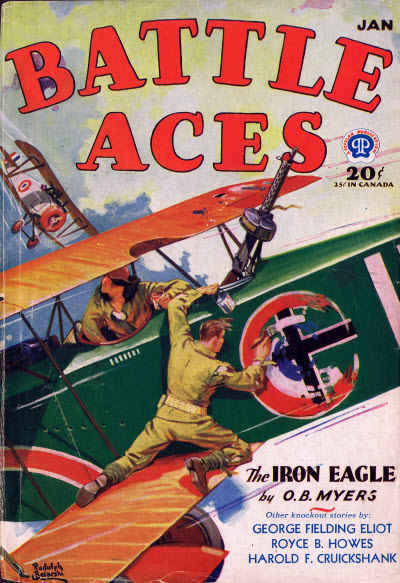
For Harry Steeger’s trio of Popular Publication’s titles—Battle Aces, Dare-Devil Aces and Battle Birds—Mr. Cruickshank developed continuing characters that ran generally in short novelettes each month. Although the final issue of Battle Aces had just hit the stands in November of 1932, Cruickshank created a brand new series when asked to for the new companion magazine to Dare-Devil Aces—Battle Birds in December 1932.

In “The Red Eagle,” Cruickshank gives us Ted Blair—a Yank Eagle who excelled more than any other with fighting guts and his ability to maneuver in tight loops and slip-offs which amazed and baffled his opponents. His eye was quick, as quick as the flash of greased lightning, and his Vickers twins were deadly accurate. In the dive he was merciless; he struck like a hungry, angered eagle, hence his nom de guerre, Red Eagle. That, and because of his flaming red hair and freckled spotted face.

Cruickshank gave him a brood much like the Sky Devil’s—formed from his old B Flight of the 44th, Blair had played with, fought with, nursed, and built up those members of the Brood—Lieutenant Sam Martin, the tall, blond deputy leader; Lieutenant Pete Monty Rider, the hard-egg scrapper from America’s ranch country; Lieutenant Frank “Spud” Fallon, the Irish-Yank, whose wit was no less appreciated than his fighting quality, and his flair for fixing things mechanical; and Lieutenant Dave “Babe” Deakin, the big-framed ex-fullback of Yale, a good-natured fighting hellcat, whose piano playing and singing, though of secondary importance, brought a big hand from his intrepid pals. They were all men of guts. Each wore a single decoration. Each packed an unswerving brand of loyalty and a fighting heart. These were the Red Eagle’s Brood—big-chested, rollicking sky scrappers, who feared nothing, save the tongue of their leader.

The Red Eagle and his Brood were established as an semi-independent flight under the command of Major Bruce Grove. Unfortunately, Grove had his own problems—a splendid fellow in every way, he had jeopardized his position some months back by taking the rap for a wrong done by one of his former flights. He knew that if he rode just once over a Wing order, his term of command was done. Bruce Grove was, literally, on the spot and Wing was ready to get him. Bill Mond, the surgeon, knew this. Ted Blair, the Eagle skipper knew it too.

With all that in mind, we present The Red Eagle’s self-titled premier outing from the December 1932 issue of Battle Birds!

Zeps stalked above; from below a flight of super-Fokkers zoomed, Spandaus snarling. But the Red Eagle led his devil’s brood straight on; like monster bird killers they dived straight for the staffle of Death, determined to slash a gap through this hell trap—or meet their doom fighting!

A listing of Harold F. Cruickshank’s RED EAGLE stories.

title magazine date vol no
1932
The Red Eagle Battle Birds Dec 1 1
1933
The Iron Eagle Battle Birds Jan 1 2
The Phantom Staffel Battle Birds Feb 1 3
The Masked Buzzard Battle Birds Mar 1 4
The Gray Phantom Battle Birds Apr 2 1
The Black Skull Staffel Battle Birds May 2 2
The Red Death Battle Birds Jun 2 3
Hellion’s Brood Battle Birds Jul 2 4
The Coffin Ace Battle Birds Aug 3 1
The Buccaneer Flight Battle Birds Sep 3 2
The Hell Busters Battle Birds Oct 3 3
Dodoes from Hell Battle Birds Nov 3 4
The One-Eyed Squadron Battle Birds Dec 4 1
1934
Storm Eagles Battle Birds Jan 4 2
Mad Shark of Prussia Battle Birds Feb 4 3
Staffel of Skulls Battle Birds Mar 4 4
Squadron of Lost Men Battle Birds Apr 5 1
The Bloodhound Patrol Battle Birds May 5 2
Tiger Patrol Battle Birds Jun 5 3
Dynamite Busters Dare-Devil Aces Oct 8 3
The Bloodhound Flight Dare-Devil Aces Dec 9 1
1935
The Black Comet Dare-Devil Aces Apr 10 1
Gunpowder Eagles Dare-Devil Aces Jul 10 4
The Vampire Flight Dare-Devil Aces Dec 12 1


“Sky Devil’s Trap” by Harold F. Cruickshank

Link - Posted by David on February 12, 2021 @ 6:00 am in

WE’RE celebrating the works of Canada’s very own Harold F. Cruickshank this month. Mr. Cruickshank launched his career writing stories based loosely on his war experiences. As tastes turned from straight out battle field stories to air war stories, Cruickshank shifted his setting from the trenches to the cockpit. With stories appearing in such titles as War Birds, War Aces, Sky Birds, Airplane Stories, Flying Aces, and Sky Fighters.

For Harry Steeger’s trio of Popular Publication’s titles—Battle Aces, Dare-Devil Aces and Battle Birds—Mr. Cruickshank developed continuing characters that ran generally in short novelettes each month. Following on from the success of The Sky Wolf in Battle Aces, Cruickshank was asked to develop a series for the newly premiered sister magazine, Dare-Devil Aces. For Dare-Devil Aces, Cruickshank developed his best known war hero—the rough and tumble Captain Bill Dawe—The Sky Devil! Cruickshank based Bill Dawe on his own infantry commander from WWI.

There was no better flight in France than the Sky Devil and his Brood. Led by Captain Bill Dawe, the famous Yank ace known to all of France as the Sky Devil, the brood consisted of Chuck Verne, Mart Bevin, Slim Skitch and Slug Walton. The crimson devil insignia on their silver Spads brought fear to any German pilot unlucky enough to meet them in the air. But the Sky Devil’s greatest enemy might just be his own C.O., Major Petrie, who had been railroaded into command of 120 Squadron over Dawe’s head. Jealous of Dawe’s popularity, Petrie will do anything to bring down the Sky Devil and his Brood!”

Sky Devil flew through the Hell Skies of 29 adventures in the pages of Dare-Devil Aces from 1932-1935. Cruickshank returned to the savior of the Western Front in six subsequent stories several years later. The first two were in the pages of Sky Devils (June 1939) and Fighting Aces (March 1940). The other four ran in Sky Fighters (1943-1946) where he was aged up and moved to the Second World War where Bill Dawe changes his name to get into the air service and flys along side his son!

Here we present The Sky Devil’s premier outing from the April 1932 issue of Dare-Devil Aces, it’s “Sky Devil’s Trap!”

Swiftly those Yank bombers ripped in, blasting that fake staffel to hell. They didn’t see the Fokkers swinging down from above; didn’t guess they were cold meat—snared in a blood trap from which only the yammering guns of one doomed sky devil could hope to snatch them.

Here is a listing of Harold F. Cruickshank’s SKY DEVIL stories.

title magazine date vol no
1932
Sky Devil’s Trap Dare-Devil Aces Apr 01 02
The Green Devils Dare-Devil Aces Jul 02 01
Hell’s Skipper Dare-Devil Aces Sep 02 03
The Sky Devil’s Brood Dare-Devil Aces Oct 02 04
Killer’s Drome Dare-Devil Aces Nov 03 01
The Sky Tiger Dare-Devil Aces Dec 03 02
1933
Captain von Death Dare-Devil Aces Jan 03 03
The Flaming Ace Dare-Devil Aces Feb 03 04
Sky Devil’s Trap Dare-Devil Aces Mar 04 01
The Haunted Fokker Dare-Devil Aces Apr 04 02
Buzzards’ Brand Dare-Devil Aces May 04 03
Torpedo Buzzards Dare-Devil Aces Jun 04 04
The Bat Patrol Dare-Devil Aces Jul 05 01
Hell Buzzards Nest Dare-Devil Aces Aug 05 02
The Sky Cobra Dare-Devil Aces Sep 05 03
The Outlaw Ace Dare-Devil Aces Oct 05 04
Ace of Devils Dare-Devil Aces Nov 06 01
Skeleton’s Drome Dare-Devil Aces Dec 06 02
1934
The Sky Pirates Dare-Devil Aces Jan 06 03
Staffel of Hate Dare-Devil Aces Feb 06 04
The Flaming Vulture Dare-Devil Aces Mar 07 01
No-Man’s Squadron Dare-Devil Aces Apr 07 02
The Storm Buzzard Dare-Devil Aces May 07 03
The Derelict Patrol Dare-Devil Aces Jun 07 04
Staffel of Skeletons Dare-Devil Aces Jul 08 01
Graveyard Staffel Dare-Devil Aces Sep 08 02
1935
The Stratosphere Patrol Dare-Devil Aces Feb 09 03
The Undersea Buzzard Dare-Devil Aces Jun 10 03
Staffel of Dead Men Dare-Devil Aces Sep 11 02
1939
Wings of the Brave Sky Devils Jun 01 06
1940
A Torch for the Damned Fighting Aces Mar 01 01


When Cruickshank brought The Sky Devil back in the 40’s for Sky Fighters, he moved his theater of operations from the First World War to the Second World War. Older, more reckless and enlisted under false pretenses, he’s fighting the good fight and watching out for his son as well!


1943
Sky Devil and Son Sky Fighters Jan 28 02
Return of the Sky Devil Sky Fighters Mar 28 03
1946
Settlement in Full Sky Fighters Win 33 01
Sky Route to Hell Sky Fighters Spr 33 02


We’ve collected and published all 29 of The Sky Devil’s stories from Dare-Devil Aces into two volumes—Hell’s Skipperand Ace of Devils! In addition, we’ve posted many of the post-Popular stories on the site here (just click on the “Sky Devil” tag below). The books can be picked up through the usual sources—Adventure House, Mike Chomko Books and Amazon!

How the War Crates Flew: Airplane Cooperation with the Artilary

Link - Posted by David on February 9, 2021 @ 6:00 am in

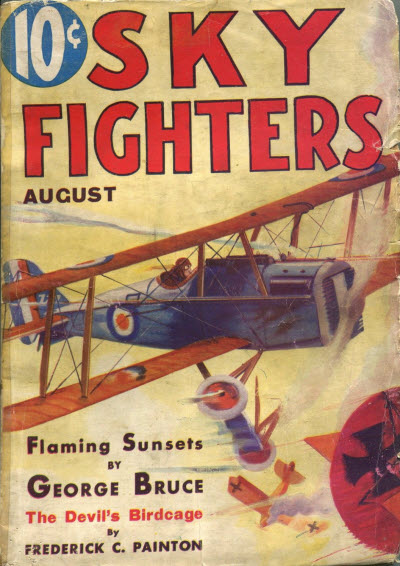
FROM the pages of the August 1932 number of Sky Fighters:

Editor’s Note: We feel that this magazine has been exceedingly fortunate in securing R. Sidney Bowen to conduct a technical department each month. It is Mr. Bowen’s idea to tell us the underlying principles and facts concerning expressions and ideas of air-war terminology. Each month he will enlarge upon some particular statement in the stories of this magazine. Mr. Bowen is qualified for this work, not only because he was a war pilot of the Royal Air Force, but also because he has been the editor of one of the foremost technical journals of aviation.
Airplane Cooperation With the Artillery

by Robert Sidney Bowen (Sky Fighters,August 1932)

COLONEL BOWERS leveled calm gray eyes at the pilots of the 42nd Pursuit Squadron.

“Gentlemen,” he said, “The Seventh Field Battery will start its shoot of the German rail-head, back of Issy, tomorrow morning at nine sharp. The Fiftieth Observation Squadron will conduct the shoot, and it will be your job to see that they are protected from German patrols. I know I can depend upon you to do a damn fine job.”

OF COURSE you can, Colonel. The 42nd boys will go over and knock the pin feathers off any Huns who get nasty. But there happens to be a couple of fledglings around here who are piping up with questions about what those observation ships have got to do. Now, you and I both know that during the late war the observation ship boys missed a lot of praise and credit that they rightly deserved. So I think it would be a good idea if we gathered ’round and chinned about observation ships and shoots for awhile.

Okay, then let’s gather.

Naturally the main idea of observation ships was to observe. And of course, what they observed was anything going on below on the ground. So in order that these question-asking fledglings won’t interrupt us, we will start with the ground and work our way up.

The map of France was divided into a number of sheets that were key-numbered so that you could easily find the adjacent sheets if you wanted to. Each sheet was 36,000 yards by 22.000 yards. And each of those sheets was divided into twenty-four lettered squares, lettered from A to X. (Fig 1)

You’ll note that there are four rows of six squares. And of course you want to understand that the top represents the northerly direction, the bottom the southerly, and the two sides east and west respectively. Well, so much for that. Now, the squares in the top and bottom rows were 6,000 by 5,000 yards. And the squares in the two middle rows were 6,000 by 6.000 yards.

Alright, now the top and bottom rows were again divided into thirty squares numbered from one to thirty. And the squares in the two middle rows were divided into thirty-six squares, numbered from one to thirty-six. To show just what we mean let us take Square A and Square K of Fig. 1, and what do we have? Well, take a look at Fig. 2. Get the idea?

Okay. Now as Square A is 6,000 by 5,000 yards and divided up into thirty numbered squares, it makes each of those squares 1,000 yards square. And as Square K is 6,000 by 6.000 yards and divided up into thirty-six numbered squares, it makes each of those squares 1,000 yards square also.

Now to check back for a moment, we started with a map sheet representing one section of land 36,000 by 22.000. We divided it up so that we got twenty-four sections of land, twelve of them 6,000 yards by 5.000 yards, and twelve of them 6,000 by 6,000 yards. And then we took those twenty-four squares and divided each of them into squares 1,000 yards by 1,000 yards. So you see we are now able to pick out any area of 1.000 yards by 1,000 yards on a section of land that was 36,000 by 22,000 yards when we started.

But we want to get it down smaller than that, so we take each one of these 1000 yards by 1000 yards squares and divide them again into four squares each and letter them A, B, C and D. And of course you can figure that each of these new squares is 500 yards by 500 yards. And just so’s you won’t forget look at Fig. 3.

However, 500 yards by 500 yards is still a pretty big area, so we will get it down smaller yet by starting with the lower left hand corner of each of the lettered squares and marking off ten equal points to the right and ten equal points straight up. Now, if we continued out those lines we would have 100 more squares with each square being 50 yards by 50 yards. Or if necessary we could divide each lettered square of Fig. 3 into 1,000 squares, each of which be five yards by five yards. But 100 squares, 50 yards by 50 yards each is small enough.

NOW all of these squares I’ve been talking about are all printed on the map sheet and lettered and numbered accordingly. That is, all except the last four lettered squares (A, B, C, D). They aren’t marked off in 100 squares usually. They are just left blank and you imagine where the ten equal spaced lines are going to the right, and going from the bottom up, beginning at the left side. Of course, though, if that particular observer was fussy he’d mark in the lines. Fig. 4.

I knew it. … I knew it! That fledgling sitting over there has just got to ask questions, hasn’t he!

He pipes up with: “What’s all these squares got to do with an artillery shoot?”

Alright, I’m getting to that right now. The Colonel has told the boys that the Seventh Artillery is going to let drive on the rail-head back of Issy. Well, does the artillery know the exact location of that rail-head? Perhaps they’ve never shot at it before.

Sure they know it . . . because the observation planes have already spotted it for them.

But to make everything clear for this question-asking fledgling we’ve got here, let’s say that instead of a rail-head it’s an ammunition dump that sprang up over-night, and that the observer notes it for the first time while out on patrol. Call it anything you want . . . but at least something that’s important and must be fired upon right away.

The leader of the observation flight sees it, and immediately starts to locate it on his map so that he can wireless the news (with the small sending sets carried) back to the gunners. Naturally he knows it’s on the map sheet he has, because he took off with the correct key numbered map sheet for the area he was going to patrol.

So by comparing the map with things on the ground (rivers, woods, towns, etc.) he finds that the ammo dump is in Square K. He looks closer and notes that it is in Square 15 of Square K. He keeps on looking and notes that it is in Square D of Square 15. And by figuring still closer he notes that the ammo dump is right where line 7, running from left to right in Square D, crosses perpendicular line 5. In other words he has pin-pointed the ammo dump, or whatever the target is, in an area of 50 yards by 50 yards.

Then he calls the battery on the wireless key by sending down a prearranged code number and the battery number. He does that three times at intervals of one minute each. Then he sends the pin-point map reading of where the target is. You’ve guessed it! Sure, he sends down the map sheet key-number, and then sends K—15—D—7—5. The gunners receive that and know just where to find the target on their map. And when they find that, they can set their guns for the range required.

So, that’s how an observation plane spots a target and sends its exact location back to the “blind” gunners.

Now, let’s say that the guns are ready to fire. The observation pilot has sent down the code-call three times, and he also sends down the pin-point location three times. And then he sends down the order to fire.

INCIDENTALLY, whenever the observer sends wireless messages to the battery he does so when he is flying from the target toward the battery.

Okay, the Fire! is sent down, and the plane banks around and flies back toward the target. At the end of three minutes the battery fires a shell over. The observer notes where it falls in relation to the target and then when the plane banks around and flies toward the battery again he sends down the correction.

Now for the corrections the observer sends down.

The target being fired upon is the center of a clock, with 12 o’clock being due north and the remaining hours accordingly. Around the target are imaginary circles at radial distances of 10, 25, 50, 100, 200, 300, 400 yards, etc. And these circles are lettered from the center Y, Z, A, B, C, D, E, F, etc.

So let us say that the first shell lands 200 yards north of the target. The correction would then be, C at 12 o’clock. And if the second shell lands 50 yards to the east of the target, the correction sent down would be, A at 3 o’clock. Of course I’ve been speaking of corrections. The observer simply tells the gunners where each shell lands so that they can make the correction on their gun sights. Of course there is no correction when a hit is made and the observer signals down that a hit has been made. And when the target is destroyed the signal to Cease Fire is sent down.

And now a little story before I put on my hat and call it a day with you fledglings.

It has to do with sending back new pin-point locations. There was in France, what was known as the S.O.S. call from plane to gunners. It was never supposed to be sent down unless the target was of great importance. A couple of thousand marching troops, or three or four field batteries on the road, or fifty or more motor lorries. In other words . . . mighty worthwhile shooting up. The reason being that when the S. O. S. signal came down, every gun within range of the target fired three shots. And during the latter part of the war, that usually meant 10,000 guns!

Well, it seems that an Allied pilot was one day straffing a German staff car, and he couldn’t seem to do much about it. So he ups and gets sore and sends down the S. O. S. Now, there’s no need of my describing what happened to that staff car and all the Hun brass-hats sitting in it. But, as for the pilot . . . he was yanked off the Front and grounded for the rest of the war. Now, take that funny look off your faces, because I’m telling you right from the shoulder, that poor peelot was not yours truly!


“The Sky Wolf’s Brood” by Harold F. Cruickshank

Link - Posted by David on @ 6:00 am in

WE’RE celebrating the works of Canada’s very own Harold F. Cruickshank this month. Mr. Cruickshank launched his career writing stories based loosely on his war experiences. As tastes turned from straight out battle field stories to air war stories, Cruickshank shifted his setting from the trenches to the cockpit. With stories appearing in such titles as War Birds, War Aces, Sky Birds, Airplane Stories, Flying Aces, and Sky Fighters.

For Harry Steeger’s trio of Popular Publication’s titles—Battle Aces, Dare-Devil Aces and Battle Birds—Mr. Cruickshank developed continuing characters that ran generally in short novelettes each month. The first was Captain Bill Hennedy, a.k.a The Sky Wolf, in the pages of Battle Aces. Starting in the magazine’s fourth issue in January 1931, The Sky Wolf would appear just over a dozen times before flying through the pages of G-8 and his Battle Aces and Dare-Devil Aces for another dozen or so adventures.

Hennedy was ably assisted by his famous Yank Wolf Brood! “Red” Kelly was the Sky Wolf’s deputy leader; he along with Pat Maguire and Stan Glover formed a trio of pilots who had no equal in the whole of France. Filling out the Wolf Flight were wolf cubs Jim Evans and Hank Daly—able to hold their own with any German Ace that dared take them on. Together, The Sky Wolf and his Brood were the scourge of any and all German Aces who dared attack the Allied forces.

Here we present The Sky Wolf’s premier outing as he and his brood try to save a stranded garrison! From the January 1931 issue of Battle Aces, it’s “The Sky Wolf’s Brood!”

It was the “Sky Wolf’s” daring scheme—this plan to rescue that stranded garrison of wounded infantrymen. And now unmindful of his blood-drenched face, he was leading his brood straight down into the enemy stronghold—for here was a skipper and a brood that didn’t know when they were dead!

Here is a listing of Harold F. Cruickshank’s SKY WOLF stories.

title magazine date vol no
1931
The Sky Wolf’s Brood Battle Aces Jan 1 4
The Sky Wolf Returns Battle Aces Jul 3 2
Fangs of the Wolf Brood Battle Aces Nov 4 2
1932
The Wolf Brood Strikes Battle Aces Jan 4 4
The Wolf Brand Battle Aces Mar 5 2
Sky Wolf’s Cub Battle Aces Apr 5 3
The Brood at Bay Battle Aces May 5 4
The Wolf Terror Battle Aces Jun 6 1
Snarl of the Sky Wolf Battle Aces Jul 6 2
Wolf Brood Hell Battle Aces Aug 6 3
The Flying Torpedo Battle Aces Sep 6 4
Sky Wolf’s Trap Battle Aces Oct 7 1
Staffel of Hell Battle Aces Nov 7 2
1934
Return of the Sky Wolf G-8 and his Battle Aces Feb 2 1
The Silver Spad G-8 and his Battle Aces Apr 2 3
The Outlaw Patrol G-8 and his Battle Aces Jun 3 1
Drome of the Living Dead Dare-Devil Aces Nov 8 4
1935
Legion of Death Dare-Devil Aces Jan 9 2
The Torpedo Eagle Dare-Devil Aces May 10 2
The Iron Devils Dare-Devil Aces Aug 11 1
The Jackal Patrol Dare-Devil Aces Nov 11 4
1937
Hell Trap Dare-Devil Aces Mar 12 4
1938
The Sky Wolf Returns Dare-Devil Aces Jun 19 3
The Hell Raider Dare-Devil Aces Oct 20 3
1943
Fangs of the Sky Wolf Dare-Devil Aces May 31 2


« Previous PageNext Page »