


Looking to buy? See our books on amazon.com Get Reading Now! Age of Aces Presents - free pulp PDFs

“Sky Devil’s Trap” by Harold F. Cruickshank

Link - Posted by David on February 12, 2021 @ 6:00 am in

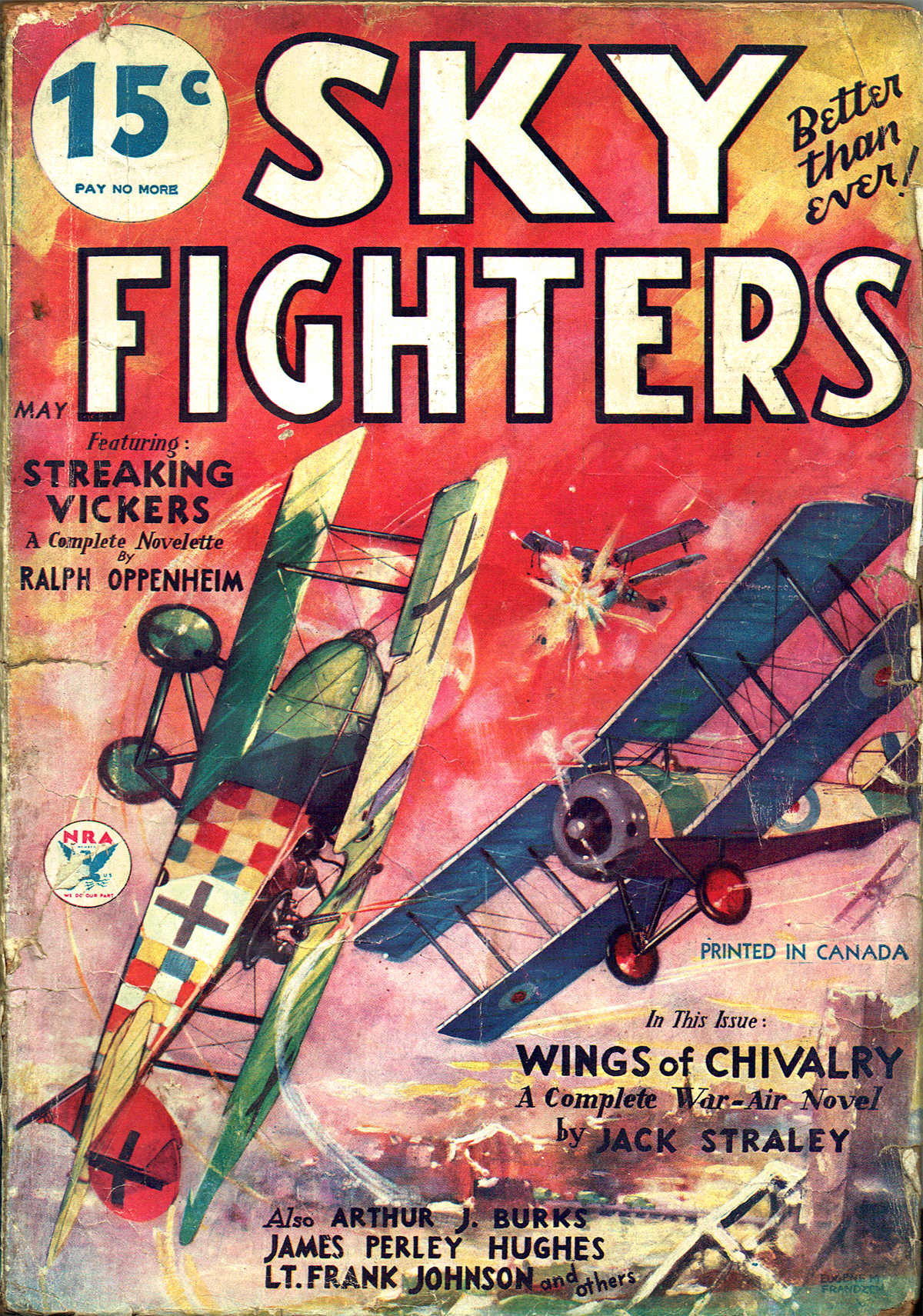
WE’RE celebrating the works of Canada’s very own Harold F. Cruickshank this month. Mr. Cruickshank launched his career writing stories based loosely on his war experiences. As tastes turned from straight out battle field stories to air war stories, Cruickshank shifted his setting from the trenches to the cockpit. With stories appearing in such titles as War Birds, War Aces, Sky Birds, Airplane Stories, Flying Aces, and Sky Fighters.

For Harry Steeger’s trio of Popular Publication’s titles—Battle Aces, Dare-Devil Aces and Battle Birds—Mr. Cruickshank developed continuing characters that ran generally in short novelettes each month. Following on from the success of The Sky Wolf in Battle Aces, Cruickshank was asked to develop a series for the newly premiered sister magazine, Dare-Devil Aces. For Dare-Devil Aces, Cruickshank developed his best known war hero—the rough and tumble Captain Bill Dawe—The Sky Devil! Cruickshank based Bill Dawe on his own infantry commander from WWI.

There was no better flight in France than the Sky Devil and his Brood. Led by Captain Bill Dawe, the famous Yank ace known to all of France as the Sky Devil, the brood consisted of Chuck Verne, Mart Bevin, Slim Skitch and Slug Walton. The crimson devil insignia on their silver Spads brought fear to any German pilot unlucky enough to meet them in the air. But the Sky Devil’s greatest enemy might just be his own C.O., Major Petrie, who had been railroaded into command of 120 Squadron over Dawe’s head. Jealous of Dawe’s popularity, Petrie will do anything to bring down the Sky Devil and his Brood!”

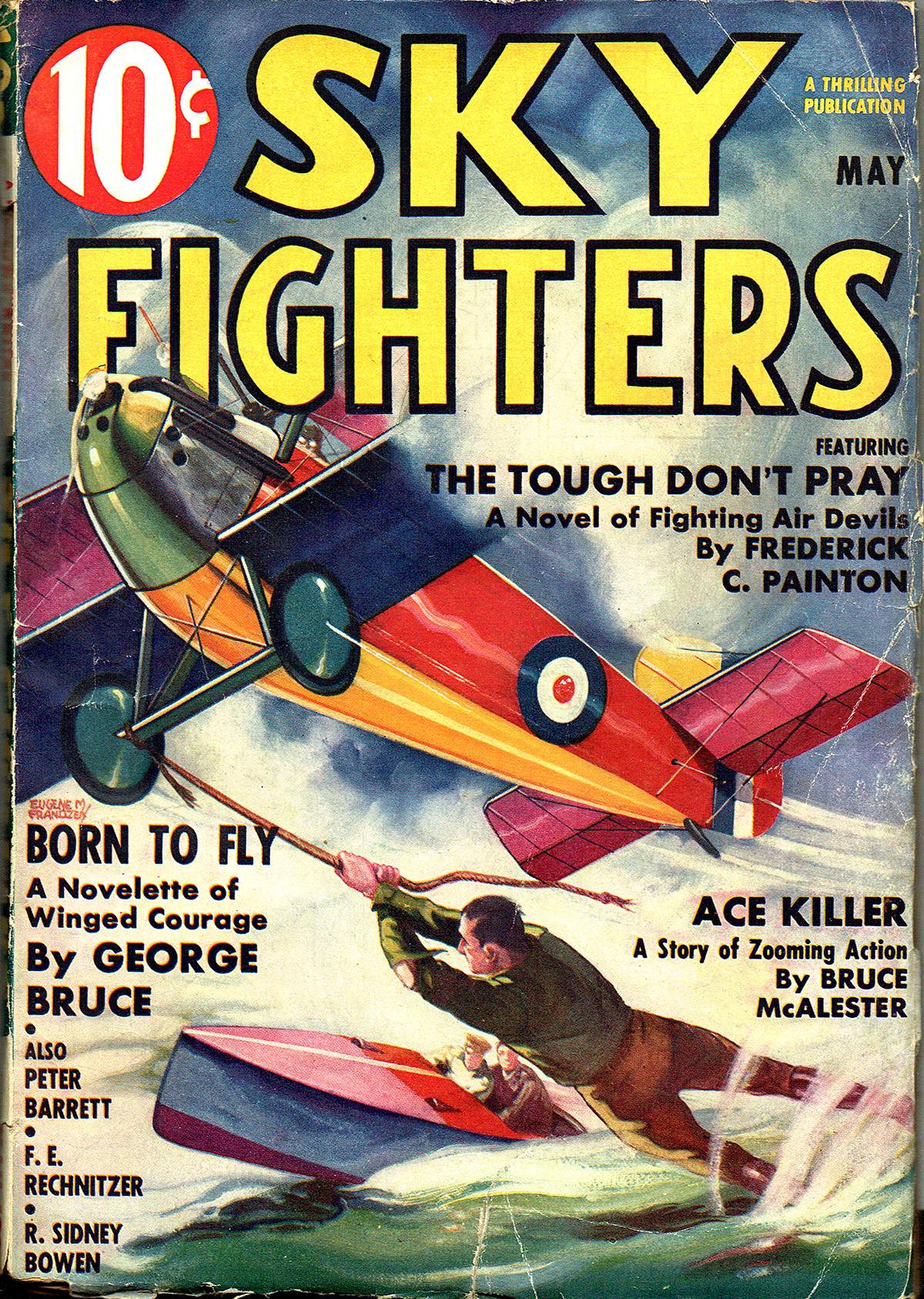
Sky Devil flew through the Hell Skies of 29 adventures in the pages of Dare-Devil Aces from 1932-1935. Cruickshank returned to the savior of the Western Front in six subsequent stories several years later. The first two were in the pages of Sky Devils (June 1939) and Fighting Aces (March 1940). The other four ran in Sky Fighters (1943-1946) where he was aged up and moved to the Second World War where Bill Dawe changes his name to get into the air service and flys along side his son!

Here we present The Sky Devil’s premier outing from the April 1932 issue of Dare-Devil Aces, it’s “Sky Devil’s Trap!”

Swiftly those Yank bombers ripped in, blasting that fake staffel to hell. They didn’t see the Fokkers swinging down from above; didn’t guess they were cold meat—snared in a blood trap from which only the yammering guns of one doomed sky devil could hope to snatch them.

Here is a listing of Harold F. Cruickshank’s SKY DEVIL stories.

title magazine date vol no
1932
Sky Devil’s Trap Dare-Devil Aces Apr 01 02
The Green Devils Dare-Devil Aces Jul 02 01
Hell’s Skipper Dare-Devil Aces Sep 02 03
The Sky Devil’s Brood Dare-Devil Aces Oct 02 04
Killer’s Drome Dare-Devil Aces Nov 03 01
The Sky Tiger Dare-Devil Aces Dec 03 02
1933
Captain von Death Dare-Devil Aces Jan 03 03
The Flaming Ace Dare-Devil Aces Feb 03 04
Sky Devil’s Trap Dare-Devil Aces Mar 04 01
The Haunted Fokker Dare-Devil Aces Apr 04 02
Buzzards’ Brand Dare-Devil Aces May 04 03
Torpedo Buzzards Dare-Devil Aces Jun 04 04
The Bat Patrol Dare-Devil Aces Jul 05 01
Hell Buzzards Nest Dare-Devil Aces Aug 05 02
The Sky Cobra Dare-Devil Aces Sep 05 03
The Outlaw Ace Dare-Devil Aces Oct 05 04
Ace of Devils Dare-Devil Aces Nov 06 01
Skeleton’s Drome Dare-Devil Aces Dec 06 02
1934
The Sky Pirates Dare-Devil Aces Jan 06 03
Staffel of Hate Dare-Devil Aces Feb 06 04
The Flaming Vulture Dare-Devil Aces Mar 07 01
No-Man’s Squadron Dare-Devil Aces Apr 07 02
The Storm Buzzard Dare-Devil Aces May 07 03
The Derelict Patrol Dare-Devil Aces Jun 07 04
Staffel of Skeletons Dare-Devil Aces Jul 08 01
Graveyard Staffel Dare-Devil Aces Sep 08 02
1935
The Stratosphere Patrol Dare-Devil Aces Feb 09 03
The Undersea Buzzard Dare-Devil Aces Jun 10 03
Staffel of Dead Men Dare-Devil Aces Sep 11 02
1939
Wings of the Brave Sky Devils Jun 01 06
1940
A Torch for the Damned Fighting Aces Mar 01 01


When Cruickshank brought The Sky Devil back in the 40’s for Sky Fighters, he moved his theater of operations from the First World War to the Second World War. Older, more reckless and enlisted under false pretenses, he’s fighting the good fight and watching out for his son as well!


1943
Sky Devil and Son Sky Fighters Jan 28 02
Return of the Sky Devil Sky Fighters Mar 28 03
1946
Settlement in Full Sky Fighters Win 33 01
Sky Route to Hell Sky Fighters Spr 33 02


We’ve collected and published all 29 of The Sky Devil’s stories from Dare-Devil Aces into two volumes—Hell’s Skipperand Ace of Devils! In addition, we’ve posted many of the post-Popular stories on the site here (just click on the “Sky Devil” tag below). The books can be picked up through the usual sources—Adventure House, Mike Chomko Books and Amazon!

How the War Crates Flew: Airplane Cooperation with the Artilary

Link - Posted by David on February 9, 2021 @ 6:00 am in

FROM the pages of the August 1932 number of Sky Fighters:

Editor’s Note: We feel that this magazine has been exceedingly fortunate in securing R. Sidney Bowen to conduct a technical department each month. It is Mr. Bowen’s idea to tell us the underlying principles and facts concerning expressions and ideas of air-war terminology. Each month he will enlarge upon some particular statement in the stories of this magazine. Mr. Bowen is qualified for this work, not only because he was a war pilot of the Royal Air Force, but also because he has been the editor of one of the foremost technical journals of aviation.

Airplane Cooperation With the Artillery

by Robert Sidney Bowen (Sky Fighters,August 1932)

COLONEL BOWERS leveled calm gray eyes at the pilots of the 42nd Pursuit Squadron.

“Gentlemen,” he said, “The Seventh Field Battery will start its shoot of the German rail-head, back of Issy, tomorrow morning at nine sharp. The Fiftieth Observation Squadron will conduct the shoot, and it will be your job to see that they are protected from German patrols. I know I can depend upon you to do a damn fine job.”

OF COURSE you can, Colonel. The 42nd boys will go over and knock the pin feathers off any Huns who get nasty. But there happens to be a couple of fledglings around here who are piping up with questions about what those observation ships have got to do. Now, you and I both know that during the late war the observation ship boys missed a lot of praise and credit that they rightly deserved. So I think it would be a good idea if we gathered ’round and chinned about observation ships and shoots for awhile.

Okay, then let’s gather.

Naturally the main idea of observation ships was to observe. And of course, what they observed was anything going on below on the ground. So in order that these question-asking fledglings won’t interrupt us, we will start with the ground and work our way up.

The map of France was divided into a number of sheets that were key-numbered so that you could easily find the adjacent sheets if you wanted to. Each sheet was 36,000 yards by 22.000 yards. And each of those sheets was divided into twenty-four lettered squares, lettered from A to X. (Fig 1)

You’ll note that there are four rows of six squares. And of course you want to understand that the top represents the northerly direction, the bottom the southerly, and the two sides east and west respectively. Well, so much for that. Now, the squares in the top and bottom rows were 6,000 by 5,000 yards. And the squares in the two middle rows were 6,000 by 6.000 yards.

Alright, now the top and bottom rows were again divided into thirty squares numbered from one to thirty. And the squares in the two middle rows were divided into thirty-six squares, numbered from one to thirty-six. To show just what we mean let us take Square A and Square K of Fig. 1, and what do we have? Well, take a look at Fig. 2. Get the idea?

Okay. Now as Square A is 6,000 by 5,000 yards and divided up into thirty numbered squares, it makes each of those squares 1,000 yards square. And as Square K is 6,000 by 6.000 yards and divided up into thirty-six numbered squares, it makes each of those squares 1,000 yards square also.

Now to check back for a moment, we started with a map sheet representing one section of land 36,000 by 22.000. We divided it up so that we got twenty-four sections of land, twelve of them 6,000 yards by 5.000 yards, and twelve of them 6,000 by 6,000 yards. And then we took those twenty-four squares and divided each of them into squares 1,000 yards by 1,000 yards. So you see we are now able to pick out any area of 1.000 yards by 1,000 yards on a section of land that was 36,000 by 22,000 yards when we started.

But we want to get it down smaller than that, so we take each one of these 1000 yards by 1000 yards squares and divide them again into four squares each and letter them A, B, C and D. And of course you can figure that each of these new squares is 500 yards by 500 yards. And just so’s you won’t forget look at Fig. 3.

However, 500 yards by 500 yards is still a pretty big area, so we will get it down smaller yet by starting with the lower left hand corner of each of the lettered squares and marking off ten equal points to the right and ten equal points straight up. Now, if we continued out those lines we would have 100 more squares with each square being 50 yards by 50 yards. Or if necessary we could divide each lettered square of Fig. 3 into 1,000 squares, each of which be five yards by five yards. But 100 squares, 50 yards by 50 yards each is small enough.

NOW all of these squares I’ve been talking about are all printed on the map sheet and lettered and numbered accordingly. That is, all except the last four lettered squares (A, B, C, D). They aren’t marked off in 100 squares usually. They are just left blank and you imagine where the ten equal spaced lines are going to the right, and going from the bottom up, beginning at the left side. Of course, though, if that particular observer was fussy he’d mark in the lines. Fig. 4.

I knew it. … I knew it! That fledgling sitting over there has just got to ask questions, hasn’t he!

He pipes up with: “What’s all these squares got to do with an artillery shoot?”

Alright, I’m getting to that right now. The Colonel has told the boys that the Seventh Artillery is going to let drive on the rail-head back of Issy. Well, does the artillery know the exact location of that rail-head? Perhaps they’ve never shot at it before.

Sure they know it . . . because the observation planes have already spotted it for them.

But to make everything clear for this question-asking fledgling we’ve got here, let’s say that instead of a rail-head it’s an ammunition dump that sprang up over-night, and that the observer notes it for the first time while out on patrol. Call it anything you want . . . but at least something that’s important and must be fired upon right away.

The leader of the observation flight sees it, and immediately starts to locate it on his map so that he can wireless the news (with the small sending sets carried) back to the gunners. Naturally he knows it’s on the map sheet he has, because he took off with the correct key numbered map sheet for the area he was going to patrol.

So by comparing the map with things on the ground (rivers, woods, towns, etc.) he finds that the ammo dump is in Square K. He looks closer and notes that it is in Square 15 of Square K. He keeps on looking and notes that it is in Square D of Square 15. And by figuring still closer he notes that the ammo dump is right where line 7, running from left to right in Square D, crosses perpendicular line 5. In other words he has pin-pointed the ammo dump, or whatever the target is, in an area of 50 yards by 50 yards.

Then he calls the battery on the wireless key by sending down a prearranged code number and the battery number. He does that three times at intervals of one minute each. Then he sends the pin-point map reading of where the target is. You’ve guessed it! Sure, he sends down the map sheet key-number, and then sends K—15—D—7—5. The gunners receive that and know just where to find the target on their map. And when they find that, they can set their guns for the range required.

So, that’s how an observation plane spots a target and sends its exact location back to the “blind” gunners.

Now, let’s say that the guns are ready to fire. The observation pilot has sent down the code-call three times, and he also sends down the pin-point location three times. And then he sends down the order to fire.

INCIDENTALLY, whenever the observer sends wireless messages to the battery he does so when he is flying from the target toward the battery.

Okay, the Fire! is sent down, and the plane banks around and flies back toward the target. At the end of three minutes the battery fires a shell over. The observer notes where it falls in relation to the target and then when the plane banks around and flies toward the battery again he sends down the correction.

Now for the corrections the observer sends down.

The target being fired upon is the center of a clock, with 12 o’clock being due north and the remaining hours accordingly. Around the target are imaginary circles at radial distances of 10, 25, 50, 100, 200, 300, 400 yards, etc. And these circles are lettered from the center Y, Z, A, B, C, D, E, F, etc.

So let us say that the first shell lands 200 yards north of the target. The correction would then be, C at 12 o’clock. And if the second shell lands 50 yards to the east of the target, the correction sent down would be, A at 3 o’clock. Of course I’ve been speaking of corrections. The observer simply tells the gunners where each shell lands so that they can make the correction on their gun sights. Of course there is no correction when a hit is made and the observer signals down that a hit has been made. And when the target is destroyed the signal to Cease Fire is sent down.

And now a little story before I put on my hat and call it a day with you fledglings.

It has to do with sending back new pin-point locations. There was in France, what was known as the S.O.S. call from plane to gunners. It was never supposed to be sent down unless the target was of great importance. A couple of thousand marching troops, or three or four field batteries on the road, or fifty or more motor lorries. In other words . . . mighty worthwhile shooting up. The reason being that when the S. O. S. signal came down, every gun within range of the target fired three shots. And during the latter part of the war, that usually meant 10,000 guns!

Well, it seems that an Allied pilot was one day straffing a German staff car, and he couldn’t seem to do much about it. So he ups and gets sore and sends down the S. O. S. Now, there’s no need of my describing what happened to that staff car and all the Hun brass-hats sitting in it. But, as for the pilot . . . he was yanked off the Front and grounded for the rest of the war. Now, take that funny look off your faces, because I’m telling you right from the shoulder, that poor peelot was not yours truly!

“The Sky Wolf’s Brood” by Harold F. Cruickshank

Link - Posted by David on @ 6:00 am in

WE’RE celebrating the works of Canada’s very own Harold F. Cruickshank this month. Mr. Cruickshank launched his career writing stories based loosely on his war experiences. As tastes turned from straight out battle field stories to air war stories, Cruickshank shifted his setting from the trenches to the cockpit. With stories appearing in such titles as War Birds, War Aces, Sky Birds, Airplane Stories, Flying Aces, and Sky Fighters.

For Harry Steeger’s trio of Popular Publication’s titles—Battle Aces, Dare-Devil Aces and Battle Birds—Mr. Cruickshank developed continuing characters that ran generally in short novelettes each month. The first was Captain Bill Hennedy, a.k.a The Sky Wolf, in the pages of Battle Aces. Starting in the magazine’s fourth issue in January 1931, The Sky Wolf would appear just over a dozen times before flying through the pages of G-8 and his Battle Aces and Dare-Devil Aces for another dozen or so adventures.

Hennedy was ably assisted by his famous Yank Wolf Brood! “Red” Kelly was the Sky Wolf’s deputy leader; he along with Pat Maguire and Stan Glover formed a trio of pilots who had no equal in the whole of France. Filling out the Wolf Flight were wolf cubs Jim Evans and Hank Daly—able to hold their own with any German Ace that dared take them on. Together, The Sky Wolf and his Brood were the scourge of any and all German Aces who dared attack the Allied forces.

Here we present The Sky Wolf’s premier outing as he and his brood try to save a stranded garrison! From the January 1931 issue of Battle Aces, it’s “The Sky Wolf’s Brood!”

It was the “Sky Wolf’s” daring scheme—this plan to rescue that stranded garrison of wounded infantrymen. And now unmindful of his blood-drenched face, he was leading his brood straight down into the enemy stronghold—for here was a skipper and a brood that didn’t know when they were dead!

Here is a listing of Harold F. Cruickshank’s SKY WOLF stories.

title magazine date vol no
1931
The Sky Wolf’s Brood Battle Aces Jan 1 4
The Sky Wolf Returns Battle Aces Jul 3 2
Fangs of the Wolf Brood Battle Aces Nov 4 2
1932
The Wolf Brood Strikes Battle Aces Jan 4 4
The Wolf Brand Battle Aces Mar 5 2
Sky Wolf’s Cub Battle Aces Apr 5 3
The Brood at Bay Battle Aces May 5 4
The Wolf Terror Battle Aces Jun 6 1
Snarl of the Sky Wolf Battle Aces Jul 6 2
Wolf Brood Hell Battle Aces Aug 6 3
The Flying Torpedo Battle Aces Sep 6 4
Sky Wolf’s Trap Battle Aces Oct 7 1
Staffel of Hell Battle Aces Nov 7 2
1934
Return of the Sky Wolf G-8 and his Battle Aces Feb 2 1
The Silver Spad G-8 and his Battle Aces Apr 2 3
The Outlaw Patrol G-8 and his Battle Aces Jun 3 1
Drome of the Living Dead Dare-Devil Aces Nov 8 4
1935
Legion of Death Dare-Devil Aces Jan 9 2
The Torpedo Eagle Dare-Devil Aces May 10 2
The Iron Devils Dare-Devil Aces Aug 11 1
The Jackal Patrol Dare-Devil Aces Nov 11 4
1937
Hell Trap Dare-Devil Aces Mar 12 4
1938
The Sky Wolf Returns Dare-Devil Aces Jun 19 3
The Hell Raider Dare-Devil Aces Oct 20 3
1943
Fangs of the Sky Wolf Dare-Devil Aces May 31 2


“The Tunnel of Death” by Harold F. Cruickshank

Link - Posted by David on February 5, 2021 @ 6:00 am in

WE’RE celebrating the works of Canada’s very own Harold F. Cruickshank this month. Mr. Cruickshank launched his career when he was asked to write about his war comrades in Belgium. He received a prize for the story and continued writing in his spare time.

In 1923 he sold his first major piece to Western Home Monthly, Chatelaine’s forerunner, and a demand quickly grew for his stories. When he first started off, the demand was for war stories so Cruickshank wrote stories inspired by his time in the 63rd Battalion of the Canadian Expeditionary Forces and soon had stories running in all the big war themed pulps of the day—War Stories, Under Fire Magazine, Canadian War Stories, War Novels, Soldier Stories, and the magazine our featured story ran in—Battle Stories!

The company commander, Captain Coyne, had been found lying in a pool of his own blood—foully murdered. Coyne had been more than a good pal to Maguire. There was a bond between them which had been cemented during years of service on the Montreal Police Force and almost three years of action together in France. Now Coyne was gone. The skipper had been shot from behind and not by a German! It was an inside job. But who? Coyne was the most popular officer in the battalion, with a heart which was always with his men. But if Maguire wanted answers, he’d have to venture into the tunnels snaking under No-Man’s-Land!

Murder and mystery stalk hand in hand in this amazing story of a dread sector at the front!

From the July 1929 issue of Battle Stories, it’s Harold F. Cruickshank’s “The Tunnel of Death!”

Cruickshank’s Adventures in Pulps

Link - Posted by David on February 1, 2021 @ 6:00 am in

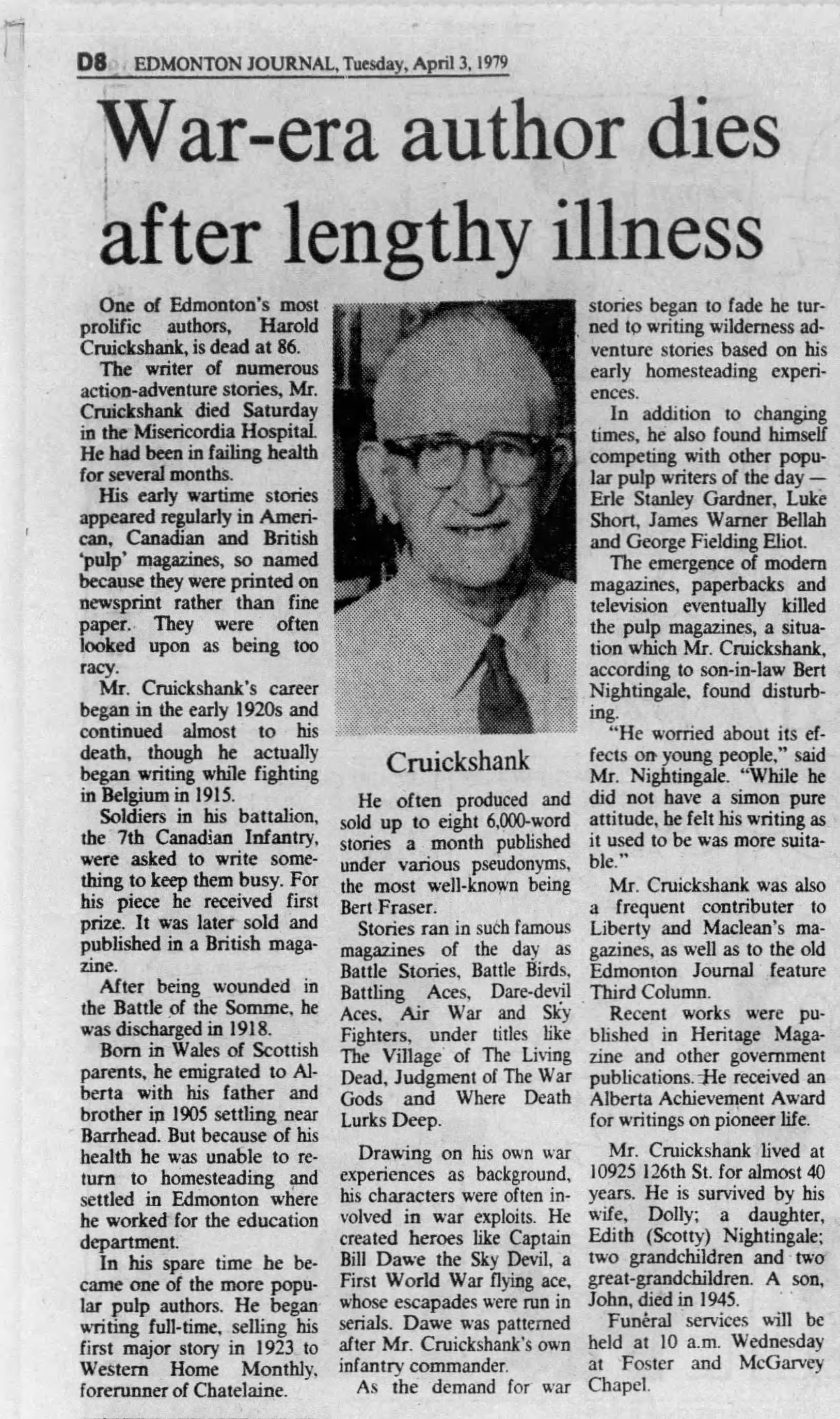
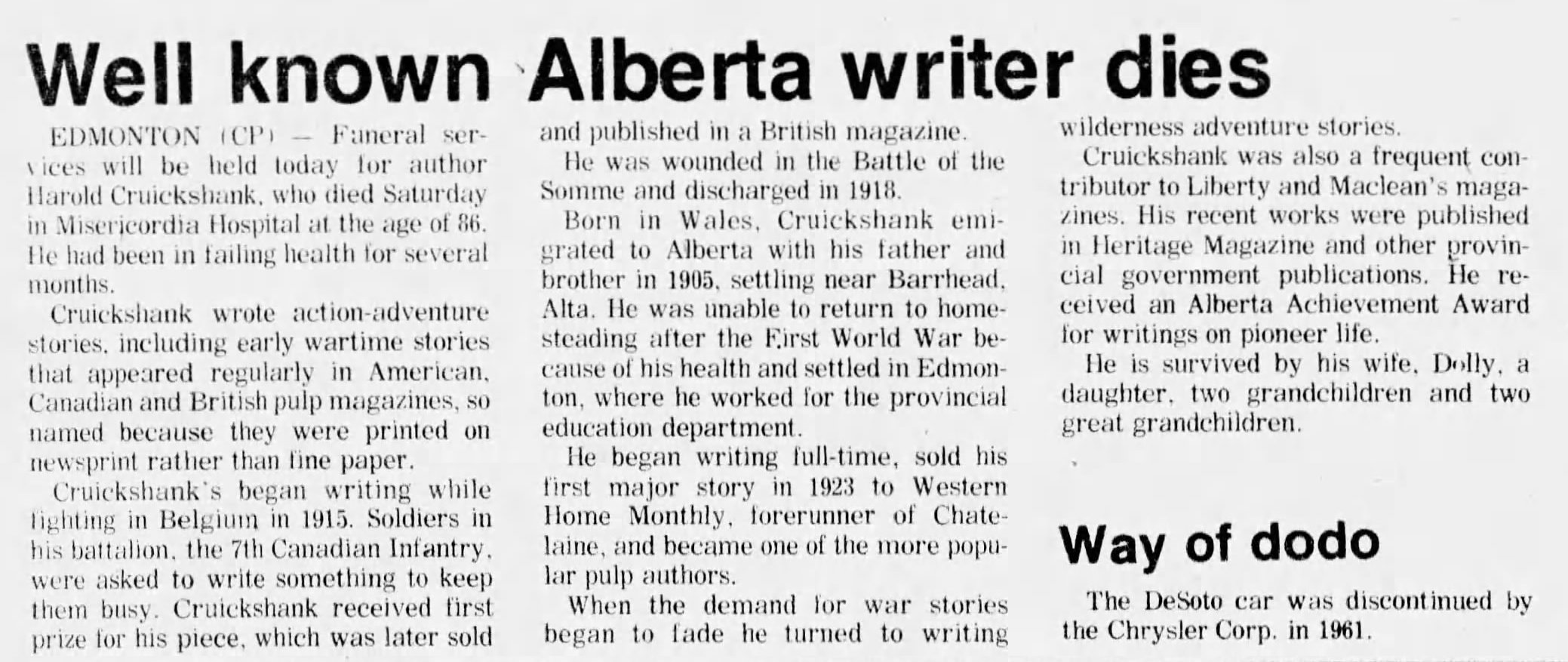
THIS month we’re spotlighting the work of Canada’s favorite son, Harold F. Cruickshank. The following article from 1974 acts as a fine introduction to this prolific pulp author!

Adventures with Pulps

The Leader Post, Regina, Canada • 6 September 1974, p14

EDMONTON (CP) — Harold Cruickshank says a “green hungry monster’’ has swallowed up the kind of adventure literature he once wrote and peddled to pulp magazines.

Cruickshank, 81, has spent most of his life creating action-adventure heroes but says his brand of story has been replaced with “sex, violence, and pornography, the very things which we tried to keep from the eyes of our younger folk.”

For 55 years Mr. Cruickshank, whose characters include the Sky Devil and Keko the wolf, wrote for pulp magazines, those publications printed on newsprint rather than fine paper.

During his peak he knocked off eight 6,000-word stories a month with titles like The Village of the Living Dead, Judgment of the War Gods and Where Death Lurks Deep.

Using pseudonyms, some magazines ran as many as three Cruickshank stories in a single issue.

“Certainly the pulps caried stories of violence, but it was a violence of a defensive nature.

“When we killed somebody it was because we knew damn well he was about to kill us, not out of any desire to kill.”

Mr. Cruickshank’s war adventure stories were based on his own combat experience during two world wars.

His best-known war hero, First World War flying ace Capt. Bill Dawe, The Sky Devil, had a real life model in Mr. Cruickshank’s own infantry commander.

He said young readers who patterned themselves after heroes like the Sky Devil and formed fan clubs to honor the fictional adventurers were doing a good thing.

The pulp magazines such as Battle Stories, Dare-Devil Aces and Sky Fighters, popular between the 1920s and the early 1950s, sold for a quarter or less.

“The critics thought the pulps should be hidden under rocks and only read on rainy days,” said Mr. Cruickshank.

“Some of the greatest writers in the world wrote for the pulps. People who also wrote for the Saturday Evening Post, Colliers and Redbook.”

“A writer for the pulp magazines had to be continually alert to cope with the changing trends. And you had to compete with the cream of the pulp people.

“When I first started off the demand was for war stories. When they faded you had to switch to air war stories.”

When that fad passed a demand for wilderness adventure grew and Cruickshank met it with his profitable series about Keko the wolf.

The series jelled during the Depression when Mr. Cruickshank saw a German shepherd and a golden collie playing together in the snow.

“At that point I conceived in ray mind’s eye the product of a mating between a wolf and a collie.

“I developed this idea into a series of animal adventure stories running several years in one of the western magazines. I later compiled the stories into a book.**

Mr. Cruickshank launched his career when he was asked to write about his war comrades in Belgium in 1918.

He received a prize for a story and continued writing in his spare time in Alberta.

In 1923 he sold his first major piece to Western Home Monthly, Chatelaine’s forerunner, and a demand grew for his stories.

“For 55 years I wrote more magazine stories than most writers in the country, the U.S. and elsewhere and nobody cared.

“Now they come around giving me halos for what I’ve done. Not that I’m complaining, you understand, I always considered I was just doing a job, like a carpenter or anybody else.”

Mr. Cruickshank now writes technical guides for would-be writers and instructional articles on homesteading for government publications.

The article above Is a combination of two versions of the same article. The one in The Regina Leader Post is the most complete version. The one in the Advocate is more edited, but includes the final paragraph.

“First Official Yank Victory” by Paul Bissell

Link - Posted by David on January 31, 2021 @ 6:00 am in

THIS week we present another of Paul Bissell’s covers for Flying Aces! Bissell is mainly known for doing the covers of Flying Aces from 1931 through 1934 when C.B. Mayshark took over duties. For the March 1932 cover Bissell put us right in the action of the

First Official Yank Victory

th_FA_3203LIEUTENANTS Alan Winslow and Douglas Campbell of the 95th Squadron, U.S. Air Service, were on alerte duty, Toul Airdrome, April 14, 1918. American squadrons at the Front were new, and no German had yet been marked up to the credit of the Yanks. These two aces-to-be thought it pretty tough to be kicking their heels on the home airdrome while “Rick” and others were patrolling the lines with a chance of a scrap at any moment, and a chance to bring credit to the 95th for the first Boche.

Suddenly the phone rang. “Yes, Squadron 95 . . . . What? . . . . Deux Boches?
. . . . Oui! Quel direction?
. . . . Pont-a-Mousson! . . . . Bien. Merci.”

In an instant motors already warmed up were roaring, chucks pulled out, and Winslow and Campbell had taken off in a steep climbing spiral, heading back in the direction of two tiny specks now appearing just under the low-hanging clouds. Hugging the ceiling, the two Americans swung to the east, hoping to gain unobserved a position on the tail of their enemy. A cloud, hanging low out of the otherwise fairly level ceiling, helped them in this for a moment. Coming out of this, however, they found themselves flying in the opposite direction, parallel to and about a quarter of a mile to the east of the two Germans, who immediately turned to attack. One was an Albatros D-5, and the other a Pfalz D-3.

The desperate tail chasing game began. Twisting and turning, the battle drifted slowly back until it was actually over the Americans’ own airdrome. Here the clouds drove them down scarcely five hundred feet from the ground. Burst after burst from both sides had as yet done no serious harm to any of the combatants.

Campbell, scrapping it out with the Pfalz, had drifted slightly to the west. Winslow, diving at the Albatros from the side, banked up steeply, kicked his plane over, slipped off on a wing, nosing down until he was under the German plane, then quick back, hard on his stick, and he saw the belly of the red machine come slowly into line with his sights. His chance at last!

Tight he squeezed his trigger, and a wild joy swept over him as he felt the answering throb of his gun. At the last instant he banked over to avoid collision—and just in time, for the red ship, spurting smoke, slipped unevenly off, wing down and tail up. The German pilot strove to gain control, partially righting the wounded ship just before it piled up almost at the door of Winslow’s own hangar.

Just a moment later Campbell brought his man down in a nearby field to the west. It was America’s first air victory. Two to the credit of the Hat-in-the-Ring Squadron, and the Germans knew that the Eagles were in the air!

The Ships on The Cover
“First Official Yank Victory”
Flying Aces, March 1932 by Paul J. Bissell

“Eclipse of the Hun” by Joe Archibald

Link - Posted by David on January 29, 2021 @ 6:00 am in

“HAW-W-W-W-W!” That sound can only mean one thing—that Bachelor of Artifice, Knight of Calamity and an alumnus of Doctor Merlin’s Camelot College for Conjurors is back to vex not only the Germans, but the Americans—the Ninth Pursuit Squadron in particular—as well. Yes it’s the marvel from Boonetown, Iowa himself—Lieutenant Phineas Pinkham!

Hauptmann Adolph August von Heinz—dubbed The Owl of the Ozone—was born on the stroke of twelve in the middle of the Black Forest, and it was rumored across the Rhine that every mouse in the Province scurried to cover when the stork dropped this Kraut squaller down the chimney of the Heinz menage. From that day on, von Heinz got blind staggers when he looked at the sun, and the War found him sleeping in the daytime and attacking at night! But that Boonetown marvel looked to the heavens to find a way to take out the Owl in broad daylight!

On the Western Front, things looked mighty dark for the minions of Democracy—so dark, in fact, that by contrast the pall over Pittsburgh resembled a bridal veil caressing a snowdrift. Once again the fly-by-night in the Entente ointment and cocklebur in the Allied rompers was that sinister Hauptmann von Heinz—The Owl of the Ozone. But what of Phineas? Well, he’d bought himself a book on the Cosmos. To put it poetically, Carbuncle was “lost in the music of the spheres!”

As a bonus…some fan art of the Boonetown Treasure!

“Sky Writers, April 1937″ by Terry Gilkison

Link - Posted by David on January 27, 2021 @ 6:00 am in

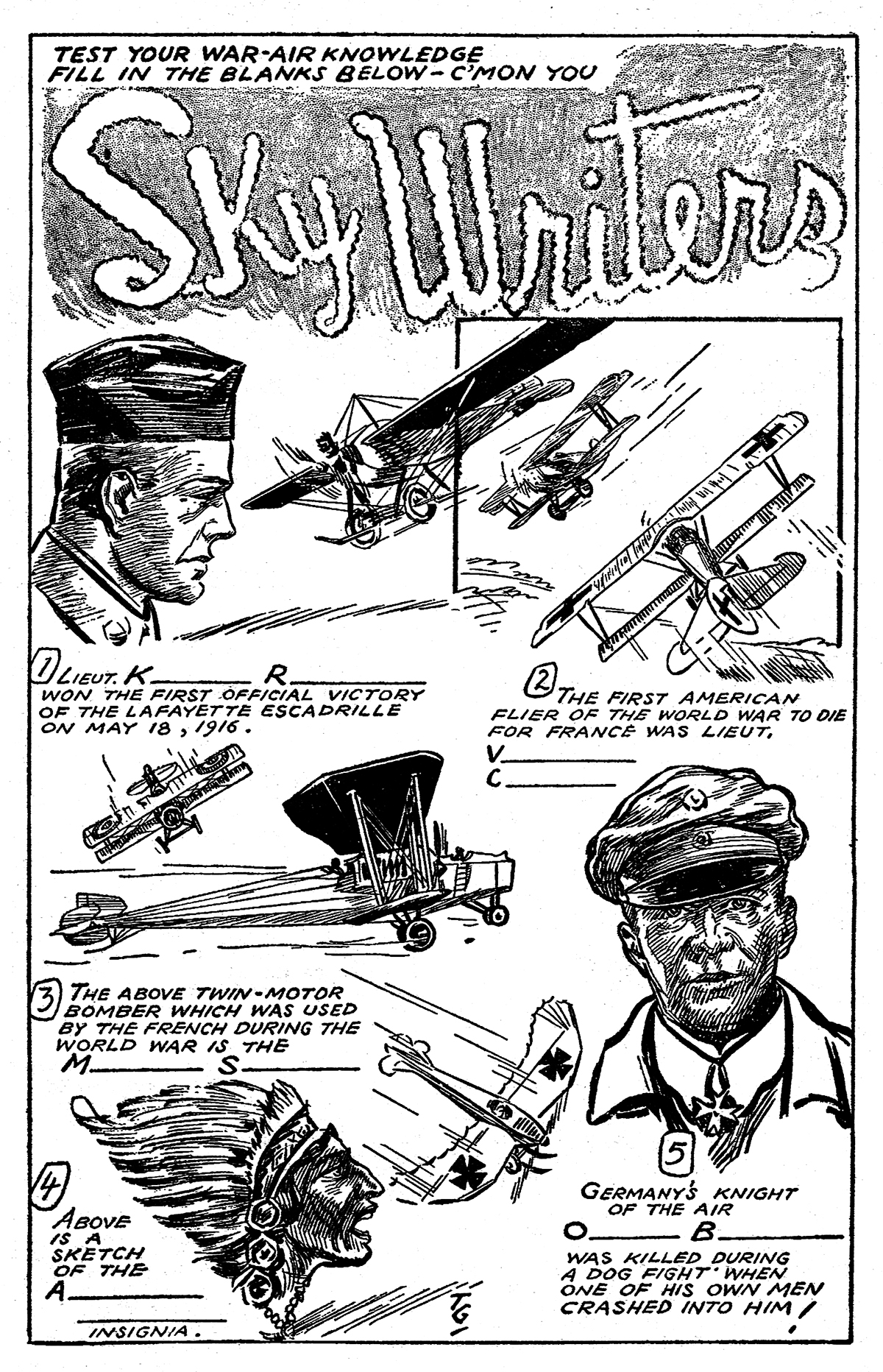
FREQUENT visitors to this site know that we’ve been featuring Terry Gilkison’s Famous Sky Fighters feature from the pages of Sky Fighters. Gilkison had a number of these features in various pulp magazines—Clues, Thrilling Adventures, Texas Rangers, Thrilling Mystery, Thrilling Western, and Popular Western. Starting in the February 1936 issue of Lone Eagle, Gilkison started the war-air quiz feature Sky Writers. Each month there would be four questions based on the Aces and events of The Great War. If you’ve been following his Famous Sky Fighters, these questions should be a snap!

Here’s the quiz from the April 1937 issue of Lone Eagle.

If you get stumped or just want to check your answers, click here!

“Squadron of the Snows” by Allan R. Bosworth

Link - Posted by David on January 22, 2021 @ 6:00 am in

THIS week we have a story from the pen of the Navy’s own Allan R. Bosworth. This time Bosworth gives us a tale of war in the Alps! Bart Mason, American pilot of Native-American desert is attached to the British squadron posted at the Italian army post west of Treviso. The sector has been terrorized by Paul Katz and his Squadron of the Snows. The problem is, Katz’ Staffel flies all-white planes which seem invisible against the snowy backdrop of the Alps—that is until Bart dons some warpaint!

Somewhere in the ice-covered heights of the Alps that deadly Snow Squadron had its lair— and none could challenge their invisible menace, until a yelling, fighting Indian had a yen to paint the town red.

From the pages of the April 1932 issue of War Birds, it “Squadron of the Snows!”

“War’s Youngest Ace Downs Voss” by Paul Bissell

Link - Posted by David on January 18, 2021 @ 6:00 am in

THIS week we present another of Paul Bissell’s covers for Flying Aces! Bissell is mainly known for doing the covers of Flying Aces from 1931 through 1934 when C.B. Mayshark took over duties. For the October 1932 cover Bissell put us right in the action as Rhys-Davids downs Werner Voss!

War’s Youngest Ace Downs Voss

th_FA_3210YOUTH, winged youth. Youth, flying to meet death.

In all the strange chapters that came from the war there is nothing more incredible than the youthfulness of its air heroes.

23 years old—a major. Officially credited with seventy-five victories in individual combat.

22 years old—a captain. Internationally known for aggressive bravery, the idol of his nation, and a price on his head, dead or alive.

21 years old—a lieutenant. With more than twoscore victories to his credit. Decorated by nations and feted by kings.

And so it went, on down—20 years—19 years—18 years—and there it stops—officially! But listen:

“And you,” said the recruiting sergeant to a glad-faced youngster who stood, bright-eyed, in front of him. “What do you wish?”

“I’ve come to enlist, sir,” replied the boy.

“Enlist, is it? And do you think it’s a kindergarten in France we be asending the lads to?”

“No, sir. I mean to fight,” was the quiet answer.

For an instant the sergeant studied the serious eyes before him. “And your age, my boy?”

“Fift—I mean eighteen, sir.”

“Eighteen, eh,” growled the sergeant, shaking his head as he reached for an enlistment blank. “Do you know what you’re doing, sonny?”

“Righto, sir.”

“Righto, it is then. And eighteen years ye be, though if you’re eighteen, Mister Methusaleh is my name. What’s your name, youngster?”

“Rhys-Davids, sir,” he replied, and a school lad had started on the road to glory, death and fame.

It was early autumn of seventeen, and the 56th Squadron, R.F.C., was in the thick of it. This famous squadron almost daily battled Richthofen and the best of his “gentlemen.” Fought them through the entire war to a credit of 411 planes downed—but not without themselves adding many famous names to the already long list of those who died for England. Included in this list was the name of their famous commander, McCudden, with fifty-eight victories to his personal credit.

Here, with this outfit, was the lad who had come to France “meaning to fight.” And fight he had. Never was there a pilot more willing or eager for a scrap. He would attack recklessly, even though outnumbered, and in a dogfight he became a madman—a madman dealing death to the enemy. And then he would return to his drome to become all boy again. A happy boy, with pets—birds that sang to him—pups that “Waited each day for his return—and tame rabbits that nipped off the shoots in the little garden behind his shack and nibbled greens, from his hand.

Already more than a score of German. had fallen before his fire. Schaffer, of “Richthofen’s Own,” had fought his last fight against this youngster. But it was on September 23, 1917, that he gained his most famous victory.

THE squadron was on patrol, protecting some bombers, when off to one side were seen two German planes. It did not seem likely that they would attack, as the English squadron numbered more than a dozen of Bristols, Camels and S.E.Ss. That is, it did not seem likely until, by the black-and-white-checkered fuselage it was seen that one of the Germans was Lieutenant Werner Voss.

This was one adversary that the Allies held in the greatest respect. Already both his plane and name were known all up and down the Front. He was always looking for combats, and fought generally over Allied territory, which could not be said of Richthofen. And with forty-eight victories over the Allies, Voss, himself of most humble origin, was a serious rival of the noble-born baron.

Indeed, records seem to show that Voss, feeling himself in every way the equal of his rival as an ace, had refused to be the tail protector to Richthofen and, on at least one occasion, when the victories of Voss had reached a number almost equal to those of the Rittmeister himself, the High Command had seen fit to transfer the mere “Lieutenant” to a less active sector, where opportunities for combat were fewer.

With such an opponent as this, the Britishers knew that attack might be expected, and when, a moment later, a patrol of Albatrosses appeared, no one was surprised to see the checkered triplane dive in headlong. Voss’ companion, flying to one side and slightly behind, was almost immediately shot down. And when the Albatrosses refused to accept battle, Voss was left to his fate.

It was an unequal fight, though after the German had winged his way through the first terrific rain of fire from all the other ships, it was Rhys-Davids who engaged him in a duel. Around and around they tore, with Voss, hemmed in on all sides, hoping only to sell his life as dearly as possible. The Fokker tripe, with its German pilot, had met its equal in the little S.E.5 flown by the English boy!

The British plane turned and twisted, meeting maneuver with maneuver, until at last the looked-for opening came and the checkered fuselage for a moment was full in the sights. Just for an instant—but an instant that was filled with spitting lead, an instant that began that mad, twisting dive that ended near Poelcapelle for the triplane with the black crosses on its wings, and ended in eternity for the brave German ace.

Rhys-Davids followed him down to the ground. It was the game—there must be no slip. Then, with motor full on, himself untouched, he raced back to his pets.

The lad—his comrades thought he must be now almost seventeen years old—had thirty-two unofficial victories to his credit, and those gods that be must have laughed as they wrote his name on a shell. No German airman carried it. But an Archie battery, a month later, shot it from the ground. Ten thousand feet up it found him.

Back in his shack the birds still sang in their cages and the rabbits still nibbled in the garden. But the puppies waited the return of their boy master in vain, for the war’s youngest ace had gone West.

The Ships on The Cover
“War’s Youngest Ace Downs Voss”
Flying Aces, October 1932 by Paul J. Bissell

“Vulture Coast” by Lester Dent

Link - Posted by David on January 15, 2021 @ 6:00 am in

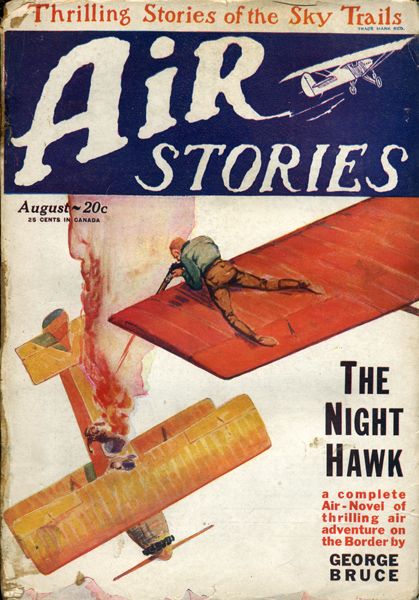
Lester Dent is best known as the man behind Doc Savage. But he wrote all number of other stories before he started chronicling the adventures of everyone’s favorite bronze giant. Here we have one of his earliest stories to appear in the pulps. From the pages of the September 1930 issue of Air Stories, it’s “Vulture Coast!”

It started as a test flight for the new amphibian. Then came the offshore rescue, pirate craft out of the China Sea, and a grim, terrible test for Power O’Malley, pilot.


If you enjoyed this story, Black Dog Books has put out an excellent volume collecting 8 of Lester Dent’s early air adventure stories! Dead Man’s Bones: The Air Adventure Stories of Lester Dent includes “Vulture Coast” as well as seven other two-fisted sky adventures! It has an introduction by historian Will Murray and appendices featuring background material, outlines and story submission notes from Dent’s personal papers! A great read! Pick it up from their website! It’s Dead Men’s Bones by Lester Dent!

And as a bonus, here’s a short plucky article from the Norman, Oklahoma Sooner State Press!


Fiction Field Beckons To Tulsa Tribune Man

Sooner State Press, Norman, OK • 20 December 1930

Lester Dent, who for the past four years has been an Associated Press operator and maintenance man detailed to the Tulsa Tribune, writing fiction on the side, has received an offer from Sky Riders, fiction magazine in New York, suggesting that he join the staff of this publication, according to the Tribune of December 8.

Less than two years ago, Dent turned his attention to fiction writing. He sent out 13 stories, all of which were rejected, then wrote the fourteenth, and found a market for it. He has sold to Popular Stories, Air Stories, Top-Notch, Action Stories and Sky Riders.

Some of the earlier titles were: “Pirate Cay,” “Death Zone,” “Buccaneers of the Midnight Sun” and “The Thirteen Million Dollar Robbery.” Later he wrote “Vulture Coast,” “The Devil’s Derelict,” “The Skeleton From Moon Cay,” and most recentlv “Hell Hop.”

“Sky Cougar” by Harold F. Cruickshank

Link - Posted by David on January 14, 2021 @ 6:00 am in

THIS week we have a story by another of our favorite authors—Harold F. Cruickshank! Cruickshank is popular in these parts for the thrilling exploits of The Sky Devil from the pages of Dare-Devil Aces, as well as those of The Sky Wolf in Battle Aces and The Red Eagle in Battle Birds. He wrote innumerable stories of war both on the ground and in the air. Here Mr. Cruickshank gives us a fast-moving tale of Jerry Cougan, known by his squadron as “The Cougar”, as he tries to save Major Power from the huns and rid the skies of the dreaded von Scheer. From the February 1935 issue of Sky Fighters, it’s “Sky Cougar!”

Racing Madly to the Rescue of a Valiant Brass Hat, Jerry Smacks Up Against Some Real Scrapping!

“Famous Sky Fighters, July 1938″ by Terry Gilkison

Link - Posted by David on January 13, 2021 @ 6:00 am in

STARTING in the October 1933 issue of Sky Fighters and running almost 5 years, Terry Gilkison’s “Famous Sky Fighters” was a staple of the magazine. Each month Gilkison would illustrate in a two page spread different Aces that rose to fame during the Great War.

Although Gilkison was probably better known for his syndicated newspaper work, he also provided black and white story interior illustrations for pulp magazines. His work appeared in Clues, Thrilling Adventures, Texas Rangers, Thrilling Mystery, Thrilling Western, and Popular Western. Gilkison provided similar features in a few other Thrilling Publications—there was “Famous Soldiers of Fortune” and later “Adventure Thrills” in Thrilling Adventures, Famous Crimes” in Thrilling Detective, and the fully illustrated air adventure stories of Buck Barton “The Flying Devil” in The Lone Eagle! He signed most of this work with only his initials “T.G.” to maintain a low profile and preserve his reputation as a syndicated newspaper cartoon artist.

The July 1938 installment, from the pages of Sky Fighters, features Georges Thenault, Lt. Jimmy Bach, Mario Galderara, and Captain John H. Towers!

Next time in “Famous Sky Fighters”, Terry Gilkison features Major Jimmie Doolittle, Armand Pinsard, and Captain Bruno Loerzer! Don’t miss it!

“Akbar the Black” by O.B. Myers

Link - Posted by David on January 8, 2021 @ 6:00 am in

THIS week, he have a story from the pen of a prolific pulp author O.B. Myers! Myers was a pilot himself, flying with the 147th Aero Squadron and carrying two credited victories and awarded the Distinguished Service Cross. He wrote hundreds of stories for the pulps—primarily in the detective and air war pulps. We’ve collected a few of his best he had in Dare-Devil Aces as The Black Sheep of Belogue: The Best of O.B. Myers.

Memo, to all intelligence operatives, and to all Air Squadron Commanders:

    Wanted, for desertion, as a renegade and spy, the following: Full name, Akbar Swaalii Ajjaszid, known as Akbar or Akbar the Black (le Noir). Half-breed African, mixed negroid and Arab parentage; skin dark brown in color. Born in French Somaliland, about 1890; left Jibuti to come to Paris in 1915 as the body-servant of a major of Spaliis. Left his master after arrival, to join a gang of apaches. Involved in stabbing affray in Cafe Fouleau in August, 1915. Enlisted, French Foreign Legion, September of same year. Assigned by request to flying service; trained Pau, Avord; sent to Front in January, 1916, with 5th Escadrille de Chasse (Pursuit). In three months of action gained two accredited victories. Disappeared April 19th; believed to have deserted to the enemy, and to be at the present lime actively engaged in their flying forces. Report of his capture, or evidence of his death, will please be sent to this office at once.

They called him Akbar the Black. His cannibal ship spewed hate through black skies—but even outlaw wings must crack when the ghost of the past calls “Time!”

“Major Vaughn Wins the D.S.C.” by Paul Bissell

Link - Posted by David on January 4, 2021 @ 6:00 am in

THIS week we present another of Paul Bissell’s covers for Flying Aces! Bissell is mainly known for doing the covers of Flying Aces from 1931 through 1934 when C.B. Mayshark took over duties. For the September 1932 cover Bissell put us right in the action that lead to Major George Vaughn winning a D.S.C.!

Vaughn Wins the D.S.C.

th_FA_3209“FOR extraordinary heroism in action near Cambrai, France. On September 22, 1918, Lieutenant Vaughn, while leading an offensive patrol, sighted 18 enemy Fokkers about to attack a group of five Allied planes which were flying at a low level. Although outnumbered nearly five to one, he attacked the enemy group and personally shot down two of the enemy planes, the remaining three pilots of his flight shooting down two more. His daring and courage enabled the group of Allied planes to escape ….”

So reads the American army citation on which the D.S.C. was awarded to Lieutenant George A. Vaughn. But between the lines is even more of a story—the story of a youth who left school to serve his country, first with the British and then under his own colors, with the 17th Aero Squadron—the story of a lad who came victorious through many air battles and who, that morning in September, 1918, seeing some of his comrades trapped by the enemy, went unhesitatingly to their aid. He knew he was outnumbered five to one by the Boche, yet he deliberately accepted the desperate odds. He calmly watched the chill hand of death reach for him; coolly he evaded its annihilating clutch and saw its grim fingers close on two of his enemies.

He fought many times after this, wresting victory after victory from the Boche until the war’s end found him one of America’s leading aces, with the rank of major.

It was 8:45 a.m. on a clear sunny morning. Big cumulus clouds about seven thousand feet up floated slowly across No-Man’s-Land, casting great blue shadows on the shell-pocked surface, and themselves affording excellent hiding places for enemy airplanes.

Vaughn, with three companions, was flying just under the clouds, protecting another flight of five Camels about three thousand feet below and slightly in advance of him. From the east fifteen Fokkers came in at about Vaughn’s level. They turned and flew parallel with him, all the time watching the lower flight. Then suddenly they tipped over on their noses and went down in a body on the planes below.

Suspecting a trap, Vaughn immediately searched the skies overhead. Sure enough, there they were—another batch of Germans ready to swoop down like hawks on him and his companions. Instantly he saw the one chance—to lead his flight down into the fight below, and do what damage they could diving in—at the same time giving the five Allied planes a chance to break away-and then try to get out of it before the enemy from above could surround them.

DOWN the four Camels tore, into the twisting dogfight below them—tracer bullets reaching out ahead, searching their red targets. In an instant it was every man for himself. Vaughn saw one of the Camels go down in flames and cursed the damned Boche as his sights picked up a black cross squarely. His fingers squeezed the trips. A wild answering throb as his guns spit flame, and he saw the red machine fall off out of control.

He swung in a tight turn to the left. The whole world now seemed nothing to him but white streaks of smoke cutting the sky in every direction, while red, yellow, green ships— ships with huge black crosses or ships with the tricolored circles of the Allies—seemed to come suddenly from nowhere.

The upper flight was now on him. He could see their tracers swish by him as they came down.

The red belly of a Fokker stood squarely in front of him. A quick burst, and he saw the red tail kick up as the Boche started on his last dive. Number Two—but a burst of bullets came through the cockpit just over his knees. Too close! They had him hemmed in, so he took his only chance, and threw himself into a spin.

Down he went, his tail whipping around and around. In this way he afforded no easy target. But the Germans followed him down, firing burst after burst into him, diving past, zooming back and diving again, their guns blazing. That spin seemed endless.

Luckily, most of the Germans had given him up as finished, and turned back. One last persistent Boche fired a long burst, and then he, too. turned, leaving Vaughn, as he supposed, to crash. Just in time the little Camel answered the controls.

THEN came the greatest blow of the battle. He was out of gas. There was no answering roar from the motor, and with a sinking heart and a vision of German prison camps, he sought a place to set her down. Lower he came. Now scarcely fifty feet was between him and the torn earth, the idling prop was slowing perceptibly, when suddenly it came to him—-the emergency tank! Quickly he switched it on. There was a sputter; then with a full-throated roar the engine took hold and the little machine climbed rapidly up again.

But the battle was over, and now not a plane was to be seen. So, turning toward his airdrome, some twenty minutes away, Vaughn for the first time had an opportunity to think about himself. It was then he was conscious of a burning sensation across his back. His flying suit was soaking wet just below his right shoulder. Wounded, he thought, and to use his own words, “Fine! Now I’ll get a month in the hospital. Or perhaps they’ll send me to Blighty.”

He could feel no pain, so decided it was slight, and landed with a broad smile, feeling he had rather put it over on the boys. Then came the second blow of the day, as the mechanics pointed to where the corner of his gas tank had been shot away. His clothes were soaked, not with blood, but with gasoline. No wound! No Blighty! Well, what the hell! It had been a good scrap, anyway. Six Fokkers had been accounted for, and only two Camels lost.

All Vaughn got then was a new ship. But later, with bands playing and flags flying and a lot of soldiers standing round to see how it was done, they pinned a bit of ribbon on him. Not much for a man who had played with death daily, but just the Army’s way of saying, “This guy’s damn good!”

The Ships on The Cover
“Major Vaughn Wins the D.S.C”
Flying Aces, September 1932 by Paul J. Bissell

« Previous PageNext Page »