


Looking to buy? See our books on amazon.com Get Reading Now! Age of Aces Presents - free pulp PDFs

From the Scrapbooks: Battle Aces Covers

Link - Posted by David on December 6, 2021 @ 6:00 am in

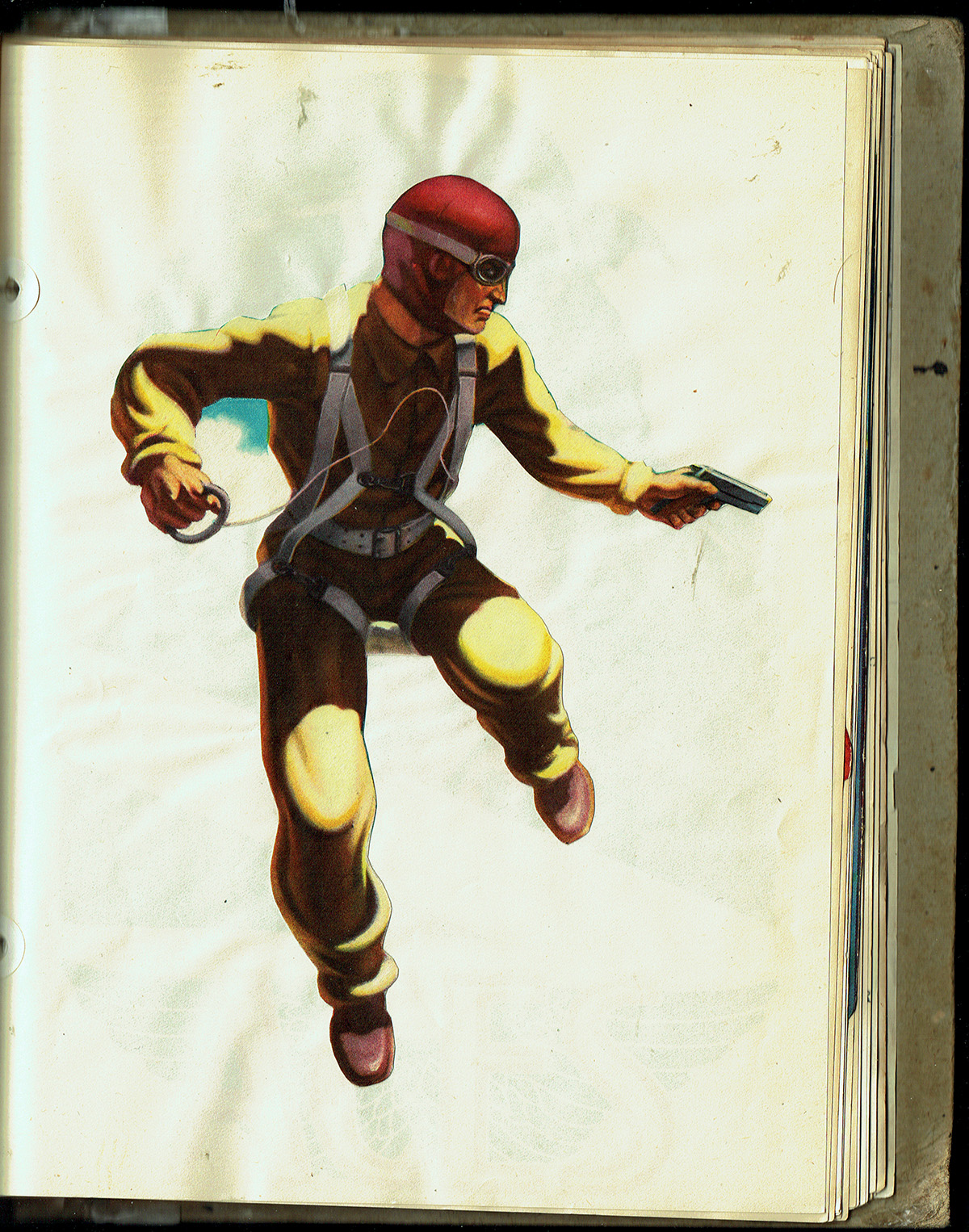
THIS Holiday Season we’re delving into a pair of scrapbooks that were created in the late 20’s and early 30’s by an industrious youth, Robert A. O’Neil, with a keen interest in all things aviation. The books contain clippings, photos and articles from various aviation pulps as well as other magazines. What has been assembled is a treasure trove of information on planes and aces of WWI.

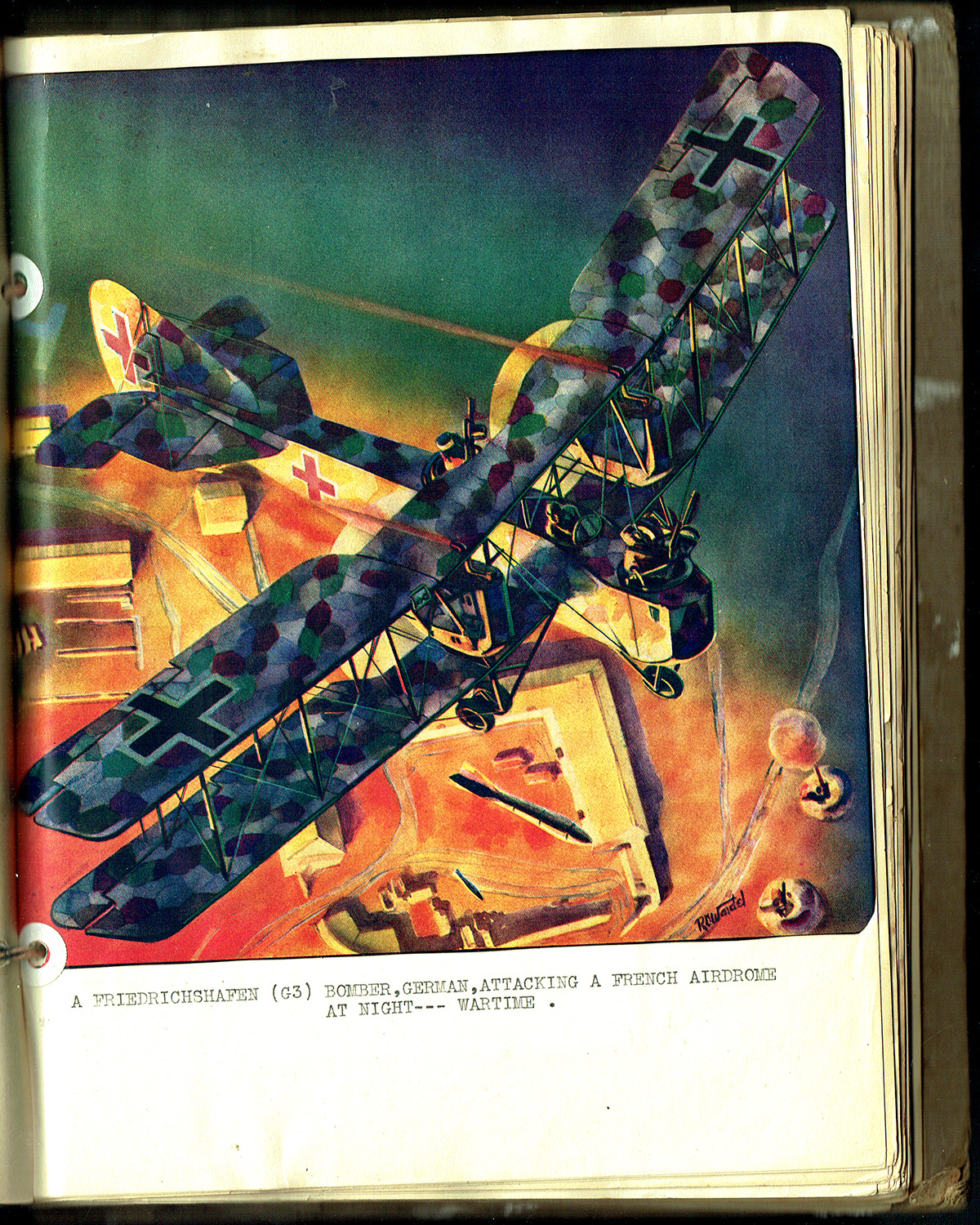
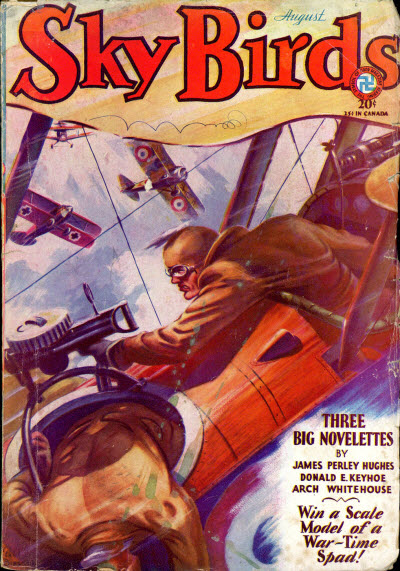
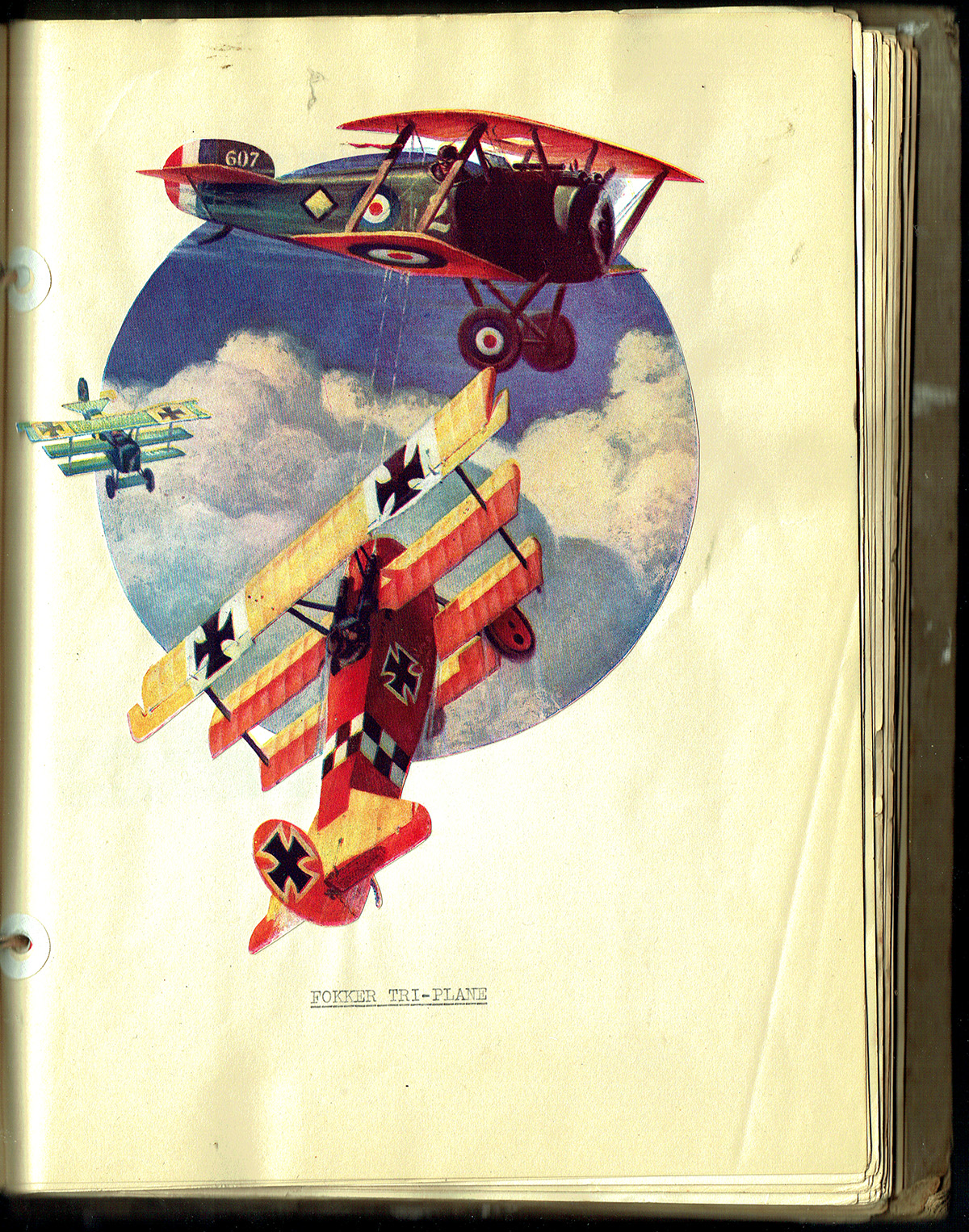
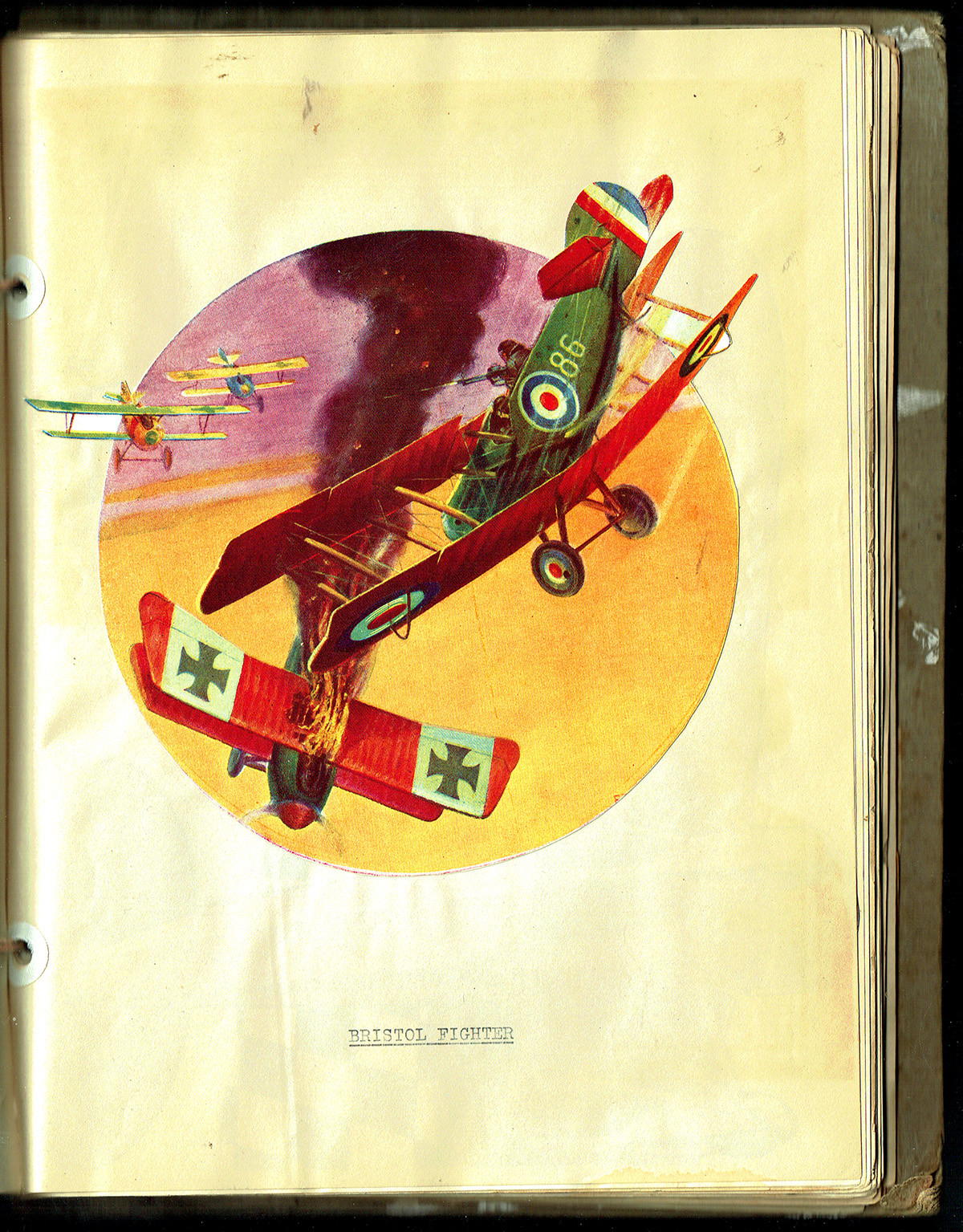
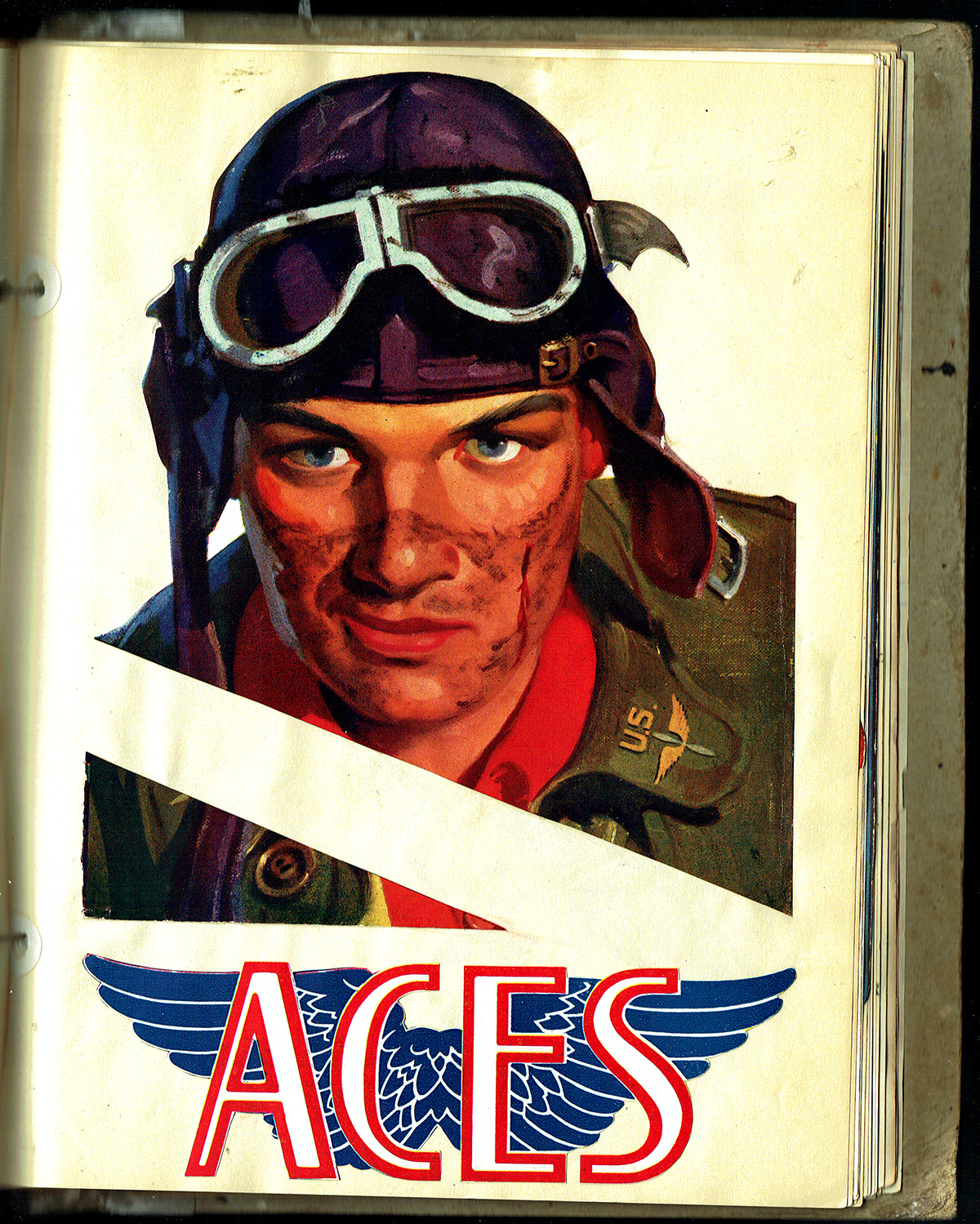
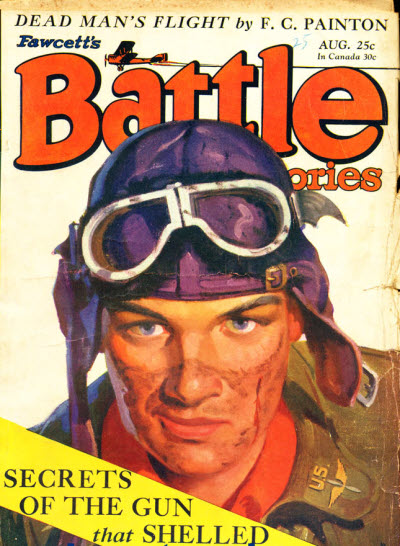
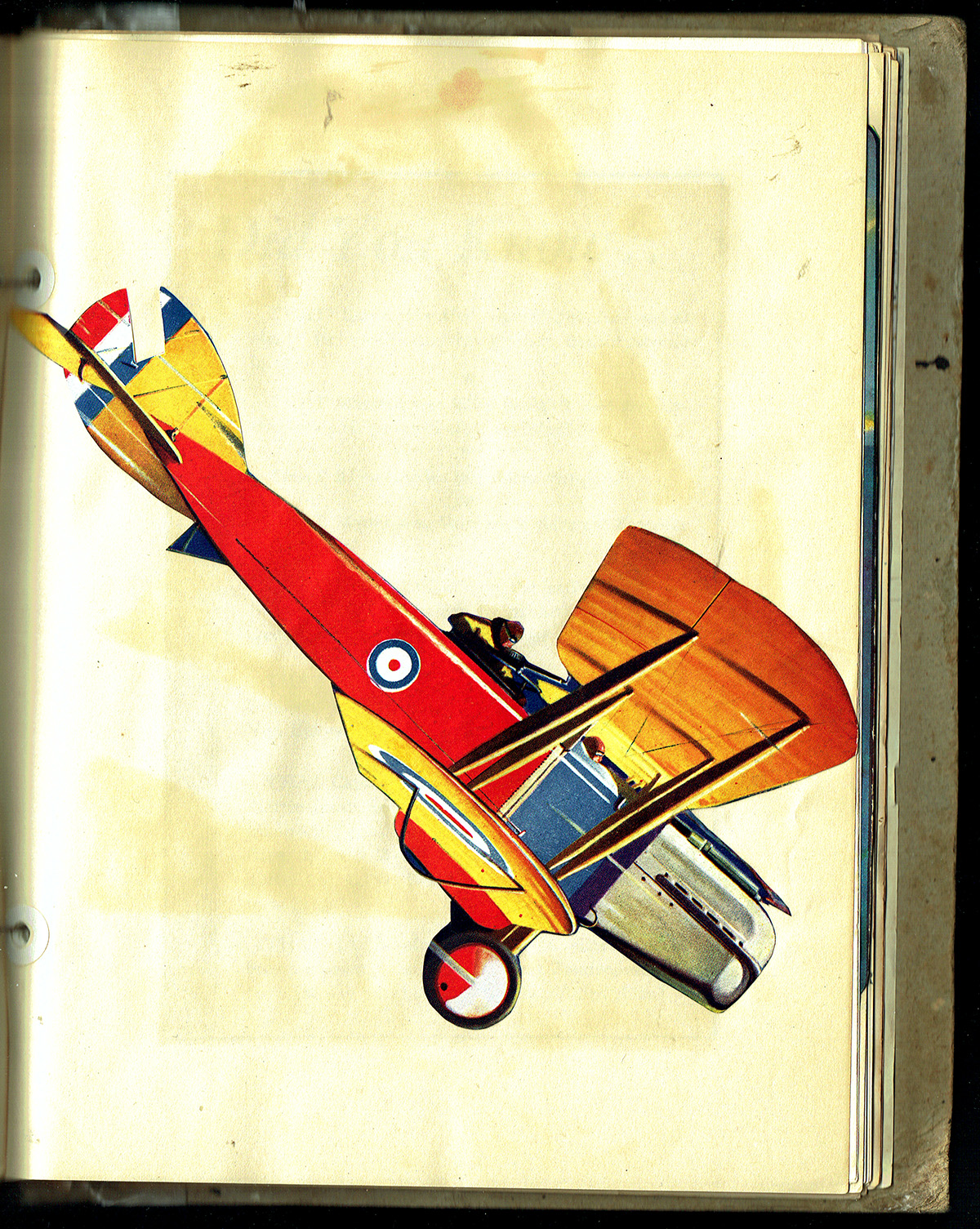
Like many in the late 20’s and early 30’s, Robert O’Neil was fascinated with aviation and as such, a large part of both volumes of his scrapbooks is taken up with a cataloging of the many different types of planes. In addition to Flying Aces’ “War Planes Album” and Sky Birds’ “Model Planes of All Nations”, Robert also featured Frederick Blakeslee’s magnificent Battle Aces covers.

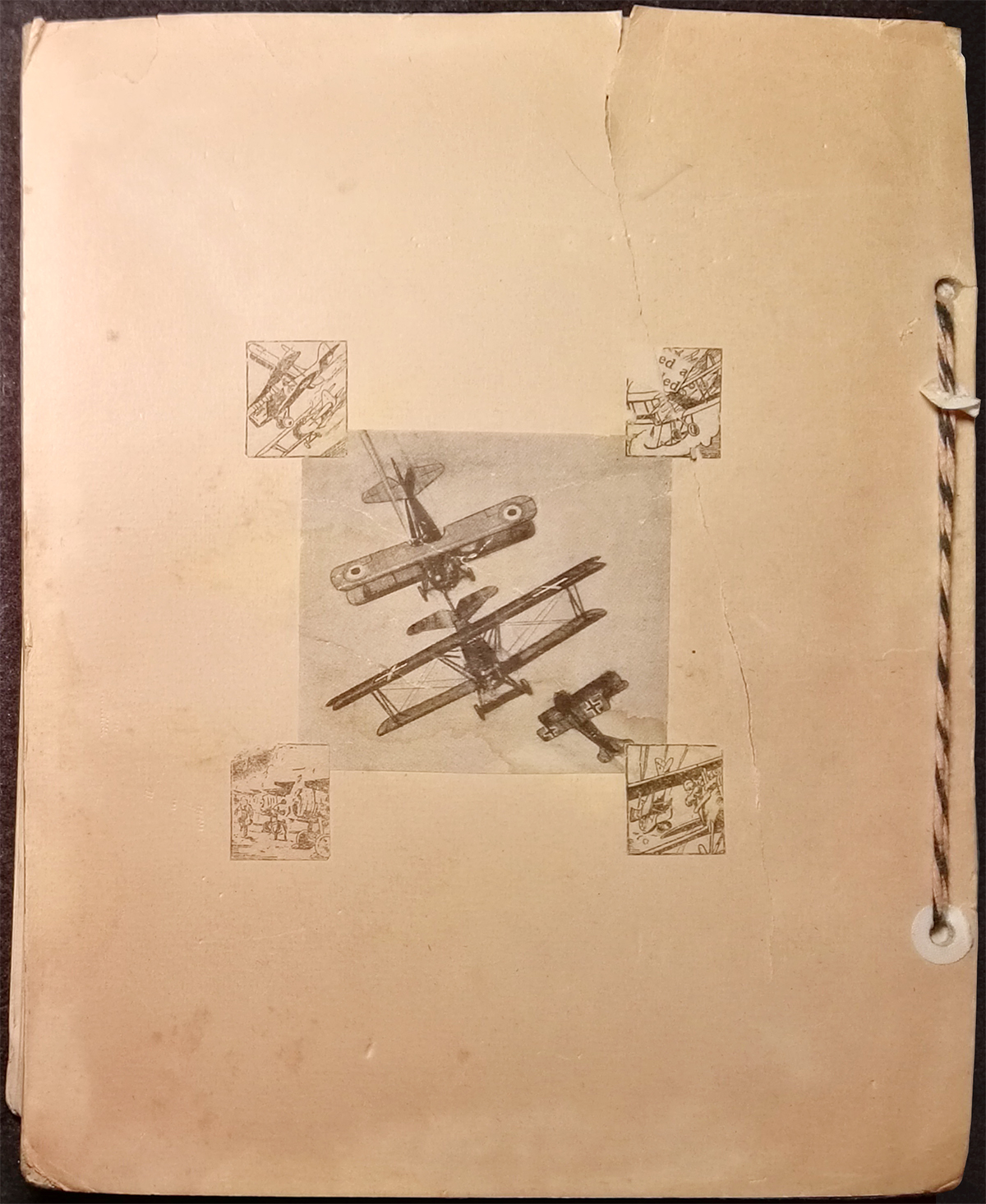
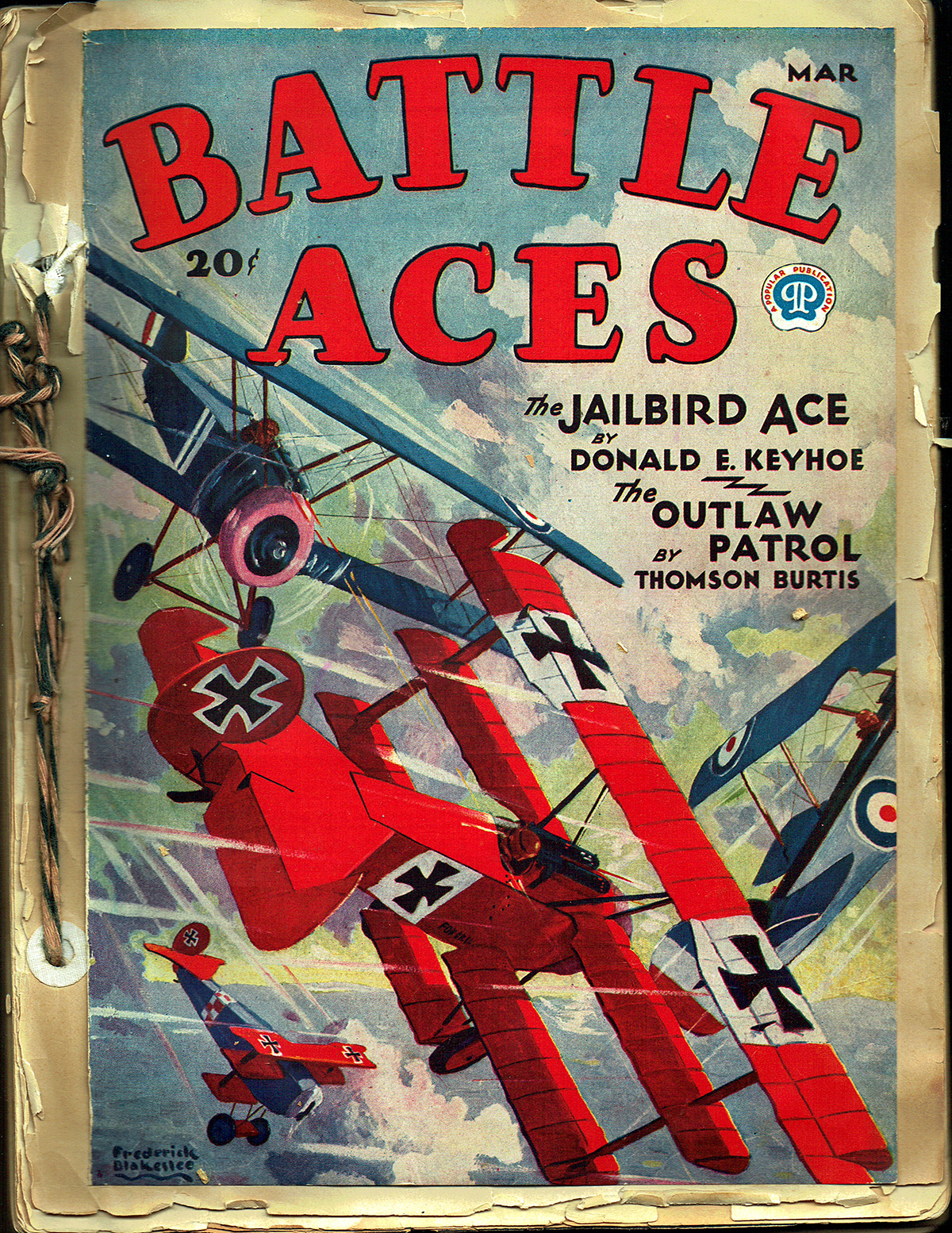
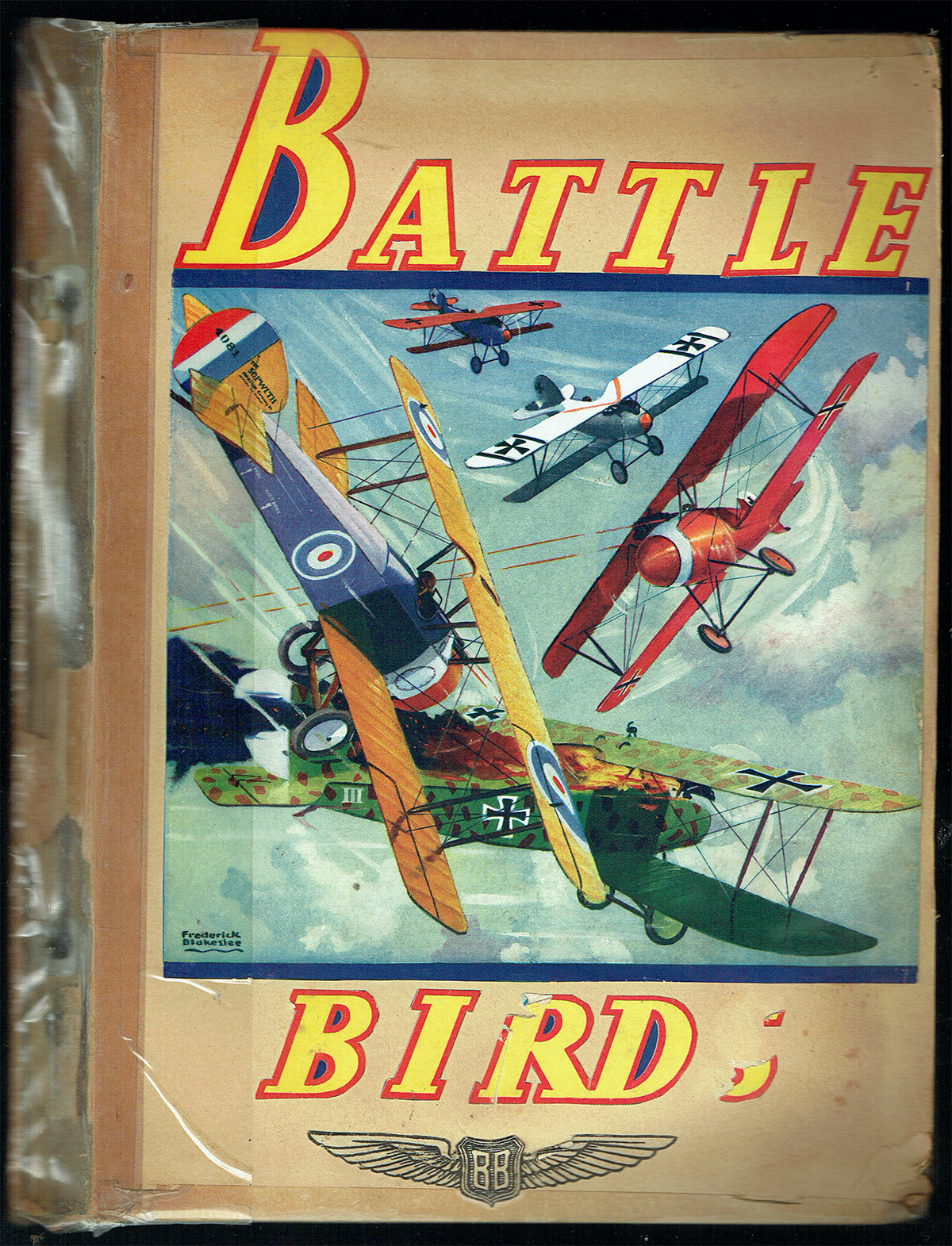
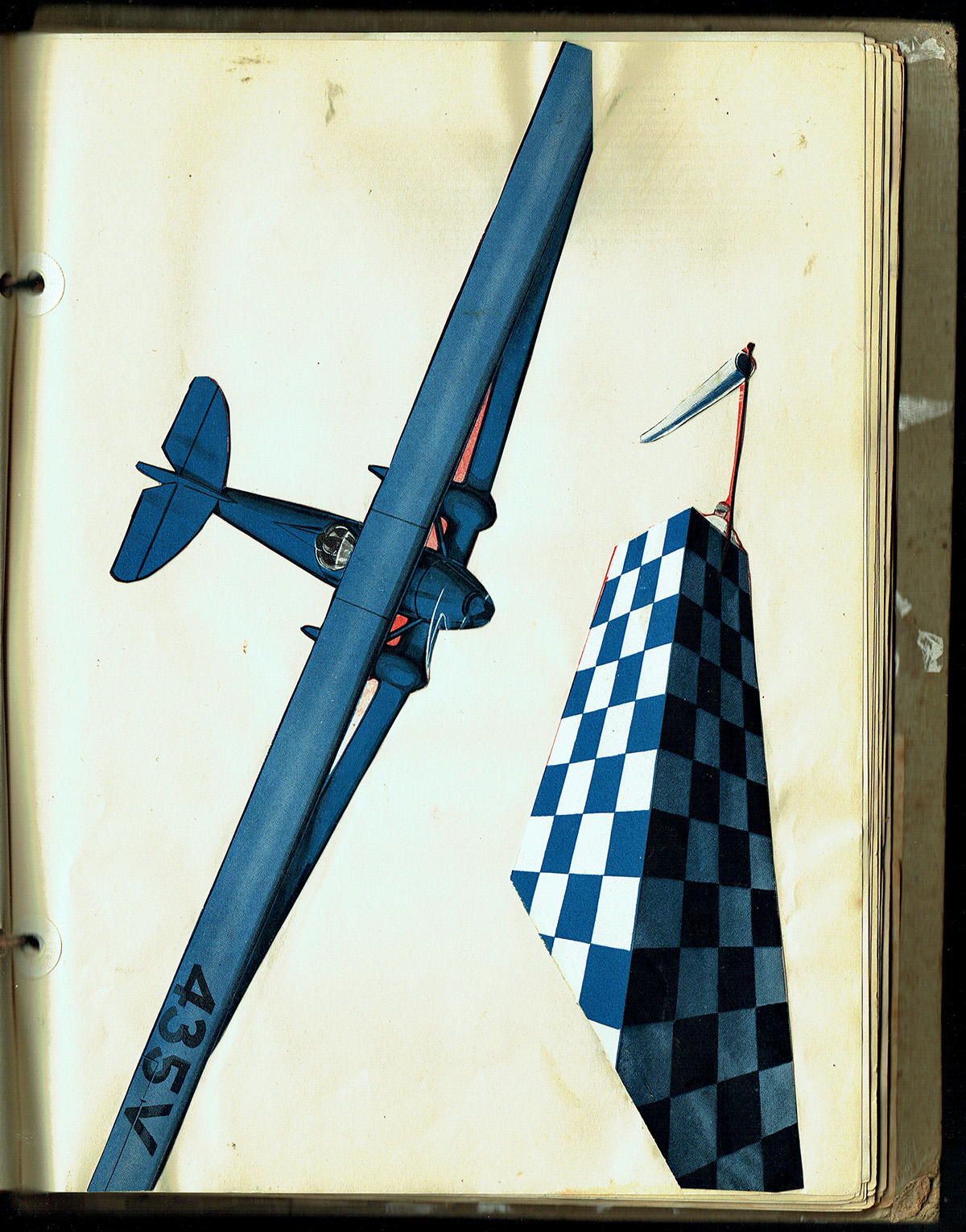
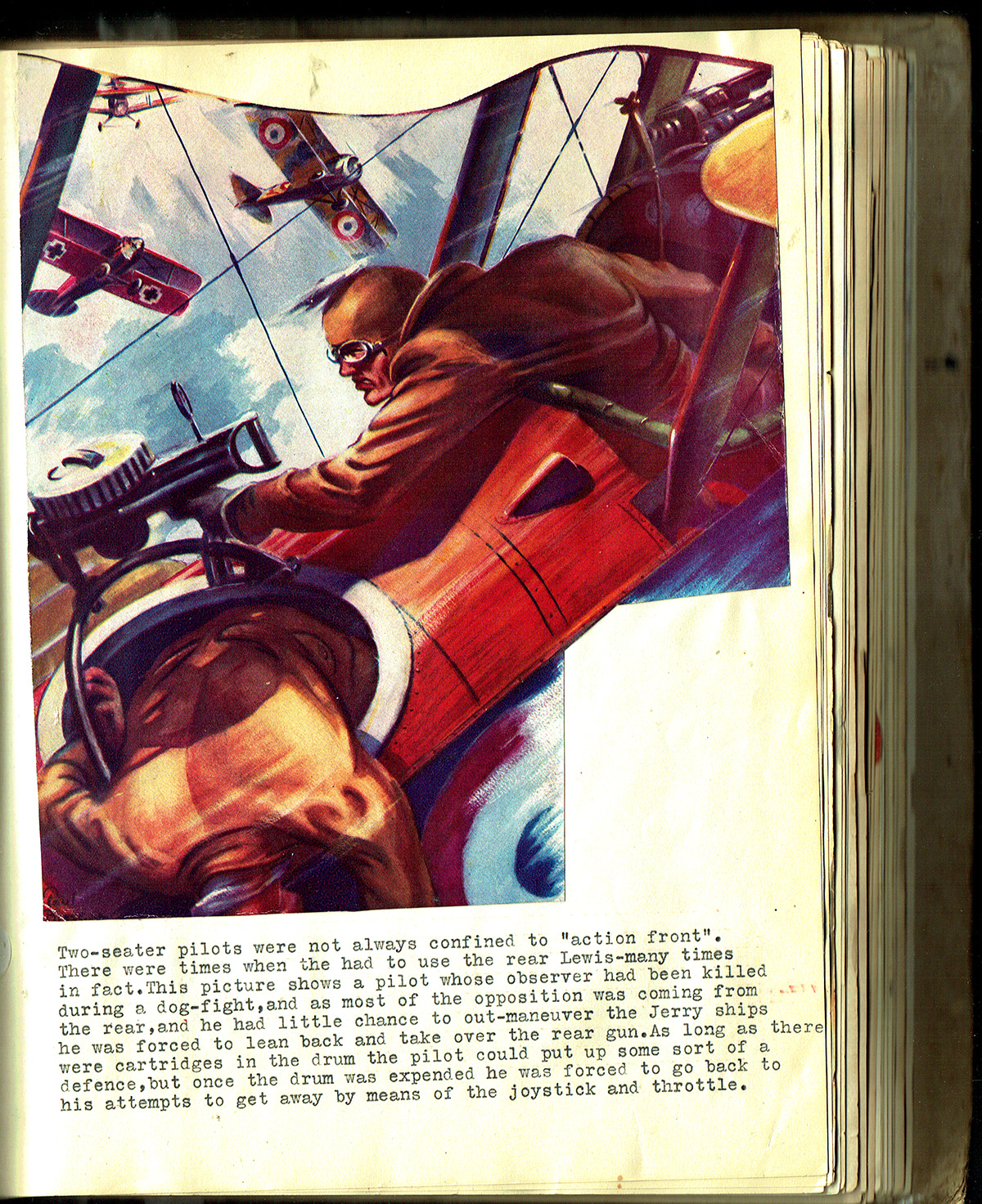
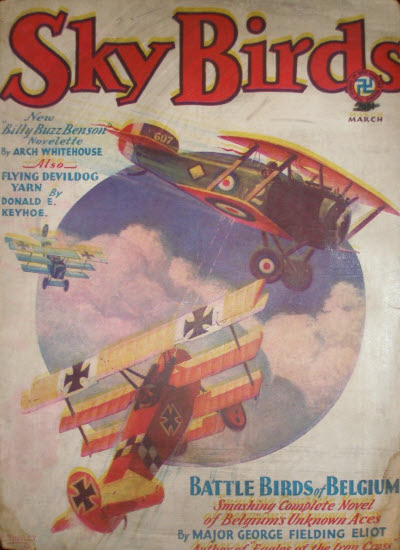
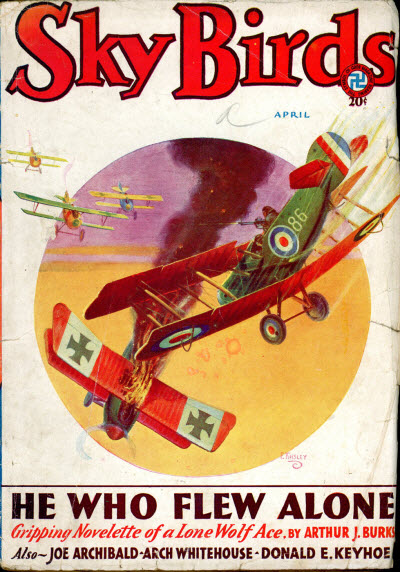
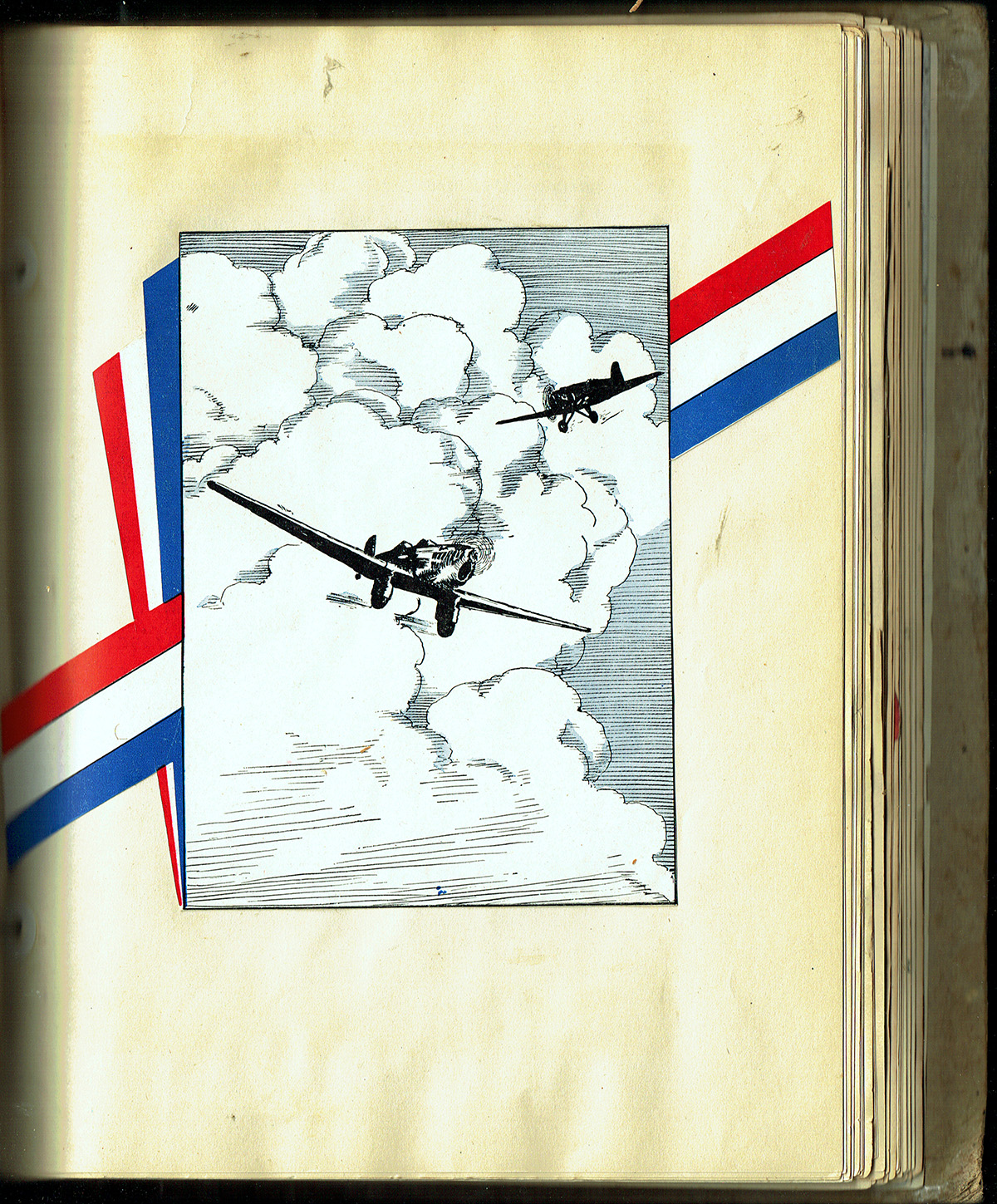
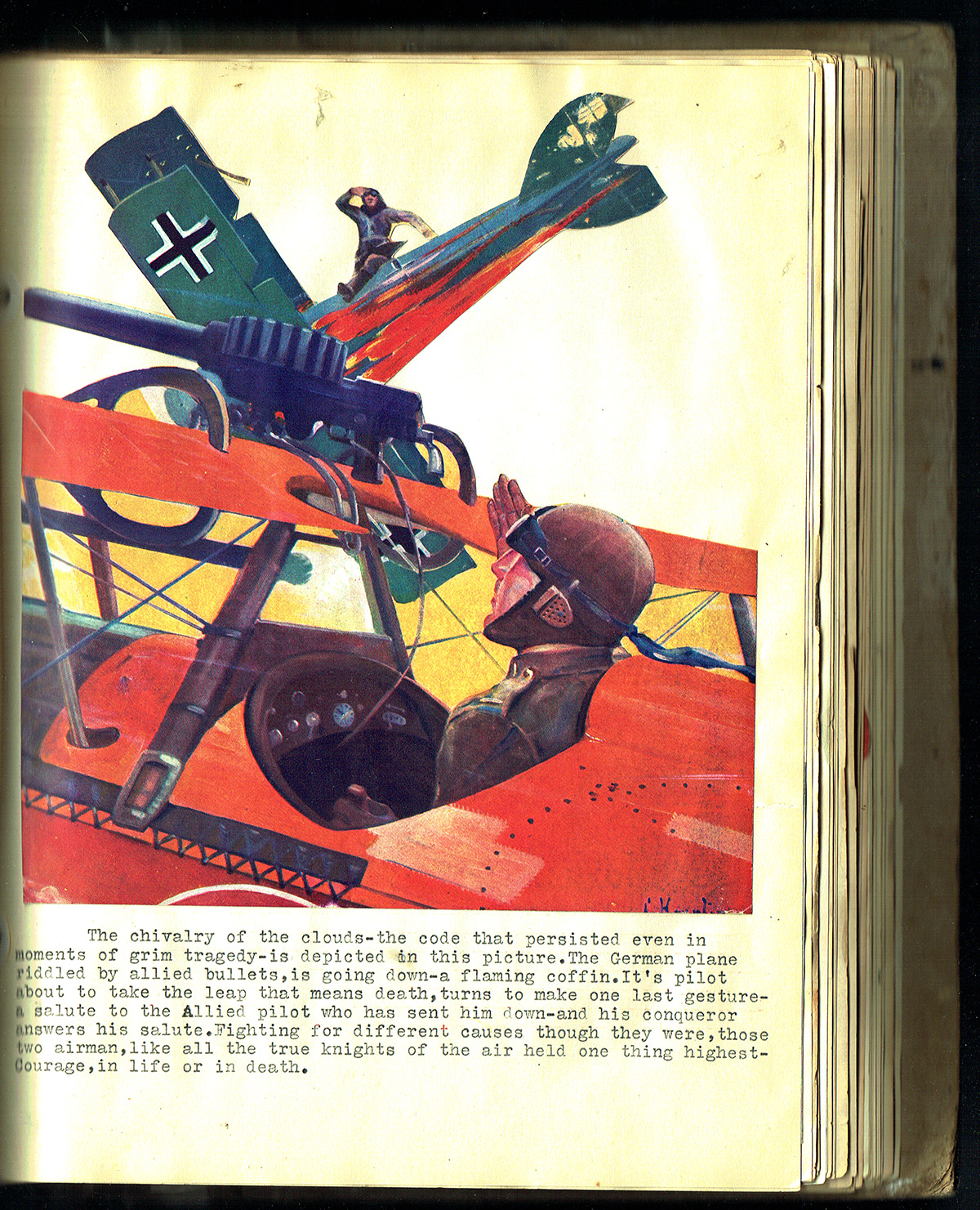
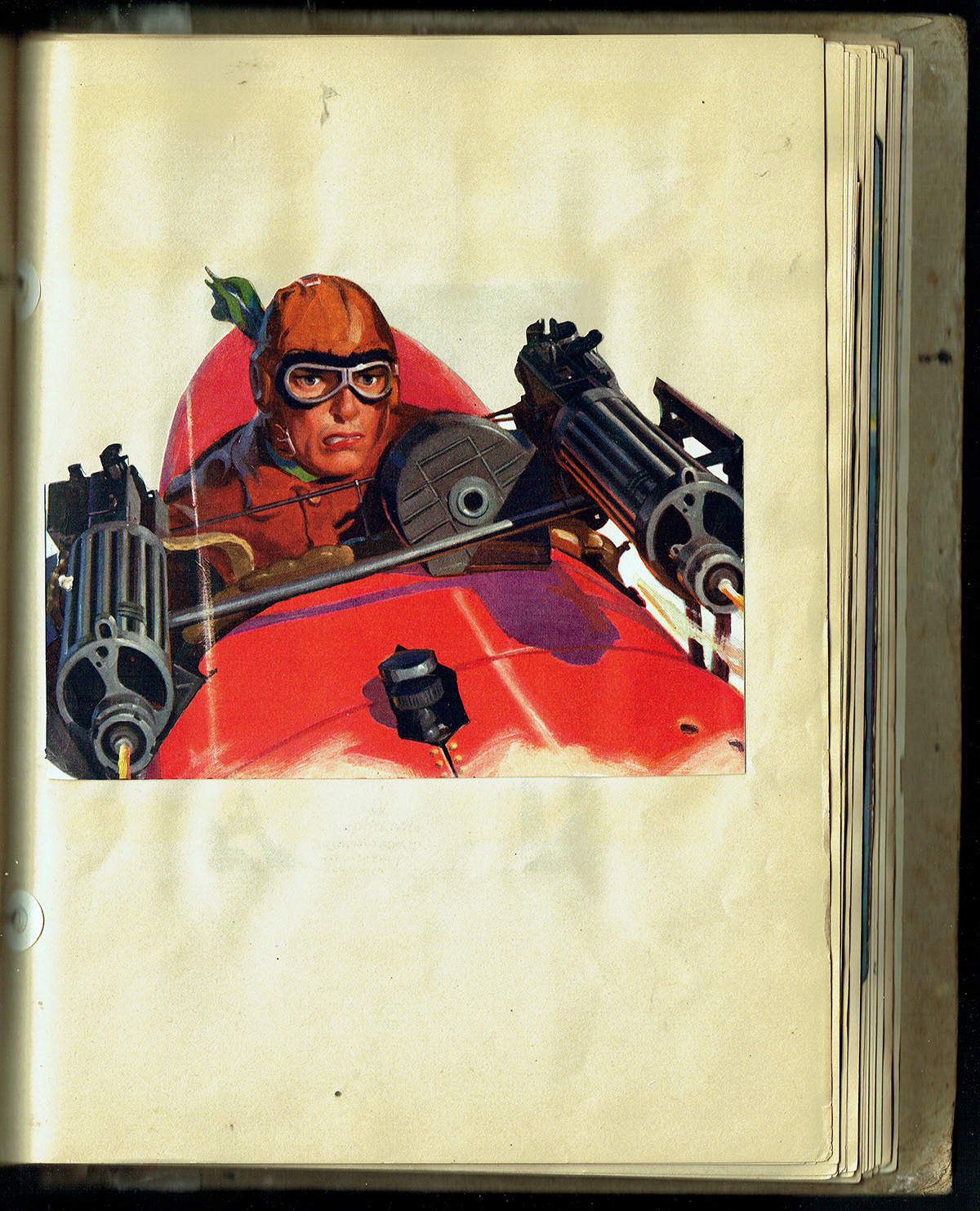
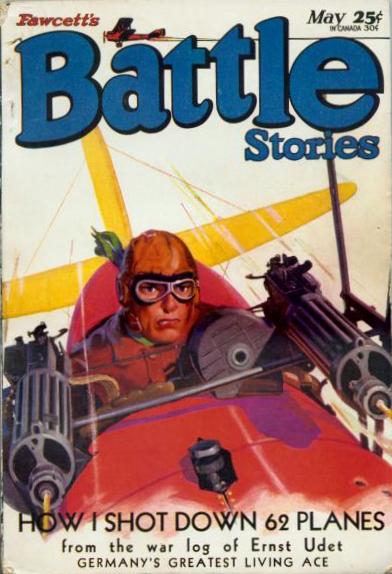
The second scrapbook which features the March 1932 Battle Aces cover as it’s cover, starts off with a collection of Blakeslee’s covers. each speed features a full fresh-off-the-newsstand cover and the story behind the cover lovingly typed on the facing page. I don’t know why he didn’t just clip out the story page from the issue instead, although he did clip out Blakeslee’s pen and ink rendering of the featured cover plane on several pages of those images collaged together.

He does not have all the Blakeslee Battle Aces covers, but he does have a majority of them.


He included the picture of O.B. Myers with the write-up for the November 1931 cover which tells how O.B. got his D.S.C.


Similarly, he includes Wilbert Wallace White’s picture with Blakeslee’s cover about White. (January 1932)

Covers he includes are:


Jan ‘32


Feb ‘32


Mar ‘32


Apr ‘32


May ‘31


Jun ‘31


Jun ‘32


Jul ‘32


Jul ‘31


Aug ‘31


Sep ‘31


Oct ‘31


Nov ‘31


Dec ‘31


Dec ‘32

From the Scrapbooks: Aces of Note

Link - Posted by David on December 3, 2021 @ 6:00 am in

THIS Holiday Season we’re delving into a pair of scrapbooks that were created in the late 20’s and early 30’s by an industrious youth, Robert A. O’Neil, with a keen interest in all things aviation. The books contain clippings, photos and articles from various aviation pulps as well as other magazines. What has been assembled is a treasure trove of information on planes and aces of WWI.

Like many in the late 20’s and early 30’s, Robert O’Neil was fascinated with aviation and not just the planes, but also some of the men who made a name for themselves flying them in The Great War.

Chronicled within the pages of the scrapbooks are such Aces the likes of:


Billy Bishop

and The Red Baron himself––


Baron Manfred von Richthofen

He has a page devoted to Rickenbacker’s Victories

And includes the four installments of Flying Aces’ “Lives of the Aces in Pictures”. Here, he’s taken the images from the two page feature (as they were in the pulp-sized issues), pasted them on a page with the accompanying captions, typed out on the facing page.


Eddie Rickenbacker, America’s Ace

He gave the same treatment for the Lives of Bert Hall, Soldier of Fortune (Flying Aces, June 1932), Georges Guynemer, Falcon of France (July 1932), and Lt. Werner Voss, German Ace (July 1933) as illustrated in pictures.

Scattered throughout are various mentions of aces from the pulps or the newspapers or other magazines.

From the Scrapbooks: Planes of the World

Link - Posted by David on December 1, 2021 @ 6:00 am in

THIS Holiday Season we’re delving into a pair of scrapbooks that were created in the late 20’s and early 30’s by an industrious youth, Robert A. O’Neil, with a keen interest in all things aviation. The books contain clippings, photos and articles from various aviation pulps as well as other magazines. What has been assembled is a treasure trove of information on planes and aces of WWI.

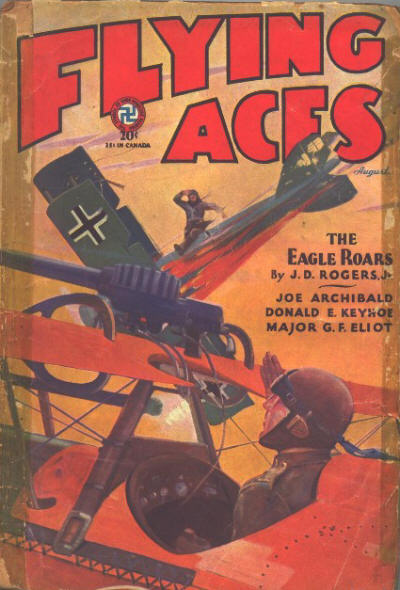
Like many in the late 20’s and early 30’s, Robert O’Neil was fascinated with aviation and as such, a large part of both volumes of his scrapbooks is taken up with a cataloging of the many different types of planes. Many of the aviation pulps featured monthly articles on this subject. Flying Aces called theirs “War Planes Album”. Each month they featured six planes with a simple illustration by C.B. Colby and an informative write-up on each of the planes.


Two of the six planes featured in the November 1932 Flying Aces

Good news for those who wanted to clip and save the plane images and paste them into an album as Robert had done, the illustrations were laid out in the article so no two images would be on the back of the other.


The opening spread of the “Model Planes of All Nations” from (Sky Birds, November 1931).

Robert also clipped similar images also by Colby from Sky Birds’ monthly feature “Model Planes of All Nations.” Sky Birds’ feature was essentially the same as Flying Aces’ feature. You get six planes an issue.


Two of the six planes featured in the November 1931 Sky Birds

Robert generally featured two images per page, but for a few, he pasted a single image on the page and below it typed the informative part of the article about that plane.

From the Scrapbooks: The Air Races

Link - Posted by David on November 29, 2021 @ 6:00 am in

THIS Holiday Season we’re delving into a pair of scrapbooks that were created in the late 20’s and early 30’s by an industrious youth, Robert A. O’Neil, with a keen interest in all things aviation. The books contain clippings, photos and articles from various aviation pulps as well as other magazines. What has been assembled is a treasure trove of information on planes and aces of WWI.

THIS week we have One of the areas that Robert was interested in were the new and exciting Air Races! The races included a variety of events, like landing contests, glider demonstrations, airship fights, parachute-jumping contests, and of course, the races themselves—both closed-course and cross-country. The cross-country races were usually from Portland or Los Angeles to Cleveland. Robert included information on five different air shows from 1928-1933, and his ticket stub for two of them.

1928 National Air Races & Aeronautical Exposition
Los Angeles

Robert would have been 17 when the 1928 National Air Races and Aeronautical Exposition took place at Mines Field in Los Angeles over nine days in September that year. Mines Field would eventually become LAX. Robert includes his ticket for the show. He went on “Boy Scouts Day” for 25¢. I couldn’t find out which day that would have been, but from the program, I see the L.A. Boy Scouts Band opened the night time programming the first two days.

Just the first two days alone had more planes than anyone would want. Saturday’s show started off with 300 airplanes in mass formation, to Dare-devil pilot Al Wilson to 7 US Marine Curtiss Falcons in formation to the Army’s version followed by the Navy’s and so on. There were parachuting demonstrations both during the day and with flares at night! There were all manner of air extravaganzas culminating in a spectacular fireworks display.

The Homestead Blog and Davis-Monthan Aviation Field Register have excellent articles about the races that year. There is even a home movie of some of the show on YouTube.

1929 Western Aircraft Show
Los Angeles

Robert also included his ticket and logo decal for the Western Aircraft Show of 1929. The Western Aircraft Show was held on a large undeveloped property at the northwest corner of Wilshire Boulevard and Fairfax Avenue. Today this is the home of the Los Angeles County Museum of Art, the Academy Museum of Motion Pictures and the La Brea Tar Pits on the northeastern corner and the Petersen Automotive Museum on the southeast corner.

The Homestead Blog comes through with an informative article on the Western Aircraft Show.

1931 National Air Races
Cleveland

There is no evidence that Robert traveled to Cleveland to see the National Air Races there in 1931. He does include a couple decals of the show’s Pilot’s head with trailing scarf logo as well as a promotional mini-poster.

1933 International Air Races and Gordon Bennett Race
Chicago

Like the Cleveland races, there is no evidence that Robert traveled to the International Air Races and Gordon Bennett Race held in Chicago the first four days of September 1933. He did write for information, and has put the letter he received along with a brochure into his scrapbooks.

1933 National Air Races
Los Angeles

Robert did not include a ticket for the 1933 Races, but he could easily have attended the show. In his scrap books he includes numerous decals from the show—both the large three headed one as well as the smaller medallion sized version, including one on the spine of the one scrapbook.

The Races returned to Mines Field for four days in July 1933. The programs shortened to four days and restricted to high speed free-for-all competition in the several commercial competitive motor groups with $50,000.00 cash prize money in addition to many coveted trophies. This international free-for-all competition included the trans-continental Vincent Bendix Trophy Race; the Aerol Trophy Race—a closed course free-for-all for women pilots; the Speed Dashes; Official World Record Attempts to establish three-kilometer strightaway speed in excess of 300 M.P.H.; and the Charles E. Thompson Trophy Race, closed course land plane classic, which has been increased to a distance of 200 miles. The Bendix Trophy Race attracted such big names as Roscoe Turner, Jimmy Wedell, Ruth Nichols, and Amelia Earhart, with Roscoe Turner taking first.

As always, there were demonstrations by the armed Military and Naval Air Forces of the United States of the latest Military and Naval Air maneuvers; as well as acrobatic demonstrations and spectacular night aerial demonstrations and pyrotechnic displays.

The Los Angeles Times covered the event publishing several spreads of pictures from the events.

The Robert A. O’Neil Scrapbooks

Link - Posted by David on November 26, 2021 @ 6:00 am in

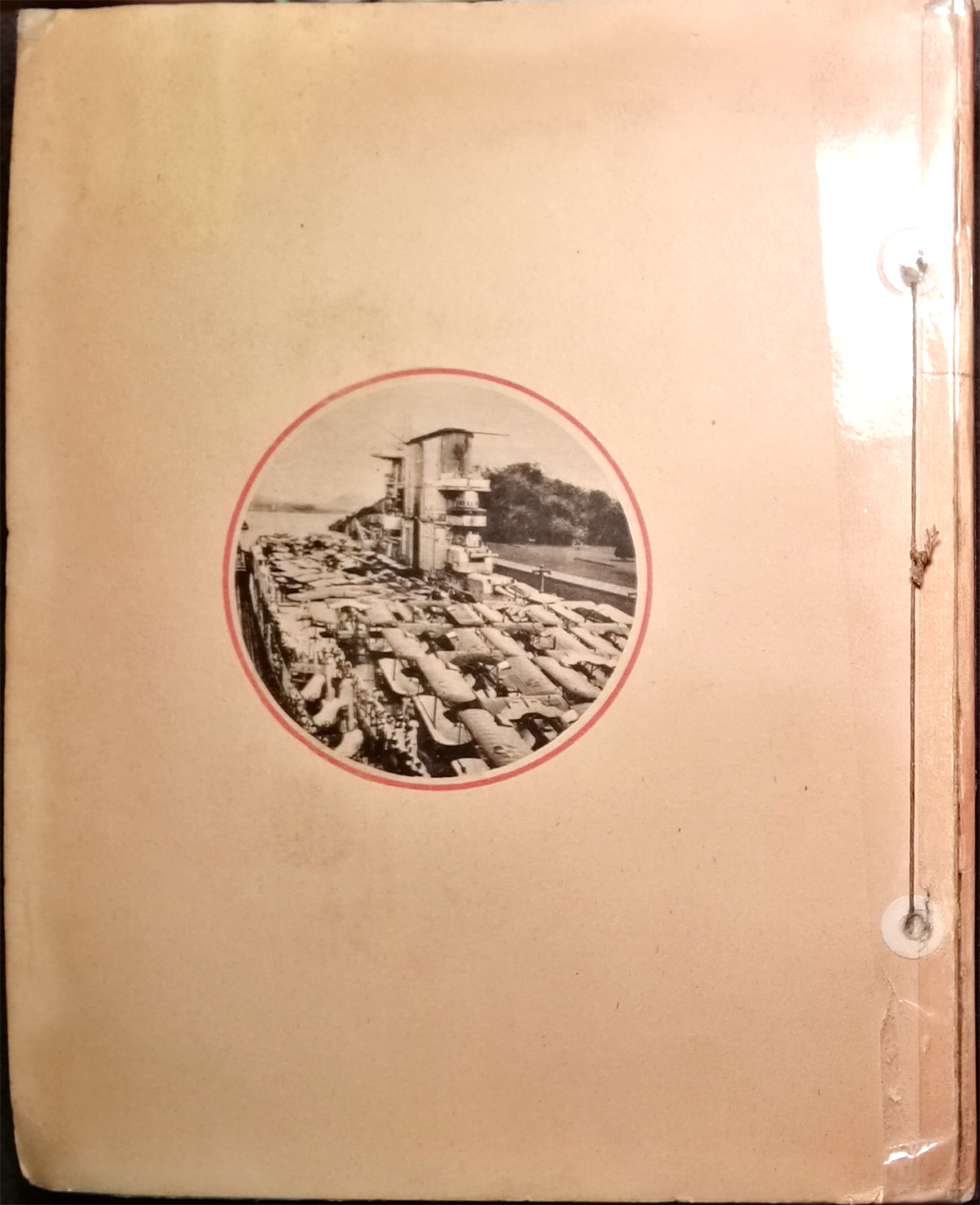
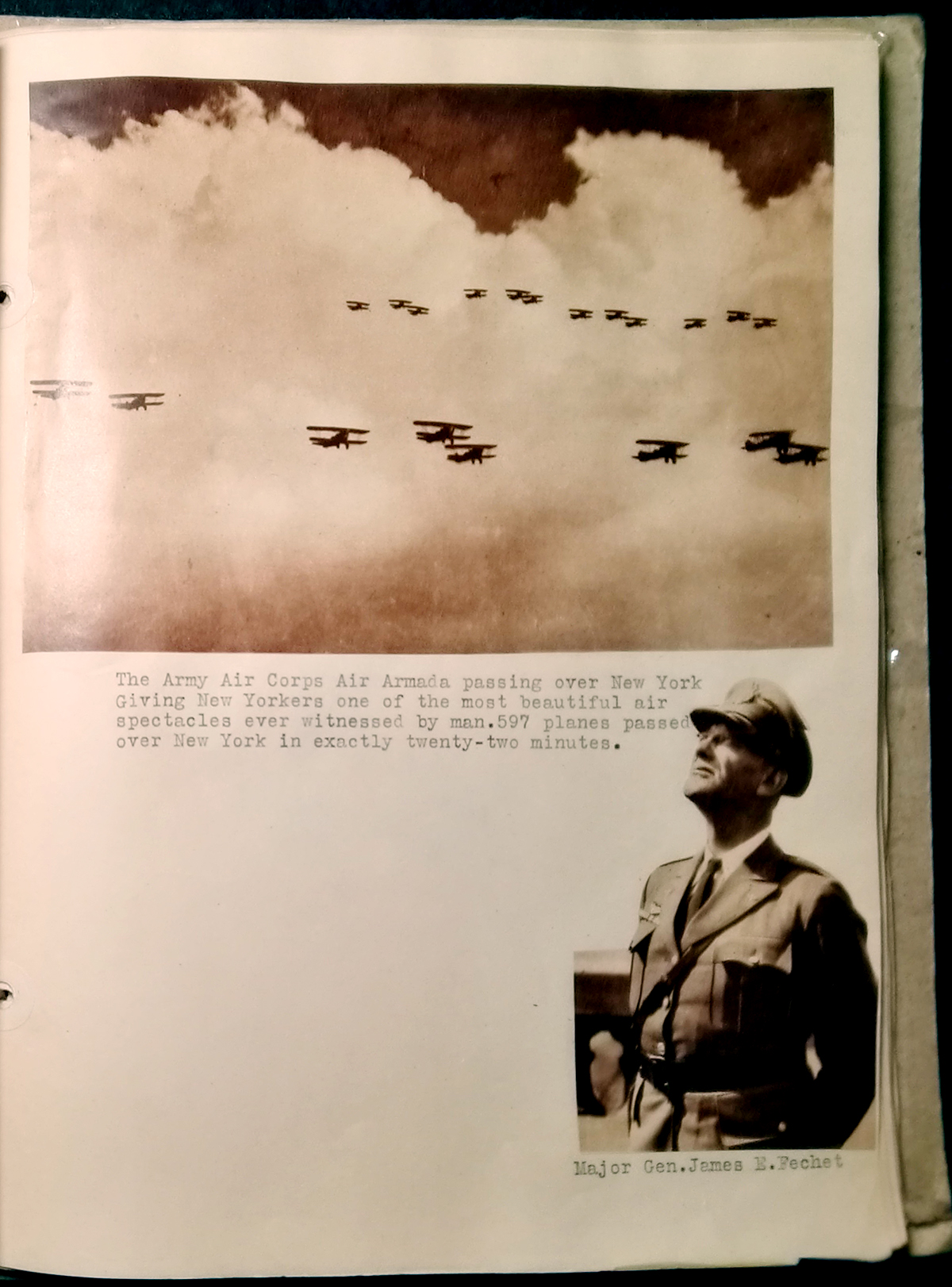
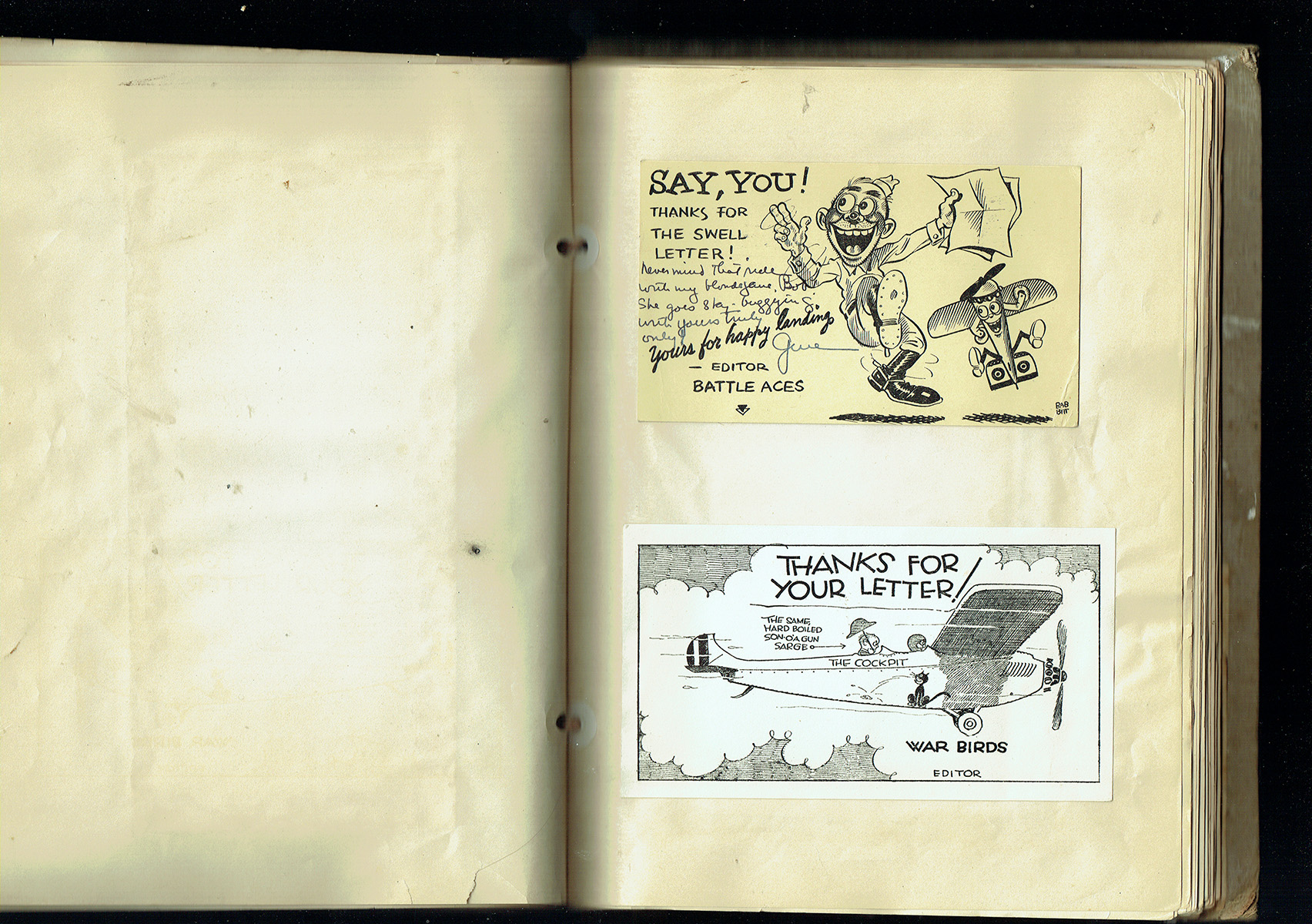
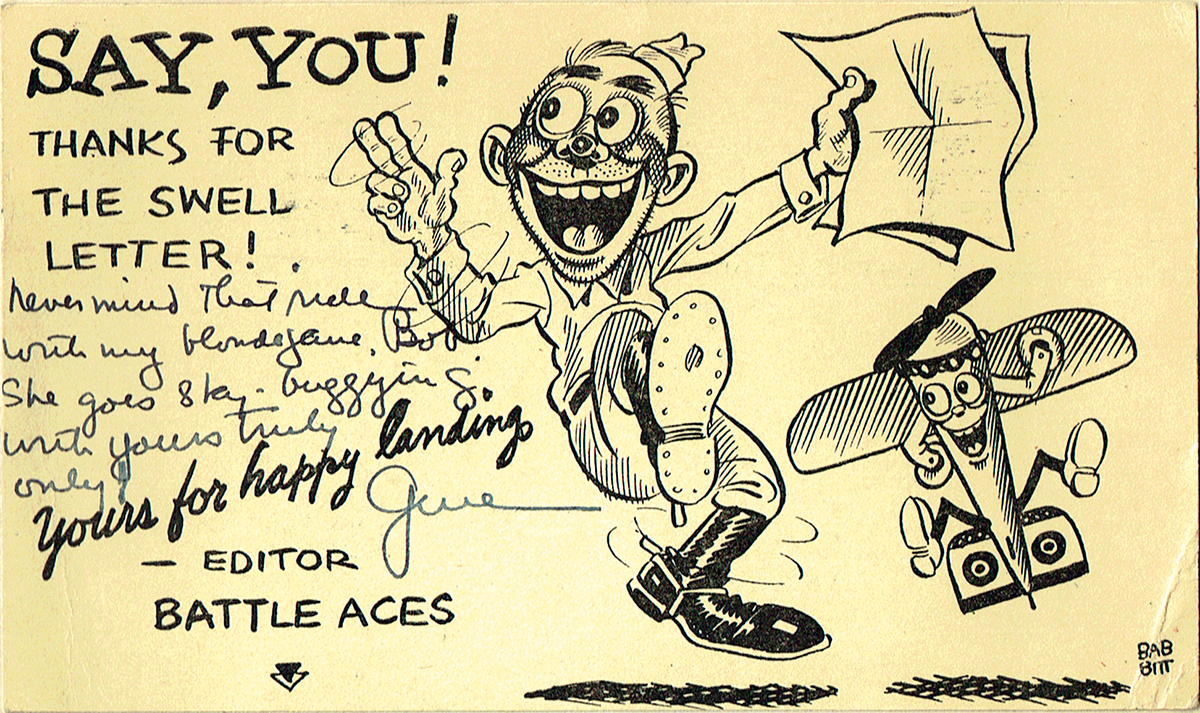
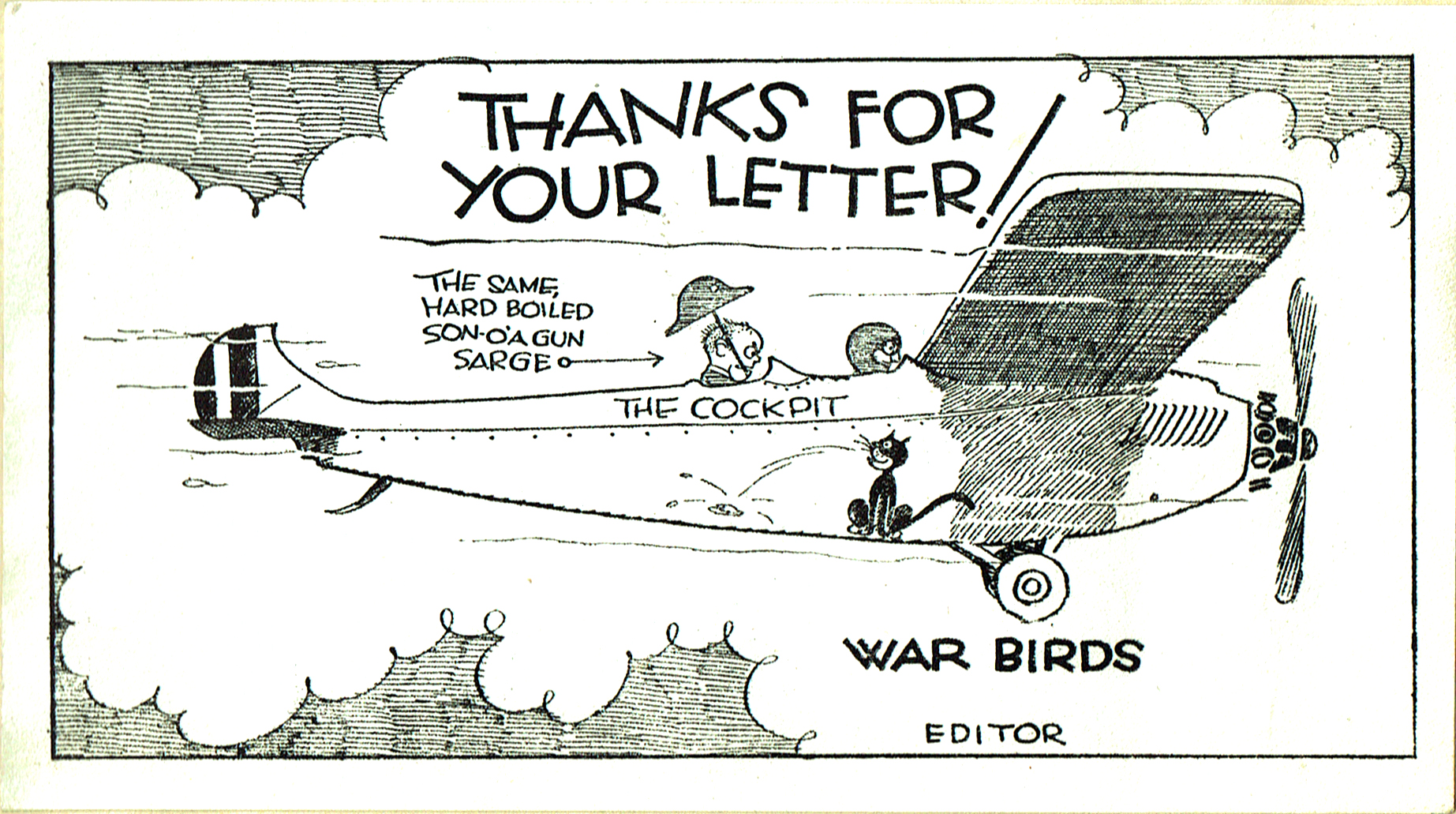
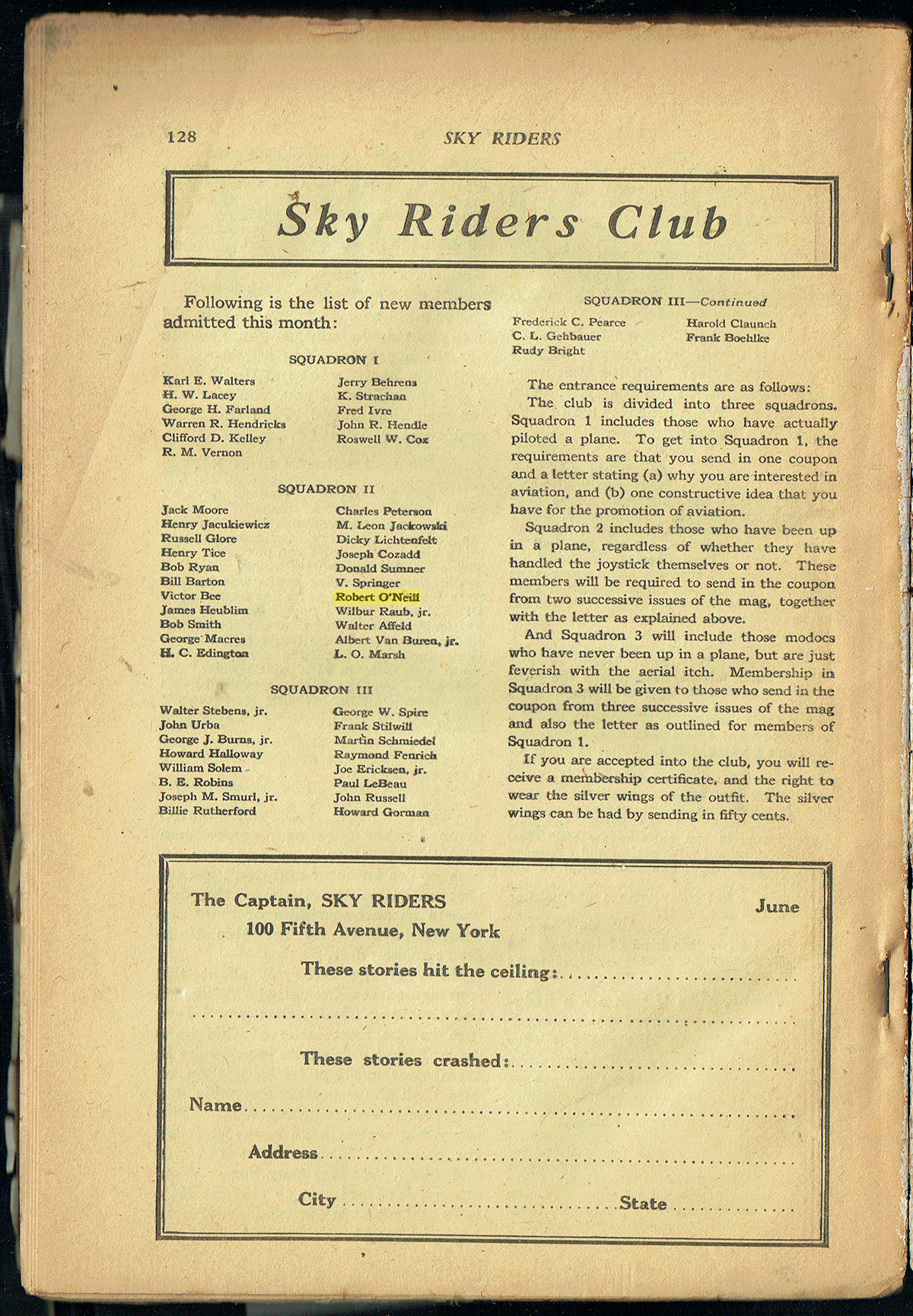
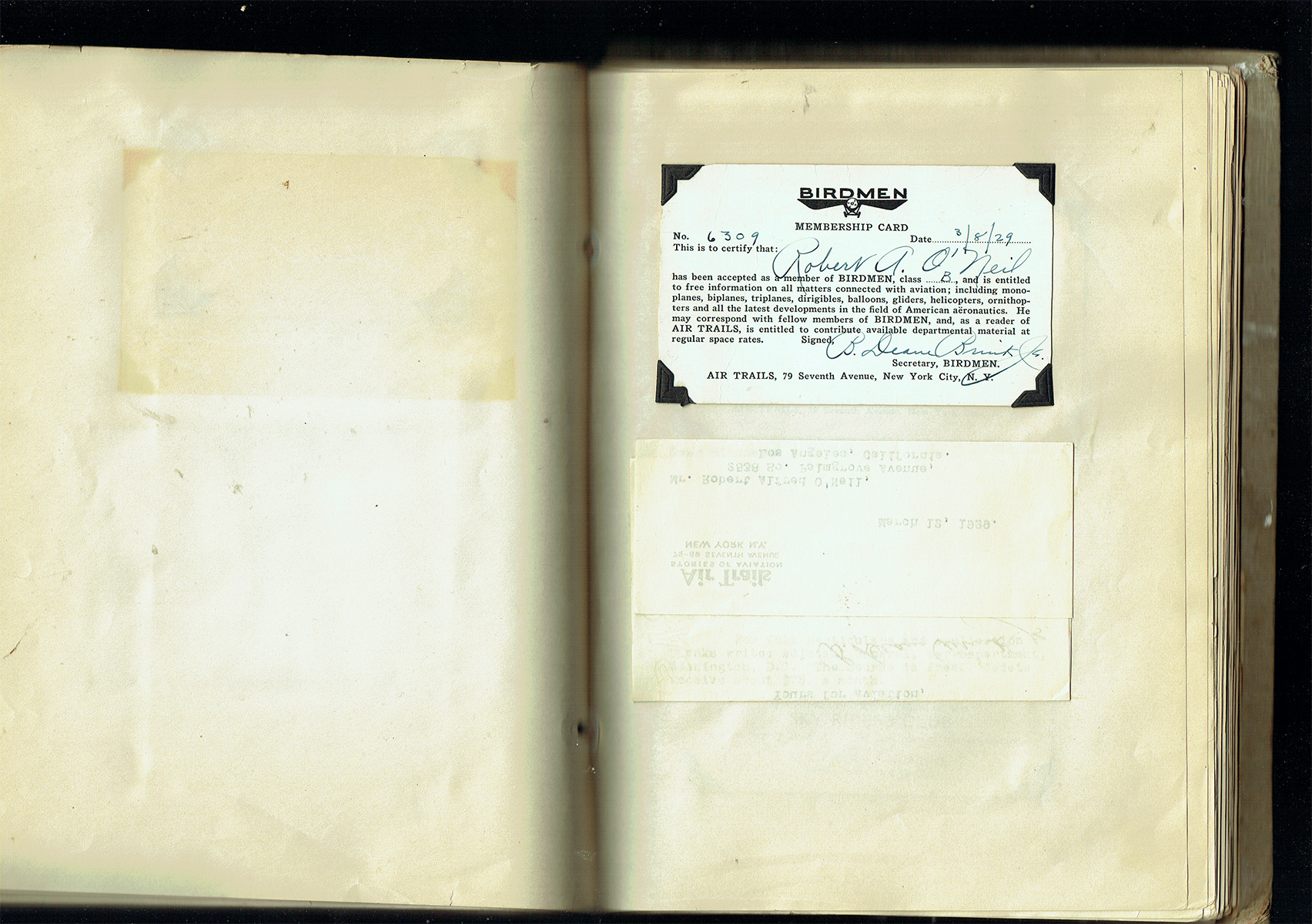
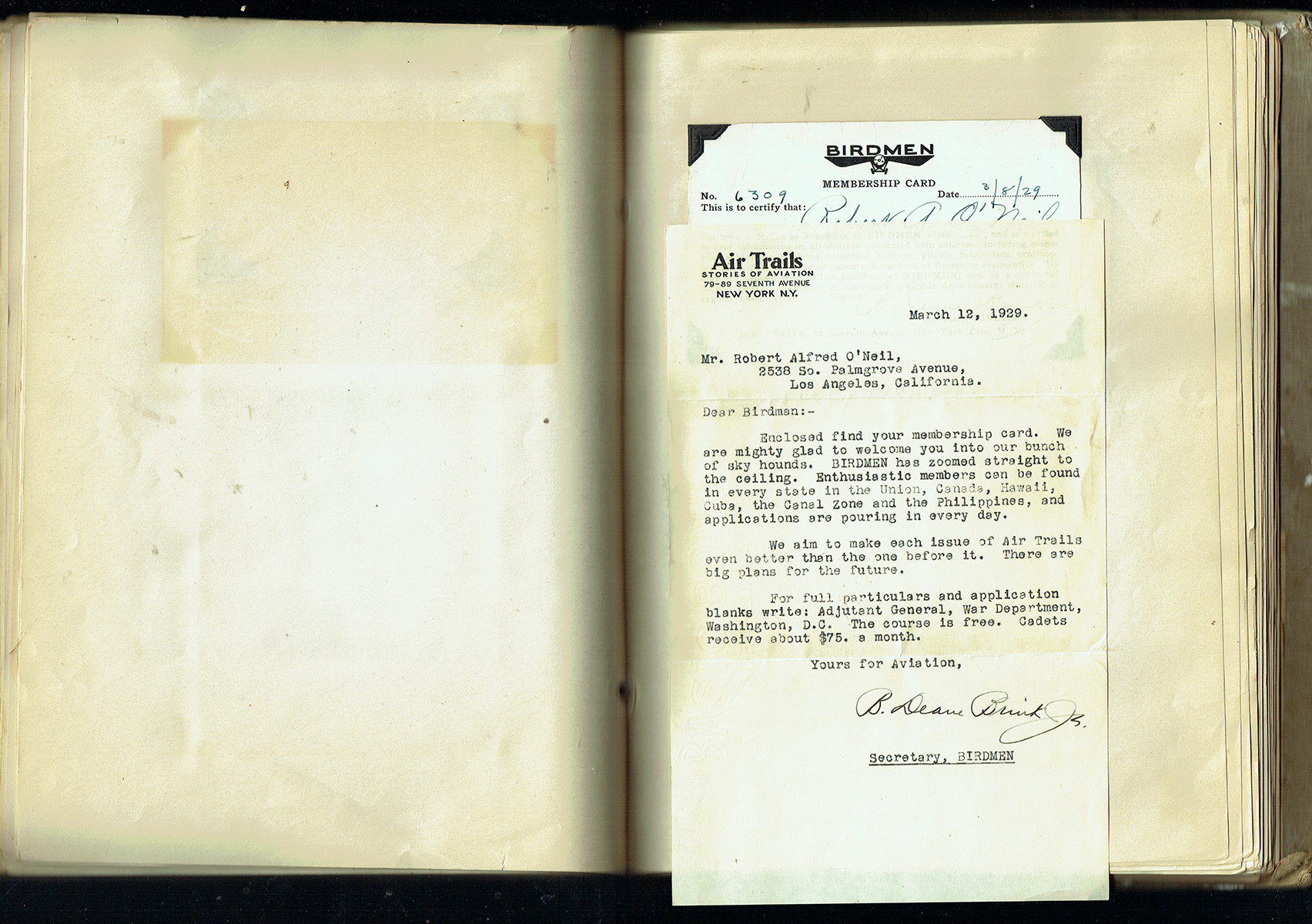
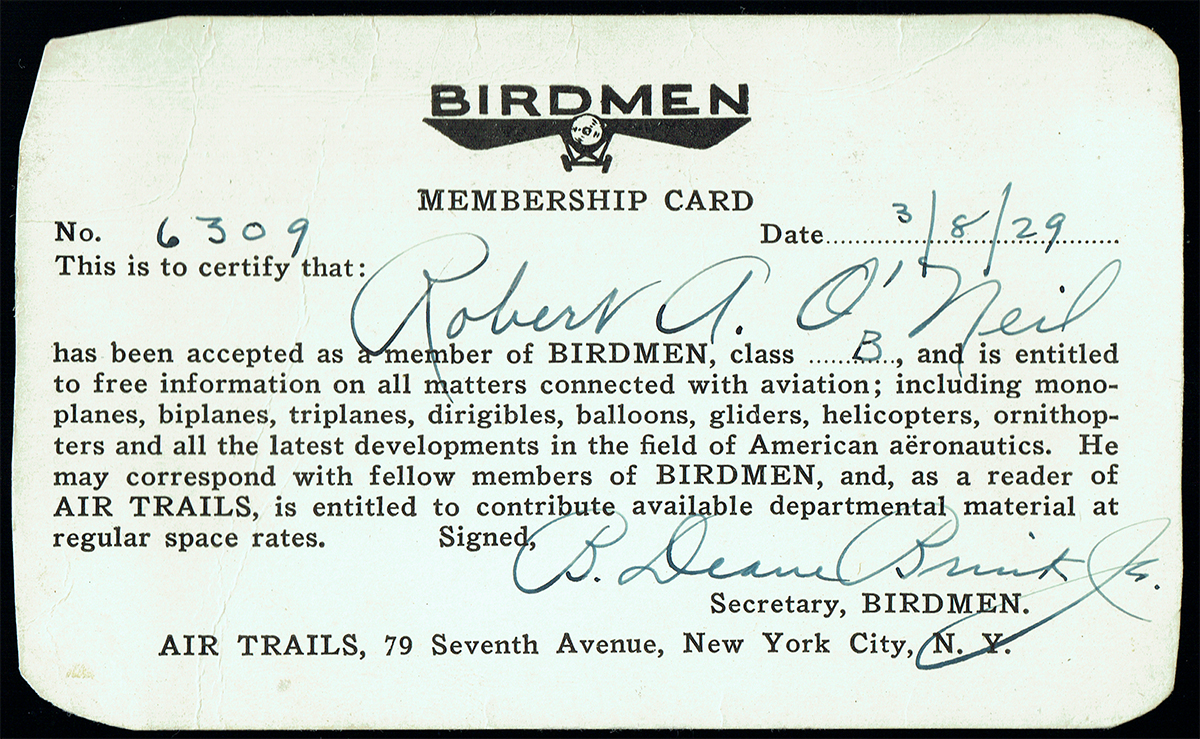
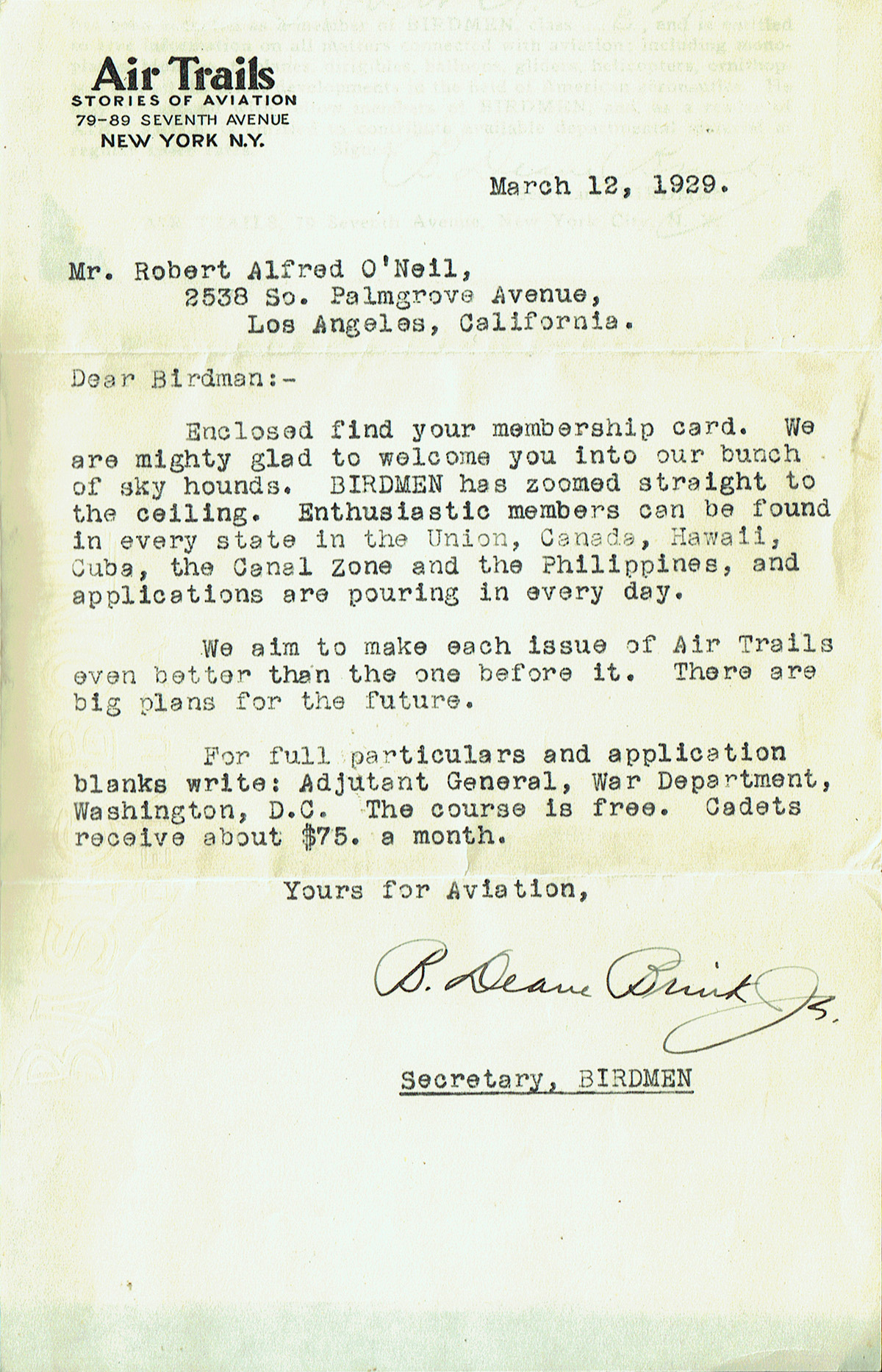
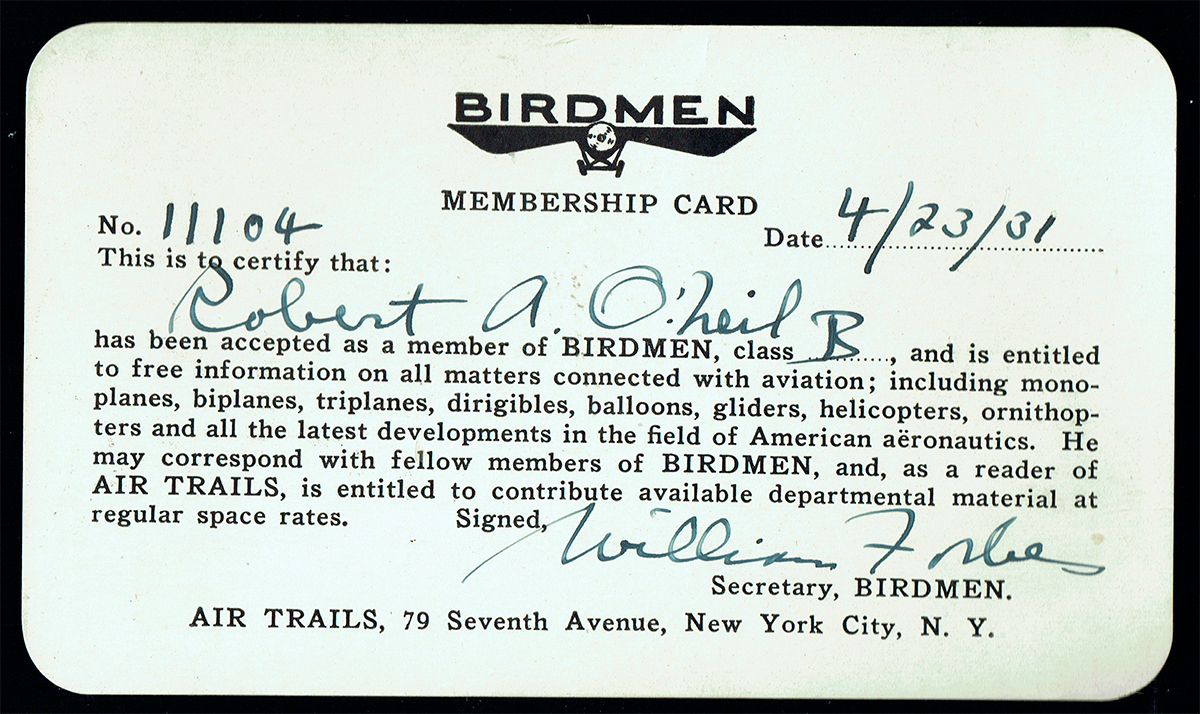
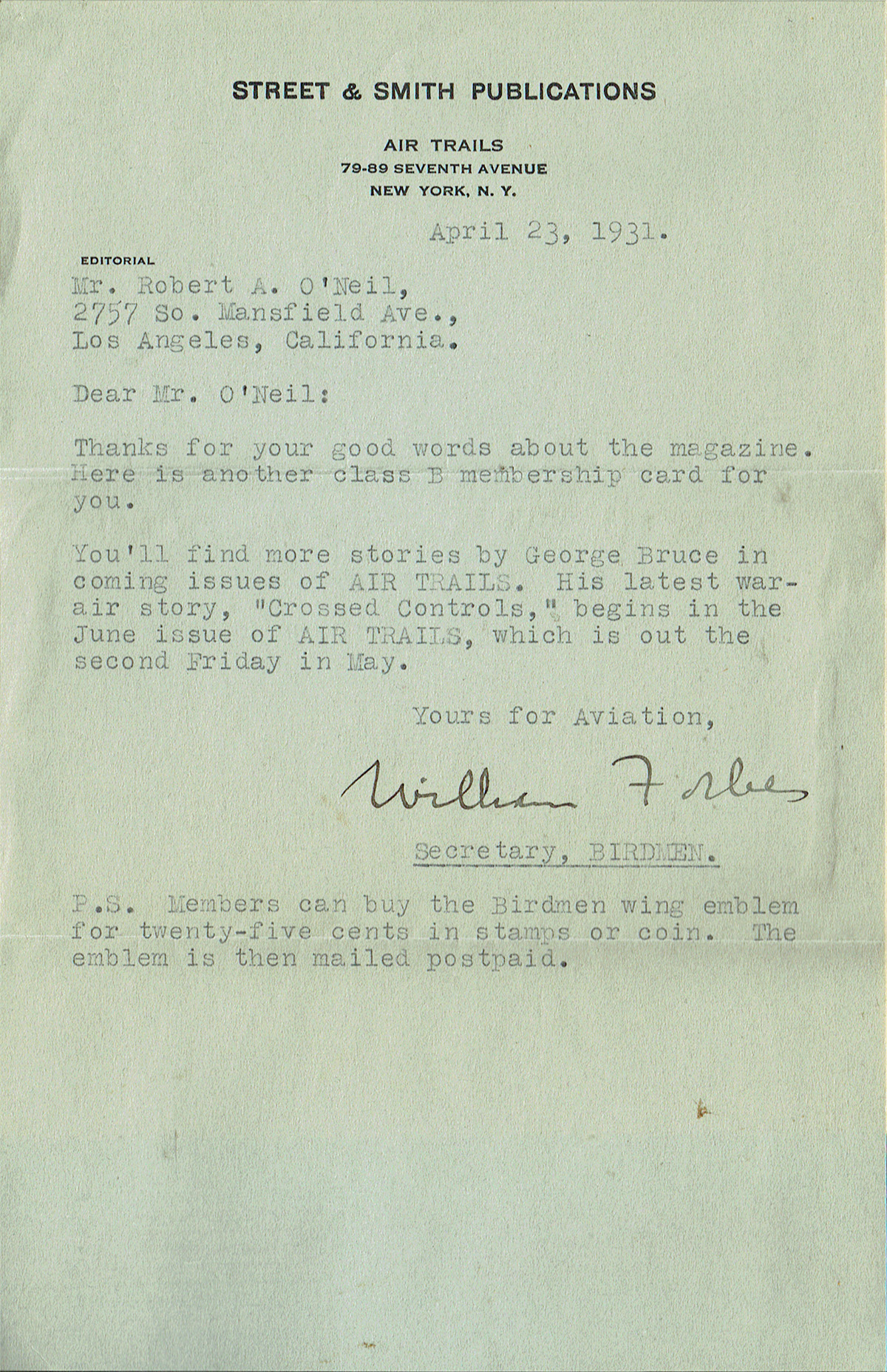
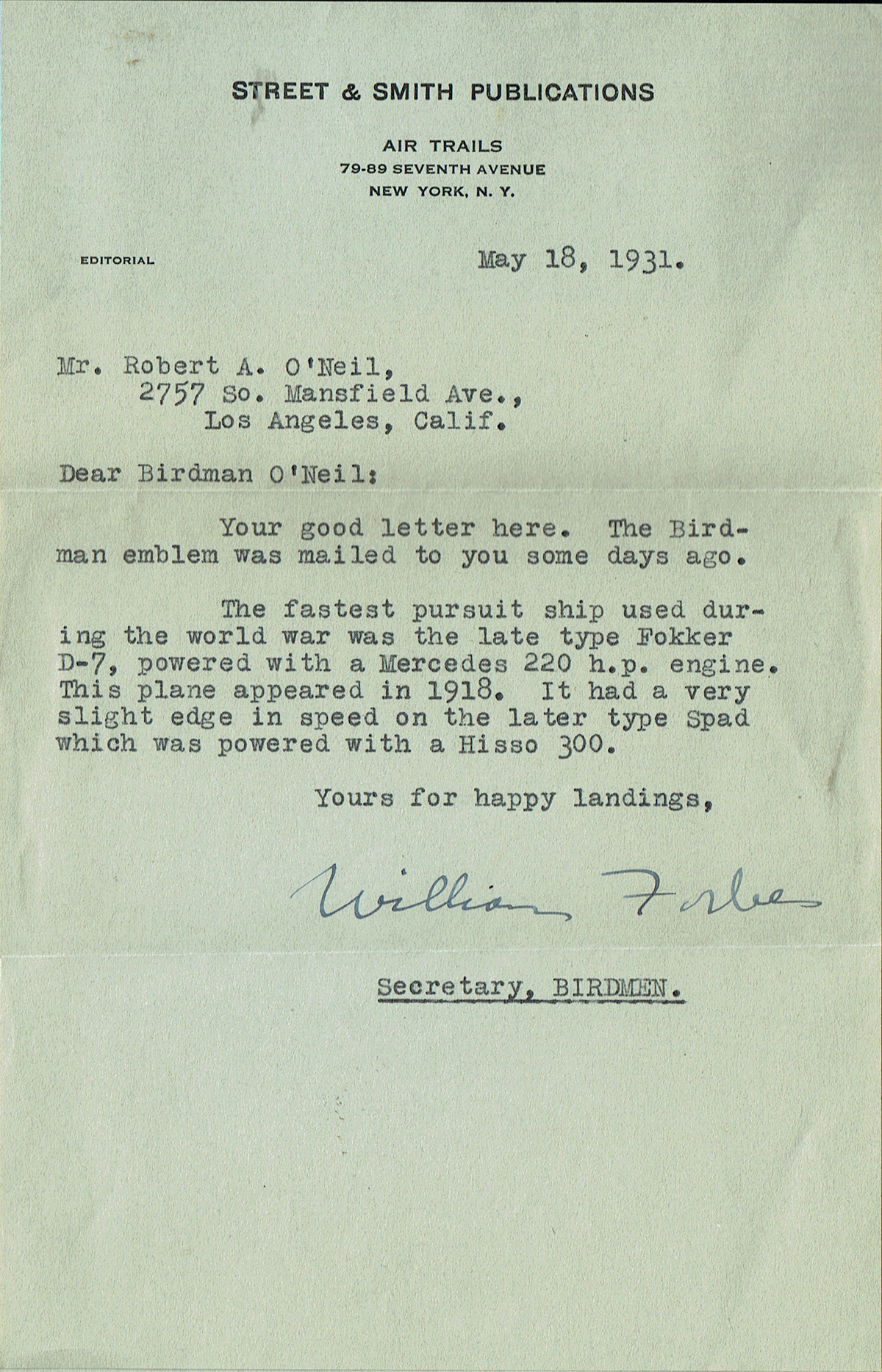
RECENTLY, Age of Aces came into possession of a pair of Aviation Scrapbooks. These scrapbooks are hand made with roughly 170 8″ x 10.5″ pages each, bound together with string. Pasted on the pages are photos, drawings and articles of early aviation history excised from pulp magazines like Battle Birds, Battle Aces, Sky Birds and Flying Aces as well as other sources from 1928 to the mid-1930’s. Typed descriptions accompany some of the pulp illustrations. Also included are ephemera from Air Shows, letters from the magazine publishers, photo postcards of airplanes and the air battle histories of Aces like Rickenbacker and Richtofen. They are a deeply personal endeavour by a young man clearly intrigued by the development of early aviation and its practical application in war.

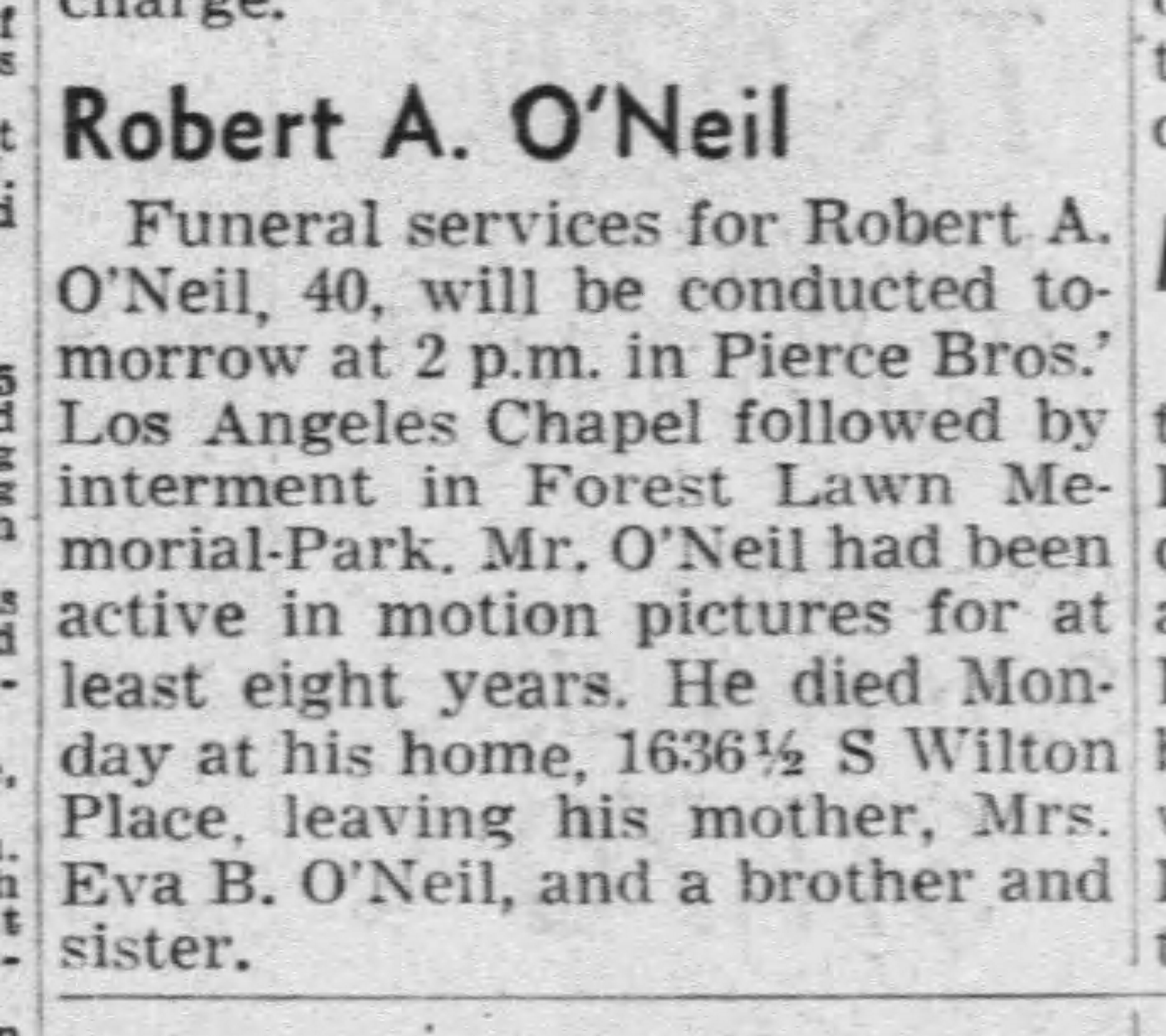
The scrapbooks were compiled by Robert Alfred O’Neil. Looking around on ancestry.com a bit, Robert was born on July 3rd, 1911 in Kansas City, Missouri. He has a sister, Evelyn, who is a year older. Some time in the early twenties the family moved to Los Angeles. Robert had a brief letter published about his first train ride in The Long Beach Telegram (April 16, 1924).

According to the date on the title page of the first Scrapbook, Robert started them January 1, 1928.

The 1930 census lists Robert as being 18, still living with his parents and 19 year old sister, and working as a messenger for a bank.

The 1940 census has Robert, now 28, living with just his mother on West 21st Street in Los Angeles and pulling in $1,104 a year as a bookkeeper. But by the following March when he filled out his draft registration card, it seems Robert was finally applying his knowledge and love of aviation—he listed his employer as Lockheed Aircraft! (His sister and her husband were living just down the street.)

Starting Monday, and on subsequent Wednesdays, Fridays and Mondays all December, we’ll be taking a look at Robert’s scrapbooks and the treasures within. So be sure to check back for a look back some things we’ve already featured on the site that Robert included in his scrapbooks as well as some exciting new discoveries! We’ll get things started on Monday when we go to the Air Races!

J.W. Scott’s Sky Devils, Pt4

Link - Posted by David on November 22, 2021 @ 6:00 am in

WE’RE back with Scott’s final Sky Devils cover! Scott painted covers for practically every genre of pulp—sports, western, detective, science fiction and aviation. Most notable of his aviation covers are the ones he did for Western Fiction Publishing’s Sky Devils, which only ran for seven issues. Scott was very adept at capturing people, so his aviation covers center on the pilots and gunners in the planes rather than the planes themselves for the most part. The issues contained no stories for these covers like other titles we’ve featured, but Scott’s magnificent work was just too good to not share! And besides, he captures the action so well, you can imagine the story that goes with the cover he’s painted.

The cover of the final issue of Sky Devils, the February 1940 issue, reused the painting Scott had done for the first issue back in 1938. Here is that final cover followed by how it was on the first issue!


Sky Devils, February 1940 by J.W. Scott


Sky Devils, March 1938 by J.W. Scott

Check out David Saunder’s page for J.W. Scott at his excellent Field Guide to Wild American Pulp Artists site for more great examples of Scott’s work!

“Balloon Bait” by Captain John E. Doyle

Link - Posted by David on November 12, 2021 @ 6:00 am in

THIS week we have a story from the pen of British Ace, Captain John E. Doyle, D.F.C. Born in 1893, Captain Doyle was a successful fighter pilot in WWI with 9 confirmed victories with 56 & 60 Squadrons. Near the end of the war, he was shot down and taken prisoner where they amputated his leg. After the war, he wrote three books, one of which was an autobiography, and 31 short stories for magazines like War Stories, The Scout, Popular Flying, The Aeroplane, Flying, Boys’ Ace Library, Mine, Modern Wonder and Air Stories.

Doyle wrote a half a dozen stories for the British version of Air Stories featuring one Montgomery de Courcy Montmorency Hardcastle, M.C. In Scotland he was usually referred to as “His Lordship,” for he was the fourteenth Viscount Arbroath as well as the sixth Baron Cupar. Out in France he was just “Monty” behind his back, or “The Major,” or “Sir” to his face. “Balloon Bait” from the November 1935 issue introduces us to the character.

When the top flights under his command in 99 Squadron fail to take out an observation balloon, The Monocled Major developed a theory as to it’s protection and takes off in the night to prove his theory.

Grim Guardians of a Balloon of Death, three Fokkers Lay in Wait for the Prey that Came with the Dawn and Never Returned—Until “The Major” Sacrificed his Beauty Sleep to Spring a Trap for Camels and Got Away with the Bait.

J.W. Scott’s Sky Devils, Pt3

Link - Posted by David on November 8, 2021 @ 6:00 am in

WE’RE back with two more of Scott’s great covers! Scott painted covers for practically every genre of pulp—sports, western, detective, science fiction and aviation. Most notable of his aviation covers are the ones he did for Western Fiction Publishing’s Sky Devils, which only ran for seven issues. Scott was very adept at capturing people, so his aviation covers center on the pilots and gunners in the planes rather than the planes themselves for the most part. The issues contained no stories for these covers like other titles we’ve featured, but Scott’s magnificent work was just too good to not share! And besides, he captures the action so well, you can imagine the story that goes with the cover he’s painted.

Here are the next two covers Scott did for Sky Devils—the April and June 1939 issues!


Sky Devils, April 1939 by J.W. Scott


Sky Devils, June 1939 by J.W. Scott

Check out David Saunder’s page for J.W. Scott at his excellent Field Guide to Wild American Pulp Artists site for more great examples of Scott’s work. And check back in two weeks for Scott’s final cover for Sky Devils magazine!

“The Rodneys” by F.E. Rechnitzer

Link - Posted by David on November 5, 2021 @ 6:00 am in

THIS week we have a story from the pen of a prolific pulp author—F.E. Rechnitzer.

Luke Rodney was the Crack flyer of the squadron. Everything was going his way until he returned form a patrol to find his father working as an Ack Emma! It was a secret he tried to keep. But when his brother who is stationed with another squadron stops by just as Luke has failed to return from a dangerous mission—it’s his brother and father who fly to his rescue! From the pages of the July 1934 issue of The Lone Eagle, it’s F.E. Rechnitzer’s “The Rodneys!”

Luke Was the Crack Flyer of His Squadron—And His Dad Was Just an Ack Emma, But Nobody Knew It Until—

“Kraut Fishing” by Joe Archibald

Link - Posted by David on October 29, 2021 @ 6:00 am in

“HAW-W-W-W-W!” That sound can only mean one thing—that Bachelor of Artifice, Knight of Calamity and an alumnus of Doctor Merlin’s Camelot College for Conjurors is back to vex not only the Germans, but the Americans—the Ninth Pursuit Squadron in particular—as well. Yes it’s the marvel from Boonetown, Iowa himself—Lieutenant Phineas Pinkham!

Not long after Lieutenant Phineas “Carbuncle” Pinkham had knocked off Herr Hauptmann Adolph August von Heinz—the Owl of the Ozone, whose nocturnal marauding had been driving the Chaumont brain trust to drunkards’ graves—the Allies had a meeting. And the motion was moved and seconded that a medal be struck off for the hero from Boonetown, Iowa. But two hours after the order was okayed by the Democratic board of directors, Major Rufus Garrity, boss of the turbulent Ninth Pursuit Squadron, wished that Phineas had let the Heinie alone. For irked no end by the news that von Heinz had been shellacked for a row of ammo dumps by Lieutenant Pinkham, a certain Boche bombing outfit hopped into their egg crates close to dawn of the day following the descendu of their Kraut hero who doted on darkness. In the confusion of the subsequent bombing of the Ninth by the von Schmierwurst’s gory Grim Reapers, The Owl flew the coup hiding in the woods full of his nocturnal friends!

Neither of the international shooting parties encamped in that noxious neighborhood bordering Bar-le-Duc was in a sugary mood. To the Teuton tracer-tossers, the capture of their sinister Spandau-ist, Hauptmann von Heinz, had proved a decided pain-in-the-neck. Likewise, von Schmierwurst’s gory Grim Reapers had become a pain-in-the-neck to the Democrats. And Phineas? You guessed it! He was a pain-in-the-neck to everybody!

J.W. Scott’s Sky Devils, Pt2

Link - Posted by David on October 25, 2021 @ 6:00 am in

WE’RE back with two more of Scott’s great covers! Scott painted covers for practically every genre of pulp—sports, western, detective, science fiction and aviation. Most notable of his aviation covers are the ones he did for Western Fiction Publishing’s Sky Devils, which only ran for seven issues. Scott was very adept at capturing people, so his aviation covers center on the pilots and gunners in the planes rather than the planes themselves for the most part. The issues contained no stories for these covers like other titles we’ve featured, but Scott’s magnificent work was just too good to not share! And besides, he captures the action so well, you can imagine the story that goes with the cover he’s painted.

Here are the next two covers Scott did for Sky Devils—the October 1938 and January 1939 issues!


Sky Devils, October 1938 by J.W. Scott


Sky Devils, January 1939 by J.W. Scott

Check out David Saunder’s page for J.W. Scott at his excellent Field Guide to Wild American Pulp Artists site for more great examples of Scott’s work. And check back in two weeks for two more of Scott’s covers for Sky Devils magazine!

“Spy Drome” by H.P.S. Greene

Link - Posted by David on October 22, 2021 @ 6:00 am in

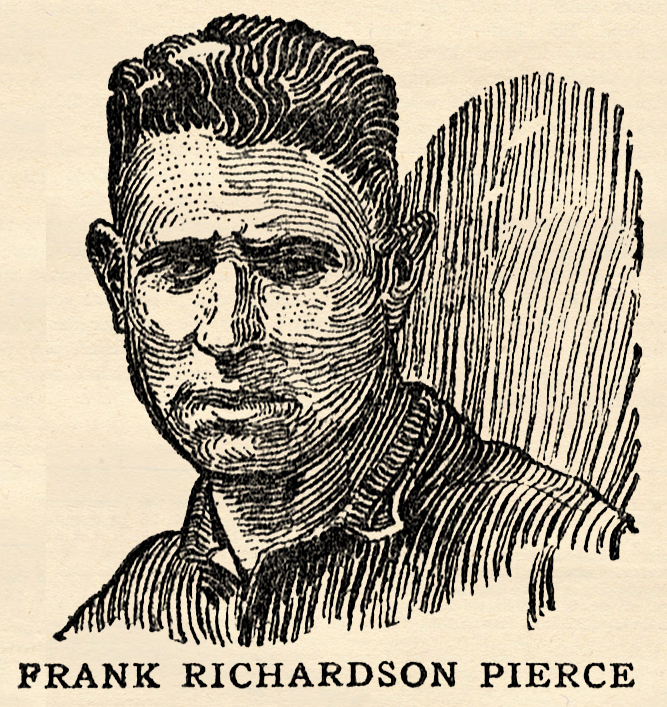
THIS week we have a story by H.P.S. Greene. Henry Paul Stevens Greene wrote aviation tales from the late 20’s to the early 40’s for magazines like Wings, Air Stories, Sky Fighters and, the magazine this story appeared in—Aces.

What little we know about Greene is from papers he left behind in a cardboard suitcase discovered in a storeroom at the National Press Club.

Greene was known by his colleagues at the National Press Club as the man who lived out of a suitcase, so it only seemed apt that he left his papers behind in a cardboard suitcase that was subsequently discovered in a storeroom of the National Press Club. The papers within the suitcase appear to be the only remaining information about H.P.S. Greene.

Henry Paul Stevens Greene was born in Boston, Massachusetts, on October 28, 1892, the son of Amy Bodwell Stevens and Henry Brooks Greene. (According to his own genealogical research, both the Bodwell and Stevens families were active in the American colonial and revolutionary periods.)

He graduated from Methuen (MA) High School and wrote the “Prophecy” for the class of 1911.

Greene was a member of the 1916 class of Amherst College but left in January of that year to join an ambulance unit in the French army.

His stories and reminiscences suggest that he may have joined the elite French flying unit, the Lafayette Escadrille, and later transferred to the American Air Service.

In August 1919, he received the Diploma of Honor of the Aerial League of America for his services in the First World War.

Greene wrote aviation tales from the late 20’s to the early 40’s for magazines like Wings, Air Stories, Sky Fighters, Flying Aces, and Aces.

Later on, while in residence at veteran’s hospitals in Tucson, Arizona, and Los Angeles, California, he wrote adventure tales of Mexico and the old West. Sadly, by the 1940’s rejection slips had become common in his correspondence.

He passed away in 1947.

In the suitcase, Greene had kept his correspondence and personal records, such as a genealogical survey, his “Prophesy” for his 1911 high school class, a college newspaper which mentions his World War I service, a diploma from the Aerial League of America, and his reminiscences. He also stored typescripts of his articles and novellas, and clipped copies of stories which had been published in the magazines likes Wings and Aces.

The articles consist largely of adventure stories of World War I: ambulance drivers and aviation aces. They appear to be drawn, in part, from the personal experiences of the author. The lack of his military record suggests, however, that they are embellished composites.

One long novelette, “A Child, an Old Woman, and a Cow,” is partially an autobiographical statement, detailing the experiences of ambulance drivers and aviators in the First World War and a character who undergoes treatment at a veteran’s hospital. It is also a fantasy which describes a decorated war hero and a successful aviation writer.

The materials from Greene’s suitcase have been archived at the National Press Club into two boxes and arranged in three series: personal files, typescripts, and printed material. Within the typescripts and printed materials, the articles are arranged alphabetically by title.

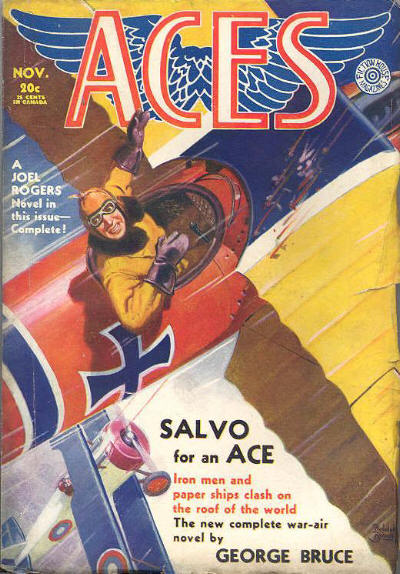
Spy Drome

A jinxed pilot, Lieutenant Hugo Von Blon, is cornered into taking the fall for his commanding officer’s indiscretion and spend the rest of the war as a prisoner of war or be cashiered out in disgrace. From the pages of the November 1931 Aces, it’s H.P.S. Greene’s “Spy Drome!”

Cornered by a fat little spy, a conspiring squadron commander and an M.S.E. who rigged the Spad for a crash, what could Von Blon do? His last landing was on a German field, hands in the air.


As a bonus, H.P.S. Greene provided some “believe-it-or-not” stories that were printed up in the letters column.

Behind “Spy Drome”

These lines from H.P.S. Greene lend additional interest to the tribulations of Von Blon, and provide fresh proof that strange things happened while the war was raging in the air. Two heroes figure in the incidents described by the author of “Spy Drome” in this issue.

A Boston bird, Gardiner Fiske, attached to the First Bombardment Group, A.E.F., at Maulan, just south of Verdun, fell out of a ship a few thousand feet up. Well, he grabbed the stabilizer as it went past and climbed back up the fuselage and into the cockpit again.

Tell you another? All right. This one’s about an observer with a British squadron—Number Twenty of the Royal Flying Corps. The observer was Captain J.H. Hedley, who at the close of the war had a score of twelve enemy planes and a balloon.

Twenty had arrived in France with Fees on January 23, 1916. Two years later, when the squadron was flying Bristol Fighters, Hedley pulled this same stunt of leaving his ship and coming back again. It happened one day in January, 1918.

The Bristol was flying over the lines way up, with more than eighteen thousand altitude. A black-crossed ship appeared ahead. Hedley, in the rear pit, swung his gun in an attempt to get the E.A. into his line of fire.

Now in the British service observers had begun without safety belts. And of course they had no parachutes. The observer was in the habit of tapping the pilot on the back of his head, thus signifying that the plane should dive.

The German was behind and above, diving zigzag wide open and gaining. His machine guns were sputtering bullets. Hedley was standing up facing back with his machine gun belching fire right back at his opponent. The German suddenly zoomed right down on the Englishman and then pulled almost straight up, evidently preparing to loop and take another dive on them.

When the German took his last zoom and pulled up, Hedley tried to follow him with bis machine guns and in so doing leaned his head back so far that he accidentally bumped the pilot’s head. To the pilot this was a sign to dive straight down and then level off again, and so the pilot pushed the stick all the way forward and started a terrific dive.

Hedley was not expecting any such maneuver, and when the plane snapped down in its dive, it threw him completely out of the plane, into the air.

Well, he fell in direct line with the falling plane and when the plane leveled off after its dive, he hit astraddle the fuselage of the plane close to the tail!

The pilot did not know that his observer had even fallen out. When he felt the jolt on the tail of the plane he looked around, and to his amazement saw his observer facing backwards on the tail. The pilot had no idea how he ever got in that position.

Neither did Hedley. He told his squadron mates that when he was thrown out his helmet slipped over his eyes and he couldn’t see anything. Suddenly he realized that he was straddling something.

You can find proof of the story in the British records of the Twentieth: “Lt. Makepeace, M.C., reports Capt. J.H. Hedley accidentally thrown into air, afterwards alighted on tail same machine and rescued.”


The archival information on H.P.S. Green at the top of the post is from the National Press Club Archive Finding Aid prepared by Christina J. Zamon and Jocelyn Manby.

“Mile-High Explosives” by Frederick C. Davis

Link - Posted by David on October 15, 2021 @ 6:00 am in

THIS week we have a short story by renowned pulp author Frederick C. Davis. Davis is probably best remembered for his work on Operator 5 where he penned the first 20 stories, as well as the Moon Man series for Ten Detective Aces and several other continuing series for various Popular Publications. He also wrote a number of aviation stories that appeared in Aces, Wings and Air Stories.

This week’s story features that crack pilot for Tip-Top World News Reel, the greatest gelatine newspaper that ever flashed on a silver screen—Nick Royce! Davis wrote twenty stories with Nick for Wings magazine from 1928-1931. Here, Nick and his crew are to shoot footage of the new American Flyer plane and get them on the screens before the other news services. But a disgruntled former designer has other plans that include dynamite! from the December 1929 Wings, it’s Frederick C. Davis’ “Mile-High Explosives!”

Dynamite on the sky track! It’s tough and fast, the newsreel game, and Nick Royce is the toughest and fastest pilot that ever flew cloud-high camera shots from the danger spot marked X.

As a bonus, here’s a “thumbnail sketch” of Frederick C. Davis from The M-P News Flash in the the August 1935 issue of Sky Birds.

Meet Frederick C. Davis

IN THE first of a series of thumbnail sketches of well-known authors, we present Frederick C. Davis who writes the “Moon Man” stories in TEN DETECTIVE ACES, the “Duke Buckland” yarns in WESTERN TRAILS, and the new “Mark Hazzard” series in SECRET AGENT “X”.

Many of our readers will be surprised to learn that Fred is only 33 years old. He is married to a charming girl, and has a sweetheart of a daughter. Fred’s home town is St. Joseph, Mo., made famous by Jesse James. He works in New York City, and has a summer home in Connecticut.

Fred started at rock bottom in tho writing game, and knows what it is to have to budget one’s self on 50¢ a day for three meals and $2.00 a week for a room. However, this is but a memory of the past now; for today he has an up-to-the-minute office, a secretary, and two electric typewriters.

J.W. Scott’s Sky Devils, Pt1

Link - Posted by David on October 11, 2021 @ 6:00 am in

HERE, at Age of Aces Books, we have featured a lot of great aviation covers by Frederick Blakeslee (Dare-Devil Aces, Battle Aces and Battle Birds), Eugene M. Frandzen (Sky Fighters and Lone Eagle), Paul Bissell (Flying Aces) and C.B. Mayshark (Flying Aces). You can add to that list J.W. Scott! Scott painted covers for practically every genre of pulp—sports, western, detective, science fiction and aviation. Most notable of his aviation covers are the ones he did for Western Fiction Publishing’s Sky Devils. The title only ran for seven issues. Scott was very adept at capturing people, so his aviation covers center on the pilots and gunners in the planes rather than the planes themselves for the most part. The issues contained no stories for these covers like other titles we’ve featured, but Scott’s magnificent work was just too good to not feature! And besides, he captures the action so well, you can imagine the story that goes with the cover he’s painted.

Here are his first two covers for Sky Devils—those for March and July 1938!


Sky Devils, March 1938 by J.W. Scott


Sky Devils, July 1938 by J.W. Scott

As a bonus, here is David Saunder’s biography of J.W. Scott from his extensive Field Guide to Wild American Pulp Artists website!

J. W. SCOTT
(1907-1987)

John Walter Scott, Jr. was born on December 1, 1907 in Camden, New Jersey. His father of the same name was a second generation immigrant from Scotland, and was a draftsman at the Camden Shipyard. His mother was Helen L. Scott, who was of Irish ancestry. They lived at 7 Wood Street, which was one block from the busy riverfront piers. He and his father were avid fishermen.

During the Great War his father rejoined the U.S.Army and attained the rank of Captain before dying in 1919.

His mother took a job at the La France Tapestry Mill in Philadelphia, and in 1923 at age fifteen, he left school and began to work at the same mill.

The mill operator offered free night school classes in various facets of mill work to his child laborers, including design at the La France Art Institute.

In 1930 he finished his art training and began to pursue a career in freelance illustration. He worked under the name “J.W. Scott” out of emulation for the well-known pulp artist “H.W. Scott” as well as to capitalize on any resultant confusion over his professional status.

In 1932 and age twenty-five, he moved to 390 First Avenue in New York City.

His first published pulp cover appeared on the July 9, 1932 issue of Street & Smith’s Wild West Weekly.

He sold freelance pulp covers to All Star Fiction, Best Western, Complete Western Book, Detective Short Stories, Future Fiction, Ka-Zar, Lone Eagle, Marvel Science Stories, Mystery Tales, Quick-Trigger Western, Real Sports, Star Detective, Star Sports, Top-Notch Western, Two-Gun Western, Western Fiction, Uncanny Tales, Western Novel and Short Stories.

By 1938 he joined an advertising agency and began to find work in slick magazines. He became friends with R.G. Harris and other New Rochelle illustrators. In the Fall he married Eleanor Snyder, a banker’s daughter and socialite, but the marriage only lasted one year. There were no children.

During WWII he served in U.S. Army Corps of Combat Engineers. His detailed field drawings were sent by his Lieutenant to the editors of YANK Magazine, and he was soon invited to work on their art staff. He eventually wrote several articles and was promoted to the editorial staff.

After the war Scott found slick magazine assignments with Coronet, Elks, This Week, and Woman’s Day.

In 1946 he married Flavia Bensing. She was also an artist, as well as the daughter of an artist, Frank C. Bensing. They moved to Ridgefield, Connecticut, where they raised two daughters.

In the 1950s he began to work for men’s adventure magazines, such as Argosy, True, and Sports Afield. He continued to produce illustrations for Sports Afield for almost two decades.

In the 1960s he was commissioned to paint several impressive murals for The Church of Latter Day Saints and The Petroleum Museum of Midland Texas.

In his final years Scott worked on easel paintings of the Old West.

According to the artist, “I paint the pictures I am interested in painting. Much of contemporary art is about people who think they are IN. The quickest way to lose yourself is to lose your individuality. The important thing is to be yourself and forget about being IN.”

John Scott died in the Danbury Hospital at the age of seventy-nine on October 20, 1987.

Check out David Saunder’s page for J.W. Scott at his excellent Field Guide to Wild American Pulp Artists site for more great examples of Scott’s work. And check back in two weeks for two more of Scott’s covers for Sky Devils magazine!

New Books Premiering at PulpFest!

Link - Posted by David on August 16, 2021 @ 6:00 am in

AFTER a year-long Covid delay, Age of Aces Books has returned with two new books. We’ll be premiering them at PulpFest 2021 this week.

First up is The Black Falcon by Arthur J. Burks.

Selected by Black Jack Pershing himself for an impossible assignment, Lt. Evan Post was volunteered to drive Germany’s top five aces out of the sky. Orders were sent ahead to see that he was given every cooperation by any allied post of command he would work out of. With the biggest, blackest, ugliest bird painted on his red plane’s fuselage, Post worked the list. And with every German Ace he downed, Evan Post became known as The Black Falcon!

Arthur J. Burks never met a story he couldn’t write. Although he was known to be able to craft a story about anything suggested to him, he was probably best known for his weird menace and detective stories. He wrote six stories with The Black Falcon for Sky Fighters magazine, with a nice continuity running through them. So much so, when he published the sixth story, two years after the initial five, The Black Falcon was a mythic character the young recruits had only heard of.

Stories Include: The Black Falcon (Oct 33), The Balloon Buster (Feb 34), Falcon Fury (Mar 34), The Falcon Flies High (Apr 34), Claws of the Falcon (Jun 34), and Black Falcon’s Return (Jul 36).

Our second book is the ninth and final volume of Donald E. Keyhoe’s Captain Philip Strange Adventures—Strange Rivals.

Captain Philip Strange is back in nine more weird WWI stories! A mental marvel from birth, who used his talents on stage as a boy, Philip Strange is now known as “The Phantom Ace of G-2″ by the Allies during WWI and the verdamnt Brain-Devil by the Boche. In these stories from the end of the series run, The Brain-Devil’s arch nemesis, Karl von Zenden, the quick-change Man of a Thousand Faces resurfaces to wreak havoc and cause more trouble—from aerodromes peopled with corpses to pirate staffels to German Officials dropped over Paris to gases of forgetfulness to all of England disappearing! Von Zenden does his worst! Thankfully, we have have Captain Philip Strange on our side to stop them in some of his strangest cases yet from the pages of Flying Aces magazine!

Stories Include: Dead Man’s Drone (Jun 37), Skeletons From the Sky (Dec 37), Scourge of Oblivion (Apr 38), Pirate Squadron (Jun 38), The Gray Face Ace (Oct 28), Strafe of the Skull (Dec 38), Raid of the Wraith (Mar 39), Flight of the Phantoms (Aug 39), and When England Vanished (Nov 39).

In addition to our two new titles, we’ll have all of our previous titles that are still in print as well as some fun extras include an 11″ x 14″ art print of all 64 splash opens for the Philip Strange stories in order from “A Squadron Shall Perish” to “When England Vanished”. If you’re at the show, stop by, say “Hi” and pick up a copy. (Quantities are limited.)

« Previous PageNext Page »