FROM the pages of the October 1934 number of Sky Fighters:
Editor’s Note: We feel that this 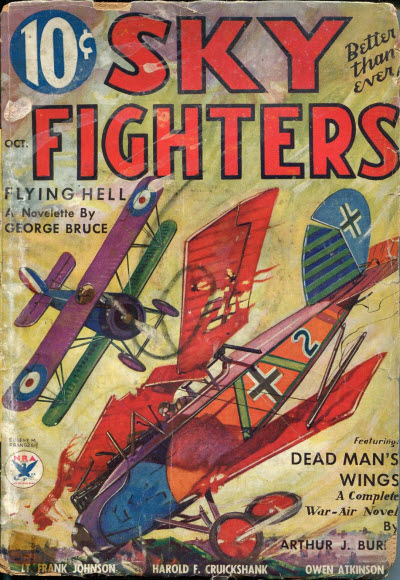 magazine has been exceedingly fortunate in securing Lt. Edward McCrae to conduct a technical department each month. It is Lt. Mcrae’s idea to tell us the underlying principles and facts concerning expressions and ideas of air-war terminology. Each month he will enlarge upon some particular statement in the stories of this magazine. Lt. MaCrae is qualified for this work, not only because he was a war pilot, but also because he is the editor of this fine magazine.
What Made ‘Em Fly
by Lt. Edward McCrae (Sky Fighters, October 1934)
NOW you wise young sons and daughters of a double eagle, or maybe it was a buzzard, maybe you hadn’t noticed it before but if you had looked a little carefully at all the nice pictures of the war crates on the covers of SKY FIGHTERS you might have noticed that nearly every one of them without exception had something peculiar about it. Whether you noticed it or not, they all had engines in ’em.
Yes, sir, they carried whole gasoline engines up in the air. Some of them had one and some had two and some had more than that—even back in the early days of the war.
Now if I know anything about you clucks you’re just as likely as not to come asking me why those aviators wanted to load themselves down with a lot of machinery. It would be just about like you.
So I’m going to head you off and tell you something about those powerhouses we used to take upstairs along with us. And don’t be asking me why they carried more than one of ’em. I’m going to get to that if you’ll let me. Mary, don’t you throw that spit-ball!
You Gotta Have an Engine
Maybe your papas have let you look under the hood of the old family car, in which case you might have learned the secret that a vehicle just can’t get along without an engine if it’s going to do any good running at all. Honey, it’s the same way with an airplane.
So I’m going to tell you a few simple things that won’t be too difficult for your shallow pans to remember so you will have a little inkling of why they have all different kinds of engines when it would look for the world like if they got a good one they would keep using it instead of trying to think up other designs and shapes to use.
You might have noticed that some of the engines when they were looked at from the front looked like stars with a lot of cylinders all sticking out every which way from the center. And others looked more like a common every-day automobile engine. How come it and why?
Air and Water Cooling
The answer is, my precious little dunderheads, that some of them were air-cooled and some water-cooled.
They learned that an engine that didn’t have to tote its own drink along with it weighed about three-quarters as much as another of the same horsepower that was water-cooled. And they learned also that for every pound you could reduce the weight of it you could add two pounds of useful load, or what amounts to the same thing, you could have a bigger engine and more power for the given weight.
Now the reason you could get those two extra pounds where one grew before was that when you took a pound’s weight away from the engine you could reduce the weight of the ship by another pound that was necessary to strengthen it to support the pound you took away, and you could further reduce the weight of your ship by another pound that went to strengthen the wing so it would support that extra pound of engine weight. That’s as clear as mud, isn’t it?
But unfortunately that added strength didn’t always show as engines got bigger. After they got so big, an air-cooled engine wouldn’t weigh any less than a water-cooled one for the same horse power.
So they used one or the other depending on the performance they wanted.
The Air-Foil
Now when you start trying to recognize the different kinds of engines you want to look at the front of them. That way you can see what kind of a surface, or air-foil they present to the wind. That’s the important thing for you to consider.
When you look at them that from that aspect you will see that there are only about three different general groups of designs. Of course, these differ among themselves in slight ways, but after all, even human beings in one family have slight differences.

Take a look at the figure which I have very cleverly called Figure 1. In that you will see the front view of a few of the stationary cylinder engines that are water-cooled and whose fathers got the idea of their design from our old friend the automobile engine. Now this group shows some outline forms of the engines themselves, but there is a fly in the amber. They don’t show the radiators, and a water-cooled engine has to have a radiator and that presents a big flat surface to the air to reduce your speed.
Rotary Engines
So then you have next in what for want of a better name I have called Figure 2, the rotary engines that were used during the war. Some of the names of these are Gnome Rotary, the Le Rhone Rotary, and the Clerget Rotary.

These were funny power plants. You might not believe it when I tell you, but it is a fact that the crank shaft stood still and the whole engine itself revolved around it! That sounds kind of Chinese, doesn’t it? But it isn’t. What with those cylinders whirling around at a thousand revolutions or more, they kept cool pretty well, but once in a while one of them would fly off the handle and scatter cylinders all over No-Man’s-Land.
And then they had another feature that the brass hats didn’t seem to bother about, but which we didn’t like at all. They were lubricated with castor oil!
Hot Castor Oil
Our objections to it came, not because we had to share their fuel oil, but because the engineers didn’t think castor oil was bad enough cold, they let it get hot in the motor.
And brothers and sisters, you have not smelled nothing yet until you have got a nose full of red hot castor oil. And you can smell it for miles—and that is not an exaggeration! We were afraid the Heinies could always tell we were coming by just sticking their noses up in the air and taking a deep breath. Boy, it was awful!
And then you might take a glimpse at a figure that I have designated as Figure 3, even though you can’t count up that high.

Those figures in that picture are some outlines that look almost like those rotary babies. But they aren’t. Their cylinders stick out from a common center just like the rotaries, but there is some sense in the way they act. The cylinders stay still and the crank shaft revolves just like any respectable crankshaft ought to do.
We Had ’Em Long Ago
We had them in the old days, and they had all the way from three to twenty cylinders stuck around the shaft.
Those were the babies that have turned out best since the war. But we had a lot of satisfaction out of them. A couple of these babies we liked in those days were the Salmson and the Cosmos Jupiter.
And just to prove how practical these air-cooled babies were, if you will take a glance around an air field today you will see more air-cooled radial motors than any other kind. Babies of that pattern since the war were the first to cross the North Pole, first to fly the English Channel, first to span the Atlantic, and about the first for everything of any importance.
And now that you know all about the different kinds of engines, I’ll give you that promised dope about why they had different numbers in different kinds of ships.
Why the Extra Engines?
There are two reasons they put more than one engine in a ship. One is to increase and distribute the lift and the other is to increase the factor of safety. These two reasons don’t always both appear in the one ship.
But even you pupils of mine ought to be able to see that if you have two engines and one conks you’ve still got a chance to get back safely over your home trenches, and if you’ve got three engines to do the same work there’s almost no chance at all of your having a forced landing in a mess of Krauts. I know about a Handley-Page bomber that went out and got a direct hit that reduced its whole lower wing to a mass of shreds and tatters and knocked one of its engines clear out of it, but the pilot steered it sixty miles back to his home tarmac! Which is something different from landing on your nose in the middle of a few rosettes of shrapnel.
Helps in the Lift
And then in the matter of lift, you will find the heavy bombers had more than one engine so they could lift a lot of weight. You would first think they would just build one big engine to carry it, but that wouldn’t be so good. Let me try to show you why.
Suppose it took a thousand horsepower to lift the desired bomber and its load. They could build one engine of a thousand horsepower all right, but they wouldn’t get a propeller that could use up and deliver all that power. But if they, say, built two five-hundred horsepower engines, they had two props which could use up all that power and besides they had the additional safety factor of the two motors I just spoke about. You might not remember it well, Tillie, but we had plenty of ships with more than one engine during the war.
The Germans were the first to come out with them, although the French were at work on them even before the war broke out. The first German flew with two engines in 1915.
But the French quickly matched them with the old twin-motored Caudron, and the British followed right off the bat with the twin-motored Dyott, which didn’t last a very long time, however. The Government never did put its official okay on the old Dyott, but it was not a bad heavy crate, and it had a lot of features the German Gotha later incorporated.
Then the Italians in the person of the well-known Mr. Caproni burst out across the field with a three-motored ship. It had two eighty-horsepower tractor motors and one ninety-horsepower pusher. Some ship, eh, Tony!
And toward the end of the fracas the British got real ambitious and brought out a ship with four—count them—motors. It just had engines stuck all over it.
They Went in for Numbers
But once they started going in for numbers, do you think the Germans were going to let anybody get ahead of them? No, my masters, not those boys.
We knocked down one of their big bombers in France, and we thought somebody had attached wings to the machine shop itself.
That crate had five motors sprouting out of it.
That might not be a lot of motors these days, but my children, I’ve been talking all this time about the war that was fought a long, long time ago.
And now, take my blessing, and go out and jump in your ten-motored kiddie cars and zoom out of my sight. Or else I’ll be counting motors instead of sheep in my sleep.




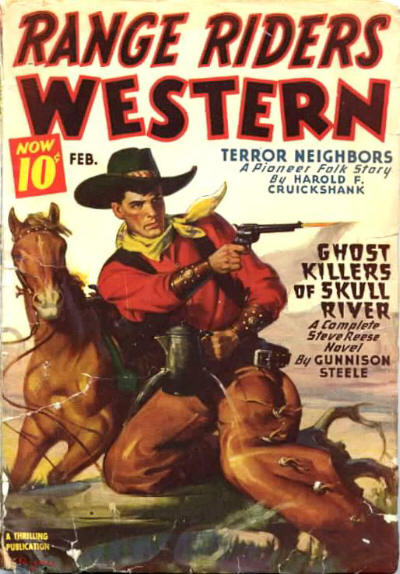 the trials and tribulations of Dal and Mary Baldwin as they carved out their piece of the Wilderness in Sun Bear Valley, Wyoming and establish a growing community. The Sun Bear settlers are menaced by Mishe, the she-grizzly, and Acheeta, the cougar and Dal knew that to grizzly and cougar alike, there was no more succulent food in all the wilds than young horseflesh. In a night, either species of varmint could wipe out the whole of Dal’s horse stock and his cow and her calf as well.
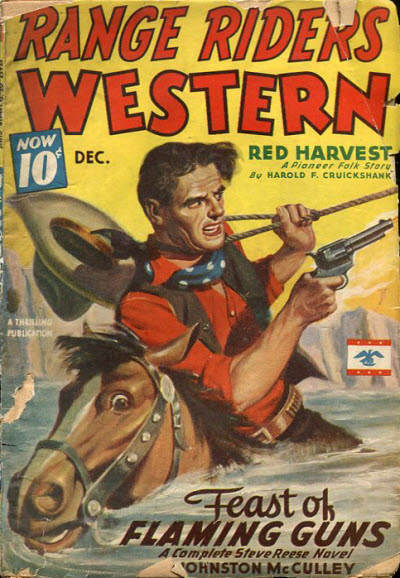 the trials and tribulations of Dal and Mary Baldwin as they carved out their piece of the Wilderness in Sun Bear Valley, Wyoming and establish a growing community. Another family arrives in the valley in the form of Tom and Ella Bruce and their infant daughter. Unfortunately for Dal, they took the advice of that rascally half-breed Quirt Malotte on their way there and their dog and flock of sheep they’ve brought with them arrive first and trample through Dal’s crop and Mary’s garden. The Bruces more than make up for it when lightning touches off a fire in the valley.
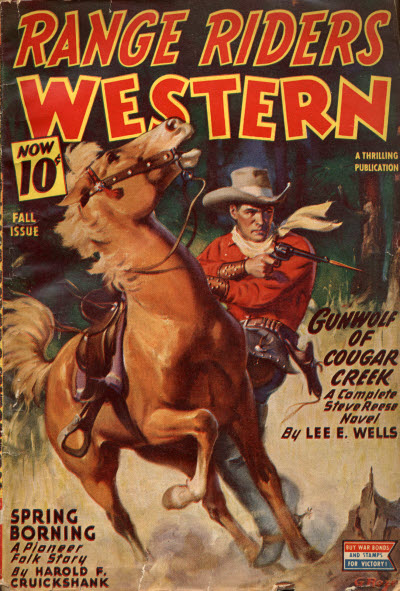 the trials and tribulations of Dal and Mary Baldwin as they carved out their piece of the Wilderness in Sun Bear Valley, Wyoming and establish a growing community. The Baldwins are settled in to their cabin in Sun Bear Valley, but an old nemesis returns and a new couple arrive in the valley just as Mary is about to give birth.
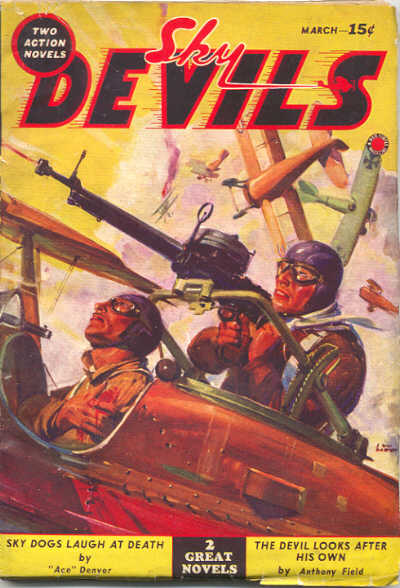 a story from the short-lived Sky Devils magazine by Anthony Field. Anthony Field was a pseudonym used by Anatole Feldman who specialized in gangland fiction—appearing primarily in Harold Hersey’s gang pulps, Gangster Stories, Racketeer Stories, and Gangland Stories. His best-known creation is Chicago gangster Big Nose Serrano. But he also wrote a number of aviation stories including four stories for Sky Devils featuring Quinn’s Black Sheep Squadron!
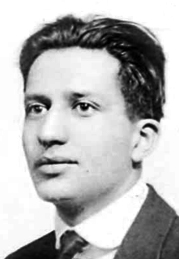 Anatole France Feldman (1901-1972) is primarily known as a pulp magazine writer from the late-’20s to the late-’30s. He specialized in gangland fiction, appearing primarily in Harold Hersey’s gang pulps, Gangster Stories, Racketeer Stories, and Gangland Stories. He also appeared in the rival magazines, Gun Molls and The Underworld.
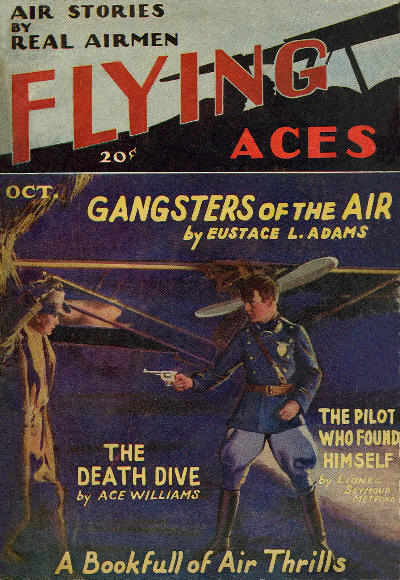 another story from one of the new flight of authors on the site this year—Andrew A. Caffrey. Caffrey, who was in the American Air Service in France during The Great War and worked for the air mail service upon his return, was a prolific author of aviation and adventure stories for both the pulps and slicks from the 1920’s through 1950. Here Caffrey tells the tale of a group of service men filling out the last months of their service stateside after the end of the war before being discharged. From the very first issue of Flying Aces October 1928 it’s Andrew A. Caffrey’s “A Fine Man—The Colonel!”
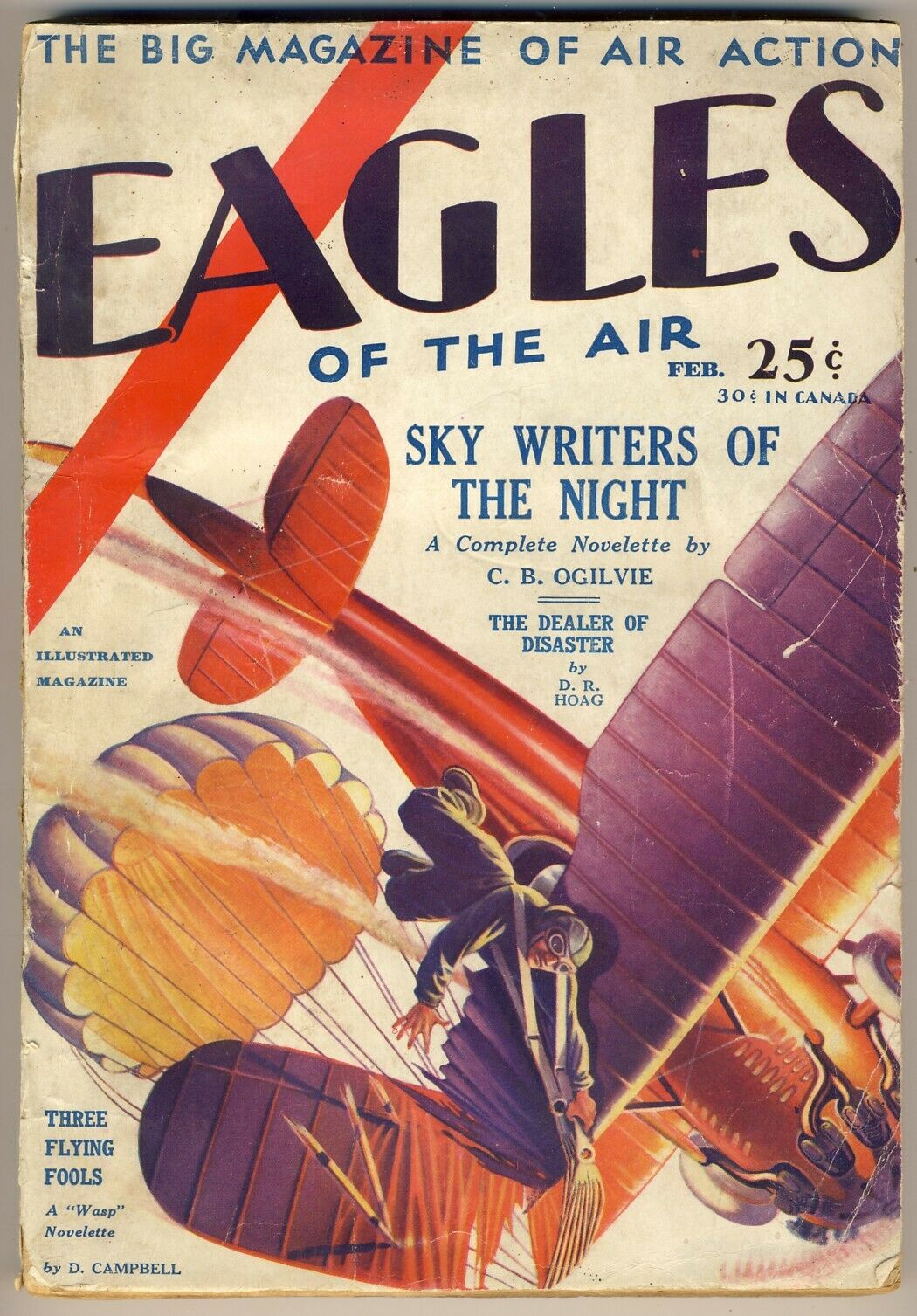 air intrigue by E.W. Chess. Elliot W. Chess was a prominent author in the pulps—his name frequently appearing on the covers to entice readers. His pulp career spanned from 1929 to 1940, but a majority of his output was in the early thirties. Equally adept at both westerns having grown up in El Paso, Texas and air war stories having served in the Royal Flying Corp in the First World War and the 7th Squadron of the Polish Air Force afterward when Russians tried to invade the country. Here, Chess tells a tale of a “Doomed Squadron” whose pilots are mysteriously disappearing one by one. . . .
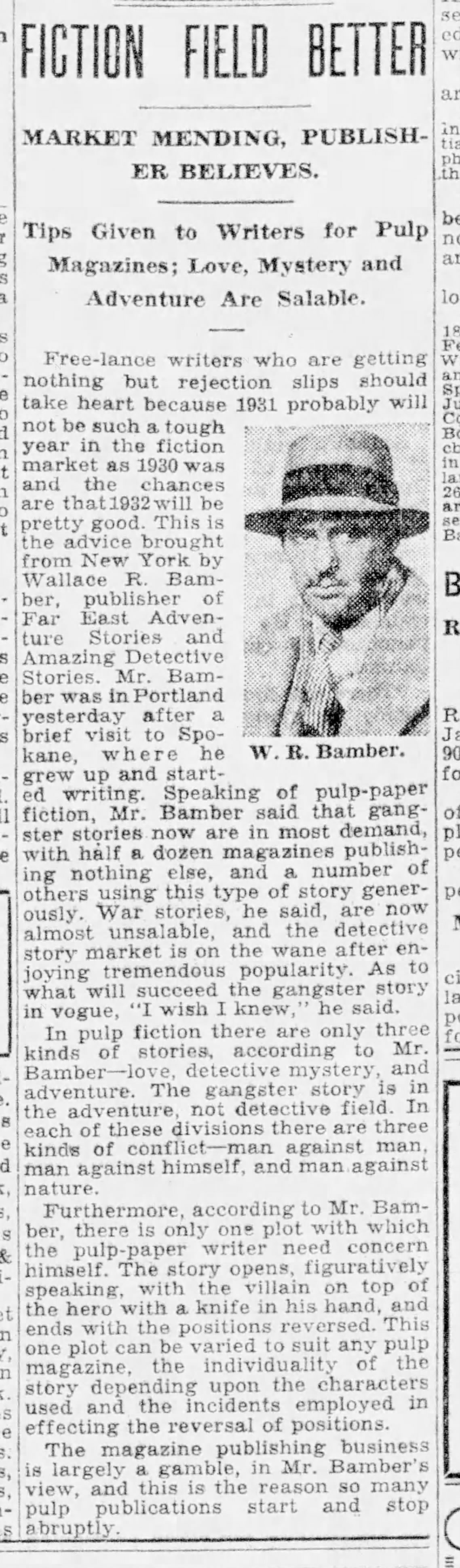
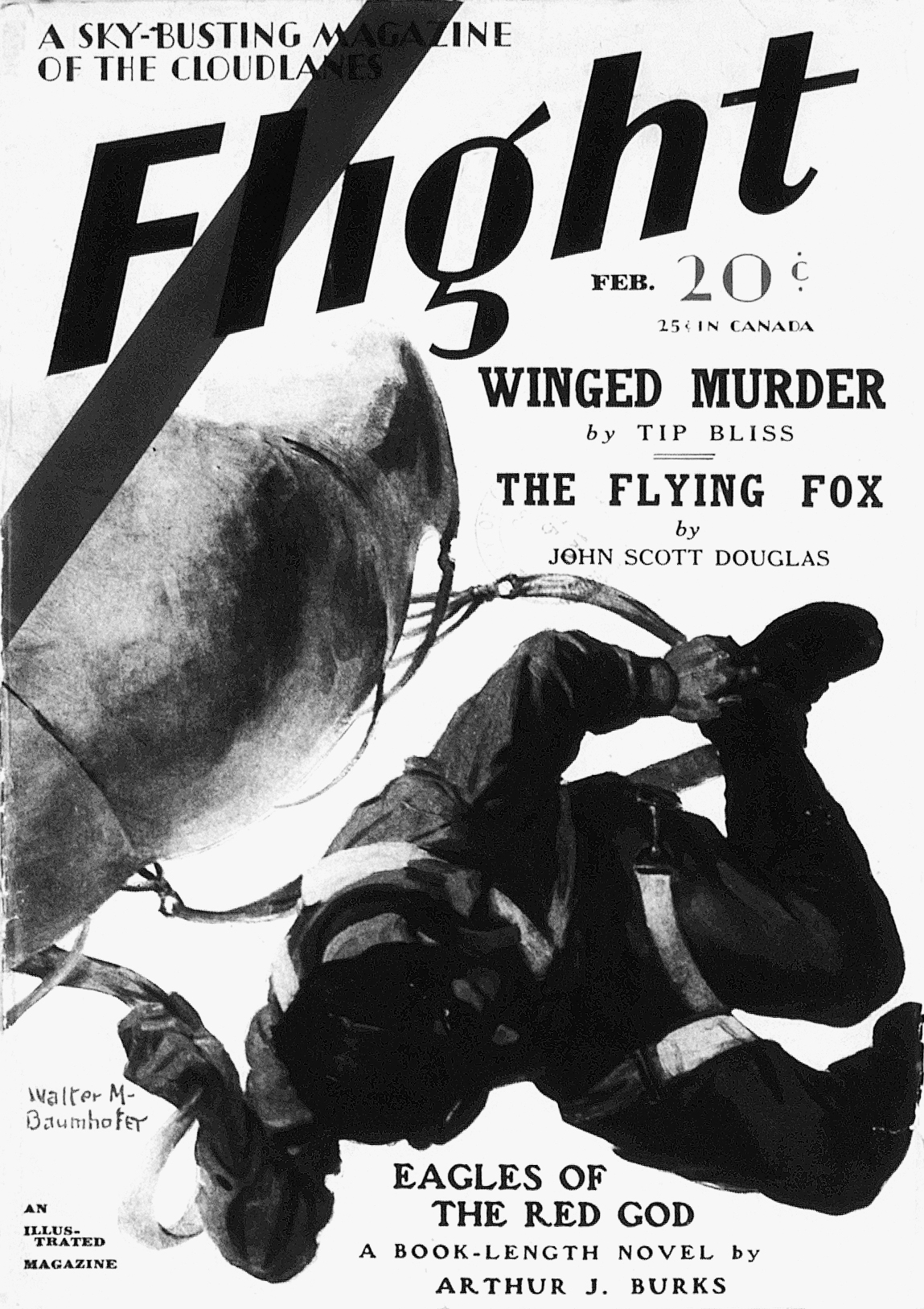 born in 1895 in Tacoma. A veteran of the First World War, serving in the A.E.F. from 1917-19, during the 20’s he lived in New York City and became a well-known writer of air fiction for pulp magazines. Later he branched out as an editor and publisher of the short-lived Far East Adventure, a fiction magazine of the Orient with a dozen issues from 1930-32, and Amazing Detective Stories with five issues published in 1931. Later he became a traveling representative of the American Fiction guild, and moved to Seattle. He was with the federal writers’ project there, and later a WPA administrative staff official. Bamber also worked for a time as editor of the Port Orchard Independent, and was active in Democratic party affairs. A newspaperman at heart, in 1944 he started publication of a weekly paper, The Bainbridge Merchant, on Bainbridge island where he was then residing, but illness forced him to curtail this venture after two issues. He passed away in November of that year.
 FREE-LANCE writers who are getting nothing but rejection slips should take heart because 1931 probably will not be such a tough year in the fiction market as 1930 was and the chances are that 1932 will be pretty good. This is the advice brought from New York by Wallace R. Bamber, publisher of Far East Adventure Stories and Amazing Detective Stories. Mr. Bamber was in Portland yesterday after a brief visit to Spokane, where he grew up and started writing. Speaking of pulp-paper fiction, Mr. Bamber said that, gangster stories now are in most demand, with half a dozen magazines publishing nothing else, and a number of others using this type of story generously. War stories, he said, are now almost unsalable, and the detective Story market, is on the wane after enjoying tremendous popularity. As to what will succeed the gangster story in vogue, “I wish I knew,” he said.
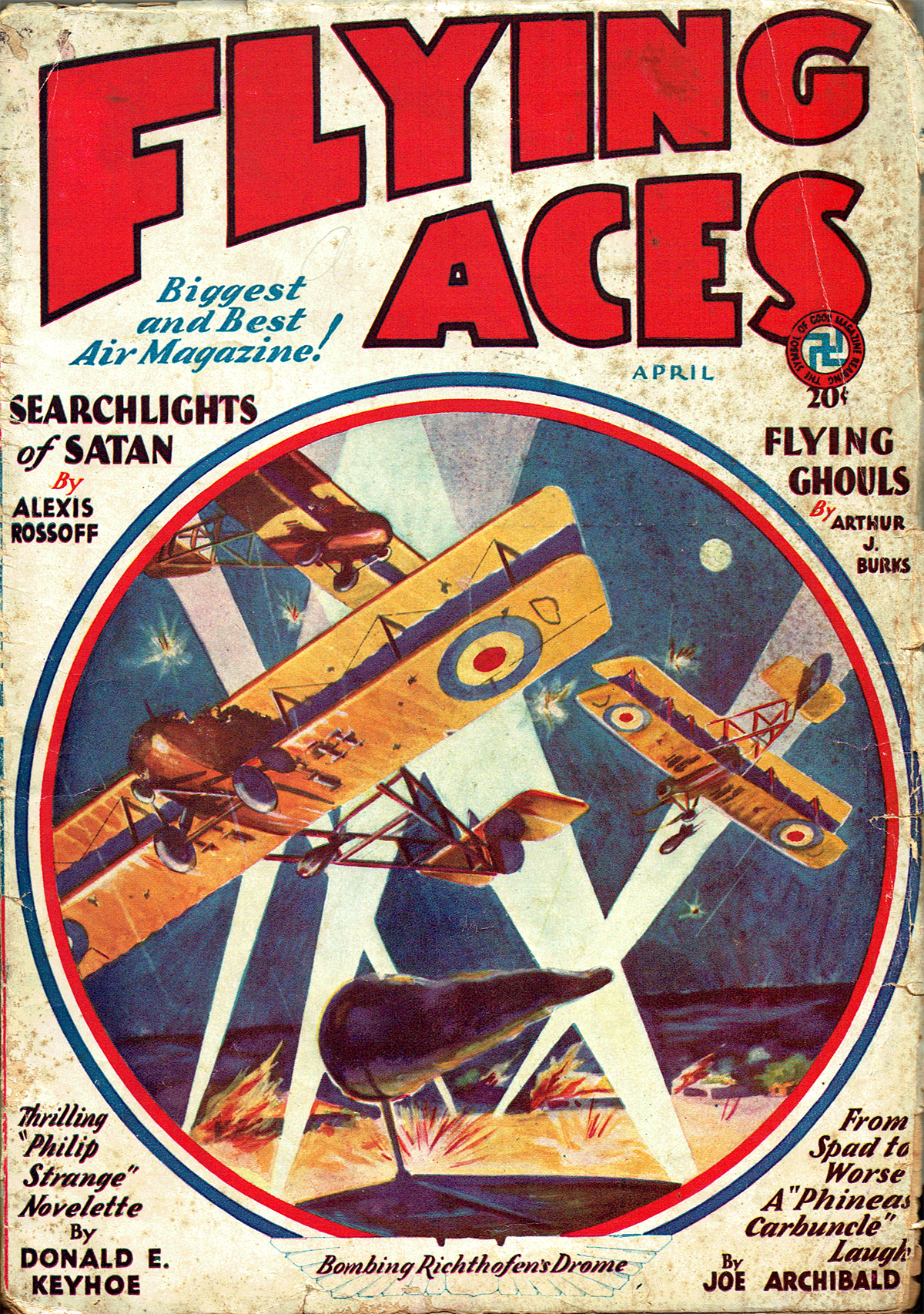 That sound can only mean one thing—that Bachelor of Artifice, Knight of Calamity and an alumnus of Doctor Merlin’s Camelot College for Conjurors is back to vex not only the Germans, but the Americans—the Ninth Pursuit Squadron in particular—as well. Yes it’s the marvel from Boonetown, Iowa himself—Lieutenant Phineas Pinkham!
 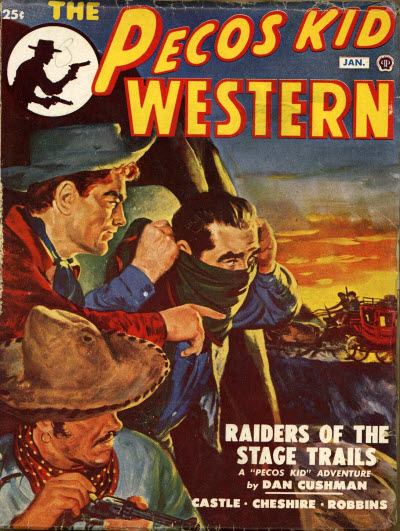 “The Roaring Town” featurettes. Blakeslee only produced three installments of his two-page illustrated looks into the boom towns of the Wild West in Pecos Kid Western. Authored by Jhan Robbins, the prolific western story author and editor of pulp magazines, and deftly illustrated by Blakeslee, the feature delves into the story behind noted boom towns of the old west. This time Robbins and Blakeslee tell us the tale of Weaverville, California—a gold rush boom town that made it and still stands
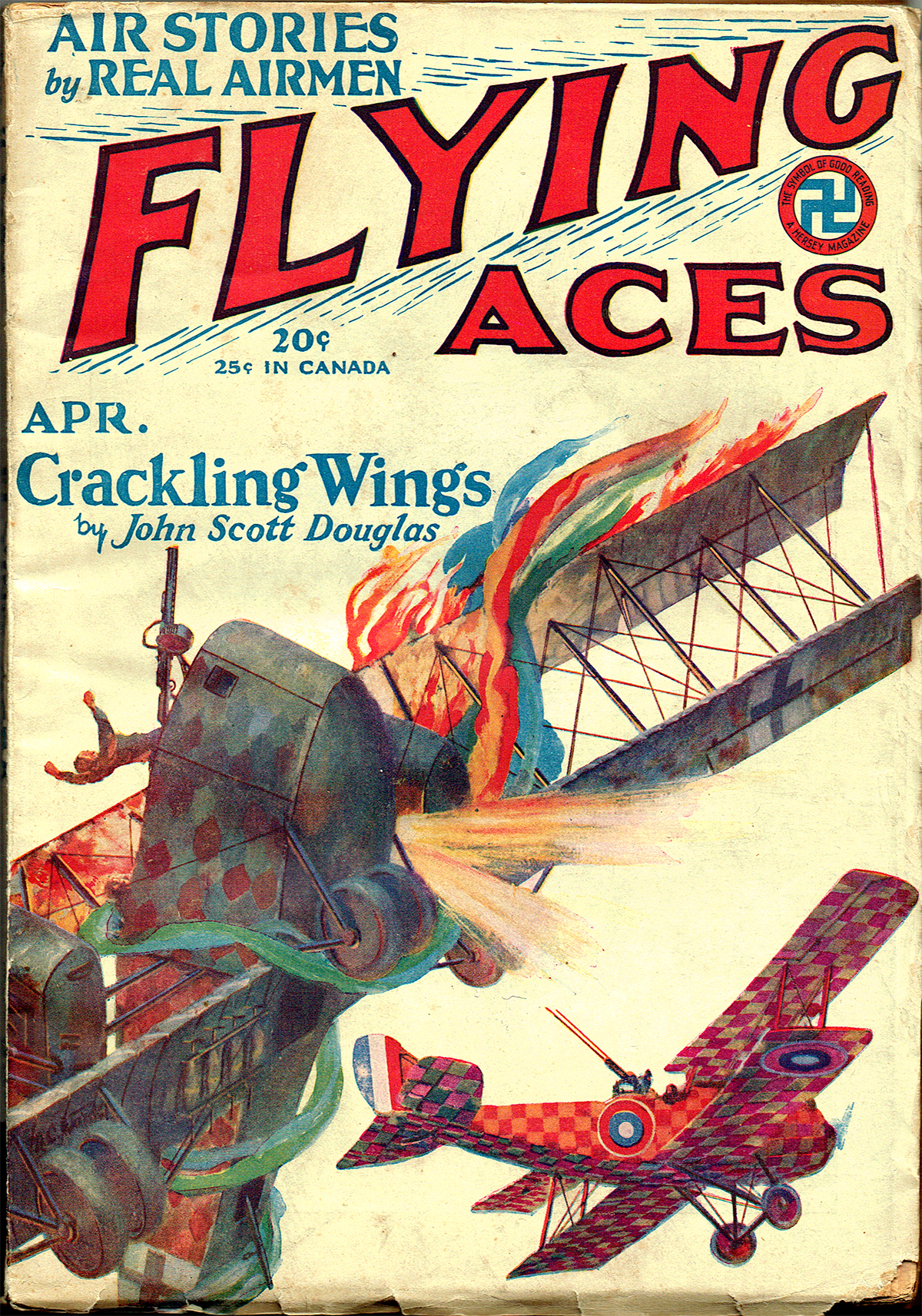 a story by Franklin M. Ritchie. Ritchie only wrote aviation yarns and his entire output—roughly three dozen stories—was between 1927 and 1930, but Ritchie was not your typical pulp author—he was a lawyer who wrote pulp stories on the side to satisfy his yen for flying.