Looking to buy? See our books on amazon.com Get Reading Now! Age of Aces Presents - free pulp PDFs

Nick Royce in “Winner Take All” by Frederick C. Davis

Link - Posted by David on February 21, 2025 @ 6:00 am in

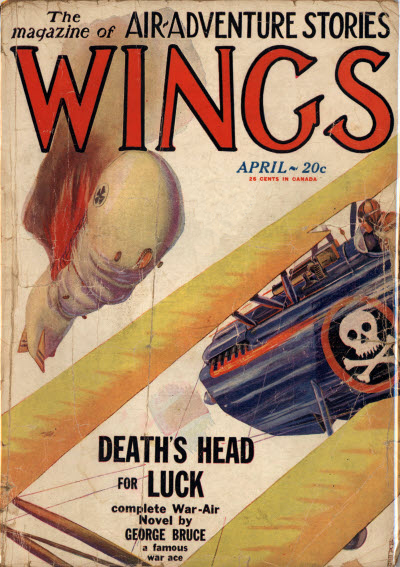
THIS week we have a short story by renowned pulp author Frederick C. Davis. Davis is probably best remembered for his work on Operator 5 where he penned the first 20 stories, as well as the Moon Man series for Ten Detective Aces and several other continuing series for various Popular Publications. He also wrote a number of aviation stories that appeared in Aces, Wings and Air Stories.

This week’s story features that crack pilot for World News Reel, the greatest gelatine newspaper that ever flashed on a silver screen—Nick Royce! Davis wrote twenty stories with Nick for Wings magazine from 1928-1931.

Tip Top, one of the biggest producers in the movie field, is looking to add a news reel to their releases and want to buy up one of the present independent movie reel producers and it’s down to Compass and World News Reel. Which ever company can out perform the other and provide the best news reels will get the gig—only problem is, someone’s on the payroll of Compass at World News Reel and causing trouble. From the April 1928 Wings, it’s Frederick C. Davis’ “Winner Take All!”

Two flyers of the newsreel wage an air-feud in the clouds, and over the flame-belching tanks of the oil fields Nick Royce, sky-eater, plays his ace-in-the-hole.

“Sky Writers, July 1936″ by Terry Gilkison

Link - Posted by David on February 17, 2025 @ 6:00 am in

FREQUENT visitors to this site know that we’ve been featuring Terry Gilkison’s Famous Sky Fighters feature from the pages of Sky Fighters. Gilkison had a number of these features in various pulp magazines—Clues, Thrilling Adventures, Texas Rangers, Thrilling Mystery, Thrilling Western, and Popular Western. Starting in the February 1936 issue of Lone Eagle, Gilkison started the war-air quiz feature Sky Writers. Each month there would be four questions based on the Aces and events of The Great War. If you’ve been following his Famous Sky Fighters, these questions should be a snap!

Here’s the quiz from the July 1936 issue of Lone Eagle.

If you get stumped or just want to check your answers, click here!

“Flaming Destiny of the Sky Damned!” by Anthony Field

Link - Posted by David on February 14, 2025 @ 6:00 am in

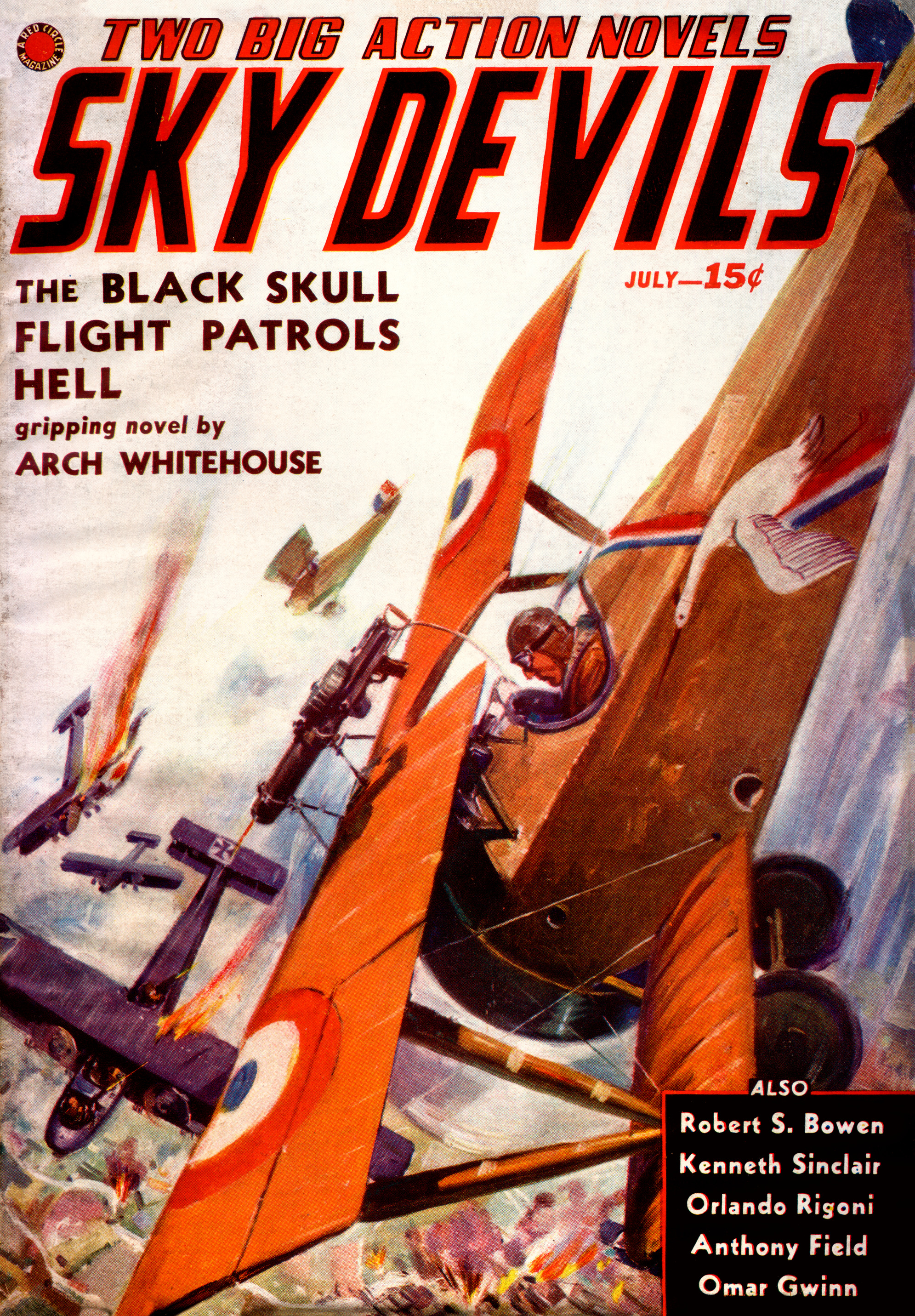
THIS week we have a story from the short-lived Sky Devils magazine by Anthony Field. Anthony Field was a pseudonym used by Anatole Feldman who specialized in gangland fiction—appearing primarily in Harold Hersey’s gang pulps, Gangster Stories, Racketeer Stories, and Gangland Stories. His best-known creation is Chicago gangster Big Nose Serrano. But he also wrote a number of aviation stories including four stories for Sky Devils featuring Quinn’s Black Sheep Squadron—this is the second of those four stories!

Quinn’s Black Sheep is another of those squadrons populated with other squadron’s troublemakers like Rossoff’s Hell-Cats or Keyhoe’s Jailbird Flight or any number of other examples. It seemed every author had a series with a black sheep squadron.

Captain Jack Quinn, brought in for disciplinary action, manages to convince the General that he could solve a lot of his headaches by hand-picking the problem aces out of other squadrons and forming an essentially independent squadron to take on the Boche. Thus, Quinn’s flight was a crew of hard bitten aces who had been tempered—to a man—in the cauldron of war, having unflinchingly facing Death many times before.

There are rumors of a spy on the Black Sheep ‘drome and when a mysterious woman arrives, Quinn finds himself thrown into the unfamiliar world of intrigue in an effort to find out who the woman is—and who the spy is and finds out there is a sinister plan afoot to wipe out the Allied High Command!

Once again the hell-diving Black Sheep Squadron rears through screaming, shell-torn war skies! Some member of that infamous Black Sheep Squadron was a spy who had sold their honor to hell—so theirs was a double mission of hate as they roared through flaming skies in a mad attempt to save the Allied High Command from raw annihilation!

“The Fighting Spotters” by Paul J. Bissell

Link - Posted by David on February 10, 2025 @ 6:00 am in

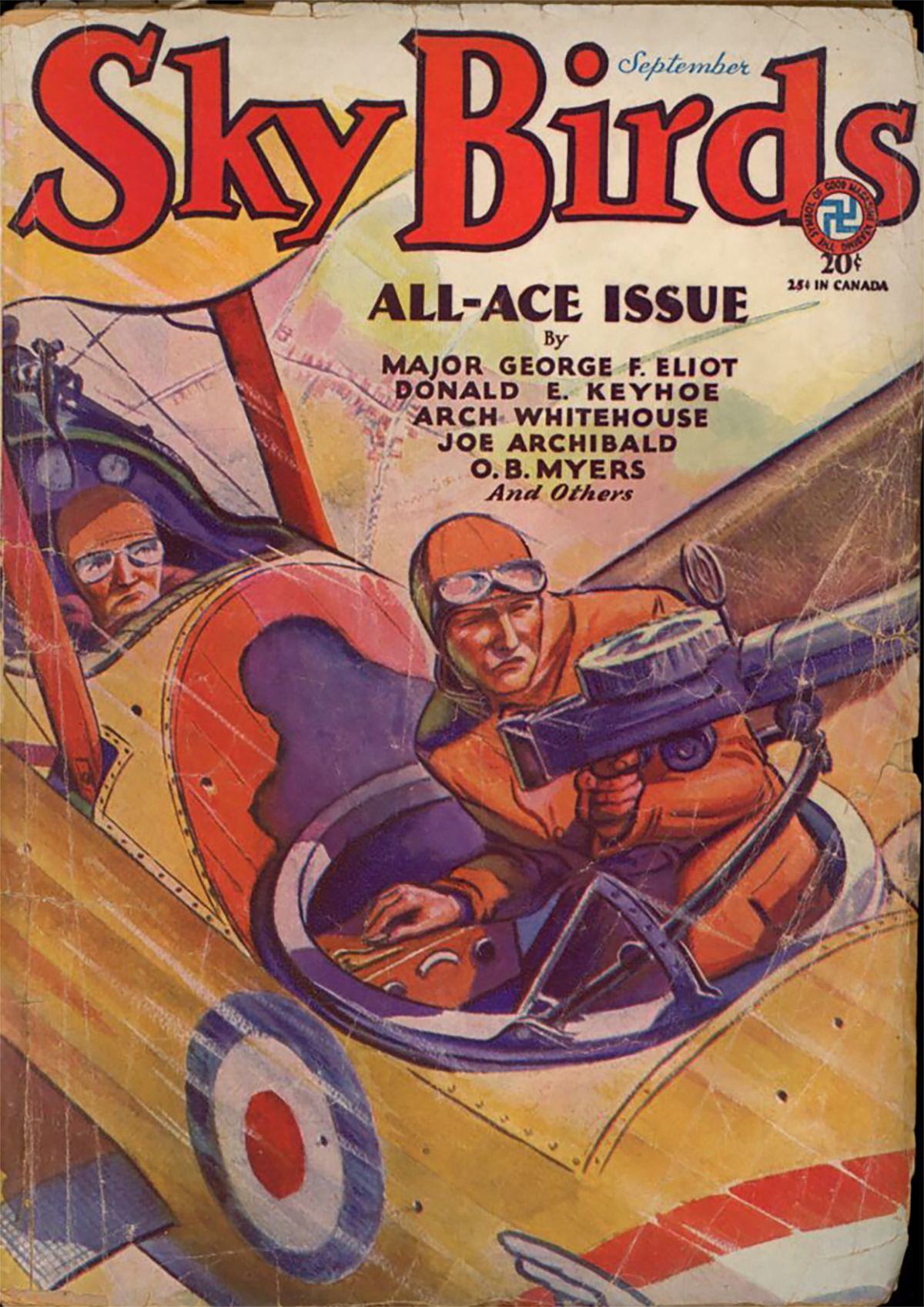
THIS week we present one of Paul Bissell’s covers for Sky Birds! Bissell is mainly known for doing the covers of Flying Aces from 1931 through 1934 when C.B. Mayshark took over duties. He also did covers for brother magazine Sky Birds. For the September 1931 cover Bissell put us right in the action with some artillery spotters over enemy lines!

The Fighting Spotters

th_SB_3109PROBABLY no group of fighters in the World War did as much and got so little credit as the artillery spotters pictured on this month’s cover. These men sat over the German lines and provided “eyes” for the big* guns that pounded the enemy dumps, transport, front-line redoubts and artillery bases.

The heroes of the air today are those pilots who fought in sleek, high-speed scouts, but the artillery-spotting airmen had to do their important work in slow, unwieldy, low-powered ships, and had to rely on what little protection they might expect from the high-flying scouts and fighters above.

Hundreds of budding airmen who trained and prepared themselves for action against the German circuses found themselves unceremoniously dumped into the cockpits of R.E.8s and told to go off and control a “shoot.” This meant that a pilot and observer would leave their airdrome, fly out over the battery they were to control, lower their wireless aerial and pick up the battery control dugout.

Once in contact they would fly out over the target and call for the first shot. This would be observed and the corrections made, by wireless. Shot after shot would be pounded out and corrected until the target was “hit.” All this would be carried out while the ship was flying in a broad figure-8 track. One half of the figure-8 would be over the German lines and the other over Allied territory.

Needless to state, these “shoots” were not always staged under tea-party conditions. Often the spotting ship would be attacked while completing the correcting process as in our cover, but in all cases, the spotters stuck it out until they had registered a “hit” and had sent out their command for “salvo.” Grimly they hung on, the observer handling his Lewis gun and telegraph key, fighting and dying amid a wild fanfare of machine-gun bullets and the screaming wail of the shells that were being vomited out from steel muzzles at the request of the fighting observer, who in all probability was taking a torrent of enemy fire as his fingers tapped out the all-important corrections for the gunners many miles behind the lines.

Little honor, little glory and often the gibes of fellow flyers who were lucky enough to be flying faster and more up-to-date ships was their lot, but they accepted their Jobs and did them well. They lived and died, true examples of the old creed of the flying men: “We Are the Eyes of the Army.”

The Story Behind The Cover
“The Fighting Spotters”
Sky Birds, September 1931 by Paul J. Bissell

How the War Crates Flew: The Instrument Board

Link - Posted by David on February 4, 2025 @ 6:00 am in

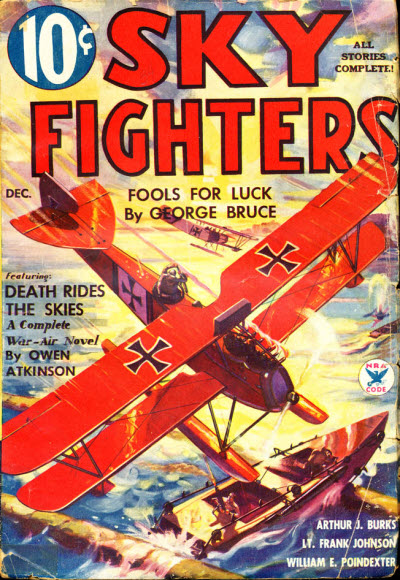
FROM the pages of the December 1934 number of Sky Fighters:

Editor’s Note: We feel that this magazine has been exceedingly fortunate in securing Lt. Edward McCrae to conduct a technical department each month. It is Lt. Mcrae’s idea to tell us the underlying principles and facts concerning expressions and ideas of air-war terminology. Each month he will enlarge upon some particular statement in the stories of this magazine. Lt. MaCrae is qualified for this work, not only because he was a war pilot, but also because he is the editor of this fine magazine.
The Instrument Board

by Lt. Edward McCrae (Sky Fighters, December 1934)

ALL RIGHT, you ring-tailed gazookuses, the class will now come to attention, which is what I don’t want anything but. Mary, take that gum out of your mouth and stick it back of your ear until school is over. And Johnny, you quit dropping those fishing worms down Irene’s back. Put ’em, in your pocket until you find a fish that wants them.

So, clean out your ears and get ready to do some concentrated listening, because this time I am going to tell you some stuff that would sound awfully technical if anybody except myself were to try to explain it to you. But when I start to talk, even you dumbkopfs ought to be able to understand it.

“Where Am I At?”

The subject of the sermon, today is taken from the first book of Aviatus, second chapter and third verse. It says here, “And the aviator came unto me saying, ‘Where am I at?’ And I answered unto him thusly, saying, ‘Learn to read your instruments and thou wilst know where thou art at’.”

And so we plungeth inneth.

Now whether you knot-heads know it or not, there is a difference between an airplane and an automobile. The point is that a car buzzes along on a highway and if something goes wrong you can pull over to the side of the road and find out what it is and maybe get towed in. And if you get lost on the road you can ask where the right road is and get on it.

When Things Go Wrong

Well, sir, believe it or not, you can’t do that in an airplane. If you are in the air over the German lines and something goes wrong with the ship you don’t want to pull over to some German camp and get them to fix you up so you can go on your way. And if you happen to get lost, you don’t want to stop some Heinie and ask him where you can find the Hamfstengle Air Circus which you were sent out to bomb.

All of which means that since we couldn’t stop to make repairs and ask questions we had to carry our information along with us when we went out sniping Heinies. We carried that information on the instrument board, in the form of dials with needles and other kinds of indicators.

Times Have Changed

It wasn’t like it is now. In these days you can look at the instrument board of a good ship and see a record of what your Aunt Mehitabell had for breakfast and how it is affecting her indigestion. Today they have turn and bank indicators that register the angle of the bank before your eyes. During the war that was registered on the seat of our pants. If we were slipping down to the left we felt it by sliding in the seat and so on.

But we had instruments. And they fall into two groups, according to their purpose. One group is for the purpose of knowing how the motor is doing at all times so we wouldn’t have to stop and get a Boche to do a repair job for us. And the other group was for the purpose of telling us where we were or ought to be so we wouldn’t have to ask a German to direct us on our way.

A Handful of Gadgets

For the engine we had a switch to turn it on and off, a tachometer to record the number of revolutions of the motor, fuel and oil gauges, etc.

And for getting around places and knowing where we were, we had an air speed indicator, an altimeter, a compass and a clock.

By the side of a list of present day instruments you would get the impression that this little handful of gadgets wouldn’t be enough to successfully navigate a kiddie-kar. But we got there, folks. Ask ’em if we didn’t!

Pretty Bare, Eh?

Take a look at Figure 1 and you will get some kind of an idea what the board of one of the old crates looked like. Looks pretty bare, doesn’t it? Well, it wasn’t the face of the instruments that did the work, it was the insides of them that performed the job. And if you want to know something about the problems of the birds that had the task of devising ways for us to know what was going on in the ship, just take a look inside one or two of those instruments. It was those tiny little hairsprings and needles that won the war.

That’s a big statement, but I can prove it. There’s no use in going into detail as to that, so I’ll get on with the lesson and show you how they did it.

How They Worked

There are some of the instruments that could be adapted from automobile and other uses. Things like thermometers and the compass and the tachometer. But in case you didn’t happen to look into the matter the last time you were playing around an instrument factory I’ll tell you how they worked.

A tachometer, or “tack” or a “/*!!&* tack” as it was called when it wasn’t working properly was a simple device adopted from the speedometer of an automobile or any other machine that had to record the number of revolutions a wheel or anything made. You merely had a flexible shaft with one end attached to or in contact with the crankshaft of the engine. The other end had a governor on it. The faster the engine turned the more the governor spread out. Then the amount of spread was recorded on the dial which is marked off in thousands of revolutions a minute. The tach didn’t tell you how fast you were going, but only how fast the engine was turning. You knew in advance how many revs it should turn for this and that, for climbing, for gliding, straight flight, and so forth. (Figure 2, if you’re interested.)

And while we’re on the simple things, we might clean up the thermometer. That little gadget ordinarily operates by having a tube with some kind of liquid like mercury or sulphur dioxide or methyl chloride in it. All these liquids expand under heat. As they expand they naturally rise up in the tube and the readings are marked on the tube.

The Distant Type

But an engine thermometer had to be read back in the cockpit, so they made a variation of this principle which comes under the head of “distant type thermometers.” If you will take your eyes off that circus parade that’s passing and look at Figure 3 you’ll see what one looks like.

What happened when it was supposed to register the temperature of the oil and the water and those things that were not supposed to get too hot if you wanted to stay in the air was this:

The part called the bulb contained methyl chloride which makes a vapor when it gets hot. The juice creates the vapor which then fills the tube running to the dial (the capillary tube) and that then exerts pressure on the Bourdon Tube which is that curled part with the needle attached. The needle then registers the temperature as indicated by the amount of pressure in the Bourdon Tube.

I’ve got to hurry through this lesson because I’ve got a date with a blonde who is “just crazy about flyers” so I’ll first tell you that the air speed indicator also works by pressure, and then explain how the pressure gauge system works so you will never forget it.

Air Speed Indicator

Now, to get the recording of the amount of speed with which you are passing through the air you have an air speed indicator. It is a combination of a Bourdon Tube and what is called a Pitot tube.

The Pitot tube is hollow and usually runs out a wing, up a strut, and ends by sticking out forward from the strut. You’d think it was a piece of gas line that was broken off. But here’s what you’ve got. When the ship is flying forward there is naturally head resistance. That open-ended tube sticking straight forward into the wind has the increased wind pressure entering the hole in it. Naturally the pressure is greater than if the ship was standing still. The ship registers no miles per hour when it is still, but as it increases speed, the air pressure increases and that in turn increases the pressure inside the Bourdon Tube and makes the dial tell you how fast you are going through the air, not from point to point on the ground.

Stay Awake

Now there are other gauges that work by pressure. They all usually use the Bourdon Tube system, or a diaphram system. So, wake up long enough to look at Figure 4, and try to stay awake long enough for me to explain it to you, and then you will know how they work.

You see that thing like a question mark? That’s the Bourdon Tube. It is hollow and made out of bronze or brass. The pressure from the thermometer or Pitot Tube, or hot oil or hot water or what have you comes in through the tube connection and enters the Bourdon Tube.

The pressure tries to straighten out the question mark and make an exclamation point out of it, like what goes after the word damn.

Speaking of Throttles

But was that air pressure or vapor pressure’s face red? The end of the tube was tied to a little gear apparatus and that was geared to a dial. So as the pressure huffs and puffs and tries to blow the house down it really succeeds only in straightening out the question mark a little bit, and in doing that, it makes the needle turn around in front of the dial and the needle says to the flyer, ‘‘watch out, your water’s getting too hot. Better throttle down.”

And in speaking of throttles, you buzzards beat it before my date shows up or I’ll throttle the whole bunch of you.

Scram!

“Pride of the Pinkham’s” by Joe Archibald

Link - Posted by David on January 31, 2025 @ 6:00 am in

“HAW-W-W-W-W!” That sound can only mean one thing—that Bachelor of Artifice, Knight of Calamity and an alumnus of Doctor Merlin’s Camelot College for Conjurors is back to vex not only the Germans, but the Americans—the Ninth Pursuit Squadron in particular—as well. Yes it’s the marvel from Boonetown, Iowa himself—Lieutenant Phineas Pinkham!

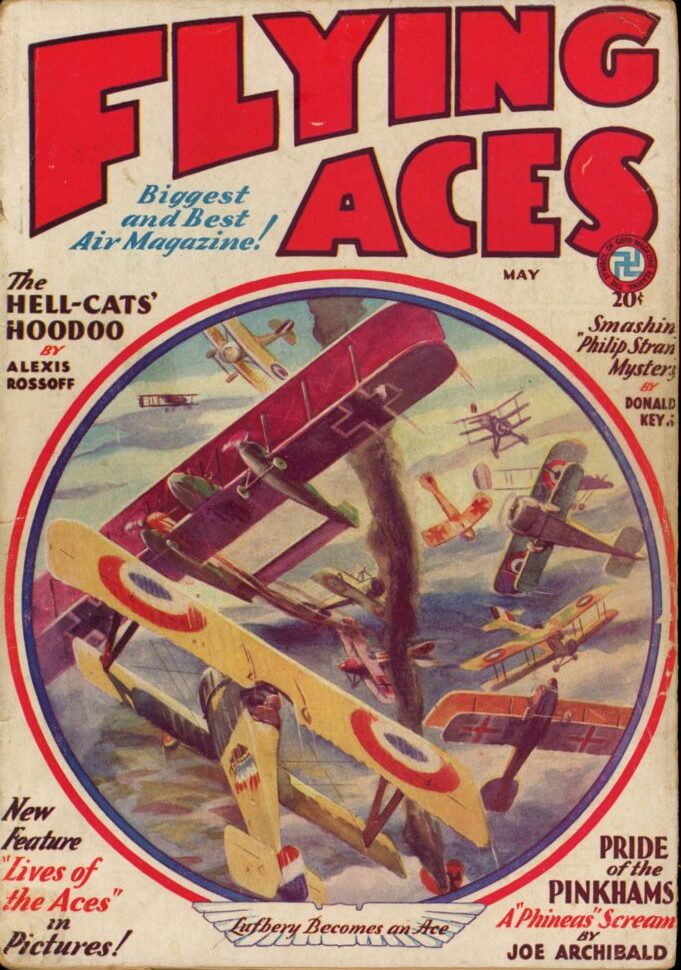
Phineas Pinkham meets his match when the 9th Pursuit’s latest replacement in the form of one Lieutenant Monk Flanagan, once known as Perfesser Merlin the Great of the Hipperdrome Vodyville Circuit, arrives. Poor Phineas gets a taste of his own medicine—he can certainly dish it up, but can he take it? Find out in Joe Archibald’s latest Phineas mirthquake, “Pride of the Pinkhams” from the May 1932 Flying Aces.

One Phineas “Carbuncle” Pinkham to a squadron would be enough in any man’s war—according to Major Rufus Garrity. But somebody back at Wing thought differently when he assigned Lieutenant Monk Flanagan, late of the Hippodrome Vaudeville Circuit, to the Ninth Pursuit!

“Rear Gun Action” by Paul J. Bissell

Link - Posted by David on January 27, 2025 @ 6:00 am in

THIS week we present one of Paul Bissell’s covers for Sky Birds! Bissell is mainly known for doing the covers of Flying Aces from 1931 through 1934 when C.B. Mayshark took over duties. He also did covers for brother magazine Sky Birds. For the August 1931 cover Bissell put us right in the action as a pilot whose observer had been killed during a dogfight is forced to lean back in his cockpit and take over the observer’s gun!

Rear Gun Action

th_SB_3108TWO-SEATER pilots were not always confined to “action front.” There were times when they had to be able to use the rear Lewis—many times, in fact. This month’s cover shows a pilot whose observer had been killed during a dogfight, and as most of the opposition was coming from the rear, and he had little or no chance to out-maneuver the Jerry ships, the pilot was forced to lean back in his cockpit and take over the observer’s gun.

As long as there were cartridges in the drum, the pilot could put up some sort of a defense, but once the drum was expended he was forced to go back to his attempts to get away by means of the joystick and throttle.

Artillery-spotting ships, that were often suddenly attacked by the enemy scouts, ran into situations of this kind many times. And on the other hand, the observer was often called upon to take over and attempt to fly the ship back when the pilot was killed. Neither situation was any too pleasant.

The Story Behind The Cover
“Rear Gun Action”
Sky Birds, August 1931 by Paul J. Bissell

“The Yellow Ace” by J.D. Rogers, Jr.

Link - Posted by David on January 24, 2025 @ 6:00 am in

THIS week we have a story by J.D. Rogers, Jr. Rogers is credited with roughly fourteen tales from the pages of Flying Aces, Sky Birds and Sky Aces. “The Yellow Ace” from the August 1929 Flying Aces was his first published tale. In it James Lawrence arrives on the tarmac of the 23rd Squadron R.F.C. with his newly designed fighter plane. In the make-up of this plane was the knowledge and experience of a young man who had played and worked in his father’s aeroplane factory since age permitted. Prompted by zealous patriotic duty he had built this super fighter for his country, a country which the warring nations had far surpassed in the art of building aircraft. Refused a fair demonstration of his plane by a very inexperienced air board, the youth, with his flame of patriotism quenched, turned from his own country to England whose air board was frantic for a plane fast enough and maneuverable enough to successfully combat the German demons who had held the air supremacy through the war.
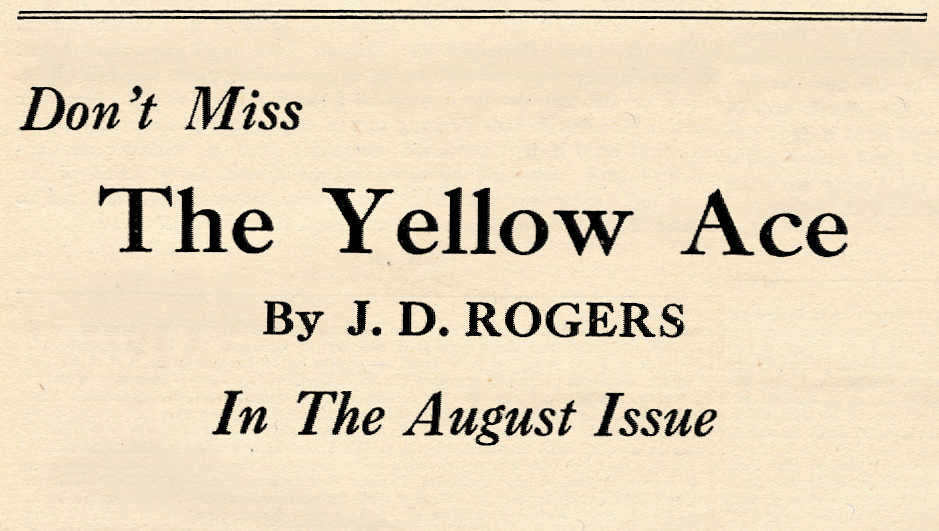
England welcomed the American. Her air experts praised the flying qualities of his plane demonstrated in trying maneuvers, but they were skeptical of its fighting ability. It was then that the youth, reckless because of miserable failure at home and unexpected success abroad, offered to fly his plane in real combat to prove its fighting ability. The air board, convinced that the pilot knew the maneuvers of air combat, gave him a thirty day trial upon the battle front to prove his handiwork. . .

Read the thrilling adventures of the man who was branded a coward. Follow flaming tracers as they eat into his plane. Watch him zig-zag through steel-spattered skies—and see if he’s yellow!

“Sky Writers, June 1936″ by Terry Gilkison

Link - Posted by David on January 20, 2025 @ 6:00 am in

FREQUENT visitors to this site know that we’ve been featuring Terry Gilkison’s Famous Sky Fighters feature from the pages of Sky Fighters. Gilkison had a number of these features in various pulp magazines—Clues, Thrilling Adventures, Texas Rangers, Thrilling Mystery, Thrilling Western, and Popular Western. Starting in the February 1936 issue of Lone Eagle, Gilkison started the war-air quiz feature Sky Writers. Each month there would be four questions based on the Aces and events of The Great War. If you’ve been following his Famous Sky Fighters, these questions should be a snap!

Here’s the quiz from the June 1936 issue of Lone Eagle.

If you get stumped or just want to check your answers, click here!

“Decoys of Doom” by Alfred Hall Stark

Link - Posted by David on January 17, 2025 @ 6:00 am in

THIS week we have another story by Alfred Hall Stark. Stark wrote a dozen or so stories for the pulps, frequently dealing with aviation, in the late twenties and early thirties before building a reputation for writing well-researched, fact-based articles for The Reader’s Digest, Popular Science, Saturday Evening Post and others.

As we found out in the letter Flying Aces published the month before last week’s story and two months before “Decoys of Doom”, Stark had written and submitted this story to the magazine first. From the July 1929 Flying Aces, it’s Alfred Hall Stark’s “Decoys of Doom.”

Every day the patrol went over the lines, and came back minus one plane and one man. Only the missing flyers could tell how they had mysteriously vanished—and the dead were turning in no reports at H.Q.

“The Back Seat Hero” by Arnold Lorne Hicks

Link - Posted by David on January 13, 2025 @ 6:00 am in

THIS week we present a cover by Arnold Lorne Hicks! Hicks worked in the pulps primarily from the late ’20’s to the mid 30’s, producing covers for such magazines as North-West Stories, Navy Stories, Police Stories, Detective Dragnet, Sky Birds, Golden West, Western Trails, Love Adventures, and a couple covers for Flying Aces!

The Back Seat Hero

th_FA_3101THE two-seater observer—the man who did more and got less credit than any rating in the air services. He fought and died with the best of them. If his pilot was killed, he stood a good chance of going west without being able to do much about it. In the rear seat he took the bulk of the enemy hatred. He was responsible for protecting his own tail and garnering Important observations at the same time. He took the pictures, dropped the bombs and directed the attack. While it Is not generally known, the observer, no matter what his rank as compared to the pilot, was the actual commander of the ship. And yet he never got any credit. He had to light and fly under the worst conditions, and if the truth were known, observers probably got more enemy planes than did the pilots. He fought in a billowing cockpit with a gun that rattled and strained against the slipstream; and when It was all over, he seldom got credit for the ships he destroyed, and usually had to bask in the reflected glory of the man who wore the double wings.

The Story Behind The Cover
The Back Seat Hero
Flying Aces, January 1931 by Arnold Lorne Hicks

“The Hurricane Kid” by Alfred Hall Stark

Link - Posted by David on January 10, 2025 @ 6:00 am in

THIS week we have a story by Alfred Hall Stark. Stark wrote a dozen or so stories for the pulps, frequently dealing with aviation, in the late twenties and early thirties. Stark was a pseudonym for Afred Halle Sinks. Sinks was a native of Ohio, who won his reportorial spurs in New York before heading to Porto Rico to work on the Porto Rico Progress published in San Juan. When sinks returned to the US, he was a staff writer for Popular Science and The Reader’s Digest building a reputation for writing well-researched, fact-based articles for those publications as well as others and newspapers.

Stark wrote “The Hurricane Kid” while still in Porto Rico. It was published in the June 1929 issue of Flying Aces.

Meet Crashing Kid Sperry, the Crack-Up King of the Caribbean, on the payroll as a curiosity. He got sore at the boss, became an air bandit and flew with sensational audacity right into a raging hurricane. Did he come out alright? Read it and see!


In a brief biographical paragraph from an article in 1963, Alfred Halle Sinks was said to be living in Philadelphia and responsible for the public information program that launched Bucks County’s open space conservation program. By that time he had been editor of the Bucks County Traveler, as well as a staff writer for Popular Science and Reader’s Digest, and had contributed articles to the Saturday Evening Post, Collier’s, Ladies Home Journal, and other leading national magazines.

As a bonus, here’s a letter from Alfred Hall Stark that Flying Aces published in the March issue—the month before the issue this story ran.

Sinks was living in Carversville, Bucks County, Pennsylvania when he passed away October 26th, 1974.

How the War Crates Flew: Personalities of the Planes

Link - Posted by David on January 7, 2025 @ 6:00 am in

FROM the pages of the November 1934 number of Sky Fighters:

Editor’s Note: We feel that this magazine has been exceedingly fortunate in securing Lt. Edward McCrae to conduct a technical department each month. It is Lt. Mcrae’s idea to tell us the underlying principles and facts concerning expressions and ideas of air-war terminology. Each month he will enlarge upon some particular statement in the stories of this magazine. Lt. MaCrae is qualified for this work, not only because he was a war pilot, but also because he is the editor of this fine magazine.

Personalities of the Planes

by Lt. Edward McCrae (Sky Fighters, November 1934)

NOW if you youngsters will get the gun cotton out of your ears I’ll tell you something that you might not have thought of before. I’m going to tell you why they sometimes call an airplane “she” just like they call a steamship or sailing ship “she.”

It’s because they all have personalities of their own, and because their personalities are so cranky usually that you can’t expect to know what they’re going to do next until you get well-acquainted with them, and by that time you don’t care much what they do. So, having personalities so much like women, we naturally call them “she” and a lot of other names that you cannot write about in a magazine.

So, if you’ll sit up I’ll try to introduce you to a bunch of the ladies and tell you some of the little things about them that you don’t ordinarily hear when they just tell you their names and addresses.

Most of ’Em British

Now most of the ladies we Americans got acquainted with were British, with just a few French gals thrown in to make it exciting.

For instance, the first lady your Uncle Eddie met when he got over in nineteen-fifteen was a gal who had just been built and had officially been named the E.F.B.5.

But that name naturally wouldn’t do for us, so we quickly got to calling her the Vickers Gun Bus, Fig. 1, You see, at this time, the war was just getting under way like it meant real business, and it had become apparent to the big shots that the airplane was going to play an important part in it.

Some Advance!

Before that they had been sending ships up with the pilots armed only with pistols or carbines or brickbats. But that didn’t work so well, so the result was an airplane with a machine-gun attachment. And boy, in those days that was some advance.

But you should have seen that old Gun Bus. Today you’d laugh your head off just looking at it, but we took it pretty seriously. She was the most famous of the early crates.

To look at her you would think the designer got his idea from a flying coffin. The nacelle sat up in front and stuck out forward of the wings. Behind the nacelle or fuselage if you could dignify it by that name—which you couldn’t—was a lot of outrigger gear with a tail stuck on it. It looked kind of like a small windmill stand sticking outward to the rear.

And then the wheels were back to the rear of the center of gravity and they had one of those landing skid arrangements in front of it so you wouldn’t nose over and bash in your face.

The Latest Thing

But boy, in those days here was what we called the latest thing in ladies of the air. The thing had a gun mounted on it, and if you don’t think that was a welcomed innovation you should have been there. The gunner sat out in front in that little cockpit of his with nothing but a lot of ozone under him, and shouted for the Heinies to come up and see me some time. He thought he was sitting on top of the world, which he was, because that gun stuck out so far in front that he had all kinds of angles through which he could aim it.

And the gal was the talk of the town because she was fast—or at least what we thought was fast in those days.

She could hit off at least sixty and seventy miles an hour! And was that getting there?

She Had B.O.

But she fitted in with those present-day soap ads. People whispered behind her back. She had B.O. That was because her 80 h.p. Gnome rotary motor burned castor oil—and no lady motor can burn that stuff and have her friends around without their holding their noses.

Anyway, she was a good old ship until a Miss Sopwith, Fig. 2, came along. That was in nineteen-sixteen, and this new gal was right up to the minute. She was beginning to look like an airplane. And just like the women in those days who tried to see how much wingspread they could carry by making their hats bigger and bigger, this Sopwith went in for wingspread in a big way by taking on an extra wing, becoming a triplane.

We kind of liked the miss because she could get upstairs in a hurry, faster in her time than any other gal on the front. But she was like a lot of the other high flyers and was unreliable in the pinches.

When You Wanted to Dive

There were times when you wanted to dive and dive in a hurry. And in times like this you felt a little worried about the gal because she could go up fast enough but she couldn’t take a dive either fast enough or safe enough to suit your hurry. It was there she showed her weakness.

Once in a while when you wanted to get back to the ground worse than you wanted to do anything else in the world she’d take you down all right—by shedding her wings. That let you down fast enough—but never easy enough. They often had to pick you up with a shovel and broom.

But she was a smart-looking gal, and so the Germans came out with their famous Fokker Triplane, Fig 2. There is plenty of argument as to whether they swiped the Sop design lock, stock and barrel. Most of us believe they did. And there’s plenty of proof. You know, if you steal a lead nickel you’ve got a piece of money that isn’t any good. The Germans’ idea wasn’t any better. They swiped the Sop, and the result was that the Fokker had just the same trouble we did. They built the ships faster, and the result was they lost more wings. There ought to be a moral hidden in that if you can find it.

The Flyers’ Sweetheart

And just about that time was born the sweetheart of all flyers—the Bristol Fighter, Fig 1. Just to prove what a good gal she was it is only necessary to say that she was the only ship that the British held on to long after the war. In fact, she wasn’t declared obsolescent until nineteen-thirty-two. That’s a mighty long life for any type of airplane, what with the steady advance of design.

She was a two-seater that had more uses than the proverbial “gadget.” They were originally intended for reconnaissance-fighters, but it wasn’t long before they used her for almost everything. She toted bombs, did photographic duty, spotted for artillery and even strafed trenches, besides being used for escorts and training. She was one gal you could stunt with and have hopes of setting her down intact when you got through.

Equipped with Stingers

And she was welbequipped with stingers. She had a Vickers gun synchronized through the prop and a Lewis gun on the scarff ring in the rear cockpit. They started her out in nineteen-seventeen with a 200 h.p. Hisso or Sunbeam Arab and got 120 m.p.h. out of her. Then they gave her a 250 Rolls-Royce Falcon and kicked her speed up to 130 m.p.h. She could take it. With that new powerhouse you could boot her up to 15,000 feet in twenty minutes, which was climbing in them days! And she had a slow landing speed of 45 m.p.h.

And she was just a nice size for proper handling, having a 39-foot, span and a 25-foot length, with a height of ten feet and a five-foot-six chord. It’ll be a long time before another ship gets as far ahead of her time as that Bristol baby. I knew her well.

A Great Family

But it seems like we couldn’t stay away from the Sopwith girls. That was a great family. So here before we knew it was another one of the sisters all rigged out and ready to step. She was the Sopwith Pup, Fig. 3. She made her debut in nineteen-fifteen and sixteen. And she was a knockout for beauty. She wore an 80 h.p. LeRhone Rotary in her hair and could get over the country, considering her small power plant.

She could get off the ground in a hurry and put five thousand feet under her in seven minutes. And when she got upstairs she was ready to talk business at the point of a Vickers fitted on the cowling to fire through the prop while she herself danced around at the rate of 99 miles per hour. She carried nearly twenty gallons of gas and five gallons of oil, and could stay in the air long enough for her to do some real damage to the Germans. And she did just that, for there was many ah Ace that piled up his score behind her guns.

Smaller, But—

She was a lot smaller than Miss Bristol, being only 26 feet across the hips. But don’t think she didn’t get there.

And she had a larger sister that you ought to get acquainted with, just to see how different sisters can be. The sister was Sopwith Camel, Fig. 3, and she was just as tricky as Pup was reliable.

Would she burn you up? And I mean that literally. This is the way it would happen. She was a kind of big Pup who was built to be still faster and more maneuverable. In order to do this she had to sacrifice some of Pup’s good qualities, and she was therefore tricky to fly, and dangerous to land. Her engine, a nine-cylinder Gnome-Monosouppe delighted in setting you on fire.

No Carburetor! No Throttle!

This was because that crazy power plant had no carburetor nor any throttle. The only way you could slow her down once she got started was to cut the ignition from certain of her cylinders.

The result was that the gas vapor would go through those cylinders without burning until it got into the exhaust. And right there the sparks from the other cylinders would ignite it. The result was a nice long sheet of flame pouring out of the exhaust into the slipstream. That made it nice and hot for you if it didn’t ignite the whole ship and leave you well-browned on both sides. Yes, sir, the old gal was hot stuff.

But she was a good old work horse when you got to know her and didn’t mind her spitting fire in your face. And she was armed to the teeth. She had two Vickers guns on the cowling and often a Lewis on the top wing just to balance things off.

Could Do Real Damage

She got a lot better when they took that crazy engine out and put a Clerget in. That sped her up to around 140 miles per hour and made her climb a thousand feet a minute. She could stay in the air two and a half hours a trip, and do real damage.

I suppose I ought to mention a lot of the other gals that helped make that war an exciting one, but there were so many that it is only possible to take a hop, skip and jump down the line and say howdy to a representative few of them.

I ought to tell you about still another Sopwith sister, that we called the one-and-one-half strutter. And I ought to tell you about some of the French ships, and a lot of others. But you’ll have to wait breathlessly for that. Just now, I’ve got a date with a modern little miss that could fly right around a lot of those good old babies, and she’s not armed with Vickers guns either.

Be seeing you.

“Spring Around the Corner” by Harold F. Cruickshank

Link - Posted by David on January 1, 2025 @ 6:00 am in

WE’RE celebrating the holidays with Harold F. Cruickshank—creator of those great Aces of the Western Front’s Hell Skies—Red Eagle, Sky Wolf, and Sky Devil. But this holiday season it’s going to be a down home Christmas featuring Cruickshank’s Pioneer Folk stories from the pages of Range Riders Western (1945-1952) on Mondays and Fridays; and Cruickshank’s own recollections of homesteading life from The Edmonton Journal’s The Third Column on Wednesdays.

The Edmonton Journal regularly set aside the third column on its editorial page for submissions from freelance writers, of which Cruickshank was an occasional contributor over the years. His columns frequently focused on his life growing up as a homesteader with his father and brother who had all immigrated from Scotland in 1905 to Barrhead, Canada along the famed Klondike Trail, just to the northwest of Fort Edmonton.

Here’s one last The Third Column by Cruickshank to end the month and start the new year!

The Third Column

by Harold F. Cruickshank • Edmonton Journal, Edmonton, Canada • Thursday, 1 April 1954

Spring Around the Corner

Cauld blaws the wind frae east to west.
    The drift is driving sairly;
Sae loud and shrill’s I hear the blast.
    I’m sure it’s winter fairly . . .

So the great Burns opened his poem. “Up In The Morning Early.” I imagine that Rabbie must have written this poem one wild March, for his next stanza pretty well describes the conditions hereabouts when:

The birds sit chittering the thorn,
    A’ day they fare but sparely;
And lang’s the night frae e’en to morn—
    I’m sure it’s winter fairly.

Watching the antics of the sparrows of late I have noticed quite a bit of confusion.

Two weeks ago. when there were marked signs of an early spring, a mated pair of sparrows decided to take up residence in a “bungalow” originally built for the tree swallows. Mrs. Sparrow fussed about, tossing bits of last year’s old nest out the front door, and began building a new one.

Mr Sparrow was very busy putting on quite a show of fidelity. An unattached hen was determined to break up the home, but Mr. Sparrow chased her away repeatedly.

When at last Mrs. Sparrow elected to go into residence, it was amusing to observe that the ol’ boy was much less severe on the intruding “vampire” he. He made some sporadic, token counterattacks, but these he soon gave up. It was very early in the season, and I imagine that he wasn’t too sure of the permanency of his new union with the incumbent Mrs. Sparrow Be that as it may, the “hussy” was permitted to perch quite close to the new home—just in case.

Then, alas, the “cauld” wind came to “drive sairly” down over the sector, and with the sharp drop in temperatures, the sparrow marriage seemed to I dissolve automatically. No doubt the sparrows were the victims of an attack of premature spring fever. They have “flown the coop!”

The sparrows are not the only creatures to have fallen victims to the false spring. Many an overcoat has been tossed into the moth-proof bag, and topcoats substituted. As a result, presumably, many of our fellow citizens are barking and sneezing.

* * *

Down through the ages. March has been one of the most maligned months of the year, and not without some justification.

Perhaps the best that may be said for it is that it is the natal month of some very important persons, and that it is closer to April and May than are Decemoer and January. As well, it is the source of a pretty well frayed cliche: “Spring is just around the corner.”

That is a fact . . . Spring is just around the corner. Don’t ask me what corner, but it is there somewhere. At this season of the year, forgetting the sparrows for the moment, I think back to the arrival of the ducks and geese and other harbingers of spring—the songbirds. There were times, of course, when the sharp-witted geese and ducks miscalculated, or were wholly deceived by the false spring, which had decided to flirt with winter a while longer.

Venturesome ducks and geese frequently poured down on the lakes almost before the Ice was clear. Wherever there were patches of open water, you would find the feathered swimmers, their chorus disturbing the air. Their voice sounds, more than any other factor but the sun, seemed to have more influence on the reawakening of springtime in the wilderness.

* * *

Now and then, alas, they, too, became victims of Nature’s fickleness. When sharp temperatures would tighten up the ice, and fierce blizzards slant down on a formation of huddled ducks or geese, the effect was very depressing on human beings. We felt that Nature had deceived us, cheated us. But as I look back visualizing those periods of uncertainty, I think it was all for the best. When the true spring came with startling suddenness, as surely it will return this year, it was doubly welcome. The better always seems much better after we have tasted and accepted the bitter.

Parting with March and its legerdemain should be an occasion for rejoicing. With the dawning of April we may in earnest begin to apply the age-worn cliche: “Spring is just around the corner!”

“Wild King Savagery” by Harold F. Cruickshank

Link - Posted by David on December 30, 2024 @ 6:00 am in

WE’RE celebrating the holidays with Harold F. Cruickshank—creator of those great Aces of the Western Front’s Hell Skies—Red Eagle, Sky Wolf, and Sky Devil. But this holiday season it’s going to be a down home Christmas featuring Cruickshank’s Pioneer Folk stories from the pages of Range Riders Western (1945-1952) on Mondays and Fridays; and Cruickshank’s own recollections of homesteading life from The Edmonton Journal’s The Third Column on Wednesdays.

Cruickshank wrote 35 stories chronicling the trials and tribulations of Dal and Mary Baldwin as they carved out their piece of the Wilderness in Sun Bear Valley, Wyoming and establish a growing community. King, the great stallion Dal had fist glimpsed when he arrived in Sun Bear Valley, has returned and Dal is determined to try and breed one of his mares with the great one, but an unsavory outsider has arrived in the valley to cause trouble and sets his sights on Nan.

From the May 1947 number of Range Riders Western, it’s Harold F. Cruickshank’s Pioneer Folks in “Wild King Savagery!”

Dal Baldwin, first settler in Sun Bear Valley, meets the challenge of a renegade seeking to despoil his homestead!

« Previous PageNext Page »