


“The Lone Eagle, February 1934″ by Eugene M. Frandzen
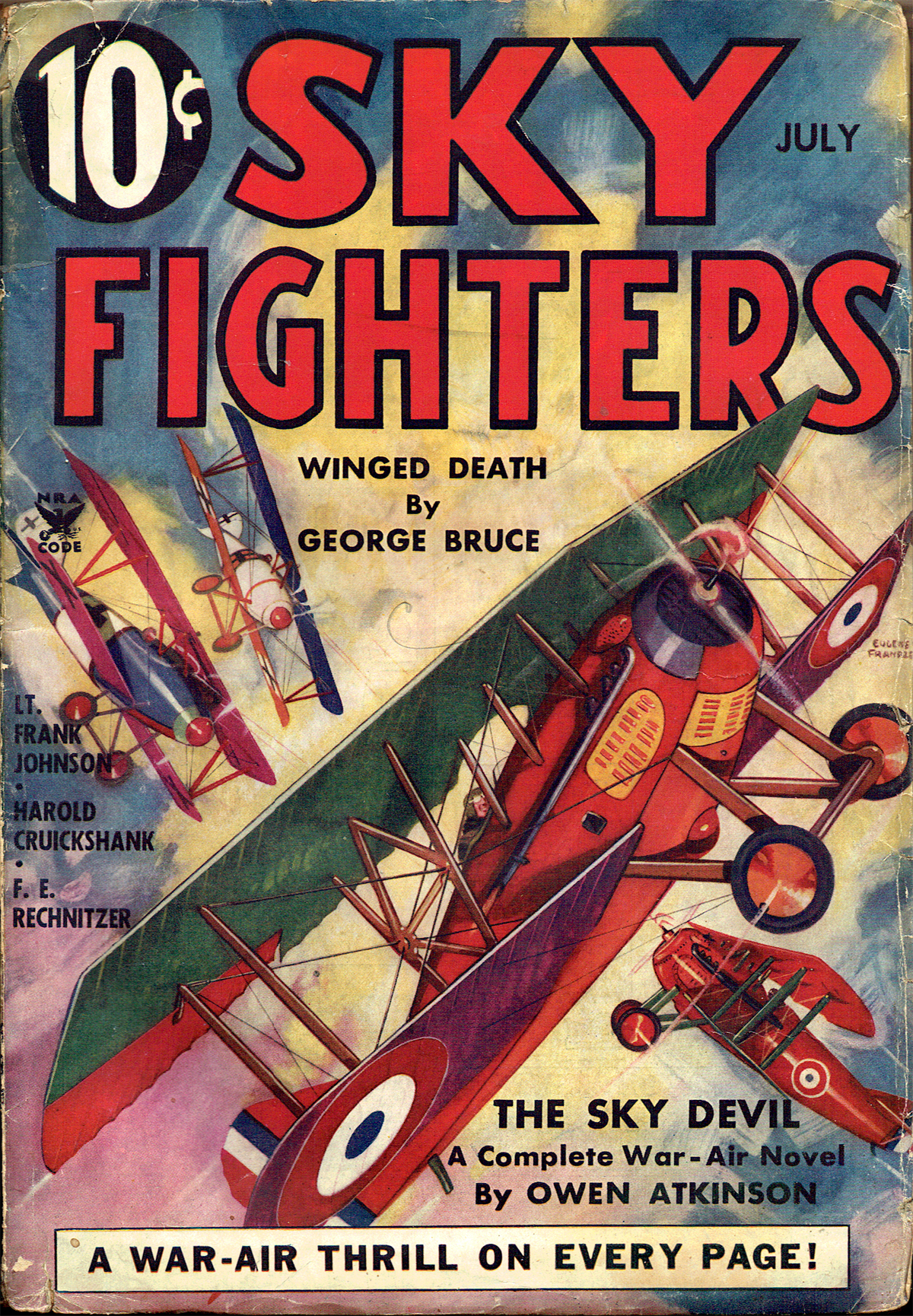
Eugene M. Frandzen painted the covers of The Lone Eagle from its first issue in September 1933 until the June 1937 issue when Rudolph Belarski took over with the August issue of that year. At the start of the run, Frandzen painted covers of general air action much like his Sky Fighters covers. Here, for the February 1934 issue, Frandzen has a British Bristol monoplane taking on a cornered German L.V.G.!
The Story of the Cover
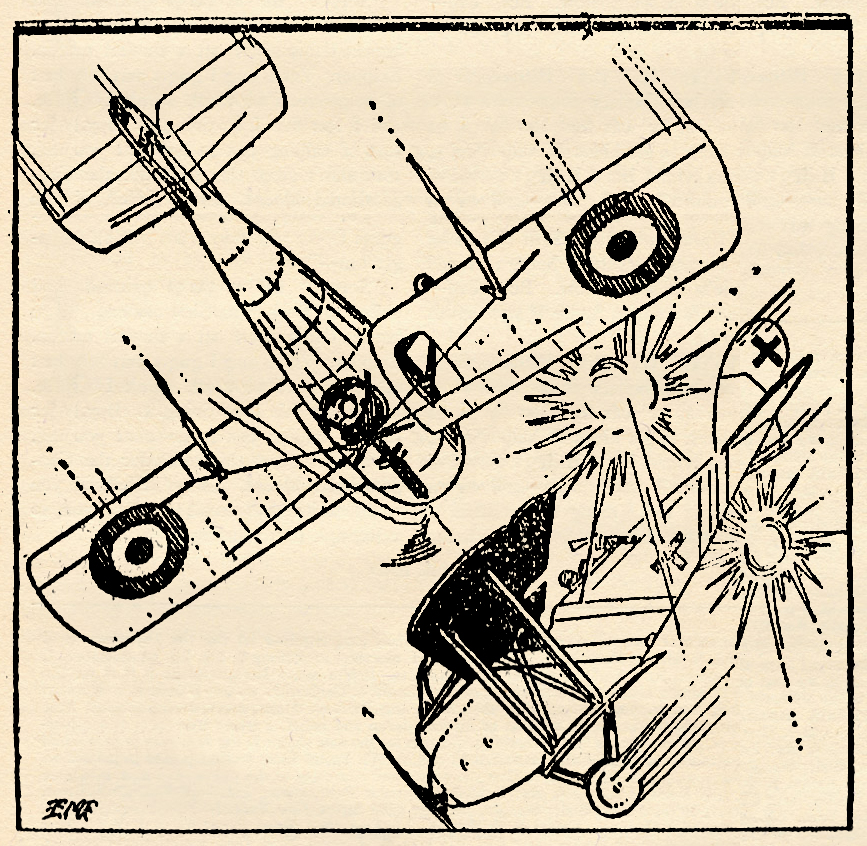
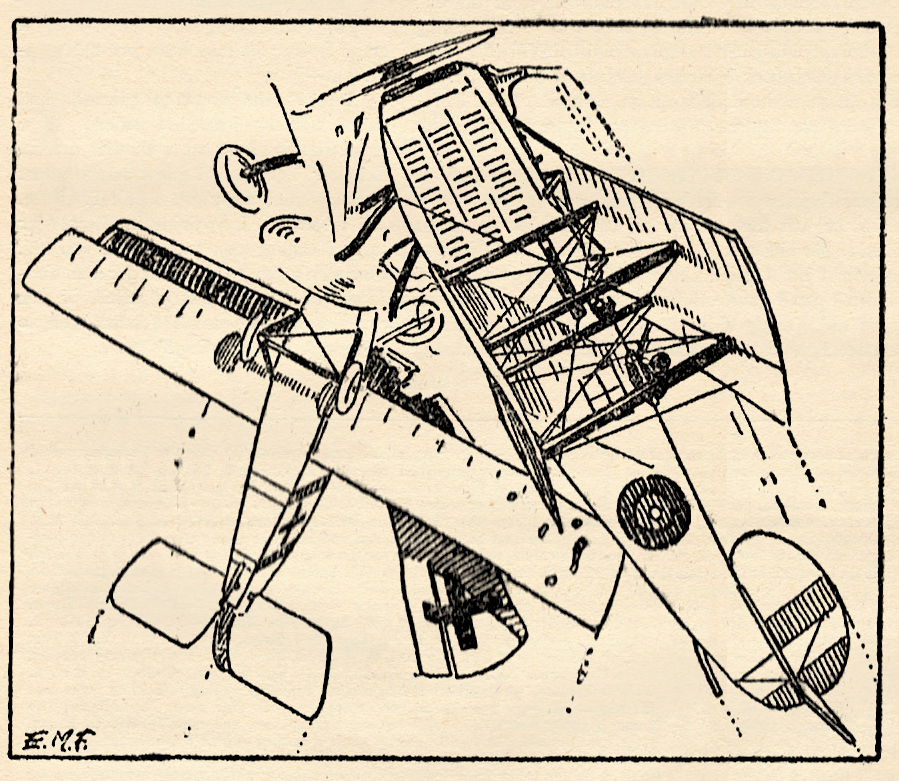
THE planes pictured on this 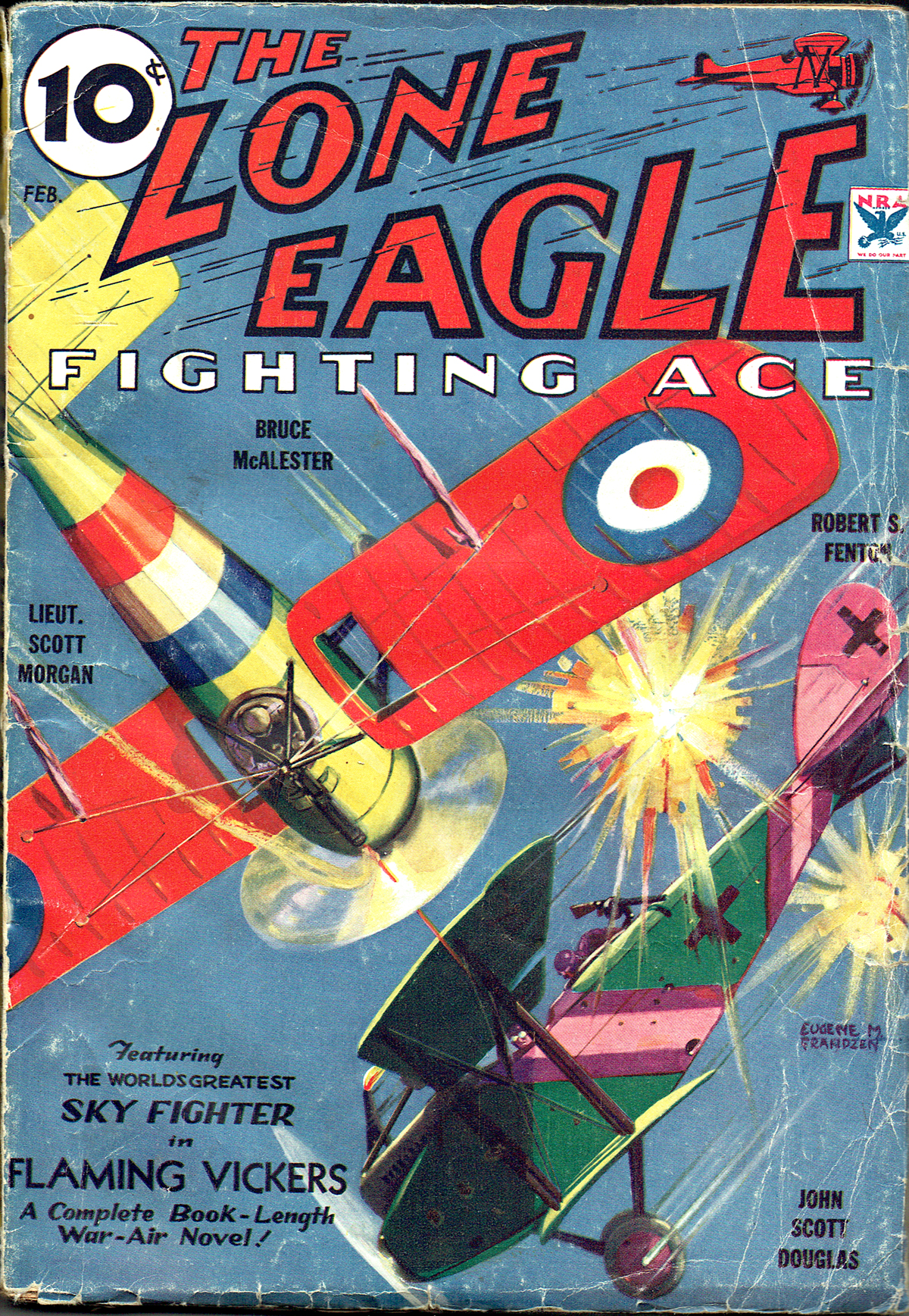 month’s cover are the Bristol monoplane, one of the prettiest little jobs turned out by the famous British and Colonial Aeroplane Co. The German ship is an L.V.G. type C.V.
High above the ground, against a background of blue, these two planes have met. The German pilot was heading back into German territory when the prowling Bristol pilot hopped the German. The Bristol, only rating one gun, was outclassed in armament at the start of the scrap by the L.V.G. which had two guns in perfect working order; one Spandau up front and a Parabellum at the back pit.
For ten or fifteen minutes the two guns on the L.V.G. have kept the Bristol at bay, but the L.V.G. being the slower and bulkier of the two has been more or less driven into maneuvers by the Bristol. And after each maneuver the German has found himself closer to the Allied lines. Also he has been forced to allow his ship to lose considerable altitude.
Over No Man’s Land
They have passed over No Man’s Land with its writhing lines of battered trenches and shell-torn fields. The Allied pilot signals the German to land—gives him to understand that he will be given a safe passage to the ground. The reply from Fritz and his observer is an assorted spray of slugs.
“O.K.,” the Allied pilot yells. And slamming the gas into the hungry carburetor he starts to really do his stuff.
The Bristol slashes back and forth across the back of the L.V.G. like a fighting shepherd dog ripping the hide from a bulldog’s back. In and out of ring-sights— short bursts—few of them, but effective. The German observer shudders, claws at his chest and stiffens, then slumps against the ring of his pit, mortally wounded.
Little Chance of Escape
The German pilot knows now that his tail is unprotected; his chances of escape amount to very little. Still, that small chance is better than nothing. He kicks his ship around and blasts at his enemy, his Spandau hammering out sizzling slugs.
Far below, carefully hidden from keen-eyed Boche airmen, a battery of Yank anti-aircraft guns have been trained on the aerial combatants.
Suddenly the commanding officer sees the Bristol dive away from the spurting gun of the German plane.
“Fire!” barks the artillery officer.
The drone and roar of the fighting planes is drowned by the sharp bark of the “75s.”
The Bristol pilot coming out at the top of a loop sees two blossoms suddenly burst on either side of the L.V.G. He pours a steady stream of lead into the German plane.
An Exciting Moment
That is the spot in the fight pictured on the cover; just that one moment when the unlucky German is beautifully bracketed by a couple of archie bursts and is getting a broadside from the Allied Vickers gun. One second later the German raises his hands above his head. The Bristol closes in on his tail. The anti-aircraft guns cease firing.
“Just in time for lunch, Fritz,” chuckles the victor. He points toward a cleared space flanked by tent hangars far below. The German nods solemnly, shrugs his shoulders—and obeys orders.
The Lone Eagle, February 1934 by Eugene M. Frandzen
(The Story of The Cover Page)
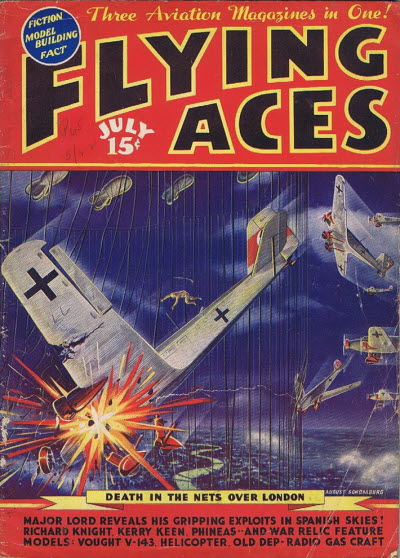 had a story in a majority of the issue of Flying Aces from his first in January 1930 until he returned to the Navy in 1942. Starting in August 1931, they were stories featuring the weird World War I stories of Philip Strange. But in November 1936, he began alternating these with sometime equally weird present day tales of espionage Ace Richard Knight—code name Agent Q. After an accident in the Great War, Knight developed the uncanny ability to see in the dark. Aided by his skirt-chasing partner Larry Doyle, Knights adventures ranged from your basic between the wars espionage to lost valley civilizations and dinosaurs. Knight is sent to Spain to get the American military men out of the Spanish Cival War, only to find the mysterious Four Faces—a criminal cabal that seek to control all crime on the earth—trying to turn La Guerra Civil into another World War with America taking all the blame!
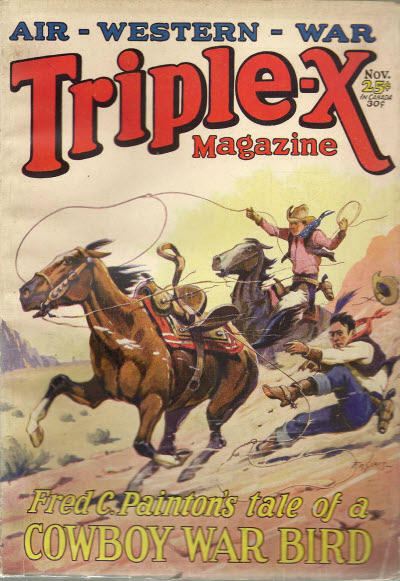 a story from the pen of a prolific pulp author and venerated newspaper man—Frederick C. Painton.
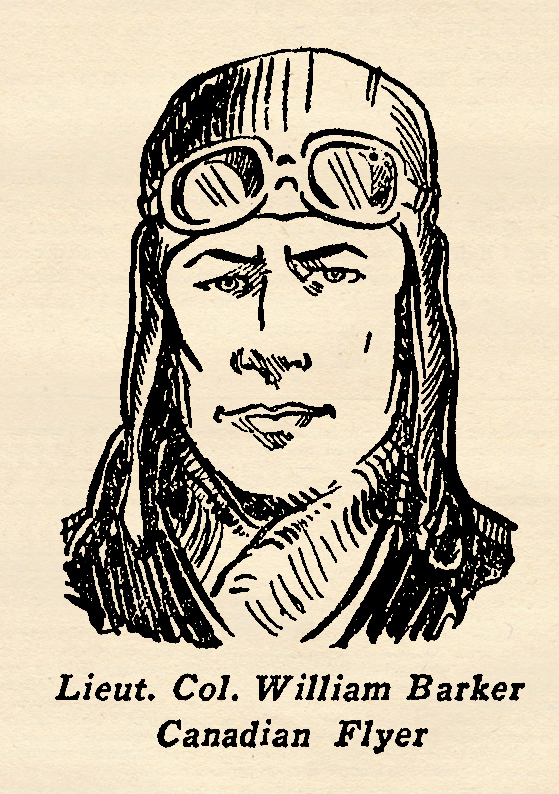 of William Barker’s career on two flying fronts reads more like fiction than fact. Born in the prairie province of Manitoba in 1894, he enlisted as a Private in the Canadian Army at the age of 19. He served in the cavalry before transferring to the flying corps. Barker began as a simple private. But he skyrocketed swiftly through all the grades to that of Lieut. Colonel. His training for a pilot was limited to two flights with an instructor. After that he was turned loose to begin piling up an amazing record. On October 27, 1918, he crowned this amazing record with the most astounding aerial feat of the whole war . . . fighting and escaping from a surrounding net of 6O enemy planes at the dizzy altitude of 20,000 feet.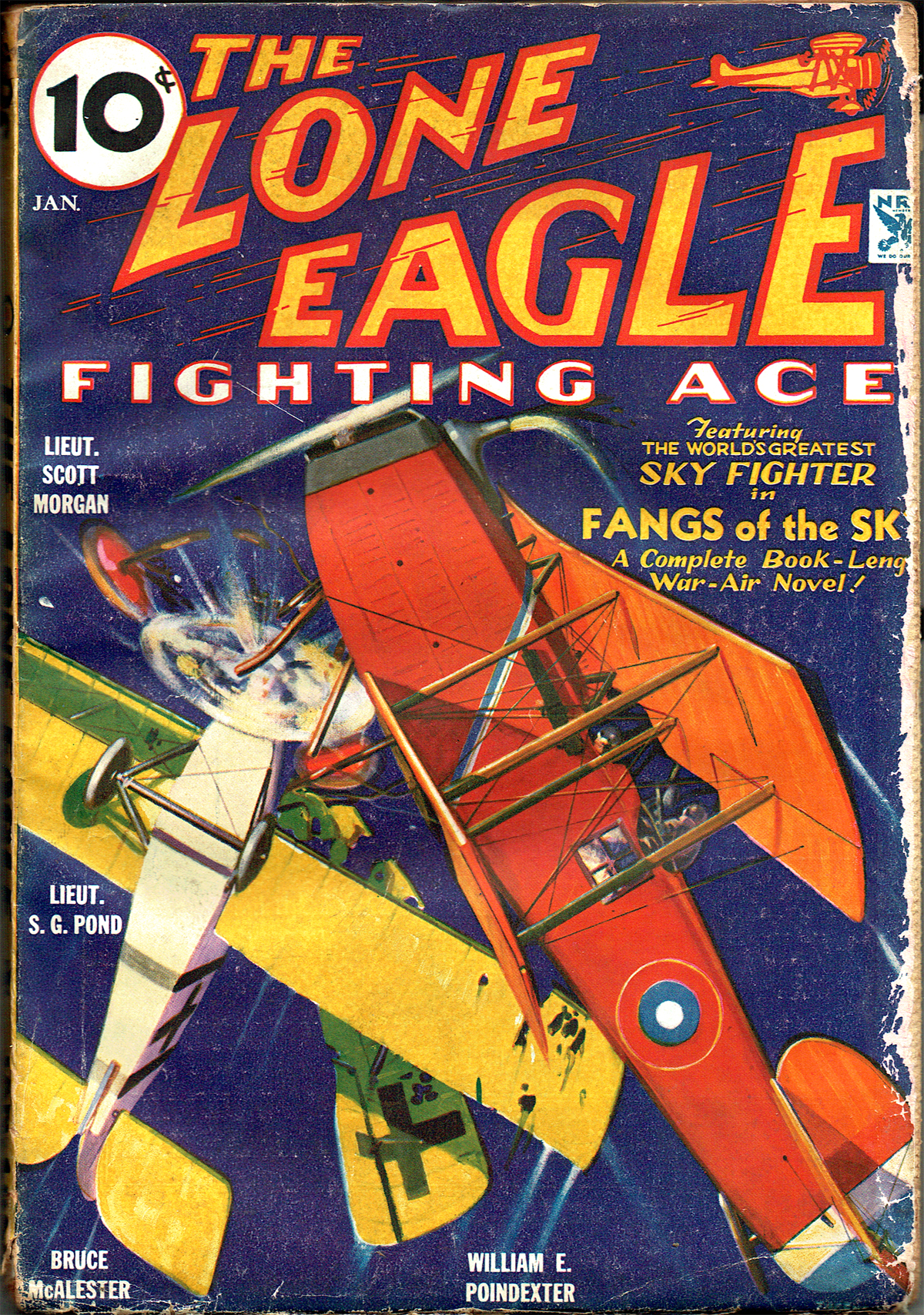
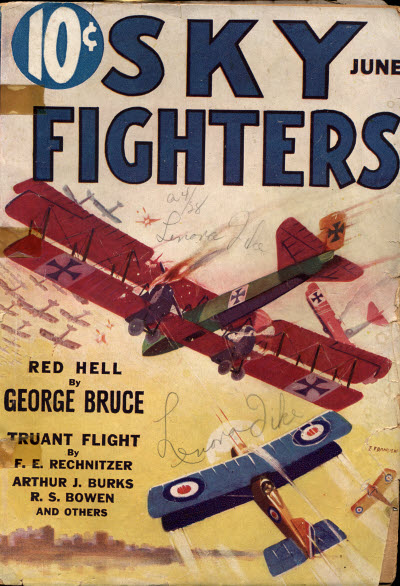 a story by prolific pulpster—Arthur J. Burks! Burks was a Marine during WWI and went on to become a prolific writer for the pulps in the 20’s and 30’s. He was a frequent contributor to Sky Fighters. Here we have a story of Frank Tracy, a strict flight leader who rules his troops with threats of court-martial or other disciplinary action. Tracy uses his methods as a way of keeping his flight safe, but they see him as just hiding behind his flight to save his own hide. As is the case in these situations tempers reach a boiling point! From the June 1933 issue of Sky Fighters, it’s Arthur J. Burks’ “Martinet.”
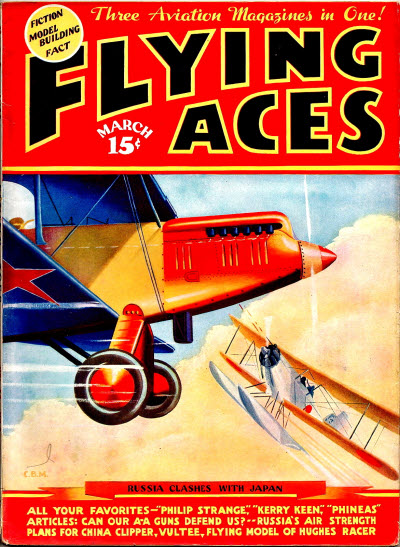 You heard right! That marvel from Boonetown, Iowa is back! And this time we find that Knight of Calamity finds himself shrieking amongst the sheiks in “Doin’s in the Dunes” from the pages of the March 1936 Flying Aces.
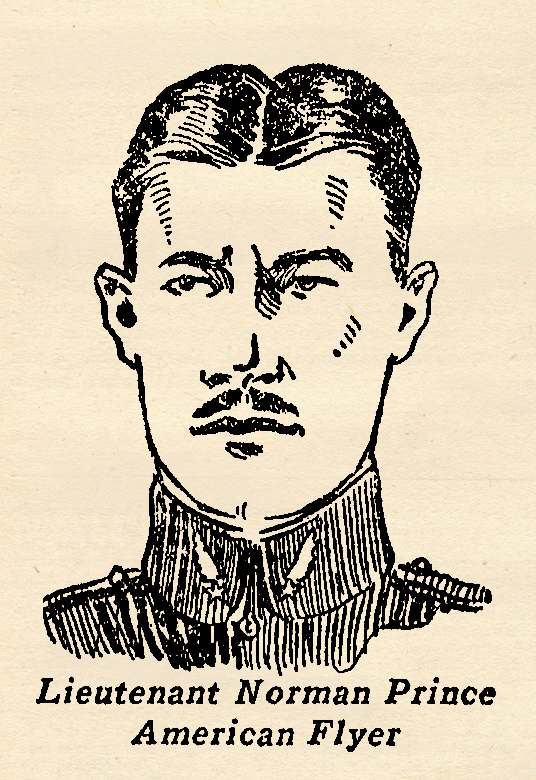 August 31, 1887, scion of one of the blue-blooded families In old Boston, was Norman Pslnce, the founder of the famous LaFayette Escadrille. Educated at Groton and Harvard for a career in business with his wealthy family, he hazarded his promising future and used his wealth and family prestige in overcoming obstacle’s to form a squadron of American aviators for battle at the front. With him in the beginning were Thaw, Chapman, Rockwell, McConnell, Hall and Cowdin. These Americans with Prince made up the roster of the original squadron sent up to the front at Luxeuil in May, 1910.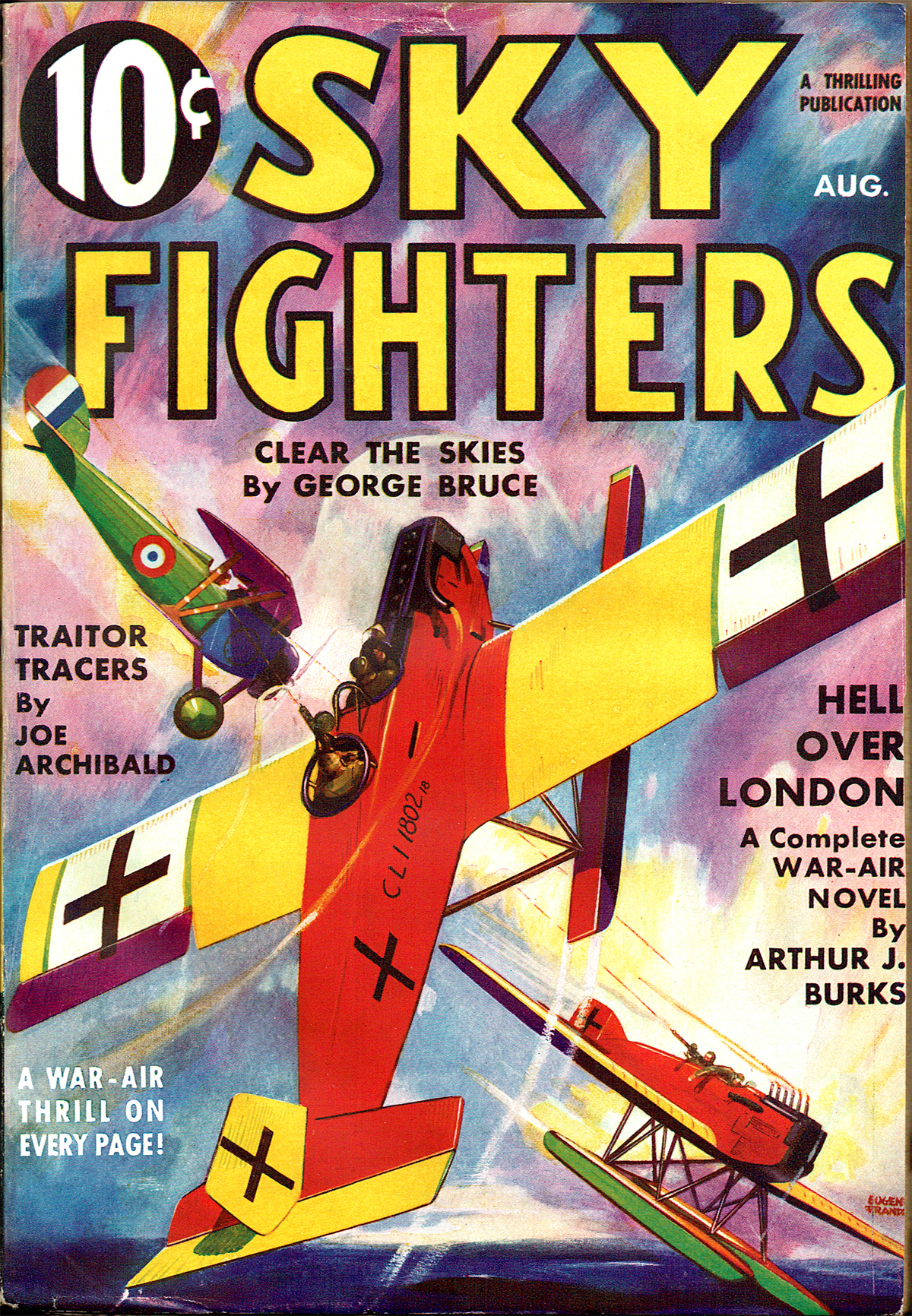
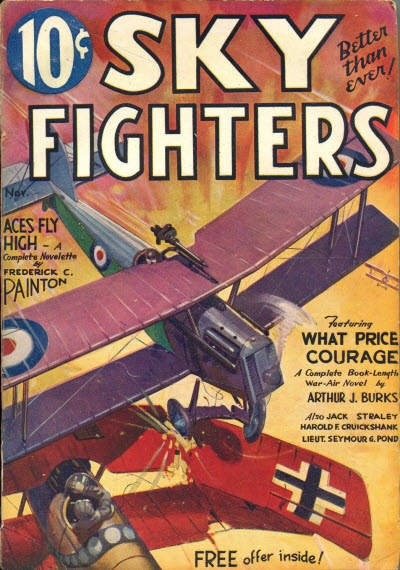 a story from the pen of a prolific pulp author and venerated newspaper man—Frederick C. Painton. In “Aces Fly High” Painton relates a tale of brothers in the same flight. The older, Blake Grenfell tasked with the duty of looking after his younger half brother, Pup. And that’s a task in itself as Pup is determined to become an Ace at the expense of all others. Good men are lost in Pup’s pursuit of becoming an Ace and things just go from bad to worse until drastic actions and sacrafice must be made to save the Grenfell’s name and social standing back home. From the November 1933 issue of Sky Fighters—it’s Frederick C. Painton’s “Aces Fly High!”

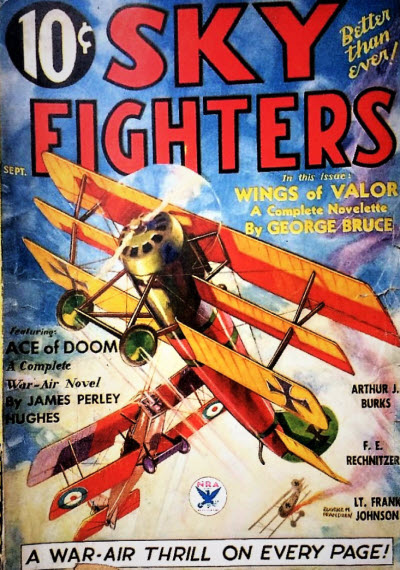 Silent Orth—ironically named for his penchant to boast, but blessed with the skills to carry out his promises—takes on four of Germany’s greatest Aces! Hauptmann Kruger, Weisskopf, Buchstabe and Braunstein. Their insignia are, in the order named, a crimson splash on the sides of the fuselage, representing blood; a hooded figure carrying an enemy’s head in his hands; the opened Book of Life with blank lines, presumably to hold the names of condemned enemies; and a comet with a tail of fire! From the pages of the September 1934 issue of Sky Fighters, it’s Silent Orth in “Shooting Star!”
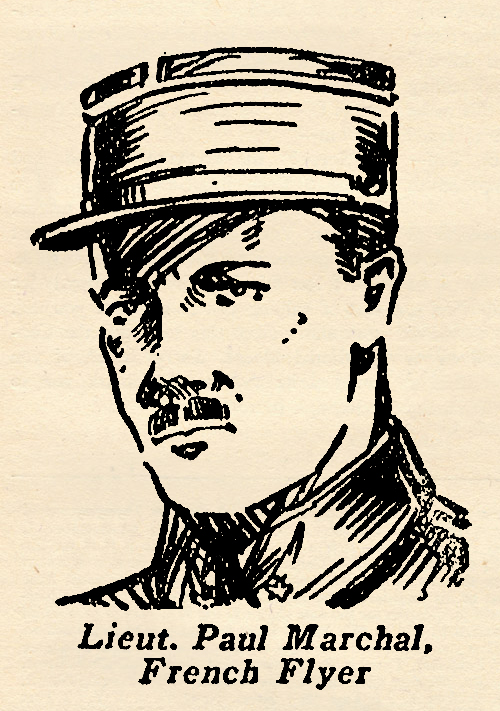 colors on the first day war was declared, and it was he that answered the challenge of that bold German, lieutenant Max Immelmann, when the latter bombed Paris with leaflets calling for surrender. Immelmann had to fly a matter of but a hundred kilometers, or less, to get over the city of Paris. But when Marchal answered his challenge with an identical flight to Berlin, he had to fly 8QO kilometers.