

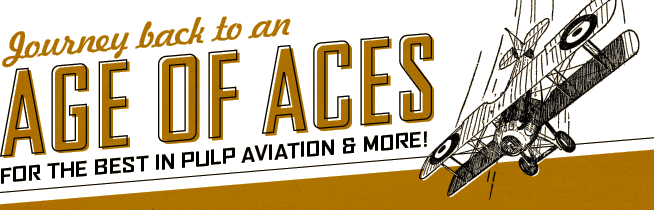

“The Lone Eagle, August 1934″ by Eugene M. Frandzen
Eugene M. Frandzen painted the covers of The Lone Eagle from its first issue in September 1933 until the June 1937 issue when Rudolph Belarski took over with the August issue of that year. At the start of the run, Frandzen painted covers of general air action much like his Sky Fighters covers. Here, for the August 1934 cover, Frandzen has a couple of S.V.A. biplanes and an Austrian Lohner flying boat!
The Story of the Cover
ITALY, a country producing no  steel or coal and an insufficient amount of foodstuffs, took a mighty walloping from Austria for over two of her three years in the Great War. But during that time, in the face of defeat after defeat, they put up a mighty sweet scrap against the Austrians.
Caught without sufficient airplanes, they tore into the job and produced some of the finest made by any country. During the war they were even supplying their allies with engines and planes.

The Adriatic does not appear to be much of a puddle when compared to other seas and oceans but it took all the ingenuity and vigilance of every available Italian flyer to patrol it.
Lurking Perils
German and Austrian submarines were lurking beneath its surface, laying in wait for cargo ships laden with iron ore and coal enroute to Italy’s foundries. Austrian airplanes roared down on seacoast cities; left a trail of ruins in their wake. Brandenburg and Lohner flying boats were continually a menace.
Gradually the speed and reliability of the Italian airplanes, seaplanes and flying boats increased. Outstanding among these were the S.V.A. types of planes. One of these, the S.V.A. biplane fitted either with pontoons or wheels, was a flying killer which the Austrians dreaded to meet.
On the cover two S.V.A. biplanes have caught an Austrian Lohner flying boat as it has finished dumping its load of bombs into a cargo ship laden with coal bound for the Italian coast.
A Devastating Bomb
One after another the bombs slipped from their racks and smashed through the steamer’s deck, down into the hold. The crew were mowed down with machine-gun fire from the Lohner’s front cockpit. Fire, the dreaded foe of all at sea, burst through the shattered deck. Dense masses of greasy opaque smoke billowed upwards. A bomb had ripped plates from the side of the ship below the water-line.
The gunner in the Lohner grins, points to the listing, stricken ship. His pilot laughs, shrugs his shoulders and looks at his gas indicator. It is low, just enough to reach home. Still smiling, he kicks his ship around to scram.
No Smile Now
The smile of victory is wiped from his lips. He yanks at his controls like a novice, nearly pitching his gunner into the briny. Bearing down on the Lohner are two S.V.A.’s tearing across the skies at a hundred and thirty-five mile clip, their 220 h.p. motors roaring. With hardly enough gas to see him home the Austrian pilot is forced to fight. To try to escape with his slower ship would be suicide.
A hail of bullets blast at the Austrian plane. Up flips the flying boat’s nose. The gunner in the bow, crouching over his gun, sends a stream of lead back at the S.V.A. The range is great but a lucky shot damages an aileron control.
The other S.V.A. coming up from below rakes the gunner and pilot of the Lohner with deadly effect. The bulky flying boat flutters, noses over and dives straight into the Adriatic, carrying a dead crew and a heavy 300 h.p. Austro-Daimler engine to use as a sinker.
The Lone Eagle, August 1934 by Eugene M. Frandzen
(The Story of The Cover Page)
 a story from the highly prolific George Bruce. Bruce, a former pilot, began writing in the 1920’s and became noted for his aerial war stories—several publications even bore his name. In the 1930’s and ’40’s he transitioned into screenwriting for Hollywood action films and then into tv in the 1950’s and ’60’s.
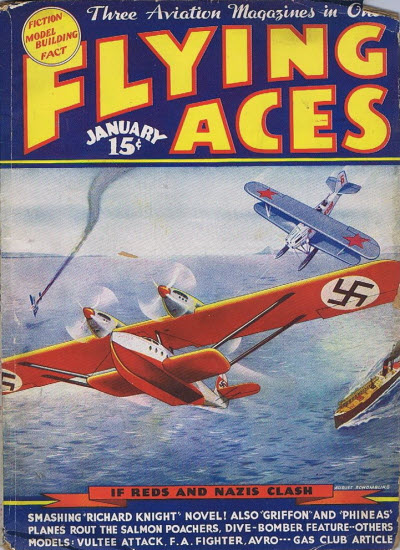 That sound can only mean one thing—it’s time to ring out the old year and ring in the new with that Bachelor of Artifice, Knight of Calamity and an alumnus of Doctor Merlin’s Camelot College for Conjurors—Phineas Pinkham.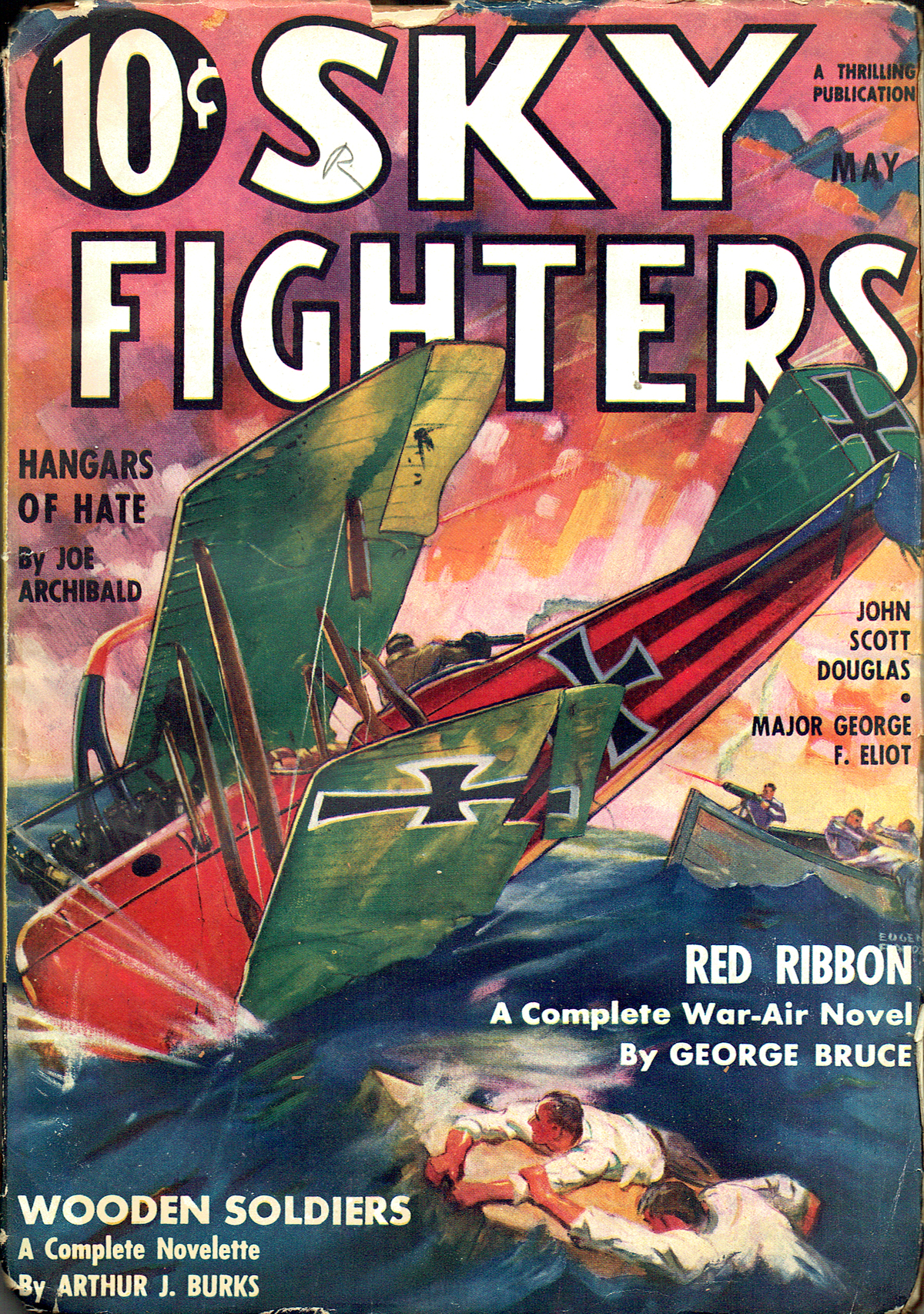
 a story from the prolific pen of Mr. Robert J. Hogan—the author of
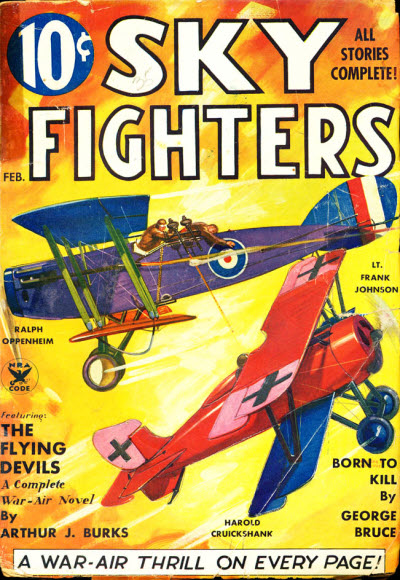 Silent Orth had made an enviable record, in the face of one of the worst beginnings—a beginning which had been so filled with boasting that his wingmates hadn’t been able to stand it. But Orth hadn’t thought of all his talk as boasting, because he had invariably made good on it. However, someone had brought home to him the fact that brave, efficient men were usually modest and really silent, and he had shut his mouth like a trap from that moment on.
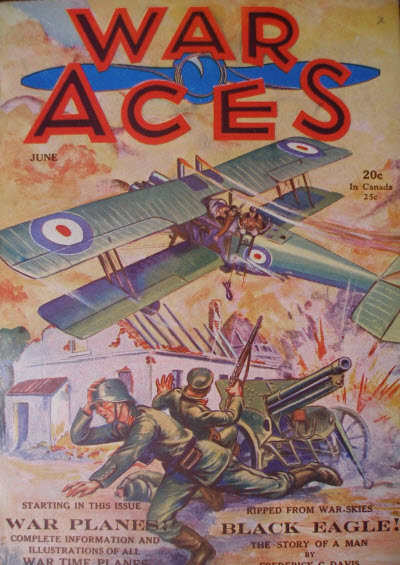 pen of the Navy’s own Allan R. Bosworth. Bosworth wrote a couple dozen stories with Humpy & Tex over the course of ten years from 1930 through 1939, mostly in the pages of War Aces and War Birds. The stories are centered around the naval air base at Ile Tudy, France. “Humpy” Campbell, a short thickset boatswain’s mate, first class who was prone to be spitting great sopping globs of tabacco juice, was a veteran seaplane pilot who would soon rate two hashmarks—his observer, Tex Malone, boatswain’s mate, second class, was a D.O.W. man fresh from the Texas Panhandle. Everybody marveled at the fact that the latter had made one of the navy’s most difficult ratings almost overnight—but the answer lay in his ability with the omnipresent rope he constantly carried.

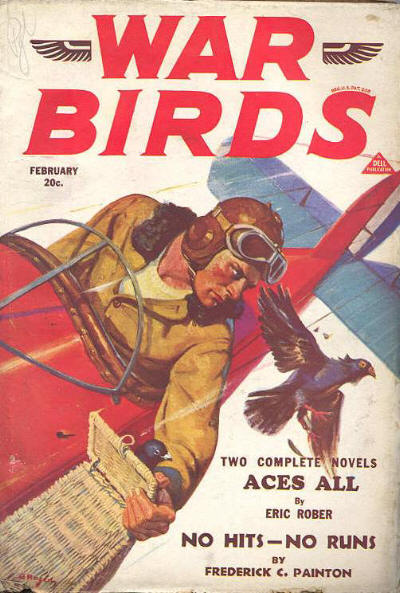 remembered as the man behind
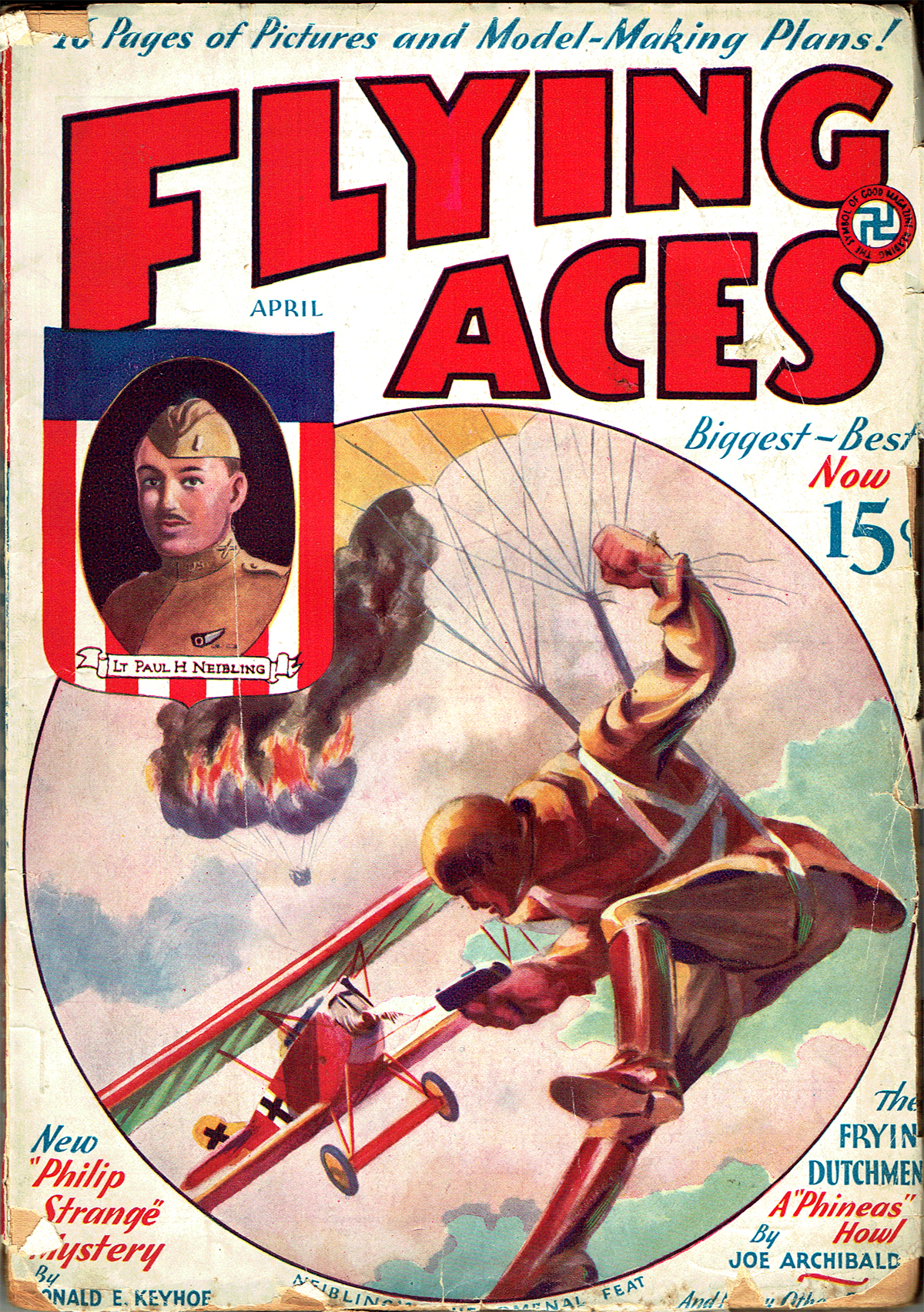
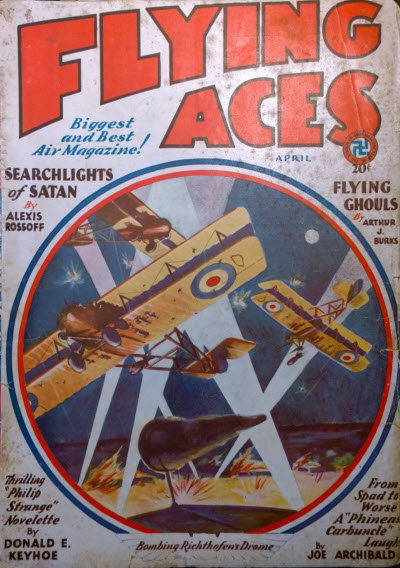
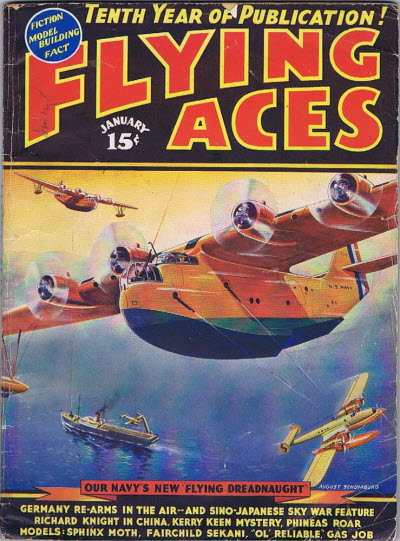 had a story in a majority of the issue of Flying Aces from his first in January 1930 until he returned to the Navy in 1942. Starting in August 1931, they were stories featuring the weird World War I stories of Philip Strange. But in November 1936, he began alternating these with sometime equally weird present day tales of espionage Ace Richard Knight—code name Agent Q. After an accident in the Great War, Knight developed the uncanny ability to see in the dark. Aided by his skirt-chasing partner Larry Doyle, Knights adventures ranged from your basic between the wars espionage to lost valley civilizations and dinosaurs.