Looking to buy? See our books on amazon.com Get Reading Now! Age of Aces Presents - free pulp PDFs

“Muffled Hissos” by Ralph Oppenheim

Link - Posted by David on October 11, 2019 @ 6:00 am in

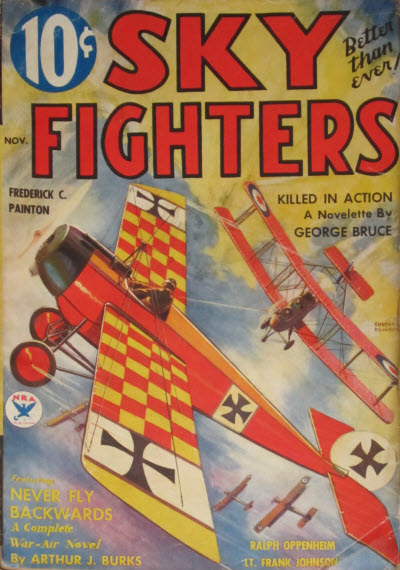
THIS week we have another great story from the pen of Ralph Oppenheim. Best known in these parts for The Three Mosquitoes, he wrote many other stories of the air and several ripping detective yarns. Here Mr. Oppenheim gives us a story of Solo Williams—a man who was used to working alone. Though he was one of the most sociable fellows in the 25th Pursuit Squadron, his official drome, his sociability vanished the moment his wings took him into the sky. In the sky he could not be hampered by formation flying or teamwork. He had to smash through in his own, individual way—a reckless, hell-bending way which no others could follow. But tonight, for the first time in his reckless career, Solo Williams had to work with a partner—a man he had never met and never would actually meet in person!

That partner was H-4, one of the very best Intelligence operatives, who was waiting on the ground, garbed as a German dispatch rider, standing by a high-speed motorcycle with a special-lensed acetylene lamp attached to it. H-4 would lead Solo Williams to a well-protected base where he would release the load of bombs he carried and hopefully wipe out von Gruening’s deadly Gotha Squadron! From the November 1934 issue of Sky Fighters it’s Ralph Oppenheim’s “Muffled Hissos!”

Lieutenant Solo Williams Flies Over the German Lines on the Most Perilous Mission of His Sky-Fighting Career!

“Famous Sky Fighters, July 1936″ by Terry Gilkison

Link - Posted by David on October 9, 2019 @ 6:00 am in

STARTING in the October 1933 issue of Sky Fighters and running almost 5 years, Terry Gilkison’s “Famous Sky Fighters” was a staple of the magazine. Each month Gilkison would illustrate in a two page spread different Aces that rose to fame during the Great War.

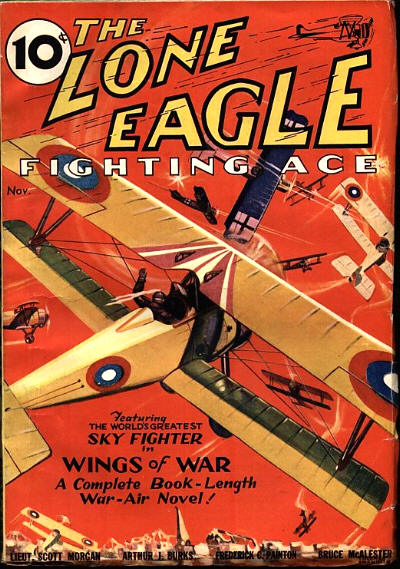
Although Gilkison was probably better known for his syndicated newspaper work, he also provided black and white story interior illustrations for pulp magazines. His work appeared in Clues, Thrilling Adventures, Texas Rangers, Thrilling Mystery, Thrilling Western, and Popular Western. Gilkison provided similar features in a few other Thrilling Publications—there was “Famous Soldiers of Fortune” and later “Adventure Thrills” in Thrilling Adventures, Famous Crimes” in Thrilling Detective, and the fully illustrated air adventure stories of Buck Barton “The Flying Devil” in The Lone Eagle! He signed most of this work with only his initials “T.G.” to maintain a low profile and preserve his reputation as a syndicated newspaper cartoon artist.

The July 1936 installment, from the pages of Sky Fighters, features Sir Charles Kingford-Smith, Captain A.W. Stevens, Captain Boris Sergievsky and the great German inventor, Graf Zeppelin!

Next time in “Famous Sky Fighters”, Terry Gilkison features Captain Frederick Libby, Lt. Joseph Wehner, Lt. Wilhelm Frankl, and Tommy Hitchcock! Don’t miss it!

“Dead Man’s Dive” by O.B. Myers

Link - Posted by David on October 4, 2019 @ 6:00 am in

THIS week, in honor of his birthday yesterday, we have a story from the pen of a prolific pulp author O.B. Myers! Myers was a pilot himself, flying with the 147th Aero Squadron and carrying two credited victories and awarded the Distinguished Service Cross.

The Boche have a balloon up at Sargelles that will interfere with the Allies big drive. It must come down, but try as they might it is heavily protected by Baron Kranich’s deadly flying circus. Both the 19th and 29th Squadrons have tried in vain to bring it down. It seems it’ll take a really great stunt to bring it down—and they just happen to have one up their sleeves. From the May 1932 issue of War Birds, it’s O.B. Myers’ “Dead Man’s Dive!”

That wind-torn streamer marked safety for two Yanks, until that trick maneuver taught Barry to distrust even the message of the white signal—when black crosses cast their sinister shadow on it.

“Sky Fighters, October 1936″ by Eugene M. Frandzen

Link - Posted by David on September 30, 2019 @ 6:00 am in

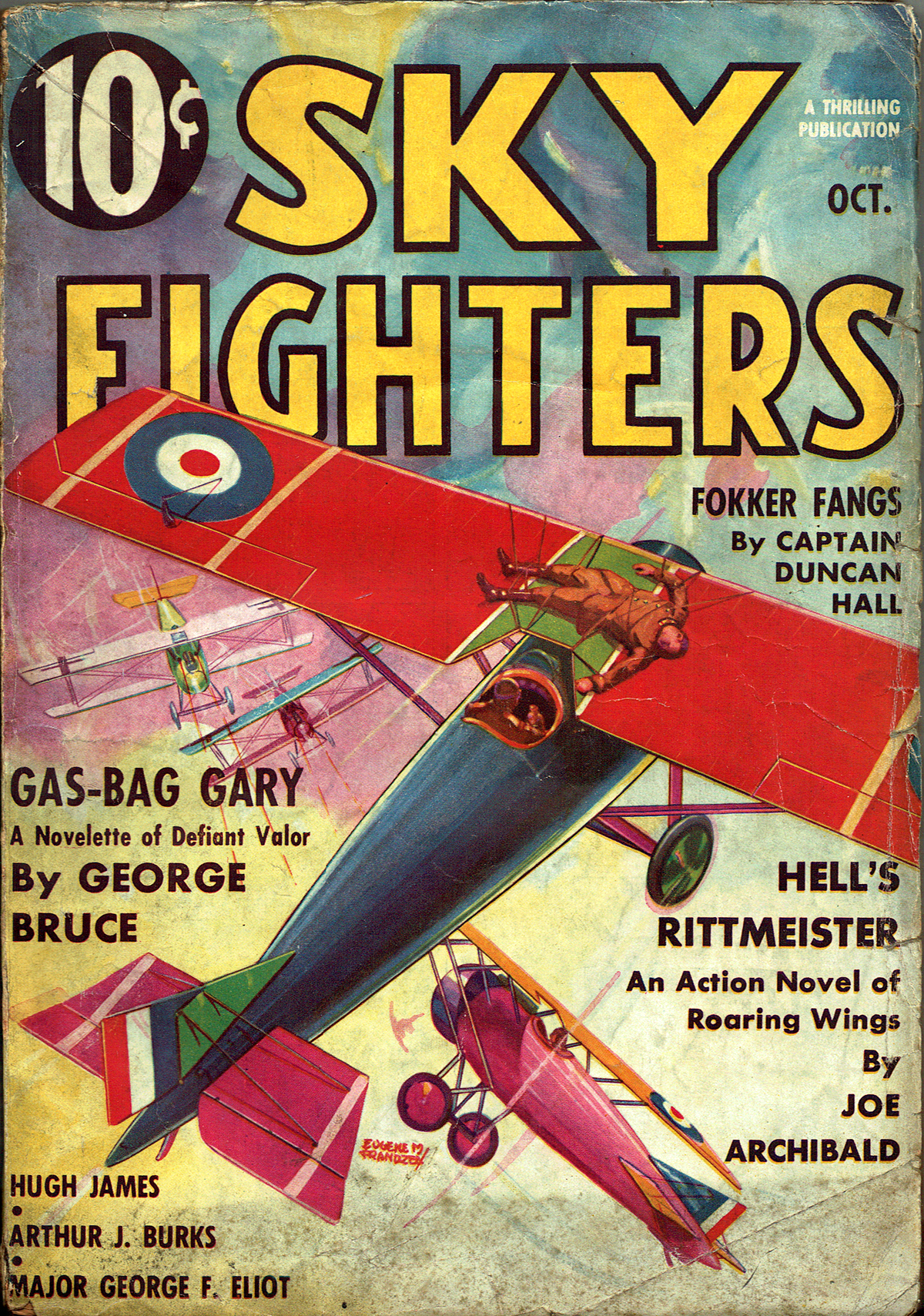
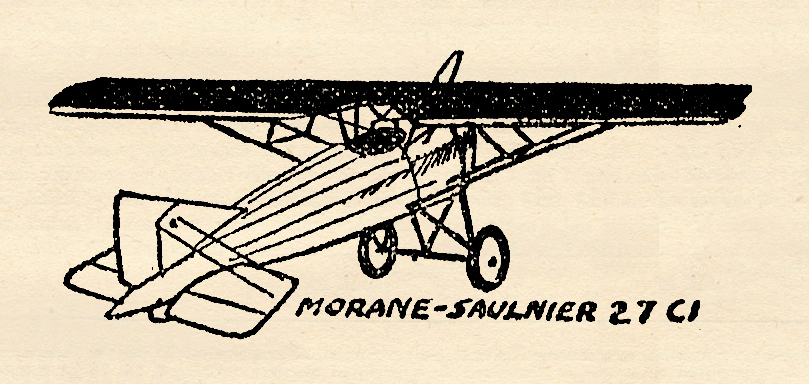
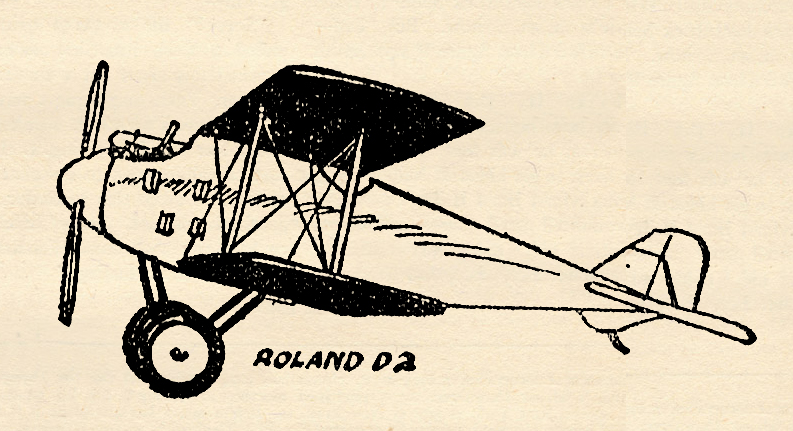
Eugene M. Frandzen painted the covers of Sky Fighters from its first issue in 1932 until he moved on from the pulps in 1939. At this point in the run, the covers were about the planes featured on the cover more than the story depicted. On the October 1936 cover, It’s the Morane-Saulnier 27C1 & Roland D2!

The Ships on the Cover

THE French developed th_SF_3610 the outstanding monoplanes of the Parasol type produced during the war. The early Morane-Saulnier Parasols were very successful and the later war models progressed with the quick advance of aviation but continued the main design features of the original Parasols. The Morane-Saulnier 27 C1 was a single-seater righting scout which carried substantial strut bracing to the wings instead of the large number of wire braces used on previous monoplane models. The rounded fuselage housed a 160 h.p. Gnome motor.

This understrut bracing of the high wing Parasol has not really been abandoned. Many of our high winged monoplanes, although not strictly Parasols, never-the-less are closely related to the old Moranes. Our Stinson, Bellanca and several others with the understrut bracing, merely have the fuselage and cabin fused in with the top wing. It was a good stunt in the old days. It’s a good stunt now. A forerunner of the Morane-Saulnier Parasol was called the Aerostable on account of its inherent stability. It had no ailerons, so it was up to the pilot to shift his weight in his seat to give lateral control.

The Roland Seemed Impractical

The German plane known as the L.F.G, Roland had an original design which was seemingly so impractical that the firm, Luft Fahrzeug Gesellschaft was safe from anyone stealing their idea. The Roland D2 was a single-seater fighter in which this design was incorporated. The fuselage under the top wing was carried up to the wing cutting off the pilot’s view in front, even though this superstructure did thin out considerably at the top and left room for two windshields, one on each side of the center ridge. Despite this drawback the D2 was a good ship and was still used in many German squadrons in 1918. The 160 h.p. Mercedes may have been partly responsible for the good qualities of the D2’s performance but even with a good power plant it was against all reason to park a solid mass in front of the pilot’s eyes. It would be just as practical to put a strip of tin six inches wide smack down the windshield of your car directly in front of the steering wheel. But just a few dozen cockeyed hunches like that thrown into the war crates gave the civil designers plenty of precedents of what not to do when the war was over.

Possibly if war comes in the future it will be a mass of planes against a like mass of enemy’s fighting planes. Aces will be a thing of the past. A few men will be outstanding in their flying but it will be hard to observe their deeds in the terrific rnixup that must occur far overhead, possibly out of sight. Publicized stunts will be few and far between, but to cut out entirely from the picture the personal element of friendship and cooperation between men of a squadron will be impossible!

Saving a Buddy

The Morane pilot on the cover knew exactly where a buddy, who had been taken prisoner from a cracked-up plane, was confined in a hospital in a small suburb. He communicated with his friend by those devious means that humans will always work out some way, despite the vigilance of the enemy’s espionage system. The man in the hospital feigned lameness longer than necessary and at a prearranged moment, while the Morane was landing at an adjacent field, he swung his crutches with vim and vigor. Down went the two unarmed attendants. In ten minutes he was securely tied to the top of the Morane’s wing and high in the air headed for home. Another Parasol joined the French plane and drove off two Roland D2s who had sighted the overburdened Morane and considered it easy pickings.

The personal touch was in that quickly executed rescue. War will always have those daring exploits. Friendships formed under fire are lasting and strong.

The Ships on The Cover
Sky Fighters, October 1936 by Eugene M. Frandzen
(The Ships on The Cover Page)

“Famous Sky Fighters, June 1936″ by Terry Gilkison

Link - Posted by David on September 11, 2019 @ 6:00 am in

STARTING in the October 1933 issue of Sky Fighters and running almost 5 years, Terry Gilkison’s “Famous Sky Fighters” was a staple of the magazine. Each month Gilkison would illustrate in a two page spread different Aces that rose to fame during the Great War.

Although Gilkison was probably better known for his syndicated newspaper work, he also provided black and white story interior illustrations for pulp magazines. His work appeared in Clues, Thrilling Adventures, Texas Rangers, Thrilling Mystery, Thrilling Western, and Popular Western. Gilkison provided similar features in a few other Thrilling Publications—there was “Famous Soldiers of Fortune” and later “Adventure Thrills” in Thrilling Adventures, Famous Crimes” in Thrilling Detective, and the fully illustrated air adventure stories of Buck Barton “The Flying Devil” in The Lone Eagle! He signed most of this work with only his initials “T.G.” to maintain a low profile and preserve his reputation as a syndicated newspaper cartoon artist.

The June 1936 installment, from the pages of Sky Fighters, features Canadian Col. William Bishop, Colonel Frank P. Lahm, and observation Ace William Erwin!

Next time in “Famous Sky Fighters”, Terry Gilkison features Sir Charles Kingford-Smith, Captain A.W. Stevens, Captain Boris Sergievsky and the great German inventor, Graf Zeppelin! Don’t miss it!

“Sky Guilt” by Frederick C. Painton

Link - Posted by David on September 6, 2019 @ 6:00 am in

THIS week we have a story from the pen of a prolific pulp author and venerated newspaper man—Frederick C. Painton. Mike O’Connor returns from a four day stint of detached service with the Second Corps to find his kid brother in the brig facing a court martial for murdering a fellow pilot in a bar brawl. Mike draws on his pre-war experience as a detective to find the true culprit and takes to the sky to sweat out a confession from the guilty party! From the pages of the November 1933 The Lone Eagle, it’s Frederick C. Painton’s “Sky Guilt!”

A Gripping Story of Exciting Peril in the Air and a Pilot’s Grim Determination!

As he has in previous stories we’ve posted, Painton has once again named the squadron’s operations officer Willie the Ink—Painton uses a similarly named character—Willie the Web—as operations officer in his Squadron of the Dead tales.

“When Bishop Fought Richthofen” by Paul J. Bissell

Link - Posted by David on September 2, 2019 @ 6:00 am in

CONTINUING with the Richthofen themed covers, this week we present “When Bishop Fought Richthofen”—The story behind the cover of Paul Bissell’s June 1932 cover for Flying Aces! Bissell is mainly known for doing the covers of Flying Aces from 1931 through 1934 when C.B. Mayshark took over duties. For the June 1932 cover Bissell put us right in the action as the planes of Bishop and Richthofen square off!

When Bishop Fought Richthofen
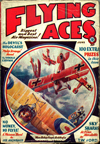
th_FA_3206THE early spring of ‘17 saw Richthofen, the Red Knight of Germany, with almost two-score victories to his credit. For months now, hunter that he was, he had carefully searched the skies for his victims, and steadily built up a record that had already made him leading ace of the German Air Force and air idol of the German public. He had seen several months of duty as an observer at the Front, but it was under the guidance of the famous Boelcke that he started his career as a fighting pilot.

Now at last he was able to satisfy the impulse of the hunter which had always been a part of him. A deadly shot, and an expert flyer, he would climb into the clouds and there stalk his prey as carefully as he did the wild game on his own estate, waiting patiently his opportunity to dive headlong at some unsuspecting “bit of cold meat.”

This same spring there landed in a British airdrome on the Western Front a young pilot fresh from the training fields of England. He, too, had already done some four months of duty at the Front as an observer, but without getting the opportunity even to fire a shot. This lad of twenty-three was Lieutenant William Bishop, R.F.C., without a fight to his record, though he was destined in the next few months to pack in more air scraps than any other pilot in a similar length of time. He was, in these same few months, to became the dread of the Germans, the ranking ace of the R.F.C.—to barely escape death time after time, and rise to the rank of major.

He had been at the Front scarcely two weeks when he got his first German, while another two weeks saw him the proud possessor of a bright blue propeller hub-cap, presented to him by his mechanics upon his becoming an ace.

April the thirtieth was a red-letter day for both Bishop and Richthofen, though other days showed larger scores against the enemy for each of them. On this day, Bishop, in one hour and forty-five minutes, before lunch, had the distinction of engaging, single-handed, in nine separate aerial combats, bringing down a two-seater to add to his score, while Richthofen, before his noonday meal, by shooting down two of the enemy, had raised his score to fifty-two planes.

Seated as they were in their respective messes, it is questionable if either Bishop or Richthofen gave a thought one to the other, in fact, it is almost certain that Richthofen had never even heard the name of Bishop. However, fate that afternoon was to bring these two against each other.

It was about two in the afternoon, when Bishop, accompanied by his major, who was flying in another Nieuport, took off from his airport. For almost half an hour they flew steadily eastward without seeing any signs of the enemy; then, noticing some archie fire off to the left, they turned to investigate. Off some distance and below them they saw a German reconnaissance plane, and started the attack, when suddenly, darting in from their right, came four scarlet-nosed Albatross scouts.

SWINGING to avoid the first dive of the enemy, the two Britishers turned back into the battle. The major, with guns blazing, bore down upon the leader of the Germans, who, reversing quickly, avoided the direct fire of the major, and in turn attacked Bishop. It was then that Bishop realized that this plane was solid red, crimson from nose to tail save only for the black crosses standing out strongly in contrast on the wings. It was Richthofen, diving at him, trying to get him full in line with those deadly guns which had meant death to so many Englishmen. Well Bishop knew that only a split second now separated him from death.

Automatically he threw his stick over, and the plane banked up just in time, as Richthofen’s tracers went wild. Then began the tail-chasing. Around and around they swung, striving desperately to gain that deadly position behind the other’s flippers. Moments came when one or the other, by some quick maneuver, would, for the fraction of a second, find his target in line with his sights.

A burst of flames as the guns spat, but to no avail, and the chase began again.

The major had drifted off to the left, scrapping it out with one of the other Germans. This left two others, beside Richthofen, in this mad fight with Bishop. They, too, fought for a position from which they might fire upon the Britisher without endangering their own comrade and leader.

The circles were now getting tighter and tighter. The pace was terrific, and the other planes, unable to help their comrade, and fearing collision, had withdrawn to the side. Alone, the two masters of the air fought on. Each, finding himself unable to obtain the desired dead spot, was now firing with more abandon, hoping that one stray bullet might find its mark and bring this whirling dance of death to an end. For those two, time had ceased. The world was just themselves, rushing through endless space, madly circling, instinctively using every maneuver, every bit of skill at their command, to gain the desired opening.

They flew now as part of their own machines, and their guns, as part of themselves, spoke, when, for even the barest fraction of a second, their target flashed by.

Suddenly Bishop realized that he was near the end of his ammunition. He could not be sure that his opponent faced the same situation, and decided that he must conserve the few bullets that he had left. His feeling of desperation turned almost to despair, when, at this instant, he discovered three planes diving steeply at him.

Back he pulled on his stick, climbing sharply out of the mad circle, expecting every instant to feel the German bullets begin to spatter his plane, but knowing that he must take this hazard to get away from the new attack.

However, to his surprise, the planes dived past him, and down after the Red Knight, who had headed toward his two companions and Germany. Then Bishop discovered to his relief that the three planes were not Germans, as he had thought, but were three British naval planes which had come up opportunely at this moment.

The fight was over. One of the great air battles of the war was a thing of the past. The sportsman and the hunter had fought to a draw and retired with honor, each to fight many times again for his country, but never again against each other. For yet another year Richthofen continued his victories until he fell with an enemy bullet through his heart, to be buried with full military honors by his admiring foes.

Bishop fought steadily for six more months until, with forty-nine victories, he returned to his homeland, to receive every honor that a grateful king and country could bestow. He survived the war and is today the only living man with a V.C., D.S.O. twice awarded, and M.C.

The Ships on The Cover
“When Bishop Fought Richthofen”
Flying Aces, June 1932 by Paul Bissell

“Smoke Scream” by Joe Archibald

Link - Posted by David on August 30, 2019 @ 6:00 am in

“HAW-W-W-W-W!” That sound can only mean one thing—that Bachelor of Artifice, Knight of Calamity and an alumnus of Doctor Merlin’s Camelot College for Conjurors is back to vex not only the Germans, but the Americans—the Ninth Pursuit Squadron in particular—as well. Yes it’s the marvel from Boonetown, Iowa himself—Lieutenant Phineas Pinkham!

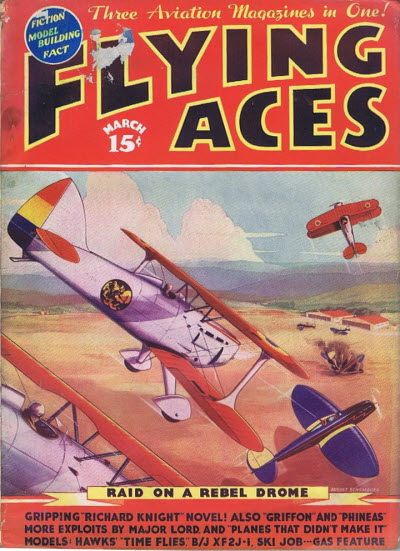
It’s a simple formula. Take one Brigadier who’s lost important plans for the big push add to it the crafty Baron von Spieler. Multiply it by an elephant hopped up on arnica on a rampage. Throw in a hindu mystic and take all of it to the Phineas Pinkham power and you get “Smoke Scream,” Joe Archibald’s latest side-splitting Phineas laugh riot from the pages of the March 1937 Flying Aces!

Lost battle plans! That’s what worried the Brass Hats. But Lieutenant Pinkham, Boonetown’s gift to the 9th Pursuit, went out for bigger things—to be specific, something a couple of tons bigger which answered to the monicker of Hungha Tin. All of which led to a riddle which was still bigger, to wit: Which came first, the bruises or the arnica?

“Famous Sky Fighters, May 1936″ by Terry Gilkison

Link - Posted by David on August 28, 2019 @ 6:00 am in

STARTING in the October 1933 issue of Sky Fighters and running almost 5 years, Terry Gilkison’s “Famous Sky Fighters” was a staple of the magazine. Each month Gilkison would illustrate in a two page spread different Aces that rose to fame during the Great War.

Although Gilkison was probably better known for his syndicated newspaper work, he also provided black and white story interior illustrations for pulp magazines. His work appeared in Clues, Thrilling Adventures, Texas Rangers, Thrilling Mystery, Thrilling Western, and Popular Western. Gilkison provided similar features in a few other Thrilling Publications—there was “Famous Soldiers of Fortune” and later “Adventure Thrills” in Thrilling Adventures, Famous Crimes” in Thrilling Detective, and the fully illustrated air adventure stories of Buck Barton “The Flying Devil” in The Lone Eagle! He signed most of this work with only his initials “T.G.” to maintain a low profile and preserve his reputation as a syndicated newspaper cartoon artist.

The May 1936 installment, from the pages of Sky Fighters, features Captain Francis Quigley, Major Baron von Schleich, and Lt. John A. MacReady among others!

Next time in “Famous Sky Fighters”, Terry Gilkison features Canadian Col. William Bishop, Colonel Frank P. Lahm, and observation Ace William Erwin! Don’t miss it!

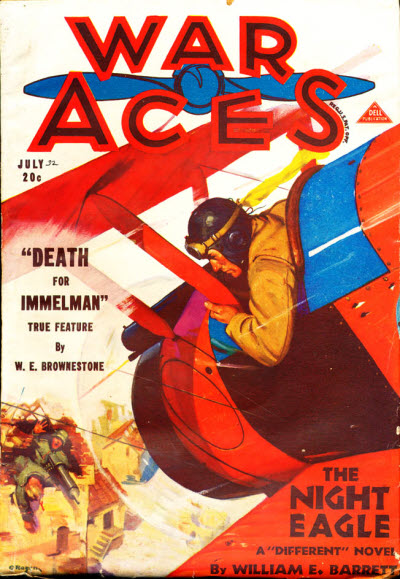
“High Boomerang” by Arthur J. Burks

Link - Posted by David on August 23, 2019 @ 6:00 am in

THIS week we have a story by prolific pulpster—Arthur J. Burks! Burks was a Marine during WWI and went on to become a prolific writer for the pulps in the 20’s and 30’s. He was a frequent contributor to War Aces.

Meet Hank Flynn, second lieutenant in the air service, was six feet two in his stocking feet and could whip any German that flew. His friends had told him so, and he modestly admitted when pressed, or even when not pressed, that they probably underestimated his abilities. He wasn’t a braggart, a bluff or an ass; he was just too young for his job and too full of the spirits of life. To others the war might be an excuse to discuss deep questions of psychology; to Hank it was a grand chance to have a hell of a good time and be decorated for it.

He had flaming red hair and a hawk nose smothered in freckles, and a grin that reached from here to there. But when, out of a clear sky, he was ordered to join that peculiar outfit in the woods across the lines from Masmunster known as “The Boomerangs,” something whispered to him that maybe there mightn’t be so much to smile about after he reported. From the pages of the July 1932 War Aces, it’s Arthur J. Burks’ “High Boomerang!”

Hank Flynn thought that a bag of ten gave him the right to give the skipper a few points, but he didn’t know that the best boomerangs always fly in a curve!

“Bombing Richthofen’s Drome” by Paul J. Bissell

Link - Posted by David on August 19, 2019 @ 6:00 am in

THIS week we present “Bombing Richthofen’s Drome”—The story behind the cover of Paul Bissell’s April 1932 cover for Flying Aces! Bissell is mainly known for doing the covers of Flying Aces from 1931 through 1934 when C.B. Mayshark took over duties. For the April 1932 cover Bissell put us right in the action as the planes of Squadron 100 circle over Richthofen’s drome, bombs exploding down below!

Bombing Richthofen’s Drome

th_FA_3204IT IS April of ‘17. Above, a full moon shines from an almost cloudless sky. Below, the landscape spreads away to the east—dark, except where a faint glimmer traces the twisting course of a river. To the west, against the horizon, continuous flashes show the progress of the battle of Arras, raging in its full fury.

There men lie in trenches, waiting in mud and slime for the signal which, at dawn, will send them from their meagre protection into that hail of bullets sweeping across No-Man’s-Land. Here, high in the air, all seems peaceful. Only the droning of many motors tells that death is on the wing. Death in the form of a dozen or more planes, each bearing the blue, white and red circles of the British Air Service on its wings; each carrying its little bunch of “bouquets” slung carefully in their racks underneath—”bouquets” to be presented to Richthofen’s Jagdstaffel II at its home airdrome at Izel le Hameau.

Suddenly the squadron leader, sensing rather than actually seeing what he knows to be his objective, cuts his motor and, tipping up one wing, descends in a wide, easy spiral so that he may more carefully check against his map the few faintly visible landmarks below. The other pilots, too, have cut their motors, hoping that there is a chance of getting down a bit before their singing wires will give them away. They do not know that already word of their approach has been given, that the searchlights and defenses are already manned by tense and eager foes waiting for that signal which will turn the quiet night into an inferno.

ONE thousand—two thousand—three thousand feet the leader drops, spiraling slowly. His companions, maintaining a much flatter glide, circle about the airdrome, holding their elevation until the leader can find his objective and drop his phosphorus bombs to light up their target.

Now, when he is scarcely a thousand feet up, a siren screams from the ground; a brilliant beam of light stabs the night—another, then still others, all sweeping the sky searchingly until one, finding its prey, stops suddenly, and the others quickly focus with it on the old British F.E. 2B. Instantly the sharp bark of archies shatters the stillness. On the ground, men dash from barracks and hangars. Hoarse orders are sharply given, and though the range is still too great, machine guns are already rattling nervously.

On, with never a waver, comes the old British crate—slowly gliding in, as surely and quietly as if she were coming down to land in her own airdrome. Down, down—five hundred feet. Now she is directly over the airdrome. The observer can be seen clearly in the white, merciless gleam of the searchlights, peering over the side—awaiting his moment.

They level off, one hundred and fifty feet up, and from the under wing of the plane comes a dark rush earthward. Men dive for shelter, and an instant later all hell breaks loose. The whole field is lighted up with the flaming brilliance of the burning bomb. Two hangars are ablaze. Shrapnel and flaming onions scream through the night. Other bombs crash, and the machine-gun fire is incessant.

NOW the other planes can be seen, diving straight in, or swinging in a wide circle to take their places in the parade of terror and death. One after another they come through the terrific barrage, and with deadly aim drop their bombs into the German quarters. One terrific explosion follows another. Hoarse screams echo as some poor devil is blown to bits.

Above, the motors are roaring full on, as the planes circle again and again to drop the last of their deadly missiles.

After all, it is only a matter of minutes. Destruction has come and passed, leaving in its wake burning hangars, dead and maimed bodies, and huge gaping holes in the formerly smooth carpet of the airdrome.

Already the hum of the motors can scarce be heard, as the squadron wings its way back home. Back over the front line, through another baptism of shell-fire, and then to their own field. Dawn is just graying the east as the last plane glides in safely. Not a machine but is torn by shrapnel. Wings are riddled with bullet holes. But Squadron 100, of the R.F.C., has bombed Richthofen and come back without the loss of a ship or a man!

The Ships on The Cover
“Bombing Richthofen’s Drome”
Flying Aces, April 1932 by Paul Bissell

“The Avalanche” by Lt. Frank Johnson

Link - Posted by David on August 16, 2019 @ 6:00 am in

ORTH is back! Silent Orth had made an enviable record, in the face of one of the worst beginnings—a beginning which had been so filled with boasting that his wingmates hadn’t been able to stand it. But Orth hadn’t thought of all his talk as boasting, because he had invariably made good on it. However, someone had brought home to him the fact that brave, efficient men were usually modest and really silent, and he had shut his mouth like a trap from that moment on.

Orth’s new headache—Herman Manke, who has recently moved to the German outfit just across the front lines. He’s already knocked out four British flyers with his Fokker that’s rigged so that it will dive twice as far as a Fokker is calculated to dive, getting up terrific speed and doesn’t try to avoid anyone under him—that’s up to them! He’s as deadly with his Spandaus as a spitting cobra and never seems to miss! From the pages of the May 1935 Sky Fighters, Silent Orth faces “The Avalanche!”

Herman Manke, German Flyer, Was Hell on Wheels—and It Was Up to Orth to Knock the Wheels Out from Under Him!

“Famous Sky Fighters, April 1936″ by Terry Gilkison

Link - Posted by David on August 14, 2019 @ 6:00 am in

STARTING in the October 1933 issue of Sky Fighters and running almost 5 years, Terry Gilkison’s “Famous Sky Fighters” was a staple of the magazine. Each month Gilkison would illustrate in a two page spread different Aces that rose to fame during the Great War.

Although Gilkison was probably better known for his syndicated newspaper work, he also provided black and white story interior illustrations for pulp magazines. His work appeared in Clues, Thrilling Adventures, Texas Rangers, Thrilling Mystery, Thrilling Western, and Popular Western. Gilkison provided similar features in a few other Thrilling Publications—there was “Famous Soldiers of Fortune” and later “Adventure Thrills” in Thrilling Adventures, Famous Crimes” in Thrilling Detective, and the fully illustrated air adventure stories of Buck Barton “The Flying Devil” in The Lone Eagle! He signed most of this work with only his initials “T.G.” to maintain a low profile and preserve his reputation as a syndicated newspaper cartoon artist.

The April 1936 installment, from the pages of Sky Fighters, features Commandant Marquis de Turenne, Lt. Karl Schafer, Lt. Silvio Scaroni and Lt. R.A.J. Warneford who brought down the first zeppelin!

Next time in “Famous Sky Fighters”, Terry Gilkison features Captain Francis Quigley, Major Baron von Schleich, and Lt. John A. MacReady among others! Don’t miss it!

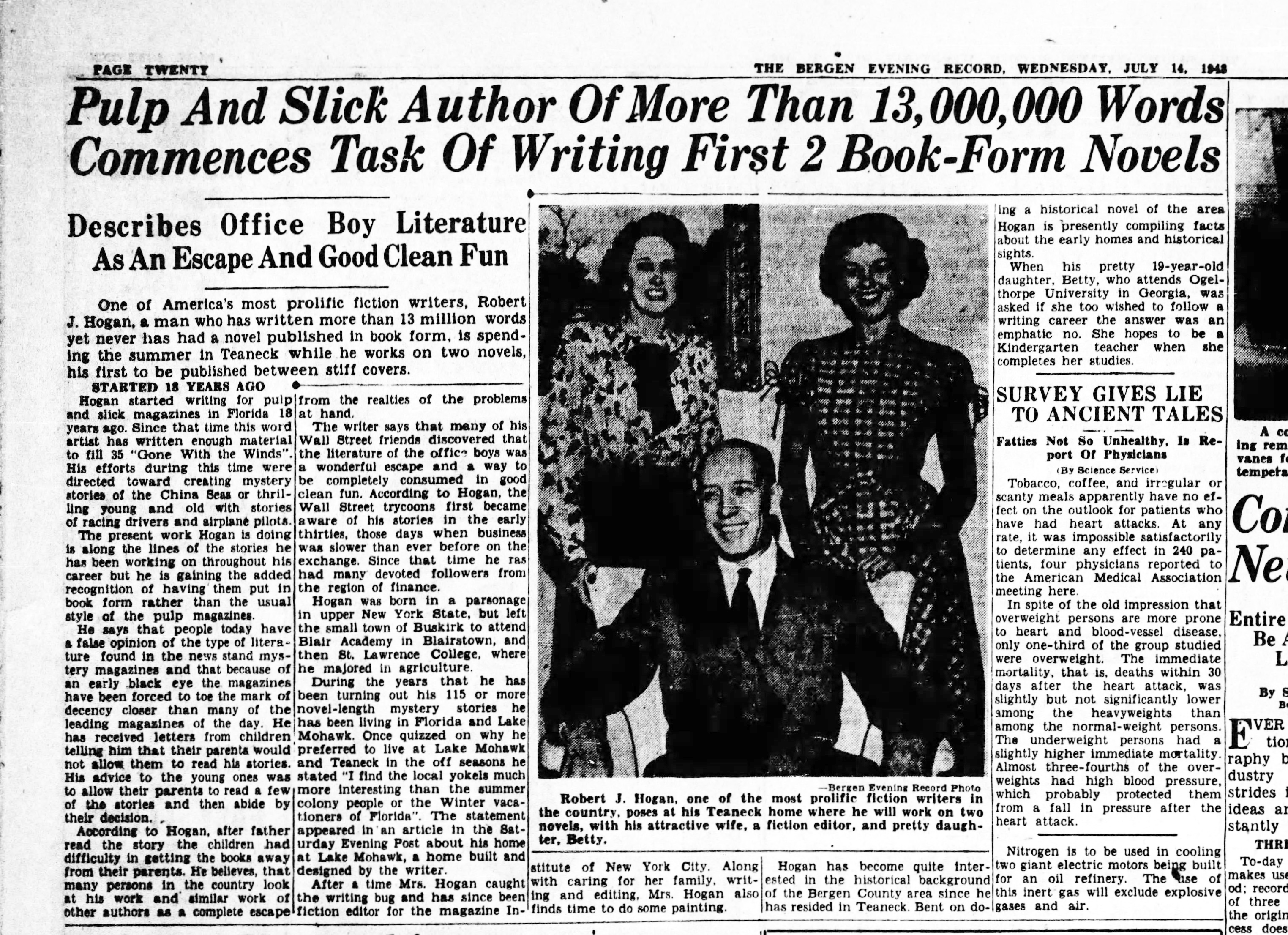
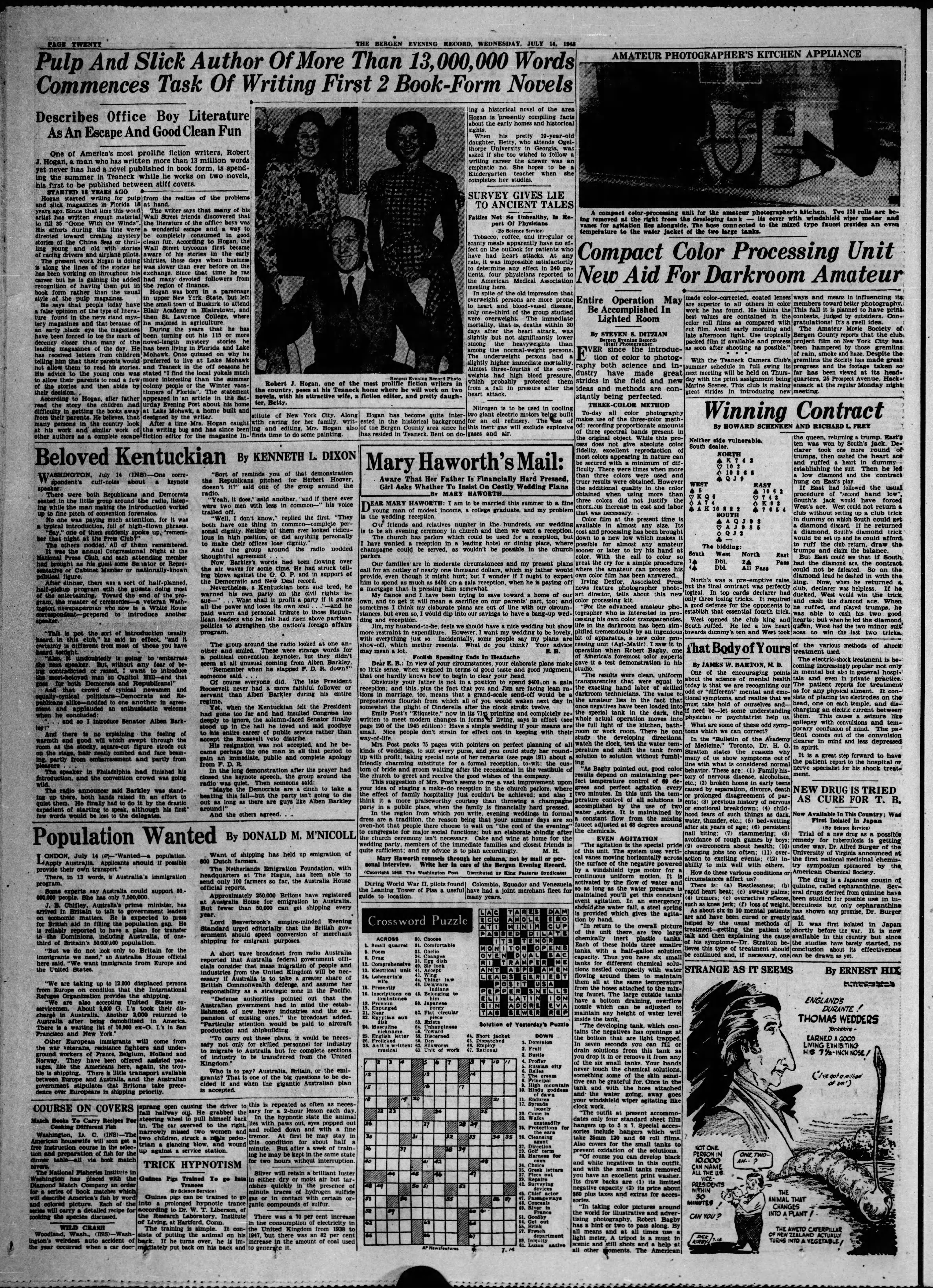
At Home with Robert J. Hogan, 1948

Link - Posted by David on August 9, 2019 @ 6:00 am in

Five years ago we posted a great article about Robert J. Hogan at home from 1962. We’ve come upon another great article about Hogan as he sets out on his book writing career in 1948. He wrote a number of hard cover westerns for Dodd, Mead & Company, three of them historical westerns featuring a cowboy named Smoke Wade who rides a pinto horse name Jake!

Here’s the article from The Bergen Evening Record, July 14, 1948:

Pulp and Slick Author of More Than 13,000,000 Words Commences Task of Writing First 2 Book-Form Novels

The Bergen Evening Record, Bergen, New Jersey • 14 July 1948, P.20

Describes Office Boy Literature As An Escape And Good Clean Fun

One of Americas most prolific fiction writers, Robert J. Hogan, a man who has written more than 13 million words yet never has had a novel published in book form, is spend-ing the summer in Tea neck while he works on two novels, his first to be published between stiff covers.

STARTED 18 YEAR8 AGO

Hogan started writing for pulp and slick magazines in Florida 18 years ago. 8ince that time this word artist has written enough material to fill 35 “Gone With the Winds”. His efforts during this time were directed toward creating mystery stories of the China Seas or thrilling young and old with stories of racing drivers and airplane pilots.

The present work Hogan is doing is along the lines of the stories he has been working on throughout his career but he is gaining the added recognition of having them put in book form rather than the usual style of the pulp magazines.

He says that people today have a false opinion of the type of literature found in the news stand mystery magazines and that because of an early black eye the magazines have been forced to toe the mark of decency closer than many of the leading magazines of the day. He has received letters from children telling him that their parents would not allow them to read his stories. His advice to the young ones was to allow their parents to read a few of the stories and then abide by their decision.

According to Hogan, after father read the story the children had difficulty in getting the books away from their parents. He believes, that many persons in the country look at his work and similar work of other authors as a complete escape from the realties of the problems at hand.

The writer says that many of his Wall Street friends discovered that the literature of the office boys was a wonderful escape and a way to be completely consumed in good clean fun. According to Hogan, the Wall Street trycoons first became aware of his stories in the early thirties, those days when business was slower than ever before on the exchange. Since that time he has had many devoted followers from the region of finance.


Robert J. Hogan, one of the most prolific fiction writers In the country, poses at his Teaneck home where he will work on two novels, with his attractive wife, a fiction editor, and pretty daughter, Betty. (Bergen Evening Record Photo)

Hogan was born in a parsonage in upper New York State, but left the small town of Buskirk to attend Blair Academy in Blairstown, and then 8t. Lawrence College, where he majored in agriculture.

During the years that he has been turning out his 115 or more novel-length mystery stories he has been living in Florida and Lake Mohawk. Once quizzed on why he preferred to live at Lake Mohawk and Teaneck in the off seasons he stated “I find the local yokels much more interesting than the summer colony people or the Winter vacationers of Florida”. The statement appeared in an article in the Saturday Evening Post about his home at Lake Mohawk, a home built and designed by the writer.

After a time Mrs. Hogan caught the writing bug and has since been fiction editor for the magazine Institute of New York City. Along with caring for her family, writing and editing, Mrs. Hogan also finds time to do some painting.

Hogan has become quite interested in the historical background of the Bergen County area since he has resided in Teaneck. Bent on doing a historical novel of the area Hogan is presently compiling facts about the early homes and historical sights.

When his pretty 19-year-old daughter, Betty, who attends Ogelthorpe University in Georgia, was asked if she too wished to follow a writing career the answer was an emphatic no. She hopes to be a Kindergarten teacher when she completes her studies.

Premiering at PulpFest 2019!

Link - Posted by David on August 5, 2019 @ 6:00 am in

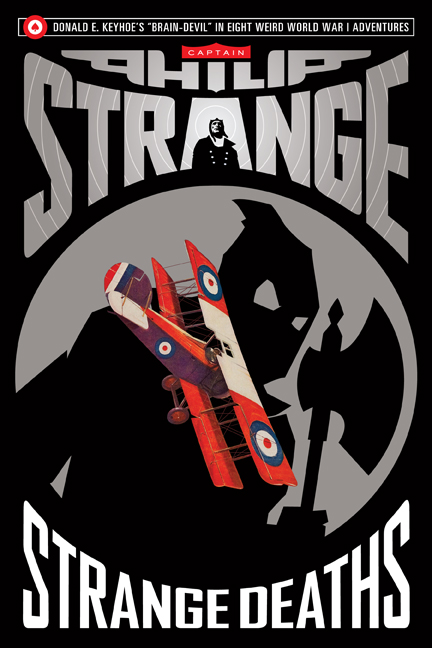
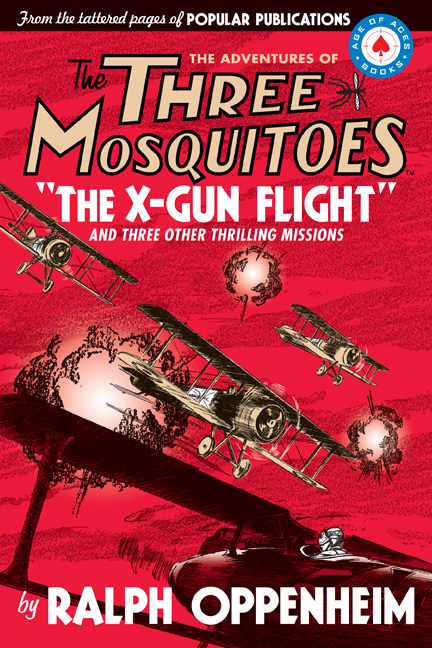
AGE OF ACES will be back at PulpFest again this year where we will be debuting our two new titles!

Our first is the penultimate volume in our Captain Philip Strange series—back this time with eight more weird WWI stories spanning the run of the series in Strange Deaths! A mental marvel from birth, who used his talents on stage as a boy, Philip Strange is now known as “The Phantom Ace of G-2″ by the Allies during WWI and the verdamnt Brain-Devil by the Boche. Just when you thought there were no more ways to die in war, the Germans come up with some even more gruesome ways! if you’re not just being incinerated by the sun’s ray focused through enormous lenses, you’re being gassed with a horribly disfiguring plague; drowned in a sea of blood or injected with a serum that turns you into a hyped up fighting hellion until you keel over dead; maybe you’ll be lucky and just have your own munitions blow up your entire outfit, or simply have your head chopped off and mounted on some psychotic ace’s wings. Thankfully, we have have Captain Philip Strange on our side to stop them in eight of his strangest cases yet from the pages of Flying Aces magazine!

The inseparable trio is back!, Through the dark night sky, streaking swiftly with their Hisso engines thundering, is the greatest trio of aces on the Western Front—the famous and inseparable “Three Mosquitoes,” the mightiest flying combination that had ever blazed its way through overwhelming odds and laughed to tell of it! At point was Captain Kirby, impetuous young leader of the great trio; on his right was little Lieutenant “Shorty” Carn, the mild-eyed, corpulent little Mosquito and lanky Lieutenant Travis, eldest and wisest of the Mosquitoes on his left! Flying in a V formation through four exciting hell-bent tales from the pages of Popular Publication’s Battle Aces—”The X-Gun Flight” (Jan 32), “The Iron Ace” (Feb 32), “The Flying Dreadnought” (Jun 32), “The 20-Ace Patrol” (Jul 32)—all illustrated by John Fleming Gould!

In addition to these two volumes we’ll have all of our other titles that are still in print as well as our convention exclusive—Arch Whitehouse’s Coffin Kirk. So if you’re planning on coming to Pittsburgh for PulpFest this year, stop by our table and say hi and pick up our latest releases! We hope we see you there!

« Previous PageNext Page »