Looking to buy? See our books on amazon.com Get Reading Now! Age of Aces Presents - free pulp PDFs

“Famous Sky Fighters, May 1936″ by Terry Gilkison

Link - Posted by David on August 28, 2019 @ 6:00 am in

STARTING in the October 1933 issue of Sky Fighters and running almost 5 years, Terry Gilkison’s “Famous Sky Fighters” was a staple of the magazine. Each month Gilkison would illustrate in a two page spread different Aces that rose to fame during the Great War.

Although Gilkison was probably better known for his syndicated newspaper work, he also provided black and white story interior illustrations for pulp magazines. His work appeared in Clues, Thrilling Adventures, Texas Rangers, Thrilling Mystery, Thrilling Western, and Popular Western. Gilkison provided similar features in a few other Thrilling Publications—there was “Famous Soldiers of Fortune” and later “Adventure Thrills” in Thrilling Adventures, Famous Crimes” in Thrilling Detective, and the fully illustrated air adventure stories of Buck Barton “The Flying Devil” in The Lone Eagle! He signed most of this work with only his initials “T.G.” to maintain a low profile and preserve his reputation as a syndicated newspaper cartoon artist.

The May 1936 installment, from the pages of Sky Fighters, features Captain Francis Quigley, Major Baron von Schleich, and Lt. John A. MacReady among others!

Next time in “Famous Sky Fighters”, Terry Gilkison features Canadian Col. William Bishop, Colonel Frank P. Lahm, and observation Ace William Erwin! Don’t miss it!

“High Boomerang” by Arthur J. Burks

Link - Posted by David on August 23, 2019 @ 6:00 am in

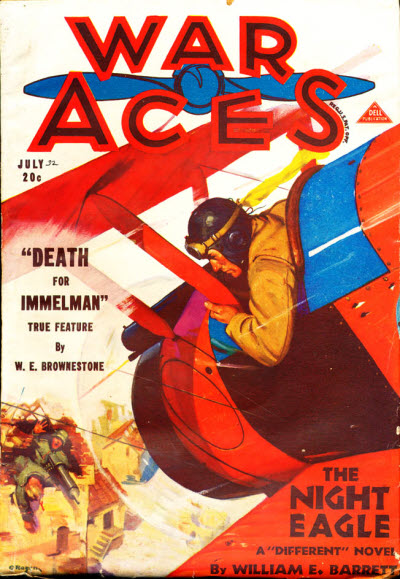
THIS week we have a story by prolific pulpster—Arthur J. Burks! Burks was a Marine during WWI and went on to become a prolific writer for the pulps in the 20’s and 30’s. He was a frequent contributor to War Aces.

Meet Hank Flynn, second lieutenant in the air service, was six feet two in his stocking feet and could whip any German that flew. His friends had told him so, and he modestly admitted when pressed, or even when not pressed, that they probably underestimated his abilities. He wasn’t a braggart, a bluff or an ass; he was just too young for his job and too full of the spirits of life. To others the war might be an excuse to discuss deep questions of psychology; to Hank it was a grand chance to have a hell of a good time and be decorated for it.

He had flaming red hair and a hawk nose smothered in freckles, and a grin that reached from here to there. But when, out of a clear sky, he was ordered to join that peculiar outfit in the woods across the lines from Masmunster known as “The Boomerangs,” something whispered to him that maybe there mightn’t be so much to smile about after he reported. From the pages of the July 1932 War Aces, it’s Arthur J. Burks’ “High Boomerang!”

Hank Flynn thought that a bag of ten gave him the right to give the skipper a few points, but he didn’t know that the best boomerangs always fly in a curve!

“Bombing Richthofen’s Drome” by Paul J. Bissell

Link - Posted by David on August 19, 2019 @ 6:00 am in

THIS week we present “Bombing Richthofen’s Drome”—The story behind the cover of Paul Bissell’s April 1932 cover for Flying Aces! Bissell is mainly known for doing the covers of Flying Aces from 1931 through 1934 when C.B. Mayshark took over duties. For the April 1932 cover Bissell put us right in the action as the planes of Squadron 100 circle over Richthofen’s drome, bombs exploding down below!

Bombing Richthofen’s Drome
th_FA_3204IT IS April of ‘17. Above, a full moon shines from an almost cloudless sky. Below, the landscape spreads away to the east—dark, except where a faint glimmer traces the twisting course of a river. To the west, against the horizon, continuous flashes show the progress of the battle of Arras, raging in its full fury.

There men lie in trenches, waiting in mud and slime for the signal which, at dawn, will send them from their meagre protection into that hail of bullets sweeping across No-Man’s-Land. Here, high in the air, all seems peaceful. Only the droning of many motors tells that death is on the wing. Death in the form of a dozen or more planes, each bearing the blue, white and red circles of the British Air Service on its wings; each carrying its little bunch of “bouquets” slung carefully in their racks underneath—”bouquets” to be presented to Richthofen’s Jagdstaffel II at its home airdrome at Izel le Hameau.

Suddenly the squadron leader, sensing rather than actually seeing what he knows to be his objective, cuts his motor and, tipping up one wing, descends in a wide, easy spiral so that he may more carefully check against his map the few faintly visible landmarks below. The other pilots, too, have cut their motors, hoping that there is a chance of getting down a bit before their singing wires will give them away. They do not know that already word of their approach has been given, that the searchlights and defenses are already manned by tense and eager foes waiting for that signal which will turn the quiet night into an inferno.

ONE thousand—two thousand—three thousand feet the leader drops, spiraling slowly. His companions, maintaining a much flatter glide, circle about the airdrome, holding their elevation until the leader can find his objective and drop his phosphorus bombs to light up their target.

Now, when he is scarcely a thousand feet up, a siren screams from the ground; a brilliant beam of light stabs the night—another, then still others, all sweeping the sky searchingly until one, finding its prey, stops suddenly, and the others quickly focus with it on the old British F.E. 2B. Instantly the sharp bark of archies shatters the stillness. On the ground, men dash from barracks and hangars. Hoarse orders are sharply given, and though the range is still too great, machine guns are already rattling nervously.

On, with never a waver, comes the old British crate—slowly gliding in, as surely and quietly as if she were coming down to land in her own airdrome. Down, down—five hundred feet. Now she is directly over the airdrome. The observer can be seen clearly in the white, merciless gleam of the searchlights, peering over the side—awaiting his moment.

They level off, one hundred and fifty feet up, and from the under wing of the plane comes a dark rush earthward. Men dive for shelter, and an instant later all hell breaks loose. The whole field is lighted up with the flaming brilliance of the burning bomb. Two hangars are ablaze. Shrapnel and flaming onions scream through the night. Other bombs crash, and the machine-gun fire is incessant.

NOW the other planes can be seen, diving straight in, or swinging in a wide circle to take their places in the parade of terror and death. One after another they come through the terrific barrage, and with deadly aim drop their bombs into the German quarters. One terrific explosion follows another. Hoarse screams echo as some poor devil is blown to bits.

Above, the motors are roaring full on, as the planes circle again and again to drop the last of their deadly missiles.

After all, it is only a matter of minutes. Destruction has come and passed, leaving in its wake burning hangars, dead and maimed bodies, and huge gaping holes in the formerly smooth carpet of the airdrome.

Already the hum of the motors can scarce be heard, as the squadron wings its way back home. Back over the front line, through another baptism of shell-fire, and then to their own field. Dawn is just graying the east as the last plane glides in safely. Not a machine but is torn by shrapnel. Wings are riddled with bullet holes. But Squadron 100, of the R.F.C., has bombed Richthofen and come back without the loss of a ship or a man!

The Ships on The Cover
“Bombing Richthofen’s Drome”
Flying Aces, April 1932 by Paul Bissell

“The Avalanche” by Lt. Frank Johnson

Link - Posted by David on August 16, 2019 @ 6:00 am in

ORTH is back! Silent Orth had made an enviable record, in the face of one of the worst beginnings—a beginning which had been so filled with boasting that his wingmates hadn’t been able to stand it. But Orth hadn’t thought of all his talk as boasting, because he had invariably made good on it. However, someone had brought home to him the fact that brave, efficient men were usually modest and really silent, and he had shut his mouth like a trap from that moment on.

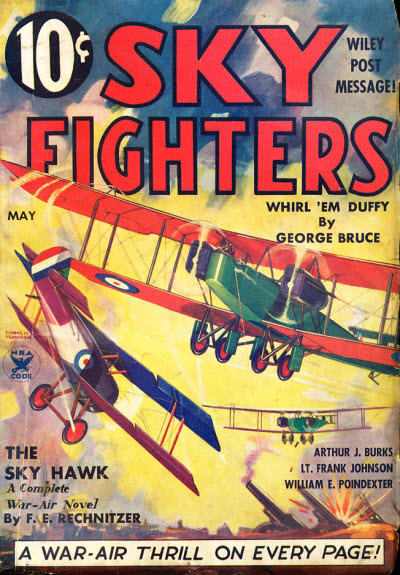
Orth’s new headache—Herman Manke, who has recently moved to the German outfit just across the front lines. He’s already knocked out four British flyers with his Fokker that’s rigged so that it will dive twice as far as a Fokker is calculated to dive, getting up terrific speed and doesn’t try to avoid anyone under him—that’s up to them! He’s as deadly with his Spandaus as a spitting cobra and never seems to miss! From the pages of the May 1935 Sky Fighters, Silent Orth faces “The Avalanche!”

Herman Manke, German Flyer, Was Hell on Wheels—and It Was Up to Orth to Knock the Wheels Out from Under Him!

“Famous Sky Fighters, April 1936″ by Terry Gilkison

Link - Posted by David on August 14, 2019 @ 6:00 am in

STARTING in the October 1933 issue of Sky Fighters and running almost 5 years, Terry Gilkison’s “Famous Sky Fighters” was a staple of the magazine. Each month Gilkison would illustrate in a two page spread different Aces that rose to fame during the Great War.

Although Gilkison was probably better known for his syndicated newspaper work, he also provided black and white story interior illustrations for pulp magazines. His work appeared in Clues, Thrilling Adventures, Texas Rangers, Thrilling Mystery, Thrilling Western, and Popular Western. Gilkison provided similar features in a few other Thrilling Publications—there was “Famous Soldiers of Fortune” and later “Adventure Thrills” in Thrilling Adventures, Famous Crimes” in Thrilling Detective, and the fully illustrated air adventure stories of Buck Barton “The Flying Devil” in The Lone Eagle! He signed most of this work with only his initials “T.G.” to maintain a low profile and preserve his reputation as a syndicated newspaper cartoon artist.

The April 1936 installment, from the pages of Sky Fighters, features Commandant Marquis de Turenne, Lt. Karl Schafer, Lt. Silvio Scaroni and Lt. R.A.J. Warneford who brought down the first zeppelin!

Next time in “Famous Sky Fighters”, Terry Gilkison features Captain Francis Quigley, Major Baron von Schleich, and Lt. John A. MacReady among others! Don’t miss it!

At Home with Robert J. Hogan, 1948

Link - Posted by David on August 9, 2019 @ 6:00 am in

Five years ago we posted a great article about Robert J. Hogan at home from 1962. We’ve come upon another great article about Hogan as he sets out on his book writing career in 1948. He wrote a number of hard cover westerns for Dodd, Mead & Company, three of them historical westerns featuring a cowboy named Smoke Wade who rides a pinto horse name Jake!

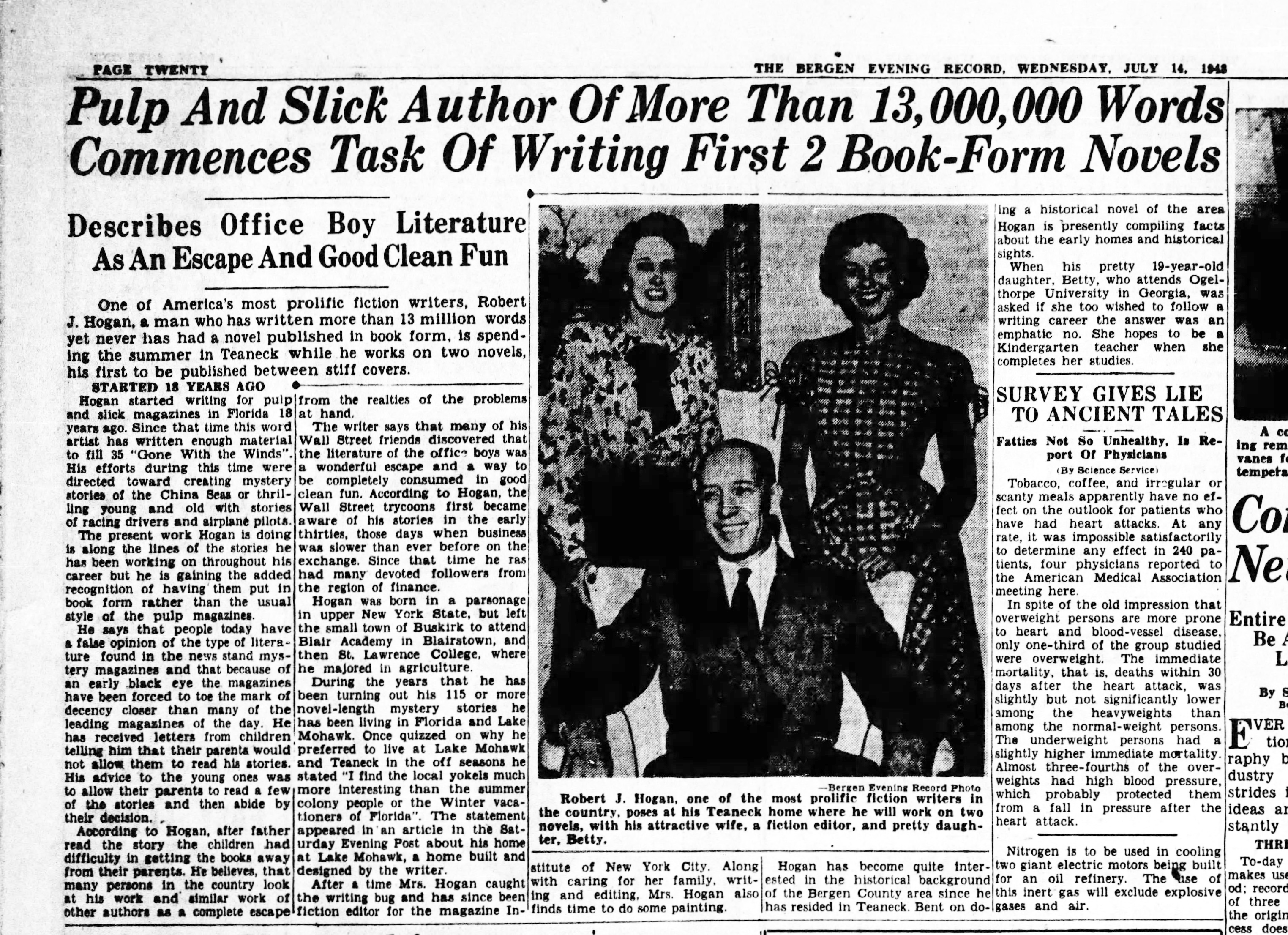
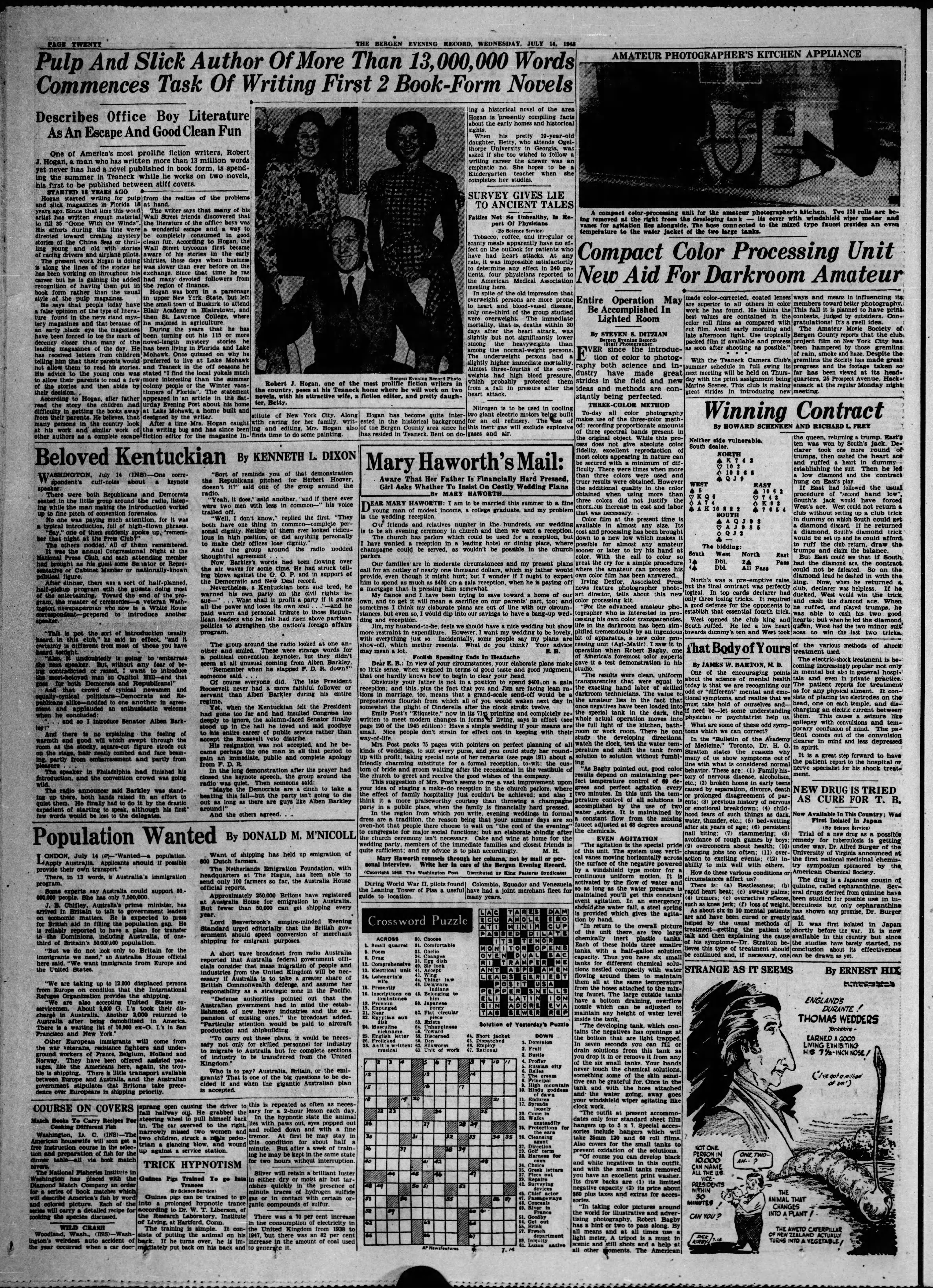
Here’s the article from The Bergen Evening Record, July 14, 1948:

Pulp and Slick Author of More Than 13,000,000 Words Commences Task of Writing First 2 Book-Form Novels

The Bergen Evening Record, Bergen, New Jersey • 14 July 1948, P.20

Describes Office Boy Literature As An Escape And Good Clean Fun

One of Americas most prolific fiction writers, Robert J. Hogan, a man who has written more than 13 million words yet never has had a novel published in book form, is spend-ing the summer in Tea neck while he works on two novels, his first to be published between stiff covers.

STARTED 18 YEAR8 AGO

Hogan started writing for pulp and slick magazines in Florida 18 years ago. 8ince that time this word artist has written enough material to fill 35 “Gone With the Winds”. His efforts during this time were directed toward creating mystery stories of the China Seas or thrilling young and old with stories of racing drivers and airplane pilots.

The present work Hogan is doing is along the lines of the stories he has been working on throughout his career but he is gaining the added recognition of having them put in book form rather than the usual style of the pulp magazines.

He says that people today have a false opinion of the type of literature found in the news stand mystery magazines and that because of an early black eye the magazines have been forced to toe the mark of decency closer than many of the leading magazines of the day. He has received letters from children telling him that their parents would not allow them to read his stories. His advice to the young ones was to allow their parents to read a few of the stories and then abide by their decision.

According to Hogan, after father read the story the children had difficulty in getting the books away from their parents. He believes, that many persons in the country look at his work and similar work of other authors as a complete escape from the realties of the problems at hand.

The writer says that many of his Wall Street friends discovered that the literature of the office boys was a wonderful escape and a way to be completely consumed in good clean fun. According to Hogan, the Wall Street trycoons first became aware of his stories in the early thirties, those days when business was slower than ever before on the exchange. Since that time he has had many devoted followers from the region of finance.


Robert J. Hogan, one of the most prolific fiction writers In the country, poses at his Teaneck home where he will work on two novels, with his attractive wife, a fiction editor, and pretty daughter, Betty. (Bergen Evening Record Photo)

Hogan was born in a parsonage in upper New York State, but left the small town of Buskirk to attend Blair Academy in Blairstown, and then 8t. Lawrence College, where he majored in agriculture.

During the years that he has been turning out his 115 or more novel-length mystery stories he has been living in Florida and Lake Mohawk. Once quizzed on why he preferred to live at Lake Mohawk and Teaneck in the off seasons he stated “I find the local yokels much more interesting than the summer colony people or the Winter vacationers of Florida”. The statement appeared in an article in the Saturday Evening Post about his home at Lake Mohawk, a home built and designed by the writer.

After a time Mrs. Hogan caught the writing bug and has since been fiction editor for the magazine Institute of New York City. Along with caring for her family, writing and editing, Mrs. Hogan also finds time to do some painting.

Hogan has become quite interested in the historical background of the Bergen County area since he has resided in Teaneck. Bent on doing a historical novel of the area Hogan is presently compiling facts about the early homes and historical sights.

When his pretty 19-year-old daughter, Betty, who attends Ogelthorpe University in Georgia, was asked if she too wished to follow a writing career the answer was an emphatic no. She hopes to be a Kindergarten teacher when she completes her studies.

Premiering at PulpFest 2019!

Link - Posted by David on August 5, 2019 @ 6:00 am in

AGE OF ACES will be back at PulpFest again this year where we will be debuting our two new titles!

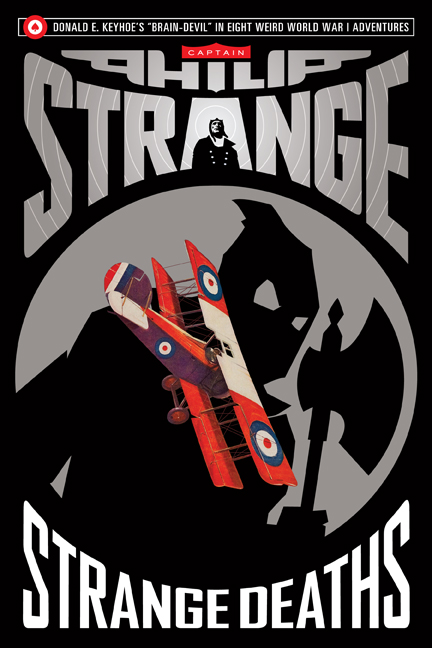
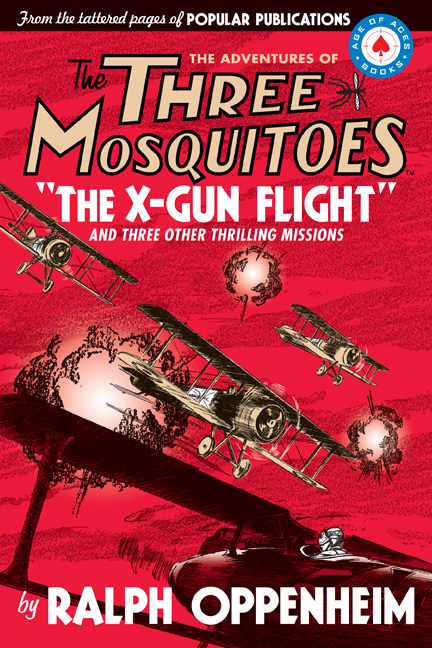
Our first is the penultimate volume in our Captain Philip Strange series—back this time with eight more weird WWI stories spanning the run of the series in Strange Deaths! A mental marvel from birth, who used his talents on stage as a boy, Philip Strange is now known as “The Phantom Ace of G-2″ by the Allies during WWI and the verdamnt Brain-Devil by the Boche. Just when you thought there were no more ways to die in war, the Germans come up with some even more gruesome ways! if you’re not just being incinerated by the sun’s ray focused through enormous lenses, you’re being gassed with a horribly disfiguring plague; drowned in a sea of blood or injected with a serum that turns you into a hyped up fighting hellion until you keel over dead; maybe you’ll be lucky and just have your own munitions blow up your entire outfit, or simply have your head chopped off and mounted on some psychotic ace’s wings. Thankfully, we have have Captain Philip Strange on our side to stop them in eight of his strangest cases yet from the pages of Flying Aces magazine!

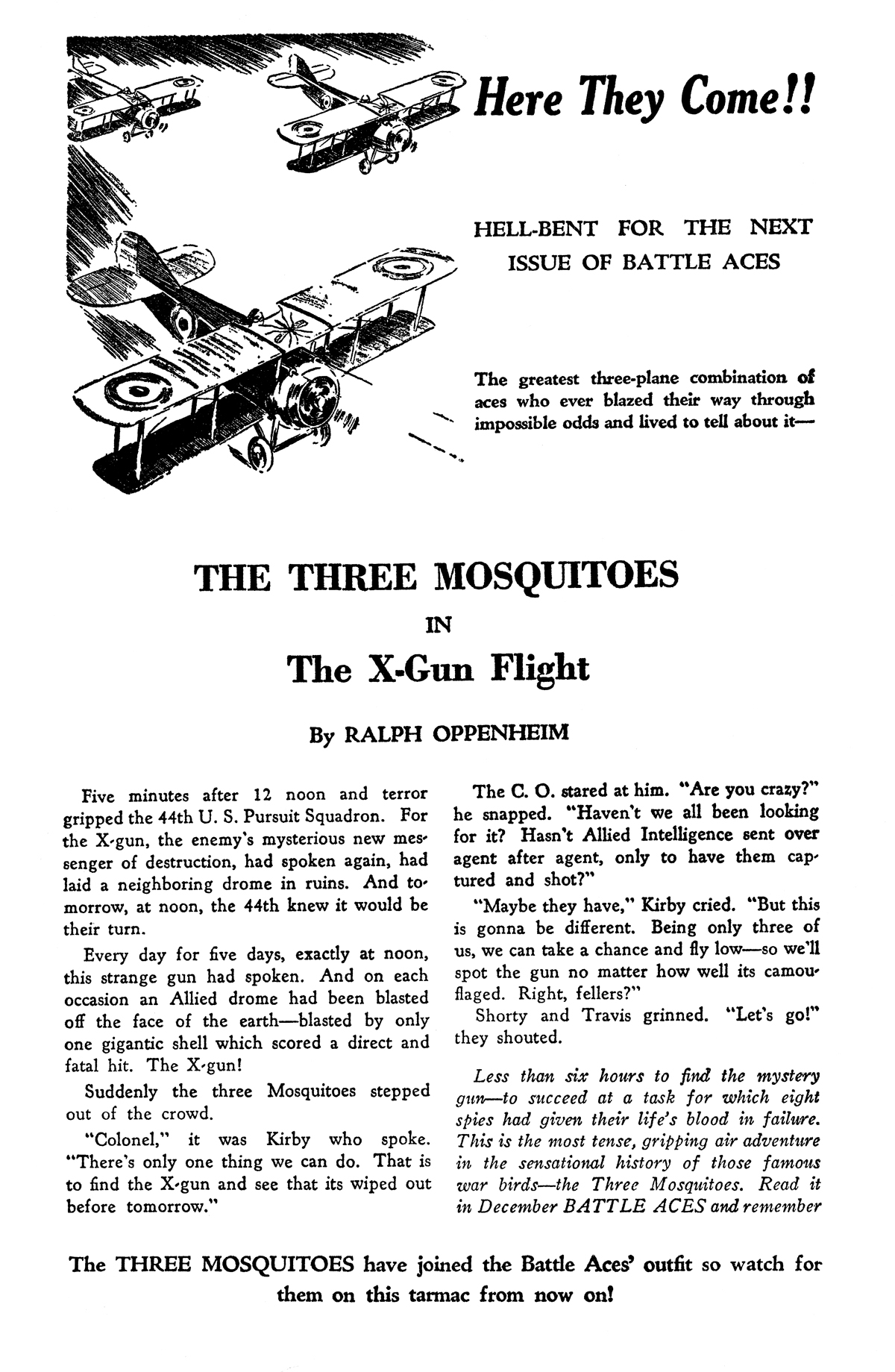
The inseparable trio is back!, Through the dark night sky, streaking swiftly with their Hisso engines thundering, is the greatest trio of aces on the Western Front—the famous and inseparable “Three Mosquitoes,” the mightiest flying combination that had ever blazed its way through overwhelming odds and laughed to tell of it! At point was Captain Kirby, impetuous young leader of the great trio; on his right was little Lieutenant “Shorty” Carn, the mild-eyed, corpulent little Mosquito and lanky Lieutenant Travis, eldest and wisest of the Mosquitoes on his left! Flying in a V formation through four exciting hell-bent tales from the pages of Popular Publication’s Battle Aces—”The X-Gun Flight” (Jan 32), “The Iron Ace” (Feb 32), “The Flying Dreadnought” (Jun 32), “The 20-Ace Patrol” (Jul 32)—all illustrated by John Fleming Gould!

In addition to these two volumes we’ll have all of our other titles that are still in print as well as our convention exclusive—Arch Whitehouse’s Coffin Kirk. So if you’re planning on coming to Pittsburgh for PulpFest this year, stop by our table and say hi and pick up our latest releases! We hope we see you there!

Coming Soon…

Link - Posted by David on August 2, 2019 @ 6:00 am in

“Famous Sky Fighters, March 1936″ by Terry Gilkison

Link - Posted by David on June 19, 2019 @ 6:00 am in

STARTING in the October 1933 issue of Sky Fighters and running almost 5 years, Terry Gilkison’s “Famous Sky Fighters” was a staple of the magazine. Each month Gilkison would illustrate in a two page spread different Aces that rose to fame during the Great War.

Although Gilkison was probably better known for his syndicated newspaper work, he also provided black and white story interior illustrations for pulp magazines. His work appeared in Clues, Thrilling Adventures, Texas Rangers, Thrilling Mystery, Thrilling Western, and Popular Western. Gilkison provided similar features in a few other Thrilling Publications—there was “Famous Soldiers of Fortune” and later “Adventure Thrills” in Thrilling Adventures, Famous Crimes” in Thrilling Detective, and the fully illustrated air adventure stories of Buck Barton “The Flying Devil” in The Lone Eagle! He signed most of this work with only his initials “T.G.” to maintain a low profile and preserve his reputation as a syndicated newspaper cartoon artist.

The March 1936 installment, from the pages of Sky Fighters, features Lt. Alan McLeod, Lt. Heinrich Gonterman, Captains Jimmy McCudden, Frank Hunter,and John Towers and Adolph Pegoud!

Next time in “Famous Sky Fighters”, Terry Gilkison features Commandant Marquis de Turenne, Lt. Karl Schafer, Lt. Silvio Scaroni and Lt. R.A.J. Warneford who brought down the first zeppelin! Don’t miss it!

“Famous Sky Fighters, February 1936″ by Terry Gilkison

Link - Posted by David on June 5, 2019 @ 6:00 am in

STARTING in the October 1933 issue of Sky Fighters and running almost 5 years, Terry Gilkison’s “Famous Sky Fighters” was a staple of the magazine. Each month Gilkison would illustrate in a two page spread different Aces that rose to fame during the Great War.

Although Gilkison was probably better known for his syndicated newspaper work, he also provided black and white story interior illustrations for pulp magazines. His work appeared in Clues, Thrilling Adventures, Texas Rangers, Thrilling Mystery, Thrilling Western, and Popular Western. Gilkison provided similar features in a few other Thrilling Publications—there was “Famous Soldiers of Fortune” and later “Adventure Thrills” in Thrilling Adventures, Famous Crimes” in Thrilling Detective, and the fully illustrated air adventure stories of Buck Barton “The Flying Devil” in The Lone Eagle! He signed most of this work with only his initials “T.G.” to maintain a low profile and preserve his reputation as a syndicated newspaper cartoon artist.

The February 1936 installment, from the pages of Sky Fighters, features Lt. Edward Roberts, Lt. Col. Robert Rockwell, Major Byford McCudden, and Rittmeister Carl Bolle!

Next time in “Famous Sky Fighters”, Terry Gilkison features Lt. Alan McLeod, Lt. Heinrich Gonterman, Captains Jimmy McCudden, Frank Hunter,and John Towers and Adolph Pegoud! Don’t miss it!

“Sky Birds, April 1935″ by C.B. Mayshark

Link - Posted by David on May 27, 2019 @ 6:00 am in

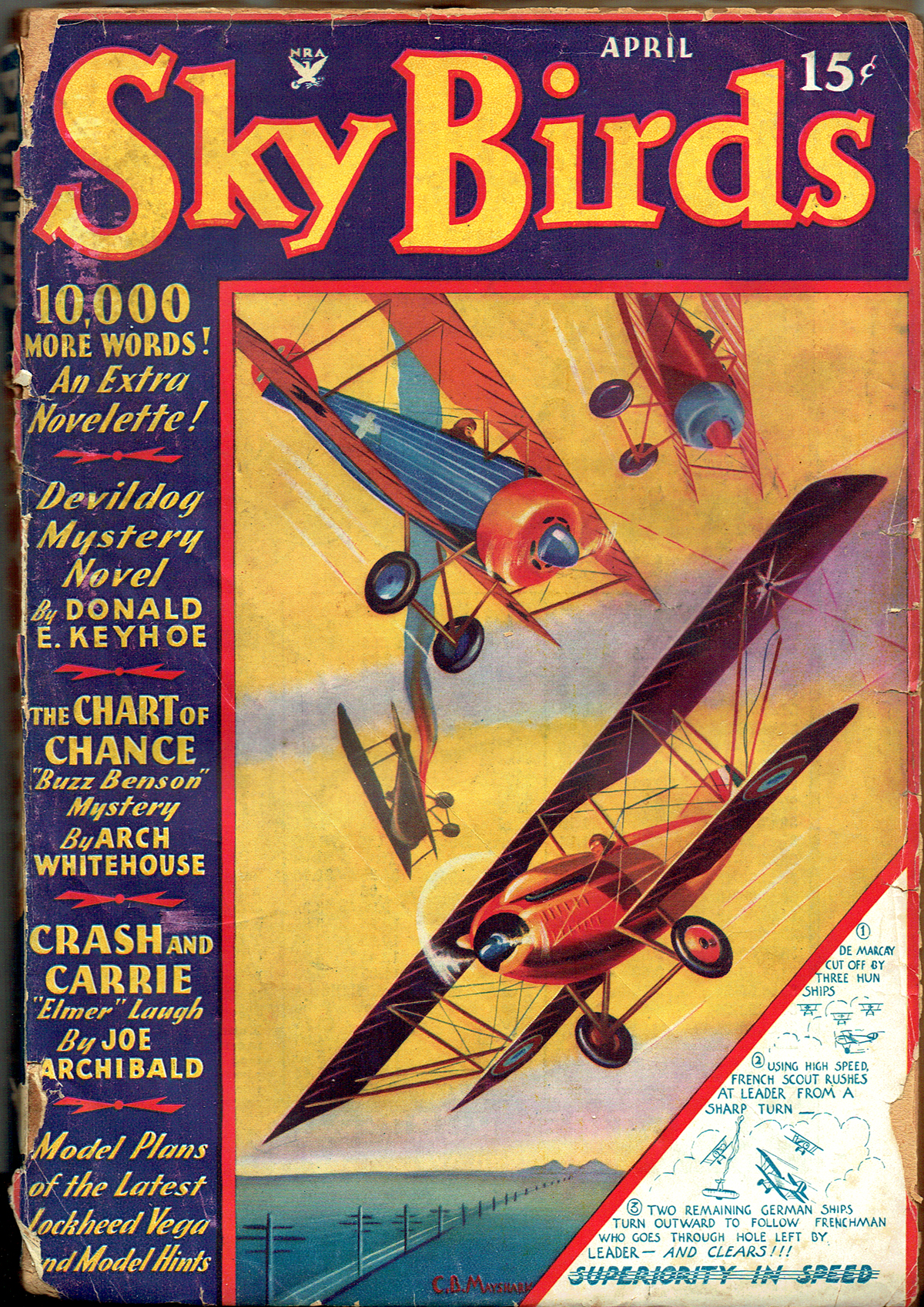
THIS May we’re celebrating the genius that is C.B. Mayshark! Mayshark took over the covers duties for Sky Birds with the July 1934 and would paint all the remaining covers until it’s last issue in December 1935. At the start of his run, Sky Birds started featuring a different combat maneuver of the war-time pilots. The lower corner presenting a play-by-play of that month’s maneuver with the remainder of the cover illustrating it. For April 1935 issue Mayshark gives us “Superiority in Speed!”

Combat Maneuvers of War-Time Pilots:
Superiority in Speed

THE predominating factor in the th_SB_3504 development of aviation ever since the Wright Brothers took wing has always been speed. Speed has been the password of the manufacturers and the demand of the public, and this element has done more than anything else to foster the building of better ships.
The keenest competition that the aircraft industry probably will ever know took place between the years 1914 and 1918. If some German appeared with a new ship that was superior in speed to any of its predecessors, it was but a matter of time before the Allied forces came forth with a plane that had the German one stopped dead in its tracks. And vice versa.

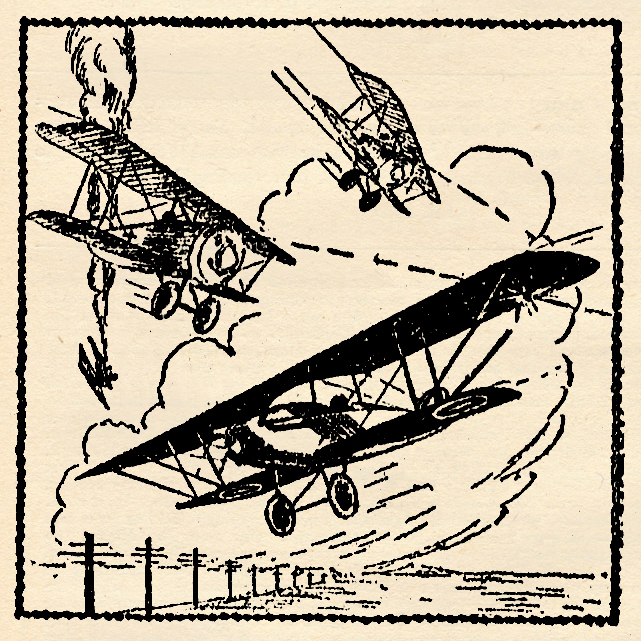
One of the fastest planes produced in the war was a French ship called the De Marcay biplane. This plane was not constructed until late in the war, and therefore it did not see much active service. However, had the ship been produced in mass, and had numbers of them been thrown against the machines of the enemy, there is no doubt but what it would have come through with flying colors.
On our cover this month we have illustrated the method by which the speedy De Marcay was enabled to attack two or more enemy ships and get away with it.

Returning from an artillery spotting job far over the lines, the French pilot suddenly finds himself confronted by three German scouts who are determined to keep him from returning with his valuable information. The sector is in a rural district which has not been torn up by the racking fire of heavy artillery, and there is nothing below but smooth, level fields and a line of telephone wires. An ideal place to bring this devil down, thinks the leader of the Hun patrol. No trouble about getting a victory confirmation here.

But the German patrol leader is doomed to disappointment. Worse than that, he is doomed to death. Yet death comes so quickly that he scarcely knows what hit him.

Banking around in a tight turn so as to attack from an angle, the Frenchman opens his throttle wide and comes tearing down across the sky, head-on into the enemy formation. One burst of fire is enough to knock the leader out of position, and as he falls rapidly in a sickening spin, blue smoke begins curling up around his fuselage. Suddenly he is a mass of fire—a flamer!

Continuing on in a straight line at a terrific rate of speed, the De Marcay biplane darts between and below the two remaining German scouts before they know what it’s all about. As he gets clear and heads for the lines, the Hun ships reform and attack with a little altitude to their advantage. Their tracer hits, but the Frenchman is going too fast for accurate aiming. He loses an outer interplane strut, but that’s all.

So a victory is won, and speed is the one thing that gets the credit. The Frenchman continues home unmolested, lands, and makes his report. He is a good pilot, yes. But besides that, he has a ship that is faster than anything else on the Western Front.

The De Marcay biplane was powered with a 300-h.p. Hispano-Suiza motor. Its top speed was 162 miles per hour, and an overall safety factor of 14 was claimed for the machine.

The German ship pictured on the cover is one of the many types of single-seater biplane that the L.F.G. Boland concern put out. It was designated as type D XIV, and it was powered with a 160-h.p. Goebel engine.

The Story of The Cover
Sky Birds, April 1935 by C.B. Mayshark
(Combat Maneuvers of War-Time Pilots: The Story Behind This Month’s Cover)

“Famous Sky Fighters, January 1936″ by Terry Gilkison

Link - Posted by David on May 22, 2019 @ 6:00 am in

STARTING in the October 1933 issue of Sky Fighters and running almost 5 years, Terry Gilkison’s “Famous Sky Fighters” was a staple of the magazine. Each month Gilkison would illustrate in a two page spread different Aces that rose to fame during the Great War.

Although Gilkison was probably better known for his syndicated newspaper work, he also provided black and white story interior illustrations for pulp magazines. His work appeared in Clues, Thrilling Adventures, Texas Rangers, Thrilling Mystery, Thrilling Western, and Popular Western. Gilkison provided similar features in a few other Thrilling Publications—there was “Famous Soldiers of Fortune” and later “Adventure Thrills” in Thrilling Adventures, Famous Crimes” in Thrilling Detective, and the fully illustrated air adventure stories of Buck Barton “The Flying Devil” in The Lone Eagle! He signed most of this work with only his initials “T.G.” to maintain a low profile and preserve his reputation as a syndicated newspaper cartoon artist.

The January 1936 installment, from the pages of Sky Fighters, features Lt. Charles Lenoir, Capt. Albert Heurteaux, Frank Luke, Lt. Col Harold E. Hartney, and the brother of the great one—Lothar von Richthofen!

Next time in “Famous Sky Fighters”, Terry Gilkison features Lt. Edward Roberts, Lt. Col. Robert Rockwell, Major Byford McCudden, and Rittmeister Carl Bolle! Don’t miss it!

“Sky Birds, March 1935″ by C.B. Mayshark

Link - Posted by David on May 20, 2019 @ 6:00 am in

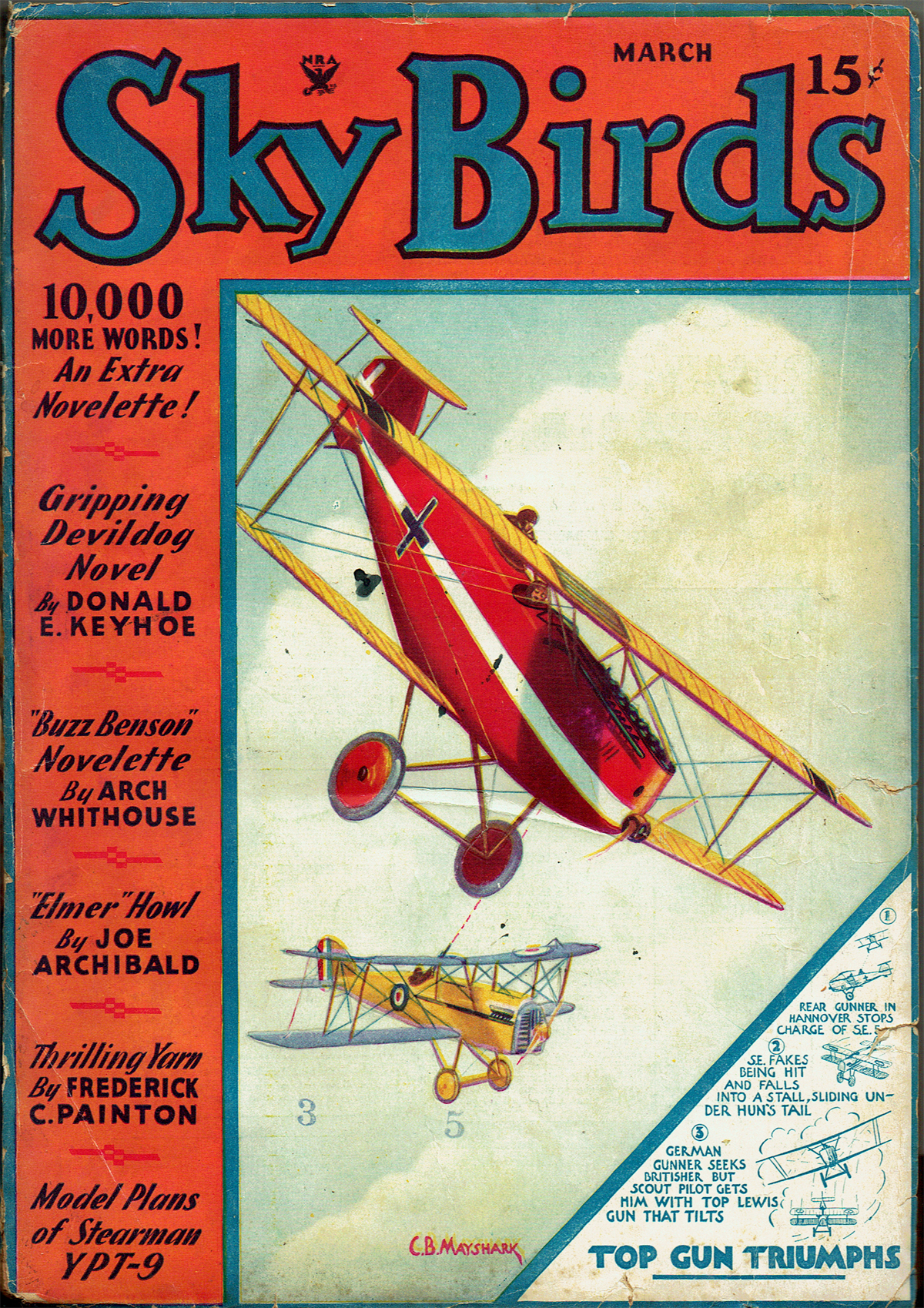
THIS May we’re celebrating the genius that is C.B. Mayshark! Mayshark took over the covers duties for Sky Birds with the July 1934 and would paint all the remaining covers until it’s last issue in December 1935. At the start of his run, Sky Birds started featuring a different combat maneuver of the war-time pilots. The lower corner presenting a play-by-play of that month’s maneuver with the remainder of the cover illustrating it. For March 1935 issue Mayshark gives us “Top Gun Triumphs!”

Combat Maneuvers of War-Time Pilots:
Top Gun Triumphs

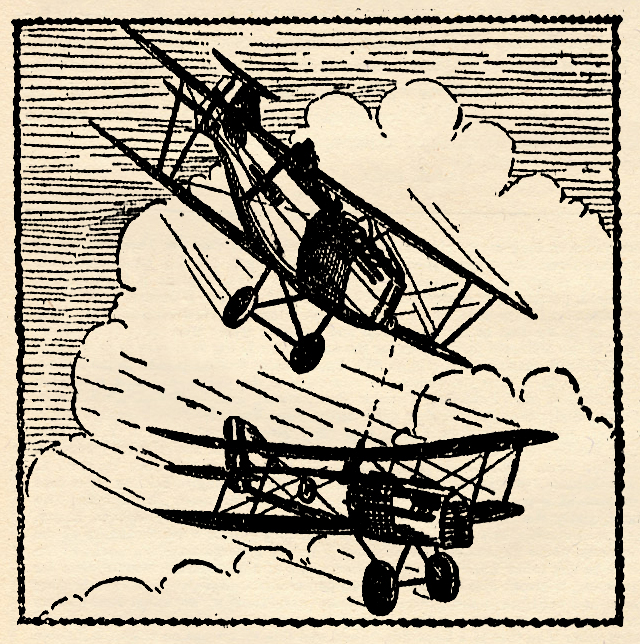
A BRITISH S.E.5 is on reconnaissance th_SB_3503 duty high above the shell-torn contours of the Rhine. As it skims along on the dead air, its pilot is suddenly struck with a feeling of loneliness. Even the sun, which is covered with a thick, murky haze, affords no companionship.

With his observations well in mind, the British pilot banks his ship around and heads for home, thinking that maybe this war flying is not such hot stuff, after all, especially when even the sun isn’t friendly. But suddenly the sun is a great deal less than friendly. A German Hannover drops from out of its glittering depths with a screech and a thunderous roar, and the S.E.5 finds its wings being splintered with Spandau tracer.

In panicky excitement, the British pilot sends his ship up into a steep climb and veers off in a mad effort to shake off the German. As he finds himself momentarily clear of the murderous machine-gun fire, the Britisher feels like a rat without a hole into which to crawl. With both ships out of firing range of each other, the S.E. pilot has time to think, and he grimly determines that he will not go down without firing a shot.

However, extreme difficulties must be overcome in order to down a German Hannover two-seater. This ship is noted for its practical immunity to single-ship attack, and its only blind spot is hard to get at. With a rear gunner who controls a wide arc of fire, it is almost impossible for one to dive upon the ship—that is, if life is to be considered. Attack from the rear is also hazardous because of the specially constructed tail assembly. With the lifting and elevator surfaces built in biplane form, the lateral dimensions are greatly reduced, thereby providing for a much greater arc of fire on either side of the fuselage than on ships of conventional style.

Also, the narrow fuselage enables the gunner to fire down at a very steep angle. Of course, the pilot’s guns firing through the propeller cover anything ahead which is in the ship’s line of flight. The Hannover is fast and maneuvers easily. All in all, it is a ship with a very high efficiency rating.

Knowing all these facts, the S.E. pilot plans his attack shrewdly. Waiting for a moment while the Hun plane comes upon him again, the Britisher continues flying in a straight line. The instant the German opens fire, our pilot fakes being hit and stalls, nose-up. As the S.E. falls away in a flutter to the rear of the Hannover, the Hun gunner, with a yell of triumph, smacks his pilot on the back. But his rejoicing is short-lived, for suddenly the S.E. comes to life. It gathers speed like a streak and is below the German in an instant. The Britisher handles the Lewis gun mounted on the top plane with cool precision, and as he pulls the handle down, he fires up almost vertically. A few short bursts are enough, and then the S.E. ducks out while the ducking is good. A moment later, the German two-seater careens crazily and then dives for earth in a mad spin. The British have won again!

The S.E.5 (S.E. meaning Scouting Experimental) was one of the best single-seaters in the Allied service during the war. It was designed by the engineers of the Royal Aircraft Establishment, and numbers of them were built by several different airplane manufacturers in England.

The Story of The Cover
Sky Birds, March 1935 by C.B. Mayshark
(Combat Maneuvers of War-Time Pilots: The Story Behind This Month’s Cover)

“Sky Birds, February 1935″ by C.B. Mayshark

Link - Posted by David on May 13, 2019 @ 6:00 am in

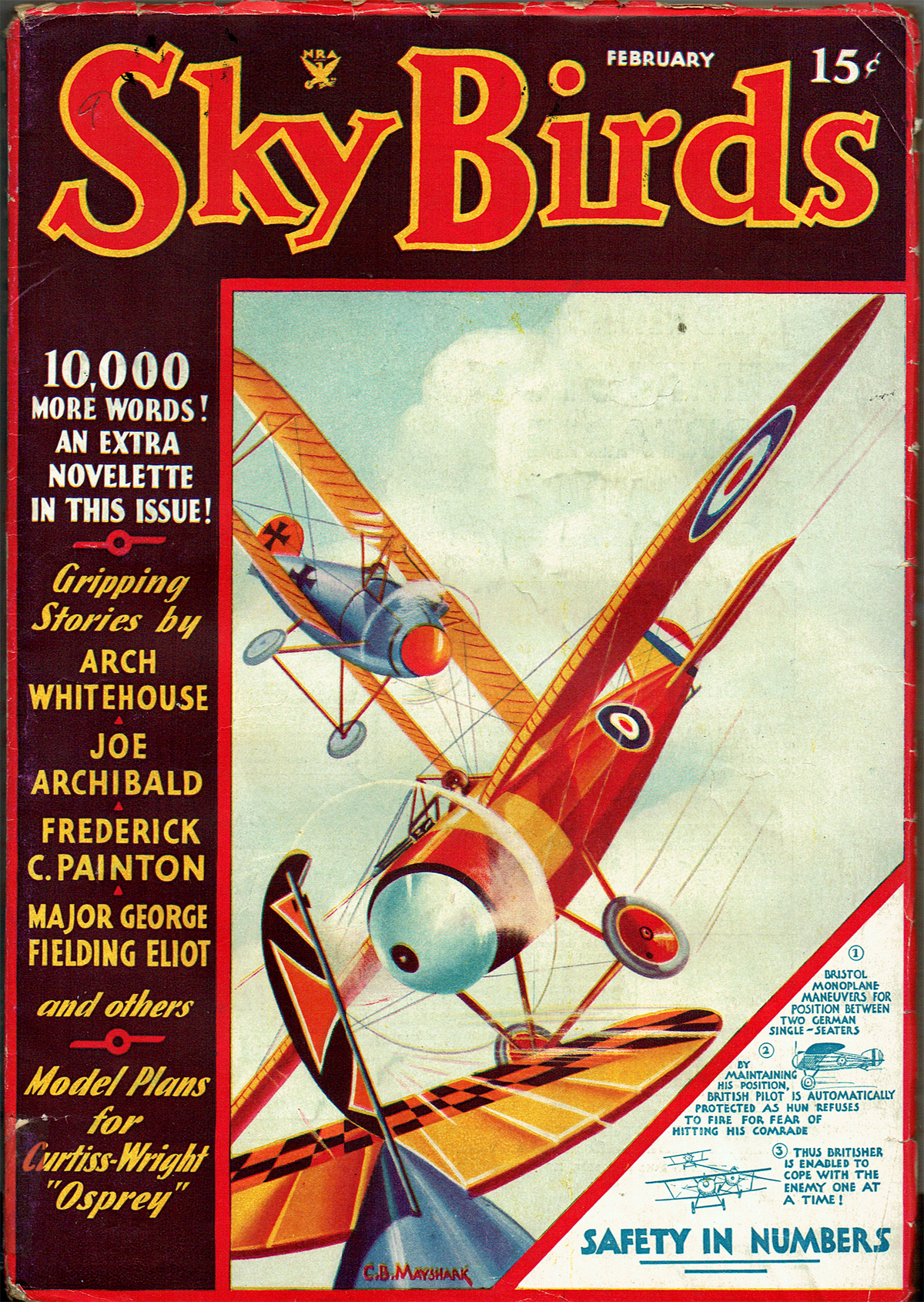
THIS May we’re celebrating the genius that is C.B. Mayshark! Mayshark took over the covers duties for Sky Birds with the July 1934 and would paint all the remaining covers until it’s last issue in December 1935. At the start of his run, Sky Birds started featuring a different combat maneuver of the war-time pilots. The lower corner presenting a play-by-play of that month’s maneuver with the remainder of the cover illustrating it. For February 1935 issue Mayshark gives us “Safety In Numbers!”

Combat Maneuvers of War-Time Pilots:
Safety In Numbers

UNDER ordinary circumstances, th_SB_3502 when you get one ship in combat with many, you have a very one-sided battle. Of course, there were instances during the war when a single combatant came out the victor over overwhelming odds, but these cases were few and far between.

Usually, when one lone ship came upon a flight of enemy planes, the solitary plane made a decided effort to duck out. A pilot who was seen streaking for home with a flock of Germans on his tail was never considered a coward. On the contrary, he was thought to be displaying a lot of good common sense. Foolhardy exposure never drew praise.

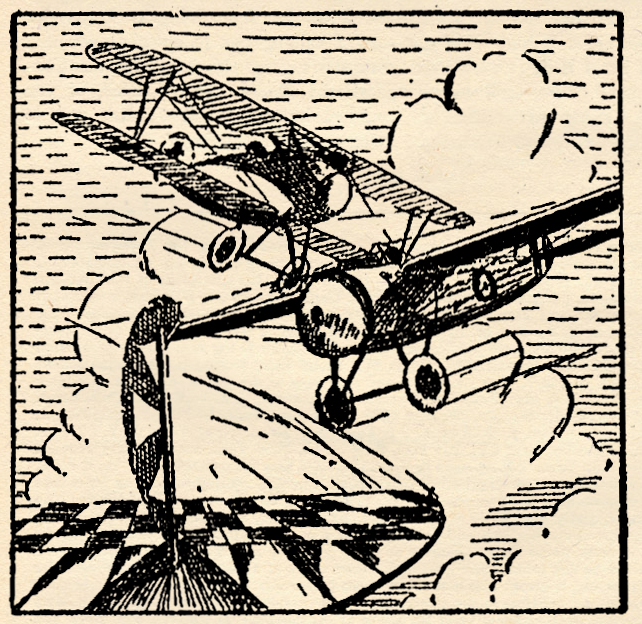
On this month’s cover, we have illustrated an air battle which, at first glance, looks like a victory for the enemy. A Britisher who was trapped between two Huns got nothing but sympathy and prayers from nonparticipating onlookers, if the combat happened to be taking place over Allied soil. If the Germans were viewing the fight, the Britisher didn’t get even that much of a break. But in our cover, the British pilot is fooling them all, whether they be enemy or Allied bystanders.

Diving full upon a German scout, the British pilot is just ready to line up his target when he suddenly becomes aware of the fact that another German is bearing down upon him from behind. His first impulse is to abandon the prey before him and attempt to get away. He almost carries out his impulse, but in a second he foresees the possible outcome of the battle if he sticks where he is. He is taking a long chance, and he knows it. The only alternative is almost certain defeat.

Having decided that he has a fifty-fifty chance of disposing of these Huns one by one, the British pilot pulls up closer onto the tail of his adversary. The German ship which is bringing up the rear also pulls up closer, but the Hun finds himself in a fit of indecision. There is a chance that he can fire upon the Allied ship before him and register a hit with the first burst. But if he misses, the chances are ten to one that his comrade ahead will get it in the neck. What to do?

Then, suddenly, he sees it is too late to do anything. The British pilot has opened fire, and one short burst proves adequate to knock the German out of the sky.

As his ship falls away in a spin, the remaining German is blinded with rage. Why hadn’t he drilled this British pilot when he had a chance? He has been duped, and, as a result, his comrade has fallen to his death. Now the only thing left is revenge.

But the Britisher is as wary as he is smart. As soon as he sees that his bullets have found their mark, he spins away from the remaining Hun with the speed of lightning. And now he finds himself free to engage the enemy on even terms.

But what is this dropping out of the clouds on his left? A whole flight of enemy scouts! The Britisher knows when he has had enough. Losing altitude quickly, he gains speed and streaks for home.

Thus a victory is won. An Allied pilot has fought bravely and smartly, and when the odds mount too heavily against him, he quits. A courageous but cautious airmanl

The planes on the cover this month are high-performance single-seater fighters, one of which is comparatively unknown.

The Bristol monoplane was built late in the war by the British and Colonial Aeroplane Co., Ltd. Incorporated in its design are found what was then the latest ideas in airplane construction. As can be seen, it is a high-wing, wire-braced monoplane. The fuselage is circular in construction, the shape of the cowling being preserved down to the tail by fairing. The ship is powered with a 110-horsepower Le Rhone engine, and a large spinner is fixed to the propeller boss. The ship has a top speed of 130 m.p.h.

The German planes pictured on the cover are the well-known Albatross D-3’s.

The Story of The Cover
Sky Birds, February 1935 by C.B. Mayshark
(Combat Maneuvers of War-Time Pilots: The Story Behind This Month’s Cover)

“Famous Sky Fighters, December 1935″ by Terry Gilkison

Link - Posted by David on May 8, 2019 @ 6:00 am in

STARTING in the October 1933 issue of Sky Fighters and running almost 5 years, Terry Gilkison’s “Famous Sky Fighters” was a staple of the magazine. Each month Gilkison would illustrate in a two page spread different Aces that rose to fame during the Great War.

Although Gilkison was probably better known for his syndicated newspaper work, he also provided black and white story interior illustrations for pulp magazines. His work appeared in Clues, Thrilling Adventures, Texas Rangers, Thrilling Mystery, Thrilling Western, and Popular Western. Gilkison provided similar features in a few other Thrilling Publications—there was “Famous Soldiers of Fortune” and later “Adventure Thrills” in Thrilling Adventures, Famous Crimes” in Thrilling Detective, and the fully illustrated air adventure stories of Buck Barton “The Flying Devil” in The Lone Eagle! He signed most of this work with only his initials “T.G.” to maintain a low profile and preserve his reputation as a syndicated newspaper cartoon artist.

The December 1935 installment, from the pages of Sky Fighters, features noted American flyer Lt. Thomas Hitchcock, Jr., and famous German Ace Lt. Friedrich Allmenroder!

Next time in “Famous Sky Fighters”, Terry Gilkison features Lt. Charles Lenoir, Capt. Albert Heurteaux, Frank Luke, Lt. Col Harold E. Hartney, and the brother of the great one—Lothar von Richthofen! Don’t miss it!

« Previous PageNext Page »