Looking to buy? See our books on amazon.com Get Reading Now! Age of Aces Presents - free pulp PDFs

Cowboys of the Air

Link - Posted by David on July 19, 2022 @ 6:00 am in

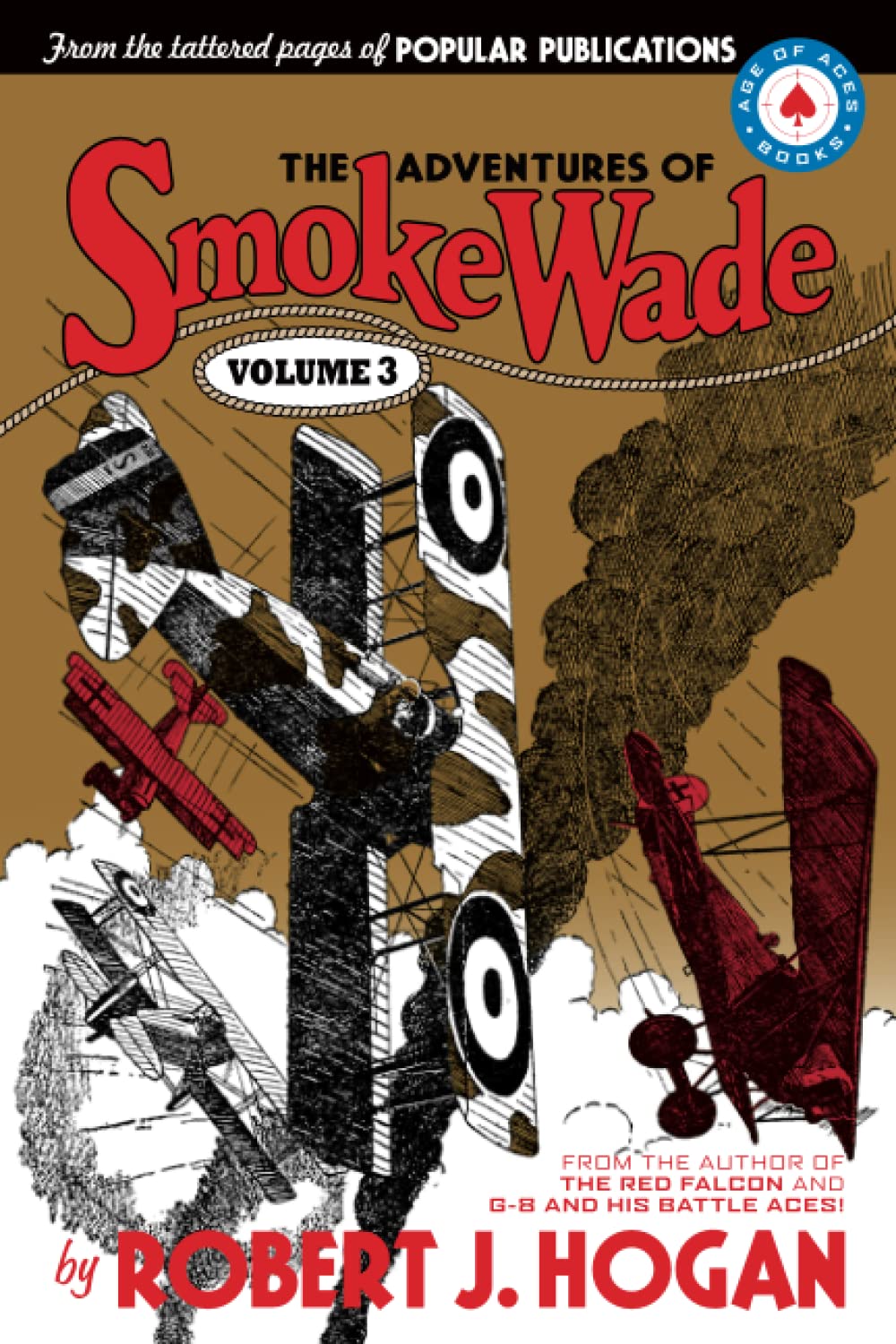
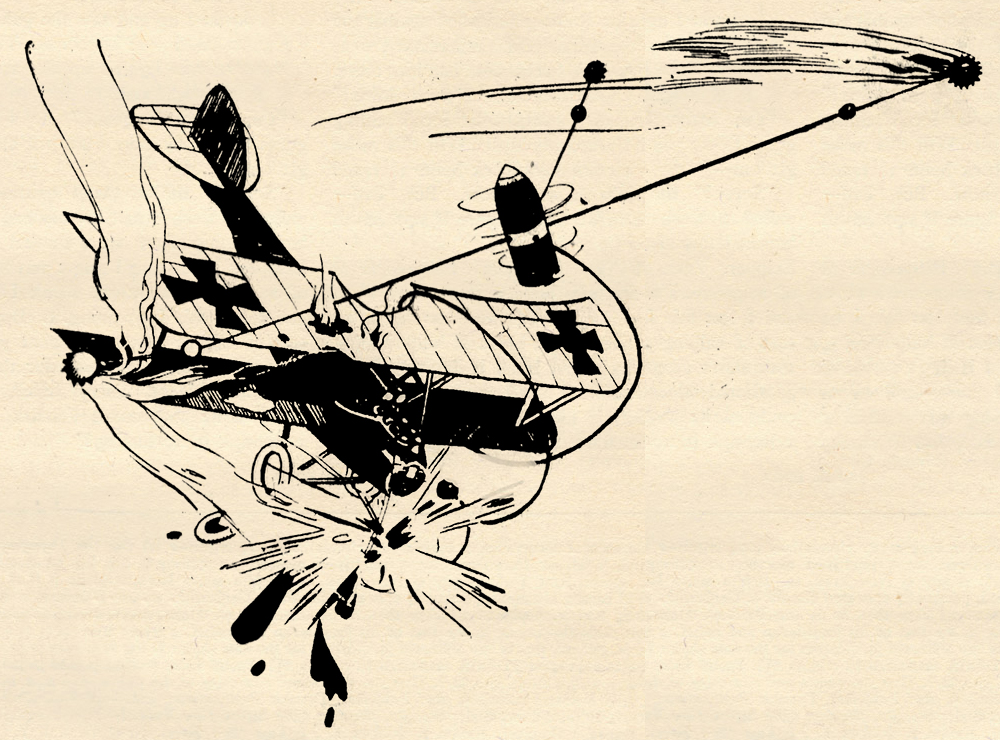
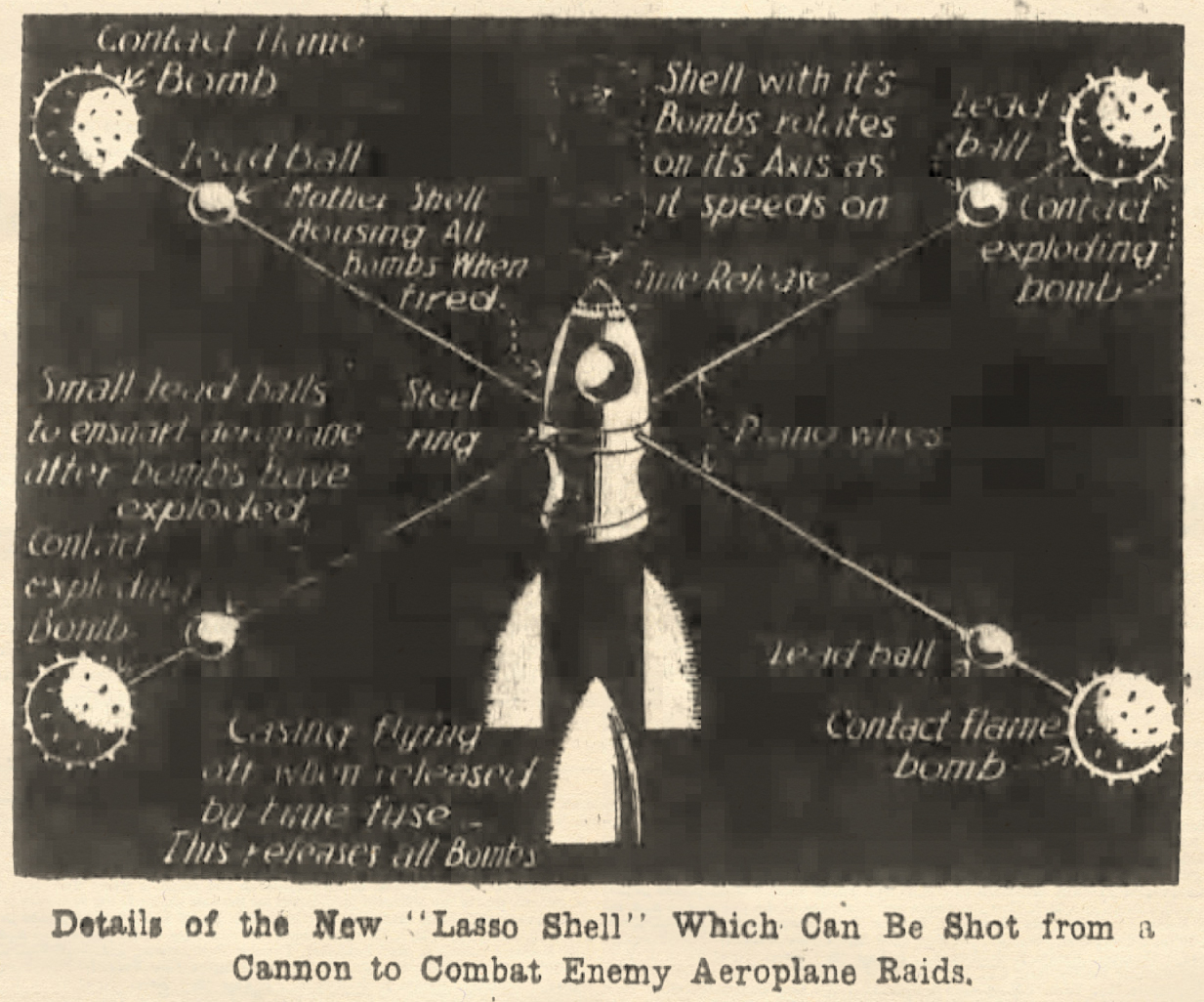
HERE’S and interesting article from the pages of the San Francisco Chronicle in 1918 theorizing about a new “Lasso” bomb that would “rope” an enemy when exploded near their plane. Sounds like the kind of thing that should come from the pages of Robert J. Hogan’s six-gun ace, Smoke Wade, but is actually from the father of Science-Fiction himself, Hugo Gernsback, and The Electrical Experimenter!

“Cowboys” of the Air

The San Francisco Chronicle, San Francisco, California • 22 September 1918

How The New Lasso Shell Makes Possible the Rare and Exciting Sport of Roping Hostile Airplanes

“ARCHIES,” as anti-aircraft guns are called, throughout the war have been blazing away at Hun airplanes and scoring some remarkable hits. However, military experts are of the opinion that it is impossible to stop an aerial raid by means of anti-aircraft guns alone. Notwithstanding the fact that the armed aeroplane Itself is probably the most effective means of downing enemy planes, there is a long felt want of some other method of clearing the skies of raiders.

With this idea in mind Mr. H. Gernsbeck, editor of the Electrical Experimenter, has perfected a plan which he says, to a certain degree, will accomplish such a result. The principle of this writer’s device, which is illustrated and described in the Electrical Experimenter, centres upon the “chain-shot,” which was nothing else but chaining several cannon balls together and shooting them at the enemy with devastating results. As the erratic flight of such a device made it extremely inefficient, it was soon given up and came into disuse.

“In my device,” says Mr. Gernsbeck, “I propose the use of a ‘mother-shell’ containing two explosive bombs, as well as two ’liquid-fire’ bombs. Each one of these bombs has a smaller companion—a heavy lead ball, the purpose of which is explained later.

“All of the bombs and bails are normally housed in the metal mother-shell which need not be very heavy, as it does not contain any explosive charge itself. All the bombs are kept in their respective places by means of a casing composed of eight pieces of reasonably thin steel. These pieces are released from the mother-shell, and fly off as soon as the time mechanism located at the apex of the mother-shell permits this. This time mechanism works on the principle of the one used on shrapnel, the purpose of the present device being to keep the mother-shell intact till it comes within a few hundred feet of the aeroplane under attack. This, of course, makes for great accuracy, as the mother-shell can be accurately timed, and being a self-contained shell like any other, its flight will naturally be true.

“The mother-shell In addition is ‘rifled,’ exactly like other big shells. A rifled shell while still in the cannon is made to turn on its axis by following a corkscrew path cut Into the inner walls of the cannon. This Imparts a spinning action to the shell which it maintains during its entire flight. So while the shell flies over its course with its nose pointed at its target, it also spins like a top. This spinning action, it has been found, keeps the shell better on its course than if it did not spin.

“In the case of the rifled mother-shell, another distinct advantage is had. Aside from keeping the shell on a true course as soon as the time mechanism acts, the pieces of the casing are thrown violently outward by centrifugal action. The same is the case of the four bombs which art hurled outwardly as shown in the illustration. Each set of bombs and balls are attached to a central steel ring by meant of a thin, but tremendously strong steel piano wire. Each wire may be from two hundred to three hundred feet long as desired. But as the mother-shell and the various bombs still have their rotary (spinning) motion, it follows that the entire device will continue to revolve not unlike a miniature planetary system. The four piano wires will be straight and taut, and as they cut the air at a great rate of speed, they will probably ’sing’ with a weird as well as a shrill note.

“We now have an aerial lasso covering a circular space of from four hundred to six hundred feet, all depending upon the length of the piano wires.

“Woe to the enemy aeroplane flying into it, or which is overtaken by it! There can be no escape. If either of the two contact-exploding bombs touch the aeroplane, it will be wrecked by the terrific ensuing explosion. If either of the contact-flame bombs touch, liquid fire kill be sprayed over wings or fuselage, setting the plane on fire.

“But let us suppose that neither type of bomb were effective, or touched only non-vltal parts of the enemy plane. Here it is where the lead balls take up their deadly work. Suppose all the four bombs bad been exploded. If it were not for the four lead balls, the four piano wires would simply go limp and the fight would be over. But having these lead balls spaced about ten feet from the explosive bombs, they will not be affected at all after the former have been set off.

“The planetary system, broadly speaking, still remains intact, although now we have only four ‘moons’ left. But suppose only one of them manages to get entangled in the trusswork of the enemy plane. Immediately the flight of the entire system is stopped abruptly and the three other balls come whining around, snarling up the entire plane and breaking the wings, fuselage or tail as they come crashing down at a terrific speed.

“You have read of the terrible Mexican lasso, the Bolas, which is a lasso with lead balls. It works on the same principle as the aerial lasso, only the latter having lead balls weighing several pounds apiece, will cause correspondingly greater havoc, especially on a comparatively fragile aeroplane.

“Perhaps you have read accounts of aerial fliers and their dread to intercept the course of even the smallest bird. It is a well known fact that an aeroplane propeller revolving at its great speed, will be instantly shattered if a bird as small as a sparrow flies into it. Therefore it may be imagined what a large load ball, or a powerful piano wire will do to a propeller should either come in contact with it.”

And look for Smoke Wade to return real soon in a new volume of rip-snortin’ air adventures!

“The Devil’s Forest” by Harold F. Cruickshank

Link - Posted by David on July 15, 2022 @ 6:00 am in

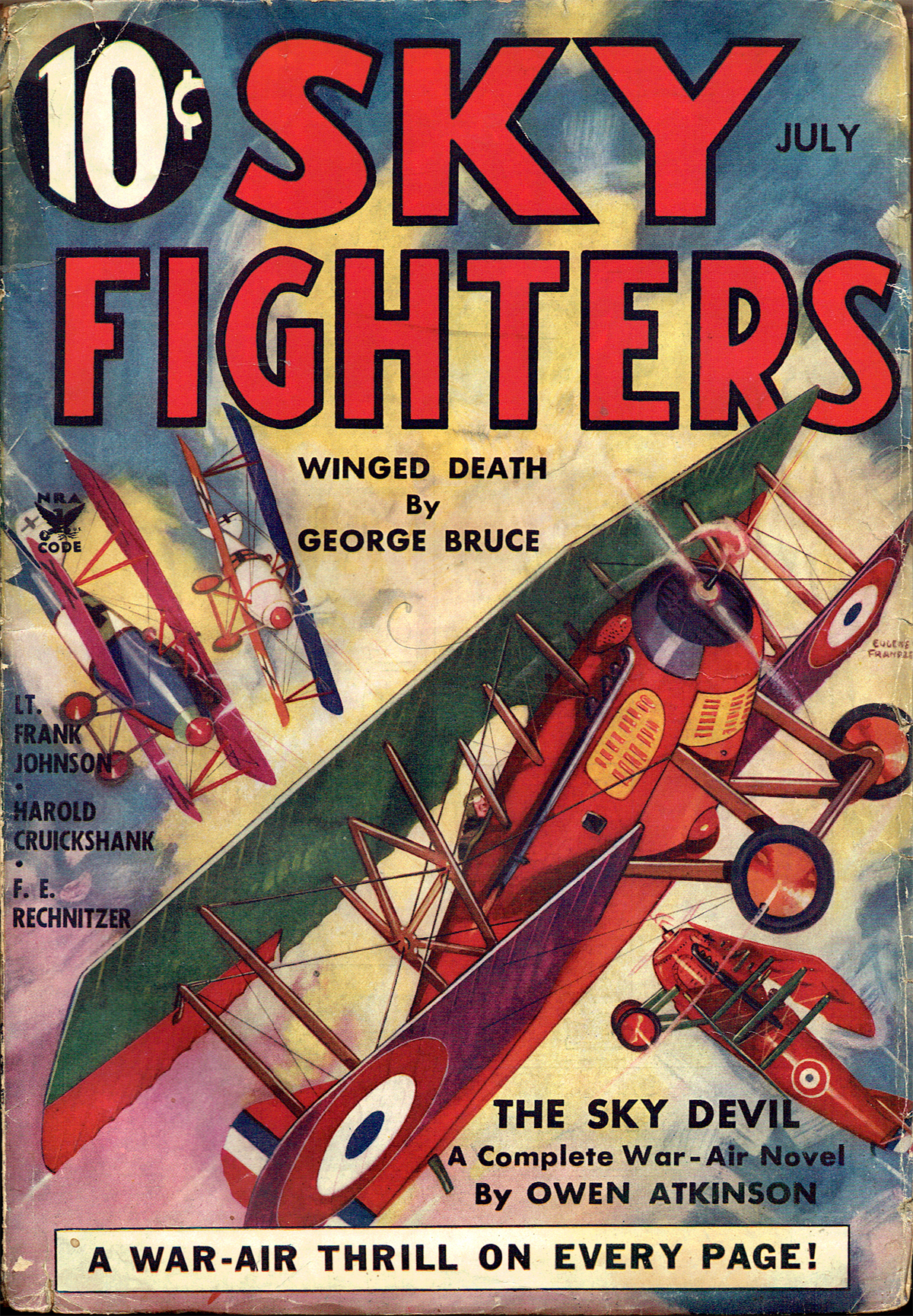
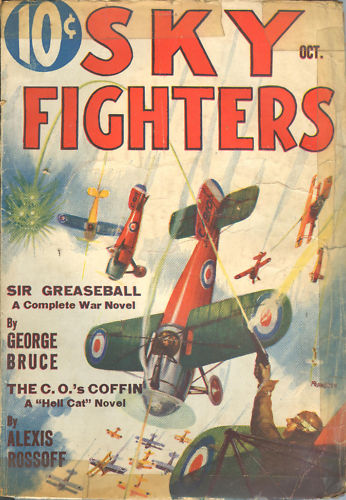
THIS week we have a story by another of our favorite authors—Harold F. Cruickshank! Cruickshank is popular in these parts for the thrilling exploits of The Sky Devil from the pages of Dare-Devil Aces, as well as those of The Sky Wolf in Battle Aces and The Red Eagle in Battle Birds. He wrote innumerable stories of war both on the ground and in the air. Here we have a story of acting Captain “Nim” Halsey—sent by intelligence to find the leak at Squadron 36. His search for the leak leads Nim all the way to “The Devil’s Forest!”

From the July 1935 issue of Sky Fighters—

Deep in the Craggy Badlands of the Ardennes, Grim Horror Stalked—and Halsey Had to Act Quickly!

How the War Crates Flew: Konking Engines

Link - Posted by David on July 6, 2022 @ 6:00 am in

FROM the pages of the November 1932 number of Sky Fighters:

Editor’s Note: We feel that this magazine has been exceedingly fortunate in securing R. Sidney Bowen to conduct a technical department each month. It is Mr. Bowen’s idea to tell us the underlying principles and facts concerning expressions and ideas of air-war terminology. Each month he will enlarge upon some particular statement in the stories of this magazine. Mr. Bowen is qualified for this work, not only because he was a war pilot of the Royal Air Force, but also because he has been the editor of one of the foremost technical journals of aviation.
Konking Engines

by Robert Sidney Bowen (Sky Fighters, December 1932)

ALRIGHT, YOU FLEDGLINGS, sit up and pay attention! – Huh? What am I sore about? Well, I’m not exactly sore, just a little bit nettled, if you get what I mean. Its this way. A flatspinning fledgling out Arkansas way (I won’t mention his name) has sent me a letter that calls for a light in any country. Yup, its little short of an insult to all us wonderful war pilots.

He says in part:

    I have been reading air magazines for a long time, and although I enjoy the stories, particularly Air Fighters yarns, there is one thing that gives me a pain in the neck. Why, does the Hero always have his engine go blooey just when he’s all set to knock some Fokker out of the sky?
    Did you war pilots ever inspect your engines, or were you just too darn lazy? In other words, there were too many forced landings in the World War to suit me. I’ll bet I’d have kept the old crate going, if I had been over there!

Now I ask you, is that conceit, or is that conceit? However, in view of the fact that some of you other babes-in-wings have hinted at the same thing, I’m going to devote this meeting to konked engines, and how they got that way. If I get too technical, its just too bad for you. So button back your ears!

Before I start, though, I’ll stick in a word about forced landings in general. No pilot ever asked or prayed for one! And we’ve all had them. Right from me, the greatest, down to you, the poorest. A few years ago the papers were full of news about H.M. Prince of Wales falling off his horse. People began to get the idea that the Prince did not know how to ride, which was certainly the wrong idea. Mr. Will Rogers cleared that point up when he asked, “What’s the Prince going to do when his horse stumbles and falls, stay up there?” Well, that also goes for pilots with konked engines. What are they going to do? Walk around on the clouds while the ship glides down?

But to get real serious. Many forced landings during the late war were due to carelessness on the part of the pilot. But an equal number were just tough luck. We’ll pass over the carelessness part and just deal with the tough luck. In short, what were the things that made the old power plant give up?

All the answers to that would fill up this whole magazine a couple of times. So we’ll just deal with the major causes. Like in an automobile engine there are three important things in an airplane engine. The oiling system, the carburation system and the ignition system. All three are absolutely indispensable to the proper functioning of the engine, and the failure of any one of them will cause the other two to fold up.

Take the carburation system. The gas used during the war was usually the best that could be turned out. It was high test, AA, No.1, etc. But, the facilities for storing it at the squadron, often were not of the best. Careful as the pilot and mechanics might be, a few drops of water sometimes got into the gas tank. Eventually those drops of water got into the carburetor. Water being heavier than gas, they collected around the base of the needle valve and prevented gas from being sucked through into the cylinder head. Naturally, the engine stopped because it was gas starved.

Sometimes those drops of water didn’t get as far as the carburetor. They got stuck in a bend in the feed line—a bend that went upwards. The result was that the carburetor was blocked off from gas.

IN EITHER case, the line and the carburetor had to be blown free of water before the engine would hit on all six, or twelve. Now I’ll admit that sometimes the suction of your engine was great enough to suck the water clear, but lots of times it wasn’t. So you’d have to land and clear out the line on the ground.

And another thing. Air engines during the war, were comparatively speaking, mighty delicate pieces of machinery. Just let a few specks of dirt get in with the gas (all gas was strained into the tank as a precaution against that) and sure as the Lord made little apples, those specks of dirt would find their way into the carburetor and gum up the works. Most times they’d get under the needle valve seat, and keep it open, with the result that the carburetor would flood, and your engine would be gassed to death.

And one more thing about gas and carburetors. Vibration from violent maneuvering, to get the heck away from that Hun, would shake loose some of the feed line joints. The next thing you knew the raw gas would be spilling out into God’s open spaces, instead of into the carburetor. And I’m not even saying a word about a Spandaus bullet nicking a feed line, or puncturing your gas tank.

Now, take the oiling system. Most air engines during the war were oiled by what was known as the splash system. Your engine of today is oiled by force feed, or a combination of splash and force feed. In the war engines the big end bearing of the piston slapped down into a sump full of oil and splashed oil all over the place. Oil reached the parts missed by the splash by working its way by centrifugal force through hollowed out channels. Of course, with force feed, you have an oil pump working off the cam shaft, that pumps oil to all necessary parts of the engine. However, with the war engines the oiling system was often put on the blink just the way the gas system was. In other words, some dirt would lodge itself in one of those hollowed out channels, block off an important bearing, and cause said bearing to burn out, due to lack of lubrication. And it did not have to be actual dirt either. A little gob of crusted grease would do the trick. True, engine failure, due to the failing of the oiling system was not particularly common. At least not in my experience. However, it did happen. And nine times out of ten, all the care in the world would not have prevented it.

There’s one thing you fledglings sometimes forget. That is, that the war crates were built and flown eighteen to twenty years ago. In other words, the ships you toot around today, have incorporated in them almost twenty years of aeronautical progress.

Now don’t get me wrong. As I said at another meeting, I’m not trying to give you the impression that we war pilots were supermen, etc. I’m just trying to bring to light a few of the things we bucked up against when you fledglings were doing flat spins in your cribs.

AND now for some words about the ignition system. Believe it or not, eighty per cent of the troubles that happen to your automobile are due to the ignition. If you doubt that, ask the first automotive ignition specialist you meet. The same thing held true with air engines. In your car you have battery ignition. In the war crates you had magneto ignition. Of course you have to interrupt me, and ask why? Well, a battery is additional weight for one thing. And for another, there was no ignition battery during the war that could stand being tipped upside down without the electrolite (liquid content of a wet battery) spilling out.

Yes, I know, I know! There were dry batteries to be sure, and planes that had wireless sending sets used them. But, you cannot recharge a dry cell. And that would call for new batteries darn near every patrol. And that would be too expensive for any government, even though said government had decided not to pay their war debts!

NOW I could get so technical that you’d go ground looping, but I’ll spare you, and just deal with ignition troubles in general. The first, and a very common one—spark plugs quitting. In most cases it was due to the plugs getting carboned up. The gas used in war crates was, as I have told you, very high test. In other words, it ignited, and how! Now, if the rings in the piston are not so good, and the oil ring fails to wipe the cylinder walls clear of all excess oil on the downward stroke, that oil is going to be burned when the vaporized gas is ignited. The result, of course, is carbon that collects on the spark plug points. Presently the gap between the points is closed up with carbon and the plug stops firing. Of course one plug going out does not necessarily mean a forced landing. But it means a loss of maximum power and a ragged engine. I once had the actual experience of getting back home with three plugs quitting on me. But that was in a rotary engine, and the inertia of the revolving cylinders aided by the six other firing plugs (a 9-cylinder Bentely engine) enabled me to make the grade, thank goodness! However, in a stationary engine, more than one plug quitting means that you’ll have a forced landing, nine times out of ten.

Of course the major part of an ignition system is made up of wires. Each wire, naturally has a definite purpose, else it wouldn’t be used. Therefore, if any one of them gets loose, it stands to reason that something is going to happen And something does. Any spark plug wires that shake loose and hit against the engine block instantly short circuit the cylinder for which they were intended. And let the engine ground wire work loose and the whole system goes on the blink. Now, when I say ground wire, I don’t mean a wire leading to the ground, terra-firma in other words. All ignition systems have a definite course of travel for that invisible thing called electricity. In your car it starts from the battery and goes right through your engine and back to the battery again. The path of return is called the “Ground.” In other words it has got to get back where it started. The part of it that is spent is made up for by the generator. To be more definite, the current starts from the battery, is maintained by the generator which also shoots it back to recharge the battery again. In the airplane engine of the war days, the magneto functioned as the battery, and generator combined. It still does in a lot of today’s ships. If wet batteries are used they are used mostly for lighting in the cabin, etc. After all, a battery is added weight, and a magneto gives a hotter spark, so naturally, everything is in favor of magneto ignition in airplane engines, instead of battery ignition.

Now, of course, one could say that constant inspection of your engine and its various parts would go a long ways toward preventing any of the faults of which I have been talking, coming to pass. And to a certain extent, that is true. And it is also true that we inspected our ships before each patrol until we were blue in the face. But in those days all the little kinks had not been ironed out of engines, and their construction was not of the best, so things did happen. I don’t mean to say that we had forced landings every time we took off. Far from it. But we did have plenty. Some of us, more than our share, perhaps. But we never prayed for them, and we did everything possible to prevent them. However, Rome wasn’t built in a day, and neither was a perfect aero engine. Our experiences during the war were ground work for engineers to work upon. So the next time your hero gets a konked engine just as he’s going to blast that Fokker apart, just bear in mind that he hasn’t got a 1932 aero engine up there in the nose. Either that, or else the author forces the poor bird down so that he can be taken prisoner and later escapes with valuable information swiped right off the Kaiser’s desktop.

But anyway, keep on writing in your questions fledglings, because, after all, I don’t get really and truly nettled when you take cracks at us broken-down eagles who used to make three-point landings . . . upside down! Cheese it! . . . The C.O. of this magazine!

“Yank Rookie Gets German Ace” by Paul Bissell

Link - Posted by David on June 13, 2022 @ 6:00 am in

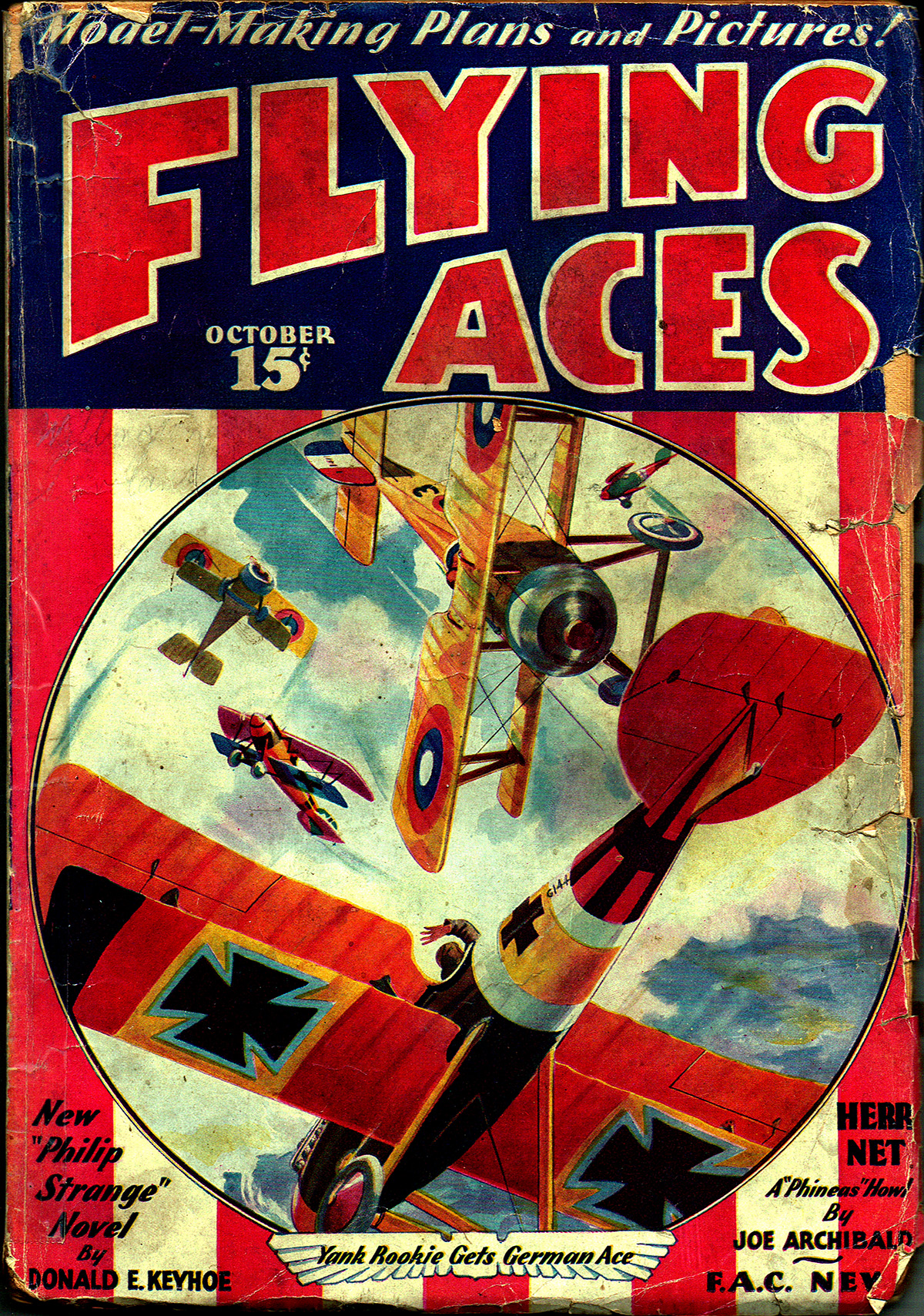
THIS week we present another of Paul Bissell’s covers for Flying Aces! Bissell is mainly known for doing the covers of Flying Aces from 1931 through 1934 when C.B. Mayshark took over duties. For the October 1933 cover Bissell put us right in the action as a …

Yank Rookie Gets German Ace

th_FA_3310IN THE early summer of ’18 the 95th Yank Squadron was having a busy time of it on the Front near Verdun. The long-promised Spads had not yet arrived, and they were still flying their old Nieuports to combat the new Albatrosses and Fokkers with which the Germans were filling the skies.

The squadron losses had not been unusual, but quite heavy enough so that replacements were constantly coming up. Often these were lads who had previously been with the French or English, and so had some actual combat experience. But sometimes there would be one who came fresh from the training centers, with only what experience he had received in “aerial combat” at those fields, and not enough of that.

As a general thing, these lads could be broken in gradually, the usual procedure being for the experienced pilots to take them over in formation, avoiding, if possible, a serious scrap, but allowing them to get accustomed to archie and the feel of being out—assisted to be sure, but on their own, where the stakes were life and death.

If a scrap was unavoidable, the new lads were told to stick close in their formation, or if the formation was broken, to pull out of the scrap entirely if the opportunity presented itself. However, things didn’t always work out 15,000 feet up as they were planned on the ground.

So it was with Lieutenant Walter Avery, who came up entirely without experience to join the 95th. He, like all other rookie aviators, without underestimating his job or the danger in it, was impatient to get at the enemy, and restlessly waited for his time to be taken over.

While waiting, he heard tales of the activities of the Boche squadrons in this sector, especially of an ace named Menckeff, who flew a red Albatross with the tips of its lower wings painted black.

This ace had thirty-eight official victories to his credit, and he and his men had been in many a spectacular dogfight with the Allied birdmen of this sector. Possibly at night Avery dreamed of that red ship with the black lower wing tips. Anyway, those markings must have stuck in his memory for—but that’s part of the story of Avery’s big day.

WITH the sun shining down blindingly from the vast blue dome above, seven German ships sped along over the big white clouds below them. High up there, everything was so quiet, so beautiful and peaceful, that it was almost incredible that the veil of smoke seen drifting across the landscape far below was really the shroud of hundreds who at that instant were dying—a sacrifice to the gods of war.

So, indeed, it was impossible to believe that these ships flying swiftly and easily, beautiful in the sunlight, their red wings flashing, were in reality a squadron of death, mercilessly searching for their victims.

Far below, coming from behind a cloud, five tiny specks had appeared, almost invisible against the shell-torn earth still miles beneath them. The quick eyes of the Boche leader had observed them, however, and already his wings were wagging their signal to his comrades. The red, blue and white circles on the lower planes showed them to be Americans. It was the 95th, and Lieutenant Avery was being taken over for the first time.

He had already come through his first tryout with archie, and had marveled at the apparent unconcern of the older pilots when puffs of smoke had appeared all around them as if by magic, and their ships had been bumped around as if by the hand of the magician himself. The flight had shifted course suddenly, and at certain definite intervals, but that was all, and soon the smoke puffs had ceased.

But now it was different. The flight leader had banked up sharply, at the same time giving a quick signal. Avery, looking over his shoulder, saw seemingly countless red ships, their guns blazing, diving straight down on him, and he knew that this was one scrap not as per ground instructions.

Just what happened during the next few moments will always remain a confused mass of memories to the young airman. He tried to remember his warning to stay in formation, but there seemed to be no formation left. He had escaped the first driving onslaught and was now just one of twelve twisting and dodging planes. So far he had not even used his machine gun. There had seemed nothing to shoot at—just flashes of color that passed him before he had opportunity even to determine what they were.

Then some bullets, spattering close to his cockpit, brought him abruptly out of his confusion. His senses cleared. All his training came back suddenly. He threw his ship into a screaming vrille and came out with a red ship square in front of him. Automatically his fingers squeezed the trips, and for the first time he felt the thrill of actual combat. His aim was high. He saw his tracers pass over the top wing of the other ship.

The German was busy on the tail of one of the other Americans and had not noticed Avery. A yank of Avery’s stick brought the whole enemy ship more into line. Then for the first time his eyes caught something that sent his heart into his mouth. The red Albatross had black lower wing tips.

Carefully he sighted, aiming at the nose of the Albatross so that the German would have to pass through the line of fire. Once again his guns throbbed, and this time his aim was true. The German plane shot up in a tight loop like an animal stung unawares, but at the top, his motor sputtered and he dropped off to one side. Right behind him went Avery, his guns blazing, the bullets ripping the sides of the diving Albatross.

It was soon over. They had drifted too far over the Allied lines for the Boche to make the German side; so, with motor gone, unable to fight, and himself wounded, he threw up his hands in surrender. The scrap was over, and Avery headed back for the airdrome.

His squadron mates had seen the newcomer get his German, but it was not until the prisoner had been brought in that Avery was sure his eyes had not deceived him. And not until then did his comrades realize that the young American lieutenant had on his first flight over the lines brought down the famous German ace, Menckoff—a record we believe unique in the annals of the war.

The Ships on The Cover
“Yank Rookie Gets German Ace”
Flying Aces, October 1933 by Paul J. Bissell

How the War Crates Flew: Tricky Ships

Link - Posted by David on June 8, 2022 @ 6:00 am in

FROM the pages of the November 1932 number of Sky Fighters:

Editor’s Note: We feel that this magazine has been exceedingly fortunate in securing R. Sidney Bowen to conduct a technical department each month. It is Mr. Bowen’s idea to tell us the underlying principles and facts concerning expressions and ideas of air-war terminology. Each month he will enlarge upon some particular statement in the stories of this magazine. Mr. Bowen is qualified for this work, not only because he was a war pilot of the Royal Air Force, but also because he has been the editor of one of the foremost technical journals of aviation.

Tricky Ships

by Robert Sidney Bowen (Sky Fighters, November 1932)

POWERLESS to do a single thing about it, the members of the 23rd pursuits watched the lone Camel flatspinning down to total destruction. Its pilot was plainly visible, battling the controls. But his frantic efforts were to no avail. Seconds later the nose struck, flames leaped skyward, and another pilot was added to the long list of tricky ship victims. . . .

And that, fledglings, was the way more than one Hun-getter checked in his chips during the late war . . . a victim of a tricky ship, not Spandaus lead. Now, don’t go getting the idea that those lads were dumb pilots, else they wouldn’t have allowed their crates to throw them. That’s not the idea at all. More than a few crack pilots got into trouble with a tricky ship and lost the decision. What we are going to try and point out this meeting is that during the late war a peelot had to be a heads-up peelot for reasons other than those manufactured in Germany.

Present day ships are so well designed and constructed that you can almost go to sleep and let them fly on by themselves. They are steady as a rock even in pretty punk weather, and when anything does happen there is always the good old ’chute-pack on your back. All you have to do is step overboard, count six and pull the ring. But the war crates? Ah, there you have something different . . . mighty different, and don’t you forget it! In the first place, they were all designs of 1914-1918 vintage, naturally. Designers didn’t know as much then as they do now. And, there were no parachutes for pilots. The Germans started using ’chutes during the last year of the war, but the Yanks, English and French never had them except for balloon work.

That statement may surprise you, after some of the war-air yarns that you’ve been reading. But it happens to be a fact, and any war peelot will check on that statement.

But to get back to the business of these tricky ships. That questionasking fledgling over there in the corner looks like he’s ready to burst with curiosity, so I’ll talk fast and maybe choke him off.

JUST for the heck of it, we’ll take some of the war crates, one by one, and elaborate on their tricky features and peculiarities.

Of course, the Sopwith Camel is the first on the list. Of all the tricky ships that crossed over No-Man’s-Land the Camel was the trickiest of them all. A wonderful stunting crate, and great stuff in a dog scrap, but my, my, how you had to watch that baby and check its tendency to throw you for a flock of wooden kimonos!

The Camel was powered with a Clerget, Le Rhone, and later for high altitude work, with a 210 Bentely. All three were rotary engines. And all three gave the ship its nasty desire to flip over and down on right wing and into a tight spin. It was propeller torque that did that. As I explained at another meeting, propeller torque is a tendency for a ship to go in the opposite direction to the rotation of the propeller blades. In a Camel the prop rotated from right to left (standing in front of the prop). Therefore the ship would try to swing to the right (the pilot’s right when in the cockpit). Naturally, the way to counteract that was to keep on a bit of left rudder all the time. In other words, when you wanted to make a right bank you really eased up a bit on left rudder and let the torque carry you around, instead of actually putting on right rudder. The Camel was also rigged to whip around on a dime, and that helped the engine torque idea all the more. There was no dihedral on the top wings, but there was about two degrees on the bottom ones.

What’s that? What’s dihedral?

Well, Fledgling, dihedral of airplane wings is the angle of a wing upwards and outwards to the horizontal. In other words, if a wing is pefectly flat it has no dihedral, but if it tilts upwards it has. No dihedral reduces the horizontal stability of a plane, and in this way. The area under a tilted flat wing is the same on either side of the fuselage. But when there is dihedral the area (called horizontal equivalent) becomes increased on the down-tilted side and increased on the up-tilted side. Therefore the natural reaction is for the plane to right itself to an even keel.

Naturally the dihedral on the lower wings of a Camel was put there so that the ship wouldn’t fly completely wild, but still be a fast maneuvering ship. Never having experienced such a thing, I can’t go on record definitely, but I would say that flying a Camel with no dihedral on any of the wings would be just like going down a mountain road at midnight, with both headlights on the blink. You’d just hang on and pray that you didn’t hit anything.

WHENEVER a pilot slipped up in alertness and engine torque whipped a Camel over on its right wing, it always fell into a tight spin. Now a spin is nothing to get grayhaired about, even in a Camel, if you have altitude. BUT, the camel was so darn sensitive to the controls that when you took it out of a spin you had to be mighty careful lest it didn’t flip right over into a spin in the opposite direction. In case you don’t know, you stop a plane from spinning by moving the controls as though you wanted the ship to spin in the other direction. But as soon as the ship stopped spinning the original way, you checked its tendency to flop over on the opposite side, and began to get the nose up. In a Camel split-second checking was in order. You couldn’t take your time about it. The instant the ship stopped spinning you had to check and get the nose up, else you went spinning down in the opposite direction, and had the whole darn job to do all over again.

THERE was also another tricky feature of the Camel, and one which cost many lives. That was the tendency of the ship to go past the vertical when diving.

You would start a steep dive in a Camel and unless you watched the ship the nose would start to swing back to the rear, and before you knew it you were diving backwards as though you were going to pull an outside loop. The way to get out of that was to pull the stick back so that the nose would start moving forward, and then when you got vertical again to slowly ease the nose up. But it was right at that moment when a lot of chaps checked out of the world, and for this reason. When a Camel’s nose starts back toward the vertical, after being past it, it comes slowly at first but as it reaches the vertical it develops a vicious tendency to whip upward in a zoom. If you don’t check that and hold the ship steady in a vertical dive, and ease up slowly, why, the result is that you lose your wings. The savage up-thrust of the plane, with the top surfaces of the ship broadside to the line of motion, just wipes the wings off as though they were so much paper.

Now, if you’ve been listening to me, instead of falling asleep like that fledgling over there, why, you’ll realize that both of the principal tricky features of a Camel can be hooked up together. But, in case you don’t, it’s like this. You’re buzzing along, and start to make a right bank, a split-arc turn. You take off too much left rudder, and zowie, engine torque whips you over to the right and into a spin. You start to take it out, don’t check it in time and zowie, it flops over into an opposite spin. You start to take it out, check it this time, but before you realize it you’re diving past the vertical before you’ve had time to start getting the nose up. Well, you try to get the nose forward to the vertical, and then when it gets to the vertical you don’t hold it steady. Zowie the plane zooms up, the wings come off, and zowie . . . no more peeloting for you in this world! Now, do you get the idea?

ANOTHER tricky ship that Sopwith also made was the Sopwith Pup. Strictly speaking, it wasn’t what you’d call a dangerous ship. It was simply a crate that made you stay awake if you cared anything about seeing the girl friend again. It was a very small job, and naturally very light. And being light, it floated like a feather. And as it floated like a feather, the job of landing was just that much more difficult. Time and time again (until you got the hang of things) a greenhorn pilot would overshoot the field. Of course that’s okay provided the engine is still functioning. You simply feed it the hop, go around and try again. But in the event of a forced landing, why, the story was different. You only had one chance then, and if you didn’t make good you were just out of luck. The Pup came out before the Camel but was used mostly for training purposes. It was so small and light that it couldn’t stand the gaff in a dog-scrap.

In the early part of 1918 the Sopwith outfit came out with a ship called the Snipe. It was an improvement on the Camel, and was intended for high altitude work. Only two Snipe squadrons got out to France before the Armistice, and those only for a few weeks. But they certainly knocked the pants off the Fokkers, which proves what swell ships they were. The first model was known as the Unmodified Snipe. It was the tricky job. The fuselage was barrel shaped and the rudder and tail surfaces a bit too small. The result was that when you got into a spin it was the task of your life-time to get it out. The reason for that was this. The fuselage being so big and the tail surfaces so small, the slip-stream didn’t strike all of the surfaces. When the ship went into a spin an air-lock would be formed between the rudder and the elevators. That would practically render the controls useless. In other words the tail surfaces were so blanketed by the size of the fuselage that they wouldn’t get the proper grip on the air. (Fig. 2.) Once the ship got into a spin it was difficult to present a flat spin developing when you tried to take it out. It was practically impossible to come out of a flat spin. What you had to do was go back into a tight spin again and make another try to get past the flat spinning point. Just so’s you won’t be too confused about my jabbering, a tight spin is when the wings revolve about the fuselage as the axis. And a flat spin is when the plane pivots around the nose in a gyroscopic motion. In other words, the plane is at a slight angle to the vertical and the whole plane goes swinging around in a circle, sidewise.
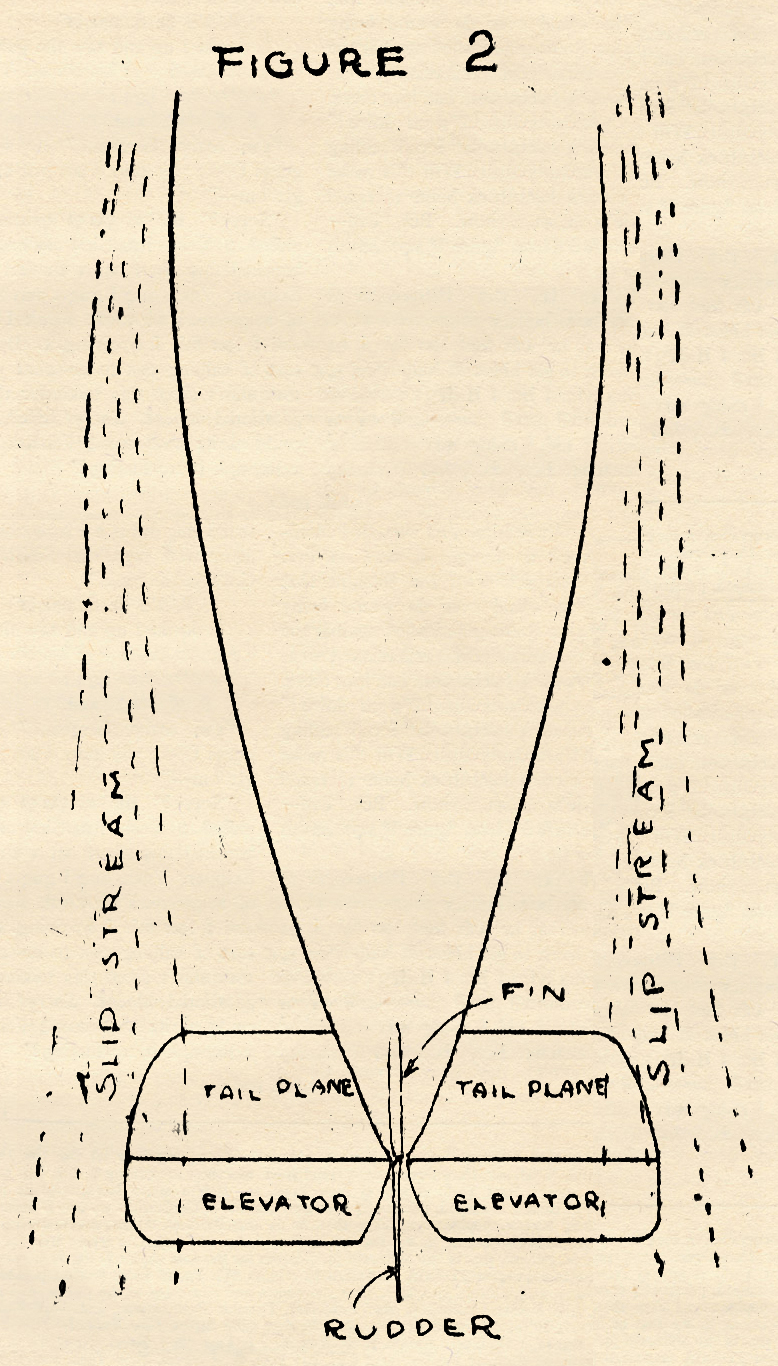
Yeah, no fooling, a spin in an Unmodified Snipe was not so hot. We speak from experience about that item. One day during a joyhop we slipped into a spin at ten thousand feet, and it took us just eight thousand feet to get out of it. Another two thousand feet and yours truly wouldn’t be here chinning with you fledglings.

Later that fault was corrected in what was called the Modified Snipe. The elevators were made a bit bigger and the ship had a balanced rudder and balanced ailerons. And if you don’t know what those things are, why, just take a look at Fig. 3.

THE well known Spad might be called a tricky ship because it was more or less a flying brick, and didn’t have much of a gliding angle. Naturally, all that means that the Spad was heavy, and it was, darned heavy in proportion to the wing surface. Under full power it was a sweet ship, but when you cut the gun you had to look out. The nose just plopped right down and you started diving hellbent. In the event of a forced landing you had to decide on your field mighty quick, because you didn’t have much time to think it over. You just naturally lost ground too fast. We once had a Spad forced landing. The engine konked at two thousand feet and we were just able to make two and one-half gliding turns to get into a field. But, of course, maybe a GOOD pilot could have made five. Now, you know what we think of us!

Speaking of landing reminds me of the Sopwith Dolphin, a high altitude scout that came out in 1918. The cockpit was right under the top wing. In fact we got into it through an opening in the wing. It was a smooth job until it came time to land . . . then, hold her Newt! If you ground looped it was just too bad. Why? Well, you usually went over on your back, and there you were, head down in the cockpit and no way to get out because the opening in the top wing was right smack against the ground. And if the ship caught fire . . . well, you can figure that out for yourself! After several chaps got burned alive or had their necks broken, braces were put on the top wing so as to give the peelot exit room when he needed it.

A LOT of your heros in this mag fly the good old S.E.5 and S.E.5a, but we can’t list either as a tricky ship, because it was only tricky when the peelot was just plane dumb. We mean this. The S.E. had what was known as an adjustable tail plane. In other words, from the cockpit you could adjust the tail plane (section to which the elevators are attached), so that it would tilt up or down. In other words, you could make the ship nose heavy or tail heavy, just as you wished. When taking off you would tilt the tail plane upward and that would help you get into the air sooner. And in landing you’d do the same thing because the reaction would be for the nose to go up, and thus you would have less trouble getting the tail down for a nice three point landing. But when you forgot about that tail-plane the ship got real tricky. For instance, you might pile into an S.E., slam home the juice and go tearing across the field. If the tail-plane happened to be tilted down you’d probably dig your prop into the ground. Another case is when you’re landing and over-shoot the field. Well, you feed the hop to go around again, and pull back the stick to get more altitude. Well, if the tail plane has been tilted up, as it should be for a landing, why, you’ll just go zooming up quicker than you expected, and if you don’t re-adjust the tail plane you’ll find yourself on your back at a rather low altitude for that sort of thing. So, of course, S.E. peelots remembered that they had a tail-plane just like they remembered they had an engine in the nose!

WELL, here comes that hard-boiled C.O. of this mag, and the look in his eye says, scram. But before I do, just let me lip another word or two. Don’t get the idea that we bohunks who flew the war crates were supermen. Far from it, believe you, me! But some of the ships were tricky, as I’ve been explaining, and the war peelot who went to sleep on the job, or didn’t keep his mind on the race, was asking for a lot of trouble that wasn’t German-made, either. But even a dumb peelot could handle them okay, if he paid attention to his knitting. And the very fact that we used to fly them, and are still alive, proves the above statement beyond all possible argument.

And the same to you! S’long!

“Flying Aces, April 1935″ by C.B. Mayshark

Link - Posted by David on May 30, 2022 @ 6:00 am in

THIS May we are once again celebrating the genius that is C.B. Mayshark! Mayshark took over the covers duties on Flying Aces from Paul Bissell with the December 1934 issue and would continue to provide covers for the next year and a half until the June 1936 issue. While Bissell’s covers were frequently depictions of great moments in combat aviation from the Great War, Mayshark’s covers were often depictions of future aviation battles and planes. April 1935’s thrilling story behind its cover features an Attack on San Fancisco!

Attack on San Francisco

th_FA_3504 FROM across the Pacific a harmless-looking tramp steamer is churning its way to a point within five hundred miles of San Francisco. There is nothing about her appearance to arouse the slightest suspicions on the part of anyone. She is just like a thousand other tramp steamers—black and smoky and clumsy-looking.

As the ship nears the California coast line, it heads into the wind and drops anchor. Activity on deck is apparent as huge hatches are removed and the swinging arm of a derrick is brought into play. Terse orders are barked out, and obeyed with smart promptness. Military procedure appears to be the keynote of all operations—a thing unusual in a tramp steamer’s crew.

An observer, if he had the good fortune to watch the activity unseen, would by this time begin to doubt the steamer’s appearance. As a matter of fact, he could not help suspecting a warlike objective. Tramp steamers do not stop five hundred miles off San Francisco for the fun of it.

In San Francisco Bay, a batch of United States destroyers and cruisers are weighing anchor, preparatory to steaming out of the harbor and joining the rest of the fleet for operations off Catalina Island. The smooth lines of the fighting craft are set off in sharp relief against the blue hills of the Tamalpais range. Unlike other mechanical devices, they add immeasurably to the natural beauty of the surroundings, and as they slowly get under way, they remind one of a giant cat carefully threading its way through leaves and branches, only to bound into action with a roar as its prey is hopelessly pinned beneath it.

One by one, Uncle Sam’s ships steam up the bay, through the Golden Gate and out into the broad Pacific. As they pass the hundreds of workers busily employed on the construction of the new Golden Gate Bridge, a spontaneous cheer floats across the still air from riveters and engineers alike. With a sense of proud security, the bridge workers drop their tools to gaze intently on each vessel as it passes beneath them. There is something awe-inspiring about the United States Navy, and it makes the men on the steel towers reflect upon the possibility of foreign invasion. Each Navy ship seems like such a mountain of strength and durability that an offensive move against our coastline by anyone would most assuredly lose. However, torpedoes that find their mark are seldom ineffective.

By this time, the tramp steamer has completed its work. Two Kawasaki two-seater torpedo planes are well on their way to San Francisco, and as they flash up over the horizon, their pilots see that they must hurry. Almost half of the destroyers and cruisers are already clear of the Golden Gate channel. The rest must remain inside.

As the two airplanes draw near, a cry of fear rings out. The bridge workers realize that this is not a friendly air visit. The torpedoes hung between the wheels of each plane give cause for grave doubt, and all operations on the Golden Gate span stop as the men scramble to places of safety.

But what is this roaring out from the mainland? Two Navy planes to the rescue! The approach of the two foreign torpedo ships has been observed from a land station and, taking no chances, the C.O. has sent a couple of Vought landplanes into the air.

The pilots of the Navy planes, of course, figure the move a useless one. Nobody would torpedo United States cruisers or destroyers out of a clear blue sky, when there is no apparent motive, they think. Doubtless, the Navy pilots are unaware of a recent diplomatic breach between the United States and a certain Eastern power. They are unaware of the fact that a certain power considers itself Uncle Sam’s equal and is out to prove it. Most of all, they don’t know that a whole fleet is at that very moment charging across the Pacific, intent upon taking swift advantage of the preliminary work to be done by the torpedo planes.

The object being pursued by the invading power is simply this. As the fleet, or part of it, is departing from San Francisco Bay, one or more ships are to be torpedoed and sunk directly in the Golden Gate Channel, thereby making it impossible for the remainder of the craft to accomplish their scheduled departure. In this way, the attacking warships would be left more or less free to proceed with the bombardment of San Francisco and the near-by coast-line cities, thereby paving the way for the actual landing of troops. Of course, failure to bottle up the fleet in the bay would mean failure at the very start of the enterprise.

In the particular instance, some of the Navy fighting craft have already made their safe departure through the Golden Gate, but there are still numbers of ships which theoretically could be locked inside. Besides the ships that are in the clear, the rest of the fleet is still somewhere off the coast of southern California. These combined forces might possibly fight off the attacking navy, but that is doubtful.

The only course left open, then, is defense by air. Naturally, the attacking forces are well equipped with aircraft carriers and launching apparatus on all battleships. Quite possibly the combined strength of the Pacific Coast Army and Navy Air Forces might turn the tables completely and force the invaders into confused retreat. The whole affair would be a huge air battle, with both sides sending hundreds of planes into the air. If the invaders should win, California would be doomed. If Uncle Sam’s ships came out victorious, the outcome even then would be problematical.

But to get back to the two torpedo planes bearing down on the Golden Gate. Will they accomplish their purpose and block off San Francisco Bay? Or will the Corsairs send them charging into the water?

No one can say what would be the outcome of such a venture, but this much we do know. Judging from the recent better understanding which has been accomplished between most of the nations of the world, and from the bitter lessons which we all learned in the last great war, we have good reason to assume the belief that no nation would care to or have reason to attempt a wholesale invasion such as the one fictitiously described here. We earnestly hope this to be the case, and we pin our hopes on the strength of the United States Army and Navy Air Forces.

The Story of The Cover
Flying Aces, April 1935 by C.B. Mayshark
Attack on San Francisco: Thrilling Story Behind This Month’s Cover

“Cocarde Sharpers” by Joe Archibald

Link - Posted by David on May 27, 2022 @ 6:00 am in

“HAW-W-W-W-W!” You heard right! That sound can only mean one thing—that Bachelor of Artifice, Knight of Calamity and an alumnus of Doctor Merlin’s Camelot College for Conjurors is back. Yes it’s the marvel from Boonetown, Iowa himself—Lieutenant Phineas Pinkham!

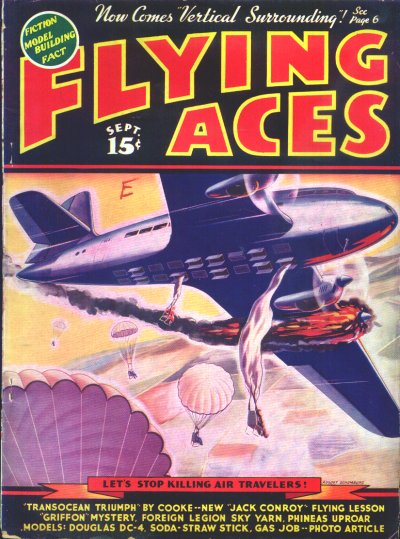
Looks like the Boomtown Miracle Man is public enemy No.1. Everyone wants Phineas Pinkham dead! The Germans are looking for him and bombing the 9th unmercifully in hopes of hitting their mark. As a result, everyone at the 9th Pursuits would like Pinkham to expire. Even his girl, Babbette wants that fiery-headed Yankee Peeg dead. What’s a Pinkham to do? Find out in Joe Archibald’s latest, larrupin’ laff fest—from the September 1938 Flying Aces, Phineas Pinkham puts the “poke” in poker in “Cocarde Sharpers!”

“Get das Pingham!” war-cried the flocks of squarehead flyers facing Bar-le-Duc. And when they proceeded to pour seven months’ output of Krupp poison onto the drome of the fighting Ninth in seven days, the battered and bomb-sprayed Major Rufus Garrity had to admit he was licked. “Pinkham,” he said, “for the safety of the rest of the service, go out—and get yourself killed!” And wasn’t Phineas always a man to obey orders?

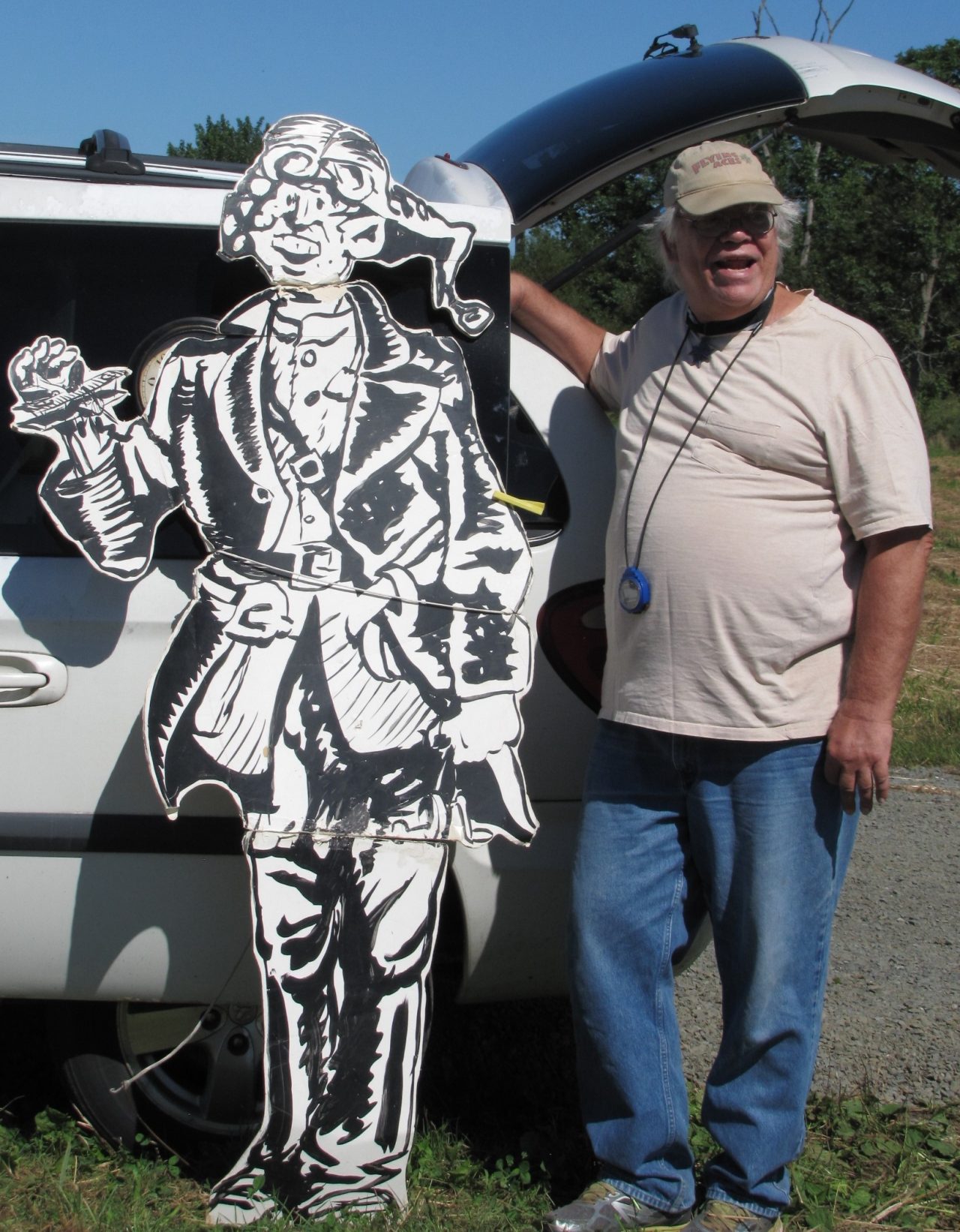
And lest you think the legend that is Phineas Pinkham resides only in crumbling old magazines from 80 years ago, the modern day Flying Aces Club keeps his spirit alive! The field where they hold their competitions is named “Pinkham Field” after the great, grinning, jug-headed buffoon. In fact, he’s even been known to put in an appearance!


The FAC’s Information Technology Guru, Rick Pendzick was awarded the FAC Blue Max at the September Outdoor Contest at Pinkham Field in Connecticut. That’s Rick on the right with Phineas Pinkham.

“Flying Aces, March 1935″ by C.B. Mayshark

Link - Posted by David on May 23, 2022 @ 6:00 am in

THIS May we are once again celebrating the genius that is C.B. Mayshark! Mayshark took over the covers duties on Flying Aces from Paul Bissell with the December 1934 issue and would continue to provide covers for the next year and a half until the June 1936 issue. While Bissell’s covers were frequently depictions of great moments in combat aviation from the Great War, Mayshark’s covers were often depictions of future aviation battles and planes. March 1935’s thrilling story behind its cover features Martin Bombers vs. Armed Transports!

Martin Bombers vs. Armed Transports

th_FA_3503NEW YORK, the metropolis of the nation, threatened with complete ruin! An unknown foe striking from the mist-shrouded deeps of the North Atlantic on wings of treachery, with all the speed of light and the blasting power of lightning! High-speed bombers converted in a few hours from peaceful commercial craft, loaded with high explosive and bristling with machine guns!

A wild fantasy? Impossible? But not so! Already it has been proved that several well-known commercial types used by many countries are so constructed that within a few hours they may be turned into grim war craft.

Any day, the great city of New York might be shining in the sunlight of a Spring morning to realize suddenly that within an hour the sunshine was to be blotted out by clouds of poison gas, billowing waves of screen smoke and the acrid fumes of high-explosive flame. Great buildings might be blasted from their bases, to topple with the thunder of Thor down into the cavernous streets of the city, wiping out hundreds of lives and spreading destruction in their crunching wake. Death and disease would stalk through the ruins and blot out thousands. Famine, waste and thirst would follow the concussion as these aerial monsters screened behind peaceful commercial insignia swooped down and struck the first blow of an unexpected war.

But their mission might be detected by the roving Coast Guardsmen, and great Martin bombers would sweep into the sky to intercept them. The Junkers Ju. 60 depicted on this month’s cover is a typical ship on which this conversion job could be attempted. And remember, Germany is not the only foreign power that uses this type of commercial craft. The Junkers ships are manufactured under license all over the world, so the Ju. 60 could be the vanguard of attack from any one of several foreign countries.

The Ju. 60 is classified as an express monoplane. It will accommodate eight persons, a more than adequate number for a bombing crew. The only visible changes in the ship are the gunner’s door in the roof, the bomb equipment, including racks and bombs under the wings, and the machine guns protruding from the side windows. Of course, other minor changes would be necessary within the fuselage.

Perhaps the most interesting feature of this ship is its power plant. The engine is a B.M.W. Hornet, and it is built in Germany under license from the Pratt & Whitney Co. of Hartford, Conn. Its design is absolutely identical with the Hornet series A of the licensor. The Hornet is a nine-cylinder, air-cooled radial engine on detachable engine mounting, and it is capable of 600 horsepower. A three-bladed metal air screw is used.

The ship can attain a speed of 175 miles per hour and has a range of 683 miles. Undoubtedly, however, this range would be greatly increased when the bomber conversion job was completed.

The Martin bomber has received a great deal of publicity, which it has rightfully deserved. The performance of the Martins that made the Alaska trip last summer was indeed enviable. It is the general consensus of opinion that the Martin bombers of the YB series are the fastest and the most efficient ships of their type in the world. These ships do better than 200 miles per hour, and they are so maneuverable that they can be used as pursuit or attack planes in case of emergency.

Presuming that the United States is attacked by an unknown foreign power with an air arm that incorporates a number of these converted commercial ships, let us see what would be the result of an air battle between a Junkers and a modern Martin. We must, of course, take the fictional attitude that a fleet of these Junkers has been catapulted from a giant launching gear, or from the hurriedly converted flight deck of a long tanker, for a secret raid on some important military point on the mainland.

In the matter of a ship-to-ship conflict—that is to say, an equal number of Martins against a formation of Junkers—we must consider the duties of each ship. The Martins are on the defensive, purely and simply, while the raiding Junkers have the problem of making their bombing attack and defending themselves at the same time. After all that is over, they must get back to their surface base.

So far, so good. The Junkers have almost reached the mainland when their move has been spotted and the defending squadrons are sent aloft. If, for instance, as is the case, they have decided on a raid on New York City, they would first have to brave the anti-aircraft fire from any of the several forts in the mouth of the Hudson. This, in itself, is no easy task, and several would probably, on the law of war averages, go down or fail to gain their objective.

The rest would have to make their way through a winged wall of 200-mile-an-hour Martins armed with high speed and high-calibre guns. The Junkers, gorged with heavy bombs, would not get up to their best speed, and all battle tactics would have to be thrown aside in their dash for their targets. The Martins, on the other hand, unhampered by pre-arranged plans, would have the benefit of freedom of action under a general leadership of a squadron leader in a flag-plane. While the Junkers ships plunged on, dead for their objective, depending mainly on their gunners, the Martins would be able to form angle attacks to harass the visitors.

Now, it is not exactly true that the fastest ship always wins a fight, especially where defensive ships try to intercept bombing machines. The last year of the World War proved that, and we shall have to accept the fact that in this great defense, many Martins would be destroyed. However, with the gunnery of the modern bomber-fighter, the air battle would become something of a mid-air battle-cruiser engagement in which speed, careful maneuvering and gunnery would win.

In this case, then, the slower Junkers bombers, confined to a direct line of flight—at least, until they have reached and bombed their objective—would be on the short end of the battle, for the speedy Martins would be able to use all their, fighting tactics. The gunnery must be considered on modern figures. No country in the world today is believed to have the aerial weapons that the United States boasts.

Therefore, the Junkers would come under another bitter blow. While the enemy got in the first thrust by surprise in the use of a converted transport ship, the side with equipment especially designed for defensive work would win in the end. The attacking party always loses more than the defending—an old war axiom—but in doing so, it actually accomplishes its end or goal.

Thus, on facts and figures, the Martin bomber should always be able to outdo the converted commercial ship.

The Story of The Cover
Flying Aces, March 1935 by C.B. Mayshark
Martin Bombers vs. Armed Transports: Thrilling Story Behind This Month’s Cover

“Flying Aces, February 1935″ by C.B. Mayshark

Link - Posted by David on May 16, 2022 @ 6:00 am in

THIS May we are once again celebrating the genius that is C.B. Mayshark! Mayshark took over the covers duties on Flying Aces from Paul Bissell with the December 1934 issue and would continue to provide covers for the next year and a half until the June 1936 issue. While Bissell’s covers were frequently depictions of great moments in combat aviation from the Great War, Mayshark’s covers were often depictions of future aviation battles and planes—Case in point, for three issues, starting with the December 1934 issue, Mayshark depicted Air Battles of the future! For the third and final future cover on the February 1935 issue Mayshark gives us the Troop Ship of the Skies!

Air Battles of the Future: Troop Ship of the Skies

th_FA_3502WAR in the air! What would it mean in the future?

Armadas of fighting ships in grim formations, thundering into attack at terrific speed? Darting scouts bristling with guns directed from a ground base? Giant dreadnaughts of the sky in battle formation, answering the commands of the Air Admiral as he paces the bridge of his battle-plane?

All this—and more! There is another side to the air war of the future. What the raiding cruisers and monitors of World War days were to the elements of attack, the new troop carrier would be to the future war in the air. A great flying boat, capable of transporting several hundred men, weapons, demolition devices and transport destruction equipment, could swoop down out of the skies from bases several thousand miles distant, and before ground troops could be brought up to lay down temporary lines of defense, these flying boats could be gone, after paralyzing whole sectors, battering important base points to bits and—what is more terrible—destroying the morale of the civilian population.

Let us picture a possible raid of this type—say five, perhaps ten years from now.

At the present rate of improvement in service equipment, we can easily picture a United States Navy patrol station leader faced with the astounding report that an unknown troop transport has been seen heading toward the eastern coast of the United States. The formality of the declaration of war leaves everyone concerned with the problem of learning who and why. But the orders state in crisp, terse sentences that the mysterious troop transport must be blocked off and prevented from making a landing on the mainland.

A Captain Sully and a Lieutenant Stevens, crack contact men of the Twentieth Squadron, are shown the message and ordered off to do the intercepter job. Unfortunately, their equipment is nothing more up-to-date than the Curtiss Goshawk, a fine ship in 1934, but hardly an intercepter in 193—. Still, there’s a job to do, and Sully and Stevens take it on. The former, a soldier to his stubby fingertips, realizes the seriousness of the situation. The latter, still in the prime of youth, regards it a great joke and, probably, the nightmare of some sleepy-eyed transatlantic liner radio operator.

The trim but service-weary Goshawks are warmed up.

Once in the air, Captain Sully turned his thoughts to the mysterious orders he has in his pocket. Troop transports are ordinary things. Every country’s air force has them—has had them for years, but machines under this classification have never been regarded as particularly effective because of restrictions in accommodation of personnel and equipment.

The Navy pilots have been speeding close to the water for only a few minutes when what they thought was somebody’s bad dream turns into stark realism. Thundering along close to the water at a good rate of speed, a giant flying boat comes into view from out of a cloudless horizon.

With a gasp, Sully jams his foot down on the rudder control, and the fighter lurches to the left. With Stevens close behind him, the Navy pilot darts out of firing range of the huge transport. After banking around and flying along parallel with the mysterious air monster. Captain Sully has time to make a more comprehensive inspection of the ship.

Between two wings which have a slight degree of dihedral, there are seven motor nacelles, all set in the same plane. Each nacelle carries two motors—one driving a tractor and the other a pusher air-screw. There are a total of fourteen engines, the aggregate energy of which is fourteen thousand horsepower.

Each motor nacelle is supported by a main strut and also by two smaller struts which connect with the trailing edge spars. These smaller struts take up the forward thrust, which is generated to a very marked degree when two thousand horsepower is unleashed. The engines are cooled by means of a special liquid cooling agency, air cooling being impractical when engines are set in tandem. Cantilever construction is employed in the wings, the ribs and spars being built entirely of a light-weight composition metal.

The hull of the ship is connected with the lower wing, through which an extension of the hull passes. The center motor nacelle is built upon this extension. The control cabin is located forward of the leading edge of the lower plane, where the best possible line of vision is obtained, and from where most of the ship can be viewed. This facilitates immediate action in case anything goes wrong with the controls, motors, or anything else important to the flight of the ship.

The hull of the ship is divided into three sections, the central section being large and the other two small. In the central section there are accommodations for 275 men. All their equipment, including rifles, pistols, ammunition, blankets, gas masks, and extra clothing, is carried in the forward compartment, each man’s supplies being stowed in a separate closet. The galley and various other stowage compartments are located in the aft section of the hull. Gasoline and oil tanks, as well as extra motor parts, are also carried in this section. Minor motor difficulties can be repaired in flight by means of a catwalk which connects the motor nacelles. Space is provided in the two outboard pontoons for auxiliary gasoline tanks.

It is safe to assume that any invading nation would not send a transport full of buck privates into the United States, because even 275 armed soldiers are not likely to be particularly effective unless placed where they can make a certain type of raid on a weakly defended point. Instead, this transport is probably loaded with experts in bridge and railroad demolition. It would carry highly trained machine-gun and light field-gun crews who would scatter for a certain distance and throw up a defending ring of steel and fire to cover the workings of the experts. These, in turn, would no doubt destroy first the transatlantic cable stations, high-power radio towers, important bridge and railroad junctions. There is a possibility that they would head for one of the great ammunition plants on the New Jersey coast or the noted weapon works near Bridgeport.

But what of Sully and Stevens?

By this time, they have hurled their fighters into action. Their wires scream, and they pound down with an angled fire from their 30-caliber guns. The gunners aboard the transport ship reply with heavy-caliber fire, and the Goshawks tremble under the pounding spray. Guns appear in the port and starboard turrets aft of the wings.

Sully gives a signal and they both switch in their 50-caliber guns, hoping that the high-pressure stuff will batter into a vulnerable spot and at least head the raider off. The fire continues, but the troop-carrier goes on, while her gunners harass the defending Goshawks.

The Goshawks stagger and falter. At last, there is an ominous rattle in the ammo cans—and their fight is over. They have no more cartridges, no more fight. They surge down once more in a screeching dive, full into the flaming guns of the raiders. It is an ineffectual gesture, but they have nothing left to do.

The grim troop-carrier hurtles on, and the two gallant American airmen are left helpless. They have given their best with what they had to use. Is the enemy to score because of better equipment, or will our services be up to par if the time ever comes? We have the men and the guns. Can we get them into action and ward off any threats that may darken our shores?

The troop-carrier roars away into the mist that shields the mainland. Where? What is its objective?

The two battered Goshawks return to their base, frustrated but not beaten. They know the troop-carrier will have to return, and they hope to have something in hand to send it on its way. If this situation ever arises, will we have the air defense to cope with it?

The Story of The Cover
Flying Aces, February 1935 by C.B. Mayshark
Air Battles of the Future: Troop Ship of the Skies

How the War Crates Flew: Getting Your Hun

Link - Posted by David on May 11, 2022 @ 6:00 am in

FROM the pages of the October 1932 number of Sky Fighters:

Editor’s Note: We feel that this magazine has been exceedingly fortunate in securing R. Sidney Bowen to conduct a technical department each month. It is Mr. Bowen’s idea to tell us the underlying principles and facts concerning expressions and ideas of air-war terminology. Each month he will enlarge upon some particular statement in the stories of this magazine. Mr. Bowen is qualified for this work, not only because he was a war pilot of the Royal Air Force, but also because he has been the editor of one of the foremost technical journals of aviation.

Getting Your Hun

by Robert Sidney Bowen (Sky Fighters, October 1932)

PETE BANKS, of the 65th Pursuits, flashed into a screaming half roll, and went thundering down to pour burst after burst into the checkered Fokker. . . .

And then the story goes on to tell how Pete finally got his Fokker and returned home to be made round-shouldered by all the medals they pinned on him. But, if the truth be known, Pete, I wouldn’t pin a medal on you. Sure, I’d tell you that you were a swell guy for getting that Hun. And then I’d turn around and ask you why you wasted so much costly ammunition. Huh? What’s that? Oh, it was just that way in the story. Well, then I guess that it would be a pretty good idea if we told these fledglings here a little about the technical side of getting Huns.

Now, just so’s we’ll get off on the right foot we’ll make this statement. In the final analysis the only thing that really counts is getting your Hun. If you can bring him down by tossing tomatoes at him, why so much the better. But during the late war the recognized method was shooting them down with nice stinging bullets. However, there are ways and ways to get an enemy ship.

And, believe it or not, you do a big part of the job of getting an enemy ship before you leave the ground. What’s that? Why, you ask? Well, give me time to tell you about it. Just sit still, and don’t be fussing around so much.

Now let us say that we are flying an S.E.5a, powered with a 210 hp. Hisso-Viper engine. On that kind of ship we’d have two Vickers guns mounted on the engine cowling and geared to shoot between the revolving propeller blades. And, mounted on the top center section, we’d have a single Lewis gun that fired over the top of the propeller blades. Now, right here I want to put in a word about that Lewis gun. The Lewis machine gun, which was an aerial adaptation of the regular infantry machine gun, was never geared to fire between the propeller blades. It just couldn’t be done, for technical reasons we won’t take time to mention here. So if you ever read in a story where it was done, why you can just put it down that the author was thinking about the Vickers gun when he was writing the yarn.

Okay, let’s get on. We have three guns, a Lewis and two Vickers. The Lewis is fed by a drum that contains ninety-seven rounds. And the Vickers are fed by belts that contain a varying number of rounds. The usual number carried was about six hundred rounds in each belt. Now for the two Vickers that would make a total of around twelve hundred rounds. And on the Lewis there would be a drum of ninety-seven rounds. And in containers in the cockpit the pilot would carry two extra drums. So the total number of shots that the pilot could wham at a Hun plane was around fifteen hundred.

Whether you think so or not, the Vickers guns were finished for the day once the belts were run through. And that was for the simple reason that you didn’t carry extra belts. But, when a drum of bullets on the Lewis gun were used up, why, you could take off the empty drum and take one of the spare full drums and stick it on. Doing that was a simple job yet you had to watch yourself, else the drum would go sailing back over the tail plane. Here’s how you did it. The Lewis was mounted so that the end of the barrel slipped down into a snap catch. When that snap catch was released (by pulling a wire that lead down into the cockpit) the gun would tilt back on its mounting to a forty-five degree angle. In other words, the rear end of the gun would tilt down toward you sitting in the cockpit. In that way you could reach the drum with your hand. First you stuck your hand up and slipped four fingers under the leather handle in the center of the top of the drum. Then with your thumb you pressed a little sliding catch at the bottom of one side of the handle. Doing that, released the drum from the post it’s mounted on. And then you lifted the drum clear of the post and brought it back toward you, being careful to keep the front part of the drum tilted toward the prop wash. If you didn’t the wind would get under the underneath part of the drum and force the drum and your arm back and the drum would go sailing away.

BUT we got the empty drum off alright, so we’ll grab up one of the full drums in the cockpit container and put it back on the gun by simply reversing the operation. In other words, tilt it toward the prop wash, fit it down over the post and release the catch. Then we load the gun by pulling back the loading handle on the side of the gun. And then we shove up the rear of the gun so that the end of the barrel slips down into the snap catch. And then she’s all set to fire ninety-seven more rounds.

Well, so much for that. But let’s go back to where we haven’t loaded the guns. We’re still on the ground, and in the armament hut checking our guns to make sure that everything is in good working order. Now what we’ll do is load the belts and the drums. On the table in front of us we have a pile of regular bullets, a pile of tracer bullets, and a pile of incendiary bullets. And right close to us we have a dummy gun barrel. We load the belts in this order. First a regular bullet, then a tracer bullet, and then an incendiary bullet. And so on in that order until the belts and the drums are full. But let me say right here that every pilot had different ideas about what kind of bullets he’d carry. Some loaded two regular to one tracer and so forth. And of course if you were going after balloons you’d put in lots of explosive bullets. But before you put in any bullet, regardless of what kind it was, you’d first fit it into the dummy barrel to make sure that it would fit. In short, you personally inspected every single round that you intended to fire at some Hun ship. You might think that that was a waste of time, if you had a good armament officer. But, don’t forget, those little bullets and your little ship were the difference between life and death for you. So naturally you personally looked over everything, just in case.

Well, let’s say that the guns are loaded, the ship inspected, and that you are sailing over Hunland in quest of another bird for your bag.

Ah, you spot a dark speck off to the left and on the same level as you. You squint at it a moment and by knowing the silhouettes of German ships you can tell what type it is. This time it’s a Fokker. So you start to climb because in a dog fight the top man has the advantage. Why? Well, because a pursuit job can only fire one way . . . straight forward. Therefore his blind spot is his tail. And if you are above him it’s a darn sight easier to drop down on his tail than it is to try and climb up to it, for the simple reason that while you’re climbing up, he’s dropping down on you.

Well, for the sake of this chin-fest let’s say that you get above him a few hundred feet or so. He spots you coming and tries to get away. Now you’re all set to dive down on his tail and fire. You slide your fingers up to the gun release levers on the joystick and maneuver your ship until you get him in your sights.

And we’ll stop right there for a second while we talk about the gun sights.

There were two kinds of sights used. (See Sept. “Sky Fighters.”) One was called the telescopic sight, and the other the right sight. The telescopic sight was a tube about twelve inches long mounted parallel to the two Vickers guns. At one end it had the ring sight markings on the lens so that you sighted the same as you would if using the regular ring sight. Now, the ring sight was in two parts, the ring and the bead. The ring part was a metal ring about three inches across mounted on a post at the rear of the gun. The post continued into the ring to form a quarter inch ring in the center. And mounted on end of the barrel of the gun was a post that tapered up into a red colored bead.

What was that? What do you mean mounted on the gun? Good boy, I wondered if you’d trip me up on that. When you use only one gun the sights are mounted on that gun, usually. But when you use two guns, as we have in this case, the sights are mounted between the guns.

But about that ring sight. When you sight so that the red bead forward is square in the quarter inch ring at the rear it means that your guns (the Lewis included) are aimed at everything that that red bead is on. Now, you have three paths of fire, the two Vickers and the Lewis. Naturally you want those three paths of fire to converge at a certain point. The point determined upon is dependent upon the whims of the pilot. But the average distance is about two hundred yards from the nose of the plane. And so the guns are tilted or moved sidewise to effect that range. That is done on the ground of course, and the guns fastened securely in the desired position.

Alright, alright, I’m coming to it. What about the large ring? Well, here’s the idea of that. The average war plane had a speed of about 100 m.p.h. Now, let us say that a Hun ship is flying across your sights. If you waited until the red bead was on him and then fired, why, he would be past your bullets by the time they reached him. But if you fired when the outer ring was cutting his cockpit, why, he and the bullets would meet. In other words, the outer ring enabled you to take care of what was termed deflection . . . his speed against the speed of your bullets and the distance they have to travel. Naturally, pilot judgment has to be put into play in every case. But as a sort of standard gauge the ring sight is set so that a ship crossing your path two hundred yards distant will reach the center of the ring at the same time as your bullets, provided you fire when the outer ring is cutting the enemy’s cockpit.

Of course that is assuming that the Hun ship is flying at right angles to you. If he is diving down past the front of you his speed is greater. Therefore you would open fire when he was outside the ring to make sure that he dived into your burst of shots. And if he was climbing up in front of you, his speed would be slower. Therefore you would let him get inside the ring before you opened fire.

In other words, you really look through a ring at the enemy ship and open fire when he has reached the correct spot in that ring. And naturally you place him in the ring, outside it, or on it, as the case may be, so that he is headed toward the center.

A little while back I mentioned about the telescopic sight having the ring sight markings. Well, that’s just what I meant. Marked on the rear lens of the telescopic sight is the ring sight. So you use the telescopic sight just the same way.

Now, naturally, if you took out time to get your Hun this way or that in your sights, he might fool you and keep you chasing around the air all day long. In a scrap you can’t be accurate about that. You take a snap sight and fire, and your tracer bullets (which leave a tiny trail of phosphorous smoke) will give you an idea of where your other shots are going. But tracers start to go cockeyed after about two hundred yards of travel, so that is why the average effective range is about two hundred yards. Beyond that point your tracer bullets aren’t worth a darn. They burn as they go through the air and after a while their path of travel ceases to be straight.

AND now let’s get back to this Fokker we’re after. We start down in a dive and fire . . . and miss. The Fokker skids out of the line of fire. So we follow him around and let drive every time we get him in our sights. And of course all the time we are trying to stick on his tail . . . above him and behind him. But, we do not let our guns keep firing all the time. Our guns will fire about six hundred rounds a minute. So when you figure that out, if we fire for a minute steady we are all out of shots, with exception, of course, of our two extra Lewis drums of ninety-seven rounds each. But we haven’t had time to change the drums, because that’s a tough job to do when you are twisting around in a scrap and making sure that friend Hun doesn’t get on your tail.

So, naturally, we scrap with the idea of making every round count. Of course, every round doesn’t count. But we work that way nevertheless. And so we fire short bursts of, say, ten or twenty rounds at a time. But the idea of Pete Bank pouring burst after burst into that checkered Fokker is out! If he does that he’s wasting shots because if the checkered Fokker is in his sights, one burst will probably do the trick. And if it doesn’t, it means that Pete is just shooting cockeyed.

Now, don’t get the idea that bullet economy was the sole watchword of war pilots. It wasn’t. Yet, at the same time every pilot knew just how many rounds he had to fire. Some did act like Pete Banks, and go crazy and let the whole works go. But the great majority didn’t shoot until they were darn sure they had something to shoot at. And to make as certain as possible that they were going to hit what they shot at, they used the old sights just as much as they could.

When you think it over it really doesn’t take much to send a plane swirling down out of the sky. One little incendiary bullet in the gas tank will do the trick. Or one little bullet right in the skull of your enemy will do it too. Or a nice little burst of ten or a dozen that riddles the engine, or splits the prop will get desired results also. It’s all a combination of marksmanship and flying ability. Some of the greatest aces in the World War were terrible pilots, but they were perfect shots. They could knock the whiskers off a Hun at any distance, and that’s what counted. The Hun might outfly them, but once they got in just one crack, it was all over for the other fellow.

And I guess that it’s all over for us, for the present.

“Flying Aces, January 1935″ by C.B. Mayshark

Link - Posted by David on May 9, 2022 @ 6:00 am in

THIS May we are once again celebrating the genius that is C.B. Mayshark! Mayshark took over the covers duties on Flying Aces from Paul Bissell with the December 1934 issue and would continue to provide covers for the next year and a half until the June 1936 issue. While Bissell’s covers were frequently depictions of great moments in combat aviation from the Great War, Mayshark’s covers were often depictions of future aviation battles and planes—Case in point, for three issues, starting with the December 1934 issue, Mayshark depicted Air Battles of the future! For the January 1935 issue Mayshark gives us an Attack from the Stratosphere!

Air Battles of the Future: Attack from the Stratosphere

th_FA_3501DEATH and destruction from the skies! Raids on the United States mainland by an unknown
foe!

Impossible? That’s what the armchair soldiers say. They see only attack in the form of surface vessels that may try to sneak through the natural defenses. A few with a broader scope of view admit that a few airplanes could take off from a carrier outside New York or Washington. But of course, they say, these planes would be stopped once they got inside the range area of the defensive microphones.

But there is a deadlier air weapon than the ordinary bomber or fighting plane. Let’s paint the picture.

Fifty thousand feet above the Gulf Coast, the sunshine is trickling through the clouds in straight lines, bringing life to the farmers and fishermen and merchants on the land and water below. But suddenly something else, mysterious and ominous, is trickling down through the clouds—in straight lines, also. Bombs! And instead of bringing life, they are bringing death and destruction to the people below.

With a shriek, they hurtle into view beneath the lowest strata of clouds, but no mortal force can stop them now. When these bombs hit, dirt, sunshine, and men alike are driven into oblivion, and hysteria and a ghostly fear follow in their deadly wake.

Frantic telephone calls stream out over the wires, and presently the C.O. at Maxwell Field, Montgomery, Alabama, is speaking. Are there any fast two-seaters available? Certainly! Several Curtiss Shrikes have just been sent down from Buffalo. Can they be prepared for action and flown to the coast immediately? Yes, immediately. That is all. Within five minutes three Shrikes rip into the air and head south, and on the grim faces of their pilots and observers is a look of courage and determination.

What are the machines that have been given this assignment?

The Shrikes are considered among the greatest attack ships in the world, and have provided a new design for many other countries to copy. The ship is manufactured by the Curtiss Aeroplane and Motor Company at Buffalo. It is a low-wing, wire-braced machine, carrying a pilot and an observer. The model shown on the cover is the Conqueror-powered job, listed as the A-8. The motor is chemically cooled, and rated at 600 horsepower.

Probably the most interesting feature of this ship is the armament, for it has been stated that it is equal in gun fire to a regiment of infantry. The observer is provided with two high-speed Browning guns. The pilot has the control buttons of four high-calibre guns in his cockpit. These weapons are hidden in the upper portion of the landing wheel cowlings, while in some models an additional high-calibre gun is mounted in the starboard wing root.

On actual attack work, the Shrike carries a special 500-lb. fragmentation bomb hung between the wheels. This is for offensive work against troops, ground activity and transportation.

Some one back at Maxwell has hinted that the attack is being made by a stratosphere machine of some sort. Every pilot is pondering on that statement. They circle over the area pin-pointed for them until they reach 25,000 feet, the ceiling of the new attack ships. They have taken to the oxygen masks 5,000 feet below this sky lane, and still catch no sight of the raider. Where—and what—is the menace from above?

The stratosphere ship which eludes the Army two-seaters so easily embodies principles of construction which are being employed at the present time in several countries.

There are two details of design in the stratosphere ship which might be alluded to as radical departures from conventional airplane construction. The first to note is the unusual depth to which the undercarriage is slung. The sole purpose of this is to allow an unobstructed radius for the long blades of the propeller when the ship is on the ground. The long-bladed air screw is used because a greater propeller beat is required in the thin air of the stratosphere.

The second feature to note is the comparatively large control surfaces, used because of the low resistance offered by the high-altitude atmosphere. The control surfaces of an ordinary airplane, if it could reach the stratosphere, would be of practically no avail.

The control cabin is absolutely air-tight, thus maintaining a pressure that is equivalent to that of sea level. Oxygen tanks are carried to insure a fresh supply of air at all times. The power plant is a twelve-cylinder, opposed, water-cooled engine, fitted with a super-charger. Difficulty is encountered in cooling an engine at high altitudes. Therefore, the radiators are located outside the metal hull.

The water radiator is on top, and is set in a longitudinal line so as to offer the least resistance. As water circulates through this radiator, it is cooled instantly upon contacting the extremely cold air to be found at great heights. The oil cooling is also accomplished by means of a radiator mounted outside the hull. Swung between the main struts of the undercarriage, this radiator is built so that the broadest surface is facing forward. Resistance offered is practically negligible, however, because of the small overall dimensions. All bombs are carried inside the hull, a trap being opened to emit them.

As the Shrikes speed along at 193 miles an hour to meet this monster, the Army pilots and observers scan the skies with searching eyes. If they must fight a stratosphere ship, they certainly cannot fight it in the stratosphere. With difficulty they can get a few thousand feet higher—but no more. Well, perhaps this strange demon of the air will eventually come down to get observations and pictures. Then they will have their chance.

The Shrikes continue along the coastline for perhaps twenty minutes in a westerly direction toward Mobile—and suddenly the stratosphere ship appears. Tearing down through the clouds at a terrific rate of speed, a long, blue low-wing monoplane seems about to crash into the Army two-seaters. With the speed of a darting snake, the leading Shrike banks to the right, and the observer fires the first shots. But to no avail!

The stratosphere ship has now pulled around and is beginning to climb, with the two-seaters frantically trying to reach it. Suddenly a gun tunnel is lowered from beneath the fuselage of the stratosphere ship, and as it belches tracer, the Shrikes are dispersed like leaves before an autumn wind. As they reassemble, they make one last desperate attempt to reach their adversary—but the height is too great.

What is the answer to this threat? Will it be an armored lighter-than-air ship, or will the anti-aircraft men develop a gun and range-finding equipment to stop it?

Our guess is that we shall have to fight fire with fire, and build stratosphere fighters.

The Story of The Cover
Flying Aces, January 1935 by C.B. Mayshark
Air Battles of the Future: Attack from the Stratosphere

“Above The Lines” by Raoul Whitfield

Link - Posted by David on May 6, 2022 @ 6:00 am in

THIS week we have another of Raoul Whitfield’s ‘Buck’ Kent stories from the pages of Air Trails magazine. Whitfield is primarily known for his hardboiled crime fiction published in the pages of Black Mask, but he was equally adept at lighter fair that might run in the pages of Breezy Stories. ‘Buck’ Kent, along with his pal Lou Parrish, is an adventurous pilot for hire. These stories, although more in the juvenile fiction vein, do feature some elements of his harder prose.

In the November 1928 issue of Air Trails, ‘Buck’ is flying down to the boarder to meet up with his buddy Lou, the two will then travel on to Mexicali. Unfortunately, the brother of a bank robber Buck had stopped earlier is out for revenge and his reward money. It all goes down “Above the Lines!”

Bullets meant little when his pal’s life was at stake! Another sure-fire story of Buck Kent, the free-lance airman!

“Flying Aces, December 1934″ by C.B. Mayshark

Link - Posted by David on May 2, 2022 @ 6:00 am in

THIS May we are once again celebrating the genius that is C.B. Mayshark! Mayshark took over the covers duties on Flying Aces from Paul Bissell with the December 1934 issue and would continue to provide covers for the next year and a half until the June 1936 issue. While Bissell’s covers were frequently depictions of great moments in combat aviation from the Great War, Mayshark’s covers were often depictions of future aviation battles and planes—Case in point, for three issues, starting with the December 1934 issue, Mayshark depicted Air Battles of the future! For the December 1934 issue Mayshark gives us The Rocket Raider!

Air Battles of the Future: The Rocket Raider

th_FA_3412THE future war in the air has the national defense experts puzzled as to what methods of attack may be used and what systems of defense may be required to maintain public security. In general, the aviation experts agree that few ships in modern use today would be able to withstand the onslaught of several air weapons that have already been devised and, in many cases, actually built and flown. These weapons include gas distributors, stratosphere ships, radio-controlled torpedo planes and various types of rocket-propelled machines.

Should any of these devices be brought into play today, it is evident that we have little with which to combat them. Take the case of the rocket ship, for instance. It is not a figment of the imagination, in any sense. Rocket ships and rocket automobiles have been built and actually flown or run. Rocket boats have been propelled successfully at high speed. A controlled rocket system is actually in operation in Europe, and plans are under way to deliver mail from the center of Germany to England next summer. How far away, then, is the military rocket ship? Possibly a year, possibly five.

But suppose that some foreign power has a rocket ship—a small fleet of them. If we believe facts and figures as shown, a large rocket ship, capable of carrying large bomb loads and heavy gun-power, could cross the Atlantic or the Pacific in about ten hours. Let us suppose, for instance, that such a ship or a fleet of ships were to attack the American mainland.

For one thing, this raid would not be discovered at once—probably not before the fleet was within one hundred miles of the coastline. Immediately, the General Staff would realize the seriousness of the situation. It might mean the destruction of government nerve centers. It might indicate terrible bombing, or the spreading of gas or disease germs. The knowledge of who the possible enemy was would give the first inkling of the points of attack. Naval bases might be threatened, and aircraft factories.

If big cities were to come in for the threat, it would mean death and destruction amid the civil population. Water supplies might be cut off, power and communication systems destroyed. But one of the most important points to be considered in a raid of this sort would be the grim element of blasting surprise and demoralization of morale among the civil population.

A scene prophetic of such a situation might be constructed on the air field of an Army Air Service squadron—let us say, along the Atlantic Coast. The sound-detectors have picked up a suspicious sound, a sound not quite like anything ever caught before. The detector-operator senses that this is no ordinary internal combustion engine, and at once his fears begin to gather, for he has been warned of possible raids by strange aircraft. What can this powerful engine threaten?

A fleet of Army Boeings is sent out to attempt to contact this ship. They are equipped with two-way radio sets, so they are sent out fanwise to cover as wide an area as possible and with orders to report the position of the on-rushing winged weapon.

The pilots—young, anxious, but a little skeptical about all this talk of strange foreign raiders of such monstrous proportions and ability—climb into their ships under the hasty commands of their field commandant.

As the pilot jams the gas into the 500-h.p. Wasp engine, the Boeing P-12E strains forward and is off the tarmac with a roar. Climbing in a spiral, the ship reaches six thousand feet in 3.5 minutes, levels off, and heads to the east. The pilot of the Boeing searches the skies before him and spots an object just above the horizon. Within the next minute, all his illusions about the possibilities of a rocket raid on the United States are gone.

Tearing down across the sky at a phenomenal rate of speed, there appears before the eyes of the Boeing pilot a long, black, perfectly streamlined hull supported in the air by stubby yellow wings. As the strange machine bursts into a better line of vision, the mechanical detail is easily distinguished. The rocket projection tubes are located near the aft end of the ship, and are placed so that the tail assembly will not interfere with the rocket bursts as they are emitted. On top of the rudder is a machine gun which fires in the direction that the rudder is set. The cartridge belt passes within the framework of the rudder down to the magazine, which is located in the tail of the hull. Two 37-mm. air cannons are carried in the wings. These guns are stationary, and they fire forward in the line of flight.

Other armament consists of a bullet-proof, glass-covered gun turret directly in front of the control cabin, and a fixed, steel-covered cannon turret above and to the rear of the control cabin. The ship is equipped with wheels and pontoons, both of which are retractable. Complete radio equipment is carried, including transmitter and receiver and a television screen. Except for the reserve tank, the rocket fuel is carried in ten individual containers, which feed directly to their respective rocket projection tubes. The carburetor and firing unit are located in the elbow of the tube, so that when the explosion occurs, the burst carries itself without friction with anything but air, past the tail and directly to the rear of the ship, thereby producing forward motion.

The crew consists of seven men, including the commanding officer, the pilot, the navigator, the radio operator, two gunners, and the engineer. The machine is covered with a lightweight composition sheet metal which is as strong as steel. The ship attains a speed of between 600 and 700 miles per hour, but the landing speed is relatively low, due to the fact that forward motion can be reduced simply by reversing the position of two of more of the rocket projection tubes, all of which are mounted on a swivel and can be turned to any point within 180 degrees.

Our pilot in the Boeing barely has time to collect his senses before the roaring rocket raider is all but upon him. As he kicks his trim little ship over in the air, he feels the impact of steel-jacketed bullets on his fuselage and realizes with anger that the gunner in the glass turret of the rocket demon is already firing on him! He pulls up and drops over into a half-roll in an attempt to maneuver out of the line of that deadly fire.

At last he is in the clear and, as he trains his wing guns upon the flashing hull of the rocket ship, he realizes that there are no visible vital spots at which to aim. All he can do is fire point blank and trust that he hits a control surface with damaging effect. During the few seconds that his enemy remains in his line of fire, he keeps his fingers on the trigger buttons, but the bullets bounce off the steel ship like hailstones off a tin roof.

In a vain attempt, our Boeing pilot dives down, firing at the tail of the giant ship. But suddenly he finds himself being racked by the terrific fire of his adversary’s rudder gun. Frantically he pulls his damaged ship over and slides into a slow spin. He lands a few moments later, scarcely able to explain what he has seen, owing to his excitement. But the rocket raider continues on to the west, unchecked. Where will it strike, and how will it be stopped? It will be coped with, there is certainly no doubt, but a much faster and more powerful ship than the Boeing P-12E will be required to bring it to its doom.

The Story of The Cover
Flying Aces, December 1934 by C.B. Mayshark
Air Battles of the Future: The Rocket Raider

“Tripe of Peace” by Joe Archibald

Link - Posted by David on April 29, 2022 @ 6:00 am in

“HAW-W-W-W-W!” That sound can only mean one thing—that Bachelor of Artifice, Knight of Calamity and an alumnus of Doctor Merlin’s Camelot College for Conjurors is back to vex not only the Germans, but the Americans—the Ninth Pursuit Squadron in particular—as well. Yes it’s the marvel from Boonetown, Iowa himself—Lieutenant Phineas Pinkham!

The Germans have developed a new, sinister gas bomb that makes a person have no desire to fight and love their fellow man. What kind of war would that be? Needless to say, the Boomtown marvel sets out to find the source of this new deadly destruction and in the process inspires a put-upon German corporal named Adolph to dream big—real big!

When the Kraut concoction cooker-uppers caused a flock of Allied flyers to forsake their battle buggies in favor of a Western Front version of the Yassar daisy chain, Rufus Garrity roared, “It’s impossible!” Of course, when his own sky-scrappers got messed up with Kid Maxie, the Munich Mauler, the fiery Major’s opinion had to be revised. All of which was a mere trifle. For after Phineas deftly tossed his Uncle Thaddeus’s Sioux shillelah, Heinie-land’s whole history had to be revised—believe it, or else!

“Aid to the Lost Battalion” by Paul Bissell

Link - Posted by David on April 25, 2022 @ 6:00 am in

THIS week we present another of Paul Bissell’s covers for Flying Aces! Bissell is mainly known for doing the covers of Flying Aces from 1931 through 1934 when C.B. Mayshark took over duties. For the September 1933 cover Bissell put us right in the action as Lt’s Goettler and Bleckley try to get …

Aid to the Lost Battalion

th_FA_3309THE Congressional Medal of Honor is the highest decoration the United States can bestow upon its military heroes. Only four airmen of the World War received it — Captain Edward V. Rickenbacker, Lieutenant Frank Luke, and Lieutenants Harold Ernest Goettler and Erwin R. Bleckley. The first two, both aces, are well known, and most people know that Congress so honored them, even if a bit tardily in Rickenbacker’s case. But few know of Goettler and Bleckley and the glorious story of how they gave their lives, going “above and beyond the call of duty in action with the enemy” in an effort to save some of their countrymen.

On October 2, 1918, the 77th Division in the Argonne sector was ordered to advance, with directions to reach their objective, regardless of cost. In this movement was included the Second Battalion of the 308th Infantry, under command of Major Charles Whittlesey. The advance was made late in the afternoon. At the end of hours of terrific hand-to-hand fighting the battalion had advanced to its objective, the old Charlevaux Mill, near Binarville.

The troops on both sides of them, however, had been unable to hold their positions. This allowed the Germans to filter in from both ends and completely surround the Americans. For the next five days, this battalion of about 550 men, without food, supplies or ammunition, with scant water, and subjected to the most terrific fire, dug themselves in as best they could and refused repeated demands of the Germans to surrender.

They held a narrow ravine, the general location of which was known to our headquarters, but the exact location and the conditions existing among these men was unknown, since repeated efforts from both the battalion and the main division to establish contact had been unsuccessful. It was, however, definitely known that some of the battalion were still alive, and so, on October 6th, an order came over the wires which snapped every airdrome on that front to instant alertness. “Locate the battalion and get it food and supplies at any cost.”

Every available ship of Squadron 50 was soon on the line. The powerful Liberty motors roared and the propellers bit into the heavy fog. This was no flying weather, but somewhere out there where the incessant bark of the big guns could be heard, were Americans surrounded and trapped by the enemy, suffering and dying, waiting for help from their comrades.

There was no small talk among the airmen. A dirty job lay ahead of them—a job that none of them wished for, yet none of them thought of shirking. The planes were loaded with iron rations—chocolate, bully beef, coffee, hard tack—bandages and official messages. Quietly the men climbed into their ships—an observer and pilot to each of the D.H.4s, and with Flight Commander Lieutenant Goettler leading, one after another the big planes took off into the mist.

An hour had passed when a ship came sliding out of the fog to a rough landing on the tarmac of Squadron 50. The mechanics rushed out, to find it was Goettler and Bleckley, his observer, returned from their search. The plane was riddled with bullet holes, and large pieces of fabric were missing from the fuselage.

The faces of the two airmen were grim. Goettler’s orders were curt. “Refuel the plane and put in another set of rations. Patch it up as best you can. We have found the Lost Battalion, and we’re going back in another fifteen minutes.”

THE mechanics did not know until later all the details of the first flight—of how the battalion had at last been located at “Charleyvoo” Mill—how the big D.H.4 had waded through a storm of fire from the ground to get in a position to drop the much needed rations to the entrapped doughboys; how, although the two airmen had gone as near the ground as they dared, the lines of the Germans were so close to the Americans that when they had dropped the rations and messages overboard, the Germans had come out and seized them. All of this the mechanics later learned from their squadron commander, to whom Goettler had given a brief account of his effort while the plane was being refuelled.

All they now saw were the two grim-faced youngsters gravely shake hands and climb into their respective cockpits, and, in a ship already shot half to pieces, take off to carry aid to their fighting comrades.

Only too well the two lads knew what lay ahead of them. After their first unsuccessful trip it was evident to both of them that there was but one chance for success—to wing down through the terrific hail of lead from the ground, so low that with their wing tips almost touching the torn tree trunks of what had once been a forest, they could with accuracy drop the supplies to the doughboys dug in below.

Yes, this was possible if they could live through the terrific barrage they would meet. Anyway, it was their one chance, and there was no hesitation on the part of the two lads as Goettler piloted his plane directly to Charlevaux Mill. Soon it was below them, a pile of gray ruins, and Bleckley pointed out to “Dad” Goettler a khaki-clad figure waving feebly to attract their attention.

The big plane nosed over, swinging down in a spiral. The fire from below was now appalling. Machine-gun bullets were riddling the plane, while the impact from high explosives at short range tossed the ship around almost like a small boat in a rough sea.

Completely oblivious to this terrific punishment, the two airmen concentrated their entire attention on the job to be done. Goettler piloted his plane skilfully, while Bleckley leaned far over the side, holding a bag of rations ready to drop at the right instant. The trees were not fifty feet below them when Goettler leveled off slightly. Then, banking up, he let his wing tip almost touch the hillside to give Bleckley a better chance in his work.

Below, the doughboys crouched behind what shelter they had made for themselves, looking anxiously upward, waiting for the food and ammunition that they needed so desperately. They saw Bleckley release the bag and then lean over the side to see if his aim had been true. But this time the two aviators were never to know, for at that moment, up from the ground, death, in the shape of leaden bullets, reached for them.

The nose of the big D.H. yanked up suddenly, then dropped as if the hand that held the control had suddenly lost its strength. There was a sickening instant as the plane slipped off on a wing, then crashed, burying her heavy nose deep in the hillside over near the German trenches.

The next day, in an irresistible advance, the 77th Division pushed the Germans back and reached the “Lost Battalion.” Only 107 of them were left; and on the hillside were the remains of the D.H.4. Goettler had apparently been killed instantly, and Bleckley, hopelessly wounded, died before reaching a hospital. But their deed will live forever.

The Ships on The Cover
“Aid to the Lost Battalion”
Flying Aces, September 1933 by Paul J. Bissell

« Previous PageNext Page »