Looking to buy? See our books on amazon.com Get Reading Now! Age of Aces Presents - free pulp PDFs

“The Hardware Ace” by Joe Archibald

Link - Posted by David on April 28, 2023 @ 6:00 am in

“HAW-W-W-W-W!” That sound can only mean one thing—that Bachelor of Artifice, Knight of Calamity and an alumnus of Doctor Merlin’s Camelot College for Conjurors is back to vex not only the Germans, but the Americans—the Ninth Pursuit Squadron in particular—as well. Yes it’s the marvel from Boonetown, Iowa himself—Lieutenant Phineas Pinkham!

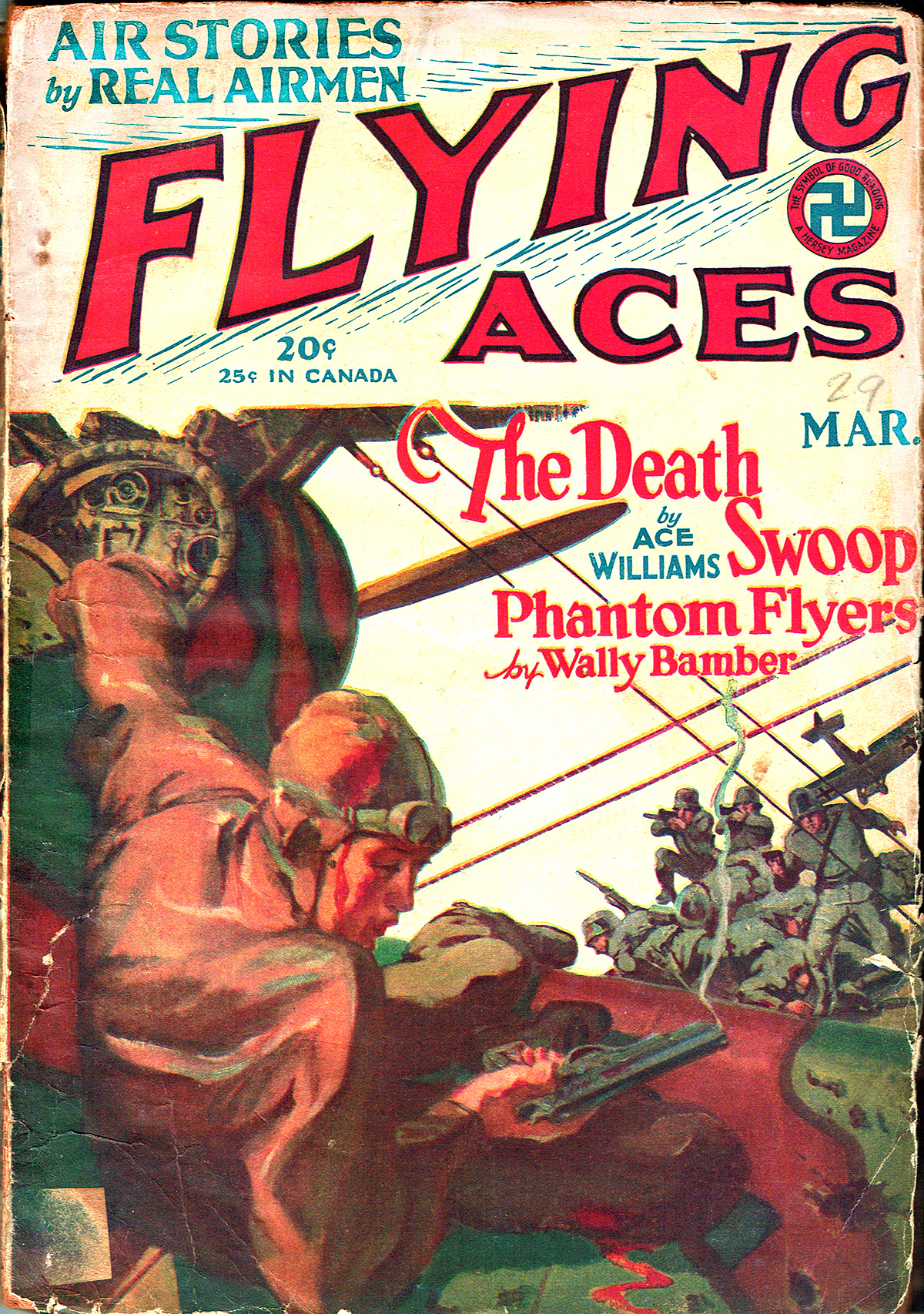
Following up on Phineas Carbuncle Pinkham’s introduction to the Ninth Pursuit Squadron and The Great Guerre, this month we have Pinkham’s second escapade from the February 1931 Flying Aces. Here, the Boonetown Ace inadvertently sparks a feud between the Ninth and their new neighbors—a French Squadron at Soirry Wood 20 ships and DeHavalind bombers would help them wreck Manheim’s Flying Circus and reclaim the air! Phineas turns to history for a lesson on how to win back the French when he puts on a little show as “The Hardware Ace!”

The C.O. should have known better. It was a friendly relations dinner for the new Frog squadron in that sector—and the Skipper let Phineas Carbuncle Pinkham come to the party!

Strange War Ships: Spad Tractor-Pusher

Link - Posted by David on April 24, 2023 @ 6:00 am in

FOR FOUR successive months in 1933, War Birds ran a series of covers featuring “Strange War Planes.”—those freak planes that were used during the First World War. The covers were by Eugene M. Frandzen—known here for the covers he did for Sky Fighters from its first issue in 1932 until he moved on from the pulps in 1939. The third in the series was the Spad Tractor-Pusher.

Strange War Ships:
Spad Tractor-Pusher

th_WB_3308THIS was one of the freakiest ships of the war, presenting the diverting 5pectacie of pilot and gunner in the same ship but separated by the whirling propeller.

Before the days of the front fire fokker engineers and pilots were dreaming of a device which would enable them to fire a machine gun in the direction of flight. The existing pushers permitted this but they were being replaced by tractors with their higher performance. The pilot wanted to take his front fire gun with him from the pusher to the tractor, but synchronization was unheard of then.

The result was as pictured on the cover and in this sketch. Sechereau, the designer, took the standard Spad tractor with 150 h.p. hisso and suspended a nacelle before the prop by a pair of members which formed part of the undercarriage.

The ship flew and was being considered for military use when the Fokker Eindecker came out. Naturally this type of ship became obsolete immediately.

Strange War Ships: Spad Tractor-Pusher
Strange War Ships: Spad Tractor-Pusher • War Birds, August 1933
by Eugene M. Frandzen

What is next month’s strange ship? Check back again for pictures and complete data on another freak ship of the war!

“Flying Odds” by Andrew A. Caffrey

Link - Posted by David on April 21, 2023 @ 6:00 am in

THIS week we have a story from a author new to Age of Aces—Andrew A. Caffrey. Caffrey, who was in the American Air Service in France during The Great War, was a prolific author of aviation and adventure stories for both the pulps and slicks from the late 1920’s through 1950. In “Flying Odds,” Caffrey gives us a taut tale of Lieutenant Wood trying to get as far back to allied territory as possible when the engine of his Spad conks out.

From the January 1930 issue of Sky Birds

Lieutenant Wood’s engine was hot, but the Huns who tried to force that crate-busting fool out of the sky found that Lieutenant Wood was “hot stuff” too.

How the War Crates Flew: Things to Inspect

Link - Posted by David on April 18, 2023 @ 6:00 am in

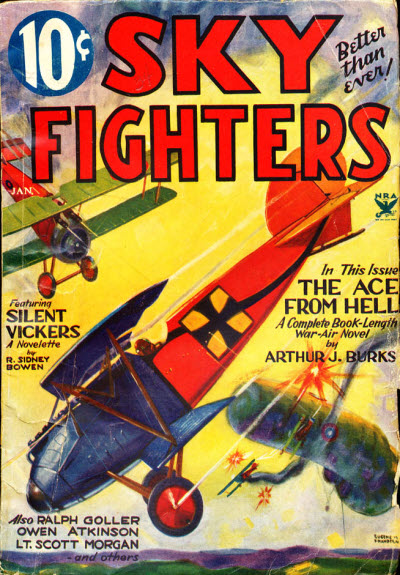
FROM the pages of the November 1933 number of Sky Fighters:

Editor’s Note: We feel that this magazine has been exceedingly fortunate in securing R. Sidney Bowen to conduct a technical department each month. It is Mr. Bowen’s idea to tell us the underlying principles and facts concerning expressions and ideas of air-war terminology. Each month he will enlarge upon some particular statement in the stories of this magazine. Mr. Bowen is qualified for this work, not only because he was a war pilot of the Royal Air Force, but also because he has been the editor of one of the foremost technical journals of aviation.
Things to Inspect

by Robert Sidney Bowen (Sky Fighters, November 1933)

A WHILE back I told you buzzards a few things about knocking engines. In other words, some reasons why the engines of the old war crates used to pass out oil us now and then, and sort of leave us in the soup. Well, today I’m going to talk about things that could happen to the plane, and likewise put us in the soup.

I believe I’ve only mentioned this fact about seven million times, so I’ll just say it again—taking good care of your ship was about fifty percent of the war pilot’s job. Now, when I say, taking good care of your ship, I don’t mean being easy with it when you’re in a dog scrap. At a time like that it’s a case of your life or the other chaps, and naturally you have to take a lot of chances that you wouldn’t take if you were just buzzing around on a little joy hop. And when I speak of taking a lot of chances I mean forcing your ship to execute maneuvers that it may not be able to stand—and as a result, tear itself apart in mid-air.

Good Pilots Don’t Take Chances

But here’s the point—good pilots didn’t take chances with their ships! And why? Well, buzzards, for this reason. A good war pilot knew his ship from prop boss to tail skid. He knew from experience in the cockpil just what it would do, and just what it wouldn’t do. And how come he knew all that? For the simple reason that he cared for it as a mother would care for a new-born babe. And naturally enough! Gosh almighty, a war pilot’s ship was the difference between life and death for him.

But enough of that stuff. What we are chinning about right now, is what used to happen to war crates, and why it did happen.

Three Important Parts

GENERALLY speaking, there are three parts of an airplane that can fail and as a result cause a lot of trouble, to say nothing of causing the death of the pilot. And those three parts are, the wing fittings, the landing gear (undercarriage) and the controls. As I said in the beginning, we’ve already talked about the engine, so we’ll leave that very important part out of this meeting.

Okay, first the wing fittings.

In a biplane (and all pursuit ships at the end of the war were biplanes) there were at least four, and in many cases eight, wing fittings, or wing bolts as they were sometimes called. And if you want to count in the aileron bolts, that’s eight more.

Now just a minute, don’t get so doggone impatient. I know what you are going to ask. Just what is a wing fitting, eh? Well, a wing fitting, or wing bolt, or wing attachment bolt (all the same thing) is simply the bolt hinge by which a wing is fastened to something else.

Take the top span of a biplane, for example. It is made up of three parts. They are, the left top wing, the center section, and the right top wing. Now, the center section is solid.

BY THAT I mean it is attached to the fuselage by struts and cross bracing wires. But the left and right top wings are hinge bolted to it on their respective sides (Fig. 1). The inner end of the wing is a solid rib. (Not holed out for lightness like the rest of the ribs in the wing.) Into that solid rib is fitted the forward and rear spars of the wing. The same thing is true of the spars in the center section. So that makes re-enforced solid pieces coming together. In other words, something strong against which you can fasten the hinge fittings.

Hinge Fittings Varied

Now the hinge fittings varied in different types of ships. But the one used quite a lot was like the one in Fig. 2. As you can see, the two parts of the hinge simply slide together and the bolt is slipped through the holes and held in place by a cotter pin at the rear end of the bolt.

With reference to the lower wings, the idea of attachment is exactly the same. Except, of course, you fasten the left and right lower wings to the left and right lower longerons of the fuselage. In some planes, though, the left and right lower wings were all one piece. That is, the spars extended right through the fuselage, and the whole thing could be fastened solidly to the fuselage.

If the wings are hinged, why don’t they fall down? Because of the wing struts and wing cross bracing wires.

No Danger of Sagging

AERODYNAMICALLY speaking, the top and lower wings of a biplane are a solid piece in themselves. When the struts are put in, and the wings are tightened up there is no sagging strain on the wing attachments. So although they may only be fastened to the body of the ship, and to the center section, by small bolts, there is no danger of them sagging in flight or on the ground and pulling the wing fastenings loose.

No, not if the pilot of that ship knows his onions and has a good rigger (name given to the mechanic that is responsible for the rigging of the ship). However, if the pilot is slipshod, and the rigger doesn’t give a darn, a lot of things can happen. To begin with, the wing fastening bolts should be put in from front to rear, and the cotterpin should be in place. If not, then engine vibration is apt to shake the bolt out, and if it does—wham, your wing tears itself off.

Another thing, the cross bracing wires between the wings should be neither too loose nor too tight. If they are too tight, extra strain cahsed by violent maneuvering in a dog scrap might make them part. And if enough of them do that, your wings will just naturally fold up on you, and you’ll get no more of mother’s cooking.

The Turnbuckle

AS YOU probably know, the cross bracing wires are adjusted by turnbuckles. And a turnbuckle is simply a rod, tapered at both ends, a hole through it in the middle (to enable twisting), and a threaded hole at each end.

For the idea look at Fig. 3. The turnbuckles are fastened by wire at one end to the strut stubbs and the other end is fastened to the wire that is to do the bracing. Naturally, excess strain, vibration, etc., can make turnbuckles untwist a bit. And the result is a slack bracing wire.

And so, with reference to the wings there are several things that the good pilot takes care of and inspects every time he lands after a scrap. And lots of other times, too. He makes sure the bolts are in right. He makes sure that the locking cotter pins are in the bolts. He makes sure that the turnbuckles have not untwisted. And last but not least he makes sure that all those parts have enough grease on them and have not become rusted (and thus weakened) by exposure.

If he doesn’t do those things, he will be flying a weakened ship, that looks strong enough on the surface, but which will fold up on him some day.

The second part of the ship that needs constant watching is the landing gear or undercarriage.

What “Split Axle’’ Means

THE ships of today have what are known as split axle landing gears, and most all of them are equipped with Aero shock absorbers. By split axle we mean just that—the axle is in two parts, hinged in the middle, with the middle part higher than the two ends, so that the axle can spread outward due to the weight of the ship above it.

But, the war crates had solid axles with a wheel at each end. The axle went through vertical slots in the landing gear struts, and was held in place at the lower end of the slot by rubber cords. Thus when a ship landed the axle would try to travel up the slot in the landing gear struts, but the rubber cord would tend to hold it back. And the result was that most of the shock in landing was absorbed by the wound rubber cording stretching. Perhaps you’ll get a better idea of what I’m talking about by glancing at Fig. 4.

Of course, the wheel was fastened to the axle by a nut with locking cotterpin. The axle was stationary and the wheel revolver about it.

Now, a bad landing could weaken the rubber cording. A bum pilot might leave the locking cotter pin out of the nut on the end of the axle. A bum pilot might forget to change the rubber cording when it got too old for good use. And a bum pilot might weaken his landing gear cross bracing wires and not trouble about it.

Here’s What Could Happen

AND if he did, here’s what could and probably would happen. He might lose a wheel when taking off from bumpy ground.

His whole undercarriage might fold up on him sometime when he made a bad landing. A wheel might buckle when making a cross-wind landing. And if the rubber on one side gave way, the ship would be flung over that way when he landed, even if it was a good landing. And the result of any one of those things happening would be a nasty ground loop, if not a direct crash.

And just to show how dumb even yours truly can be, I’ll admit that once I lost a wheel while taking a Spad off. What happened? Well, a Spad always lands like two tons of brick, even with two wheels on—and with one gone, well, I plowed up enough of that drome to plant a year’s supply of potatoes, and it was a couple of weeks before all the skin grew back on my face.

And now for the third, and yes, the most important part to keep your eye on. Naturally, I mean the controls.

You can have a bum engine, you can have a badly rigged ship, and you can have a weakened undercarriage, yet somehow you can manage to get down, and probably walk away from the wreck. But—and that’s a big but—if your controls go cockeyed, you might just as well buy yourself a oneway ticket to the Pearly Gates. Or at least become resigned to a long stay in a little white cot in some hospital.

As I told you sometime ago, the controls of an airplane consist of the rudder bar and the joystick. The rudder bar works the rudder, and the joystick works the elevators and the ailerons. Naturally, they work them by the means of wires. To the right side of the rudder is a wire that leads back to the horn on the right side of the rudder. The same thing on the left side. Now, from the joystick four wires lead back to the elevators. Two for the top and bottom of the right elevator, and two for the top and bottom of the left elevator. Also from the joystick, wires lead out to the ailerons.

Now, just how many control wires were used, and how they were lead out to the various control surfaces, depended upon the type of machine. But, on any type of ship, turnbuckles were used for tightening or slackening, pulleys were used where the wire had to go around a bend, and leather guides were used wherever the wire unavoidably rubbed against something.

Wires Constantly Moved

Naturally it follows that the wires were constantly being moved while in flight. That means that some of them were constantly sliding around on pulleys, and others were constantly rubbing against leather guides.

Contact means friction, and friction means wear. Added to that was the strain of violent maneuvering, the full force of which was instantly transmitted to the turnbuckles and the wire eyes. (See Fig. 3.)

Now if the pilot did not take constant care of his controls he was simply flirting with his life. For example, take the pulleys. (Fig. 5.) Dirt, grease and other things such as dope flakes, could very easily jam them so that they would not turn. As a result the wire would slide around it, instead of the pulley revolving with the wire. Naturally the wire couldn’t stand that very long—and suddenly it would give way, and the pilot would be helpless to use his ailerons.

In other words, lateral stability would be all lost. In most planes the pulleys were inside the wing, and you got at them by unlacing a bit of the fabric. Doing that little thing was tiresome, but lordy how important!

The leather guides wore out very quickly and if they were not replaced with new guides you might find that your control wire was rubbing against a fuselage cross-bracing wire. And you can figure out for yourself what happens when steel cable rubs against steel cable. An example of where and how leather guides were used will be noted in Fig. 6.

And as for the turnbuckles and wire eyes. Well, the same points hold true for them as for cross-bracing wire turnbuckles. Get the wires too tight and a savage loop might part them. Let them get rusty and the eyes might pull out of the turnbuckles, or the turnbuckle itself give way. And so you make sure that there is plenty of grease on them to insure no rust.

AND that, incidentally, goes for the control wires themselves. They should always have a light coating of grease to prevent rust. And for a thorough inspection, the good pilot always runs his fingers along the wires, to see if they have become weakened by a strand or two parting. And when your finger suddenly gets a pin prick, stop, look and be a bright boy. Take out the whole wire and replace it with a new one. One strand breaking does not mean death is coming to you. It simply means that the wire has been weakened just that much—and maybe the other strands will let go when you’re ten thousand feet up.

Pay Attention, Buzzards!

Well, you’re all asleep now, so I guess I’ll go home. But remember this (if it’s possible) your engine is important, but so is the ship itself. It may seem like a waste of time to crawl all over it with an eagle eye each time before you go up. But listen to me, buzzards, I’ve seen plenty who figured it a waste of time, and took a chance. Well, they lost. I’m a scare-cat—I hate to take chances—maybe that’s why I’m still able to admire the trees and the flowers and other things in life on this man’s planet!

“Three Months to Live” by Captain John E. Doyle

Link - Posted by David on April 14, 2023 @ 6:00 am in

THIS week we have a story from the pen of British Ace, Captain John E. Doyle, D.F.C. Born in 1893, Captain Doyle was a successful fighter pilot in WWI with 9 confirmed victories with 56 & 60 Squadrons. Near the end of the war, he was shot down and taken prisoner where they amputated his leg. After the war, he wrote three books, one of which was an autobiography, and 31 short stories for magazines like War Stories, The Scout, Popular Flying, The Aeroplane, Flying, Boys’ Ace Library, Mine, Modern Wonder and Air Stories. Five of those stories were for the British version of Air Stories and featured one Montgomery de Courcy Montmorency Hardcastle, M.C. In Scotland he was usually referred to as “His Lordship,” for he was the fourteenth Viscount Arbroath as well as the sixth Baron Cupar. Out in France he was just “Monty” behind his back, or “The Major,” or “Sir” to his face.

99 Squadron was in desperate need of replacements, but all the good ones were being attached to other squadrons and Monty was left with Percy H. Yapp—”the queerest specimen he’d ever seen wearing the uniform of the R.F.C. Percy was short, and so slightly built that the small tunic he wore hung in folds on his frame. His face was devoid of colour, except for a faint yellowish tinge. But Monty was instantly attracted by the fellow’s eyes, which looked so intently into his. For all his affectation of languor, he was a shrewd judge of character, and decided that the frail figure before him possessed those resolute and determined qualities for which he was ever searching—or so he hoped. From the December 1935 issue of the British Air Stories, it’s Captain John E. Doyle’s “Three Months to Live!”

Major Montgomery Montmorency Hardcastle was not Ordinarily a Fightin’ Man but his Great Idea for “Huntin’ the Hun” involved him in a Considerable “Spot of Shootin’” and Nearly Ruined his Record of “One Bird—One Barrel!”

Heroes of the Air: Major J.B. McCudden

Link - Posted by David on April 10, 2023 @ 6:00 am in

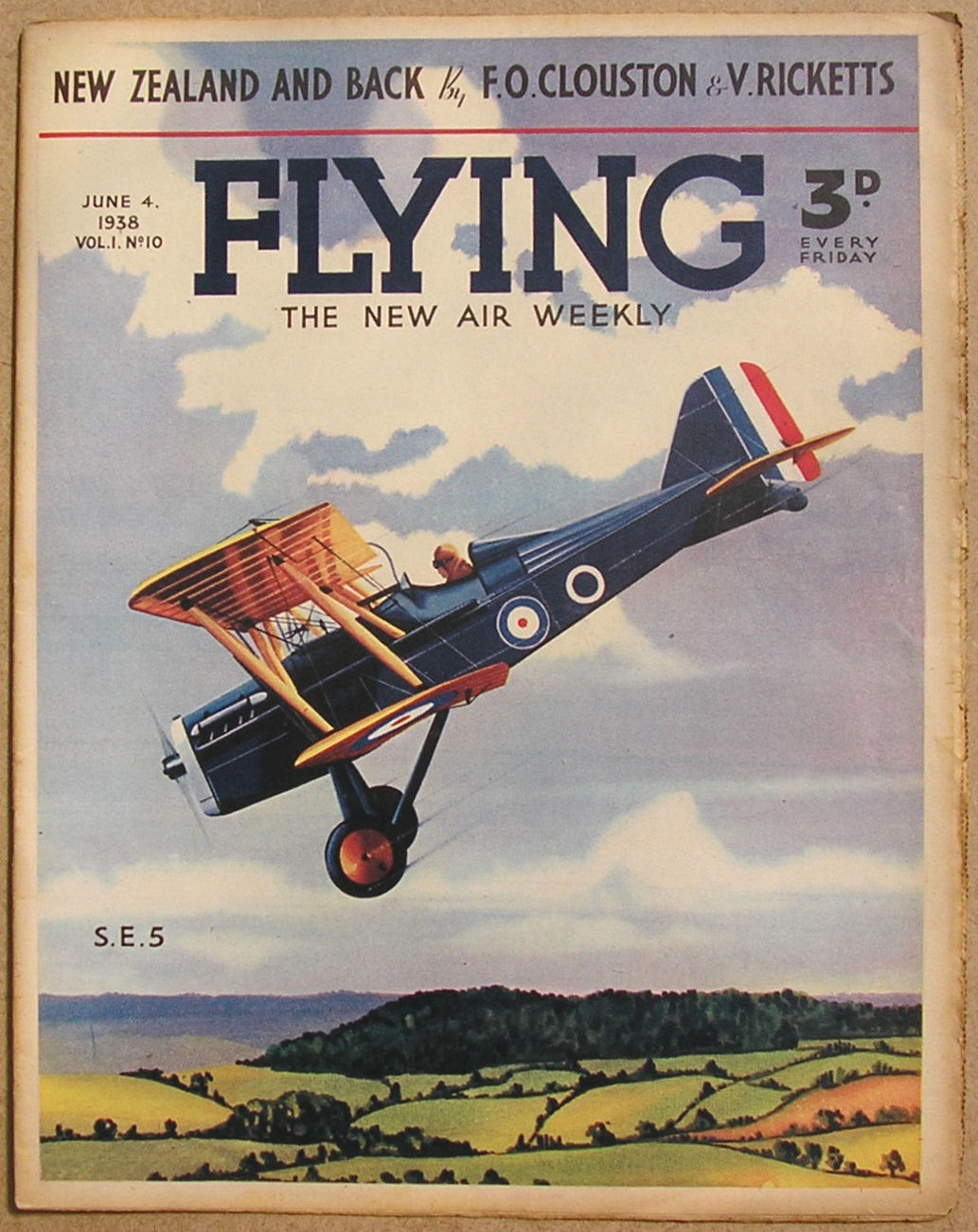
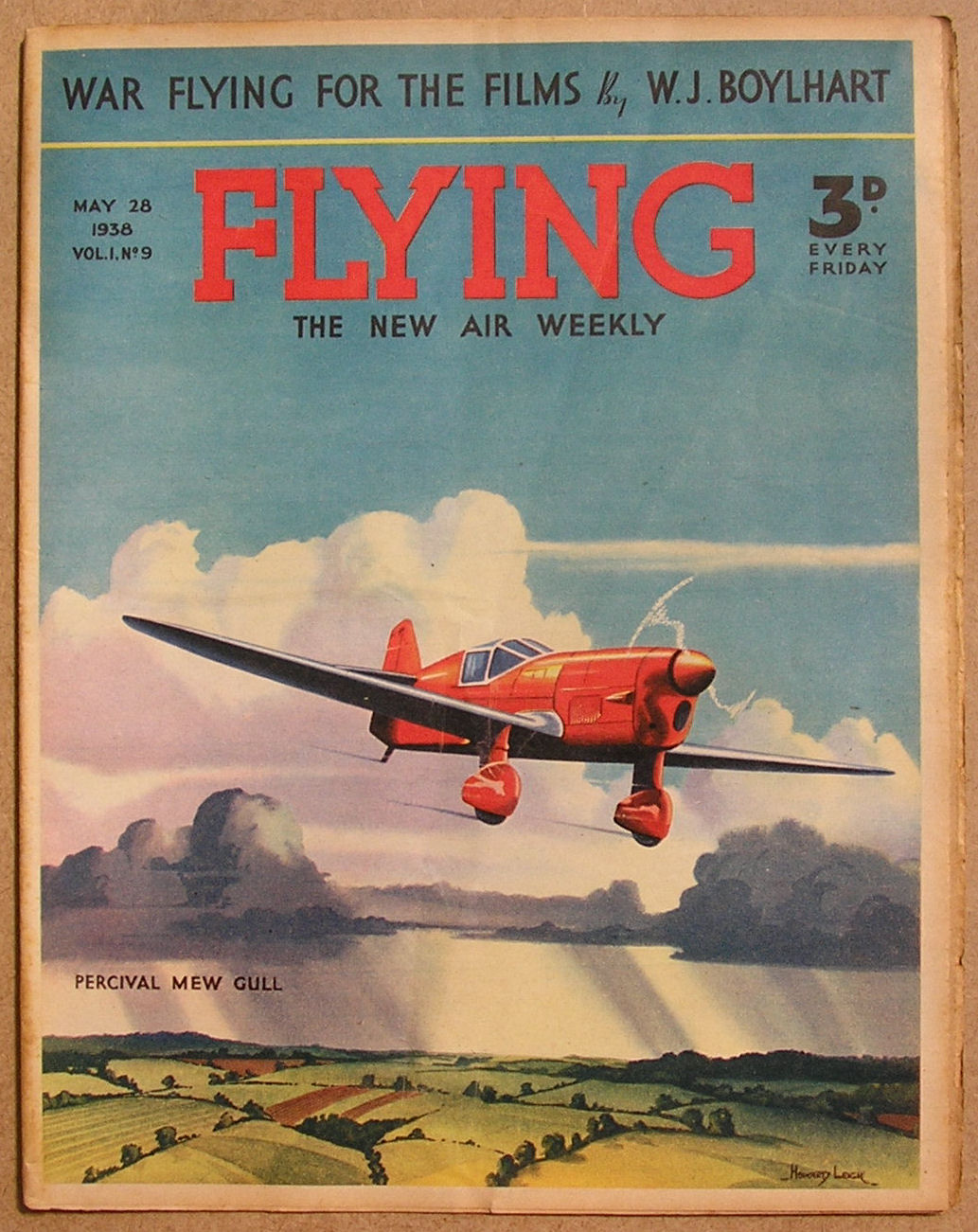
WHEN Flying, the new weekly paper of all things aviation, started up in England in 1938, amongst the articles and stories and photo features was an illustrative feature called “Heroes of the Air.” It was a full page illustration by S. Drigin of the events surrounding how the pictured Ace got their Victoria Cross along with a brief explanatory note.
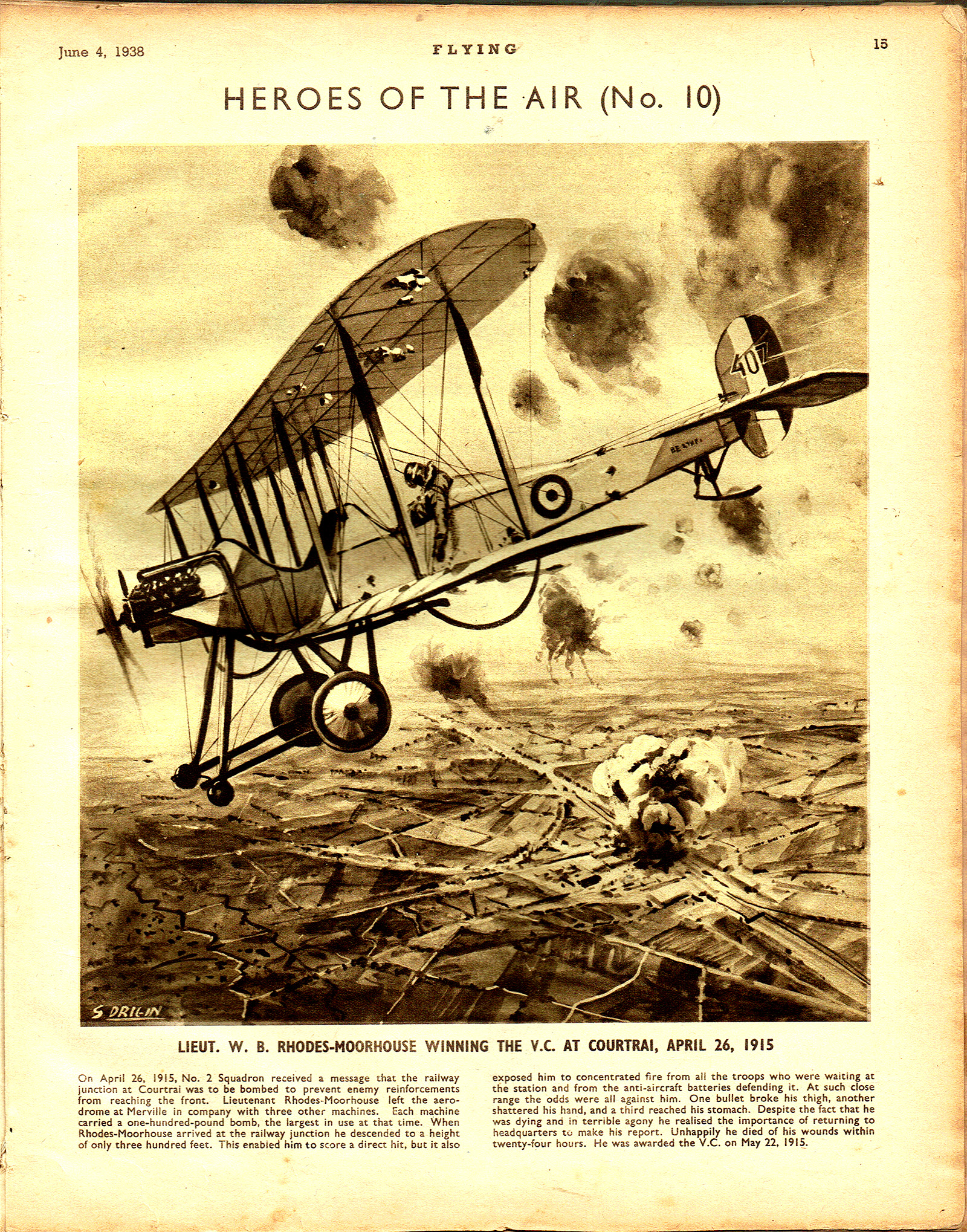
Russian born Serge Drigin became a successful illustrator in the UK in the 1920s with his work regularly appearing in such British magazines as The Detective Magazine, Modern Boy and Chums. He is probably best known for his startling covers for Scoops, Air Stories, War Stories, Fantasy and others in the 30s.

From the 21 May 1938 issue of Flying:

MAJOR J. B. McCUDDEN ATTACKING A HANNOVERANA, FEBRUARY, 1918

THE NOTIFICATIONS of Major J. B. McCudden’s award was made in the following words: “For conspicuous bravery, exceptional perseverance, and a very high devotion to duty. Captain McCudden has at the present time accounted for fifty-four enemy aeroplanes.” McCudden, like several others, was awarded the Victoria Cross not for one particularly brave action, but for consistent gallantry. The incident shown below occurred in February, 1918. It shows his fifty-seventh, and last, victory. McCudden attacked a Hannoverana at close range and poured a stream of bullets into its tail. So furious was this attack that the German observer fell through the shattered fuselage of his machine, to come to earth behind the British lines, while his pilot went on and crashed in German territory. Major McCudden was awarded several other decorations and had the distinction of being the only man to witness the death of Wernher Voss, who was shot down by the guns of Lieutenant Rhys Davids, a member of McCudden’s flight. In July, 1918, he crashed on leaving a French aerodromes for his squadron, and was killed instantaneously. Thus ended the career of one of our most efficient air fighters.

“Deuces Wild” by Alexis Rossoff

Link - Posted by David on April 7, 2023 @ 6:00 am in

THIS week we have a fun tale of the Hell-Cat Squadron from the prolific pen of Alexis Rossoff. The adventures of the Hell-Cat Brood ran in War Birds, War Stories and Flying Aces. The Seventy-Seventh Squadron had a reputation of being short on technique and long on defying every regulation in the book. The squadron was the cause of many gray hairs on the pates of the star-spangled ones back in G.H.Q. They flew their merry way like nobody’s business, and played hell with any Jerry who tried to dispute their intention of going places. This bunch of cloud-hopping war birds were known from one end of the Western front to the other as the “Hell-cats”—and sometimes the “Unholy Dozen!”

A pair of the Hell-cats are inmates in a prisoner of war camp deep within Germany. Although one is very sick, they try a daring escape to get back to the Seventy-Seventh and their brood. It’s “Deuces Wild” by Alexis Rossoff from the pages of the May 1928 War Birds!

They belonged to the Hell-cat brood, this pair—but they had been brought down by overwhelming odds, and we find them in a German prison camp, far behind the lines. Caged birds—watching, waiting—to escape—to get back somehow to the brood—and ride the clouds—with avenging guns spitting!

“Death Takes Off” by Ralph Oppenheim

Link - Posted by David on March 31, 2023 @ 6:00 am in

TO ROUND off Mosquito Month we have a non-Mosquitoes story from the pen of Ralph Oppenheim. In the mid thirties, Oppenheim wrote a half dozen stories for Sky Fighters featuring Lt. “Streak” Davis. Davis—ace and hellion of the 25th United States Pursuit Squadron—was a fighter, and the speed with which he hurled his plane to the attack, straight and true as an arrow, had won him his soubriquet. Once more it’s a battle against time as Streak must retrieve vital information about Pershing’s big push against Hindenburg that had been left behind in a locked safe when the Boche over ran the villa that had been an Allied held town. From the April 1935 issue of Sky Fighters it’s “Death Takes Off!”

With the Success of the Allies in the Balance, Streak Davis Roars into Enemy Territory on a Mission that Spells Doom—Casting all Thought of Failure into the Slipstream of His Pounding Crate!

“Aces of the Sea” by Ralph Oppenheim

Link - Posted by David on March 24, 2023 @ 6:00 am in

Navy Stories Ad
An ad for “Aces of the Sea” from the pages of the March 1929 Sky Riders

THEIR familiar war cry rings out—”Let’s Go!” The greatest fighting war-birds on the Western Front are once again roaring into action. The three Spads flying in a V formation so precise that they seemed as one. On their trim khaki fuselages, were three identical insignias—each a huge, black-painted picture of a grim-looking mosquito. In the cockpits sat the reckless, inseparable trio known as the “Three Mosquitoes” Captain Kirby, their impetuous young leader, always flying point. On his right, “Shorty” Carn, the mild-eyed, corpulent little Mosquito, who loved his sleep. And on Kirby’s left, completing the V, the eldest and wisest of the trio—long-faced and taciturn Travis.

Were back with the third of three Three Mosquitoes stories we’re presenting this month. This week it’s a bit of a departure for the inseparable trio when they are loaned out to the Navy. Somehow, under our very noses in the heavily mined and patrolled waters of the English Channel, six ships have disappeared without a trace and no survivors. The Navy has designed a trap that they hope will catch or reveal what has happened to their missing ships and The Three Mosquitoes are to fly over the area to observe whatever happens. And that’s just the tip of this iceberg—events lead Kirby to be an unwilling passenger/prisoner aboard a U-boat bent on a hellish suicide mission to destroy Englands new super dreadnaught about to set sail! From the March 1929 issue of Navy Stories, it’s “Aces of the Sea!”

Every day Allied ships were being sunk in their own barricaded stronghold—and always there came the strange report, “No Survivors.” It was to solve this mystery that the navy called those three famous aces, Kirby, Carn and Travis, from the skies. A gripping novel in which the “Three Mosquitoes” go to sea!

If you enjoyed this tale of our intrepid trio, check out some of the other stories of The Three Mosquitoes we have posted by clicking the Three Mosquitoes tag or check out one of the four volumes we’ve published on our books page! A fifth volume will be out later this year. And come back next Friday or another exciting tale.

“Stacked Cards” By Ralph Oppenheim

Link - Posted by David on March 17, 2023 @ 6:00 am in

THEIR familiar war cry rings out—“Let’s Go!” The greatest fighting war-birds on the Western Front are once again roaring into action. The three Spads flying in a V formation so precise that they seemed as one. On their trim khaki fuselages, were three identical insignias—each a huge, black-painted picture of a grim-looking mosquito. In the cockpits sat the reckless, inseparable trio known as the “Three Mosquitoes.” Captain Kirby, their impetuous young leader, always flying point. On his right, “Shorty” Carn, the mild-eyed, corpulent little Mosquito, who loved his sleep. And on Kirby’s left, completing the V, the eldest and wisest of the trio—long-faced and taciturn Travis.

Were back with the second of three Three Mosquitoes stories we’re presenting this month. Nach Felt 21. Field 21. Important, time-sensitive information needs for an Allied offensive against the Boche has been hidden in the crotch of a forked tree down a dirt path in the woods on Field. 21. Intelligence operatives have been unable to retrieve this informations a last ditch effort, they figure a lone flyer may be able to land on the field, retrieve the information, and get out before the Germans in the area could stop them. Kirby is this flyer. Landing in the midst of German troops and retrieving the info is the easy part, keeping his two pals—Travis and Carn from tagging along is the hard part. From the July 1928 issue of War Birds, it’s “Stacked Cards!”

It was Intelligence stuff, and Kirby could not even tell his two buddies. He took off alone—for Germany—and how was he to know that the cards were stacked against him? Another of Oppenheim’s breathless thrillers.

If you enjoyed this tale of our intrepid trio, check out some of the other stories of The Three Mosquitoes we have posted by clicking the Three Mosquitoes tag or check out one of the four volumes we’ve published on our books page! A fifth volume will be out later this year. And come back next Friday or another exciting tale.

Introducing The Three Mosquitoes!

Link - Posted by David on March 10, 2023 @ 6:00 am in

MARCH is Mosquito Month! We’re celebrating Ralph Oppenheim and his greatest creation—The Three Mosquitoes! We’ll be featuring three early tales of the Mosquitoes over the next few Fridays as well as looking at Mr. Oppenheim’s pre-pulp writings. So, let’s get things rolling, as the Mosquitoes like to say as they get into action—“Let’s Go!”

The greatest fighting war-birds on the Western Front are once again roaring into action. The three Spads flying in a V formation so precise that they seemed as one. On their trim khaki fuselages, were three identical insignias—each a huge, black-painted picture of a grim-looking mosquito. In the cockpits sat the reckless, inseparable trio known as the “Three Mosquitoes.” Captain Kirby, their impetuous young leader, always flying point. On his right, “Shorty” Carn, the mild-eyed, corpulent little Mosquito, who loved his sleep. And on Kirby’s left, completing the V, the eldest and wisest of the trio—long-faced and taciturn Travis.

Were going to get things off the ground with Oppenheim’s very first Three Mosquitoes tale from the pages of War Stories from July 1927! This premier tale finds the inseparable trio separated following a stunting attack on the front line trenches that resulted in Carn and Travis going down behind enemy lines and captured and an humiliated Kirby being sent down to ferrying new ships to their assigned fields. Mindless, boring work for the beaten Ace—his instructions are to avoid all altercations and steer far clear of any action what so ever. Especially since the plane he’s flying and those of the other ferried ships have no guns! But that doesn’t stop Kirby when he sees the Block brothers sniffing around the very secluded forrest the Allies are amassing troops and supplies—he tries to find a way to stop them from getting that information back across the lines without the benefit of guns!

Kirby was an Ace, a fighter, and today they had him “ferry-piloting,” without guns. If the enemy showed, he was supposed to keep out of it. And then the enemy showed, and Kirby, the Ace, the born fighter, forgot those hateful orders, forgot that he had no guns! A splendid, thrilling story of the airmen.

If you find yourself wanting to read more exploits of the intrepid trio, we’ve posted a number of the adventures of the Three Mosquitoes during past Mosquito Months, including several of their exploits from their first year:

HIGH DIVING

It was against orders, but Kirby and his pals weren’t worrying about that. They wanted to meet that big German formation—and Kirby wanted to give battle to the “Black Devil,” the famous German Ace. A splendid flying story.

DOWN FROM THE CLOUDS

The C.O. of the flying field was sore—the Three Mosquitoes, dare-devils supreme were doing their “grand-stand stuff” again. But when the C.O. found himself in difficulties, with Boche planes swarming all around him—things were different. The best flying story of the month.

DEVILS OF THE AIR

Here again is Kirby, the great leader of the “Three Mosquitoes.” The pilot of the new Fokker knew every trick, and Kirby matched him—then went into straight fighting. A brilliant air story—and one that is totally different.

If you enjoyed these tales of our intrepid trio, check out some of the other stories of The Three Mosquitoes we have posted by clicking the Three Mosquitoes tag or check out one of the four volumes we’ve published on our books page! A fifth volume will be out later this year. And come back next Friday or another exciting tale.

Ralph Oppenheim’s Pre-squito Stories

Link - Posted by David on March 3, 2023 @ 6:00 am in

MARCH is Mosquito Month! We’re celebrating Ralph Oppenheim and his greatest creation—The Three Mosquitoes! We’ll be featuring three early tales of the Mosquitoes over the next few Fridays,but we’re gonna start this year by looking at Mr. Oppenheim’s pre-Mosquito pulp stories. So, let’s get things rolling, as the Mosquitoes like to say as they get into action—“Let’s Go!”

Ralph Oppenheim cut his teeth on the Haldeman-Julius’ line of Little Blue Books writing about Balzac, George Sand, and Richard Wagner—getting some good notices with a couple of his five titles. Before his last two little blue books hit the stands, the 19 year-old Oppenheim had already switched gears and had started submitting stories to the pulps.

Although Oppenheim started writing tales of the Three Mosquitoes very early in his pulp career, they were not in his first published stories—their first adventure was Oppenheim’s third published story. Both his first two stories though were aviation tales full of life or death action, and oddly, both feature parachutes.

Oppenheim’s first published pulp story appeared in the February 1927 number of Action Stories and would have hit the stands New Year’s Day, January 1st, 1927. Action Stories was Fiction House’s premier title. It printed all sorts of adventure stories—adventure, western, detective, mystery, sea, sports, and aviation. And Oppenhiem’s first story—as were many of his subsequent stories—was an aviation tale.

Doom’s Pilot

Oppenheim’s first story for the pulps takes place at an Army Arsenal, whose innocent-looking buildings housed enough T.N.T. to blow up a fair-sized city. Although every safety precaution had been put in place, it seemed disaster was unavoidable when a letter arrived from an anarchist:

Dear Major:
    For a long time we have been trying to think of a way to deal a decisive blow that will hurt hundreds instead of one or two. The naval arsenal catastrophe gave us our lucky inspiration. Because I am the only man who dares to go to such lengths, I have been chosen upon to deal the big blow that will carry our Cause so much further ahead, towards the goal of righteousness. You are helping me, major dear, by storing in that new ammunition. Before those three days are up, you and your whole stinking outfit, and as much of the surrounding villages that your excellent shells can reach, will be in hell where you belong. I have to go with you, for I must remain on the spot to see that everything goes right, but I shall know that I have died doing my best to bust this damned country.
    Best regards, major, from one who will soon have the pleasure of dying with you.

—The Fearless One.

Their only hope of preventing the destruction of the base and the near by towns may lie with one of the pilots’ pride and joy—a speedy flying racer he had built and waswas planning to enter in an upcoming race!

Red terror of anarchism—a hurricane—and one of Uncle Sam’s birdmen in a grim, ruthless battle with Doom!

A Parachutin’ Fool

Oppenheim’s second published pulp story was another aviation tale, this time for the pages of Dell’s War Stories for April 1927. In this second tale, John Slade is posted at an American base in France. Slade is to take a photographer over the lines in a two-seater observation crate without an escort in hopes of getting vital pictures of a ruined town the German’s are presently holding that the Allies want to take. Slade is an exceptional, daredevil pilot perfect for the job—his only fear is using a parachute! And this job may require that if he can’t get through the German’s A.A. guns and any planes they may send out to shoot them down. Will he be able to face his fears when the time comes?

Slade watched Harlan jump, saw the parachute open, yet he kept his seat in the burning plane! Why? A thrilling vital yarn of the aviation corps.

It was Oppenheim’s third published story that hit paydirt! It was the story that introduced Kirby, Travis and Carn—The Three Mosquitoes! Check back next week for that first tale of the inseparable trio!

Strange War Ships: Maxmilian Schmitt Monoplane

Link - Posted by David on February 27, 2023 @ 6:00 am in

FOR FOUR successive months in 1933, War Birds ran a series of covers featuring “Strange War Planes.”—those freak planes that were used during the First World War. The covers were by Eugene M. Frandzen—known here for the covers he did for Sky Fighters from its first issue in 1932 until he moved on from the pulps in 1939. The second issue featured the Maxmilian Schmitt Monoplane.

Strange War Ships:
Maxmilian Schmitt Monoplane

th_WB_3307THE U.S. Army, after extensive tests, ordered this odd looking ship for service. At that time it was considered one of the fastest and safest of ships. It was to be partially armored. This feature anticipated Germany’s armoring of ships by several years.

The wings were supported by cables both top and bottom. The upper cables hanging from a pyramid of four steel tubes gave it an odd appearance. The most radical part of the design was the long rectangular section upon which was the tail planes. Another advanced feature of this ship was tubular steel construction of the landing gear.

It was powered by a 50 h.p. Gnome motor, had a top speed of 65 m.p.h. and could climb 50 feet per minute. It had a span of 25 feet. It’s length was 18 feet. The lifting surface was only 150 square feet, The weight was 600 pounds.

Strange War Ships: Maxmilian Schmitt Monoplane
Strange War Ships: Maxmilian Schmitt Monoplane • War Birds, July 1933
by Eugene M. Frandzen

What is next month’s strange ship? Check back again for pictures and complete data on another freak ship of the war!

“Sneeze That Off!” by Joe Archibald

Link - Posted by David on February 24, 2023 @ 6:00 am in

“HAW-W-W-W-W!” That sound can only mean one thing—that Bachelor of Artifice, Knight of Calamity and an alumnus of Doctor Merlin’s Camelot College for Conjurors is back to vex not only the Germans, but the Americans—the Ninth Pursuit Squadron in particular—as well. Yes it’s the marvel from Boonetown, Iowa himself—Lieutenant Phineas Pinkham!
We’re back to Pinkham’s exploits in The Great Guerre, but this time we’re going all the way back to the first appearance of Phineas Pinkham—to the day he first showed his homely mug at the Ninth Pursuit Squadron where they were being bedeviled by Baron von Kohl and his sky circus! From the November 1930 Flying Aces, it’s Joe Archibald’s “Sneeze That Off!” introducing Phineas Carbuncle Pinkham from Boonetown, Iowa!

He liked to play with rubber cigars, phony bombs, and sneeze powder—did Phineas Carbuncle Pinkham, that thorn in the flesh of the American Ninth Pursuit. Their only hope was that von Kohl, the German sky terror who never missed a man, would be a big help to them, after all!

“No Man’s Sky” by O.B. Myers

Link - Posted by David on February 17, 2023 @ 6:00 am in

THIS week we have a story from the pen of a prolific pulp author O.B. Myers! Myers was a pilot himself, flying with the 147th Aero Squadron and carrying two credited victories and awarded the Distinguished Service Cross.

A prank against their commanding officer turns into deadly mission of life or death when the pilots of the 66th must retrieve their Commander’s fancy Paris tailored uniform they tossed in No-Man’s-Land to keep important information in a letter in the pockets from falling into German hands! From the October 1931 issue of Flying Aces, it’s O.B. Myer’s “No Man’s Sky!”

The order was filled out and ready—to send one flyer of the 66th to Blois in disgrace.
And the only thing that could keep Lieutenant Linkener’s name from that order
was to bring back a letter that lay in the middle of No-Man’s-Land!

« Previous PageNext Page »