


Looking to buy? See our books on amazon.com Get Reading Now! Age of Aces Presents - free pulp PDFs

How the War Crates Flew: Aerial Photography

Link - Posted by David on September 5, 2023 @ 6:00 am in

FROM the pages of the March 1934 number of Sky Fighters:

Editor’s Note: We feel that this magazine has been exceedingly fortunate in securing Lt. Edward McCrae to conduct a technical department each month. It is Lt. Mcrae’s idea to tell us the underlying principles and facts concerning expressions and ideas of air-war terminology. Each month he will enlarge upon some particular statement in the stories of this magazine. Lt. MaCrae is qualified for this work, not only because he was a war pilot, but also because he is the editor of this fine magazine.

Aerial Photography

by Lt. Edward McCrae (Sky Fighters, March 1934)

NOW if you two sad-eyed rum-dums can hold your heads up long enough to listen, I want to smack you in the face with a question. No? Well, you’re gonna get the question anyway. Suppose you flew over some of the enemy’s territory yesterday and got acquainted with it till you could call it by its first name. And then you came along over the same ground today—I mean a mile or so over—and—stop interrupting—and today you saw a lot of trees that must have taken forty years to grow—and suppose those trees weren’t there yesterday?

What’s the Answer?

Well, you sleepy-eyed buzzards, to call you a polite name, you’d be seeing something that was mighty interesting to general headquarters. You’d probably fly over again Saturday afternoon and instead of seeing the trees you’d see nothing but a lot of shell holes.

The answer?

Aerial photography! One of the most important branches of the flying service.

Put a couple of ten-gallon funnels in your ears to let the wisdom run in to a place where there’s plenty of room for it, and I’ll tell you about a trip made by one of the war’s outstanding heroes, who must be nameless on account of his becoming modesty. We got orders from G.H.Q., which is the title of the brass hats hired to do nothing but think up crazy ideas to make flyers uncomfortable. They wanted photographs of what we will call sector D-7, because that was the way it was identified on the big maps. So naturally they called on me to do it.

I Get a Camera

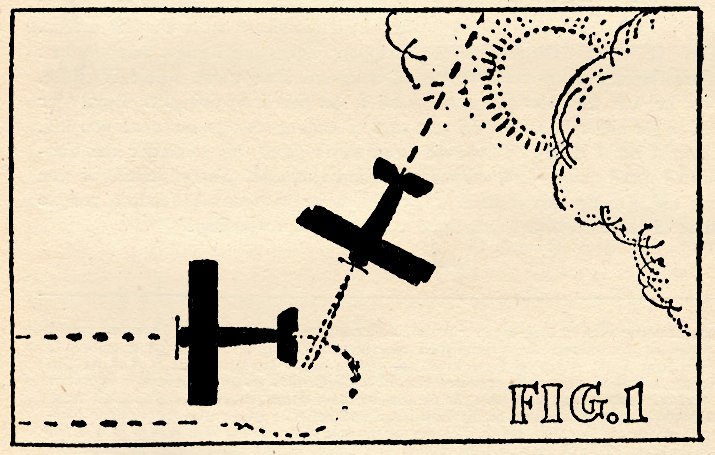
I was playing stable boy and jockey to a Sopwith. The so-called experts from the photography shack brought me out a camera—open your eyes long enough to look at the picture in Figure 1, will you? Okay, go back to sleep. I fitted the camera into the conical—not comical—slot it goes into and we climbed to about seven thousand feet, not going any higher because the light was bad.

Now, the sector we wanted to catch had a road bisecting it. I had another pilot at the stick so I could operate the camera (because the brass hats wanted to be sure the pictures were good!) So I had told my pilot to start and follow the road to the end of the sector, then come back parallel to it on the left, then go forward to the left of that, and back again to the left of that. Just like a man plowing a field.

It’s Foolproof

The camera is claimed to be foolproof. Not that that mattered to me, understand. You’ve got eighteen plates stacked in a changing box over the shutter. You have a loading handle which you slide backward and forward and the first plate falls into position. When you get over the spot you’re ready to shoot you pull a string. You tell the spot by looking at the previous pictures that were taken of the same ground.

When the string is pulled you’ve got a picture of a big area over a mile below. You yank the loading handle and the camera ejects the exposed plate into a changing-box underneath and the number two plate falls into place in the camera. You keep up this simple operation until you’ve shot all your plates.

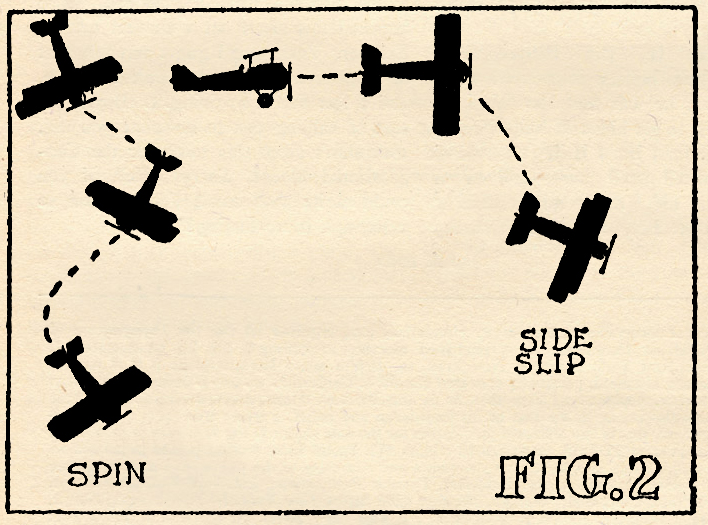
Did I say simple—you simpletons? You’ve got plenty to do and to worry about. You have to get your positions, figure out when the ship is flying dead level so you won’t shoot a picture off to the right or left, and you’ve got to figure out the proper intervals of time between shots, so you’ll cover all the territory. Open your eyes well and look at Figure 2 to see what the ground looks like.

And then another small item might be mentioned in passing. The antiaircraft guns. Those little darlings just dearly love to pop away at you as soon as you are over the German lines.

And here’s the fun in the game of “picture, picture, who’ll get the picture.” You can’t afford to dodge their cute little bursting shells because you have to take all your pictures in a straight line and from the same altitude or they will be worthless. You have to fly straight, count five, pull the string, jerk the reloading lever, count five, pull the string, jerk the reloading lever—and you keep repeating that until I tell you to stop.

Overlapping Pictures

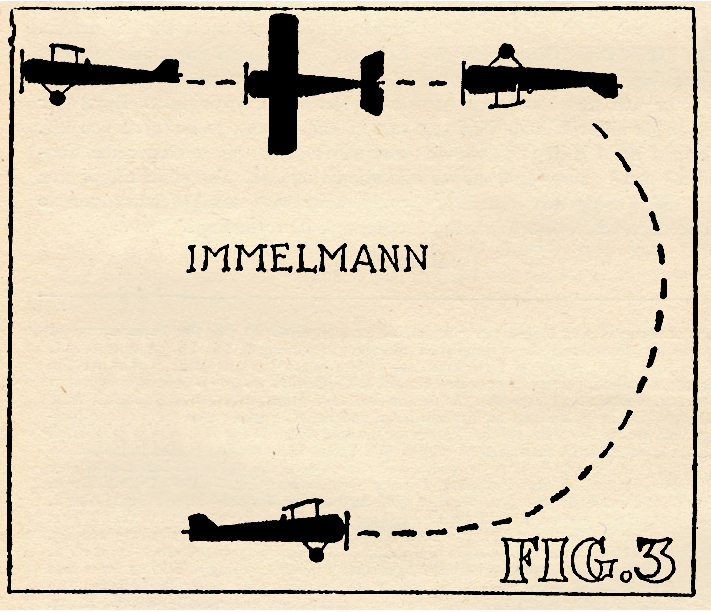
You have to make the pictures so they will overlap on all sides, like they do in Figure 3, then the brass hats put them together to form one big picture of the sector. So, thickheads, if you shot one here and another there, it would be as hard to match them up as a jig-saw puzzle.

Anyway, we get the five pictures on the first spurt across the line, nose her up and over into an Immelmann turn and start on the return voyage. But now we’re having the wind on our tail and are hitting it off at a hundred and fifty miles an hour. And so I’ve got to pull the string, count two, yank the lever, pull the string, and so forth. You can get it through your thick skulls, can’t you, that since we’re going faster, we have to work the camera faster to get the same number of pictures per mile? Good!

We Get a Break

But we get a break on this first return trip. We make a harder target for the archies who are sure burning up a lot of Herr Kaiser’s ammunition. Shells are bursting all around us. Not that I care, but I feel sorry for the pilot up in front. I bet he’s scared to death.

Whew! We’re back over our own lines. That’s great, except we’ve got to make another round trip to get the sector covered.

We act like we’re headed for home and the archies decide to call it a day and go home for a glass of beer. We’ve fooled ’em.

Then They Get Mad

Now we whip around and start plowing another furrow of pictures. The archie crew look kind of cheap at being fooled. Then they get mad and red in the face and call us a lot of schwein and ach du leibers and start sending us bursting greetings by the tons.

Well, I don’t like to talk about myself in too much detail, so I’ll just say that we accomplished the impossible and got back from that round trip.

The O.C. meets us as we settle gently to earth on one wheel and one propeller blade and rushes the camera to the dark room, where the experts develop the plates in about twenty minutes.

Now for Those Trees

Now if you can remember as far back as the beginning of this serious and highly technical discourse you might get some idea of what I meant. About those forty-year-old trees that grew up from acorns overnight, like Jack and the beanstalk.

Yes, they were camouflage to cover big guns that were being moved into place in the sector, but you’re both liars. You didn’t know that until I told you.

I have wasted my time giving you just one of many uses for aerial photography. Thousands of photographs were taken every day, and they enabled the generals to be prepared for attacks that otherwise would have surprised them. They gave exact information as to distance to strategic targets, and told when those targets, ammunition dumps, rail heads and concentration points were effectively incapacitated, as the big-word artists would have it.

Formed a War History

They formed a complete history of the war. They were studied and argued over, they solved impenetrable mysteries. There were thousands of pictures of every conceivable angle of the war. They’ll be valuable in the next war—which is headed this way faster’n a jack rabbit.

So now you two Rip Van Winkles can wake up long enough to try to make up your minds whether you want to shoot the enemy with a Kodak or a machine-gun during the next war. The photographic branch has gone forward just like the rest of aviation in the recent years and it’s going to be even more important.

Now you stay awake a while, while I sleep.

How the War Crates Flew: Guns and Howitzers

Link - Posted by David on August 8, 2023 @ 6:00 am in

FROM the pages of the February 1934 number of Sky Fighters:

Editor’s Note: We feel that this magazine has been exceedingly fortunate in securing R. Sidney Bowen to conduct a technical department each month. It is Mr. Bowen’s idea to tell us the underlying principles and facts concerning expressions and ideas of air-war terminology. Each month he will enlarge upon some particular statement in the stories of this magazine. Mr. Bowen is qualified for this work, not only because he was a war pilot of the Royal Air Force, but also because he has been the editor of one of the foremost technical journals of aviation.
Guns and Howitzers

by Robert Sidney Bowen (Sky Fighters, February 1934)

BY THIS time, you yeggs—excuse me, my error. I’ll start all over again. By this time, you buzzards must be convinced that we war pilots were very wonderful fellows.

Of course, being a modest old sparrow I can do nothing else but agree with you. However, to be serious for a few moments, the object of this little get-together is to point out that the pilot who was sent to the Front during the last war had to know quite a bit about war activities other than just the flying end.

When you enlisted there was really no way of determining whether you would be okay on pursuit ships, observation ships, or bombers. That being the case, the training you received was more general than specialized.

By that I mean, you were taught at ground school the various duties of all three types of pilots. And upon your flying depended what kind of a squadron you’d be sent to—if any!

For instance, it might so happen that once you had been sent solo you proved yourself to be a knockout on artillery co-operation work. In that case you’d be shipped to an observation squadron. And then again, perhaps, you might be a dead shot. In that case, out you’d go to a pursuit unit.

Get the Idea?

Why waste a swell shot by sticking him at the controls of a bomber? Get the idea?

Naturally, war being just as mixed up as anything else, the right men were not sent to the right squadrons all the time. There were plenty of misfits floating around—birds pushing bombers around when they should be at the controls of a pursuit or an observation ship, and vice versa. However, that sort of stuff was not the fault of the pilot in question.

Just One of Those Things

It was just one of the many, many things that can happen in war. In other words, you were sent where the big shots sent you, and that was that. You couldn’t do anything about it, except weep in your own soup.

I remember a case in particular. There were two friends of mine, one a big bruiser and the other a little half pint portion of man—but plenty scrappy, nevertheless. Well, we all trained together, and when it came time for us to be assigned to squadrons, the big fellow was sent out to a Camel squadron and the little fellow was shipped out to fly Handley-Page bombers.

The funny part of it was that I met them both about six months later, and the big fellow had to have his Camel cockpit made bigger so he could get into it, and the little fellow had to pile leather cushions in his Handley-Page cockpit in order to see over the top of the cowling.

They both came through the war with flying colors, so maybe the big shots guessed right after all.

However, whether they did or not, isn’t any skin off our noses today. What I’m trying to get over to you chipmunks is, that while you were training for the Front you were learning lots of things about war besides flying. In other words, you had to be able to fill any gap at a moment’s notice.

And so, I’m going to yell about one of the extra items we had to get through our heads before they let us go. And that item is ordnance.

Or—what? You heard me, ordnance! And being as how you don’t know what that means, I suppose I’ll have to tell you. The correct definition of ordnance is, the general name for all kinds of weapons and their appliances used in war; especially, artillery.

What’s a Gun—Huh?

That last is what I’m going to talk about—artillery.

There were, generally speaking, three types of artillery used. The first was guns, the second was howitzers, and the third was mortars.

Now wait a minute, keep your shirt on and stop asking questions so soon. I know what’s on your mind. What do I mean by guns? Well, just listen.

A gun was a piece of ordnance, cannon or pieces of artillery that was used foe, long-range fire, or in other words, line fire. A howitzer was a piece of ordnance, cannon or pieces of artillery used for short range destructive fire. And a mortar was a piece of ordnance, cannon or artillery that was used for short range, very high angle of fire bombardment work.

The Long and the Short of It

Now, let’s go into detail one at a time. First, the gun.

Of course, there were various sizes of guns. The smallest being the eighteen-pounder and the largest being the twelve-inch gun. And even bigger than that if you want to count the navel guns they sometimes mounted on mobile platforms. However, regardless of the size of the gun, the bores were all rifled to give the desired twist to the shell as it left the muzzle, so that it would travel through the air the right way.

Naturally, the driving band that circled the shell made it possible for the rifling of the bore of the gun to give a twist to the shell.

As I said, guns were used for long range work or line fire. By line fire I mean just that—the shells exploding in a line area that extended from a point on the near side of the target to a point on the far side of the target. In other words, an oblong target area. To get an exact idea of what I mean, take a squint at Fig. 1.

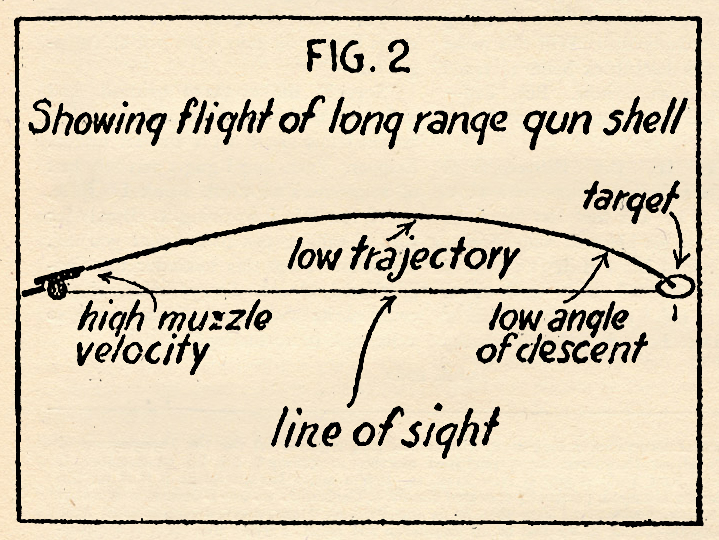
As the shell of a gun has to travel a long way, it follows that the muzzle velocity (speed of shell as it leaves muzzle of gun) is very high. However, on the other hand, the trajectory and angle of descent are very low. To explain them there big words: trajectory means angle of flight. And angle of descent, of course, means the angle in relation to the ground at which the shell descends.

Effective Range Fire

Guns were more effective on infantry movements. By that I mean, infantry columns moving along roads, field batteries moving into position, trains, railroad stations, ammo dumps, etc. In other words, targets that were either moving or stationary, but were quite a ways behind the enemy lines. See Fig. 2.

Now, I’ll get on with howitzers and you’ll be able to see just what I mean about the effective range fire of guns.

Howitzers ranged in size from four and a half inches to around sixteen inches.

Howitzers Were Accurate!

And, by the way, when I speak of size I mean the diameter of the bore of the gun or howitzer, such as the case may be.

Okay, let’s go! Howitzers were used for short-range destructive work. By that I mean, they were supposed to wipe the target right off the old map. Their range being shorter, they were far more accurate than guns. The main reason being that their area of fire was more square in shape than the area of gun-fire.

To get the point, rest your lamps on Fig. 3.

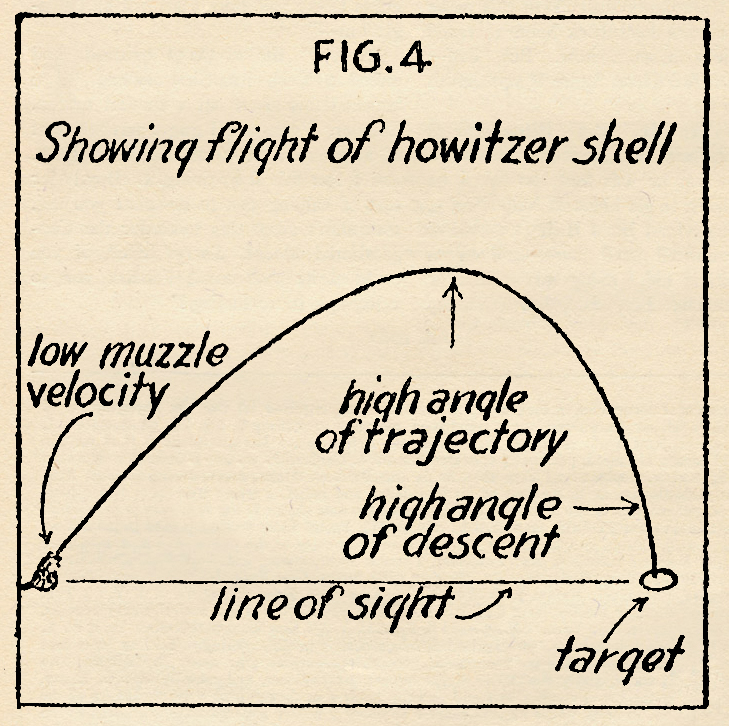
The range of howitzers being shorter the idea was to drop a shell down on it as perpendicular as possible. To do this, required low muzzle velocity, high trajectory and high angle of descent. The advantage of howitzers was that hills didn’t bother them. Their shells went up high and came down at a steep angle. So if your target was behind a hill range, you didn’t have to worry.

A gun shell that would clear the top of the hill would, of course, go beyond the target. But a howitzer shell would sneak right up over the hill and plop straight down, on the target. Take a peep at Fig. 4 and you get an idea how a howitzer shell went through the air.

Now, when I say that howitzers were for destructive work, don’t get the idea that guns didn’t destroy things. They sure did, and don’t let your cousin Alice tell you otherwise. However, perhaps you noted that howitzers pushed out bigger shells than guns, and that those shells came down straighter on the target.

Well, there you are—howitzer fire was more evenly concentrated than gun-fire, it covered a more even area about the target, and it could nail a target (within its range) regardless of ground formations. Because of its high trajectory and short range it was the bunk for moving targets.
But take an established enemy target, a field battery in position, for instance, or a troop concentration depot, and the old howitzer would give you the best results every time.

The Howitzer’s Kid Brother

A mortar was for trench to trench work. The most famous of all mortars was the Stokes trench mortar. It popped one- or two-pound shells out of your trench and down into the enemy trench. As its range of fire was nothing to write home about, a couple of hundred yards or so, the bore was not rifled, nor was there any driving band on the shell. I suppose that you could really call a trench mortar, a small edition of a howitzer without bore rifling.

Believe it or not, they were fired by dropping the shell into the muzzle. It simply slid down, detonated and came popping out again and on its way over to the enemy trench. Yes, Clarence, you had to get your hand out of the way fast. That is, of course, if you didn’t want to present the enemy with a perfectly good hand. Personally, I never met a soldier yet who didn’t want to hang onto his hands.

And there you have a general idea of artillery used in the last mix-up. Don’t forget there were all kinds of guns and all kinds of howitzers and each kind had a special use in defensive or offensive work.

However, a gun was just as different from a howitzer as a revolver is from a rifle. But both were hot stuff for their own particular type of work.

And now, just a couple of words about artillery work in general and its relation to aircraft. The work can be tabulated as follows—registration on the target for future bombardment, the bombardment itself, wire cutting and trench destruction before an infantry attack, barrage fire during an attack and emergency target work. Registration on a target (range finding) and bombardment of target work were carried out in co-operation with aircraft.

The other classes of work were carried out in co-operation with ground observation or on the initiative of the officer commanding the battery. But no matter what type of work it was, the thing that counted with G.H.Q. was results. And, now that I think of it, the only thing that ever counted with G.H.Q. was results. Nix on explanations—you had to give those big pumpkins results if you wanted to stay out of hot water.

And so there you have one non-flying item that we pilots had to learn by heart. Maybe, if you are all good little children, I’ll tell you about something else that we had to absorb before they let us become Fokker fodder. Goombye!

How the War Crates Flew: Night Flying

Link - Posted by David on July 11, 2023 @ 6:00 am in

FROM the pages of the January 1934 number of Sky Fighters:

Editor’s Note: We feel that this magazine has been exceedingly fortunate in securing R. Sidney Bowen to conduct a technical department each month. It is Mr. Bowen’s idea to tell us the underlying principles and facts concerning expressions and ideas of air-war terminology. Each month he will enlarge upon some particular statement in the stories of this magazine. Mr. Bowen is qualified for this work, not only because he was a war pilot of the Royal Air Force, but also because he has been the editor of one of the foremost technical journals of aviation.
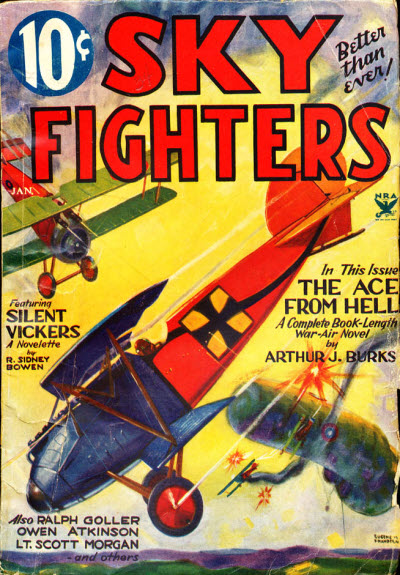
Night Flying

by Robert Sidney Bowen (Sky Fighters, January 1934)

WELL, I note that both of you sparrows are here again. And I suppose that means I’ve got to do some talking and improve your knowledge as to the activities of myself, and other world renowned heroes, during the late unpleasantness.

This time I’ll gabfest on the advantages, disadvantages, and ups and downs of night flying in the days when girls used to marry uniforms.

A Mean Job

To begin with, let me say that next to daylight bomb raids, night flying was about the meanest and toughest job that the C.O. could pass out to you. You seldom saw what you were banging away at, and the other guy wasn’t any better off.

How-the-some-ever, night flying was not originated with the idea of giving pursuit pilots something else to do. As a matter of fact, pursuit ships didn’t begin to take much part in night flying work until along about the last year of the war.

Generally speaking, night flying, simply meant bombing raids at night. Long range assignments with destinations far behind the enemy lines.

The Germans Started It

To get at the idea from a historical viewpoint, night flying in the world war was really first started by the Germans. How, you ask? With their Zeppelins, stupid. Why certainly! The Zeppelin raids on London and Paris were made under cover of darkness.

The reason for that is, of course, quite obvious. A Zeppelin raid in the daytime would be just too bad for the Zeppelin. It would be spotted long before it reached its objective.

No, Alice, this is not going to be a discourse on Zeppelin raids. So tuck in your bib and pay attention.

I spoke of Zeppelins being first used in night flying work to point out the fact that night flying was fundamentally an offensive maneuver.

How come?

Home Defense Squadrons

VERY well, let me explain the difference. In the daylight your air force raids enemy territory, repels enemy raids into your territory, and also reconnoiters enemy territory. In short there is a definite object for every patrol. But at night there were no scheduled patrols for planes on the receiving end. And by the receiving end, I mean territory that was being raided. To make it a bit more clear than that, flights of ships whose job it was to repel night invaders or raiders, didn’t take to the air until the raiders made the first move. Such squadrons were known as Home Defense Squadrons. And that’s just what they did—defended the fireside against invaders. In other words, in the daytime you flew patrols whether the enemy was there or not. But at night you only flew when the enemy came to call.

Rather than frighten the French and English populace, Zeppelin warfare made them all the more determined to defeat Germany.

Not favoring the construction of Zeppelins, or I should say, lighter-than-air-aircraft, the Allies started to hit back with long range bombing raids (Fig. 1) on German strongholds behind the lines. Most of these raids were conducted by the English, and to them should go everlasting praise for their accomplishments.

Not tor the Chicken-Hearted

A bomb raid at night is not a job for chicken-hearted men. To begin with, you’ve got to have a clear night to see things on the ground. Nowadays with blind flying developed as it is, with airway beacons, and all the rest of it, a pilot can fly from here to there and back again in almost any old kind of weather. But in war days a clear night was very essential.

But as even you two nitwits can see, what was a break for the raiders was also a break for the defenders. In other words, if you could see them, they could also see you.

There were no special hours of the night for bomb raids. The time of take-off really depended upon how far you had to fly before you could let the old “eggs” go whanging down. But the dangers of night bombing raids began just as soon as you opened up the throttle.

Today when a ship takes off at night, the runway is bathed in flood lights, and it’s just about as easy as a daytime take-off. But in war days, you did the best you could and trusted to luck for the rest. There were no flood lights, or any of the other fancy gadgets that you have today. The “runway” was simply the best part of your drome, and it was lighted by parallel rows of oil pots (Fig. 2). The ship simply took off between the two rows.

What They Looked Like

And speaking of oil pots, next time you’re out driving with the girl friend at night (you do, don’t you?) and you come to a spot where they’re digging up the road, take a look at those ball-like things that rim the ditch. They look like a bomb full of oil, and burning at the top. Well, those things are what oil pot flares used to look like during the war.

WELL, as soon as you’ve taken off, the oil pots are doused, because it’s not any help to advertise the location of your drome to any enemy ships that might be upstairs. And after those oil pots go out, the rest is up to you. If there is more than one ship in the raid, each pilot has got to make sure he doesn’t ram into the other guy. To avoid that they usually flew in follow-the-leader-style. Not only did that permit the pilot to see the exhaust flames of the ship ahead, and thus keep his distance, but it also permitted more effective bombing of the objective. When the objective was reached the first plane would drop its bombs and then bank wide and swing for home. The second ship would do the same thing, and after it, the third ship, and so on.

Naturally, while you are heading for your objective the enemy hears you, and he tries to spot you with his searchlights. And when he does, look out, because you’re going to get a shower bath of archie in the next few seconds. When one searchlight gets you, two or three others swing right over with the idea of “boxing” you—fixing you so’s you can’t dodge either way into the darkness, and escape. At such times, good piloting counts plenty, and how.

Of course, most of the time defending ships don’t wait for searchlights to nail you. They come streaking up, using your exhaust flames as a guide to where you are. And in turn your gunners use their exhaust flames as a guide to where the attacking pursuits are.

The Return Trip

Once you’ve let your eggs go, you can bet your shirt that the enemy is going to try his damnedest to get you. And so the return trip is really worse than the journey out. Besides, you’ve got to get the ship down okay.

When the home drome mechanics hear you, they set out landing marks on the drome. These are oil pots set out in a way that will indicate the direction of the ground wind. There were two signs generally used. One was in the shape of a big L, (Fig. 3) the bottom of the L being at the leeward side of the drome. In other words, you landed along the upright part of the L, toward the bottom piece. The idea being that the area formed by the angle was the smoothest part of the field.’
The other sign were lights in the form of a T, (Fig. 4) with the crosspiece being toward the leeward side of the field. And so you simply landed along either side of the leg of the T, toward the cross piece.

Sounds simple, doesn’t it? Well don’t kid yourself, sweetheart. Those oil pots never did blind you with their light, and it took wonderful pilots (like me) to get down without jarring the other guy’s teeth.

Night Pursuit Flying

To get the idea of pursuit flying at night, just reverse what I’ve been telling you about a night bombing raid. The night pursuit ships (or, bats, as your favorite authors like to call them) simply took the air when enemy bombers were announced. Their job consisted of two things. One, to get the bombers.

And the other, to avoid smacking into one of their own men. I never could decide just which job gave me the most gray hair.

Just one more thing, and I’m gone. It’s about sighting landmarks at night. One tough job, children, unless there’s a moon. About the only thing you can really see clearly, is water—rivers, lakes, etc. The rest you guess at. And here’s an interesting item lots of folks don’t know. It was a cinch for German Zeppelins to find either London or Paris at night. Why? Because both cities are on a river, and their metropolitan areas are exactly between two islands in each river, both the Thames and the Seine. They simply hovered over either of those areas and let go. And speaking of “go,” that means me. too! Good evening.

“Ghost Guns” by Ace Williams

Link - Posted by David on February 10, 2023 @ 6:00 am in

THIS week we have a brief tale by Ace Williams

THIS week we have a brief story by “Ace Williams.” I put his name in quotes because Galactic Central believes Ace to be a house pseudonym. Either way, what we have is a ripping good yarn.
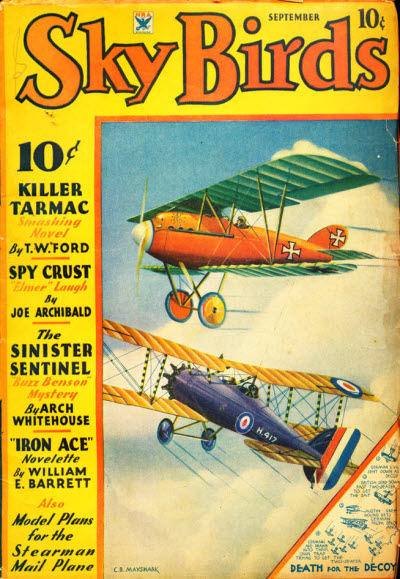
Squadron morale was falling in an alarming degree. The Roaring Hellcats had established command of the air in the sector in which they were assigned to duty. But Baron von Grunz and his Red Circus flyers had come along to make a hollow mockery of that reputation so long held by Tobey Taylor and his flying mates. Enough was enough and the C.O. declared, “We’re blasting von Grunz and his Red Circus from the skies before the sun sets this day!”

Lieutenant Tobey Taylor of the Roaring Hellcats Was Tired of Coming Out Second in Air Combat with Baron von Grunz of the Red Circus!

“Outlawed Aces” by Harold F. Cruickshank

Link - Posted by David on October 7, 2022 @ 6:00 am in

THIS week we have a story by another of our favorite authors—Harold F. Cruickshank! Cruickshank is popular in these parts for the thrilling exploits of The Sky Devil from the pages of Dare-Devil Aces, as well as those of The Sky Wolf in Battle Aces and The Red Eagle in Battle Birds. He wrote innumerable stories of war both on the ground and in the air. Here we have his take on the squadron of “Outlawed Aces”—those aces purposely listed as dead so they can be recruited for special missions much like Keyhoe’s Vanished Legion!
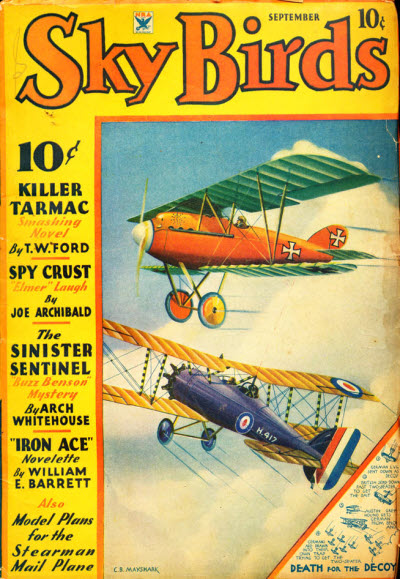
From the September 1934 issue of Sky Birds—

The thunder of guns rumbled constantly, ominously, past that secret drome in the badlands back of the Meuse River. And in the tiny hiding place were three men whose garb was strangely unmarked, whose wrists bore no identification tags. For they were a flight of vanished men—and their orders were known only to a few.

“Killer Tarmac” by T.W. Ford

Link - Posted by David on September 23, 2022 @ 6:00 am in

THIS week we have a story from the prolific T.W. Ford. Ford wrote hundreds of stories for the pages of the pulps—westerns, detective, sports and aviation—but best known for his westerns featuring the Silver Kid.

For the September 1934 number of Sky Birds Ford gives us the story of young Art Crain, just up at the front and already with a score to settle—his best mate had gone out against one of Germany’s greatest Aces, von Kunnel, to prove he wasn’t yellow as his flight leader Major “Bloody” Doll had continually chided him, and lost. Once there, Crain learns a lesson about justice, honor and war!

“Kill before somebody kills you!” That was the advice they handed to young Kid Crain when he arrived at the Front. Then the Kid ran into von Kunnel, great German ace, whose insignia was a jagged streak of lightning and who fought like that—swift, deadly, sure. And the Kid learned a lot about killers that no one had ever told him—that no one else knew.

“The Sinister Sentinel” by Arch Whitehouse

Link - Posted by David on September 2, 2022 @ 6:00 am in

THIS week we have another gripping tale from the prolific pen of Arch Whitehouse! Whitehouse had numerous series characters in the various air pulps—none ran longer than Buzz Benson! Billy “Buzz” Benson’s exploits started in the February 1930 issue of Sky Birds and appeared in every subsequent issue until it folded. Not to be twarted, Whitehouse moved Buzz over to Flying Aces where his exploits rotated with his many other characters in that title. For the uninitiated, Buzz Benson was a flying reporter for the Los Angeles Mercury newspaper, but his real job was far more dangerous. He is a secret agent and pilot extraordinaire for the U.S. military.
A young model builder stumbled on an idea the U.S. Government had been seeking for years. An Air Service official was murdered. A giant Curtiss Condor crashed to its doom on the desolate sand dunes of Chesapeake Bay. Those three things happened far apart—yet they led Buzz Benson into the mystery of the sinister sentinel known as Devils Trap Light!

“Flying Aces, December 1934″ by C.B. Mayshark

Link - Posted by David on May 2, 2022 @ 6:00 am in

THIS May we are once again celebrating the genius that is C.B. Mayshark! Mayshark took over the covers duties on Flying Aces from Paul Bissell with the December 1934 issue and would continue to provide covers for the next year and a half until the June 1936 issue. While Bissell’s covers were frequently depictions of great moments in combat aviation from the Great War, Mayshark’s covers were often depictions of future aviation battles and planes—Case in point, for three issues, starting with the December 1934 issue, Mayshark depicted Air Battles of the future! For the December 1934 issue Mayshark gives us The Rocket Raider!

Air Battles of the Future: The Rocket Raider

th_FA_3412THE future war in the air has the national defense experts puzzled as to what methods of attack may be used and what systems of defense may be required to maintain public security. In general, the aviation experts agree that few ships in modern use today would be able to withstand the onslaught of several air weapons that have already been devised and, in many cases, actually built and flown. These weapons include gas distributors, stratosphere ships, radio-controlled torpedo planes and various types of rocket-propelled machines.

Should any of these devices be brought into play today, it is evident that we have little with which to combat them. Take the case of the rocket ship, for instance. It is not a figment of the imagination, in any sense. Rocket ships and rocket automobiles have been built and actually flown or run. Rocket boats have been propelled successfully at high speed. A controlled rocket system is actually in operation in Europe, and plans are under way to deliver mail from the center of Germany to England next summer. How far away, then, is the military rocket ship? Possibly a year, possibly five.

But suppose that some foreign power has a rocket ship—a small fleet of them. If we believe facts and figures as shown, a large rocket ship, capable of carrying large bomb loads and heavy gun-power, could cross the Atlantic or the Pacific in about ten hours. Let us suppose, for instance, that such a ship or a fleet of ships were to attack the American mainland.

For one thing, this raid would not be discovered at once—probably not before the fleet was within one hundred miles of the coastline. Immediately, the General Staff would realize the seriousness of the situation. It might mean the destruction of government nerve centers. It might indicate terrible bombing, or the spreading of gas or disease germs. The knowledge of who the possible enemy was would give the first inkling of the points of attack. Naval bases might be threatened, and aircraft factories.

If big cities were to come in for the threat, it would mean death and destruction amid the civil population. Water supplies might be cut off, power and communication systems destroyed. But one of the most important points to be considered in a raid of this sort would be the grim element of blasting surprise and demoralization of morale among the civil population.

A scene prophetic of such a situation might be constructed on the air field of an Army Air Service squadron—let us say, along the Atlantic Coast. The sound-detectors have picked up a suspicious sound, a sound not quite like anything ever caught before. The detector-operator senses that this is no ordinary internal combustion engine, and at once his fears begin to gather, for he has been warned of possible raids by strange aircraft. What can this powerful engine threaten?

A fleet of Army Boeings is sent out to attempt to contact this ship. They are equipped with two-way radio sets, so they are sent out fanwise to cover as wide an area as possible and with orders to report the position of the on-rushing winged weapon.

The pilots—young, anxious, but a little skeptical about all this talk of strange foreign raiders of such monstrous proportions and ability—climb into their ships under the hasty commands of their field commandant.

As the pilot jams the gas into the 500-h.p. Wasp engine, the Boeing P-12E strains forward and is off the tarmac with a roar. Climbing in a spiral, the ship reaches six thousand feet in 3.5 minutes, levels off, and heads to the east. The pilot of the Boeing searches the skies before him and spots an object just above the horizon. Within the next minute, all his illusions about the possibilities of a rocket raid on the United States are gone.

Tearing down across the sky at a phenomenal rate of speed, there appears before the eyes of the Boeing pilot a long, black, perfectly streamlined hull supported in the air by stubby yellow wings. As the strange machine bursts into a better line of vision, the mechanical detail is easily distinguished. The rocket projection tubes are located near the aft end of the ship, and are placed so that the tail assembly will not interfere with the rocket bursts as they are emitted. On top of the rudder is a machine gun which fires in the direction that the rudder is set. The cartridge belt passes within the framework of the rudder down to the magazine, which is located in the tail of the hull. Two 37-mm. air cannons are carried in the wings. These guns are stationary, and they fire forward in the line of flight.

Other armament consists of a bullet-proof, glass-covered gun turret directly in front of the control cabin, and a fixed, steel-covered cannon turret above and to the rear of the control cabin. The ship is equipped with wheels and pontoons, both of which are retractable. Complete radio equipment is carried, including transmitter and receiver and a television screen. Except for the reserve tank, the rocket fuel is carried in ten individual containers, which feed directly to their respective rocket projection tubes. The carburetor and firing unit are located in the elbow of the tube, so that when the explosion occurs, the burst carries itself without friction with anything but air, past the tail and directly to the rear of the ship, thereby producing forward motion.

The crew consists of seven men, including the commanding officer, the pilot, the navigator, the radio operator, two gunners, and the engineer. The machine is covered with a lightweight composition sheet metal which is as strong as steel. The ship attains a speed of between 600 and 700 miles per hour, but the landing speed is relatively low, due to the fact that forward motion can be reduced simply by reversing the position of two of more of the rocket projection tubes, all of which are mounted on a swivel and can be turned to any point within 180 degrees.

Our pilot in the Boeing barely has time to collect his senses before the roaring rocket raider is all but upon him. As he kicks his trim little ship over in the air, he feels the impact of steel-jacketed bullets on his fuselage and realizes with anger that the gunner in the glass turret of the rocket demon is already firing on him! He pulls up and drops over into a half-roll in an attempt to maneuver out of the line of that deadly fire.

At last he is in the clear and, as he trains his wing guns upon the flashing hull of the rocket ship, he realizes that there are no visible vital spots at which to aim. All he can do is fire point blank and trust that he hits a control surface with damaging effect. During the few seconds that his enemy remains in his line of fire, he keeps his fingers on the trigger buttons, but the bullets bounce off the steel ship like hailstones off a tin roof.

In a vain attempt, our Boeing pilot dives down, firing at the tail of the giant ship. But suddenly he finds himself being racked by the terrific fire of his adversary’s rudder gun. Frantically he pulls his damaged ship over and slides into a slow spin. He lands a few moments later, scarcely able to explain what he has seen, owing to his excitement. But the rocket raider continues on to the west, unchecked. Where will it strike, and how will it be stopped? It will be coped with, there is certainly no doubt, but a much faster and more powerful ship than the Boeing P-12E will be required to bring it to its doom.

The Story of The Cover
Flying Aces, December 1934 by C.B. Mayshark
Air Battles of the Future: The Rocket Raider

“Hell’s Skyway” by Ralph Oppenheim

Link - Posted by David on March 25, 2022 @ 6:00 am in

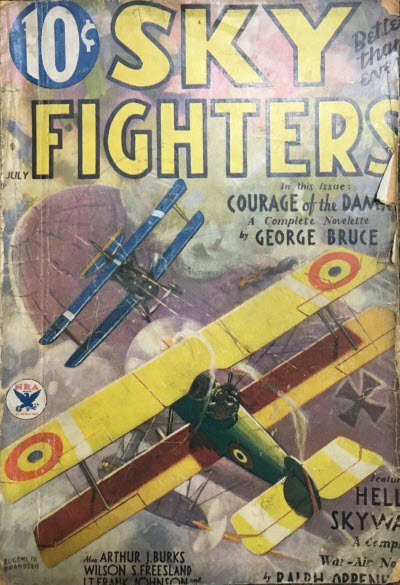
TO ROUND off Mosquito Month we have a non-Mosquitoes story from the pen of Ralph Oppenheim. In the mid thirties, Oppenheim wrote a half dozen stories for Sky Fighters featuring Lt. “Streak” Davis. Davis was a fighter, and the speed with which he hurled his plane to the attack, straight and true as an arrow, had won him his soubriquet. And time is of the essence when Streak is sent on a bombing mission. He must destroy the Krupp Machine works at Luennes before they unleash German’s newest secret weapon at noon! From the July 1934 issue of Sky Fighters it’s “Hell’s Skyway!”

The Fate of the Allies Depends on a done American Flyers Speed and Skill in this Rip-Roaring Novel of Whirling Props and Screaming Struts!

“The Greater Glory” by Ace Williams

Link - Posted by David on February 11, 2022 @ 6:00 am in

THIS week we have a story by “Ace Williams.” I put his name in quotes because Galactic Central believes Ace to be a house pseudonym. Either way, what we have is a ripping good yarn—and one that is related to R.S. Bowen’s “How The War Crates Flew” feature this month.

Captain Saunders has never failed to return with photos from an observation flight—that is until he’s paired with Lieutenant Bert Wheeling, a replacement just up from the pilot’s school at Orley. Bert is suddenly stricken with a paralysis when Saunders asks his to go down so they can snap the crucial shots. To make matters worse, a few Fokker show up with their guns yammering. What’s a green pilot to do?

A Gripping Yarn of Singing Steel and Valorous Action in the Battle-Scarred Blue!

“The Rodneys” by F.E. Rechnitzer

Link - Posted by David on November 5, 2021 @ 6:00 am in

THIS week we have a story from the pen of a prolific pulp author—F.E. Rechnitzer.

Luke Rodney was the Crack flyer of the squadron. Everything was going his way until he returned form a patrol to find his father working as an Ack Emma! It was a secret he tried to keep. But when his brother who is stationed with another squadron stops by just as Luke has failed to return from a dangerous mission—it’s his brother and father who fly to his rescue! From the pages of the July 1934 issue of The Lone Eagle, it’s F.E. Rechnitzer’s “The Rodneys!”

Luke Was the Crack Flyer of His Squadron—And His Dad Was Just an Ack Emma, But Nobody Knew It Until—

“Streaking Vickers” by Ralph Oppenheim

Link - Posted by David on March 26, 2021 @ 6:00 am in

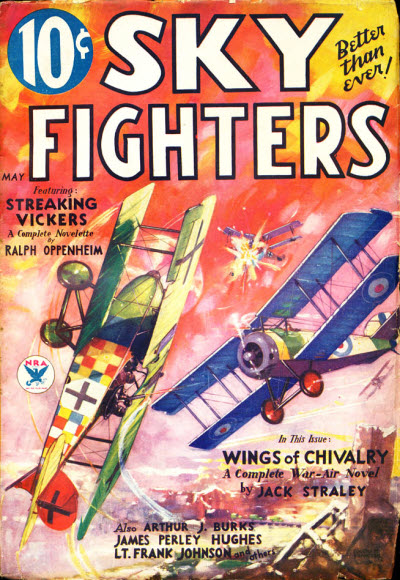
TO ROUND off Mosquito Month we have a non-Mosquitoes story from the pen of Ralph Oppenheim. In the mid thirties, Oppenheim wrote a half dozen stories for Sky Fighters featuring Lt. “Streak” Davis. Davis was a fighter, and the speed with which he hurled his plane to the attack, straight and true as an arrow, had won him his soubriquet. Operating out of the 34th Pursuit Squadron, his C.O. sends him out to range the big guns to take out the enemy’s supply dump before the Hindenburg Push. From the May 1934 issue of Sky Fighters it’s “Streaking Vickers!”

Follow Lieutenant “Streak” Davis As He Sails the Sky Lanes on the Perilous Trail of Hun Horror!

“Von Satan’s Lair” by Harold F. Cruickshank

Link - Posted by David on January 1, 2021 @ 6:00 am in

ALTHOUGH we just gave you twelve stories last month instead of just four or five, it’s Friday, so let’s make it a baker’s dozen. And who better to feature that our old pal Harold F. Cruickshank. We have three good reasons for this: First, Harold F. Cruickshank was not represented last month among our twelve tales of Christmas 1931; Second, this is kind of a teaser for next month when we’ll be featuring Canada’s favorite son and looking at his trio of Aces—The Sky Devil, The Red Eagle and The Sky Wolf, as well as his Pioneer Folk tales; and last, but by no means least, It’s just a darn good story to get the year going!

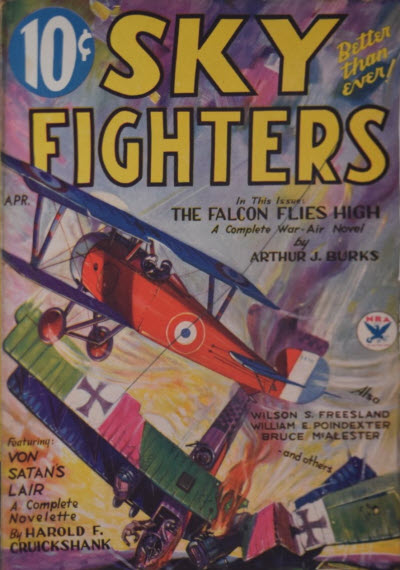
Jack Malone’s flight has been dwindling down at the hands of the evil Baron von Satan! When his former deputy leader returns badly injured, his face surgically altered, and fighting off some kind of mind control—Malone believes there’s still hope to find other members of his flight, and that he can save them before they too go under the sinister knife of von Satan!

From the pages of the April 1934 issue of Sky Fighters, it’s Harold F. Cruickshank’s “Von Satan’s Lair!”

Corporal Jack Malone Sails the Sky Lanes Grimly in this Gripping Drama of Sinister Secrets of Hun Hate!

“Solo Show” by F.E. Rechnitzer

Link - Posted by David on July 10, 2020 @ 6:00 am in

THIS week we have a story from the pen of a prolific pulp author—F.E. Rechnitzer. Tip Hunley was a forgetful sort—he would even forget his commanding officer’s direct orders. The result of which found him grounded the night before his squadron was to set to bomb the ammunition dump at Roulents early the next morning. However, he neglected to remember that he had been grounded when he took a Sopwith Camel up and took on the Roulents dump all on his own! Surely an unforgettable story he could one day tell his grandkids! From the pages of the September 1934 issue of Sky Fighters, it’s F.E. Rechnitzer’s “Solo Show!”

Tip Hurley Was Grounded for Disobedience—But No Brass Hat Could Stop That Hell-Bent Sky Rider from Taking a Crack at the Roulents Dump!

“Grim Rapiers at Retreat” by Arthur J. Burks

Link - Posted by David on October 18, 2019 @ 6:00 am in

THIS week we have a story by prolific pulpster—Arthur J. Burks! Burks was a Marine during WWI and went on to become a prolific writer for the pulps in the 20’s and 30’s and was a frequent contributor to the air war pulps like The Lone Eagle.

The Allied squadrons have been plagued by a Boche pilot known as The Red Falcon (no relation to Hogan’s Red Falcon). He’s a nasty piece of work who appears out of nowhere in his crimson painted Fokker wearing a falcon’s hood of red to pick off a returning pilot just as he gets to his drome and then disappears just as suddenly. It seems the Germans had worked out a new plan of attack, harassment and morale destruction, but Lt. Michael Kelly figured out a way to put an end to the Red Falcon’s game even it it meant following him all the way to the edge of Hell! From the pages of the August 1934 issue of The Lone Eagle, it’s Arthur J. Burks’ “Grim Rapiers at Retreat!”

A Crimson Boche Ship of Flaming Doom Calls All the Fighting Spirit of Lieutenant Michael Kelly into Play!

« Previous PageNext Page »