



Looking to buy? See our books on amazon.com Get Reading Now! Age of Aces Presents - free pulp PDFs

“Lives of the Aces in Pictures – Part 32: Wendell W. Rogers” by Eugene Frandzen

Link - Posted by David on February 11, 2015 @ 6:00 am in

Back with another of Eugene Frandzen’s “Lives of the Aces in Pictures” from the pages of Flying Aces Magazine. The series ran for almost four years with a different Ace featured each month. This time around we have the February 1935 installment featuring the illustrated biography of that famous Canadian Ace—Captain William Wendell Rogers!

RFC Captain Rogers is credited with nine aerial victories. All these accomplished while flying Nieuports. His most famous victory was singlehandedly shooting down an enormous Gotha G bomber piloted by Blue Max winner Hauptmann Rudolf Kleine—the two crew members, the Pilot Lt von der Nahmar and rear gunner, Lt.Werner Bulowius chose to jump out while Hauptmann Klein remained aboard and went down with the ship.

Canada Veterans Hall of Valour sketches out his later life:

    For his achievement, Rogers was awarded the Military Cross (MC) and a special commendation from General Trenchard, Head of the RFC. Shortly afterwards he took up instructional duties with the RAF in Canada for the rest of the war.
    Coming to Saint John N.B. in 1924, Rogers was soon active in promoting a Flying Club and the city’s first airport, constructed at Millidgeville.
    Rogers first operated a General Motors agency in Saint John N.B. In 1933 he joined the Irving Oil Company in charge of their trucking operations. In 1934 management of the Saint John Motor Line was added to his duties and in 1940 he became President of SMT (Eastern) Ltd.
    In October 1938 he was appointed Commanding Officer of No. 117 RCAF Fighter Squadron (non permanent) with the rank of Squadron Leader and there was a rush of applications to join the unit, which had been established in Saint John.
    He married Sally Head of Charlottown PEI and they had two sons; Frederick and Lloyd. In 1949, with his two sons, he established a plastic manufacturing business under the firm name of Rogers Bros., Ltd. On January 11, 1967 he died in Saint John hospital after a long illness.

“The Camel and Lt. White” by Frederick Blakeslee

Link - Posted by David on February 9, 2015 @ 6:00 am in

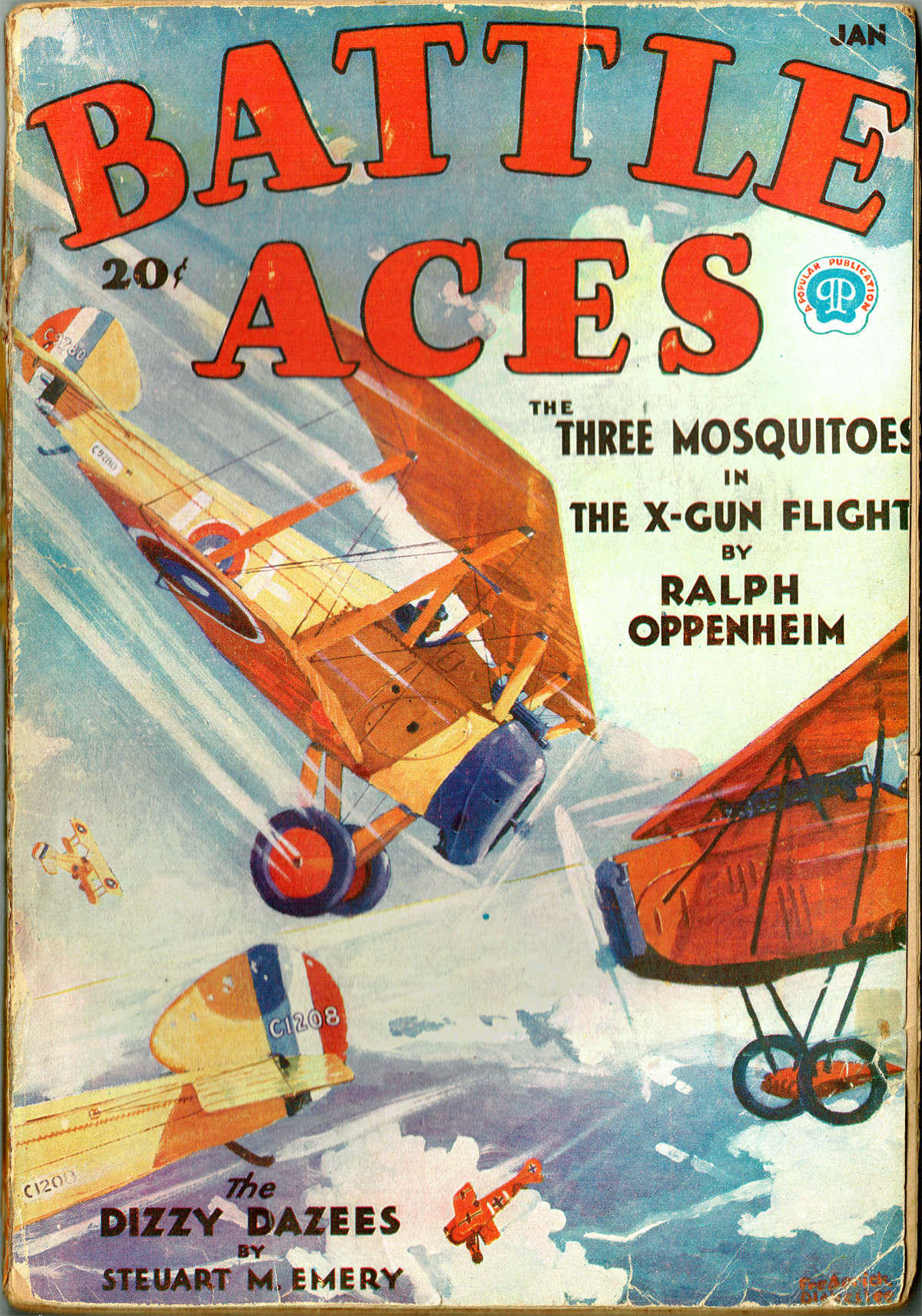
Editor’s Note: This month’s cover is the eighth of the actual war-combat, pictures which Mr Blakeslee well-known artist and authority on aircraft, is painting exclusively for BATTLE ACES. The series was started to give our readers authentic pictures of war planes in color. It also enables you to follow famous airmen on many of their amazing adventures and feel the same thrill of battle they felt. Be sure to save these covers if you want your collection of this fine series to be complete.

Lt. Wilbert Wallace White
Lt. Wilbert Wallace White, 147th Aero Squadron. He was a Flight Commander for the Squadron and gained 8 victories during his service.

th_BA_3201ON SEPTEMBER 14, 1918, three reconnaissance machines took the air on a mission of observation. They had for protection Second-lieutenant Wilbert W. White. While Lt. White was cruising about above the ships he was attacked by three Halberstadt fighters. He succeeded in fighting them off and leading them away from the observation ships, which were permitted to carry on their work unmolested. On his way home he sighted an enemy balloon near Chambley. He dove through a cloud to the attack, and before the ground crew knew what had happened, the drachen had come down about their ears in flames. The Yank was instantly attacked by two Fokker Scouts.

Although he was alone, with intrepid courage he attacked the first plane head-on, shooting until it went into a vertical dive out of control. Pulling sharply about, he fired a long burst at the second Fokker as it went over him. The Boche didn’t stop to argue, but streaked for the Vaterland as fast as his prop would drive him. For this thrilling exploit Lieutenant White was awarded the D.S.C.

The very next month he paid the supreme price in a way that was heroic in the extreme. He sacrificed his life that a buddy might live.

It was on October 10th that Lieutenant White, while in command of a patrol of four planes, met a flight of five Fokkers. In his patrol was a new member who was taking his first trip over the lines. One of the Boche pilots, perhaps sensing that he was a novice, or just by chances of combat, attacked him and obtained an advantageous position on his tail. The new pilot dodged and turned but was unable to shake off the Fokker, who followed his every move and was rapidly gaining on him. Lieutenant White saw that his friend was in dire trouble. Turning, he sped into position to attack the Boche. The Jerry was intent on his intended victim and was sending short bursts at close range whenever he could get him in line with his gun-sights. The situation looked black for the new pilot, but still blacker when Lieutenant White’s guns jammed hopelessly. Sooner or later a burst from the Fokker would hit a vital spot.

There was only one thing Lieutenant White could do to save his buddy, but it meant a horrible death. Without an instant’s hesitation he swung around and streaked full speed, head-on, into the startled and horrified enemy. The impact was terrific, the results devastating. For this act of extraordinary heroism the oak leaf cluster was awarded. The scene on the cover is just before the impact.

Lieutenant White belonged to the 147th squadron which used Spads. Since there was a picture of a 147th squadron Spad on last month’s cover, I have painted Lieutenant White’s machine as a Sophwith Camel to prevent repetition in plane types.

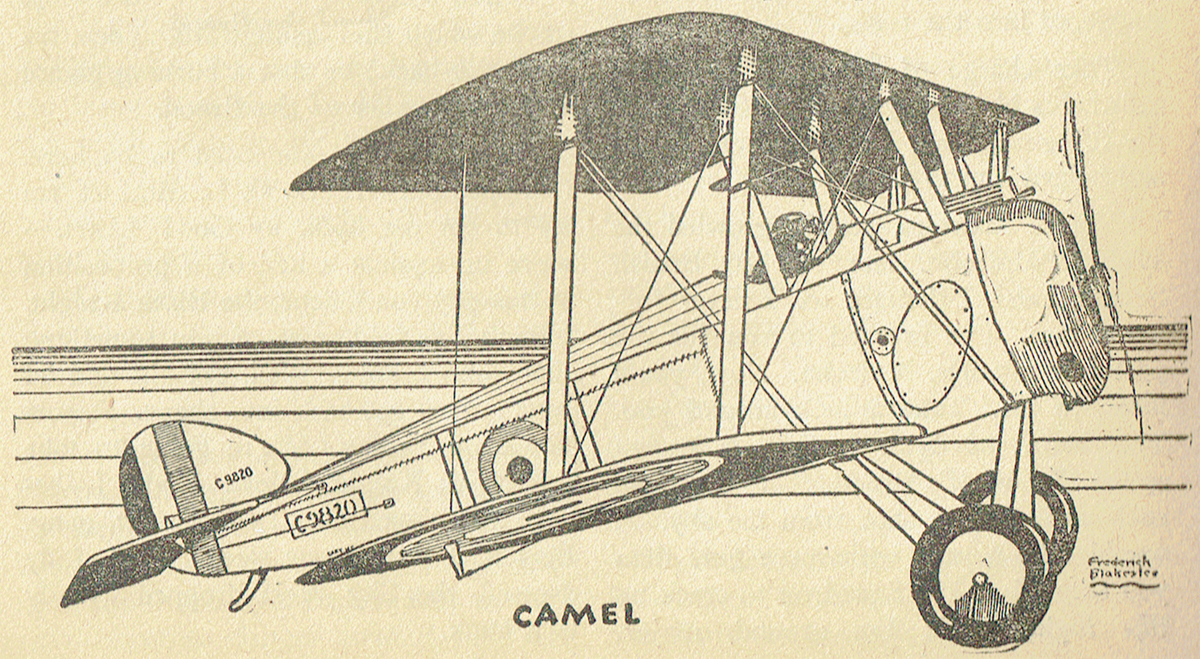
Much can be said for and against the Camel. It was an enlarged and modified “Pup” and was designed specially for high performances and extreme maneuverability. To obtain these ends some of the qualities of the Pup were necessarily sacrificed, and the machine had a reputation for being uncomfortable to fly. In fact I know of no pilot who went into a Camel squadron voluntarily.

Due to the torque of the motor it was extremely difficult to make a right-hand turn. This one fault caused a great many deaths to the men in training.

The Camel was also prone to catch fire in landing. The reason for this was because the engine, a 9-cylinder Gnome Monosoupape rotary, had no carbureter and therefore no throttle. It was necessary to slow down by means of a selector on the ignition system which cut out various cylinders. For example, the engine could run on 9-7-5-3 or one cylinder.

The mixture in the cylinders not used was sent through the exhaust manifold unburnt and might be ignited by the exhaust from an active cylinder. The ship landed with a long flame streaming from the exhaust which very often ignited the fabric.

On the other hand, it was the best ship for maneuvering ever brought out by the Allies, and was a great success in combat.

The Camel could climb to 5,000 feet in 5 minutes and to 10,000 feet in 12 minutes, at which height its speed was 113 m.p.h. It had a span of 28 feet; an overall length of 18 feet, 9 inches; a maximum gap of 5 feet and a minimum gap of 4 feet, F/io inches. A distinctive feature of this machine is the great dihedral of the bottom plane, combined with a flat top plane.

The ship received its name partly because of the appearance of a hump when seen from the side, and partly because the elevators were so sensitive that unless the pilot had a great deal of experience he flew in humps.

The Camel and Lt. White
“The Camel and Lt. White” by Frederick M. Blakeslee (January 1931)

“Two Aces ~ and a Joker” by Ralph Oppenheim

Link - Posted by David on February 6, 2015 @ 6:00 am in

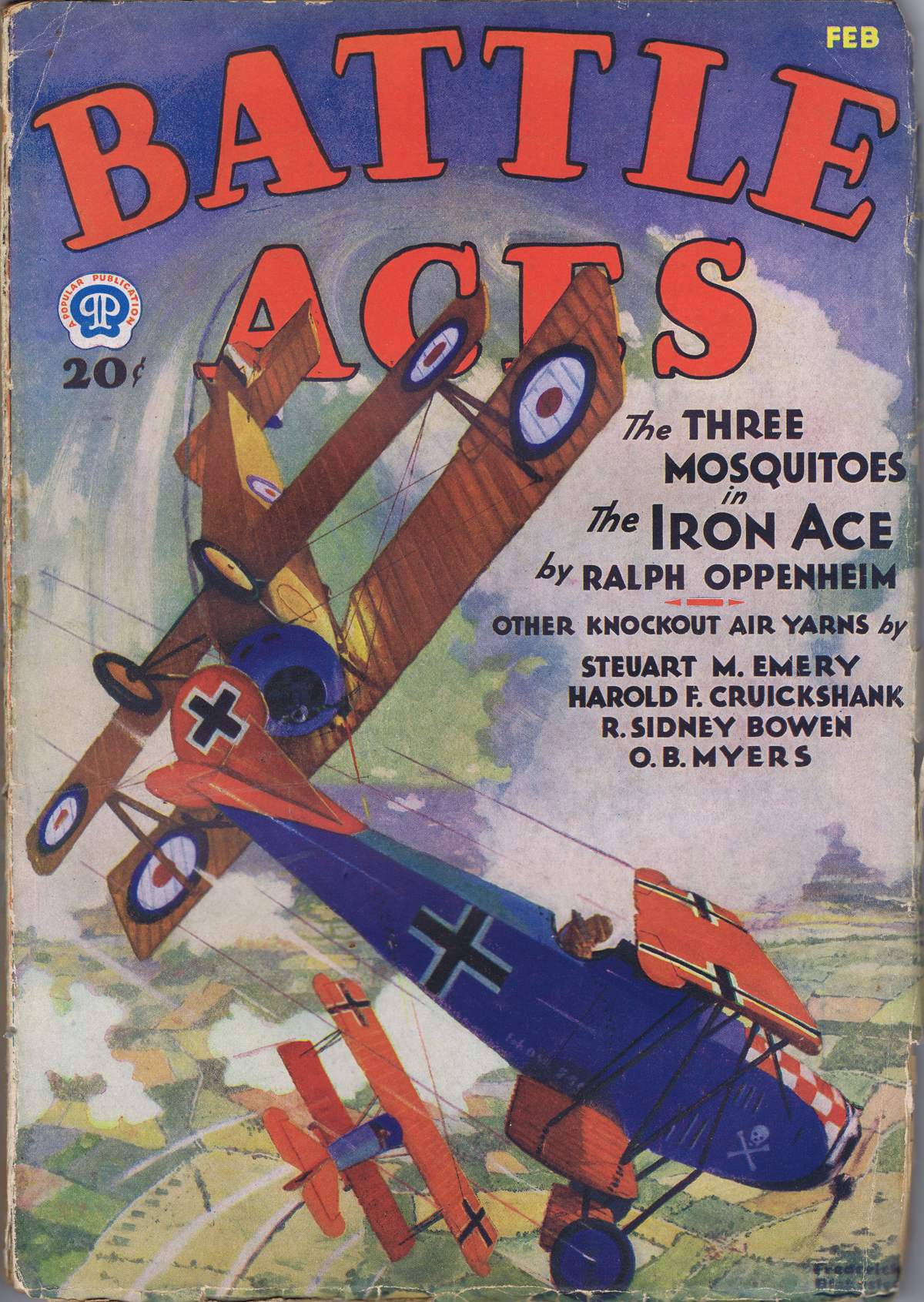
THROUGH the dark night sky, streaking swiftly with their Hisso engines thundering, is the greatest trio of aces on the Western Front—the famous and inseparable “Three Mosquitoes,” the mightiest flying combination that had ever blazed its way through overwhelming odds and laughed to tell of it! Flying in a V formation—at point was Captain Kirby, impetuous young leader of the great trio; on his right was little Lieutenant “Shorty” Carn, the mild-eyed, corpulent little Mosquito and lanky Lieutenant Travis, eldest and wisest of the Mosquitoes on his left!

Yes! The Three Mosquitoes, and to help get through the cold winter months, at Age of Aces dot net it’s Mosquito Month! We’ll be featuring that wiley trio in three early tales from the Western Front. This week we have the classic “Two Aces ~ and a Joker” in which Kirby takes on a lone enemy plane while returning from a mission. The two crash and Kirby and the Boche flyer strike up an uneasy truce until they find out which side of the lines they are on and who is whose prisoner!
Kirby, leader of the famous “Three Mosquitoes,” knew that he was too worn out to jump into another fight. He must get his plane back to the drome. But that lone Fokker that appeared suddenly below him looked too easy to miss—it was a cinch! He dived, with motor roaring, but it wasn’t such a cinch——

If you enjoyed this tale of our intrepid trio, check out some of the other stories of The Three Mosquitoes we have posted by clicking the Three Mosquitoes tag or check out one of the three volumes we’ve published on our books page! And come back next Friday or another exciting tale.

“Lives of the Aces in Pictures – Part 31: Oswald Boelcke” by Eugene Frandzen

Link - Posted by David on February 4, 2015 @ 6:00 am in

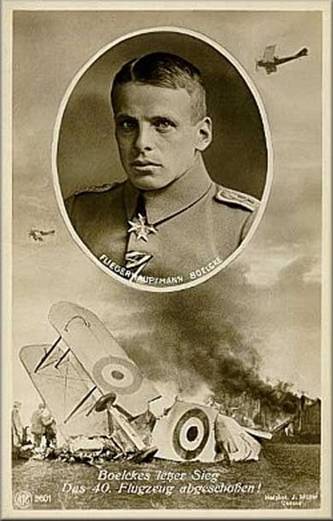
boelckeBack with another of Eugene Frandzen’s “Lives of the Aces in Pictures” from the pages of Flying Aces Magazine. The series ran for almost four years with a different Ace featured each month. This time around we have the January 1935 installment featuring the illustrated biography of Hauptmann Oswald Boelcke!
Boelcke is regarded by many as the father of air combat—he developed a series of rules known as the Dicta Boelcke that espoused fighter tactics based upon aircraft formation rather than upon the characteristics of any individual machine. By 1916 Boelcke had amassed more ‘kills’ than any other German pilot—40, many above the Verdun battlefield. And had a chest full of awards and honors. Sadly, it his death is a result of not following his own rules of engagement—which mandated never to close in on a single combatant when others are also pursuing it—as he crashed into one of his fellow ships while trying to avoid a French pilot.

“Friedrichshafen Bomber” by Frederick Blakeslee

Link - Posted by David on February 2, 2015 @ 6:00 am in

Editor’s Note: Every month the cover of BATTLE ACES depicts a scene from a real combat actually fought in the War and a real event in the life of a, great ace. The series is being painted exclusively for this magazine by Frederick M. Blakeslee, well-known artist and authority on aircraft and was started especially for all of you readers who wrote us requesting photographs of war planes. In this way you not only get pictures of the ships—authentic to the last detail—but you see them in color. Also you can follow famous airmen on many of their most amazing adventures and feel the same thrills of battle they felt. Be sure to save these covers if you want your collection of this fine series to be complete.

Friedrichshafen G.III Bomber
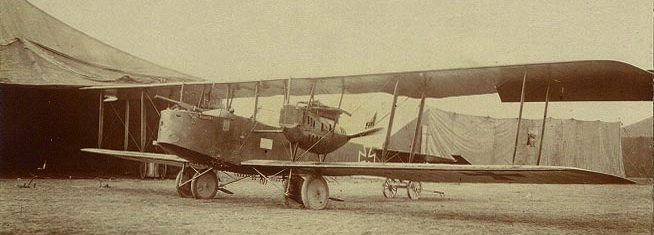
The Friedrichshafen G.III Bomber

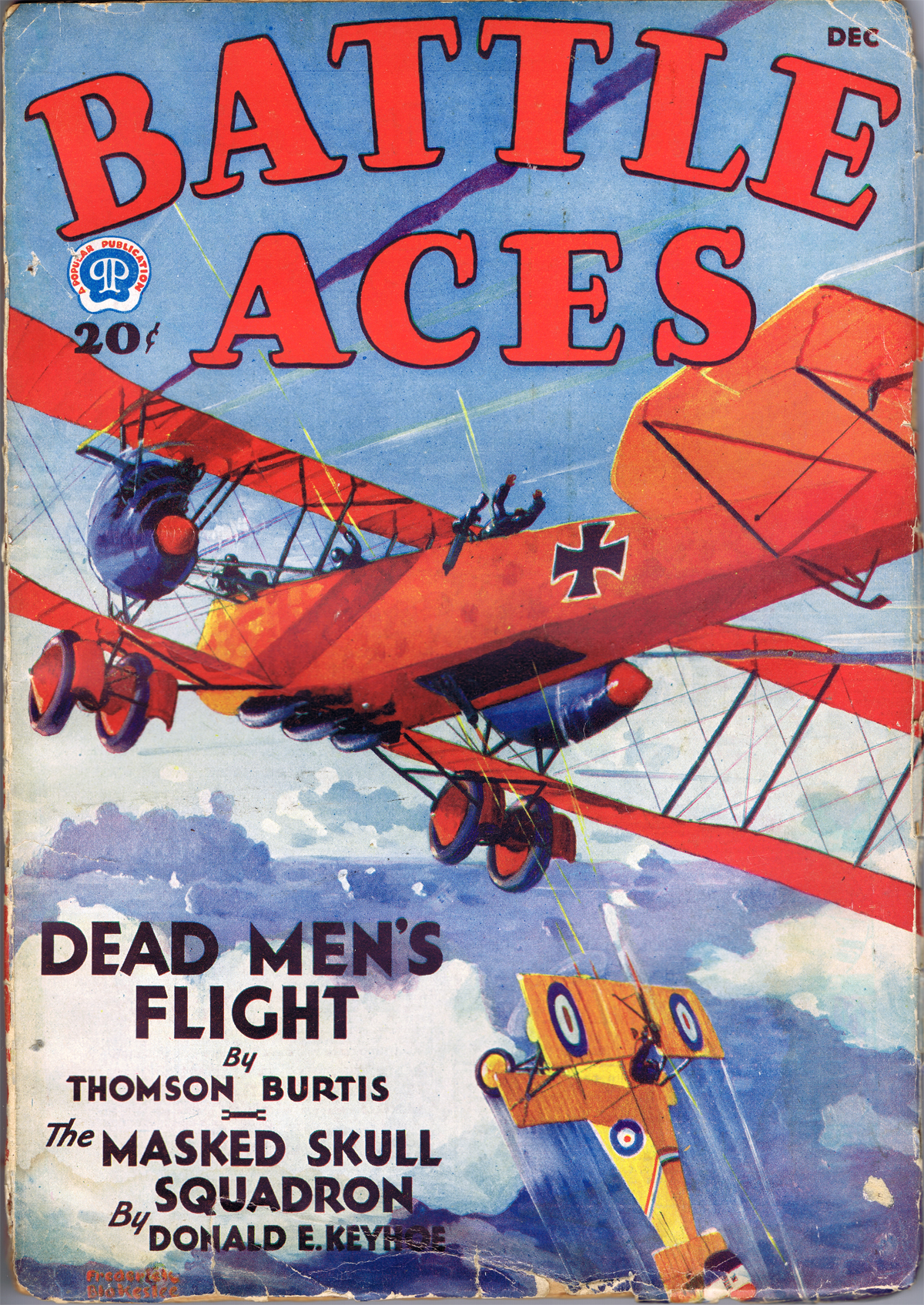
th_BA_3112THE cover this month shows how a Friedrichshafen bomber was brought down by a Frenchman near Verdun. It was a big brute such as this that spelled the doom of Lufbury, America’s most spectacular ace.

The huge ship appeared back of the American sector near Loul. Four fighting ships took the air to give it combat, but returned after expending their ammunition, reporting that it seemed impossible to damage it. The big bomber loafed along as unconcernedly as if it were an elephant with a swarm of mosquitoes at its heels. Then Lufbury obtained permission to try his hand. He took off and mounted above the dragon of the air, then swept down upon it. His machine gun is believed to have become jammed, for when nearly upon the German he swerved off. Almost at once he came back again, flashing by the Boche with his guns blazing. But still the German lumbered on unhurt. Again Lufbury returned to the attack. Suddenly the watchers below saw a line of fire burst from his machine, and the ship began to plunge earthward.

We all know the manner of Lufbury’s death. He had a horror of being burned, and always said that in the event of his machine catching fire he would jump. He was true to his word, for that is exactly what he did, from a height of about two thousand feet. However, this is a digression; let us return to the Friedrichshafen.

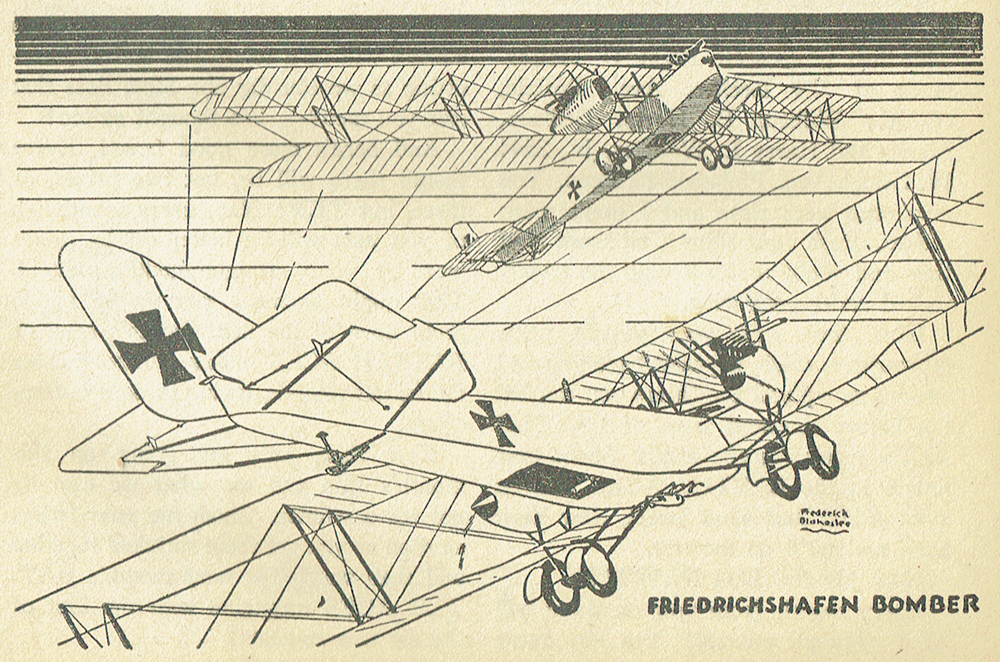
These machines were in the air what the battleship is in the sea, and about as dangerous to tackle. There was no blind spot except on the under part of the fuselage toward the bow, and it was extremely hard to maneuver for this position, due to the fact that in the bottom of the floor, just aft of the bomb racks, was a trap door from which a machine gun commanded a view downward and backward.

The weak point in all big planes had been the inability of the gunners to protect the ship from an attack underneath. The secret of the invulnerability of the Friedrichshafen was that, due to this trap door, the gunner could now protect the blind spot, making the accepted mode of an attack on a bomber not only very dangerous but almost useless. The guns aboard these planes commanded a field of fire that almost completely surrounded the ship.

The big red devil pictured on this month’s cover, however, was unlucky. It was returning from a bombing mission at early dawn. A French flyer on morning patrol spotted it and speeding along in the gloom that hung close to the earth, slowly mounted until directly behind the tail. Then with throttle wide open he dove, gaining tremendous speed. He zoomed up and in a flash was directly underneath, his guns blazing forth a deadly hail of lead. Then he stalled, fell away, and dived out of range.

What circumstances accounted for the fact that he was allowed to approach within range, is not known. It is presumed that the crew, for some reason, had lapsed their vigil and were feeling safe either because of the early hour of the morning, or because they thought themselves over Germany. At any rate, that one burst was enough. The big crate came down back of the lines near Verdun, very slightly damaged, and was hailed with much joy by the powers that he.

It would serve no purpose to give an exhaustive technical description of the Friedrichshafen. A few facts will suffice. Big ships as they were, they were considerably smaller than the Gotha, being 36 feet in length with a wing span of 66 feet. They were powered by two 225 h.p. Benz motors, one each side of the center and inclosed in ovoid bonnets. The ship weighed when loaded 6,960 lbs. Beside machine guns they each carried twelve high explosive bombs and seven incendiary bombs.

The cover and the drawing below will give you a very accurate idea of how the plane looked.

Friedrichshafen Bomber
“Friedrichshafen Bomber” by Frederick M. Blakeslee (December 1931)

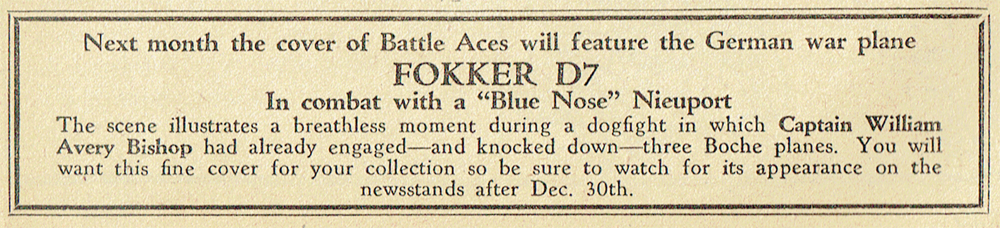
Next month’s cover will feature a CAMEL in deadly combat with a FOKKER. If you have been wanting an authentic picture in colors of a Camel machine, you will find it on the cover of the January issue. Not only that, but there is a real, gripping story behind the fight in which the ship is portrayed—the story of a valiant flyer who was willing to crash nose on into an enemy plane, willing to meet a flaming death, in order that he might save the life of his buddy. This will be the 8th in the series of actual war combat covers which Mr. Blakeslee is painting for you. If you do not have all of these pictures and would like them so that your series will be complete, send twenty cents for each magazine to Battle Aces, 205 E. 42nd St., New York City, and specify which issue or issues you desire. The planes illustrated so far have been: S.E.5; B.E. Fighter; R.E.8; Pfaltz Scout; Spad.

“Intelligence Pest” by Joe Archibald

Link - Posted by David on January 30, 2015 @ 6:00 am in

“Haw-w-w-w-w!” That sound can only mean one thing—that Bachelor of Artifice, Knight of Calamity and an alumnus of Doctor Merlin’s Camelot College for Conjurors is back to vex not only the Germans, but the Americans—the Ninth Pursuit Squadron in particular—as well. Yes it’s the marvel from Boonetown, Iowa himself—Lieutenant Phineas Pinkham!
Phineas Pinkham was so pleased with his particular prisoner that he even offered him a cigar that wasn’t loaded. Yes, they call that fraternizing with the enemy!

The Hogan/Steeger Letters 6

Link - Posted by David on January 29, 2015 @ 6:00 am in

A few years ago, writer and frequent Age of Aces contributer Don Hutchison came up to our table at PulpFest and handed us a manilla envelope, entrusting us with its contents. When we opened the envelope, there were correspondence between Robert Hogan and Henry Steeger and a copy of the Newton, New Jersey Sunday Herald from October 21st, 1962.

While we don’t have a copy of Bob Swift’s G-8 homage that ran in the Miami Herald Sunday Magazine on July 8th, 1962, we do have an article on Robert J. Hogan that ran in his local paper, the Newton, NJ Sunday Herald in October of 1962. We posted the article—“Lurid Plots Hatched In Sussex Boro”—back in October. What follows is the correspondence between Robert J. Hogan and Henry Steeger in regard to this article. . .


October 22, 1962    


Dear Harry:

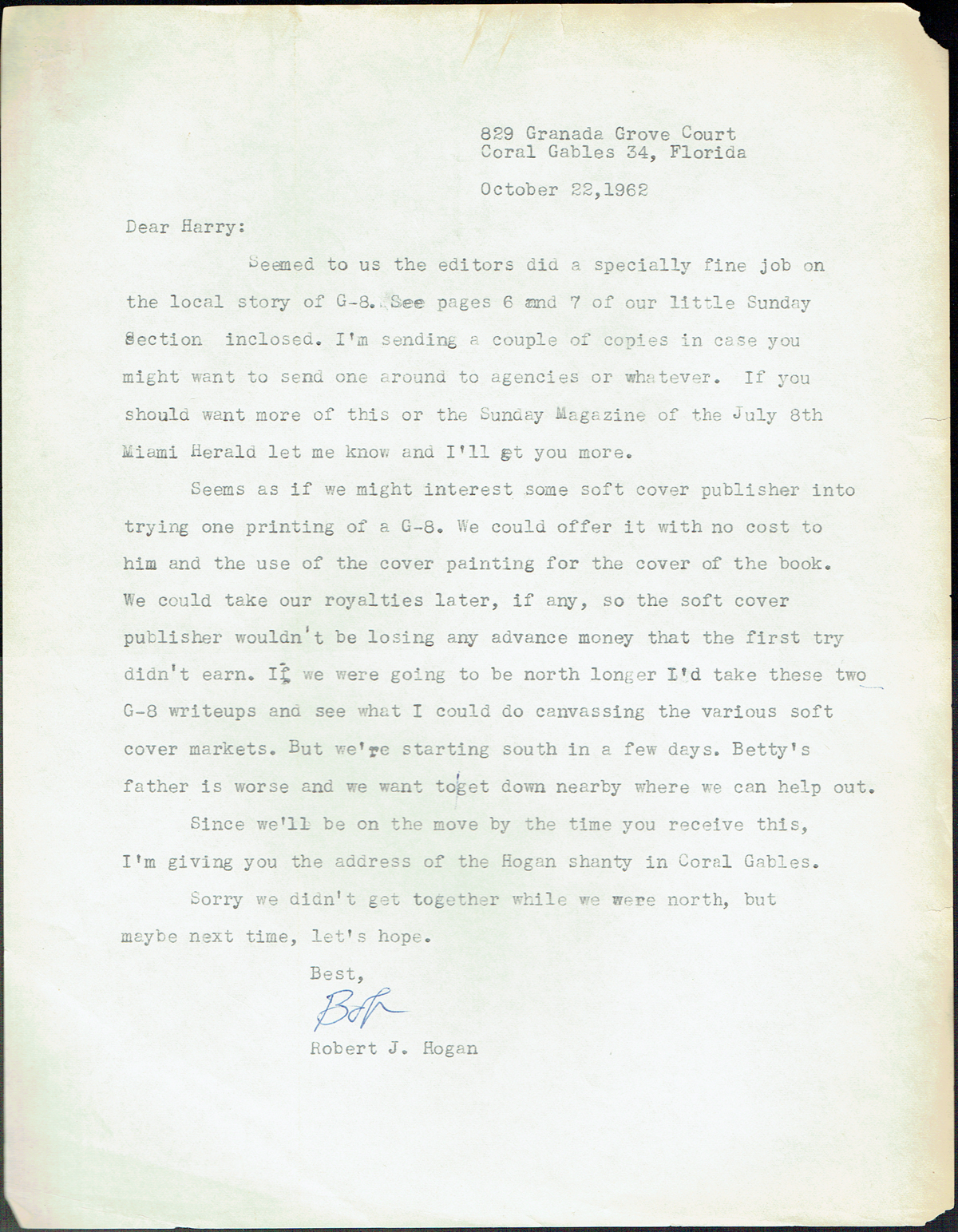
    Seemed to us the editors did a specially fine job on the local story of G-8. See pages 6 and 7 of our little Sunday Section inclosed. I’m sending a couple of copies in case you might want to send one around to agencies or whatever. If you should want more of this or the Sunday Magazine of the July 8th Miami Herald let me know and I’ll get you more.

Seems as if we might interest some soft cover publisher into trying one printing of a G-8. We could offer it with no cost to him and the use of the cover painting for the cover of the book. We could take our royalties later, if any, so the soft cover publisher wouldn’t be losing any advance money that the first try didn’t earn. If we were going to be north longer I’d take these two G-8 writeups and see what I could do canvassing the various soft cover markets. But we’re starting south in a few days. Betty’s father is worse and we want to get down nearby where we can help out.

Since we’ll be on the move by the time you receive this, I’m giving you the address of the Hogan shanty in Coral Gables.

Sorry we didn’t get together while we were north, but maybe next time, let’s hope.

                    Best,
                    Robert J. Hogan


— ✪ ✪ ✪ —


October 30, 1962    


Dear Bob:

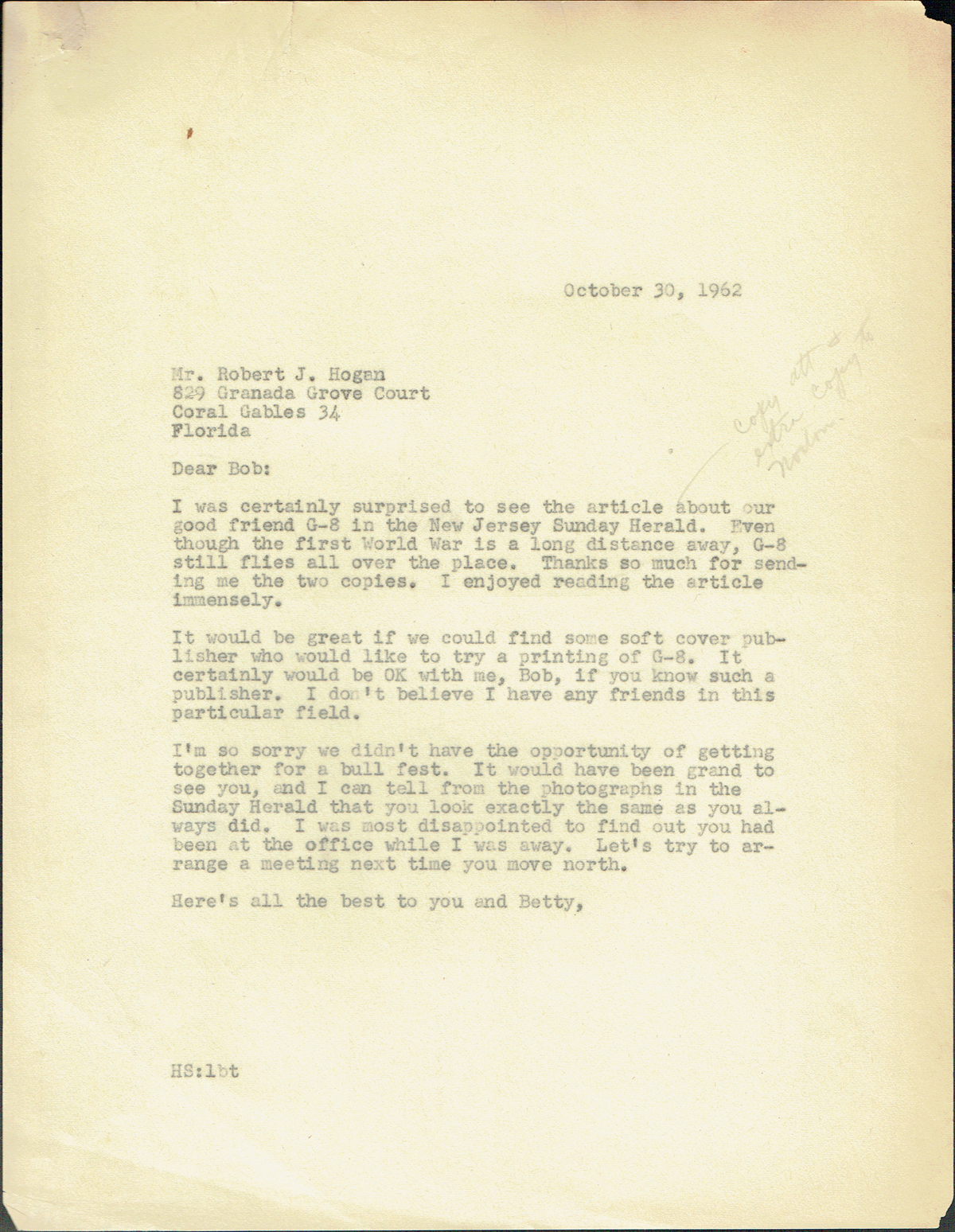
I was certainly surprised to see the article about our good friend G-8 in the New Jersey Sunday Herald. Even though the first World War is a long distance away, G-8 still flies all over the place. Thanks so much for sending me the two copies. I enjoyed reading the article immensely.

It would be great if we could find some soft cover publisher who would like to try a printing of G-8. It certainly would be OK with me, Bob, if you know such a publisher. I don’t believe I have any friends in this particular field.

I’m so sorry we didn’t have the opportunity of getting 
together for a bull fest. It would have been grand to 
see you, and I can tell from the photographs in the
 Sunday Herald that you look exactly the same as you al
ways did. I was most disappointed to find out you had
 been at the office while I was away. Let’s try to arrange a meeting next time you move north.

Here’s all the best to you and Betty,


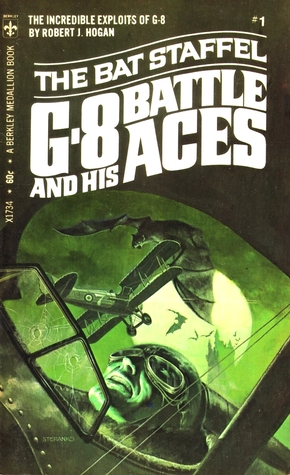
Berkely Medalion would eventually publish a series of 8 G-8 and His Battle Aces unabridged paperbacks from 1969 through 1971—the first three with new cover art by Jim Steranko.
The Hogan/Steeger Letters 5

Link - Posted by David on January 28, 2015 @ 6:00 am in

A few years ago, writer and frequent Age of Aces contributer Don Hutchison came up to our table at PulpFest and handed us a manilla envelope, entrusting us with its contents. When we opened the envelope, amung other things, there were letters from Robert Hogan to Harry Steeger and back again.

The correspondence continues. Bob Swift’s G-8 piece has been published in the Miami Herald Sunday Magazine Sunday July 8th, 1962. (Steeger did not include a copy of the article with his correspondence files and we have been unable to get a hold of a copy of this article otherwise). . .


July 12, 1962    


Dear Harry:

    The G-8 piece finally came out and we all feel it was well worth waiting for. I saw Bob Swift yesterday and he said hed sent you a copy and returned the G-8 magazines you had sent him. So you should see it for yourself if you haven’t already.

    Bob Swift feels very strongly that G-8 should be a TV series and so do we all, of course. They’ve had about every type now except the World War One flying stuff and G-8 should do it well. I think if j:e could get a piece like this or this piece itself or an enlargement of this G-8 piece in a national magazine we might be on our way to the TV moneybags.

    We’re heading north July 26th so we’ll be there during August and probably the fall and hope I can drop in for a hello when we get into New York.

    A chance came along to rent our home down here to some nice folks until November 1st. They had to get in right off so we’ve taken an apartment here where we’ve been on similar occasions. Third floor and nice and cool.

    If you write after the 26th of this month better address us at our old stand:
                                    Box 248
                                    Sparta
                                    New Jersey

                    Best,
                    Robert J. Hogan


— ✪ ✪ ✪ —


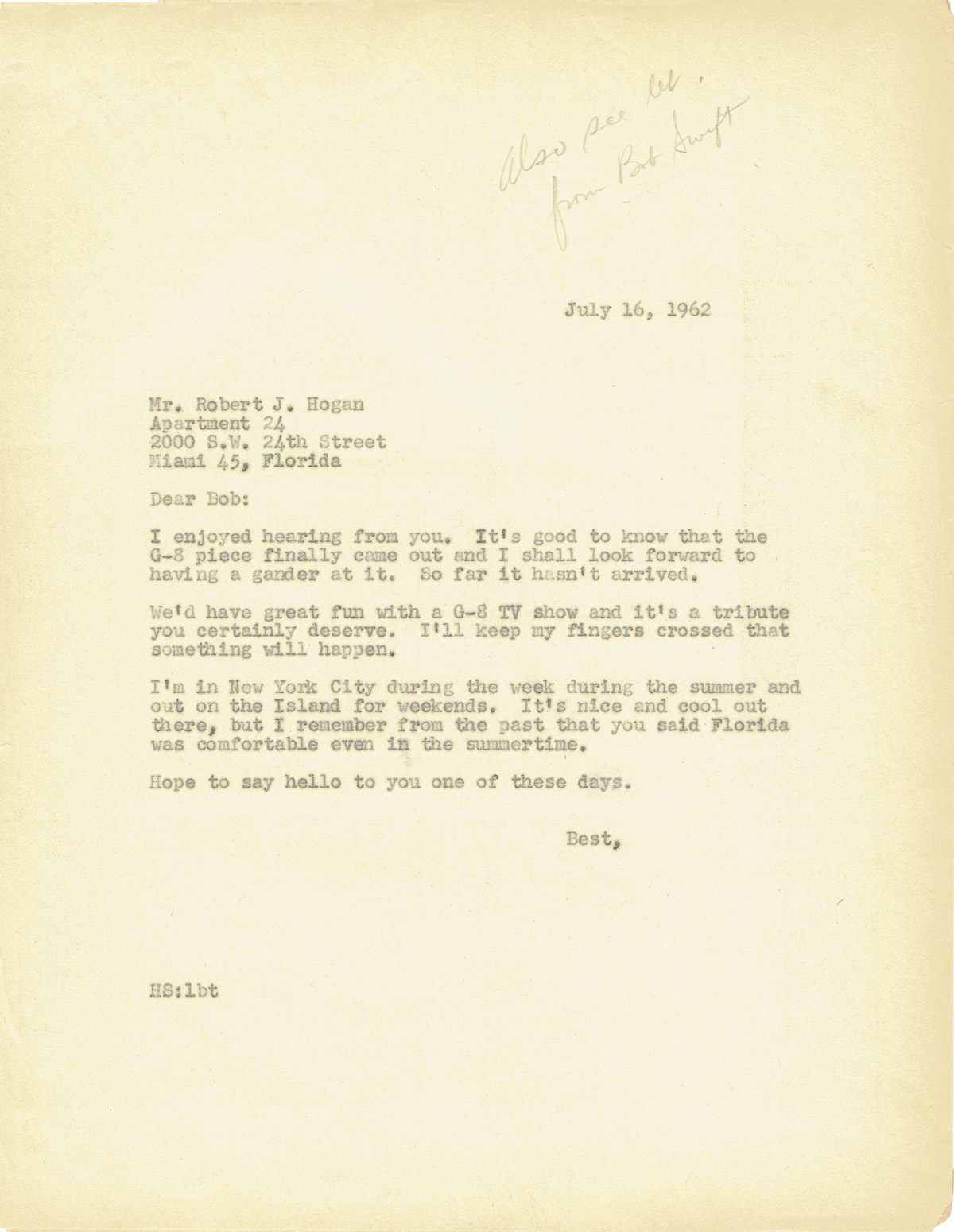
July 16, 1962    


Dear Bob:

I enjoyed hearing from you. It’s good to know that the G-8 piece finally came out and I shall look forward to having a gander at it. So far it hasn’t arrived.

We’d have great fun with, a G-8 TV shov and it’s a tribute you certainly deserve. I’ll keep ay finders crossed that something will happen.

I’m in New York City during the week during the summer and out on the Island for weekends. It’s nice and cool out there, but I remember from the past that you said Florida was comfortable even in the summertime.

Hope to say hello to you one of these days.

                    Best,


— ✪ ✪ ✪ —

 
And to Bob Swift at the Miami Herald:

July 18, 1962    


Dear Bob:

That’s a great article! I got such a kick out of it that I practically drooled nostalgia all over my desk.

The Miami Herald Sunday Magazine and your letter arrived just a few minutes ago and I read each of them immediately. You did the job to perfection and I congratulate you for having captured so well all the delights and joys of a 14-year-old’s heart. I know Bob Hogan himself enjoyed your article very much because I had a letter from him yesterday in which he told me about it. I hope it gets around to all the places where it will do the most good. If Bob could sell a TV show from it, he would indeed be a very happy feller.

I am glad you had such gratifying results from the story. I started publishing as soon as I was out of school and G-8 was one of the first publications. In about 3 years from the standing start we had the largest pulp magazine house in New York – and we were still in our 20’s. In fact, we eacj borrowed $5,000 to get it started, and no one ever had it so good as did we during the war! After that, rising costs killed off the pulp market and people became interested in a more ritzy product. It took us several years to get ARGOSY really rolling and each issue costs anywhere from 30 to 50 times what a pulp magazine would have set us back.

I wonder if it would be possible for you to send me 2 more copies of the Sunday Magazine. I’d like to send one to John Fleming Gould, illustrator for the G-8 stories, because he, too, enjoyed doing this work so much. I’d like to send the second one to a New York advertising agency in the hope that some interest might be sparked for a TV show.

Thanks for sending back the copies of G-8 and His Battle Aces – and good luck.

                    Regards,


— ✪ ✪ ✪ —


Dear Harry:

Here are a oouple more issues of the magazine. Hope John Gould enjoys seeing his old stuff in print again. Bob Hogan is probably en route north by now so expect you’ll see him shortly. I hope either you or Bob will let me know if you do anything further with G-8, in print or on TV.

Regards,
Bob Swift


— ✪ ✪ ✪ —


August 9, 1962    


Dear Bob:

Many thanks for sending along the two copies of G-8. I’ll use them where they’ll do the most good, I hope, and if there are any TV or other offers I’ll keep you advised.

Kindest regards.

                    Sincerely,


— ✪ ✪ ✪ —

 
And to Edward J. Degray of Degray & Associates:

August 9, 1962    


Dear Ed:

I have a possibility in mind for a TV show. It may be remote and unusable, but you are the guy to judge. It’s concerned with an old magazine we published called “G-8 And His Battle Aces”. This was pure kid stuff but it appealed to kids all oyer the United States and, like the Model A Ford, copies of G-8 are now selling for 50 bucks apiece.

The author wrote me recently, saying there had been some talk of a TV show and, as usual, the letters TV brought you immediately to mind. I have an article from the Miami Herald Sunday Magazine telling all about G-8 And His Battle Aces – and if you’d like to have a gander at it, please let me know and I’ll shoot it along.

Kindest regards.

                    Sincerely,


As far as we’ve been able to assertain, a possible G-8 and his Battle Aces tv show never got beyond the talking stage. Sadly, Robert J. Hogan would pass away the following year

The Hogan/Steeger Letters 4

Link - Posted by David on January 27, 2015 @ 6:00 am in

A few years ago, writer and frequent Age of Aces contributer Don Hutchison came up to our table at PulpFest and handed us a manilla envelope, entrusting us with its contents. When we opened the envelope, amung other things, there were letters from Robert Hogan to Harry Steeger and back again.

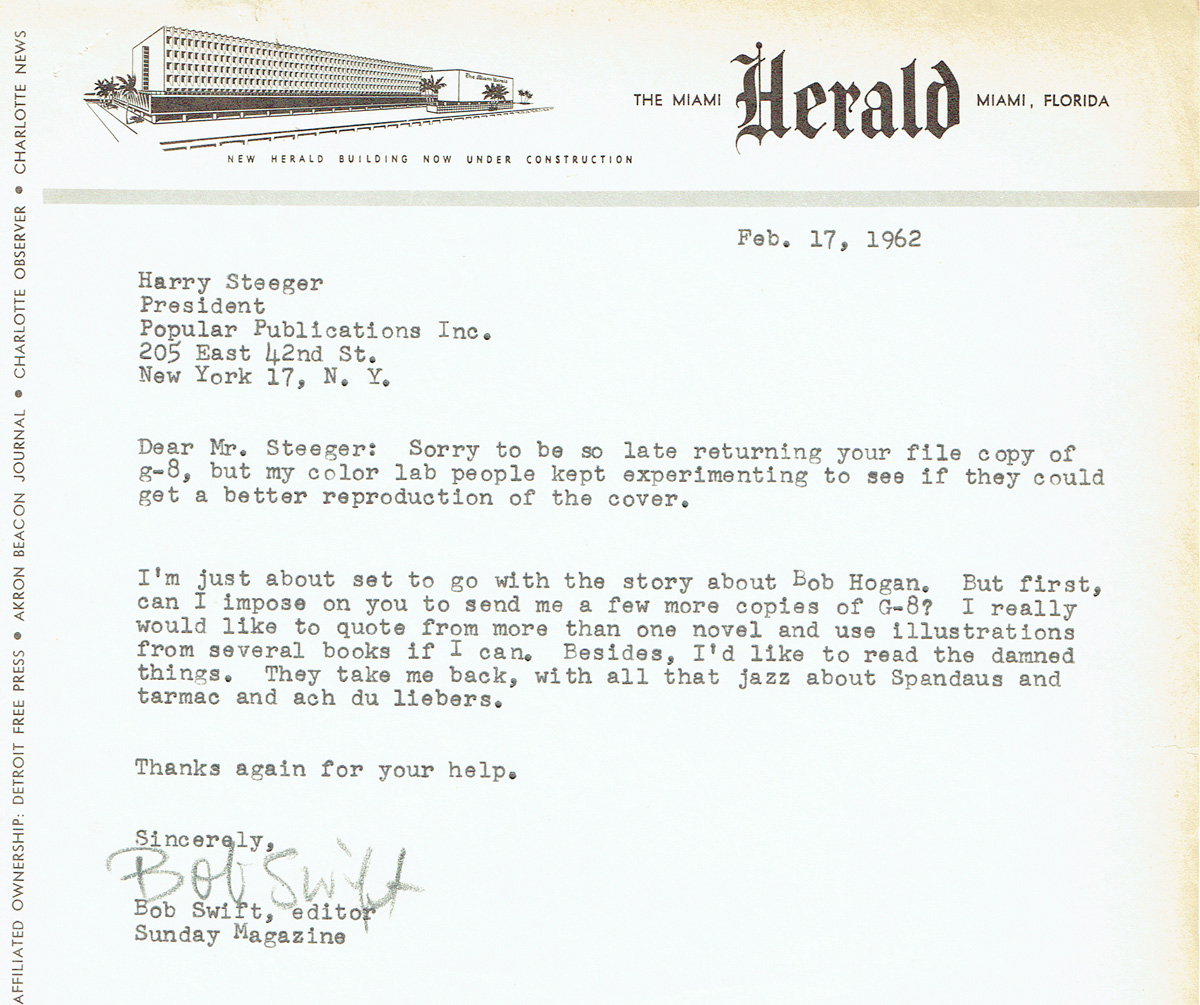
The correspondence continues but this time with a series of memorandums between Henry Steeger and Bob Swift, editor of the Miami Herald Sunday Magazine, as he prepares to publish the article on Robert J. Hogan and G-8 and his Battle Aces. . .


Feb. 17, 1962    


Dear Mr. Steeger:

Sorry to be so late returning your file copy of g-8, but my color lab people kept experimenting to see if they could get a better reproduction of the cover.

I’m just about set to go with the story about B0b Hogan. But first, can I impose on you to send me a few more copies of G-8? I really would like to quote from more than one novel and use illustrations from several books if I can. Besides, I’d like to read the damned things. They take me back, with all that jazz about Spandaus and tarmac and ach du liebers.

Thanks again for your help.

Sinceraly,
Bob Swift, Editor
Sunday Magazine


— ✪ ✪ ✪ —


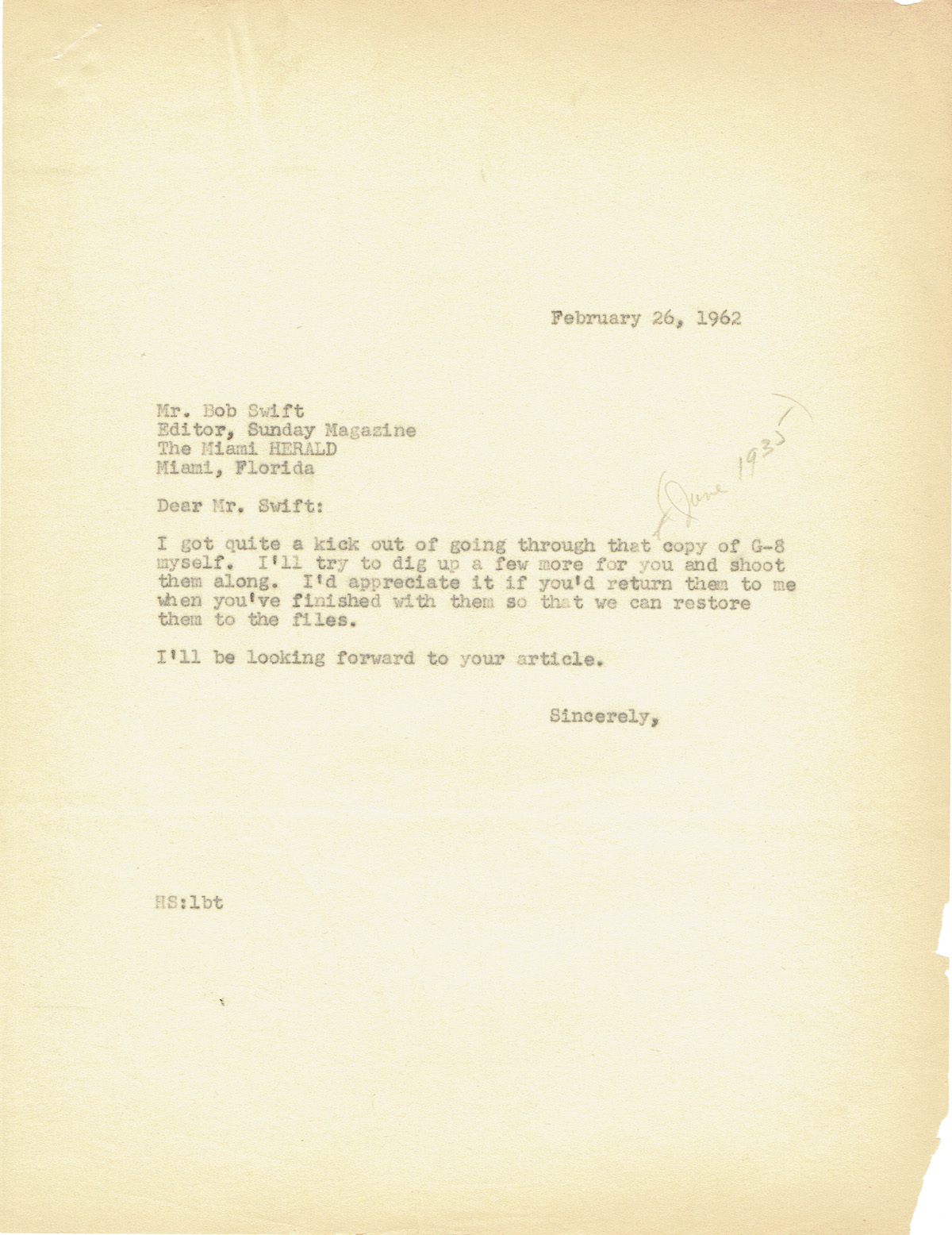
February 26, 1962    


Dear Mr. Swift:

I got quite a kick out of going through that copy of G-8 myself. I’ll try to dig up a few mora for you and shoot them along. I’d appreciate it if you’d return them to me when you’ve finished with them so that we can restore them to the files.

I’ll be looking forward to your article.

                    Sincerely,


— ✪ ✪ ✪ —


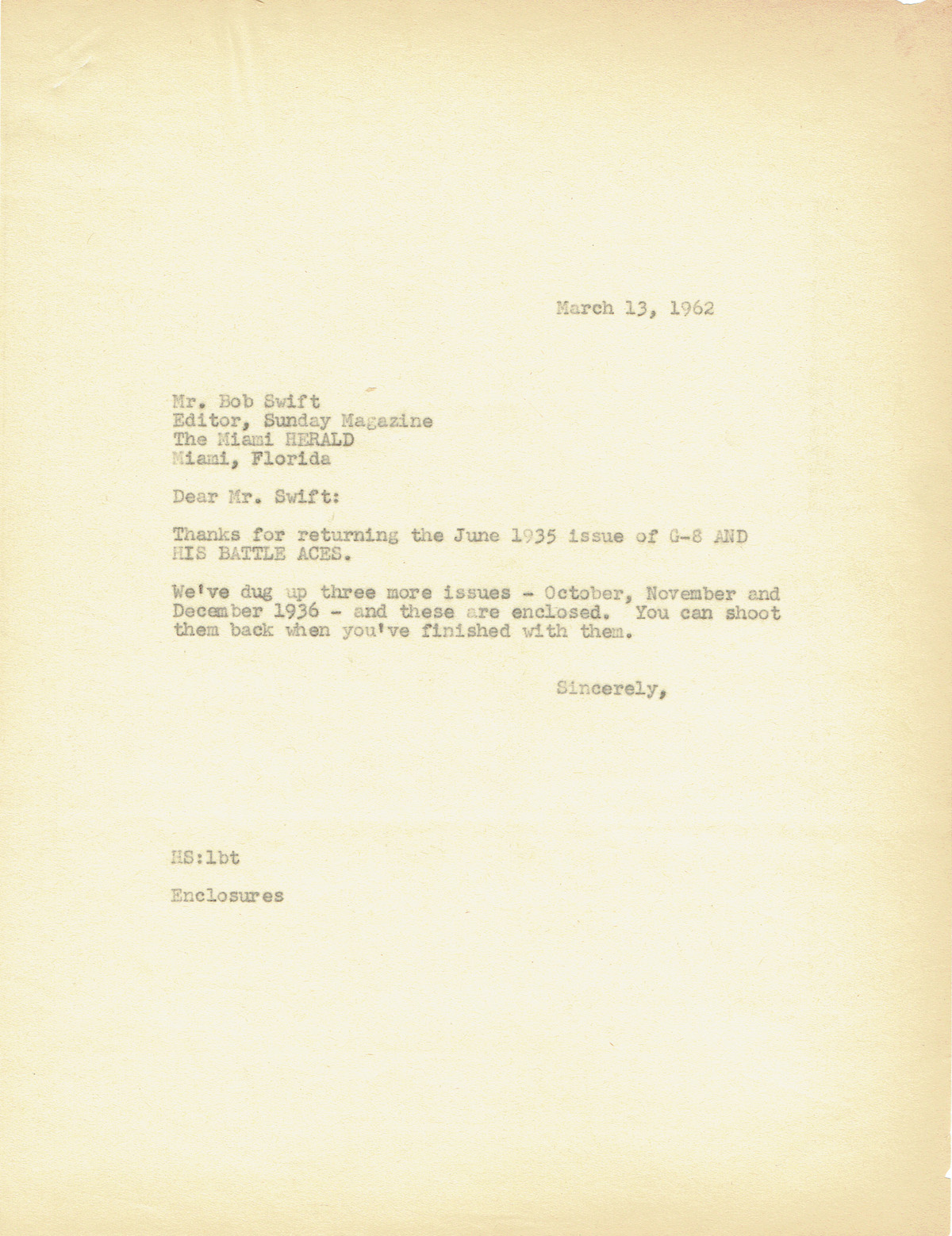
March 13, 1962    


Dear Mr. Swift:

Thanks for returning the June 1935 issue of G-8 AHD HIS BATTLE ACES.

We’ve dug up three more issues – October, November and December 1936 – and these are enclosed, You can shoot them back when you’ve finished with them.

                    Sincerely,


— ✪ ✪ ✪ —


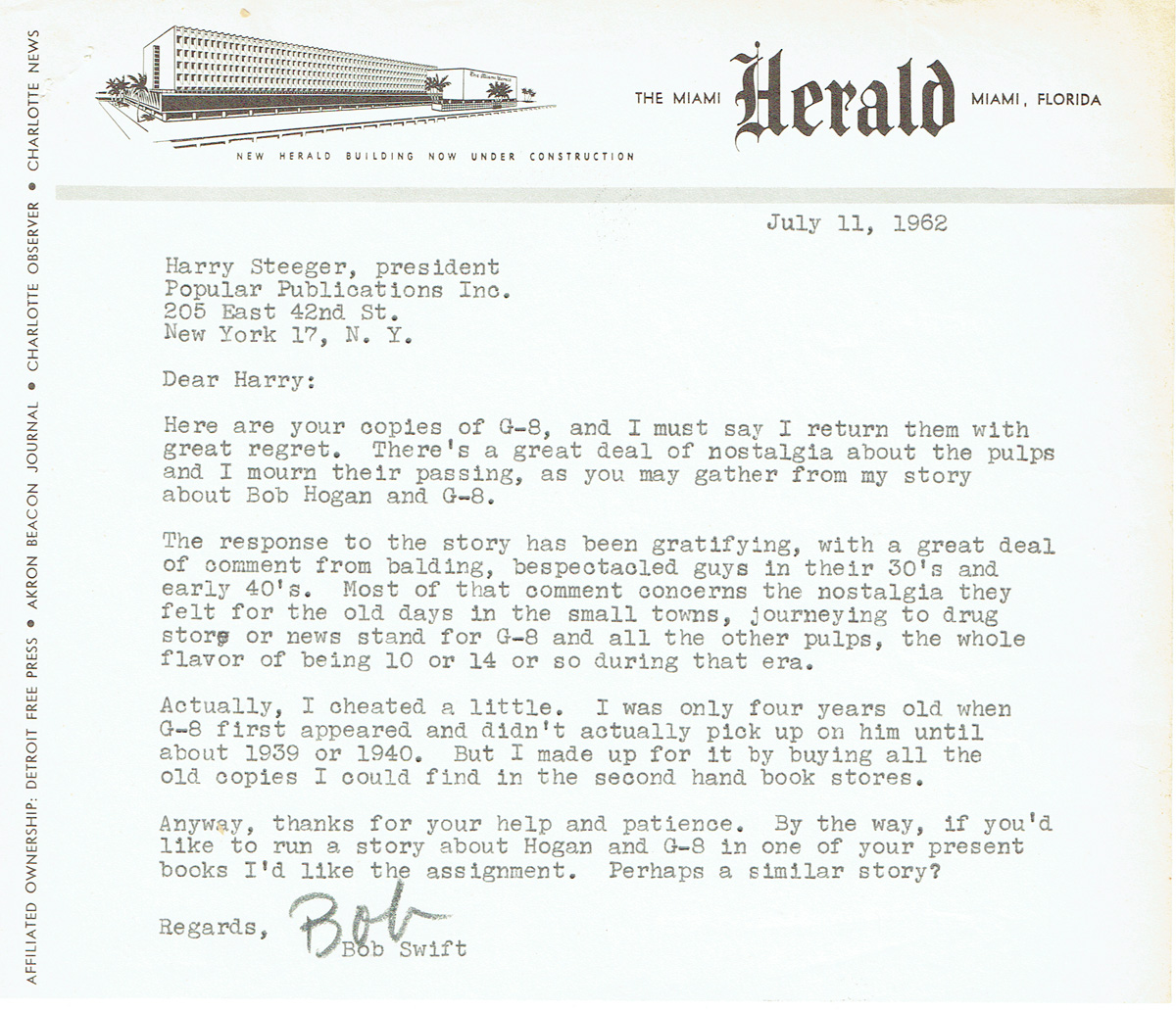
July 11, 1962    


Dear Harry:

Here are your copies of G-8, and I must say I return them with great regret. There’s a great deal of nostalgia about the pulps and I mourn their passing, as you may gather from my story about Bob Hogan and G-8.

The response to the story has been gratifying, with a great deal of comment from balding, bespectacled guys in their 30’s and early 40’s. Most of that comment concerns the nostalgia they felt for the old days in the small towns, journeying to drug store or news stand for G-8 and all the other pulps, the whole flavor of being 10 or 14 or so during that era.

Actually, I cheated a little. I was only four years old when G-8 first appeared and didn’t actually pick up on him until about 1939 or 1940. But I made up for it by buying all the old copies I could find in the second hand book stores.

Anyway, thanks for your help and patience. By the way, if you’d like to run a story about Hogan and G-8 in one of your present books I’d like the assignment. Perhaps a similar story?

Regards,
Bob Swift


“O. B. Myers: Flying Hero” by Kenneth L. Porter

Link - Posted by David on January 26, 2015 @ 6:00 am in

Editor’s note: Here you are gang, a real surprise for you this month. You have all read and enjoyed the ceiling-smashing stories that O.B. Myers writes for you every month. But did you know that he had won the Distinguished Service Cross for heroism in one of the toughest scraps of the war? That almost single-handed he engaged a powerful German squadron and made monkey meat out of them? Yes, sir, and below you will read this amazing true story. It’s told for you by one of Obie’s best friends, Kenneth L. Porter, who was along on that eventful day as Flight Commander, and what he tells you, he saw with his own eyes.


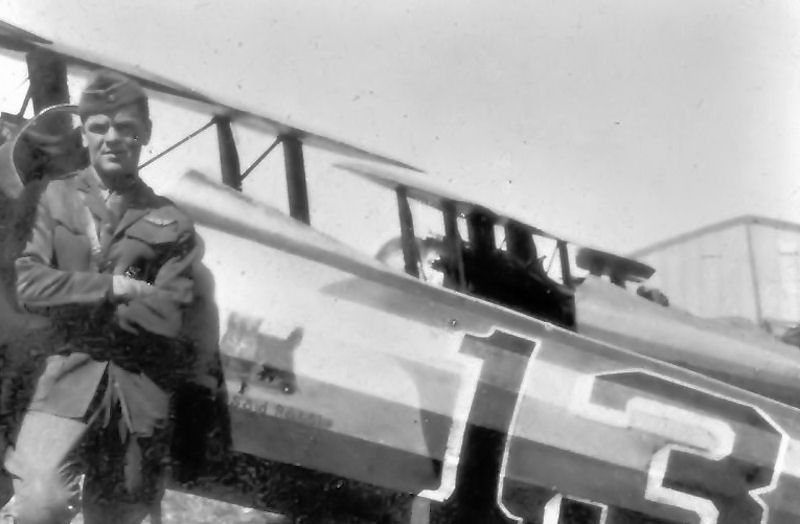
1Lt Kenneth Lee Porter of the 147th Aero Squadron stands before Nieuport 28 N6256 ‘15′ in which he shared in the downing of a Pfalz D Ilia with five squadronmates on 2 July 1918.

Ken Porter is himself one of America’s sixty-six accredited aces, with five enemy planes to his string of victories. On the cover, this month, is the actual picture of O.B. Myers in the act of downing the German observation plane. Obie is one swell guy whom you would all like to know personally. He’s also a modest cuss, and if he had any inkling that this was being printed, he’d probably land on our necks with a ton of T.N.T.

O.B. Myers: Flying Hero

By Kenneth L. Porter • Battle Aces, November 1931

FOLLOWING is O.B. Myer’s citation: Extract from General Orders No. 1, War Department, 1919.

“Myers, Oscar B., Near Cierges, France, September 28, 1918. First Lieutenant, 147th Aero Squadron, Air Service. Sent on a particularly hazardous mission, he harassed and routed enemy troops. He then climbed higher to look for German planes. With two other officers, he encountered 9 Fokkers protecting a reconnaissance machine flying in one of the most effective formations used by the enemy. Outmaneuvering the hostile planes, the three officers succeeded in routing them. After a quick turn he dived at the reconnaissance machine and crashed it to the ground in flames.”

th_BA_3111DURING the latter part of September, 1918, the start of the big Argonne push was getting under way. At the time, we of the 147th aero squadron, 1st pursuit group, A.E.F., were stationed at Rembercourt almost due west of St. Mihiel and south of Grand Pre. The first pursuit group was called upon to carry out a great variety of special assignments in collaboration with the movement of ground troops. Some of these assignments were balloon strafing, troop strafing, contact patrol and escort work of various kinds.

Our troops were attempting to straighten out the line and in doing so encountered very strenuous resistance from both the German artillery and infantry.

On the morning of September 28th, the operation officer called me into his office and advised that our troops were experiencing difficulty in straightening out the line near Cierges, France. He advised that I was to take a patrol out and strafe the German front-line troops. At the same time he ordered me to be on the lookout for enemy two-seaters which might be regulating artillery fire in that specific sector.

After receiving the orders I walked out onto the line to ascertain how many ships I had available for patrol duty. I found that, including my own, we had only three serviceable ships—those of Lt. O.B. Myers and Lt. L.C. Simon, Jr. I immediately rounded up “Obie” Myers and “Red” Simon and informed them of the somewhat difficult mission.

We accordingly took off and proceeded immediately to the Front, Obie flying on my immediate left and Red on my immediate right. We easily located the particular portion of the line which was causing the difficulty by the great concentration of artillery fire, machine-gun activities, etc. After carefully sizing up the situation, we realized the reason for our inability to displace the German position. The front line of the enemy was immediately back of the crest of a small ridge, making it easy for the Boches to keep up a scathing fire without undue exposure to themselves.

Hastily glancing at the sky to see that there were no enemy Fokkers lurking around, I swung my formation into an attacking position and raked the entire crest of the ridge with machine-gun fire. Immediately the Germans let loose with their anti-aircraft defense. Upon pulling away after the first attack I noticed that our anti-aircraft guns were sending shells into our vicinity, which caused me to more carefully survey the skies. Immediately I discovered a patrol of nine enemy Fokkers rapidly approaching. I decided to make one more hasty attack at the troops on the ground and then attempt to better our own defensive position from the attack of the nine Fokkers.

After completing the ground attack I rapidly climbed the patrol and at the same time signaled both Obie and Red to close in. We had gained about 500 meters when I discovered the reason for the presence of the nine Fokkers. A German Hanoverian two-seater was regulating artillery on our ground-line troops which were attempting to take the ridge that we had just strafed. I swung my patrol over toward the Hanoverian and the Fokkers made immediate plans to attack us.

As we crossed over the position of the Hanoverian, Obie dived out of formation and coming up under the tail of the Hanoverian raked it with devastating fire from his machine gun. The Hanoverian fell off almost immediately and burst into flames, crashing right near the town of Cierges. Meanwhile the Fokkers had jumped us and were making things very interesting for Red and me. We were seriously outnumbered and were making a running fight of it all the time working our way toward home, when Obie climbed back into position and flew straight into the middle of the fight, shooting at everything that came in his way. This diversion put the Fokkers on the defensive and we immediately drove them back toward their line. Out of the group we shot down one Fokker and badly disorganized the rest.

Upon returning to the airdrome we discovered that all of our ships had been pretty badly shot up in the engagement, but no serious damage done. The first thing that Red said on landing was “Oh boy, did you see that Boche burn!” Obie replied that he had not seen the ship go down in flames but he was sure that he had gotten it from the way it fell out of control. Both Red and myself saw the two-seater burst into flames. The victory was later confirmed by our own ground troops. While Obie always claimed that it was a bit of luck on his part to have gotten the two-seater so quickly, I always claimed that it was very pretty flying.

The ships used at this time by our squadron were Spad’s, type 13, and the ship flown by Obie bore the squadron number 28. These ships were equipped with 220 H.P. Hispano motor with geared-down propeller. This was one of the earliest types of service machine to use a motor with a gear reduction. The Spad was a small biplane of about 30 feet wing-spread, the wings having neither stagger nor dihedral. The armament consisted of two Vickers machine guns mounted and synchronized to shoot through the propeller. In order to aim the guns the ship had to be aimed, in other words flown into firing position. This type of Spad was capable of a top speed of 135 miles per hour and up to that time, with the exception of the Fokker D-7, was about the best ship on the front.

O.B. Myers: Flying Hero
“O.B. Myers: Flying Hero” by Frederick M. Blakeslee (November 1931)

You have just read in the foregoing story how O.B. Myers won his Distinguished Service Cross. All of the authors in BATTLE ACES are real flyers and fighting aces, and believing that you would like to know a bit about them personally as well as to read the stories they write, we got Ken Porter to tell you the interesting story about Obie’s first flight across the lines. Usually, when a green peelot took his first trip over, he missed his landmarks, got jumpy under anti-aircraft barrage, and couldn’t even see enemy planes if he was attacked. But did Obie beat it at the first sign of trouble? Wow—we’ll tell the cockeyed flying world he didn’t! Ken Porter, who was assigned to break him in, tells this unusual story here for the first time.

Obie’s First Flight

By Kenneth L. Porter • Battle Aces, November 1931

EARLY in September, just after the completion of the St. Mihiel push, we were located at Rembercourt which was almost due south of Souilly and approximately sixty or seventy kilometers from Bar-le-Duc. For quarters we had tents which were pitched in a small clump of trees on the side of a hill just across the road from our airdrome. Whenever it rained the water succeeded in flooding our tent and making us very uncomfortable.

The St. Mihiel Drive had thinned our ranks considerably and we were expecting several replacements at any time. One evening, just after mess, we returned to our tent and discovered that five or six new pilots were temporarily housed in C Flight tent. It was customary, upon the arrival of new pilots, for the boys to look them over and decide in their own minds just who they wanted attached to their particular flights.

Among the new arrivals was one Lt. O.B. Myers and Lt. Hayward Cutting. “Whitie,” who was flight commander at that time, drew me aside and asked me what I thought about the new arrivals. I told him that if possible we should get Myers and Cutting attached to our flight. Whitie accordingly called on the C.O. that evening and requested that the two boys in question be attached immediately.

It is a rather peculiar situation when new pilots arrive on the Front as they are more or less under a tension and as a rule don’t act naturally. They seem to think that they have to throw some kind of a bluff to impress the boys who are already there. One of the outstanding characteristics of Obie was that he seemed perfectly natural and entirely unperturbed as to what the future held. Of course, all new pilots, upon arrival, immediately want to have a ship assigned to them and participate in regular patrols.

A few days after his arrival, Obie sought me out one morning and asked me when he could expect to participate in regular patrols. I pointed out to him that we were rather short on planes at the time, but I would see what I could do about the situation and try to get him a joy hop anyway. I had a talk with “Whitie” and we decided that we would let Obie use Lt. Bronson’s ship for a little joy ride, as Lt. Bronson was away on leave. I took Obie over to the airdrome and told him to take Bronson’s ship up for half or three-quarters of an hour to familiarize himself with a new type of plane and that after he felt that he was satisfied with the handling of the ship, he could go over to a nearby lake and practice shooting at the flying target which we had anchored there.

Obie went through these preliminary tests very satisfactorily and upon his return to the ground he collared me and pleaded with me to take him out for a look at the lines. I told him that if the weather improved a little, we would take an observation tour on the next morning.

When we awoke the following day, the weather looked none too good. There was considerable haze on the ground and the clouds were not over 1,200 meters high. Not only that, but it had been raining slightly during the night. I requested information of headquarters as to weather conditions on the Front and found they were about the same as those prevailing at our own airdrome. Accordingly, about ten o’clock, we decided to make a tour of the Front with a view to familiarizing Obie with the landmarks and conditions as they existed up there. Taking him into the operations tent where there was a map of our entire sector, I carefully pointed out the exact route we were to follow.

Now, among other things that are lacking when a pilot arrives on the Front is his ability to see things from the air. Some pilots acquire it very quickly, while others take time, but as a rule when they do acquire it, it happens all of a sudden. I told Obie that we would fly due east to St. Mihiel and from there to the north over the ridge of hills to Verdun. From Verdun we would swing west along our front line over Montfaucon to the river which goes through the middle of the Argonne forest.

It is a rather ticklish situation to have a new pilot with you on his first trip over the lines, so I was very explicit in requesting Obie not to pay too much attention to landmarks, but to stick close to me, and that above all, if we got into any trouble, to stay close on my tail and that I would lead him home. I further advised him that if we met any Germans he was to stay out of the fight and watch me, as he probably could learn more from watching my tactics than he could from getting himself shot up.

As it was immediately after the St. Mihiel Drive and just prior to the final Argonne push, there were practically no aerial activities and I felt fairly safe. In fact I didn’t expect to see anything more than a good anti-aircraft barrage. Finally feeling that Obie fully understood the instructions, we took off and made our way leisurely to the Front by way of St. Mihiel. We were flying pretty close up under the clouds at about a thousand meters altitude when we reached St. Mihiel. From time to time, I glanced back to see just where Obie was. Each time I looked back, it seemed that he was closer to me; in fact he was riding so close to my tail that it was a little bit uncomfortable.

Consequently when we arrived at St. Mihiel, the Boches let loose with their anti-aircraft guns and we received a very nice dose of it. I expected, after the barrage, to find Obie at a considerable distance away from me, but upon looking back I discovered that he was in his usual position—right on my tail. This was somewhat unusual, as most new pilots, upon experiencing their first heavy barrage, go through all sorts of aerial acrobatics and stunts and find themselves a considerable distance away from where they should be. I began to feel a little less worried about Obie and proceeded more confidently to Verdun.

We had almost reached Montfaucon when I noticed that the Germans were putting up one of their balloons just to the east. Everything had been going so smoothly that I decided to show Obie how a balloon was shot down. As we approached the Boches apparently divined my purpose, because they immediately started to pull the drachen down.

Prior to leaving the ground I had told Obie that in the event of attacking any balloons or going close to the ground he was to remain up above and watch. I therefore signaled him that I was going to dive and without looking around, did so. The balloon was about halfway down when I opened fire, raking it from end to end with machine-gun fire. Incidentally, I didn’t have any incendiary ammunition in my guns, as we were not supposed to carry it unless specifically ordered to strafe balloons. The air being damp and the envelope of the balloon covered with moisture, there was no apparent effect of burning as a result of my shots. I pulled off and climbed back up a short distance to attack the balloon once more, when to my astonishment I saw Obie giving the sausage a dose of the same medicine.

He pulled up from his attack and dove in again. By this time the balloon was pretty close to the ground. As I opened fire the second time, they let loose at me from the ground with everything they had—machine guns, flaming onions, rockets and what have you. Following my example, Obie also came in for a second dose, and was treated to the same display of fireworks. While we didn’t burn the balloon, we put enough holes in it to keep it on the ground for a couple of days while it was being patched. As I pulled up from my second attack and circled over, Obie climbed up and got into his usual position on my tail. By this time, I was beginning to feel that he was almost a passenger in my own plane and had no more fears that I would lose him, or could even shake him loose if I wanted to.

We had hardly reached our lines before I noticed a barrage of our own antiaircraft. This barrage was in front of me—or in other words, between me and home and would indicate that there were German airplanes in that vicinity. I felt that I would probably run into some kind of a fight before we had proceeded much further. Almost immediately I saw what the cause of the excitement was—a two-seater Halberstadt, which was regulating artillery fire on our troops, The clouds were so low that I didn’t like the looks of the situation because I felt that the two-seater would probably have some chasse protection. However, I couldn’t seem to find them and decided that the two-seater must be done away with. We already had him blocked off from home and so I now endeavored to force him still further back into our lines where the advantage would be much more in my favor. However, the Jerry seemed to think otherwise and headed straight for home. Consequently, I again signaled to Obie to stay up above, and dove in to attack.

Then I put the ship into a steep dive and came up under the tail of the two-seater, slightly from one side. I got in about ten rounds before I fell off, and was swinging around to make another attack when, to my astonishment, again Obie was attacking the two-seater from above. I immediately turned sharply and gave him another burst from below, with the result that the two-seater went down out of control. Meantime, Obie had climbed back up and I was probably 400 meters below him, when two German Fokkers dropped down from the clouds. For a few minutes I was so busily engaged that I had no more than a passing moment to think of Obie. I was hoping that there were no more than two of them, and that he had not been surprised by the attack. I finally got on the tail of one of the Fokkers and was giving him the works when I heard guns and was aware of bullets going by my head and realized that another Boche was immediately on my tail.

It was necessary for me to pull over in order to protect myself. As I did so, I heard the sound of some more guns, and both the Jerry and Obie dove past me hell-bent. We now had the two Dutchmen below us and I swung back to renew hostilities, but by this time I discovered that we had drifted considerably into German territory, and as we had been out about an hour and a half, we only had about enough gas to get us home. Consequently, I dove in front of Obie and signaled him to follow me. Then we turned back home. We arrived without any uneventful happenings other than my mixed feelings and amazement at the show this new pilot had put up.

After each patrol it is customary for a pilot to make out a combat report. I was interested to see what kind of one Obie was going to make of his first flight. While we were in the operations tent preparing to make out these reports, the flight sergeant came in and reported that Lieutenant Myers had eight bullet holes in his plane and that the tail of my ship had so many in it he couldn’t count them. I told Myers to go ahead and make out his report. He advised me that I had better make mine out first, as, while he knew we had shot at a balloon, engaged a two-seater and two Fokkers in combat, he had no idea where the action occurred. This, of course, was no more than was to be expected from a man who is unfamiliar with the territory over which he has flown. I therefore wrote out my report and Obie practically wrote “ditto.”

Later we received confirmation of the victory over the two-Seater, and the fact was also mentioned that we had succeeded in forcing the Germans to pull down one of their balloons. While we didn’t claim a victory over either of the Fokkers, one of them was reported to have crashed just inside the German lines. Obie, in his first show, had proved himself to be decidedly an exception to the average both as to attitude and results.

The 147th
The 147th Aero Squadron They are, standing, from left to right, 1Lt Oscar B Meyers, 2Lt Arthur H Jones, 2Lt Edward H Clouser (adjutant), 2Lt Ralph A O’Neill (five victories), ILt James A Healy (five victories), 2Lt Charles P Porter, Maj Harold E Hartney, commander 1st Pursuit Group (seven victories), Capt James A Meissner, commander 147th Aero Squadron (eight victories), 1Lt Heywood E Cutting, 1Lt James P Herron, 2Lt Francis M Simonds (five victories), 1Lt George H Brew, 2Lt G Gale Willard, 2Lt Cleveland W McDermott and 1Lt Collier C Olive. Squatting, from left to right, ILt Walter P Muther, 2Lt Frank C Ennis, 2Lt Louis C Simon Jr, 1Lt G A S Robertson, 2Lt Stuart T Purcell, 2Lt Thomas J Abernethy, 1Lt Horace A Anderson (supply officer), 1Lt Josiah P Rowe Jr, 2Lt James C McEvoy and 2Lt John W Havey (armament officer)

Both of these stories are featured in our collection of stories by O.B. Myers—The Black Sheep of Belogue: The Best of O.B. Myers which collects his Black Sheep of Belogue stories featuring Yank Ace Dynamite Pike and his trusted mechanic Splicer Teale and The Mongol Ace stories which pits American pilot Clipper Stark against the seemingly invincible “Mongol Ace”—Janghiz Kaidu, a descendant of Genghis Kahn who has joined the German army. Some great stories!

The Hogan/Steeger Letters 3

Link - Posted by David on January 23, 2015 @ 6:00 am in

A few years ago, writer and frequent Age of Aces contributer Don Hutchison came up to our table at PulpFest and handed us a manilla envelope, entrusting us with its contents. When we opened the envelope, amung other things, there were letters from Robert Hogan to Harry Steeger and back again.

The correspondence continues . . .


Feb. 3, 1962    


Dear Harry:

    It was so nice to heer the enthusiastic agreement with our 50-50 idea on good old G-8. We’re working on it. Betty came up with an idea a while ago. She said it seemed that Walt Disney would be the only outfit on the coast or anywhere to do justice to G-8 if he came back for movies and/or TV. Betty always was the brains of our family and that proves it. Of course, Disney, when the time is right. I believe this is something that needs care and good, Efceajiy buildup (if we live so long) if we can get the idea off the ground at all. But strange things happen. Sax Rohmer’s brother-in-law is a friend of ours down here. Bill said some outfit paid Sax $4,000,000 for all rights to Fu Manchu not long before his death and the old Chinaman had been outmoded and outdated for many years. TV is a hungry monster and no telling which ways the giant jaws may snap. Certainly not our way, likely, but it’s just as well to be prepared.

    I liked the way Erle Gardner handled Perry Mason for TV. Of course we haven’t got a Perry Mason but the approach (and it does seem we do have a sizeable ready-made audience), seems to me, should be the same, slowly and carefully until we get things right. I could use a little or a lot of money myself at this or any time (who couldn’t) but not to the extent that we have to make a quick sale at sacrifice to a well done product. Last night I watched the rehash of the 1946 spy movie 13 Rue Madeleine on our TV. The review said it was GOOD. I decided after watching it that some of the old G-8s could show Madelein some real suspense. Kind of got me itching to get things going. Anyway, we’ll see.

    I’m writing mainly to say thanks and to give you our new temperary address. Don’t feel you must answer this, but any ideas are always welcome. We’ve rented out Coral Gables shanty till April 10th to some nice folks (we hope) from Darien, Conn. So we’re very comfortable near Betty’s folks In a one bedroom apartment where we’ve spent two winters before this, secomd floor overlooking a lovely garden, coconut palms, avacado and grapefruit trees outside the window and such. And right now it’s in the mid 70s. How about you and Shirley coming on down? We’ve got the big, old Chrysler to get around in.

    Bob Swift of the Herald Sunday Magazine said last time I talked to him that the photo lab hasn’t brought down your G-8 mad yet. Soon as they do he’ll return it to you. Meantime, he’s slated the article for Sunday magazine early in March.

                    Best,
                    Robert J. Hogan


— ✪ ✪ ✪ —


February 5, 1962    


Dear Bob:

    Let’s all Keep our fingers crossed that G-8 hits the TV screens!

    It was good to hear from you again – and let’s hope a sale is made. I agree with you that G-8 could show many of these programs some real suspense.

    Be sure to send me a copy of the Herald Sunday Magazine when G-8 makes his bow early in March.

    Wish we could get down to see you, but Shirl and the kids and I usually go north to ski during the winter time.

    Your set-up sounds terrific and I can lmaglne life must really be pleasant in your Florida home.

                    Best,


The Miami Herald Sunday Magazine feature on Robert J. Hogan and G-8 and his Battle Aces would not see print until July of 1962. Our correspondence picks up next week with notes between Bob Swift and Henry Steeger.

The Hogan/Steeger Letters 2

Link - Posted by David on January 22, 2015 @ 6:00 am in

A few years ago, writer and frequent Age of Aces contributer Don Hutchison came up to our table at PulpFest and handed us a manilla envelope, entrusting us with its contents. When we opened the envelope, amung other things, there were letters from Robert Hogan to Harry Steeger and back again.

Responding to Steeger’s letter of the 11th, Hogan fills Steeger in on the interview with Bob Swift for the Miami Herald Sunday Magazine and talk of the rights structure to the G-8 stories and the possibility of a G-8 television show. . .


January 22, 1962    


Dear Harry:

    So good to get your letter of December 11th. Thanks for your congrats and your always kind words.

    We’ve had the interview with Bob Swift, Editor of the Miami Herald Sunday Magazine, and photographer. Also met Jim Eussell, Business and financial Editor of the Herald, who as a Louisiana boy had G-8 mania. These G-8 fans I’ve met and heard from in recent years are a high-type bunch of guys, literate and respected. Fact, I’ve never met or heard from a G-8 reader who didn’t seem someone to be proud of. The G-8 interview, with pictures, was supposed to consume about an hour last Tuesday afternoon. It consumed 3½ hours Instead, and two days later Bob Swift talked for an hour and a half on the phone, all of which I enjoyed, of course.

    Bob is returning the magazine you sent him as soon as the photo lab at the Herald gets squared away for their color print from the cover. Then, I believe, he hopes to ask you for several more to choose typical passages from for the article. Also, he said, “I’d read every one if I could get them again.” That seemed to me a fantastic angle. Bob read G-8s as a boy. Now he’s editor of one of the largest magazine Sunday supplements in the country and still likes to read them. He said he enjoyed reading the novel you sent him just as much as when he was a kid. Said, as before, he couldn’t lay it down.

    That seems to be the opinion of others who have grown to positions of responsibility. A letter arrived the other day from an old reader who got our Coral Gables address from a recent SPORTS ILLUSTRATED. It was written on the stationary of one of the larger Madison Avenue advertising agencies and he signed himself; “Executive Producer Radio-TV Programming Department.” I’d like to think it’s a feeler for some use of G-8 in either of his mediums, but more than likely not. Anyway, it could be a wedge. He says, in part: “With regard to G-8, I would certainly like to see more of this kind of reading for my boy who is just about the age I was when I was first Introduced to our hero.” He also said he deplored a lack of back copies of the magazine and was trying to think of some way to get the past ones reprinted possibly as paperbacks. He went on about settling a little bet with another G-8 fan as to whether there was ever a woman villain in any of the G-8 stories. He ended the letter: “With many thanks again for everything you have done for us indirectly —-” There must be some smoke behind all these little signal fires, which might be to our advantage if handled correctly.

    You mentioned in your letter, Harry, that you had no sales set-up for a G-8 renaissance and suggested I try selling G-8 to one or several mediums. So far as adapting or scripting any of the old stories for TV or whatever, I’ve never done a script although my/stuff has sold to TV in GE and Loretta Young and to the movies, all of which was adapted in the studios, the only thing I might help out in, beside sales, would be in an advisory capacity. I’m also afraid any efforts to write new G-8 stories would lack the old zing of twenty or more years ago. Anyway, there were a hundred odd old stories, which the old readers have forgotten and, according to their many expressions of hope, would like to read over again in newly published paperback editions. Also new reader possibilities.

    I’ve thought of the autobiographical book I mentioned in my other letter (a backward look at the old pulp days with a G-8 novel added) as a possible build-up to a string of republished G-8 paperbacks, if we could sell the idea to any of the paperback publishers. This might eventually lead to the sale for TV. In any event, it Is a very long shot in the dark. However, with all the furor the old readers have whipped up, particularly in the nation-wide organization known as “The Society of World War I Aero Historians,” which boasts a pretty impressive membership of successful young executives, including the advertising guys I mentioned, something might go.

    Betty’s father, Vic Lambdin, lives near us. He, my father-in-law, has been political cartoonist and newspaper man all his life (now retired). He says this thing busting out as a feature in the Miami Herald Sunday Magazine could very well bring what is needed to set off G-8 as a big thing. Turns out there are upwards of 5,000,000 readers of the Sunday Magazine down here at this time of year, with Florida loaded at the peak with what some laughingly call “the nation’s most important people.” Vic says they’re likely to burn up the Hogan phone with various offers or whatever. I don’t count on it, but it would be fun up to a point and, If so, it would be well to be prepared. With that in mind, it seems that maybe we should have some better idea of rights, mine and yours, in this thing.

    Here is the way I recollect the G-8 set-up as to ownership. I remember near the start you told me it was understood that the magazine was yours. As long as I wanted to and/or could write the G-8 stories, that was fine. But if anything happened to me, you wanted Betty to understand that you would have to get someone else to write it under Robert J. Hogan. Of course we agreed.

    As to the rights to all stories I wrote for you, at first you purchased only first serial rights. Then, because some writers were selling second serial rights to competing magazines, you bought all serial rights. At the time you explained this to me, you said that at any time I had legitimate sales for my writing to mediums other than competing magazines you would release the rights back to me.

    So, from the above, you own the magazine and I own the story rights. Now it seems to me with the bare possibility of something some day coming of this G-8 furor in paperbacks, TV, radio or whatever, there could be overlapping of rights and interests here and there. Also, we’ve always had the best relations with each other, Harry, and never a line of written contract. It seems to Betty and me that the best way to handle this, for all concerned and our joint good, would be on a fifty-fifty basis on all past G-8 stuff. If G-8 went into paperbacks I would like to write a forward for each, telling how that particular story came to be written and how I got the idea for that menace or war machine which seems to be the main part that the old readers still go nuts over. That would be part of our joint paperback sales, if any.

    In other words, whatever we could make out of old G-8 we would split the gross take, you and I, fifty-fifty. We might need an agent, but so far we have never needed one, and if contracts required a careful check, your Popular Publications attorney might take care of it.

    There probably isn’t a chance in the world that this G-8 comeback will amount to anything. However, some crazy things are happening these days. And wouldn’t it be fun to see the old boy diving in again with Nippy and Bull flying wing in Spads 13 and 7?

    If this idea is agreeable with you—the feature story is due out in a week or two—would it be well for Bob Swift to mention in the article that the G-8 stories, series or whatever, are being submitted or negotiated for paperback and/or TV? How would you suggest wording it on the chance of raising some interest?

                    Our best to you and yours, Harry.
                    Robert J. Hogan


— ✪ ✪ ✪ —


January 25, 1962    


Dear Bob:

    Needless to say, I enjoyed your letter of January 22nd very much. It was nice to hear from you and it was good news that the popular demand for a return of G-8 and his Battle Aces appears to be growing.

    I think your idea for a fifty-fifty split on possible sales is very fair and I agree with your letter in every respect. Since I agree completely, I am sure it won’t be necessary for me to requote these points.

    Wouldn’t it be wonderful to see a pocketbook of G-8 stories or a television program? I’m sure that either one would be a real success. In fact, just the reading of your letter made me feel nostalgic again about Nippy and Bull.

    Here’s wishing us luck, Bob – and my kindest personal regards to you and the family.

                    Sincerely.


“Lives of the Aces in Pictures – Part 30: Captain Frederick McCall” by Eugene Frandzen

Link - Posted by David on January 21, 2015 @ 12:00 pm in

Here’s another of Eugene Frandzen’s “Lives of the Aces in Pictures” from the pages of Flying Aces Magazine. The series ran for almost four years with a different Ace featured each month. This week we have his illustrated biography from the December 1934 issue featuring that famous Canadian Ace—Captain Frederick McCall!

By the end of the great war, McCall had become Canda’s fifth most successful flying aces with 35 confirmed and two unconfirmed victories. He was awarded the Distinguished Service Order, Military Cross & Bar and the Distinguished Flying Cross!

After the war he went into civil aviation, trying his hand at Barnstorming and stunt flying as well as founding a pair of aviation companies. In 1920 he founded McCall Aero Corporation Limited which flew commercial freight and passengers and opened up regions of Canada that had previously been hard to reach. He later founded Great Western Airways in the late ’20’s once again flying cargo hither and yon. Including flying 200 quarts of nitroglycerin from Shelby, Montana to Calgary! On another occasion, he ignored all bad weather reports to fly a much needed doctor to the Skiff oil fields to treat two seriously injured workers. All the while, McCall worked to encourage the formation of Canadian flying clubs!

With the arrival of the Second World War McCall was recalled to service with the Royal Canadian Air Force as a Squadron Leader, based at numerous western Canadian bases.

McCall passed away in Calgary, Alberta on the 22nd of January 1949. He was 52.

“The S.E.5 and Lt. Lindsay” by Frederick Blakeslee

Link - Posted by David on January 19, 2015 @ 12:00 pm in

Editor’s Note: Every month the cover of BATTLE ACES depicts a scene from a real combat actually fought in the War and a real event in the life of a great ace. The series is being painted exclusively for this magazine by Frederick M. Blakeslee, well-known artist and authority on aircraft and was started especially for all of you readers who wrote us requesting photographs of war planes. In this way you not only get pictures of the ships—authentic to the last detail—but you see them in color. Also you can follow famous airmen on many of their most amazing adventures and feel the same thrills of battle they felt. Be sure to save these covers if you want your collection of this fine series to be complete.

th_BA_3110THE COVER this month might be called “Turn, Turn Who’s Going to Turn.” Of course you know the answer, but just a second before the scene depicted occurred it was a toss-up whether the leading Boche would turn or whether the American ship would be flattened on its nose. However, the Jerry did the turning and all the others did likewise. This tactic of rushing head-on at each other was used by both sides. There were pilots who said that no German could stand up under the terrific strain of an impending collision. Of course this is not true. There must have been Boches who refused to turn, but since no one survived to tell of it, we only hear of the ones who did.

Such a battle of nerves happened to First Lieutenant Robert O. Lindsay of the 139th aero squadron near Bantheville on October 27th, 1918. While on a patrol in company with two others, he met three Jerries with the usual exchange of compliments. The combat took place at three thousand meters and after a sharp combat Lieutenant Lindsay shot down one. While he was maneuvering for position on the tail of another Jerry, he noticed a flock of eight Fokkers coming at him. Without a moment’s hesitation, he turned, and sped straight at the startled Boches.

The German leader held to his course until he saw that Lindsay was not going to turn and then he veered aside at the last moment. The others got out of the way as best they could. In a flash Lindsay was through the formation. Then he whirled around and dove on the last Fokker which, after the first burst, rolled on its back and started the long but swift plunge into eternity. Lindsay then streaked for home as the others in his patrol had done long before. The Jerries got themselves organized and searched an empty sky for the nervy Yank.

On the cover you see Lindsay halfway through the formation and seeing this you are inclined to say that the chances of a collision were remote. But there is an element you might not have taken into consideration—speed. We’ll say Lieutenant Lindsay was traveling over 125 m.p.h. and the Boches at the same speed. That would mean the Jerries were approaching Lindsay at well over 250 m.p.h. At that rate, it doesn’t take long for an object to pass a given point; and so, although the farthest planes from Lindsay seem a long way off, he actually grazed them in passing, for it took only the wink of an eye to close the distance between them.

For this exploit Lieutenant Lindsay won the Distinguished Service Order.

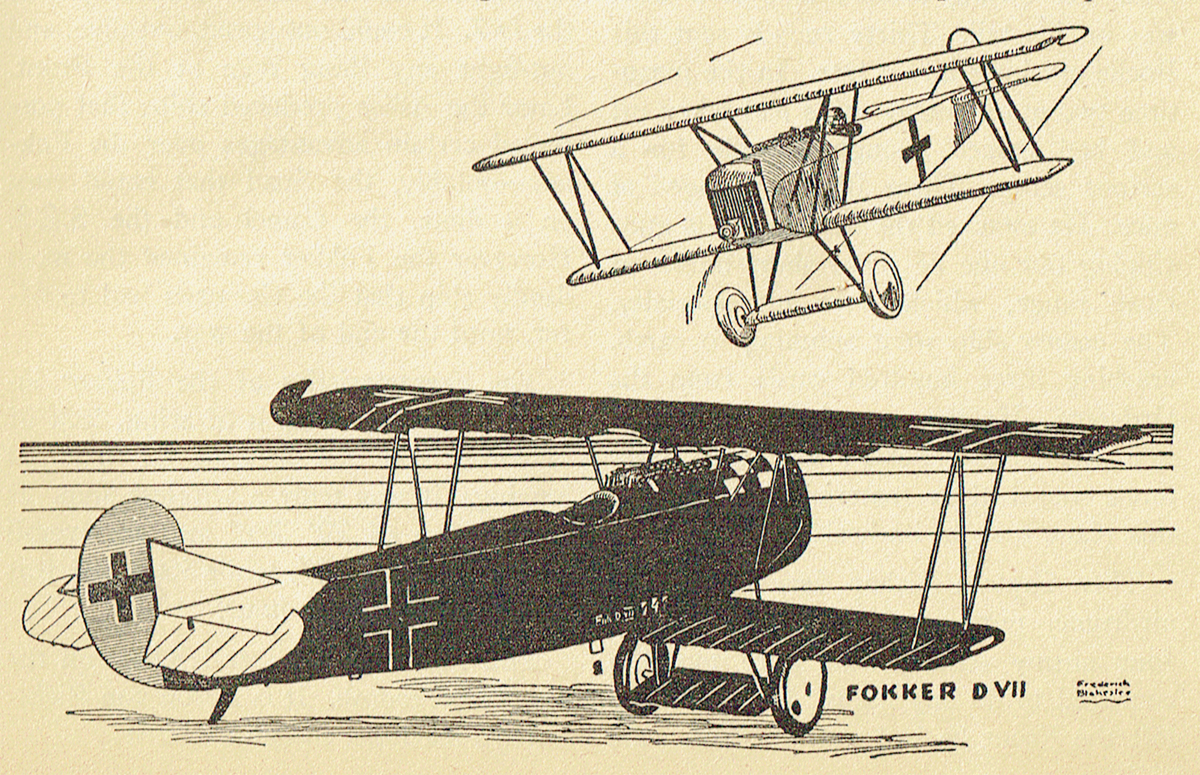
No doubt you will recognize the plane in the foreground as an S.E.5. This was not the type of plane flown by the 139th squadron at that time. In our series, we don’t always show the machines that we actually used in the incidents pictured, because frequently they were the same type, and one of our aims is to give you pictures of every one of the machines. We have used the S.E.5. before in a cover, but have not shown a drawing of it, therefore we include the drawing this month. The Fokker D.7 will be a feature on the December issue.

The S.E.5 and Lt. Lindsay
“The S.E.5 and Lt. Lindsay” by Frederick M. Blakeslee (October 1931)

The Hogan/Steeger Letters

Link - Posted by David on January 16, 2015 @ 8:00 am in

A few years ago, writer and frequent Age of Aces contributer Don Hutchison came up to our table at PulpFest and handed us a manilla envelope, entrusting us with its contents. When we opened the envelope, amung other things, there were letters from Robert Hogan to Harry Steeger and back again.

On December 7th, 1961, prompted by the growing nostagia over World War I and G-8 and his Battle Aces in particular, Robert J. Hogan took the time to write to his old publisher and friend Harry Steeger. . .


December 7, 1961    


Dear Harry:

    For some time I’ve been going to drop you a line on the matter of an old friend. Tempus fidgets and none of us is getting younger, except one old geezer who seems to be looming out of the past to haunt me, bless him. He, according to books, mailed reports, phone calls and magazines articles, seems to be growing younger and it does me good to think that I gave birth to this full sized adult who, defying the laws of Nature and Biology, seems to be gradually taking a second hold on life. Namely good old G-8 and His Battle Aces.

    I received my first inkle of this shot in the arm for the old boy perhaps three years, yes? over three years ago, when a guy phoned me long distance from somewhere to tell me how much he used to enjoy G-8 and to ask me if I had any copies of G-8 magazines I would care to part with. I said I had none for sale or loan but that I did love his flattery. He went on to say that he had been trying to buy some old back copies of G-8 and recently had been offered a brace of three, without covers, but assured that the first page of contents was there WITH THE AUTHOR’S NAME visible. The back number mag merchant would part with these three for the meager price of $7.00 for the three. He said he had asked what he might get one or more with covers and in good condition for and was told that if such a rare item could be found anywhere they would run from $10. each up and up and up. That was well over 3 years ago.

    A year ago Betty picked up a well written contemperary paper back novel wherein some guy was sounding off on “My country right or wrong,” after which he apologized by saying, “Damned if I don’t sound like G-8 and his Battle Aces.” Then continued a few sentences of dialogue something like, “Damned if you don’t look like G-8,” and “Wasn’t that the best damned set of character stories that ever hit print?” etc. etc.

    Next thing, one of the boys in the Sparta PO said someone had come through asking where the house of Robert J. Hogan was. Said he wanted to see where G-8 stories were written. This was nearly 15 years after publication was suspended.

    I’ve had the general run of pleasant flattery all the way. But a few months ago the magazine section of the Miami Sunday Herald came out with a piece about World War I planes and the furor that is now cooked up. Mel Torme, the singer, is head of a club, as you likely know, who hold a kind of worship for World War I fliers and planes and who make a thing of collecting G-8 and his Battle Aces magazines. This article referred to G-8 as a fast returning popular character. I phoned the editor of the mag section and asked him, a nice guy named Bob Swift, how come he had mentioned G-8. He said, “Because it’s the hottest thing in present day collectors’ items. I read it, every issue, when I was a kid. Used to sit on the curb in front of the mag store where I bought it because I couldn’t wait to get home to read it.”

    The upshot of all this is that he wants to run a piece on ye old creator and writer of G-8 and His Battle Aces. I told him I had nothing on G-8 down here with me. He said he would write you and ask if you might have an old proof sheet or something you could send him of one of the old cover prints. He wants to do a special in full color in the Sunday mag. No doubt you have heard from him by now.

    On top of that comes an article in SPORTS ILLUSTRATED? October 30th 1961 issue, by Robert H. Boyle, titled HELL’S OLD ANGELS. On page 61 on and on under the paragraph head THE FLYING SPY he does some nice stuff on old G-8 and says that Hollywood and other sources are now probing the possibilities of making TV series out of World War I stuff and—well you can read it. You’ll get a kick out of it, I know.

    Wouldn’t it be something if they saw a good TV series in G-8 and His Battle Aces? I know that if or when G-8 sells to TV or whatever interests, you’ll see to it that they make fitting payment to the guy who originated and wrote the series. Believe me, we can use it.

    For now, I’m writing about another angle of this new G-8 popularity. Because of this furor that seems to have been growing over G-8, bless his handsome heart and diary, I’m planning to do a sort of autobiographical book about the old pulp days as I knew them and the development of said G-8 and His Battle Aces and how they grew. So many amazing and Interesting things connected with the writing of the magazine and the pulps in general. Why and how come practically every owner of a seat on the NY stock exchange came to read G-8 and His Battle Aces, a magazine aimed at age 14 I believe you said, and never missed a copy during the 30s. The fun we had writing for the pulps and the funny things that came up from the thousands of letters we received from fans all over the world. And I’m hoping I could have your permission (when I get the autobiog. part done) to publish one of the G-8 novels at the conclusion of the book, with illustrations, cover and all. At least some arrangement so any cost for such rights, if any, wouldn’t come out of me and my royalties.

    Best to Al Norton, Eva, Peg and any others of the old bunch who may still be about. And the best of the best to you, Harry. It’s beginning to look like we created an era that may live for some time in the memory of the old G-8 readers. How many total readers, would you guess, G-8 really had during the years? Seems about every young man I’ve ever talked to of that age range read the mag at some time.

                    Yours,
                    Robert J. Hogan


— ✪ ✪ ✪ —


December 11, 1961    


Dear Bob:

    I can’t tell you what a big kick I got out of your letter of December 7th. It’s been a long time since we exchanged letters, and I’ve often wondered how you were doing.

    One of my chief regrets has been the demise of the pulp magazines. I thought they were great fun and G-8 was one of the best. I, too, have noticed the resurgence of popularity for G-8 and have seen his name mentioned even in newspaper pieces and magazine articles not mentioned in your letter. He must have struck a tremendous note of popularity which even we were not quite aware of. I was fascinated to read all of the listings made by you of his recent appearances. The old boy had a lot of fight in the beginning and he still has a lot of fight in him. More congratulations and felicitations to you, Bob. You did a magnificent job and you brought great happiness to what looks like all the kids of America. Certainly a large percentage of them.

    As you know, World War I planes are still very popular. People like to collect them and to look at them, much the same as old automobiles. They also like articles on old planes. Each time we’ve run an article in ARG0SY on old planes it has been extremely popular.

    Yes, I think a good TV series on G-8 and his Battle Aces would be quite some thing. Maybe you could sell some breakfast food company on the idea. There would certainly be no better person to write it than your noble self. However, we do not have any salesmen in this particular realm and, hence, could make no effort on our parts toward selling the property.

    An autobiographical book about the old pulp days would be most amuslng and I think quite a collector’s item. If you do it, I’m sure you would please many readers. If there is any way in which we can help, just call on us.

    It would be hard to guess how many total readers we had for G-8 during the years because, as you know, kids love to pass copies of the magazine around—so that each magazine could have had anywhere from 1 to 10 readers. In any event, it was a mighty large number.

    I am so glad for you and for us—but particularly you—that this resurgence of popularity has occurred. You certainly deserved it and we had a grand time putting the product together!

    All the best to you and your family, Bob.


« Previous PageNext Page »