


Looking to buy? See our books on amazon.com Get Reading Now! Age of Aces Presents - free pulp PDFs

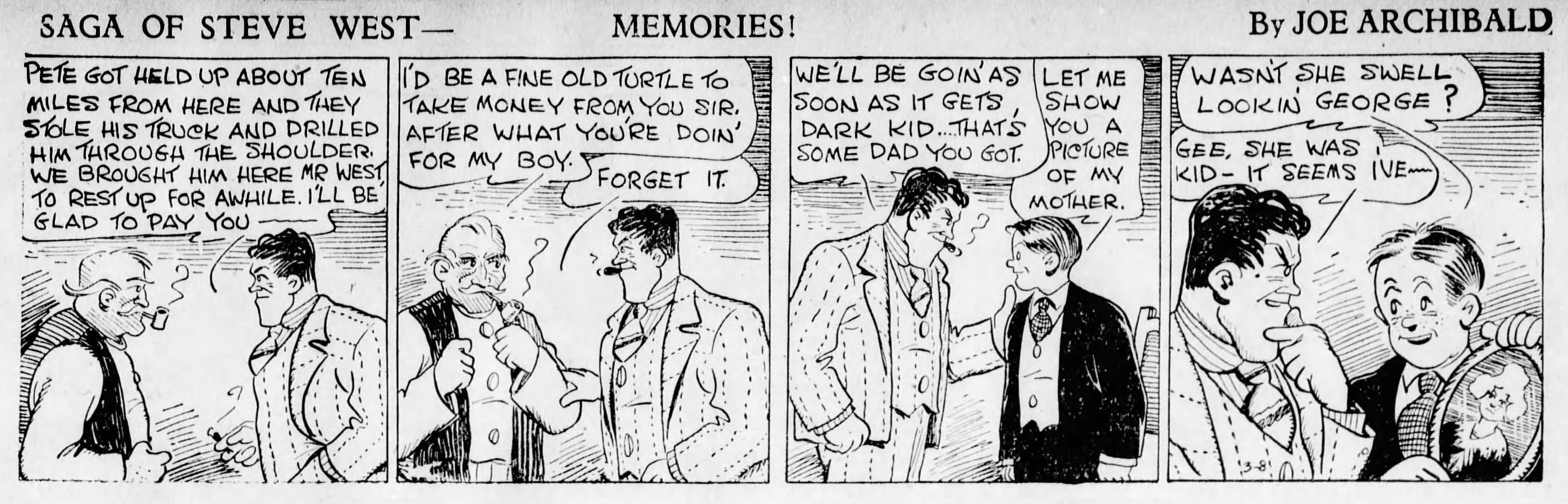
“The Saga of Steve West Pt1″ by Joe Archibald

Link - Posted by David on December 22, 2015 @ 6:00 am in

This month we’re celebrating the talents of that pulp stalwart—Joe Archibald. Joe had quite the string of jobs that led him to the pulps. Born in 1898, Joe began his writing career at the age of fifteen with a prize-winning contribution to the Boston Post. At the age of twelve he submitted and sold his first cartoon to the original JUDGE Magazine. He is a graduate of the Chicago Academy of Fine Arts.

During World War I he served on a sub-chaser for the United States Navy and was staff cartoonist for a service publication. After the armistice, he was a police and sports reporter for Boston Newspapers, and then went to New York and became a sports and panel cartoonist for the McClure Newspaper Syndicate.

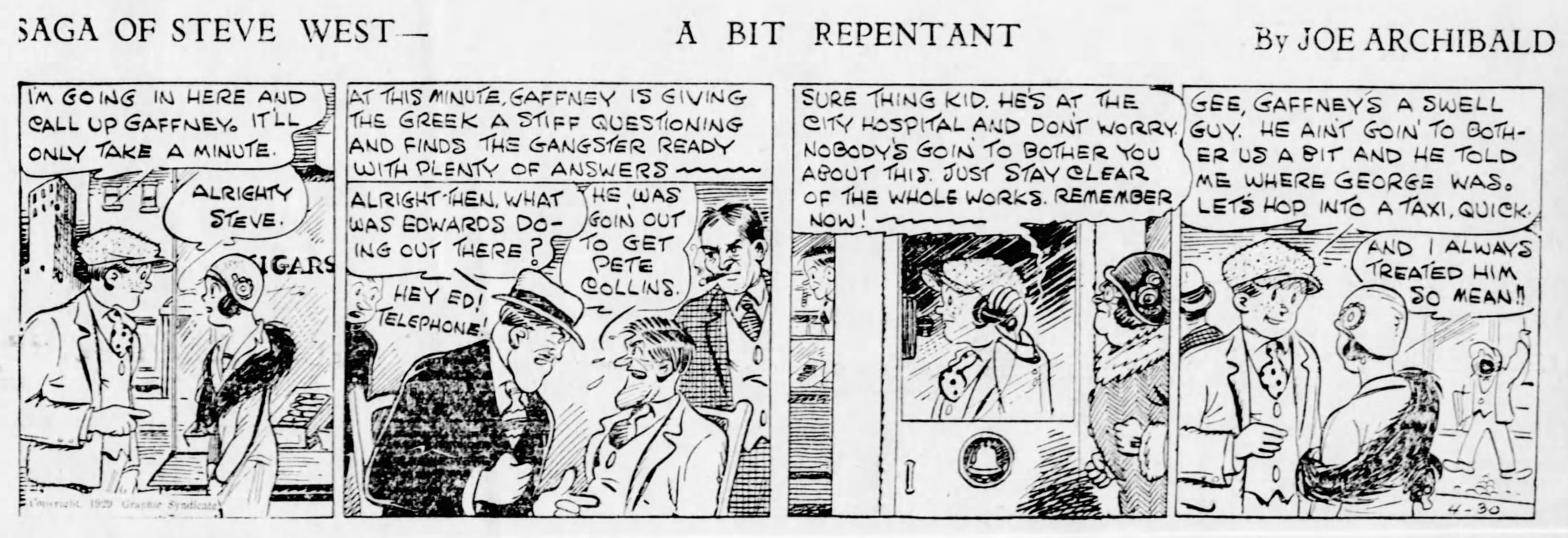
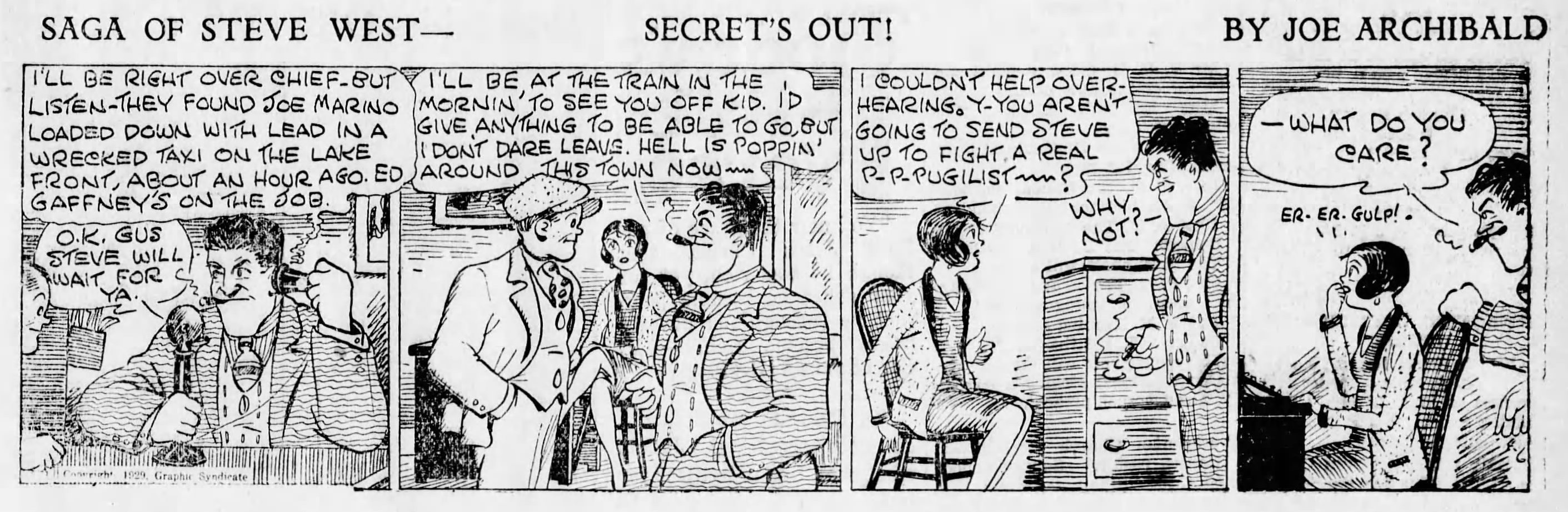
In 1928 he created his first comic strip syndicated by the New York Evening Graphic. Here he had characters, continuity and action. What he came up with was “Saga of Steve West,” a strip about a young man who leaves the farm and heads to the big city to find his way in life. The principle characters are: Steve West, the young man in question who appears to be in his late teens or early twenties; George Edwards who is Steve’s friend and benefactor and—a bootlegger; Edwards’ secretary and sometimes girlfriend, Helen Wyatt, who has a secret warm spot in her heart for Steve; Detective Gaffney who has matched wits with Edwards in gangland; and rounding out the main cast is Steve’s pal Pete Collins.
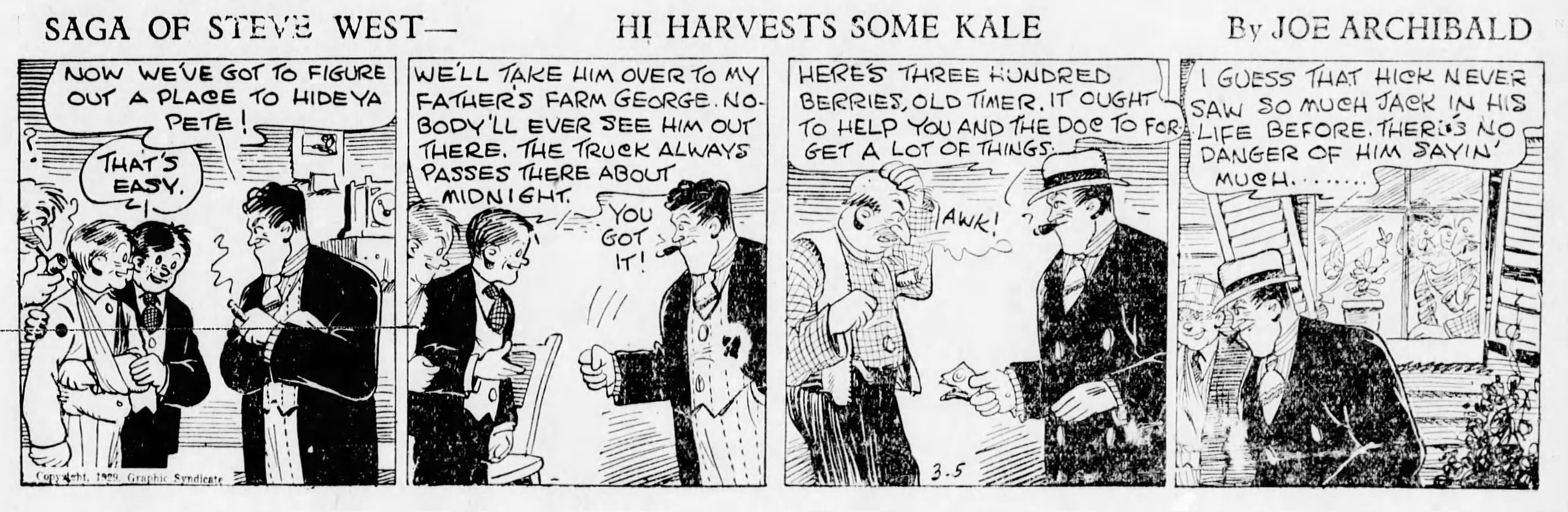
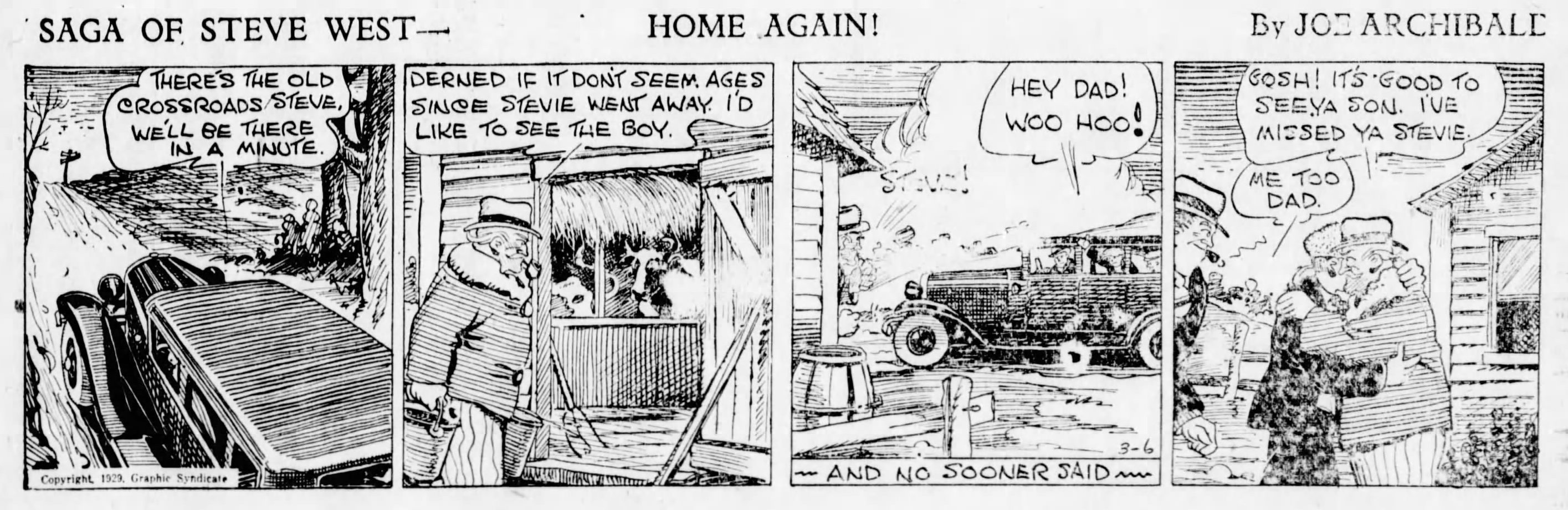
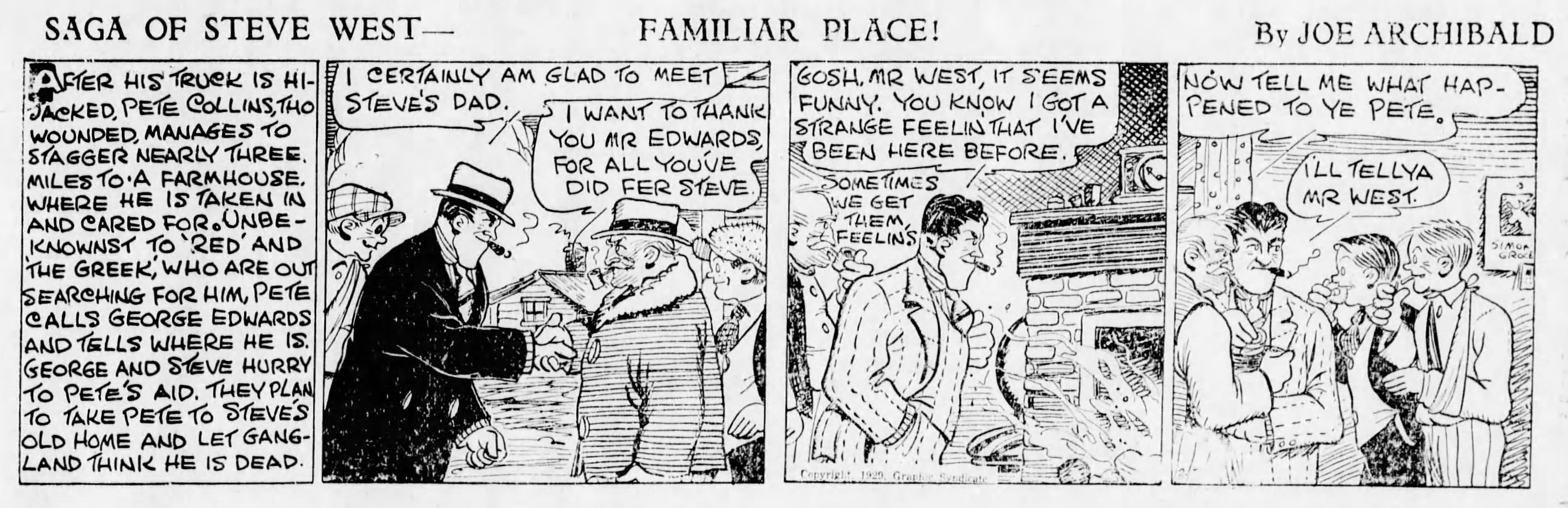
Beginning on November 12the 1928, the strip ran for almost a year according to Stripper’s Guide—ending its run in late September or early October 1929.

Here’s a taste of what was going on the first week of March 1929. As we join the action, Pete has been hi-jacked while driving one of George Edwards’ trucks. The truck stolen and shot through the shoulder, Pete has managed to make his way to not so nearby farmhouse three miles away where he was cared for and able to contact Edwards and Steve who have shown up to help hide him from “Red” and “The Greek.”

Strips courtesy of The Daily News of Mount Carmel, Pennsylvania.

To find out what happens next. . .

An Elmer Hubbard Bibliography

Link - Posted by David on December 18, 2015 @ 6:00 am in

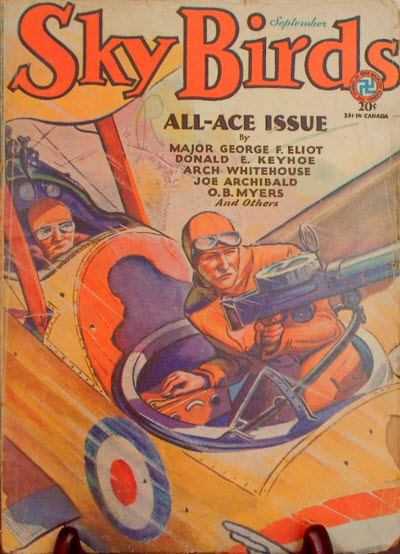
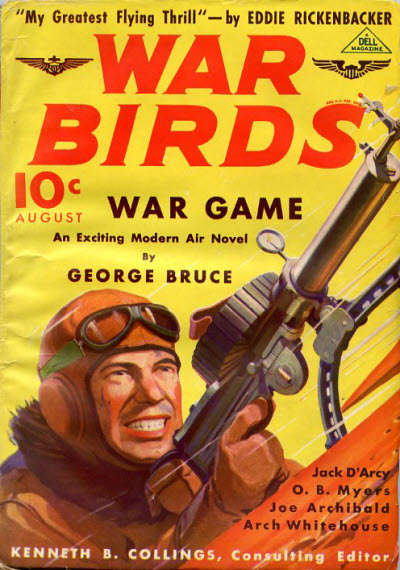
This month we’re celebrating the talents of that pulp stalwart—Joe Archibald. Archibald wrote hundreds of stories for the pulps, both dramatic and humorous. His bread and butter it would seem was the humorous tale. He had long running series in several pulp titles. In the detective titles there was Alvin Hinkey, the harness bull Hawkshaw, in 10 Story Detective; Scoops & Snooty, the Evening Star’s dizzy duo, in Ten Detective Aces; and the President of the Hawkeye Detective Agency himself—Willie Klump in Popular Detective. While in the aviation titles he had the pride of Booneville—Phineas Pinkham in Flying Aces; and the one-two punch of Ambrose Hooley & Muley Spinks in The Lone Eagle, The American Eagle, Sky Fighters and War Birds!; and Elmer Hubbard and Pokey Cook in Sky Birds!


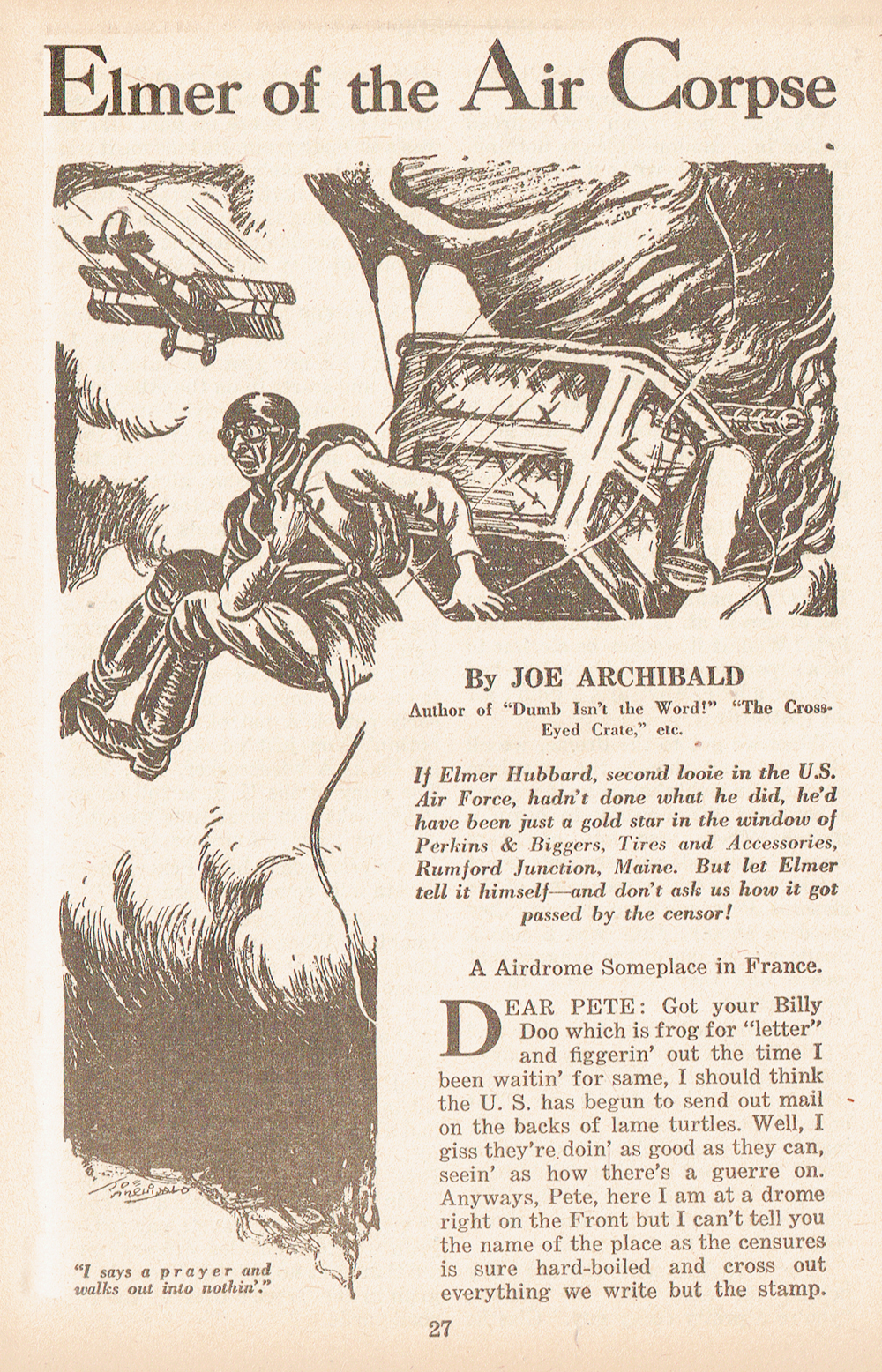
Joe Archibald also supplied illustrations for his Elmer Hubbard stories
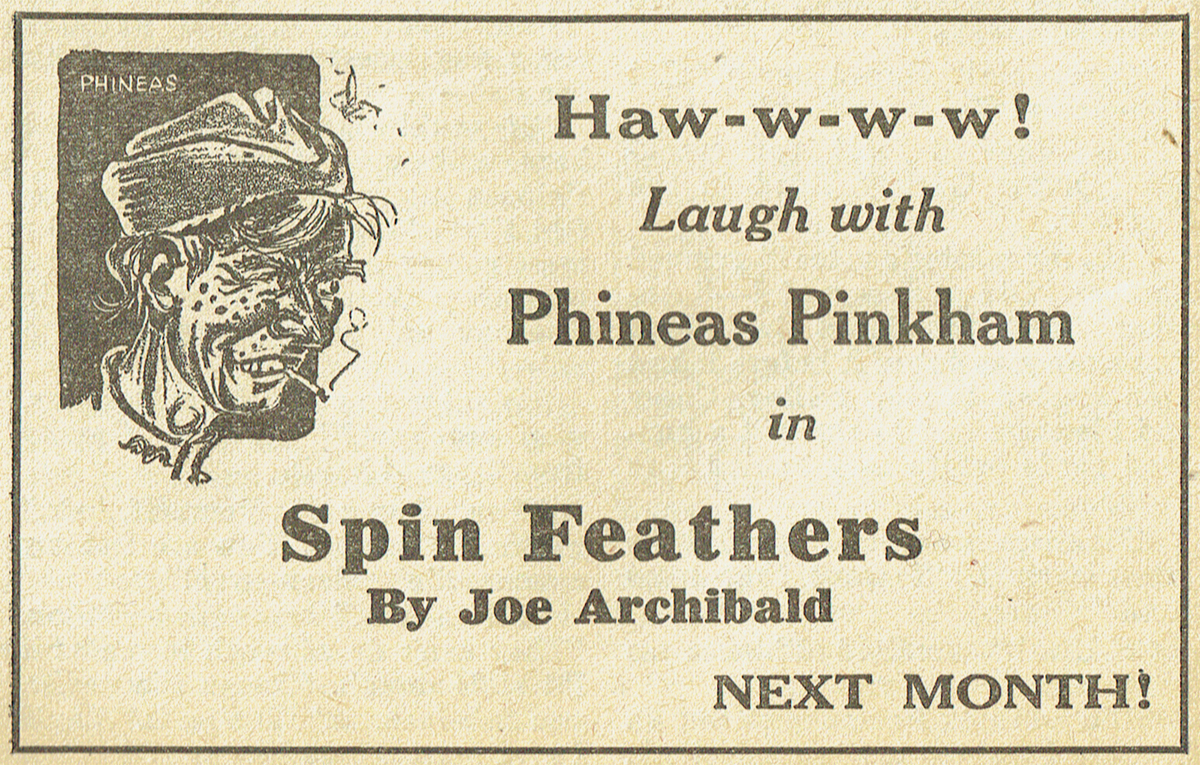
as he was doing with the Phineas Pinkham howls in Flying Aces.

Archibald wrote the Elmer Hubbard stories as if they were letters Elmer was writing home to his friend Pete back in Rumford Junction, Maine. In these Billy Doos he tells Pete all about his adventures as a Second Lieutenant in the U.S. Air Corpse—the hi-jinx he gets up to with his buddy Pokey Cook knocking around Paris and knocking down germans. All the usual Archibald humor abounds.

A listing of all the Elmer Hubbard stories.

title magazine date vol no
1931
Elmer of The Air Core Sky Birds Sep 07 6
Local Boy Makes Good Sky Birds Oct 07 7
Paree—And Busted Sky Birds Nov 07 8
Nitwit’s Nest Sky Birds Dec 07 9
1932
Elmer Knows His Groceries Sky Birds Jan 07 10
Assault and Flattery Sky Birds Feb 07 11
Chute The Works Sky Birds Mar 07 12
Elmer and His Tin Fish Sky Birds Apr 10 1
School Daze Sky Birds Jun 10 2
Duck Soup For Elmer Sky Birds Aug 10 3
Hedgehopper’s Heaven Sky Birds Sep 10 4
I.O.U.—One Ace Sky Birds Oct 11 1
Stick With Me, Elmer Sky Birds Nov 11 2
Sadder, But Not Wiser Sky Birds Dec 11 3
1933
Cook’s Detour Sky Birds Jan 11 4
Good Night, Nurse Sky birds Feb 12 1
To The Highest Kidder Sky Birds Mar 12 2
Kilt In Action Sky Birds Apr 12 3
Bullet Spoof Sky Birds May 12 4
Scent By Air Sky Birds Jul 13` 1
A Spree De Corpse Sky Birds Aug 13 2
I Cover The Western Front Sky Birds Sep 13 3
Spark Pugs Sky Birds Oct 13 4
Ain’t We Got hun Sky Birds Nov 14 1
Page Mr. Handley Sky Birds Dec 14 2
1934
Channel Skimmers Sky Birds Jan 14 3
The Vanishing Americans Sky Birds Feb 14 4
Uneasy Marks Sky Birds Mar 15 1
Three Flights Up Sky Birds Apr 15 2
By Hook or Cook Sky Birds May 15 3
The Tusk Patrol Sky Birds Jun 15 4
Hokus Focus Sky Birds Jul 16 1
Stormy Petrol Sky Birds Aug 16 2
Spy Crust Sky Birds Sep 16 3
France Formation Sky Birds Oct 16 4
Fudge Fight Sky Birds Nov 17 1
Yankee Boodle Sky Birds Dec 17 2
1935
The Oily Bird Sky Birds jan 17 3
Observation Bust Sky Birds Feb 17 4
Red Herrs Sky Birds Mar 18 1
Crash and Carrie Sky Birds Apr 18 2
Heir Attack Sky Birds Jun 18 3
Shoe Flyers Sky Birds Jul 18 4
Zoom With Bath Sky Birds Aug 19 1
Stars and Tripes Sky Birds Sep 19 2
Slip Screams Sky Birds Dec 19 3


We present as a bonus, Joe Archibald’s first tale of Elmer Hubbard. Elmer writes his first letter to Pete back in Rumford Junction telling him all about his first days in France as a second lieutenant in the U.S. Air Force with Pokey Cook.

Elmer Hubbard, second looie in the U.S. Air Force, hadn’t done what he did, he’d have been just a gold star in the window of Perkins & Biggers, Tires and Accessories, Rumford Junction, Maine. But let Elmer tell it himself—and don’t ask us how it got passed by the censor!


And check out these previously posted letters home from Elmer Hubbard of his exploits on the Western Front with Pokey Cook.

Duck Soup For Elmer

Rittmeister von Gluck was making things so tough on the tarmac where Elmer of the Air Corps parked his Spad that G.H.Q. threatened to move the whole drome back. But there was a very special reason why Elmer didn’t want that to happen—a reason named Gwendolyn. Now don’t get us wrong—Gwendolyn was no lady!

Channel Skimmers

There’s no stopping a pair of daring explorers like Elmer of the Air Corpse and Pokey Cook. This time they find themselves in England—but Pokey wants a bridge built across the Channel before he’ll go back. No stopping them? Well, not much!

The Varnishing Americans

If you thought Elmer Hubbard and Pokey Cook were a couple of wild Indians before, just wait until you see them with their war paint and feathers on! Even C.O. Mulligan had to listen to their war whoops with a smile.

Joe Archibald’s Sports Panel

Link - Posted by David on December 16, 2015 @ 6:00 am in

This month we’re celebrating the talents of that pulp stalwart—Joe Archibald. Archibald was not only a prolific author, but a decent artist as well illustrating many of his stories. His Phineas Pinkham tales from Flying Aces are an excellent example. So it’s no surprise that he had a past as a cartoonist working primarily with the McClure Syndicate.

During his time with McClure Syndicate, Joe Archibald produced a number of strips. We saw his “Champions Past and Present” from 1925 yesterday. Today we have a sports panel he produced that covered any topic related to sports under the sun—and they were varied.

Here are a few examples from February 1928 from the pages of the Lebanon Daily News, Lebanon Pensylvania.

“Champions Past and Present” by Joe Archibald

Link - Posted by David on December 15, 2015 @ 6:00 am in

This month we’re celebrating the talents of that pulp stalwart—Joe Archibald. He had a varied career even before he sold his first story to the pulps. Born in 1898, Joe began his writing career at the age of fifteen with a prize-winning contribution to the Boston Post. At the age of twelve he submitted and sold his first cartoon to the original JUDGE Magazine. He is a graduate of the Chicago Academy of Fine Arts.

During World War I he served on a sub-chaser for the United States Navy and was staff cartoonist for a service publication. After the armistice, he was a police and sports reporter for Boston Newspapers, and then went to New York and became a sports and panel cartoonist for the McClure Newspaper Syndicate.

Here are a few examples of one of his early strips for the McClure Syndicate—from the yellowing pages of the Bridgeport Telegram out of Bridgeport, Connecticut. From 1925, it’s “Champions Past and Present.”

“The Sopwith Salamander” by Robert H. Rankin

Link - Posted by David on December 14, 2015 @ 6:00 am in

Frederick Blakeslee painted all the covers for the entire run of Dare-Devil Aces. And each of those covers had a story behind it. Although this looks like it should be in his new series of scrambled time covers, instead we get Robert H. Rankin, formerly a draughtsman for Fokker Aircraft Corp, telling the story of the last of the Sopwith war-time machines—The Sopwith Salamander—from the cover of the November 1935 number of Dare-Devil Aces!

th_DDA_3511THE SALAMANDER, the last of the Sopwith war-time machines, was one of the most interesting and efficient types used in the World War. Although the design of the Salamander followed that of the earlier developed Sopwith Snipe, the plane was not intended for use as a scout or fighter—as were the Camel, Pup, Dolphin, and Snipe. It was designed primarily as a trench fighter, and in official circles it was known as the T.F.2.

The rudder of the Salamander was larger than those on the majority of the Sopwith designs. The pilot’s head, owing to the extremely deep fuselage and comparatively small wing gap, was on a level with the top plane, the center of which was partly slotted and partly cut away, to insure a better vision.

Due to the rather large diameter of the engine used, a B.R.2., the rectangularity of the fuselage was apparent toward the tail only, with the result that the fuselage was of a more circular cross-section than was the case in the other Sopwith ships.

Perhaps the mast interesting feature of the Salamander was the manner in which it was armored. Light steel plating formed the front of the fuselage from a point immediately in the rear of the engine, and extended to a point slightly to the rear of the cockpit. This armor, instead of being added to an existing fuselage frame, was a definite structual part of the frame work, and in itself formed the front portion of the fuselage. Thus, the armor plating served a structual, as well as a protective function.

Another variation from the usual Sopwith designs was incorporated in a tapering spine which served to taper off the pilot’s head and at the same time act as a head rest. This spine, being bulletproof, gave the pilot considerable protection against a rear attack.

The total weight of the armor in the Salamander totaled to some 650 pounds, and in addition to this weight, more than 2,000 rounds of ammunition was carried. In all, the ship weighed 2,945 pounds, as compared to the 1,959 pounds of the Dolphin, which was considered a rather heavy plane.

The following figures will give some idea of the performance and construction of the Salamander:


GENERAL SPECIFICATIONS
    Type Tractor Bi-plane
    Purpose Trench fighter
    Engine B.R.2, 230 h.p.
    Weights
        Loaded 2,945 lbs.
        Empty 1,844 lbs.
 
PERFORMANCE
    Speed (High—at 6,500 ft.) 123 m.p.h.
              (High—at 10,000 ft.) 117 m.p.h.
    Climb 10,000 ft. in 17 min.
    Landing speed 60 m.p.h.
    Ceiling 14,000 ft.
 
DIMENSIONS
    Length, over all 19 ft. 6 in.
    Stagger 1 ft. 5 in.
    Sweepback None
    Top Wing
        Span 31 ft 2⅝ in.
        Chord 5 ft.
        Area, not including ailerons 139 sq.ft.
        Incidence 1.8 deg.
        Dihedral 4.0 deg.
    Bottom Wing
        Span 30 ft. 2½ in.
        Chord 5 ft.
        Area, not including ailerons 123 sq.ft.
        Incidence 1.8 deg.
        Dihedral 4.0 deg.
 
AREAS
    Total wing area, not including ailerons
    Total wing, not inch ailerons 272 sq. ft.
    Tailplane 15 sq. ft.
    Elevators 11 sq. ft.
    Fin 2.75 sq. ft.
    Rudder 9 sq. ft.
    Total aileron area 51 sq. ft.


With the weights carried, the machine had a loading of 11 pounds per horse power, or 9.4 pounds per square foot.

As originally designed, the Salamander was armed with two fixed machine guns, but with its development into a general ground strafer, and later into a contact-patrol ship, the armament was increased, first to four guns, and later to six guns. In this later type there were two Lewis guns mounted on the top wing in such a manner that they could be easily drawn back and reloaded by the pilot from the cockpit.

Then, two Vickers were fixed on the top of the cowling, synchronized to fire through the propeller arc, while two Lewis guns, intended for trench strafing work were mounted on the bottom of the cockpit in such a way as to fire through the floor of the fuselage at an angle of about forty-five degrees.

The Salamander was passed by the experimental board of the Sopwith concern in April, 1918, but it was not until considerably later on in the year that the plane reached a production stage. Consequently few of them were in service over the lines.

In the short time that they were in action they showed such a performance record that it is quite probable, had the conflict lasted longer, the Salamander would have been one of the outstanding planes.

It is interesting to note, in connection with the Salamander, that the armored airplane has always been generally accepted as a logical step in the evolution of military planes by aeronautical engineers and designers. In actuality, however, there have been very few armored ships produced, and in fact, it was not until late in the war that any machines of the armored classification appeared.

For the most part, the greater number of the so-called armored planes produced were most inefficient, and in most instances the protective plating was added to the fuselage frame work of a regular pursuit or observation ship, with the result that the total weight of the machine was increased to a point where, powered with the engines then in use, they were sadly underpowered.

The Salamander, however, was designed from the first as an armored fighter, and inasmuch as the armor plating was made an integral part of the structural framework, the weight problem was done away with. This particular Sopwith offered a definite advance over the designs then in use, and it will be interesting to note in just what ways the modern armored pursuits will follow this pioneer model.

The Story Behind The Cover
“The Sopwith Salamander: The Story Behind The Cover” by Frederick Blakeslee
(November 1935, Dare-Devil Aces)

An Ambrose Hooley Bibliography

Link - Posted by David on December 11, 2015 @ 6:00 am in

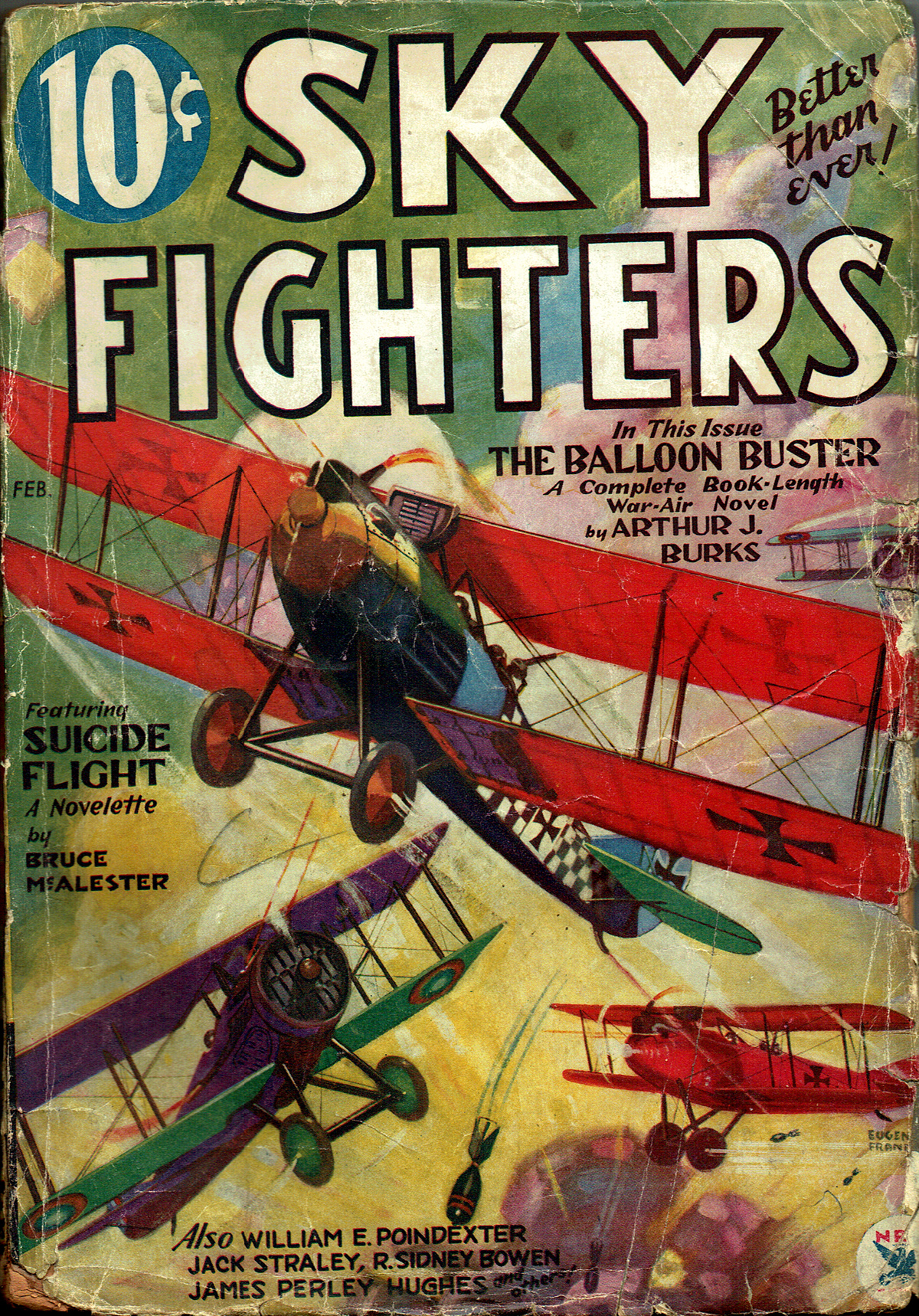
This month we’re celebrating the talents of that pulp stalwart—Joe Archibald. Archibald wrote hundreds of stories for the pulps, both dramatic and humorous. His bread and butter it would seem was the humorous tale. He had long running series in several pulp titles. In the detective titles there was Alvin Hinkey, the harness bull Hawkshaw, in 10 Story Detective; Scoops & Snooty, the Evening Star’s dizzy duo, in Ten Detective Aces; and the President of the Hawkeye Detective Agency himself—Willie Klump in Popular Detective. While in the aviation titles he had Elmer Hubbard and Pokey Cook in Sky Birds; the pride of Booneville—Phineas Pinkham in Flying Aces; and the one-two punch of Ambrose Hooley & Muley Spinks in The Lone Eagle, The American Eagle, Sky Fighters and War Birds!


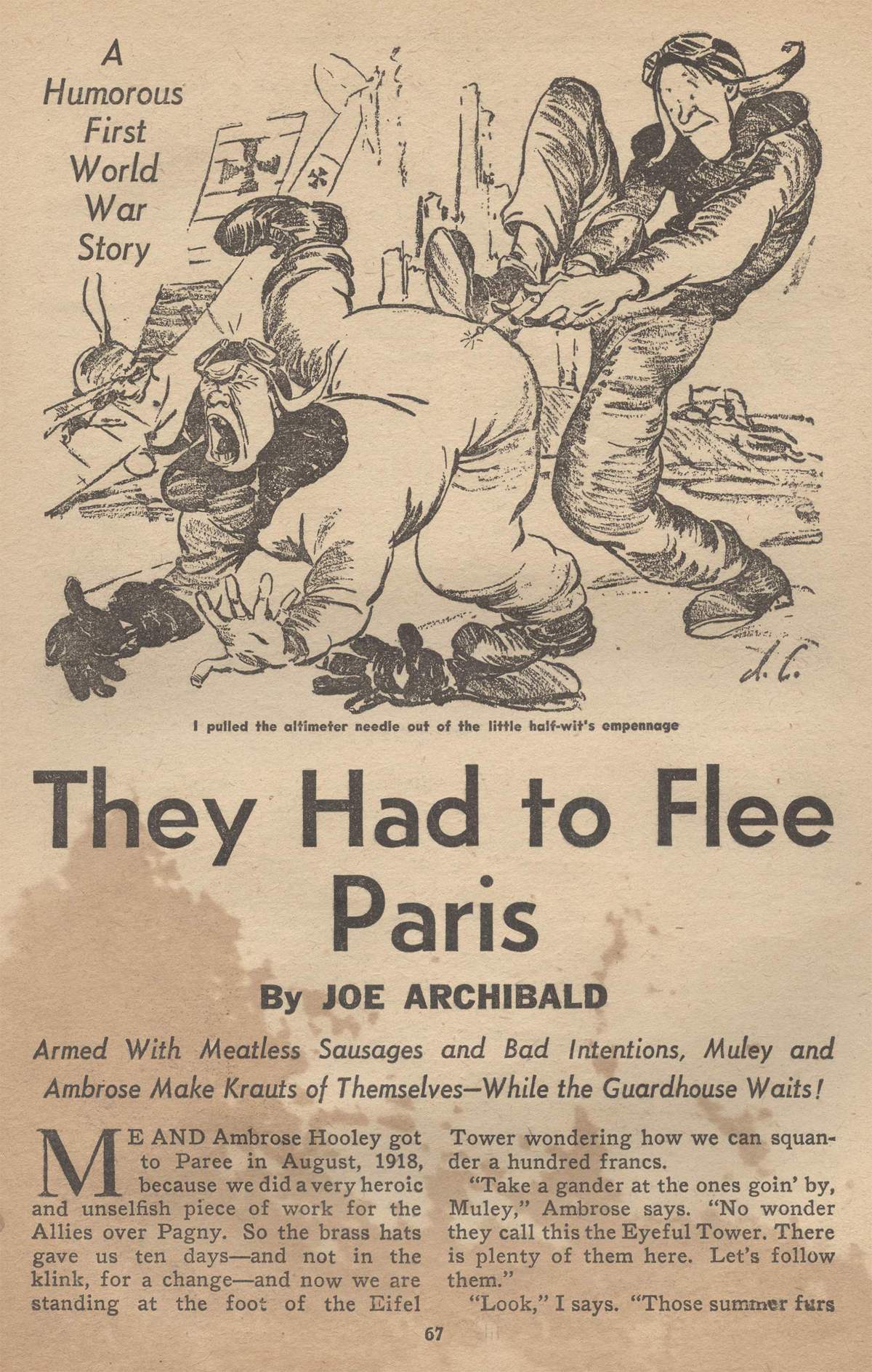
Here the incomparable Dunc Coburn handles the illustration duties for
“They Had To Flee Paris” (April 1942, The American Eagle)

The Ambrose Hooley stories are written as if Muley Spinks were telling us the tale, describing Hooley as a sawed off little tomato who is a demon in a Spad and dynamite with his fists on the ground. Hooley is frequently working some angle at the 93 Pursuit Squadron and getting their C.O. Major Bertram Bagby’s Hackels up.

A listing of all Joe Archibald’s Ambrose Hooley & Muley Spinks tales.

title magazine date vol no
1936
A Fuel There Was War Birds aug 32 1
Hun and Dearie War Birds oct 32 2
1937
Doubling in Brass Hats Sky Fighters Jan 16 1
A Flyer in Cauliflowers Sky Fighters Jul 17 2
Jennies From Heaven The Lone Eagle oct 15 2
1938
Pfalz Teeth The Lone Eagle feb 16 1
Flying Fishy The Lone Eagle apr 16 2
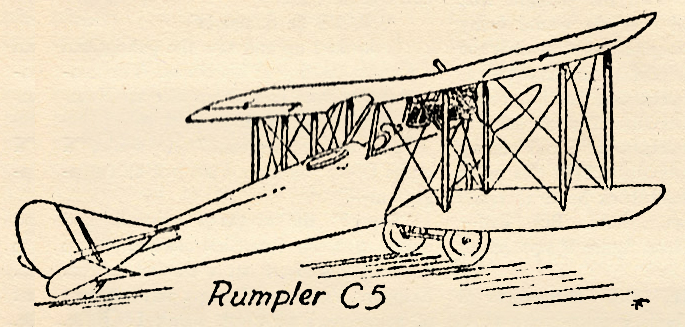
Rumpler Stakes The Lone Eagle jun 16 3
Just Plane Nuts The Lone Eagle aug 17 1
Spandau Re Mi The Lone Eagle oct 17 2
1939
Goose Stepbrothers The Lone Eagle jun 18 3
Cockpit Cuckoos The Lone Eagle aug 19 1
Observation Bus Boys The Lone Eagle oct 19 2
1940
Filet of Solos The Lone Eagle jun 20 3
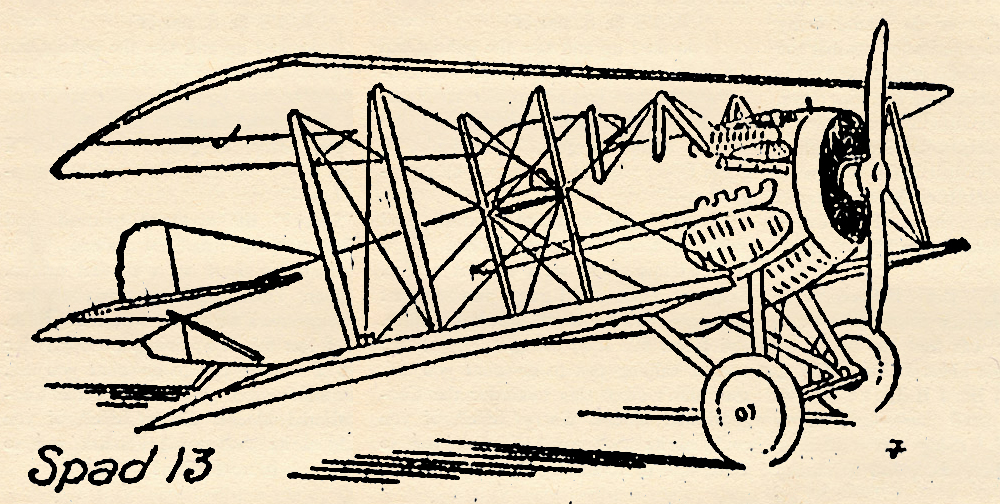
From Spad to Worse The Lone Eagle aug 21 1
Plane Jane The Lone Eagle oct 21 2
Chocks and Blondes The Lone Eagle dec 21 3
1941
Spook Spad The Lone Eagle feb 22 1
Reel Heroes The Lone Eagle apr 22 2
Flight Manager The Lone Eagle jun 22 3
Pastry Doughboys The American Eagle aug 23 1
1942
Dawn Patrol Wagon The American Eagle feb 24 1
They Had to Flee Paris The American Eagle apr 24 2
Prussian Patsies The American Eagle sum 24 3
A Bargain For Blois The American Eagle fal 25 1
1943
Sea Slick The American Eagle win 25 2
Francs and Sauerkraut American Eagles spr 25 3
Messup––1918 Sky Fighters Sep 29 3
1944
Cualiflower Alley Sky Fighters jan 30 2
Dough Dough Birds Sky Fighters sum 31 1
Uneasy Aces Sky Fighters fal 31 2
1945
Ambrose Hooley, C.O. Sky Fighters spr 32 1
Forever Ambrose Sky Fighters sum 32 2
1946
At ‘Em, Bums Sky Fighters sum 33 3
Errornautics Sky Fighters fal 34 1
Spy Crust Sky Fighters win 34 2
1948
Operation Hooley Sky Fighters win 35 3


We present as a bonus, Joe Archibald’s first tale of Ambrose Hooley. No Muley Spinks as yet, but all the other elements are there—the 93 Pursuit Squadron, Major Bagby and Ambrose shooting krauts out of the sky like ducks in a barrel while simultaneously working all the angles. The tale of assumed identity is illustrated by our old friend Frederick Blakeslee using a more cartoonish style! So, without further Adoo, “A Fuel There Was”—
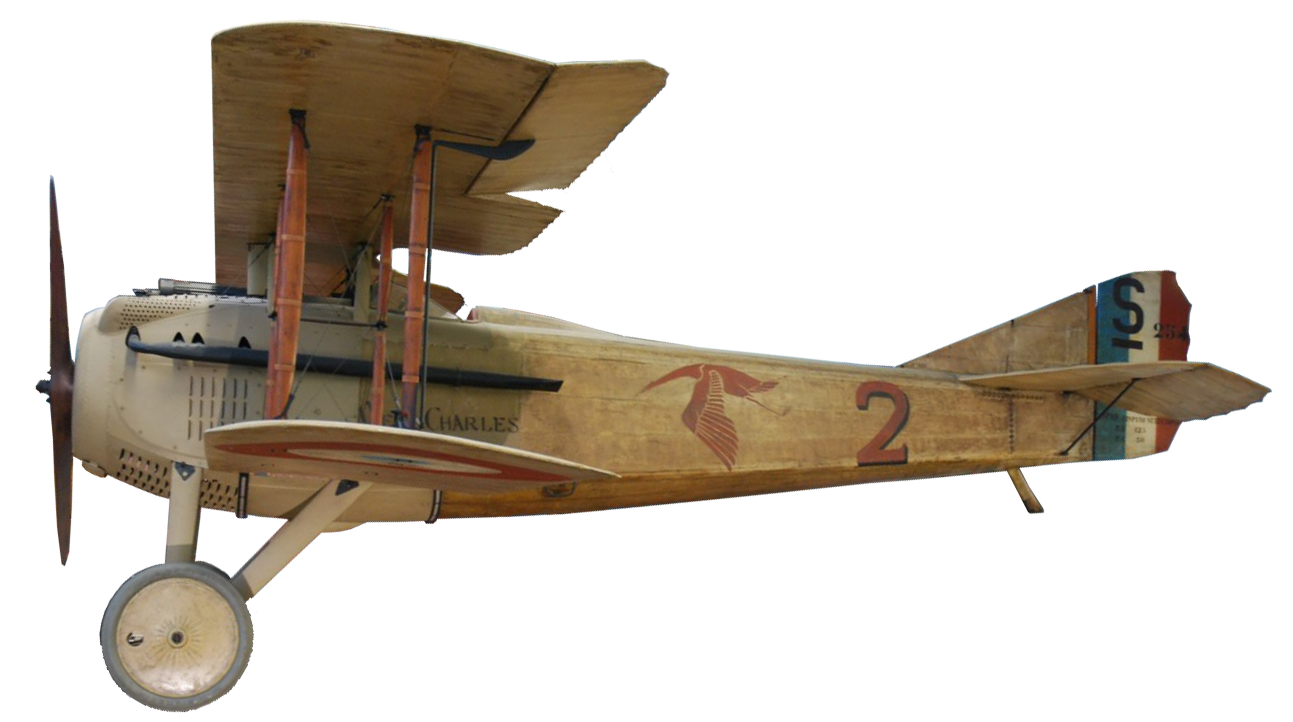
He was washing out ships at fifteen thousand dollars a washout—but Ambrose was determined to win the war along with the heart of a girl in Kansas.


For Ambrose and Muley in action together, check out “Rumpler Stakes” previously posted on AgeofAces.net.

When this pair of wild aces get started, they ruin anybody’s old war!

“Lives of the Aces in Pictures – Part 3: Georges Guynemer” by Eugene Frandzen

Link - Posted by David on December 9, 2015 @ 6:00 am in

Starting in the May 1932 issue of Flying Aces and running almost 4 years, Eugene Frandzen’s “Lives of the Aces in Pictures” was a staple of the magazine. Each month Frandzen would feature a different Ace that rose to fame during the Great War. This time around we have the third installment featuring France’s greatest flying Ace—Georges Guynemer!

That name may sound familiar to you if your a frequent visitor to this site. He’s been mentioned a few times in the past in conjunction with the lives of other Aces, and his demise was the subject of Frederick Blakeslee’s cover for the July 1933 issue of Dare-Devil Aces. Guynemer was France’s most beloved ace. He entered the French Air Service in November 1914 and served as a mechanic before receiving a Pilot’s Brevet in April 1915. Assigned to Spa3—Les Cigognes or Storks Squadron—Guynemer used his skills as an excellent pilot and marksman to quickly pile up the victories eventually being promoted to captain and commander of the Storks squadron.

By the time of his disappearance he had accrued 53 victories.

On 11 September 1917, Guynemer was last seen attacking a two-seater Aviatik near Poelcapelle, northwest of Ypres. Almost a week later, it was publicly announced in a London paper that he was missing in action. Shortly thereafter, a German newspaper reported Guynemer had been shot down by Kurt Wissemann of Jasta 3. For many months, the French population refused to believe he was dead. Guynemer’s body was never found.

(Editor’s Note: These early installments of Frandzen’s “Lives of the Aces in Pictures” that were published in the pulp-sized issues have been reformatted from a two page spread into a one page feature.)

Introducing Your Friend—Joe Archibald

Link - Posted by David on December 7, 2015 @ 6:00 am in

Since we’re celebrating the man behind the mirthquakes this month, a little introduction is in order. Here is a brief bio that ran in the back of the September 1935 issue of Sky Birds as part of Magazine Publisher’s The M-P News Flash—a one page newsletter of sorts getting readers interested in and informed about what’s in the other titles they publish. The prolific Archibald ran stories in all their titles.

JOE ARCHIBALD is one of the veterans of the Magazine-Publishers group. Since its conception, the words he has pounded out are beyond computation. The short chunky little writer who is never seen without a cigar has had a diversified career to put it mildly. In 1917 be was selected as one of a small group from the Chicago Academy of Arts to draw pictures of mother earth from the air. Joe arrived at Kelly Field and was about to climb in a plane when a telegram arrived from his fond parents. He was under age and they clipped his wings! A year later he joined the Navy and chased up and down the New England coast looking for German subs. After the fuss was over he became a police reporter on the “Boston Telegram” and “Post.” Joe can also swing a pencil. He stopped haunting Beantown’s underworld and signed up to draw two or three features for the McClure Newspaper Syndicate. From there he went to the United Press to draw sport cartoons and write a column.

“The New York Graphic” drew Joe next. He claims to have been the pioneer in detective strips. But the yen to write fiction was strong and he quit newspaper work to devote his entire time to turning out flying, detective. western and adventure stories for WESTERN ACES—WESTERN TRAILS—TEN DETECTIVE ACES—FLYING ACES and SKY BIRDS.

The majority of his readers do not have to be told that Joe prefers to dish out humor more than anything else. He assures us that a man has to possess an abnormal funny bone to have been a hotel man, a wrestler, a bookkeeper, an artist, a writer and a newspaper reporter during a period of seventeen years. Life has not begun for Joe as yet. He’s nowhere near forty. There’s no telling what he’ll try his hand at next.

A Phineas Pinkham Bibliography

Link - Posted by David on December 4, 2015 @ 6:00 am in

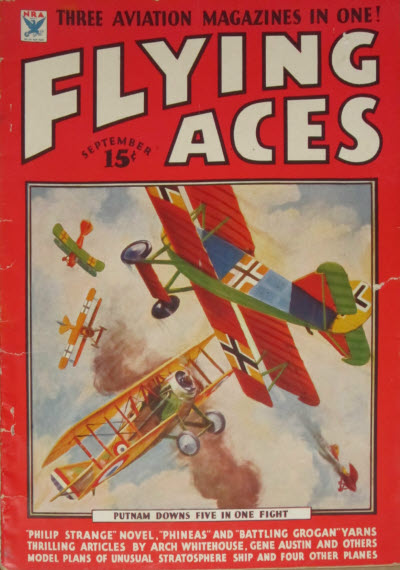
This month we’re celebrating the talents of that pulp stalwart—Joe Archibald. Archibald wrote hundreds of stories for the pulps, both dramatic and humorous. His bread and butter it would seem was the humorous tale. He had long running series in several pulp titles. In the detective titles there was Alvin Hinkey, the harness bull Hawkshaw, in 10 Story Detective; Scoops & Snooty, the Evening Star’s dizzy duo, in Ten Detective Aces; and the President of the Hawkeye Detective Agency himself—Willie Klump in Popular Detective. While in the aviation titles he had Elmer Hubbard and Pokey Cook in Sky Birds; the one-two punch of Ambrose Hooley & Muley Spinks in The Lone Eagle, The American Eagle, Sky Fighters and War Birds; and last, but by no means least, the pride of Booneville—Phineas Pinkham in Flying Aces!

Joe Archibald’s Phineas Pinkham was the longest continuously running aviation character in the pulps. Running in the pages of Flying Aces from November 1930 until the magazine dropped it’s Fiction section in November 1943. In 151 stories, Pinkham bedevils the men of the 9th Pursuit Squadron, all the Hauptmanns and vons the Boche send his way and his hapless C.O. Major Rufus Garrity with his pranks, jokes and insane inventions that seem only to amuse Phineas.

Here is a checklist of his adventures:

title magazine date vol no
1930
Sneeze That Off Flying Aces Nov 6 6
1931
The Hardware Ace Flying Aces Feb 6 9
Rock-A-Bye Jerry Flying Aces Jun 9 1
Bargains For Blois Flying Aces Jul 9 2
Tell It To The King Flying Aces Aug 9 3
For Dear Old G.H.Q. Flying Aces Sep 9 4
Crazy Like a Fox Flying Aces Oct 9 5
Junkers—C.O.D. Flying Aces Nov 9 6
Please Omit Flowers Flying Aces Dec 9 7
1932
Half-Shot at Chaumont Flying Aces Jan 9 8
A Flyer In Tin Flying Aces Feb 11 1
Too Good for Hanging Flying Aces Mar 11 2
From Spad to Worse Flying Aces Apr 11 3
Pride of the Pinkhams Flying Aces May 11 4
No Money, No Flyee Flying Aces Jun 12 1
Herr Tonic Flying Aces Jul 12 2
Sky A LA Mode Flying Aces Aug 12 3
The Reel Hero Flying Aces Sep 12 4
The Bat’s Whiskers Flying Aces Oct 13 1
Good To The First Drop Flying Aces Nov 13 2
Shower Kraut Flying Aces Dec 13 3
1933
The Bull Flight Flying Aces Jan 13 4
Sleuthing Syrup Flying Aces Feb 14 1
Nothing But The Tooth Flying Aces Mar 14 2
The Fryin’ Dutchman Flying Aces Apr 14 3
The Grim Reaper Flying Aces May 14 4
Spin Feathers Flying Aces Jul 15 1
Take The Heir Flying Aces Aug 15 2
Stage Flight Flying Aces Sep 15 3
Herr Net Flying Aces Oct 15 4
Bomb Voyage Flying Aces Nov 16 1
The Frying Suit Flying Aces Dec 16 2
1934
Smell-Shocked Flying Aces Jan 16 3
String ‘Em Back Alive Flying Aces Feb 16 4
Hans Up Flying Aces Mar 17 1
Hose De Combat Flying Aces May 17 2
No Fuelin’ Flying Aces Jun 17 3
Hunbugs Flying Aces Jul 17 4
Intelligence Pest Flying Aces Aug 18 1
Scrappy birthday Flying Aces Sep 18 2
Tattle Tailwinds Flying Aces Oct 18 3
Parlez Voodoo Flying Aces Nov 18 4
Good Haunting Flying Aces Dec 19 1
1935
An Itch In Time Flying Aces Jan 19 2
Crepe Hangers Flying Aces Feb 19 3
Horse Flyers Flying Aces Mar 19 4
Geese Monkeys Flying Aces Apr 20 1
Cinema bums Flying Aces May 20 2
Prop Eyes Flying Aces Jun 20 3
Rice and Shine Flying Aces Jul 20 4
Dog Flight Flying Aces Aug 21 1
Pfalz Teeth Flying Aces Sep 21 2
One Hun, One Hit, Three Errors Flying Aces Oct 21 3
Sea Gullible Flying Aces Nov 21 4
Fallen Archies Flying Aces Dec 22 1
1936
Spy Larking Flying Aces Jan 22 2
T.N.T. Party Flying Aces Feb 22 3
Doin’s In The Dunes Flying Aces Mar 22 4
The Batty Patrol Flying Aces Apr 23 1
Smells, Spells, And Shells Flying Aces May 23 2
Sky Finance Flying Aces Jun 23 3
Scratch-as-Scratch Can Flying Aces Jul 23 4
Blois, Blois, Blacksheep Flying Aces Aug 24 1
Fish and Gyps Flying Aces Sep 24 2
Watch Your Steppes Flying Aces Oct 24 3
C’est La Ear Flying Aces Nov 24 4
Scrappy Birthday Flying Aces Dec 25 1
1937
Flight Opera Flying Aces Jan 25 2
P.D.Q.—Boat Flying Aces Feb 25 3
Smoke Scream Flying Aces Mar 25 4
Poosh ‘Em Up, Pinkham Flying Aces Apr 26 1
Wrong About Face Flying Aces May 26 2
Bagger In Bagdad Flying Aces Jun 26 3
Spree With Lemon Flying Aces Jul 26 4
Swiss Wheeze Flying Aces Aug 27 1
Peck’s Spad Boys Flying Aces Sep 27 2
Scott Free-For-All Flying Aces Oct 27 3
Crash or Delivery Flying Aces Nov 27 4
Yankee Doodling Flying Aces Dec 28 1
1938
Flight Team Flight Flying Aces Jan 28 2
Cat’s Spad-Jamas Flying Aces Feb 28 3
Eclipse of The Hun Flying Aces Mar 28 4
Hoots and Headlights Flying Aces Apr 29 1
Kraut Fishing Flying Aces May 29 2
The Spider and The Flyer Flying Aces Jun 29 3
Zuyder Zee Zooming Flying Aces Jul 29 4
Tripe of Peace Flying Aces Aug 30 1
Cocarde Sharpers Flying Aces Sep 30 2
Heir-O-Bats Flying Aces Oct 30 3
Skyway Robbery Flying Aces Nov 30 4
Happy Hunning Ground Flying Aces Dec 31 1
1939
A Haunting We Will Go Flying Aces Jan 31 2
Don Patrol Flying Aces Feb 31 3
Kaiser Bilious Flying Aces Mar 31 4
Slaked Limeys Flying Aces Apr 32 1
Spin Money Flying Aces May 32 2
Flight Headed Flying Aces Jun 32 3
The Airy Ape Flying Aces Jul 32 4
Herr Dresser Flying Aces Aug 33 1
Duc Soup Flying Aces Sep 33 2
C’est La Goat Flying Aces Oct 33 3
Nippon Tuck Flying Aces Nov 33 4
Ye Ould Emerald Oil Flying Aces Dec 34 1
1940
Impropa Ganda Flying Aces Jan 34 2
Fright Leader Flying Aces Feb 34 3
Take It or Leafet Flying Aces Mar 34 4
Briny Deep Stuff Flying Aces Apr 35 1
Flight to the Finish Flying Aces May 35 2
Pharaoh and Warmer Flying Aces Jun 35 3
Dawn Parole Flying Aces Jul 35 4
Horse of Another Cocarde Flying Aces Aug 36 1
Air or Nautical Flying Aces Sep 36 2
The Foil Guy Flying Aces Oct 36 3
Bull Flight Flying Aces Nov 36 4
Leave La Frawnce Flying Aces Dec 37 1
1941
Crow de Guerre Flying Aces Jan 37 2
I Knew De Gaulle Flying Aces Feb 37 3
Daze In Dunkirk Flying Aces Mar 37 4
Zooming Zombies Flying Aces Apr 38 1
Dawn Petrol Flying Aces May 38 2
Jerry Prison Scamp Flying Aces Jun 38 3
The Eyes Have It Flying Aces Jul 38 4
Nieuport News Flying Aces Aug 39 1
Chuting Star Flying Aces Sep 39 2
Zoom Like It Hot Flying Aces Oct 39 3
Gleech of Promise Flying Aces Nov 39 4
Gas Me No Questions Flying Aces Dec 40 1
1942
Tanks For The Memory Flying Aces Jan 40 2
The Moor The Merrier Flying Aces Feb 40 3
Hot Francs Flying Aces Mar 40 4
Contact Bridge Flying Aces Apr 41 1
The Crate Impersonation Flying Aces May 41 2
Grim Ferry Tale Flying Aces Jun 41 3
Maltese Doublecross Flying Aces Jul 41 4
Spy and Ice Cream Flying Aces Aug 42 1
Air Screwball Flying Aces Sep 42 2
Glider Than Air Flying Aces Oct 42 3
Flight Headed Flying Aces Nov 42 4
Pot Luck Flying Aces Dec 43 1
1943
Heir Minded Flying Aces Jan 43 2
Chateau Theory Flying Aces Feb 43 3
Pinkham’s Pixies Flying Aces Mar 43 4
Laughing Gas Model Flying Aces Apr 44 1
Hide and Go Sheik Flying Aces May 44 2
Jappy Landing Flying Aces Jun 44 3
Three Aces Feast Flying Aces Jul 44 4
Italian Vamoose Flying Aces Aug 45 1
Czech Mates Flying Aces Sep 45 2
Gamboling With Goebbels Flying Aces Oct 45 3
Sounds Vichy Flying Aces Nov 45 4


“Haw-w-w-w-w!” As a bonus, here’s Phineas Pinkham mirthquake from 1934. From the February number of Flying Aces Phineas goes to some inventive extremes to get a captured flyer back in “String ‘Em Back Alive!”

Major Garrity had an idea. It involved sending Phineas Pinkham back to training school in his stolen Fokker to teach rookies to fight. Phineas had an idea, too. It involved taking that stolen Fokker across the lines to teach the Mad Butcher not to fight. Lay your bets, gentlemen!

Editor’s Note: This story was posted a number of years ago, but this is an update PDF with Archibald’s illustrations included to add to the merriment!

“The Yellow Monsters” by Frederick Blakeslee

Link - Posted by David on November 30, 2015 @ 6:00 am in

Frederick Blakeslee painted all the covers for the entire run of Dare-Devil Aces. And each of those covers had a story behind it. Last time Mr. Blakeslee gave us the first in a new series of mismatched time images with planes from the Great War along side present day planes from 1935! This time he returns with he second in the series, from the cover of the October 1935 number of Dare-Devil Aces—”The Yellow Monsters!”

th_DDA_3510ABOVE is the drawing of a Pterodactyl, a pre-historic flying reptile that lived thousands of years ago. Today the Pterodactyl flies again, but this time it is man-made—in short, a modern fighting airplane. Before we go ahead with our story, let us explain why you find a modern ship in combat with a wartime airplane.

The World War is long past, yet many are still interested in the war-time ship; but an equal number are interested in the modern craft too. In thinking it over we wondered what a war-time pilot would do, had he in war days, met a ship of today. The problem was solved. Why not mix time? Take 1918 and 1935 and just scramble them?

The result certainly isn’t the World War, in fact it isn’t any war; it isn’t even real and not being real we can let our imagination roam. By scrambling time this way we can not only show you a war-time ship, but a modern one as well both on the same cover thus giving you an easy way of comparing the fighting ship of today with the fighting ship of yesterday.

So now, let us enter the realms of imagination. Let us see what Otto, a German pilot of 1918 would do had he met the Pterodactyl.

Otto was a crack pilot; he was leader of his staffel and was in the habit of going off on bis own occasionally to look for trouble. He was on one of these trips when he saw a speck way off on his right. Being over the French lines he guessed it was an Allied plane. His big Mercedes engine soon had him high above the other ship. As he crossed its path he looked down and saw the British insignia on the wing-tips. Something about the plane seemed queer, but not giving it a second thought he dove.

He suddenly pulled out of his dive and rubbed his eyes. He looked again. His first impression had been right after all. Something was definately queer about the British ship. Mein Gott, what was it? Was it an airplane? If so it was like nothing he had ever seen.

But he could see the flash of propellers and the crew—that was real anyway, so it must be an airplane. Dunner und blit-sen, what a crazy thing it was! Why it looked as though it would fall apart if a wind hit it. Where was the tail? Well, thought Otto, this will be cold turkey.

He was about to dive again when the strange ship put on a burst of speed. To Otto’s surprise he discovered that he had had his throttle wide open to keep up with the yellow monster.

Well it certainly could fly, he decided, as the Britisher pulled rapidly away from him. Then he saw several others of the strange ships join the first and turn toward him. Otto thought he better return to his drome and get help.

Otto assembled his pilots and recounted what he had seen. The assembled pilots looked at each other but said nothing. Otto was their superior officer so what could they say? A tailless ship indeed, bosh!

Otto led his staffel back and soon spotted the strange ships.

He made a wide circle and gave the signal to dive. The scene on the cover shows the beginning of the fight.

Here we might consider what chance Otto and his men flying Fokker DVII’s would have against the Pterodactyl. We do not hesitate to say that they don’t stand a ghost of a chance.

At the time of writing this, no data on the performance of the Pterodactyl is available. The speed is very high; the exact figure we do not know. Note the wonderful unobstructed field of fire of the rear gunner. It would be impossible for an attacker to hide under the tail. It can deliver a steady stream of lead from its fixed guns and as it dives on an enemy another dose from the free gun as it zooms away. The rear gunner by the way is fully protected from the wind. The pilot can look either under or over the center section too.

Some think that the Pterodactyl may prove to be the most formidable fighter yet produced. Others wonder if it will not become extinct as the bird-lizard from which the new ship gets its name.

The Story Behind The Cover
“The Yellow Monsters: The Story Behind The Cover” by Frederick Blakeslee
(October 1935, Dare-Devil Aces)

The Pterodactyl is manufactured by Westland Aircraft Co., England, and was first produced last year.

 BBAA_3501
Editor’s Note: The Westland Pterodactyl was featured much more prominently earlier in 1935 on the January cover of Street & Smith’s Bill Barnes Air Adventurer. Here Frank Tinsley has place the Pterodactyl front and center with the tailless tailgunner blasting away at the pursuing biplanes!

“Geese Monkeys” by Joe Archibald

Link - Posted by David on November 27, 2015 @ 6:00 am in

“Haw-w-w-w-w!” You heard right! That marvel from Boonetown, Iowa is back and in hotter water than usual, but as is the case—what’s sauce for the goose is gravy for Phineas!

Trouble had been coming to Phineas in bunches, like bananas. At last, the Ninth Pursuit thought they had got him down. But don’t let that fool you. A Pinkham at bay is worse than an army of leopards with brass knuckles.

“Lives of the Aces in Pictures – Part 2: Bert Hall” by Eugene Frandzen

Link - Posted by David on November 25, 2015 @ 6:00 am in

Starting in the May 1932 issue of Flying Aces and running almost 4 years, Eugene Frandzen’s “Lives of the Aces in Pictures” was a staple of the magazine. Each month Frandzen would feature a different Ace that rose to fame during the Great War. This time around we have the second installment featuring America’s Flying Soldier of Fortune—Bert Hall!

Weston Birch “Bert” Hall was one of the seven original members of the Lafayette Escadrille. And was probably America’s most colorful Soldier of Fortune. Born in 1885, he began his storied carrer in the early 1900’s in the Balkan war. Later, he is reported to have dropped rocks on the sultan of Turkey’s enemies while flying for the Turks. He was a four-flusher, a liar, a deserter and a damn good poker player who was good at reading his opponents.

Hall wrote two books about his exploits in the Lafayette Escadrille, En L’air (1918) and One Man’s War (1929). The former was the basis of the 1918 film A Romance of the Air, in which he starred as himself.

He assisted the Chinese in the 1920’s when he headed the Chinese air force. However he was sentenced to 30 months in jail when a money for arms deal fell through and was accused of receiving money under false pretenses.

When he was released in 1936, he ended up moving around alot—to Seattle for a while and Hollywood where he worked for 20th Century Fox Studios. By 1940 he found himself in Dayton, Ohio—finally settling in Castalia, Ohio and starting the Sturdy Toy Factory.

He died of a massive heart attack while driving down the highway in 1948.

(Editor’s Note: These early installments of Frandzen’s “Lives of the Aces in Pictures” that were published in the pulp-sized issues have been reformatted from a two page spread into a one page feature.)

“The Solo Skipper” by Harold F. Cruickshank

Link - Posted by David on November 20, 2015 @ 6:00 am in

This week we have a story by another of our favorite authors—Harold F. Cruickshank! Cruickshank is popular in these parts for the thrilling exploits of The Sky Devil from the pages of Dare-Devil Aces, as well as those of The Sky Wolf in Battle Aces and The Red Eagle in Battle Birds. He wrote innumerable stories of war both on the ground and in the air. Here we have a tale of “Mud” Collier, a flyer who likes to go it alone and is as comfortable in the trenches where he started out as he is in the air. From the February 1935 Flying Aces we bring you “The Solo Skipper”—

His own squadron called him “Mud” because he spent his leave up front with the infantry and his air hours patrolling their death-infested forward zone to protect them. But to those doughboys who every day defied the fury of the enemy barrage—his name was not mud.

“The Tailless Ship” By Frederick Blakeslee

Link - Posted by David on November 16, 2015 @ 6:00 am in

Frederick Blakeslee painted all the covers for the entire run of Dare-Devil Aces. And each of those covers had a story behind it. This time Mr. Blakeslee gives the first in a new series of mismatched time images with planes from the Great War along side present day planes from 1935! Without further Ado, Mr. Blakeslee gives us the story of “The Tailless Ship!”

th_DDA_3509AFTER looking at the cover this month you have probably turned to this story quickly to find out what it is all about. You probably think you have missed something in German war-time ships. But you haven’t. Its this way.

Recently we were wondering what a war-time pilot would think and do, had he, in 1918, met a ship of today. So we took 1918 and 1935, mixed them thoroughly and what have we? Well, the result certainly isn’t the World War. As a matter of fact it isn’t any war. It isn’t even real, and that is just the result we were after. Not being real we can let our imaginations roam. Therefore, this cover is No. 1 of a brand-new series. To
keep them in order we will number them. You will find the number in the lower left-hand corner on the blue band.

Now let us suppose that a French pilot, in 1918 meets a ship of 1935. This opens a fascinating field. We can keep abreast with the very latest in modern fighting aircraft design on these covers as well as present the war-time ship. And more, you will then have an easy way of comparing the fighting ship of today with the fighting ship of yesterday.

To start off, we have selected a tailless ship. It is not strictly speaking, a fighter. It was designed by a young German inventor in 1933 and he startled the aeronautical world by actually flying it.

It was, therefore, the forerunner of the modern tailless type. Designers seized on the tailless idea and a recent ship of this type, produced by Great Britain, may prove to be the most formidable fighting craft yet made. That ship is the Pterodactyl, which we shall show next month.

As we said above, the tailless ship was not designed as a fighter. But for the purposes of this cover and to give the Spad a break, we have made it into a fighter by merely making the passenger cockpit into a gun nacelle.

Granted it is a fighter, let us see what Pierre, our French pilot of 1918, would think of it. When he first sighted it he probably thought it was a bat, but as it approached and grew in size, and although it still looked to him like a bat, he knew it for what it was, for he caught the flash of propellers.

And then he sat fascinated as the strange ship circled him. His eyes told him it zvas an airplane, but his mind refused to accept it as such. He probably said to himself, in French of course, “There ain’t no such animal, there couldn’t be! Why, it hasn’t even got a tail and where the tail should be is a propeller! There’s a propeller at the bow too. Good grief, it’s a pusher and a tractor at the same time, impossible! And what are those green things at the end of the wings, if they are wings?”

Just then the bat-like ship banked. “Are they rudders? How could rudders be there? No, I’m seeing things, no more cognac for me!”

Of course we must assume all this went through Pierre’s head in a flash. As the ship banked, Pierre was startled to see smoking white tracers flash past. He then saw what had escaped him at first, the bat ship carried German crosses. Pierre looped and although he didn’t think the thing was really there, went to work.

Now what chance would Pierre have against this ship? A very good chance indeed. Pierre, with his 300 h.p. Hispano could do 130 m.p.h. on the straight-away. The tailless ship with only 150 h.p. could do 160, no use trying to run for it. Maybe he could out-climb it? No, the German could climb a thousand feet a minute. Well maybe he could out-dive it? Not that either, the German ship could dive like a bat out of hell.

He could out-maneuver it however, but what good would that do? The gunner had an unrestricted field of fire, back, ahead, up and to the sides. Well, maybe the thing has a blind spot. Ah! There we have him; underneath Pierre was as safe as a church. Now just tip up and let him have it.

Yes, we’re sure Pierre would win this fight, but next month the tailless ship tells a different story.

The Story Behind The Cover
“The Tailless Ship: The Story Behind The Cover” by Frederick Blakeslee
(September 1935, Dare-Devil Aces)

“Lives of the Aces in Pictures – Part 1: Eddie Rickenbacker” by Eugene Frandzen

Link - Posted by David on November 11, 2015 @ 6:00 am in

Starting in the May 1932 issue of Flying Aces and running almost 4 years, Eugene Frandzen’s “Lives of the Aces in Pictures” was a staple of the magazine. Each month Frandzen would feature a different Ace that rose to fame during the Great War. This time around we have the inaugral installment featuring America’s Ace of Aces—Eddie Rickenbacker!

Rickenbacker is credited with 26 victories—the most of any American flyer. He was awarded the Medal of Honor, Legion of Honor, Croix de Guerre and the Distinguished Service Cross with 8 oak leaf clusters (1 silver & 3 bronze).

Before the war, Rickenbacker had become one of the most successful race car drivers, and, with the war’s end, Rickenbacker went back to what he knew. He elected to leave the air service and established his own automotive company that ultimately went out of business. Not detoured, he bought the Indianapolis Speedway—turning it around and making it profitable. From there he went into General Motors. When GM aquired North American Aviation in 1935, RIckenbacker was asked to manage one of their holdongs—Eastern Air Transport which Rickenbacker merged with Florida Airways to form Eastern Air Lines—taking a little airline flying a few thousand miles a week to major airline!

(Somehow during all this he found the time to also script two popular comic strip from 1935 to 1940—Ace Drummond and Hall of Fame of the Air.)

The advent of World War II brought Rickenbacker back to service—but as a civilian Representative to the Secretary of War in the survey of aircraft installations. Resuming his role at Eastern Air Lines after the war. With Eastern’s financial losses in the 1950’s, Rickenbacker was forced out of his position as CEO in 1959 and resigned as Chairman of the Board on December 31st, 1963.

Rickenbacker spent his remaining years lecturing, writing his autobiography and traveling with his wife. He suffered a stroke while in Switzerland and contracted pneumonia—dying on July 23rd, 1972.

(Editor’s Note: These early installments of Frandzen’s “Lives of the Aces in Pictures” that were published in the pulp-sized issues have been reformatted from a two page spread into a one page feature.)

« Previous PageNext Page »