Looking to buy? See our books on amazon.com Get Reading Now! Age of Aces Presents - free pulp PDFs

“Aces Aren’t Born” by Robert Sidney Bowen

Link - Posted by David on September 1, 2023 @ 6:00 am in

TODAY we have a story from the prolific pen of Robert Sidney Bowen. Bowen was a war pilot of the Royal Air Force, as well as the editor of one of the foremost technical journals of aviation in addition to penning hundreds of action-packed stories for the pulps.

Chuck Kirkwood is in a slump when he is sent along with several other members of his squadron to support a fake offensive that becomes all too real. Thankfully he gets his mojo back at just the right moment.

They’re re-born—fighting stark berserk in shrapnel-shredded skies for a crazy cause!

Humpy & Tex in “Washed Out” by Allan R. Bosworth

Link - Posted by David on August 25, 2023 @ 6:00 am in

THIS week we have a story from the pen of the Navy’s own Allan R. Bosworth. Bosworth wrote a couple dozen stories with Humpy & Tex over the course of ten years from 1930 through 1939, mostly in the pages of War Aces and War Birds. The stories are centered around the naval air base at Ile Tudy, France. “Humpy” Campbell, a short thickset boatswain’s mate, first class who was prone to be spitting great sopping globs of tabacco juice, was a veteran seaplane pilot who would soon rate two hashmarks—his observer, Tex Malone, boatswain’s mate, second class, was a D.O.W. man fresh from the Texas Panhandle. Everybody marveled at the fact that the latter had made one of the navy’s most difficult ratings almost overnight—but the answer lay in his ability with the omnipresent rope he constantly carried.

Caught in a sudden squall, Humpy & Tex find themselves down in the ocean and starting to sink! Their rescue puts them smack in the middle of a German plot to blow up the port at St. Nazaire. They may be down, but they’re not “Washed Out!” By the Navy’s own Allan R. Bosworth from the pages of the December 1930 War Aces.

One of them chewed tobacco and the other sang, but it wasn’t until they were pulled over the side of that mystery ship that Humpy and Tex sang “Hallelujah, I’m a bum.”

“Knights of the Nieuport” by Andrew A. Caffrey

Link - Posted by David on August 18, 2023 @ 6:00 am in

THIS week we have another story from one of the new flight of authors on the site this year—Andrew A. Caffrey. Caffrey, who was in the American Air Service in France during The Great War and worked for the air mail service upon his return, was a prolific author of aviation and adventure stories for both the pulps and slicks from the 1920’s through 1950. For the second issue of Sky Birds, Caffrey tells the story of Lieutenant Mike Harris—a.k.a. “Coupe Mike” due to his proclivity to overuse the coupe button during his training—fresh up from Issoudon after extensive training.

Caffrey himself gives a vague bit of the background for the tale while praising Hersey on his great line of aviation titles in a letter in the Ailerons column from the same issue:

From the February 1929 issue of Sky Birds:

“Coupe Mike,” they called him. He was named a Lieutenant by the War Department, and Michael by an adoring mother. However, Fate dubbed him a Black Cat for luck until Fate changed his mind and so furnished the material for a bang-up air novelette.


As a bonus, here’s a brief autobiography of sorts by Andrew that ran in the April 1928 New McClures Magazine:

MY LONG-LOAFING experience was started back in Lawrence, Massachusetts, on the coldest March the eleventh that 1891 knew. That makes me twenty-one by actual count.

Early in May, 1917, I talked the War over with a recruiting sergeant in San Francisco and he promised that it would last long enough. Well, before I was in that uniform for one full lay I knew that the War had lasted too long. And it was more than three years before I gazed at a bird in a mirror of a New York automat and wondered why he looked back at me, and like me. It was so long since I had seen me in civvies that I was startled, as someone has said, to stillness. Yet, for the first time in a long while i liked me.

After the War I was with air mail in San Francisco. Later I went as a civilian employee to McCook Field, Dayton. There I worked with the cross-country section and flew much over the East. When Clover Field, Santa Monica, came into existence I came here as Chief Mechanic. Out of Clover Field I flew on much long-distance work; coast to coast and north and south. We were trying to prove that aviation had arrived. It hadn’t and it hasn’t: and I, for one, know that there’ll be lots of good flying ten years from now. And wanting to be in on some of the good flying, I gave the thing up till such time as some great skill unfolds the future of air. Over periods of years at a time we followers of air lose track of old pals. But sooner or later we always find them, and in the same place—in the crashed and killed news. As long as that is true flying has not arrived. The game today is just as dangerous as it was when the Wrights hopped off at kitty Hawk. That’s why the one living Wright, Curtiss, Martin and the old men of the air stay on the ground. They know, and better than anybody else realize, that the patron saint of aviation is the Fool Killer.

Fact is, I am one of an ex-army of broken men. And I tell you what: it’s been a hard quiet war for a lot of us boys ever since a certain long lank kid clapped a cool blue eye to a periscope and found Paris. . . Find Paris! Say, isn’t it just possible that a lot of us should get off the controls and let somebody fly who can fly? . . . But it’s tough to be running around with clipped wings and have no willing ears to tell it to. Lindy has done a lot for aviation, but look what he’s done to the rest of us!

Well, I’m sure sorry for the rest of the boys, but just so long as McClure’s will let me fly now and then I’ll try to keep a stiff upper lip and the rest of the fixings.


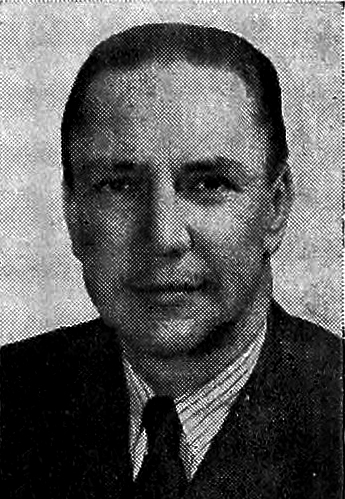
* The above picture of Andrew A. Caffrey is cropped from a picture that accompanied Caffrey’s article “West is East (Or Delivering the General’s Nickel-Plated Dog Kennel)” that appeared in the pages of the December 1923 issue of U.S. Air Service.

Heroes of the Air: Lieut. R.A.J. Warneford

Link - Posted by David on August 14, 2023 @ 6:00 am in

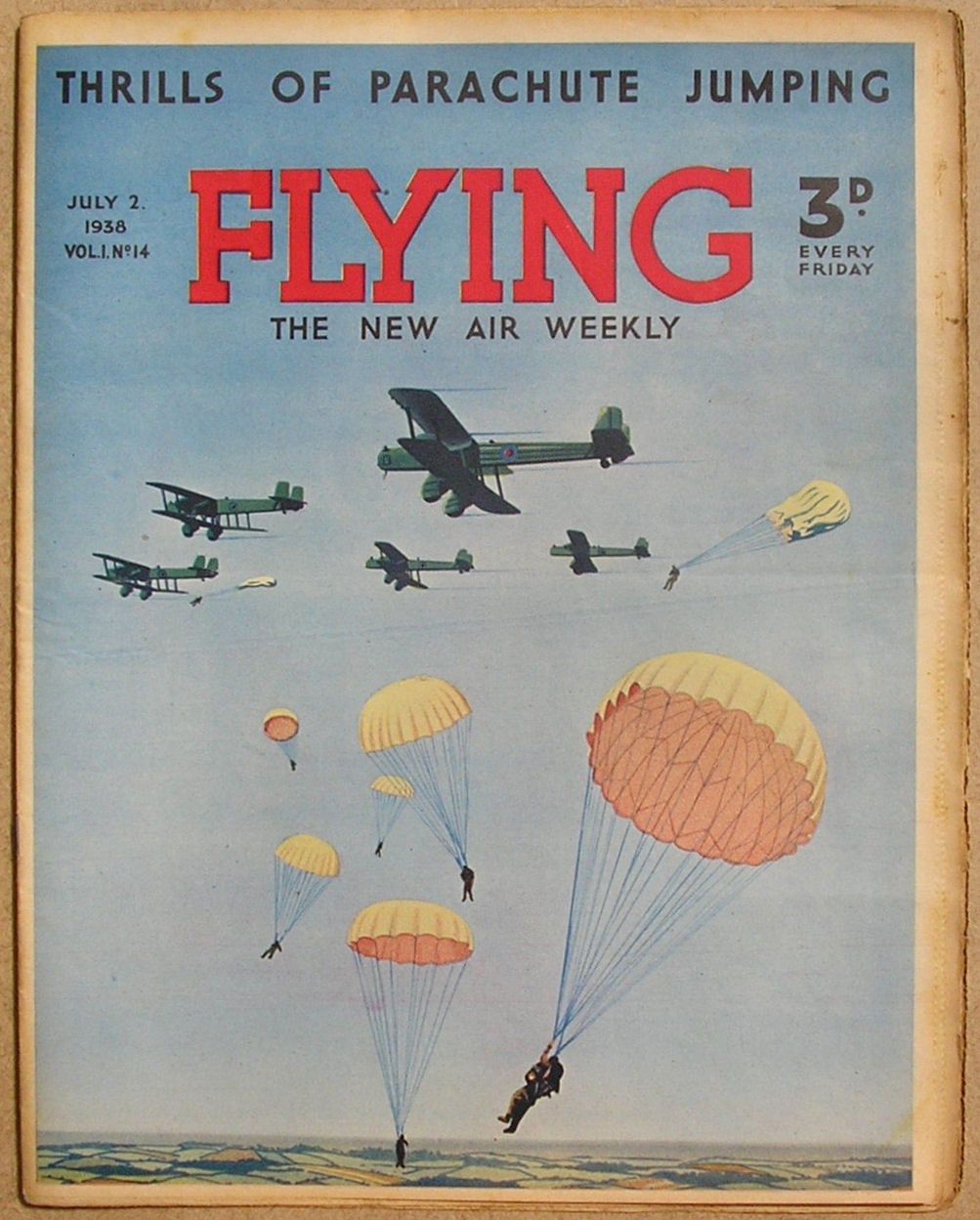
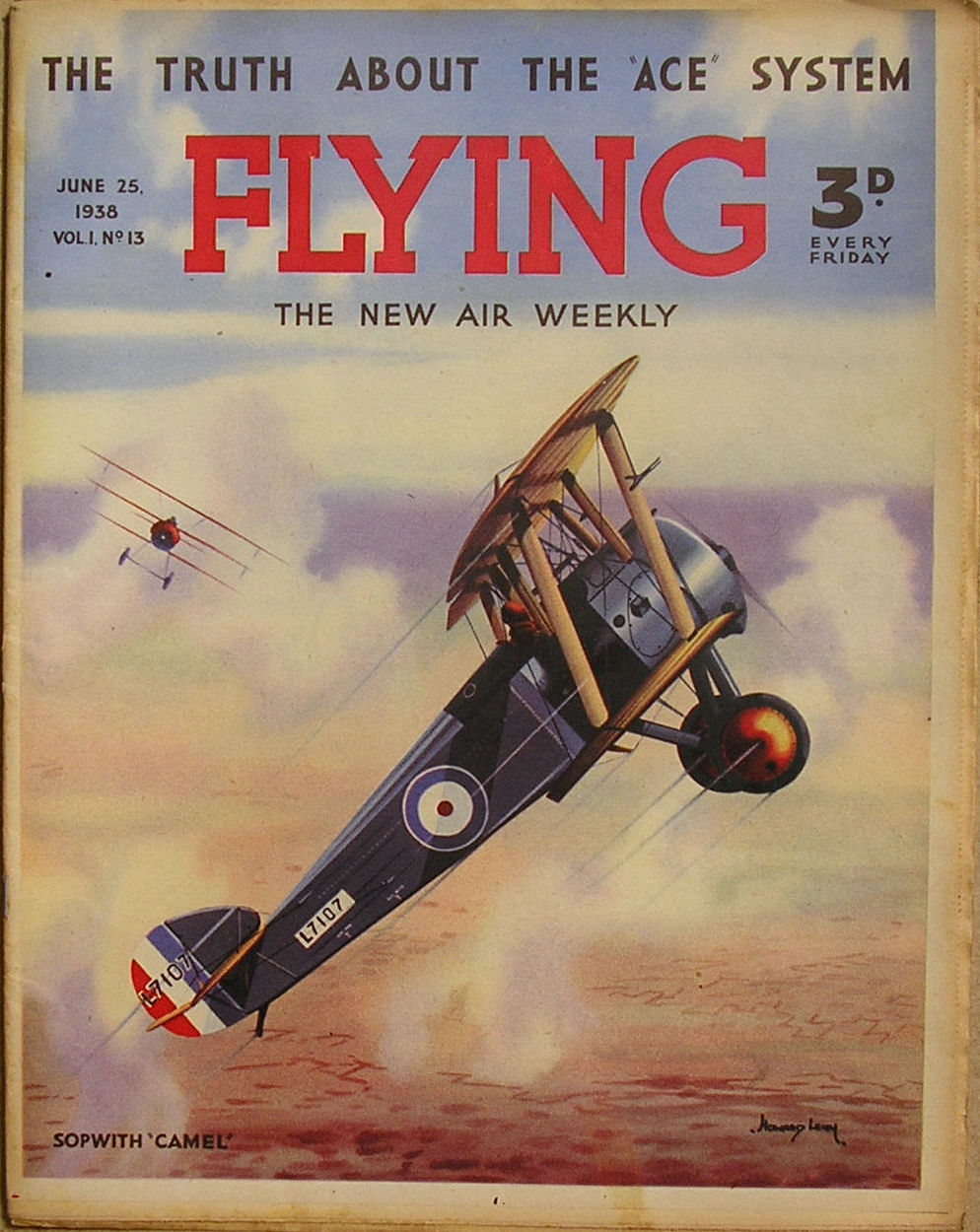
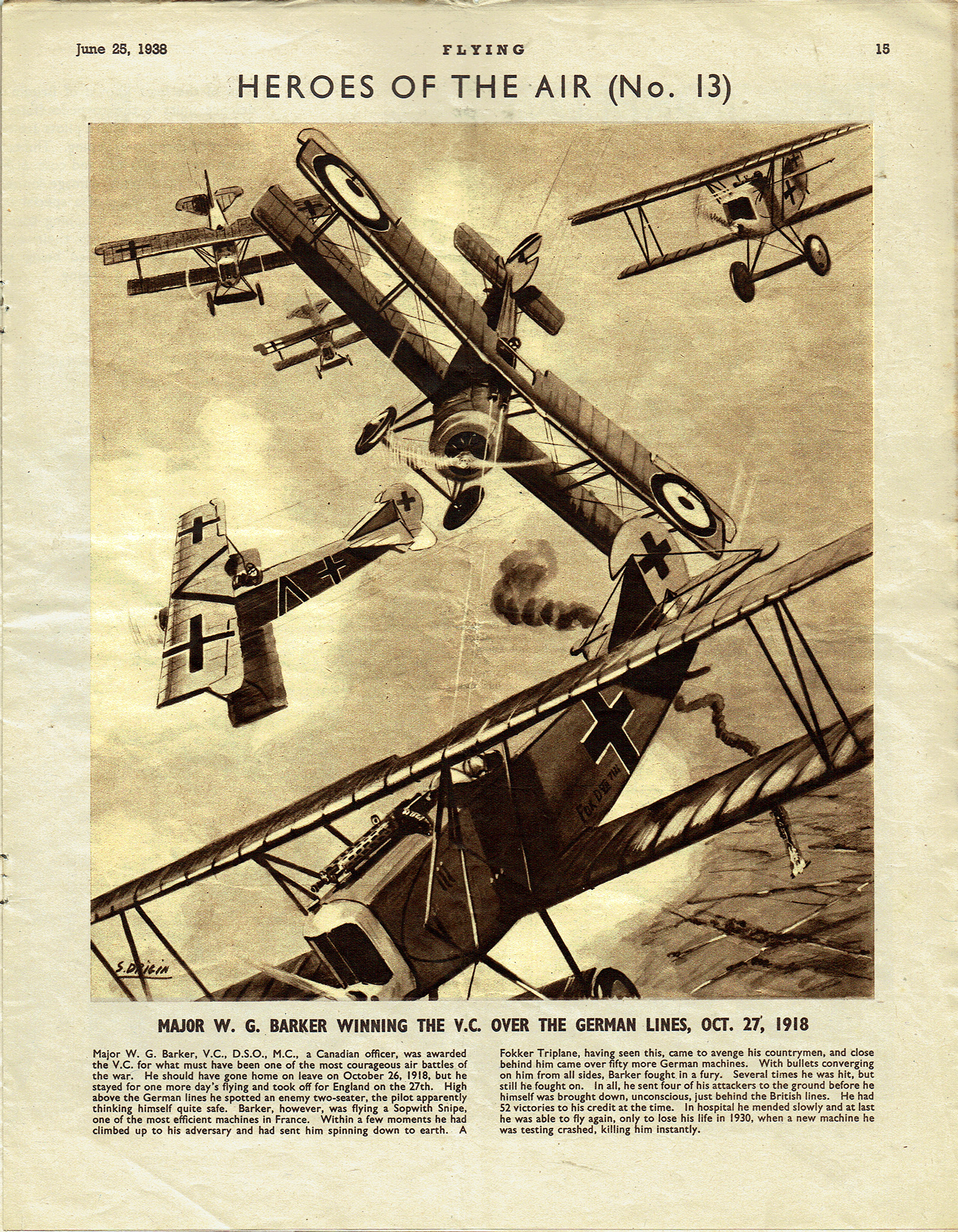
WHEN Flying, the new weekly paper of all things aviation, started up in England in 1938, amongst the articles and stories and photo features was an illustrative feature called “Heroes of the Air.” It was a full page illustration by S. Drigin of the events surrounding how the pictured Ace got their Victoria Cross along with a brief explanatory note.

Russian born Serge Drigin became a successful illustrator in the UK in the 1920s with his work regularly appearing in such British magazines as The Detective Magazine, Modern Boy and Chums. He is probably best known for his startling covers for Scoops, Air Stories, War Stories, Fantasy and others in the 30s.

From the 11 June 1938 issue of Flying:

LIEUT. R.A.J. WARNEFORD DESTROYING THE L.Z.37 OVER THE ENEMY LINES, JUNE 7, 1915

TO SUB-LIEUTENANT Reginald Alexander John Warneford, V.C., belongs the honour of being the first British officer to bring down a Zeppelin. Towards the end of 1915 Britain decided to take decisive action against the activities of the Zeppelins, which were becoming a serious menace. Flying a Morane “Parasol,” Warneford set out from Furnes at one o’clock in the morning, on June 7th, 1915. His instructions were to bomb enemy airship hangars. Within five minutes he sighted the L.Z.37 and set off after it. He carried six bombs, but in order to use them he had to get above his quarry. At first he was too close and five bombs passed right through the airship before exploding. After dimbing a little he dropped his last bomb. It exploded in the nose of the Zeppelin with such force that the “Parasol” was thrown upside down, several hundred feet into the air. Having regained control Warneford found that his engine had stopped. He was forced to land, and repairing a broken petrol pipe as quickly as possible (he was 30 miles inside enemy territory) he took off again for his base. Like many others he did not long survive his triumph; he was killed in a crash near Paris only ten days later.

“The Last of Spad 16″ by O.B. Myers

Link - Posted by David on August 11, 2023 @ 6:00 am in

THIS week we have a story from the pen of a prolific pulp author O.B. Myers! Myers was a pilot himself, flying with the 147th Aero Squadron and carrying two credited victories and awarded the Distinguished Service Cross.

This time, Mr. Myers gives us “The Last of Spad 16″ from the pages of the January 1932 number of Flying Aces!

Every day that lone Yank with the number 16 on his Spad swooped down out of the clouds and attacked single-handed a drome twenty-five miles behind the German lines—a daredevil stunt only one of America’s greatest aces would try. You couldn’t blame Oberleutnant Schmidt of the proud Schmidts of Brandenburg for plotting to see!

How the War Crates Flew: Guns and Howitzers

Link - Posted by David on August 8, 2023 @ 6:00 am in

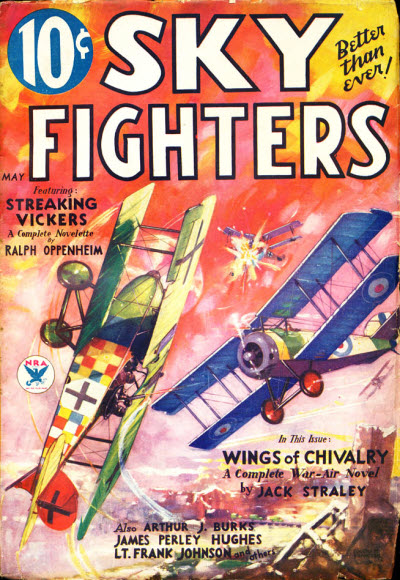
FROM the pages of the February 1934 number of Sky Fighters:

Editor’s Note: We feel that this magazine has been exceedingly fortunate in securing R. Sidney Bowen to conduct a technical department each month. It is Mr. Bowen’s idea to tell us the underlying principles and facts concerning expressions and ideas of air-war terminology. Each month he will enlarge upon some particular statement in the stories of this magazine. Mr. Bowen is qualified for this work, not only because he was a war pilot of the Royal Air Force, but also because he has been the editor of one of the foremost technical journals of aviation.
Guns and Howitzers

by Robert Sidney Bowen (Sky Fighters, February 1934)

BY THIS time, you yeggs—excuse me, my error. I’ll start all over again. By this time, you buzzards must be convinced that we war pilots were very wonderful fellows.

Of course, being a modest old sparrow I can do nothing else but agree with you. However, to be serious for a few moments, the object of this little get-together is to point out that the pilot who was sent to the Front during the last war had to know quite a bit about war activities other than just the flying end.

When you enlisted there was really no way of determining whether you would be okay on pursuit ships, observation ships, or bombers. That being the case, the training you received was more general than specialized.

By that I mean, you were taught at ground school the various duties of all three types of pilots. And upon your flying depended what kind of a squadron you’d be sent to—if any!

For instance, it might so happen that once you had been sent solo you proved yourself to be a knockout on artillery co-operation work. In that case you’d be shipped to an observation squadron. And then again, perhaps, you might be a dead shot. In that case, out you’d go to a pursuit unit.

Get the Idea?

Why waste a swell shot by sticking him at the controls of a bomber? Get the idea?

Naturally, war being just as mixed up as anything else, the right men were not sent to the right squadrons all the time. There were plenty of misfits floating around—birds pushing bombers around when they should be at the controls of a pursuit or an observation ship, and vice versa. However, that sort of stuff was not the fault of the pilot in question.

Just One of Those Things

It was just one of the many, many things that can happen in war. In other words, you were sent where the big shots sent you, and that was that. You couldn’t do anything about it, except weep in your own soup.

I remember a case in particular. There were two friends of mine, one a big bruiser and the other a little half pint portion of man—but plenty scrappy, nevertheless. Well, we all trained together, and when it came time for us to be assigned to squadrons, the big fellow was sent out to a Camel squadron and the little fellow was shipped out to fly Handley-Page bombers.

The funny part of it was that I met them both about six months later, and the big fellow had to have his Camel cockpit made bigger so he could get into it, and the little fellow had to pile leather cushions in his Handley-Page cockpit in order to see over the top of the cowling.

They both came through the war with flying colors, so maybe the big shots guessed right after all.

However, whether they did or not, isn’t any skin off our noses today. What I’m trying to get over to you chipmunks is, that while you were training for the Front you were learning lots of things about war besides flying. In other words, you had to be able to fill any gap at a moment’s notice.

And so, I’m going to yell about one of the extra items we had to get through our heads before they let us go. And that item is ordnance.

Or—what? You heard me, ordnance! And being as how you don’t know what that means, I suppose I’ll have to tell you. The correct definition of ordnance is, the general name for all kinds of weapons and their appliances used in war; especially, artillery.

What’s a Gun—Huh?

That last is what I’m going to talk about—artillery.

There were, generally speaking, three types of artillery used. The first was guns, the second was howitzers, and the third was mortars.

Now wait a minute, keep your shirt on and stop asking questions so soon. I know what’s on your mind. What do I mean by guns? Well, just listen.

A gun was a piece of ordnance, cannon or pieces of artillery that was used foe, long-range fire, or in other words, line fire. A howitzer was a piece of ordnance, cannon or pieces of artillery used for short range destructive fire. And a mortar was a piece of ordnance, cannon or artillery that was used for short range, very high angle of fire bombardment work.

The Long and the Short of It

Now, let’s go into detail one at a time. First, the gun.

Of course, there were various sizes of guns. The smallest being the eighteen-pounder and the largest being the twelve-inch gun. And even bigger than that if you want to count the navel guns they sometimes mounted on mobile platforms. However, regardless of the size of the gun, the bores were all rifled to give the desired twist to the shell as it left the muzzle, so that it would travel through the air the right way.

Naturally, the driving band that circled the shell made it possible for the rifling of the bore of the gun to give a twist to the shell.

As I said, guns were used for long range work or line fire. By line fire I mean just that—the shells exploding in a line area that extended from a point on the near side of the target to a point on the far side of the target. In other words, an oblong target area. To get an exact idea of what I mean, take a squint at Fig. 1.

As the shell of a gun has to travel a long way, it follows that the muzzle velocity (speed of shell as it leaves muzzle of gun) is very high. However, on the other hand, the trajectory and angle of descent are very low. To explain them there big words: trajectory means angle of flight. And angle of descent, of course, means the angle in relation to the ground at which the shell descends.

Effective Range Fire

Guns were more effective on infantry movements. By that I mean, infantry columns moving along roads, field batteries moving into position, trains, railroad stations, ammo dumps, etc. In other words, targets that were either moving or stationary, but were quite a ways behind the enemy lines. See Fig. 2.

Now, I’ll get on with howitzers and you’ll be able to see just what I mean about the effective range fire of guns.

Howitzers ranged in size from four and a half inches to around sixteen inches.

Howitzers Were Accurate!

And, by the way, when I speak of size I mean the diameter of the bore of the gun or howitzer, such as the case may be.

Okay, let’s go! Howitzers were used for short-range destructive work. By that I mean, they were supposed to wipe the target right off the old map. Their range being shorter, they were far more accurate than guns. The main reason being that their area of fire was more square in shape than the area of gun-fire.

To get the point, rest your lamps on Fig. 3.

The range of howitzers being shorter the idea was to drop a shell down on it as perpendicular as possible. To do this, required low muzzle velocity, high trajectory and high angle of descent. The advantage of howitzers was that hills didn’t bother them. Their shells went up high and came down at a steep angle. So if your target was behind a hill range, you didn’t have to worry.

A gun shell that would clear the top of the hill would, of course, go beyond the target. But a howitzer shell would sneak right up over the hill and plop straight down, on the target. Take a peep at Fig. 4 and you get an idea how a howitzer shell went through the air.

Now, when I say that howitzers were for destructive work, don’t get the idea that guns didn’t destroy things. They sure did, and don’t let your cousin Alice tell you otherwise. However, perhaps you noted that howitzers pushed out bigger shells than guns, and that those shells came down straighter on the target.

Well, there you are—howitzer fire was more evenly concentrated than gun-fire, it covered a more even area about the target, and it could nail a target (within its range) regardless of ground formations. Because of its high trajectory and short range it was the bunk for moving targets.
But take an established enemy target, a field battery in position, for instance, or a troop concentration depot, and the old howitzer would give you the best results every time.

The Howitzer’s Kid Brother

A mortar was for trench to trench work. The most famous of all mortars was the Stokes trench mortar. It popped one- or two-pound shells out of your trench and down into the enemy trench. As its range of fire was nothing to write home about, a couple of hundred yards or so, the bore was not rifled, nor was there any driving band on the shell. I suppose that you could really call a trench mortar, a small edition of a howitzer without bore rifling.

Believe it or not, they were fired by dropping the shell into the muzzle. It simply slid down, detonated and came popping out again and on its way over to the enemy trench. Yes, Clarence, you had to get your hand out of the way fast. That is, of course, if you didn’t want to present the enemy with a perfectly good hand. Personally, I never met a soldier yet who didn’t want to hang onto his hands.

And there you have a general idea of artillery used in the last mix-up. Don’t forget there were all kinds of guns and all kinds of howitzers and each kind had a special use in defensive or offensive work.

However, a gun was just as different from a howitzer as a revolver is from a rifle. But both were hot stuff for their own particular type of work.

And now, just a couple of words about artillery work in general and its relation to aircraft. The work can be tabulated as follows—registration on the target for future bombardment, the bombardment itself, wire cutting and trench destruction before an infantry attack, barrage fire during an attack and emergency target work. Registration on a target (range finding) and bombardment of target work were carried out in co-operation with aircraft.

The other classes of work were carried out in co-operation with ground observation or on the initiative of the officer commanding the battery. But no matter what type of work it was, the thing that counted with G.H.Q. was results. And, now that I think of it, the only thing that ever counted with G.H.Q. was results. Nix on explanations—you had to give those big pumpkins results if you wanted to stay out of hot water.

And so there you have one non-flying item that we pilots had to learn by heart. Maybe, if you are all good little children, I’ll tell you about something else that we had to absorb before they let us become Fokker fodder. Goombye!

“S.E.5 vs. Fokker D7″ by Frederick Blakeslee

Link - Posted by David on July 31, 2023 @ 6:00 am in

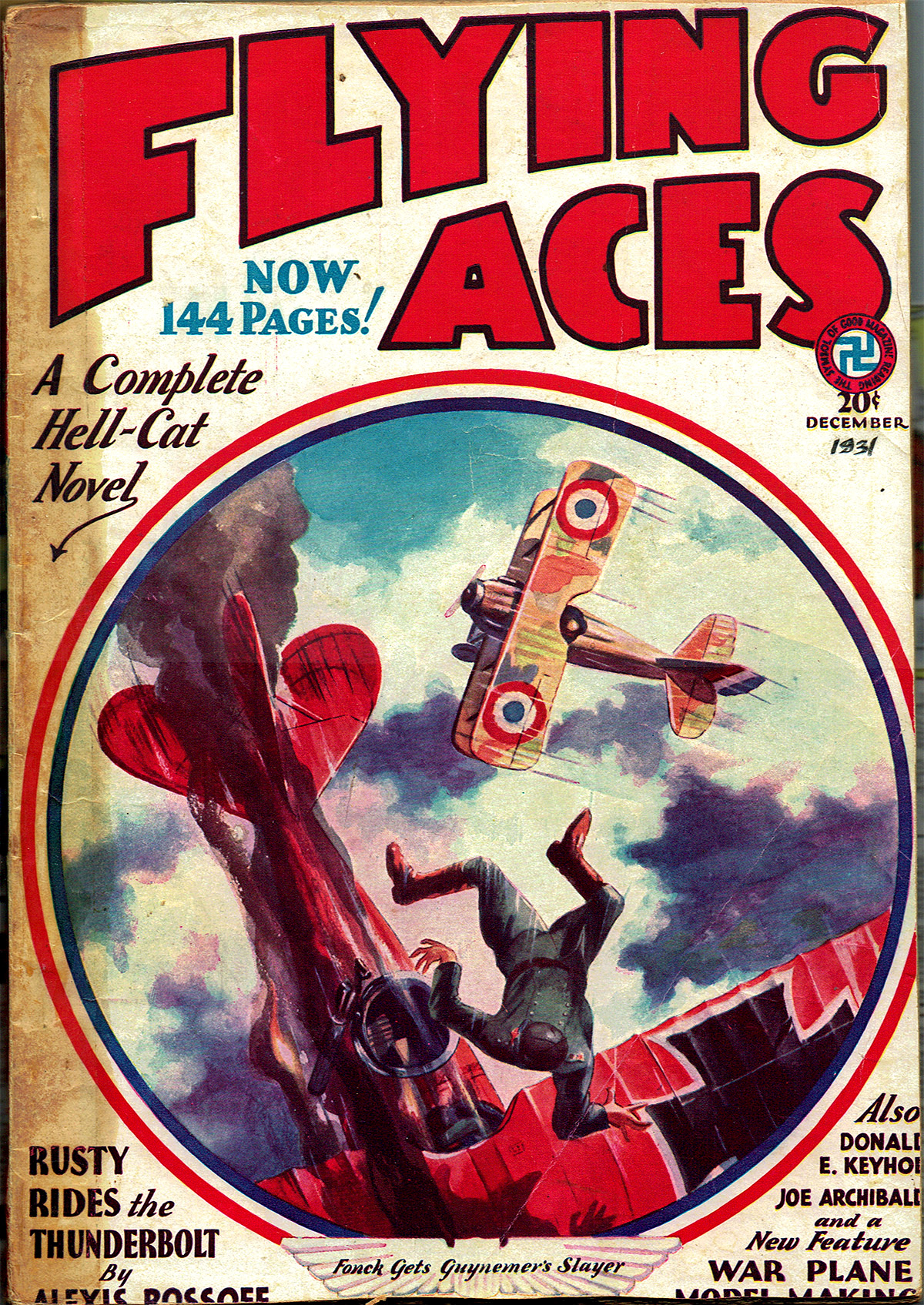
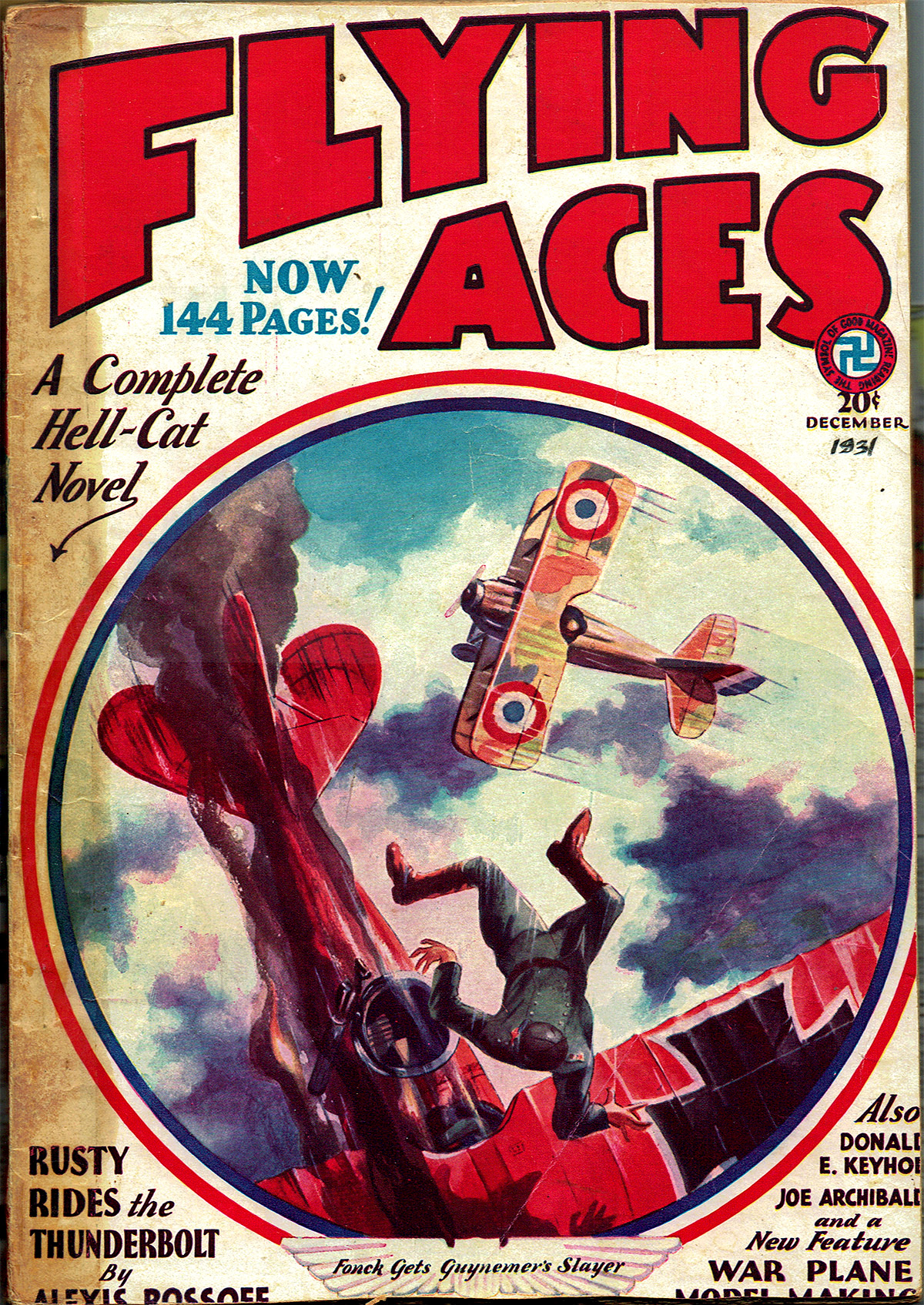
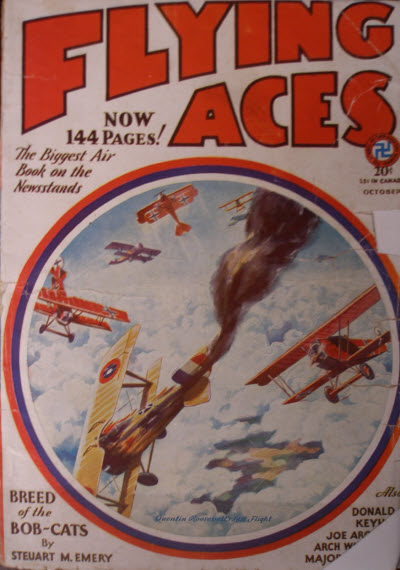
THIS week we have an early cover by Frederick Blakeslee for Flying Aces. Blakeslee did three covers for Flying Aces in 1930. The one below for the August issue of that year was his third and final cover for the magazine.

The Story Behind the Cover

th_FA_3008BRITISH against German—S.E.5 against Fokker—that’s the struggle depicted in this month’s cover. The S.E.5 has taken a long dive and is raking the Fokker from wing tip to cockpit. In this particular bit of action, the German was wounded in the legs, and with great difficulty escaped to his own lines.

Planes of the S.E.5 type appeared in France during the winter of 1917-1918. The German Fokker D7 was the only ship at the Front superior to the S.E.5—and our cover shows that the Fokker did not always win!

The Ships on The Cover
“S.E.5 vs Fokker D7″
Flying Aces, August 1930 by Frederick Blakeslee

“Tell It to the King!” by Joe Archibald

Link - Posted by David on July 28, 2023 @ 6:00 am in

“HAW-W-W-W-W!” That sound can only mean one thing—that Bachelor of Artifice, Knight of Calamity and an alumnus of Doctor Merlin’s Camelot College for Conjurors is back to vex not only the Germans, but the Americans—the Ninth Pursuit Squadron in particular—as well. Yes it’s the marvel from Boonetown, Iowa himself—Lieutenant Phineas Pinkham!

Phineas is jumped by a couple Boche Fokkers and sent crashing into a tree all while a pair of British Bristols idly fly by watching, but not helping in the least. When Phineas tries to get to the bottom of the British flyers’ lack of assistance it could all blow up into a Royal Scandal! From the August 1931 Flying Aces, it’s Phineas Pinkham in Joe Archibald’s “Tell It to the King!”

It was all the fault of the Limeys that his Spad was smeared against the side of a tree and he himself looked like the target in a knife-throwing contest. And if you think he let the matter rest right there—well, you don’t know Phineas “Carbuncle” Pinkham!

Premiering at PulpFest 2023!

Link - Posted by David on July 21, 2023 @ 6:00 am in

AGE OF ACES will be back at PulpFest again this year where we will be debuting our two new titles!

First up is another collection of tales of that Inseparable trio—The Three Mosquitoes!

The Adventures of the Three Mosquitoes: The Night Monster
by RALPH OPPENHEIM

THE Three Mosquitoes—Kirby, the D’Artagnan of the group, led the formation even though he was the youngest, but his amazing skills had won him the position of leader of the trio. On his right flew “Shorty” Carn, bald, stocky, and mild of eye, but nevertheless a dead shot with a gun. On his left flew Travis, the oldest and wisest of the trio, whose lanky legs made it difficult for him to adjust himself in the little cockpit. With their customary battle cry—“Let’s go!”—they’re off on another dangerous mission in perilous skies!

Ralph Oppenheim’s Three Mosquitoes was one of the longest running aviation series to never have its own magazine. They flew for twelve years, through nine different magazines in over five dozen stories! This thrilling volume collects four action-packed adventures from the pages of Popular Publications’ Dare-Devil Aces: The Night Monster (2/32), The Crimson Ace (7/32), The Rocket Ace (11/32), and The Secret Ace Patrol (6/33).

Paired with this is the second volume of Donald E. Keyhoe’s Fighting Marines—The Devildog Squadron!

Devildog Squadron: The Flying Juggernaut
by DONALD E. KEYHOE

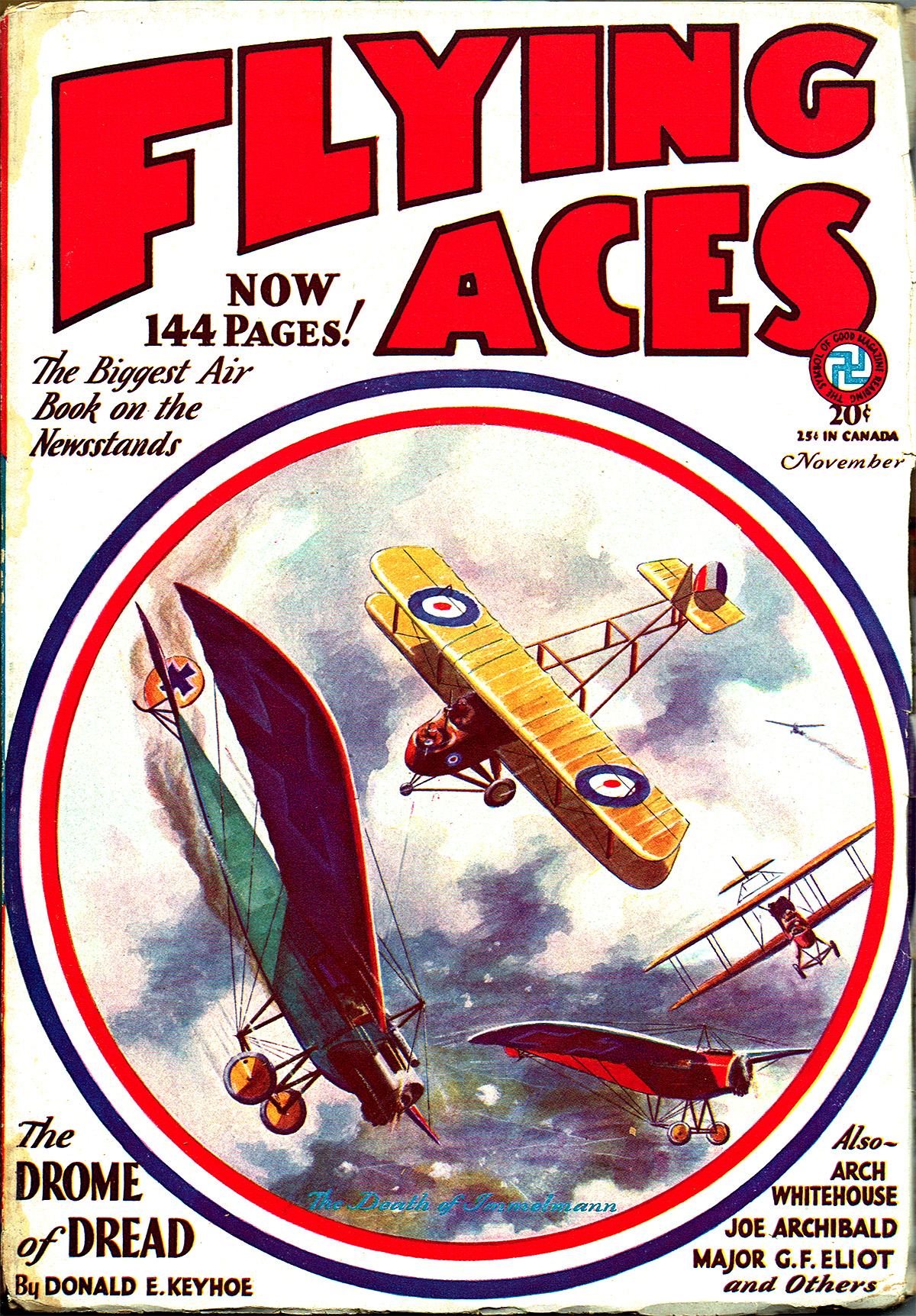
“CYCLONE BILL” Garrity and his Mad Marines are back in the thick of things in six more Weird World War I Adventures from the imaginative pen of Donald E. Keyhoe. Those crazy Germans have come up with even more ways to turn the tide and win the war. Operating from airfields hidden in the sides of cliffs under a waterfall, beneath an impenetrable dome, or simply under camouflage nets, the Germans unleash everything from deadly rays that can wipe an entire drome off the face of the earth; the dead pilots flying again; a tank as large as a city block and just as tall that can flatten everything in it’s path; and the cloak of death itself lurking in the night sky ready to suck the life out of anything it should happen to touch––both pilot and plane!

The Devildog adventures featured in this volume are all from the pages of Sky Birds: Devildog Doom (6/32), Lucky’s Day (8/32), The Devildogs’ Decoy (1/33), The Flying Juggernaut (2/33), The Squadron Nobody Knew (7/33), and Devildog Breed (7/34).

In addition to these new books, we’ll have all of our other titles on hand as well as our previous convention exclusive—Arch Whitehouse’s Coffin Kirk, and last year’s two book set of Steve Fisher’s Sheridan Doome! So if you’re planning on coming to Pittsburgh for PulpFest this year, stop by our table and say hi and pick up our latest releases! We hope we see you there!

Heroes of the Air: Lieut. W. B. Rhodes-Moorhouse

Link - Posted by David on July 17, 2023 @ 6:00 am in

WHEN Flying, the new weekly paper of all things aviation, started up in England in 1938, amongst the articles and stories and photo features was an illustrative feature called “Heroes of the Air.” It was a full page illustration by S. Drigin of the events surrounding how the pictured Ace got their Victoria Cross along with a brief explanatory note.
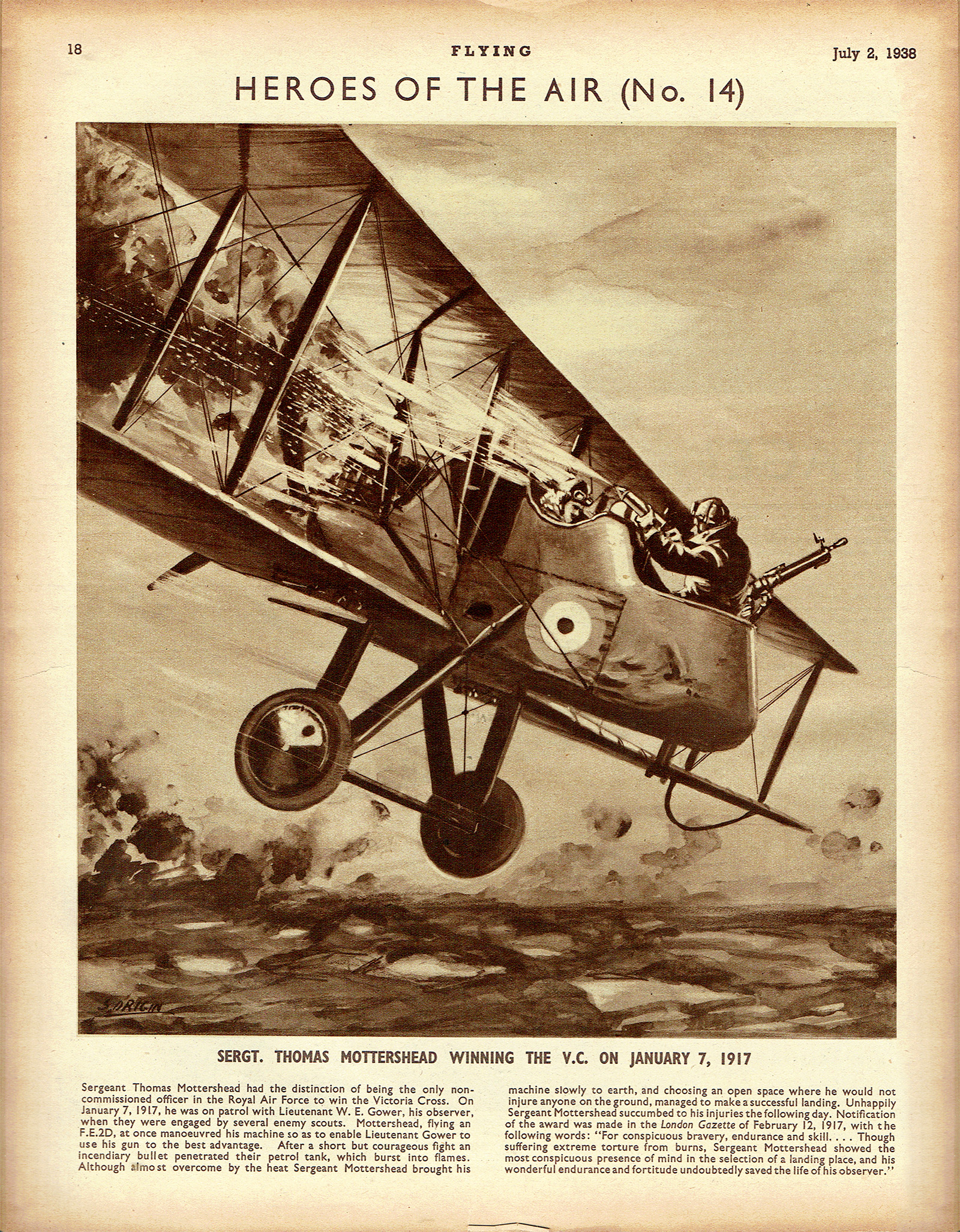
Russian born Serge Drigin became a successful illustrator in the UK in the 1920s with his work regularly appearing in such British magazines as The Detective Magazine, Modern Boy and Chums. He is probably best known for his startling covers for Scoops, Air Stories, War Stories, Fantasy and others in the 30s.

From the 4 June 1938 issue of Flying:

LIEUT. W.B. RHODES-MOORHOUSE WINNING THE V.C. AT COURTRAI, APRIL 26, 1915

ON APRIL 26, 1915, No. 2 Squadron received a message that the railway junction at Courtrai was to be bombed to prevent enemy reinforcements from reaching the front. Lieutenant Rhodes-Moorhouse left the aerodrome at Merville in company with three other machines. Each machine carried a one-hundred-pound bomb, the largest in use at that time. When Rhodes-Moorhouse arrived at the railway junction he descended to a height of only three hundred feet. This enabied him to score a direct hit, but it also exposed him to concentrated fire from all the troops who were waiting at the station and from the anti-aircraft batteries defending it. At such close range the odds were all against him. One bullet broke his thigh, another shattered his hand, and a third reached his stomach. Despite the fact that he was dying and in terrible agony he realised the importance of returning to headquarters to make his report. Unhappily he died of his wounds within twenty-four hours. He was awarded the V.C. on May 22, 1915.

How the War Crates Flew: Night Flying

Link - Posted by David on July 11, 2023 @ 6:00 am in

FROM the pages of the January 1934 number of Sky Fighters:

Editor’s Note: We feel that this magazine has been exceedingly fortunate in securing R. Sidney Bowen to conduct a technical department each month. It is Mr. Bowen’s idea to tell us the underlying principles and facts concerning expressions and ideas of air-war terminology. Each month he will enlarge upon some particular statement in the stories of this magazine. Mr. Bowen is qualified for this work, not only because he was a war pilot of the Royal Air Force, but also because he has been the editor of one of the foremost technical journals of aviation.

Night Flying

by Robert Sidney Bowen (Sky Fighters, January 1934)

WELL, I note that both of you sparrows are here again. And I suppose that means I’ve got to do some talking and improve your knowledge as to the activities of myself, and other world renowned heroes, during the late unpleasantness.

This time I’ll gabfest on the advantages, disadvantages, and ups and downs of night flying in the days when girls used to marry uniforms.

A Mean Job

To begin with, let me say that next to daylight bomb raids, night flying was about the meanest and toughest job that the C.O. could pass out to you. You seldom saw what you were banging away at, and the other guy wasn’t any better off.

How-the-some-ever, night flying was not originated with the idea of giving pursuit pilots something else to do. As a matter of fact, pursuit ships didn’t begin to take much part in night flying work until along about the last year of the war.

Generally speaking, night flying, simply meant bombing raids at night. Long range assignments with destinations far behind the enemy lines.

The Germans Started It

To get at the idea from a historical viewpoint, night flying in the world war was really first started by the Germans. How, you ask? With their Zeppelins, stupid. Why certainly! The Zeppelin raids on London and Paris were made under cover of darkness.

The reason for that is, of course, quite obvious. A Zeppelin raid in the daytime would be just too bad for the Zeppelin. It would be spotted long before it reached its objective.

No, Alice, this is not going to be a discourse on Zeppelin raids. So tuck in your bib and pay attention.

I spoke of Zeppelins being first used in night flying work to point out the fact that night flying was fundamentally an offensive maneuver.

How come?

Home Defense Squadrons

VERY well, let me explain the difference. In the daylight your air force raids enemy territory, repels enemy raids into your territory, and also reconnoiters enemy territory. In short there is a definite object for every patrol. But at night there were no scheduled patrols for planes on the receiving end. And by the receiving end, I mean territory that was being raided. To make it a bit more clear than that, flights of ships whose job it was to repel night invaders or raiders, didn’t take to the air until the raiders made the first move. Such squadrons were known as Home Defense Squadrons. And that’s just what they did—defended the fireside against invaders. In other words, in the daytime you flew patrols whether the enemy was there or not. But at night you only flew when the enemy came to call.

Rather than frighten the French and English populace, Zeppelin warfare made them all the more determined to defeat Germany.

Not favoring the construction of Zeppelins, or I should say, lighter-than-air-aircraft, the Allies started to hit back with long range bombing raids (Fig. 1) on German strongholds behind the lines. Most of these raids were conducted by the English, and to them should go everlasting praise for their accomplishments.

Not tor the Chicken-Hearted

A bomb raid at night is not a job for chicken-hearted men. To begin with, you’ve got to have a clear night to see things on the ground. Nowadays with blind flying developed as it is, with airway beacons, and all the rest of it, a pilot can fly from here to there and back again in almost any old kind of weather. But in war days a clear night was very essential.

But as even you two nitwits can see, what was a break for the raiders was also a break for the defenders. In other words, if you could see them, they could also see you.

There were no special hours of the night for bomb raids. The time of take-off really depended upon how far you had to fly before you could let the old “eggs” go whanging down. But the dangers of night bombing raids began just as soon as you opened up the throttle.

Today when a ship takes off at night, the runway is bathed in flood lights, and it’s just about as easy as a daytime take-off. But in war days, you did the best you could and trusted to luck for the rest. There were no flood lights, or any of the other fancy gadgets that you have today. The “runway” was simply the best part of your drome, and it was lighted by parallel rows of oil pots (Fig. 2). The ship simply took off between the two rows.

What They Looked Like

And speaking of oil pots, next time you’re out driving with the girl friend at night (you do, don’t you?) and you come to a spot where they’re digging up the road, take a look at those ball-like things that rim the ditch. They look like a bomb full of oil, and burning at the top. Well, those things are what oil pot flares used to look like during the war.

WELL, as soon as you’ve taken off, the oil pots are doused, because it’s not any help to advertise the location of your drome to any enemy ships that might be upstairs. And after those oil pots go out, the rest is up to you. If there is more than one ship in the raid, each pilot has got to make sure he doesn’t ram into the other guy. To avoid that they usually flew in follow-the-leader-style. Not only did that permit the pilot to see the exhaust flames of the ship ahead, and thus keep his distance, but it also permitted more effective bombing of the objective. When the objective was reached the first plane would drop its bombs and then bank wide and swing for home. The second ship would do the same thing, and after it, the third ship, and so on.

Naturally, while you are heading for your objective the enemy hears you, and he tries to spot you with his searchlights. And when he does, look out, because you’re going to get a shower bath of archie in the next few seconds. When one searchlight gets you, two or three others swing right over with the idea of “boxing” you—fixing you so’s you can’t dodge either way into the darkness, and escape. At such times, good piloting counts plenty, and how.

Of course, most of the time defending ships don’t wait for searchlights to nail you. They come streaking up, using your exhaust flames as a guide to where you are. And in turn your gunners use their exhaust flames as a guide to where the attacking pursuits are.

The Return Trip

Once you’ve let your eggs go, you can bet your shirt that the enemy is going to try his damnedest to get you. And so the return trip is really worse than the journey out. Besides, you’ve got to get the ship down okay.

When the home drome mechanics hear you, they set out landing marks on the drome. These are oil pots set out in a way that will indicate the direction of the ground wind. There were two signs generally used. One was in the shape of a big L, (Fig. 3) the bottom of the L being at the leeward side of the drome. In other words, you landed along the upright part of the L, toward the bottom piece. The idea being that the area formed by the angle was the smoothest part of the field.’
The other sign were lights in the form of a T, (Fig. 4) with the crosspiece being toward the leeward side of the field. And so you simply landed along either side of the leg of the T, toward the cross piece.

Sounds simple, doesn’t it? Well don’t kid yourself, sweetheart. Those oil pots never did blind you with their light, and it took wonderful pilots (like me) to get down without jarring the other guy’s teeth.

Night Pursuit Flying

To get the idea of pursuit flying at night, just reverse what I’ve been telling you about a night bombing raid. The night pursuit ships (or, bats, as your favorite authors like to call them) simply took the air when enemy bombers were announced. Their job consisted of two things. One, to get the bombers.

And the other, to avoid smacking into one of their own men. I never could decide just which job gave me the most gray hair.

Just one more thing, and I’m gone. It’s about sighting landmarks at night. One tough job, children, unless there’s a moon. About the only thing you can really see clearly, is water—rivers, lakes, etc. The rest you guess at. And here’s an interesting item lots of folks don’t know. It was a cinch for German Zeppelins to find either London or Paris at night. Why? Because both cities are on a river, and their metropolitan areas are exactly between two islands in each river, both the Thames and the Seine. They simply hovered over either of those areas and let go. And speaking of “go,” that means me. too! Good evening.

“Frozen Wings” by Frank Richardson Pierce

Link - Posted by David on July 7, 2023 @ 6:00 am in

THIS week we have another exciting air adventure with Rusty Wade from the pen of Frank Richardson Pierce. Pierce is probably best remembered for his prolific career in the Western Pulps. Writing under his own name as well as two pen names—Erle Stanly Pierce and Seth Ranger. Pierce’s career spanned fifty years and produced over 1,500 short stories, with over a thousand of these appearing in the pages of Argosy and the Saturday Evening Post.

Each year Rusty Wade promised himself a real, old-fashioned Christmas, and each year Fate decreed that he be riding high in the air, eating cold sandwiches instead of thrusting his long legs under a table groaning with turkey and the other good things that went with a Christmas dinner. But this year he was determined to have just that with Mary Heath—the prettiest teacher in the whole Yukon country. Until that faked distress call came in from the ice bound Ellen Dow. From the pages of the January 1930 Air Trails, it’s Christmas in July with Rusty Wade in Frank Richardson Pierce’s “Frozen Wings!”

“Hawk” Breed was out to beat him; but “Rusty” Wade made a dare-devil’s landing and pledged himself to play a desperate game!

“Martyrs of the Air: Frank Luke” by R.C. Wardell

Link - Posted by David on July 3, 2023 @ 6:00 am in

THIS week we present an early Flying Aces cover from March 1929 by the incomparable R.C. Wardell. Wardell turned out numerous covers for the pulps in the late ’20’s and early ’30’s for magazines like Under Fire, Flyers, Flying Stories, Prison Stories, Sky Birds, Prize Air Pilot Stories, Far East Adventure Stories, Murder Stories, Murder Mysteries, Zoom! and of course Flying Aces, signing most of this work as “R.C. Wardel.” Here he depicts American Ace Frank Luke, shot down behind enemy lines waiting for the enemy troops to advance and take him prisoner—if they can!

Martyrs of the Air: Frank Luke

A German in name, but a fiery, patriotic American at heart, Frank Luke, the greatest ace that ever emblazoned his name in aviation annals, died as he had lived—a flaming, fighting, fast-winged warbird.

th_FA_2903FRANK LUKE!

How much the name means to those few who knew how he fought, and died. And contrarily, how little it means to the vast majority of the great American people who knew so little about him.

Lieutenant Frank Luke’s career was short, hectic, and dynamic. He blazed across the wartorn skies of France like a flaming meteor and with equal brilliance. Very few people ever see the same blazing meteor in its dazzling course across the night skies; very few people ever heard of Lieutenant Frank Luke during his short but sensational career on the western front.

But to those who did come in contact with him, his valorous deeds and manner of dying will ever remain in their memories as long as they live. Frank Luke was the most courageous, the most audacious war bird that ever handled a control stick and pressed the Bowden triggers mounted on it.

Only Eddie Rickenbacker topped him in the final list of American Aces after the war was ended. Rickenbacker was officially credited with 26 victories. Frank Luke had 21. But the comparison is hardly fair to Frank Luke, for Eddie Rickenbacker was on the front for almost six months.

Luke’s front line career lasted only a little over two weeks, and even in that short space of time he was at one time the American Ace of Aces and there is no telling what score he would have run up if he hadn’t died. And how he died!

Bom of a German father who had emigrated to this country in the early days, and carrying a German name, Luke was looked upon with suspicion by his squadron mates who fraternized very little with him. Little did they suspect the intense hatred for the Germans that Luke harbored in his breast. He hated the enemy with an intensity of feeling that was only equalled by his supreme courage, and he swore when living that no German would ever take him alive. No German did.

There was another pilot in his squadron who had a German name and was of German parentage, a Lieutenant Wehner. The two, because they were more or less ostracized by the other members of the squadron, teamed up together. And what a team it was. The Germans soon learned to recognize the pair as twin furies of the skies, and would dash for cover as soon as the pair came in sight.

They were such dashing, daring fighters that the Germans gave them a clear sky when they came over, not even bothering to tarry and fight with them. Then it was that Luke originated his plans for bringing down German sausage balloons.

And what a terror the pair were to the German sausage observers—balloon after balloon fell before their streaking tracer fire. Finally, Wehner was killed while holding off an upper flight of German Fokkers who were trying to get at Luke below when he was diving on a German sausage with his twin Vickers guns blazing molten lead. Luke got the sausage, but the Fokkers got Wehner, and from that late afternoon on, Luke was never the same. He loved Wehner like a brother, and the Huns had got him.

“They’ll pay!” Luke stormed, and clenched his fists. “More than one Hun will pay for Wehner’s death.”

And more than one Hun did!

HE HAD been a terror before. After Wehner’s death he became a raving, tearing madman of the skies. Flying alone thereafter, he was the Lone Wolf of the sky trails. He had but one consuming passion; that was to get the Huns and then more Huns. Flying wherever he willed he tore up and down the front lines in search of Hun meat.

He paid no attention to orders and had absolutely no regard for discipline. One night would see his Spad plane bivouaced at some strange French airdrome far from his own squadron. The next night he would be way across France over in Lorraine somewhere. During his flights between he left a path of desolation. The German feldwebels dubbed him the Scourge of the Skies and scurried for cover whenever they saw Luke’s plane skirting down the trench lines.

His own commanding officer never knew where he was or what he was doing. An old army sergeant, one John Monroe, who had charge of an advanced emergency landing field right behind the front lines perhaps knew more of Luke’s movements during his short career on the front than any other man. Luke spent many a night sleeping with Monroe in his pup tent.

The sergeant would service his plane for him each night he landed and make it ready to take off before dawn the next day. Then while the two laid in the tent trying to go to sleep, Luke would tell the sergeant of the events of the day as he saw them from the sky.

Luke’s last day on earth was a spectacular one. He brought down two sausage balloons and one Hun plane, and was himself shot down about five miles behind the German lines near the little town of Murveaux. Luke was not shot to death in the air, but bullets from a Hun Spandau had shattered his propellor and damaged his engine such that he had to make a forced landing behind the German lines.

In addition he had two slight flesh wounds which were not in themselves serious enough to cause death, but they did make him somewhat weak from loss of blood. While the crippled plane was Winging down to a landing with the Hun attackers hovering overhead, Luke spied a cutover wheat-field and by agile manoeuvering, managed to set his plane down safely on it.

To any ordinary pilot, that would have meant the end of the war. But, not so with Luke. A small company of German infantry were stationed at Murveaux not far from the wheatfield, and when they saw Luke’s plane land, they sauntered out to take him prisoner.

When Luke’s plane staggered to a dead stop Luke jumped out of the cockpit on the side nearest the approaching soldiers. His left hand dangled loosely from his-shoulder and blood was on his tunic sleeve. His right hand he kept inside the cockpit, apparently holding himself up, for his knees buckled and he was half slumped to the ground, and so the approaching captors thought.
Luke looked at them and let them come. On they came in sort of a half run with their bayonets fixed. Luke watched them out of the corner of his eyes, and clenched his right hand tighter. His body swayed a little and he reeled slightly, nevertheless he held his feet, and when th approaching Germans got within about 50 feet of him, he snapped his right hand out of the cockpit. In it was a Colt Automatic. Luke leveled it and fired pointblank into the faces of the captors.

Bang! Bang! Bang! Bang! Bang!

Five successive shots rang out. Five of the approaching Germans fell dead, shot through the heart each and every one of them.

More shots rang out, from the German’s rifles this time. Luke slumped over by the side of his machine, dead, his body riddled like a sieve by the German fire.

But think of the cold, raw courage that was Luke’s. In the height of battle man might do that, many of them. But Luke had time to think while his would-be captors approached.

“Surrender, and live through the war? Or die fighting with the blood of his comrade Wehner further avenged?”

Frank Luke died, and how gallantly!

The Ships on The Cover
“Martyrs of the Air: Frank Luke”
Flying Aces, March 1929 by R.C. Wardell

“Bargains for Blois” by Joe Archibald

Link - Posted by David on June 30, 2023 @ 6:00 am in

“HAW-W-W-W-W!” That sound can only mean one thing—that Bachelor of Artifice, Knight of Calamity and an alumnus of Doctor Merlin’s Camelot College for Conjurors is back to vex not only the Germans, but the Americans—the Ninth Pursuit Squadron in particular—as well. Yes it’s the marvel from Boonetown, Iowa himself—Lieutenant Phineas Pinkham!
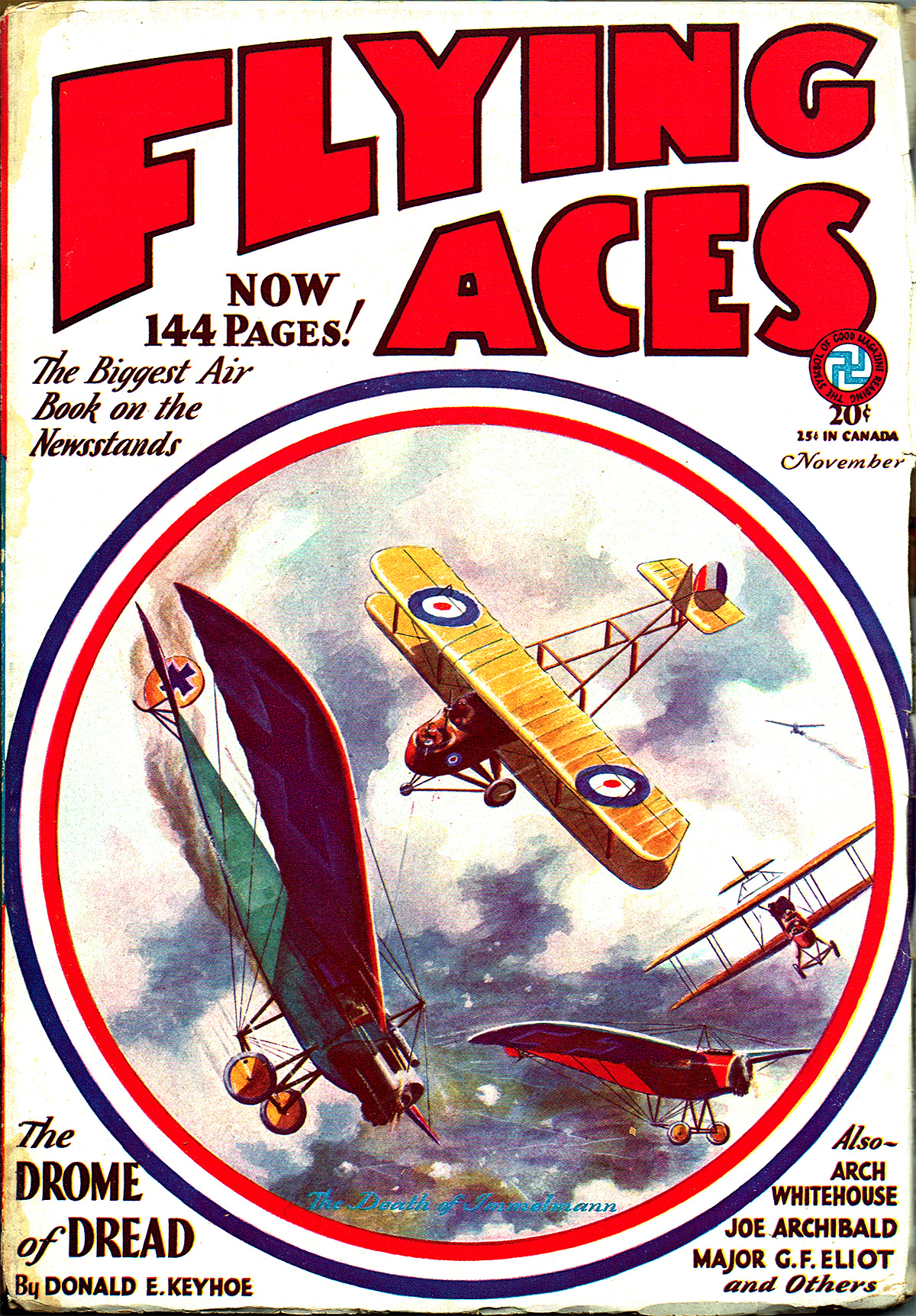
When Phineas’ joke on Colonel Guilfoyle gets the Old Man in trouble, he concocts an elaborate plan to try and get Garrity and the Ninth Pursuit Squadron off the hook. From the July 1931 Flying Aces, it’s Joe Archibald’s “Bargains fro Blois!”

It was a dastardly trick! On account of it, Colonel Guilfoyle, G.H.Q.’s weightiest chair-warmer, threatened to bust the Old Man. Somehow connected with it was the Old Man’s promise to make a spark plug-cleaner out of Phineas “Carbuncle” Pinkham. And we don’t blame either of them–do you?

“The Cloud Busters” by Fred Denton Moon

Link - Posted by David on June 23, 2023 @ 6:00 am in

THIS week we have one of the few stories from Fred Denton Moon. Moon was born in Athens, Georgia in 1905 and was a freelance writer. A former staff member of The Atlanta Journal Sunday Magazine, he was the first editor of the Journal’s wire photo service as well as former city editor of the Journal. He was member of Sigma Delta Chi and a retired member of the Georgia Department of Labor.

Galactic Central lists just a handful of stories by Moon in their various directories:

title magazine date vol no
1928
The Cloud Busters Flying Aces November 1 3
1929
The Unclaimed Necklace The Underworld Magazine February 5 1
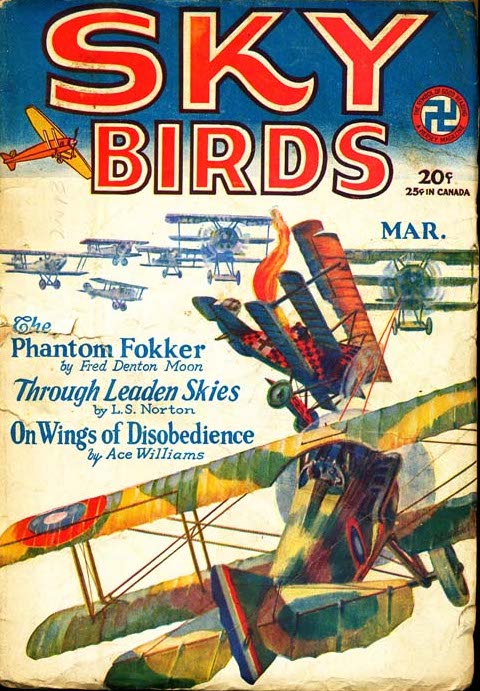
The Phantom Fokker Sky Birds March 1 3
The Buzzard Feeder The Golden West Magazine April 5 3
Tortured Skies Flying Aces June 3 2
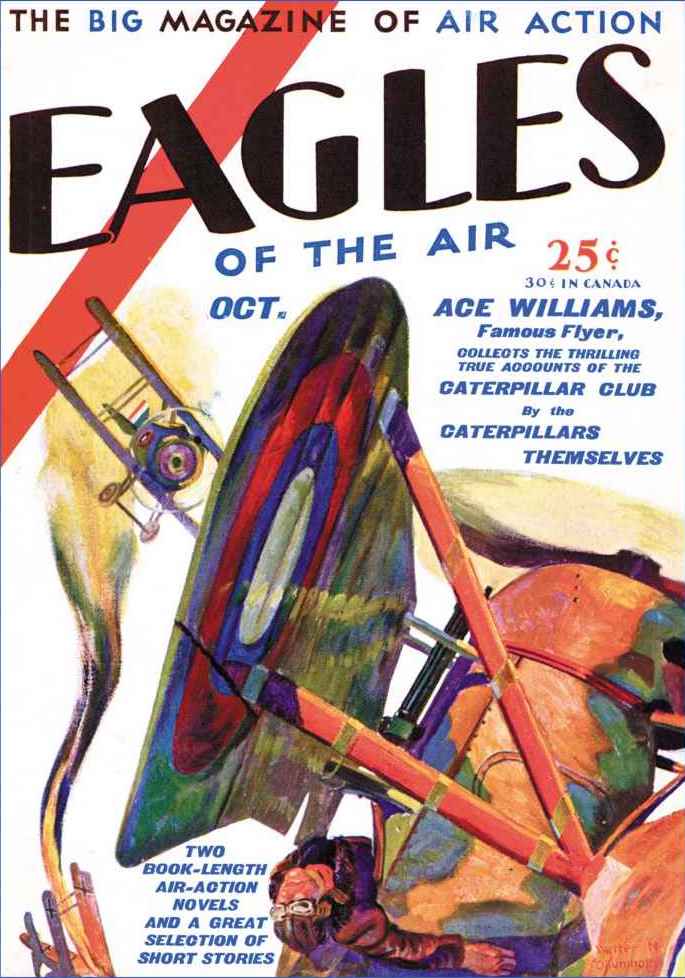
Lieutenant Goose-Egg Eagles of the Air November 1 2
The Aerial Aim Flying Aces November 4 3
1930
The Bear Facts The Dragnet Magazine January 4 4
Front Page Stuff Prize Air Pilot Stories January 1 2
Gimme a Cigaret! Thrilling Stories January 1 2
The Rattler of No Fang Western Trails June 6 1

 
Moon died in 1982 at the age of 76.

His first published pulp tale is one of an overly harsh C.O., hated by his men who get no respect for making due with the Army’s worst equipment, who proves his mettle when he joins a bombing raid over enemy lines. From the pages of the November 1928 Flying Aces, it’s Fred Denton Moon’s “The Cloud Busters!”

Hades had spewed up and was spreading all over the map of France. Count von Stratton’s flying circus was the worst bunch of hornets that had ever stung to death the group of able flyers under the disliked Commandant Legarrin—but the Commandant was an old devil who knew his viewpoint so well he tried to stop the war all by himself.

« Previous PageNext Page »