


Looking to buy? See our books on amazon.com Get Reading Now! Age of Aces Presents - free pulp PDFs

The Story Behind The Cover


“The Lone Eagle, February 1934″ by Eugene M. Frandzen

Link - Posted by David on February 17, 2018 @ 10:21 pm in

Eugene M. Frandzen painted the covers of The Lone Eagle from its first issue in September 1933 until the June 1937 issue when Rudolph Belarski took over with the August issue of that year. At the start of the run, Frandzen painted covers of general air action much like his Sky Fighters covers. Here, for the February 1934 issue, Frandzen has a British Bristol monoplane taking on a cornered German L.V.G.!

The Story of the Cover

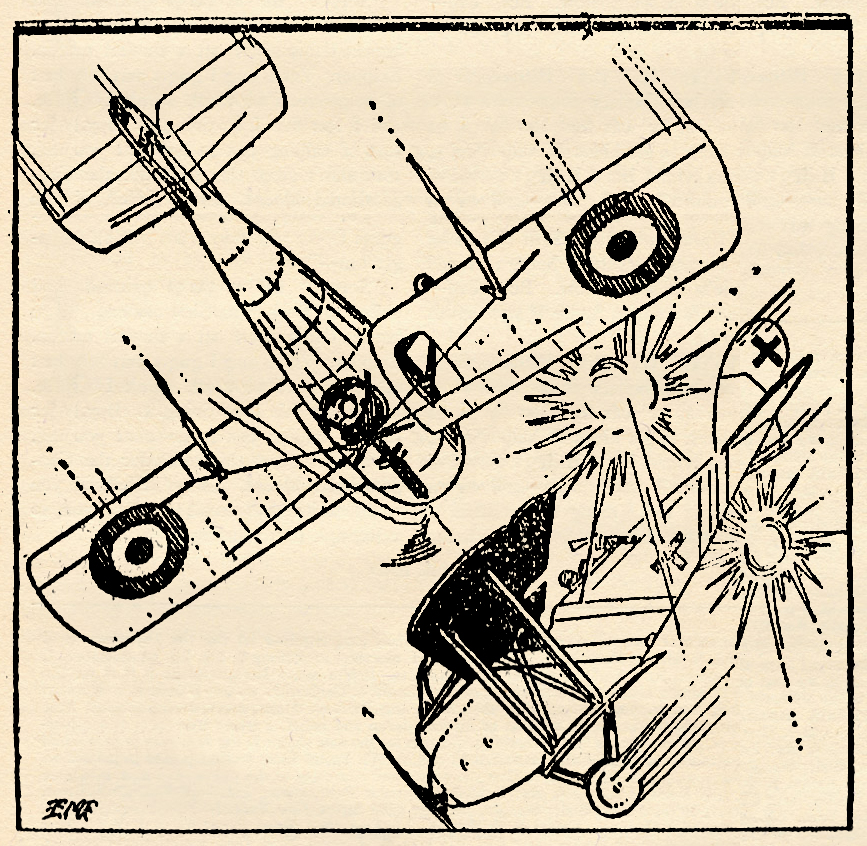
THE planes pictured on this th_LE_3402month’s cover are the Bristol monoplane, one of the prettiest little jobs turned out by the famous British and Colonial Aeroplane Co. The German ship is an L.V.G. type C.V.
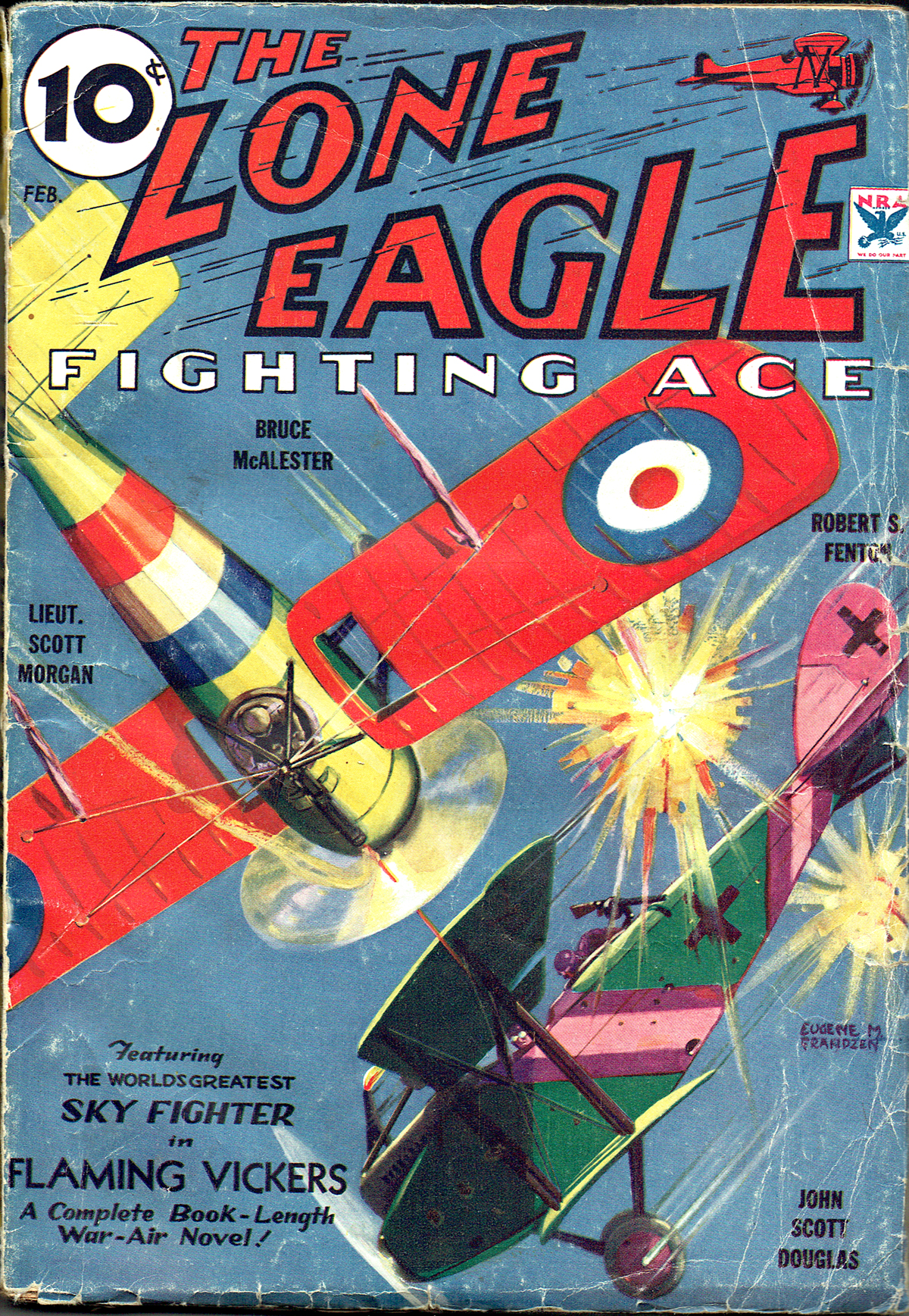
High above the ground, against a background of blue, these two planes have met. The German pilot was heading back into German territory when the prowling Bristol pilot hopped the German. The Bristol, only rating one gun, was outclassed in armament at the start of the scrap by the L.V.G. which had two guns in perfect working order; one Spandau up front and a Parabellum at the back pit.

For ten or fifteen minutes the two guns on the L.V.G. have kept the Bristol at bay, but the L.V.G. being the slower and bulkier of the two has been more or less driven into maneuvers by the Bristol. And after each maneuver the German has found himself closer to the Allied lines. Also he has been forced to allow his ship to lose considerable altitude.

Over No Man’s Land

They have passed over No Man’s Land with its writhing lines of battered trenches and shell-torn fields. The Allied pilot signals the German to land—gives him to understand that he will be given a safe passage to the ground. The reply from Fritz and his observer is an assorted spray of slugs.

“O.K.,” the Allied pilot yells. And slamming the gas into the hungry carburetor he starts to really do his stuff.

The Bristol slashes back and forth across the back of the L.V.G. like a fighting shepherd dog ripping the hide from a bulldog’s back. In and out of ring-sights— short bursts—few of them, but effective. The German observer shudders, claws at his chest and stiffens, then slumps against the ring of his pit, mortally wounded.
Little Chance of Escape

The German pilot knows now that his tail is unprotected; his chances of escape amount to very little. Still, that small chance is better than nothing. He kicks his ship around and blasts at his enemy, his Spandau hammering out sizzling slugs.

Far below, carefully hidden from keen-eyed Boche airmen, a battery of Yank anti-aircraft guns have been trained on the aerial combatants.

Suddenly the commanding officer sees the Bristol dive away from the spurting gun of the German plane.

“Fire!” barks the artillery officer.

The drone and roar of the fighting planes is drowned by the sharp bark of the “75s.”

The Bristol pilot coming out at the top of a loop sees two blossoms suddenly burst on either side of the L.V.G. He pours a steady stream of lead into the German plane.

An Exciting Moment

That is the spot in the fight pictured on the cover; just that one moment when the unlucky German is beautifully bracketed by a couple of archie bursts and is getting a broadside from the Allied Vickers gun. One second later the German raises his hands above his head. The Bristol closes in on his tail. The anti-aircraft guns cease firing.

“Just in time for lunch, Fritz,” chuckles the victor. He points toward a cleared space flanked by tent hangars far below. The German nods solemnly, shrugs his shoulders—and obeys orders.

The Story of The Cover
The Lone Eagle, February 1934 by Eugene M. Frandzen
(The Story of The Cover Page)
“The Lone Eagle, January 1934″ by Eugene M. Frandzen

Link - Posted by David on February 5, 2018 @ 6:00 am in

Eugene M. Frandzen painted the covers of The Lone Eagle from its first issue in September 1933 until the June 1937 issue when Rudolph Belarski took over with the August issue of that year. At the start of the run, Frandzen painted covers of general air action much like his Sky Fighters covers. Here, for the fourth issue from January 1934, Frandzen has a German Halberstadt smashing into the undercarriage of a French Breguet—with dire consequences.

The Story of the Cover

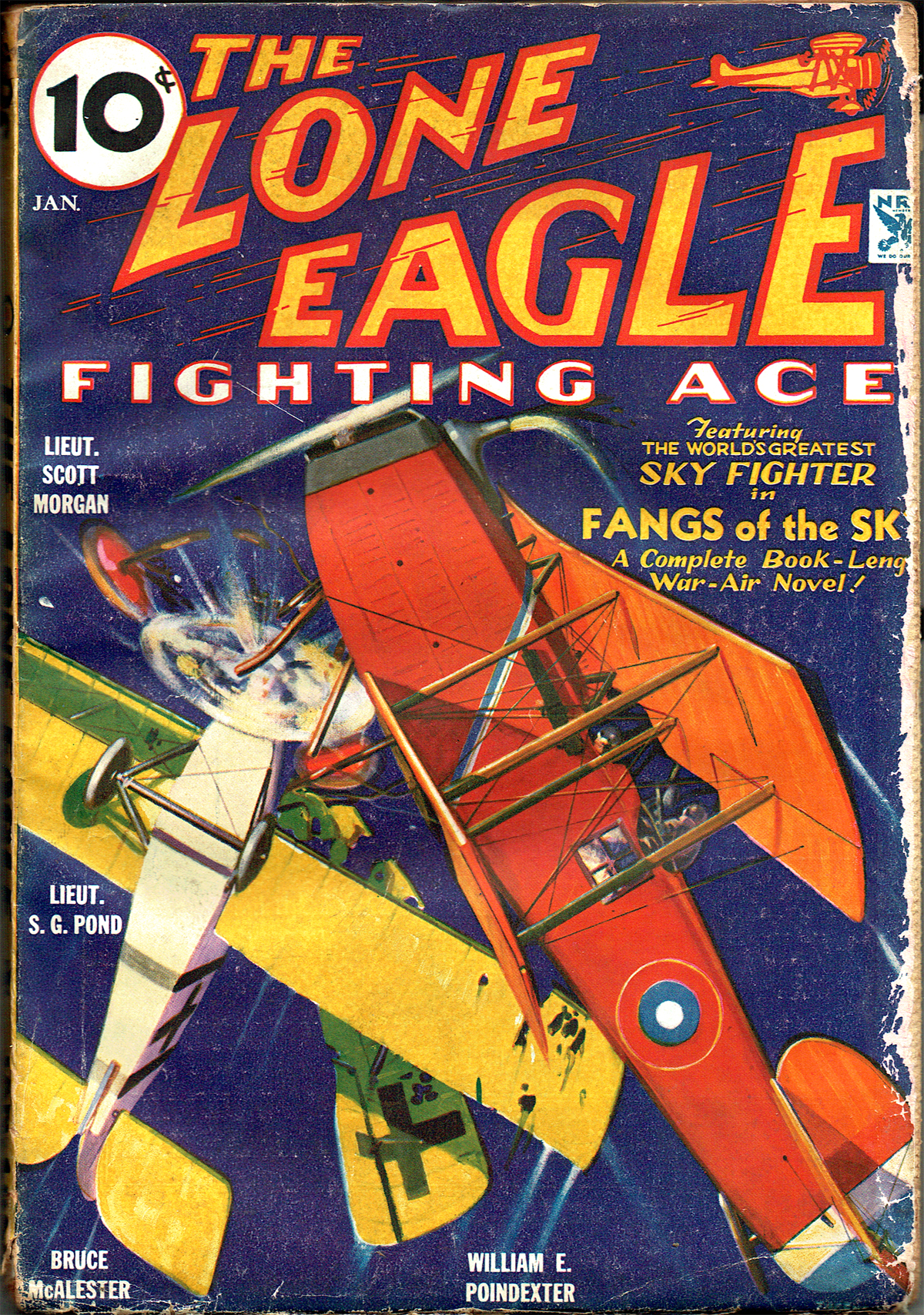
SMASH! A crackup in the air! th_LE_3401 That is the picture on this month’s cover.

A shaved second before the collision there were two trim ships battling each other high above the war-torn fields—two ships piloted by airmen intent on blasting each other into oblivion. Vickers, Lewis, and Spandau slugs have slashed back and forth across the heavens.

The big Breguet with its wing span of forty-seven feet is not as maneuverable as the small Halberstadt scout with a span of only twenty-eight feet. But the Breguet’s handicap is offset by its rear gunner, who has an office unequalled for visibility. On either side of his pit he has Cellon windows.

There is a hole in the floor that he can see through and fire through if necessary. Therefore the blind spot under his tail is not as vulnerable as in ordinary two-seaters.

A Dangerous Opponent

The small Halberstadt has had a taste of the observer’s fire when sneaking in from behind to make the hoped for kill. The ship the German pilot thought was an easy victim has turned out to be a dangerous opponent.

Twice the German pilot has barged in from in front. Each time a stream of Vickers’ slugs drenched his ship. One of those hot, whistling messengers of death has slashed into his shoulder. Not a fatal wound, but a painful one. A wound that causes his flying to become jerky and erratic.

Another Angle of Attack

Mad clear through from being bested in a sky duel with a lumbering two-seater the German pushes the nose of his ship down. He starts to slither out of the fight, then he suddenly changes his mind. There is one angle of attack he has not tried; that one is coming up under the blunt nose of the Breguet. Coming up with a brace of Spandaus churning out hot steel.

His Halberstadt shudders as he pulls it out of its dive into a loop. Up swings the nose. He presses his gun trips. A short stutter from one gun, then it jams.

The other gun is silent—its ammo exhausted. Then directly in front of his blazing eyes looms the undercarriage of the Breguet; six husky steel members holding the axle and wheels—the strongest under construction of any Allied two-seater. Too late the German yanks on the stick to pull out of danger.

And This Is What Happens

Smash—his prop chews into the tough steel struts. His top left wing snaps—rips off—his prop flies to pieces, as does the undercarriage of the Breguet.

Both ships will get to earth; but one will be a wingless fuselage holding a doomed German pilot. The Breguet, minus wheels, can come down under its own power, flatten out and take the ground on its chest. It will be a rough landing but it is a ten to one chance that those two Yanks will be in the air again in a few days. They will be on the job—looking for trouble and overconfident Boche pilots.

The Story of The Cover
The Lone Eagle, January 1934 by Eugene M. Frandzen
(The Story of The Cover Page)
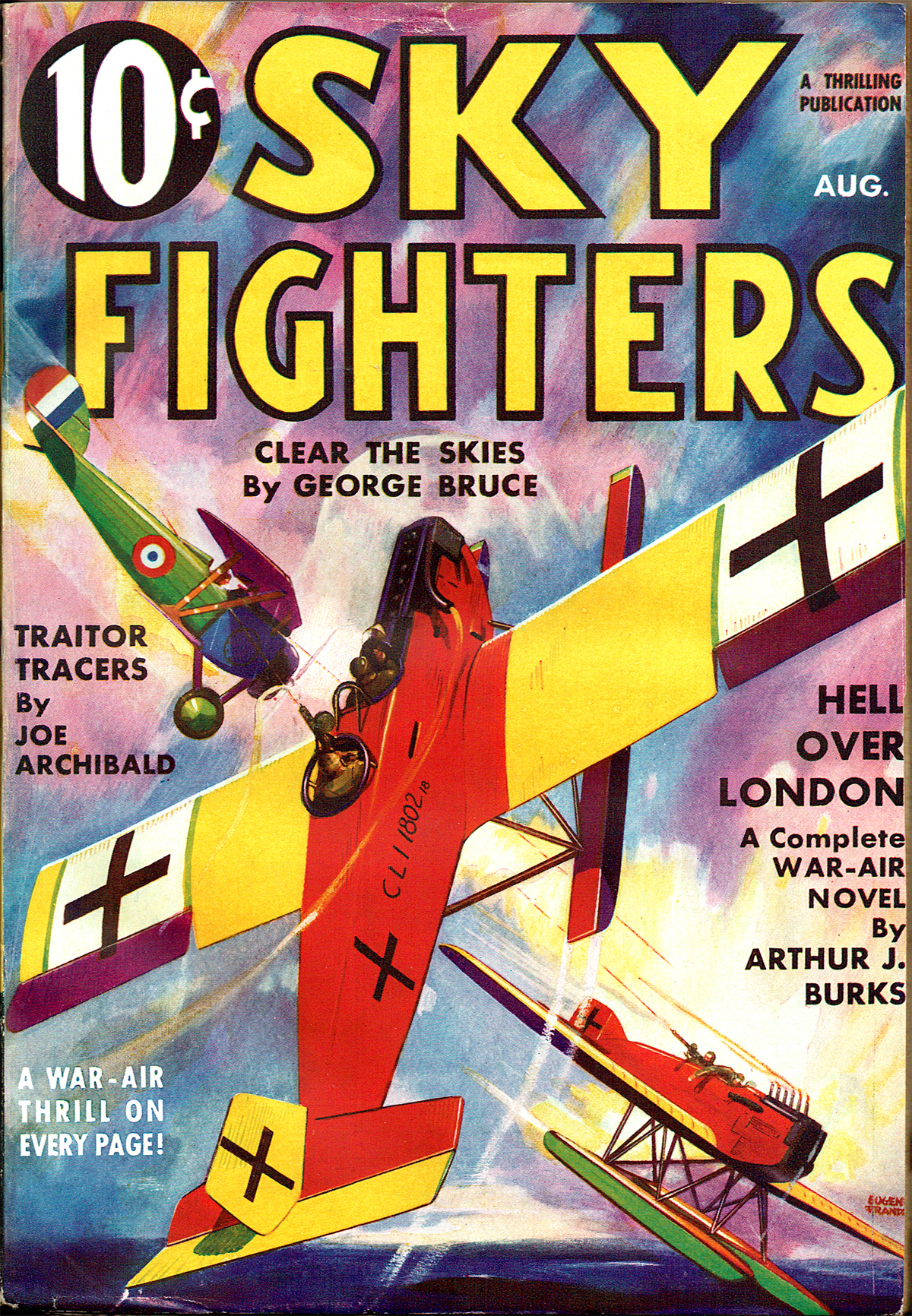
“Sky Fighters, August 1935″ by Eugene M. Frandzen

Link - Posted by David on January 22, 2018 @ 6:00 am in

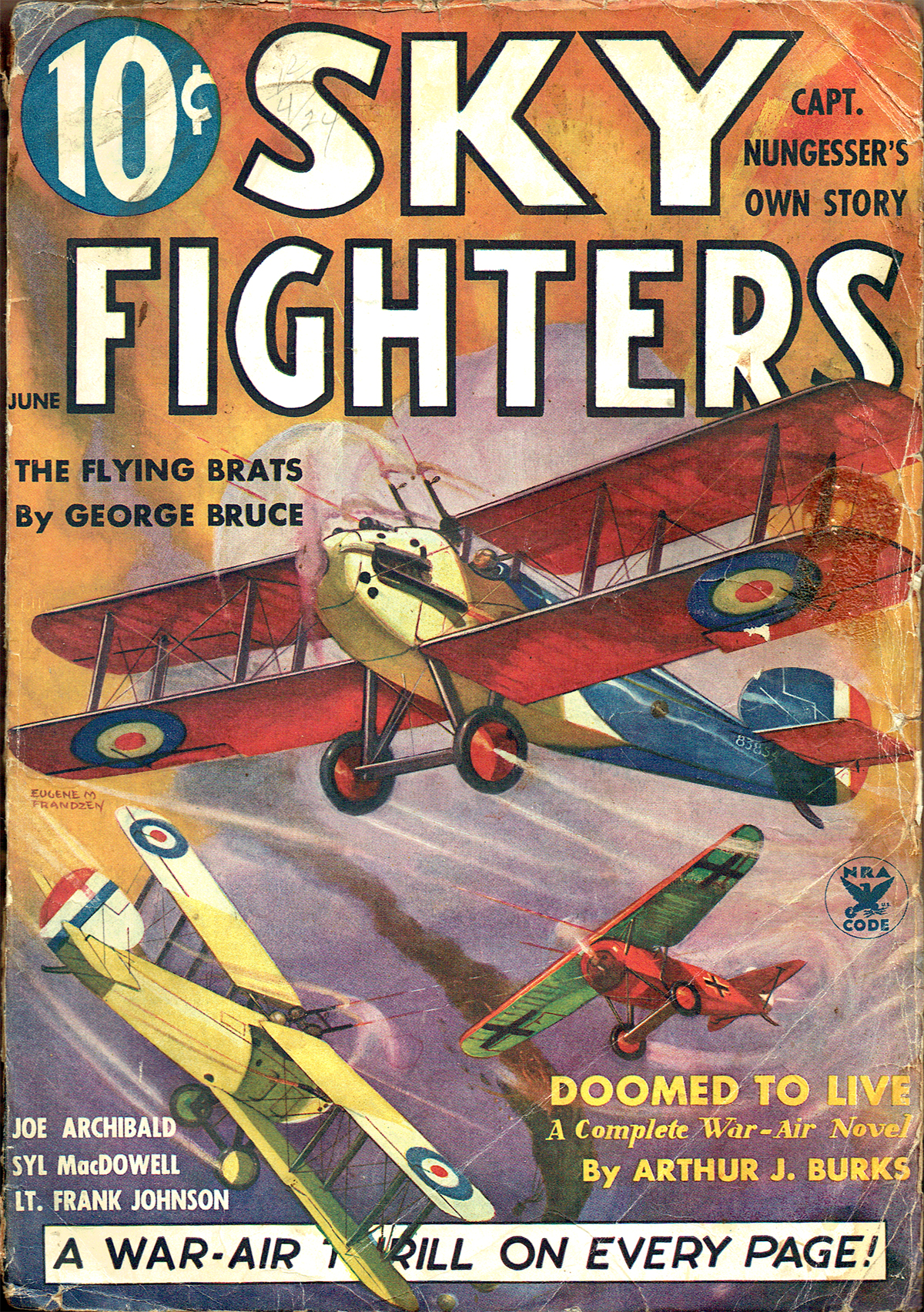
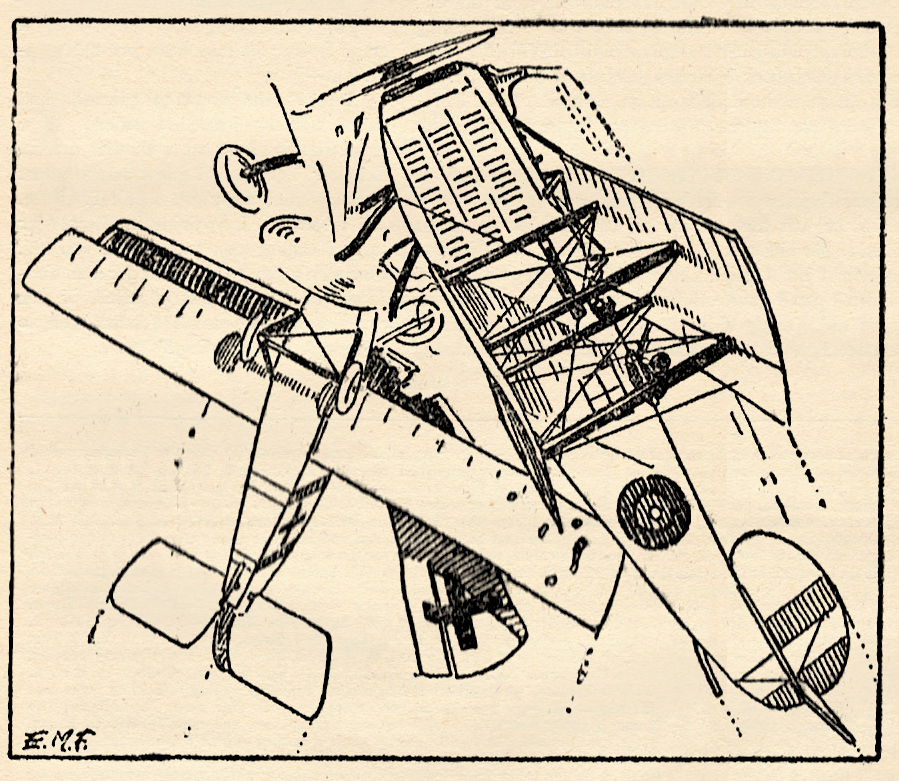
Eugene M. Frandzen painted the covers of Sky Fighters from its first issue in 1932 until he moved on from the pulps in 1939. At this point in the run, the covers were about the planes featured on the cover more than the story depicted. For the August 1935 cover, Mr. Frandzen features the a couple of Junkers C.L.1 Seaplanes taking on a Neieuport 27!

The Ships on the Cover

ALL metal low-wing monoplanes th_SF_3508 are not a new wrinkle in sky ships. Back in the World War days, Professor Hugo Junkers sat before a drafting table littered with plains, blueprints and bits of corrugated metal. His simple stream-lined designs were far ahead of his day, therefore they were scoffed at by the heads of the German Flying Corps.

Anthony Fokker had a welded steel frame in the fuselage of his planes at the time. But this welding job was an exception. Fokker liked the looks of the Junkers design and saw to it that certain strings were pulled along the political line and it came to pass that those who had turned down the Junkers all metal planes swung into a snappy about-face in their beliefs. Fokker linked his name definitely with Hugo Junker’s. If those shiny metal jobs load been adequately powered with engines which were not too heavy, they would have revolutionized airplane design.

Finest of ‘em All

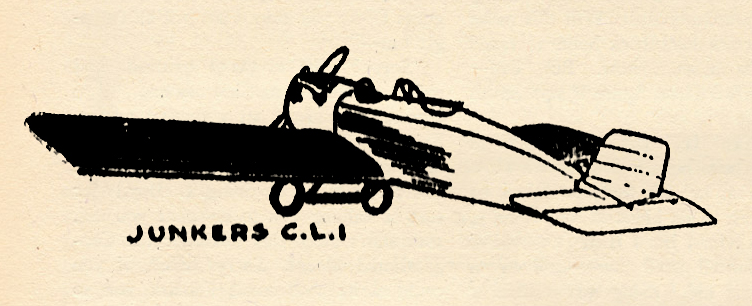
The C.L.1 All Metal monoplane in the foreground on the cover, powered by a Mercedes engine, was probably the finest ship turned out by Junkers in 1918. The wings had considerable dihedral and were very thick at the leading edge. Junkers who was an authority on Diesel engines which his firm manufactured, insisted that the Mercedes engine be used in his planes. Car type radiators were used in the nose. Ailerons on most of the Junkers craft were balanced, similar to the Fokker D7. But on this particular version of the C.L.1 they were unbalanced as was the elevator. The rudder was anchored by a single post which in rotating swung it to left or right. Corrugated aluminum was used throughout, which did not by any means make the ship bullet proof but it did minimize the fire hazard and give added strength to the ship that allowed inner structural bracing to be lightened.

Professor Junkers, who died only a few months ago at the age of seventy-six, predicted when he made his first all metal airplane that some day planes would be armor-plated. But with heavy motors developing less than 300 h.p., he was limited to aluminum which is about one-third the weight of steel. Had he been able to armor plate the Junkers planes, a different story could be told of the cover picture.

Zeebrugge, the submarine lair of the German navy, was bottled up by the British navy on April 23, 1918, by sinking ships filled with concrete across the mouth of the harbor.

Blazing Red Skies

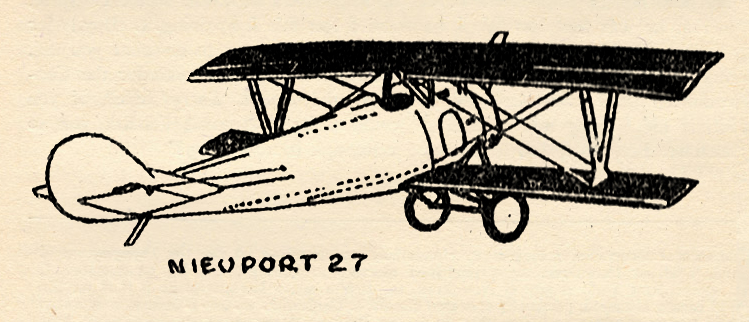
A lone French Nieuport roared along the coast toward the heavily fortified submarine basin. A final observation from the air was necessary to the British. Two shining German Junkers seaplanes skidded off the water and flashed into the skies. The Nieuport looked like a butterfly attacked by two bats. But the thundering Vickers guns in the French plane’s nose blasted a rain of slugs through the thin-gauge aluminum of the Junkers into a vital spot. One down! The back gunner on the foremost Junkers blazed at the Nieuport. The tiny French ship flipped under the German plane. One volley sent it reeling towards the sea. The Nieuport circled twice over Zeebrugge, streaked for home.

A telegraph key clattered in a British seaport. An admiral smiled grimly as he read the dispatch from the French pilot.

That night the skies blazed red above Zeebrugge in the most spectacular naval-land battle of the whole war. The engagement mounted to an unbelievable pitch, then slowly died out as the British ships, battered, decks blasted away and superstructure listing, limped into the darkness toward home.

A terse message flashed through the ether from the Admiral’s flagship to British headquarters: “Mission accomplished satisfactorily.”

The Ships on The Cover
Sky Fighters, August 1935 by Eugene M. Frandzen
(The Ships on The Cover Page)
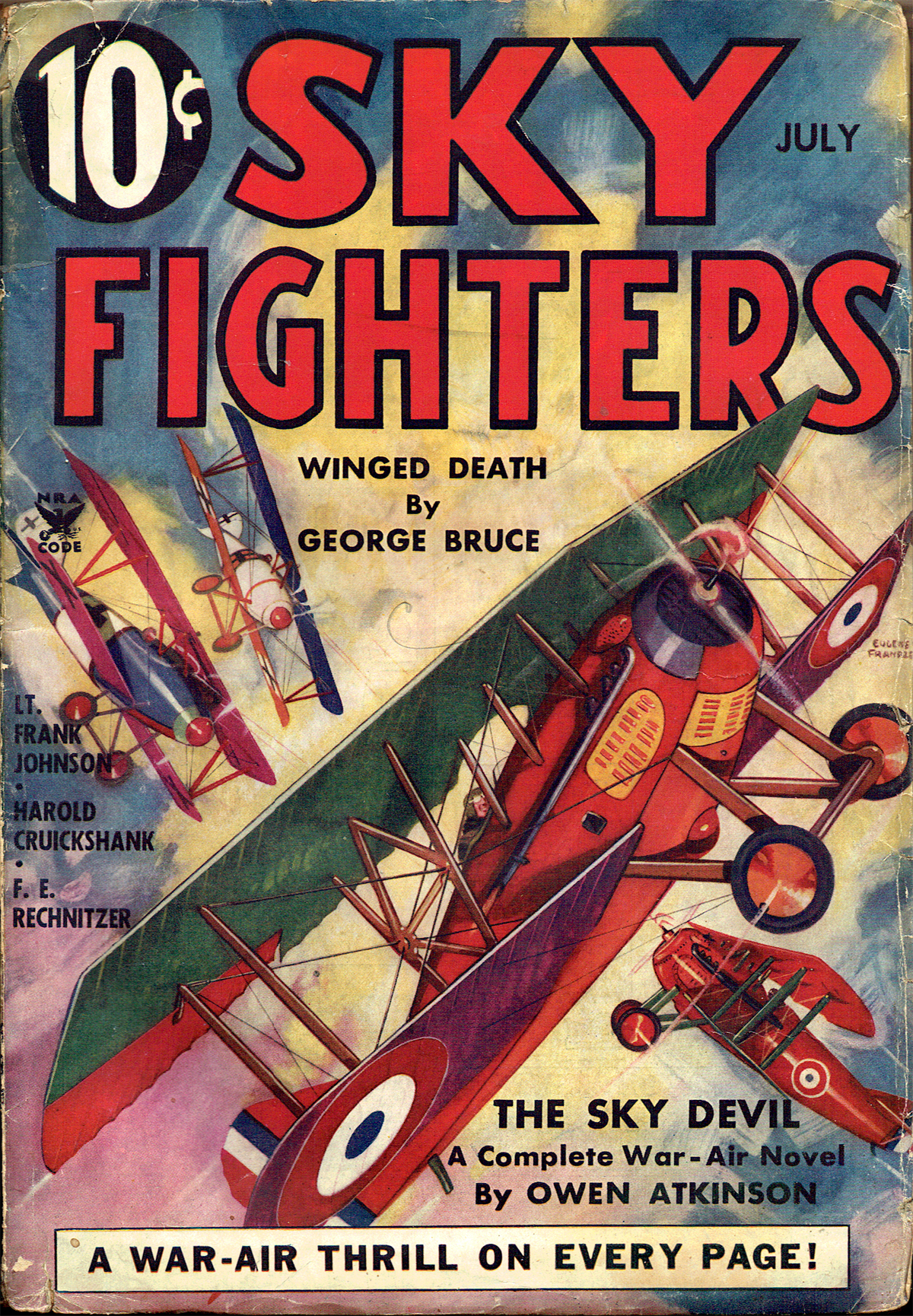
“Sky Fighters, July 1935″ by Eugene M. Frandzen

Link - Posted by David on January 8, 2018 @ 6:00 am in

Eugene M. Frandzen painted the covers of Sky Fighters from its first issue in 1932 until he moved on from the pulps in 1939. At this point in the run, the covers were about the planes featured on the cover more than the story depicted. For the June 1935 cover, Mr. Frandzen features the Spad 22 and Spad 13 C1!

The Ships on the Cover

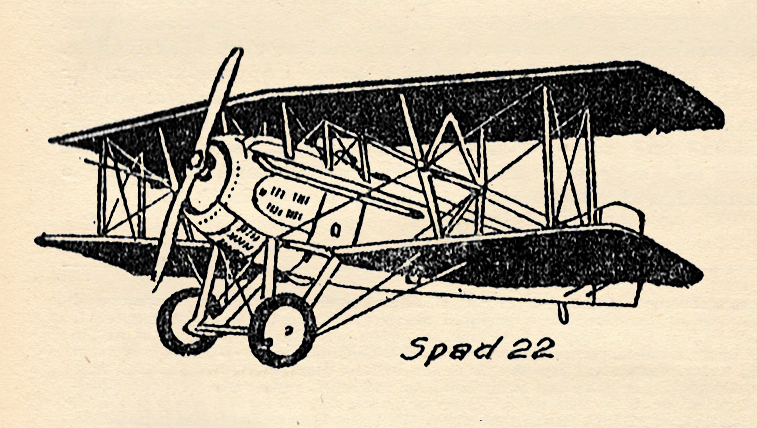
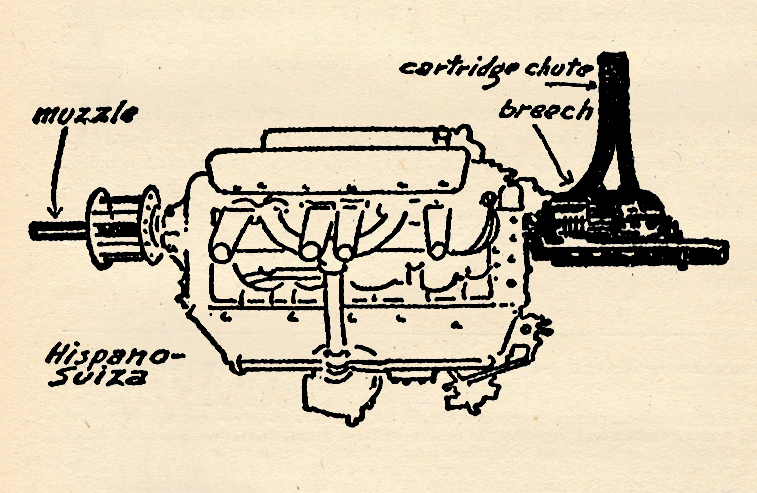
THE cannon ship used during th_SF_3507 the World War did not necessarily have to be one type of plane. Any ship having a “V” type engine with a geared propeller could do the trick. The geared prop was above the crank shaft at the front of the engine, therefore above the center of the round radiator in the Spad. The hub of the propeller was made hollow just large enough to clear the sides of the muzzle of the 37 millimeter cannon which protruded about two inches. In the accompanying drawing this is clearly shown.

The ship with the complicated bracing in the foreground of the cover is the Spad 22, one of the little known crates of the war. It rated a 220 h.p. Hispano-Suiza motor with a geared prop which could accommodate the cannon. The Spad zooming up in the lower background is the Spad 13 C1 with geared prop. There were plenty of these “cannon ships” tried out from time to time and words flew hot and heavy from pilots who used this new gun arrangement for and against the stunt.

The Original Cannon

The original 37 millimeter cannon, the type the great French ace Guynemer used to down his forty-ninth to fifty-second victims, had to be fed by hand. Each seven-inch shell weighing about one pound had to be dropped into the breach of the gun. This took about three seconds in which time a pair of Vickers guns could churn out around fifty slugs, one of which might find a vulnerable spot in the enemy or his ship. But said enemy ship in three seconds could vary its position about 600 feet which is about equal to a shooting gallery target being reduced from the size of a wash tub to an aspirin tablet, a comparison which you fans with air guns or .22 caliber rifles Will appreciate.

On the other hand a Vickers slug might smack into a strut longeron, engine or even the gas tank, if it was rubber housed and not cause any serious damage; but let one of the one-pounder shells which explodes on impact connect with about any part of the enemy plane and the fight is over. The non-explosive one-pounder shell will knock a plane down in from one to three hits. Then there was a “fireworks” shell which was designed to set the target on fire, also a shell similar to a shotgun shell, which when loaded with buckshot would tear a wing to pieces.

A versatile gun, that cannon, and one which certainly did plenty of damage to the Germans.

Later Models Weighed More

The later cannon was semi-automatic, using the recoil, which was eight inches or more, depending on the muzzle velocity, to eject the used shell and slide a new one into the gun chamber. Guynemer’s cannon weighed about 100 pounds. The later models, 150 pounds or more. So put this added weight into a plane with a given speed and load, is to cut down its speed and put it at a disadvantage in a fight. To overcome this, the ammunition supply was limited or the fuel supply cut down which naturally decreased the cruising range. There were plenty of arguments for this weapon but also a few plain and fancy arguments against it.

Those two Albatross D5s zipping down on the foremost Spad are churning out four streams of slugs at a range which only amateurs would fire. The Spad 13 C1 coming up under them has a better range at a good angle. Not only are the bets on the Spads to come out with flying colors but when those explosive shells from the one pounder connect with the German ships, only one shell is necessary for blasting each one, where dozens of Spandau bullets may whistle through the Spads without harming them.

The Ships on The Cover
Sky Fighters, July 1935 by Eugene M. Frandzen
(The Ships on The Cover Page)
Next time, Mr. Frandzen features the Nieuport 27 and Junkers C.L.1!

“Sky Fighters, June 1935″ by Eugene M. Frandzen

Link - Posted by David on December 11, 2017 @ 6:00 am in

Eugene M. Frandzen painted the covers of Sky Fighters from its first issue in 1932 until he moved on from the pulps in 1939. At this point in the run, the covers were about the planes featured on the cover more than the story depicted. For the June 1935 cover, Mr. Frandzen features the Sopwith Dolphin and the Fokker D VIII!

The Ships on the Cover

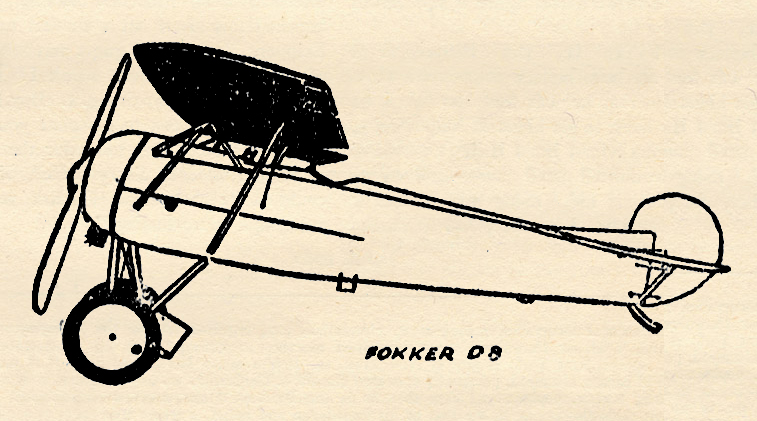
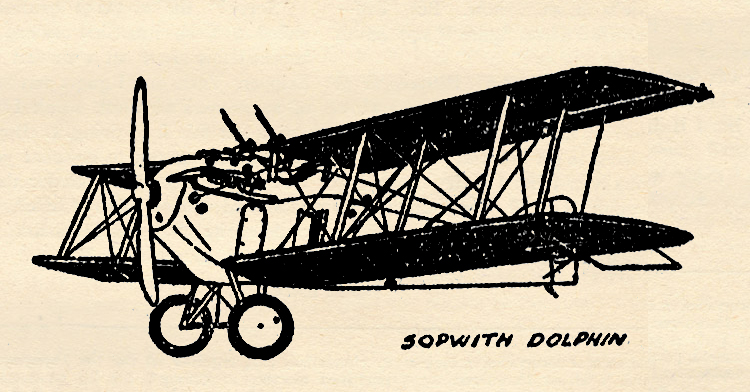
TWO of the last ships to th_SF_3506 get into the air to swap lead in the World War were the Fokker D8 and the Sopwith Dolphin. The Dolphin had four exposed machine-guns, two Vickers shooting through the propeller arc and two Lewis guns shooting over the top of the arc at 45 degrees. The Dolphin’s pilot had good visibility with his top wing cut away and his office parked directly beneath this opening. His vision depended only on how far he could swivel his neck without putting it out of joint.

The Fokker D8, also known as the “Flying Razor,” was Fokker’s last contribution to Germany’s air fleet. He built it around an Oberursel motor because he could not depend on delivery of the Mercedes motors which he had used in his famous D7.

These Oberursel engines had been kicking around for months before Fokker finally in desperation figuratively jacked them up and built planes around them. Not many of these planes got to the front, but those that did, were used to good advantage. Udet, the famous German Ace flew the D8, and liked it. It was not as fast as Fokker would have liked because of the limited power of the rotary in its nose. But its ability to maneuver like a streak of greased lightning got it places where it could do things quicker than some planes with greater power which answered to their controls sluggishly.

Many Balloon Victories

Balloon busting was not confined to such sharpshooters as our own Frank Luke or Belgium’s Willy Coppens. Scattered through the official records of the Allies are scores of balloon victories chalked up to the credit of its flyers. Each of those downed bags represented a drain on the Kaiser’s money bags up to as high as $100,000. Therefore, the balloon falling in flames put a dent equal to from three to six war planes in the German finances.

As the Germans entered the last year of the war their supplies for making their kite balloons, or drachens, was at a premium. Where, in the early war stages, a half dozen of the cumbersome observation bags could be seen strung along four to six miles behind their lines, now only an occasional balloon floated.

“Blind the German’s observation,” was the terse order issued to all Allied armies.

By telephone, wireless, and despatches, this command raced along the lines. Long range guns poured streams of whistling shells into the skies. Their hits were few and far between. The ammunition wasted could have flattened mountains. The gunners gave up and watched tiny specks far up in the skies darting past, fading into the smoky war haze and disappearing over German territory.

Racing Through the Blue

Spads, Nieuports, Bristols, Moranes, Sop Camels, S.E.5’s raced through the heavens. Then the new Sopwith Dolphins flashed their black-staggered wings against an orange sky. Hisso motors yanked them toward a mountainous section where a German balloon had been floating unharmed for months. The massive gas bag was swaying swiftly down to its retreat between rocky crags as the Sopwith tipped their stubby noses down and blazed incendiaries into it. Smoke, then flame belched forth as the porcine mass writhed, collapsed and sank.

Two small monoplanes, one climbing rapidly. Another, diving, bracketed the Dolphins. Incendiary bullets were in the Sops’ Vickers belts, bullets that are outlawed for warfare against man. Down tipped the nose of one Dolphin, up went the prop of the other. Lewis guns bucked in their mounts, streams of orthodox bullets connected the enemy plane with the Dolphins. Two black-crossed monoplanes, “Flying Razors,” staggered in their flight. Blunted and dulled, they fluttered like discarded razor blades pitched from a roof, down into the purple haze of oblivion.

The Ships on The Cover
Sky Fighters, June 1935 by Eugene M. Frandzen
(The Ships on The Cover Page)
Next time, Mr. Frandzen features the Spad 22 and 13 C1!

“Sky Fighters, May 1935″ by Eugene M. Frandzen

Link - Posted by David on November 27, 2017 @ 6:00 am in

Eugene M. Frandzen painted the covers of Sky Fighters from its first issue in 1932 until he moved on from the pulps in 1939. At this point in the run, the covers were about the planes featured on the cover more than the story depicted. On the May 1935 cover, a de Haviland 5 protects a couple Handley Page 0/400s over a Boche battery!

The Ships on the Cover

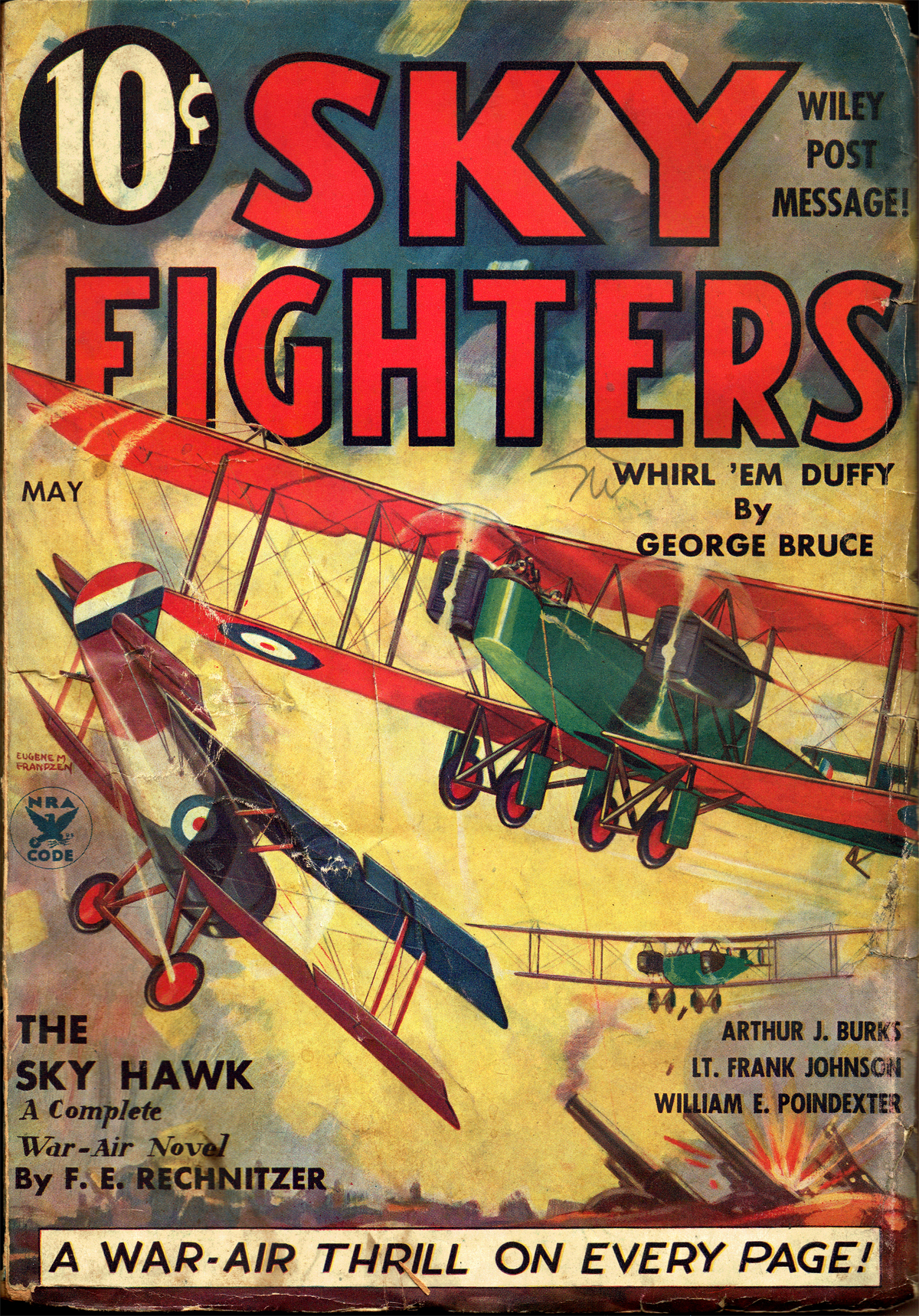
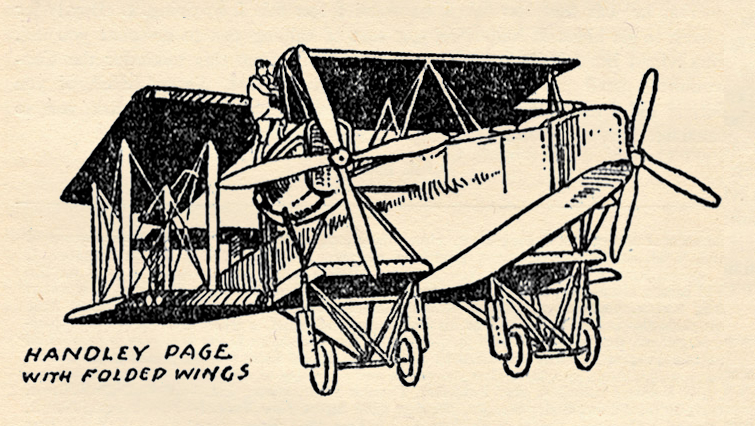
THE Handley Page 0/400 twin-engined th_SF_3505bomber pictured on the cover was the most publicized bomber produced by Great Britain during the World War. This company produced a larger four-engined job, the V/1500, with a wing span of 126 feet toward the end of hostilities. It was built to raid distant German cities: Berlin was to be the first one on which the British steel-cased calling cards were to drop.

The 0/400 was a sturdy, dependable old stick and wire job with a top speed about 98 miles per hour. The criss-cross bracing of the under-carriage held the wheels sturdily enough so that the 100 ft. ship could be set down pretty roughly without the landing gear folding and the ship rolling up in a ball. The wings folded back along the sides of the fuselage to conserve space when the ship was hangared. The standard engine equipment was two Rolls Royce Eagle 8s, but Liberties, Sunbeams, Fiats, etc., could be used as alternatives.

But There Was No Eclipse

It is interesting to note that the United States was going to manufacture this bomber, using Liberty motors, to send over to the Yank aviators to use against the Germans. One optimistic orator in Washington proclaimed, “We will blanket the war skies with these huge bombers. We will have such great numbers flying at the Hun that the sun will be blotted out!” Well, there was no eclipse registered during the latter part of the war.

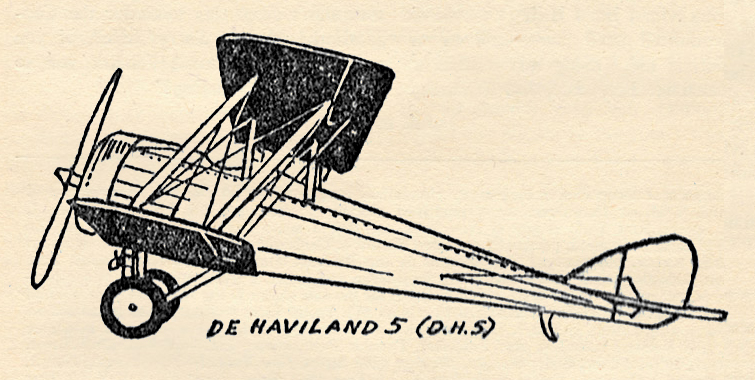
The D.H.5 is one of the long line of de Haviland war planes that are more or less familiar to most readers. The D.H.5’s 25 ft. wings were back-staggered to give the pilot a full vision forward and up. This trick wing arrangement cut down the efficiency of the plane but careful streamlining and reduction of head resistance brought the scout’s rating pretty well up on the right side of the ledger.

It could click off around 105 miles per hour with its 110 h.p. Le Rhone rotary motor whirling at top speed.

Blazing Vickers

The D.H.5 had spotted a German battery dug in the back of the boche lines throwing a barrage of shells toward the British lines. He tilted his ship down and blazed away with his Vickers. The German gun crews took cover for a few minutes and were back at their jobs as soon as the D.H. zoomed. This would not stop the Germans, the pilot realized, so he opened his throttle and tailed for a British bomber squadron’s hangars. The Germans wriggled their fingers at their noses and threw shells into the hot guns faster than ever.

A battery of “heavies” makes plenty of racket and plays havoc with the eardrums of the humans servicing its hungry maws, so it is not a miracle that allowed the tiny D.H. to lead his giant bombers to within striking distance of the Boche battery. The Germans’ first warning of danger was the high screech of whistling wires as the D.H. zipped past the slower bombers and flipped his tail over and up. Down he came with Vickers flaming. At the same moment the Handley Pages let loose a hail of heavy bombs. The enemy’s cannons were tossed into the air, twisted masses of useless steel. The gun crews disappeared in clouds of smoke and debris.

Opinions Differ

Back across the Allied lines the Tommies crawled out of dugouts and from behind sandbags, wiped the dust out of their eyes and went calmly about the business of pointing rifles and pulling triggers. Later they saw the big bombers lumbering overhead toward home.

“They say those airplanes are doing a bit of good now and then,” said one Tommy to another.

“Don’t you believe it,” replied his friend. “It’s us infantry wot’s winning this war!”

The Ships on The Cover
Sky Fighters, May 1935 by Eugene M. Frandzen
(The Ships on The Cover Page)
Next time, Mr. Frandzen features the Fokker D8 and Sopwith Dolphin!

“Sky Fighters, April 1935″ by Eugene M. Frandzen

Link - Posted by David on November 13, 2017 @ 6:00 am in

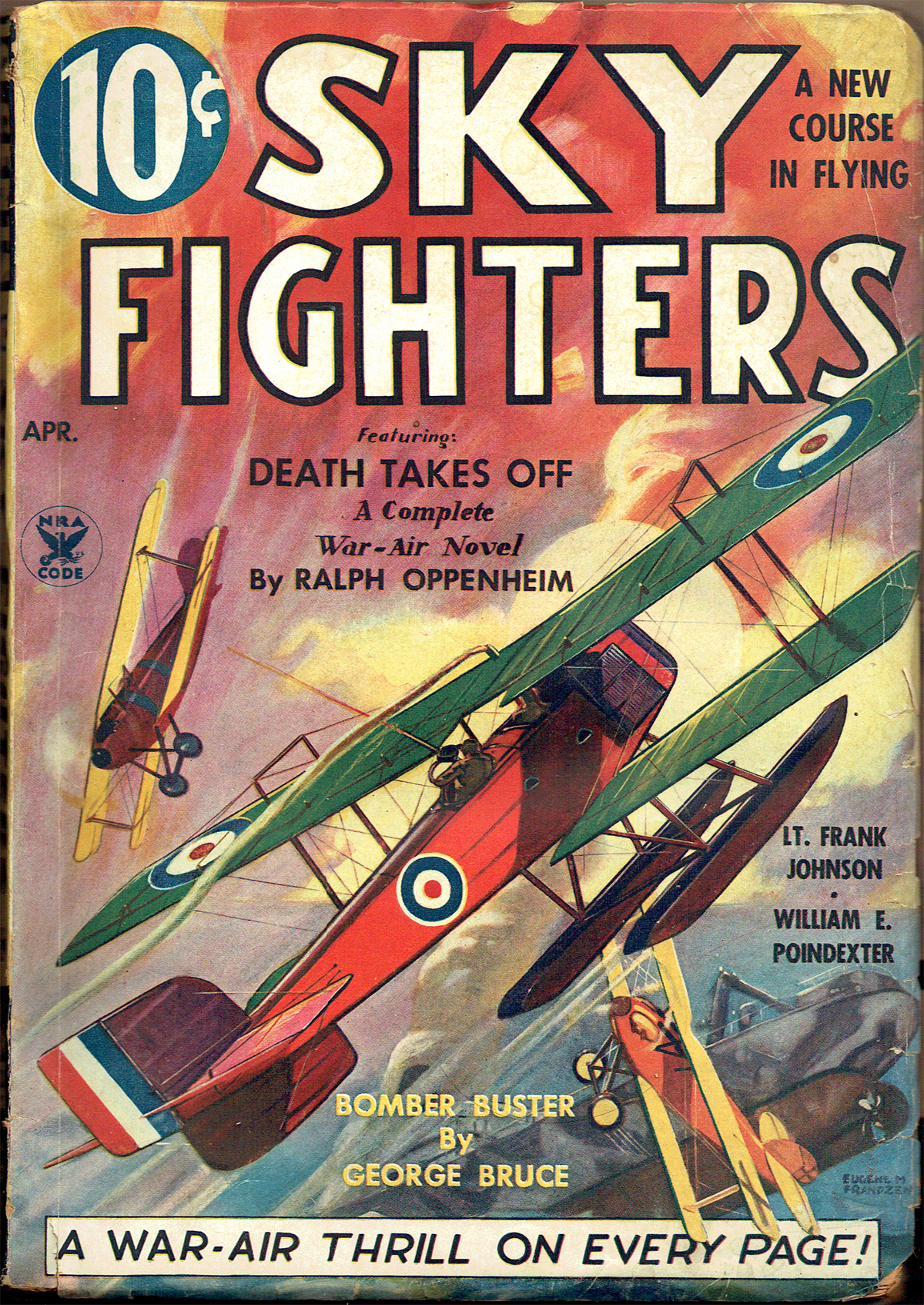
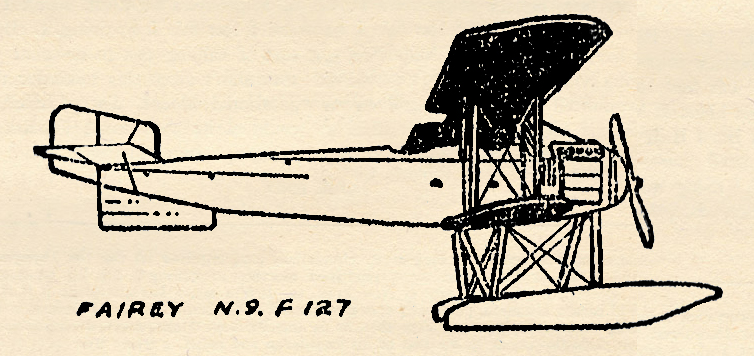
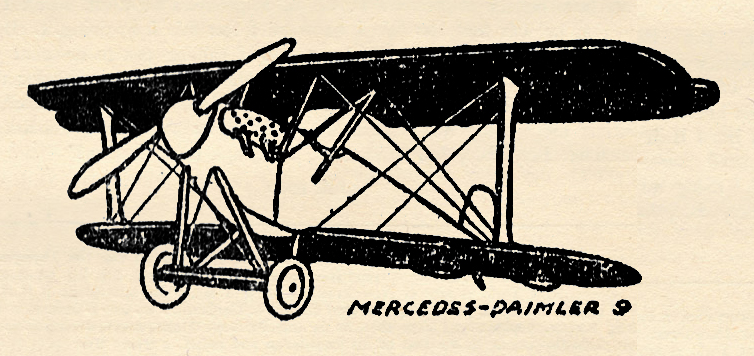
Eugene M. Frandzen painted the covers of Sky Fighters from its first issue in 1932 until he moved on from the pulps in 1939. At this point in the run, the covers were about the planes featured on the cover more than the story depicted. On the April 1935 cover, The Fairey N.9 F127 Seaplane takes on some Mercedes-Diamler 9s!

The Ships on the Cover

THE Fairey N.9. F127 is th_SF_3504the British seaplane in the foreground of this month’s cover. The two black-crossed scouts are German Mercedes-Daimler 9’s.

Fairey seaplanes were used to great advantage in patrolling the North Sea and did much to make that turbulent mass of water a comparatively safe area for friendly shipping. C.R. Fairey founded the firm bearing his name in 1916, after severing connections with the old Dunne Co. and the Short Bros., famous for their seaplanes dating back to 1910, so he was no newcomer to this field.

Slow Landing Possible

His trailing edge flaps gave his seaplanes mobility with heavy loads and made slow landings possible.

The original No. 9 Fairey seaplane has the distinction of being the first seaplane to begin an actual flight by being catapulted from the deck of a warship. But away back in 1912 the U.S. Navy used a catapult to launch a seaplane from a floating dock. Catapulting is a regular stunt on warships today, but back in the early days of aviation with crude gear and low-powered ships it took courage to climb into a cockpit and be shot into space.

The German Mercedes-Daimler Motorcar Gesellschaft manufactured Mercedes motors for many of the German planes. Their engine was so popular with the German fliers that the supply could not keep up with the demand. Evidently not content with doing a landoffice business with engines and being months behind with orders, they broke out in a rash of single and two place fighters which were fairly good ships but never got to first base in mass production.

Two of them were taken into the German Navy’s service and used as decoys.

It is an old racket to send out a plane or two over the battlefields to lure a few of the enemy’s planes into an unprotected position so that a superior number of planes may dive from the clouds and do their stuff; but on the sea the technique was a little different.

The two decoys took off and flew over a prearranged area of water. A lone freighter with anti-submarine guns is spotted. Immediately the two single-strutted ships go into action, sweeping back and forth over the tramp steamer’s decks, spraying it with burst after burst of Spandau lead. The ship’s crew drag out machine-guns and blaze back. Occasionally the anti-sub gun pops ineffectually at the heckling German planes. This air attack can do no vital harm to the steamer.

They’re Merely Decoys

Don’t forget that these Mercedes-Daimlers are merely decoys for a lurking submarine which slinks close to the freighter. They let go one torpedo at point blank range. The freighter shudders, lists—it is doomed. Men take to the boats. The sub quickly submerges. It has sunk a ship without the chance of being destroyed itself by the ship’s gunners.

A wireless flash from the doomed freighter was received by a British patrol cruiser. A catapult snaps the Fairey seaplane into the air. Its motor hurls the plane towards its enemies. It flies high, spots the German planes and swoops down with guns blasting. A surprise attack was staged by the sub on the freighter. The Fairey seaplane used surprise tactics also and in two minutes the Mercedes-Daimlers dove out of control to strike the water and sink in exactly the same spot where the stricken freighter has disappeared.

The Ships on The Cover
Sky Fighters, April 1935 by Eugene M. Frandzen
(The Ships on The Cover Page)
Next time, Mr. Frandzen features the Handley-Page and D.H.4!

“The Hawker Fury” by Frederick Blakeslee

Link - Posted by David on September 18, 2017 @ 6:00 am in

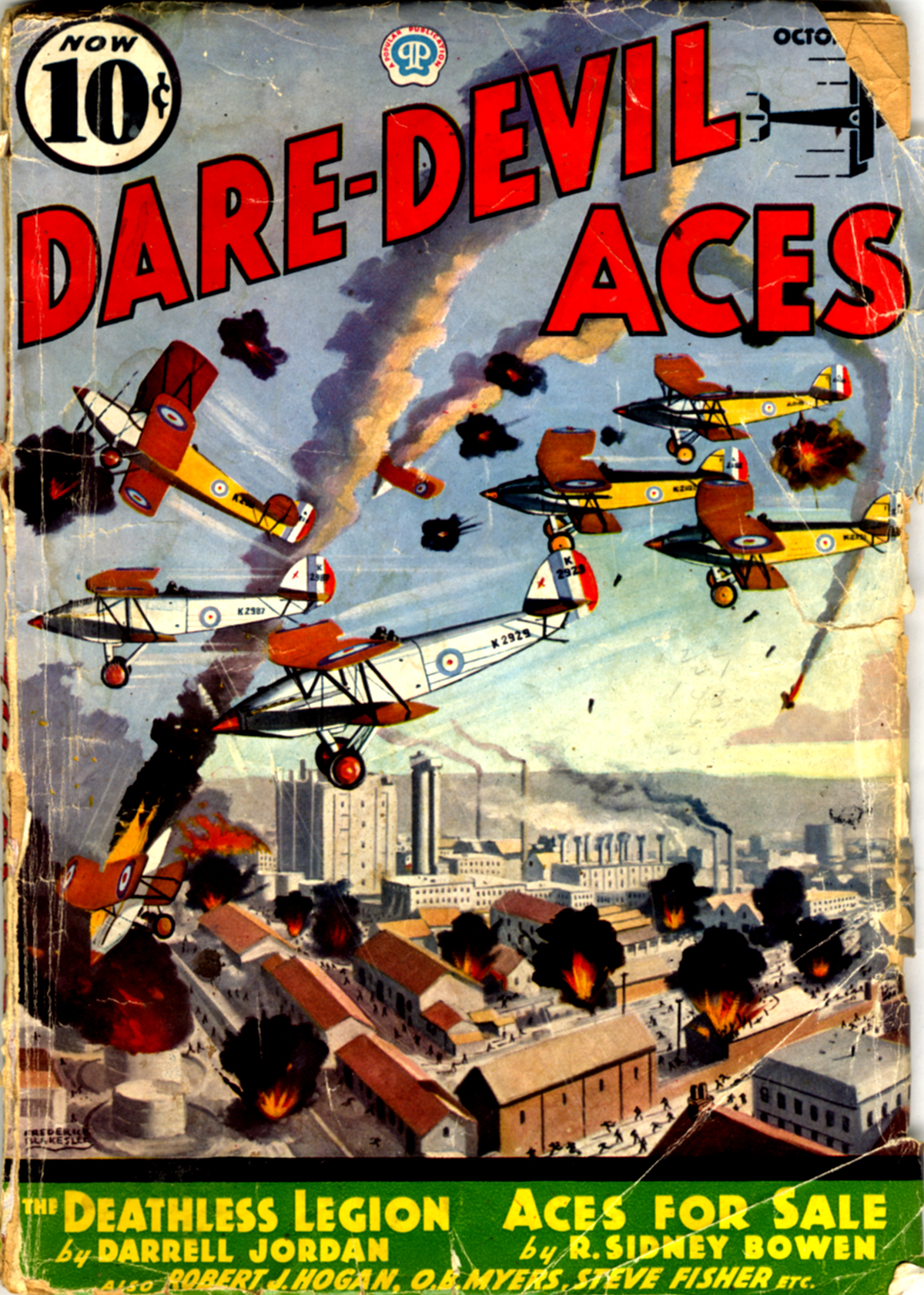
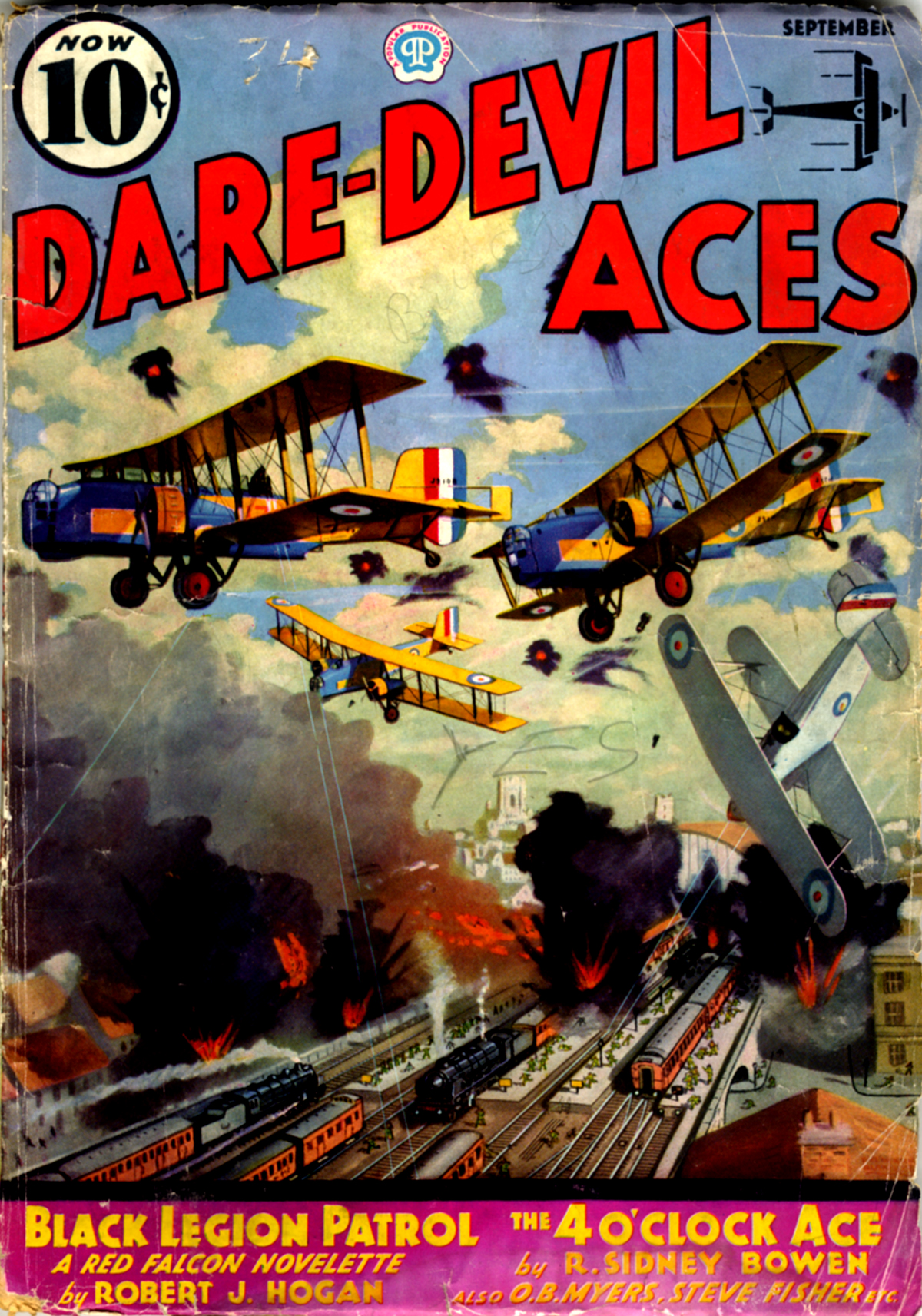
Frederick Blakeslee painted all the covers for the entire run of Dare-Devil Aces. And each of those covers had a story behind it. On Dare-Devil Aces’ September 1936 cover, Mr. Blakeslee presents a couple Hawker Furys escorting a flight of Hawker Demons on a bombing mission!

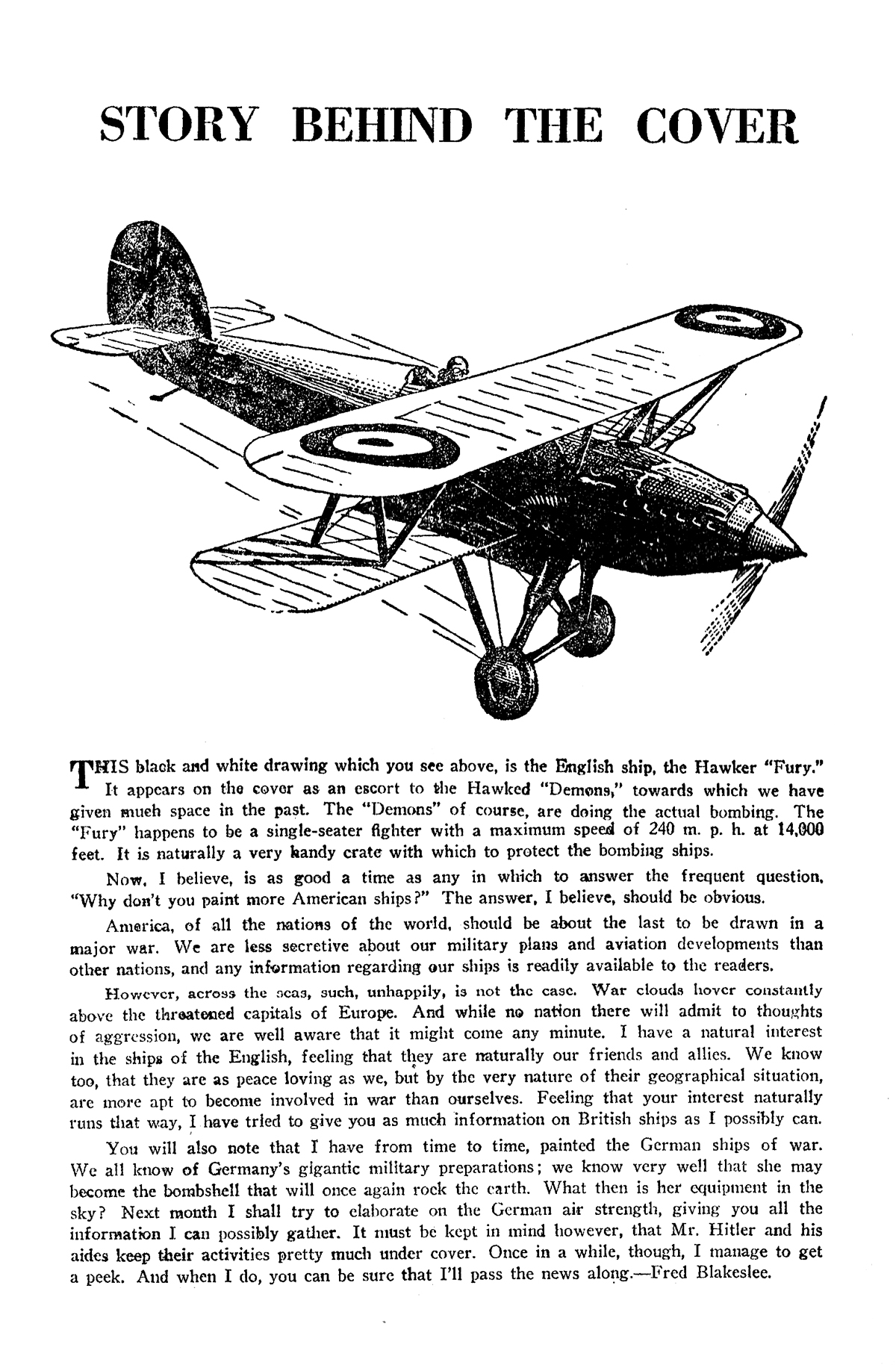
th_DDA_3610THIS black and white drawing which you see above, is the English ship, the Hawker “Fury.” It appears on the cover as an escort to the Hawker “Demons,” towards which we have given much space in the past. The “Demons” of course, are doing the actual bombing. The “Fury” happens to be a single-seater fighter with a maximum speed of 240 m.p.h. at 14,000 feet. It is naturally a very handy crate with which to protect the bombing ships.

Now, I believe, is as good a time as any in which to answer the frequent question, “Why don’t you paint more American ships?” The answer, I believe, should be obvious.

America, of all the nations of the world, should be about the last to be drawn in a major war. We are less secretive about our military plans and aviation developments than other nations, and any information regarding our ships is readily available to the readers.

However, across the seas, such, unhappily, is not the case. War clouds hover constantly above the threatened capitals of Europe. And while no nation there will admit to thoughts of aggression, we are well aware that it might come any minute. I have a natural interest in the ships of the English, feeling that they are naturally our friends and allies. We know too, that they are as peace loving as we, but by the very nature of their geographical situation, are more apt to become involved in war than ourselves. Feeling that your interest naturally runs that way, I have tried to give you as much information on British ships as I possibly can.

You will also note that I have from time to time, painted the German ships of war. We all know of Germany’s gigantic military preparations; we know very well that she may become the bombshell that will once again rock the earth. What then is her equipment in the sky? Next month I shall try to elaborate on the German air strength, giving you all the information I can possibly gather. It must be kept in mind however, that Mr. Hitler and his aides keep their activities pretty much under cover. Once in a while, though, I manage to get a peek. And when I do, you can be sure that I’ll pass the news along.

Fred Blakeslee

The Story Behind The Cover
“The Hawker Fury: The Story Behind The Cover” by Frederick Blakeslee
(October 1936, Dare-Devil Aces)

“The Overstrand” by Frederick Blakeslee

Link - Posted by David on August 21, 2017 @ 6:00 am in

Frederick Blakeslee painted all the covers for the entire run of Dare-Devil Aces. And each of those covers had a story behind it. On Dare-Devil Aces’ September 1936 cover, Mr. Blakeslee gives us his two favorite things to paint—planes and trains—in this case a couple Boulton Paul Overstrands attacking a train depot!

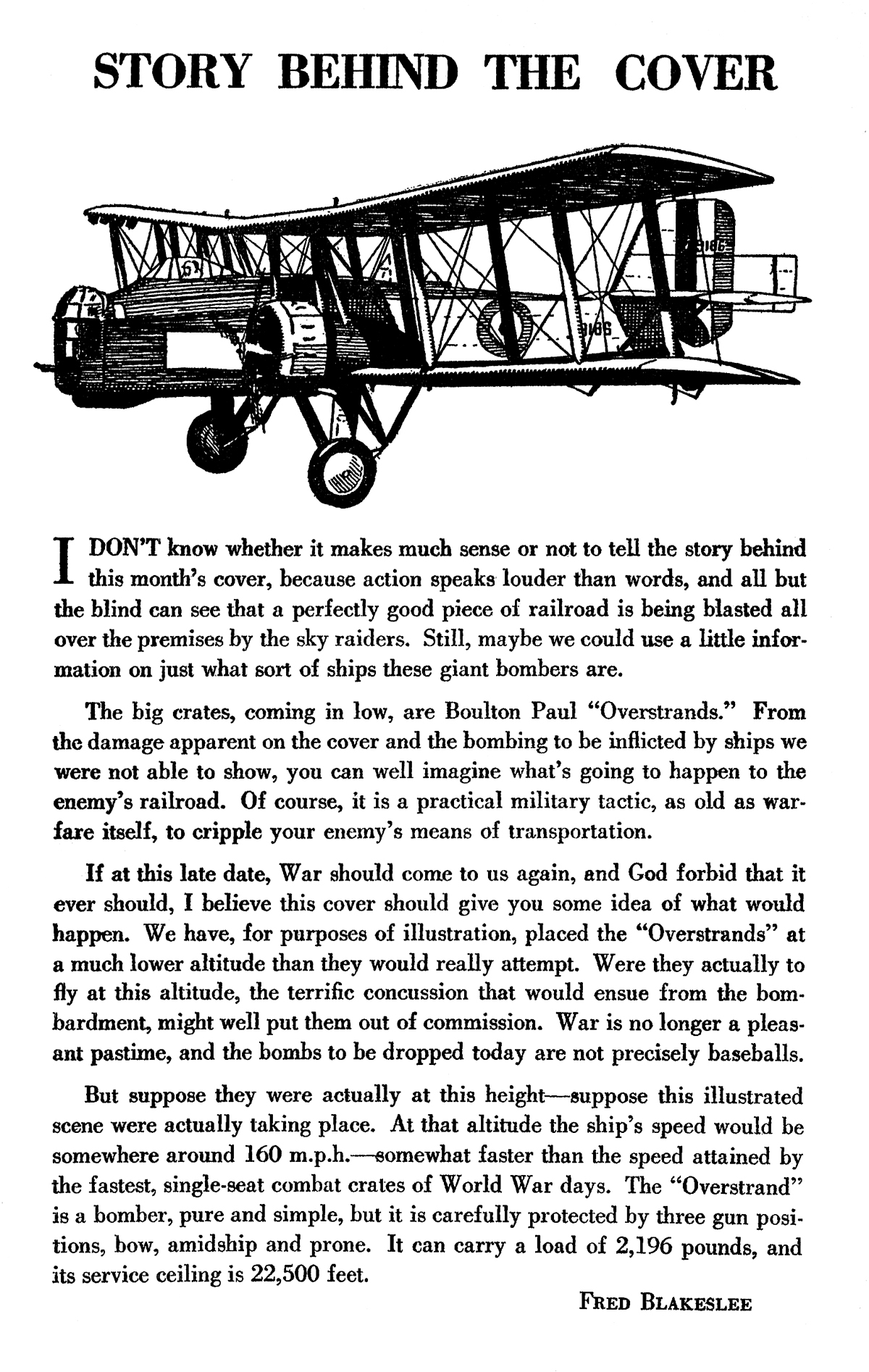
th_DDA_3609I DON’T know whether it makes much sense or not to tell the story behind this month’s cover, because action speaks louder than words, and all but the blind can see that a perfectly good piece of railroad is being blasted all over the premises by the sky raiders. Still, maybe we could use a little information on just what sort of ships these giant bombers are.

The big crates, coming in low, are Boulton Paul “Overstrands.” From the damage apparent on the cover and the bombing to be inflicted by ships we were not able to show, you can well imagine what’s going to happen to the enemy’s railroad. Of course, it is a practical military tactic, as old as warfare itself, to cripple your enemy’s means of transportation.

If at this late date, War should come to us again, and God forbid that it ever should, I believe this cover should give you some idea of what would happen. We have, for purposes of illustration, placed the “Overstrands” at a much lower altitude than they would really attempt. Were they actually to fly at this altitude, the terrific concussion that would ensue from the bombardment, might well put them out of commission. War is no longer a pleasant pastime, and the bombs to be dropped today are not precisely baseballs.

But suppose they were actually at this height—suppose this illustrated scene were actually taking place. At that altitude the ship’s speed would be somewhere around 160 m.p.h.—somewhat faster than the speed attained by the fastest, single-seat combat crates of World War days. The “Overstrand” is a bomber, pure and simple, but it is carefully protected by three gun positions, bow, amidship and prone. It can carry a load of 2,196 pounds, and its service ceiling is 22,500 feet.

Fred Blakeslee

The Story Behind The Cover
“The Overstrand: The Story Behind The Cover” by Frederick Blakeslee
(September 1936, Dare-Devil Aces)

“The Fairey Hendon Night Bomber” by Frederick Blakeslee

Link - Posted by David on August 7, 2017 @ 6:00 am in

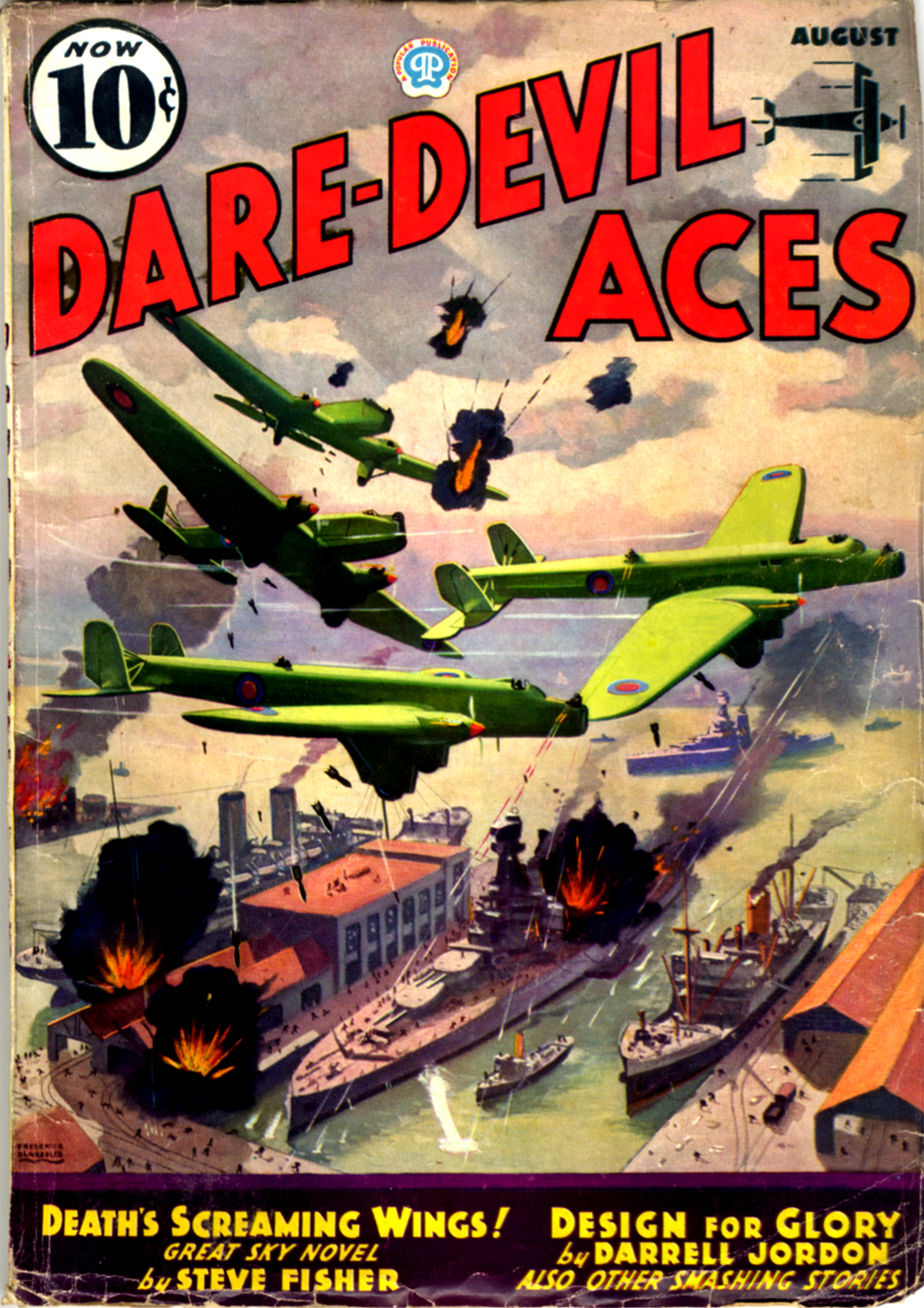
Frederick Blakeslee painted all the covers for the entire run of Dare-Devil Aces. And each of those covers had a story behind it. On Dare-Devil Aces’ August 1936 cover, Mr. Blakeslee has painted a squadron of Fairey Hendon Night Bombers doing what they do best!

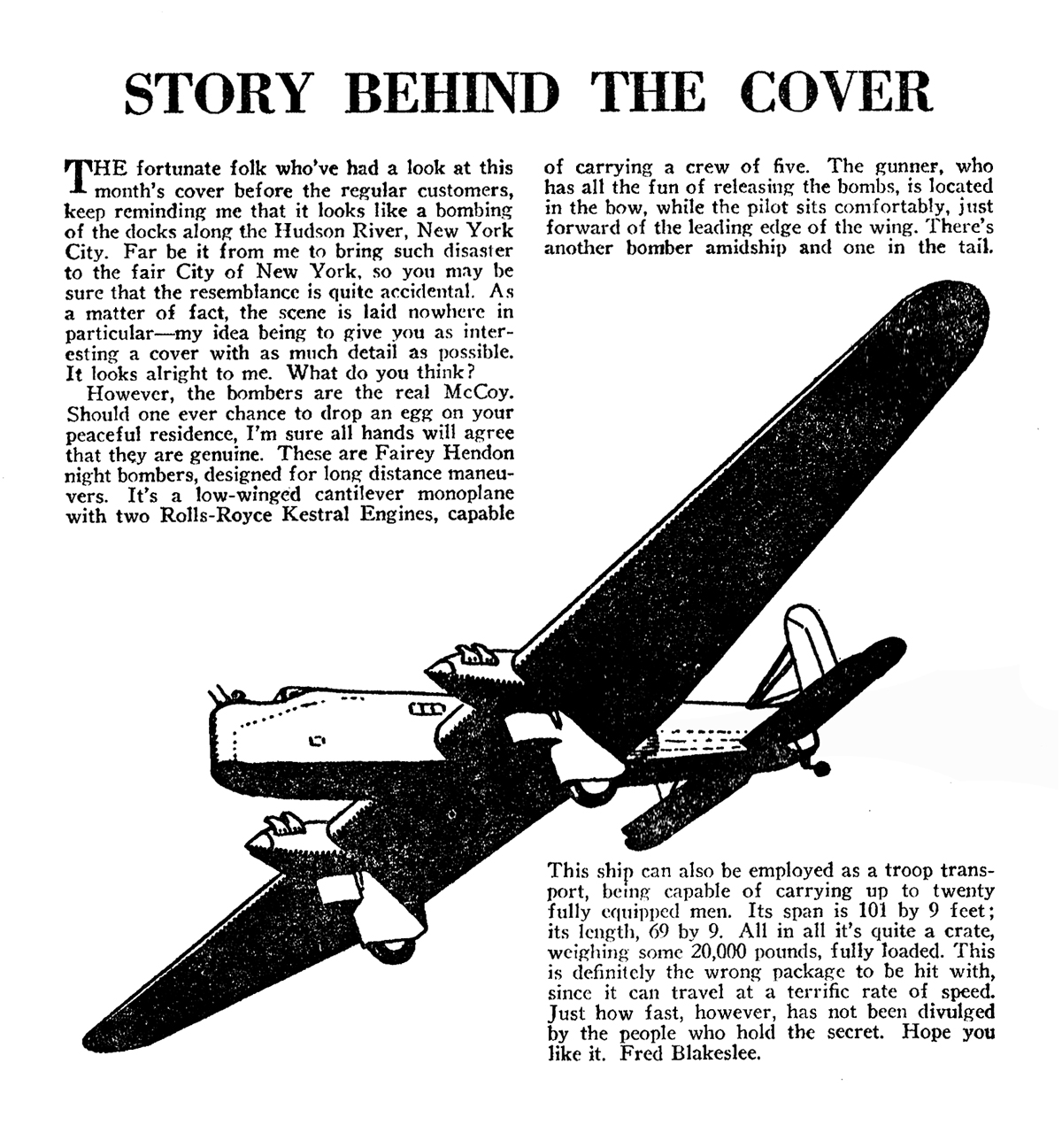
th_DDA_3608THE fortunate folk who’ve had a look at this month’s cover before the regular customers, keep reminding me that it looks like a bombing of the docks along the Hudson River, New York City. Far be it from me to bring such disaster to the fair City of New York, so you may be sure that the resemblance is quite accidental. As a matter of fact, the scene is laid nowhere in particular—my idea being to give you as interesting a cover with as much detail as possible. It looks alright to me. What do you think?

However, the bombers are the real McCoy. Should one ever chance to drop an egg on your peaceful residence, I’m sure all hands will agree that they are genuine. These are Fairey Hendon night bombers, designed for long distance maneuvers. It’s a low-winged cantilever monoplane with two Rolls-Royce Kestral Engines, capable of carrying a crew of five. The gunner, who has all the fun of releasing the bombs, is located in the bow, while the pilot sits comfortably, just forward of the leading edge of the wing. There’s another bomber amidship and one in the tail. This ship can also be employed as a troop transport, being capable of carrying up to twenty fully equipped men. Its span is 101 by 9 feet; its length, 69 by 9. All in all it’s quite a crate, weighing some 20,000 pounds, fully loaded. This is definitely the wrong package to be hit with, since it can travel at a terrific rate of speed. Just how fast, however, has not been divulged by the people who hold the secret. Hope you like it. Fred Blakeslee.

The Story Behind The Cover
“The Fairey Hendon Night Bomber: The Story Behind The Cover” by Frederick Blakeslee
(August 1936, Dare-Devil Aces)

“The Hanriot-Biche Pursuit” by Frederick Blakeslee

Link - Posted by David on July 10, 2017 @ 6:00 am in

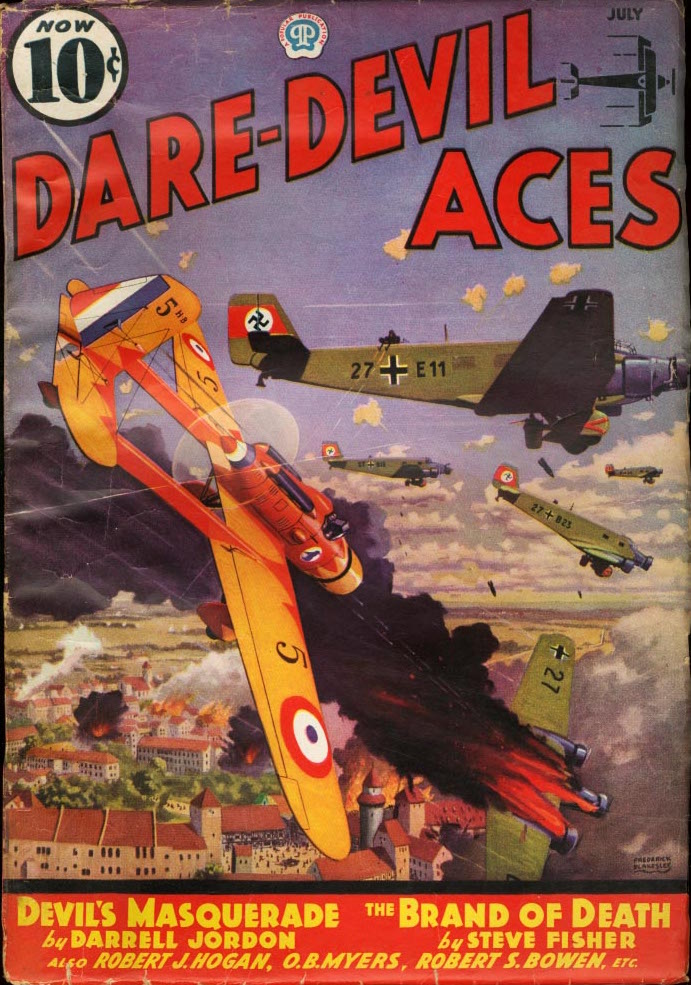
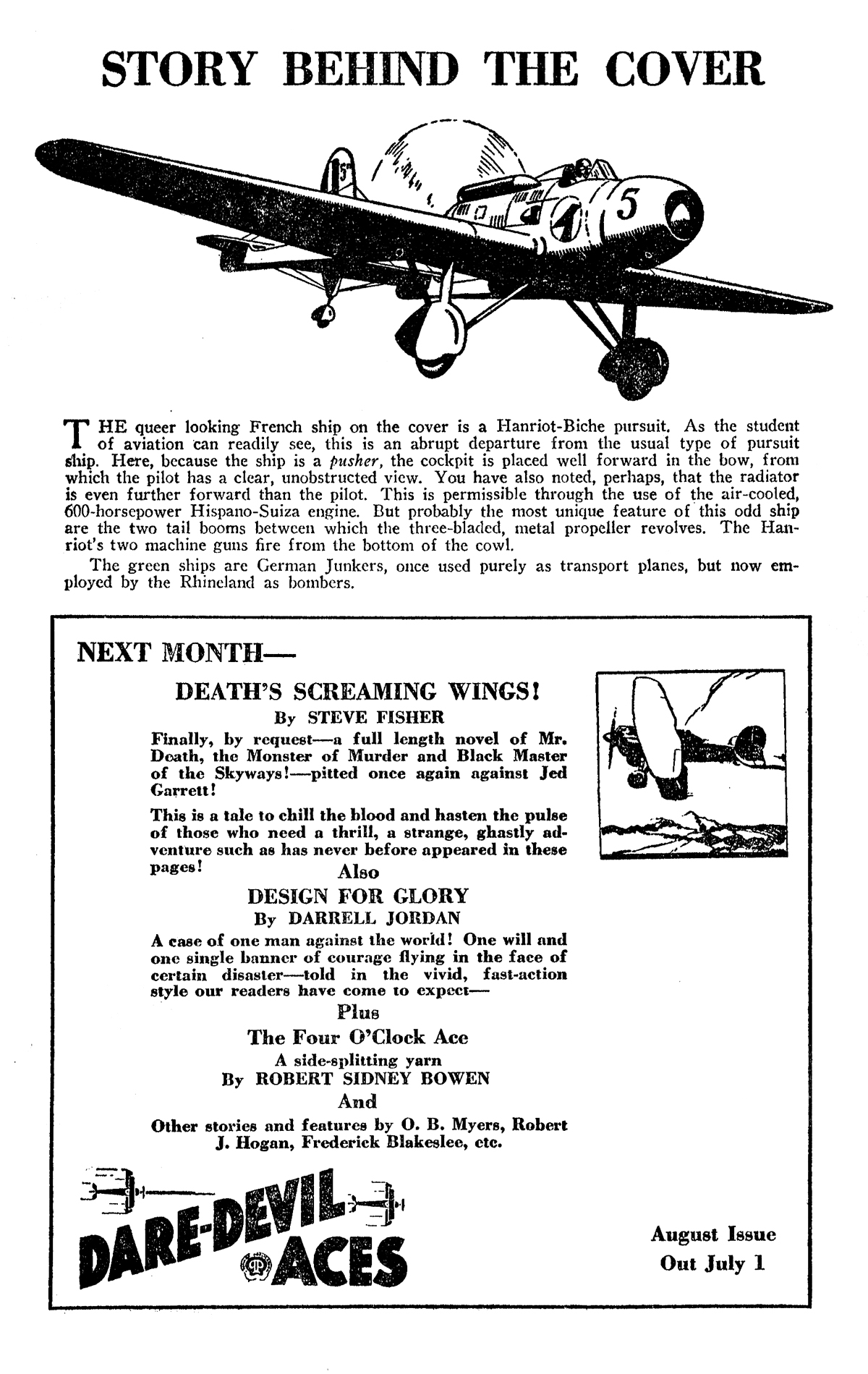
Frederick Blakeslee painted all the covers for the entire run of Dare-Devil Aces. And each of those covers had a story behind it. On Dare-Devil Aces’ July 1936 cover, Mr. Blakeslee depicts a French Hanriot-Biche pursuit plane attacking a flight of German Junkers!

th_DDA_3607THE queer looking French ship on the cover is a Hanriot-Biche pursuit. As the student of aviation can readily see, this is an abrupt departure from the usual type of pursuit ship. Here, because the ship is a pusher, the cockpit is placed well forward in the bow, from which the pilot has a clear, unobstructed view. You have also noted, perhaps, that the radiator is even further forward than the pilot. This is permissible through the use of the air-cooled, 600-horsepower Hispano-Suiza engine. But probably the most unique feature of this odd ship are the two tail booms between which the three-bladed, metal propeller revolves. The Hanriot’s two machine guns fire from the bottom of the cowl.

The green ships are German Junkers, once used purely as transport planes, but now employed by the Rhineland as bombers.

The Story Behind The Cover
“The Hanriot-Biche Pursuit: The Story Behind The Cover” by Frederick Blakeslee
(July 1936, Dare-Devil Aces)

“The Bristol Bulldog” by Frederick Blakeslee

Link - Posted by David on June 26, 2017 @ 6:00 am in

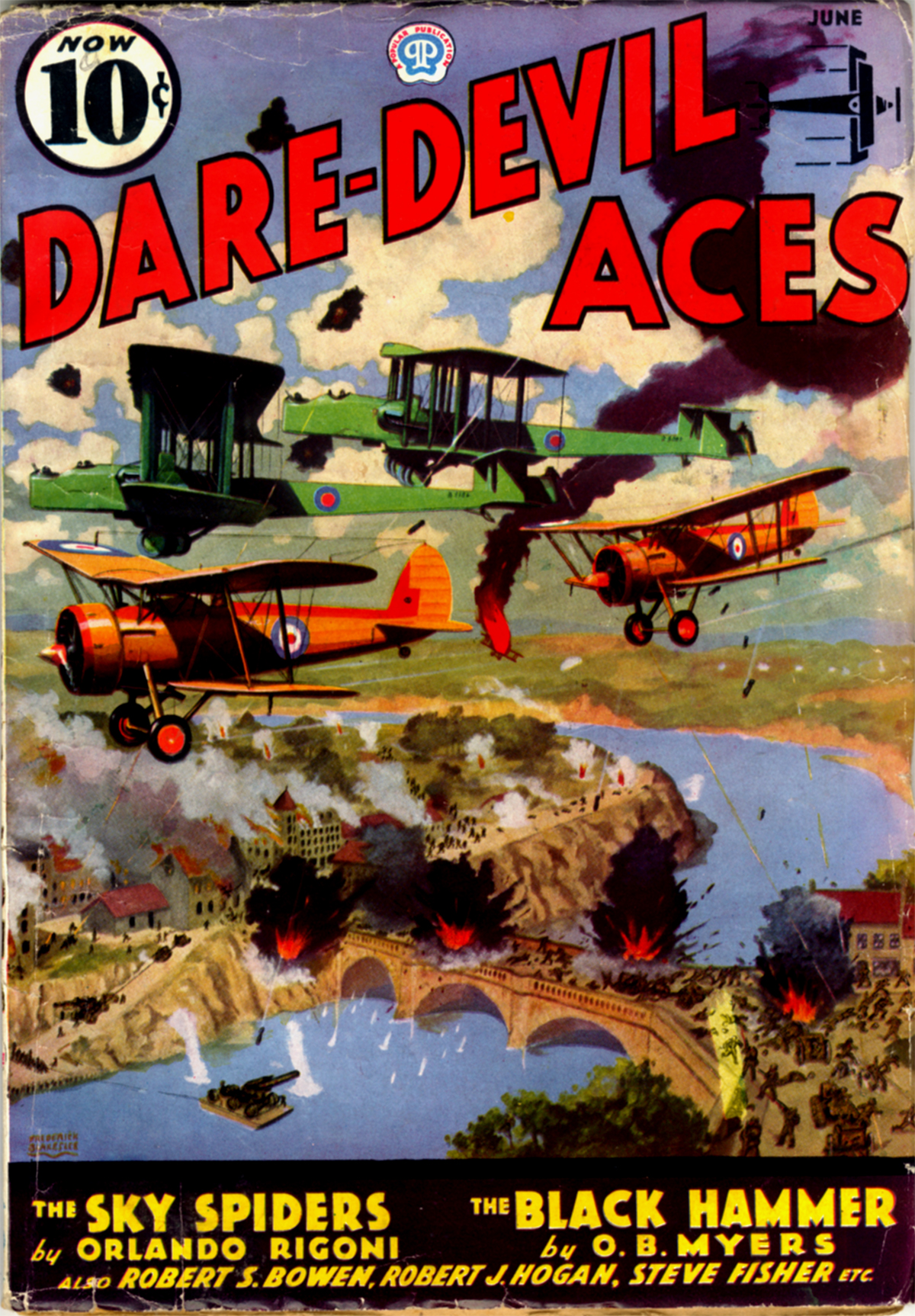
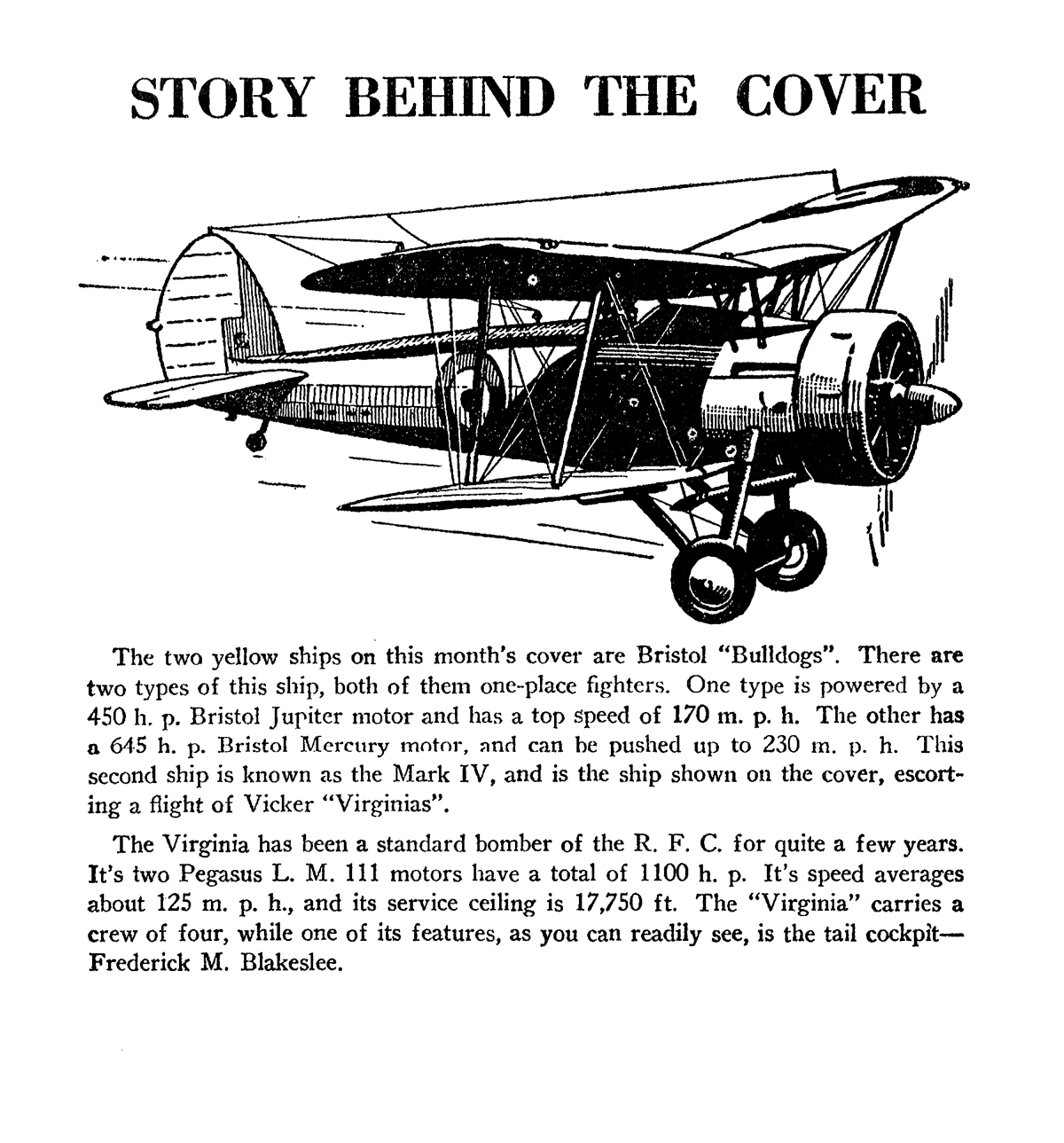
Frederick Blakeslee painted all the covers for the entire run of Dare-Devil Aces. And each of those covers had a story behind it. On Dare-Devil Aces’ June 1936 cover, Mr. Blakeslee has painted a couple of Bristol Bulldogs escorting a flight of Vickers Virginias!

th_DDA_3606THE two yellow ships on this month’s cover are Bristol “Bulldogs”. There are two types of this ship, both of them one-place fighters. One type is powered by a 450 h.p. Bristol Jupiter motor and has a top speed of 170 m.p.h. The other has a 645 h.p. Bristol Mercury motor, and can be pushed up to 230 m.p.h. This second ship is known as the Mark IV, and is the ship shown on the cover, escorting a flight of Vicker “Virginias”.

The Virginia has been a standard bomber of the R.F.C. for quite a few years. It’s two Pegasus L.M. 111 motors have a total of 1100 h.p. It’s speed averages about 125 m.p.h., and its service ceiling is 17,750 ft. The “Virginia” carries a crew of four, while one of its features, as you can readily see, is the tail cockpit— Frederick M. Blakeslee.

The Story Behind The Cover
“The Bristol Bulldog: The Story Behind The Cover” by Frederick Blakeslee
(June 1936, Dare-Devil Aces)

“The Hawker Demon” by Frederick Blakeslee

Link - Posted by David on June 12, 2017 @ 6:00 am in

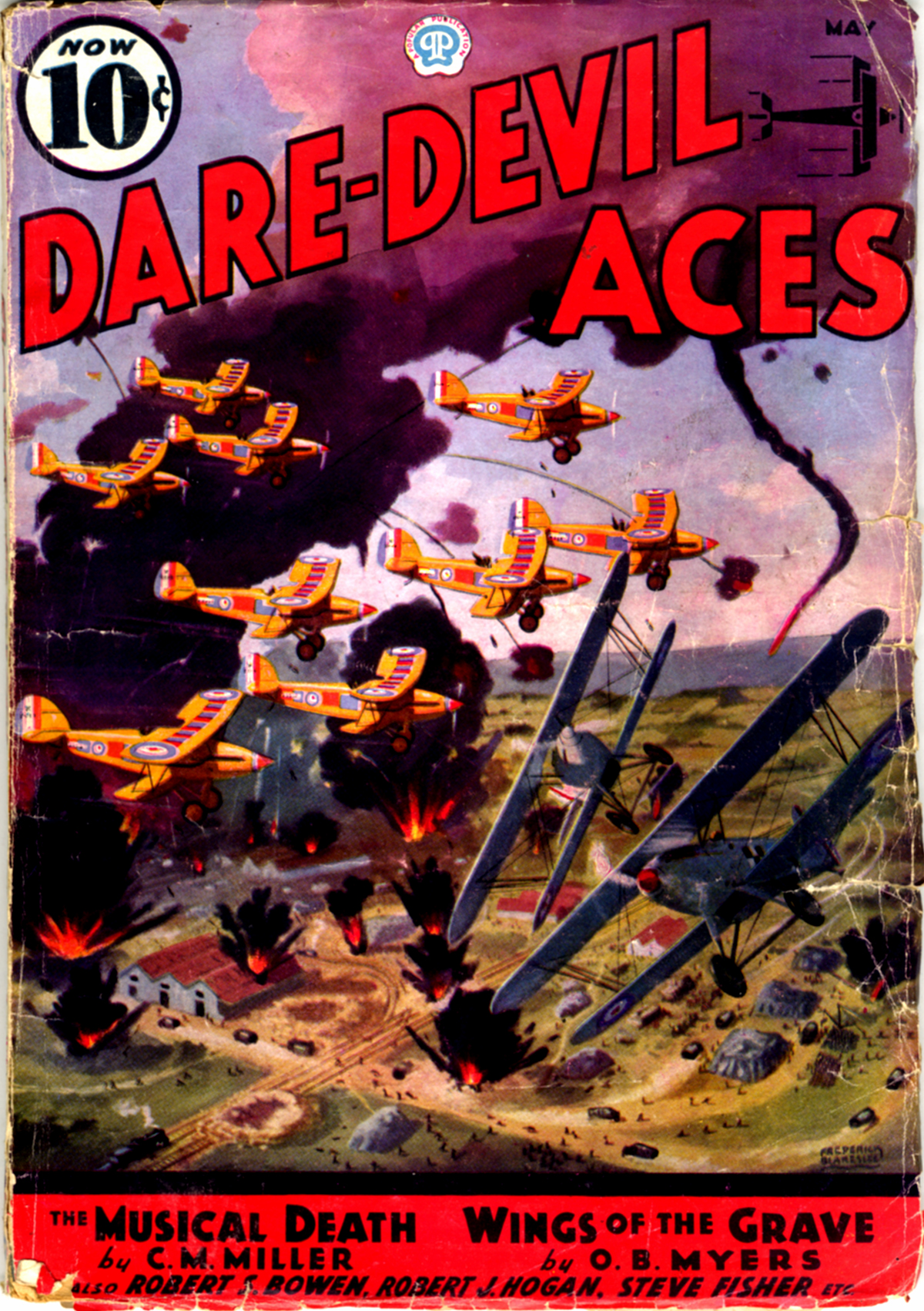
Frederick Blakeslee painted all the covers for the entire run of Dare-Devil Aces. And each of those covers had a story behind it. On Dare-Devil Aces’ May 1936 cover, Mr. Blakeslee has painted a flight of Hawker Demons bombing an enemy ammunitions dump!

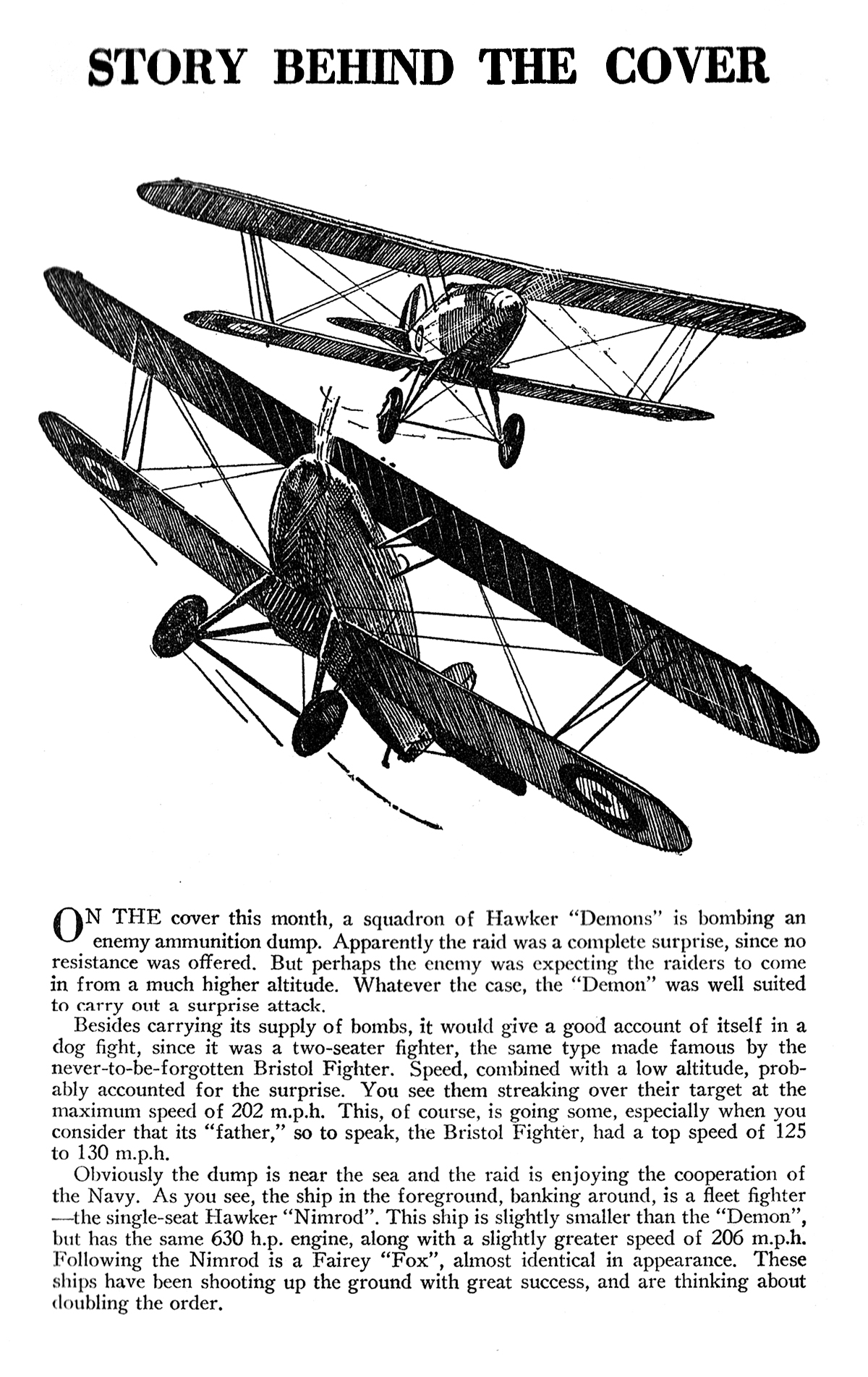
th_DDA_3605ON THE cover this month, a squadron of Hawker “Demons” is bombing an enemy ammunition dump. Apparently the raid was a complete surprise, since no resistance was offered. But perhaps the enemy was expecting the raiders to come in from a much higher altitude. Whatever the case, the “Demon” was well suited to carry out a surprise attack.

Besides carrying its supply of bombs, it would give a good account of itself in a dog fight, since it was a two-seater fighter, the same type made famous by the never-to-be-forgotten Bristol Fighter. Speed, combined with a low altitude, probably accounted for the surprise. You see them streaking over their target at the maximum speed of 202 m.p.h. This, of course, is going some, especially when you consider that its “father,” so to speak, the Bristol Fighter, had a top speed of 125 to 130 m.p.h.

Obviously the dump is near the sea and the raid is enjoying the cooperation of the Navy. As you see, the ship in the foreground, banking around, is a fleet fighter —the single-seat Hawker “Nimrod”. This ship is slightly smaller than the “Demon”, but has the same 630 h.p. engine, along with a slightly greater speed of 206 m.p.h. Following the Nimrod is a Fairey “Fox”, almost identical in appearance. These ships have been shooting up the ground with great success, and are thinking about doubling the order.

The Story Behind The Cover
“The Hawker Demon: The Story Behind The Cover” by Frederick Blakeslee
(May 1936, Dare-Devil Aces)

“The Gloster Gauntlets” by Frederick Blakeslee

Link - Posted by David on May 29, 2017 @ 6:00 am in

Frederick Blakeslee painted all the covers for the entire run of Dare-Devil Aces. And each of those covers had a story behind it. On Dare-Devil Aces’ April 1936 cover, Mr. Blakeslee has painted a flight of Gloster “Gauntlets” protecting a Handly-Page Heyford on a bombing mission!

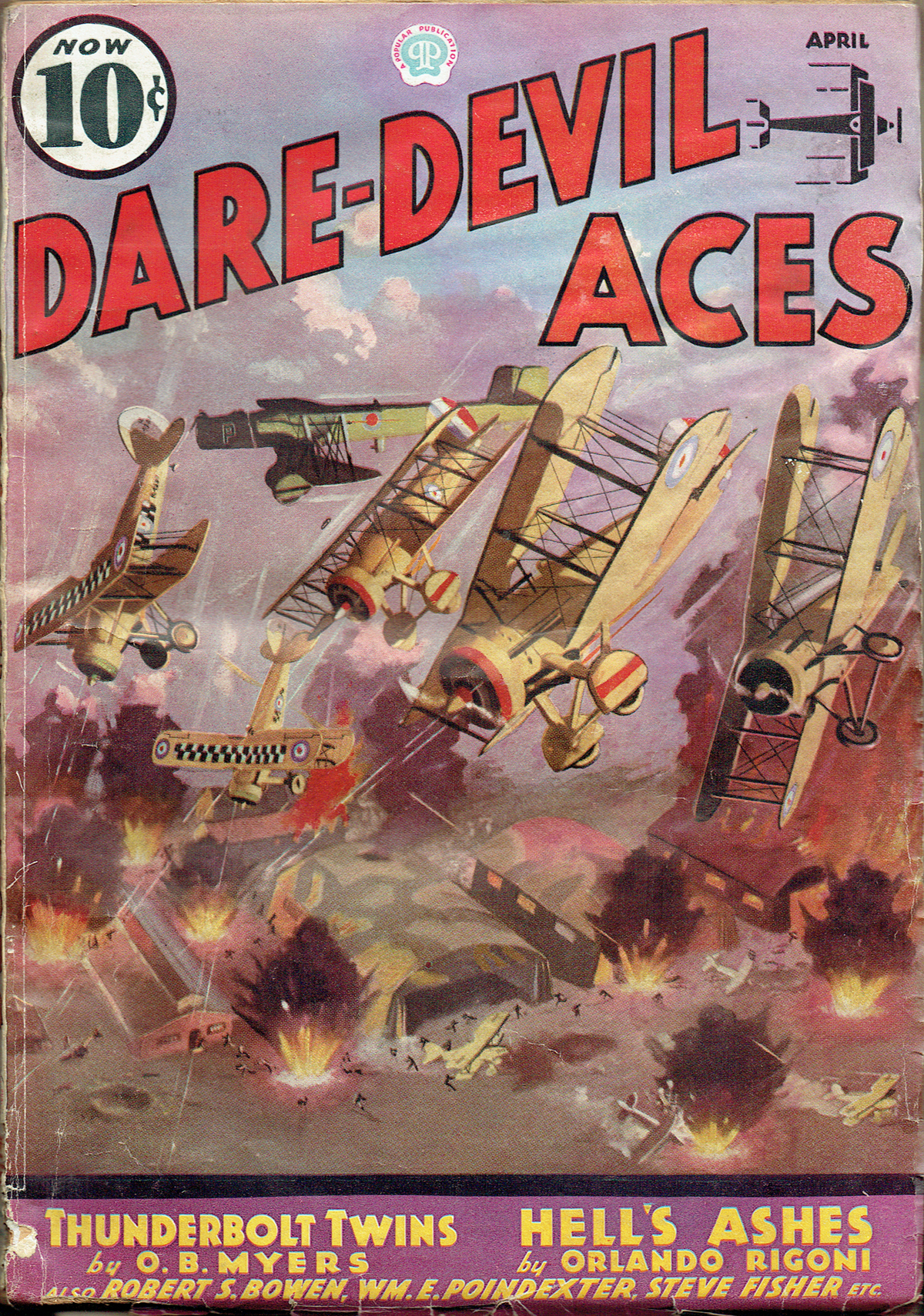
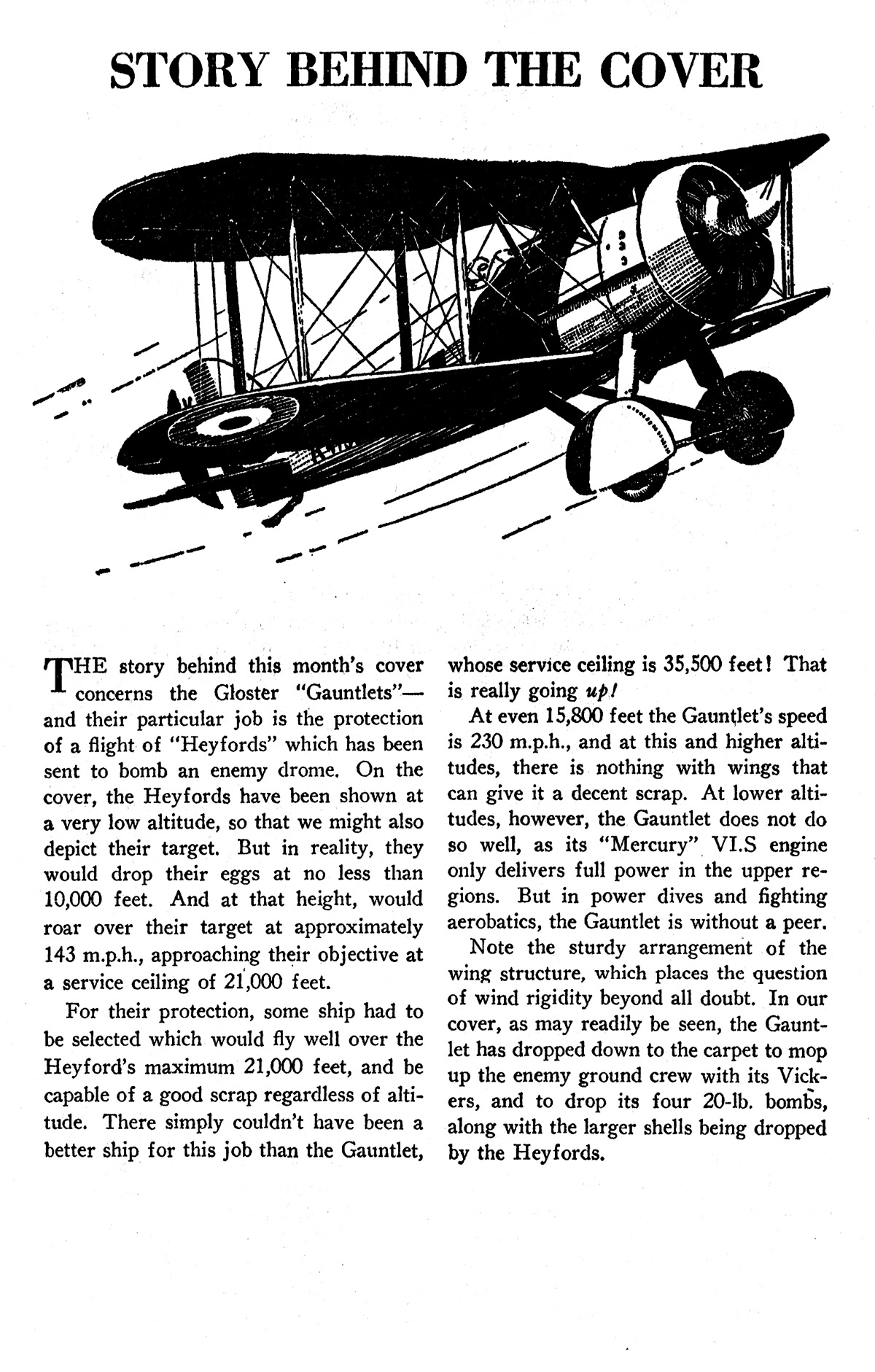
th_DDA_3604THE STORY behind this month’s cover concerns the Gloster “Gauntlets”— and their particular job is the protection of a flight of “Heyfords” which has been sent to bomb an enemy drome. On the cover, the Heyfords have been shown at a very low altitude, so that we might also depict their target. But in reality, they would drop their eggs at no less than 10,000 feet. And at that height, would roar over their target at approximately 143 m.p.h., approaching their objective at a service ceiling of 21,000 feet.

For their protection, some ship had to be selected which would fly well over the Heyford’s maximum 21,000 feet, and be capable of a good scrap regardless of altitude. There simply couldn’t have been a better ship for this job than the Gauntlet, whose service ceiling is 35,500 feet! That is really going up!

At even 15,800 feet the Gauntlet’s speed is 230 m.p.h., and at this and higher altitudes, there is nothing with wings that can give it a decent scrap. At lower altitudes, however, the Gauntlet does not do so well, as its “Mercury” VI.S engine only delivers full power in the upper regions. But in power dives and fighting aerobatics, the Gauntlet is without a peer.

Note the sturdy arrangement of the wing structure, which places the question of wind rigidity beyond all doubt. In our cover, as may readily be seen, the Gauntlet has dropped down to the carpet to mop up the enemy ground crew with its Vickers, and to drop its four 20-lb. bombs, along with the larger shells being dropped by the Heyfords.

The Story Behind The Cover
“The Gloster Gauntlets: The Story Behind The Cover” by Frederick Blakeslee
(April 1936, Dare-Devil Aces)

“H.P.47″ by Frederick Blakeslee

Link - Posted by David on May 15, 2017 @ 6:00 am in

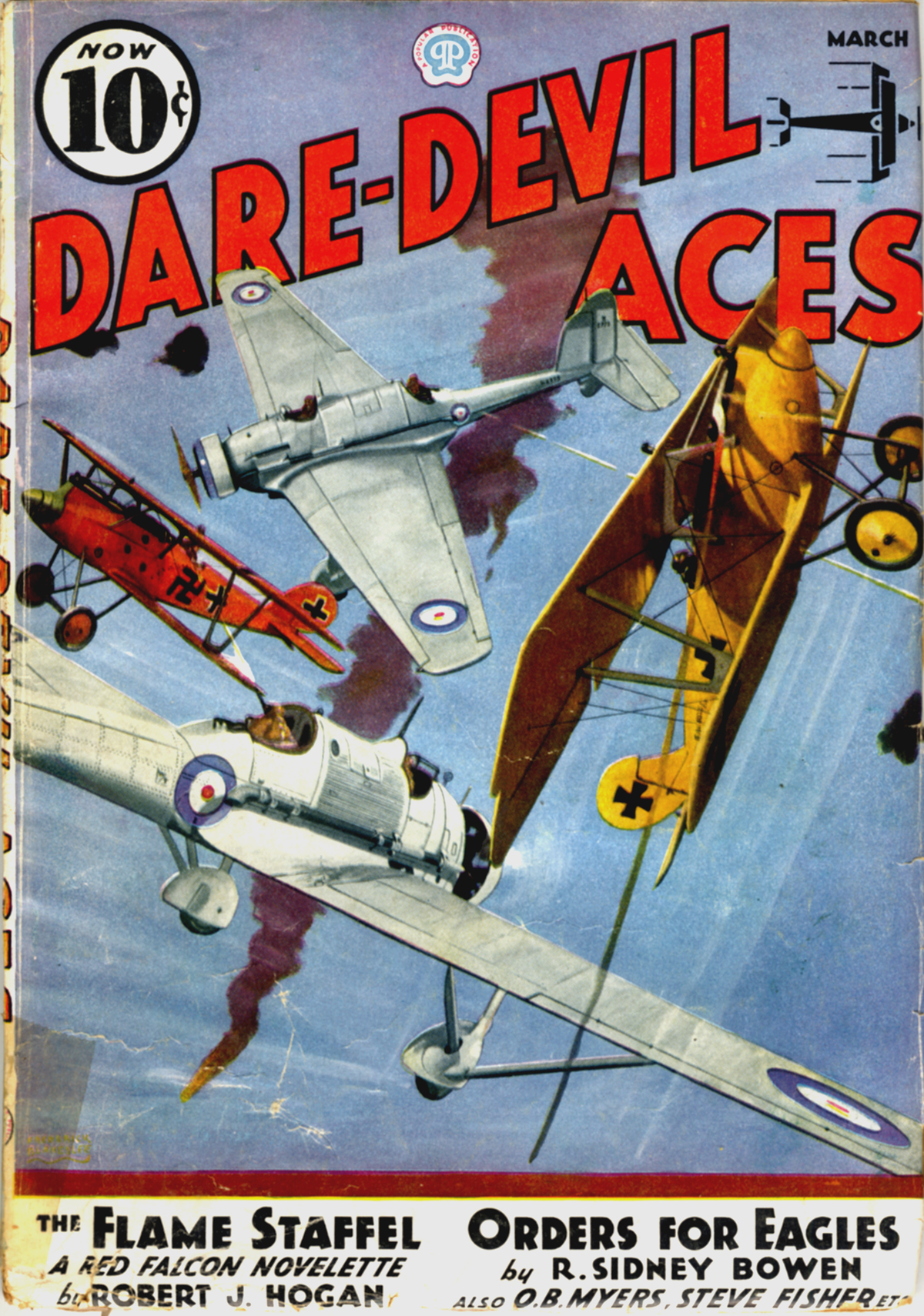
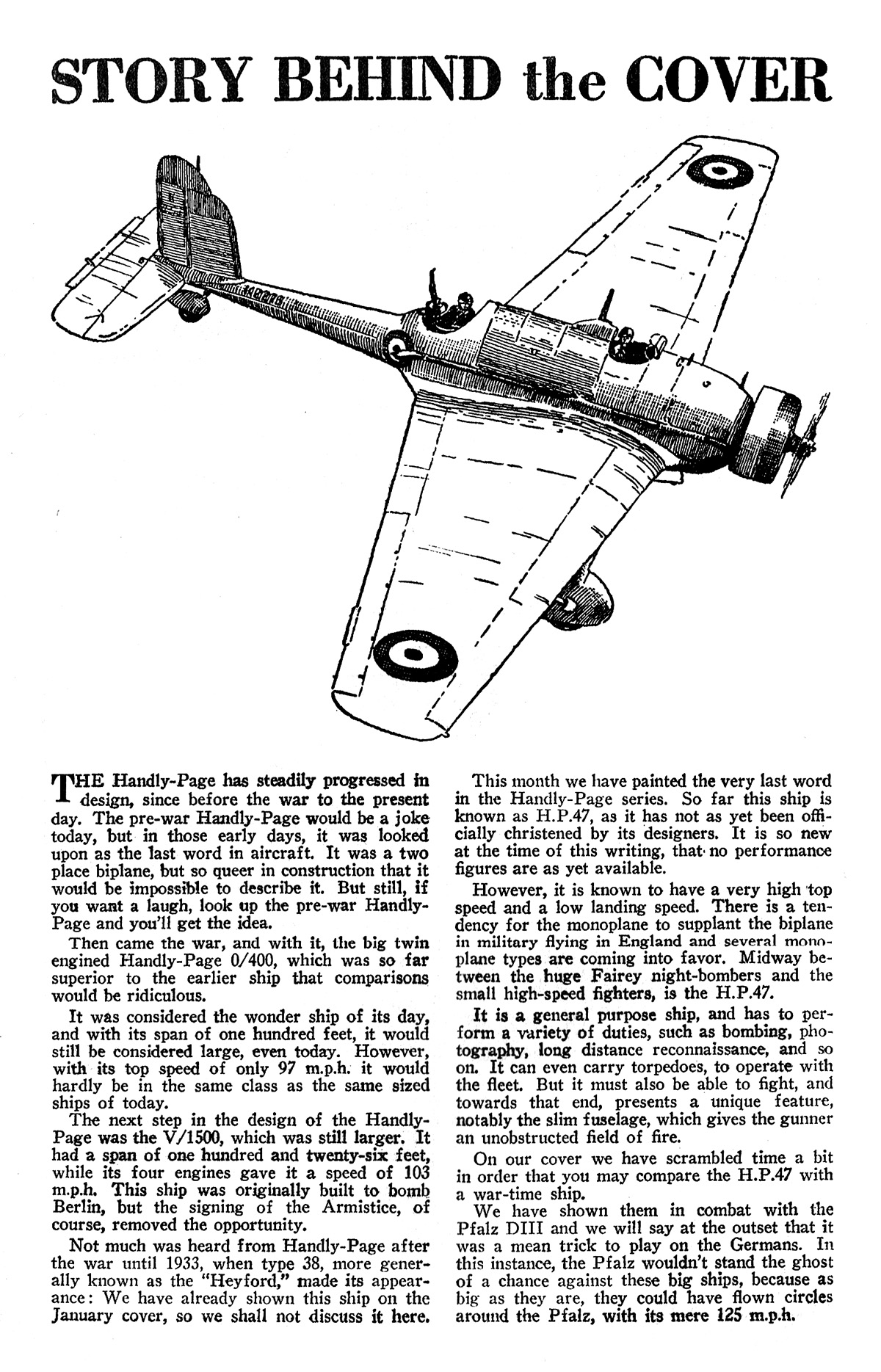
Frederick Blakeslee painted all the covers for the entire run of Dare-Devil Aces. And each of those covers had a story behind it. This time Mr. Blakeslee brings another of his “scrambled time” covers pitting planes of the great war against modern day planes (those from the 1930’s), from the March 1936 issue of Dare-Devil Aces it’s a plane so new it doesn’t have a name yet—The Handly-Page 47!

th_DDA_3603THE HANDLY-PAGE has steadily progressed in design, since before the war to the present day. The pre-war Handly-Page would be a joke today, but in those early days, it was looked upon as the last word in aircraft. It was a two place biplane, but so queer in construction that it would be impossible to describe it. But still, if you want a laugh, look up the pre-war Handly-Page and you’ll get the idea.

Then came the war, and with it, the big twin engined Handly-Page 0/400, which was so far superior to the earlier ship that comparisons would be ridiculous.

It was considered the wonder ship of its day, and with its span of one hundred feet, it would still be considered large, even today. However, with its top speed of only 97 m.p.h. it would hardly be in the same class as the same sized ships of today.

The next step in the design of the Handly-Page was the V/1500, which was still larger. It had a span of one hundred and twenty-six feet, while its four engines gave it a speed of 103 m.p.h. This ship was originally built to bomb Berlin, but the signing of the Armistice, of course, removed the opportunity.

Not much was heard from Handly-Page after the war until 1933, when type 38, more generally known as the “Heyford,” made its appearance : We have already shown this ship on the January cover, so we shall not discuss it here.

This month we have painted the very last word in the Handly-Page series. So far this ship is known as H.P.47, as it has not as yet been officially christened by its designers. It is so new at the time of this writing, that no performance figures are as yet available.

However, it is known to have a very high top speed and a low landing speed. There is a tendency for the monoplane to supplant the biplane in military flying in England and several monoplane types are coming into favor. Midway between the huge Fairey night-bombers and the small high-speed fighters, is the H.P.47.

It is a general purpose ship, and has to perform a variety of duties, such as bombing, photography, long distance reconnaissance, and so on. It can even carry torpedoes, to operate with the fleet. But it must also be able to fight, and towards that end, presents a unique feature, notably the slim fuselage, which gives the gunner an unobstructed field of fire.

On our cover we have scrambled time a bit in order that you may compare the H.P.47 with a war-time ship.

We have shown them in combat with the Pfalz DIII and we will say at the outset that it was a mean trick to play on the Germans. In this instance, the Pfalz wouldn’t stand the ghost of a chance against these big ships, because as big as they are, they could have flown circles around the Pfalz, with its mere 125 m.p.h.

The Story Behind The Cover
“H.P.47: The Story Behind The Cover” by Frederick Blakeslee
(March 1936, Dare-Devil Aces)

« Previous PageNext Page »