


Looking to buy? See our books on amazon.com Get Reading Now! Age of Aces Presents - free pulp PDFs

The Story Behind The Cover


“Sky Fighters, October 1934″ by Eugene M. Frandzen

Link - Posted by David on May 2, 2016 @ 6:00 am in

Eugene M. Frandzen painted the covers of Sky Fighters from its first issue in 1932 until he moved on from the pulps in 1939. At this point in the run, the covers were about the planes featured on the cover more than the story depicted. On the October 1934 cover, It’s the Halberstadt C.L.2 vs the Avro “Spider”!

The Ships on the Cover

THE Halberstadt C.L.2 was, th_SF_3410 with its sister ship the C.L.4, a bright spot in Germany’s output of two-seater fighters. It was simpler in design than most of the German ships of this type; probably thereby lays the reason for its very good performance. Kicking over 1,385 r.p.m.’s at 10,000 feet, it could travel at around 100 m.p.h. It was not so hot on climbing, but was light on its controls and could be maneuvered with ease.

The other ship on the cover is the Avro “Spider,” a job turned out by the famous A.V. Roe & Co., Ltd. It had “It” when it came to speed, maneuverability, and climb. Its trick triangular system of inter-plane bracing obviated the use of flying or landing wires. And when it came to visibility that “one holer” in the top wing gave the pilot a look-see up and ahead. Even downward vision was good as the chord of the lower wing was very narrow.

Let’s slip back about half an hour before this crackup that’s pictured on the cover.

A Trophy of War

Consider yourself planked on an Allied tarmac. Out in front of number one hangar is a captured German ship; a Halberstadt. A group of British aviators are standing around admiring their trophy. Greaseballs have tuned her up, she is idling beautifully. One of them with three pots of colors is ready to paint the British cocardes on this German ship. There is darn good reason for this art work on captured machines. It’s to save the Allied test pilots who take up the captured ship back of the lines from getting popped down by some other Allied aviator who might think a German was at the stick.

Standing among the British aviators is a young man with a very dejected expression on his square face. His goggles are shoved back. His collar ornaments are German. To the Allied aviators, whose captive he is, he is just a flyer who happened to work for the wrong side. Much wine and spirits have trickled down all throats since the capture of the German. All hands are buddies, friends; in fact old pals. What if Fritz did pop at them from his Halberstadt? It was all in the game.

Just a Joy-Ride

“Let’s have a little ride in your old war chariot, Fritz,” suggested Lieutenant Mills, who had forced the German down.

So Fritz climbed in at the controls after it was certain his front and rear guns were harmless. Lt. Mills tucked a pistol into his pocket and heaved himself up on the side.

Smack!

Fritz fist clipped the Britisher on the button. The Mercedes roared. Dirt blasted into the other’s eyes on the ground.

An Avro roared throatily in the next hangar. Lt. Mills was in it in a jiffy, gunned the Bentley and blasted down the drag and up into the air. It took him twenty minutes to catch Fritz. Then came ten minutes of systematic sniping at engine and wings. Finally the Halberstadt’s engine sputtered, died. Down she came, flopping and shuddering. As her undercarriage hit the ground her wings folded and called it a day. Lt. Mills landed close by, rubbed his aching jaw and walked over to the wreck. Fritz crawled out, felt himself all over and indicated that he was not injured. He then shoved out his jaw and Lt. Mills carefully planked a beautiful right uppercut home. Fritz took it standing up and grinned.

Mills produced a flask—”Cheerio,” he grinned.

“Prosit,” replied Fritz.

The Ships on The Cover
Sky Fighters, October 1934 by Eugene M. Frandzen
(The Ships on The Cover Page)

Next time, Mr. Frandzen features the Fokker E.1 and the F.E.2!
“Sky Fighters, September 1934″ by Eugene M. Frandzen

Link - Posted by David on April 18, 2016 @ 6:00 am in

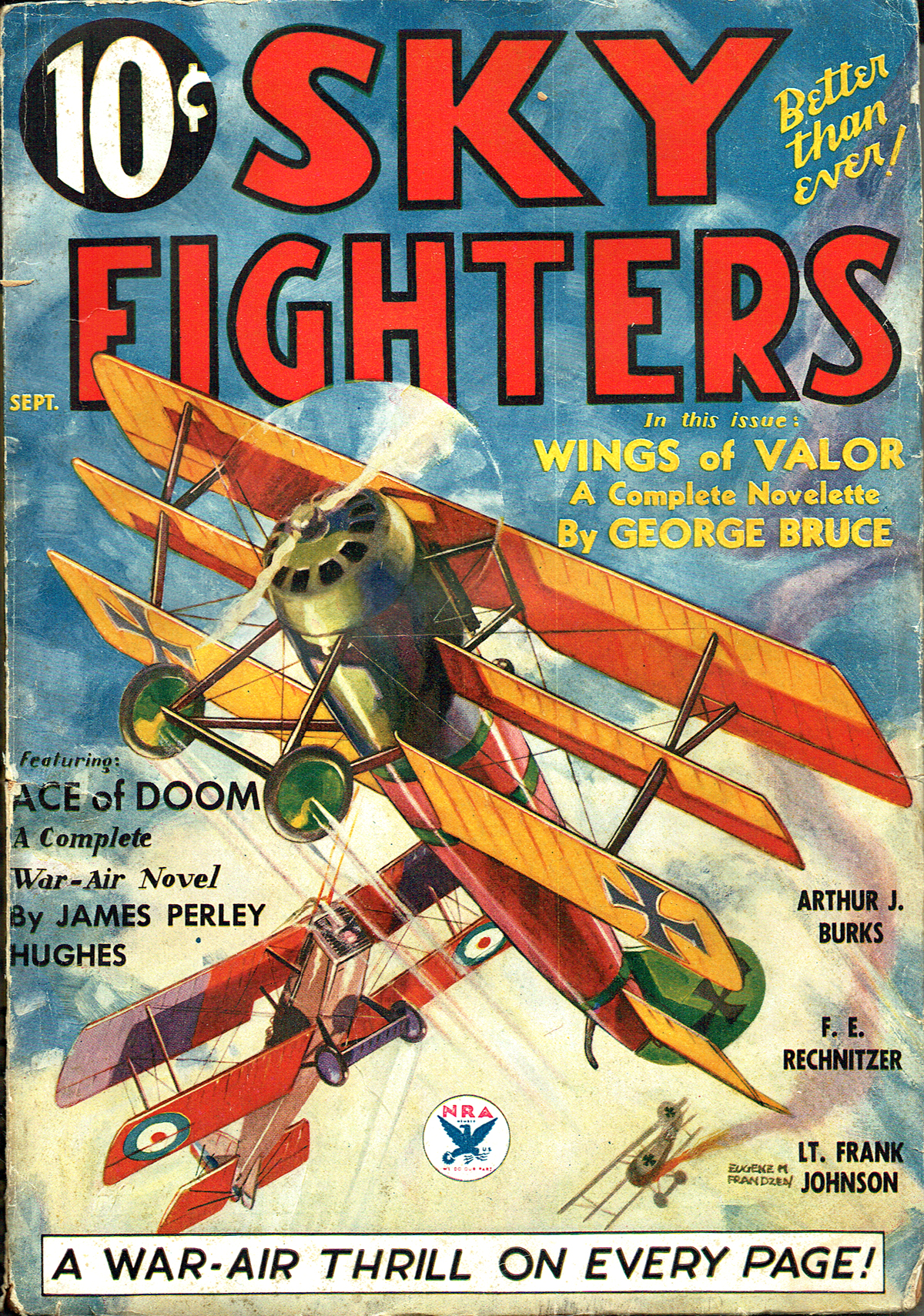
Eugene M. Frandzen painted the covers of Sky Fighters from its first issue in 1932 until he moved on from the pulps in 1939. At this point in the run, the covers were about the planes featured on the cover more than the story depicted. On the September 1934 cover, It’s the Pfalz Triplane vs the indomitable S.E.5!

The Ships on the Cover

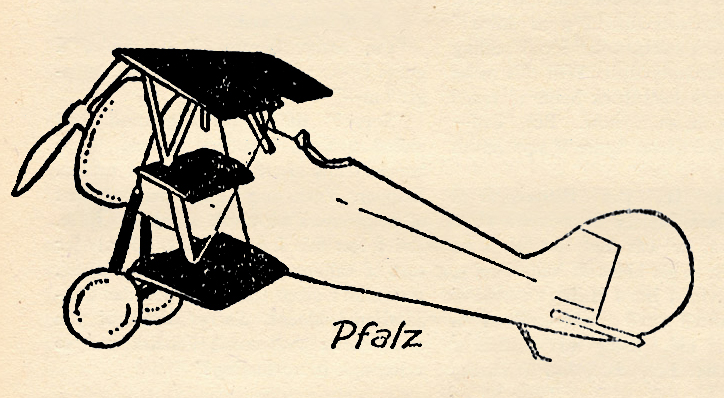
THE Pfalz Triplane was th_SF_3409 one of the neatest looking jobs among the number of multi-wing planes which all European countries experimented with during the late fracas Over There. The fuselage was exceptionally slick in proportion and line. If you can imagine the two top wings removed and the bottom wing having a much greater chord you will see a strong resemblance between this tripe of bygone war days and the Lockheed Sirius of modern times.

Those designers of a sixth of a century ago did some sweet visualizing far in advance of their time. If they’d have had engines as efficient as those of today to yank their stick and wire jobs through the clouds there’s no telling what the outcome of the air campaigns might have been.

Three Winged Crates

But we’re not as interested in the fuselage as in those three wings which make our Pfalz a Triplane or Dreideckcr. In building this type of ship the hope was for greater efficiency in all ways. They got it in some and lost it in others. In using three instead of one or two wings the chord and span could be reduced. Then the tail assembly could be pushed up closer to the wings, giving compactness and maneuverability. A single interplane strut could be used on each side, instead of the conventional double struts. The Pfalz used a combination of V strut and straight single strut. The top wing did most of the lifting work as the lower wings had a very narrow chord.

The Nieuport, Sopwith, Albatross and Fokker firms experimented with the triplane idea. Fokker undoubtedly was influenced by the Sopwith “tripe.” Some other manufacturers even went in for quadraplanes, and not to be outdone, one stuck on five planes which made the crate look like a flying stepladder.

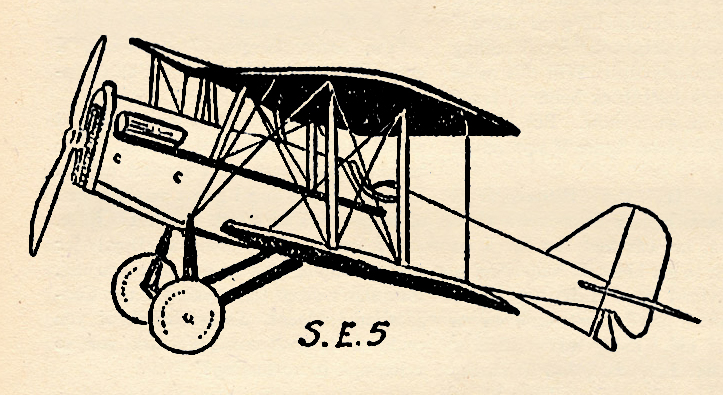
On the cover the Pfalz tripe in the foreground with the red belly has been tearing in and out of the ring-sights of the S.E.5. That fight started down low and gained altitude as the two ships circled and sparred with left and right guns.

Even Steven

The famous S.E.5 of British origin, one of their outstanding successes, has the edge on the tripe in many of their in and out maneuvers, but a triplane has a much reduced period of inertia in the horizontal plane; so therefore is able to slip from one dodging tactic to another quicker than the S.E.5. So it was about “even Steven” in this climbing fight.

Suddenly another Pfalz tripe hove into the scrap with spitting Spandaus. Just about the time it looked like curtains for the S.E.5 her pilot flopped his ship into a trick skidding turn and sprayed a drizzle of slugs into the second ship. Down it went smoking, out of control. Not contented with his one victory he repeated his maneuver on the surprised Boche in the foreground Pfalz. One quick burst from the Vickers sent bullets thudding into the German pilot. He died instantly with his nerveless hands and feet still holding his plane in a climbing circle.

The S.E.5 pilot followed for a moment then eased his plane aside and headed for home. Once he turned, raised his right hand in salute as he watched the triplane, now a tiny speck far above, still gracefully climbing into the blue dome of heaven.

The Ships on The Cover
Sky Fighters, September 1934 by Eugene M. Frandzen
(The Ships on The Cover Page)

Next time, Mr. Frandzen features the Halberstadt C.L.2 and the Avro Spider!

“Sky Fighters, August 1934″ by Eugene M. Frandzen

Link - Posted by David on April 4, 2016 @ 6:00 am in

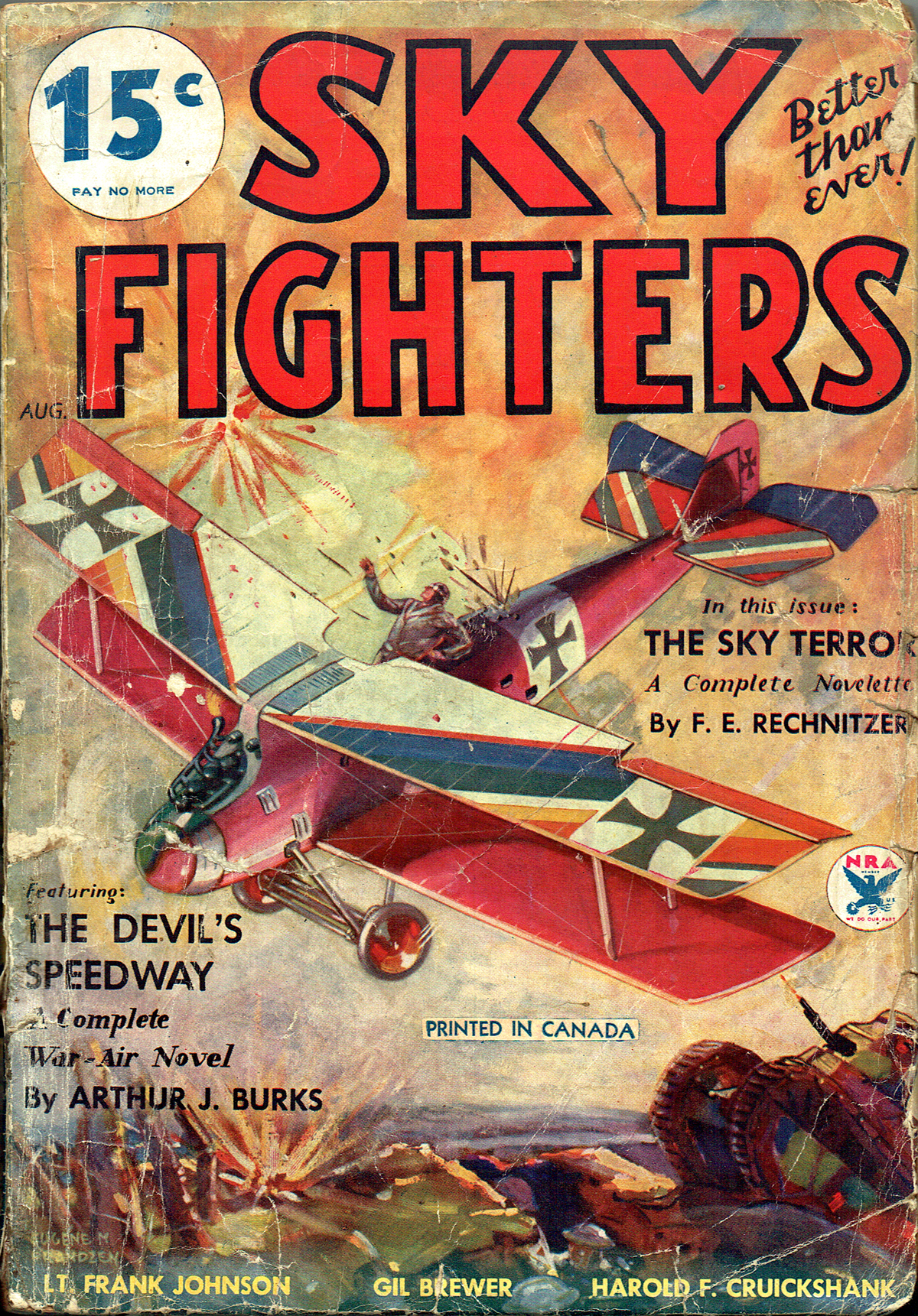
Eugene M. Frandzen painted the covers of Sky Fighters from its first issue in 1932 until he moved on from the pulps in 1939. At this point in the run, the covers were about the planes featured on the cover more than the story depicted. On the August 1934 cover, It’s the Roland D-2 vs a Renault “Chars d’Assaut” baby tank!

The Ships on the Cover

THIS month’s cover th_SF_3408_CN brings us right down to earth. In fact we are dug into a trench with our hob-nailed shoes clawing at the slippery duck boards.

Tin helmets were not much protection for our hard-working doughboys when a raiding German plane came screeching down from the clouds with a couple of synchronized Spandaus tossing hot lead up and down the length of their private trench.

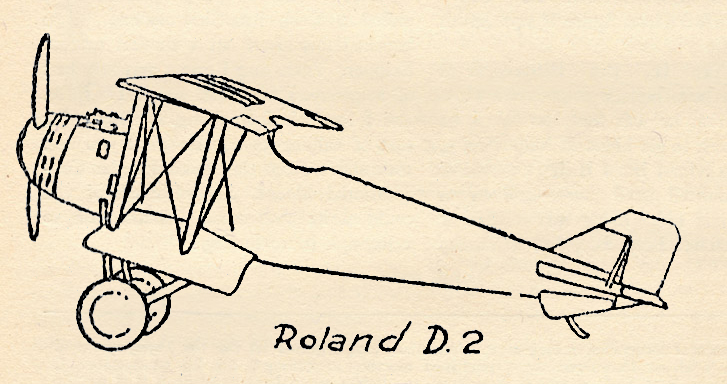
The Roland D-2 with the dazzle painted upper wings was one of Germany’s trickiest looking ships. The peculiarly shaped forward part of the fuselage sweeping up to form a sturdy center brace for the top wings gives the job a certain streamlined effect that is pleasing to the eye. But consider the poor forward visibility of the pilot. He had about as much visibility as a taxi driver with a tin windshield. The two machine-guns are housed in this built-up part of the fuselage, their muzzles barely protruding over the partly hidden Mercedes engine.

A Mere Seven Tons!

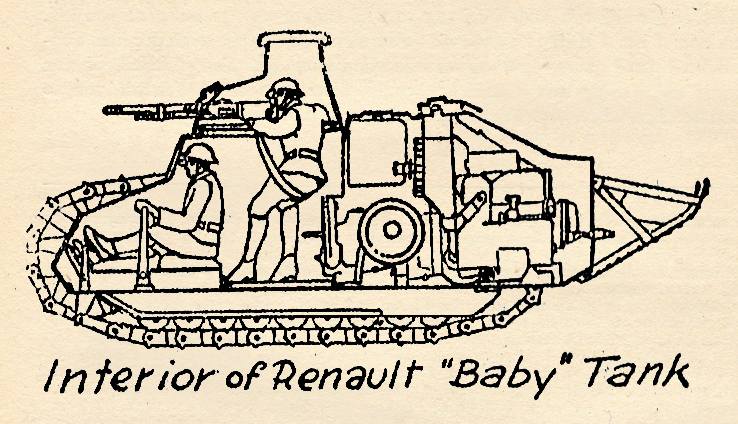
The tank in the picture is the famous Renault “Chars d’Assaut.” It was a “Baby tank” weighing a mere seven tons and could crawl along the shell torn fields at from four to six miles an hour (we have baby tanks now which click off ten times this speed).

The first tank was a British invention and first went into action near Cambrai during 1916, smashing the German lines.

From the first the tanks were a success and were made in all conceivable shapes. The outstanding all around success was the baby Renault tank.

The lone Roland D-2 with the swept-back wings has shot down an Allied plane, the only one visible in the sector. Two lines of trenches are just below. Pot-helmeted German troops filled one line of trencher. Flat tin derbies of Americans filled the other. The Roland pilot giggled his head back and forth, tipped his plane down and roared down on the American trenches. His guns blazed and Spandau bullets kicked up mud. Rifles barked back, a ground machine-gun swung up to fire at the attacker, smashed out a spray of lead. Several Yanks went down under the fire, others sought cover. It was a helpless situation.

A ground straffing plane is a dangerous opponent but not as effective as might at first glance be supposed. When it is within range of the trench it is attacking, it lets loose a hail of bullets but it must immediately pull up and dive again to get the correct angle of fire and to keep from crashing.

The Boche Blasts Away

The German pilot leap-frogged his plane up and down the trench, blasting away with both guns. Each time he zoomed, he swept his eyes across all sections of the sky. Still safe from Allied planes he returned to his slaughter.

A small dark shape, so much the color of the ground that it nearly reached the back of the Yank trenches before the German pilot spotted it, crawled slowly forward.

“Verdammte tank!” growled the German and swooped down to show his disdain for this slow-crawling iron beetle. A tattoo of lead spattered the “Baby Renault.” The tank driver stopped his machine. His gunner squinted along the barrel of his 37 millimeter gun. The Roland raced across his sights.

Blam! A 37 millimeter shell smashed through the belly of the plane, tore its way through the German’s body. One well-aimed shell from the lowly mud-spattered iron beetle has clipped the wings of the dazzle-colored Roland.

The Ships on The Cover
Sky Fighters (Canadian Edition), August 1934 by Eugene M. Frandzen
(The Ships on The Cover Page)

Next time, Mr. Frandzen features the Pfalz Triplane and the indomitable S.E.5!

“Sky Fighters, June 1934″ by Eugene M. Frandzen

Link - Posted by David on March 7, 2016 @ 6:00 am in

Eugene M. Frandzen painted the covers of Sky Fighters from its first issue in 1932 until he moved on from the pulps in 1939. At this point in the run, the covers were about the planes featured on the cover more than the story depicted. On the May 1934 cover, Frandzen featured the German Junkers and D.H.4!

ON THE cover this month th_SF_3405you will find the German Junkers biplane and the American Liberty-motored D.H.4. The D.H.4 was our one and only contribution to the front. That plane took nearly a year to produce.

It was designed after the famous British D.H., which earlier in the war; could stand up to any of the enemy planes. But the war moved fast. The Germans and the Allies changed and improved their planes so often that it was hard for this country to keep up with the advancement made on the other side of the pond.

A Difficult Task

We sent over commissions to nose around and pick out a few types of planes which could be put into mass production in this country, built around the bulky twelve-cylinder Liberty motor.

It took the boys on the commission several weeks to make up their minds as to which of the Allies* planes could be copied and be satisfactory. When they finally got back to Washington and got the designers busy it took three weeks of night and day work for them to complete their work.

They Were Obsolete

Just as the duplicate sets of plana were ready to go to the manufacturers word came from abroad that the planes the Americans planned to build were obsolete. Another commission hopped the ferry for Europe and went through the same stunt.

Again the designs were drawn; again they were pitched over because they were out-dated. Finally, after nearly a year of discouraging experimenting and disappointments the cumbersome American D. H. 4 started to roll off on the production line in an endless stream. In the first quarter of 1918 the first shipments were delivered to the Yanks at the front. They took ‘em, gritted their teeth and did what they could with a type of ship which the British had abandoned as obsolete some months before.

There were 23,000 screws holding that old D.H. crate of ours together, also 600 separate pieces of wood in a single wing; possibly that’s one of the reasons that delayed the boys back home from delivering the planes before they were listed in the antique class.

Well, the pilot and observer in the D.H. on the cover got a break when they got in a scrap with the German Junkers biplane. It was also a crate of earlier vintage, but a good one. The Junkers outfit was associated with the Fokker Company. This thick-winged job shows the Fokker influence.

The Fight Is On!

Returning from a reconnaissance expedition the D.H. ran across the Junkers. Both pilots decided that he could outsmart the other; the fight was on. The planes, evenly matched, tore in at each other like a couple of hungry wolves, ripped bullets through each other’s wings and squared off for another round. Again and again they tangled.

The D.H. was getting the worst of it. Suddenly a Fokker D.7 comes in from the distance. The Yank gunner spots it, points it out to his pilot. But a passing Frenchman in a Spad sees the set up and kicks his fleet plane into the show. He is in a position to pop the Fokker down. The Junkers zooms up under the D.H.’s tail.

It Looks Like Curtains

It looks like curtains for the Americans. The Yank pilot flips his tail down. The German tries to miss a collision. He succeeds, but the tip of his propeller blade grazes the aft part of the D.H.’s fuselage; just barely touches it, but that is all that is necessary.

Bingo, his prop flies to pieces. He is gone, through, licked. And the D.H., with its 23,000 screws, shakes its ruffled tail feathers and sails proudly for home—victorious.

The Ships on The Cover
Sky Fighters, ,June 1934 by Eugene M. Frandzen
(The Ships on The Cover Page)

“Sky Fighters, May 1934″ by Eugene M. Frandzen

Link - Posted by David on February 22, 2016 @ 6:00 am in

Eugene M. Frandzen painted the covers of Sky Fighters from its first issue in 1932 until he moved on from the pulps in 1939. At this point in the run, the covers were about the planes featured on the cover more than the story depicted. On the May 1934 cover, Frandzen featured the Sopwith Snipe and the Halberstadt C-4!

ON THIS month’s cover th_SF_3405the two types of ships shown are the Sopwith Snipe and the Halberstadt C-4.

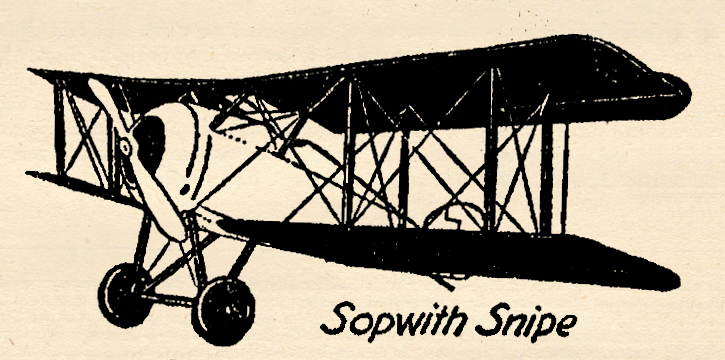
The Sopwith Snipe was considered by many to be the finest job turned out by the Sopwith Company. The 1918 Snipe knocked the Germans out of the skies with system and precision. In four days a single Snipe squadron accounted for thirty-six enemy planes. In one day alone they smacked down thirteen.

Major Barker, of Canada, pulled the outstanding feat of his career in a Snipe. Attacked by fifty Boche planes he fought back, downed four and lived to tell the tale. He gave lots of credit to his Snipe.

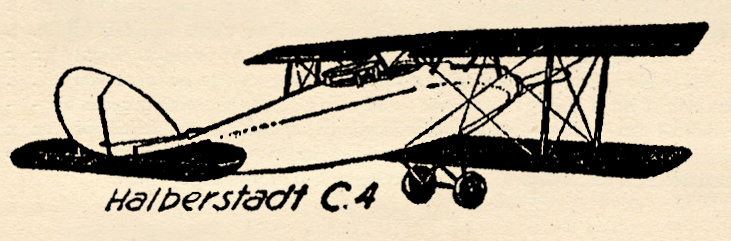
The Halberstadt C-4 was a good all round fighter-reconnaissance plane. Its bulky forward fuselage and its thin, tapering short section behind the cockpits gave it a nose-heavy appearance. Despite its awkward proportions it had good flying characteristics and was a dependable ship when not forced beyond the limits of its class.

One of the pastimes indulged in by the retreating Germans during 1918 was blowing up bridges they had crossed. And one of the best little things our hard-worked engineers did was to smack down pontoon bridges to replace them.

Of course then the Boche artillerymen came out of their dugouts and popped over a few tons of steel-cased shells, which, if nicely directed had the nasty habit of destroying the engineers floating road. Now the obszrvers in the two-seaters had to direct this demolition fire by wireless. They were usually protected by several scout plinos flying above and capable of giving even battle to anyone asking for an argument.

A little mix-up of this sort is happening in the picture on the cover. The Halberstadt has spotted the pontoon bridge. He gets his wireless going. The German artillerymen start ranging their shells. Above are his protecting planes, Fokkers. Hardly had the German observer warmed up his dot-dash key than two Sopwith Snipes swooped down on the Fokkers, sent two of them down. One Fokker remained. One Snipe started after him while the other Snipe tore in at the Halberstadt.

The German reeled in his aerial and un-limbered his Parabellum gun. He signalled his pilot to fight his way out. Above he saw the lone Fokker coming down to his assistance.

The Snipe roared in on the two-seater, guns blazing. The Halberstadt pilot flipped his ship up and over. His gunner all set for this maneuver pressed his trigger as the plane started up. He kept the gun chattering as the Halberstadt started over on its back. He hoped to catch the Snipe in his spraying arc of fire.

Twin Vickers bucking in their mounts on the Snipe; the Parabellum vibrating in the hands of the German observer. Three streams of lead slicing through the air, perforating fabric, ricocheting off metal parts.

The diving Fokker abruptly disintegrates in mid-air. A ranging German Shell hunting the pontoon bridge hits his ship, explodes; blows the ship to bits.

The odds are now too great for any two-seater, no matter how good it, or its crew, may be. A matter of minutes remain till it will be all over. Trucks, cannon and infantry will continue to pass over the pontoon bridge, shelled of course, but not as accurately as would have been the case had the artillery-directing Halberstadt been allowed to remain on tha job five minutes longer.

The Ships on The Cover
Sky Fighters (Canadian Edition), May 1934 by Eugene M. Frandzen
(The Ships on The Cover Page)

Next time, Mr. Frandzen features the German Junkers and D.H.4!

“Sky Fighters, April 1934″ by Eugene M. Frandzen

Link - Posted by David on February 8, 2016 @ 6:00 am in

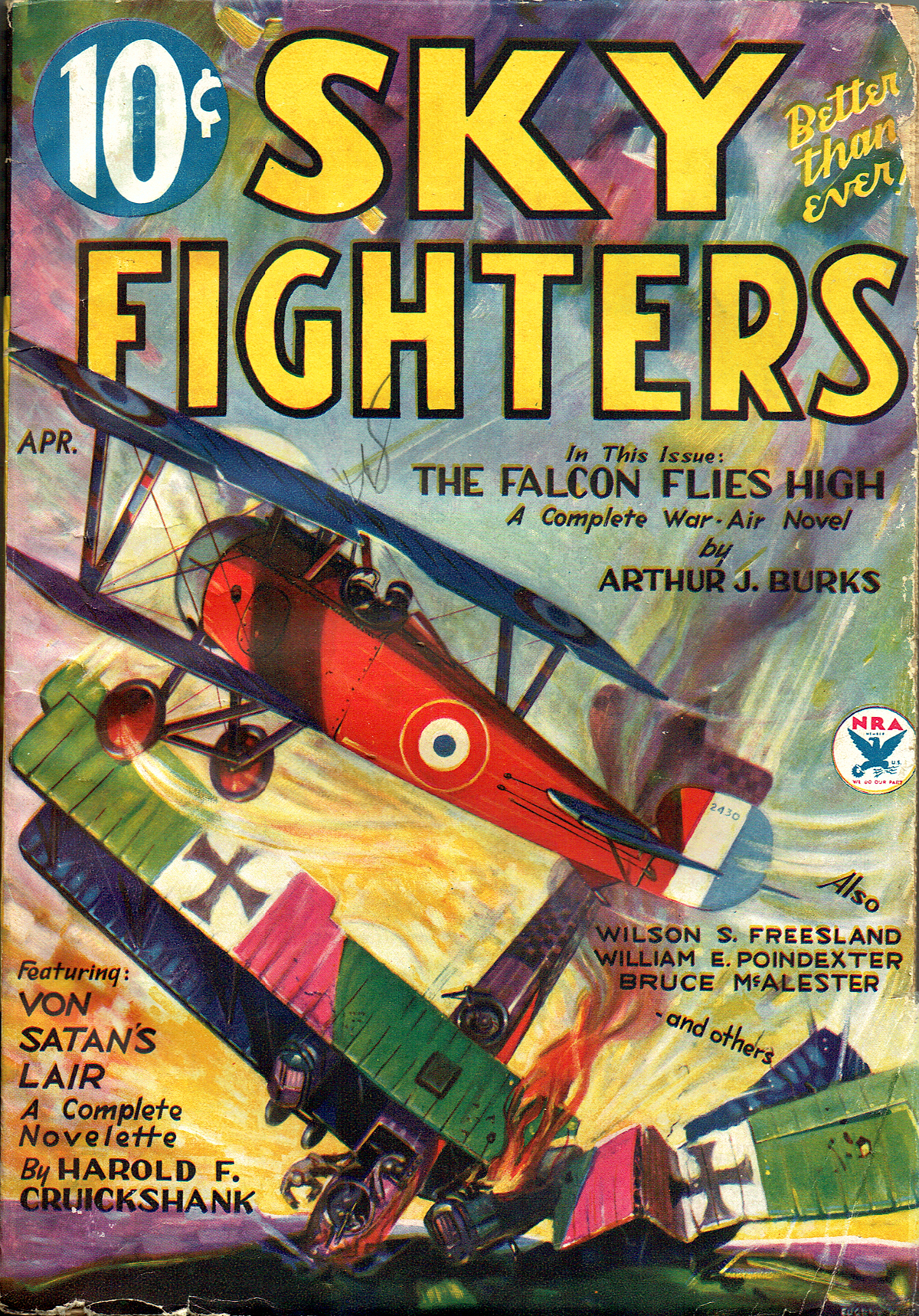
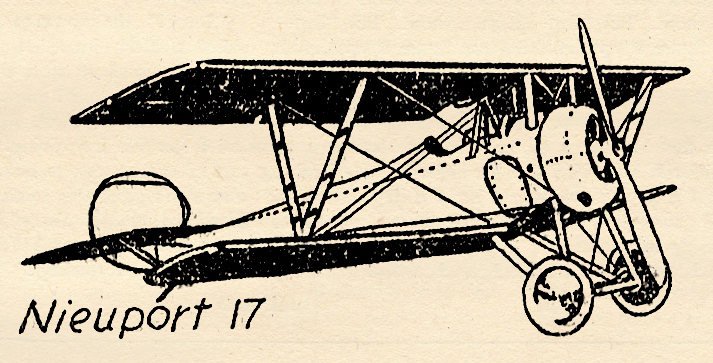
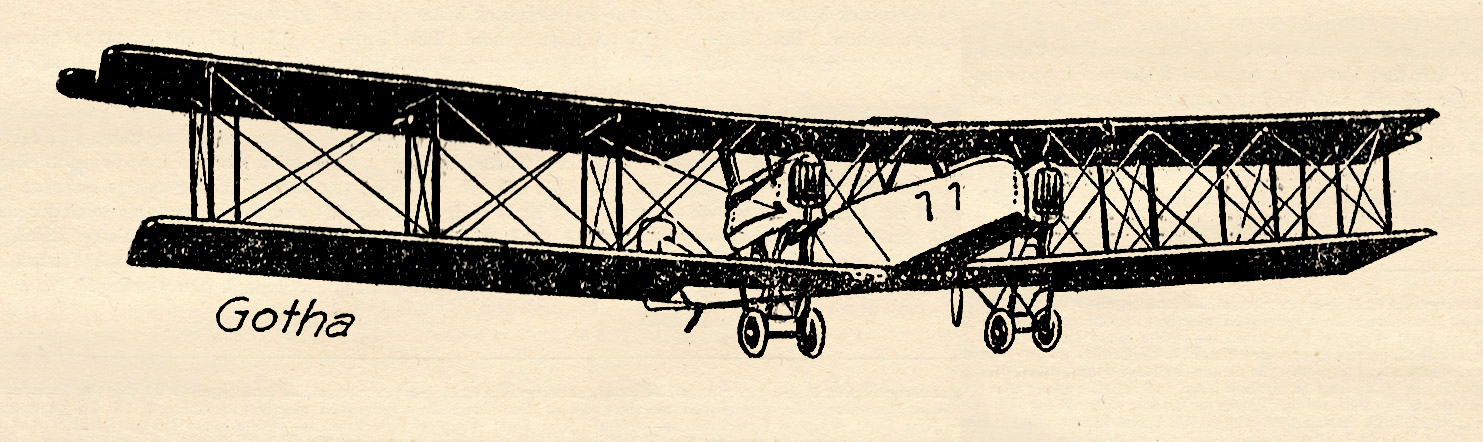
Eugene M. Frandzen painted the covers of Sky Fighters from its first issue in 1932 until he moved on from the pulps in 1939. At this point in the run, the covers were about the planes featured on the cover more than the story depicted. On the April 1934 cover, Frandzen featured the Nieuport 17 and the giant Gotha bomber!

ON THE COVER this month th_SF_3404you will find two ships as radically different in design as you could wish for. The fleet little scrapper, the Nieuport 17 and the cumbersome engine of destruction, the Gotha bomber. The Nieuport was one of the most effective scouts that the French turned out. Owing to its high speed and maneuverability it was very popular with the French flyers. It was really a parasol in that the lower wing was so small that its chief function was to give girder strength to the upper wing. The Nieuports of this type were commonly called “one-and-a-half-planes.”

The big Gotha smacking the ground was just the last word in bombers as far as Germany was concerned. She built some bigger ones and stuck more engines on them than this 77 ft. twin-engined job, but in the case of the larger bombers they had plenty of trouble lifting them off the ground.

Slip back a few hours and take off with this broken Gotha as it leaves its home drome with a half a ton of bombs snuggled against its belly. With its two 160 horse power Mercedes churning the two pusher props more than four tons of ship and load are eased into the air. Two other giant bombers follow. The field is circled twice and then the three ships with their motors blasting orange streaks of flame from six exhaust stacks point their noses westward, toward the English Channel. The vibrating motors are laboring like mogul locomotives pulling a heavy train over a steep mountain grade—they are climbing. At last they reach twelve thousand feet, level off and throttle down to about sixty-five miles per hour. It is a clear night with high clouds scudding just below. Finally the nose of the leading Gotha is pointed downward. The other two follow. They slip down through the clouds. The Channel is below, now it has been passed. Again the bombers level off, wing slightly to the left. Scattered houses, the outskirts of London are below. Now the dwellings are bunched together. The gunner in the front pit has his eye glued to a Georz bomb-dropper’s sight. The pilot is watching his galvanometer, his left hand is on his bomb releases. Government buildings are now below at an angle of about twelve degrees.

Two giant bombs drop flatly from beneath the Gotha, lazily point their noses downward, then gathering momentum they go streaking down at their target. Buildings rock, flames spurt from shattered windows. Sirens from tops of buildings wail their eerie warnings through the chill before dawn air. AIR RAID. Again the bombs go racing toward the sleeping city. A ton and a half of high explosive has been released.

The British home defense planes are in the air, sweeping up to engage the giant destroyers, but already those dark shapes have slunk off into the blackness and are well out over the Channel.

The British were taken by surprise. They had not adequate speed in their protection planes. The advantage of the raiders was too great, they escaped across the Channel. But did they get back to their hangars behind the German lines? They did not! One was forced down with a balky engine. The two others ran into a dawn patrol of French airmen out looking for big game. Spandaus and Vickers snarled and spat lead as the eastern sky burst gloriously into color as the sun rose over the torn and twisted battle fields. A Vickers’ bullet found a vulnerable spot in the left engine of the Gotha pictured on the cover. Another killed the pilot. Flames, a dive, oblivion for the raiders. The Nieuport pilot circles the flamer once, salutes his fallen foe. It’s all in the day’s work.

The Ships on The Cover
Sky Fighters, April 1934 by Eugene M. Frandzen
(The Ships on The Cover Page)

“Sky Fighters, March 1934″ by Eugene M. Frandzen

Link - Posted by David on January 25, 2016 @ 6:00 am in

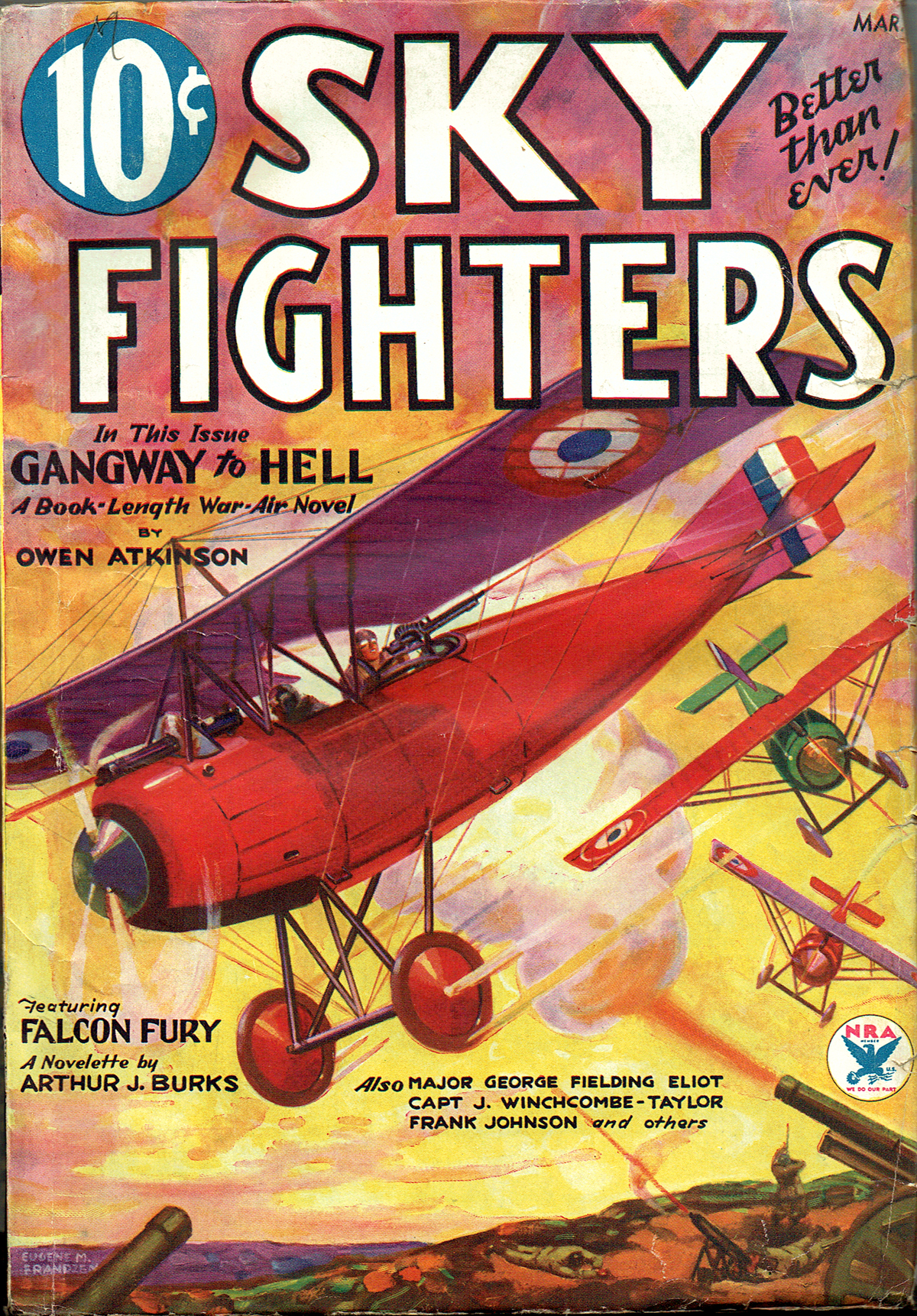
Eugene M. Frandzen painted the covers of Sky Fighters from its first issue in 1932 until he moved on from the pulps in 1939. At this point in the run, the covers were about the planes featured on the cover more than the story depicted. On the March 1934 cover, Frandzen featured the Morane-Saulnier Parasol (type P)!

THE PLANES on this th_SF_3403month’s cover are all manufactured by the same firm. The leading plane, the red two-seater, is a Morane-Saulnier Parasol (type P). The two smaller planes are single-seater Morane-Saulnier (type 27 C1), fighting scouts of the French air force which did fine service at the front during 1916.

The two-seater was used extensively during the same period by the French and the British for general reconnaissance and for artillery spotting. The Morane-Saulnier firm also turned out a twin engined job which saw plenty of active service.

On a Prowl of Their Own

Artillery spotting was really spotting the bursts of our own artillery and by radio adjusting the fire for the batteries. But in the picture on the cover the Moranes have finished their job of adjusting fire and gone on a prowl of their own. Instead of turning back toward their own lines and safety they have gone deeper into enemy territory and have done some artillery spotting which is not in the instruction books for what the well-trained observer shall spot.

For days the Allies have been harassed by a mobile battery of German guns which has changed its position so quickly after laying down a blanket of shells on some strategic point that the Allied counter batteries have been unable to blast them out.

One of the scouts in the background had seen a battery digging in when on his dawn patrol and mentioned it to the pilot of the two-seater Morane and to his pardner in the other single-seater Morane. A few extra belts of ammo were pitched into the pockets in the cockpits and after the thankless little job of ranging the artillerymen’s guns has been accomplished they streak along on business of their own.

And from the action depicted on the cover it looks as though they arc causing plenty of trouble to the Boche servicing those fast firing field guns. But they are not getting away with their surprise attack without some reply from the men on the ground.

That Maxim machine-gun in the foreground is trained in a pretty dangerous way on our friends in the first plane, trained so it is raking the whole ship; but those hands clutching the gun handles won’t function for more than a split second if that second Morane, the little red scout with the purple wing, continues to hold its bead on that ground machine-gunner.

Two Planes Roar In

Suddenly the alert observer in the front ship swings his Lewis gun away from the battery on the ground. Two enemy planes arc roaring in from the side with gun3 blazing. The more or less one-sided scrap will turn into a free for all in about two flips of an aileron.

And just to make it all the more interesting for the raiding Allied aviators, one of the cannons sprays fire from its recoiling muzzle and hurtles a twisting shell fall of high explosive at the leading two-seater. The explosion rocks the ship and pitches its nose toward the ground. It is yanked back into level flight in the nick o£ time and the three Moranes go roaring toward home. The two-seater brings up the rear and the observer has plenty of work for his Lewis gun. The German planes pursue, but are just a shade slower than the Allied ones.

Score for the Allied pilots: one disabled German battery put out of commission long enough for the radio-equipped Morane to transmit the map coordinates to his artillery buddies. Ten minutes later there is no German battery; it has been knocked to pieces by concentrated demolition fire by a brigade of Allied heavy guns.

The Ships on The Cover
Sky Fighters, March 1934 by Eugene M. Frandzen
(The Ships on The Cover Page)

Next time, Mr. Frandzen features the Nieuport 17 and giant Gotha bomber!

“Sky Fighters, February 1934″ by Eugene M. Frandzen

Link - Posted by David on January 11, 2016 @ 6:00 am in

This week we have the cover of Sky Fighters from February 1934 by our old friend Eugene Frandzen. Franzen painted the covers of Sky Fighters from its first issue in 1932 until he moved on from the pulps in 1939. At this point in the run, the covers were about the planes featured on the cover more than the story depicted.

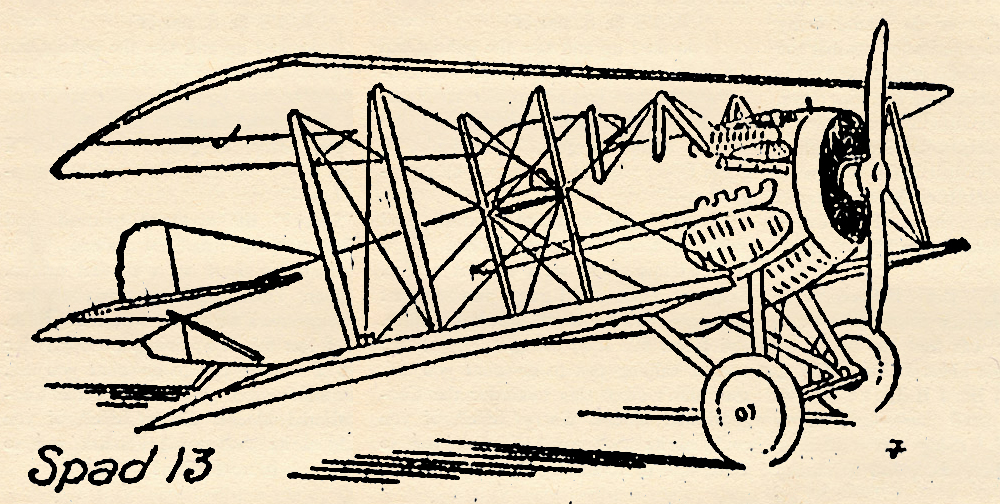
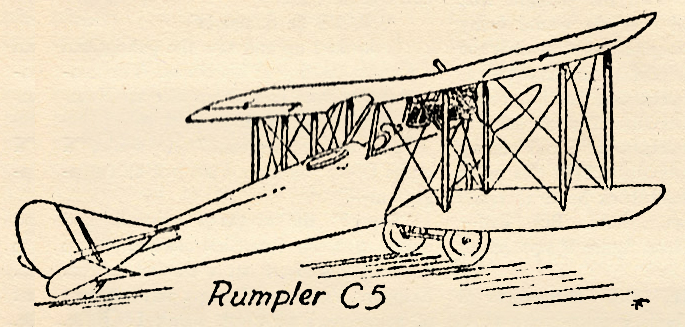
THE SHIPS pictured th_SF_3402on this month’s cover are the German Rumpler type C5 and the French Spad type 13.

The Rumpler was one of Germany’s most successful war planes. As far back as 1908 Herr E. Rumpler was working on airplane designs. At first his ships followed closely the Eitrich “Taube” design, that queer birdlike swept-back wing construction. In a Rumpler biplane an eighteen-hour record was established just before the war by Herr Basser who flew from Berlin to Constantinople, making only three stops.

This flight was phenomenal for those days and it was only natural that when the World War flared and burst over nearly all Europe that the German High Command would do plenty of concentrating on their prize-winning Rumpler. It eventually lost its swept-back wings but the general appearance of the fuselage and nose remained the same up to the end of the war.

The two Rumpler C5s pictured on the cover are equipped for light bombing. Their speed was around 105 to 110 m.p.h.

From the blast of the explosion coming from the bottom of the picture it looks as though they have caused plenty of trouble. When we consider that the bill for the World War amounted to about 186 billion dollars and that plenty of that sweet little amount went into explosives of assorted shapes and potency one little ammunition dump valued at a few hundred thousand dollars doesn’t amount to much on the books, but add a few of these dumps together along a front that is causing the opposing power plenty of headaches and you’ll easily see how extremely important a little bomb-dropping party really is.

That in exactly what is happening in the picture—an ammo dump has gone blooey. One bomb beautifully spotted by the leading Rumpler pilot has done the trick. His pardner in the background is shedding his load of eggs in a businesslike manner too. The odds are against the Allies in this particular instance. They will have to rush some fresh ammunition to this particular sector if they want to have sufficient food for their hungry cannons.

But don’t overlook that Spad coming in with both guns blazing at the Rumpler. It didn’t get there quite in time to drive the Fritz away before he could shed his bombs but if a stray hunk of exploding shell from the dump doesn’t get one of the Spad pilots it will just be too bad for the men in the German ships.

This Spad 13 could kick off about 130 to 135 miles per hour. It carried plenty of horsepower up front in its nose, 220 to be exact. The ambitious pilots of the bomb-dropping Rumplers are quite some distance behind the Allied lines. Their protection planes are far behind the German lines. And those two Spads will either herd the Germans down to the ground or blow them out of the sky.

Bombing ammunition dumps during the World War was done extensively by both sides. Many times the pilot and observer of a two-seater plane went on a special ammunition-bombing expedition from which they knew they would never return.

They had specific jobs to accomplish and they grinned, smoked a last cigarette and flew their ships to the spot indicated on their maps. Usually a one-way trip, but if the mission was successful thousands of lives were saved.

The Ships on The Cover
Sky Fighters, February 1934 by Eugene M. Frandzen
(The Ships on The Cover Page)

Next time, Mr. Frandzen features the Morane-Saulnier Parasol (type P)!

“The Hawker Demon” by Frederick Blakeslee

Link - Posted by David on December 28, 2015 @ 6:00 am in

Frederick Blakeslee painted all the covers for the entire run of Dare-Devil Aces. And each of those covers had a story behind it. Last time Mr. Blakeslee gave us the first in a new series of mismatched time images with planes from the Great War along side present day planes from 1935! This time he returns with another in the series, from the cover of the December 1935 number of Dare-Devil Aces—where a Fokker DVII finds itself pitted against “The Hawker Demon!”

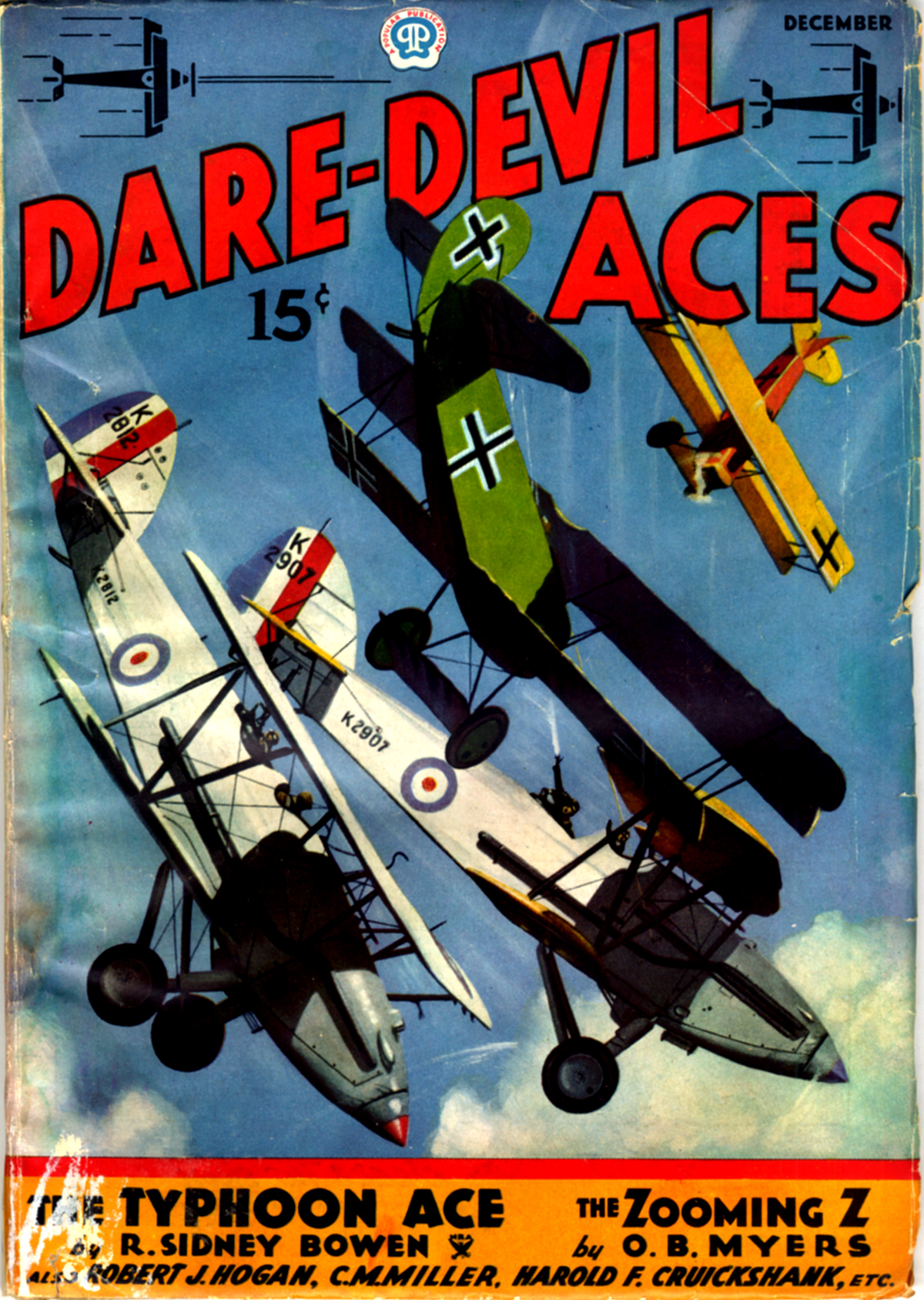
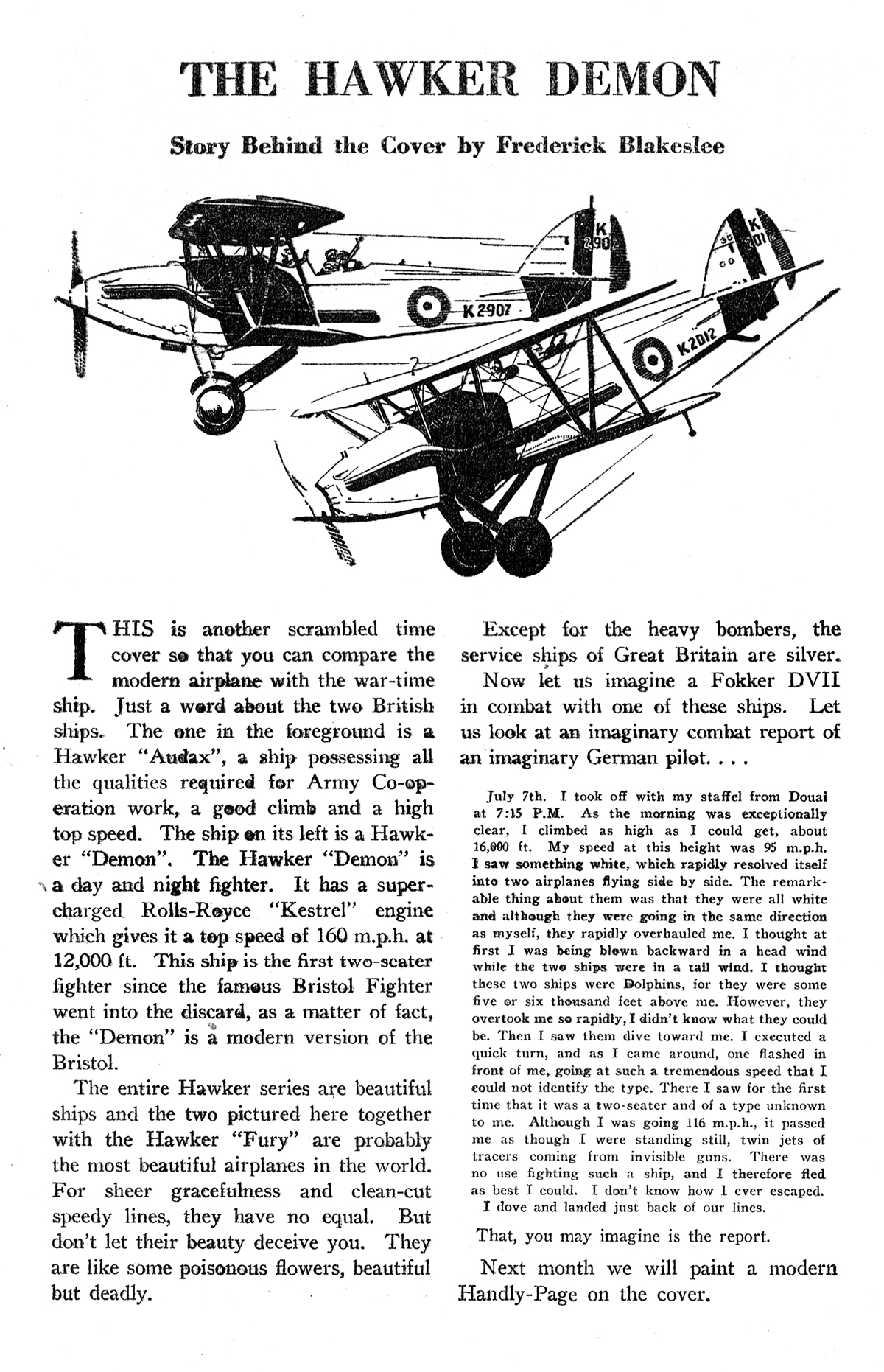
th_DDA_3512THIS is another scrambled time cover so that you can compare the modern airplane with the war-time ship. Just a werd about the two British ships. The one in the foreground is a Hawker “Audax”, a ship possessing all the qualities required for Army Co-operation work, a good climb and a high top speed. The ship an its left is a Hawker “Demon”. The Hawker “Demon” is a day and night fighter. It has a supercharged Rolls-Royce “Kestrel” engine which gives it a top speed of 160 m.p.h. at 12,000 ft. This ship is the first two-scatcr fighter since the famous Bristol Fighter went into the discard, as a matter of fact, the “Demon” is a modern version of the Bristol.

The entire Hawker series are beautiful ships and the two pictured here together with the Hawker “Fury” are probably the most beautiful airplanes in the world. For sheer gracefulness and clean-cut speedy lines, they have no equal. But don’t let their beauty deceive you. They are like some poisonous flowers, beautiful but deadly.

Except for the heavy bombers, the service ships of Great Britain are silver.

Now let us imagine a Fokker DVII in combat with one of these ships. Let us look at an imaginary combat report of an imaginary German pilot. . . .

  July 7th. I took off with my staffel from Douai at 7:15 P.M. As the morning was exceptionally clear, I climbed as high as I could get, about 16,000 ft. My speed at this height was 95 m.p.h. I saw something white, which rapidly resolved itself into two airplanes flying side by side. The remarkable thing about them was that they were all white and although they were going in the same direction as myself, they rapidly overhauled me. I thought at first I was being blown backward in a head wind while the two ships were in a tail wind. I thought these two ships were Dolphins, for they were some five or six thousand feet above me. However, they overtook me so rapidly, I didn’t know what they could be. Then I saw them dive toward me. I executed a quick turn, and as I came around, one flashed in front of me, going at such a tremendous speed that I could not identify the type. There I saw for the first time that it was a two-seater and of a type unknown to me. Although I was going 116 m.p.h., it passed me as though I were standing still, twin jets of tracers coming from invisible guns. There was no use fighting such a ship, and I therefore fled as best I could. I don’t know how I ever escaped.
  I dove and landed just back of our lines.

That, you may imagine is the report.

The Story Behind The Cover
“The Hawker Demon: The Story Behind The Cover” by Frederick Blakeslee
(December 1935, Dare-Devil Aces)

Next month we will paint a modern Handly-Page on the cover.

“The Sopwith Salamander” by Robert H. Rankin

Link - Posted by David on December 14, 2015 @ 6:00 am in

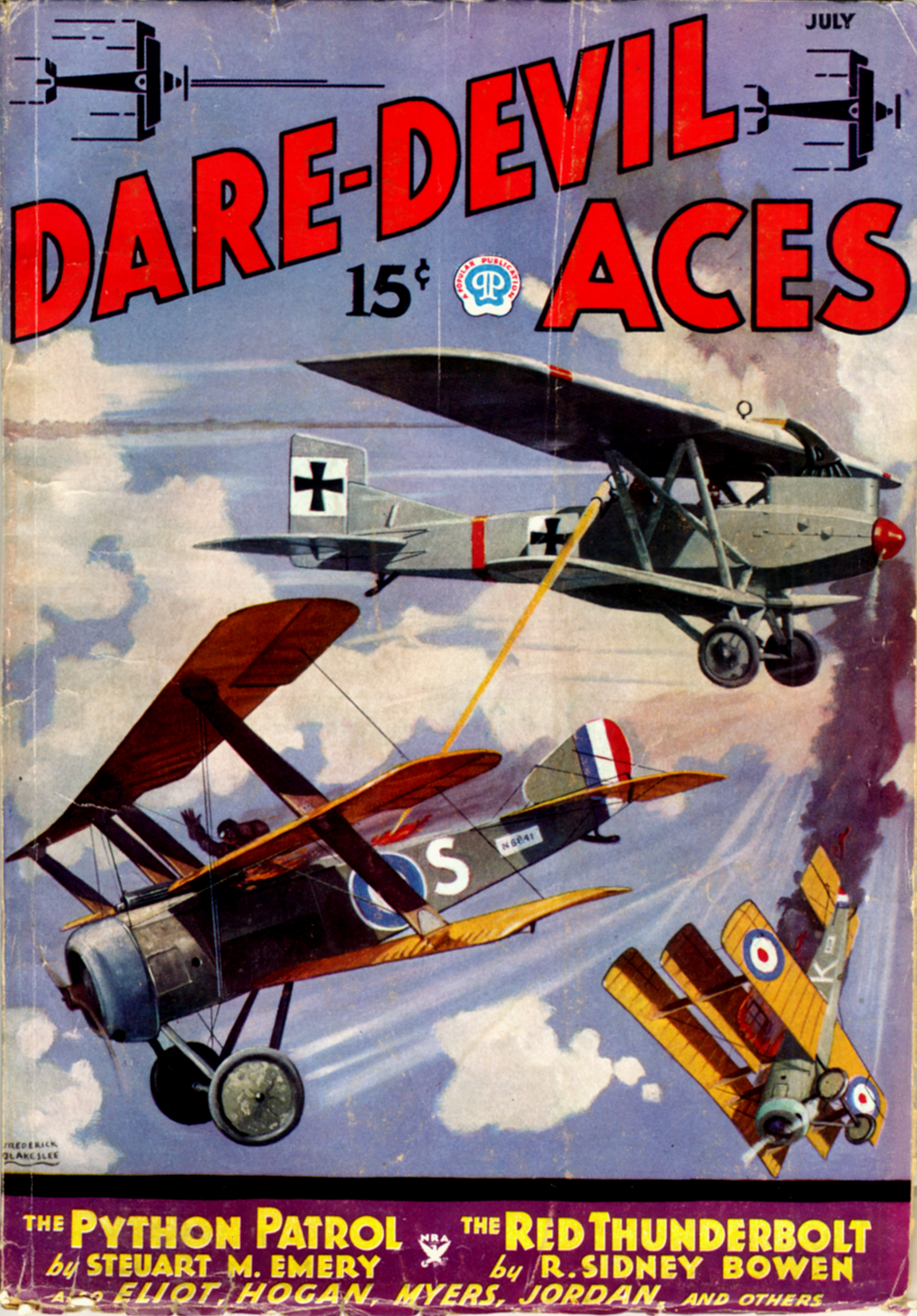
Frederick Blakeslee painted all the covers for the entire run of Dare-Devil Aces. And each of those covers had a story behind it. Although this looks like it should be in his new series of scrambled time covers, instead we get Robert H. Rankin, formerly a draughtsman for Fokker Aircraft Corp, telling the story of the last of the Sopwith war-time machines—The Sopwith Salamander—from the cover of the November 1935 number of Dare-Devil Aces!

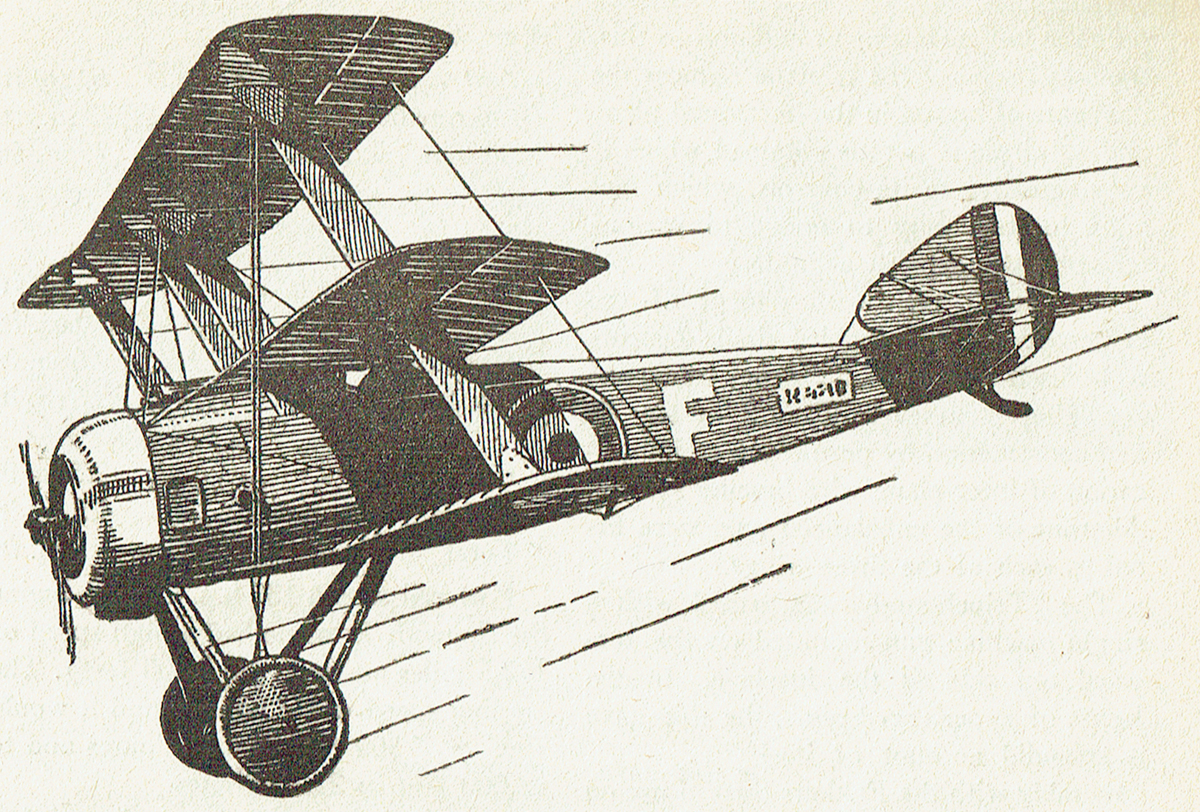
th_DDA_3511THE SALAMANDER, the last of the Sopwith war-time machines, was one of the most interesting and efficient types used in the World War. Although the design of the Salamander followed that of the earlier developed Sopwith Snipe, the plane was not intended for use as a scout or fighter—as were the Camel, Pup, Dolphin, and Snipe. It was designed primarily as a trench fighter, and in official circles it was known as the T.F.2.

The rudder of the Salamander was larger than those on the majority of the Sopwith designs. The pilot’s head, owing to the extremely deep fuselage and comparatively small wing gap, was on a level with the top plane, the center of which was partly slotted and partly cut away, to insure a better vision.

Due to the rather large diameter of the engine used, a B.R.2., the rectangularity of the fuselage was apparent toward the tail only, with the result that the fuselage was of a more circular cross-section than was the case in the other Sopwith ships.

Perhaps the mast interesting feature of the Salamander was the manner in which it was armored. Light steel plating formed the front of the fuselage from a point immediately in the rear of the engine, and extended to a point slightly to the rear of the cockpit. This armor, instead of being added to an existing fuselage frame, was a definite structual part of the frame work, and in itself formed the front portion of the fuselage. Thus, the armor plating served a structual, as well as a protective function.

Another variation from the usual Sopwith designs was incorporated in a tapering spine which served to taper off the pilot’s head and at the same time act as a head rest. This spine, being bulletproof, gave the pilot considerable protection against a rear attack.

The total weight of the armor in the Salamander totaled to some 650 pounds, and in addition to this weight, more than 2,000 rounds of ammunition was carried. In all, the ship weighed 2,945 pounds, as compared to the 1,959 pounds of the Dolphin, which was considered a rather heavy plane.

The following figures will give some idea of the performance and construction of the Salamander:


GENERAL SPECIFICATIONS
    Type Tractor Bi-plane
    Purpose Trench fighter
    Engine B.R.2, 230 h.p.
    Weights
        Loaded 2,945 lbs.
        Empty 1,844 lbs.
 
PERFORMANCE
    Speed (High—at 6,500 ft.) 123 m.p.h.
              (High—at 10,000 ft.) 117 m.p.h.
    Climb 10,000 ft. in 17 min.
    Landing speed 60 m.p.h.
    Ceiling 14,000 ft.
 
DIMENSIONS
    Length, over all 19 ft. 6 in.
    Stagger 1 ft. 5 in.
    Sweepback None
    Top Wing
        Span 31 ft 2⅝ in.
        Chord 5 ft.
        Area, not including ailerons 139 sq.ft.
        Incidence 1.8 deg.
        Dihedral 4.0 deg.
    Bottom Wing
        Span 30 ft. 2½ in.
        Chord 5 ft.
        Area, not including ailerons 123 sq.ft.
        Incidence 1.8 deg.
        Dihedral 4.0 deg.
 
AREAS
    Total wing area, not including ailerons
    Total wing, not inch ailerons 272 sq. ft.
    Tailplane 15 sq. ft.
    Elevators 11 sq. ft.
    Fin 2.75 sq. ft.
    Rudder 9 sq. ft.
    Total aileron area 51 sq. ft.


With the weights carried, the machine had a loading of 11 pounds per horse power, or 9.4 pounds per square foot.

As originally designed, the Salamander was armed with two fixed machine guns, but with its development into a general ground strafer, and later into a contact-patrol ship, the armament was increased, first to four guns, and later to six guns. In this later type there were two Lewis guns mounted on the top wing in such a manner that they could be easily drawn back and reloaded by the pilot from the cockpit.

Then, two Vickers were fixed on the top of the cowling, synchronized to fire through the propeller arc, while two Lewis guns, intended for trench strafing work were mounted on the bottom of the cockpit in such a way as to fire through the floor of the fuselage at an angle of about forty-five degrees.

The Salamander was passed by the experimental board of the Sopwith concern in April, 1918, but it was not until considerably later on in the year that the plane reached a production stage. Consequently few of them were in service over the lines.

In the short time that they were in action they showed such a performance record that it is quite probable, had the conflict lasted longer, the Salamander would have been one of the outstanding planes.

It is interesting to note, in connection with the Salamander, that the armored airplane has always been generally accepted as a logical step in the evolution of military planes by aeronautical engineers and designers. In actuality, however, there have been very few armored ships produced, and in fact, it was not until late in the war that any machines of the armored classification appeared.

For the most part, the greater number of the so-called armored planes produced were most inefficient, and in most instances the protective plating was added to the fuselage frame work of a regular pursuit or observation ship, with the result that the total weight of the machine was increased to a point where, powered with the engines then in use, they were sadly underpowered.

The Salamander, however, was designed from the first as an armored fighter, and inasmuch as the armor plating was made an integral part of the structural framework, the weight problem was done away with. This particular Sopwith offered a definite advance over the designs then in use, and it will be interesting to note in just what ways the modern armored pursuits will follow this pioneer model.

The Story Behind The Cover
“The Sopwith Salamander: The Story Behind The Cover” by Frederick Blakeslee
(November 1935, Dare-Devil Aces)

“The Yellow Monsters” by Frederick Blakeslee

Link - Posted by David on November 30, 2015 @ 6:00 am in

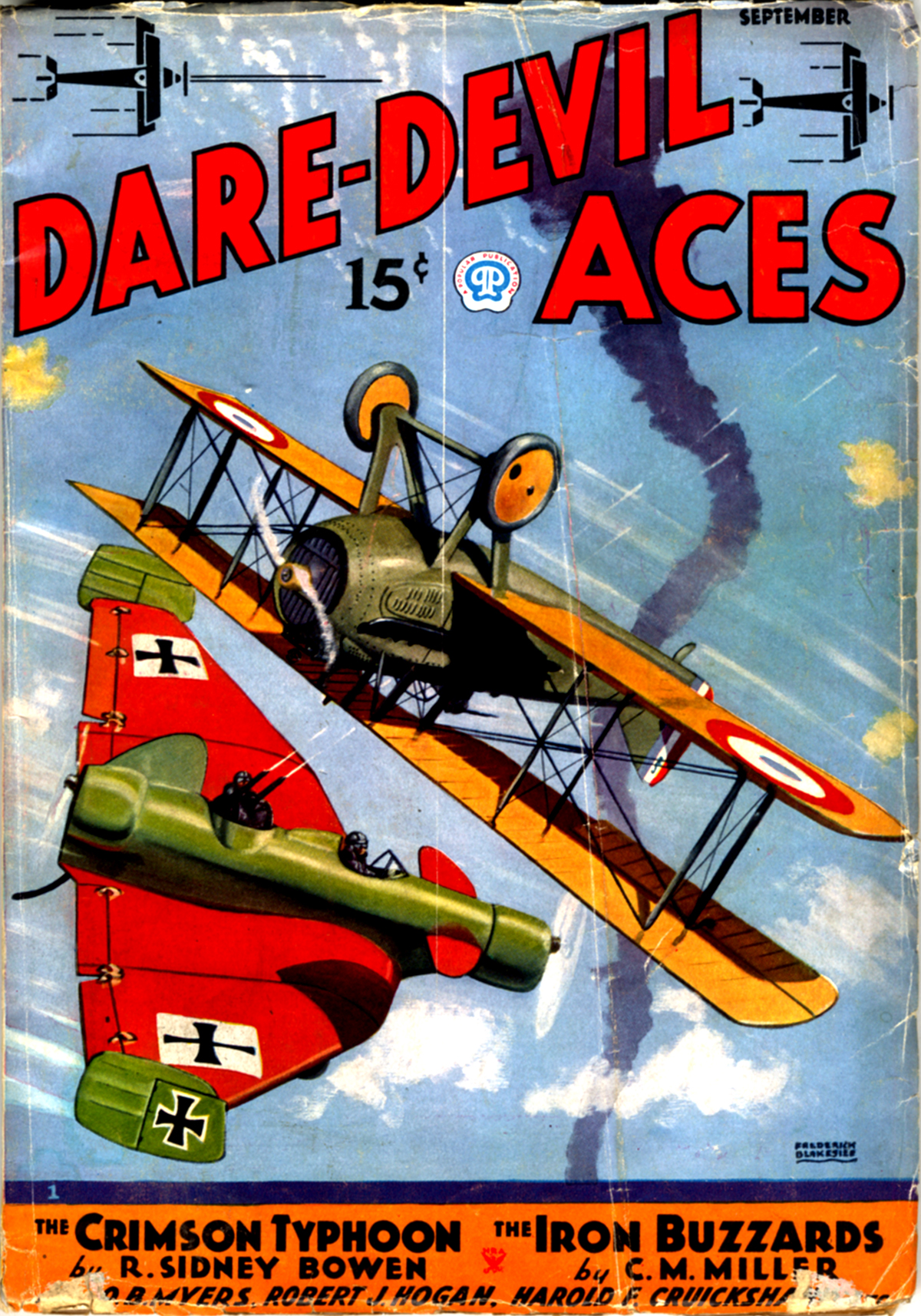
Frederick Blakeslee painted all the covers for the entire run of Dare-Devil Aces. And each of those covers had a story behind it. Last time Mr. Blakeslee gave us the first in a new series of mismatched time images with planes from the Great War along side present day planes from 1935! This time he returns with he second in the series, from the cover of the October 1935 number of Dare-Devil Aces—”The Yellow Monsters!”

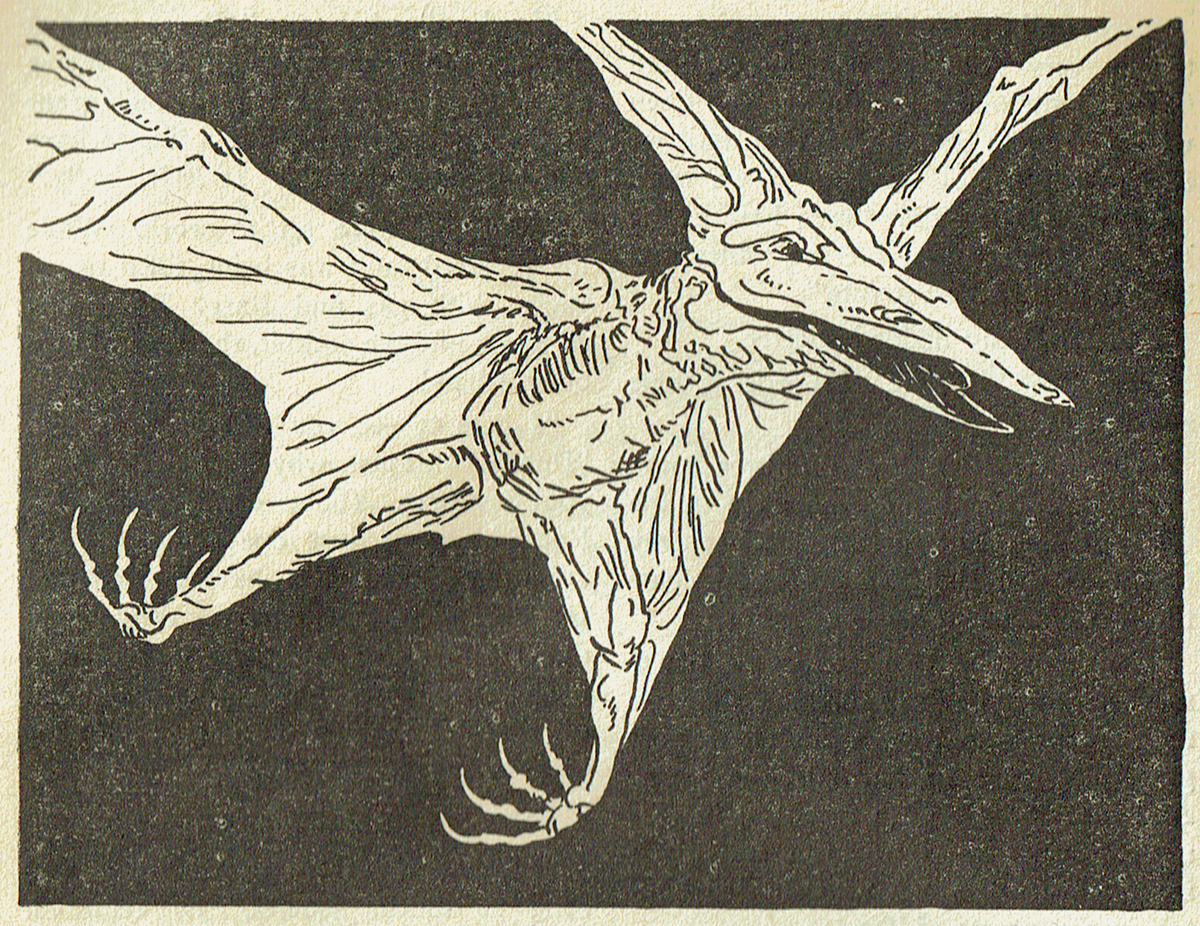
th_DDA_3510ABOVE is the drawing of a Pterodactyl, a pre-historic flying reptile that lived thousands of years ago. Today the Pterodactyl flies again, but this time it is man-made—in short, a modern fighting airplane. Before we go ahead with our story, let us explain why you find a modern ship in combat with a wartime airplane.

The World War is long past, yet many are still interested in the war-time ship; but an equal number are interested in the modern craft too. In thinking it over we wondered what a war-time pilot would do, had he in war days, met a ship of today. The problem was solved. Why not mix time? Take 1918 and 1935 and just scramble them?

The result certainly isn’t the World War, in fact it isn’t any war; it isn’t even real and not being real we can let our imagination roam. By scrambling time this way we can not only show you a war-time ship, but a modern one as well both on the same cover thus giving you an easy way of comparing the fighting ship of today with the fighting ship of yesterday.

So now, let us enter the realms of imagination. Let us see what Otto, a German pilot of 1918 would do had he met the Pterodactyl.

Otto was a crack pilot; he was leader of his staffel and was in the habit of going off on bis own occasionally to look for trouble. He was on one of these trips when he saw a speck way off on his right. Being over the French lines he guessed it was an Allied plane. His big Mercedes engine soon had him high above the other ship. As he crossed its path he looked down and saw the British insignia on the wing-tips. Something about the plane seemed queer, but not giving it a second thought he dove.

He suddenly pulled out of his dive and rubbed his eyes. He looked again. His first impression had been right after all. Something was definately queer about the British ship. Mein Gott, what was it? Was it an airplane? If so it was like nothing he had ever seen.

But he could see the flash of propellers and the crew—that was real anyway, so it must be an airplane. Dunner und blit-sen, what a crazy thing it was! Why it looked as though it would fall apart if a wind hit it. Where was the tail? Well, thought Otto, this will be cold turkey.

He was about to dive again when the strange ship put on a burst of speed. To Otto’s surprise he discovered that he had had his throttle wide open to keep up with the yellow monster.

Well it certainly could fly, he decided, as the Britisher pulled rapidly away from him. Then he saw several others of the strange ships join the first and turn toward him. Otto thought he better return to his drome and get help.

Otto assembled his pilots and recounted what he had seen. The assembled pilots looked at each other but said nothing. Otto was their superior officer so what could they say? A tailless ship indeed, bosh!

Otto led his staffel back and soon spotted the strange ships.

He made a wide circle and gave the signal to dive. The scene on the cover shows the beginning of the fight.

Here we might consider what chance Otto and his men flying Fokker DVII’s would have against the Pterodactyl. We do not hesitate to say that they don’t stand a ghost of a chance.

At the time of writing this, no data on the performance of the Pterodactyl is available. The speed is very high; the exact figure we do not know. Note the wonderful unobstructed field of fire of the rear gunner. It would be impossible for an attacker to hide under the tail. It can deliver a steady stream of lead from its fixed guns and as it dives on an enemy another dose from the free gun as it zooms away. The rear gunner by the way is fully protected from the wind. The pilot can look either under or over the center section too.

Some think that the Pterodactyl may prove to be the most formidable fighter yet produced. Others wonder if it will not become extinct as the bird-lizard from which the new ship gets its name.

The Story Behind The Cover
“The Yellow Monsters: The Story Behind The Cover” by Frederick Blakeslee
(October 1935, Dare-Devil Aces)

The Pterodactyl is manufactured by Westland Aircraft Co., England, and was first produced last year.

 BBAA_3501
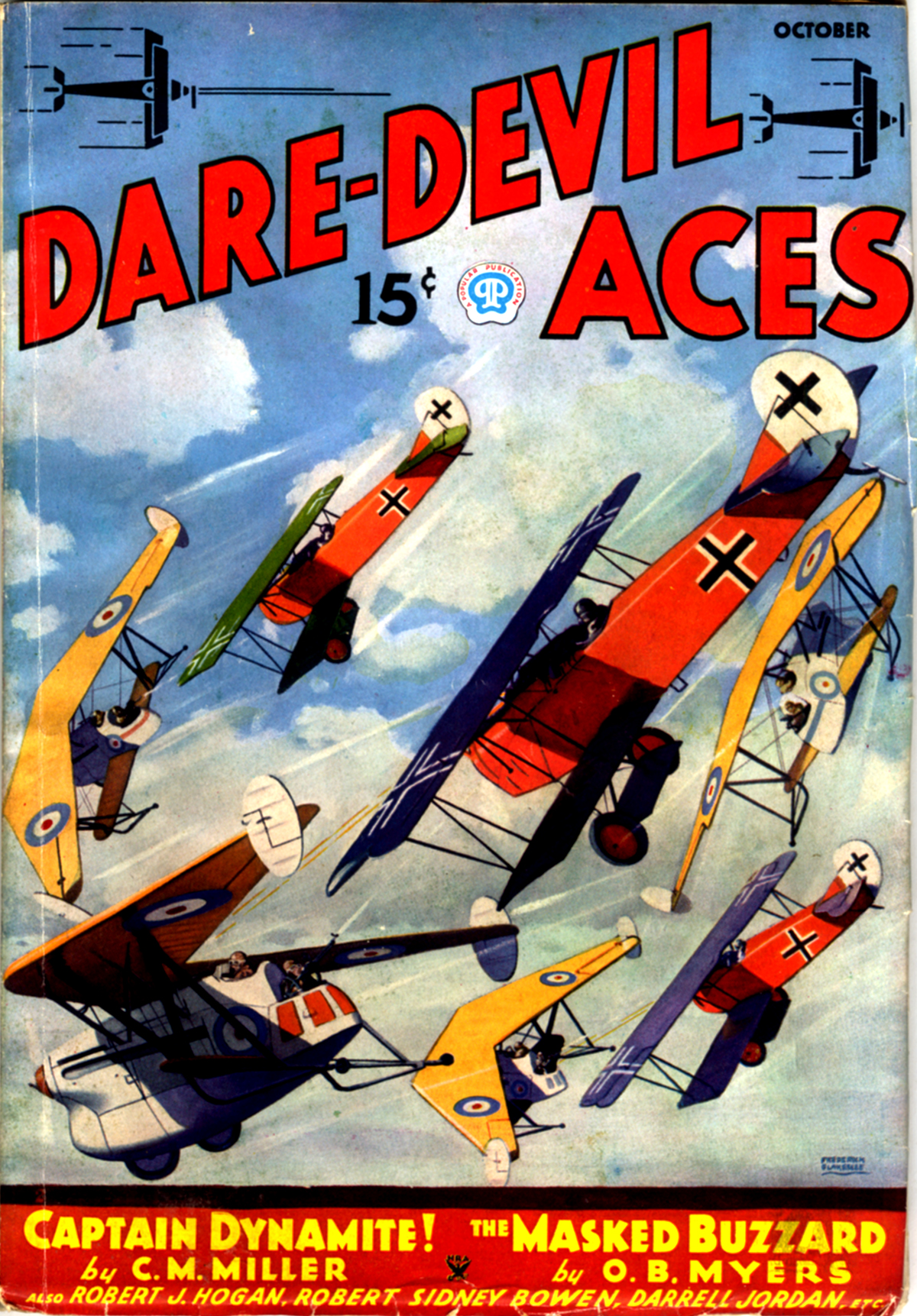
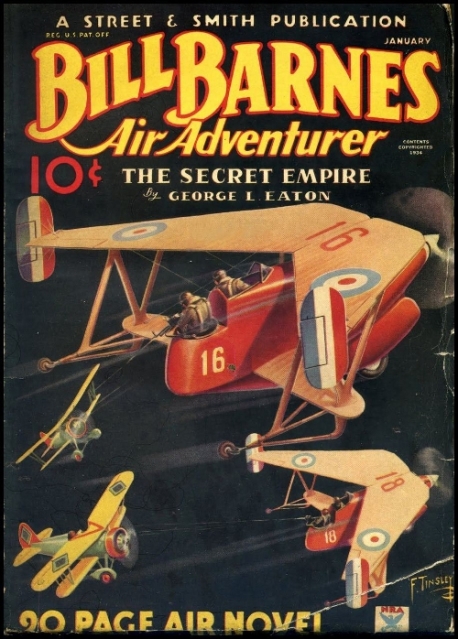
Editor’s Note: The Westland Pterodactyl was featured much more prominently earlier in 1935 on the January cover of Street & Smith’s Bill Barnes Air Adventurer. Here Frank Tinsley has place the Pterodactyl front and center with the tailless tailgunner blasting away at the pursuing biplanes!

“The Tailless Ship” By Frederick Blakeslee

Link - Posted by David on November 16, 2015 @ 6:00 am in

Frederick Blakeslee painted all the covers for the entire run of Dare-Devil Aces. And each of those covers had a story behind it. This time Mr. Blakeslee gives the first in a new series of mismatched time images with planes from the Great War along side present day planes from 1935! Without further Ado, Mr. Blakeslee gives us the story of “The Tailless Ship!”

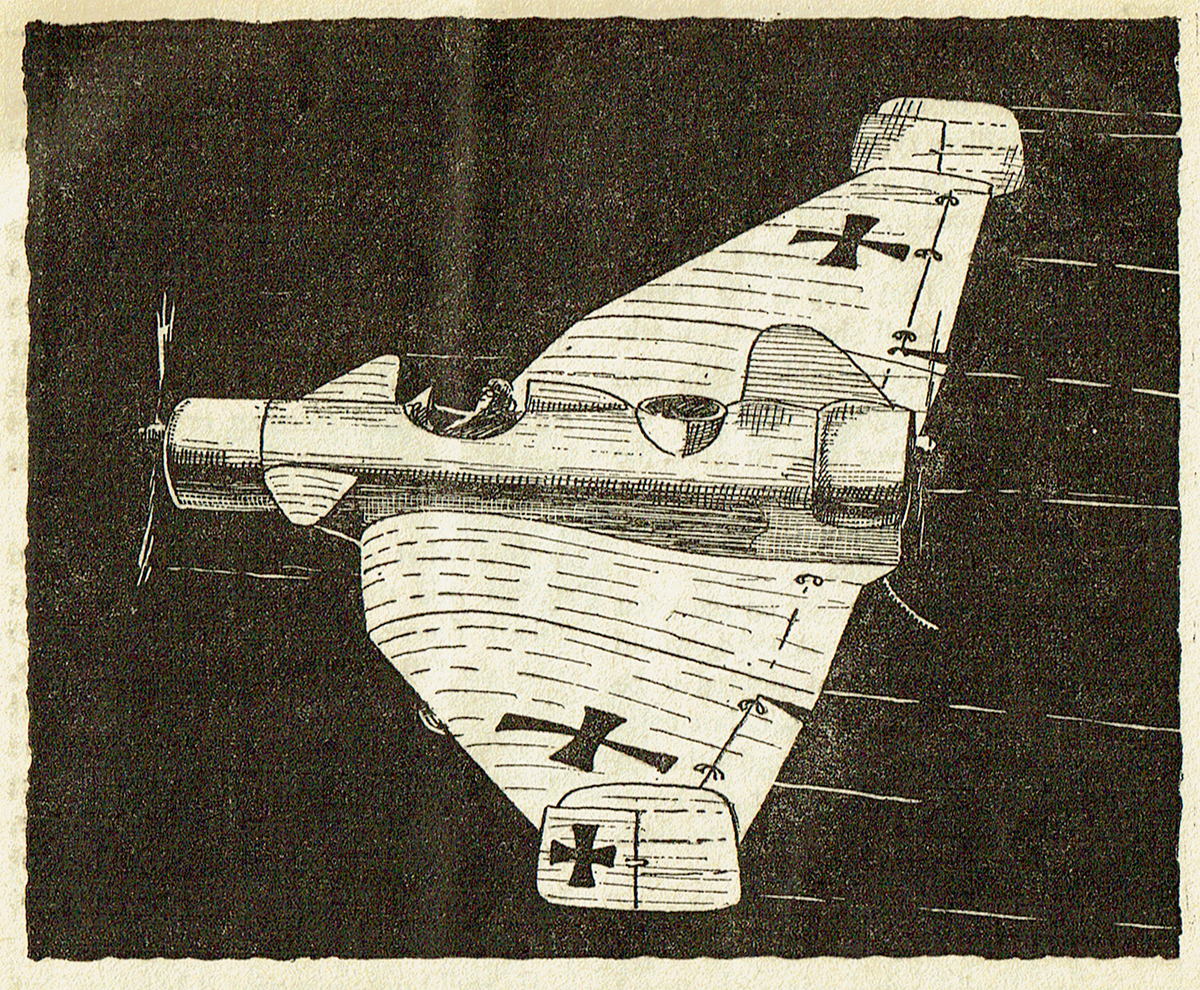
th_DDA_3509AFTER looking at the cover this month you have probably turned to this story quickly to find out what it is all about. You probably think you have missed something in German war-time ships. But you haven’t. Its this way.

Recently we were wondering what a war-time pilot would think and do, had he, in 1918, met a ship of today. So we took 1918 and 1935, mixed them thoroughly and what have we? Well, the result certainly isn’t the World War. As a matter of fact it isn’t any war. It isn’t even real, and that is just the result we were after. Not being real we can let our imaginations roam. Therefore, this cover is No. 1 of a brand-new series. To
keep them in order we will number them. You will find the number in the lower left-hand corner on the blue band.

Now let us suppose that a French pilot, in 1918 meets a ship of 1935. This opens a fascinating field. We can keep abreast with the very latest in modern fighting aircraft design on these covers as well as present the war-time ship. And more, you will then have an easy way of comparing the fighting ship of today with the fighting ship of yesterday.

To start off, we have selected a tailless ship. It is not strictly speaking, a fighter. It was designed by a young German inventor in 1933 and he startled the aeronautical world by actually flying it.

It was, therefore, the forerunner of the modern tailless type. Designers seized on the tailless idea and a recent ship of this type, produced by Great Britain, may prove to be the most formidable fighting craft yet made. That ship is the Pterodactyl, which we shall show next month.

As we said above, the tailless ship was not designed as a fighter. But for the purposes of this cover and to give the Spad a break, we have made it into a fighter by merely making the passenger cockpit into a gun nacelle.

Granted it is a fighter, let us see what Pierre, our French pilot of 1918, would think of it. When he first sighted it he probably thought it was a bat, but as it approached and grew in size, and although it still looked to him like a bat, he knew it for what it was, for he caught the flash of propellers.

And then he sat fascinated as the strange ship circled him. His eyes told him it zvas an airplane, but his mind refused to accept it as such. He probably said to himself, in French of course, “There ain’t no such animal, there couldn’t be! Why, it hasn’t even got a tail and where the tail should be is a propeller! There’s a propeller at the bow too. Good grief, it’s a pusher and a tractor at the same time, impossible! And what are those green things at the end of the wings, if they are wings?”

Just then the bat-like ship banked. “Are they rudders? How could rudders be there? No, I’m seeing things, no more cognac for me!”

Of course we must assume all this went through Pierre’s head in a flash. As the ship banked, Pierre was startled to see smoking white tracers flash past. He then saw what had escaped him at first, the bat ship carried German crosses. Pierre looped and although he didn’t think the thing was really there, went to work.

Now what chance would Pierre have against this ship? A very good chance indeed. Pierre, with his 300 h.p. Hispano could do 130 m.p.h. on the straight-away. The tailless ship with only 150 h.p. could do 160, no use trying to run for it. Maybe he could out-climb it? No, the German could climb a thousand feet a minute. Well maybe he could out-dive it? Not that either, the German ship could dive like a bat out of hell.

He could out-maneuver it however, but what good would that do? The gunner had an unrestricted field of fire, back, ahead, up and to the sides. Well, maybe the thing has a blind spot. Ah! There we have him; underneath Pierre was as safe as a church. Now just tip up and let him have it.

Yes, we’re sure Pierre would win this fight, but next month the tailless ship tells a different story.

The Story Behind The Cover
“The Tailless Ship: The Story Behind The Cover” by Frederick Blakeslee
(September 1935, Dare-Devil Aces)

“The Green Death” by Frederick Blakeslee

Link - Posted by David on October 5, 2015 @ 6:00 am in

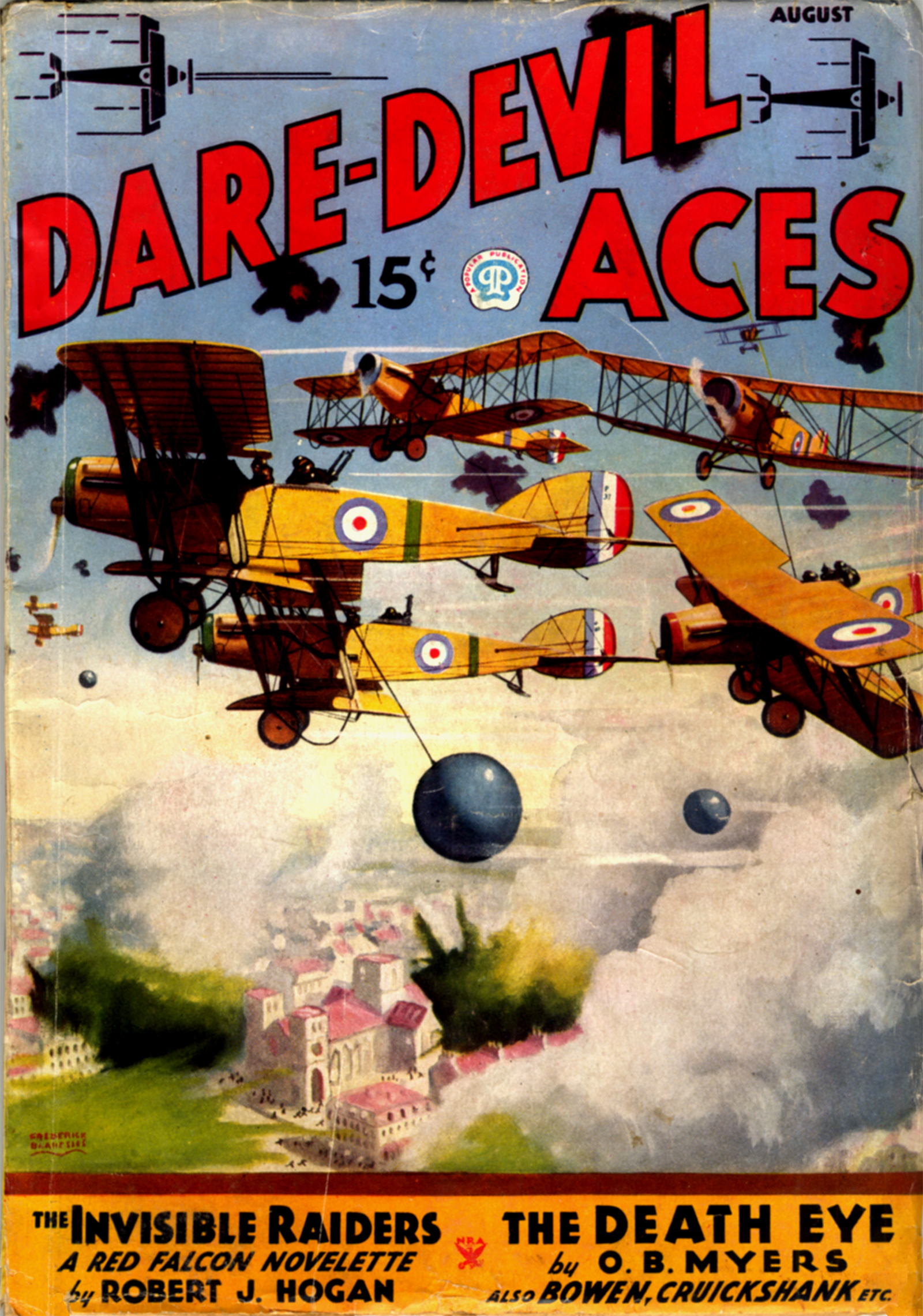
Frederick Blakeslee painted all the covers for the entire run of Dare-Devil Aces. And each of those covers had a story behind it. This time, we have Mr. Blakeslee’s cover for the August 1935 number on which he depicts the story of The Green Death!

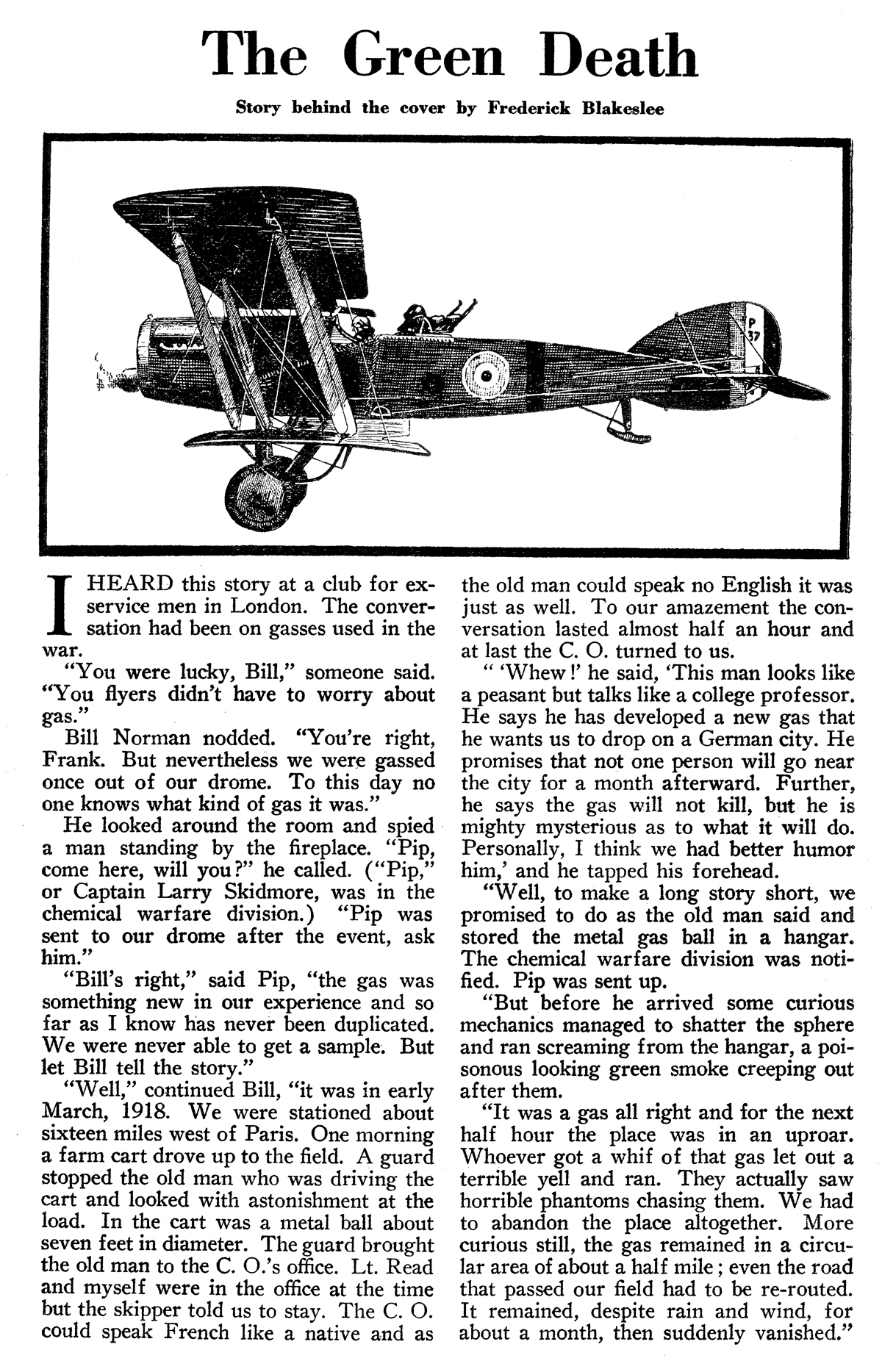
th_DDA_3508I HEARD this story at a club for ex-service men in London. The conversation had been on gasses used in the war.

“You were lucky, Bill,” someone said. “You flyers didn’t have to worry about gas.”

Bill Norman nodded. “You’re right, Frank. But nevertheless we were gassed once out of our drome. To this day no one knows what kind of gas it was.”

He looked around the room and spied a man standing by the fireplace. “Pip, come here, will you?” he called. (”Pip,” or Captain Larry Skidmore, was in the chemical warfare division.) “Pip was sent to our drome after the event, ask him.”

“Bill’s right,” said Pip, “the gas was something new in our experience and so far as I know has never been duplicated. We were never able to get a sample. But let Bill tell the story.”

“Well,” continued Bill, “it was in early March, 1918. We were stationed about sixteen miles west of Paris. One morning a farm cart drove up to the field. A guard stopped the old man who was driving the cart and looked with astonishment at the load. In the cart was a metal ball about seven feet in diameter. The guard brought the old man to the C.O.’s office. Lt. Read and myself were in the office at the time but the skipper told us to stay. The C.O. could speak French like a native and as the old man could speak no English it was just as well. To our amazement the conversation lasted almost half an hour and at last the C.O. turned to us.

” ‘Whew!’ he said, ‘This man looks like a peasant but talks like a college professor. He says he has developed a new gas that he wants us to drop on a German city. He promises that not one person will go near the city for a month afterward. Further, he says the gas will not kill, but he is mighty mysterious as to what it will do. Personally, I think we had better humor him,’ and he tapped his forehead.

“Well, to make a long story short, we promised to do as the old man said and stored the metal gas ball in a hangar. The chemical warfare division was notified. Pip was sent up.

“But before he arrived some curious mechanics managed to shatter the sphere and ran screaming from the hangar, a poisonous looking green smoke creeping out after them.

“It was a gas all right and for the next half hour the place was in an uproar. Whoever got a whif of that gas let out a terrible yell and ran. They actually saw horrible phantoms chasing them. We had to abandon the place altogether. More curious still, the gas remained in a circular area of about a half mile; even the road that passed our field had to be re-routed. It remained, despite rain and wind, for about a month, then suddenly vanished.”

The Story Behind The Cover
“The Green Death” by Frederick Blakeslee (August 1935, Dare-Devil Aces)

“The Sopwith Triplane” by Robert H. Rankin

Link - Posted by David on September 28, 2015 @ 6:00 am in

Frederick Blakeslee painted all the covers for the entire run of Dare-Devil Aces. And each of those covers had a story behind it. This time, we have more of the approach he used for the covers he painted for Battle Aces—telling us about the ship on cover. But, instead of Mr Blakeslee telling us about the ship on the cover, we have Mr. Robert H. Rankin, formerly a draughtsman for the Fokker Aircraft Corp telling the story of the Sopwith Triplane—featured on the cover of the July 1935 cover of Dare-Devil Aces. . . .

th_DDA_3507Editor’s Note: This month’s cover shows what would happen if a certain invention, had been perfected during the War. The rear-pit man in the all metal Junkers is operating a huge, highly magnified tense, so constructed as to concentrate a powerful percentage of the sun’s rays. When focused on the fabric covering of an airplane, this sunlight beam would cause a tiny burn. It is based on the same principle as that of lighting a fire by focusing sunlight on a small glass dial. The Allied ships on the cover are Sopwith triplanes.

The Sopwith Triplane
By ROBERT H. RANKIN
Formerly draughtsman, Fokker Aircraft Corporation

OF THE various Sopwith planes, all of which attained great fame, none is more interesting and characteristic than the Triplane—or as it was better known by the German and British pursuit pilots, the “Tripe” or “Tripe-hound.”

The Triplane was the ninth type produced by the Sopwith works, being accepted by the Experimental Board about four months after the Sopwith Pup. The principal object aimed at in the design of the Triplane was the attainment of an extra high degree of visibility, or in other words, the reduction to minimum of the pilot’s blind angle.

With his eyes on a level with the intermediate plane the pilot had practically an junrestricted arc of vision through some 120 degrees, while a section cut out of the intermediate wing enabled him to have a rather good view of the ground while landing the ship, the position of the cockpit being such that the bottom wing had no restricting effect on the vision.

The narrowness of the chord made possible by the use of three main planes also enabled the pilot to have an exceptional view upward and to either side—a most important consideration in any pursuit ship. Another object aimed at in the “Tripehound” was an increase in maneuverbility.

It will be seen that due to the narrow; chord the shifts in the center of pressure with varying angles of incidence is smaller than in a biplane, and consequently a much shorter fuselage can be used to suport the tail surfaces. In addition to this, the small span of the triplane reduces the moments of inertia in the horizontal plane and an airplane is thus obtained which is very sensitive to its controls, which fact adds to its ability to dodge to various strategic positions in a fight.

The factor of the movement of the center of pressure enabled single I-struts to be used instead of the usual pairs, one springing from each spar. This simplified construction by permitting a simplification of inter-plane wire bracing system. Ailerons of the unbalanced type were fitted to each of the three wings.

The “Tripehound” was armed with a single machine gun mounted on the forward top side of the fuselage. In the hands of experienced pilots the ship gave a splendid account of itself and coped favorably with the Fokkers then in use on the Western Front.

The dimensions of the Triplane follow:

Sweepback None
Stagger 1 ft. 6 in.
Dihedral (same for each wing) 2.5 degrees
Total wing area 231 sq.ft.
Length over all 18 ft. 10 in.
Overall span 26 ft. 6 in.
Wing span (same for each wing) 26 ft. 6 in.
Chord (same for each wing) 3 ft. 3in.
Wing areas—
    Top 84 sq. ft.
    Intermediate 72 sq. ft.
    Bottom 75 sq. ft.
    Gap 3 ft.
Areas—
    Aileron 34 sq. ft.
    Tail plane 14.0 sq. ft.
    Elevators 9.6 sq. ft.
    Total 23.6 sq.ft.
    Fin 2.5 sq. ft.
    Rudder 4.5 sq. ft.
    Total 6.5 sq. ft.


Powered with a 130 h.p. Clerget engine the Sopwith Triplane had a high speed of 112.5 miles an hour (at 6,500 feet). The landing speed was 35 m.p.h. and it would climb to 6,500 feet in 6.5 minutes and to 15,000 feet in 22.3 minutes.

The plane had a fuel capacity of 180 pounds and a flight range of 310 miles. The ceiling was 20,500 feet. The “Tripehound” weighed 1,103 pounds empty and 1,543 pounds loaded which made a loading of 6 pounds per square foot or 12.4 pounds per horse power.

Although judged by present standards the Triplane was low-powered and rather slow, its speed, ease of handling and general performance were outstanding at the time of its introduction into the Royal Flying Corps.

The Story Behind The Cover
“The Sopwith Triplane” by Frederick Blakeslee (July 1935, Dare-Devil Aces)

“The Fokker Triplane” By Robert H. Rankin

Link - Posted by David on September 21, 2015 @ 6:00 am in

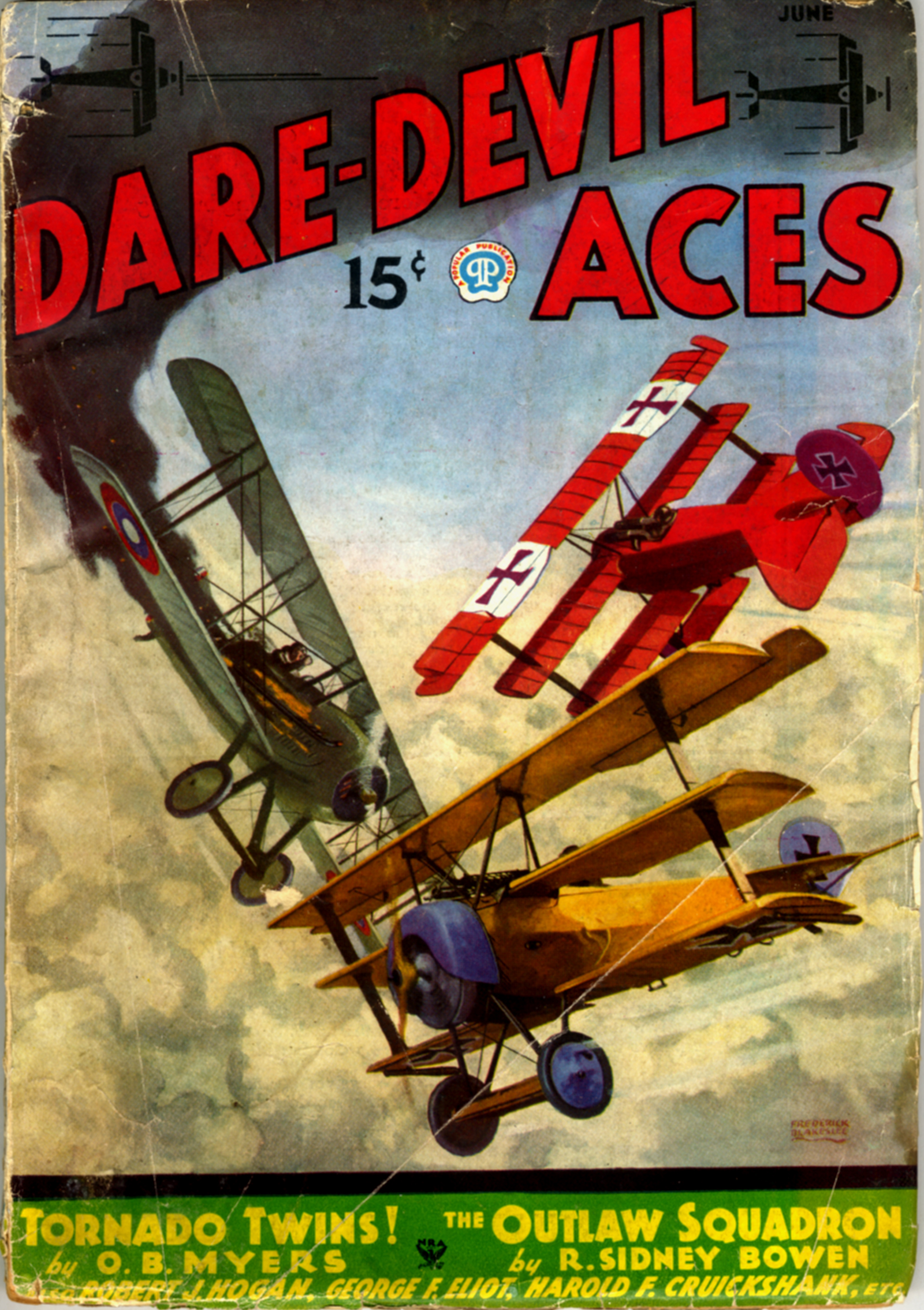
Frederick Blakeslee painted all the covers for the entire run of Dare-Devil Aces. And each of those covers had a story behind it. This time, we have more of the approach he used for the covers he painted for Battle Aces—telling us about the ship on cover. But, instead of Mr Blakeslee telling us about the ship on the cover, we have Mr. Robert H. Rankin, formerly a draughtsman for the Fokker Aircraft Corp telling the story of the most recognized plane of the era—the Fokker Triplane—featured on the cover of the June 1935 cover of Dare-Devil Aces. . . .

th_DDA_3506AFTER one look at the cover this month you would probably think that the American and German pilot were doomed. However, both escaped, the American with minor burns and the German with a bad fright.
  As a matter of fact, the fire on the Spad was not quite as bad as we have shown; just bad enough to make the pilot think that he was due for an awful death. He decided to crash one of the Fokker tripes, bringing it down with him. But the pilot of the Fokker got ont of the way just in the nick of time.
  The American discovered in that dive that if he side-slipped the blast of wind would keep the fire away from the cockpit. He managed to reach the ground by side-slipping. As he later said—”Given my choice of crashing or being burned to a cinder, I’ll crash every time.” And crash he did.

Now let’s hear from an expert the inside dope on the Fokker triplane.

The Fokker Triplane
By ROBERT H. RANKIN
Formerly Draftsman, Fokker Aircraft Corporation

DURING the early part of the year 1916 the German High Command realized that the war had developed into a bitter struggle which would be prolonged much longer than had at first been expected.

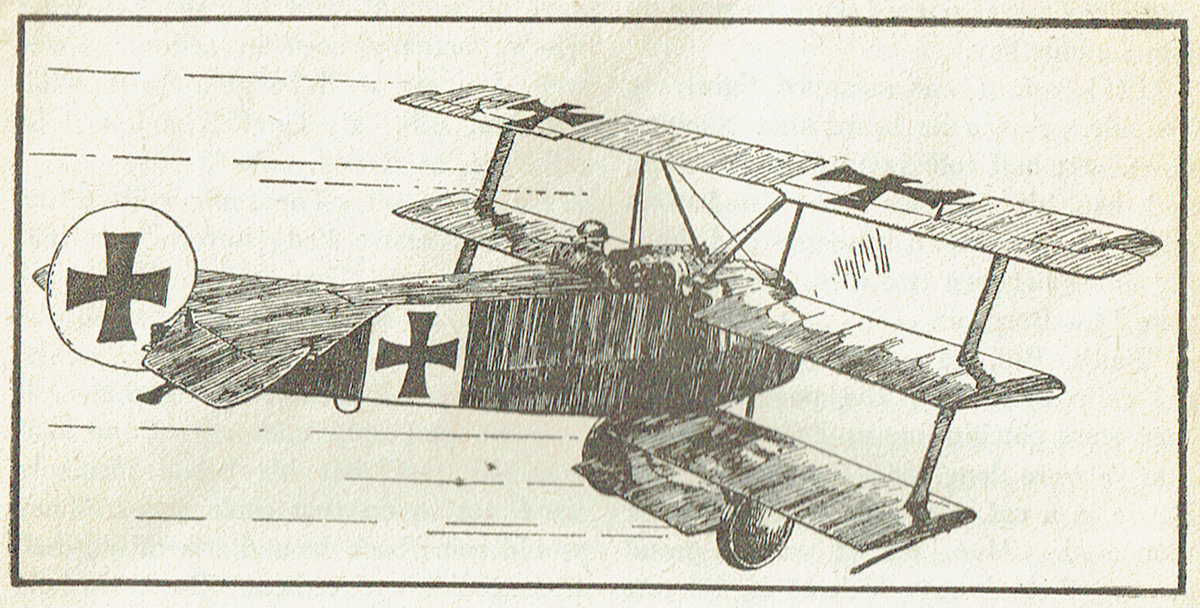
With this fact in mind, Germany at once redoubled her efforts to gain undisputed supremacy of the skies and Anthony Fokker was asked to design and produce a new combat ship which would enable her to gain the upper hand. Fokker set to work at once and in the early fall of 1916 this plane was placed in the hands of the fighting pilots. It was the Fokker D.R.-I, or as it was perhaps better known, the Fokker triplane.

At first the performance of the triplane was not viewed seriously by the Allies. But within a short time they learned to have a high regard for the new Fokker pursuit. Although this unique ship was slower than the Nieuports, Sopwiths and Spads, its ability to climb and maneuver gave it a decided advantage over any ship then in use and the series of impressive victories for which it was responsible gave the entire world notice that it was a most important factor in aerial warfare.

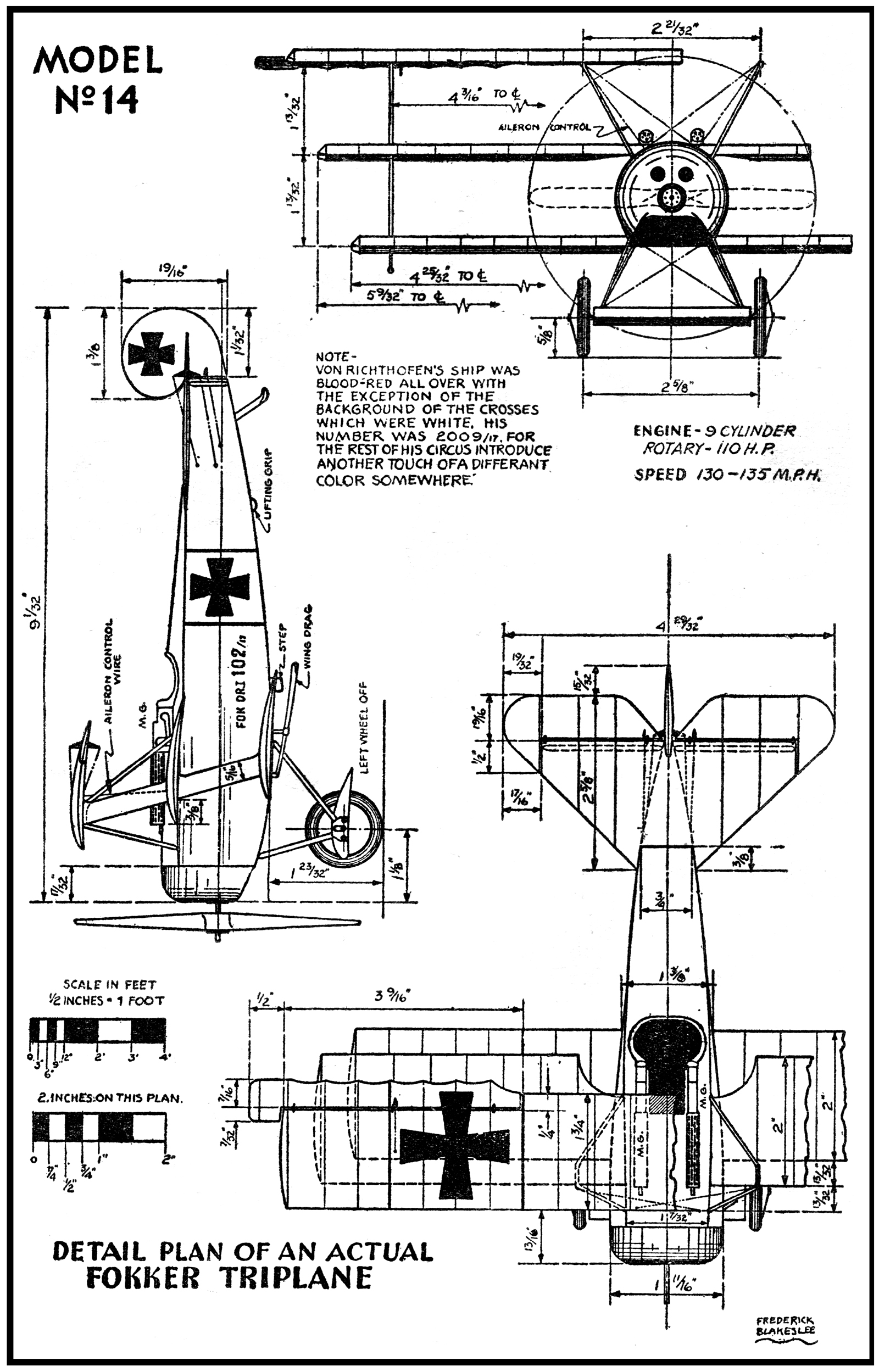
In general outline the Fokker D.R.-I was of the orthodox triplane type. However, unlike the Sopwith triplane the span of the wings were unequal.

The span for the top wing was 23 feet, 7 inches, the span for the middle wing was 20 feet, 6 inches, while the span of the bottom wing was 18 feet, 9 inches. The chord was the same for all three wings. The top wing alone was provided with ailerons, and these were of the balanced type.

One of the outstanding features of the Fokker was the wing spar construction. The main point of interest is that the twin spars were built up of two box section tapering spars, these being joined by transverse plywood. The front and rear shear strength of this built-up member was supplied by one right and one left plywood bulkhead in each wing.

Structurally the main wing frame could be regarded as consisting of three pairs of cantilevers tied by pseudo-struts near the wing-tips. The function of this structure was to distribute the load evenly from wing to wing.

The use of the triplane design gave the advantage of a larger ratio of lifting power. Of course, there was some increase in head resistance caused by the use of the extra set of inter-plane struts. But by bracing the wings internally, Fokker eliminated all brace wires, thus reducing the total head resistance to some extent.

It is interesting to note in connection with this that Fokker was the first designer to completely do away with inter-plane bracing.

The Story Behind The Cover
“Model No.14 – Fokker Triplane” by Frederick Blakeslee (January 1934, Battle Birds)

The fuselage of the triplane was built up of welded tubular steel and was covered with linen fabric. It was rather well streamlined, and like most of the Fokker war-time designs it compared closely to modern aeronautical practice.

The empennage or tail of the ship was a fabric covered steel tubing framework. There was no vertical fin, there being only the characteristic Fokker rudder. The tail plane or stabilizer was comparatively large and was fitted with the usual type elevators.

The landing gear axle was inclosed by a wing, a feature which was incorporated on all of the later Fokker fighting models. This wing was two pieces and these were attached to a central casting which housed the shock absorbing agents and the axle. The covering for this wing was plywood.

The triplane or D.R.-I was equipped with a 110 h.p. 9 cylinder Oberursel rotary motor. This motor was mounted on a plate which was stamped from sheet steel. The plate was attached, of course, to the front ends of the fuselage longerons.

For armament the plane was fitted with twin Spandau machine guns, these being mounted on the top side of the fuselage directly in front of the cockpit. Directly behind the engine was the synchronizing gear for the guns, and behind this gear was located the fuel tank. This tank was of a rather small capacity and as a result the flight range of the machine was greatly limited.

The triplane answered very well to the controls and as far as climb and general maneuverability are concerned it was equaled by but very few of the later war time designs.

German pilots have told the writer that they were greatly impressed with the ship and if the speed of the plane could have been increased they would have preferred it to any other plane, with the possible exception of the D-VTI. Certainly it was the choice of many of the German pilots.

The great von Richthofen, who could select any ship he desired, favored it above them all; and his series of victories indicate the famous flyer made no mistake in his choice of a pursuit.

The Story Behind The Cover
“The Fokker Triplane” by Frederick Blakeslee (June 1935, Dare-Devil Aces)


Mr. Blakeslee covered the Fokker Triplane himself with the story of the great von Richthofen last flight for the cover of the March 1932 number of Battle Aces.

« Previous PageNext Page »