Looking to buy? See our books on amazon.com Get Reading Now! Age of Aces Presents - free pulp PDFs

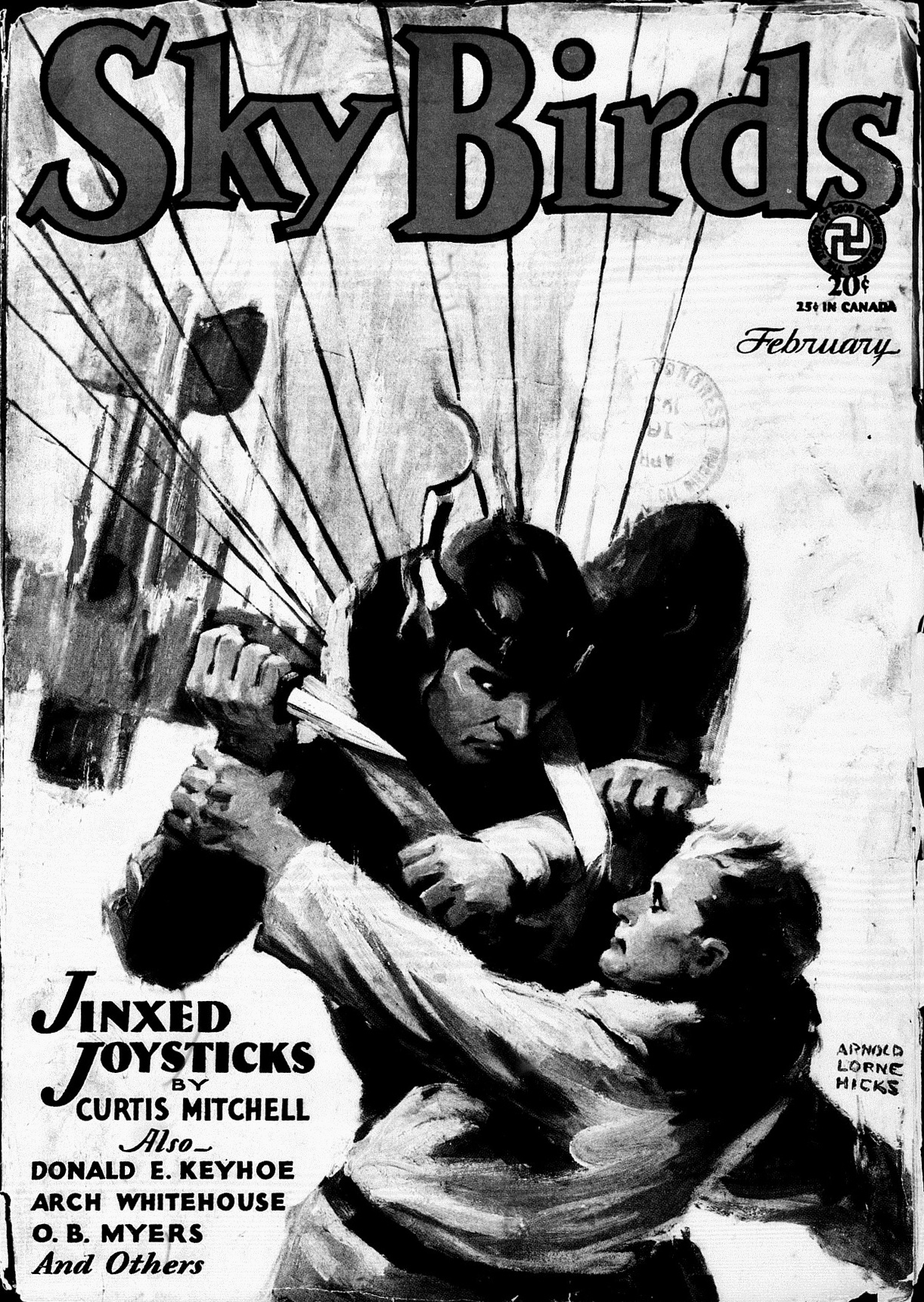
“Hunted Vultures” by Arch Whitehouse

Link - Posted by David on October 24, 2025 @ 6:00 am in

THIS week we have another gripping tale from the prolific pen of Arch Whitehouse! Whitehouse had numerous series characters in the various air pulps—Coffin Kirk, Buzz Benson, and The Casket Crew to name a few. But this week’s story does not feature any of his series characters. It’s about Teddy.

As an observer, a loyal member of the Eyes of the Army, Teddy was a knockout. His reports were lengthy affairs crammed with accurate data. He knew every German trench from Dixmude to Cambrai. He could take and read aerial photographs like a wizard.

However, Teddy was stricken with the same weakness, that seemed to beset many observers at the front during the dizzy days of 1917 and 1918. In the gunnery schools he had been taught the art of firing at moving targets with the aid of his ring sight and wind vane. The theory and practice, in school, had been religiously digested by our Teddy, but out at the front where excitement plays a big part in the game, he had forgotten all about laying off for direction, speed of machines, angles of approach and all that data.

When an enemy bus appeared in sight, it was Teddy’s idea to point the muzzle of the gun at the black-crossed vulture, pull the trigger and move the muzzzle so that the tracers appeared to be eating their way dead into the enemy cockpit. Thus, Teddy’s tracers were directed at the enemy machines but his armorpiercing and regular ammunition was perhaps being fired yards ahead or behind and recklessly wasted. Unless the aerial target was within a few yards of the Lewis gun muzzle, such firing and aiming was useless.

An amazing, hair-raising story of a spectacular air battle and an observer who was bitten by a most peculiar bug. It brought him nothing but trouble until, in the thick of the fight something happened that wasn’t on the program—

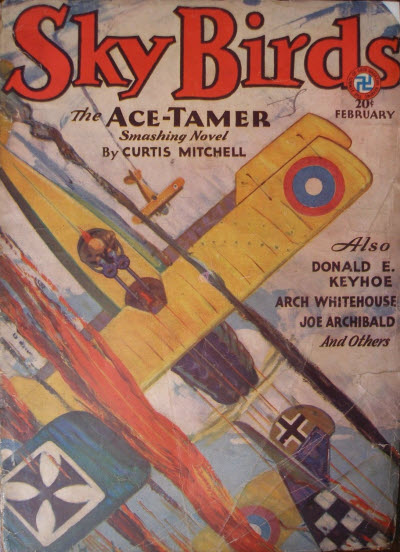
“No More Victories” by Donald E. Keyhoe

Link - Posted by David on August 8, 2025 @ 6:00 am in

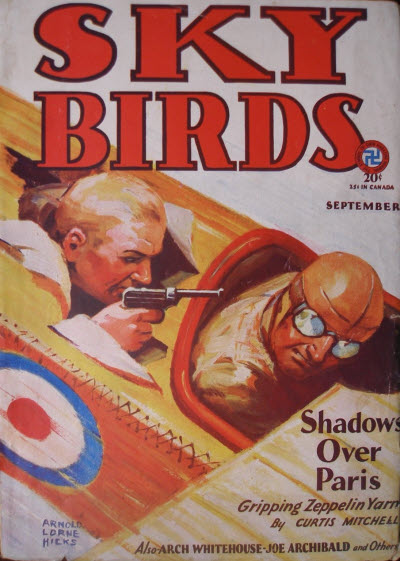
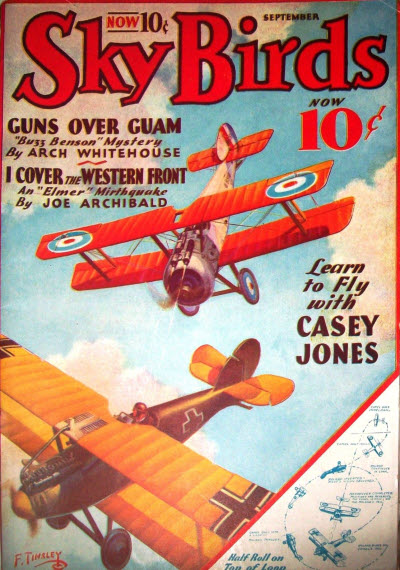
THIS week we have an early story from the pen of Donald E. Keyhoe from the pages of the September 1930 Sky Birds magazine. Keyhoe started appearing regularly in the aviation pulps—Wings, Air Stories, Sky Birds, Flying Aces—starting in December 1929. His series characters started in August 1931.

Gene Burke tried to keep a low profile, lest he be discovered and imprissoned for a murder he did not commit. He must be careful not to arouse suspicion—but there must be no confirmed victories. Rather incur the stigma of lost nerve than risk disaster. Unfortunately, ever since he had come up from Issoudun, intent on remaining but an obscure pilot of the Royal Flying Corps, that Fate had shaped a strange destiny for him. Three swift victories had been his, longed-for but feared because of the inevitable increase of local fame. Then he had gotten a straggler from Richthofen’s Circus, which he dared not hold back from attacking, and finally came the fifth scrap that had made him an ace. It was Fate, a grinning, mocking Fate that gave him these victories, only to lead him closer to a dishonored end . . .

A haunting fear crept into Burke’s eyes as he saw his thirteenth Boche go twisting down in flames. For it was a mocking Fate that gave him these victories—victories that he dared not claim!

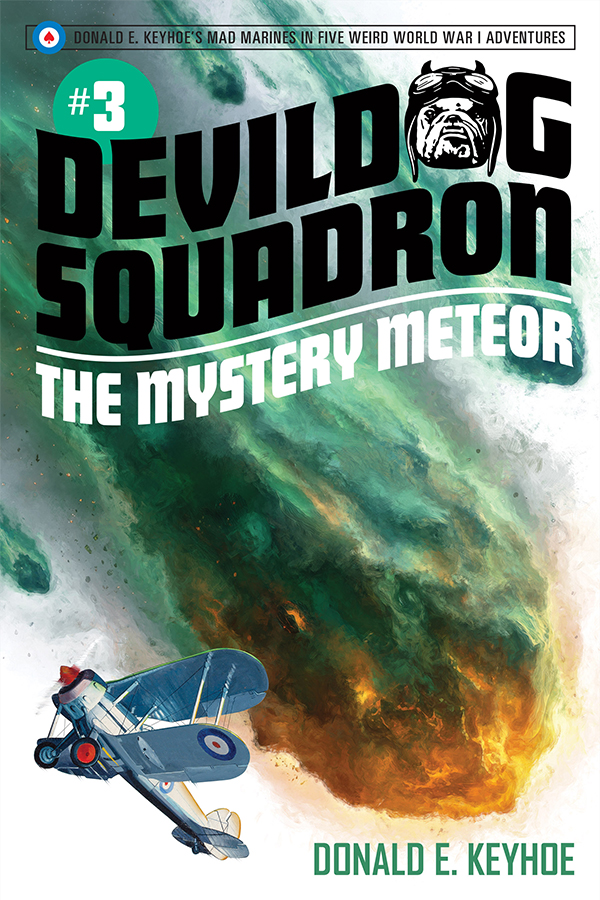
And be sure to check out Keyhoe’s Mad Marines—The Devildog Squadron—in five new Weird World War Adventures in The Devildog Squadron: The Mystery Meteor!

“Patrol of the Dead” by Franklin H. Martin

Link - Posted by David on August 1, 2025 @ 6:00 am in

TODAY we have a story by Franklin H. Martin. Not much is known about Martin aside from the fact he worked as a reporter on Newark newspapers. He had almost a hundred stories published in the pulps with roughly three quarters being detective or weird menace stories and the remaining quarter being air stories in the pages of Sky Birds, War Birds and Wings.

Ronald Sexton and his brother, Kenneth, came to the squadron together while we were up near Bar-le-Duc, during the St. Mihiel drive. They had gone to school together, enlisted together, trained side by side and gotten their little gold shoulder bars and wings together. Ronny was a year older, darker, huskier and livelier. Ken was quiet and inclined to be studious. It’s a mystery where Ken got time to do all his reading, because Ronny liked parties, and whenever Ronny went on a binge, Ken went along. They flew together, too. And even when Ronny was shot down and killed, he continued to look after his brother. Kenneth seemed to develop a kind of prescience that the squadron leader found hard to believe and led H.Q. to believe he was a German spy.

Many strange and weird stories have been told about the war. At some of them men have shrugged their shoulders, and lifted a doubting eyebrow. Others, men have believed—because they must. Here is one of the strangest of them all—the story of a squadron, and the blood-chilling Thing that almost drove them mad. It all began one afternoon bach in 1918, when Ronny Sexton crashed at Hill 420, near Exermont, France, and his smoking-hot motor dug him a six-foot grave. A powerful and unusual novel of war skies.

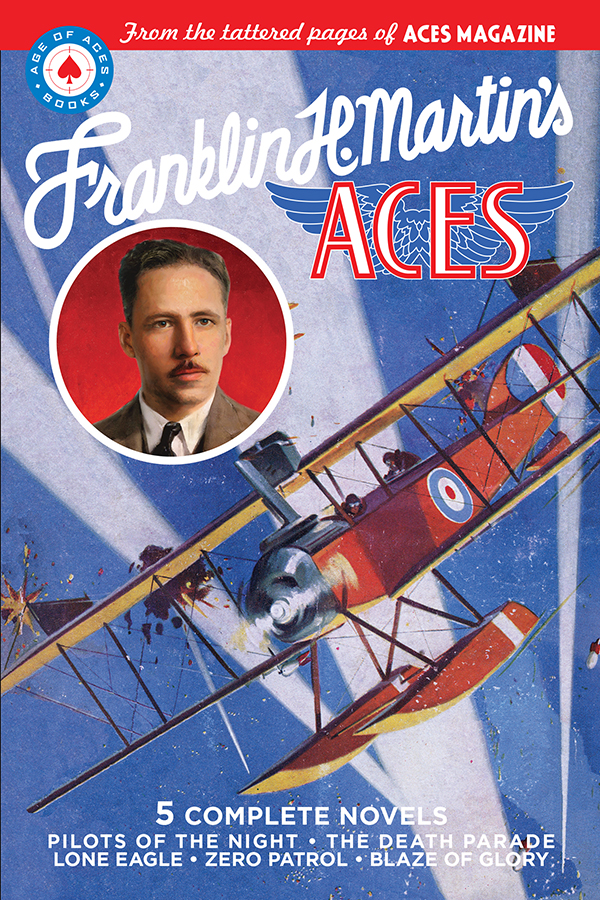
If you enjoyed this taste of Franklin H. Martin’s writing, you’ll be happy to hear that we’ve collected the five stories Martin had in Aces in the Fall of 1932. We’re calling it Franklin H. Martin’s Aces—the volume includes the Black Hawk of Prussia duology and three other stories!

Premiering at PulpFest 2o25!

Link - Posted by David on July 21, 2025 @ 6:00 am in

AGE OF ACES will be back at PulpFest again this year where we will be debuting our two new titles!

For those who were disappointed that the Devildogs took a break last year, you’ll be happy to hear they’re back with a third volume of their exploits. Paired with that will be the volume of stories Franklin H. Martin had in Aces.

Franklin H.Martin’s Aces
by FRANKLIN H. MARTIN

This volume collects the five stories the enigmatic Martin had in Aces in the August through December issues of 1932 including the epic two part Black Hawk of Prussia story!

He is known as The Black Hawk of Prussia, but just who is von Woolrich? Every description of him is different. Some say he is big and dark. Others claim to have seen him—and say he’s short and slight, with reddish hair. Some rumors describe him as a man who can break a laminated mahogany prop over his knee like a stick of kindling wood. Others say that he is esthetic, an artist and a musician—he is said to have composed several splendid arias before the war. Or maybe he is just a name made up to scare little boys, like a boogy-man. Whatever the case may be, one thing is for certain—von Woolrich, is a master-mind spy!

Stories include: Pilots of the Night (10/32), Zero Patrol (11/32), The Death Parade (8/32), Lone Eagle (9/32) and Blaze of Glory (12/32). Also a special feature on Franklin H. Martin’s winning submission to the Writer’s Digest-Liberty $2,000 Short Story Contest and a bibliography of Martin’s pulp stories

Paired with this is the third volume of Donald E. Keyhoe’s Mad Marines—The Devildog Squadron! We gave them a rest last year and they are raring to go in five more Weird World War adventures!

Devildog Squadron: The Mystery Meteor
by DONALD E. KEYHOE

“Cyclone Bill” Garrity and his Mad Marines are back in the thick of things in five more Weird World War I Adventures from the imaginative pen of Donald E. Keyhoe. Those crazy Germans have come up with even more ways to turn the tide and win the war. Whether it’s going to elaborate lengths to convince an English scientist it is still 1915 and England and Germany are in a war against France to get the formula for a super explosive he invented; raining an extremely deadly and corrosive liquid fire down from the skies killing all in its deadly path; or developing a brilliant silvery beam that can cut anything in it’s way to shreds. If that’s not enough, throw in the fact that the Devildog’s latest replacement is a dead ringer for the Kaiser’s own brother and you’ve got all the making of classic Keyhoe madness!

The Devildog adventures featured in this volume are all from the pages of Sky Birds: Hangers of Hell (8/34), The Spandau Cyclone (10/34), Devildog Dynamite (12/34), The Mystery Meteor (1/35).

In addition to these new books, we’ll have all of our other titles on hand as well as our previous convention exclusive—Arch Whitehouse’s Coffin Kirk, and 2022’s two book set of Steve Fisher’s Sheridan Doome! So if you’re planning on coming to Pittsburgh for PulpFest this year, stop by our table and say hi and pick up our latest releases!

We hope we see you there!

“Crossed Controls” by William E. Barrett

Link - Posted by David on June 13, 2025 @ 6:00 am in

TODAY we have a story by the inimitable William E. Barrett! Before he became renown for such classics as The Left Hand of God and Lilies of The Field, Barrett honed his craft across the pages of the pulp magazines—especially in the air war titles like War Birds, War Aces, Air Stories, Air Trails, Wings, Sky Riders, War Novels, Sky Fighters, Flying Aces and, of course, Sky Birds—in whose pages this story appeared

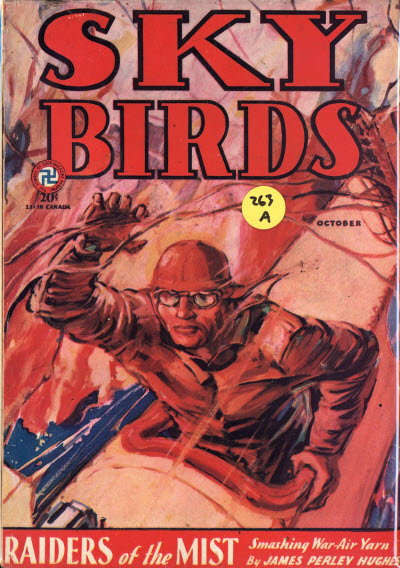
He would fight as never before, and death to the Allied plane that crossed his guns! Yet the sight of those British cockades made a bell ring in his clouded mind, and his hands fumbled on the trips. He could not shoot!

From the October 1930 Sky Birds, it’s William E. Barrett’s “Crossed Controls!”

If you enjoyed this story, check out William E. Barrett’s other features and stories on this site or pick up a copy of his Iron Ace stories which collects all nine of his tales of Hugh McQuillen, The Iron Ace, also from the pages of Sky Birds.

Major T.A.B. Ditton

Link - Posted by David on May 16, 2025 @ 6:00 am in

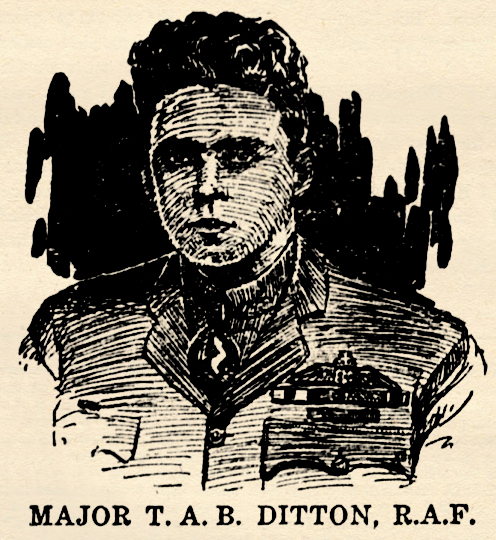
INTRODUCING war ace and flying author Thomas Alfred Belcher Ditton or Major T.A.B. Ditton as he credited himself on the stories he had published. His pulp career was brief. Ditton only had 17 stories published from 1929 through 1936 in magazines like Sky Birds, Flying Aces, War Aces, Bill Barnes Air Adventures, Thrilling Adventures and Top Notch. Sky Birds did cover Ditton in one of their half a dozen “Flying Into View” features which profiled a different famous birdman or well known character in the world of flying each month. We’ll start with that; then list his pulp bibliography; and follow it up with three of his stories.

Flying Into View
introducing MAJOR T.A.B. DITTON, R.A.F.

“. . . HE WENT DOWN end over end and crashed behind the German lines, leaving the three other Albatrosses to finish me off, now that I’d used up my last few bullets on him,” continued “Tabs” Ditton, as he ordered more coffee.
“There was nothing that I could do,” he went on, “but do my best to out-stunt ’em and get back to my drome with a whole crate. I sure did stunt that Dolphin, but just a bit too much. With the snarling hun ships swarming all over me I kicked the rudder over and threw her into a vertical bank with the power full on. There was a sudden lurch, a snapping, splintering cra-a-a-a-a-ack, and the two left wings just folded up and over the center section! The bus went into a sickening spin at once, and after a few turns the broken wings came off and went turning and twisting down off to one side. I shed ’em at four thousand feet and I sure covered that in short order.

“All the way down I cut the engine in and out and wrestled with the controls, hoping to get what there was left of the bus out of the spin. I’d unhooked my safety belt so that I would have a chance at least of getting clear when she hit, if I was still interested in getting clear.

“Well, we spun down to about two hundred feet and then the bus came out of the spin for a few seconds. Then when we got down to about a hundred she came out again and slid down on one wing. The men on the ground that saw me said I was thrown clear when she hit, and landed about fifty feet off to one side. I went out for a while and came to in a hospital all snarled up in bandages. I was out in about two weeks and back in the air even if my left eye wasn’t so good,” concluded “Tabs.”

Major T.A.B. Ditton, as he is officially known, was with the R.F.C., which later became the R.A.F., from 1916 until the end of the war. He is officially credited with thirteen German planes, about the same number unofficially, and that besides balloons. He also has several decorations for his skill and bravery in the air.

“Tabs,” as he was known to the men of his outfit, learned to fly on Maurice-Farmans, or “short horns.” He says that they had so many guy wires that the only way they could be tested to see if they were rigged right was to put a canary in the pilot’s seat. If the canary could fly out through the snarl of wires and struts the ship wasn’t rigged right. From those he went on Avros, S.E.5s, Sop. Camels and D.H.5s. He also had flights in bombing crates to make his training complete. Camels were his special hobby, even if they were tricky boats to push around upstairs.

One time one of the “higher ups” decided that the pilots at his drome had not had enough stunting to keep them in trim, so he was ordered up for a few wingovers. Before he went up he had another officer move the planes out of one of the permanent hangars and open the doors on both sides.

After a few rolls and loops he dove his little Sop. Pup down in a screaming dive straight through the hangar and out the other side. He said he landed with his chest all puffed out and was at once put under arrest for reckless flying. The officer who had requested the stunting practice, however, managed to get him off. But needless to say that sort of stunts was barred in the future.

AFTER LUNCH was over “Tabs” and I caught a train for his home in Greenwich Village, where he turns out the stories you men are clamoring for. Here, with his feet parked on a footstool made from the prop of that same Dolphin whose wings he shed, he showed me snapshots of overseas days and told me some of his narrow escapes. This one he says was a joke on himself.

He was setting a Camel down when her wheels caught on a stump. The tail rose up in a high arc and came down with a terrific crun-n-n-n-nch where the plane’s nose should be. “Tabs,” hanging head down from his safety belt, took account of all his bones and found that at least he was all there and not hurt. He was trying to unhook his belt, which was held tightly because of his weight pulling on it, when an “Ack-emma” came running up to see if he was killed, or only banged up. After being assured that “Tabs” was O.K., the Ack-emma reached up under the fuselage and unhooked the safety belt for the suspended pilot. Now for the tragic part of the story! Ditton had forgotten by this time to hold onto the sides of the fuselage, so that when the safety belt snap was released he dropped about two feet and landed on his head. Just his tough luck, after cracking up a ship without getting a mark.

Another almost fatal flight was in a Camel that had been rigged up for instruction work. The main gas tank had been removed and another pilot cockpit and set of controls had been put in where the gas tank had been located. So many young pilots were killed soloing in Camels that it had been thought best to rig up dual controls in a few ships to enable the instructors to ride along with students and help ’em.

Well, this particular bus had just been converted, and Ditton was to give her a buzz or two over the field for a tryout. He told the “Ack-emma” to take the safety belt out of the front seat so that it would not get in the way of the stick.

“Tabs” took the bus up a good ways and proceeded to do his stuff with her. A few minutes later he decided to loop her. The loop went O.K. till he tried to level off at the end of the loop. Try as he might he couldn’t get the stick back to neutral to save his neck, so up went the nose into another loop. He cut the motor and of course she stalled. He did his best but the stick refused to go forward an inch. Right and left O.K. But front? Not an inch!

He finally decided to stall and spin and side slip all the way down to the field. When he landed there was quite an audience waiting for an explanation, including several C.O.s. The first thing Ditton did was to look into the front pit, and there, sure enough, was the safety belt looped over the stick. When the plane had gone into the first loop the belt had hung, down, of course, and swung over the end of the stick. When the stick was shoved forward at the end of the loop of course it tightened the belt about the stick in the front pit, and there it was locked for good. That Ack-emma is still running!

Major Ditton is a yery popular author here at the Sky Birds drome. You can read more of his split second air thrills at any time—because he draws all of his yarns from actual personal experience.

Bibliography

title magazine date vol no
1929
The Desert Hawk Sky Birds Sep/Oct 3 1
Aerobatics Aviation Stories Oct 1 3
1930
Death Deviation Flying Aces Jan 4 4
The Flying Idol Sky Birds Jan 3 4
Eagle of the North Flying Aces Feb 5 1
Three Points Ahead Flying Aces Mar 5 2
Air Wolves Flying Aces Apr 5 3
Death Rides High Flying Aces May 5 4
Desert Vultures Sky Birds May 4 4
Boom Buzzards Flying Aces Aug 6 3
1932
Stars in the Sky War Aces Apr 9 25
Artillery Guys Battle Stories Jul 10 57
1935
Annihilation or a Firing Squad Dime Adventure Jun 1 1
Diamonds in the Sky Bill Barnes Sep 4 2
Sable Rider Thrilling Adventures Nov 15 3
Black Saber Thrilling Adventures Dec 16 1
1936
Wings of the Dragon Top-Notch Jan 98 1

 
Here are a trio of his stories that ran in the 1930 in the pages of Flying Aces and Sky Birds.

Death Derivation

Murder in the skies. The slain pilot lay slumped in his cockpit—the blue mark of a pistol shot on his forehead. A mysterious killing in the air that will keep you guessing.

The Flying Idol

Yank flying courage clashes with the treacherous cunning of a swarm of godless yellow devils. A tale of thrills and daring adventure in heathen skies!

Death Rides High

Powell was fighting mad. It wasn’t the crashed altimeter that got him—it was the startling discovery he made after that.


“Unseen Guns!” by Colcord Heurlin

Link - Posted by David on April 7, 2025 @ 6:00 am in

THIS week we present a cover by Colcord Heurlin! Heurlin worked in the pulps primarily over a ten year period from 1923 to 1933. His work appeared on Adventure, Aces, Complete Stories, Everybody’s Combined with Romance, North-West Stories, The Popular, Short Stories, Flying Aces, Sea Stories, Top-Notch, War Stories, Western Story, and here, the cover of the November 1931 Sky Birds!

Unseen Guns!

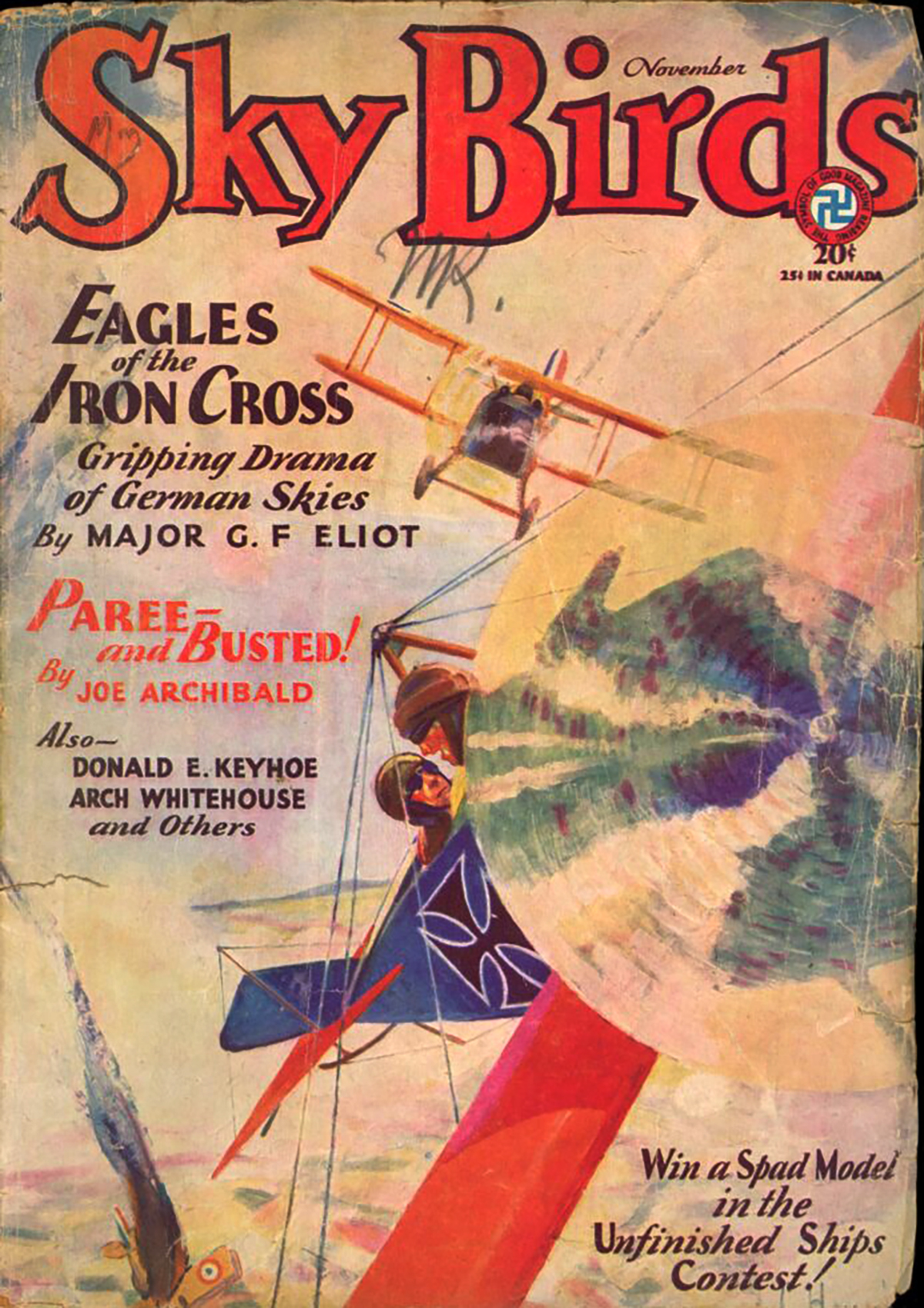
th_SB_3111THE breaks of war! One minute you were a hero and the next going down in a burning crate. It happened on both sides of the line. In the picture on the cover this month we see the pilot and observer of an early German Taube monoplane which has just brought down a French single-seater. As the scout falls and bursts into flame, the Germans make the mistake of relaxing their vigil to share glances of congratulation. Then from their blind side comes an unexpected burst of fire from another scout.

It came quick and fast in the Air Service. One minute you were the victor and the next some one was battering the dials out of your instrument board. And there were two ways of being mentioned in dispatches!

The Story Behind The Cover
“Unseen Guns!”
Sky Birds, November 1931 by Colcord Heurlin

“The Giant Killer” by Colcord Heurlin

Link - Posted by David on February 24, 2025 @ 6:00 am in

THIS week we present a cover by Colcord Heurlin! Heurlin worked in the pulps primarily over a ten year period from 1923 to 1933. His work appeared on Adventure, Aces, Complete Stories, Everybody’s Combined with Romance, North-West Stories, The Popular, Short Stories, Flying Aces, Sea Stories, Top-Notch, War Stories, Western Story, and here, the cover of the October 1931 Sky Birds!

The Giant Killer

th_SB_3110IT IS interesting to note that comparatively few Zeppelin raids were made on Paris during the war. Early in the big conflict the French brought down a big gas-bag, and the Germans decided to devote their raiding to night Gotha patrols or hurling giant shells from the security of the wood that hid Big Bertha. The main air defense of Paris in the early days was carried out by the old Maurice and Henry Farman ships. These rare old pushers, weird as they might seem today, were too much for the Zeps. Our cover this month shows a gunner in a Henry Farman “shorthorn” putting the fatal burst into a big raider on its way to bomb Paris. The airmen are wearing the famous old crash helmets that all wise flyers donned before taking the air, prior to 1915 or 16.

The Story Behind The Cover
“The Giant Killer”
Sky Birds, October 1931 by Colcord Heurlin

“The Fighting Spotters” by Paul J. Bissell

Link - Posted by David on February 10, 2025 @ 6:00 am in

THIS week we present one of Paul Bissell’s covers for Sky Birds! Bissell is mainly known for doing the covers of Flying Aces from 1931 through 1934 when C.B. Mayshark took over duties. He also did covers for brother magazine Sky Birds. For the September 1931 cover Bissell put us right in the action with some artillery spotters over enemy lines!

The Fighting Spotters

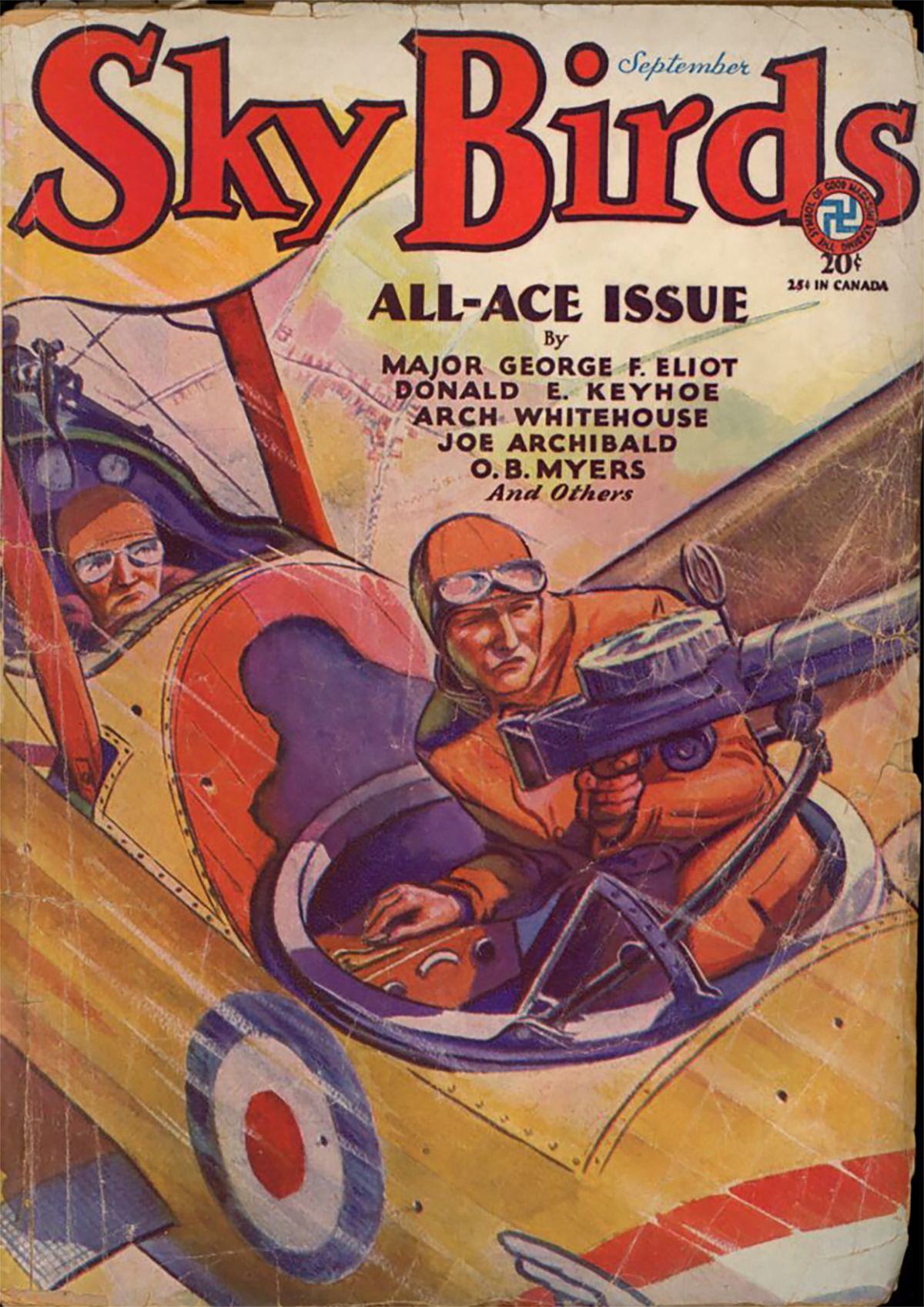
th_SB_3109PROBABLY no group of fighters in the World War did as much and got so little credit as the artillery spotters pictured on this month’s cover. These men sat over the German lines and provided “eyes” for the big* guns that pounded the enemy dumps, transport, front-line redoubts and artillery bases.

The heroes of the air today are those pilots who fought in sleek, high-speed scouts, but the artillery-spotting airmen had to do their important work in slow, unwieldy, low-powered ships, and had to rely on what little protection they might expect from the high-flying scouts and fighters above.

Hundreds of budding airmen who trained and prepared themselves for action against the German circuses found themselves unceremoniously dumped into the cockpits of R.E.8s and told to go off and control a “shoot.” This meant that a pilot and observer would leave their airdrome, fly out over the battery they were to control, lower their wireless aerial and pick up the battery control dugout.

Once in contact they would fly out over the target and call for the first shot. This would be observed and the corrections made, by wireless. Shot after shot would be pounded out and corrected until the target was “hit.” All this would be carried out while the ship was flying in a broad figure-8 track. One half of the figure-8 would be over the German lines and the other over Allied territory.

Needless to state, these “shoots” were not always staged under tea-party conditions. Often the spotting ship would be attacked while completing the correcting process as in our cover, but in all cases, the spotters stuck it out until they had registered a “hit” and had sent out their command for “salvo.” Grimly they hung on, the observer handling his Lewis gun and telegraph key, fighting and dying amid a wild fanfare of machine-gun bullets and the screaming wail of the shells that were being vomited out from steel muzzles at the request of the fighting observer, who in all probability was taking a torrent of enemy fire as his fingers tapped out the all-important corrections for the gunners many miles behind the lines.

Little honor, little glory and often the gibes of fellow flyers who were lucky enough to be flying faster and more up-to-date ships was their lot, but they accepted their Jobs and did them well. They lived and died, true examples of the old creed of the flying men: “We Are the Eyes of the Army.”

The Story Behind The Cover
“The Fighting Spotters”
Sky Birds, September 1931 by Paul J. Bissell

“Rear Gun Action” by Paul J. Bissell

Link - Posted by David on January 27, 2025 @ 6:00 am in

THIS week we present one of Paul Bissell’s covers for Sky Birds! Bissell is mainly known for doing the covers of Flying Aces from 1931 through 1934 when C.B. Mayshark took over duties. He also did covers for brother magazine Sky Birds. For the August 1931 cover Bissell put us right in the action as a pilot whose observer had been killed during a dogfight is forced to lean back in his cockpit and take over the observer’s gun!

Rear Gun Action

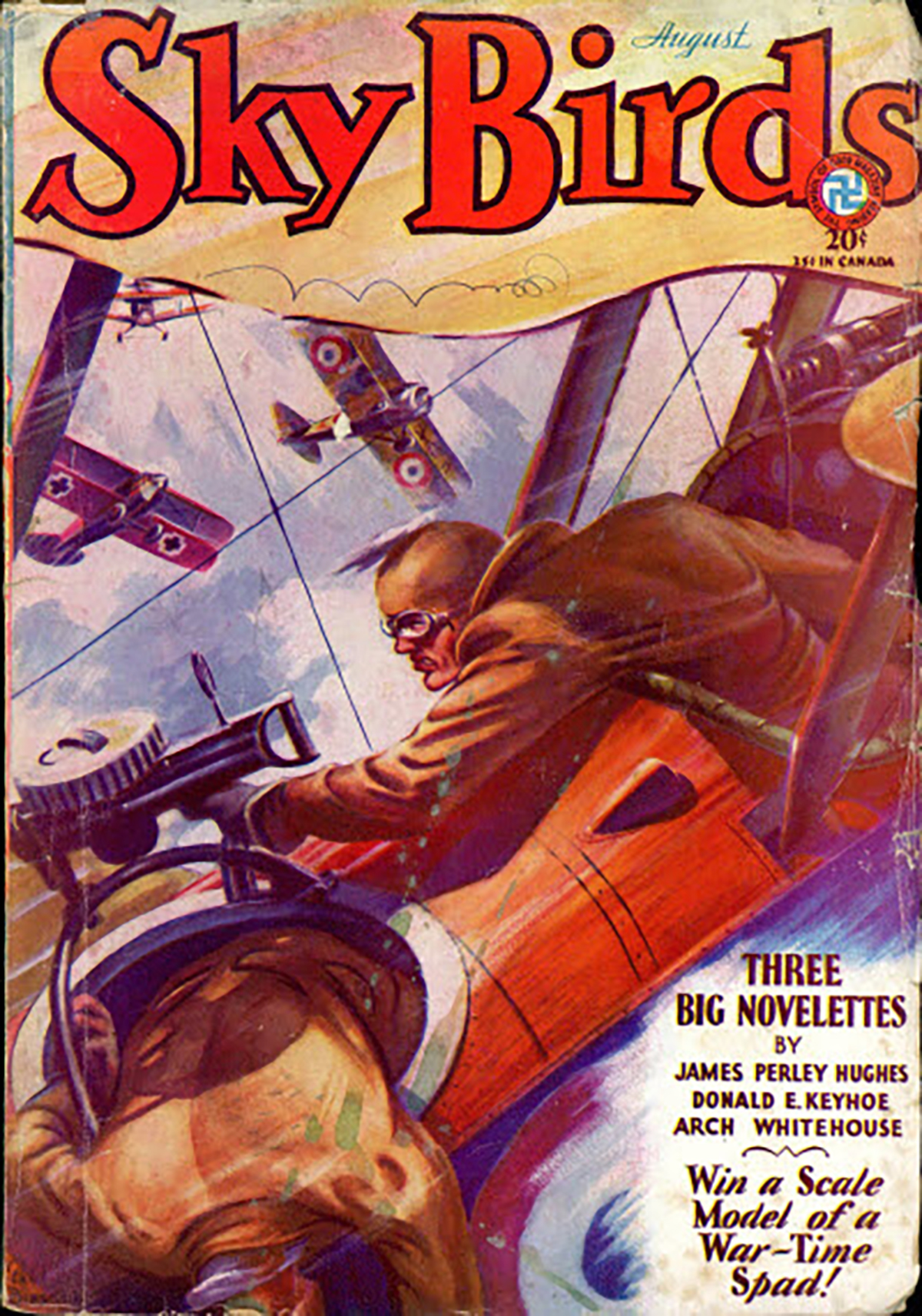
th_SB_3108TWO-SEATER pilots were not always confined to “action front.” There were times when they had to be able to use the rear Lewis—many times, in fact. This month’s cover shows a pilot whose observer had been killed during a dogfight, and as most of the opposition was coming from the rear, and he had little or no chance to out-maneuver the Jerry ships, the pilot was forced to lean back in his cockpit and take over the observer’s gun.

As long as there were cartridges in the drum, the pilot could put up some sort of a defense, but once the drum was expended he was forced to go back to his attempts to get away by means of the joystick and throttle.

Artillery-spotting ships, that were often suddenly attacked by the enemy scouts, ran into situations of this kind many times. And on the other hand, the observer was often called upon to take over and attempt to fly the ship back when the pilot was killed. Neither situation was any too pleasant.

The Story Behind The Cover
“Rear Gun Action”
Sky Birds, August 1931 by Paul J. Bissell

“In The Clouds” by Franklin M. Ritchie

Link - Posted by David on August 9, 2024 @ 6:00 am in

THIS week we have another story by Franklin M. Ritchie. Ritchie only wrote aviation yarns and his entire output—roughly three dozen stories—was between 1927 and 1930. Today we have another one from the lawyer who wrote pulp stories on the side to satisfy his yen for flying. From the May 1929 issue of Sky Birds, Ritchie gives us a tale of Lieutenant Hank Durant.

Hank Durant, flying instructor of Issoudun, A.W.O.L., was up in an unarmed observation training ship—the American battery was firing short of the Big Bertha—his radio dynamo was shot—but getting the Big Bertha meant more to him than just fighting!—There was Betty Kramer’s admiration for one thing and there was Phil Marcel to settle with for another!

“The Vanishing Ace” by Andrew A. Caffrey

Link - Posted by David on June 7, 2024 @ 6:00 am in

THIS week we have another story from one of the new flight of authors on the site this year—Andrew A. Caffrey. Caffrey, who was in the American Air Service in France during The Great War and worked for the air mail service upon his return, was a prolific author of aviation and adventure stories for both the pulps and slicks from the 1920’s through 1950. Here Caffrey tells the tale of Loop Murry, stunt flier for the movies who learns there’s sometime more to a man than meets the eye. From the May 1929 number of Sky Birds, it’s Andrew A. Caffrey’s “The Vanishing Ace!”

They all thought Tilton Mills was a dumb-Dora when it came to flying even though he wrote the script he was playing in. Loop Murry was doing the stunting, and damning the leading man below—but when Loop’s machine crashed in a burst of flame Tilton Mills turned out to be more than just actor-playwright!

“The Balloon-Gun Kid” by Andrew A. Caffrey

Link - Posted by David on February 23, 2024 @ 6:00 am in

THIS week we have another story from one of the new flight of authors on the site this year—Andrew A. Caffrey. Caffrey, who was in the American Air Service in France during The Great War and worked for the air mail service upon his return, was a prolific author of aviation and adventure stories for both the pulps and slicks from the 1920’s through 1950. Here Caffrey tells the tale of Lieutenant Paul Storm.

Lieutenant Paul Storm was a few years shy of being twenty. Yes, that was young. But Storm was an exceptional hand with a ship. He had been exceptional from the first time he’d ever taken his place in a rear cockpit for instruction. He learned how to fly in three hours. As a rule, ten hours was considered mighty fast. Storm was so good, he was placed on a free-lance status allowing him to fight where and when and with whom he liked. From the July 1929 number of Sky Birds, it’s Andrew A. Caffrey’s “The Balloon-Gun Kid!”

Storm was an airman—every inch of him. When he started out free-lancing, even the sullen sides helped him to batter and spin his way to victory!

“The Night-Raid Patrol” by Eustace Adams

Link - Posted by David on January 12, 2024 @ 6:00 am in

THIS week we have a story from the prolific pen of Eustace L. Adams. Born in 1891, Adams was an editor and author who served in the American Ambulance Service and the US Naval Service during The Great War. His aviation themed stories started appearing in 1928 in the various war and aviation pulps—Air Trails, Flying Aces, War Stories, Wings, War Birds, Sky Birds, Under Fire, Air Stories and Argosy. He is probably best remembered for the dozen or so airplane boys adventure books he wrote for the Andy Lane series.

Lieutenant Bull Meehan, U.S.N., was in a mood. And when Bull was in a mood, let it be said that the United States Naval Air Station at Souilly-sur-mer was a place over which the sun hid behind lowering clouds; where red wine soured on the mess table; where flatfooted gob sentries paced their beats with the snap and the devotion to duty of Imperial Household Guardsmen and where the young naval aviators gathered in the lee of the hangars and cursed with great feeling and remarkable fluency. It was at this time, Ensign Wadsworth arrived wearing his Croix de Guerre under his gold naval aviator’s badge and had a record of two years’ flying service with the French Army…

From the August 1929 issue of Sky Birds, it’s Eustace Adams’ “The Night-Raid Patrol!”

A smashing hit! Follow this plucky Yankee flier through hell-popping adventure. See him zig-zag through the air, spewing havoc and destruction, locking wings with his venomous C.O. Here is a thrilling yam from the pen of a master of tale-spinner!


As a bonus, here’s an article about the author himself from the Akron Beacon Journal in 1940!

Argument With Wife Started Eustace Adams’ Career; Author of Adventure Tales Now Wants To Do ‘Better’ Things

by Naomi Bender • Akron Beacon Journal, Akron, Ohio • Sunday, March 24, 1934, p.9-D

MIAMI, Fla., March 23.— Ever hear of Eustace L. Adams? Probably not, yet he’s in “Who’s Who”—there’s three inches of small type about him—he writes serials and short stories for most of the better magazines.

He’s had dozens of boys’ books published, as well as a few adventure novels. His works have been published in England. They’re called “Sovereign Thrillers” there, or, in the vernacular, “Shilling Shockers.” He’s 49 and he makes enough money out of his writing to be in the upper income brackets. He calls himself just a good “potboiler.”

“And I have no message for suffering humanity,” the athletic-looking author said, with a grin, as he puffed on a cigaret. We were seated in his workroom, at the rear of his home on Palm island overlooking the bay.

He’s a likable fellow, this Adams, with a nice grin, kindly blue eyes and a nautical air about him. That’s probably because, when he’s not working, you’ll usually find him on his tiny sailboat, for sailing is his one and only pastime.

Argument Changes Career

He was an aviator during the war. After that, he became a salesman for an advertising concern. Then fate stepped in and shoved him into a completely different profession.

It all started over an argument with his wife. Well, not exactly an argument, but it was like this:

Mr. Adams traveled quite a bit so his wife decided to take a course in journalism to keep herself busy. That started her writing short stories but, like many an amateur writer, her intentions were better than the results. She rarely, if ever, finished her stories.

So naturally, one day, friend husband said, with a very superior air: “I bet I could write one of those confession stories you’re always playing around with. I’ll show you how to do it.”

And naturally, friend wife, knowing her husband had never written a line in his life, reacted just as any wife would—with a big raspberry.

But this time the husband won the decision. He not only wrote the story, but he received a handsome check as first prize winner of a confession story contest.

This was very nice indeed, but Adams still thought a good job with an advertising concern was better than the doubtful security of writing.

Then Lindbergh made his sensational hop across the Atlantic, which might seem to have no connection with the life of Eustace L. Adams but did.

Adams had been a professional aviator; he had also won a confessional story contest. Lindbergh’s flight put a premium on stories with a factual aviation background. And the pulp magazine editor thought of Adams.

”It just happened that at the time I was one of the few literate persons who knew anything about flying,” Adams modestly explained.

He wrote a serial and five short stories in 60 days and sold them all.

From that time on, he has been a professional writer.

Starts Early, Quits Early

He says he keeps “regular office hours” but there are few offices where the employees arrive at 5 o’clock every morning. Adams works until noon each day on an electric typewriter and then he’s through for the day.

“I take only two holidays a year,” he said, “the 4th of July and Christmas.”

He reads a lot, chiefly better fiction and magazines, plenty of magazines.

“I’m just like an architect looking at other architects’ houses,” he stated. “Times change in popular fiction; each year there’s a tiny shift in fashions and I have to keep up with them if I want to sell my stuff.”

There are days when he’s wished he were a plumber or a dentist. “Anything,” he said, with a wry grin, “but what I am, which forces me to sit here at the typewriter whether I want to or not.”

And he does sit there, without doodling, for a stipulated time each day even when he can’t write a line he thinks is worth a hoot.

For, as with all authors, there are dry periods when things just won’t come through

“Then I try to remember what Edith Wharton once said. It’s helped me over many a tough spot when my mind’s as empty as a bass drum. ’Just put one word after another laboriously,’ she said, ’juat carry your hero along and keep on plodding, then all of a sudden things begin to go.’”

He works on one story at a time even though he does turn out millions of words each year. He doesn’t use a plot machine, either He’s tried it, he confesses, but it didn’t work. He sells the majority of the stories he writes. He has a little card file on which he keeps a record of each story he has written and its fate. If the story sells, the amount is marked down neatly, with the date and the publication to which it was sold. If it flopped, this is noted on cards that go into the rear of the file, marked “Rejected.” The number of these cards is very small.

Like all authors who depend on their writing for a living. Adams fears the day when he may run out of ideas or may not be able to sell his stories.

But when that day comes he hopes to have enough money so that he can sit back and relax and enjoy life.

Influence Isn’t Necessary

Here’s how he would advise those who aspire to be professional “entertainment writers.”

Study the magazines to which you want to sell your stories. “You can’t just write a story, send it around to every magazine from the pulps to the slicks and get it sold. It has to be directed to a particular publication.”

You don’t need any influence with magazine editors. If your stories are good, they’ll grab them.

“About the only break I get,” the author said, “is that if I send a story in that Isn’t quite right, I’ll get It back with something like this written on it. ‘On page 33, you stink. Or your heroine is out of line, fix her up.’ Then I revise the story, send it back and it has a good chance of being accepted.

“The chief handicap any young writer has to overcome,” Adams continued, “Is getting gun shy in front of the typewriter. Most amateurs have to cure themselves of buck fever before they can do their best. Once that’s licked, half battle is won.”

Tucked somewhere back in his mind is the thought that some day he may do a “real job of writing ”

He knows most popular authors feel that way and he’s not kidding himself.

“Naturally I would like to do better things,” he confessed frankly. “It would be swell to have real genius, like Hemingway in ‘The Killer’ or ’The Sun Also Rises,’ or Steinbeck In ‘The Grapes of Wrath.’ I would like to say to myself that, if I had five years I could do something good, too. I know it may be just an illusion, but I also know that many of our best writers got their training first in the pulp magazine field.”

“Flaming Bullets” by Franklin M. Ritchie

Link - Posted by David on January 5, 2024 @ 6:00 am in

THIS week we have another story by Franklin M. Ritchie. Ritchie only wrote aviation yarns and his entire output—roughly three dozen stories—was between 1927 and 1930. Today we have another one from the lawyer who wrote pulp stories on the side to satisfy his yen for flying. From an early issue of Sky Birds, Ritchie gives us a tale of the chivalry of the air—but from the German point of view. Enter young Oberleutnant Fritz von Hullesheim who gets himself into a real mess over his flight leaders use of incendiary bullets in his air battles.

From the April 1929 issue of Sky Birds, it’s Franklin M. Ritchie’s “Flaming Bullets!”

The amazing chivalry of the men of the air astounded the whole world during the war. They were true sportsmen, those sky-fighters. Here is a breath-taking yarn from behind the enemy lines showing how the picture looked through the eyes of German War Flyers!

Next Page »