


Looking to buy? See our books on amazon.com Get Reading Now! Age of Aces Presents - free pulp PDFs

“Tripe of Peace” by Joe Archibald

Link - Posted by David on April 29, 2022 @ 6:00 am in

“HAW-W-W-W-W!” That sound can only mean one thing—that Bachelor of Artifice, Knight of Calamity and an alumnus of Doctor Merlin’s Camelot College for Conjurors is back to vex not only the Germans, but the Americans—the Ninth Pursuit Squadron in particular—as well. Yes it’s the marvel from Boonetown, Iowa himself—Lieutenant Phineas Pinkham!

The Germans have developed a new, sinister gas bomb that makes a person have no desire to fight and love their fellow man. What kind of war would that be? Needless to say, the Boomtown marvel sets out to find the source of this new deadly destruction and in the process inspires a put-upon German corporal named Adolph to dream big—real big!

When the Kraut concoction cooker-uppers caused a flock of Allied flyers to forsake their battle buggies in favor of a Western Front version of the Yassar daisy chain, Rufus Garrity roared, “It’s impossible!” Of course, when his own sky-scrappers got messed up with Kid Maxie, the Munich Mauler, the fiery Major’s opinion had to be revised. All of which was a mere trifle. For after Phineas deftly tossed his Uncle Thaddeus’s Sioux shillelah, Heinie-land’s whole history had to be revised—believe it, or else!

“Aid to the Lost Battalion” by Paul Bissell

Link - Posted by David on April 25, 2022 @ 6:00 am in

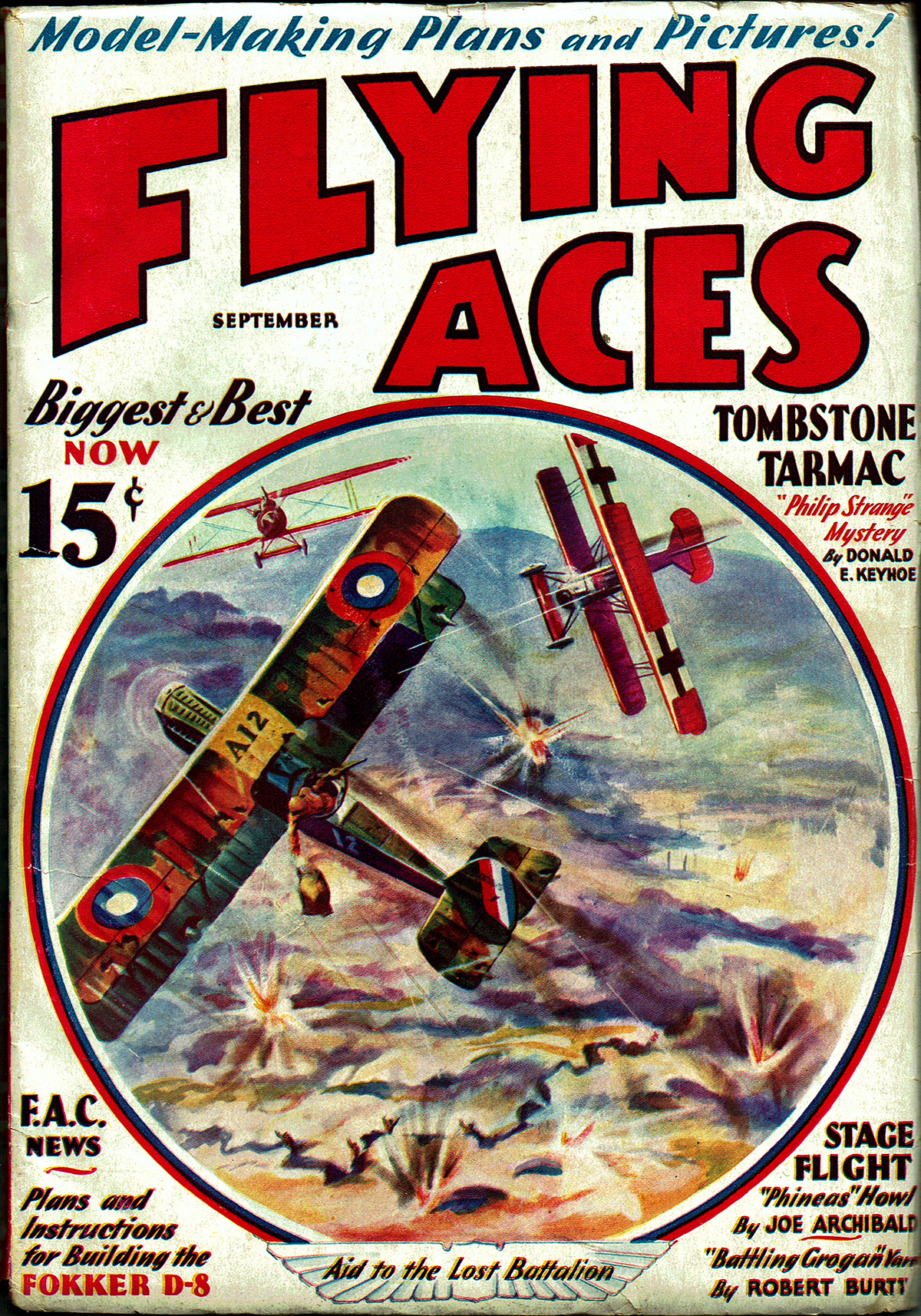
THIS week we present another of Paul Bissell’s covers for Flying Aces! Bissell is mainly known for doing the covers of Flying Aces from 1931 through 1934 when C.B. Mayshark took over duties. For the September 1933 cover Bissell put us right in the action as Lt’s Goettler and Bleckley try to get …

Aid to the Lost Battalion

th_FA_3309THE Congressional Medal of Honor is the highest decoration the United States can bestow upon its military heroes. Only four airmen of the World War received it — Captain Edward V. Rickenbacker, Lieutenant Frank Luke, and Lieutenants Harold Ernest Goettler and Erwin R. Bleckley. The first two, both aces, are well known, and most people know that Congress so honored them, even if a bit tardily in Rickenbacker’s case. But few know of Goettler and Bleckley and the glorious story of how they gave their lives, going “above and beyond the call of duty in action with the enemy” in an effort to save some of their countrymen.

On October 2, 1918, the 77th Division in the Argonne sector was ordered to advance, with directions to reach their objective, regardless of cost. In this movement was included the Second Battalion of the 308th Infantry, under command of Major Charles Whittlesey. The advance was made late in the afternoon. At the end of hours of terrific hand-to-hand fighting the battalion had advanced to its objective, the old Charlevaux Mill, near Binarville.

The troops on both sides of them, however, had been unable to hold their positions. This allowed the Germans to filter in from both ends and completely surround the Americans. For the next five days, this battalion of about 550 men, without food, supplies or ammunition, with scant water, and subjected to the most terrific fire, dug themselves in as best they could and refused repeated demands of the Germans to surrender.

They held a narrow ravine, the general location of which was known to our headquarters, but the exact location and the conditions existing among these men was unknown, since repeated efforts from both the battalion and the main division to establish contact had been unsuccessful. It was, however, definitely known that some of the battalion were still alive, and so, on October 6th, an order came over the wires which snapped every airdrome on that front to instant alertness. “Locate the battalion and get it food and supplies at any cost.”

Every available ship of Squadron 50 was soon on the line. The powerful Liberty motors roared and the propellers bit into the heavy fog. This was no flying weather, but somewhere out there where the incessant bark of the big guns could be heard, were Americans surrounded and trapped by the enemy, suffering and dying, waiting for help from their comrades.

There was no small talk among the airmen. A dirty job lay ahead of them—a job that none of them wished for, yet none of them thought of shirking. The planes were loaded with iron rations—chocolate, bully beef, coffee, hard tack—bandages and official messages. Quietly the men climbed into their ships—an observer and pilot to each of the D.H.4s, and with Flight Commander Lieutenant Goettler leading, one after another the big planes took off into the mist.

An hour had passed when a ship came sliding out of the fog to a rough landing on the tarmac of Squadron 50. The mechanics rushed out, to find it was Goettler and Bleckley, his observer, returned from their search. The plane was riddled with bullet holes, and large pieces of fabric were missing from the fuselage.

The faces of the two airmen were grim. Goettler’s orders were curt. “Refuel the plane and put in another set of rations. Patch it up as best you can. We have found the Lost Battalion, and we’re going back in another fifteen minutes.”

THE mechanics did not know until later all the details of the first flight—of how the battalion had at last been located at “Charleyvoo” Mill—how the big D.H.4 had waded through a storm of fire from the ground to get in a position to drop the much needed rations to the entrapped doughboys; how, although the two airmen had gone as near the ground as they dared, the lines of the Germans were so close to the Americans that when they had dropped the rations and messages overboard, the Germans had come out and seized them. All of this the mechanics later learned from their squadron commander, to whom Goettler had given a brief account of his effort while the plane was being refuelled.

All they now saw were the two grim-faced youngsters gravely shake hands and climb into their respective cockpits, and, in a ship already shot half to pieces, take off to carry aid to their fighting comrades.

Only too well the two lads knew what lay ahead of them. After their first unsuccessful trip it was evident to both of them that there was but one chance for success—to wing down through the terrific hail of lead from the ground, so low that with their wing tips almost touching the torn tree trunks of what had once been a forest, they could with accuracy drop the supplies to the doughboys dug in below.

Yes, this was possible if they could live through the terrific barrage they would meet. Anyway, it was their one chance, and there was no hesitation on the part of the two lads as Goettler piloted his plane directly to Charlevaux Mill. Soon it was below them, a pile of gray ruins, and Bleckley pointed out to “Dad” Goettler a khaki-clad figure waving feebly to attract their attention.

The big plane nosed over, swinging down in a spiral. The fire from below was now appalling. Machine-gun bullets were riddling the plane, while the impact from high explosives at short range tossed the ship around almost like a small boat in a rough sea.

Completely oblivious to this terrific punishment, the two airmen concentrated their entire attention on the job to be done. Goettler piloted his plane skilfully, while Bleckley leaned far over the side, holding a bag of rations ready to drop at the right instant. The trees were not fifty feet below them when Goettler leveled off slightly. Then, banking up, he let his wing tip almost touch the hillside to give Bleckley a better chance in his work.

Below, the doughboys crouched behind what shelter they had made for themselves, looking anxiously upward, waiting for the food and ammunition that they needed so desperately. They saw Bleckley release the bag and then lean over the side to see if his aim had been true. But this time the two aviators were never to know, for at that moment, up from the ground, death, in the shape of leaden bullets, reached for them.

The nose of the big D.H. yanked up suddenly, then dropped as if the hand that held the control had suddenly lost its strength. There was a sickening instant as the plane slipped off on a wing, then crashed, burying her heavy nose deep in the hillside over near the German trenches.

The next day, in an irresistible advance, the 77th Division pushed the Germans back and reached the “Lost Battalion.” Only 107 of them were left; and on the hillside were the remains of the D.H.4. Goettler had apparently been killed instantly, and Bleckley, hopelessly wounded, died before reaching a hospital. But their deed will live forever.

The Ships on The Cover
“Aid to the Lost Battalion”
Flying Aces, September 1933 by Paul J. Bissell

“The Youngest V.C. Flyer” by Paul Bissell

Link - Posted by David on March 28, 2022 @ 6:00 am in

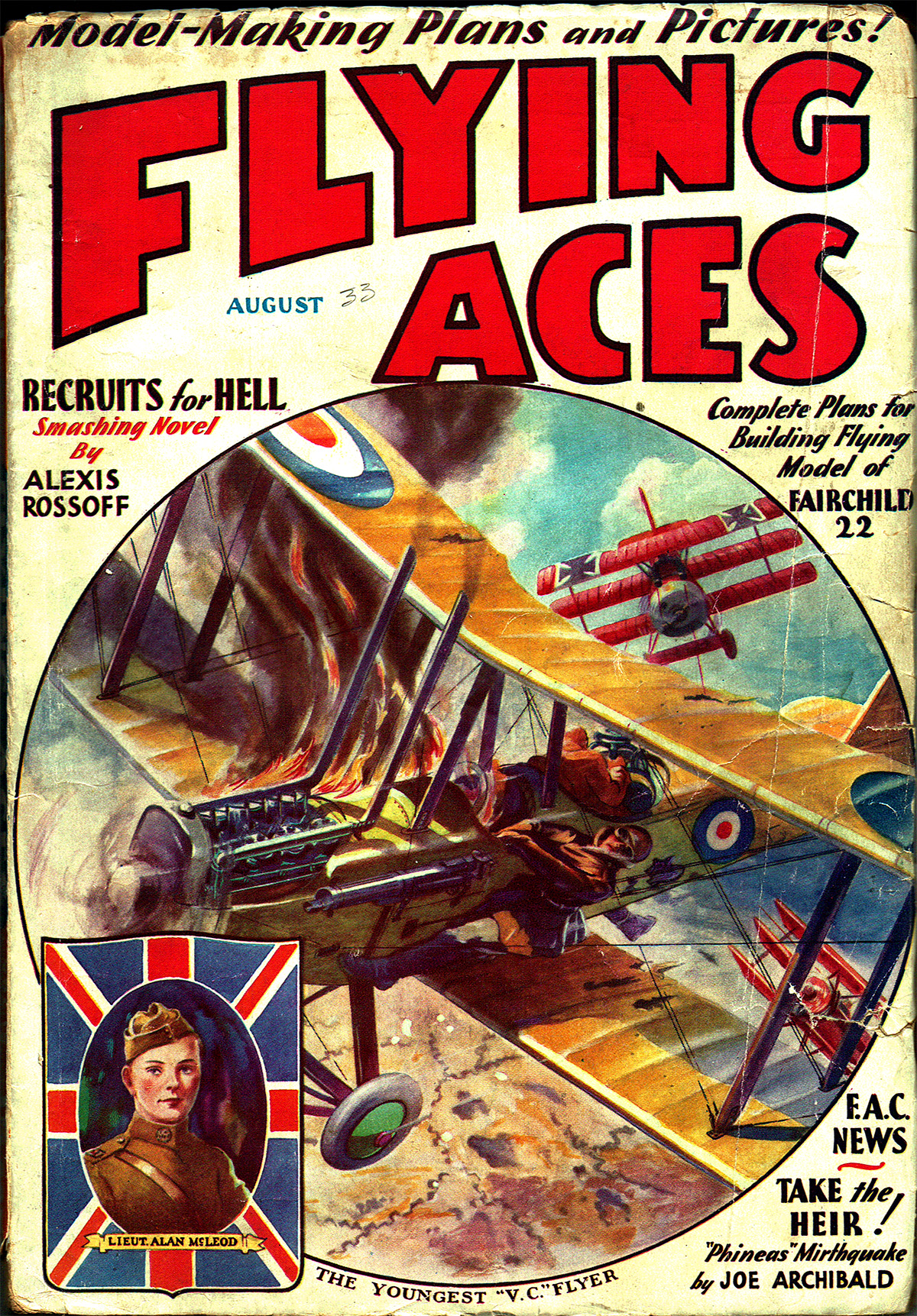
THIS week we present another of Paul Bissell’s covers for Flying Aces! Bissell is mainly known for doing the covers of Flying Aces from 1931 through 1934 when C.B. Mayshark took over duties. For the August 1933 cover Bissell put us right in the action with…

The Youngest V.C. Flyer

th_FA_3308SOME wise man has said that to every man, once in life, comes his big moment. Then he must make a quick decision or choice and, whether he be king or peasant, the real man is judged by how he meets this test.

Such a moment came to Alan McLeod, the young Canadian flyer. Always he was in the thick of it, eagerly taking chances, thumbing his nose at death until that day in March, 1918, when he came face to face with his big moment, made his choice and, himself wounded, gambled his life a thousand times over to save a comrade already wounded almost past saving—gambled and won, and took his place among the “Incredibles” of the World War.

McLeod was just fifteen years old when the war began. Twice rejected because of his youth, he enlisted on his eighteenth birthday, in April, 1917. By July he had qualified as a pilot, and by September he was in England. When his squadron, the 82nd, was ordered to the Front, his Commanding Officer refused to take him along—again on account of his youth.

However, on Home Defense in England with the 51st, during a bitter duel with a Gotha over London, he displayed such heroism, although shot down, that Headquarters posted him to France with the 2nd Squadron, in November, 1917. This squadron boasted no fast pursuit ships, but was engaged principally in observation, bombing, and artillery spotting, and flew the Armstrong-Whitworth, a good ship for these purposes, but slow.

It was with this ship that McLeod went “a-hunting” beyond and outside of his daily routine, strafing the trenches, attacking troops in movement, machine-gun emplacements and batteries. No one had ever thought to attack a sausage in one of the old crates. Nevertheless McLeod coolly destroyed a German balloon and then, when attacked by a flight of Albatross pursuit planes, shot one of them down and held the others off, returning safely to his airdrome. Soon none but the most daring observers would fly with him, but there were always enough of these so that he did not lack for companions. Besides, he always brought them back—and how!

The morning of March 22, 1918, seemed to McLeod much like any other day. With Lieutenant A.W. Hammond in the observer’s cockpit, he had started out on a patrol to Bray sur Somme. He got lost in the heavy, low clouds but, at last finding a hole, he had dropped down to let his bombs go when a Fokker tripe rode his tail down from the same clouds. A half-roll saved him from the Fokker’s burst, and a zoom put Hammond in position to prevent that particular German from ever firing another burst.

But seven other tripes had come down after their leader and were now bent on revenge. Like red hawks they darted around the two Canadians, raking them with machine-gun fire from every direction until one, more daring than the others, dived in from the front.

McLeod beat him to the shot and Fokker No. 2 joined his leader far below. At that instant, however, McLeod felt his first bullet. One of the tripes, attacking from below, had put a full burst into the British machine. Hammond was hit twice, and the entire bottom of his cockpit collapsed. Then the gas tank burst into flames. The Armstrong-Whitworth plunged down, out of control, with McLeod dazed in the front seat, and Hammond clinging desperately to the rim of what had been his cockpit.

THE flames licked up, burning McLeod back to consciousness. To stay in the front seat was no longer possible. McLeod stepped out on the wing, reaching back into the burning cockpit for the controls and sideslipping the plane so that the flames were blown away from Hammond. Although two more bullets had found him by now, he succeeded in keeping the ship in fair control and getting rid of his bombs. The Germans were following the helpless Canadians down, pouring burst after burst into them.

Hammond now had three bullets in his body, while one arm hung limp. Almost unconscious, with his feet braced against the sides of the fuselage to keep from falling through the bottomless cockpit, he still had strength enough for one last burst at the Boche. Almost point-blank he emptied his drum into the nearest tripe. A burst of smoke and screaming wires told that Fokker No. 3 had joined the other two victims, crashing below almost at the same instant that McLeod, leveling off his blazing ship as best he could, piled up in No-Man’s-Land.

The crash threw them both clear of the wreckage, about ten yards apart in the middle of No-Man’s-Land, three hundred yards from the British trenches. For an instant they lay there, unconscious, but the Germans were already sniping at them and McLeod, who lay in a more exposed position, was roused to consciousness by a bullet nipping his leg. Rolling into a shallow hole, his senses returned, and with them came his “big moment.”

To stay where he was was impossible. The whole area was too much exposed. He must make the trenches. But outside lay Hammond, wounded, perhaps dead. Should he leave him and try for the trenches alone? In another instant he was out of the hole and at Hammond’s side. The poor observer was alive but completely unconscious, with six wounds.

How McLeod dragged and carried Hammond those three hundred yards he himself never knew. But the Tommies in the trenches saw him coming. They watched him as, inch by inch, he dragged himself and his observer across the torn earth, with the enemy raking him with bullets. They watched and helped all they could by laying down a deadly fire on the German trenches.

With just six yards to go, another bullet got McLeod, and the Tommies went over the top and dragged the two unconscious flyers in, still breathing—but not much more. All day they lay in those exposed trenches without medical aid. But the gods must have smiled, for they both got well eventually—Hammond to get a D.S.O., and McLeod the V.C.

The Ships on The Cover
“The Youngest V.C. Flyer”
Flying Aces, August 1933 by Paul J. Bissell

“Zuyder Zee Zooming” by Joe Archibald

Link - Posted by David on February 25, 2022 @ 6:00 am in

“Haw-w-w-w-w!” That sound can only mean one thing—it’s time to ring out the old year and ring in the new with that Bachelor of Artifice, Knight of Calamity and an alumnus of Doctor Merlin’s Camelot College for Conjurors—Phineas Pinkham. The Boonetown miracle is misdirected to the wrong train in Paris coming back from leave and finds himself knee-deep in tulips and treachery! It’s a Dutch treat special—it’s Phineas in Holland! from the July 1938 issue of Flying Aces, it’s “Zuyder Zee Zooming!”

Ludendorff was well satisfied. He already had his sand and gravel on the Holland canals, and now his eye was on the Hollanders’ ports. But when he began putting ants in their pants, Phineas raised the ante. All of which proved that there’s a limit—even to Dutchman’s breeches.

“The Invulnerable Dormé” by Paul Bissell

Link - Posted by David on February 14, 2022 @ 6:00 am in

THIS week we present another of Paul Bissell’s covers for Flying Aces! Bissell is mainly known for doing the covers of Flying Aces from 1931 through 1934 when C.B. Mayshark took over duties. For the January 1933 cover Bissell put us right in the action with

The Invulnerable Dormé

th_FA_3301“AND, Adjutant, get that request of transfer off to headquarters today, s’il vous plait?”

“Certainement, mon Capitaine, but why so vite? There is not an aviator in all France who does not desire to be one of Les Cigognes. So with all the aviators to choose from, why do you ask for Dormé? He has had but little experience in le Chasse.”

“Mon ami,” said the captain affectionately, “when a lad stationed at Paris flies an old Caudron up so close to the Front that he runs into a German squadron of six planes, he shows himself an ambitious and aggressive aviator. But when he then attacks them single-handed, brings one of them down and puts the rest to flight, he shows he has the stuff we want in Squadron 3. Don’t let’s lose him.” And the captain’s tone left no room for further argument.

So, early in July, 1916, René Dormé came to Squadron 3, better known as the Flying Storks, from the insignia painted on the side of their ships. This squadron had been formed by Captain Brocard and was already well known at the Front. It was destined later to enjoy a fame greater, perhaps, than that of any other French flying unit, and Dormé was to play no small part in helping to earn that fame.

In fact, he had been with the squadron but a few weeks when it was very evident that he was, as the French said, “un pilot extraordinaire.” He was quiet and gracious in manner, and was soon affectionately dubbed “Père” by his comrades, not because of his age—he was only 21—but because of the esteem and affection in which they held him.

Though he became one of the nation’s heroes, he remained always modest and unassuming. Twenty-three official victories were finally credited to him, but this was by no means his complete score. He often fought alone, far in the enemy’s territory, and his comrades knew that he had gained many a victory which went unrecorded. Once when a superior officer mentioned this fact in front of Dormé, Père quietly replied, “But the Germans know, mon Capitaine, and that is all that really matters.”

Guynemer considered Dormé the greatest flyer of the war. The ability with which he maneuvered his little Nieuport was nothing short of miraculous. He helped develop air fighting tactics and is credited with being the first to make use of the great defensive stunt, the wing slip.

Battle after battle he would carry through to victory and emerge untouched. To the poilus he was known as “Dormé the Unpuncturable.” They said he could see the bullets and dodge between them. Certain it is that after his tenth victory his mechanics, going carefully over his plane, could not find one single bullet hole. Yet it was this ability to quickly maneuver which almost cost him his life, one morning in the summer of ’16.

JULY was almost over and Dormé was up early to bag himself a Boche to add to his record before the month’s end. He soon spotted a Fokker and swung around in a circle to prevent the black-crossed plane from turning back toward the German lines, at the same time tipping the nose of his little Nieuport up to gain altitude for the attack.

He reached his desired position, and with that quickness which marked all of his maneuvers in the air, swooped down in a power dive, his guns blazing. But here Fate took a hand to save the hapless German from Dormé’s deadly fire.

Completely absorbed in his maneuvers on the tail of the Fokker, Père had not noticed an Aviatic that had swung in from the left and been steadily creeping up under his tail. Evidently the pilot of this ship had just gotten himself in a position to fire on the unsuspecting Dormé when the Frenchman’s quick dive caught him so completely unawares that he was unable to twist his own ship out of the way and avoid a crash. The wheels of the little Nieuport struck the leading edge of the upper wing of the big Aviatic just where it joined the center section.

Luckily for Dormé, the Nieuport, ordinarily considered rather frail in its construction, this time proved the sturdier of the two planes. Though one wheel and part of the landing gear were crushed, a quick jerk of the stick on Dormé’s part yanked the little Nieuport out of danger while the Aviatic’s upper wing, broken at the midsection, swung away, carrying the lower wing with it, and the plane started in its mad dive earthward, the pilot finally jumping to avoid death by flames, the dread of all aviators.

Through the many months that followed, Dormé kept steadily gaining victories over the enemy. He ran neck and neck for many weeks in friendly rivalry with his fellow Cigogne, Captain Heurteaux, for the distinction of the premiere place of the squadron, until at last, when Heurteaux had gained a lead of a few victories, Dormé in a tremendous spurt shot down eight of the enemy in one short week and took a lead that he maintained until that day in May which was ever remembered as a black day for the Storks—the day when Dormé took off in the early morning light, never to be seen or heard from again.

For days the Cigognes kept secret the fact that he had failed to return, hoping against hope that Dormé would yet come back safely. It was more than a fortnight later when the Germans dropped a message on his field saying that Pilot Dormé had been killed in combat.

No data or particulars were given, and to this day there are thousands who refuse to believe that Dormé was brought down by the enemy. Père Dormé, the Beloved, the Unpuncturable, brought down by a German bullet? No! To the French this is unthinkable. But the fact remains that Dormé never came back.

The Ships on The Cover
“The Invulnerable Dormé”
Flying Aces, January 1933 by Paul J. Bissell

“The Spider and the Flyer” by Joe Archibald

Link - Posted by David on January 28, 2022 @ 6:00 am in

“HAW-W-W-W-W!” That sound can only mean one thing—that Bachelor of Artifice, Knight of Calamity and an alumnus of Doctor Merlin’s Camelot College for Conjurors is back to vex not only the Germans, but the Americans—the Ninth Pursuit Squadron in particular—as well. Yes it’s the marvel from Boonetown, Iowa himself—Lieutenant Phineas Pinkham!

The Boonetown miracle man, Lieutenant Phineas Pinkham, is attached to help Captain McSniff over in the Isle investigate rumors of Kraut skullduggery rife on his home soil. Apparently, Scottish folk along the Firth of Solway had begun to get the jitters and that a fisherman had claimed to have seen a Heinie pigboat slipping through the fog that always hung over the Firth as thick as porridge.

When that bonnie braw Kraut shooter, Captain Gregory MacSniff button-holed Lieutenant Phineas Pinkham regarding an “Annie Laurie” journey, that jaunty jokester didn’t appreciate it. He scowled about going to Scotland. And he groused about going grousing. But the flying headache of the 9th quickly found out that orders are orders, and cordite is cordite—even though fish aren’t always just fish.

From the Scrapbooks: Cover Cut-Outs

Link - Posted by David on December 27, 2021 @ 6:00 am in

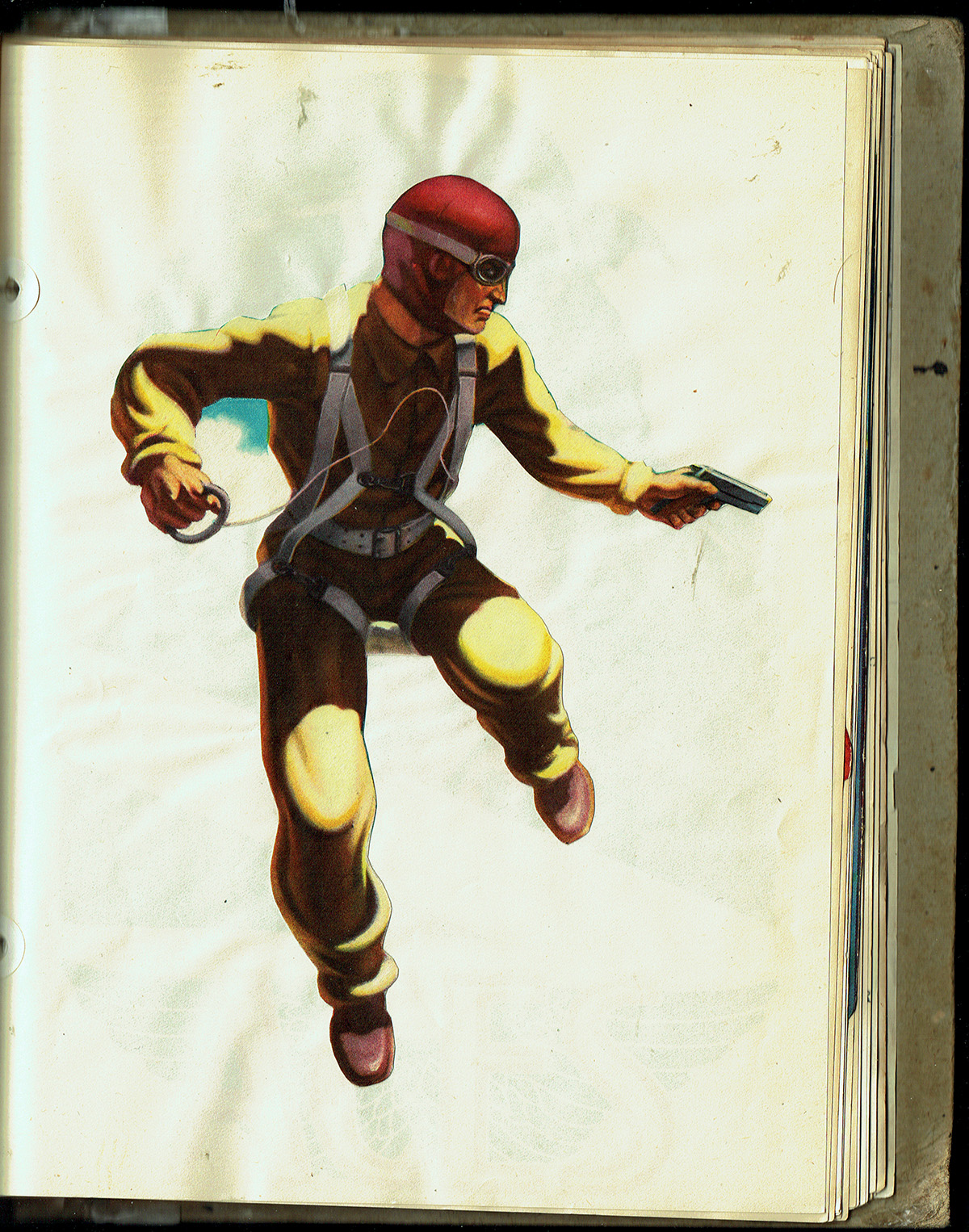
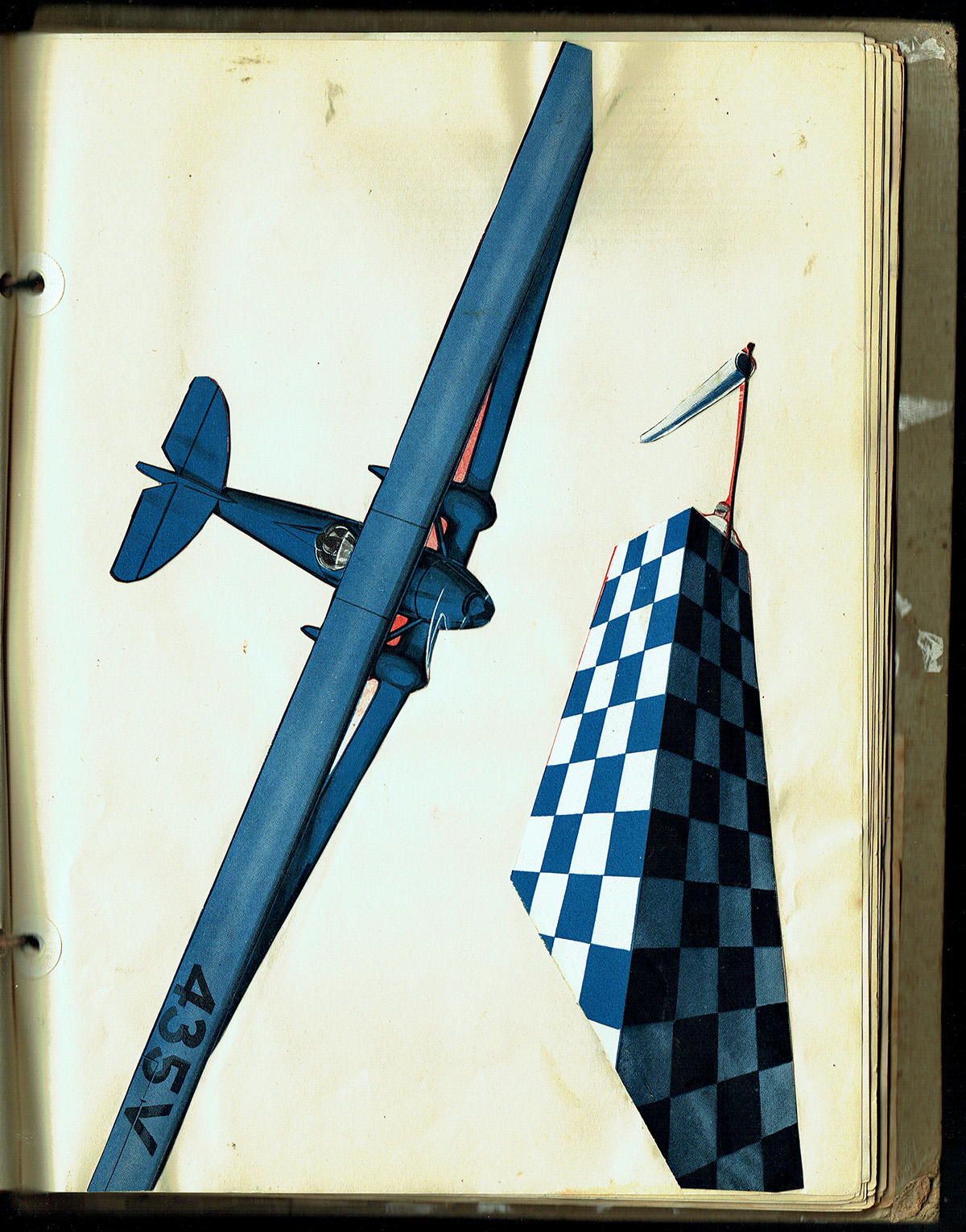
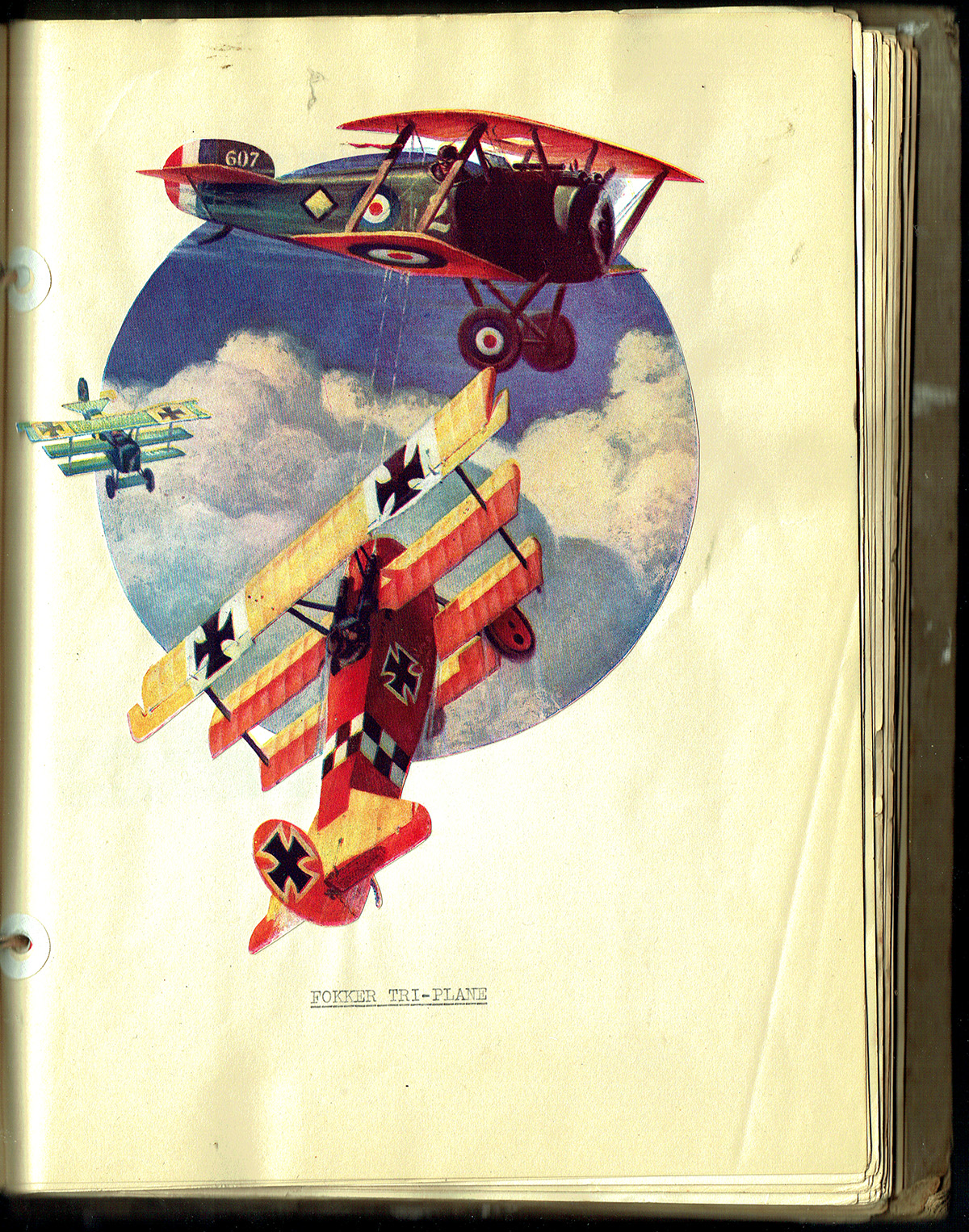
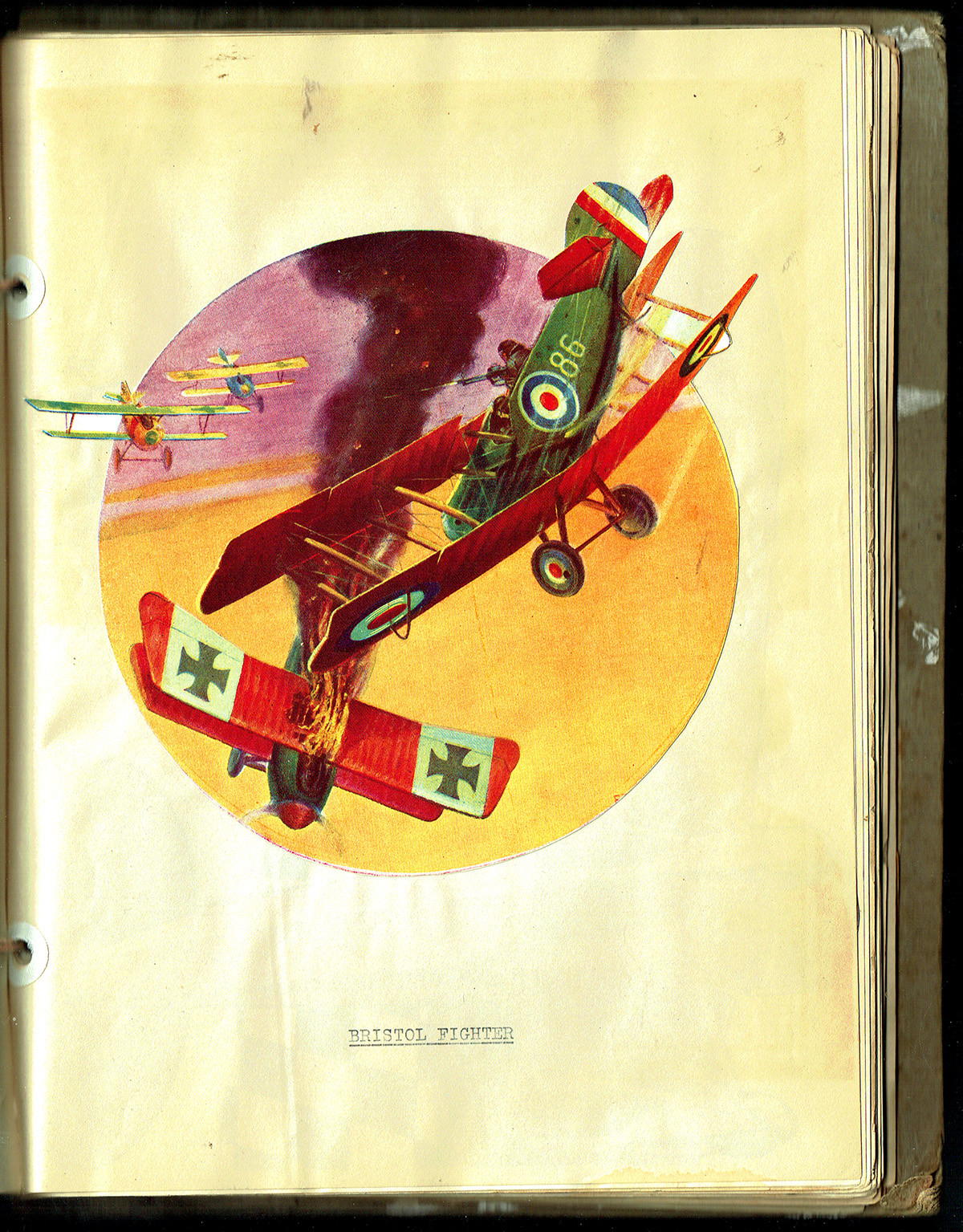
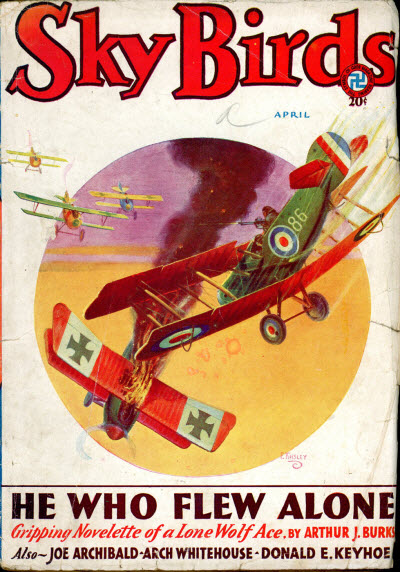
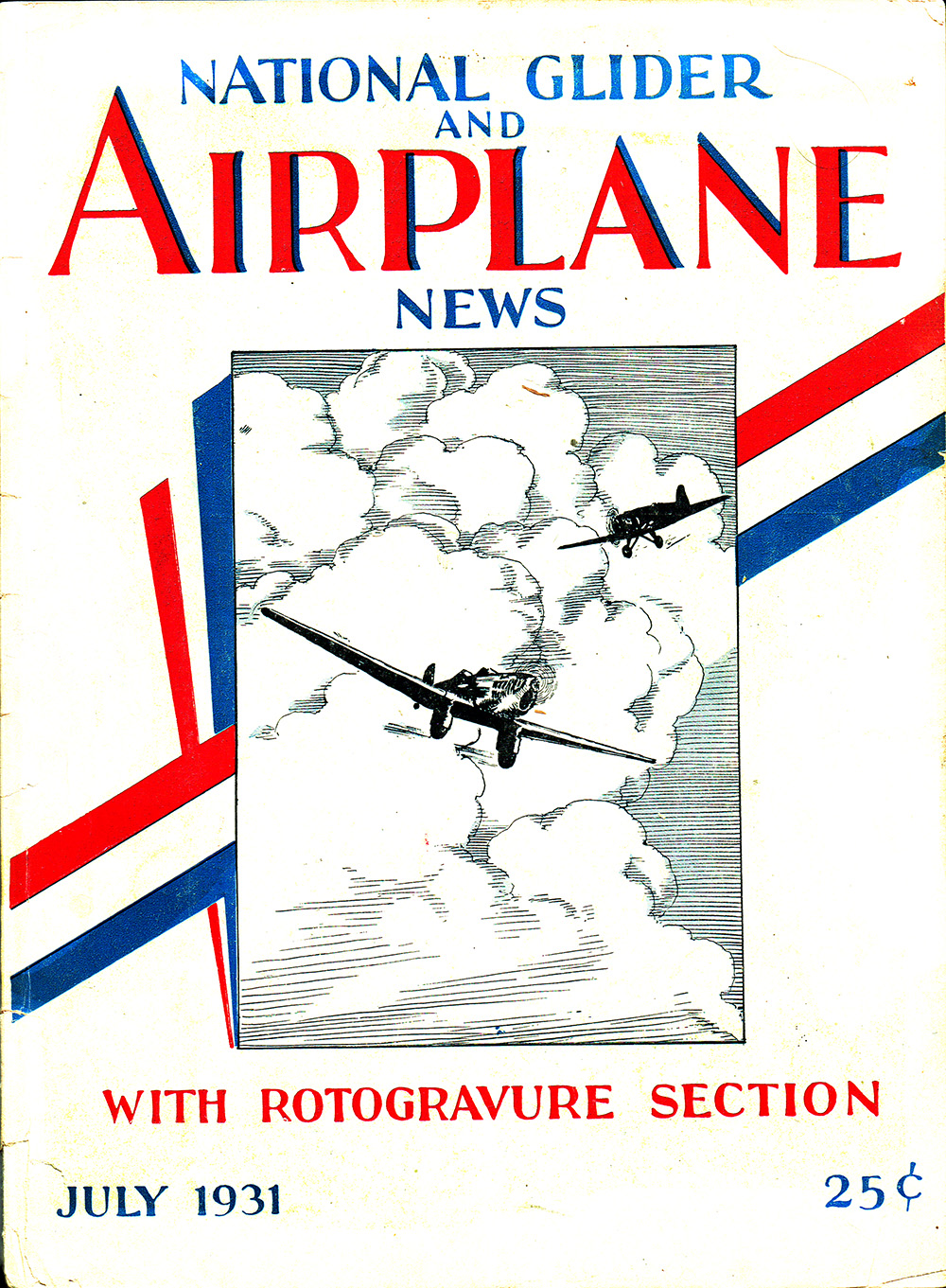
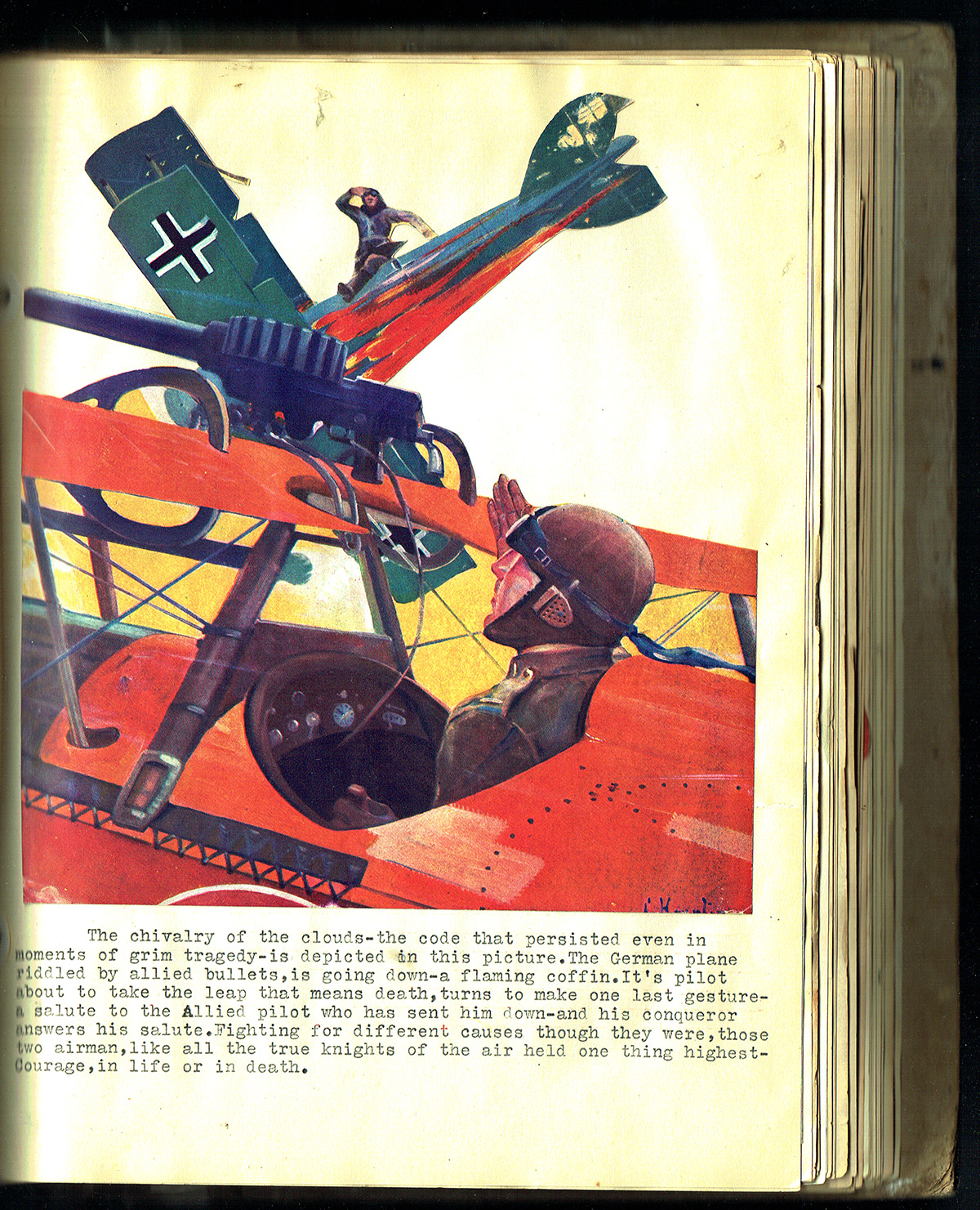
THIS Holiday Season we’re delving into a pair of scrapbooks that were created in the late 20’s and early 30’s by an industrious youth, Robert A. O’Neil, with a keen interest in all things aviation. The books contain clippings, photos and articles from various aviation pulps as well as other magazines. What has been assembled is a treasure trove of information on planes and aces of WWI.

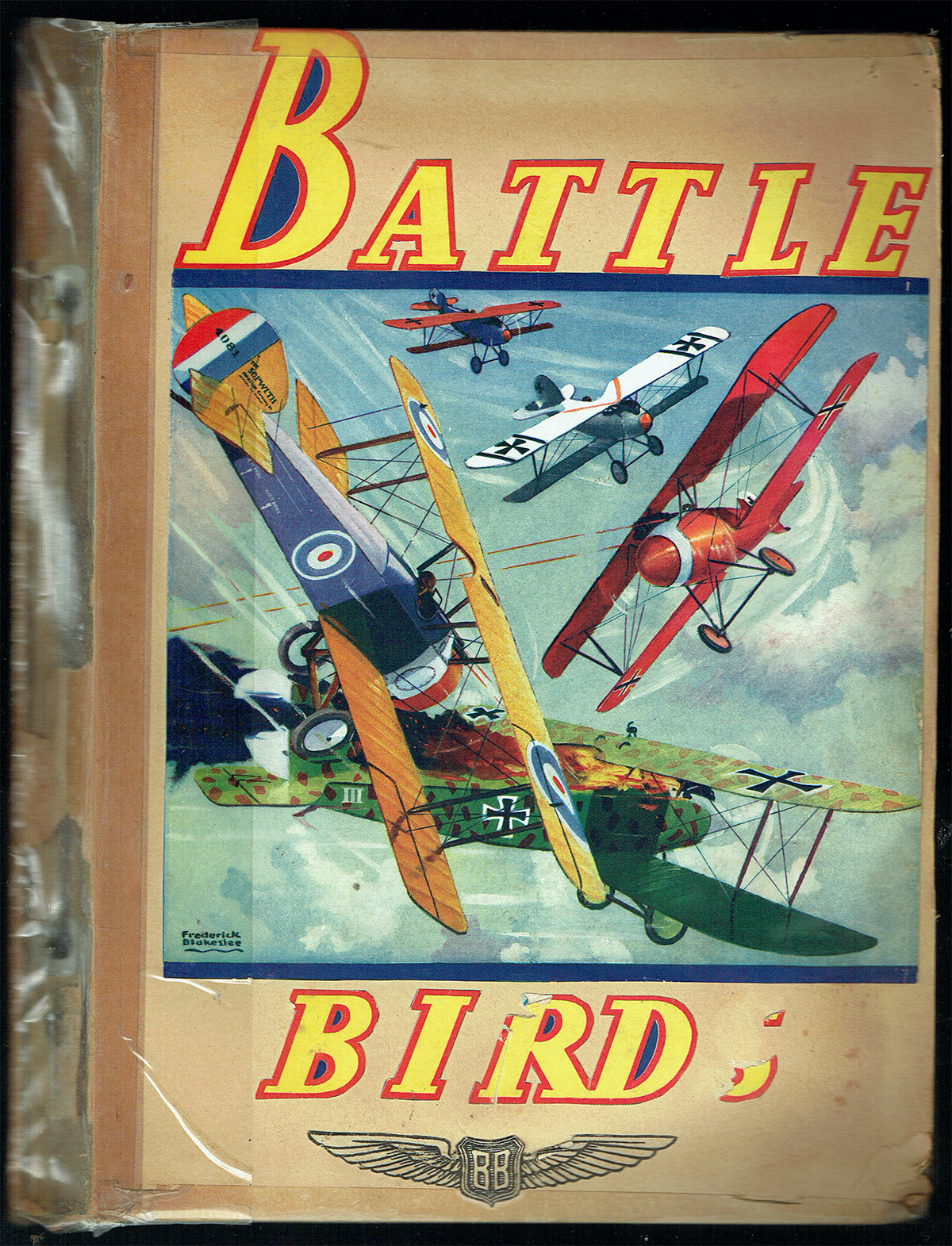
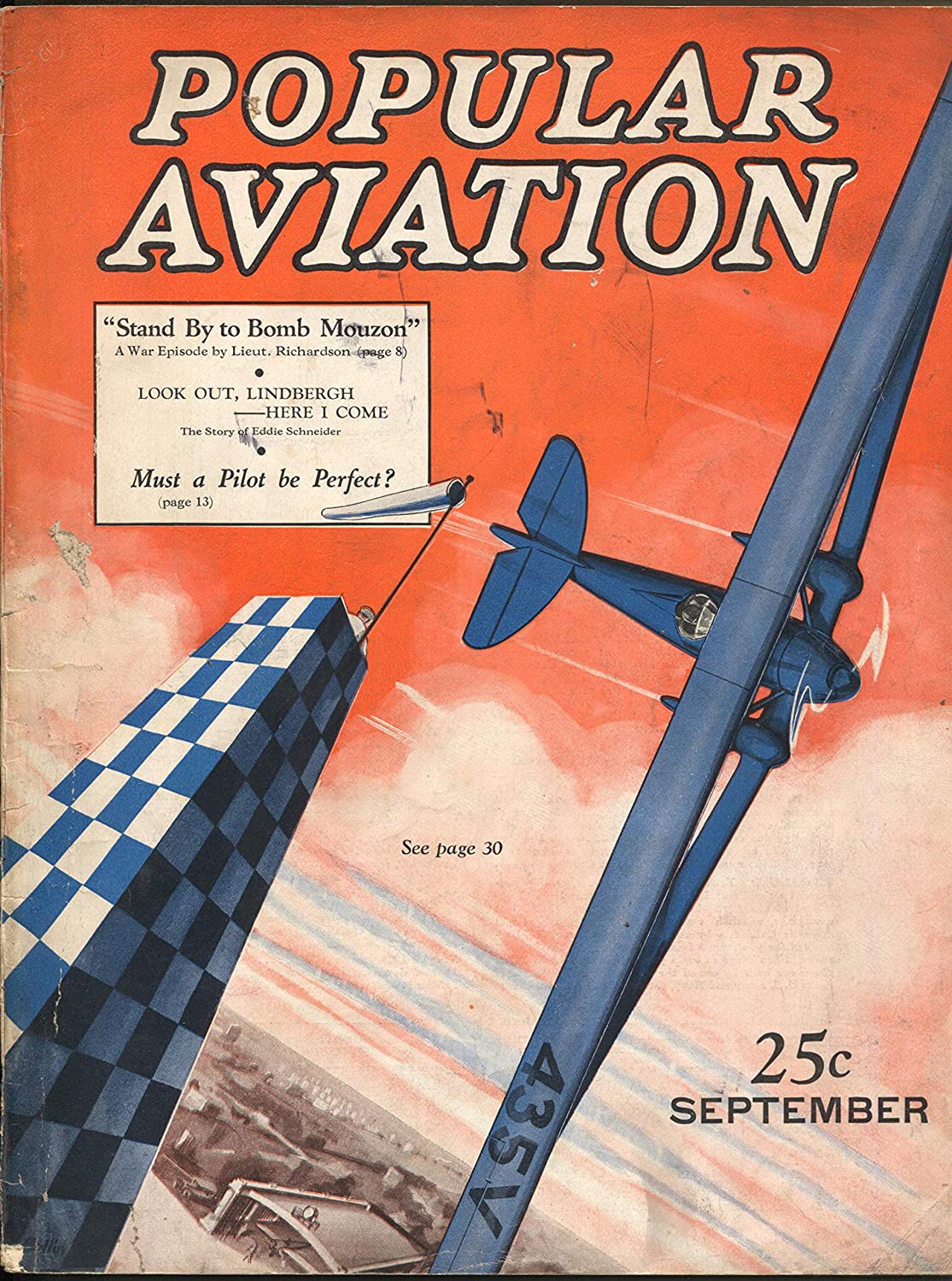
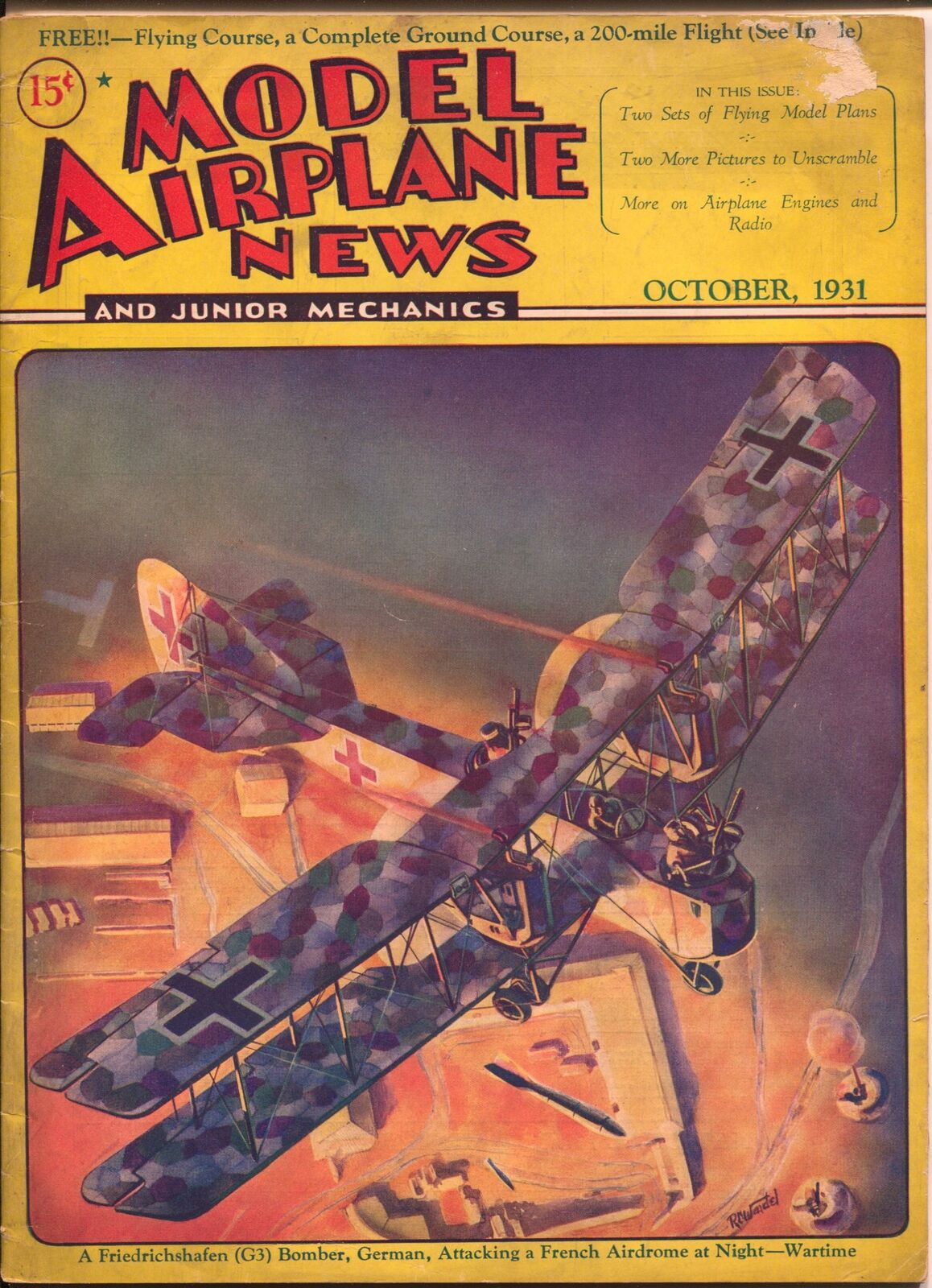
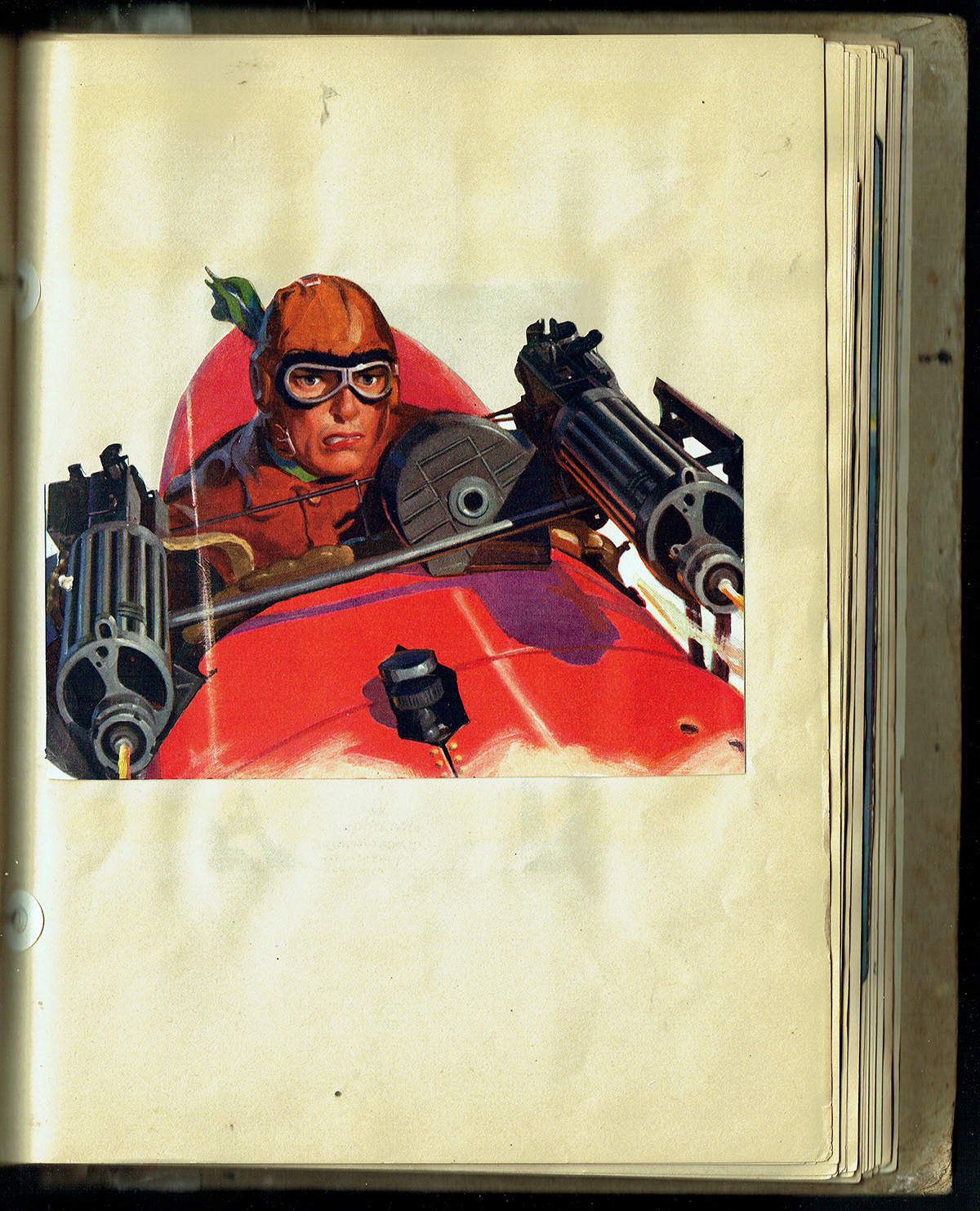
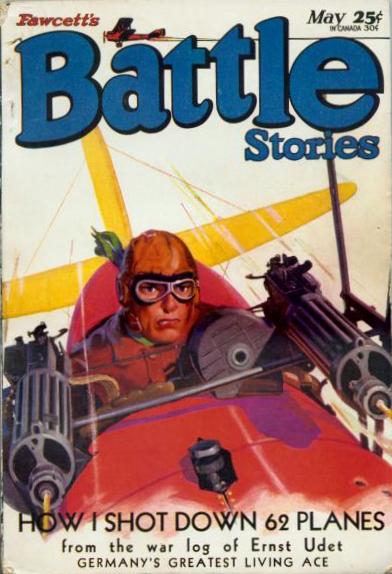
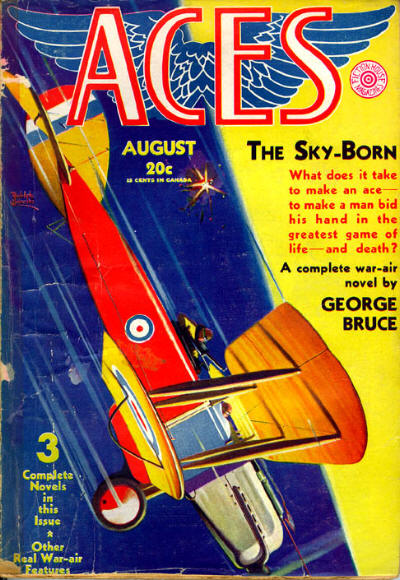
Like many in the late 20’s and early 30’s, Robert O’Neil was fascinated with aviation and as such, a large part of both volumes of his scrapbooks is taken up with a cataloging of the many different types of planes. But amongst all the planes and air race flyers and info on Aces are some surprising items. Robert was also fond of including cut-outs from covers of all kinds of aviation themed magazines.

Here are a few along with the full covers Robert excised them from:


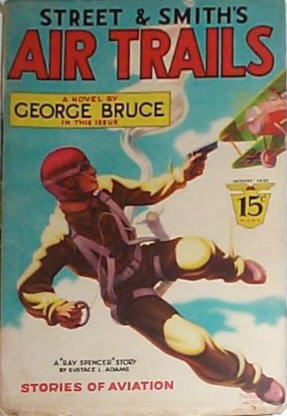
AIR TRAILS
August 1931


POPULAR AVIATION
September 1931


MODEL AIRPLANE NEWS
OCTOBER 1931


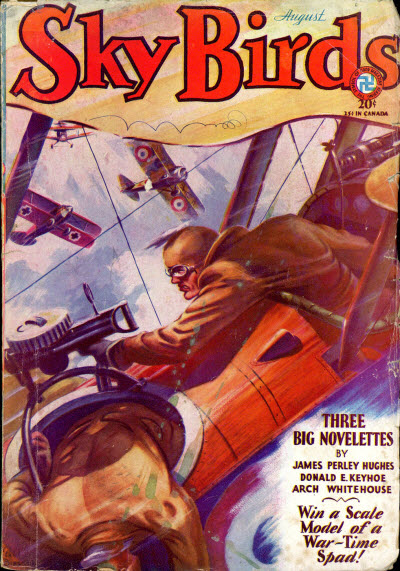
SKY BIRDS
August 1931


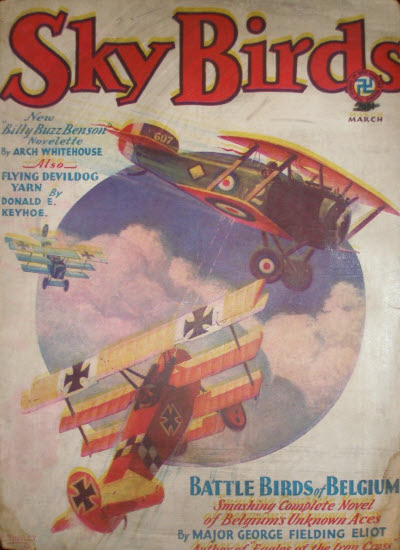
SKY BIRDS
MARCH 1932


SKY BIRDS
APRIL 1932


NATIONAL GLIDER
and AIRPLANE NEWS

July 1931


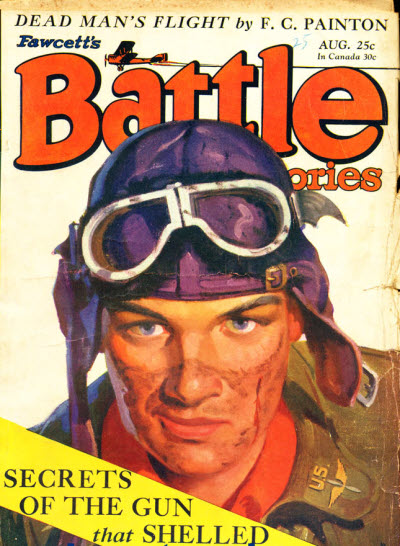
BATTLE STORIES
August 1931


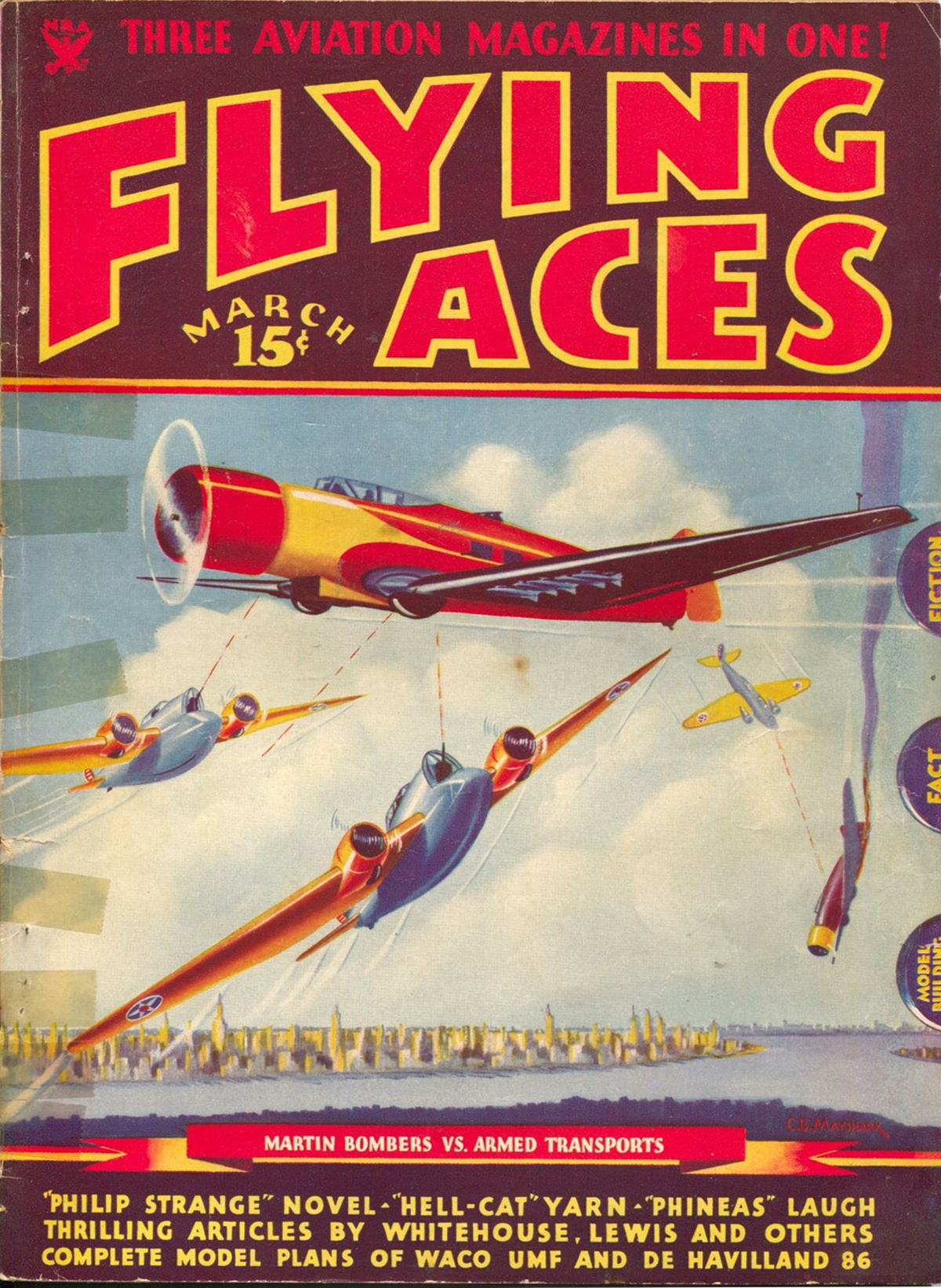
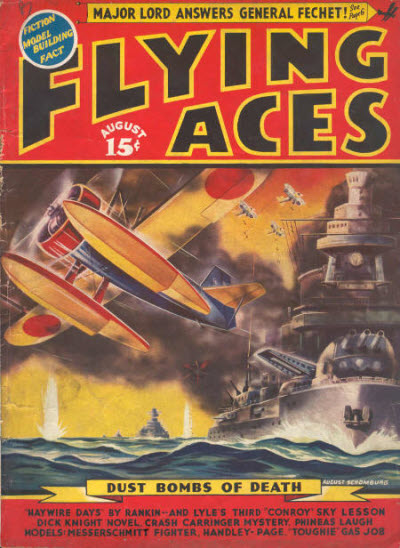
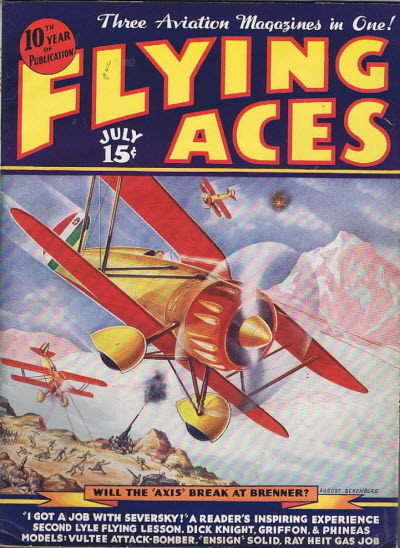
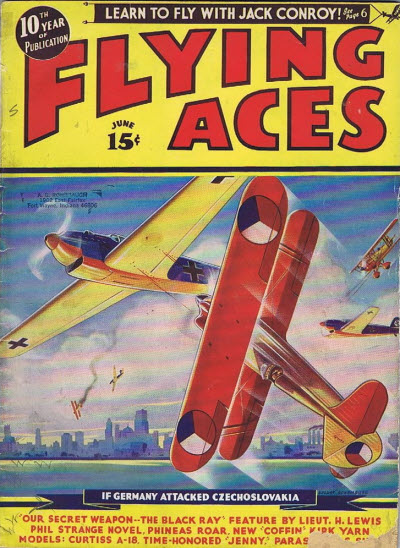
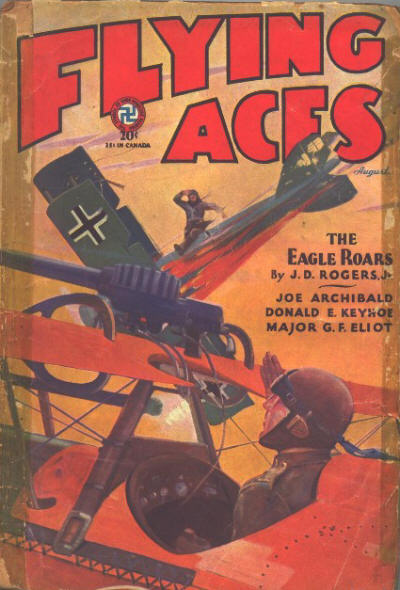
FLYING ACES
August 1931


BATTLE STORIES
May 1931


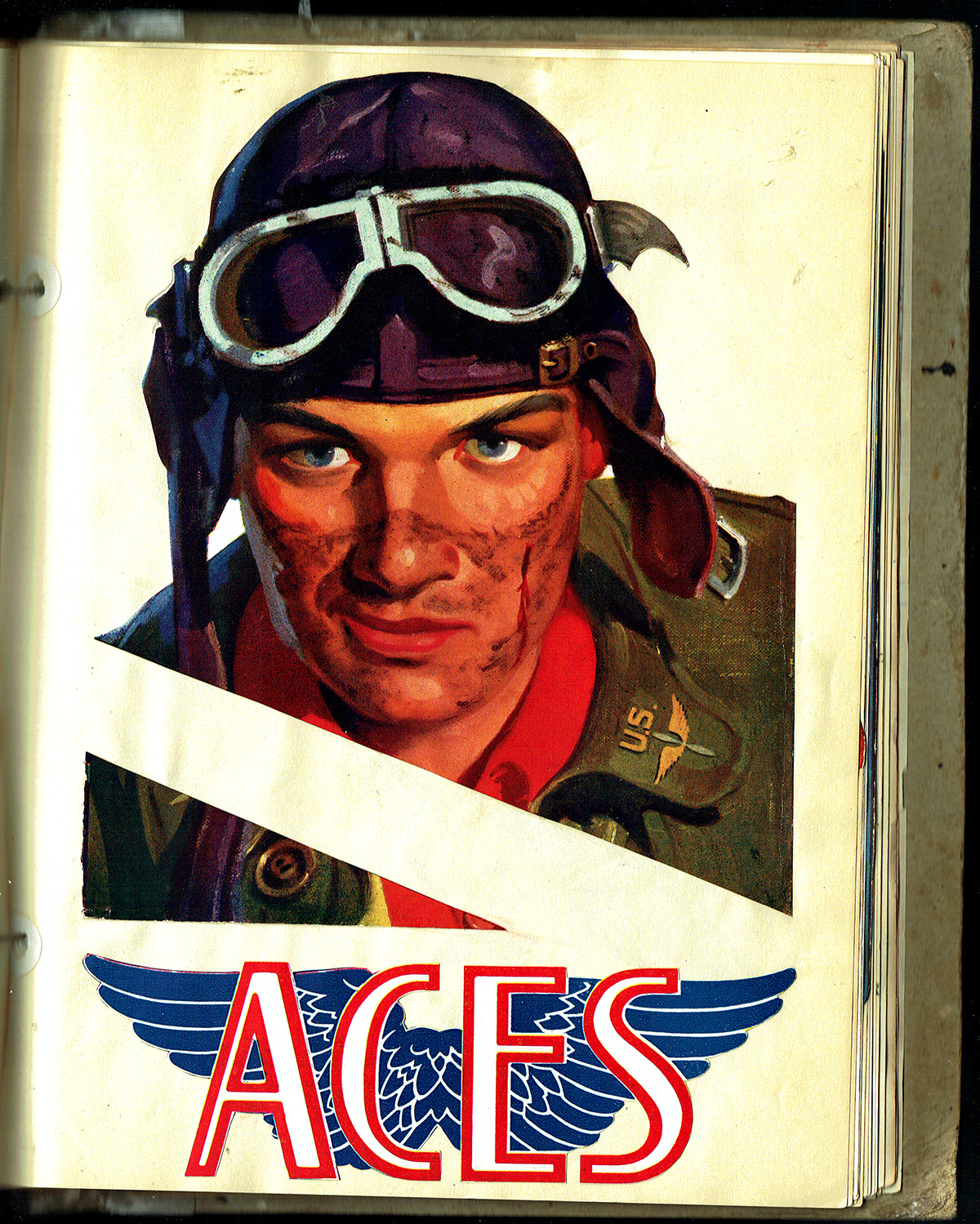
ACES
August 1931


From the Scrapbooks: A Letter from Arch Whitehouse

Link - Posted by David on December 15, 2021 @ 6:00 am in

THIS Holiday Season we’re delving into a pair of scrapbooks that were created in the late 20’s and early 30’s by an industrious youth, Robert A. O’Neil, with a keen interest in all things aviation. The books contain clippings, photos and articles from various aviation pulps as well as other magazines. What has been assembled is a treasure trove of information on planes and aces of WWI.

Like many in the late 20’s and early 30’s, Robert O’Neil was fascinated with aviation and as such, a large part of both volumes of his scrapbooks is taken up with a cataloging of the many different types of planes. But amongst all the planes and air race flyers and info on Aces are some surprising items.

Moving on from the George Bruce letter, a few pages later we find what looks like another letter, folded into thirds like it too had just been pulled out of an envelope and pasted to the page. . .

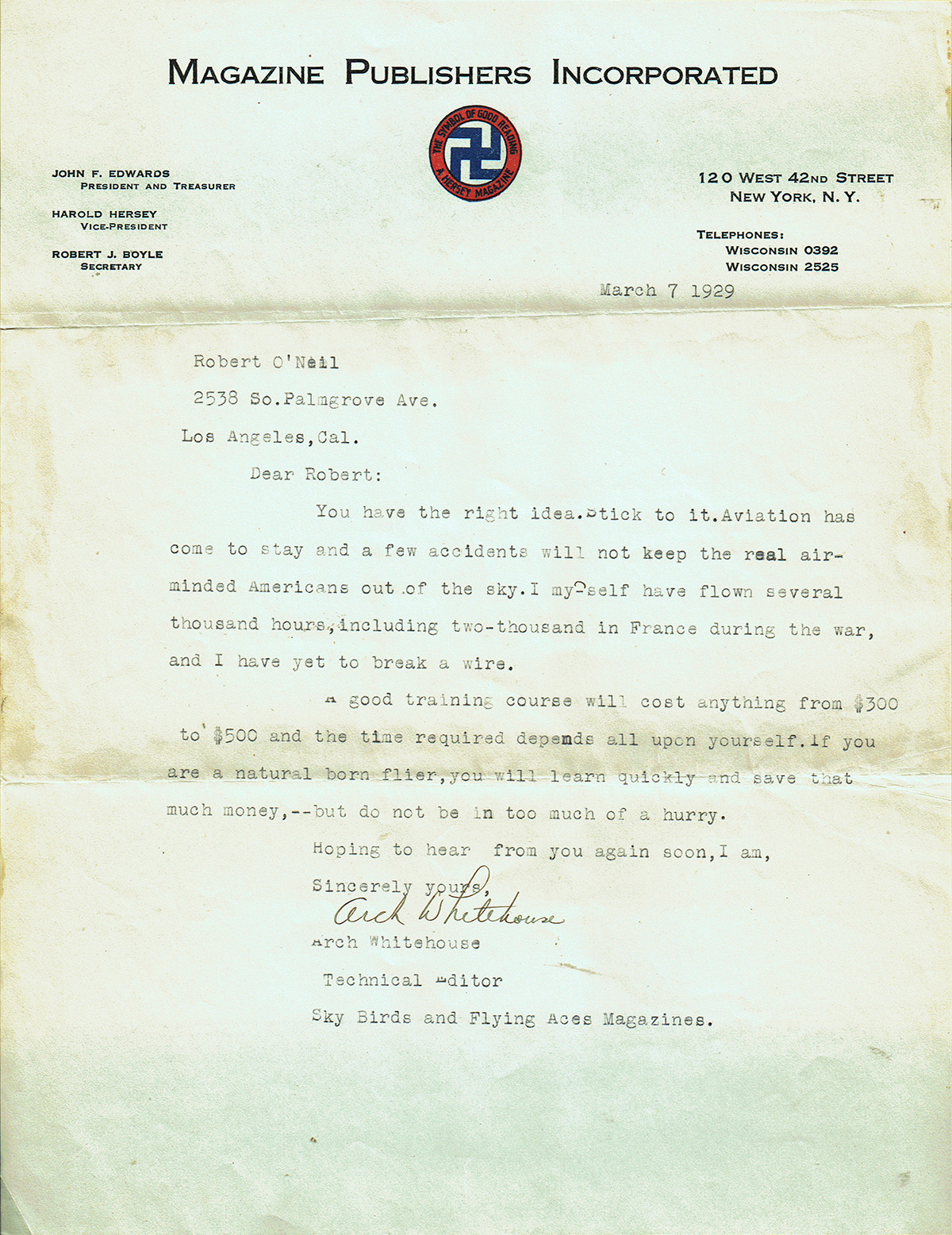
Unfolding the sheet of paper reveals a letter from Arch Whitehouse on Magazine Publishers Incorporated letterhead from March 7th, 1929.

Arch Whitehouse was one of the most prolific aviation writers out there. He created numerous series characters with names like Buzz Benson, Tug hardwick, Coffin Kirk, Crash Carringer, the Casket Crew, and many more. These series characters created for Flying Aces and Sky Birds were extremely popular with the readers back in the 30’s and 40’s. Month after month he brought these colorful aces to life. Whitehouse scope and breadth of information on aviation was so great that he also answered all questions written in to the magazines from the readers.

Robert had apparently written in about learning to fly and Arch Whitehouse felt the need to respond with words of encouragement personally to a then 19 year-old Robert.

Writing from New York City, Whitehouse advises:

Dear Robert:

    You have the right idea. Stick to it. Aviation has come to stay and a few accidents will not keep the real air-minded Americans out of the sky. I myself have flown several thousand hours, including two-thousand in France during the war, and I have yet to break a wire.

    A good training course will cost anything from $300 to $500 and the time required depends all upon yourself, if you are a natural born flier, you will learn quickly and save that much money, –but do not be in too much of a hurry.

                    Hoping to hear from you again soon, I am,
              Sincerely yours,                        

                              Arch Whitehouse
                              Technical editor
                              Sky Birds and Flying Aces Magazines.


From the Scrapbooks: Aces of Note

Link - Posted by David on December 3, 2021 @ 6:00 am in

THIS Holiday Season we’re delving into a pair of scrapbooks that were created in the late 20’s and early 30’s by an industrious youth, Robert A. O’Neil, with a keen interest in all things aviation. The books contain clippings, photos and articles from various aviation pulps as well as other magazines. What has been assembled is a treasure trove of information on planes and aces of WWI.

Like many in the late 20’s and early 30’s, Robert O’Neil was fascinated with aviation and not just the planes, but also some of the men who made a name for themselves flying them in The Great War.

Chronicled within the pages of the scrapbooks are such Aces the likes of:


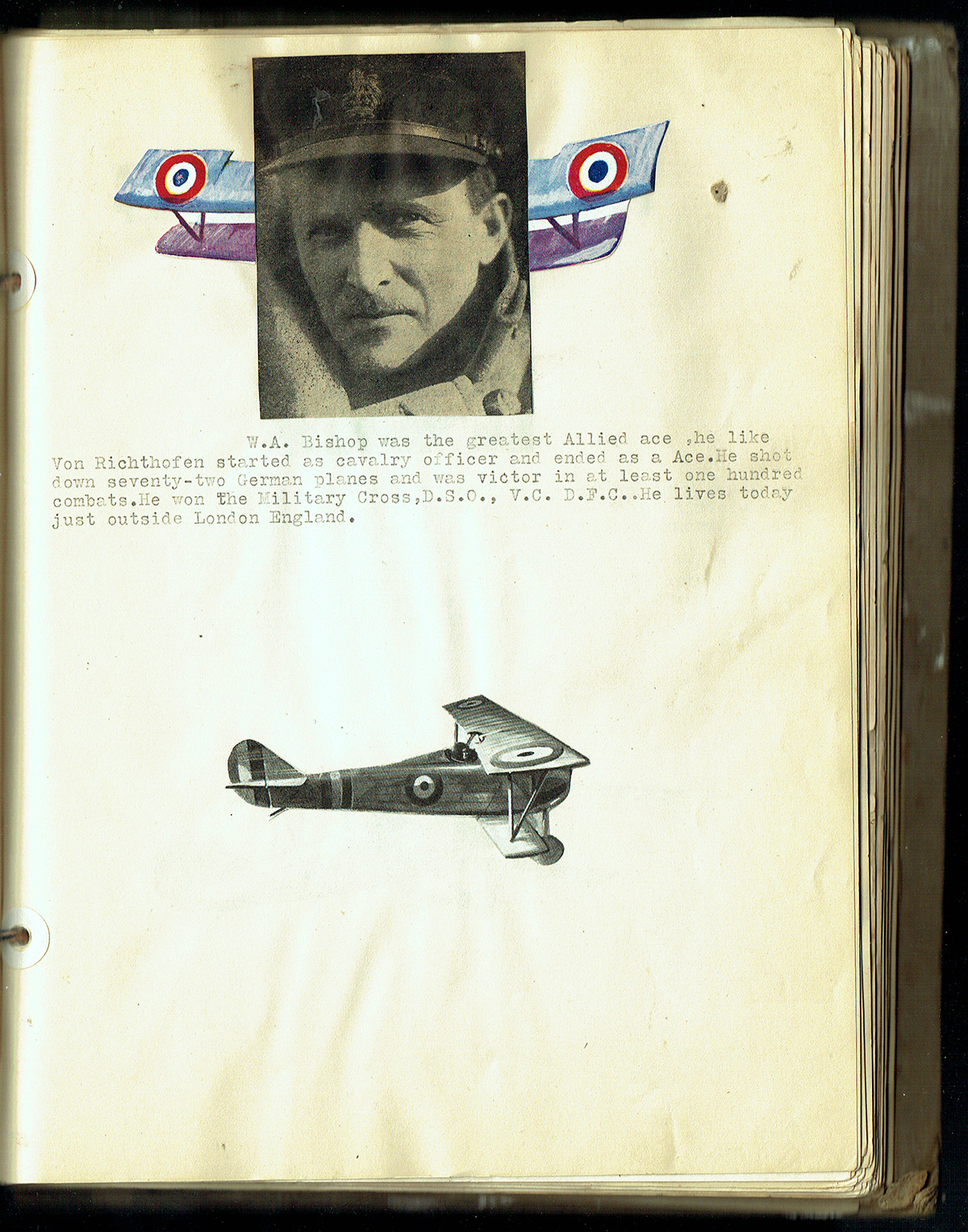
Billy Bishop

and The Red Baron himself––


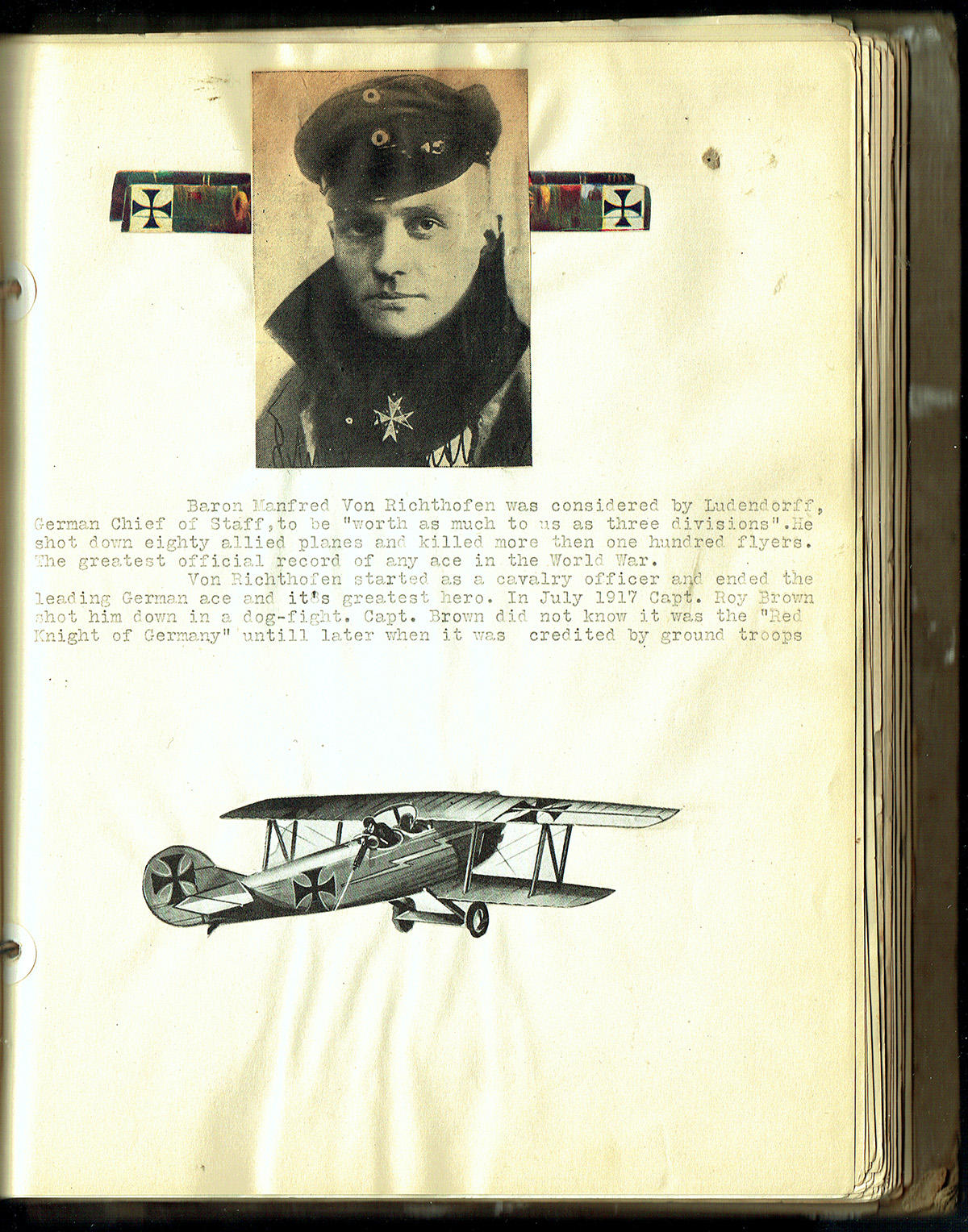
Baron Manfred von Richthofen

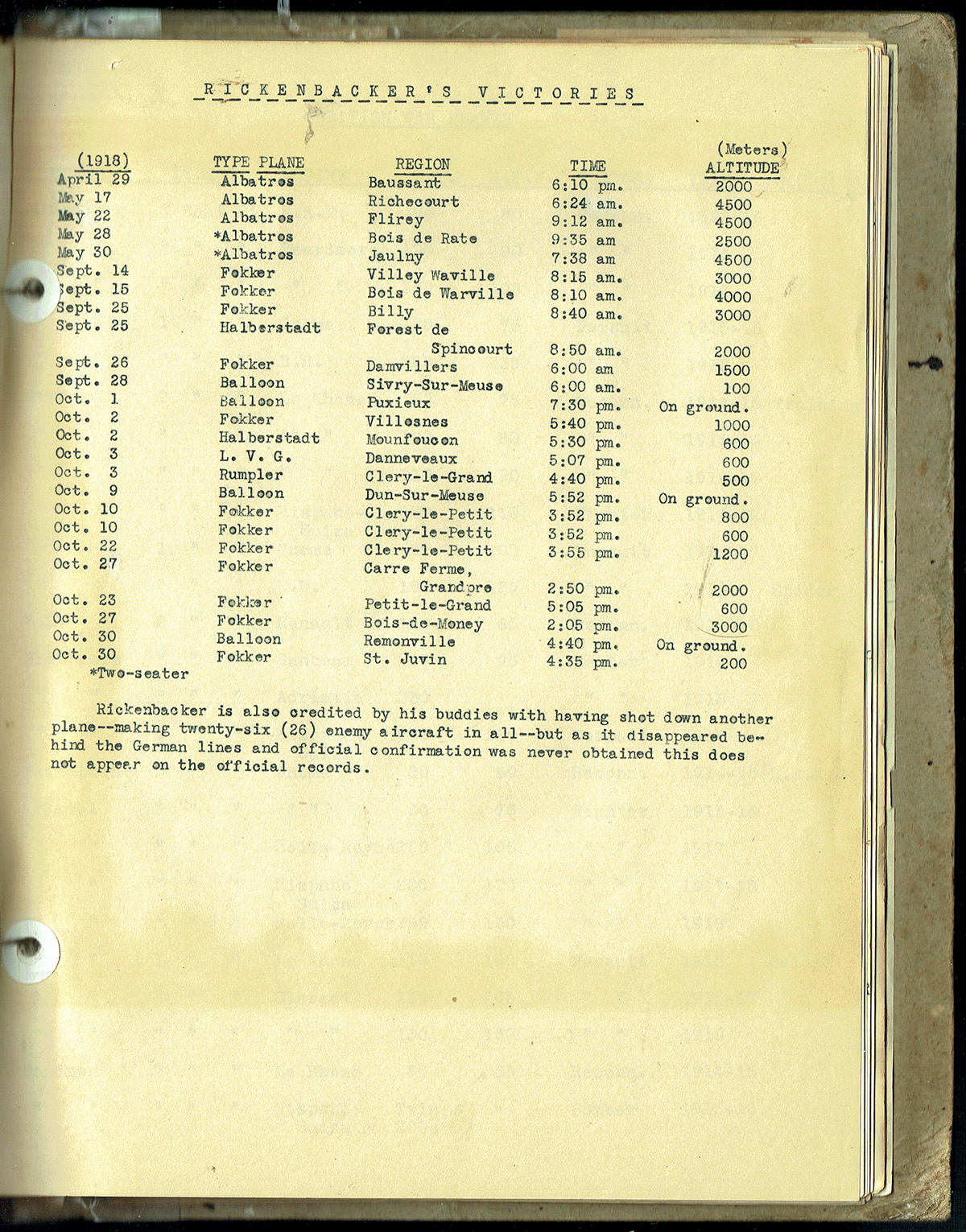
He has a page devoted to Rickenbacker’s Victories

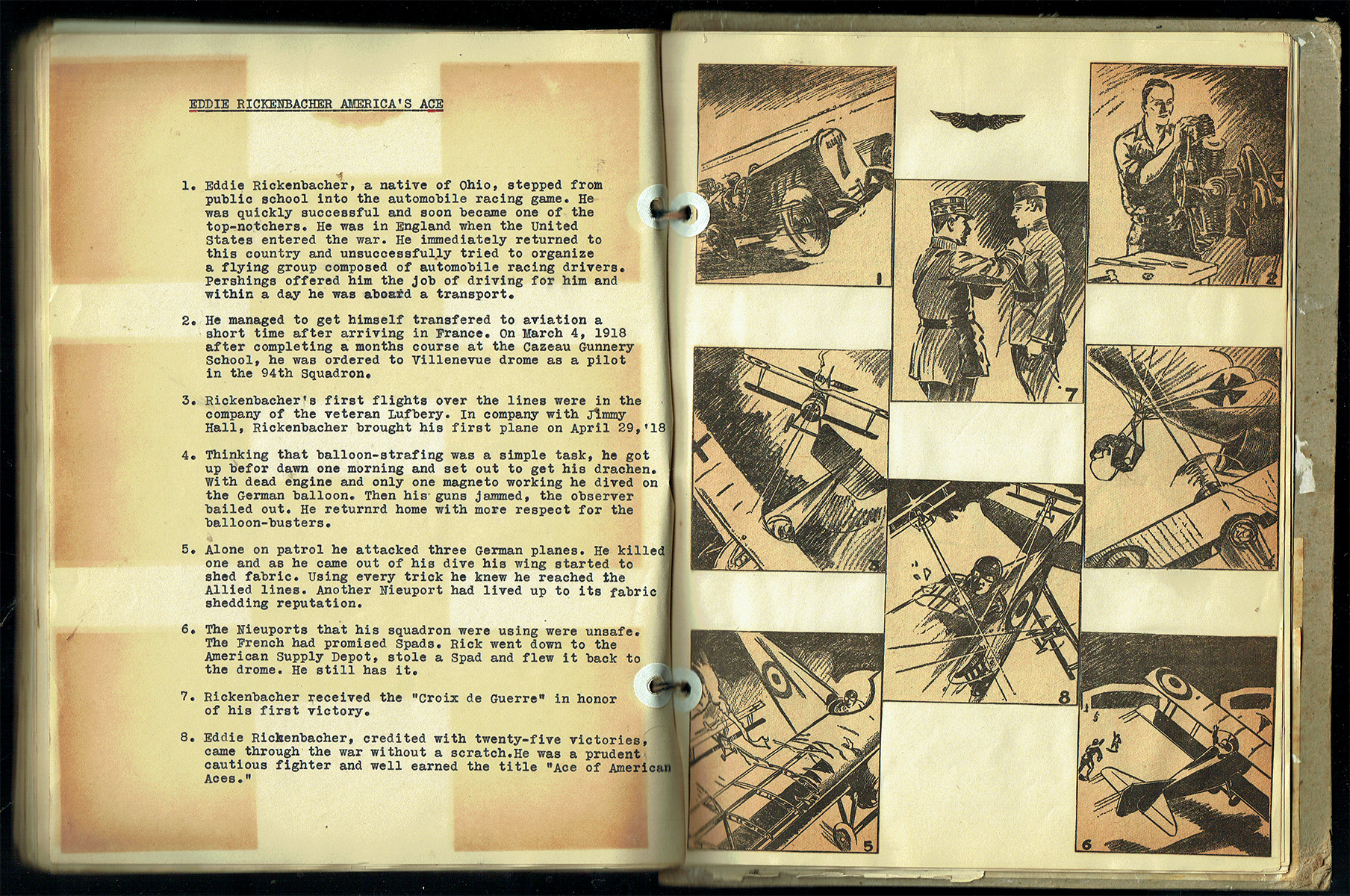
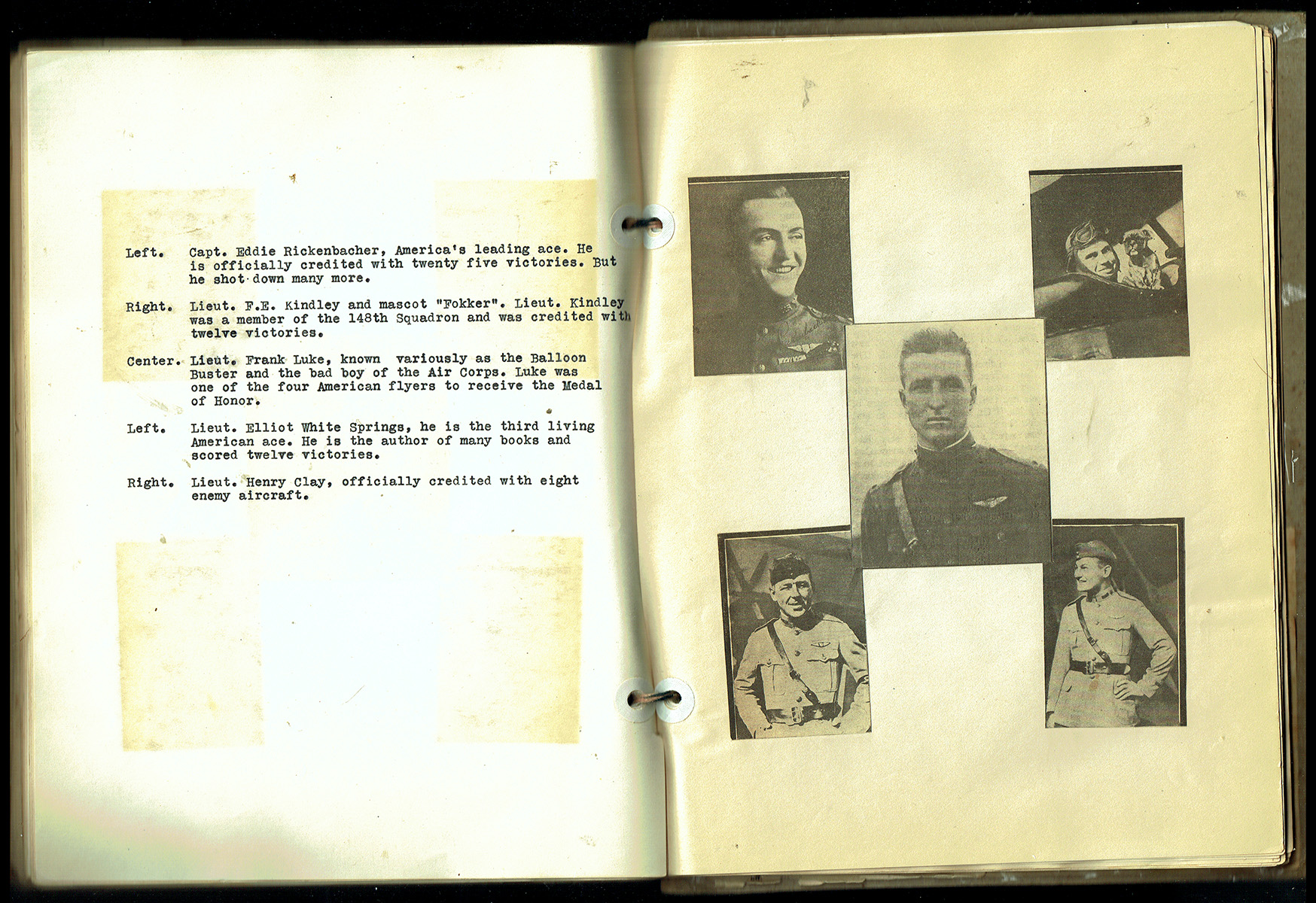
And includes the four installments of Flying Aces’ “Lives of the Aces in Pictures”. Here, he’s taken the images from the two page feature (as they were in the pulp-sized issues), pasted them on a page with the accompanying captions, typed out on the facing page.


Eddie Rickenbacker, America’s Ace

He gave the same treatment for the Lives of Bert Hall, Soldier of Fortune (Flying Aces, June 1932), Georges Guynemer, Falcon of France (July 1932), and Lt. Werner Voss, German Ace (July 1933) as illustrated in pictures.

Scattered throughout are various mentions of aces from the pulps or the newspapers or other magazines.

From the Scrapbooks: Planes of the World

Link - Posted by David on December 1, 2021 @ 6:00 am in

THIS Holiday Season we’re delving into a pair of scrapbooks that were created in the late 20’s and early 30’s by an industrious youth, Robert A. O’Neil, with a keen interest in all things aviation. The books contain clippings, photos and articles from various aviation pulps as well as other magazines. What has been assembled is a treasure trove of information on planes and aces of WWI.

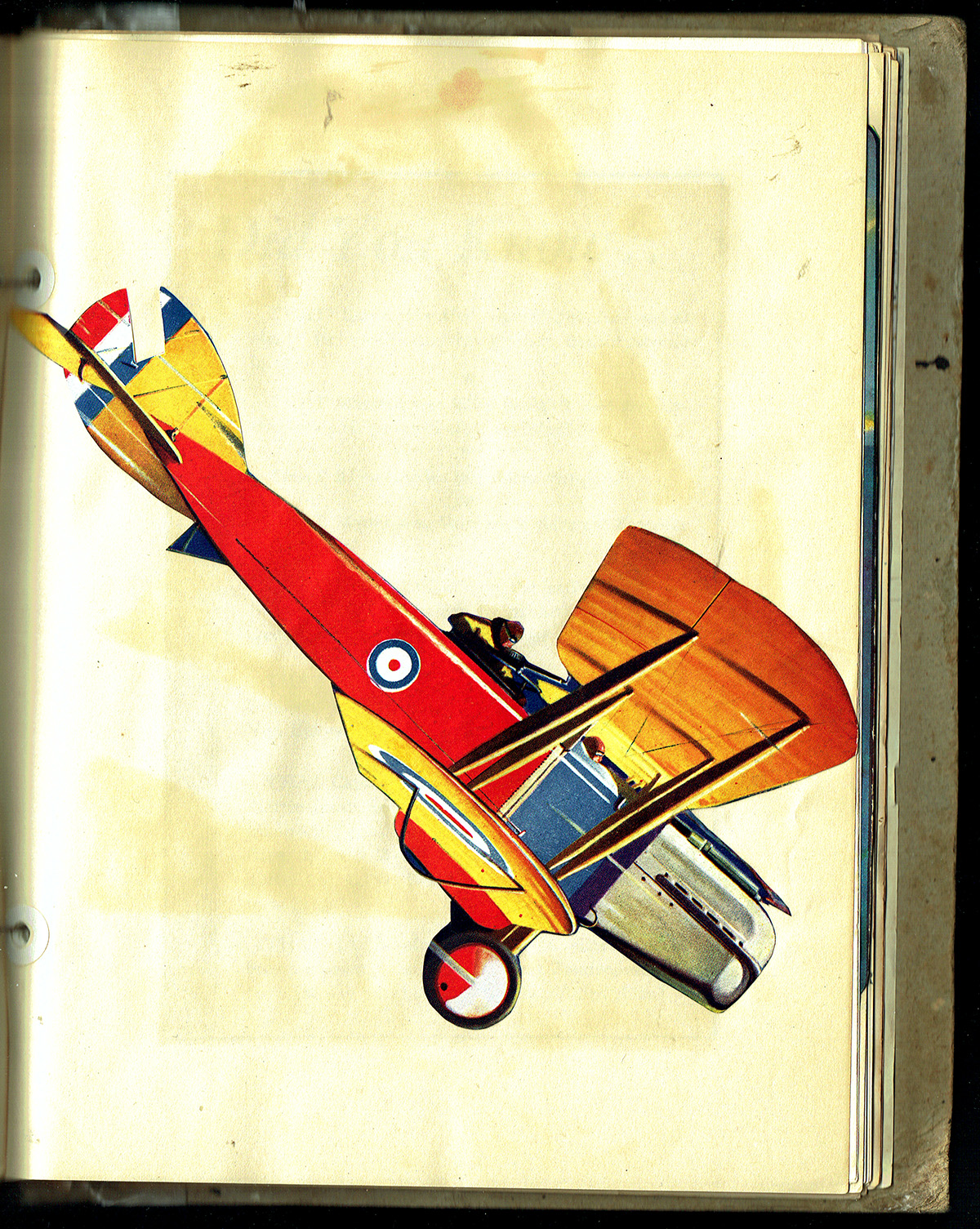
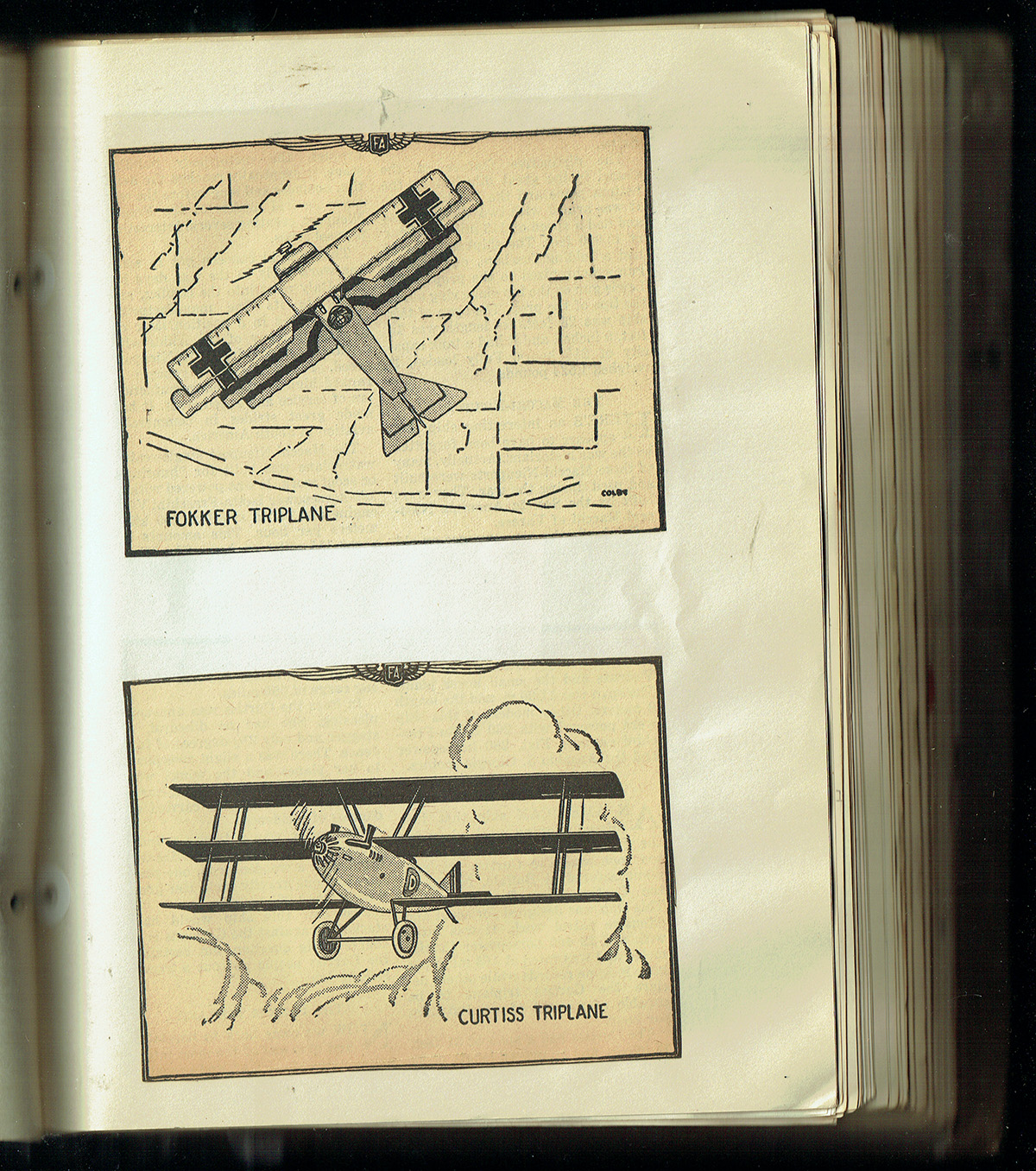
Like many in the late 20’s and early 30’s, Robert O’Neil was fascinated with aviation and as such, a large part of both volumes of his scrapbooks is taken up with a cataloging of the many different types of planes. Many of the aviation pulps featured monthly articles on this subject. Flying Aces called theirs “War Planes Album”. Each month they featured six planes with a simple illustration by C.B. Colby and an informative write-up on each of the planes.


Two of the six planes featured in the November 1932 Flying Aces

Good news for those who wanted to clip and save the plane images and paste them into an album as Robert had done, the illustrations were laid out in the article so no two images would be on the back of the other.


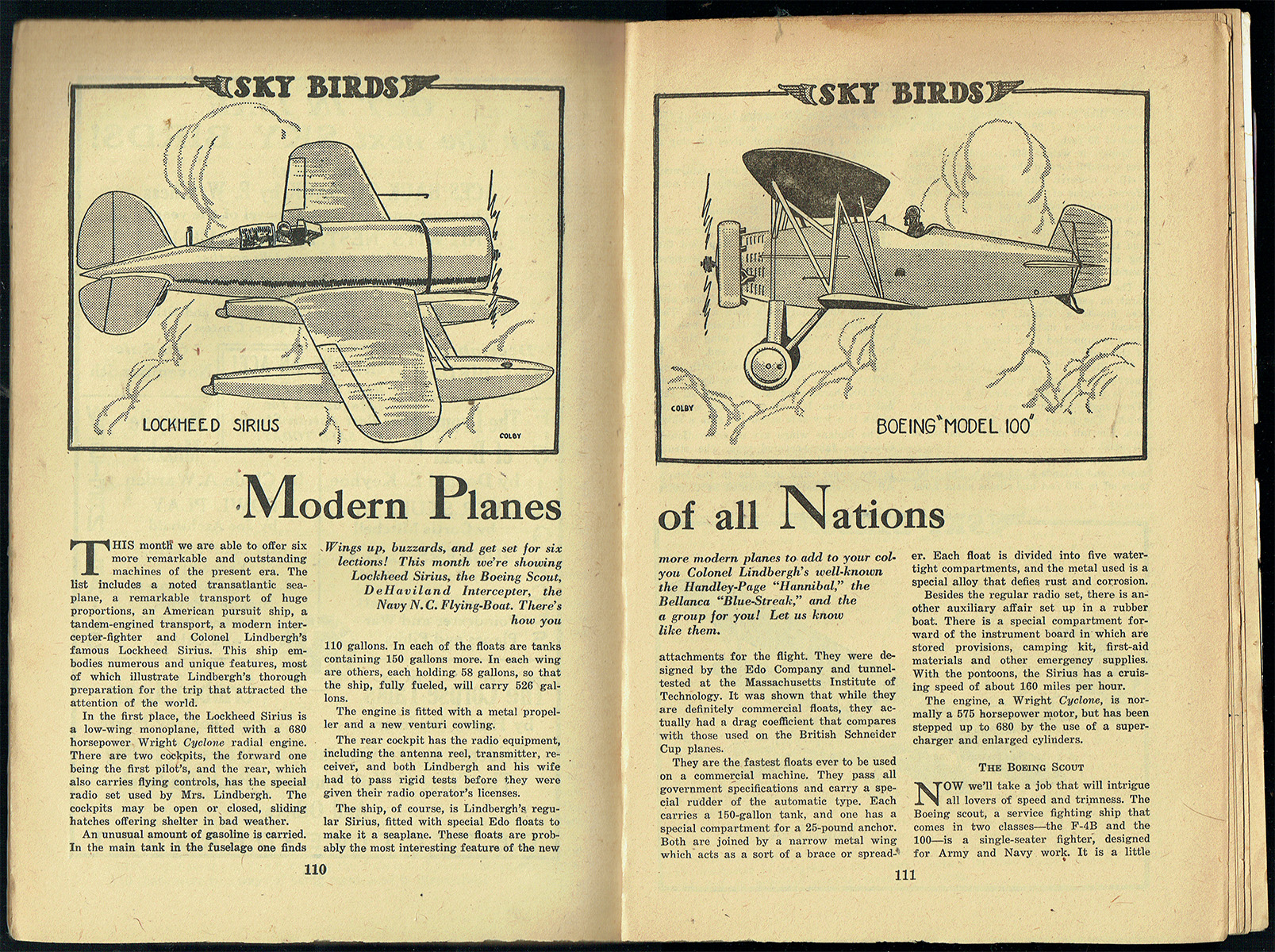
The opening spread of the “Model Planes of All Nations” from (Sky Birds, November 1931).

Robert also clipped similar images also by Colby from Sky Birds’ monthly feature “Model Planes of All Nations.” Sky Birds’ feature was essentially the same as Flying Aces’ feature. You get six planes an issue.


Two of the six planes featured in the November 1931 Sky Birds

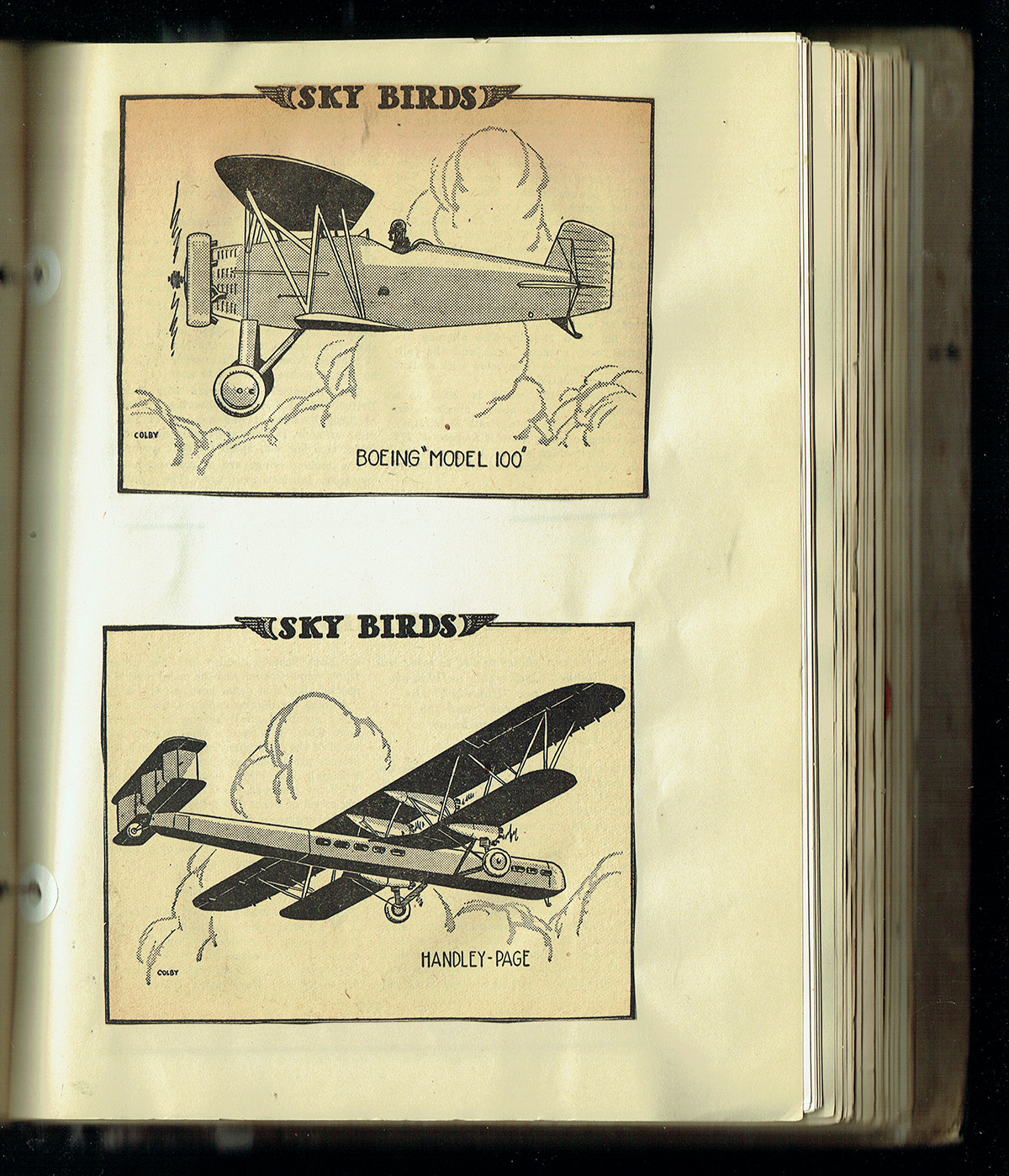
Robert generally featured two images per page, but for a few, he pasted a single image on the page and below it typed the informative part of the article about that plane.

The Robert A. O’Neil Scrapbooks

Link - Posted by David on November 26, 2021 @ 6:00 am in

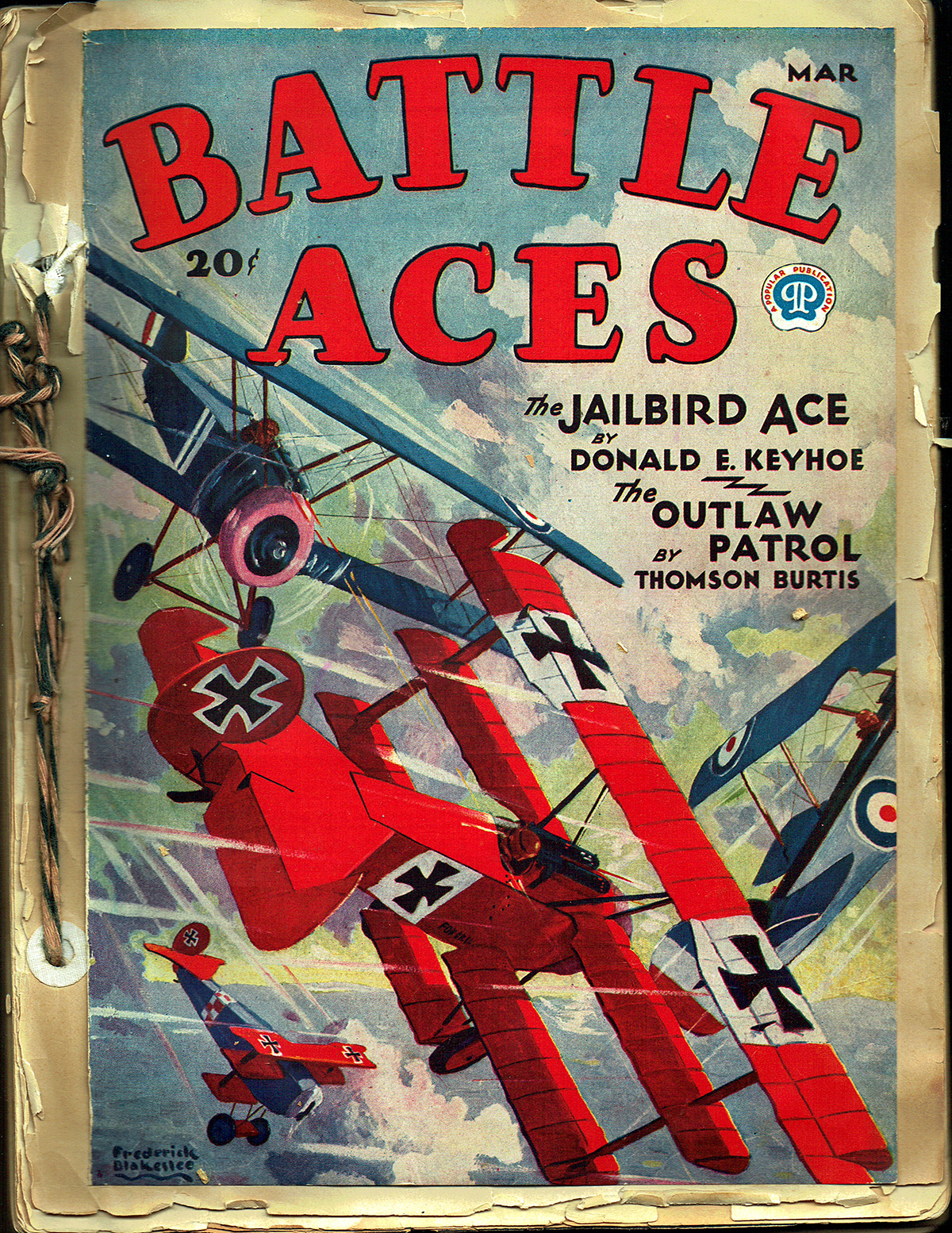
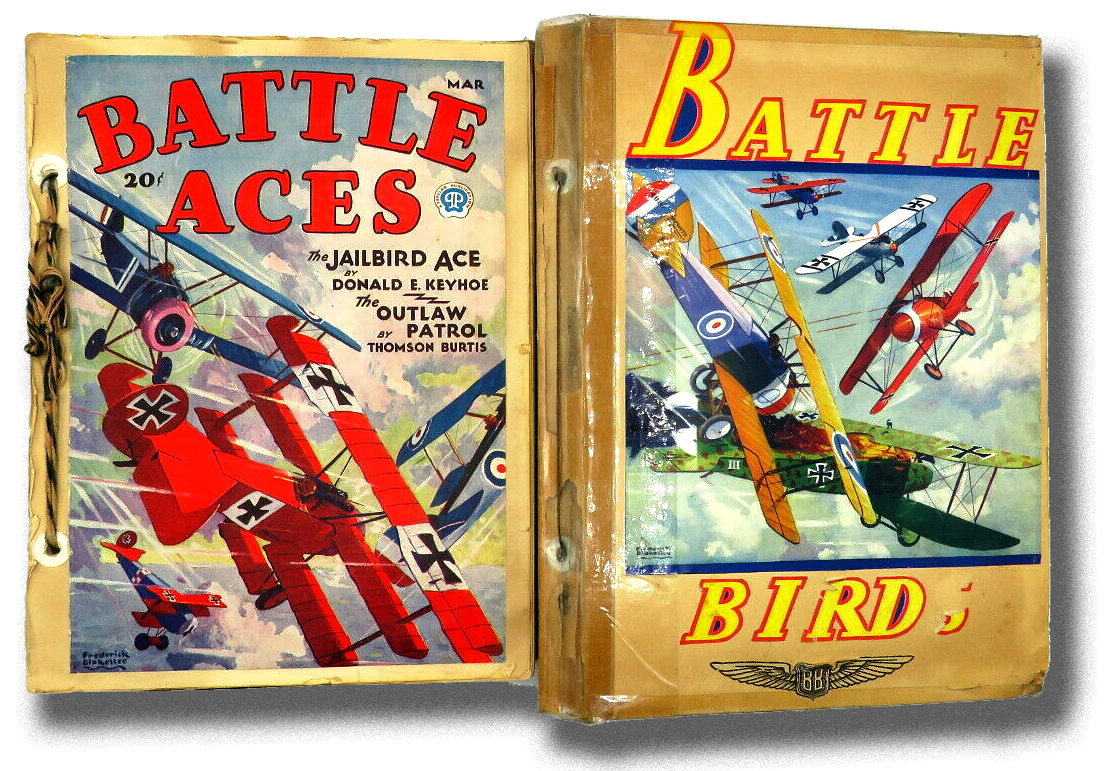
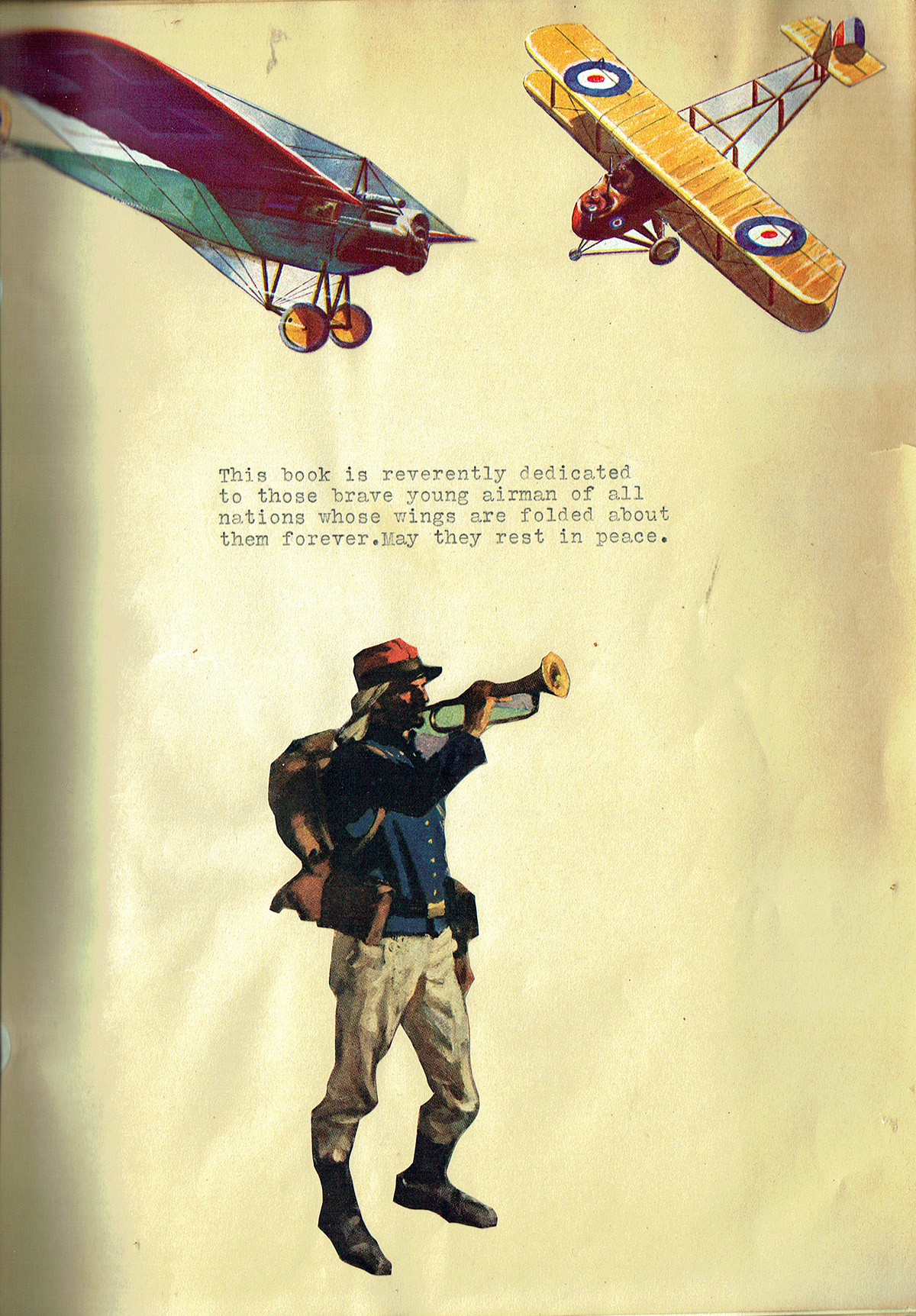
RECENTLY, Age of Aces came into possession of a pair of Aviation Scrapbooks. These scrapbooks are hand made with roughly 170 8″ x 10.5″ pages each, bound together with string. Pasted on the pages are photos, drawings and articles of early aviation history excised from pulp magazines like Battle Birds, Battle Aces, Sky Birds and Flying Aces as well as other sources from 1928 to the mid-1930’s. Typed descriptions accompany some of the pulp illustrations. Also included are ephemera from Air Shows, letters from the magazine publishers, photo postcards of airplanes and the air battle histories of Aces like Rickenbacker and Richtofen. They are a deeply personal endeavour by a young man clearly intrigued by the development of early aviation and its practical application in war.

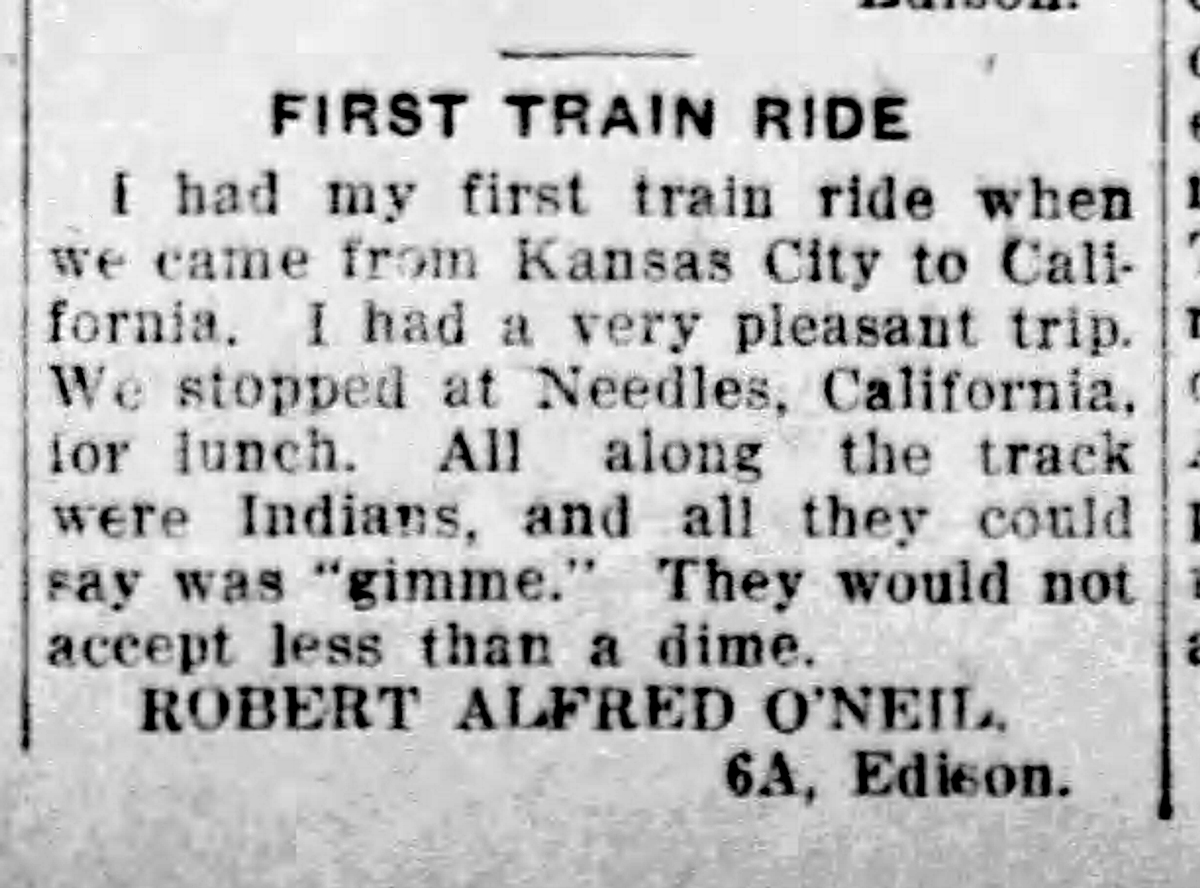
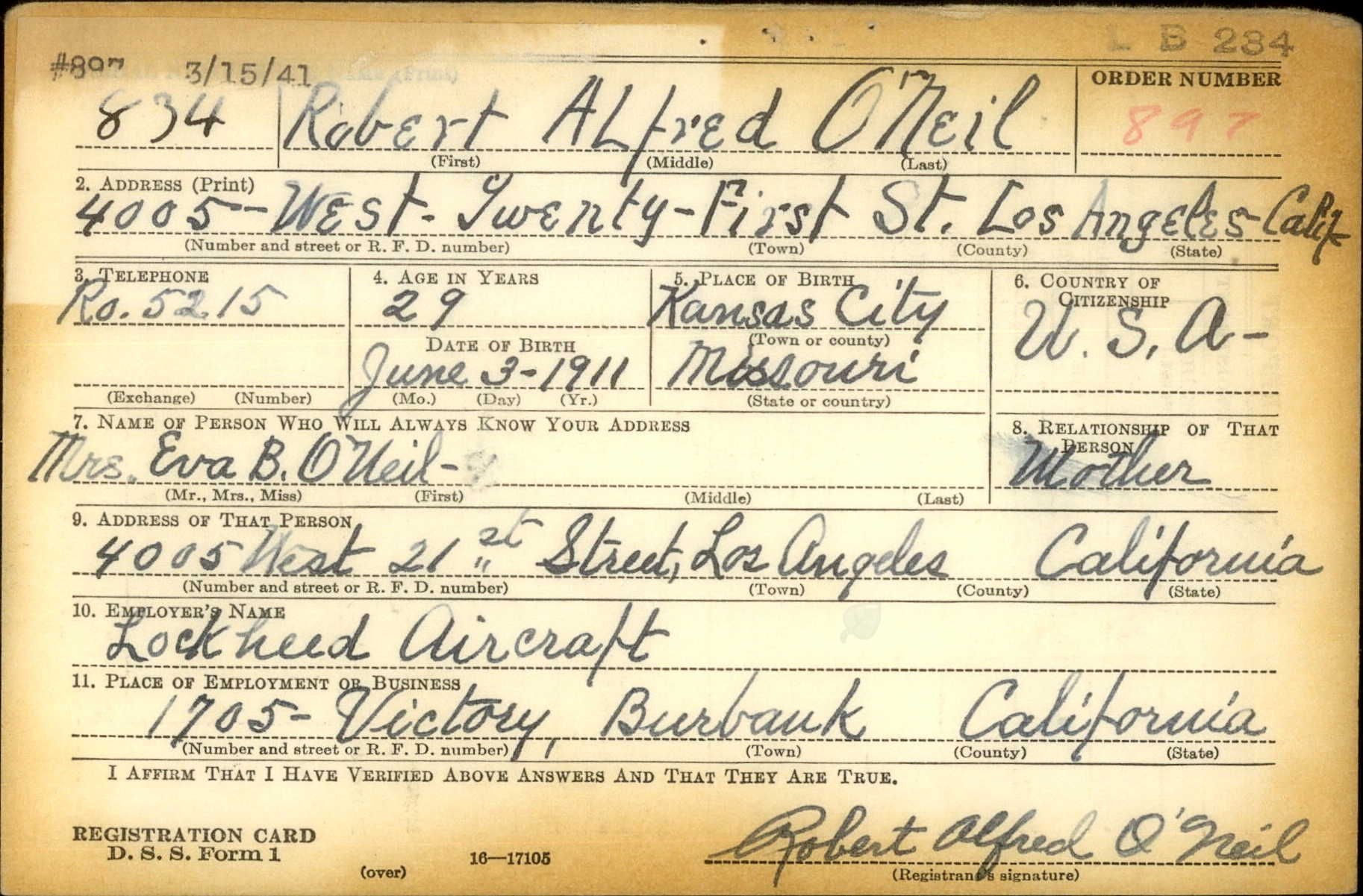
The scrapbooks were compiled by Robert Alfred O’Neil. Looking around on ancestry.com a bit, Robert was born on July 3rd, 1911 in Kansas City, Missouri. He has a sister, Evelyn, who is a year older. Some time in the early twenties the family moved to Los Angeles. Robert had a brief letter published about his first train ride in The Long Beach Telegram (April 16, 1924).

According to the date on the title page of the first Scrapbook, Robert started them January 1, 1928.

The 1930 census lists Robert as being 18, still living with his parents and 19 year old sister, and working as a messenger for a bank.

The 1940 census has Robert, now 28, living with just his mother on West 21st Street in Los Angeles and pulling in $1,104 a year as a bookkeeper. But by the following March when he filled out his draft registration card, it seems Robert was finally applying his knowledge and love of aviation—he listed his employer as Lockheed Aircraft! (His sister and her husband were living just down the street.)

Starting Monday, and on subsequent Wednesdays, Fridays and Mondays all December, we’ll be taking a look at Robert’s scrapbooks and the treasures within. So be sure to check back for a look back some things we’ve already featured on the site that Robert included in his scrapbooks as well as some exciting new discoveries! We’ll get things started on Monday when we go to the Air Races!

“Kraut Fishing” by Joe Archibald

Link - Posted by David on October 29, 2021 @ 6:00 am in

“HAW-W-W-W-W!” That sound can only mean one thing—that Bachelor of Artifice, Knight of Calamity and an alumnus of Doctor Merlin’s Camelot College for Conjurors is back to vex not only the Germans, but the Americans—the Ninth Pursuit Squadron in particular—as well. Yes it’s the marvel from Boonetown, Iowa himself—Lieutenant Phineas Pinkham!

Not long after Lieutenant Phineas “Carbuncle” Pinkham had knocked off Herr Hauptmann Adolph August von Heinz—the Owl of the Ozone, whose nocturnal marauding had been driving the Chaumont brain trust to drunkards’ graves—the Allies had a meeting. And the motion was moved and seconded that a medal be struck off for the hero from Boonetown, Iowa. But two hours after the order was okayed by the Democratic board of directors, Major Rufus Garrity, boss of the turbulent Ninth Pursuit Squadron, wished that Phineas had let the Heinie alone. For irked no end by the news that von Heinz had been shellacked for a row of ammo dumps by Lieutenant Pinkham, a certain Boche bombing outfit hopped into their egg crates close to dawn of the day following the descendu of their Kraut hero who doted on darkness. In the confusion of the subsequent bombing of the Ninth by the von Schmierwurst’s gory Grim Reapers, The Owl flew the coup hiding in the woods full of his nocturnal friends!

Neither of the international shooting parties encamped in that noxious neighborhood bordering Bar-le-Duc was in a sugary mood. To the Teuton tracer-tossers, the capture of their sinister Spandau-ist, Hauptmann von Heinz, had proved a decided pain-in-the-neck. Likewise, von Schmierwurst’s gory Grim Reapers had become a pain-in-the-neck to the Democrats. And Phineas? You guessed it! He was a pain-in-the-neck to everybody!

“Flying Aces, October 1935″ by C.B. Mayshark

Link - Posted by David on May 31, 2021 @ 6:00 am in

THIS May we are once again celebrating the genius that is C.B. Mayshark! Mayshark took over the covers duties on Flying Aces from Paul Bissell with the December 1934 issue and would continue to provide covers for the next year and a half until the June 1936 issue. While Bissell’s covers were frequently depictions of great moments in combat aviation from the Great War, Mayshark’s covers were often depictions of future aviation battles and planes—like the October 1935 cover where Mayshark gives us a glimpse into a Nazi attack on the Polish Corridor!

Raid on the Polish Corridor

th_FA_3510IT IS nearly 2 a.m. in the City of Danzig, and the atmosphere of quiet, common to that hour, prevails. The city’s population is asleep; there is little activity other than the measured steps of the guards and sentinels at the military encampments and fortifications. The night is clear, and a soft, yellow radiance, cast by the moon, is playing over the cold, grey walls of the century-old buildings. Here and there, the darkness is punctuated by the brilliant pin points of the city’s remaining lights.

It is difficult for one to visualize the fact that this peaceful and slumbering city is one of the storm centers of European diplomatic wrangling. Nazi Germany believes that the city rightfully belongs to her, and if she can’t get it by vote, very likely she will resort to force. Votes, thus far, have failed her.

SUDDENLY an operator on a sound detector at a military flying field springs to attention. Adjusting his earphones, he tunes his instrument to maximum efficiency. Quickly jotting down his observations, he calls a runner and dispatches a note to his superior. A hurried order is broadcast, and a Polish squadron of single-seaters roars into action.

They arrive over the city at a speed of more than two hundred miles per hour—just in time to meet a flight of huge, tri-motored German converted bombers. The Polish pilots must act quickly if Danzig is to be saved. Already, the German ships have begun to drop their deadly eggs, and to make matters worse for the defense ships, a devastating anti-aircraft fire has been leveled at the invaders.

There is a contention among military authorities that it is impossible to completely destroy a city with one air raid, and that one bombing expedition will only serve to bring on a reciprocal one, thus prolonging the warfare. Very likely this logic is good, but it is doubtful if it is applicable in the present case. Danzig, a free city, is under the protectorate of the League of Nations—a body that would find it difficult to conduct retaliatory air raids against Germany. If Germany were successful in taking Danzig by force, she might have a chance of getting away with it, because Poland no longer depends entirely upon that city as a seaport, having recently built her own port at Gdynia, which is located at the Baltic end of the Polish Corridor.

On the other hand, a German air raid on Danzig might only constitute a move to throw Poland off her guard. Once a few bombs were dropped on Danzig, the Nazi bombers could continue southward to attempt devastation of the whole length and breadth of the Polish Corridor.

However, it is logical to assume that Poland would spring to the assistance of Danzig in the manner we have pictured on our cover. Poland, naturally, has an interest in the welfare of Danzig, for she is responsible for the city’s relations with foreign countries. And then, if the German ships were to jump across the border into the Corridor, Poland would find herself in a position to repulse the attack if she had sent defense ships into the air at the first warning of impending danger to the City of Danzig.

And so, with the shrieking of shrapnel and the whine of machine gun bullets the populace of Danzig is awakened with a start of horror. The flight of single-seaters is knifing down to the attack with a vengeance, and the formation of the bombers is temporarily broken. As a rain of tracer is directed against the first German ship, the Polish single-seaters swerve to the side abruptly. Bombers always have been difficult to shoot down, and the defense pilots are finding that their fire is ineffective. It is hard to find a vulnerable spot on such a large surface as that possessed by a tri-motored bomber, much less crash it to the earth with a single burst of bullets. As the defense ships roar in, the anti-aircraft fire abates somewhat in order that the defense ships will not be endangered.

Like a pack of yelping dogs, the gull-winged fighters cut loops of fury in the night sky. Three or four converge on one bomber, and after repeated thrusts it goes down, to crash with a deafening concussion on the earth below. And now two fighters follow it, victims of streaming lead from a vengeful bomber.

The Nazi bombing group now re-forms quickly. With the single-seaters still yelping about their ears, they climb for altitude and leave the city.

What is their purpose? Will they continue on and destroy Gdynia? Or are they merely temporarily pulling away from the scene of battle in order that they can reorganize and return in a short time to finish the job which they have only begun?

The scene that they leave behind is not pleasant to look upon. Everything is stark horror on the streets of Danzig. Mutilated bodies and piles of debris lie grotesquely about the city. Police emergency squads are carrying the wounded and dying to hospitals, and the streets are being cleared of the wreckage. Already, the work of rehabilitation has begun.

Everything being considered, Danzig has not suffered as badly as one might imagine. Comparing the potential destructive force of each bomb dropped, with the actual damage done, it is not difficult to share the belief that it is well nigh impossible to completely annihilate a sizable city with one raid.

And so, Nazi Germany has started on a rampage of conquest, fictitiously, of course. And thus history repeats itself. Governments whose positions have become jittery and insecure domestically have almost invariably attempted to excuse their existence by a successful campaign for territorial annexation. In the long run, however, such governments are doomed to destruction.

THE German ships pictured on this month’s cover are Junkers JU. 52/3m’s. They are tri-motored bombers capable of making 177 miles per hour and having a disposable load of 8,360 pounds. They are powered with three B.M.W. “Hornet” T.I.C. engines. Of course, these planes were designed for freight and passenger service, but the job of converting them into high-efficiency modern bombers would require only a few hours. As a matter of fact, it has already been done, and one ship has been named the “Baron Manfred von Richthofen.”

The Polish ship used is a P.Z.L. P-XI with a Bristol Mercury IV.A. radial engine fitted with a Townsend low-drag ring cowling. It has a high speed of 217 miles per hour. Poland is known to possess several types of remarkably efficient ships, and the strides she has made in airplane manufacture is all the more remarkable in that every ship in service in that country is of Polish manufacture.

The Story of The Cover
Flying Aces, October 1935 by C.B. Mayshark
Raid on the Polish Corridor: Thrilling Story Behind This Month’s Cover

“Flying Aces, September 1935″ by C.B. Mayshark

Link - Posted by David on May 24, 2021 @ 6:00 am in

THIS May we are once again celebrating the genius that is C.B. Mayshark! Mayshark took over the covers duties on Flying Aces from Paul Bissell with the December 1934 issue and would continue to provide covers for the next year and a half until the June 1936 issue. While Bissell’s covers were frequently depictions of great moments in combat aviation from the Great War, Mayshark’s covers were often depictions of future aviation battles and planes—like the September 1935 cover where Mayshark gives us a glimpse of an air Battle in Oriental Skies!

Battle in Oriental Skies

th_FA_3509THE drowning of powerful motors, the rattle of machine-gun fire, the shrieking of a ship falling out of control, the gasp of horror coming from the civil population—it means but one thing—the Japanese have struck!

And when the Japanese strike, it is like the lightning thrust of the hooded cobra. It is sudden and effective, and over almost as soon as it has begun. The resistance of the Chinese border patrols is determined, however, even if it is of little value against the power and speed of the machines from the land of the rising sun.

On our cover this month, we have depicted for you a clash between a Chinese-owned Douglas and a Japanese-built Nakajima. The territory over which the battle takes place is near a border in the hill country in North China. The approach of the single-seaters has been telegraphed ahead, and a Douglas two-seater takes the air in an effort to defend the district from the raking enemy machine-gun fire and from the destructive bombers which must surely follow the Nakajimas.

Ironically enough, the Douglas comes up with the two Japanese single-seaters directly above a temple of worship, many of which are to be found in isolated regions in North China. As the Japanese pilots spot the Douglas, they realize that their task is a comparatively simple one. The two-seater would not have any real effectiveness against the powerful bombers which are to come, but nevertheless, a pile of smouldering debris on the ground is of more benefit to the Japanese at this particular point than an unchecked stream of lead spattering its message of death at them, even, if it is coming from a Douglas 02MC4.

And so the machines from across the water set upon the Chinese with a vengeance. Attacking in unison, they bear down on the Douglas with several hundred feet of altitude to their advantage. As they approach their target, they spread out fan-wise, and then bank sharply in toward each other so that the line of fire from both ships converges at the unhappy point at which the Douglas finds itself.

However, the Chinese pilot has participated in air defense maneuvers before, and he knows what tactics are required to beat off these vicious Nakajimas. However, he knows how hopeless it is to count on getting even one of these Japanese boys, much less both. Of course, being a good pilot, he can cut his gun and nose his ship sharply up, and so escape the first death-dealing crossfire, but the ultimate outcome is written in blood on every burst of Japanese tracer which comes tearing down the sky.

The result of the fight is so obvious that further elaboration is unnecessary. Of course, the Japanese take the territory, as the resistance is nil after the first onslaught. But another blow has been struck, and the Chinese pride has suffered once more.

With the advent of modern aerial warfare, the Sino-Japanese situation has taken on an entirely different aspect. Border raids by foot soldiers have almost become a thing of the past, and in their stead, swift powerful attacks from the air are the signal for a belligerent and highly mechanized maneuver.

A thing of great importance is the moral effect of bomb-dropping on the Chinese civil population. On the ignorant superstitious hillman, this effect is far greater than it ever could be on any nation of people in the Western hemisphere. The Chinese are, as a general rule, conscious of their vast strength and wealth, and they naturally assume that they can successfully wage war with Japan. The confusion that results from the petty ambitions of the individual war lords, however, complicates matters to such an extent that unified resistance against Japan seems out of the question.

In spite of all this, the Central Government has made an effort to defend itself against the air attacks of the invader. Lacking the modern industrial activity with which the Western world is blessed, the Chinese are compelled to buy their machines of war, if they are to have any, outside their own country. American airplane manufacturers have been favored with much of this lucrative business.

The lack of centralization of the Chinese military activity is evidenced by the fact that the air forces of the various provinces are independent of each other, although a friendly relationship exists between the larger provinces in most instances. The provinces of Canton, Kwangsi, and Fukien, among others, have independent air forces.

In direct contrast, the Japanese do much of their own manufacturing. They have acquired the industrial fever with which the West is imbued.

As has been said, the Chinese ship on our cover is an American-built Douglas 02MC4. Several Douglas ships have been purchased by China, as well as many other types, including Vought and Waco. Types other than American include Junkers, Fiats, De Havillands, and Armstrong-Whitworths.

And here’s an interesting point. To close followers of military aviation design, the Nakajima monoplane fighter seems very similar to the Boeing single-seater developed in this country three years ago. Inspection will show that the unusual strutting arrangement displayed on the Japanese ship is exactly like that of the Boeing which came out under the type numbers 270-V. The fuselage was smooth monocoque; the motor is mounted in the same way and the same type of undercarriage is used. The only improvement the Japanese added was the Townsend ring around the engine.

In other words, there might be such a thing as espionage in aviation after all!

The Story of The Cover
Flying Aces, September 1935 by C.B. Mayshark
Battle in Oriental Skies: Thrilling Story Behind This Month’s Cover

“Flying Aces, August 1935″ by C.B. Mayshark

Link - Posted by David on May 17, 2021 @ 6:00 am in

THIS May we are once again celebrating the genius that is C.B. Mayshark! Mayshark took over the covers duties on Flying Aces from Paul Bissell with the December 1934 issue and would continue to provide covers for the next year and a half until the June 1936 issue. While Bissell’s covers were frequently depictions of great moments in combat aviation from the Great War, Mayshark’s covers were often depictions of future aviation battles and planes—like the August 1935 cover where Mayshark gives us a glimpse into a future air attack on London!

London Under Air Attack

th_FA_3508WAR! The word twangs a different chord in the heart of every man. To the Frenchman, it means a charge toward Paris—or Bayonet Trench outside Verdun. To the American, it means Chateau Thierry or the Argonne; to the Belgian, the remorse of Leige and the ravaging of a neutrality; to the Russian, the helpless swamps in front of the Masurian Lakes; to the Italian, the bloody Piave.

But to the average Englishman, whether he wore khaki or blue, war means air raids on London!

And well it might. When the news reached the trenches on that eventful day in 1915 that German airships had raided peaceful English towns on May 31st, raining incendiary and high-explosive shells on peaceful and unarmed British towns, the horror of war was probably first realized, after nearly a year of bitter fighting.

The English saw their kinfolk battered and mangled, buried under massive piles of masonry. Civilian names were listed in the casualty columns. From that day on, the Englishman knew he was in a war, and in retaliation, British airmen braved distance and bombed Karlsruhe. The French bombarded Baden. The British captured Kut-el-Amara and German South-West Africa. They raced across No-Man’s-Land and completed the capture of the area around Neuve Chapelle. They began a new march on the Dardanelles. And war today still means air raids on London.

The moment the German plans for a gigantic army and a great air force were announced, the British remembered the air raids of 1914-18. They set to work at once to strengthen the air defenses around London, the capitol of the Empire. Forty-one new squadrons were ordered, and recruiting for the R.A.F. leaped to amazing figures. Old flying men swarmed back to the colors. Youngsters hardly out of public school rallied to the call. Their England, which had once denied the charges that Germany was rearming, was threatened again, just as she was in 1914.

She would need more Warnefords, more Robinsons, more McCuddens, more Balls and more Mannocks. Some one had to face the foe which threatened again. No one ever knew the surge of air-mindedness that swept England last March. No one probably ever will. But the gauntlet, the flying glove, was taken up, and again England was ready.

But there is one difference. Germany knows today that she must never make the mistake she made in 1914 when she allowed England to get into a war. This time England must be shunted out of the picture early—just as Belgium was in the last war. The quickest and surest way to do it is by air. Germany’s vest-pocket Navy is no match for Britain’s might on the sea. Her army could never make a landing on British soil. But her air force, with high explosive, gas bombs and all forms of chemical warfare, might be able to stop Britain in her tracks before the English ground and sea forces could go into action.

Let us imagine that overnight Germany should decide to put the British out of any possible play. Her best bet would be a monster air raid on the main centers—London, Birmingham, Chatham, the naval base, Southampton, Dover and many other points of industrial strength—but mainly, of course, London. Here the raiders could sever the many cables of communication and the mighty seat of government—the point of power that controls the vast empire. Blotting out London with either high explosive or chemicals would have such a monstrous reaction, would be such a grim stroke at the morale of the nation, that it would take months to reorganize the intricate mechanism and put the nation back on its feet as an offensive power in a European conflict.

To do this, Germany naturally would have to employ ships capable of a wide cruising area and the carrying of great loads. These planes would require large crews to handle all the. intricate duties necessary in a mission of this kind. There would be two pilots, one navigation officer, one bombardier officer in charge of the bombing details, and at least two men to act as gunners in the defense.

A close examination of the available craft suitable for such a raid discloses that the famous Dornier Super-Wal four-engined flying boat would be the most likely choice. It has a wide cruising range, and is very seaworthy. With four 500-h.p. Jupiter VIII motors, (British, by the way) the Super-Wal has a top speed of 136 m.p.h. and carries a disposable load of 15,840 lbs. Imagine what a formation of twenty such ships could do, assuming they got through the London defenses!

Their equipment includes full night-flying instruments, two-way radio, a navigation compartment comparable to that in any Atlantic liner, and fuel tanks accommodating more than 1,000 gallons. Allowing a few hundred pounds for special armament in the way of high-caliber guns and modern air cannons, these ships could still deposit three-quarters of a ton of destruction and make a fast get-away.

The question naturally arises—what has England to offer in the way of defense against this type of raider?

The only thing worth mentioning, even with the vast improvement in all forms of anti-aircraft guns, is the modern intercepter. On this month’s cover, we have shown the form of defense employed by the British fighter squadrons using the Hawker Super-Fury fighter. Squadrons of these machines have been posted around the London defense area, and Britain believes that in them she has the answer to the air raid problem.

However, of all military machines, the intercepter fighter is probably the least understood, especially in countries where such a ship is not included in the air defense system. The Hawker Super-Fury, with the Rolls Royce “Goshawk” steam-cooled engine, is the most efficient type of intercepter in the world today. It has a top speed of 250 m.p.h. and is the fastest service machine in the world. Contrary to general impression, it is not a ship that can only get upstairs fast, and be confined to a small radius of action. Not at all! It climbs to 20,000 feet in about seven minutes, to be sure, but it can stay in the air well over two hours. It carries two Vickers guns of the new high-speed type, and is the safest bet in the swiftly forming defense against enemy raiders.

Thus, if a war should break out, you can bet your last dollar that Britain’s first line of defense would not be her Navy, but her air service. The Hawker-Fury pilots of the London defense area would have to take up the work where old No.39 Squadron, Home Defense, left off in 1918, in the last attempted raid on London. On that memorable occasion, they destroyed seven Gothas out of eleven that had crossed the British Coastline. What would be the record now?

The Story of The Cover
Flying Aces, August 1935 by C.B. Mayshark
London Under Air Attack: Thrilling Story Behind This Month’s Cover

« Previous PageNext Page »