Looking to buy? See our books on amazon.com Get Reading Now! Age of Aces Presents - free pulp PDFs

“Rock-A-Bye Jerry” by Joe Archibald

Link - Posted by David on May 26, 2023 @ 6:00 am in

“HAW-W-W-W-W!” That sound can only mean one thing—that Bachelor of Artifice, Knight of Calamity and an alumnus of Doctor Merlin’s Camelot College for Conjurors is back to vex not only the Germans, but the Americans—the Ninth Pursuit Squadron in particular—as well. Yes it’s the marvel from Boonetown, Iowa himself—Lieutenant Phineas Pinkham!

The Jerries thought themselves lucky, when Lieutenant Phineas “Carbuncle” Pinkham crashed within their lines. But that was before they were acquainted with this ace of practical jokers. Poor Fritz!

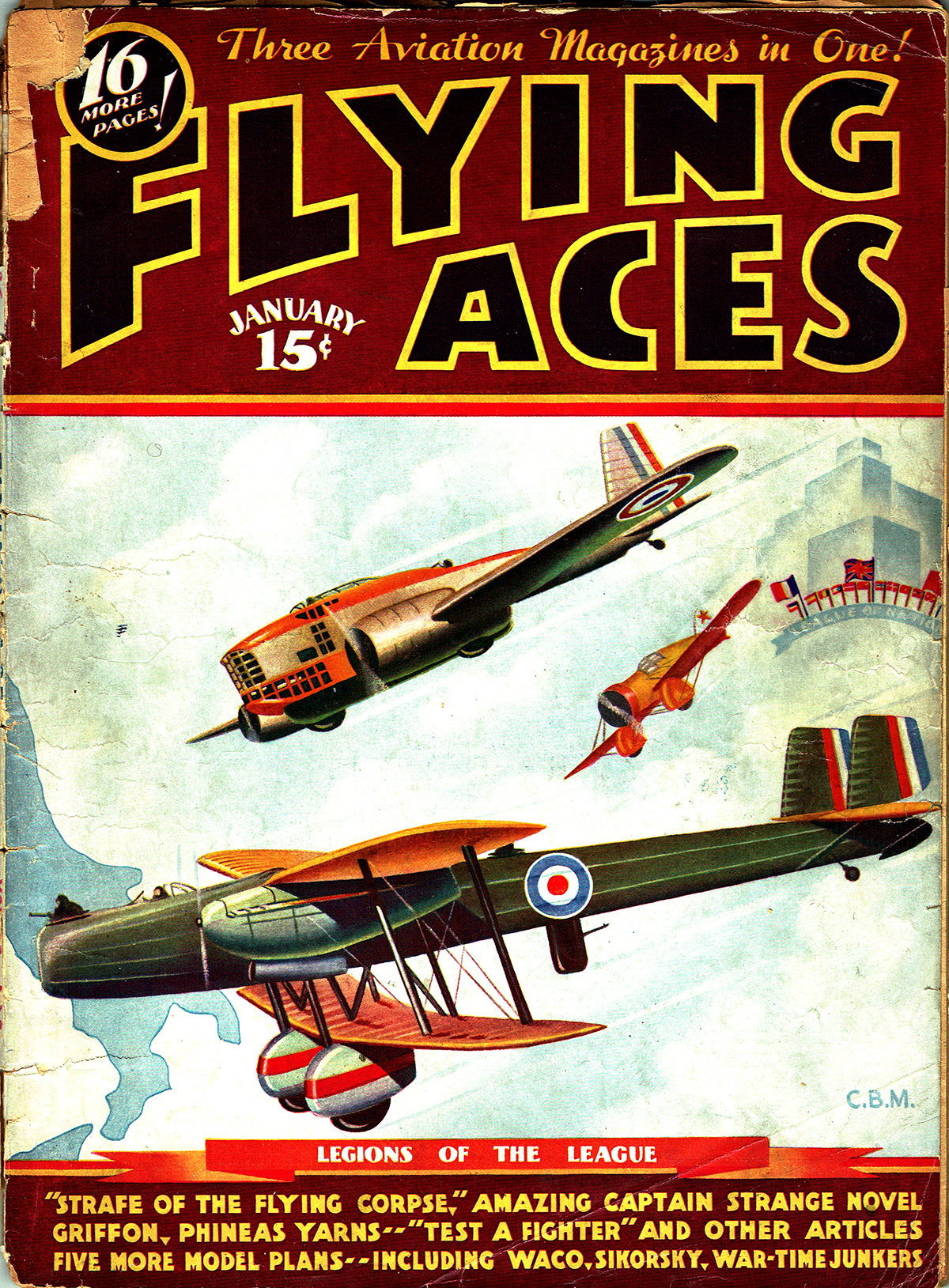
“Flying Aces, January 1936″ by C.B. Mayshark

Link - Posted by David on May 22, 2023 @ 6:00 am in

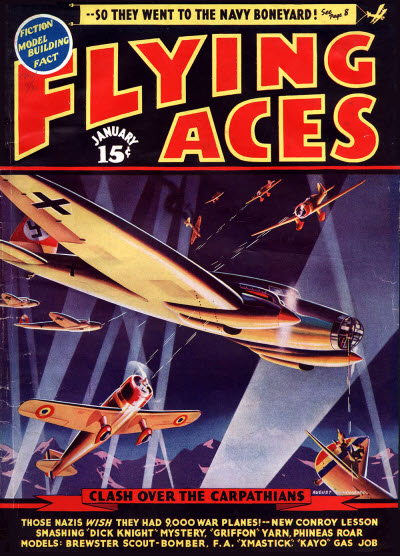
THIS May we are once again celebrating the genius that is C.B. Mayshark! Mayshark took over the covers duties on Flying Aces from Paul Bissell with the December 1934 issue and would continue to provide covers for the next year and a half until the June 1936 issue. While Bissell’s covers were frequently depictions of great moments in combat aviation from the Great War, Mayshark’s covers were often depictions of future aviation battles and planes, like January 1936’s thrilling story behind its cover portrays one of the means by which military action might be applied against Italy, whom the League regards as the aggressor in the Italo-Ethiopian conflict by the other League of Nation members!

Legions of the League

th_FA_3601FOR the first time since the inception of the League of Nations, members of that international body have combined in an effort to restrain a member State from pursuing a “war of aggression.” The invocation of the Covenant’s dreaded Article XVI sets a decided precedent, and those peace-loving inhabitants of the earth who place their faith in the League are proud of the fact that at last a united exertion of power has been mobilized in opposition to conquest by the force of arms. The League Covenant states that a member may not go to war, either officially or unofficially, against another member for the purpose of annexing territory. If an act of war is committed in defiance of the Covenant, the other members have the right to punish the offending nation with a view to ending hostilities. If economic and financial sanctions fail to provoke an attitude of cooperation on the part of the aggressor, then the only course open for the League is the application of force. In other words, the League may declare a war to end a war.

This month we have portrayed on our cover one of the means by which military action might be applied against Italy, whom the League regards as the aggressor in the Italo-Ethiopian conflict. The ominous shadow of the powerful air forces of the three leading members of the League—England, France, and Russia—might prove in itself to be a threat of sufficient force to curb Italy. On the other hand, it might not.

Italy is rightly a proud nation. More than once in the course of her colorful history she has been the most powerful nation on the face of the earth, and the Twentieth Century finds her among the world’s first rank powers. However, the consensus is that Italy cannot afford to resist such military sanctions as Britain, France, and Russia could array against her.

Thus far, Italy has turned a deaf ear to the dangers of economic and financial sanctions. As this is written, the League has just applied boycotts on Italian exports and has barred the import of key products. This drastic move is designed to cut Rome’s vital sales by 70 per cent, thereby putting millions of Italians out of work. Common sense tells us that if this move is effective, Italian resources will be strained to the limit if Rome intends to continue the African war. However, the likelihood of her immediately withdrawing her troops seems remote, however effective the League boycott may prove to be. It is with alarm, therefore, that we view the future if present sanctions fail to force peace. As has been said, the only recourse is the application of armed force—unless the League backs out.

If an actual conflict between Italy and the League members comes to pass, it is difficult to say whether it would take place on the Continent, in Africa, in the Mediterranean, or all three. The present concentration of Italian troops in Libya forces us to imagine a bloody slaughter on the rolling sands of north Africa. On the other hand, Italy’s fortification of her own borders is stronger than ever.

But wherever the struggle takes place, the fearful hum of League planes over the boot of Italy would be inevitable—providing such a fracas actually begins. And that is the picture that the League will attempt to force on the minds of those it blames for the continuance of current hostilities in Africa. For it is only with the realization of such opposition that Italy will retreat.

Of course it is ridiculous to suppose that a gigantic League air force would advance on Italy and bomb a helpless civil population. Only points of military importance would be marked for annihilation, but, as in all conflicts, the invading force would not be held responsible for damage done to civil property. And in the end, of course, the civil population always suffers the most.

Air raid drills for the protection of the populace are already being held in Italy. By posters, apparatus, and demonstration, the people will be taught how to face gas attacks from the air. Undoubtedly, this is throwing a scare into the entire Italian population, but the people are being assured that there is no chance of anyone finding a new gas against which they cannot be protected. That, however, must be taken with a grain of salt.

But all of this may not come to pass. The desperate peace overtures now being pushed by the League may be successful, with the result that the general mobilization moves now in progress all over Europe will come to a halt. Yet the tension that exists as this is written is greater than at any time since 1914. Each government involved in present negotiations hardly desires to retreat or give quarter for fear of losing international prestige. And prestige is something that is coveted by every country. But a way out may be found. If a treaty contains provisions for Italian expansion, very likely peace will ensue.

A parting word concerning the attitude of our own country, the United States: An arms embargo is now in effect and provisions are being made to halt the export of key implements and products to the belligerents. It is obvious that our nation does not want war. The likelihood of our remaining free of the conflict is possible only if we show a disposition to steer clear of the brief and dangerous profits that invariably ensue from an armed contest. It appears that we are taking adequate measures to prevent menacing foreign entanglements.

THE three planes on our cover are symbolic of the air forces the League might call into action. The British ship is a Handley-Page “Heyford” night bomber equipped with two Rolls Royce “Kestrel” engines. It is a single-bay biplane with dihedral on both wings. Automatic slots are fitted to the upper wing, giving lateral control and added stability. Three gun positions are provided, being so placed that the gunners are afforded excellent arcs of fire.

The French ship is a new style Breguet bomber and is touted as “the fastest bomber in the world.” It has only recently been adopted by the French Army, hence no details on the ship are available.

The Russian ship is an Ossaviachim Air 7. It is a low-wing monoplane and is classed as an attack ship. Figures on the performance of this plane are likewise unavailable.

The Story of The Cover
Flying Aces, January 1936 by C.B. Mayshark
Legions of the League: Thrilling Story Behind This Month’s Cover

“Luck in the Blue” by James Perley Hughes

Link - Posted by David on May 19, 2023 @ 6:00 am in

TODAY we have a story from the pen of a prolific pulp author James Perley Hughes! Hughes was managing editor of the San Francisco Chronicle before turning his hand towards fiction and becoming a frequent contributor to various adventure pulps—but he seemed to gravitate toward the air-war spy type stories.

A spy was loose on the base, but Zoom Hale had bigger problems—his childhood buddy and wing-man Charlie Spellman was in a bad way with a sudden attack of nerves. He had been through and seen enough and Zoom thought his pal was ready to end it all. So when Charlie takes his plane out early the next morning, Zoom dashes off to keep him from doing just that and try to bring him down without killing his best friend in the process!

The whirring air yarn of a man who felt he had to chase his own buddy—who had to sit on his soul to shoot down his pal. Then—a zooming finish but unexpected and thrilling!

“Flying Aces, December 1935″ by C.B. Mayshark

Link - Posted by David on May 15, 2023 @ 6:00 am in

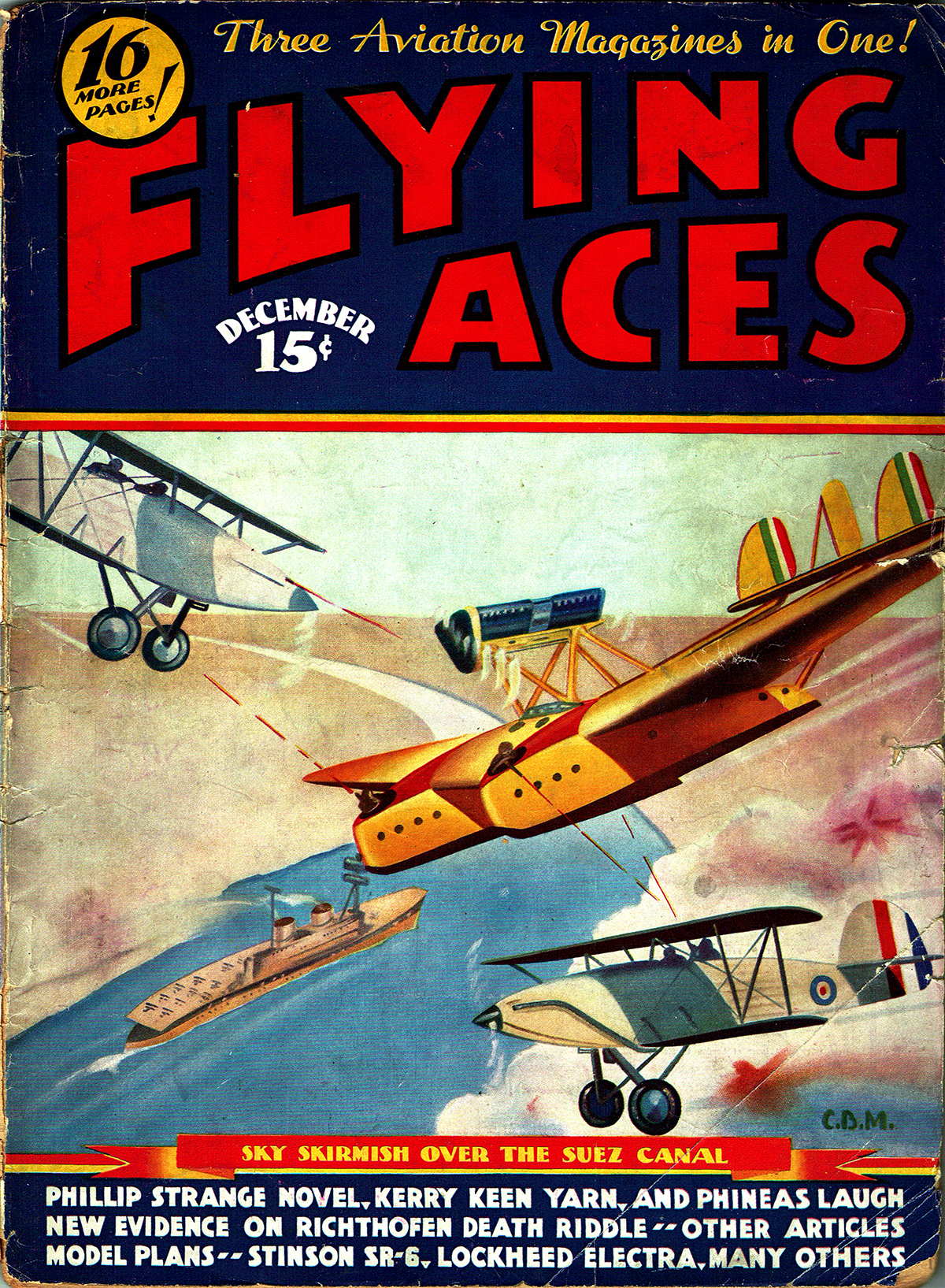
THIS May we are once again celebrating the genius that is C.B. Mayshark! Mayshark took over the covers duties on Flying Aces from Paul Bissell with the December 1934 issue and would continue to provide covers for the next year and a half until the June 1936 issue. While Bissell’s covers were frequently depictions of great moments in combat aviation from the Great War, Mayshark’s covers were often depictions of future aviation battles and planes, like December 1935’s thrilling story behind its cover gives us a possible glimpse into the future (of 1935) of what could happen should England go to war with Italy over access to the Suez Canal!

Sky Skirmish Over the Suez Canal

th_FA_3512A BLOODY war that will draw in all the nations of the world—a conflict that will drain civilization of its youth—a conflagration that will make the World War seem like a series of practice maneuvers! All that, and more, is what many experts insist is now in store for us.

There is no doubt but what the Italo-Ethiopian situation is the gravest impasse that has confronted Europe’s statesmen since 1914. Proposals and counter-proposals have devolved into quibbling and bickering. As this is written, peace moves have been of no avail, and instead of the positions of the various nations becoming clearer and more easy to define, they have now been tightened in a web of confusion. It is extremely difficult for even those “on the inside” to make an open-minded analysis of the situation. Indeed, most reports are colored so that they overly favor either one faction or another. It is clear that it would be ridiculous for us to attempt to predict success for either side. Moreover, it is not our purpose to pass judgment as to right or wrong in this imminent war or even to vouchsafe an opinion as to the outcome. We seek to offer only a purely fictional viewpoint dealing with possibilities.

Newspapers are replete with news of the British Fleet maneuvers in the Mediterranean Sea. There is not one iota of a doubt in anyone’s mind as to the purpose of the operations. As a matter of fact, the British Government finally acknowledged the fact that the operations were other than routine. During the summer, the Italian Government has transported hundreds of thousands of troops and millions of dollars worth of war materials through the Suez Canal to the territory adjacent to Ethiopia.

The Suez Canal is controlled by the British, and one might think they would be happy at the thought of the increased traffic and the correspondingly increased revenue. That, however, is a much too simple conclusion. The problem that the Suez Canal offers is much more involved than that, for this thin strip of water is the key to the widespread British Empire.

As a matter of fact, the British are so adverse to an African conflict that there has even been talk of closing the Suez Canal. Should things come to a head, it is very likely that the Canal will be closed. Certainly the repercussions of such an act would be far reaching, and it was this thought that gave birth to the idea for our cover this month.

Assuming that the British have denied the Italians access to the Suez Canal, we can likewise assume that the Italians will retaliate. Let us suppose that a flight of flying boats has been dispatched from a base in Italy to proceed to the Canal region to force access, or gain it by intimidation. But a British aircraft carrier is found lying in the mouth of the canal, and with the first appearance of the Italian planes, orders are issued for flight preparations of several British two-seaters. As they take the air, the Italians veer off. Perhaps they did not expect any stiff opposition. However, the British are determined. The orders read that the aircraft carrier must remain in the mouth of the Canal and deny the entrance of any ship flying the Italian flag. Nor is the British Naval commander taking any chances on being bombed by the persistent Italians.

Sensing the fact that they must beat down the British two-seaters before they can accomplish their purpose, the Italians swing into action with a vengeance. Attacking in an echelon formation, they sweep in upon the British with all guns roaring. The leading Italian ship is the first one to become entangled, and the two-seaters pounce upon it with the vigor of tigers.

Banking and climbing with everything they’ve got, the British ships finally manage to attain a position of advantage. But the Italian flying boats are fast and easy to maneuver, and the two gunners in the bows of the twin hulls spray their opponents with lead. The bomber officer inside the Italian ship is also on the job and several bombs are released. As shown on our cover, these projectiles have caused a conflagration among buildings on the shore, but thus far the aircraft carrier has not been touched.

But how long can the British planes protect their mother ship—or, on the other hand, how long can II Duce’s machines be effective? Will some of those bombs blow the carrier to smithereens? All that is only a matter of conjecture. In an air battle, anything can happen. Nor does victory always go the strongest.

THE armaments of Italy and Great Britain present a truly interesting picture. England is admittedly the strongest on the sea, but the question of strength in the air is something that requires careful analysis. Italy possesses approximately 1,600 service planes and the home flying fields of most of the Italian squadrons are within easier striking distance of most of the areas where hostility is likely to occur than are the air forces of Great Britain, which is naturally forced to keep a good part of her air strength at home. Most likely the only British planes which would see any real action are those carried by King George’s aircraft carriers and by his other naval vessels.

At the present writing, it would seem that a war between England and Italy would be a war involving ships and airplanes. There is nothing which would be indicative of the outcome of such a conflict. Certainly. Italy’s submarines would supplement the fight of the Italian airplanes and surface craft, but on the other hand England’s ability to blockade Italy and thus inflict severe damage on Italian commerce must be taken into consideration.

Such a set-to, however, may never come to pass at all. The League of Nations is making a concerted effort to preserve the peace of Europe—and of the whole world. There is always a chance that the various overtures which are being made will finally be successful, and it is our devout hope that this will be the case. Yet, if worst comes to worst, it is likely that the conflict will be of short duration.

The Italian ship shown on this month’s cover is a Savoia-Marchetti S-55. It is a long range bomber and one of the most airworthy—and seaworthy—of the Italian flying boats. The British planes are Hawker Ospreys. They are two-seater, fleet reconnaissance ships and possess the fine features of performance that are to be found in all Hawker aircraft.

The Story of The Cover
Flying Aces, December 1935 by C.B. Mayshark
Sky Skirmish Over the Suez Canal: Thrilling Story Behind This Month’s Cover

“Flying Aces, November 1935″ by C.B. Mayshark

Link - Posted by David on May 8, 2023 @ 6:00 am in

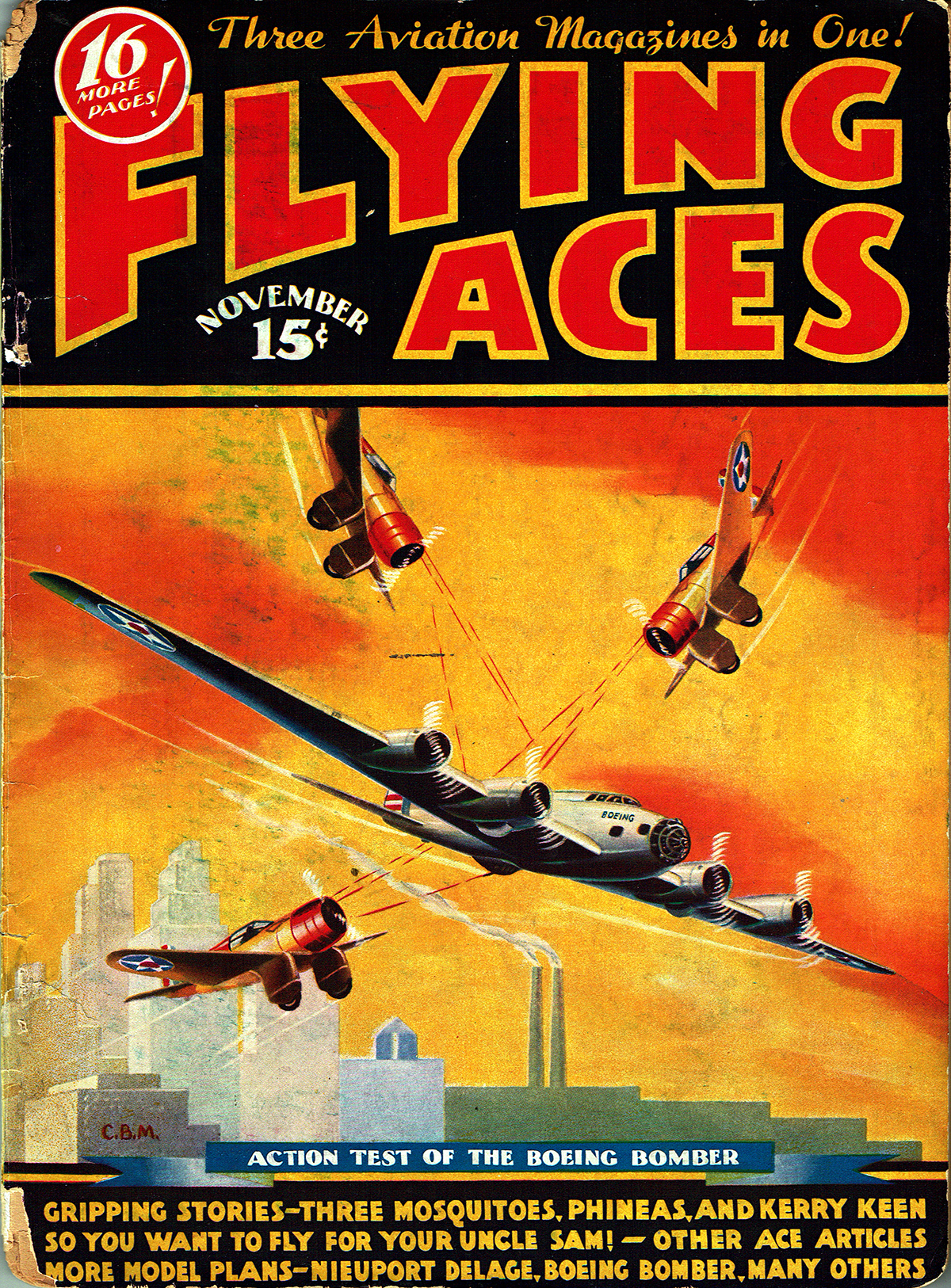
THIS May we are once again celebrating the genius that is C.B. Mayshark! Mayshark took over the covers duties on Flying Aces from Paul Bissell with the December 1934 issue and would continue to provide covers for the next year and a half until the June 1936 issue. While Bissell’s covers were frequently depictions of great moments in combat aviation from the Great War, Mayshark’s covers were often depictions of future aviation battles and planes, like November 1935’s thrilling story behind its cover in which Mr. Mayshark shows us what it might look like when they test the new Boeing Bomber!

Action Test of the Boeing Bomber

th_FA_3511OVER the distant horizon, a speck suddenly becomes visible from the housetops of a teeming industrial city. As if by magic, the speck grows in size, finally taking on gigantic proportions. Crowds in the streets are attracted, all eyes are turned heavenward. And now the aerial monster—the new Boeing Bomber—hurtles over the city at more than 250 miles per hour! This giant, powered by four Pratt & Whitney engines, is the newest thing in the air—the latest marvel of an age which already boasts innumerable mechanical wonders.

Suddenly, the local airport is alive with activity. Three brand new Navy Northrops are speedily rolled from a hangar. Commands are curtly barked, starters whine, and the deafening roar of three powerful engines pervades the air. The single-seaters are off the ground with a leap; and once in the air, they head in Vee formation toward the circling bomber. Their job is a test attack on the immense ship before them. They must attempt, theoretically, to send it to destruction.
Will they be returned the victors? Will the Boeing Bomber, in supposition, go “down in flames?” Will the years of research and toil be written off as short of the goal?

In short, were the designers fully warranted in making this new swing in military aviation? At this writing, the answer seems to be an emphatic “Yes!” To begin with, the argument is advanced that the days of the single-seater hero pilot are gone forever. Already there are indications that present day single-seater squadrons may become somewhat outmoded before the advance of fast and powerful two- and three-seater attack jobs. This fact gives credence to the growing acceptance, in military circles, of the large capacity, long-range bomber, of which the new Boeing is the acme.

Of course, we all know of the romance and spirit of adventure which characterized the fighting of the daring war-time pilots. In those days it was generally a case of man against man. But today things are different.

There are those who declare that single-seaters have little chance against a four-engined giant with five gun platforms—a ship which cruises at better than 250 m.p.h. The present day fighters of less speed would, of course, have difficulty in getting within range. As for the faster fighters, it may be pointed out that it takes plenty of skill to hit a fast moving ship; and when you are forced to zig-zag and literally throw yourself all over the sky in order to escape burst after burst of withering fire from such a formidable flying fortress—it requires more than skill!

However, in spite of what the experts think, and in spite of what the consensus is among those who think they are experts, the new Boeing Bomber must be put to test. A violent encounter must be simulated.

And so, the Northrops appear on the scene. One of the finest single-seater types in the world, they are fast, powerful, highly maneuverable. If anything can get near the Boeing Bomber, the Northrop can.

Coming upon the bomber from behind, they spread out fan-wise as soon as the first warning burst of tracer sprays the air about them. One Northrop climbs, another maintains its position, and the other dives. Attack the ship from more than one angle! Close in on it! Throw tracer from all directions! Those are the accepted tactics.

But the Northrop pilots soon find their task difficult. The Boeing Bomber cannot safely be approached from any angle. It is protected from above by a turret along the top of the fuselage. A “bird cage” gun emplacement protects the nose of the ship. Moreover, guns bristle from “blister” turrets on both sides and belly of the bomber’s fuselage. There are no blind spots!
The gunners aboard the Boeing are wide awake to every movement of the Northrops. But even so, their task, too, is not the simplest one in the world. The shifty little Northrops are giving them the fight of their lives. But finally, the hugh bomber prevails.

AND so, the Boeing theoretically is successful in bombing the industrial center it has attacked. True, the city is also protected by anti-aircraft defences. But the speed at which the Boeing flies makes one sceptical as to the success of such fire. And this brings up an interesting question: Have anti-aircraft developments kept pace with plane developments? A city is a huge target for a bomber speeding at high altitudes—but to gunners on the ground the bomber is, of course, a very small and highly-elusive object. While we’ve heard rumors of super-effective anti-aircraft pieces, the powers that be have thus far kept such inventions well veiled.

As for our Northrops, they now land, and the pilots climb wearily from their cockpits, haggard, exhausted. They have been through an ordeal. The tight turns and steep power dives have told upon them; for the tricky maneuvering in the hurtling fighters of the present day exerts a terrific strain upon the body.

Of course, the air battle pictured on our cover is entirely fictitious. Our purpose has simply been to help you visualize the new Boeing Bomber in a real air scrap. If such a test takes place, there will be a board of judges to render a verdict as to the outcome. Blank cartridges or camera guns will be substituted for bullets.

Performance figures of the new Boeing have not been released. At this writing, its top speed is a matter of conjecture. Your guess is as good as ours.

The Story of The Cover
Flying Aces, November 1935 by C.B. Mayshark
Action Test of the Boeing Bomber: Thrilling Story Behind This Month’s Cover

“Flying Aces, May 1935″ by C.B. Mayshark

Link - Posted by David on May 1, 2023 @ 6:00 am in

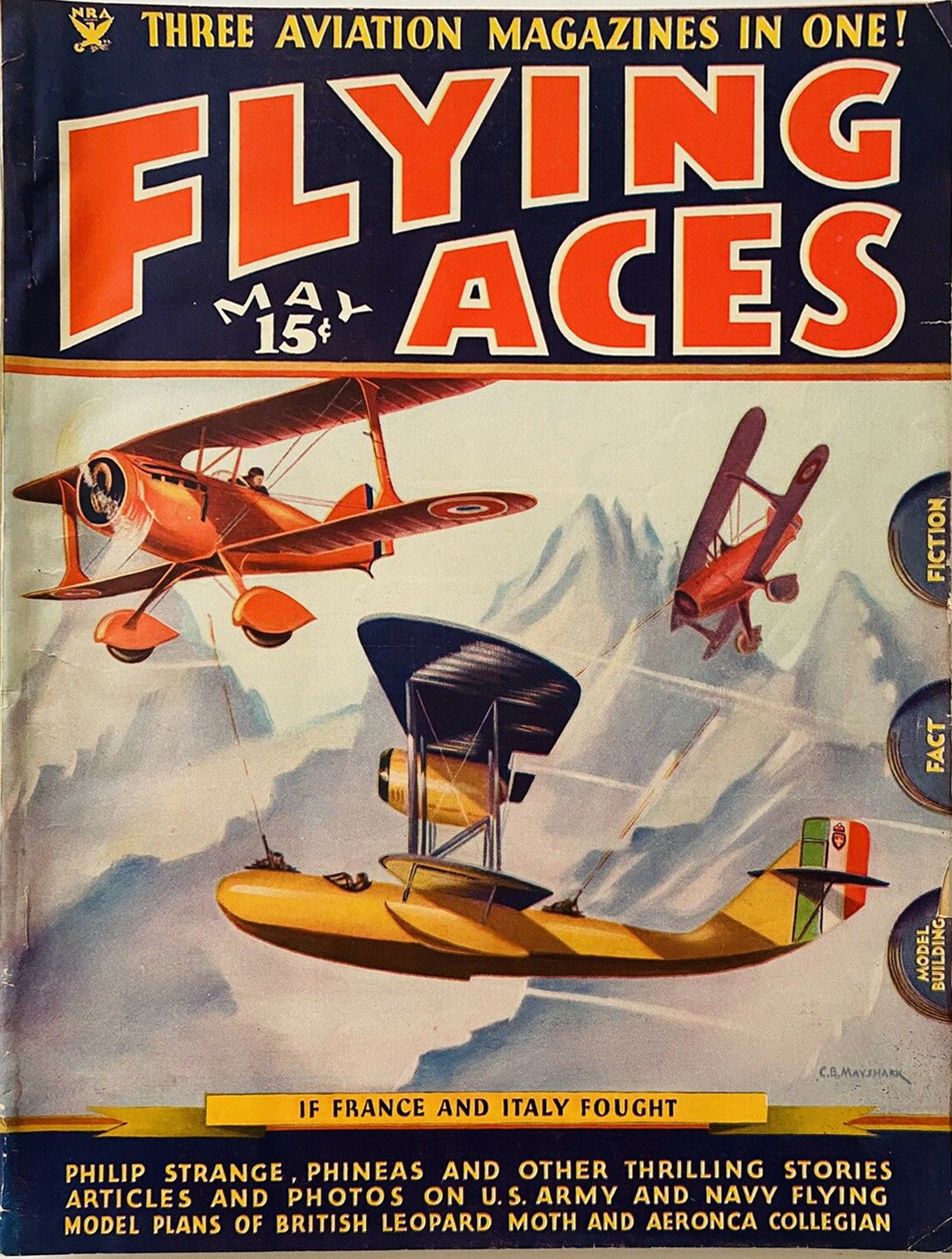
THIS May we are once again celebrating the genius that is C.B. Mayshark! Mayshark took over the covers duties on Flying Aces from Paul Bissell with the December 1934 issue and would continue to provide covers for the next year and a half until the June 1936 issue. While Bissell’s covers were frequently depictions of great moments in combat aviation from the Great War, Mayshark’s covers were often depictions of future aviation battles and planes, like May 1935’s thrilling story behind its cover which imagines what an aerial fight between France and Italy might look like!

If France and Italy Fought

th_FA_3505DEATH in the Alps! Smashing tracer that severs control wires and snuffs out human lives with equal ease! Pursuit ships tearing across frigid skies with reckless abandon, primed for the kill! A powerful reconnaissance flying-boat winging its way belligerently towards a French objective! All this and more could happen on the mountainous Franco-Italian border.

Let us suppose that an Italian flying-boat is ordered to fly over French territory on a secret reconnaissance job. The resultant information is to be used by a fleet of bombers which are to wipe out certain industrial centers in the south of France. Munition manufacturing plants are to be the prime objective, most of which are within easy range of Italian flying fields. But everything depends upon the success of the reconnaissance expedition.

The Cant flying-boat has almost reached the border when two French single-seaters tear into view. Something has leaked out! The French are aware of the impending danger, and they are determined to avert disaster. But the three Italian airmen must carry out their orders, and they prepare for the imminent encounter.

Flying a ship in the Alps Mountains is at best no simple task. There are towering snow-capped peaks which mask themselves in the surrounding hazy atmosphere, and they are a constant menace. Treacherous air currents are also particularly dangerous, so that a pilot never knows when his ship is going to be sucked down and smashed. Then, too, the wind reaches such a high velocity at times that it is almost impossible to turn the controls against it.

Having learned of all these dangers through painful experience, the French and Italian airmen proceed warily. Circling at a safe altitude above the Italian ship, the French fighters wait for a chance to strike. But the Italians do not deviate from their course. They, too, are waiting.

Suddenly, without warning, one of the Frenchmen drops. Like a plummet he falls, seemingly out of control. But quickly, as if he had hit something solid, he pulls out of the dive. Now the Italians are directly in the Frenchman’s line of flight, and as the pilot of the fighter turns on the heat, two murderous streams of machine-gun tracer splatter upon the wings of the flying-boat.

Now the Frenchman is forced to pull up and retreat to safety. The rear gunner in the Italian ship has entered into the picture and is returning the fire with a zest. In the meantime, the second Frenchman has projected himself into the fray. The Hisso motor screams as the single-seater lunges down, but again the Italians are successful in beating off the speedy enemy.

And so back and forth across the sky weave the three planes, the French ships possessing the greater speed, and the Italians the greater fighting power.

It is difficult to predict the outcome of such an air battle. Although the flying-boat does not possess great speed or maneuverability, its two gunnery should be able to protect it against any reasonable attack. On the other hand, the speed and the fighting fury displayed by the French single-seaters give rise to the belief that nothing could withstand the power of their vicious onslaught.

The Italian ship taking part in this air battle is a Cant 21 bis two-seater reconnaissance flying-boat. It is powered with a 500-horsepower Isotto Fraschini “Asso” engine. Gunners’ cockpits are situated in the rear and in the nose of the fuselage, the one in the nose being directly connected with the pilot’s cockpit. The ship’s speed is 134 miles per hour, and its range is ten hours.

The two French ships are Bleriot-Spad 510’s. This ship is designated as a single-seater high-altitude fighter. Its speed is 231 miles per hour, which places it among the fastest military planes in the world. Its power plant consists of one 500-horsepower Hispano-Suiza twelve-cylinder supercharged engine.

In view of the present fictitious description, it would be interesting to note the difference in the make-up of the French and Italian air forces. The Italians have a particularly difficult problem to face because of their geographical surroundings. Bounded on the south, east, and west by water as they are, the need for flying-boats and seaplanes can be readily seen.

On the other hand, an entirely different kind of aircraft is needed for work in the mountainous regions which bound the peninsula on the north. Italy leans more towards large, long-range ships than it does toward fast intercepter fighters. Very strenuous training must be undergone by all Italian military pilots, and once they have accomplished their training, their duties are varied and often hazardous. As a result, Italian military airmen rank among the best in the world. Proof of this fact was exhibited when General Balbo led the Italian Air Armada to America and back again to Italy in 1933.

When we look at the air arm of France, we see an entirely different picture. France has always been regarded as the nation which possesses greater strength than any other nation, in so far as fast pursuit jobs are concerned. Ever since the war, France has concentrated upon efficiency and speed in single-seater fighters. A great many different makes of pursuit and intercepter fighters are now in the French service, and their performance is indeed enviable. An example of this fact is to be found in the performance figures for the Bleriot-Spad. However, France is not lacking in reconnaissance and bomber types. Farman has been world-famous since the days of the war for the production of high-efficiency bombers.

The idea of anyone’s entertaining seriously the thought that the air battle pictured on our cover could actually take place is, in the light of present-day diplomatic developments, quite inconceivable. Our only aim has been to show our readers how representative ships of France and Italy would appear and what would be the advantages of each, if they were to engage in combat.

The Story of The Cover
Flying Aces, May 1935 by C.B. Mayshark
If France and Italy Fought: Thrilling Story Behind This Month’s Cover

“The Hardware Ace” by Joe Archibald

Link - Posted by David on April 28, 2023 @ 6:00 am in

“HAW-W-W-W-W!” That sound can only mean one thing—that Bachelor of Artifice, Knight of Calamity and an alumnus of Doctor Merlin’s Camelot College for Conjurors is back to vex not only the Germans, but the Americans—the Ninth Pursuit Squadron in particular—as well. Yes it’s the marvel from Boonetown, Iowa himself—Lieutenant Phineas Pinkham!

Following up on Phineas Carbuncle Pinkham’s introduction to the Ninth Pursuit Squadron and The Great Guerre, this month we have Pinkham’s second escapade from the February 1931 Flying Aces. Here, the Boonetown Ace inadvertently sparks a feud between the Ninth and their new neighbors—a French Squadron at Soirry Wood 20 ships and DeHavalind bombers would help them wreck Manheim’s Flying Circus and reclaim the air! Phineas turns to history for a lesson on how to win back the French when he puts on a little show as “The Hardware Ace!”

The C.O. should have known better. It was a friendly relations dinner for the new Frog squadron in that sector—and the Skipper let Phineas Carbuncle Pinkham come to the party!

“Sneeze That Off!” by Joe Archibald

Link - Posted by David on February 24, 2023 @ 6:00 am in

“HAW-W-W-W-W!” That sound can only mean one thing—that Bachelor of Artifice, Knight of Calamity and an alumnus of Doctor Merlin’s Camelot College for Conjurors is back to vex not only the Germans, but the Americans—the Ninth Pursuit Squadron in particular—as well. Yes it’s the marvel from Boonetown, Iowa himself—Lieutenant Phineas Pinkham!

We’re back to Pinkham’s exploits in The Great Guerre, but this time we’re going all the way back to the first appearance of Phineas Pinkham—to the day he first showed his homely mug at the Ninth Pursuit Squadron where they were being bedeviled by Baron von Kohl and his sky circus! From the November 1930 Flying Aces, it’s Joe Archibald’s “Sneeze That Off!” introducing Phineas Carbuncle Pinkham from Boonetown, Iowa!

He liked to play with rubber cigars, phony bombs, and sneeze powder—did Phineas Carbuncle Pinkham, that thorn in the flesh of the American Ninth Pursuit. Their only hope was that von Kohl, the German sky terror who never missed a man, would be a big help to them, after all!

“No Man’s Sky” by O.B. Myers

Link - Posted by David on February 17, 2023 @ 6:00 am in

THIS week we have a story from the pen of a prolific pulp author O.B. Myers! Myers was a pilot himself, flying with the 147th Aero Squadron and carrying two credited victories and awarded the Distinguished Service Cross.

A prank against their commanding officer turns into deadly mission of life or death when the pilots of the 66th must retrieve their Commander’s fancy Paris tailored uniform they tossed in No-Man’s-Land to keep important information in a letter in the pockets from falling into German hands! From the October 1931 issue of Flying Aces, it’s O.B. Myer’s “No Man’s Sky!”

The order was filled out and ready—to send one flyer of the 66th to Blois in disgrace.
And the only thing that could keep Lieutenant Linkener’s name from that order
was to bring back a letter that lay in the middle of No-Man’s-Land!

“Don Patrol” by Joe Archibald

Link - Posted by David on January 27, 2023 @ 6:00 am in

“HAW-W-W-W-W!” That sound can only mean one thing—that Bachelor of Artifice, Knight of Calamity and an alumnus of Doctor Merlin’s Camelot College for Conjurors is back to vex not only the Germans, but the Americans—the Ninth Pursuit Squadron in particular—as well. Yes it’s the marvel from Boonetown, Iowa himself—Lieutenant Phineas Pinkham!

We’re back to Pinkham’s exploits in The Great Guerre where G-2 calls on Pinkham to go undercover in Spain to keep the Germans from getting their hands on the secret plans for the Alhambra and a foothold in France’s backdoor.

Down in the Kingdom of Alphonso, certain cagey Castilians had cooked up a Spanish omelet for the Allies—one which had a Kraut smell to it. And when the bad eggs that figured in it evaded all the Entente spies, the Democrat Generals were frantic. But the real action didn’t begin until Don Quixote Pinkhamo homed his way into the land of bull fights—and it didn’t stop until the terrible tempered Ferdinando horned him right out again.

Phineas Pinkham Flies Again!

Link - Posted by David on December 9, 2022 @ 6:00 am in

WITH the exception of that Bachelor of Artifice, Phineas Pinkham, Flying Aces stopped printing fiction with the September 1942 issue. Joe Archibald continued to chronicle the calamitous WWI exploit’s of Booneville’s favorite son for another year, when Flying Aces printed Pinkham’s last sojourn in the November 1943 issue. Joe Archibald had given Phineas Pinkham a good long run—surely the longest run of any of the WWI pulp pilots—running in the pages of Flying Aces from 1930 to 1943!

For a long time I thought that was it.

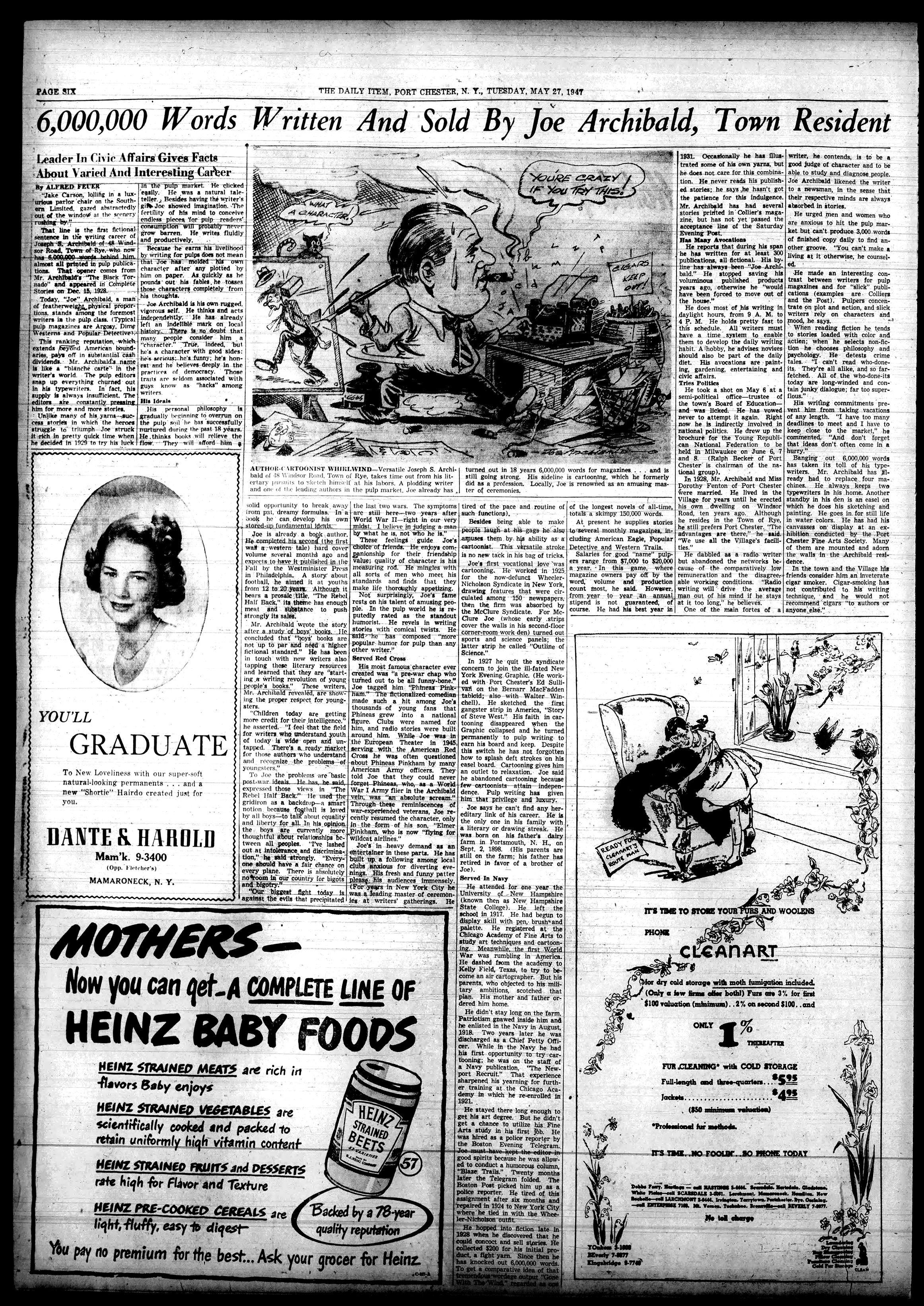
But then I started to see mentions here and there while reading articles about Joe Archibald of a post-war Pinkham. Now I didn’t know if there were actual stories or he just mentioned off hand what Phineas would be up to were he still going or even a flash forward in one of the later Flying Aces tales. That is, until I came upon the article below from the Port Chester, NY The Daily Item where it says categorically:

“. . . Joe recently resumed the character, only in the form of his son, “Elmer Pinkham, who is now ‘flying for wildcat airlines.’ ”

If this was true, where were these stories being printed? I checked all the sources at my disposal—the Robbins Pulp Magazine Index, the FictionMags Index website and any other reference book I could find, but none listed any further adventures past Flying Aces November 1943 tale “Sounds Vichy.” So the stories must have been published in a magazine not indexed by either of these two comprehensive sources.

Hmmm.

What if they were in Flying Aces, just later, after people had stopped indexing them. The article in The Daily Item was from May 1947, four years after Flying Aces stopped printing them. So I looked into tis and Flying Aces had a convoluted publishing history after Pinkham left their pages. Flying Aces was Flying Aces until April 1945. It changed it’s name to Flying Age (including Flying Aces) with the May 1945 issue. This change lasted less than two years! The December 1946 issue (v54n1) took on the title Flying Age Traveler! That lasted one issue. And it seemed it had possibly died with that concept change. . . .

Six months later, in June 1947, the magazine was reborn as Flying Models with a number of the old staff on board. Some of the ideas they tried to bring back with the first issue was continuing the FAC (Flying Aces Club) and Phineas Pinkham!

Ah, there he was.

His red hair may have been greying at the temples and balding on top, and he may have added a spare tire to his physique, but it was still Pinkham. The new stories were set in the present day (post WWII) where Phineas, now married—not to Babbette, is now running a airline transport company called Flying Carpet Airlines—”We Fly Anything, Anybody, Anywhere! The Sky Is The Limit!”—with his son Elmer, a real chip off the old block (unfortunately), and with his old WWI mechanic, Terence Patrick Casey, keeping the repurposed DC3s in good shape. Phineas is also running a tricks and novelty company on the side making all the items he used to use to torment the Ninth Pursuits and many a German Von with during the Great War.


AN AGING PHINEAS PINKHAM gives his son a good what for.

History haunts the old man. There are mentions of his his wartime love Babbette, and his old C.O. at the Ninth Pursuits, Major Garrity—why his old hut mate Bump Gillis even puts in an appearance in one of the tales.

Sadly, it seems these new stories of Phineas Pinkham only ran in the first three issues of Flying Models. Brief as the run was, it was great to catch up with an old friend.

OVER the next few weeks, we’ll be posting the three post war Pinkham stories from Flying Models Magazine. In this first story, Flying Carpet Airlines is engaged to transport a pair of corpses to Cleveland. Phineas hopes to get double duty out of the flight and hop a ride to Cleveland where he’s been invited by his old hutmate Bump Gillis to entertain at his Rotarian meeting, but runs into a little trouble with some spies on the way! From the June 1947 premiere issue of Flying Models, “Phineas Pinkham Flies Again!”
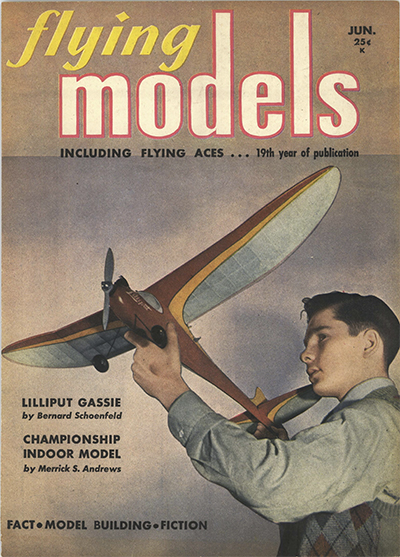
Yielding to the demand of many thousands of flying model builders, Joe Archibald, personal historian of the famous Phineas Pinkham who singlehandedly almost lost the first World War for Uncle Sam, brings back Phineas in a new and hilarious series of adventures. Hail Phineas, Demon of the Blazing Skies, now chief of the Flying Carpet Airline, Inc., the biggest little trouble monopoly on wings in the USA!


As a bonus, here’s the article on author/artist Joe Archibald from the May 27th 1947 edition of Port Chester, NY’s The Daily Item that inspired the search for the post-war Pinkham stories:


6,000,000 Words Written And Sold By Joe Archibald, Town Resident

Leader In Civic Affairs Gives Facts About Varied And Interesting Career
by Alfred Feuer • The Daily Item, Port Chester, NY • 27 May 1947


AUTHOR-CARTOONIST-WHIRLWIND—Versatile Joseph S. Archibald of 48 Windsor Road, Town of Rye, takes time out from his literary pursuits to sketch himself at his labors. A plodding writer and one of the leading authors in the pulp market, Joe already has turned out in 18 years 6,000,000 words for magazines . . . and is still going strong. His sideline is cartooning, which he formerly did as a profession. Locally, Joe is renowned as an amusing master of ceremonies.

“Jake Carson, lolling in a luxurious parlor chair on the Southern Limited gazed abstractedly out of the window at the scenery rushing by.“

That line is the first fictional sentence in the writing career of Joseph S. Archibald of 48 Windsor Road, Town of Rye, who now has 6,000,000 words behind him, almost all printed in pulp publications. That opener comes from Mr. Archibald’s “The Black Tornado” and appeared in Complete Stories on Dec. 15, 1928.

Today, “Joe” Archibald, a man of featherweight physical proportions, stands among the foremost writers in the pulp class. (Typical pulp magazines are Argosy, Dime Westerns and Popular Detective).

This ranking reputation, which extends beyond American boundaries, pays off in substantial cash dividends. Mr. Archibald’s name is like a “blanche carte” in the writer’s world. The pulp editors snap up everything churned out in his typewriters. In fact, his supply is always insufficient. The editors are constantly pressing him for more and more stories.

Unlike many of his yarns, success stories in which the heroes struggle to triumph, Joe struck it rich in pretty quick time when he decided in 1929 to try his luck in the pulp market. He clicked easily. He was a natural tale-teller. Besides having the writer’s gift, Joe showed imagination. The fertility of his mind to conceive endless pieces for pulp readers’ consumption will probably never grow barren. He writes fluidly and productively.

Because he earns his livelihood by writing for pulps does not mean that Joe has molded his own character after any plotted by him on paper. As quickly as he pounds out his fables he tosses those characters completely from his thoughts.

Joe Archibald is his own rugged, vigorous self. He thinks and acts independently. He has already left an indelible mark on local history. There is no doubt that many people consider him a “character.” True, indeed, but he’s a character with good sides: he’s serious; he’s funny; he’s honest and he believes deeply in the practices of democracy. Those traits are seldom associated with guys know as “hacks” among writers.

His Ideals

His personal philosophy is gradually beginning to overrun on the pulp soil he has successfully nurtured during the past 18 years. He thinks books will relieve the flow. They will afford him a solid opportunity to break away from pat, dreamy formulas. In a book he can develop his own stored-up fundamental ideals.

Joe is already a book author. He completed his second (the first was a western tale) hard cover volume several months ago and expects to have it published in the Fall by the Westminister Press in Philadelphia. A story about football, he aimed it at youths from 12 to 20 years. Although it bears a prosaic title, “The Rebel Half Back,” its theme has enough meat and substance to push strongly its sales.

Mr. Archibald wrote the story after a study of boys’ books. He concluded that “boys’ books are not up to par and need a higher fictional standard.” He has been in touch with new writers also lapping these literary resources and learned that they are “starting a writing revolution of young people’s books.” These writers, Mr. Archibald revealed, are showing the proper respect for youngsters.

“Children today are getting more credit for their intelligence,” he asserted. “I feel that the field for writers who understand youth of today is wide open and untapped. There’s a ready market for those authors who understand and recognize the problems of youngsters.”

To Joe the problems are basic post-war ideals. He has, he said, expressed those views in “The Rebel Half Back.” He used the gridiron as a backdrop—a smart notion because football is loved by all boys—to talk about equality and liberty for all. In his opinion the boys are currently more thoughtful about relationships between all peoples. I’ve lashed out at intolerance and discrimination,” he said strongly. “Everyone should have a fair chance on every plane. There is absolutely no room in our country tor bigots and bigotry.”

“Our biggest fight today is against the evils that precipitated the last two wars. The symptoms are still here—two years after World War II—right in our very midst. I believe in judging a man by what he is, not who he is.”

These feelings guide Joe’s choice of friends. He enjoys companionship for their friendship value; quality of character is his measuring rod. He mingles with all sorts of men who meet his standards and finds that they make life thoroughly appetizing.

Not surprisingly, Joe’s fame rests on his talent of amusing people. In the pulp world he is reputedly rated as the standout humorist. He revels in writing stories with comical twists. He said he has composed “more popular humor for pulp than any other writer.”

Served Red Cross

His most famous character ever created was “a pre-war chap who turned out to be all funny-bone.” Joe tagged him “Phineas Pinkham.” The fictionalized comedian made such a hit among Joe’s thousands of young fans that Phineas grew into a national figure. Clubs were named for him, and radio stories were built around him. While Joe was in the European Theater in 1945 serving with the American Red Cross he was often questioned about Phineas Pinkham by many American Army officers. They told Joe that they could never forget Phineas who, as a World War I Army flier in the Archibald vein, was “an absolute scream.” Through these reminiscences of war-experienced veterans, Joe recently resumed the character, only in the form of his son, “Elmer Pinkham, who is now “flying for wildcat airlines.”

Joe’s in heavy demand as an entertainer in these parts. He has built up a following among local clubs anxious for diverting evenings. His fresh and funny patter please his audiences immensely. (For years in New York City he was a leading master of ceremonies at writers’ gatherings. He tired of the pace and routine of such functions).

Besides being able to make people laugh at his gags he also amuses them by his ability as a cartoonist. This versatile stroke is no new tack in his bag of tricks.

Joe’s first vocational love was cartooning. He worked in 1925 for the now-defunct Wheeler-Nicholson Syndicate in New York, drawing features that were circulated among 150 newspapers, then the firm was absorbed by the McClure Syndicate. For McClure Joe (whose early strips cover the walls in his second-floor corner-room work den) turned out sports and science panels; the latter strip he called “Outline of Science.”

In 1927 he quit the syndicate concern to join the ill-fated New York Evening Graphic. (He worked with Port Chester’s Ed Sullivan on the Bernarr MacFadden tabloid; also with Walter Winchell). He sketched the first gangster strip in America, “Story of Steve West.” His faith in cartooning disappeared when the Graphic collapsed and he turned permanently to pulp writing to earn his board and keep. Despite this switch he has not forgotten how to splash deft strokes on his easel board. Cartooning gives him an outlet to relaxation. Joe said he abandoned cartooning because few cartoonists attain independence. Pulp writing has given him that privilege and luxury.

Joe says he can’t find any hereditary link of his career. He is the only one in his family with a literary or drawing streak. He was born on his father’s dairy farm in Portsmouth, N.H., on Sept. 2, 1898. (His parents are still on the farm; his father has retired in favor of a brother of Joe).

Served In Navy

He attended for one year the University of New Hampshire (known then as New Hampshire State College). He left the school in 1917. He had begun to display skill with pen, brush and palette. He registered at the Chicago Academy of Fine Arts to study art techniques and cartooning. Meanwhile, the first World War was rumbling in America. He dashed from the academy to Kelly Field, Texas, to try to become an air cartographer. But his parents, who objected to his military ambitions, scotched that plan. His mother and father ordered him home.

He didn’t stay long on the farm. Patriotism gnawed inside him and he enlisted in the Navy in August, 1918. Two years later he was discharged as a Chief Petty Officer. While in the Navy he had his first opportunity to try cartooning; he was on the staff of a Navy publication, “The Newport Recruit.” That experience sharpened his yearning for further training at the Chicago Academy in which he re-enrolled in 1921.

He stayed there long enough to get his art degree. But he didn’t get a chance to utilize his Fine Arts study in his first job. He was hired as a police reporter by the Boston Evening Telegram. Joe must have kept the editor in good spirits because he was allowed to conduct a humorous column, “Blaze Trails.” Twenty months later the Telegram folded. The Boston Post picked him up as a police reporter. He tired of this assignment after six months and repaired in 1924 to New York City where he tied in with the Wheeler-Nicholson outfit.

He hopped into fiction late in 1928 when he discovered that he could concoct and sell stories. He collected $200 for his initial product. a fight yarn. Since then he has knocked out 6.000.000 words. To get a comparative idea of that tremendous wordage output “Gone With The Wind.” regarded as one of the longest novels of all-time totals a skimpy 150,000 words.

At present he supplies stories to several monthly magazines, including American Eagle, Popular Detective and Western Trails.

Salaries for good “name” pulpers range from $7,000 to $20,000 a year. In this game, where magazine owners pay off by the word, volume and production count most, he said. However, from year to year an annual stipend is not guaranteed, of course. He had his best year in 1931. Occasionally he has illustrated some of his own yarns, but he does not care for this combination. He never reads his published stories; he says he hasn’t got the patience for this indulgence. Mr. Archibald has had several stories printed in Collier’s magazine, but has not yet passed the acceptance line of the Saturday Evening Post.

Has Many Avocations

He reports that during his span he has written for at least 300 publications, all fictional. His byline has always been “Joe Archibald.” He stopped saving his voluminous published products years ago, otherwise he “would have been forced to move out of the house.”

He does most of his writing in daylight hours, from 9 A.M. to 4 P.M. He holds pretty fast to this schedule. All writers must have a time system to enable them to develop the daily writing habit. A hobby, he advises novices should also be part of the daily diet. His avocations are painting, gardening, entertaining and civic affairs.

Tries Politics

He took a shot on May 6 at a semi-political office—trustee of the town’s Board of Education—and was licked. He has vowed never to attempt it again. Right now he is indirectly involved in national politics. He drew up the brochure for the Young Republican National Federation to be held in Milwaukee on June 6, 7 and 8. (Ralph Becker of Port Chester is chairman of the national group).

In 1928, Mr. Archibald and Miss Dorothy Fenton of Port Chester were married. He lived in the Village for years until he erected his own dwelling on Windsor Road, ten years ago. Although he resides in the Town of Rye, he still prefers Port Chester. “The advantages are there,” he said. “We use all the Village’s facilities.”

He dabbled as a radio writer but abandoned the networks because of the comparatively low remuneration and the disagreeable working conditions. “Radio writing will drive the average man out of his mind if he stays at it too long,” he believes.

One of the main fortes of a writer, he contends, is to be a good judge of character and to be able to study and diagnose people. Joe Archibald likened the writer to a newsman, in the sense that their respective minds are always absorbed in stories.

He urged men and women who are anxious to hit the pulp market but can’t produce 3,000 words of finished copy daily to find another groove. “You can’t make a living at it otherwise, he counseled.

He made an interesting contrast between writers for pulp magazines and for “slick” publications (examples are Colliers and the Post). Pulpers concentrate on plot and action, and slick writers rely on characters and mood, he says.

When reading fiction he tends to stories loaded with color and action; when he selects non-fiction he chooses philosophy and psychology. He detests crime tales. “I can’t read who-done-its. They’re all alike, and so farfetched. All of the who-done-its today are long-winded and contain junky dialogue; far too superfluous.”

His writing commitments prevent him from taking vacations of any length. “I have too many deadlines to meet and I have to keep close to the market,” he commented. “And don’t forget that ideas don’t often come in a hurry.”

Banging out 6,000,000 words has taken its toll of his typewriters. Mr. Archibald has already had to replace four machines. He always keeps two typewriters in his home. Another standby in his den is an easel on which he does his sketching and painting. He goes in for still life in water colors. He has had his canvasses on display at an exhibition conducted by the Port Chester Fine Arts Society. Many of them are mounted and adorn the walls in the Archibald residence.

In the town and the Village his friends consider him an inveterate cigar smoker. Cigar-smoking has not contributed to his writing technique, and he would not recommend cigars “to authors or anyone else.”

Be sure to come back next Friday for another Post War Pinkham story!

“A Hunting We Will Go” by Joe Archibald

Link - Posted by David on October 28, 2022 @ 6:00 am in

“HAW-W-W-W-W!” That sound can only mean one thing—that Bachelor of Artifice, Knight of Calamity and an alumnus of Doctor Merlin’s Camelot College for Conjurors is back to vex not only the Germans, but the Americans—the Ninth Pursuit Squadron in particular—as well. Yes it’s the marvel from Boonetown, Iowa himself—Lieutenant Phineas Pinkham!
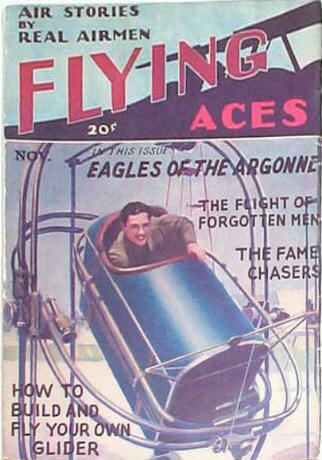
In 1918, Lieutenant Phineas “Carbuncle” Pinkham took a long hop, figuratively speaking, in an astral plane and came down to earth with the Zodiac in his lap. And as if that weren’t enough, a spiritualist of note—one Madame Mazola, who had taken a powder out of the Tyrol in 1915—put out her shingle in Bar-le-Duc, announcing to whomever it might concern that she would give an applicant a clear wire to his relatives who had long since departed this vale of tears. Ectoplasm was her specialty, and it would be produced for the most skeptical—for the insignificant sum of five francs—payable in advance!

After Madame Mazola hit town with her astrology, it didn’t take Phineas “Taurus” Pinkham long to prove that Garrity was a crab, Gillis was a sucker, Goomer was two other guys, and Casey was the goat. But it wasn’t until Babette hit Phineas with her skillet that the transplanted star gazer from Boonetown really got his astral plane into the ascendancy. And then he hit into something himself—a double-talk play!

“Happy Hunning Ground” by Joe Archibald

Link - Posted by David on September 30, 2022 @ 6:00 am in

“HAW-W-W-W-W!” That sound can only mean one thing—that Bachelor of Artifice, Knight of Calamity and an alumnus of Doctor Merlin’s Camelot College for Conjurors is back to vex not only the Germans, but the Americans—the Ninth Pursuit Squadron in particular—as well. Yes it’s the marvel from Boonetown, Iowa himself—Lieutenant Phineas Pinkham!
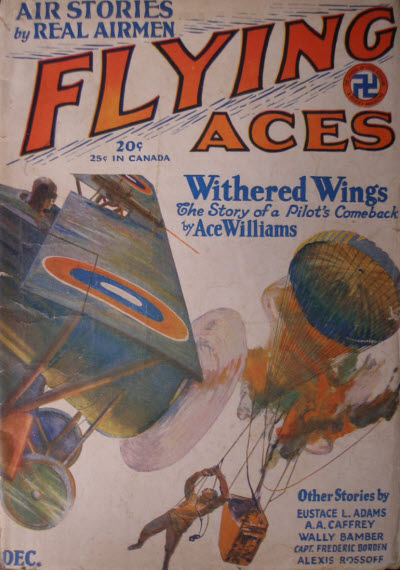
American military moguls were miserable! For along the Western Front, the Krauts were doing a Russian business which threatened to give the Potsdam Potentate a corner on the Frog real estate market. But meanwhile there was one thing that neither Chaumont nor the Wilhelmstrasse had figured on. This was Phineas Pinkham’s skin game—a redskin game that was a cinch to corner a flock of squarehead scalps!

“Skyway Robbery” by Joe Archibald

Link - Posted by David on August 26, 2022 @ 6:00 am in

“HAW-W-W-W-W!” That sound can only mean one thing—that Bachelor of Artifice, Knight of Calamity and an alumnus of Doctor Merlin’s Camelot College for Conjurors is back to vex not only the Germans, but the Americans—the Ninth Pursuit Squadron in particular—as well. Yes it’s the marvel from Boonetown, Iowa himself—Lieutenant Phineas Pinkham!
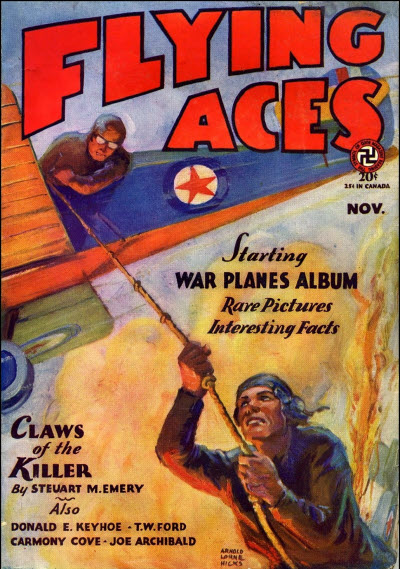
The Boonetown miracle man, Lieutenant Phineas Pinkham, and his unwitting hut mate Bump Gillis find themselves down behind Boche lines only to run into a fellow Boonetownian, but one who’s fighting for the Germans!

You can’t blame a fellow for wanting to make his mark. But over on the Heinie side of the Big-Fuss fence, marks were scarce. Yes, and when Phineas staged that “Bank Night of Germany” and hit the jack plot—they were even scarcer!

“Heir-O-Bats” by Joe Archibald

Link - Posted by David on July 29, 2022 @ 6:00 am in

“HAW-W-W-W-W!” That sound can only mean one thing—that Bachelor of Artifice, Knight of Calamity and an alumnus of Doctor Merlin’s Camelot College for Conjurors is back to vex not only the Germans, but the Americans—the Ninth Pursuit Squadron in particular—as well. Yes it’s the marvel from Boonetown, Iowa himself—Lieutenant Phineas Pinkham!
Berlin’s big guy—Kaiser Bill, by name—had suddenly taken a decided interest in a postage-stamp Balkan state named Pandemonia. That was because a wizard named Mymugiz Grotescu kept shop there—an hombre said to be 10½ times smarter than an inventor named Edison. Only that high Heinie named Bill counted a little too heavily on a dope named Carol Fzog. What’s more, he completely forgot about a gazabo named Phineas Pinkham!

« Previous PageNext Page »