“Rice and Shine” by Joe Archibald
“Haw-w-w-w-w!†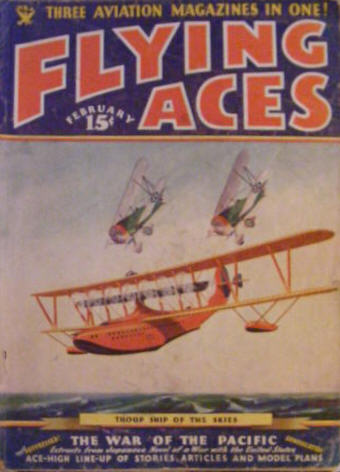 That sound can only mean one thing—that Bachelor of Artifice, Knight of Calamity and an alumnus of Doctor Merlin’s Camelot College for Conjurors is back and this time the marvel from Boonetown is suffering from “yeller jaundice” as he puts it and makes the most of his condition by assuming the coolie guise of Flew Man Hooey in order to bring down RIttmeister von Beerbohm and his Flying Circus.
It was a red-letter day for Garrity. The Ninth Pursuit had bagged a Gotha, and Phineas had been shipped off to the hospital. The major lit a cigar and relaxed—but he should have known better. You would, wouldn’t you?
“Lives of the Aces in Pictures – Part 15: Major Vaughn” by Eugene Frandzen
Starting in the May 1932 issue of Flying Aces and running almost 4 years, Eugene Frandzen’s “Lives of the Aces in Pictures” was a staple of the magazine. Each month Frandzen would feature a different Ace that rose to fame during the Great War. This time around we have American Ace—Major George Vaughn!
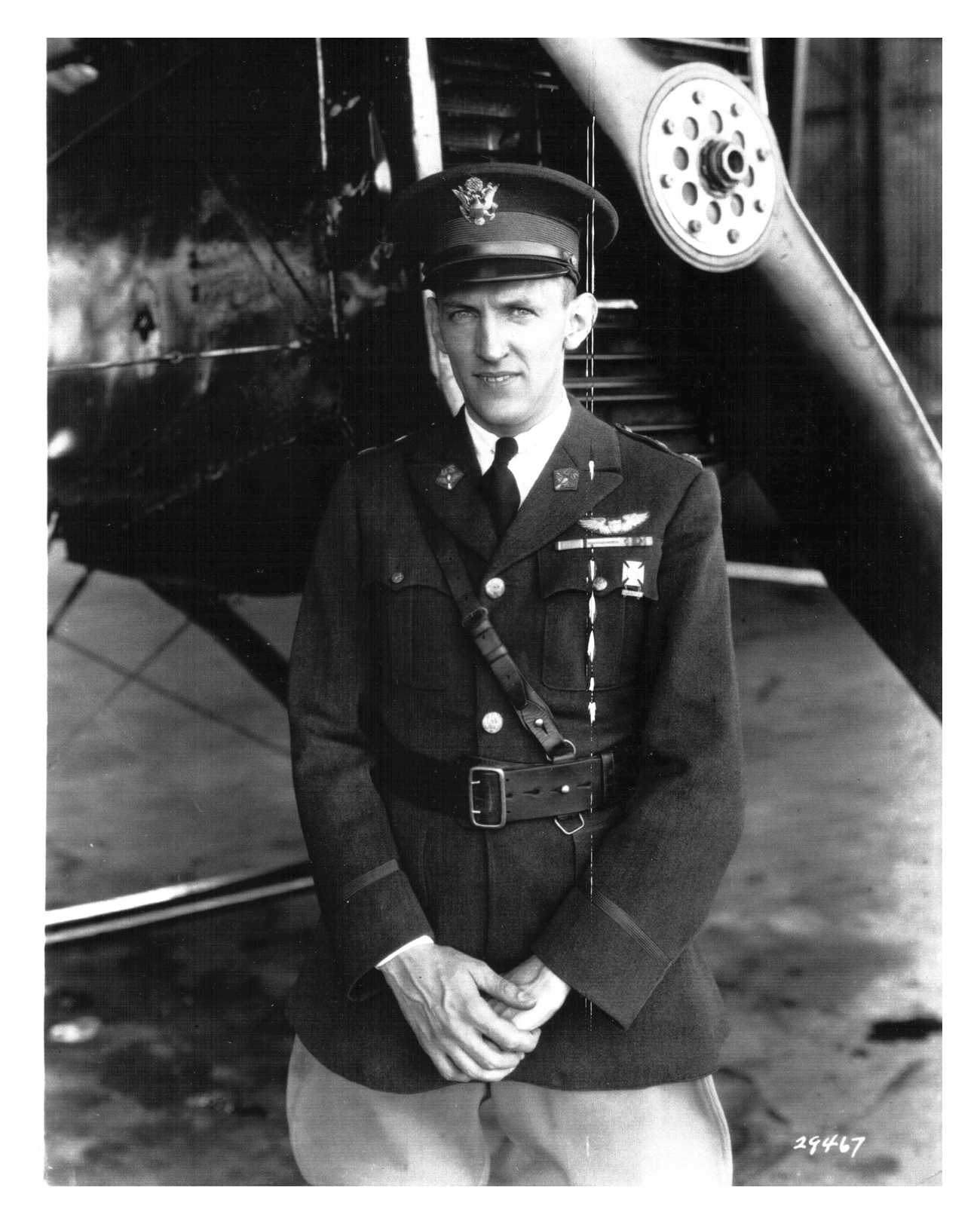
Major George A. Vaughn is credited with 13 victories—12 German planes and one balloon—and awarded the American Distinguished Service Cross, the British Distinguished Flying Cross and Silver Star with two citations. He was shot down twice, but managed to escape uninjured both times.
A student at Princeton when the war broke out, Vaughn returned and finished his degree after the war. He became a reearch engineer for Western Electric and later a slea engineer for Westinghouse.
Vaughn was asked by the Governor of New York, Franklin Roosevelt, to help organize the New York Air National Guard—the 102nd Observation Squadron—in the early 1920s. He served as it’s commander for nine years. In 1933 he was promoted to lieutenant colonel and assigned to the 27th Division Staff as Air Officer until he retired in 1939.
Vaughn was on of the organizers of the Casey Jones School of Aeronautics along with Lee D. Warrender and Casey Jones in 1932. The School, based at La Guardia Airport, would become the College of Aeronautics. In 2004, the name was changed to the Vaughn College of Aeronautics and Technology.
George Vaughn passed away in 1989 at the age of 92 of a brain tumor.
(Editor’s Note: These early installments of Frandzen’s “Lives of the Aces in Pictures” that were published in the pulp-sized issues have been reformatted from a two page spread into a one page feature.)
“Lives of the Aces in Pictures – Part 14: Lieutenant Werner Voss” by Eugene Frandzen
Starting in the May 1932 issue of Flying Aces and running almost 4 years, Eugene Frandzen’s “Lives of the Aces in Pictures” was a staple of the magazine. Each month Frandzen would feature a different Ace that rose to fame during the Great War. This time around we one of Germany’s greatest Aces—Lieutenant Werner Voss!
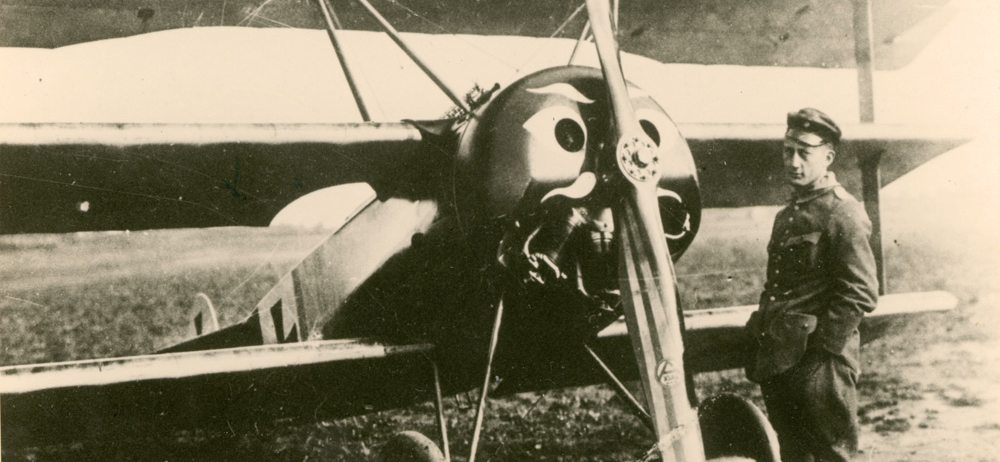
Voss infront of his prototype Fokker DR.I Triplane with a face painted on the engine cowling.
Werner Voss began his military career as a Hussar in November 1914 while still 17 years old. Turning to aviation, he proved to be a natural pilot and after flight school he spent six months in a bomber unit. Moving on he joined a newly formed fighter squadron—Jagdstaffel 2 on 21 November 1916. It was here he became friends with Manfred von Richthofen.
Voss was chalking up the victories one after another until that fateful day in September 1917. On the 23rd, Leutnant Werner Voss, commanding officer of Jagdstaffel 10 and flying his prototype Fokker DR.I Triplane, encountered the renowned ‘B’ Flight of British 56 Squadron in the skies north of Frezenberg. B Flight was comprised of some of britain’s finest Aces—James McCudden and Arthur Rhys Davids among them.
The odds stacked against him—Voss managed to hold his own against the seven S.E.5s of B Flight. Somehow hitting each plane in a dogfight that lasted ten minutes before his own was hit by fire from at least two of the British airplanes. Voss himself, was struck by three bullets. His plane went into a steep dive and crashed north of Frezenberg, Belgium. Voss was killed. He was 20 years old.
In the ten short months Voss was in the air he was confirmed to have 48 victories (which practically matched the great von Richtofen plane for plane during the same time) and was awarded the Pour le Mérite, House Order of Hohenzollern and the Iron Cross 1st and 2nd Class.
(Editor’s Note: These early installments of Frandzen’s “Lives of the Aces in Pictures” that were published in the pulp-sized issues have been reformatted from a two page spread into a one page feature.)
“Lives of the Aces in Pictures – Part 12: Major MacClaren” by Eugene Frandzen
Starting in the May 1932 issue of Flying Aces and running almost 4 years, Eugene Frandzen’s “Lives of the Aces in Pictures” was a staple of the magazine. Each month Frandzen would feature a different Ace that rose to fame during the Great War. This time around we have Canadian Ace—Major Donald MacClaren!
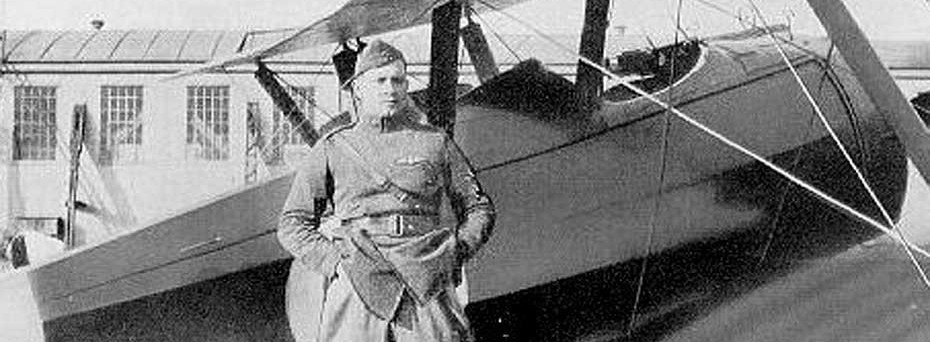
Donald MacLaren joined the Royal Flying Corps in 1917 and quickly accrued 54 victories, making him the highest scoring ace to fly a Sopwith Camel. He was awarded the Military Cross & Bar, Distinguished Service Order, Distinguished Flying Cross, Legion d’Honneur and Croix de Guerre. MacLaren recorded his last victory on October 9, 1918—as his combat career came to an end the next day when he broke his leg while wrestling with a friend.
Following the Armistice, he helped form the Royal Canadian Air Force before retiring to begin a career in civil aviation where he formed Pacific Airways which was eventually acquired by Western Canada Airways.
He died on 4 July 1988, aged 95.
(Editor’s Note: These early installments of Frandzen’s “Lives of the Aces in Pictures” that were published in the pulp-sized issues have been reformatted from a two page spread into a one page feature.)
“Prop Eyes” by Joe Archibald
“Haw-w-w-w-w!†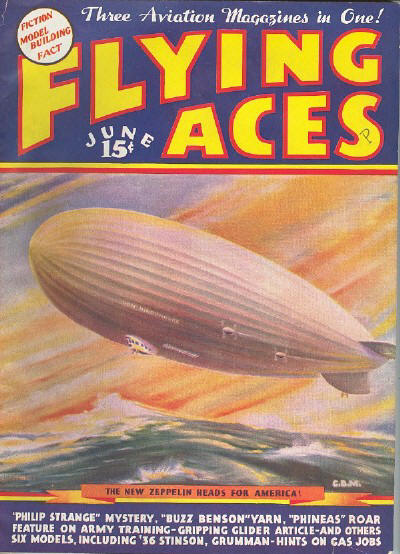 You heard right! That marvel from Boonetown, Iowa is back and this time Phineas goes in for hypnotism!
Bump Gillis was crazy to let the Jerries force him down behind their lines. But the Jerries were crazy, too. For Bump was the hutmate of the incurable Boonetown jokester—and taking him away from Phineas was like wounding a sabre-toothed tiger’s wife
“Lives of the Aces in Pictures – Part 11: Ernst Udet” by Eugene Frandzen
Starting in the May 1932 issue of Flying Aces and running almost 4 years, Eugene Frandzen’s “Lives of the Aces in Pictures” was a staple of the magazine. Each month Frandzen would feature a different Ace that rose to fame during the Great War. This time around we have German Ace—Ernst Udet!
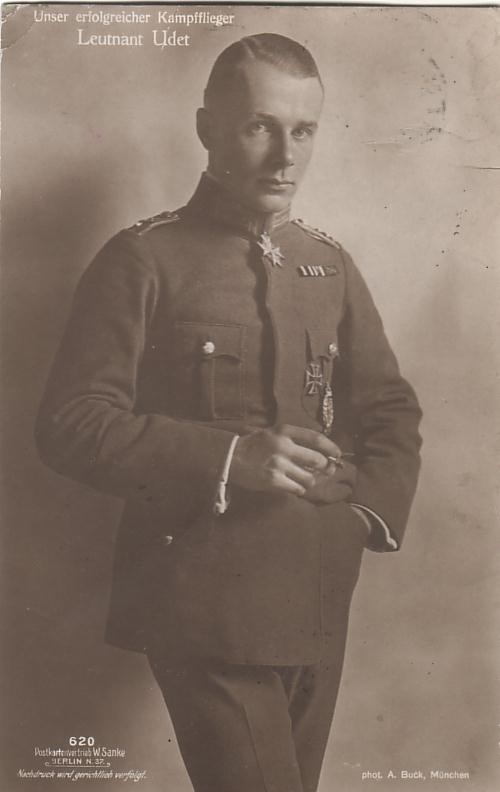
Ernst Udet was one of the highest scoring Aces in the German airforce—second only to the great Manfred von Richtofen with 62 victories to his 80! He entered the German Army in 1914 before becoming a fighter pilot serving in Jastas 4, 11, 15, 37 and eventually commanding the 37th and 4th fighter squadrons. However, injuries he had sustained forced the Ace out of active combat in late September 1918—which may have helped him survive the war, unlike Richtofen.
Udet was a young man of 22 at the end of the war. Following Germany’s defeat, Udet post-war career in the 1920s and early 1930s saw him work as a stunt pilot and in movies, international barnstormer, light aircraft manufacturer, and all around playboy before joining the Nazi party in 1933 and working to recreate the Luftwaffe that would play such a pivotal role in the coming Second World War.
Udet’s wartime success came to an abrupt end however in 1941. Accused by General Erhard Milch of bringing about the Luftwaffe’s shortcomings as demonstrated during the Battle of Britain, and under fire from Goring himself, Udet—who had become critical of the Nazi regime—’chose’ to commit suicide. His suicide was concealed from the public at the time and he was lauded a hero who had died in flight while testing a new weapon. Udet was buried next to Richtofen. He was 45.
(Editor’s Note: These early installments of Frandzen’s “Lives of the Aces in Pictures” that were published in the pulp-sized issues have been reformatted from a two page spread into a one page feature.)
Now Available!

IF YOU can’t make it to PulpFest in Columbus this weekend, you can still get copies of our new books online from the usual outlets. Both of our new books—Frederick C. Painton’s Squadron of the Dead and Donald E. Keyhoe’s Captain Philip Strange: Strange Spectres—are now available to order online from Adventure House, Mike Chomko Books and Amazon!

While you’re waiting for the books to arrive, why not check out some of the extras we’ve put on line for each book to whet your appetite. For Painton’s Squadron of the Dead we’ve posted the original pulp scans from Sky Birds magazine of the opening page art so you can see how it would have looked if you were reading the stories back in 1935 when they were originally published. You can also read the opening of the stories in the scans. Orignally we had posted a few of the Squadron of the Dead stories on our site—we had enjoyed them so much that we we had found all eight stories we decided to collect them into a book. The first one is still available here if you want to sample the book.

For the latest release of the weird World War I adventures of Donald E. Keyhoe’s Captain Philip Strange we have the original full page scans of the opening artwork for each of the six stories collected in Strange Spectres! For the last few volumes we’ve only been posting cropped artwork, this is the first time we’re posting the full page scan so you can read a bit of story and enjoy Eugene M. Frandzen’s art in all its glory from the pages of Flying Aces magazine. Painton’s Squadron also uses Frandzen’s art, but here in the bedsheet sized issues of Flying Aces you get those glorious painted images Frandzen would do—much better than his line art.

And the piece de resistance of any Strange book—Chris’ great cutout artwork he does for each of the stories! There are only six this time—but they’re all winners. You can check them out on the Strange Spectres Design page!
Both books are available for $16.99 wherever our books are sold, so pick up both today! You can order online from Adventure House, Mike Chomko Books and Amazon!
Premiering at PulpFest 2016!
Age of Aces will be back at PulpFest again this year where we will be debuting our two new titles!
First, we have the lastest in our  Captain Philip Strange series—back with six more weird WWI stories in Strange Spectres! A mental marvel from birth, who used his talents on stage as a boy, Philip Strange is now known as “The Phantom Ace of G-2″ by the Allies during WWI. “Horrors of war†takes on a whole new meaning when WWI erupts with paranormal activity: Flaming planes piloted by charred skeletons; Battleship crews that mysteriously vanish; Medieval knights falling from the sky; The spirit of the Red Baron himself haunting the frontlines! When World War I gets weird, only America’s own “Phantom Ace of G-2†has a ghost of a chance against the supernatural slaughter. Captain Philip Strange in his strangest cases yet from the pages of Flying Aces magazine!
Our other title is from the pen  of Frederick Painton, a prolific pulp author and venerated newspaper man. We’ve collected eight of his stories that ran in the pages of Sky Birds magazine in 1935 and are publishing them under the title Squadron of the Dead. The Squadron of the Dead contained all the hellions of ten armies! Men without hope; men courting death; men who loved to kill; men who laughed and fought, drank and cursed, lived hard, and died harder. Americans, British, Russians—even Germans—made up their ranks, and only one bond held them together: Death lay ahead of them. They were assigned the grim missions no other squadron dared to take—for they had all been condemned to die!
Painton’s Squadron of the Dead is a departure from our usual titles that feature a scrappy band of aviators flying through various adventures. Each of the eight stories in Painton’s Squadron of the Dead is the story of a different pilot who has been condemned to death and sent to the squadron to serve out his sentence. And die they did, dropping spies, bombing impossible places, strafing infantry for harassed Allied battalions. These men flew recklessly, savagely, knowing they could live again only when death really claimed them. Then their names would shine once again in the casualty announcements and they would be posthumously awarded the Legion d’Honneur.
In addition to these two volumes we’ll have all of our other titles that are still in print as well as our convention exclusive—Arch Whitehouse’s Coffin Kirk. So if you’re planning on coming to Columbus for PulpFest this year, stop by our table and say hi and pick up our latest releases!
“Lives of the Aces in Pictures – Part 13: Major Hawker” by Eugene Frandzen
Starting in the May 1932 issue of Flying Aces and running almost 4 years, Eugene Frandzen’s “Lives of the Aces in Pictures” was a staple of the magazine. Each month Frandzen would feature a different Ace that rose to fame during the Great War. This time around we have English Ace—Major Lanoe G. Hawker!
Lanoe George Hawker joined the 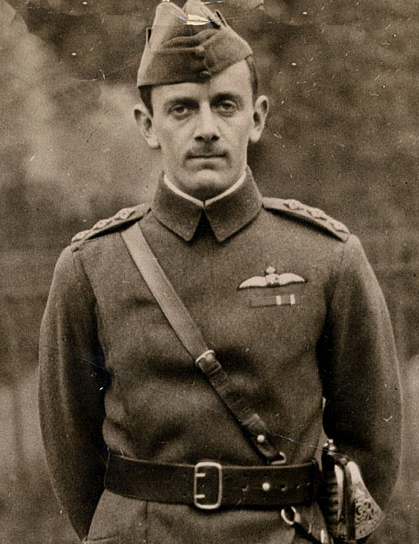 Royal Flying Corps and quickly developed a reputation as an aggressive pilot. In April 1915, armed with just a few bombs and some hand gernades, he successfully attacked a Zeppelin plant at Gontrobe while flying a BE-2. This earned him the Distinguished Service Order.
A few months later, on 25th July 1915 Hawker became the first fighter pilot to win the Victoria Cross for air combat. Flying a single-seater Bristol Scout and armed with a single-shot cavalry carbine mounted on the starboard side of the fuselage, Hawker attacked an enemy two-seater over Ypres. He managed to not only bring that plane down, but two others as well—and all three had been armed with machine guns!
Promoted to the rank of major, Hawker died after taking part in one of the longest dogfights of the war. Flying an Airco DH-2 over Bapaume on 23rd November, 1916, Hawker was eventually shot down and killed by Manfred von Richthofen.

(Editor’s Note: These early installments of Frandzen’s “Lives of the Aces in Pictures” that were published in the pulp-sized issues have been reformatted from a two page spread into a one page feature.)
“Lives of the Aces in Pictures – Part 10: Captain Ball, British V.C.” by Eugene Frandzen
Starting in the May 1932 issue of Flying Aces and running almost 4 years, Eugene Frandzen’s “Lives of the Aces in Pictures” was a staple of the magazine. Each month Frandzen would feature a different Ace that rose to fame during the Great War. This time around we have English Ace—Captain Albert Ball!
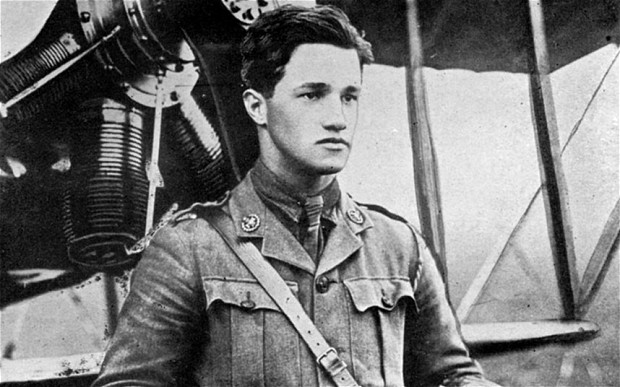
Captain Albert Ball was the first of the Royal Flying Corps pilots to make a distinguished record. Unlike the French, the British made no mention of their air pilot’s victories. One day Ball wrote home that he had just counted his 22nd victory. His mother proudly showed this letter to her friends. Ball was disbelieved.
It was beyond belief at that time that any single pilot could have shot down so many enemy planes. Ball was finally vindicated. From that time on the British publicized the exploits of flying aces. Ball shot down 43 enemy planes and one balloon, being at the time of his death the Ace of Aces of all the armies.
He received every decoration the British Army could give him, including the Victoria Cross. He was killed in a new British triplane by the younger von Richthofen the day after America entered the War.
(Editor’s Note: These early installments of Frandzen’s “Lives of the Aces in Pictures” that were published in the pulp-sized issues have been reformatted from a two page spread into a one page feature.)
“Lives of the Aces in Pictures – Part 9: David Putnam” by Eugene Frandzen
Starting in the May 1932  issue of Flying Aces and running almost 4 years, Eugene Frandzen’s “Lives of the Aces in Pictures” was a staple of the magazine. Each month Frandzen would feature a different Ace that rose to fame during the Great War. This time around we have American Ace—Lt. David Putnam!
David Endicott Putnam, a descendant of Revolutionary War General Israel Putnam, was a Harvard student before running off to join the French Foreign Legion in may 1917. From there he transferred to the air service. Putnam has thirteen confirmed victories, but his unconfirmed totals could range as high as twenty-six or thirty—he’s known for shooting down five planes in one day (although only three were confirmed).
Putnam was awarded the Croix de Guerre, with palms and stars, The Medaille militaire, the Cross of the Legion of Honor, the American Areo Club Medal and the Distinguished Service Cross—the last posthumously. Putnam was shot down in September 1918 by German Ace Georg von Hantelmann and laid to rest in Toul beside Luftbury, Blair and Thaw.
(Editor’s Note: These early installments of Frandzen’s “Lives of the Aces in Pictures” that were published in the pulp-sized issues have been reformatted from a two page spread into a one page feature.)
“Cinema Bums” by Joe Archibald
“Haw-w-w-w-w!†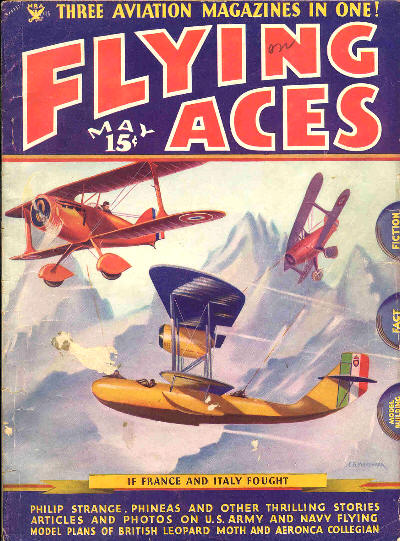 You heard right! That marvel from Boonetown, Iowa is back with a tale of starry-eyed colonels with visions of Hollywood and hidden german gun placements. Can that Knight of Calamity manage to find the Boche’s long-range guns while placating a colonel who thinks he’s the next Cecil B. DeMille all while avoiding landing in a dank cell in Blois? Find out in “Cinema Bums” from the pages of the May 1935 Flying Aces.
Can a Pinkham reform? A certain high and mighty Wing colonel thought so. But the Ninth shook in its shoes. For the Boonetown wonder’s eyes were entirely too friendly when they rested on the colonel—friendly like the eyes of a surgeon when he hovers over a guinea pig with a meat axe in his hand.
“Lives of the Aces in Pictures – Part 8: Edmond Thieffry” by Eugene Frandzen
Starting in the May 1932 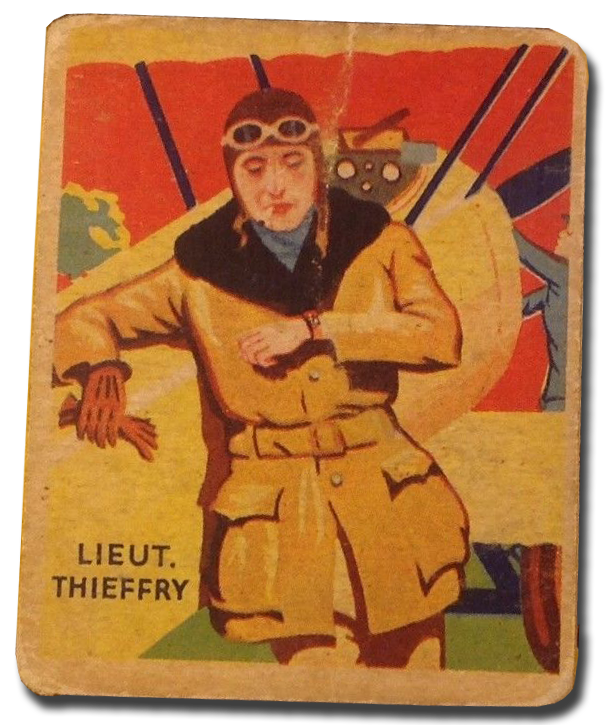 issue of Flying Aces and running almost 4 years, Eugene Frandzen’s “Lives of the Aces in Pictures” was a staple of the magazine. Each month Frandzen would feature a different Ace that rose to fame during the Great War. This time around we have Belgium’s favorite Ace—Lt. Edmond Thieffry!
Thieffry was Belgium’s daring ace who entered the war as an orderly and worked his way up to being King Albert’s leading sky fighter—preferring to fight alone, crashing at the enemy ships from high above. A strategy that worked well for him leaving him with 10 victories on his balance sheet by the end of the war.
After the war, Thieffry resumed his pre-war job as a lawyer, but kept his hand in aviation—helping to found Sabena (Societé Anonyme Belge d’Exploitation de la Navigation Adrienne) in 1923 which would remain Belgium’s national airline until 2001.
Thieffry was killed in a crash close to Lake Tanganyika during a test flight while trying to set up an internal air service in the Congo on April 11th, 1929. He was 36 years old.
(Editor’s Note: These early installments of Frandzen’s “Lives of the Aces in Pictures” that were published in the pulp-sized issues have been reformatted from a two page spread into a one page feature.)
“Lives of the Aces in Pictures – Part 7: René Fonck” by Eugene Frandzen
Starting in the May 1932 issue of Flying Aces and running almost 4 years, Eugene Frandzen’s “Lives of the Aces in Pictures” was a staple of the magazine. Each month Frandzen would feature a different Ace that rose to fame during the Great War. This time around we have France’s Ace of Aces—Lt. René Fonck!
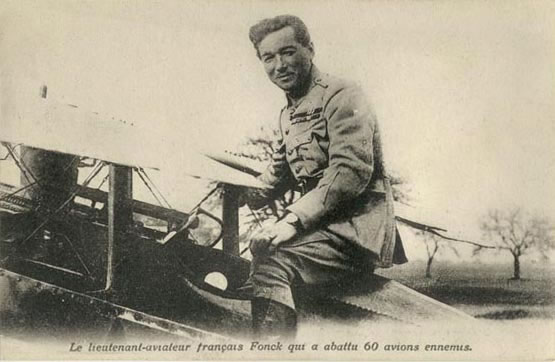
Lt. René Fonck is recognized as one of the greatest French air fighters since Captain Guynemer and is credited with bringing down no less than 75 enemy planes, out of a claimed 142—bringing down six in one day (twice)! As his fame grew, sadly, so did his ego and he never really gained the admiration and popularity of Guynemer.
After the war, Fonck returned to civilian life, but kept his hand in aviation even trying to win the Orteig prize by being the first person to fly across the atlantic—he unfortunately crashed on take-off, killing two of his three crew members. Charles Lindbergh would win the prize seven months later.
He return to military aviation and from 1937-39 he acted as Inspector of fighter aviation within the French Air Force. However his later record of working with the Vichy government following the fall of France in June 1940 later besmirched his reputation. A French police inquiry about his supposed collaboration with the Vichy regime completely cleared Fonck after the war. The conclusion was that his loyalty was proved by his close contacts with recognised resistance leaders such as Alfred Heurtaux during the war—and he was awarded the Certificate of Resistance in 1948.
Just five years later Fonck suffered a fatal stroke and died in 1953 at the age of 59.
(Editor’s Note: These early installments of Frandzen’s “Lives of the Aces in Pictures” that were published in the pulp-sized issues have been reformatted from a two page spread into a one page feature.)
“Hunbugs” by Joe Archibald
“Haw-w-w-w-w!†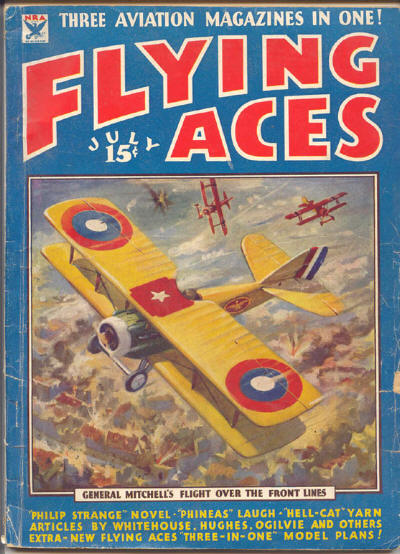 That sound can only mean one thing—that Bachelor of Artifice, Knight of Calamity and an alumnus of Doctor Merlin’s Camelot College for Conjurors is back and this time he’s fighting the war on two fronts—there’s a Boche Bat Patrol running riot in the Moselles and at the Ninth there’s a new recruit who wins every bet—that is until he comes up against the marvel from Boonetown, Iowa. From the July 1934 number of Flying Aces it’s “Hunbugs!”
Meet Lieutenant Ignatius Moots, newest member of the famous Ninth Pursuit. You may like him or you may not, but let us give you a tip—don’t ever bet with him. Phineas did!