



Looking to buy? See our books on amazon.com Get Reading Now! Age of Aces Presents - free pulp PDFs

Happy Anniversary!

Link - Posted by David on January 15, 2015 @ 12:00 pm in

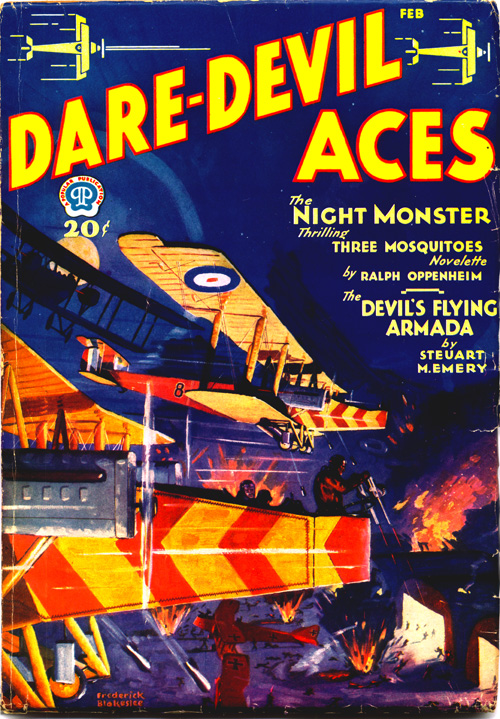
No, not of Age of Aces Books, but of Popular Publication’s Dare-Devil Aces magazine! It was 83 years ago today that the first issue of Dare-Devil Aces hit the stands.

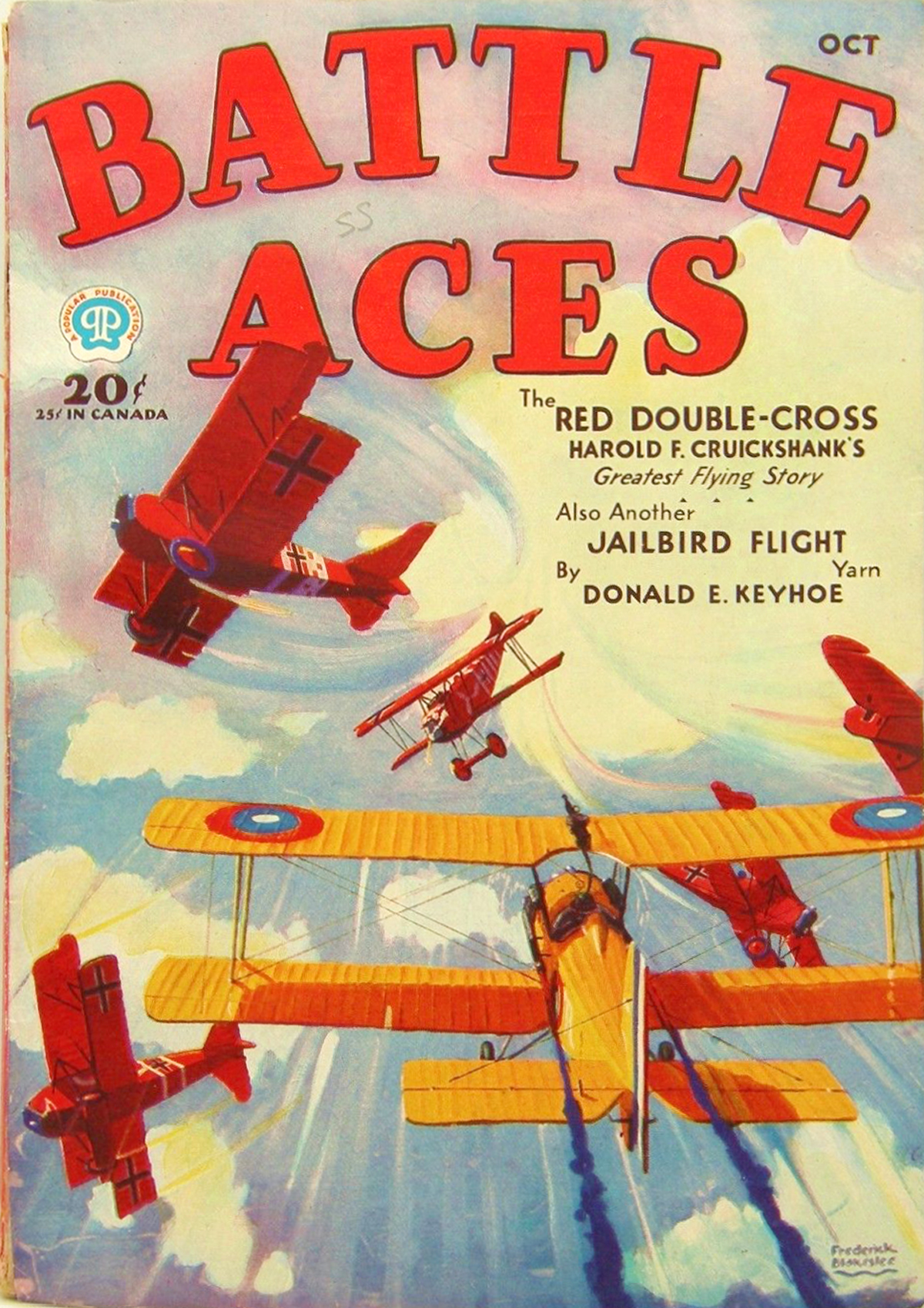
Popular Publications had been publishing for a few months over a year, and their Battle Aces magazine was doing well. Steeger had been able to get some of the best aviation writers out there for Battle Aces, so why not start up a sister mag—or in this case, a big brother magazine.

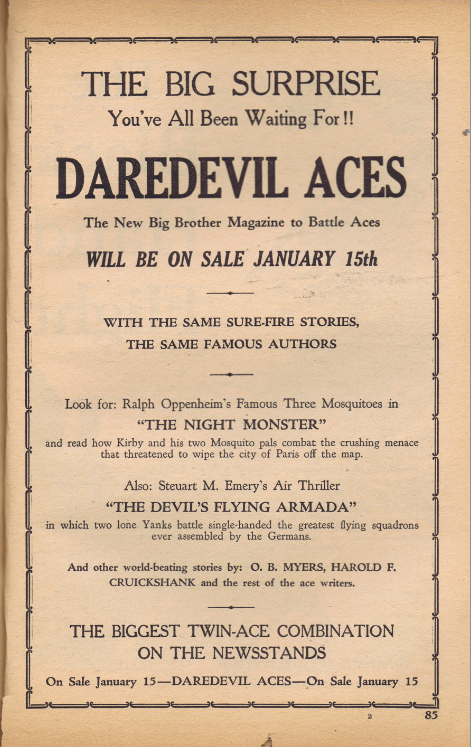
he First Issue Ad
Ad for the first issue of Dare-Devil Aces from the February 1932 issue of Battle Aces.

The Three Mosquitoes led off the issue with “The Night Monster.” Steeger had just rustled Oppenheim into the Popular fold, with the Three Mosquitoes first appearance being the previous month’s issue of Battle Aces! Here the Mosquitoes take on a dragon-like menace that has been terrorizing the Allied front lines. Entire armies fell before it—this dragonlike horror with flame-pointed breath and glimmering eyes. But there were three who dared challenge it—dared follow it down a sky trail of blood.

Next up is a short story by the incomparable O.B. Myers, “The Suicide Ace”—Those Fokkers gloated as they buzzed around their prey; they didn’t know he was of the already lost—that he fought not to escape but to hold them off for 14 minutes—14 minutes of living death.

Coming in next was “The Sky Killers” by Harold F. Cruickshank. Straight into that poison-gas barrage those two gutty Spads plunged, braving a hideous death in a mad scheme that meant victory or defeat for the Allies.

Steuart M. Emery was next to the deadline with “The Devil’s Flying Armada.” “Rescue Major Revel from the Boche prison camp!” That was the order that sent Joe and his buddy into peril skies on the most amazing adventure a pair of fighting fools ever tackled.”

“The Skeleton Flight” by William E. Poindexter was fifth in the flight. For weeks the ghost ship had patroled Allied skies. Now two Yanks were taking up the trail—determined to answer the grizly challenge with their life’s blood.

And flying in the safety position was Frederick M. Blakeslee with his Story Behind the Cover of a gallant British squadron that staged one of the most daring air raids of the war—”Revenge Bombs.”

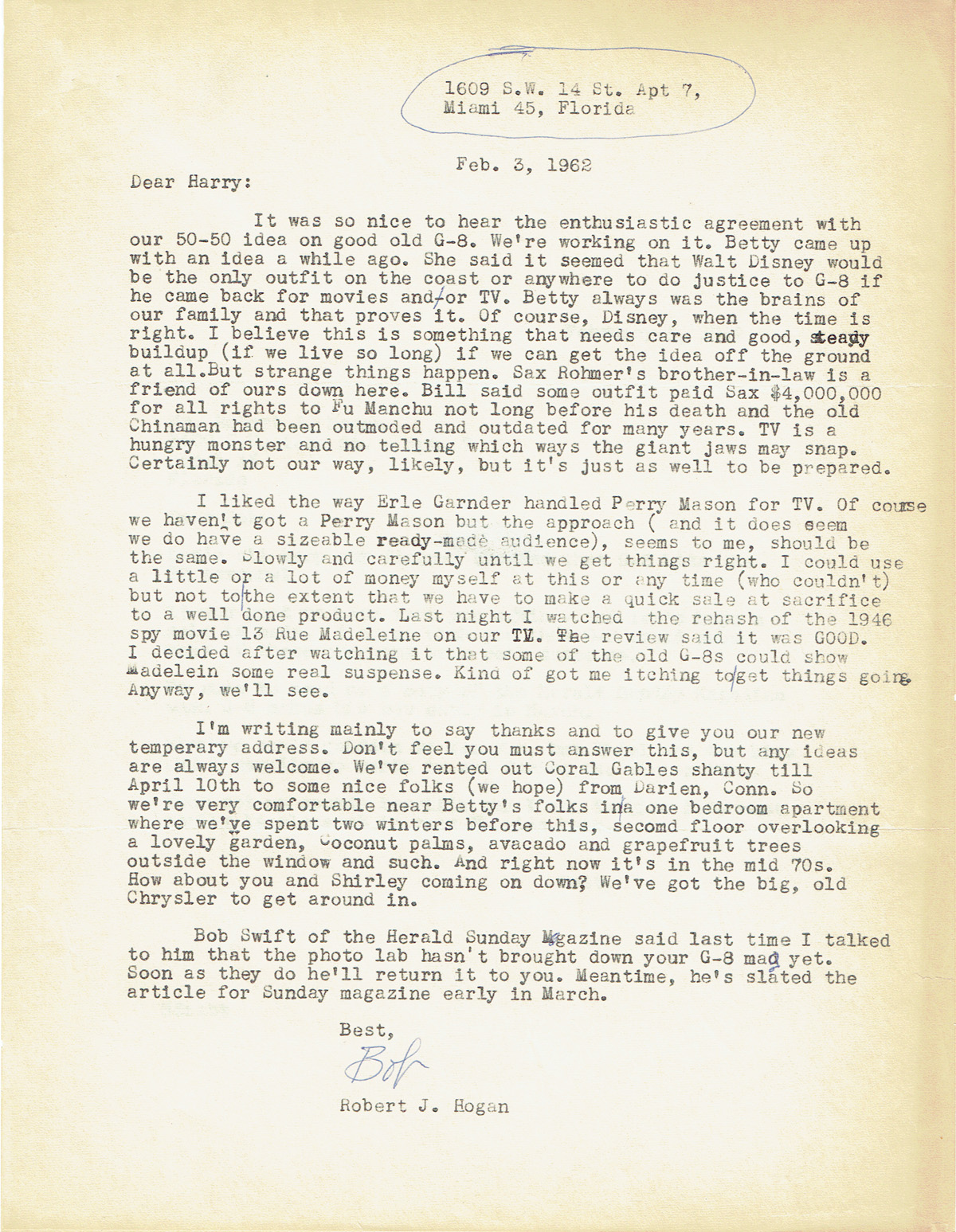
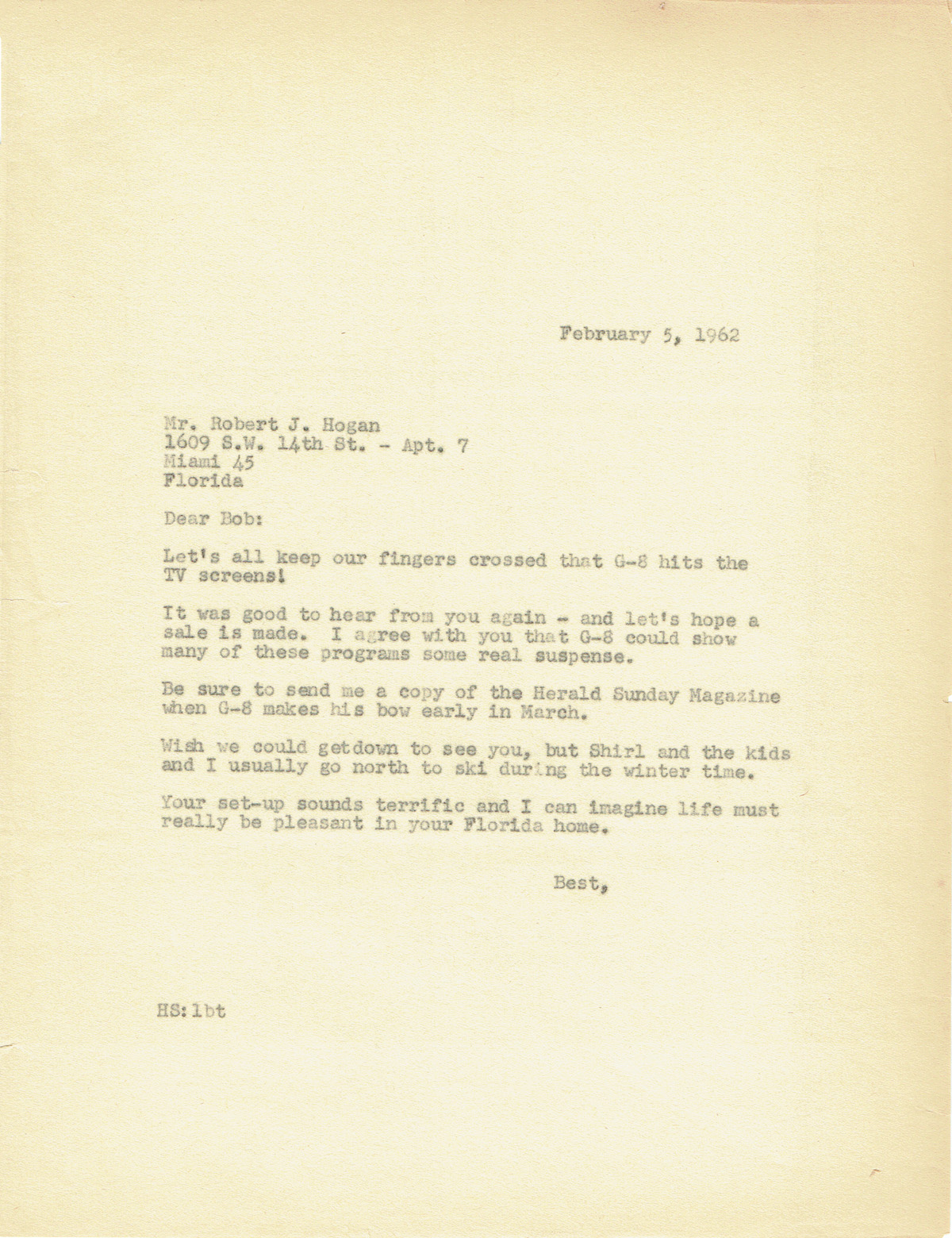
Dare-Devil Aces would go on to be Popular’s longest running aviation title. In the early years of publication Steeger packed each issue full of every 14 year old boy’s favorite authors and series characters. There was Ralph Oppenheim’s Three Mosquitoes, Robert J. Hogan’s Red Falcon and later Smoke Wade, Harold Cruickshank’s Sky Devil, Donald E. Keyhoe’s Vanished Legion and The Jailbird Flight, Steve Fisher’s Captain Babface, C.M. Miller’s The Rattlesnake Patrol and Chinese Brady, as well as O.B. Myers and R. Sidney Bowen!

Hell’s Old Angels

Link - Posted by David on January 14, 2015 @ 12:00 pm in

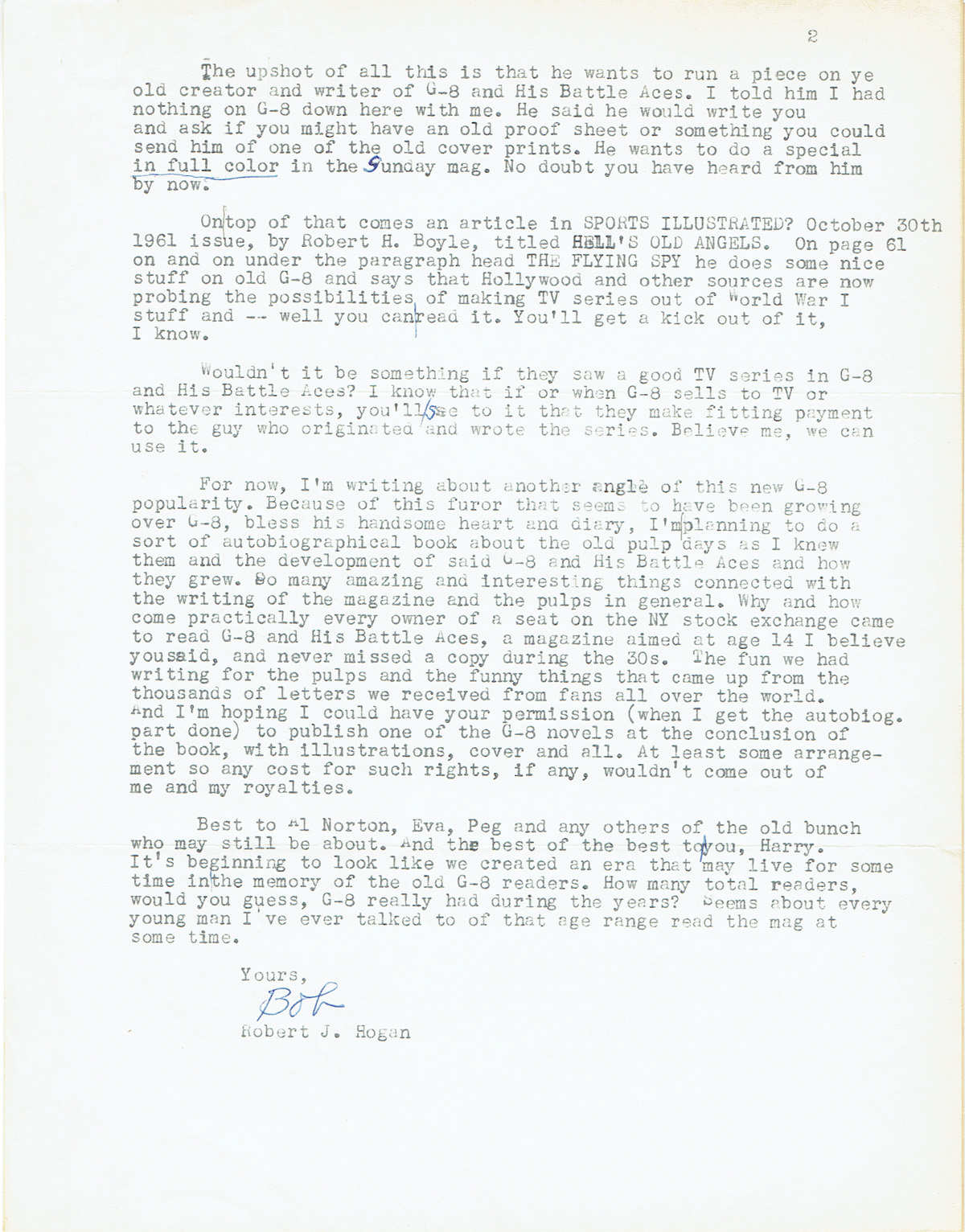
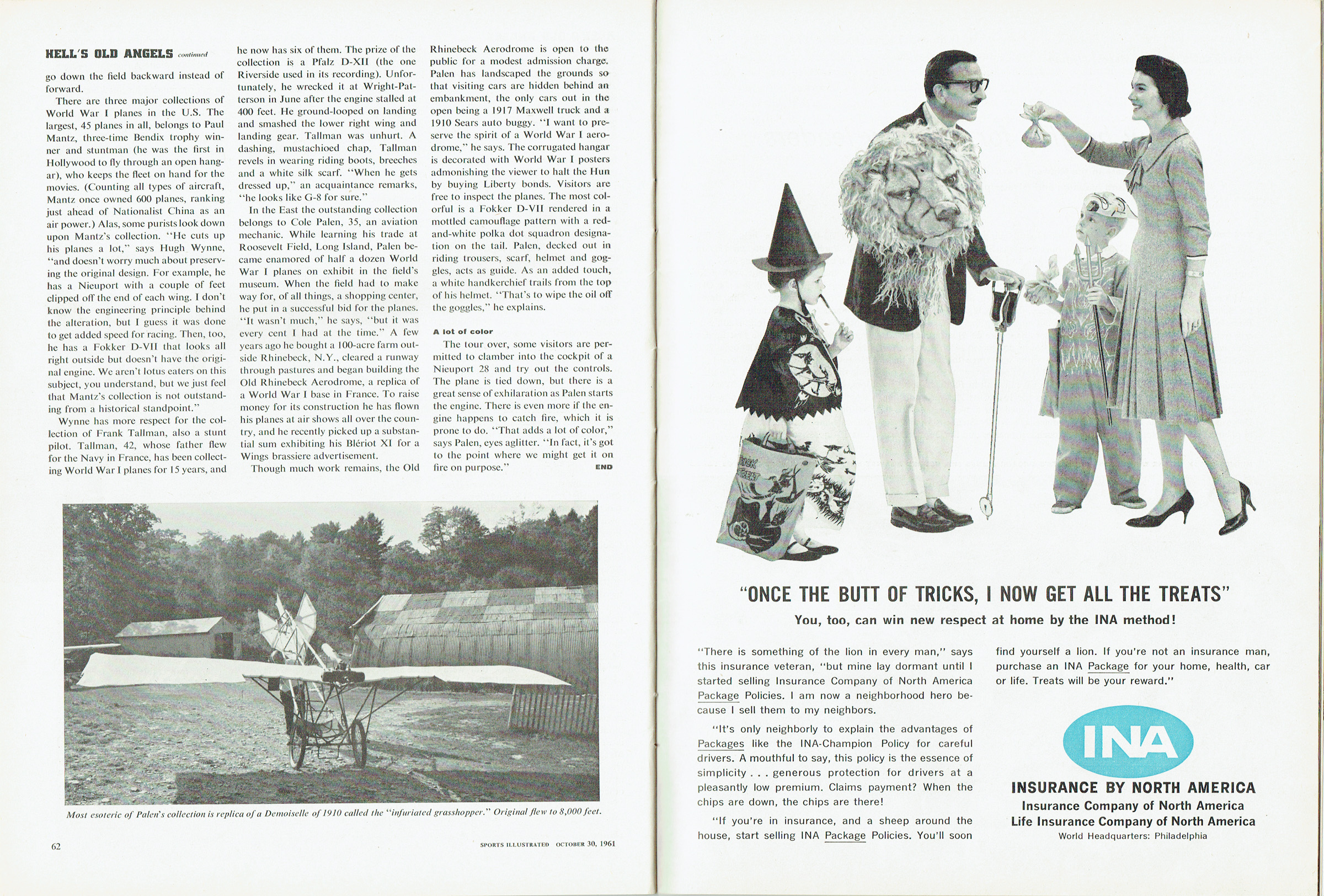
In October of 1961, Sports Illustrated ran an article on the emerging hobby of collecting Spads, Nieuports and other real live airplanes from World War I. The article centers mainly around collectors Paul Mantz and Cole Palen, but it does mention the interest surrounding The Great War that was growing at the time with interst being shown by book publishers and movie and television producers. With a mention towards America’s number one World War flying Ace—G-8!


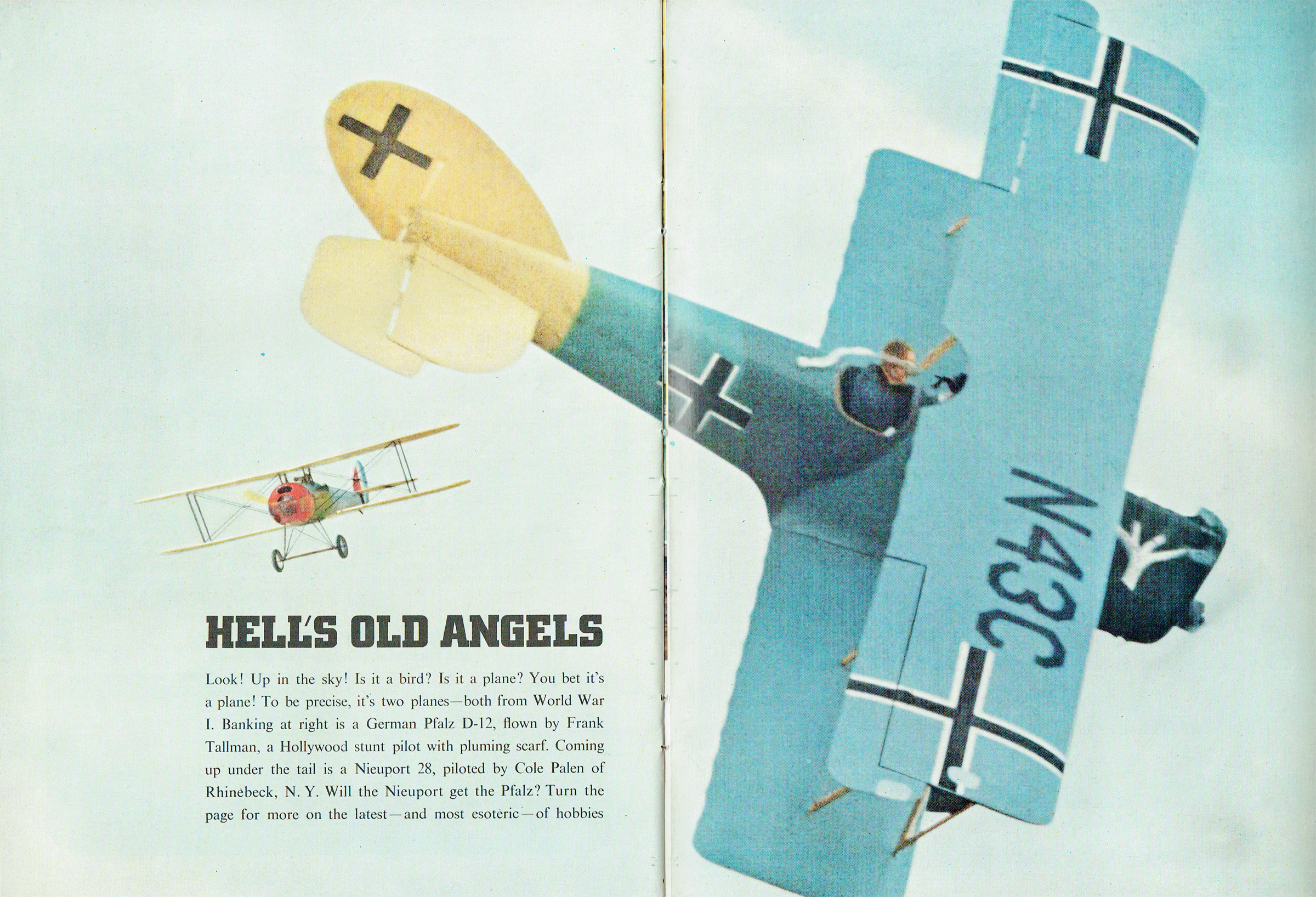
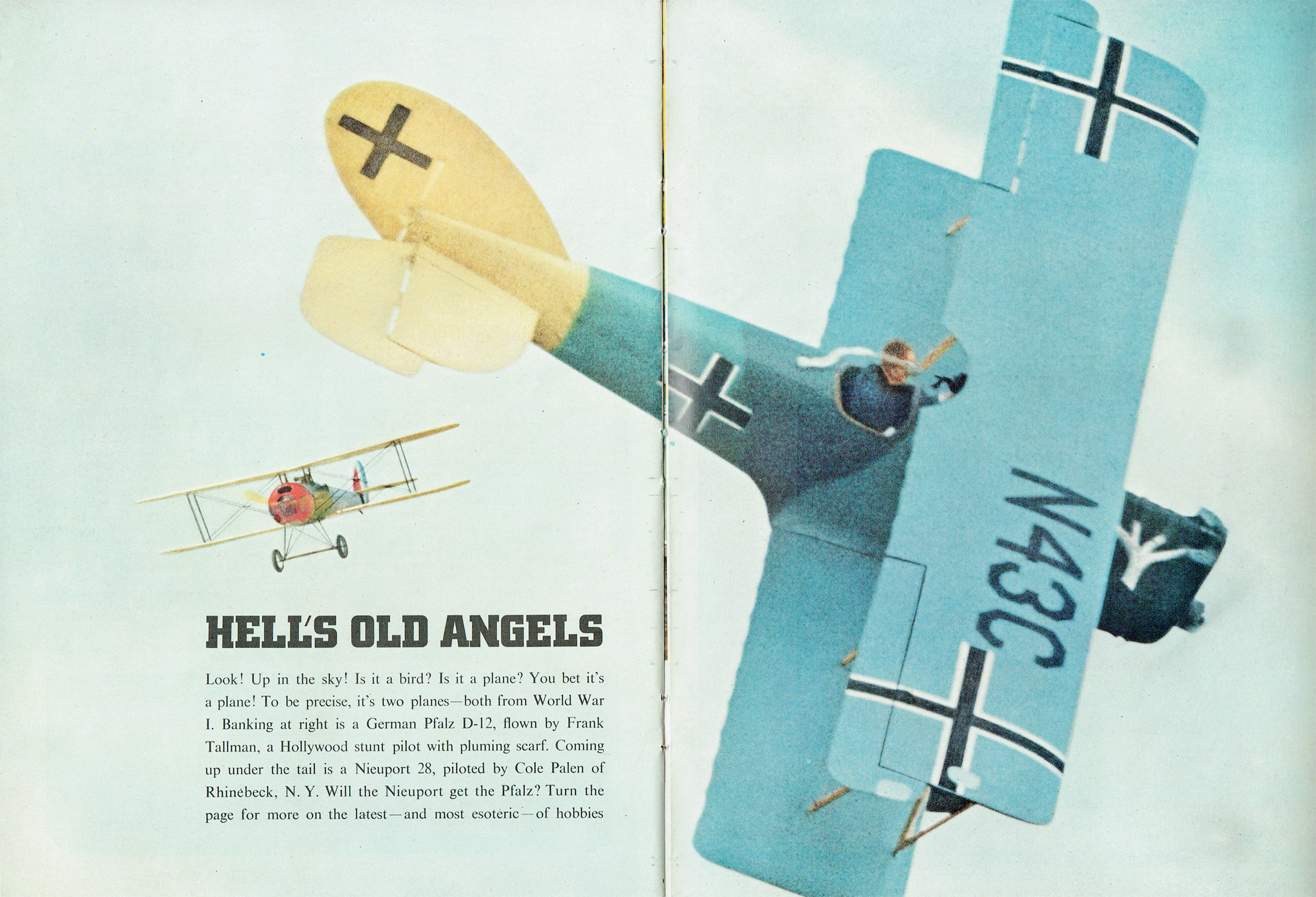
HELLS OLD ANGELS Look! Up in the sky! Is it a bird? Is it a plane? You bet it’s a plane! To be precise, it’s two planes—both from World War I. Banking at right is a German Pfalz D-12, flown by Frank Tallman, a Hollywood stunt pilot with pluming scarf. Coming up under the tail is a Nieuport 28, piloted by Cole Palen of Rhinebeck, N.Y. Will the Nieuport get the Pfalz? Turn the page for more on the latest—and most esoteric—of hobbies.

The Playing Skies of World War I

by Robert H. Boyle (Sports Illustrated, 30 October 1961 (vol.15 no.18))

Every age in history has its admirers. Raymond Duncan, the dancer, wears a homespun tunic and longs for the glory that was Greece. The late Sol Bloom, Congressman, loved nothing more than to dress up as George Washington, the Father of our Country. A goodly number of Americans are so bewitched by the Civil War that they recently refought, with no noticeable change in the result, the Battle of Bull Run. Now the latest craze is World War I planes. Antique aircraft enthusiasts, joined by a smattering of sports car drivers, classic car buff’s and gun collectors, most of whom are psychologically driven to the exotic, have, in the last three years, seized upon World War I as an outlet for their romantic fantasies.

“The World War I interest is just doubling itself by the month,” says Robert McGrath, proprietor of the World War I Aero Bookshop in Roslindale, Mass. “With the advent of jets and missiles, aircraft lost their romance. A jet or a missile is just the carrier of a pilot. World War I pilots flew the plane. They were charioteers, and it was man against man.”


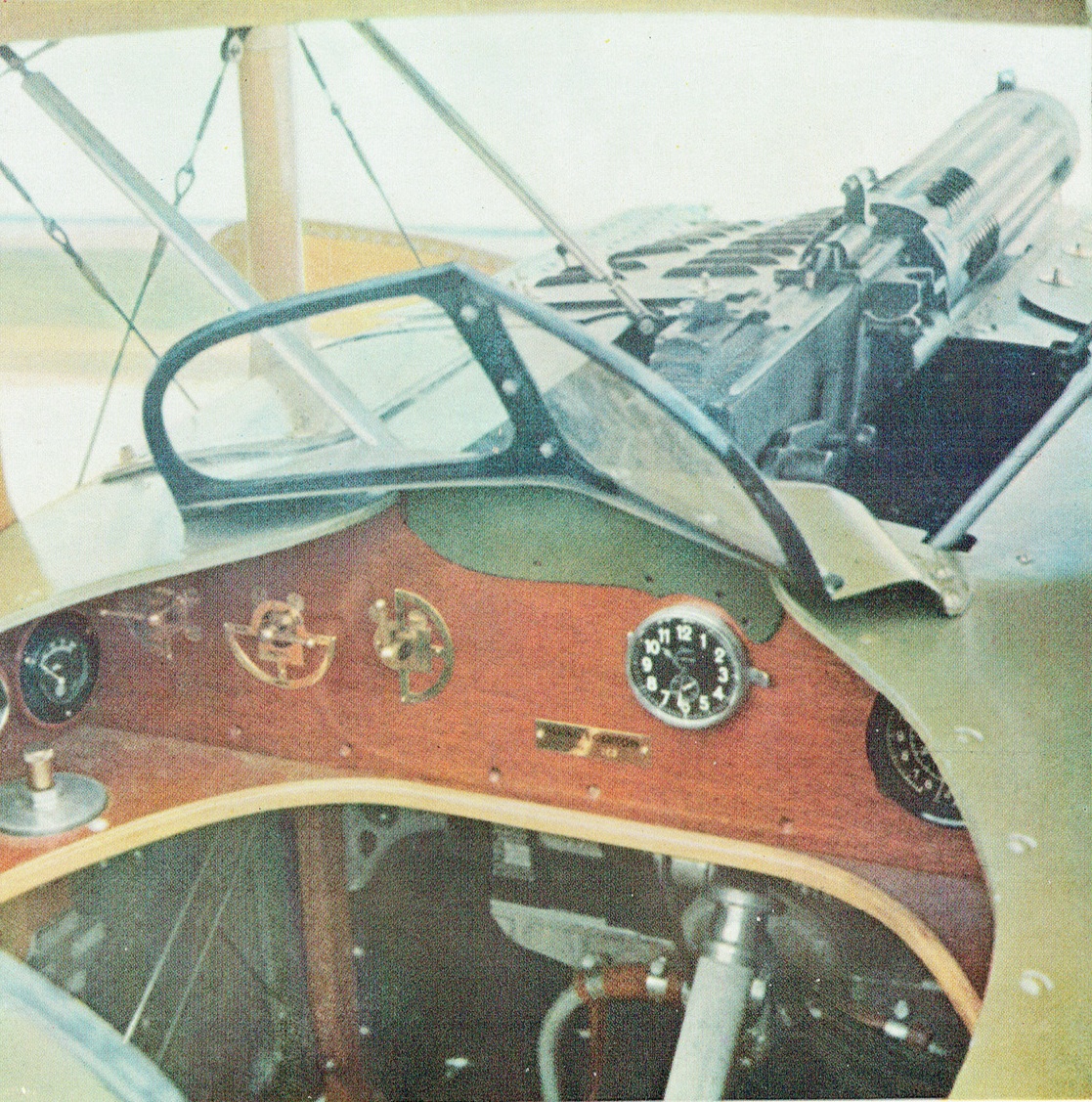
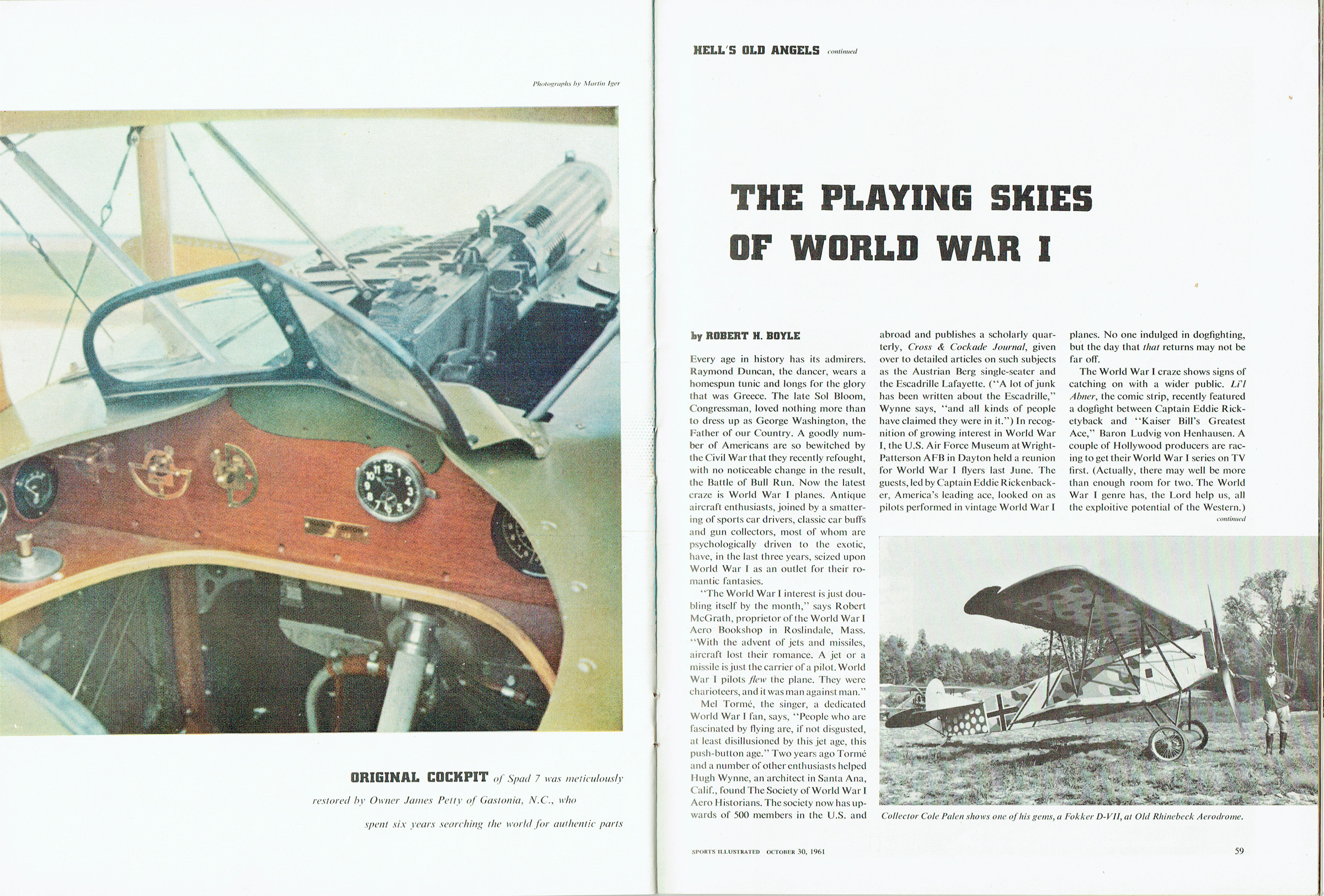
ORIGINAL COCKPIT of Spad 7 was meticulously restored by Owner James Petty of Gastonia, N.C., who spent six years searching the world for authentic parts.

Mel Tormé, the singer, a dedicated World War I fan, says, “People who are fascinated by flying are, if not disgusted, at least disillusioned by this jet age, this push-button age.” Two years ago Tormé and a number of other enthusiasts helped Hugh Wynne, an architect in Santa Ana, Calif., found The Society of World War I Aero Historians. The society now has upwards of 500 members in the U.S. and abroad and publishes a scholarly quarterly, Cross & Cockade Journal, given over to detailed articles on such subjects as the Austrian Berg single-seater and the Escadrille Lafayette. (”A lot of junk has been written about the Escadrille,” Wynne says, “and all kinds of people have claimed they were in it.”) In recognition of growing interest in World War I, the U.S. Air Force Museum at Wright-Patterson AFB in Dayton held a reunion for World War I flyers last June. The guests, led by Captain Eddie Rickcnbacker, America’s leading ace, looked on as pilots performed in vintage World War I planes. No one indulged in dogfighting, but the day that that returns may not be far off.

The World War I craze shows signs of catching on with a wider public. Li’l Abner, the comic strip, recently featured a dogfight between Captain Eddie Ricketyback and “Kaiser Bill’s Greatest Ace,” Baron Ludvig von Henhausen. A couple of Hollywood producers are racing to get their World War I series on TV first. (Actually, there may well be more than enough room for two. The World War I genre has, the Lord help us, all the exploitive potential of the Western.) Riverside Records, specialists in sports car engine sounds, have pressed World War I Fighter Planes in Action, the big selling point of which is the sound of two German Pfalz D-Xlls being pursued by two British Sopwith Camels. To add to the realism the sound track even includes machine-gun fire directed at the Bodies by a French infantryman, who opens up, according to the jacket notes, “a little soon to be effective.”

The book publishing business, too, is beginning to take note of World War I interest. The leader in the field is Harleyford Publications Limited of England. The firm has brought out several lavishly illustrated and expensive ($8.50 each) books, e.g., Air Aces of the 1914-1918 War and von Richthofen and The Flying Circus, which The Society of World War I Aero Historians has pronounced to be “a noble effort.” The main outlet for Harleyford in the U.S. is Gordon’s Bookshop on 59th Street in New York City, hitherto the unofficial headquarters for automobile cultists of all kinds.

The Flying Spy

Long-forgotten histories of World War I aeronautics are suddenly being sought after as classics, and prices have tripled in the past few years. A fine copy of Norman Hall’s Balloon Buster Frank Luke of Arizona brings $30. Hall and Nordhoff’s two-volume study, The Lafayette Flying Corps, sells for up to $ 150, and the war letters and memorial volumes, dedicated to such flyers as Edmond Genet, Norman Prince, Victor Chapman and Hamilton Coolidge fetch as much as $75 apiece. The latest writer to come on strong is Elliott White Springs. His books, written in the ’20s, are common, but since his death two years ago interest in his work has revived. (An eccentric mill owner, Springs is perhaps best remembered as the author of the saucy Springmaid advertisements. An ace in World War I, he wrote a handful of flying stories and novels, notably War Birds, that were so astonishingly successful that they earned him $250,000.)

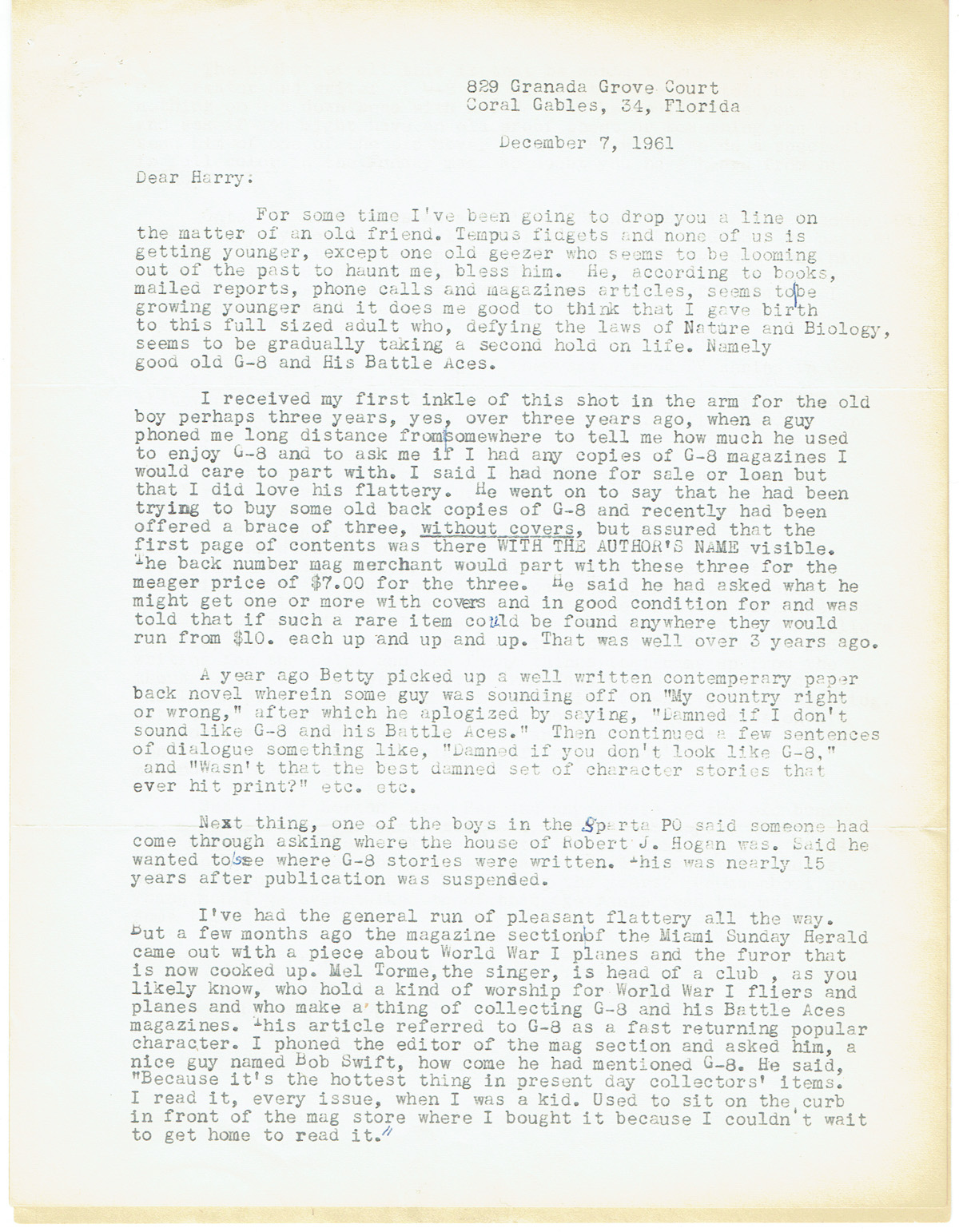
Even pulp magazines of the ’20s are in demand, particularly copies of the monthly, G-8 and His Battle Aces. G-8, it may be recalled, was not only the Master American Flying Spy but a master of the makeup kit. Whenever G-8 got in a tight spot, which was about every other page, he removed his makeup kit “from its secret hiding place,” disguised himself and quickly outfoxed the hated Huns who were searching the woods for that “verdammter Kerl!” Little did they know that the old farmer bicycling down the road was the Master Spy making his getaway. Assisting G-8 were his Battle Aces, big Bull Martin, “former All-American halfback,” and Nippy Weston, “the little terrier ace who defied superstition by flying Spad No.13 and who delighted in laughing in the very face of death.”

Of course, the most desirable possession any World War I hobbyist can have is a plane. According to a recent count taken by Professor Dean H. Obrecht and Leonard E. Opdycke of Rochester, N. Y., there are 70 authentically restored World War I planes in the U.S. today, 35 of them in flying condition. In addition, there are 44 replicas, which do not rank as high in the scheme of values as do restorations. If the plane is almost exactly as it was the day it left the factory or the day it arrived at the front, it is incomparably desirable. Restoration or replica, it is important to have an original engine. “The airplane can always be built,” explains Cole Palen, a prominent collector, “but building the engine is something else again.”

It is perfectly all right for a licensed pilot to fly a World War I plane today as long, of course, as the plane can pass Federal Aviation Agency inspection. (One collector was irked when an FAA inspector grounded his Spad because of rents in the original linen wing skin. “I thought it was all right,” the collector said, “but he was new, and I guess he was afraid.”)

Aloft, World War I planes are prohibited from flying over cities and villages or any open area of assembly. Though this would tend to indicate some doubt about the durability of the planes, pilots say that with the necessary maintenance the planes hold up reasonably well. In fact, many of the planes can outclimb and outdive light planes of comparable size today. A Spad, for instance, can climb 1,000 to 1,200 feet a minute, a respectable figure for almost any single-engine private plane. However, there are some problems, mainly in landing. The landing gear was built for grass, and a pilot who alights on concrete may as well write off the plane. A Spad is especially difficult to land because of its built-in urge to ground-loop. The Spad has too much weight in the tail, 333 pounds to be exact, and when it touches down in the classic three-point position, it shows a compulsive urge to go down the field backward instead of forward.


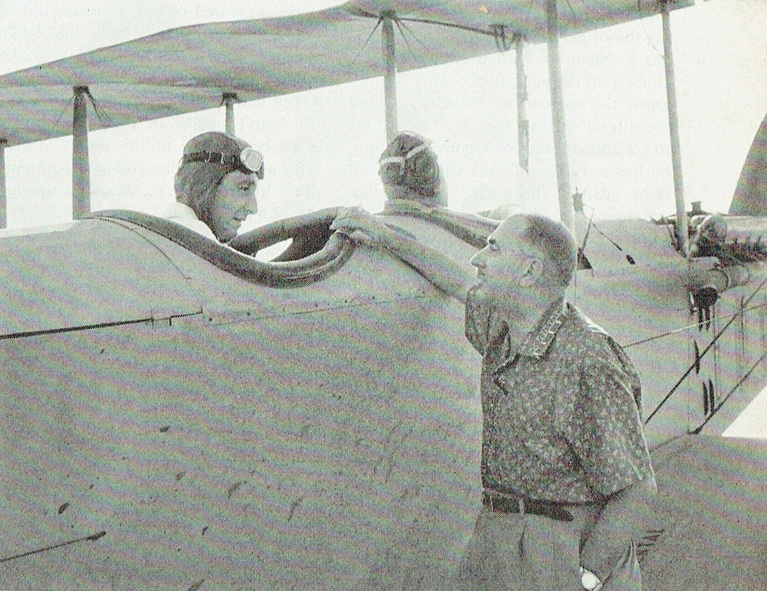
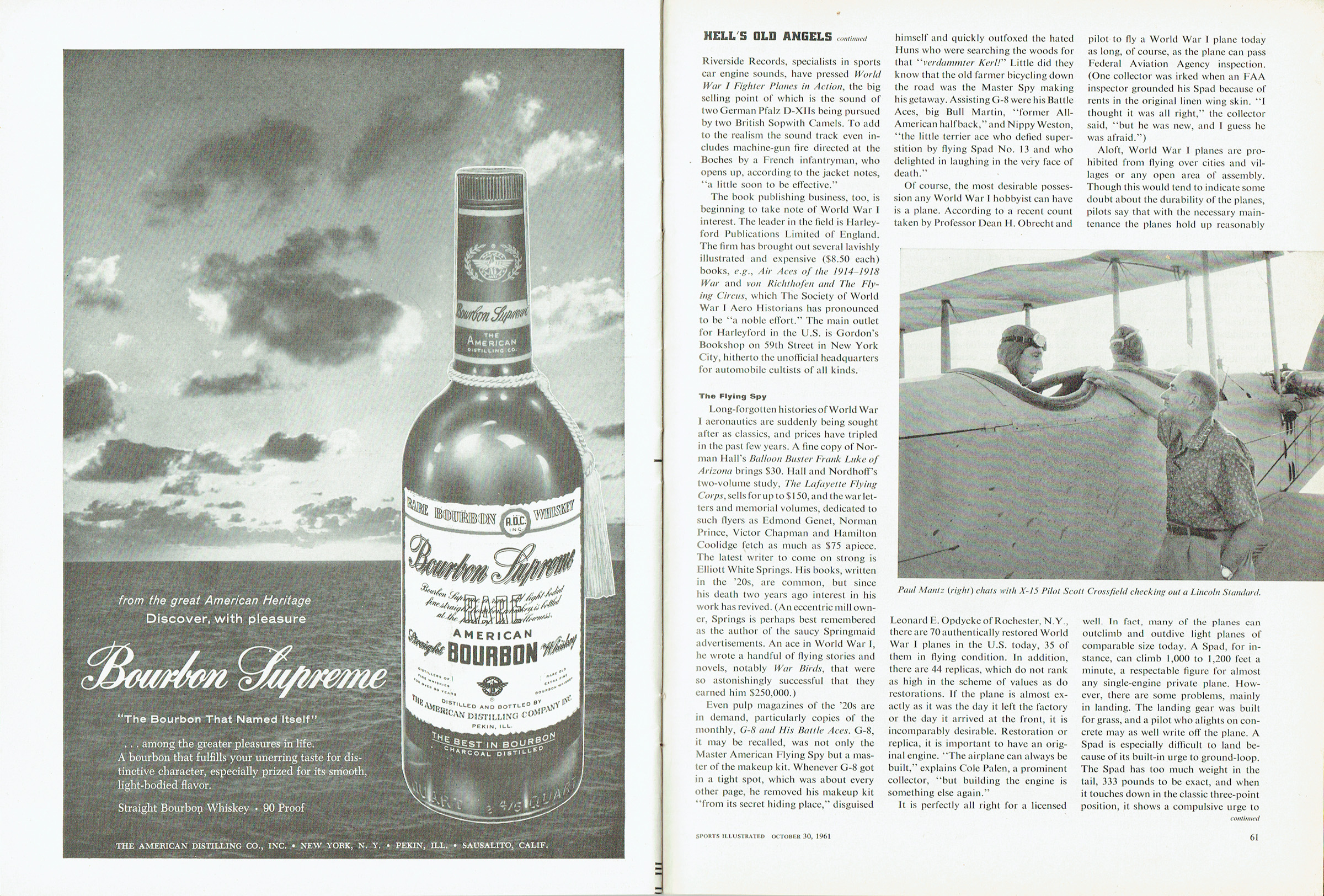
Paul Mantz (right) chats with X-15 Pilot Scott Crossfield checking out a Lincoln Standard.

There are three major collections of World War I planes in the U.S. The largest, 45 planes in all, belongs to Paul Mantz, three-time Bendix trophy winner and stuntman (he was the first in Hollywood to fly through an open hangar), who keeps the fleet on hand for the movies. (Counting all types of aircraft, Mantz once owned 600 planes, ranking just ahead of Nationalist China as an air power.) Alas, some purists look down upon Mantz’s collection. “He cuts up his planes a lot,” says Hugh Wynne, “and doesn’t worry much about preserving the original design. For example, he has a Nieuport with a couple of feet clipped off the end of each wing. I don’t know the engineering principle behind the alteration, but I guess it was done to get added speed for racing. Then, too, he has a Fokker D-VII that looks all right outside but doesn’t have the original engine. We aren’t lotus eaters on this subject, you understand, but we just feel that Mantz’s collection is not outstanding from a historical standpoint.”

Wynne has more respect for the collection of Frank Tallman, also a stunt pilot. Tallman, 42, whose father flew for the Navy in France, has been collecting World War I planes for 15 years, and he now has six of them. The prize of the collection is a Pfalz D-XII (the one Riverside used in its recording). Unfortunately, he wrecked it at Wright-Patterson in June after the engine stalled at 400 feet. He ground-looped on landing and smashed the lower right wing and landing gear. Tallman was unhurt. A dashing, mustachioed chap, Tallman revels in wearing riding boots, breeches and a white silk scarf. “When he gets dressed up,” an acquaintance remarks, “he looks like G-8 for sure.”


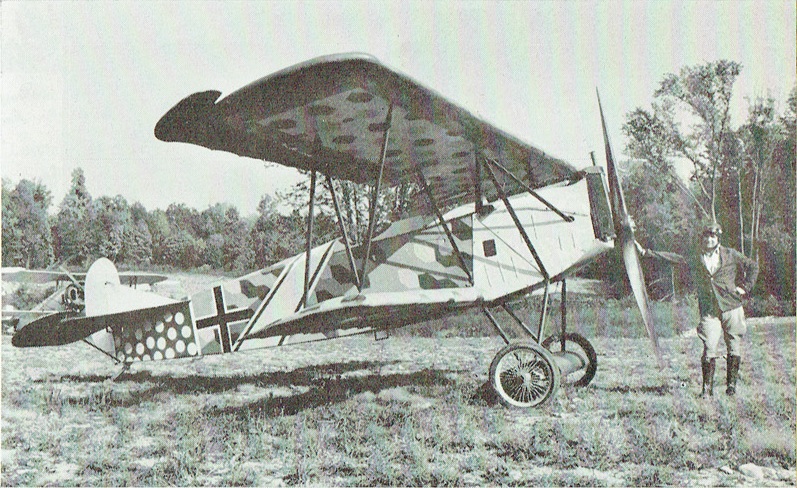
Collector Cole Palen shows one of his gems, a Fokker D-VH, at Old Rhinebeck Aerodrome.

In the East the outstanding collection belongs to Cole Palen, 35, an aviation mechanic. While learning his trade at Roosevelt Field, Long Island, Palen became enamored of half a dozen World War I planes on exhibit in the field’s museum. When the field had to make way for, of all things, a shopping center, he put in a successful bid for the planes. “It wasn’t much,” he says, “but it was every cent I had at the time.” A few years ago he bought a 100-acre farm outside Rhinebeck, N.Y., cleared a runway through pastures and began building the Old Rhincbeck Aerodrome, a replica of a World War I base in France. To raise money for its construction he has flown his planes at air shows all over the country, and he recently picked up a substantial sum exhibiting his Blêriot XI for a Wings brassiere advertisement.

Though much work remains, the Old Rhinebeck Aerodrome is open to the public for a modest admission charge. Palen has landscaped the grounds so that visiting cars are hidden behind an embankment, the only cars out in the open being a 1917 Maxwell truck and a 1910 Sears auto buggy. “I want to preserve the spirit of a World War I aerodrome,” he says. The corrugated hangar is decorated with World War I posters admonishing the viewer to halt the Hun by buying Liberty bonds. Visitors are free to inspect the planes. The most colorful is a Fokker D-VII rendered in a mottled camouflage pattern with a red-and-white polka dot squadron designation on the tail. Palen, decked out in riding trousers, scarf, helmet and goggles, acts as guide. As an added touch, a white handkerchief trails from the top of his helmet. “That’s to wipe the oil off the goggles,” he explains.

A lot of color

The tour over, some visitors are permitted to clamber into the cockpit of a Nieuport 28 and try out the controls. The plane is tied down, but there is a great sense of exhilaration as Palen starts the engine. There is even more if the engine happens to catch fire, which it is prone to do. “That adds a lot of color,” says Palen, eyes aglitter. “In fact, it’s got to the point where we might get it on fire on purpose.”


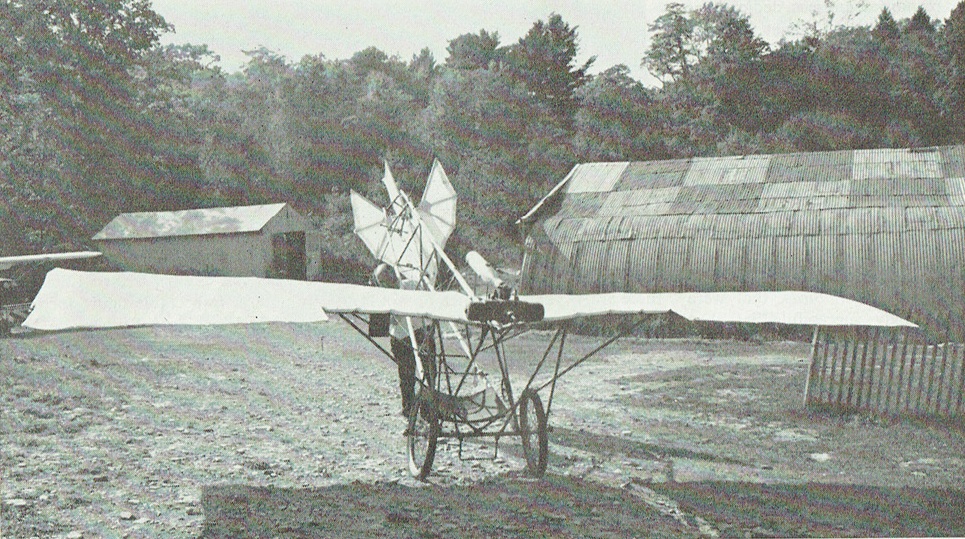
Most exoteric of Palen’s collection is a replica of a Demoiselle of 1910 called the “infuriated grasshopper.” Original flew to 8,000 feet.


pages 56+57


pages 58+59


pages 60+61


pages 62+63


“The Pfaltz Scouts and Lieutenant Alexander” by Frederick Blakeslee

Link - Posted by David on January 12, 2015 @ 12:00 pm in

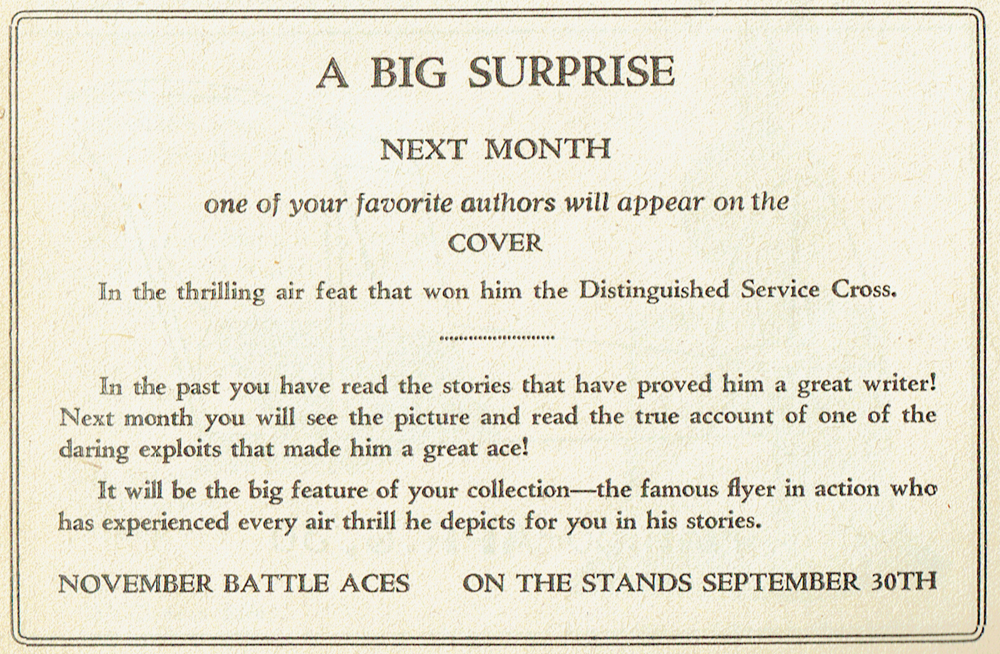
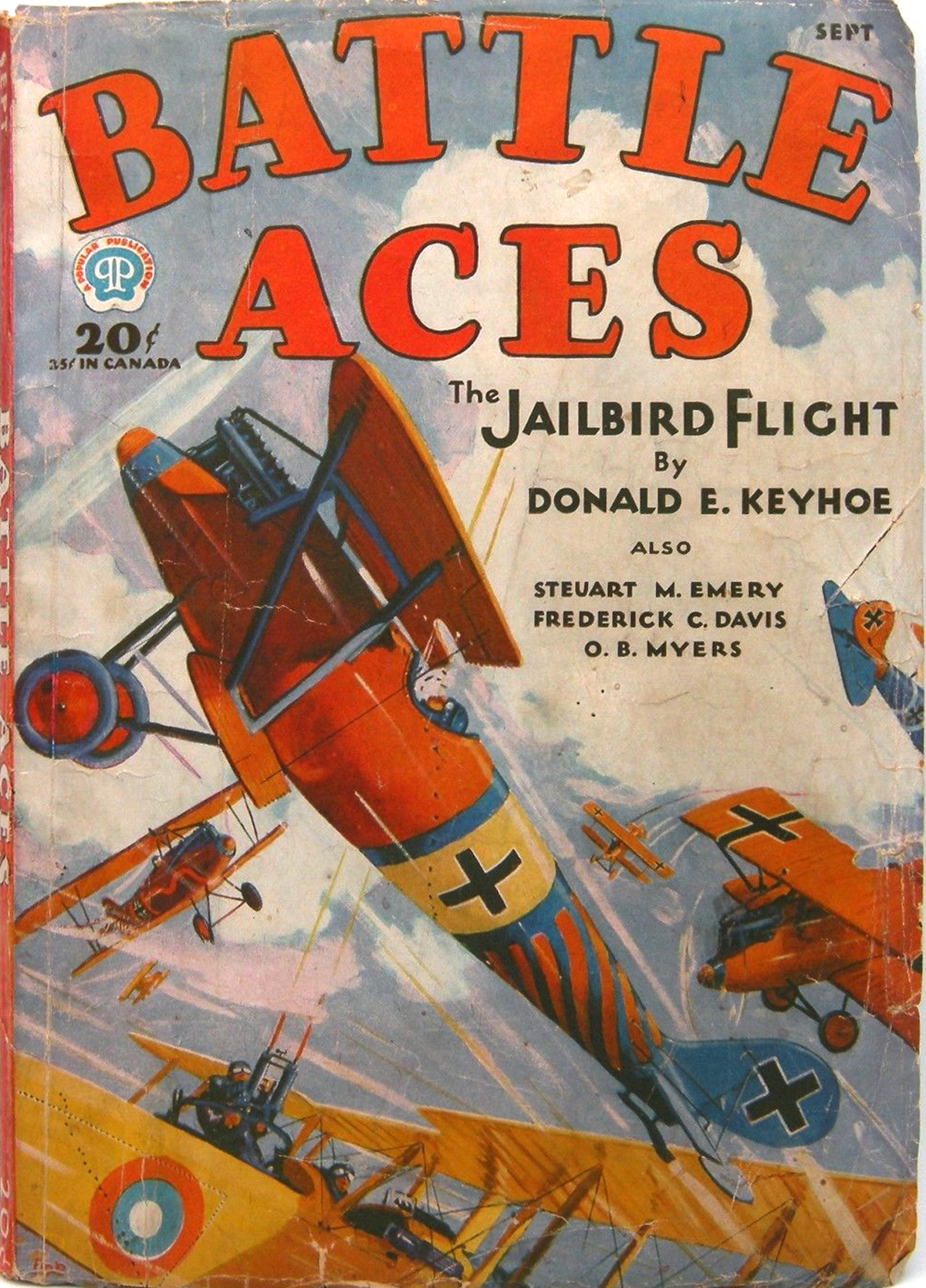
Editor’s Note: Every month the cover of BATTLE ACES depicts a scene from a real combat actually fought in the War and a real event in the life of a great ace. The series is being painted exclusively for this magazine by Frederick M. Blakeslee, well known artist and authority on aircraft and was started especially for all of you readers who wrote in asking for photographs of war planes. In this way not only do you get pictures of the ships—authentic to the last detail—but you see them in color. Also you can follow famous airmen on many of their most amazing adventures and feel the same thrills of battle they felt. Be sure to save these covers if you want your collection of this fine series to be complete.

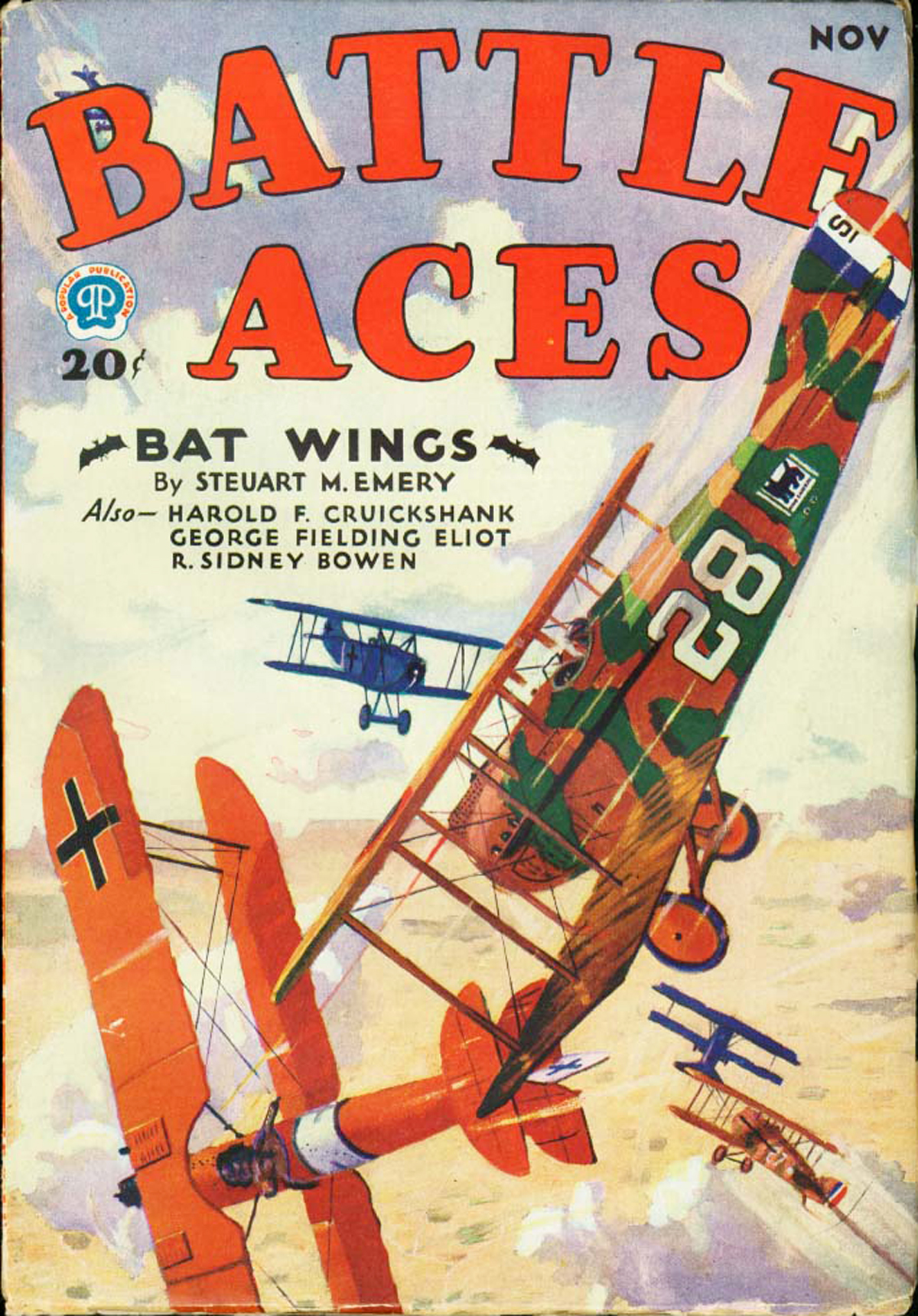
th_BA_3109THE BEST way to tell the story of this month’s cover is in the words of the citation. The pilot was First Lieutenant Stirling C. Alexander of the 99th air squadron and the incident pictured happened in the region of Landres-et-St. Georges, on October 6th, 1918. Here it is.

“He, with Lieutenant Atwater, observer, while on a photographic mission, was forced back by seven enemy pursuit planes. A few minutes later he returned over the lines and while deep in enemy territory was cut off by twelve enemy planes (Pfaltz scouts). He maneuvered his plane to give battle and so effectively managed the machine that he, with his observer, was able to destroy one and force the others to withdraw. With his observer severely wounded, he managed to bring his plane safely back to his own aerodrome with his mission completed.”

Read over the last four words of the citation, and remember—he had twelve Boches to fight! Not three or four, which would have been plenty, but twelve swift pursuit ships that could fly circles around the, comparatively speaking, lumbering reconnaissance ship. With those odds against him he completed his mission. A real pilot!

It is hard to say who had the most important job, the combat pilot, or the reconnaissance pilot, but without any question the reconnaissance pilot had the hardest job. Where the combat pilot could pull out of a fight if anything went wrong, and, due to the speed of his ship, have a fair chance of getting away, the reconnaissance pilot in his slower ship had to rely on his observer’s aim. For him it was a case of fighting it out as best he could. If his observer was shot, or his guns jammed—well, it was just too bad.

The reconnaissance pilot’s work consisted of observing troop movements, often deep in enemy territory; photographing, sometimes at low altitudes; special missions or spy planting (a job no one wanted); artillery direction and, when necessity arose, of fighting his way home.

To fly on such a mission against such overwhelming odds was no mean feat.

The combat pilots of both sides were always on the lookout for the two-place ships, as they were considered cold meat for two or more fighting planes. There is only one case on record where a reconnaissance ship was unmolested. Even archie ignored this particular plane. Combat pilots would sight it from a distance and dive in to attack, but upon recognizing it, would veer off with a smile and look for victims elsewhere.

The ship was a German and was called “The Flying Pig.” It used to come out over the lines every afternoon in the same place, fly up and down and then go home. It never did any harm as far as could be observed and from the lumbering and clumsy way it was flown it derived its name. It was believed to be piloted by an old woman. When a combat ship approached too near, its attempts to escape were pathetic. It was a point of honor among Allied pilots never to harm it. One day, however, a new pilot spied it and dove to the attack. He had heard of this particular ship, and on coming close recognized it and zoomed away. No combat ship had ever come as close as this and the poor “Pig” nearly turned itself inside out getting to safety. Since it never appeared again, it was assumed that the pilot died of fright.

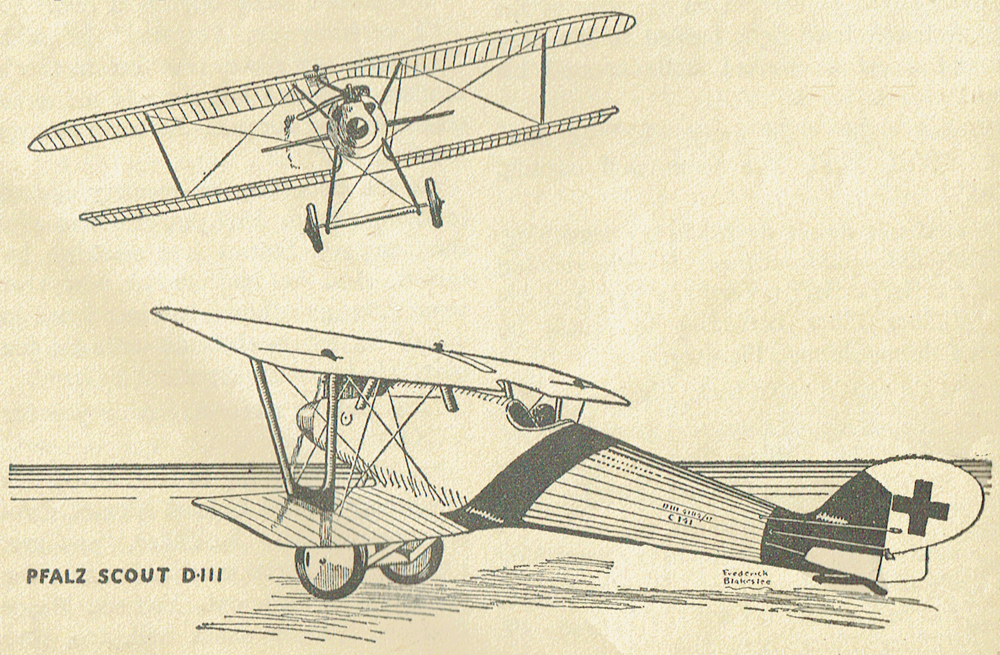
Now let us consider the Boche ship pictured on the cover. It is a Pfaltz scout DIII. Lieutenant Bert Hall of the French army had several battles with Pfaltz scouts and has this to say about them. “The new German Pfaltz single-place ships are damned good. They are as fast as hell and maneuver beautifully.”

The first ship of this type landed in the British lines near Bonnieul, on February 26th, 1918. It is first cousin to the Albatros and is like that ship in many ways. To quote from the report of the first machine captured—”It is light in construction and clean-cut in design, and from the great amount of care that has been taken to keep the fuselage of very good streamline shape, and so free from irregularities, it appears to be the result of a serious attempt to produce a scout machine with good performance. It is powered with a 160 h.p. Mercédés engine. Two Spandau guns fire through the propeller. Its speed at ten thousand feet is 102½ m.p.h. and at fifteen thousand feet, 91½ m.p.h. The estimated absolute ceiling is seventeen thousand feet.

“The machine is stable laterally and un-stable directionally and longitudinally. It tends to turn to the left in flight, is not tiring to fly and is normally easy to land.”

The Germans succeeded in producing a beautiful ship at all events, and one that did a great deal of damage. The faults of the DIII were corrected in a new modle, but it never appeared at the Front as the war ended before it could be brought up. Those who saw it after the Armistice said it was beter looking that the DIII, and if looks meant anything, a ship not to pick a fight wit.

The Pfaltz Scouts and Lieutenant Alexander
“The Pfaltz Scouts and Lieutenant Alexander” by Frederick M. Blakeslee (September 1931)

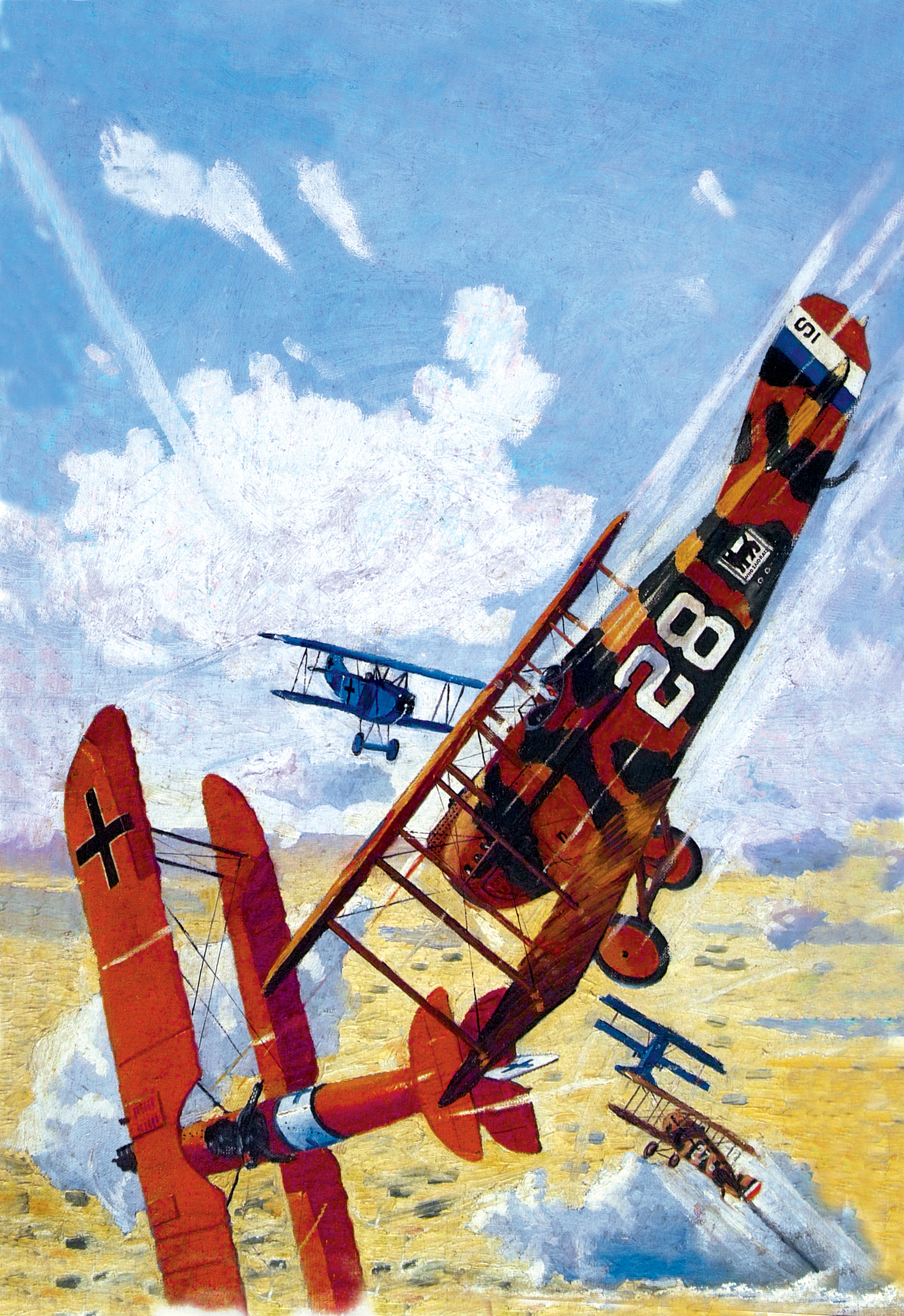
The original painting for this month’s cover was up for auction in 2012 by Heritage Auctions. They listed it as “The Jailbird Flight, Battle Aces pulp cover, September 1931.” Oil on canvas, it measures 30¼” by 21¼” and was initialed—fmb—by Blakeslee in the lower left. It’s condition reported as: “In-painting from previous frame abrasions visble along the right extreme edge; very light surface grime in the white painted areas; stretcher creases on the upper and right edges faintly visible; area of craquelure in the upper right corner; otherwise in very good condition. Framed to an overall size of 36¾ x 28 inches.” They estimated it would sell for between $3,000 and $5,000, but in the end sold for $2,250.

“Lives of the Aces in Pictures – Part 29: Oberleutnant Max Immelmann” by Eugene Frandzen

Link - Posted by David on January 7, 2015 @ 12:00 pm in

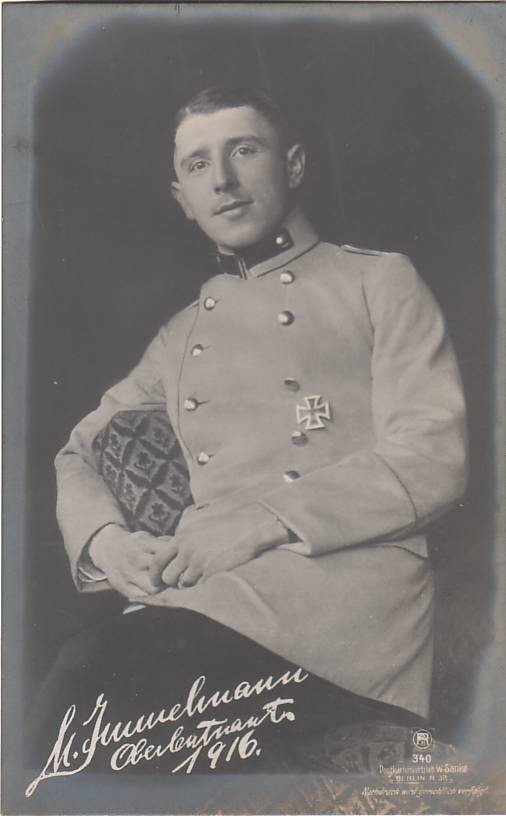
Here’s another of Eugene Frandzen’s “Lives of the Aces in Pictures” from the pages of Flying Aces Magazine. The series ran for almost four years with a different Ace featured each month. This week we have his illustrated biography from the November 1934 issue featuring Der Adler von Lille—The Eagle of Lille—Oberleutnant Max Immelmann!

Max Immelman was the first German World War I flying Ace. He was a pioneer in fighter aviation and the first aviator to win the Pour le Mérite awarded by Kaiser Wilhelm II—Prussia’s higest order of merit. His name has become synonymous with with a common flying tactic—the Immelmann turn—in which the plane performs a simultaneous loop and roll thus allowing him to dive back at a pursuing plane!

Credited with seventeen (although some would dispute this and say fifteen) kills to his name, Immelmann met his fate on the 18th of June 1916 when he was shot down by British pilot George McCubbin.

“The R.E.8’s and Lieutenant Potter” by Frederick Blakeslee

Link - Posted by David on January 5, 2015 @ 12:00 pm in

Editor’s Note: Every month the cover of BATTLE ACES depicts a scene from a real combat actually fought in the War and a real event in the life of a great ace. The series is being painted exclusively for this magazine by Frederick M. Blakeslee, well-known artist and authority on aircraft and was started especially for all of you readers who wrote us requesting photographs of war planes. In this way you not only get pictures of the ships—authentic to the last detail—but you see them in color. Also you can follow famous airmen on many of their most amazing adventures and feel the same thrills of battle they felt. Be sure to save these covers if you want your collection of this fine series to be complete.

th_BA_3108THE COVER this month tells one of the best stories of the War, and that’s saying a lot, because it’s hard to find one that isn’t good. It shows First Lieutenant William C. Potter winning his Distinguished Service Cross—a decoration well earned, as you shall see.

A formation of eight reconnaissance machines, when on a daylight bombing mission in the vicinity of Dun-sur-Meuse, on September 26th, 1918, was attacked by a force of enemy planes three times its number. Now twenty-four Jerries in one formation is a whale of a formation, believe me. Go out some nice clear morning, point your finger at twenty-four places in the sky, and you’ll get some idea of the amount of ammunition floating about that September day.

All hell broke loose when the two formations met. Potter, with his observer, was in the thick of it, and the Jerries had good cause to remember him that day. The fight had been on only a few moments when Potter noticed that his leader’s plane was pulling away from the battle toward Germany, and that the pilot was making desperate efforts to control the machine. The observer’s guns were inactive. Here was a bit of cold meat for the Boche flyers. They weren’t long in realizing it. A half dozen or more left the dogfight and tore in to finish the Yank off, but they hadn’t reckoned with Potter. He also left the fight, and, “under conditions demanding greatest courage and determination flew in close so as to protect him from the rear.”

He beat off the immediate attack on his leader, but by this time they were both well over Germany. The Allied ships had disappeared, and the disabled plane showed no indication of turning. Potter of course knew that something was desperately wrong. The observer was invisible—gone overboard perhaps—but why didn’t the pilot turn? Was he lost? Couldn’t he turn? That was it! The meaning of the pilot’s frantic signaling at last became clear. He couldn’t turn! For some reason the controls were jammed.

Well, he couldn’t leave a helpless comrade to the mercy of the Fokkers, so with renewed energy he fought on, determined to protect his leader to the last drop of blood or gas. By now they were deep in enemy territory and getting deeper every second. Chances of regaining their own airdrome were fast decreasing. The fight raged furiously, the only advantage on the side of the Americans being the Jerries’ inability to separate them, and the great number of German ships which had to watch each other to avoid collision.

Conditions were getting desperate, when suddenly, to Potter’s relief, the leader made a turn about, headed at last for home. Lieutenant Potter turned with him. Regaining his position he started to fight his way toward Allied territory, now miles ahead.

They had a long distance to go, gas was getting low and the ships were badly shot. But the planes continued to fly, and as long as the ammunition held out, the Yanks knew they now had a chance.

The frustrated Boche buzzed after them like a swarm of angry bees. Soon the two speeding planes were back over the lines where the Jerries decided to depart, helped in their decision by the presence of a few Allied wasps. The two tired pilots landed their riddled machines on their own airdrome on the last drop of gas.

It was found that the leader had been unable to turn because his observer had been killed early in the fight, and in falling had jammed the controls. It was only due to the skilled protection afforded by Lieutenant Potter that he had been given an opportunity to clear the jam.

The two ships pictured are not the machines that figured in this experience; we show these because they are more famous than the ones actually used. They are R.E.8’s, also known as the Harry Tate, a British experimental machine, hence the letters R.E.

First produced in 1912, the R.E. had a Beardmore 120 h.p. engine. It gave some good climbs, but being somewhat troublesome to land, was not built in quantities and was more or less obsolete during 1918. Later developments of the type produced in 1914-15-16, showed greater speed and were used in active service for certain specific purposes. The R.E.8, being the eighth in the series, was used during the later period of the war. It resembled somewhat the B.E.’s, known as “Quirks”—two guns fired through the propeller, that was very often four-bladed, and one gun on a swivel in the observer’s cockpit. It had an R.A.F. 4A, 150 h.p. engine; its weight was 2,680 lbs.; speed at 5,000 feet, 103 m.p.h., and at 10,000 feet, 96 m.p.h. It could climb to 5,000 ft. in 11 minutes, 25 seconds, and to 10,000 ft. in 29 minutes, 5 seconds. It’s absolute ceiling was 17,000 ft. Besides reconnaissance work, it could give a very good account of itself in a fight.

The R.E.8's and Lieutenant Potter
“The R.E.8’s and Lieutenant Potter” by Frederick M. Blakeslee (August 1931)

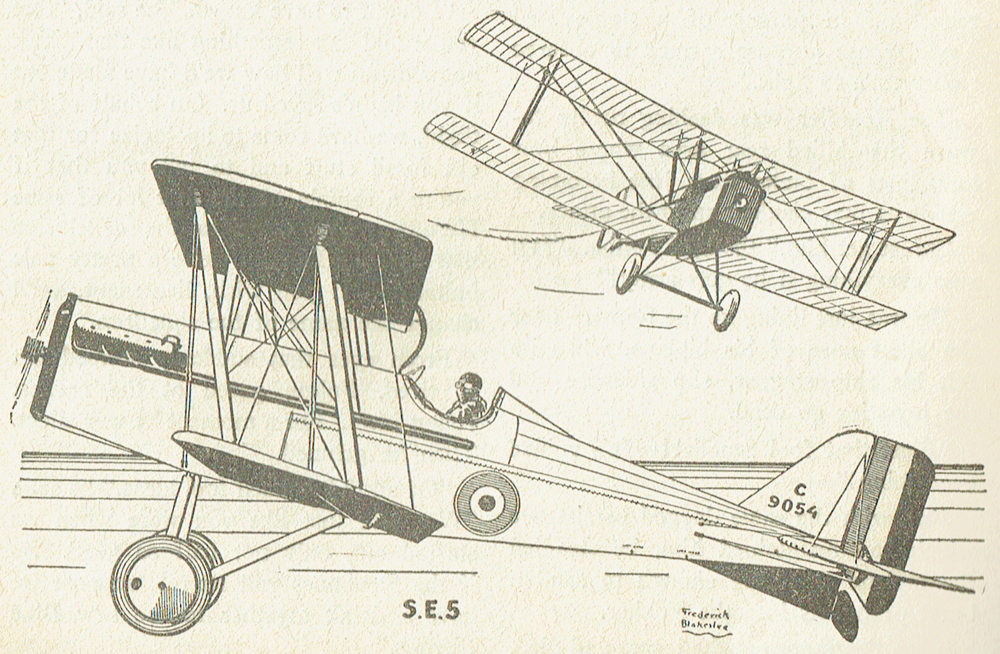
Next week the cover of BATTLE ACES will show a Pfaltz, attacking a D.H.9 which First Lieutenant S.C. Alexander of the 99th Aero Squadron is piloting. The OCTOBER number will show First Lieutenant R.O. Linsay in an S.E.5 fighting a flock of Fokkers. Others in the series will be announced later. The present cover is the third in the series. Last month we featured the B.E. Fighter, and the cover of the June issue showed a flight of S.E.’s attacking a Boche balloon.

“The Sky Raider Pt15″ by Donald E. Keyhoe

Link - Posted by David on December 31, 2014 @ 12:00 pm in

Continuing with Donald E. Keyhoe’s The Sky Raider, a serialized novel from 1929. A lot has happened. In the last installment . . .

    With Carmichael’s help, Dick manages to catch Perez, but the line-chief refuses to talk. In an effort to loosen his lips, Dick takes Perez up in his plane and puts it through every heart-stopping trick he can think of. In the end Perez begs to be put down saying he will talk. He admits to sabotaging Lawson’s gas-gauge, but will not name any of his co-conspirators. Dick does get Perez to sign a confession that he hopes will be enough to free Old Man Rand. Dick dashes off to Starkville with the confession…

Will Dick get there in time with Perez’s confession? Who helped Perez kill Lawson and steal the Federal Reserve money? Find out who really killed Lawson and masterminded the plan to steal the money in the final installment of Donald E. Keyhoe’s The Sky Raider!

or

“No Fuelin’!” by Joe Archibald

Link - Posted by David on December 30, 2014 @ 12:00 pm in

“Haw-w-w-w-w!” You heard right! That marvel from Boonetown, Iowa is back to square off against the Mad Butcher of the German Air Corps—Hauptmann Heinz, but not before getting even with the guys at the Ninth for all the razzing he’s been getting lately.
Wilson found a green snake in his bed. Bump Gillis had an unhappy visit from a snapping turtle. And Captain Howell sat up until three a.m. digging iron filings out of the soles of his feet. The boys had been picking on Phineas—and the Pinkham revenge had begun. No foolin’!

“The Sky Raider Pt14″ by Donald E. Keyhoe

Link - Posted by David on December 29, 2014 @ 12:00 pm in

Continuing with Donald E. Keyhoe’s The Sky Raider, a serialized novel from 1929. A lot has happened. In the last installment . . .

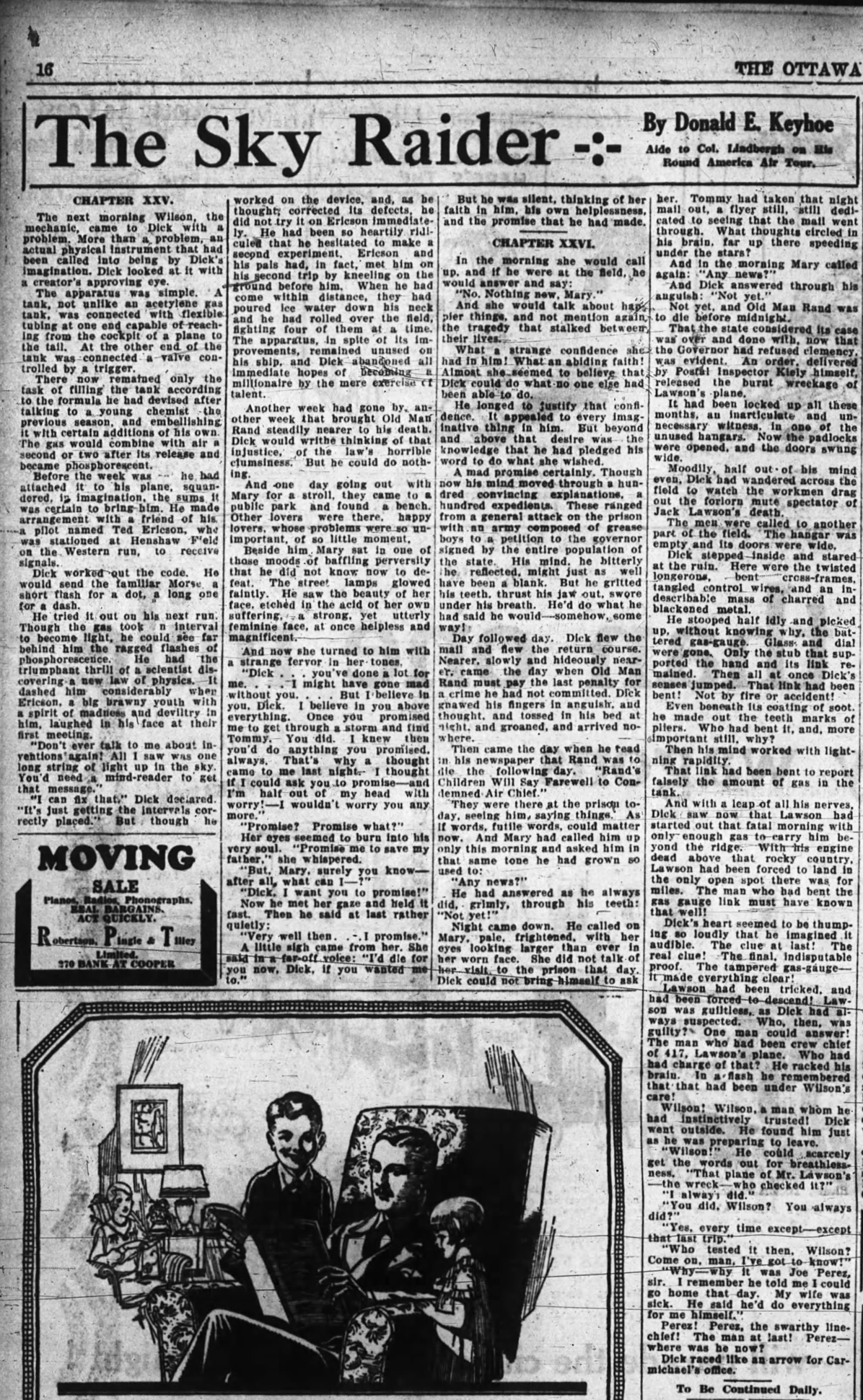
    With Wilson’s help, Dick manages to make his night-time sky-writing device a reality. Trying it out on a run to Henshaw Field, Dick finds he needs to work out the releasing interval. The news of Dick’s success does little to lighten Mary’s heavy heart. She makes Dick promiss that he will somehow free her father before his execution.
    The wreck of Lawson’s plane is released from the locked hanger it’s been stored in and Dick finds evidence of sabotage while inspecting it—the gas-gauge was crimped with pliers to give a false reading. Asking Wilson who checked over Lawson’s plane before his fateful run, Dick finds out it was the line-chief Perez…

Was it really Perez who killed Lawson? Was he working alone? And can Dick get the bottom of all this before Old Man Rand faces death that night? Find out in the fourteenth installment of Donald E. Keyhoe’s The Sky Raider!

or

And come back on Wednesday for the exciting conclusion!

“The Sky Raider Pt13″ by Donald E. Keyhoe

Link - Posted by David on December 26, 2014 @ 12:00 pm in

Continuing with Donald E. Keyhoe’s The Sky Raider, a serialized novel from 1929. A lot has happened. On Wednesday . . .

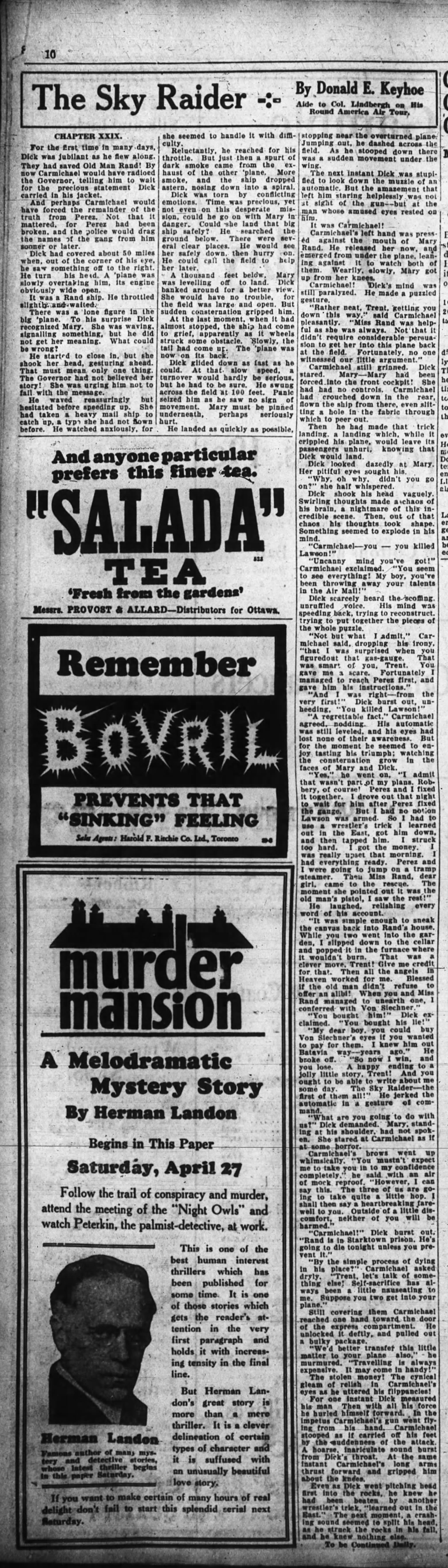
    With all hopes exhausted, the trial of Old Man Rand gets under way. Old Man Rand’s innocence is little comfort when the jury returns with a guilty verdict and the judge sentences him to death. A distraught Mary exhausts all her financial resources in trying any and every lawyer in hopes of finding an appeal that might free her father. Dick, in trying to raise some money for Mary, discusses making his night-time sky-writing invention a reality with Wilson, a mechanic at Rand Field. Excitedly he tries to tell Mary about it, but her thoughts are miles away in a tiny cell with her father…

Can Dick get his invention working? And if he does, will it prove helpful? Find out in the thirteenth installment of Donald E. Keyhoe’s The Sky Raider!

or

And come back on Monday for the penultimate installment!

“Green Horn Wings” by Frederick Blakeslee

Link - Posted by David on December 25, 2014 @ 12:00 pm in

Frederick Blakeslee painted the covers for Dare-Devil Aces‘ entire fourteen year run. He also painted all 17 covers of the first run of Battle Birds. When you’re doing all the covers, it’s easy to have a continuing story. As a special treat this week we have a three part story told over two months and two different magazines. We start with the May 1934 cover of Dare-Devil Aces and continue the story on the following month’s cover and on over to the same month’s issue of Battle Birds!

th_DDA_3405THE COVER this month illustrates one of three exciting encounters described by a German flyer in answer to the question, “What do you consider your most exciting flight?” The author’s name is withheld by request. The other two encounters will be shown on the covers of BATTLE BIRDS and DARE-DEVIL ACES for June. The following has been translated by Mr. J.J. Hermann.

“My most exciting flight? That is very easy to answer—my first front-line patrol.

“Just a word about my plane before I go on. All the ships in our staffel were painted in combinations of red, white and green, except the commander’s, which was all blue. My Albatros had red-tipped upper wings, black crosses on a white field, and the rest of the wing, fuselage and lower wing, was green. A red band encircled the fuselage, on which were black crosses. The fin and rudder were green and the elevator white. It was a beauty and I was immensely proud of it.

“Our commander, like Richthofen, was very severe with anyone who returned to the field with bullet holes in the tail of his machine. Every pilot in the staffel would rather be shot down then come home with holes in his tail.

“I received my instructions, which were to stick in formation and to follow the commander no matter what happened, unless we ran into an enemy formation. In that case, the leader was to rock his ship if he went to the attack, and I was to fly for home at once. They considered me too ‘air-blind’ to be of any use in combat. Of course, I couldn’t understand why any one should be ‘air-blind’, for certainly it would be easy enough to see an enemy plane. But I soon learned.

“I was flying close on the left of the leader, and was so engrossed with watching him that the whole enemy air force could have surrounded us without my knowing it. It was all I could do to keep my place in formation. I would throttle down when I seemed too close and then I’d get too far away and have to speed up only to get too close again. It was probably nervousness, for I had had no trouble in this respect in practice flights.

“I had been making heavy weather of it for perhaps twenty minutes when the leader suddenly dove. Ha, thought I, he is testing me. Down I went only to find that I was last in the formation. The three other planes were bunched directly in front of me. Turning to the left, I frantically tried to regain my position—and lost sight of the staffel at once. There I was as far as I could see, completely alone. The only thing was to go home, but that wasn’t so easy for I was absolutely lost. I was flying around in circles trying to locate the flight when to my surprise I found that I was again following my leader.

“It wasn’t until several hours later that I learned what had happened. When my leader dove it was to attack a lone Bre-guet. My awkward attempts to follow him disrupted the formation and spoiled his surprise move. He received a blast of fire from the French gunner, one bullet passing through his cheek and knocking out a few teeth. Then he saw me floundering around where I wasn’t supposed to be at all; breaking off the flight he picked me up and started for home.

“He looked at me to see if I saw him. I waved—I was determined not to lose him this time—and he began to climb, passing through clouds that covered what had been a cloudless sky. A minute later, he seemed to vanish again. Again I was alone and lost. . . .”

th_DDA_3406“I THOUGHT I knew what had happened. My leader had executed these sudden maneuvers to test me—and I had failed. I determined to be on the alert next time.

“When I saw him go into another dive, therefore, I followed—and a split second later found myself alone again! Finally, after a frantic search, I spotted his Alba-tros high above me. Wondering how he got so high while I was flying so low, I climbed up and took my old position in the formation. This time my leader did not look at me, and a few minutes later we landed at our drome.

“To my surprise no other ships were on the tarmac. We were the first to return. With a sigh of relief at being safely home, but dreading the lecture on formation flying which I knew I deserved, I jumped out of my Albatros. It was then I realized that several men were lifting my leader out of his cockpit. Rushing over I was amazed to see that his face was covered with blood!

“The whole flight had been one surprise after another; but two more were still to come. One occurred a few minutes later when I discovered that the tail of my ship was full of bullet holes! How had they gotten there? While I was trying to figure that puzzle out, one of my missing patrol mates landed and handed me the second surprise by explaining what had happened during the short time I was in the air.

“After describing our encounter with the Breguet (pictured on last month’s cover) he went on. It seemed that my leader, seeing me floundering around instead of flying home and realizing I was a cold meat shot, broke off the flight, picked me up and started for home.

“A minute later an S.E. 5 hurtled straight through our formation. This was when I lost sight of my leader for the second time. The S.E.5 shot through like a mad comet, neither turning right or left, but blazing away with its guns. It is this amazing act of daring that Mr. Blakeslee has painted for the present issue of DARE-DEVIL ACES.

“One of our patrol was shot down th_BB_3406in control and another started in pursuit. The three of us that remained were almost home when we ran into a formation of Salmsons (see June BATTLE BIRDS cover). The leader of this flight shot down another one of our planes—also in control, luckily. The pilot returned two days later. The man shot down by the S.E.5 had to land in enemy territory and was taken prisoner.

“Did I escape a lecture for getting my tail shot full of holes? By the time my leader was out of the hospital I had brought down my third enemy ship—but I got the lecture just the same!”

The Story Behind The Cover
“Green Horn Wings: The Story Behind The Cover” by Frederick M. Blakeslee (May 1934)

The Story Behind The Cover
“S.E.5 Hell: The Story Behind The Cover” by Frederick M. Blakeslee (June 1934)

Check back again. We will be presenting more of Blakeslee’s Stories behind his cover illustrations. This feature will move to Mondays starting in the new year when we will be featuring some of Mr. Blakeslee’s covers for Battle Aces!

“The Sky Raider Pt12″ by Donald E. Keyhoe

Link - Posted by David on December 24, 2014 @ 12:00 pm in

Continuing with Donald E. Keyhoe’s The Sky Raider, a serialized novel from 1929. A lot has happened. On Monday . . .

    With some hesitation, Lois Hamilton provides an alibi for Tommy Rand, saying he was with her the night before the murder leaving late the next day. After some thought on the matter, Tommy realizes where his father was the morning in question and why he won’t tell anyone. Tommy believes his father was at von Siechner’s gambling establishment on the edge of town looking for him. Dick, Tommy and Mary head there. Von Siechner describes their father as having been there, but when he’s questioned by the police, he doesn’t recognize Old Man Rand!

Is there any hope for Old Man Rand? And what is the cruel fate that follows him? Find out in the twelfth installment of Donald E. Keyhoe’s The Sky Raider!

or

And come back on Friday for the next installment!

“Hose de Combat” by Joe Archibald

Link - Posted by David on December 23, 2014 @ 12:00 pm in

“Haw-w-w-w-w!” You can almost hear his insane gaffaw echo through your skull while you read it. Yes, we’re back with another of Joe Archibald’s Phineas “Carbuncle” Pinkham mirthquakes to lighten your holidays. This time from the May 1934 issue of Flying Aces. As always, Phineas gets himself in a tight pickle and once again manages to get out of it and get the upper hand on the “Vons.”

Lieutenant Phineas Pinkham was in a sling. Oh, yes, we know that’s nothing new—but wait a minute. This time he’d dropped a couple of bombs right on the domes of the A.E.F. on his own side of the lines—and it didn’t look like an accident.

“The Sky Raider Pt11″ by Donald E. Keyhoe

Link - Posted by David on December 22, 2014 @ 12:00 pm in

Continuing with Donald E. Keyhoe’s The Sky Raider, a serialized novel from 1929. A lot has happened. The story so far . . .

    Dick Trent, novice in the Air Mail Service, incurs the displeasure of Carmichael, Superintendent of Rand Field, when he flies through the Rocky Mountains in a blinding snowstorm to bring back young Tommy Rand, who is stranded in a drinking in gambling haunt. Old Man Rand, owner of the field, beloved by his men, thanks Dick. Mary Rand, his beautiful daughter, is also greatful to Trent.
    The next day in a spectacular flight, Dick sweeps alongside Mary’s disabled machine in midair and saves her from a fatal crash. They express their Love and Dick is happily thinking of the future as Lawson, his buddy in the service, tells him he is leaving to marry a beautiful blonde. On his last flight Lawson’s plane goes missing. Dick, in searching the country, comes across the burned plane and Lawson’s dead body. A package containing $25O,OOO in government gold is missing. The only clue to the crime is a heavy Luger pistol used to club Lawson’s skull. Mary recognizes the pistol as her father’s.
    Old Man Rand, questioned, admitted giving the pistol to Lawson. He refuses, however, after talking tto his son, Tommy, who has been missing again, to account for his actions during the ealy morning hours when the crime was comitted. When the charred money bag is found in his own furnace Rand is arrested for murder. Dick, along with the other men of the service, is dejected. They all love the old man and know he is innocent. Mary, in hysterics, turns away from Dick, attributing her father’s arrest to the pistol he found.
    After his next run, Dick sets out to visit the old man in jail, but Rand insists he is willing to pay the penalty. Returning, Dick meets Mary, who asks his forgiveness. Dick takes her in his arms and the two vow to solve the murder mystery to clear her father.
    Suspicious of Carmichael, Field Superintendent, who knew of the gold shipment, Dick is later convinced of his innocence, when he intimates Lawson’s connivance. Dick recalls Lawson’s blonde fiancee. With her initials for a clue they learn she left for Hawaii. Jumping into a plane Mary and Dick come to greif in a field. Continuing by train they locate the girl, Dorothy Curtis, who angrily accuses Mary as the daughter of her fiancee’s murderer. Mary assures her of her father’s innocence. Asked to help solve the mystery the blonde mentions a mysterious man who talked of money and left a flask in Lawson’s room. It belonged to Tommy Rand. Accused by Mary he denies guilt of Lawson’s murder, giving Mrs Hamilton as his alibi. Mary calls her up…

Will Mrs. Hamilton give Tommy an alibi? How will this help Dick and Mary in their efforts to clear Old Man Rand? Find out in the eleventh installment of Donald E. Keyhoe’s The Sky Raider!

or

And come back on Wednesday for the next installment!

“The Sky Raider Pt10″ by Donald E. Keyhoe

Link - Posted by David on December 19, 2014 @ 12:00 pm in

Continuing with Donald E. Keyhoe’s The Sky Raider, a serialized novel from 1929. A lot has happened. In Wednesday’s installment . . .

    Dick and Mary are looking for Lawson’s fiancee. With her initials for a clue they learn she left for Hawaii. Jumping into a plane, Mary and Dick come to greif in a field. Continuing by train they locate the girl, Dorothy Curtis, who angrily accuses Mary as the daughter of her fiance’s murderer!

Will Dorothy help Dick and Mary in the efforts to clear Old Man Rand? And what does Tommy have to say for himself and his missing time that fateful morning? Find out in the tenth installment of Donald E. Keyhoe’s The Sky Raider!

or

And come back on Monday for the next installment!

“Hell Divers” by Frederick Blakeslee

Link - Posted by David on December 18, 2014 @ 12:00 pm in

Frederick Blakeslee painted all the covers for the entire run of Dare-Devil Aces. And each of those covers had a story behind it. This time the story is self evident Blakeslee tells us, but then turns around to tell us the story behind his cover for the prvious December’s issue of Battle Birds and ties our old pal, French Ace Georges Guynemer. All this in February’s cover form 1934—”Hell Divers!”

th_DDA_3402WE ARE not going to write a story behind the cover this month. It seems to us that the story is told right there on the cover. You see three Spads doing what Spads did best, and you can visualize the mix-up that followed at the end of their dive. The Fokkers have spotted the Spads and are breaking formation to meet the onrush. Who got the best of the scrap? Well, we’ll let you figure that one out. The Spads all belong to the Lafayette Escadrille, and as that was a hard fighting outfit, its safe to say that they did some damage and then escaped. Note the markings on the ships. The Spad in the foreground carries the mark of the 97th squadron, that on the left the 112th, and on the right the 77th.

Now that we have told you that, perhaps it would be a good time to discuss another Spad, not only because of its unusual history (which we think will interest you) but also to correct some impressions of it.

th_BB_3312It appeared on the cover of the December issue of BATTLE BIRDS. The scene is a close-up of a Spad looking forward from just behind the cockpit. We have been told that it should have had two machine guns, that—well anyway, it was all wrong! Now it may surprise our critics to know that the Spad on the cover was painted from an actual ship. The ship is right here in America and has been seen by thousands, so ten chances to one you have seen it too.

The ship is a Spad 7, one of the earliest types put out under the Spad name and made famous by Guynemer. Guynemer’s ship, which is in the Invalides in Paris, and which we have examined, is a Spad 7, These ships were the first to get the synchronizing attachments added to them; at that time only one gun was being put on a ship. It was not until later that French ships began using the twin mounting.

Now for the history of the ship shown on Dec. Battle Birds. Thousands saw it do a spectacular crack-up some years back—in the movies! Its war-time history has not been handed down, but Paramount purchased it in 1924 for the then proposed picture “Wings.” It was one of several purchased and it was in A-l flying condition.

If you remember the picture, you can not fail to recall the scene of the memorable crash, when Armstrong’s plane (Richard Arlen) was shot down by a German and landed in German wire. Dick Grace, doubling for Richard Arlcn, flew the ship and was supposed to crack-up the plane in the wire. The wire had been cleverly faked by using ordinary knitting wool with balsa wood posts. The spot was marked so Dick Grace would land there. But he overshot and landed in the real wire, causing the broken neck from which he suffered for many months.

The Spad landed upside-down and was a complete wash-out. Only the badly damaged fuselage remained. Since then, time and souvenir hunters have done their work, but at last it has been rescued from oblivion and is being restored. It will eventually have a resting place in the Jarrett War Museum, where, if you are in Atlantic City, you may see it.

The Story Behind The Cover
“Hell Divers: The Story Behind The Cover” by Frederick M. Blakeslee (February 1934)

Check back again. We will be presenting more of Blakeslee’s Stories behind his cover illustrations.

« Previous PageNext Page »