Looking to buy? See our books on amazon.com Get Reading Now! Age of Aces Presents - free pulp PDFs

C.B. Mayshark and Flying Aces

Link - Posted by David on May 4, 2018 @ 6:00 am in

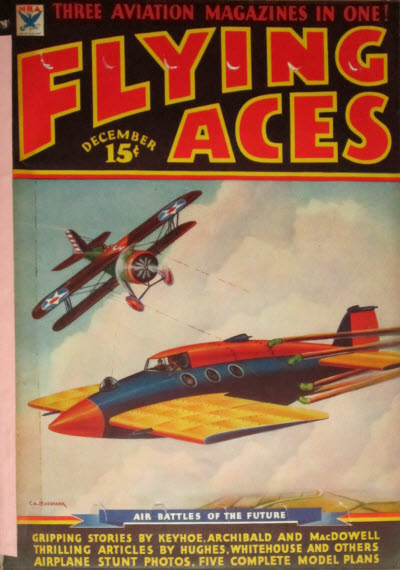
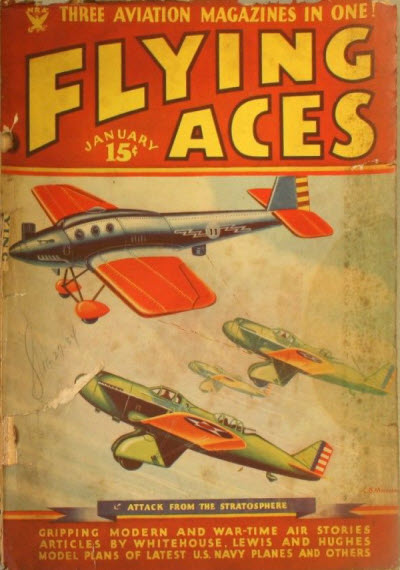
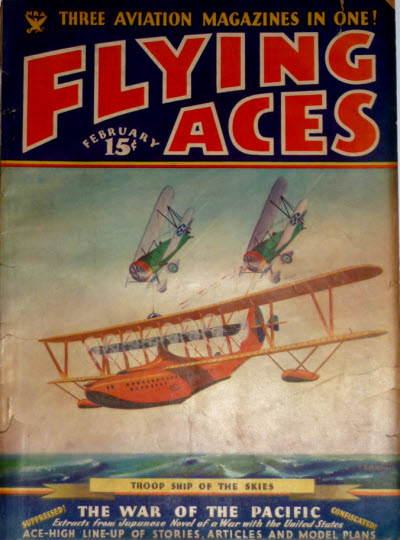
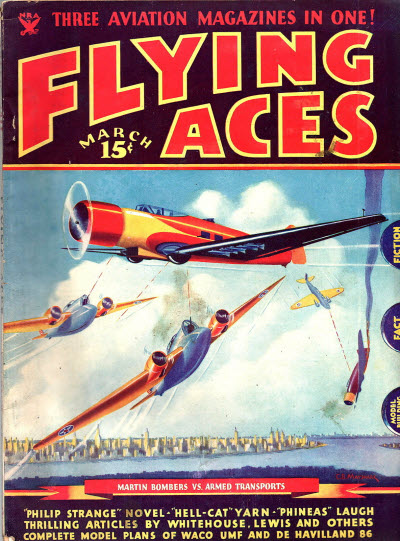
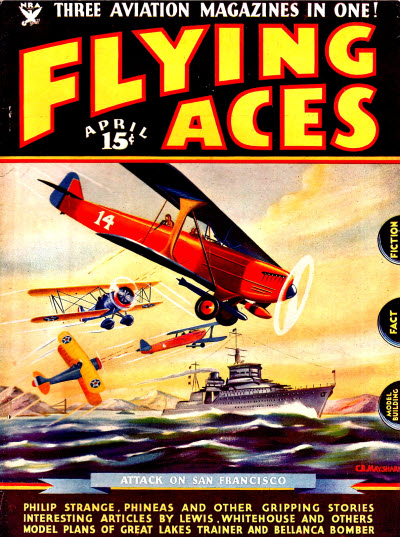
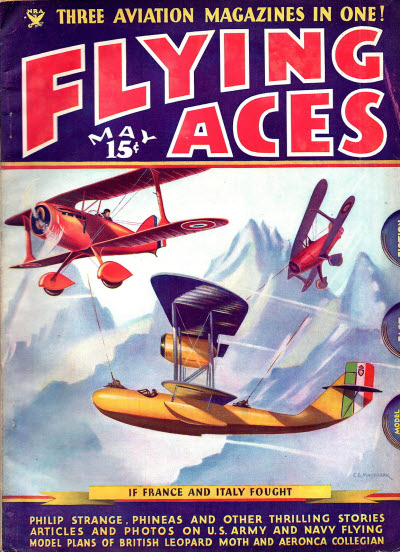
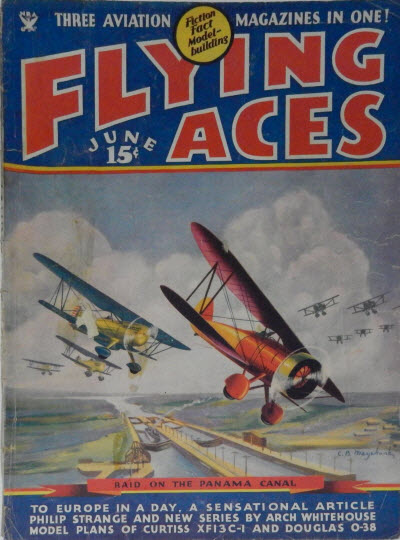
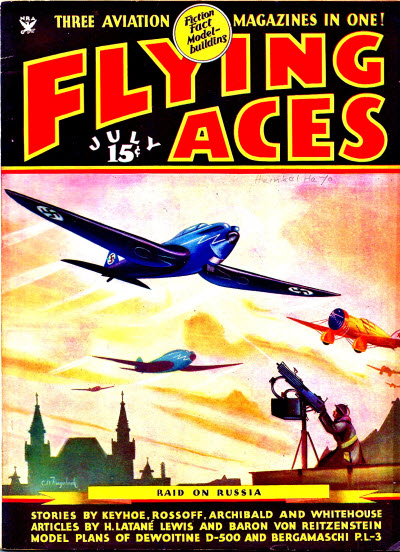
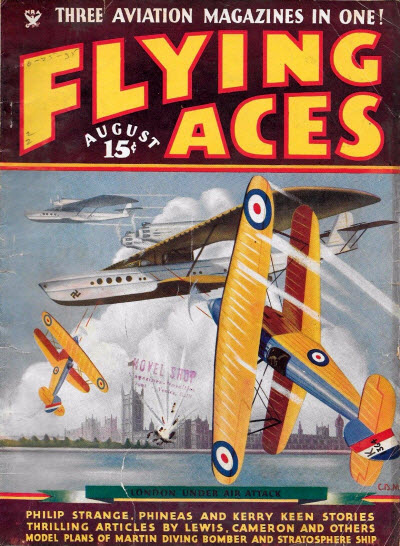
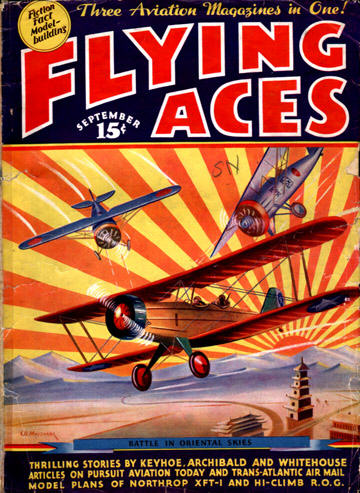
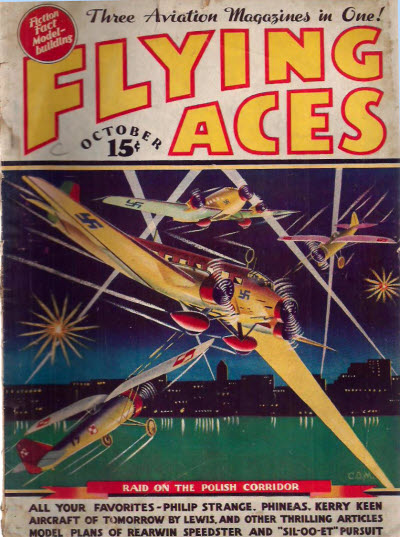
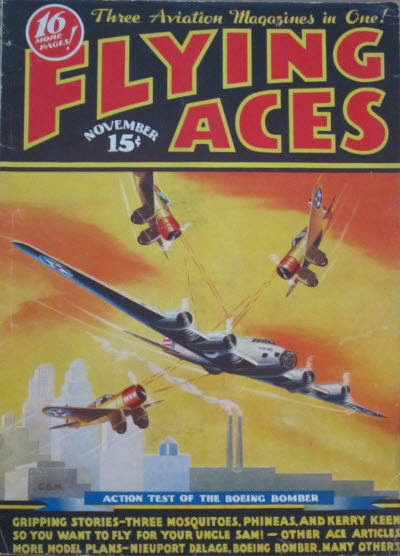
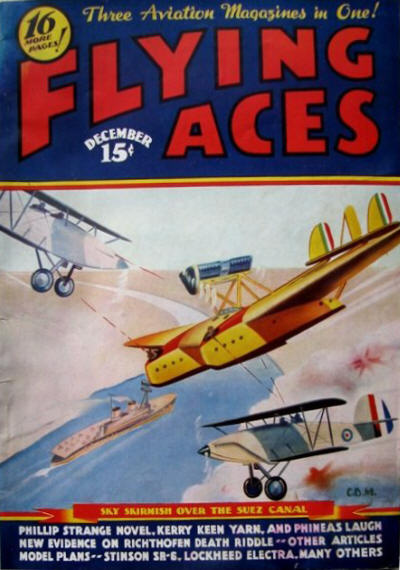
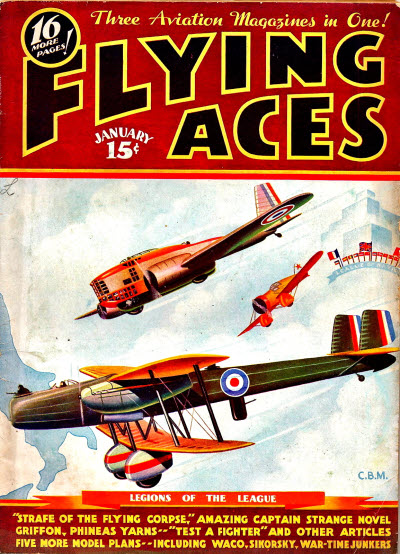
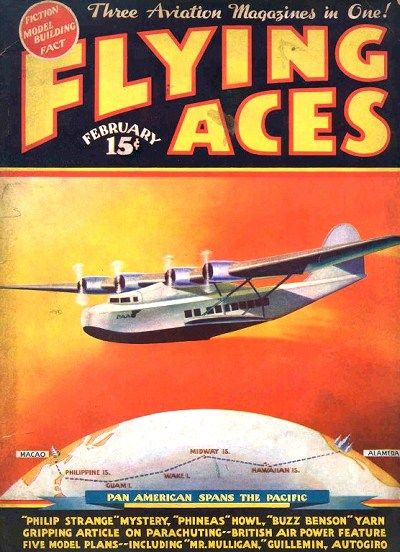
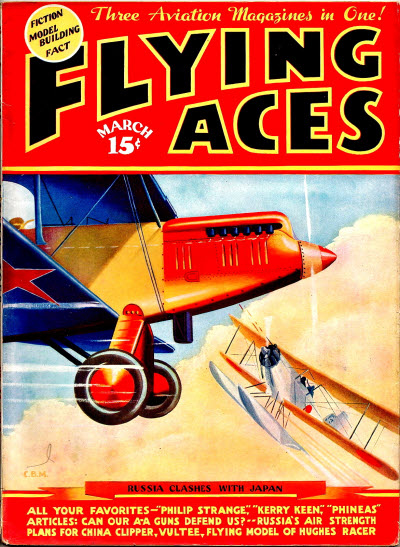
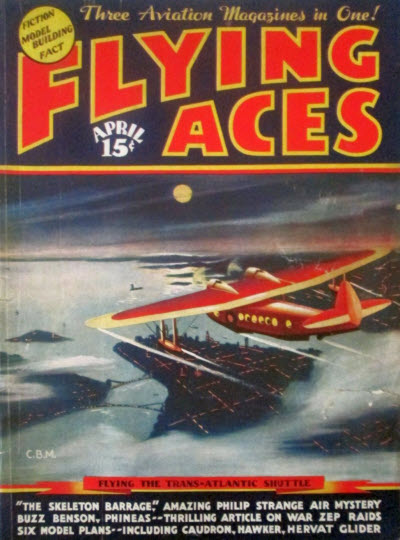
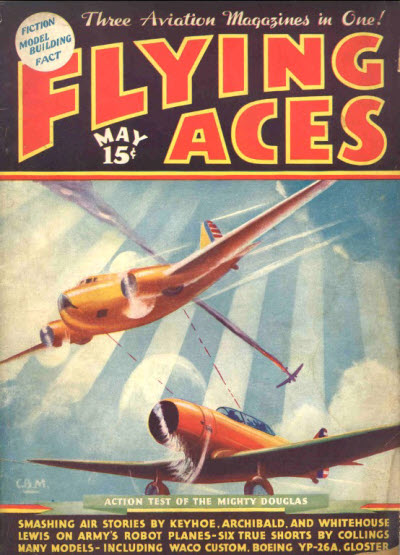
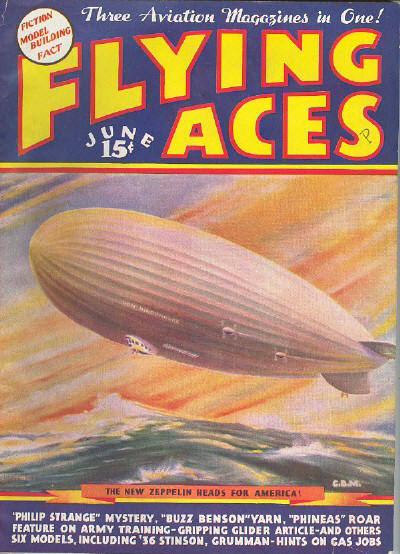
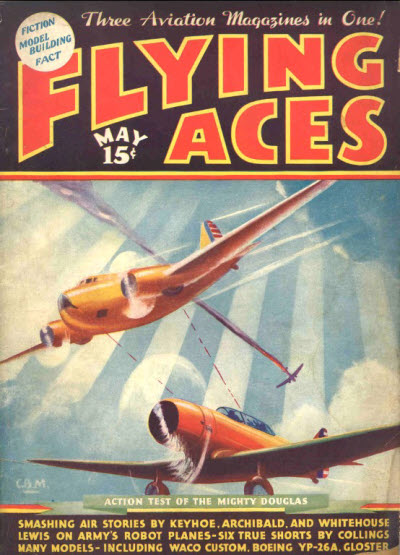
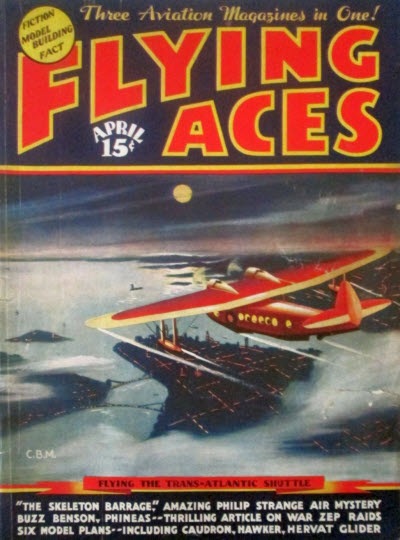
THIS May we’re celebrating the genius that is C.B. Mayshark! Mayshark took over doing the covers for Sky Birds with the July 1934 and picked up Flying Aces with the December 1934 issue. He would continue with Sky Birds until its final issue in December 1935 and Flying Aces through to the June 1936 issue.

1934


December
1935


January


February


March


April


May


June


July


August


September


October


November


December
1936


January


February


March


April


May


June


“How The Aces Went West: Captain Albert Ball” by C.B. Mayshark

Link - Posted by David on May 2, 2018 @ 6:00 am in

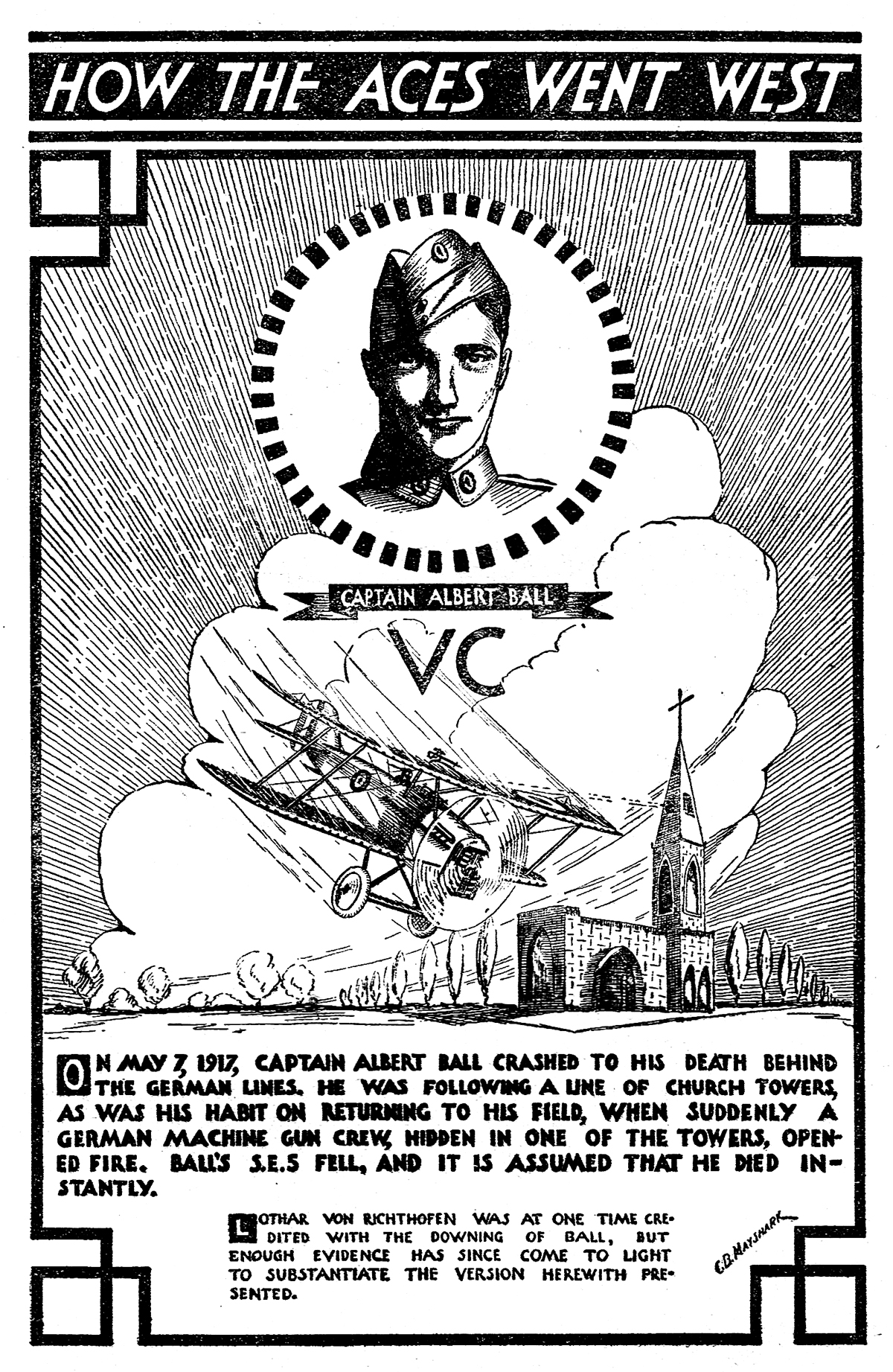
THIS May we’re celebrating the genius that is C.B. Mayshark! Along with his cover duties for Sky Birds and Flying Aces in the mid-thirties, Mayshark also contributed some interior illustrations including a series he started in the April issue of Sky Birds that would run until the final issue that December—How The Aces Went West! It was an informative feature that spotlighted how famous Aces died. For the inaugural installment from the April 1935 issue of Sky Birds, Mayshark gives us “How The Aces Went West: Captain Albert Ball!”

How The Aces Went West
“How The Aces Went West: Captain Albert Ball

by C.B. Mayshark (Sky Birds, April 1935)

May is Mayshark Month!

Link - Posted by David on May 1, 2018 @ 6:00 am in

THIS May we’re celebrating the genius that is C.B. Mayshark! On Mondays we’ll be exploring his combat maneuver covers he did for Sky Birds in 1934; Wednesdays bring his “How The Aces Went West” feature from 1935 issues of Sky Birds; and Fridays bring his covers from Flying Aces (1934-1936) and a story attributed to him from Dare-Devil Aces!

We featured his first Sky Birds cover yesterday to get the month rolling a day early. Today we have a bio of the man from Age of Aces’ resident art historian, David Saunders. Saunders’ Field Guide to Wild American Pulp Artists is an excellent site profiling any pulp artist and illustrator you can think of. Here is his entry for C.B. Mayshark:

CASIMIR B. MAYSHARK
(1912-1978)

CASIMIR BENTON “DUKE” MAYSHARK was born Casimir Mieczyslaus Mayshark, Jr., on January 3, 1912 in Sacramento, California. His father, Casimir Mieczyslaus Mayshark, was born in 1881 in Poland and came to the U.S. in 1893 and settled in San Francisco, California.

The family name Mayshark is an English transliteration of the Polish name in the Cyrillic alphabet, so U.S. immigration officials had to assign approximate phonetic equivalents. Other members of the same family who came to the U.S. were assigned various names of similar sounds, such as “Maycherczyk,” “Marzajek,” “Majchrzak,” and “Mazureck.”

The father was a commercial artist in the advertising industry of San Francisco. It was the father’s second marriage, the first one having ended unhappily, after he deserted his wife and two sons in Missouri.

The mother, Oreon Gracie Page, was born in 1875 in Mississippi, so she was six years older than her husband. She was also and artist. She designed and decorated Art Nouveau china. It was also her second marriage, the first one having ended after one year, when her husband, Percy Frank Wilson (1878-1906), the city editor of the Memphis News Scimitar, died of typhoid fever on January 15, 1906. After his death she lived with her parents in El Paso, Texas, where she operated a private art school.

In 1908 she advertised her classes in the local newspaper. By 1910 she had moved to Los Angeles, California, where she met and married Casimir Mieczyslaus Mayshark on May 7, 1910. They had two children, Casimir Mieczyslaus Mayshark, Jr., (b.1912), and his younger brother, James Page Mayshark, born June 5, 1913. The family lived at 278 29th Avenue in San Francisco.

On May 25, 1913 The San Francisco Call reported in the Art Notes column by Porter Garnett, “Casimir M. Mayshark has recently shown a landscape at the Bohemian Club. This is the first easel picture that Mr. Mayshark, who has specialized in scenic decoration in European and Eastern theaters, has exhibited here. It arrests the attention immediately by its personal quality, its quietness and its altogether delightful color.”

In 1913 the San Francisco Sketch Club organized a poster contest to commemorate the city’s patron saint, Saint Francis. On November 1, 1913 The San Francisco Call published the results of the contest. Casimir M. Mayshark was listed as an entrant but failed to win the $500 prize, which went to the NYC artist Adolph Treidler (1886-1981).

In 1914 Casimir M. Mayshark, with his wife and two sons, moved to El Paso, Texas, where they lived with the mother’s family and the father worked as a manager of the Tuttle System outdoor advertising agency.

In 1915 Casimir M. Mayshark, with his wife and two sons, moved to the East Coast to pursue his career as a Commercial artist in New York City. The family lived at 24 Van Dyke Place in Summit, New Jersey. The father commuted by ferry boat to NYC, where he worked as a freelance commercial artist.

On September 12, 1918 during the Great War Casimir M. Mayshark registered with the draft board. He listed his occupation as Poster Designer. He was recorded to be of medium height, slender build, with blue eyes and brown hair. He was thirty-six, married and supporting two young sons, so he was not selected for military service.

In 1919 the father deserted the family and was never heard from again. Casimir, Jr., was age seven and James was age six. After the marriage was legally dissolved, Casimir Mieczyslaus Mayshark, Jr., was renamed Casimir Benton Mayshark.

The mother and two sons moved to Chatham, New Jersey, where they lived at 222 Hillside Avenue. She supported the family as a commercial artist designing decorative wall paper for a manufacturer.

The father had moved to Atlantic City, NJ, where he worked as a sign painter.

On September 15, 1920 Casimir M. Mayshark addressed the 11th Annual Convention of the Outdoor Advertising Association, held in Cleveland, Ohio. His lecture topic was “Color in Outdoor Advertising.”

In 1925 Casimir M. Mayshark married his third wife, Jesse Whitney. She was born in 1889 in New Hampshire. They lived with her brother’s family at 54 Turner Street in Boston, Massachusetts, where he worked as an Interior Decorator. They had two children, Cyrus, born August 3, 1926, who grew up to become an author, and Mary, born May 5, 1928, who grew up to become Mrs. Mary Mayshark Perkins.

In 1929 the father, Casimir M. Mayshark, lived with his third wife and two children at 54 Conant Street in Roxbury, MA, but the following year he again deserted his third wife and two children, after which that marriage was legally dissolved.

In June of 1930 Casimir Benton “Duke” Mayshark graduated from Chatham High School. He had always liked to draw, but by high school he had become interested in a career as a commercial artist.

In 1931 he attended the University of Alabama, where he completed his freshman year. The Great Depression brought hard times to most American families, which made college difficult to afford. By 1932 his younger brother, James Mayshark, had graduated high school with a promising record in football and a dream to play in college, so Casimir Benton “Duke” Mayshark entered the work force instead of returning to Alabama after his freshman year. His brother became a star player with the Mountain Hawks of Lehigh University in Bethlehem, PA.

In 1932 C. B. Mayshark began to work as a commercial artist in NYC publishing and advertising. He attended night school art classes at the Art Students League at 215 West 57th Street, where his best teacher was Morris Kantor (1896-1974).

In 1934 C. B. Mayshark painted covers for the pulp magazines Sky Birds and Flying Aces. He also drew pen-and-ink interior story illustrations for these two titles. In addition, he wrote several descriptive articles about his cover paintings, which were featured inside the magazines. He signed his work for pulp magazines “C. B. Mayshark” and “C.B.M.”

The 1940 NYC Business Directory listed the art studio of C. B. Mayshark at 15 West 51st Street, between Fifth and Sixth Avenues.

In 1941 he was hired as a staff artist at the James M. Mathes Advertising Company in the prestigious Chanin Building, at 122 East 42nd Street, where Street & Smith, Ideal Publishing, and Decker Publications also had offices. While working at the advertising company he met Helen Lucille Dunaway. She was born December 30, 1919 in Yonkers, New York, and was a graduate of Smith College. She worked as a clerical secretary at J. M. Mathes.

By 1941 his estranged father, Casimir M. Mayshark, had moved to San Diego, California, where he worked as a draftsman for the Simpson Construction Company at the San Diego Naval Training Station. He lived in a lodging house at 432 F Street.

In 1943 Casimir Benton Mayshark was drafted. Before entering service he married Helen Lucille Dunaway. They eventually had three children, Joseph (b.1944), Cassandra (b.1946), and Sanford (b.1951). The family lived in Forest Hills, Queens, NY.

During WWII C. B. Mayshark served as a Second Lieutenant in the Army Air Corps, 17th Bomber Wing, Second Air Corps, Radio Division. He was stationed at an air base in Idaho, where he painted a mural in Building 23 of the air base. He was not sent overseas.

His younger brother, James P. Mayshark, served as a Captain in the Army Tank Corps and was wounded in North Africa.

On 1943 nationwide newspapers covered the poignant story of his mother, Mrs. Oreon Page Mayshark, and her remarkable experience as she sat in a Times Square movie theater and watched a wartime newsreel with dramatic battle scenes, and suddenly recognized her son as he was wounded in combat.

After the war, C. B. “Duke” Mayshark started Mayshark & Keyes Advertising Art Company with a partner, Bill Keyes. The company grew successful during the post-war years.

His brother, James P. Mayshark, became a salesman of Pneumatic tools and moved to Buffalo, NY.

In 1950 C. B. Mayshark sold his share in the business to his partner and retired to Santa Fe, New Mexico, where he designed and build the family home.

In 1952 he was appointed Director of the New Mexico State Tourist Bureau, of the State Department of Development, under Governor Ed Mechem.

In 1954 that political appointment ended, after which C. B. Mayshark started Mayshark Lithographing Company, which printed jobs for the public, but also won contracts to print posters for the New Mexico State Tourism Bureau.

In 1962 Casimir B. Mayshark’s mother, Oreon Gracie Page Mayshark, died at the age of eighty-seven in Santa Fe, where she had lived with the family.

In 1962 C. B. Mayshark closed the printing company when he was appointed Administrative Assistant for New Mexico Governor Jack Campbell.

In 1964 C. B. Mayshark became Executive Secretary to the Governor of New Mexico, in charge of Promotion of Business and Tourism with national advertising campaigns, New Mexico Magazine, and the organization of the New Mexico State Exhibition at the 1964 World’s Fair in NYC.

The father, Casimir Mieczyslaus Mayshark, returned to San Fransisco, where he lived at 715 Clementina Street, and continued to work as a Commercial Artist, until he died at the age of eighty-four on November 5, 1965.

In 1966 C. B. Mayshark was the Director of the New Mexico Department of Development.

In 1968 C. B. Mayshark retired from New Mexico State politics and concentrated on making art. His work was exhibited at the University of New Mexico, St. John’s College in Santa Fe, and the University of Hawaii.

C. B. “Duke” Mayshark (age sixty-six) and his wife, Helen Lucille Mayshark (age fifty-eight), were fatally injured in an automobile accident in Albuquerque, NM, on September 28, 1978.


David Saunders included many photos and illustrations in his entry for C.B. Mayshark on his site. Please check them out and come back frequently this month for more from C.B. Mayshark!


© 2015 David Saunders. David Saunders is the son of pulp artist Norman Saunders and an artist himself. The above article is from David’s website A Field Guide to Wild American Pulp Artists and is used with his kind permission.


“Sky Birds, July 1934″ by C.B. Mayshark

Link - Posted by David on April 30, 2018 @ 6:00 am in

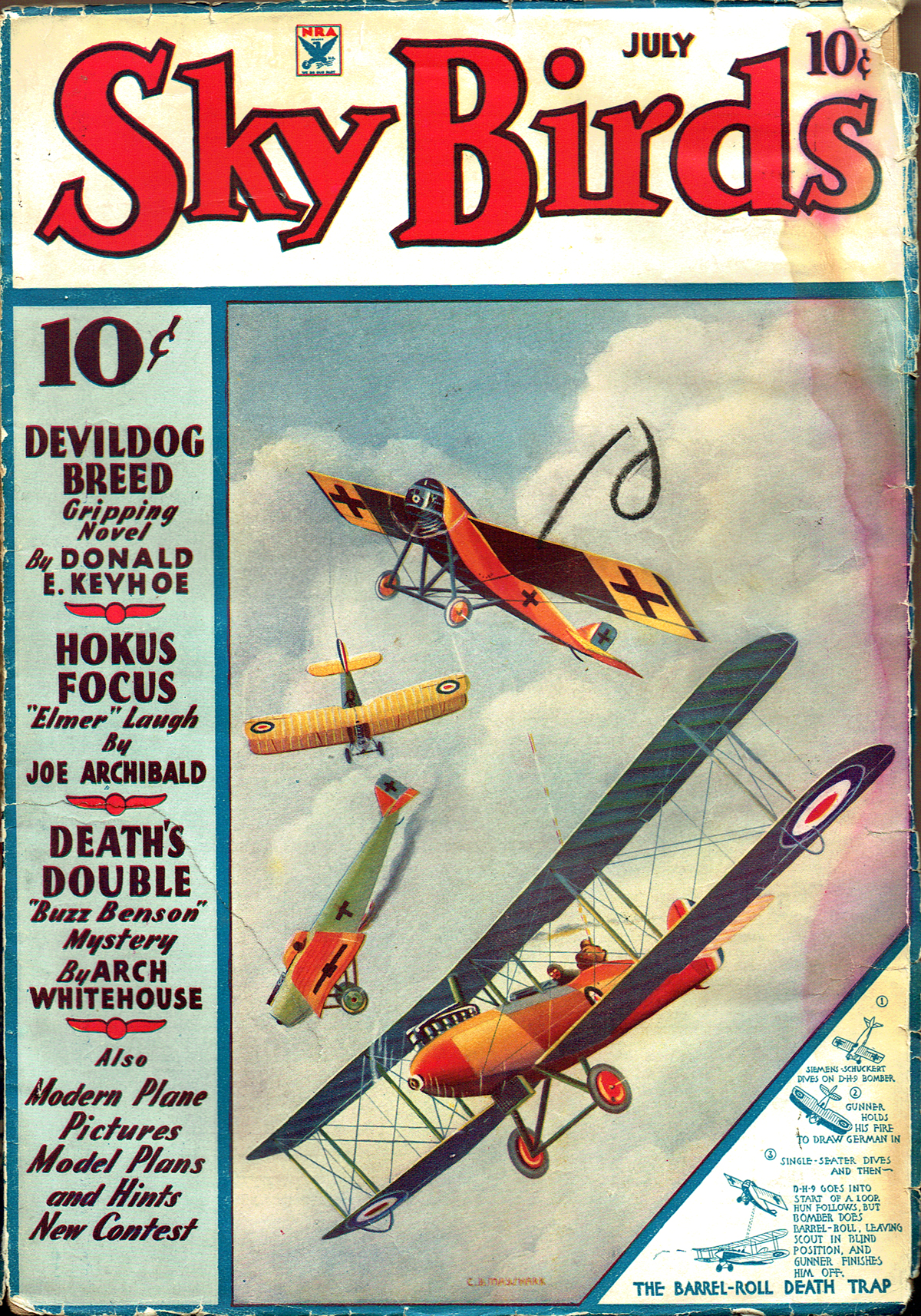
THIS May we’re celebrating the genius that is C.B. Mayshark and we’re getting things rolling a day early! Mayshark took over the covers duties for Sky Birds with the July 1934 and would paint all the remaining covers until it’s last issue in December 1935. At the start of his run, Sky Birds started featuring a different combat maneuver of the war-time pilots. The lower corner presenting a play-by-play of that month’s maneuver with the remainder of the cover illustrating it. For his inaugural issue Mayshark gives us “The Barrel-Roll Death Trap!”

Combat Maneuvers of War-Time Pilots:
The Barrel-Roll Death Trap

THE rear gunner—aerial th_SB_3407gunner to the trade—was a much misunderstood figure. Few people today realize that the R.F.C. used many noncommissioned men on their fighting ships. As a matter of fact, the R.F.C. gunner was an important figure in the victorv that the Allied aerial arm scored over the enemy.

Take this month’s fighting maneuver, for instance. Here’s a case where the rear gunner was the real brains of the action. The D.H.9 in the foreground is being piloted by an officer, but he is, at the moment, under the direct guidance of the N.C.O. gunner, who might be anything from a second-class air mechanic to a sergeant.

The case in question is the matter of maneuvers while being attacked by single-seaters. The D.H.9’s are coming home from a bombing show. They have already dropped their load on Manheim, Ghent, Gontrode, or perhaps even the submarine bases above Ostend. All they have to do now is return to the back area, where they will be picked up by the advance scouts—Camels, S.E.G’s, or Spads-who will escort them over the lines.

But in the meantime, twenty or thirty miles have to be negotiated before they can expect such protection, and from their objective back to this point, the bombers have to rely on their own ability. So far, they have managed to hold formation, but at a point about fifteen miles from the line they run into a bank of cumulus clouds and are forced to break up for safety. You can’t fly formation in cloud banks.

This break-up gives the enemy scouts their chance. They pick on the lame ducks, the ships that stray too far away from the original line of flight.

That’s where the rear gunner comes in. As the Siemens-Schuckert monoplane sweeps in for the kill, the rear gunner taps the pilot on either side of the shoulder to indicate which way he should turn. Then, when things get too hot, he feigns being wounded and holds his fire.

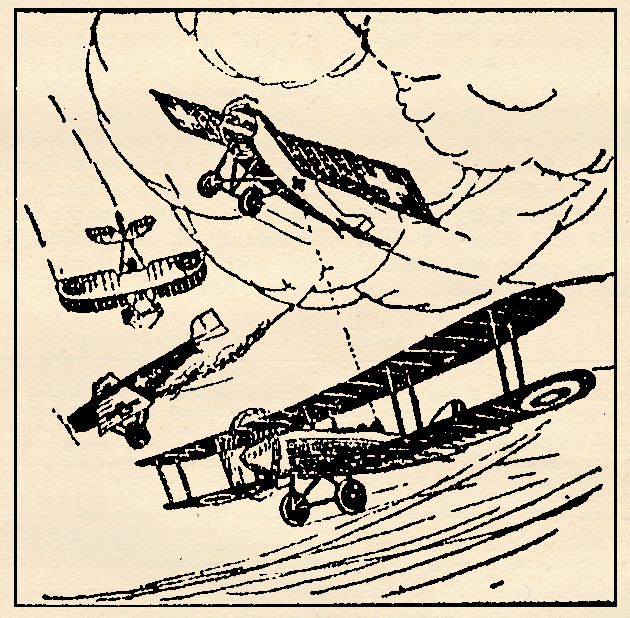
The German single-seater darts in for the final burst. Then, watching closely, the gunner signals a fake loop. The D.H.9 starts the loop and the S-S follows. But the D.H.9, gaining speed in the dive, suddenly goes into a fast barrel roll. The S-S ship continues the loop, and when her belly is shown, the rear gunner comes suddenly into action with his Lewis gun. In the loop, the single-seater is slow and offers a rare target. The gunner lets drive with all his might and plants a beautiful row in her dirty belly. A tracer finds the tank and sets her afire. The poor German, wondering where the D.H.9 went to, suddenly finds himself sitting in a blazing cockpit. The rest is history. It was the maneuvering of the gunner that brought this about—but the officer will probably get credit for the kill!

The Siemens-Schuckert shown in the picture is an unusual ship. It is a monoplane with the old Oburursal rotary, a copy of the Le Rhone, but it was fast in maneuvers. Few were flown on the Western Front, but a number were sent to Austria to combat the fast Italian Fiat chasers.

The D.H.9, one of the best two-seater bombers of the war, was powered with the B.H.P. 240-h.p. motor, a plane that was unusually suitable for fine streamlining, as seen in the nose detail. At 10,000 feet, it had a speed of 110 m.p.h. and was one of the important units of the R.F.C. in the late months of the war.

The Story of The Cover
Sky Birds, July 1934 by C.B. Mayshark
(Combat Maneuvers of War-Time Pilots: The Story Behind This Month’s Cover)

“Smells, Spells, and Shells” by Joe Archibald

Link - Posted by David on April 27, 2018 @ 6:00 am in

“Haw-w-w-w-w!” That sound can only mean one thing—that Bachelor of Artifice, Knight of Calamity and an alumnus of Doctor Merlin’s Camelot College for Conjurors is back to vex not only the Germans, but the Americans—the Ninth Pursuit Squadron in particular—as well. Yes it’s the marvel from Boonetown, Iowa himself—Lieutenant Phineas Pinkham!
Wing made a whopper in 1918! They sent America’s leading ace into the same sector with Lieutenant Phineas Pinkham, who certainly had not been a shrinking violet in the fight to save the Democrats. Morever, the war correspondents were instructed to ballyhoo the aforementioned ace at the slightest provocation. He was to be built up as the foremost Boche obliterator wearing the colors of Uncle Sam, despite the fact that Phineas Pinkham had snagged a flock of honest-to-goodness aces out of the hostile pack with the finesse of a gambler in a gold rush mining camp. Something had to happen. When two champion mauling bull elks find themselves in the same woods, all the lesser wild life move out until the battle is over!

The Yank Brass Hats made a great mistake in leading an Ace when the Boonetown Joker was still in the deck. And matters got worse when the Krauts opened up with a mile-high variety of the old shell game. Only on that last play, the Heinies forgot to look under the shell!

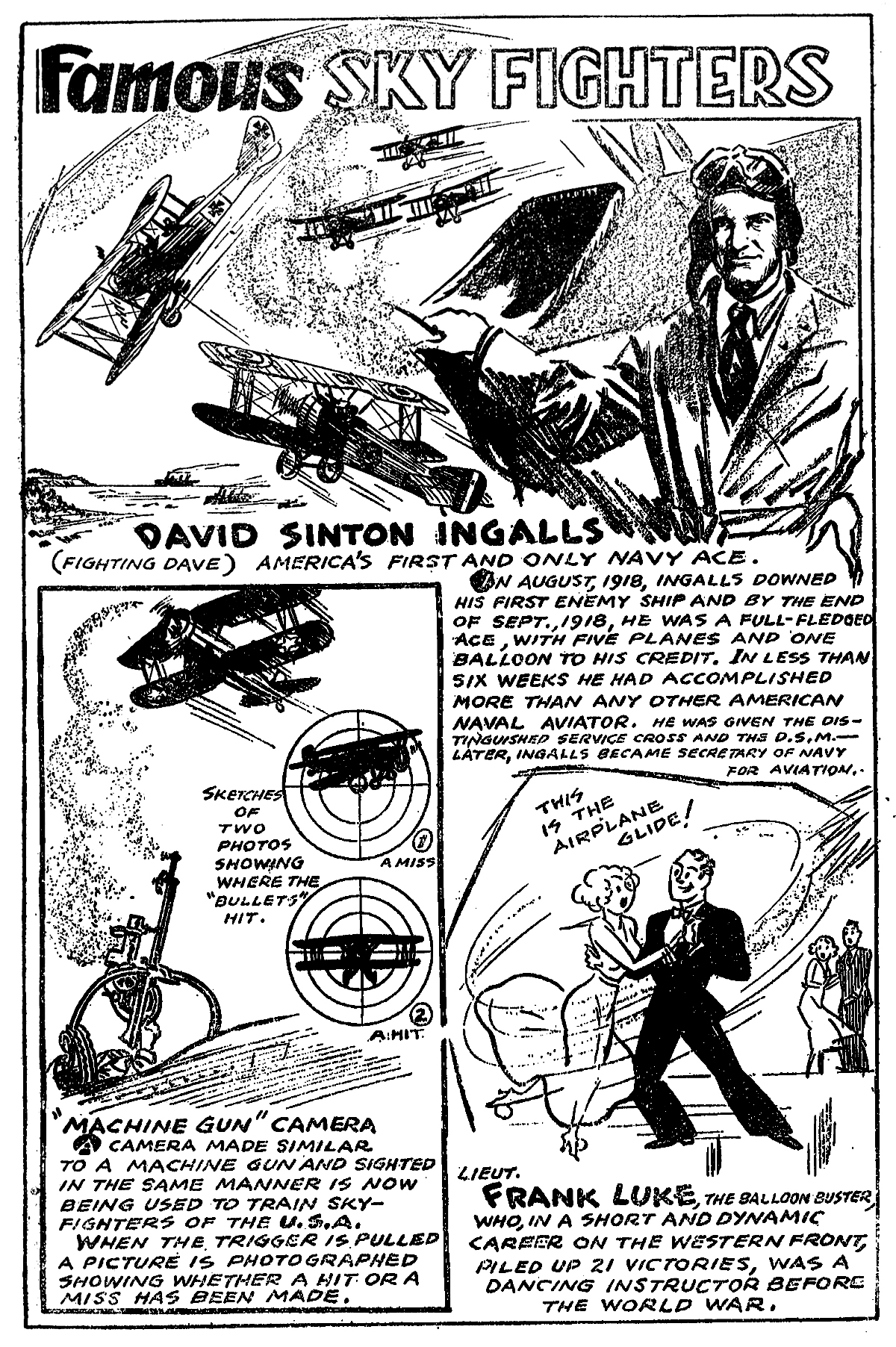
“Famous Sky Fighters, March 1934″ by Terry Gilkison

Link - Posted by David on April 25, 2018 @ 6:00 am in

STARTING in the October 1933 issue of Sky Fighters and running almost 5 years, Terry Gilkison’s “Famous Sky Fighters” was a staple of the magazine. Each month Gilkison would illustrate in a two page spread different Aces that rose to fame during the Great War.

Although Gilkison was probably better known for his syndicated newspaper work, he also provided black and white story interior illustrations for pulp magazines. His work appeared in Clues, Thrilling Adventures, Texas Rangers, Thrilling Mystery, Thrilling Western, and Popular Western. Gilkison provided similar features in a few other Thrilling Publications—there was “Famous Soldiers of Fortune” and later “Adventure Thrills” in Thrilling Adventures, Famous Crimes” in Thrilling Detective, and the fully illustrated air adventure stories of Buck Barton “The Flying Devil” in The Lone Eagle! He signed most of this work with only his initials “T.G.” to maintain a low profile and preserve his reputation as a syndicated newspaper cartoon artist.

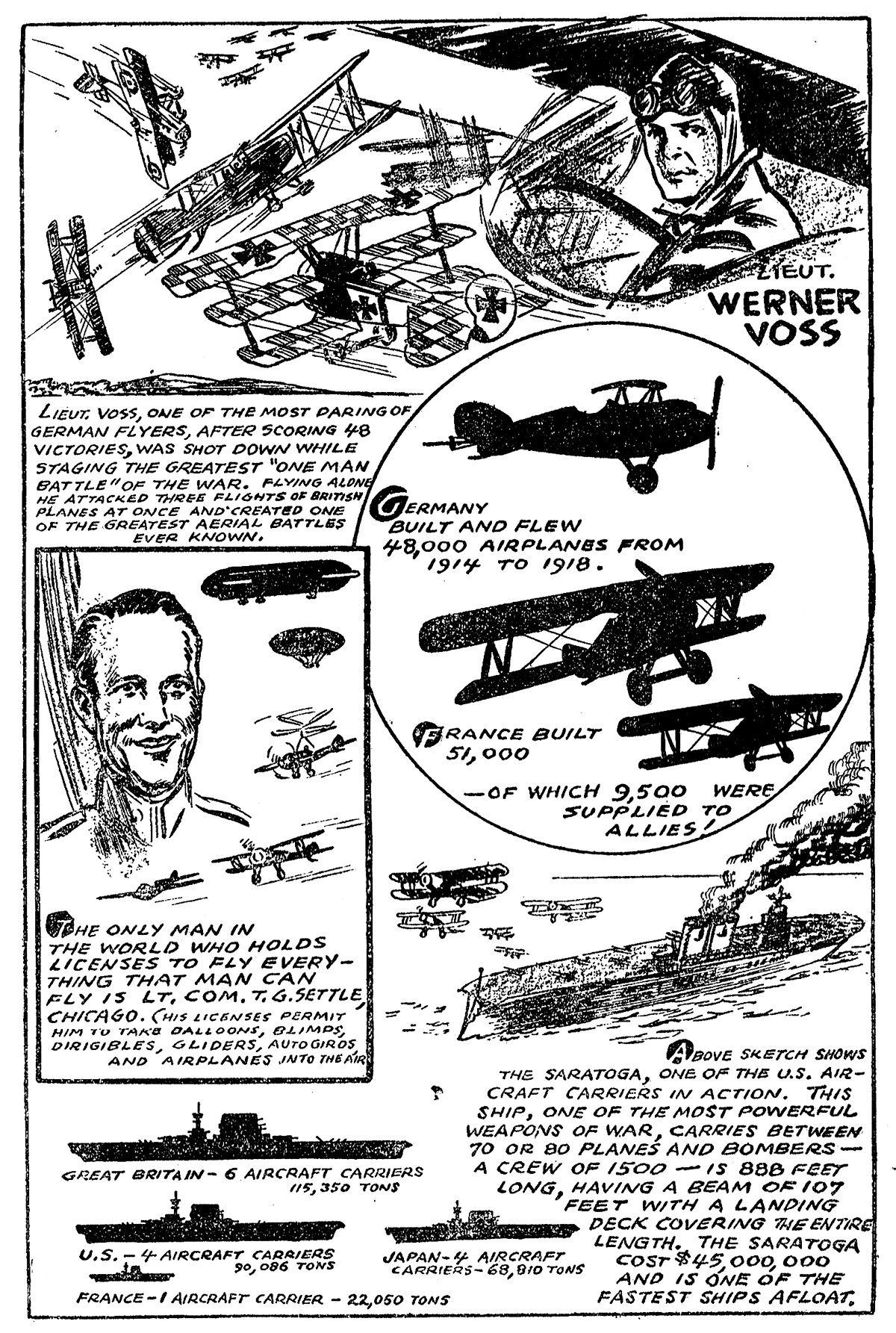
The March 1934 installment, from the pages of Sky Fighters, features “Fighting Dave” himself—David Sinton Ingalls, Lt. Frank Luke, and Germany’s Lt. Werner Voss!

Next time in “Famous Sky Fighters,” Terry Gilkison features Major Raoul Lufbery, Lt. von Eschwege, and Paul Lukas. Don’t miss it!

“Sky Fighters, November 1935″ by Eugene M. Frandzen

Link - Posted by David on April 16, 2018 @ 6:00 am in

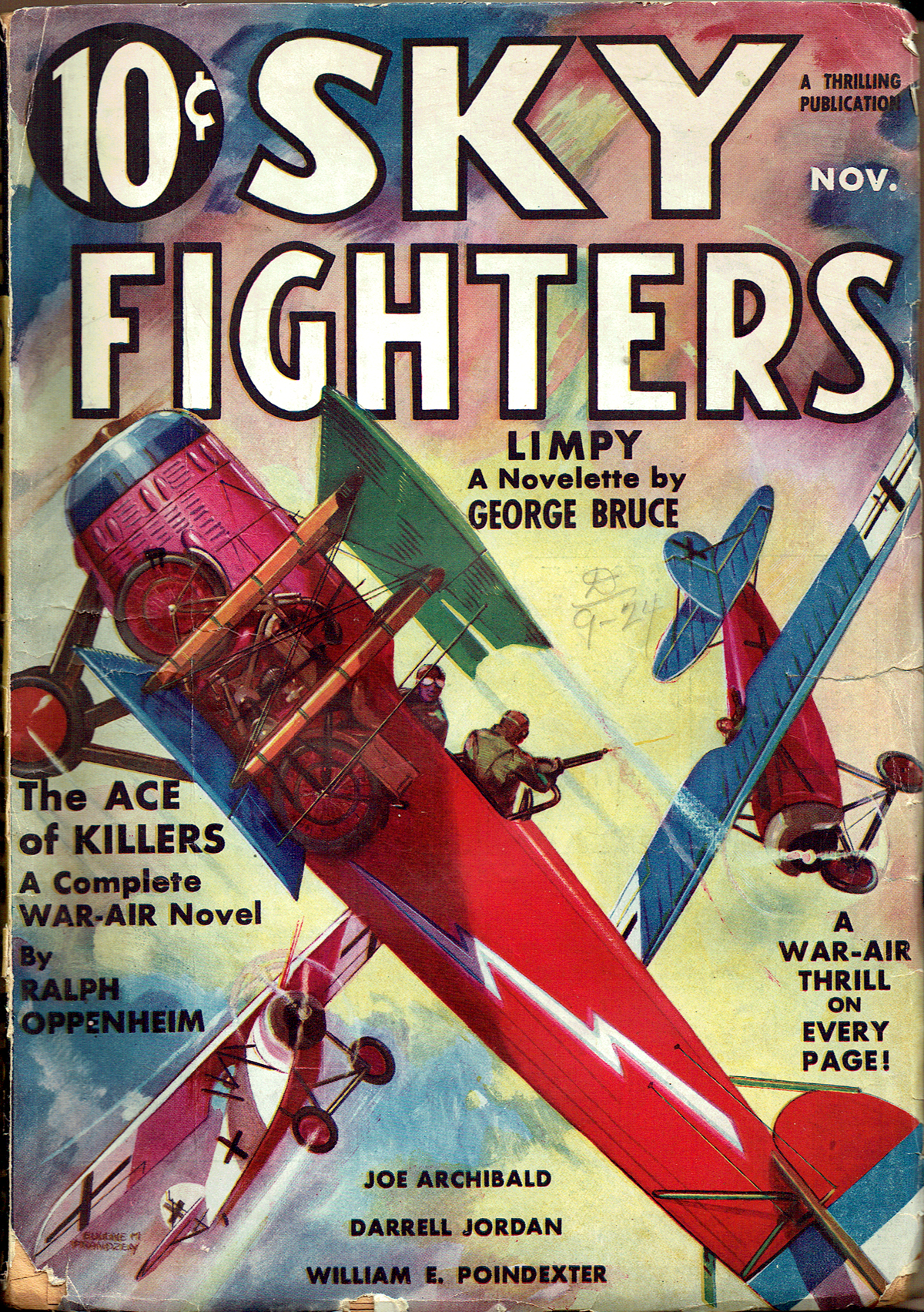
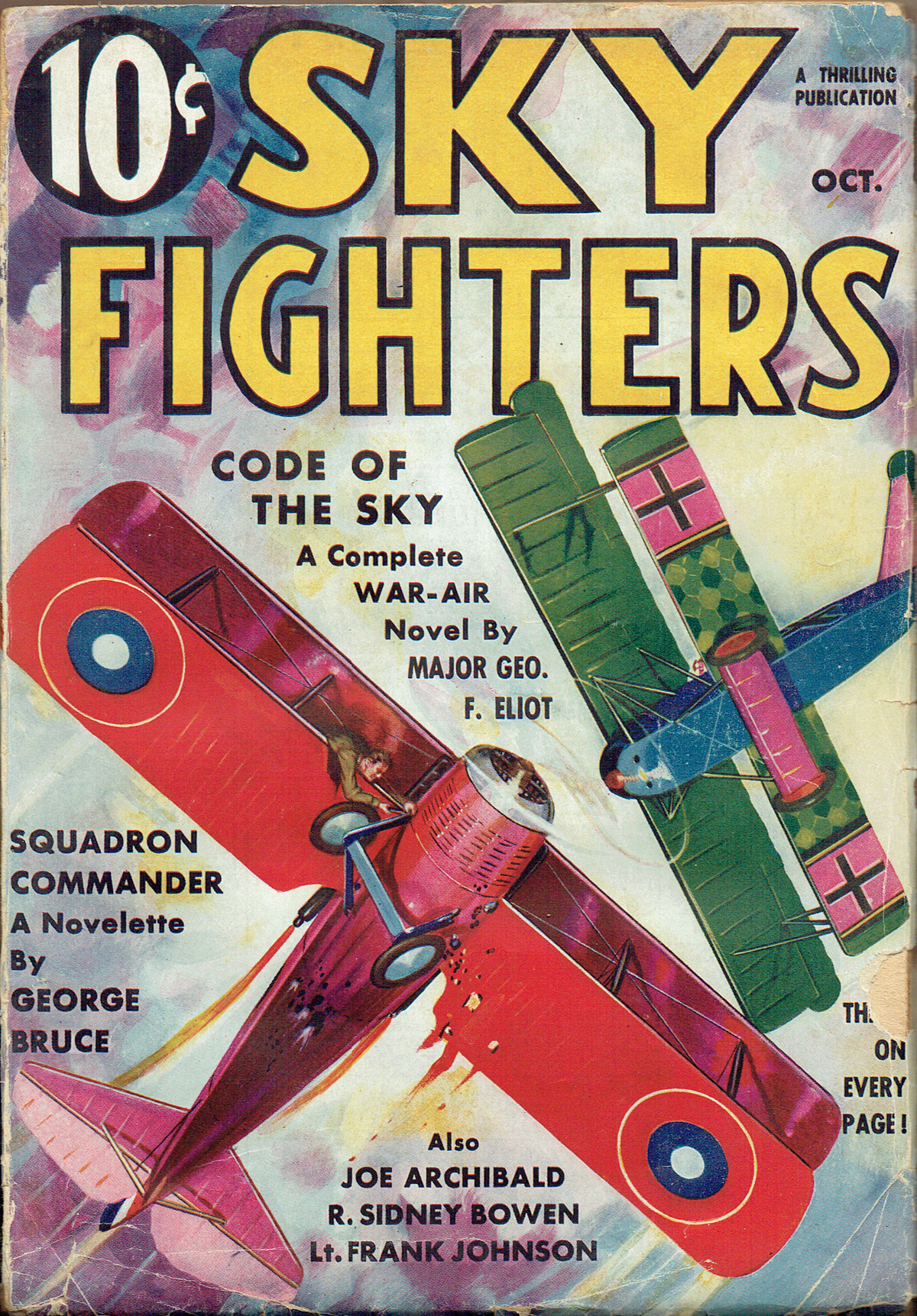
Eugene M. Frandzen painted the covers of Sky Fighters from its first issue in 1932 until he moved on from the pulps in 1939. At this point in the run, the covers were about the planes featured on the cover more than the story depicted. For the November 1935 cover, Mr. Frandzen features the Kondor E3 and Salmson 7A-2!

The Ships on the Cover

SKY battles were fought for the th_SF_3511defense of the reconnaissance arm of the air service. The all important function of airplanes in warfare from the beginning was reconnaissance. More good was done to protect the lives of millions of men on the ground by the slow reconnaissance ships plodding their daily round of the skyways than many of the glorious dog-fights of crack squadrons. Commanders of divisions were desperate in carrying out their strategy. They stamped up and down at headquarters waiting for the word that would mean success or failure for their planned maneuvers. Word of what was happening “out there” after the men had gone “over the top.”

Telegraph wire was laid over miles of territory. At great risk it was buried deep to protect it. Despite this care it was often uprooted by the continuous barrage of shells tearing into the earth. It was torn to a mass of useless shredded copper fibres. Then runners were dispatched back through the lines with the precious messages which gave the position of the troops. Often those runners, despite the sacrifice of their lives, were never able to deliver the message which would mean so much to their buddies. Sometimes those who were lucky got through, but took so long to get back that the news was too old to be of help to the men directing the action. Even more difficulty was experienced in getting directions from the men behind the scenes to the front line troops. Contact with those out there was often impossible.

Motorcycles on Planes

An American had an idea that two fast moving inventions of man could be combined to overcome such a bad situation. He said, why not carry a motorcycle on a plane? A two-seater could carry a motorcycle rider in the back pit. He could be landed as close to the front line as possible and make a dash on his cycle to the isolated units separated from their reserve support. He could bring them directions for concerted action. The motorcycle dispatch rider had the speed to get the message where it would do most good in the shortest time. His two-wheeled vehicle without wings carried him at 60 m.p.h. over shell-torn roads to the farthest outpost.

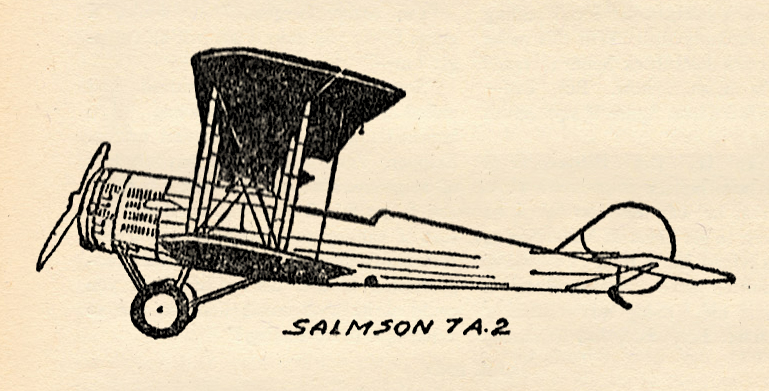
The Salmson 7A.2 on the cover was in the midst of just such a job. It had flown as close to the front lines as it could to observe the ever shifting American troops. Intent on picking a landing spot, the Salmson pilot was suddenly aware that the sky held more planes than his own by a yell from his observer in the rear of the one long cockpit.

Two Monoplanes Buzz By

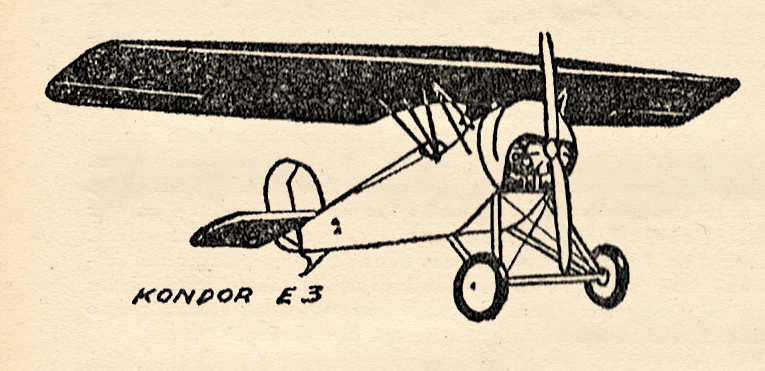
Two small monoplanes buzzed close by. Their 140 h.p. Oberursels brought them closer at the rate of 120 m.p.h. They were Kondor E 3 parasols whose pilots thought it would be easy to polish off the two-seater. But the Salmson’s observer wasn’t chosen for the hazardous work he did merely for his ability in scooting over rough roads on his motorcycle. He was as expert with the Lewis trigger as the handlebars. One Kondor misjudged the big ship’s maneuvers and the observer blasted straight at the German pilot. The second Kondor coming up under the forty feet wing spread of the Salmson had a big target, but the men in the observation ship had too much valuable information to deliver to sell their lives cheaply in a sky duel. The Kondor was literally blanketed with Vicker’s slugs. The Boche pilot decided he wouldn’t bother a ship with such a good marksman at the rear gun. He nosed over and limped for home. The Salmson sought the ground to land the motorcycle. The observer changed roles quickly and became the dispatch rider.

As the pilot took off again to return to his home tarmac he saw the motorcycle and helmeted rider fused together as one streak of lightning along the road toward Allied outposts, even as flashing a rider of fearlessness as Jove’s thunderbolt insignia painted on the side of the Salmson.

The Ships on The Cover
Sky Fighters, November 1935 by Eugene M. Frandzen
(The Ships on The Cover Page)

Silent Orth flies toward his “Zero Hour” by Lt. Frank Johnson

Link - Posted by David on April 13, 2018 @ 6:00 am in

ORTH is back! Silent Orth—ironically named for his former penchant to boast, but blessed with the skills to carry out his promises—is faced his a choice. He’s ordered to retrieve a spy with valuable information that could save the lives of thousands from behind the lines, but, at the same time his best mate is to face a German firing squad! Save the Spy or save his friend . . . . or save both? Impossible! But if anyone could do it, Orth could! From the pages of the October 1934 issue of Sky Fighters, Silent Orth flies toward his “Zero Hour!”
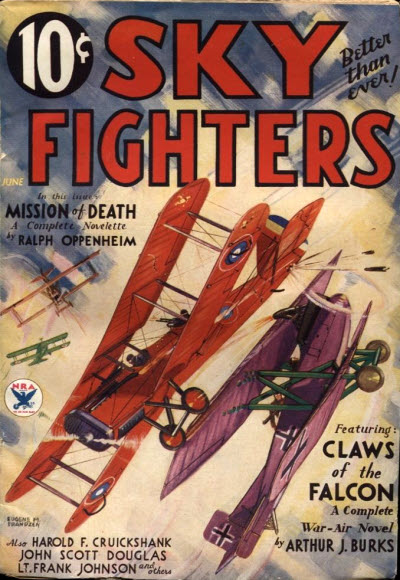
While his wingmate, Lieutenant Gabriel, waits for death by firing squad in Bocheland, Silent Orth faces the toughest problem in his career!

“Torture Drome” by Harold F. Cruickshank

Link - Posted by David on April 6, 2018 @ 6:00 am in

THIS week we have a story by another of our favorite authors—Harold F. Cruickshank! Cruickshank is popular in these parts for the thrilling exploits of The Sky Devil from the pages of Dare-Devil Aces, as well as those of The Sky Wolf in Battle Aces and The Red Eagle in Battle Birds. He wrote innumerable stories of war both on the ground and in the air. Here we have a story of brothers—half-brothers both assigned to 17 Drome. The younger brother, Cal, is posted as A.W.O.L., but Lew, the older of the two fears Cal was attempting to assist his older brother in his assignment to get the dreaded Baron von Hertzog and some awful fate has befallen him. Leading Lew to absent himself from his drome without authority to try and find the kid and save his hide. From the June 1934 issue of Sky Fighters it’s “Torture Drome”—
Captain Lew Vance Braves Boche Horror As He Flies Hell-Bent into Hunland to Vindicate the Honor of His Half-Brother!

“The Lone Eagle, March 1934″ by Eugene M. Frandzen

Link - Posted by David on April 2, 2018 @ 6:00 am in

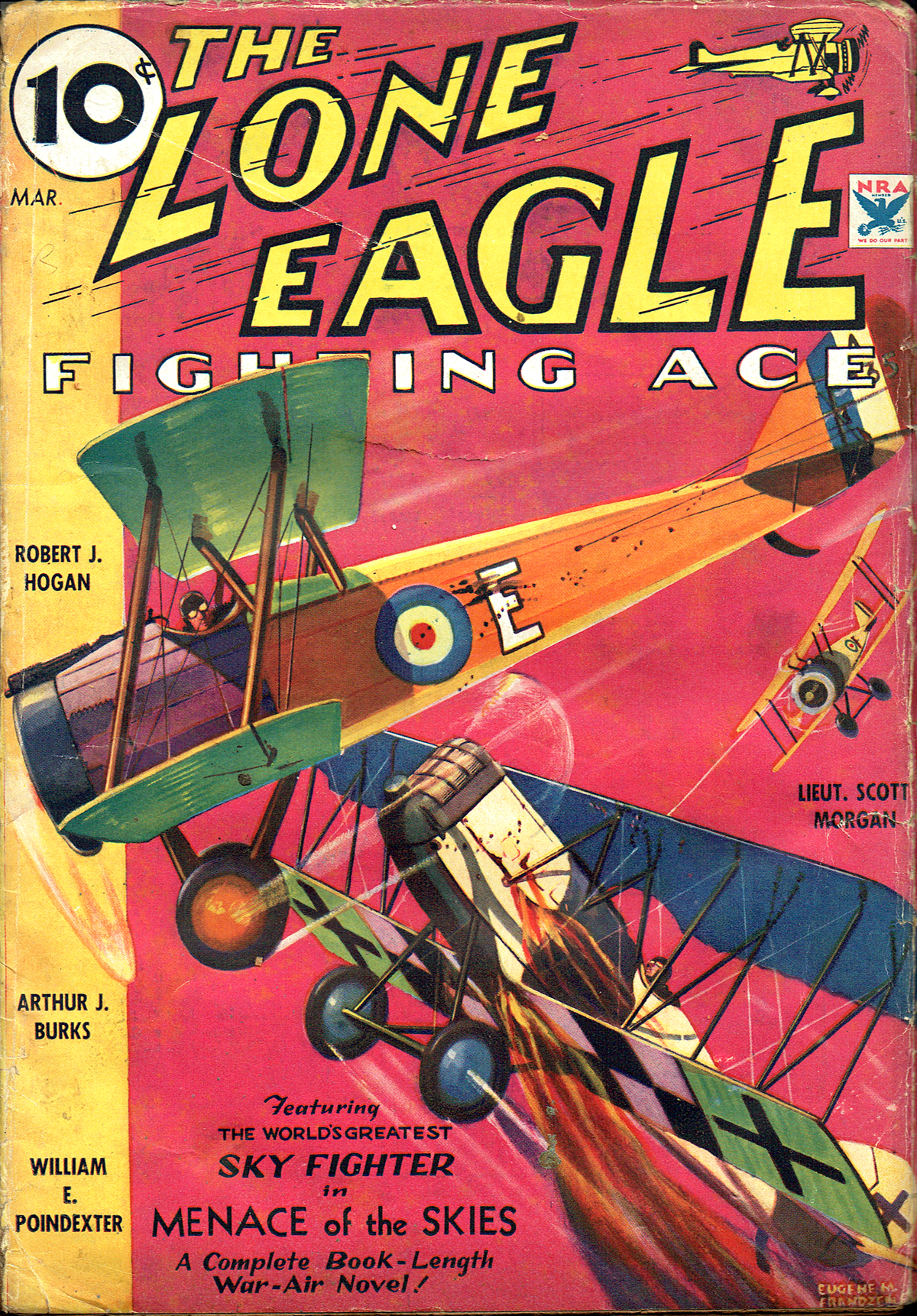
Eugene M. Frandzen painted the covers of The Lone Eagle from its first issue in September 1933 until the June 1937 issue when Rudolph Belarski took over with the August issue of that year. At the start of the run, Frandzen painted covers of general air action much like his Sky Fighters covers. Here, for the March 1934 cover, Frandzen has a D.H.5 being attacked by a Pfalz D.12!

The Story of the Cover

THE planes pictured on this th_LE_3403month’s cover are the De Haviland 5 (D.H.5), an unusual back staggered job giving the pilot exceptionally good visibility, and the Pfalz D.12. The De Haviland name is taken from the chief designer of the Aircraft Manufacturing Co., a British company formed in 1912. The Pfalz D.12 was the successor to a long line of Pfalz ships, some of them—pusher—manufactured before the World War.

The usual V struts ordinarily appearing on the Pfalz ships have been discarded in this later model for twin bays of N struts on either side of the fuselage.

The D.H.5 pictured on the cover had been brought back into the war in 1918. It did its duty during 1917 nnd sent many German ships crashing to earth.

But those enemy planes were about equal in speed to the D.H.5. The Pfalz can outdistance the back-staggered British job about twenty miles per hour—some handicap. But don’t overlook the second D.H. coming into the fracas from above.

The pilots of the Allied ships are two Yank pilots, who, thinking the war in the air had become too tame, thought up a scheme to lure the Jerries into a real scrap. “We’ll give ‘em odds,” said one to the other.

“We’ll borrow those two old D.H.5s over in the Limey’s barn and go out and beg the Boche to come and play with us. Lately they’ve been hiding out way behind their own lines. We’ll sorta tie one hand behind the back and put a chip on our shoulder.” And so it came to pass that early one morning, helped by a British mechanic who was glad to get the relics out of his crowded hangar, they “borrowed” the two crates.

Back and forth above the lines the two Yanks drove their ships, ships which but a year before had been the last screech when it came to speed and maneuverability, but now pushed to the sidelines to make room for faster jobs. In the distance and in the direction of the German dromes they saw a single ship winging toward them at about one hundred and twenty-five miles per hour. The D.H.5s continued to saunter along at their hundred and five mile clip.

Evidently the Hun pilot knew that he was being bated because he became cagey when within striking distance. He shaded his eyes and looked carefully toward the sun. No lurking Allied ships could he spot, neither could he see any in any other direction. He licked his lips and cleared his guns.

Wham, he gave the Pfalz the gun and roared in to annihilate the brazen Yanks.

They let him blast them, let him get his bullets dangerously close to their skins before they lammed out of range. But those two were buddies, air buddies who worked together on enemy ships. Timing was their favorite stunt when flying their Spads. All they had to do in the slower crates was to wait a few seconds longer before opening up and letting the attacking ship slide through between them.

They did exactly this and then as the Hun was about to swing his fast ship around and barge back at the Yanks he found twin streams of lead boring into his ship, one stream from each single gun mounted on the front of the two D.Hs. A couple of those slugs got the gas tank. The engine sputtered, a tiny whisp of flame swept back, then suddenly the whole front of the engine cowling belched flames. One D.H. flashed by the German, whose ship was now slowed down under the speed of his enemy. The German yanked at his stick. If he could only climb his ship enough he’d ram the Yank with his flaming crate, take him with him on his death dive. But don’t worry, he didn’t do it because his opponents were only giving him a last salute before starting for home, giving him a chance for a last crack at them, but in doing it they didn’t take any chances of being shot down.

The Yank in the foreground didn’t flip into the Boche’s ring-sight till only the tail of his ancient crate would be available for the Spandau bullets to perforate. Again our friend had used—TIMING.

The Story of The Cover
The Lone Eagle, March 1934 by Eugene M. Frandzen
(The Story of The Cover Page)

“The Batty Patrol” by Joe Archibald

Link - Posted by David on March 30, 2018 @ 6:00 am in

“Haw-w-w-w-w!” That sound can only mean one thing—that Bachelor of Artifice, Knight of Calamity, born on April Fool’s day and reared in raillery, an alumnus of Doctor Merlin’s Camelot College for Conjurors is back and this time the marvel from Boonetown runs for the looney bin rather than face the German’s latest and greatest invention—a bullet that can destroy a plane in one shot!
Once he got a taste of von Kruller, Phineas would be finished—according to the way the Krauts figured. But the Boonetown Prankster’s interest was in nuts, not doughnuts. And you can’t beat a combination like Charlemagne, Julius Caesar, Disraeli, and Columbus when you’ve got Marshal “Carbuncle” Ney on the board of directors.

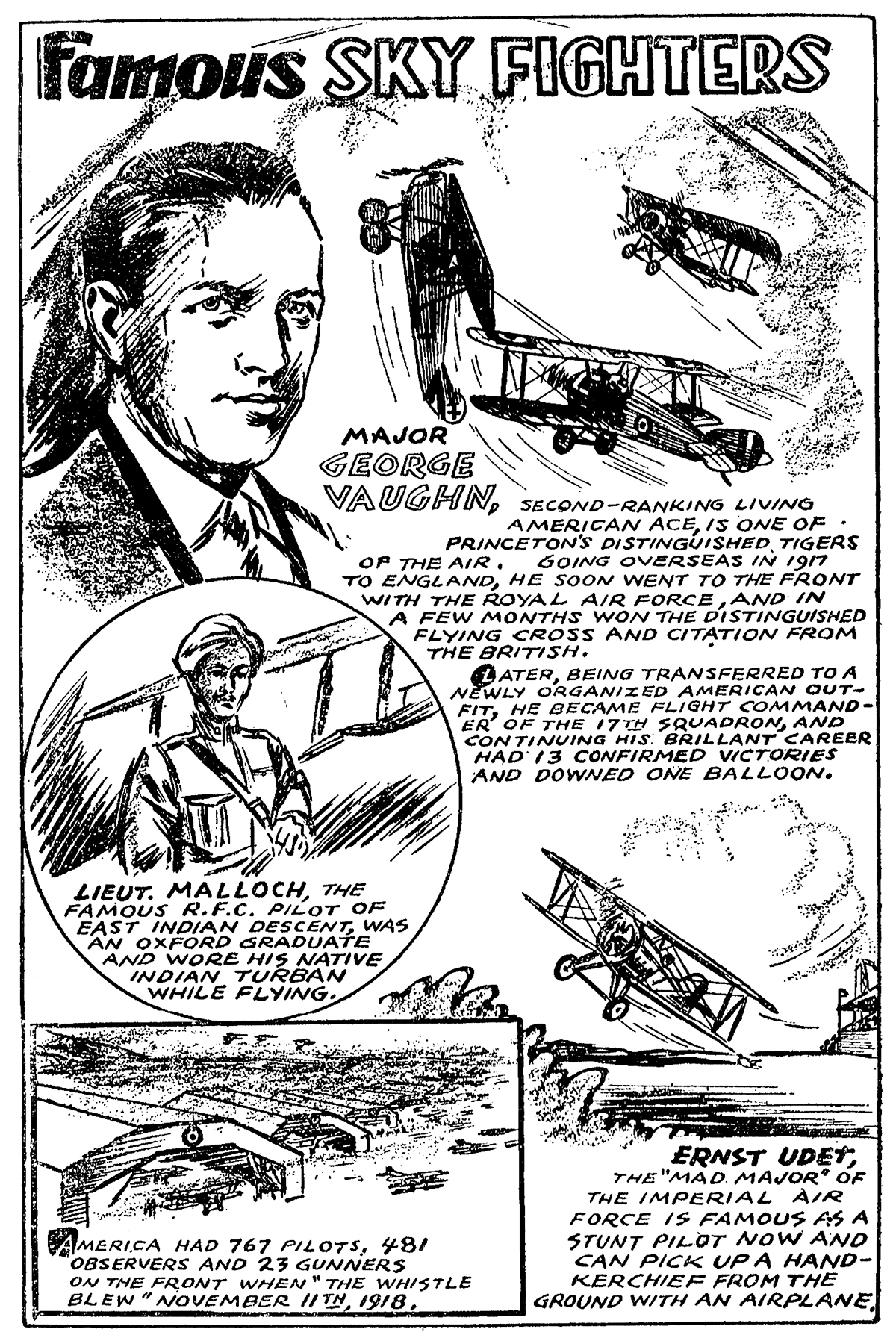
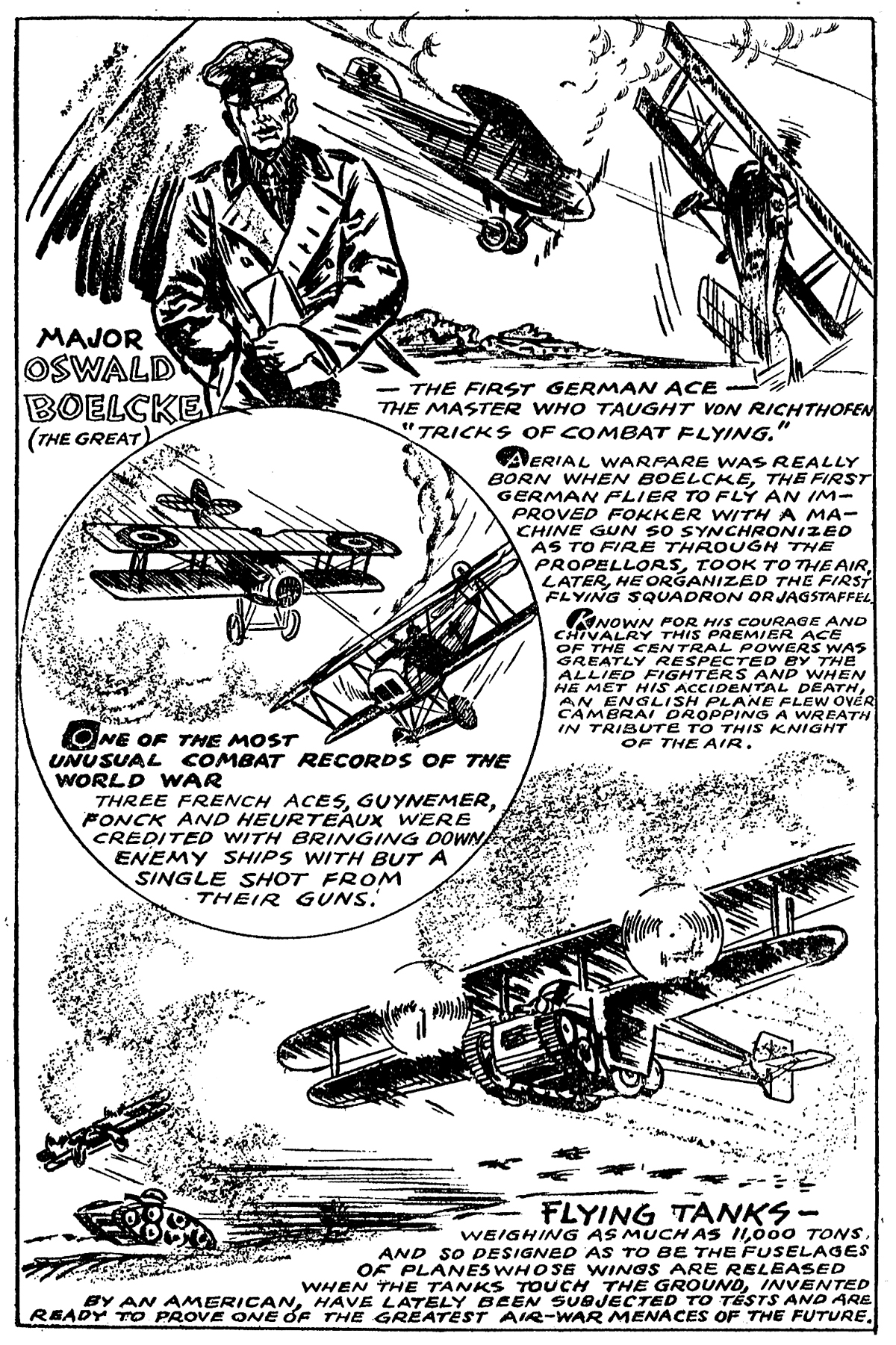
“Famous Sky Fighters, February 1934″ by Terry Gilkison

Link - Posted by David on March 28, 2018 @ 6:00 am in

Starting in the October 1933 issue of Sky Fighters and running almost 5 years, Terry Gilkison’s “Famous Sky Fighters” was a staple of the magazine. Each month Gilkison would illustrate in a two page spread different Aces that rose to fame during the Great War.

Although Gilkison was probably better known for his syndicated newspaper work, he also provided black and white story interior illustrations for pulp magazines. His work appeared in Clues, Thrilling Adventures, Texas Rangers, Thrilling Mystery, Thrilling Western, and Popular Western. Gilkison provided similar features in a few other Thrilling Publications—there was “Famous Soldiers of Fortune” and later “Adventure Thrills” in Thrilling Adventures, Famous Crimes” in Thrilling Detective, and the fully illustrated air adventure stories of Buck Barton “The Flying Devil” in The Lone Eagle! He signed most of this work with only his initials “T.G.” to maintain a low profile and preserve his reputation as a syndicated newspaper cartoon artist.

The February 1934 installment, from the pages of Sky Fighters, features American Ace Major George Vaughn, the R.F.C.’s Lt. Malloch, and the great Major Oswald Boelcke!

Next time in “Famous Sky Fighters,” Terry Gilkison features “Fighting Dave” himself—David Sinton Ingalls, Lt. Frank Luke, and Germany’s Lt. Werner Voss. Don’t miss it!

“Burning Wings” by Ralph Oppenheim

Link - Posted by David on March 23, 2018 @ 6:00 am in

TO ROUND off Mosquito Month we have a non-Mosquitoes story from the pen of Ralph Oppenheim. “Streak” Davis must stop Erich von Hartwig, Germany’s master flying spy—the craftiest and most underhanded Boche in the war! Von Hartwig just murdered three Allied officers at Chaumont in cold blood—then made off with a dispatch cylinder containing most vital information of our troop movement. His orders: “Head him off and burn von Hartwig and his black Albatross in the sky so there’s no chance of those papers falling into German hands!”
From the February 1935 issue of Sky Fighters it’s “Burning Wings.”

Follow “Streak” Davis on the Perilous Pursuit of A Fiendishly Cunning German Super Spy!

“Sky Fighters, October 1935″ by Eugene M. Frandzen

Link - Posted by David on March 19, 2018 @ 6:00 am in

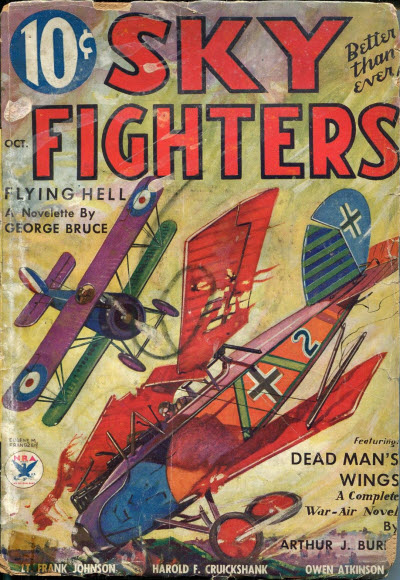
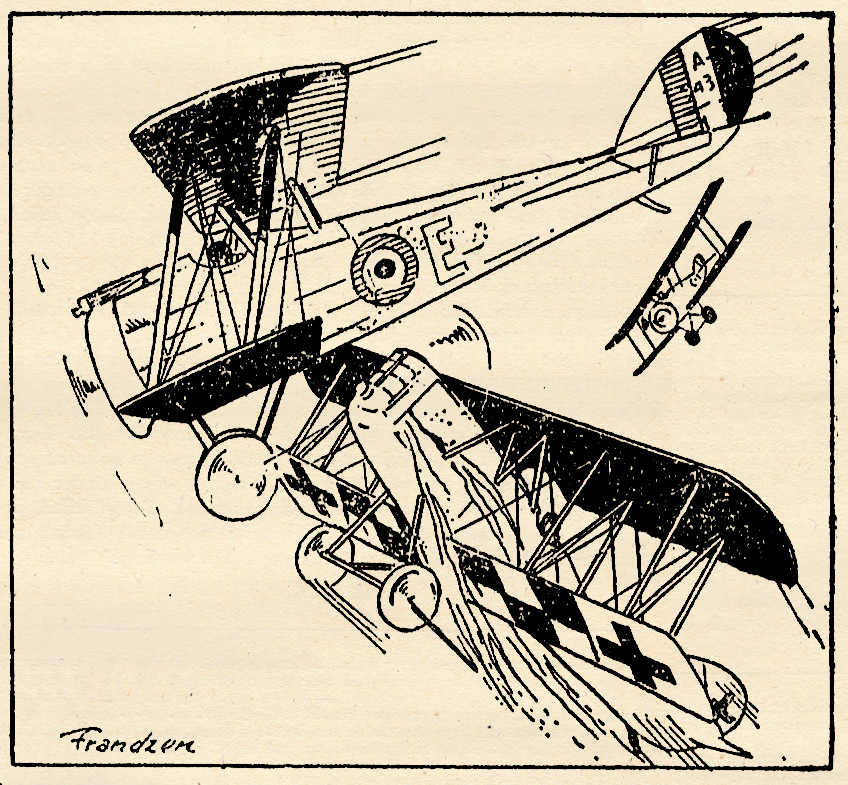
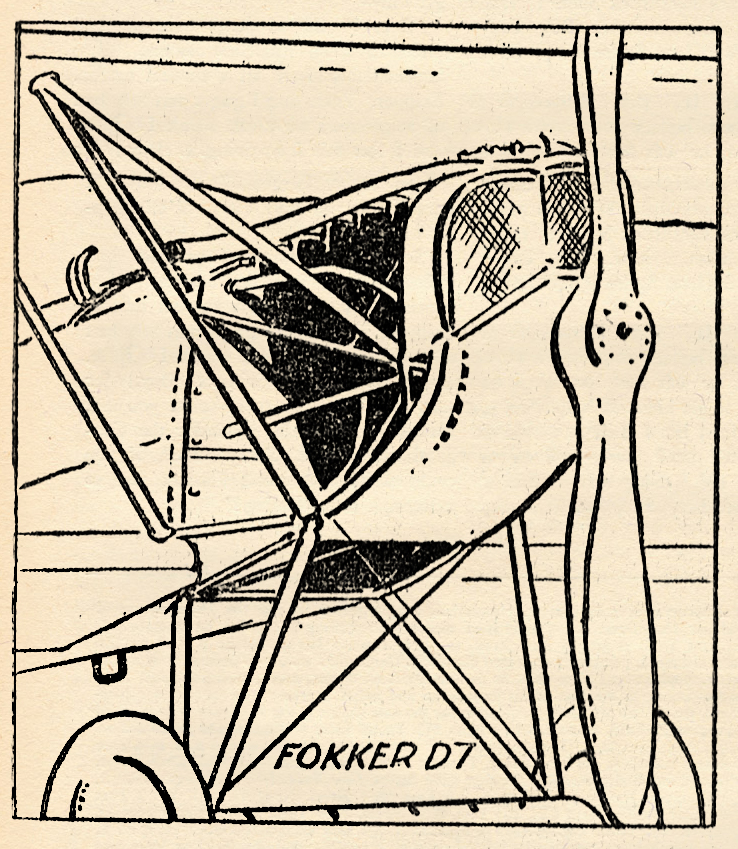
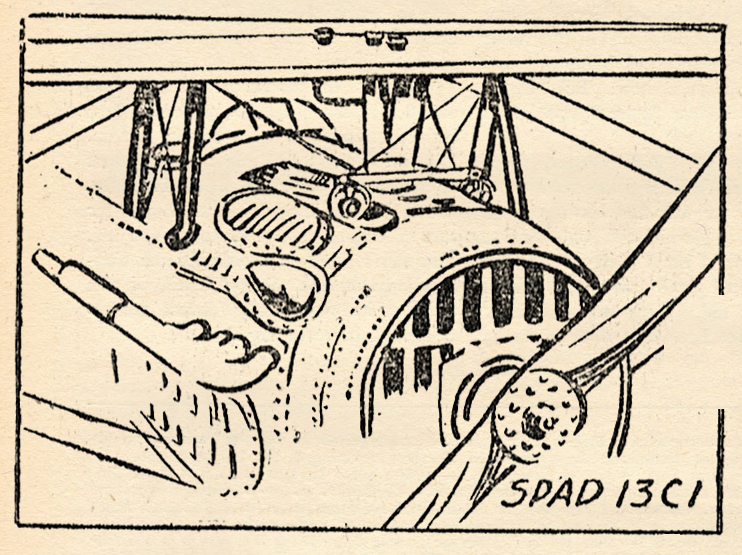
Eugene M. Frandzen painted the covers of Sky Fighters from its first issue in 1932 until he moved on from the pulps in 1939. At this point in the run, the covers were about the planes featured on the cover more than the story depicted. For the October 1935 cover, Mr. Frandzen features the classic age old battle of Spad 13 C1 vs Fokker D7!

The Ships on the Cover

THE first Spad made its debut in 1916. th_SF_3510It was a heavier ship than the French manufacturers usually turned out. They were prone to seek speed by making engine, wings and fuselage all as light as possible.

Then up popped the first Spad with its heavy Hispano-Suiza motor and its rigidly braced body and all around husky construction. It knocked the spots out of the lighter type of machines. Each succeeding model got heavier and each engine had more power.

Aviators put these husky Spads into prolonged power dives that other machines could not possibly make.

The Finest Fighting Plane

The Lafayette Escadrille swung over from Nieuports to Spads and any French squadron that could beg, borrow or steal them parked themselves in Spads and went up into the skies confident that they had the finest fighting plane in existence.

Of course there was a difference of opinion over on the German side of the line. The Fokker D7 made its appearance and the Heinie flyers just knew that they had the finest machine that ever sprouted wings. Therefore when the confident opposing war flyers, one in a Spad 13 C1 and the other in a Fokker D7 decided to smack each other with a few well placed slugs, it was an interesting show. And doubly interesting if two men happened to be aboard a one-place Spad.

Story of the Cover

Fifteen minutes before the action depicted on the cover, the Spad pilot set his ship down on German territory at a prearranged spot. A figure crawled from a clump of brush, raced to the Spad and shinned onto the right wing. Up zoomed the Spad with its precious wing passenger, an A1Iied intelligence operator who had documents that were important enough to cause three generals to be waiting at that moment at the Spad’s drome.

At a thousand feet the German archies started bursting in profusion. One lucky she11 sheared the undercarriage nearly off the Spad. It lurched and staggered with the swaying encumbrance. The wing passenger inched his way to the cockpit the pilot handed out a small hunk of iron.

Bullet Hemstitching

The passenger went to work just as a Fokker went into action. Three minutes of scientific prying on the shattered undercarriage released it and the Spad leaped forward with ten miles extra speed. It turned on the Fokker and hemstitched it from stem to stem.

The German with two minor wounds admitted the Spad, if it didn’t carry wheels, was the better ship.

He dove out of the fight cursing the anti-aircraft gunners who had ruined a sure kill for him. His only consolation was that his foe’s landing would be about as soft as a racing locomotive hitting the rear end of a cement train.

The Ships on The Cover
Sky Fighters, October 1935 by Eugene M. Frandzen
(The Ships on The Cover Page)

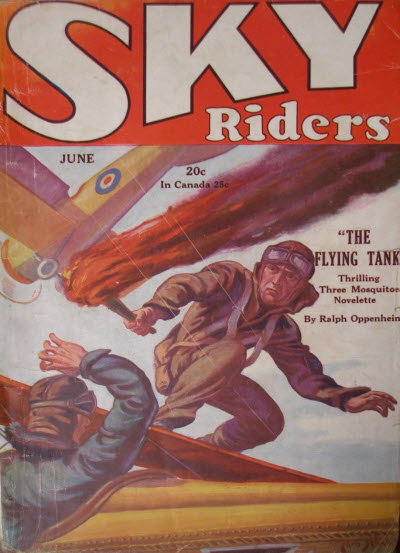
The Three Mosquitoes take on “The Flying Tank” by Ralph Oppenheim

Link - Posted by David on March 16, 2018 @ 6:00 am in

THEIR familiar war cry rings out—“Let’s Go!” The greatest fighting war-birds on the Western Front are once again roaring into action. The three Spads flying in a V formation so precise that they seemed as one. On their trim khaki fuselages, were three identical insignias—each a huge, black-painted picture of a grim-looking mosquito. In the cockpits sat the reckless, inseparable trio known as the “Three Mosquitoes.” Captain Kirby, their impetuous young leader, always flying point. On his right, “Shorty” Carn, the mild-eyed, corpulent little Mosquito, who loved his sleep. And on Kirby’s left, completing the V, the eldest and wisest of the trio—long-faced and taciturn Travis.

Were back with the third of three Three Mosquitoes stories we’re presenting this month. This week the inseparable trio and sent to destroy an indestructible allied tank that has been stolen by a german spy. Kirby, Shorty and Travis must stop the germans from stealing all the secrets of the X Tank by any means possible and at all costs! From the June 1930 issue of Sky Riders, it’s “The Flying Tank!”

With a roar the Three Mosquitoes were off—off on one of the strangest and most perilous raids ever planned. They were off to bomb a British tank as it stood in the center of a German town. And down on the secret field they had just left, a worried brigadier general was glancing at his wrist watch. Just one hour and fifteen minutes to go!

If you enjoyed this tale of our intrepid trio, check out some of the other stories of The Three Mosquitoes we have posted by clicking the Three Mosquitoes tag or check out one of the three volumes we’ve published on our books page! And come back next Friday or another exciting tale.

« Previous PageNext Page »