Looking to buy? See our books on amazon.com Get Reading Now! Age of Aces Presents - free pulp PDFs

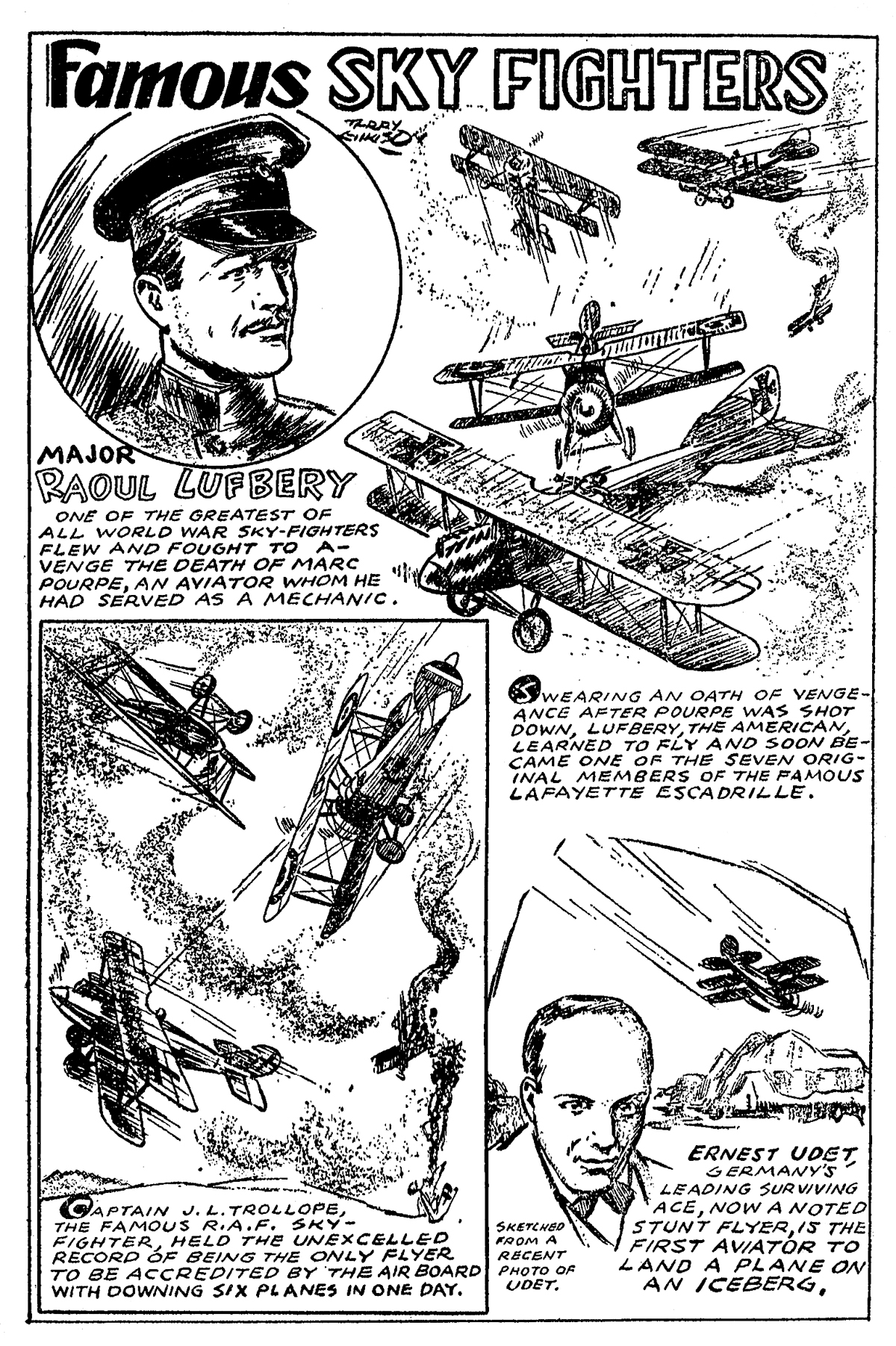
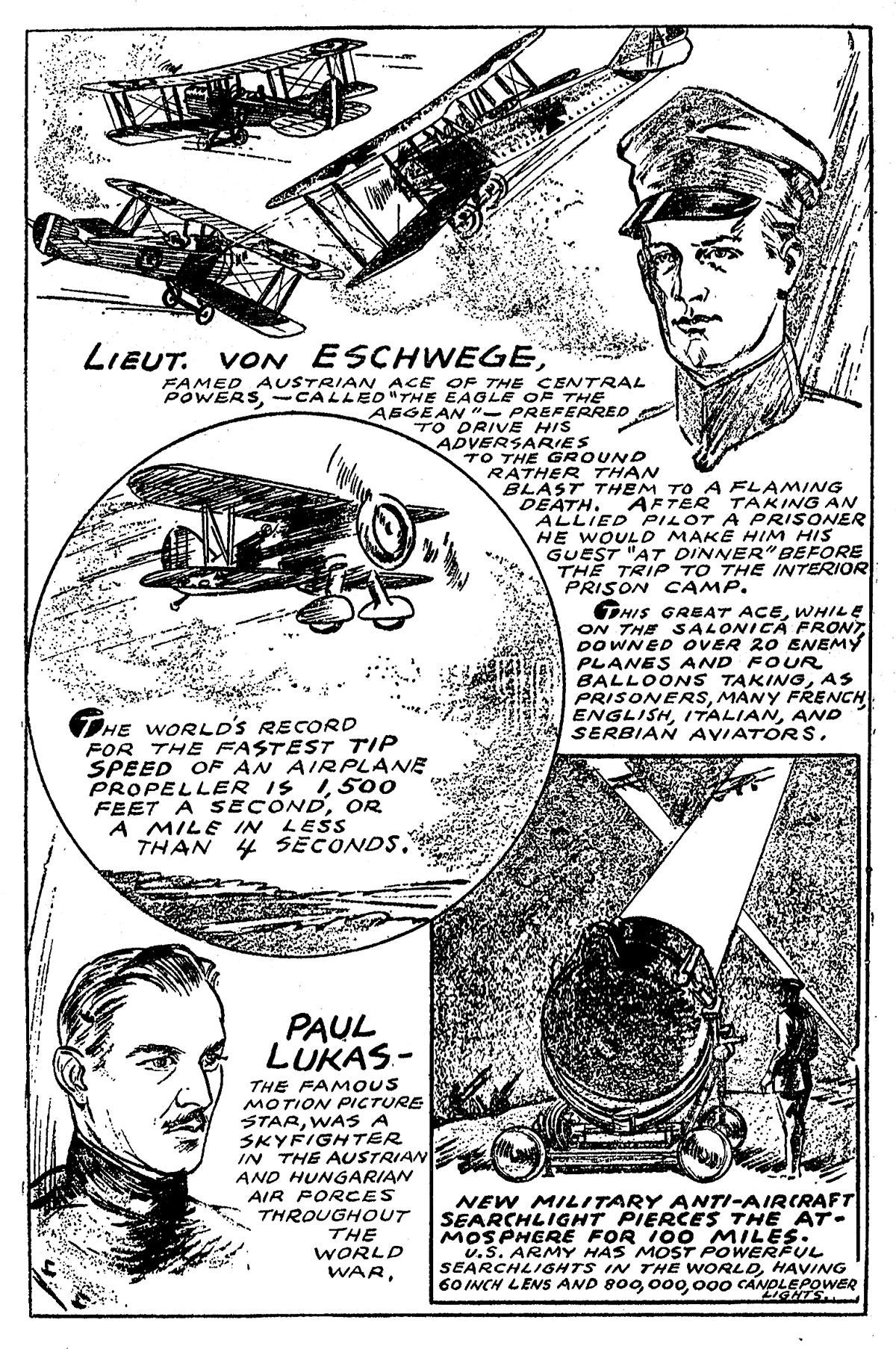
“Famous Sky Fighters, April 1934″ by Terry Gilkison

Link - Posted by David on June 20, 2018 @ 6:00 am in

STARTING in the October 1933 issue of Sky Fighters and running almost 5 years, Terry Gilkison’s “Famous Sky Fighters” was a staple of the magazine. Each month Gilkison would illustrate in a two page spread different Aces that rose to fame during the Great War.

Although Gilkison was probably better known for his syndicated newspaper work, he also provided black and white story interior illustrations for pulp magazines. His work appeared in Clues, Thrilling Adventures, Texas Rangers, Thrilling Mystery, Thrilling Western, and Popular Western. Gilkison provided similar features in a few other Thrilling Publications—there was “Famous Soldiers of Fortune” and later “Adventure Thrills” in Thrilling Adventures, Famous Crimes” in Thrilling Detective, and the fully illustrated air adventure stories of Buck Barton “The Flying Devil” in The Lone Eagle! He signed most of this work with only his initials “T.G.” to maintain a low profile and preserve his reputation as a syndicated newspaper cartoon artist.

The April 1934 installment, from the pages of Sky Fighters, features Major Raoul Lufbery, Lt. von Eschwege, and Paul Lukas!

Next time in “Famous Sky Fighters,” Terry Gilkison features Capt. Elliott White Springs, Major Edward Mannock and the three flying McCudden brothers! Don’t miss it!

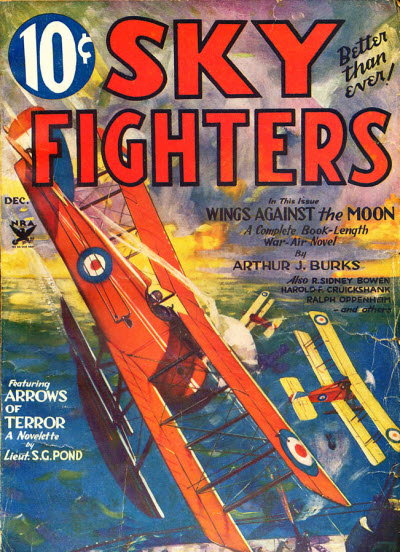
“Sky Fighters, December 1935″ by Eugene M. Frandzen

Link - Posted by David on June 11, 2018 @ 6:00 am in

Eugene M. Frandzen painted the covers of Sky Fighters from its first issue in 1932 until he moved on from the pulps in 1939. At this point in the run, the covers were about the planes featured on the cover more than the story depicted. For the December 1935 cover, Mr. Frandzen features the Italian S.V.A. bringing loaves of bread to the troops high in the mountain passes!

The Ships on the Cover

BREAD! The mainstay of mankind. th_SF_3512 And when the army is the mainstay of nations, bread for the army ranks higher than Roman Emperors.

Who said an army fights on its stomach? Someone who did plenty of fighting in the old days and knew his armies. Of what importance were guns, bombs, and shells piled up ready for combat when the human bodies to man these weapons of war have no fuel to stoke the human engine!

The chuck wagon was greeted by loud cheers when it put in its appearance in “any man’s army.” Runners with food supplies strapped to their backs dodged bullets through a maze of communication trenches to get to the front line doughboys. Dogs pulling small carts of food got through to scattered outposts.

The Alpine Heights

Italy has a wonderful northern barrier which nature has seemingly bestowed upon that sunny boot projecting into the Mediterranean. When Italy declared war on the Austrian Empire in May, 1915, she looked hopefully at those lofty Alpine heights to keep her enemy in check.

The Italian advance of early days was halted. The Austrian counter-attack regained their positions but in 1917 when Italy finally declared war on Germany also, the Italians resumed their offensive and captured fourteen fortified mountains.

It is a different problem to fight on mountain sides than on the fields of the lowlands. The ordinary labor of warfare is made a hundredfold more difficult. Dragging heavy guns up rocky mountain sides by sheer nerve-racking will power—pulling shells on sleds over icy passes—stringing communication lines from crag to crag, where one well-placed shell would damage the patient work of days of laying the wires.

The contact, broken in some out of the way pass, impossible to mend without disastrous delay. All these had to be done on the ground. The only savior of these lonely mountain outposts was the new weapon of the world war—the airplane.

Italy, from poor beginnings, progressed Steadily forward in the aviation branch of her service despite her ground army’s advances or retreats. Planes could fly from their bases on flat ground to the besieged mountain country to drop messages keeping the army in touch with headquarters no matter how many communication lines on the ground were destroyed.

Flying high over such a wide expanse of territory they observed the enemy positions, often saving their own forces from being bottled up by enemy flanking movements.

But as important as any message to the morale of these men high in snow-covered fastnesses was the sight which is shown on the cover picture. Planes bringing the white-clad figures on the mountain side that which they could obtain by no other means—Bread! Big round, crispy loaves of the life-giving food.

The pass through which the guns and ammunition have been hauled was later completely buried under an avalanche, tons of snow and rock blocked the narrow road.

When Men Hunger

Days, weeks, months might elapse before that impassable barrier could be surmounted to transport food to the men cut off from their fellows. But four planes received their orders and cargo. They were in sight of the desperate little group in a few hours time. Sleek S.V.A.’s that could climb high above the loftiest peaks, their powerful Ansaldo engines overcoming the barrier that nature had created against the Italians as well as in their favor.

Shouts of “Bravo” from the snow. Shouts that would warm the heart of an opera star at the Milan Opera House. These cheers were for something better than music when men are hungry. They were for contents of the rope bags falling from the planes, the golden brown loaves of bread.

The Ships on The Cover
Sky Fighters, Deecmber 1935 by Eugene M. Frandzen
(The Ships on The Cover Page)

“Earthbound Ace” by Ralph Oppenheim

Link - Posted by David on June 8, 2018 @ 6:00 am in

THIS week we have another great story from the pen of Ralph Oppenheim. Best known in these parts for The Three Mosquitoes, he wrote many other stories of the air and several ripping detective yarns. Here Mr. Oppenheim gives us a story of Lieutenant Steve Bentley who was a race car driver before the war like the great Rickenbacker. But unlike Rickenbacker, Lt. Bentley has a problem with take-off. So used to driving race cars, he couldn’t let go of his instincts—he would hold the stick back, keep the tail down, making the speeding plane hug the earth. He could never get it through his head that a Spad didn’t have to go ninety miles an hour to take off, that flying speed was no more than seventy. Once in the air he was as good as they come.

When Bentley finds out his friend has gone out on a suicide mission, he jumps in his plane and goes after him. Here, his proclivity to drive a plane like a race car comes in handy for getting through the German ground defenses and hopefully saving the day! From the December 1933 issue of Sky Fighters it’s “Earthbound Ace!”

An Auto Racer Takes to the Sky and Finds That He Has a Lot to Learn—But . . . .

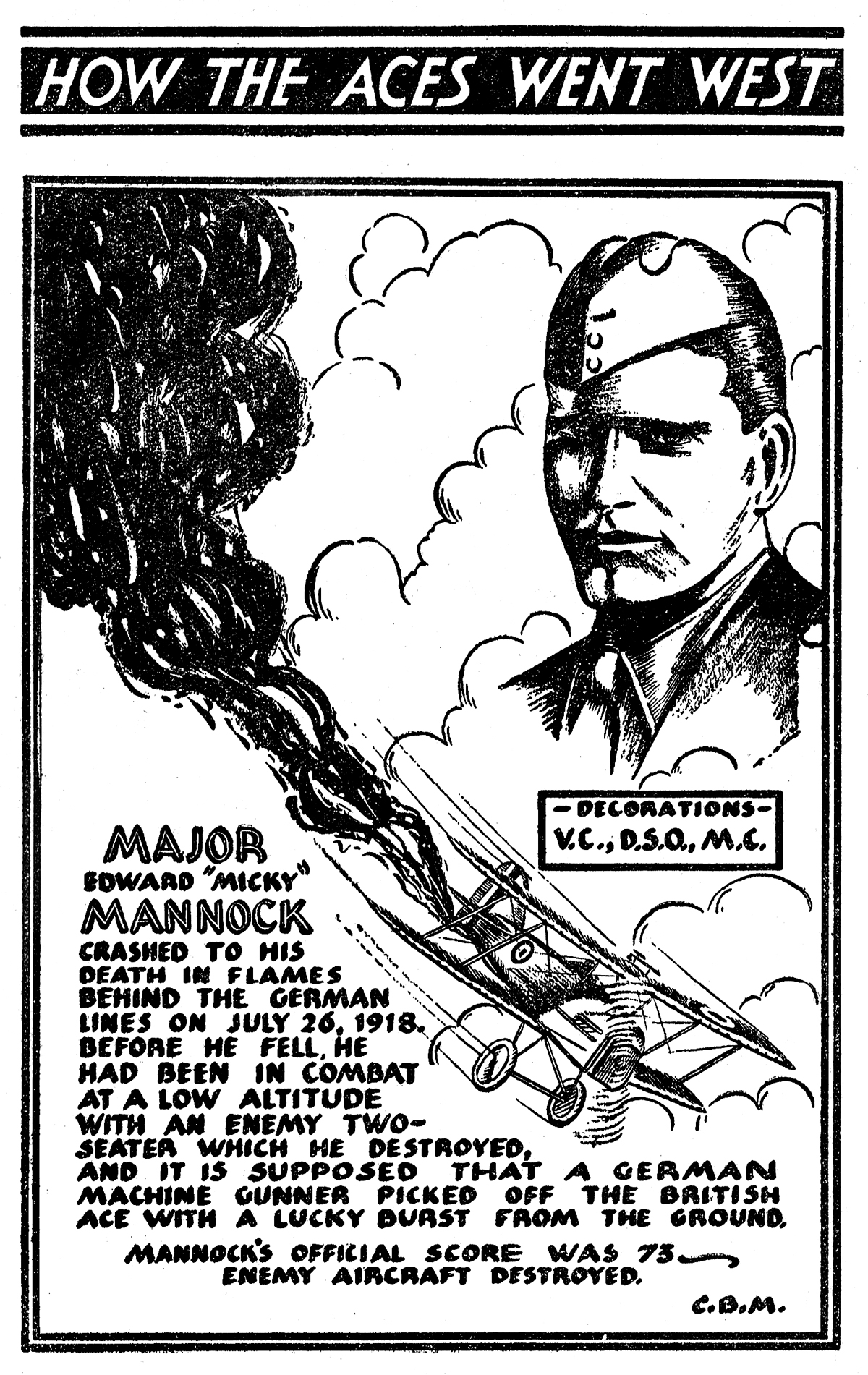
“How The Aces Went West: Major Edward Mannock” by C.B. Mayshark

Link - Posted by David on June 6, 2018 @ 6:00 am in

MAY may have ended, but we have one last burst of the genius that is C.B. Mayshark! We have the final installment of C.B. Mayshark’s “How The Aces Went West!” It was an informative feature that spotlighted how famous Aces died. For the December 1935 issue of Sky Birds, Mayshark looks at how Major Edward Mannock “Went West!”

How The Aces Went West
“How The Aces Went West: Major Edward Mannock

by C.B. Mayshark (Sky Birds, December 1935)

“The Boomerang Pilot” by Frank Richardson Pierce

Link - Posted by David on June 1, 2018 @ 6:00 am in

THIS week we have another exciting air adventure with Rusty Wade from the pen of Frank Richardson Pierce. Pierce is probably best remembered for his prolific career in the Western Pulps. Writing under his own name as well as two pen names—Erle Stanly Pierce and Seth Ranger—Pierce’s career spanned fifty years and produced over 1,500 short stories, with over a thousand of these appearing in the pages of Argosy and the Saturday Evening Post.

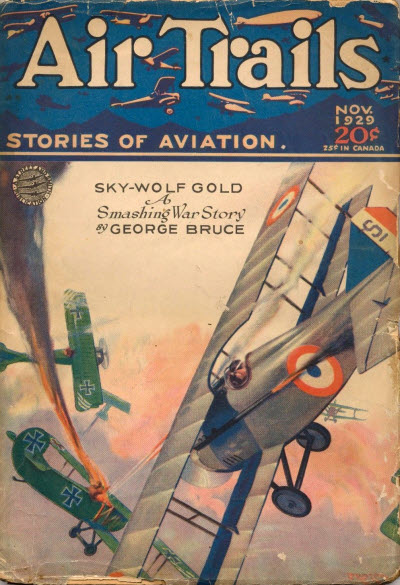
This time around, Rusty is faced with a choice—fly to Seattle to help his good friend Bid McCord win a government contract to develop long lasting airplane motors, or head off into the Alaskan wilds to save his nemesis, Hawk Breed, who’s had a bad accident and needs prompt medical assistance. From the pages of the November 1929 Air Trails, it’s Frank Richardson Pierce’s “The Boomerang Pilot!”

With disaster staring him in the face, “Rusty” Wade hurls defiance at the high gods of the air.

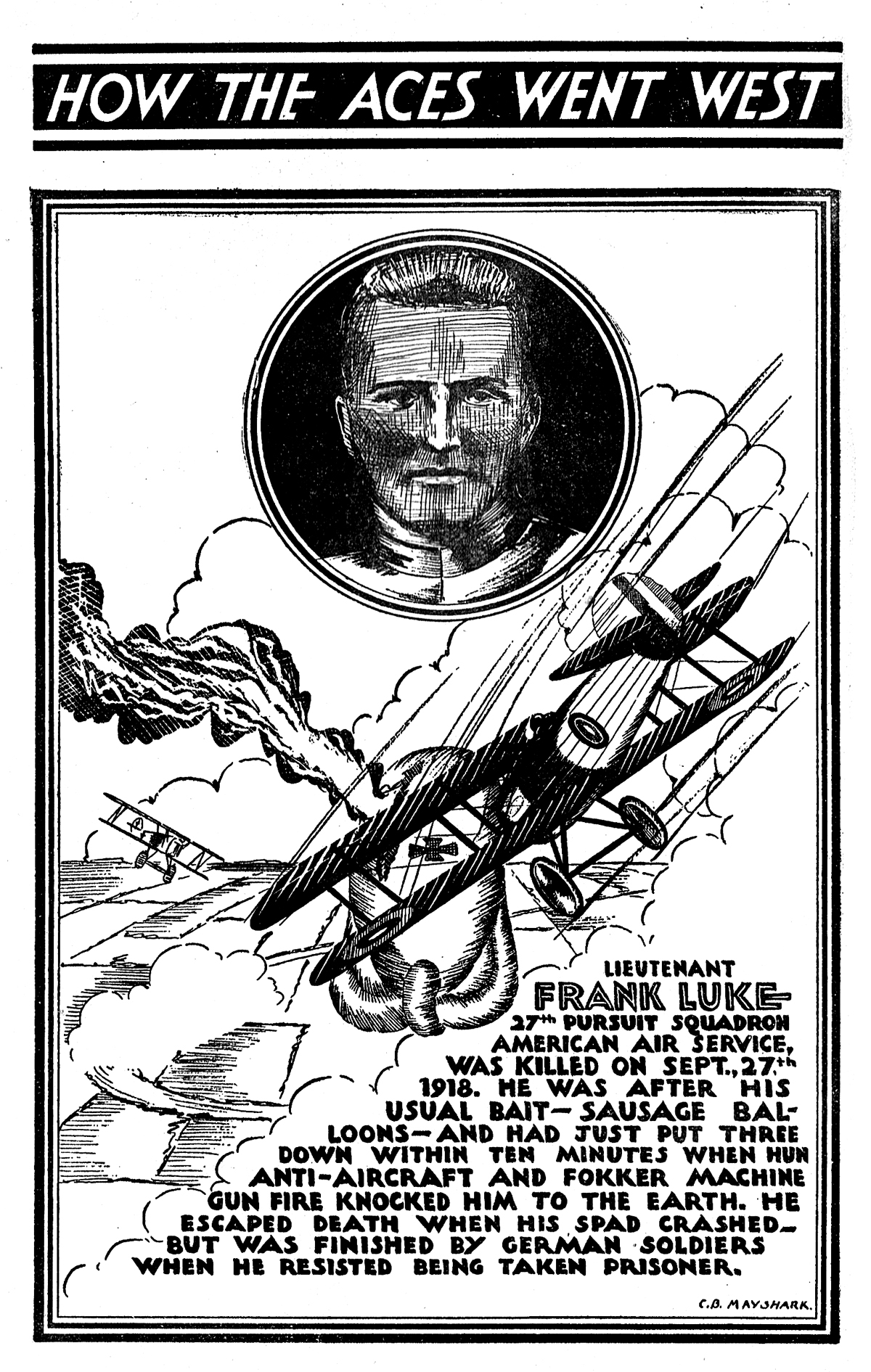
“How The Aces Went West: Lieutenant Frank Luke” by C.B. Mayshark

Link - Posted by David on May 30, 2018 @ 6:00 am in

THIS May we’re celebrating the genius that is C.B. Mayshark! Along with his cover duties for Sky Birds and Flying Aces in the mid-thirties, Mayshark also contributed some interior illustrations including a series he started in the April issue of Sky Birds that would run until the final issue that December—How The Aces Went West! It was an informative feature that spotlighted how famous Aces died. For the September 1935 issue of Sky Birds, Mayshark looks at how Lieutenant Frank Luke “Went West!”

How The Aces Went West
“How The Aces Went West: Lieutenant Frank Luke

by C.B. Mayshark (Sky Birds, September 1935)

“Sky Birds, November 1934″ by C.B. Mayshark

Link - Posted by David on May 28, 2018 @ 6:00 am in

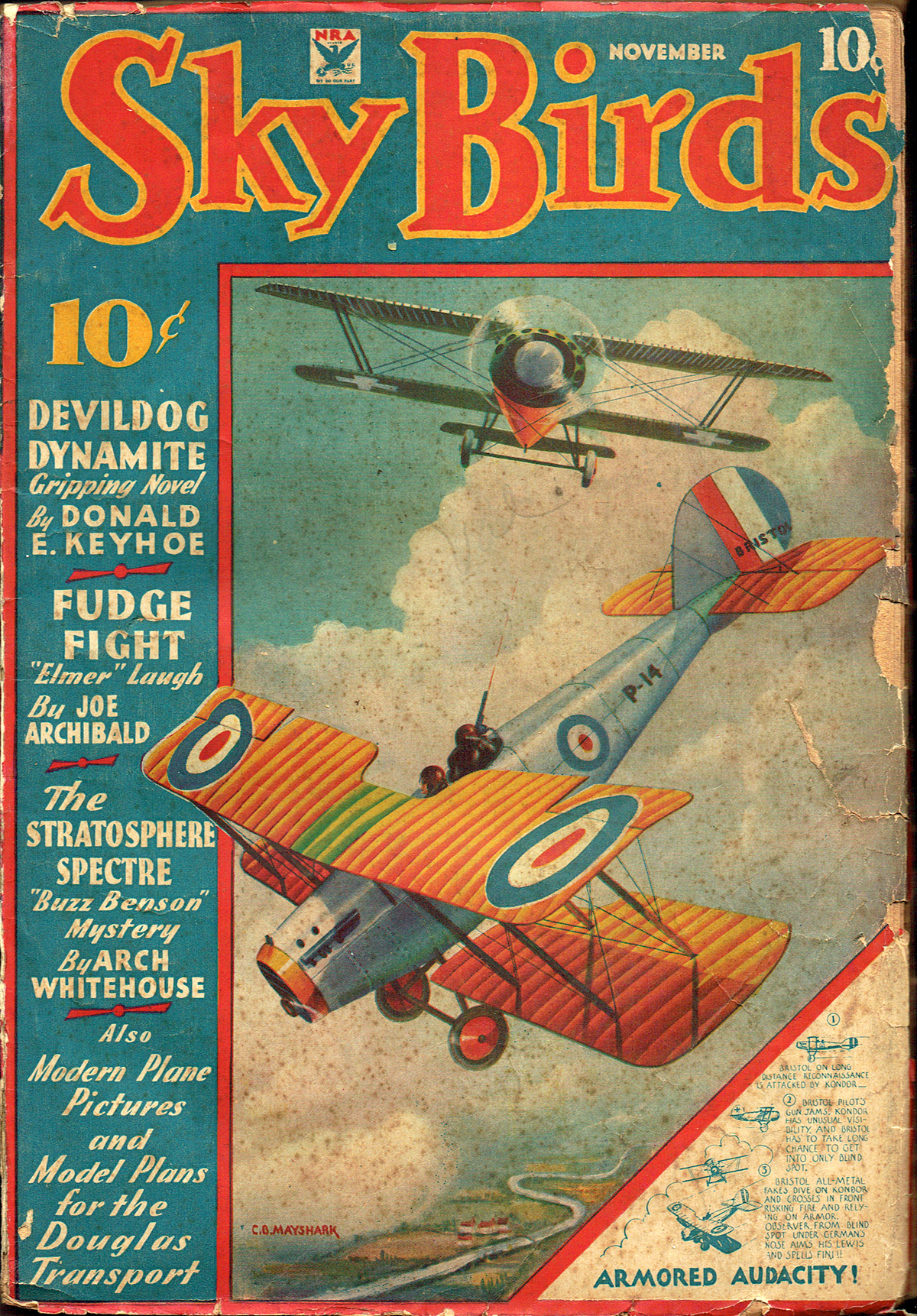
THIS May we’re celebrating the genius that is C.B. Mayshark! Mayshark took over the covers duties for Sky Birds with the July 1934 and would paint all the remaining covers until it’s last issue in December 1935. At the start of his run, Sky Birds started featuring a different combat maneuver of the war-time pilots. The lower corner presenting a play-by-play of that month’s maneuver with the remainder of the cover illustrating it. For November 1934 issue Mayshark gives us “Armored Audacity!”

Combat Maneuvers of War-Time Pilots:
Armored Audacity

WITH one or two exceptions, th_SB_3411 all metal planes were uncommon during the war. The ships which saw service on the Front were of fabric construction, with wooden spars, longerons and ribs used throughout.

On planes of 1917 and 1918 design, however, metal was employed for hoods on the water-cooled jobs, as well as for the cowlings of radials and rotaries. Metal was not used further than this, except on ships of rare design, most of which never got into active service. In the hectic days of the war, manufacturers were reluctant to depart from time-proven standards and pitch headlong into the mass production of a design which had not established its worth over the blood-stained battlefields of France.

However, there is always some one a step ahead of the rest of the world—some one with courage and foresight enough to make a radical departure from conventional design. Such a step was taken by the engineers of the Bristol Works in England during 1918. The result of their efforts is the Bristol M-1, an all-metal adaptation of the famous Bristol Fighter.

The main object in building the M-1 was to produce a ship capable of resisting the climatic variations of hot countries such as Egypt and India. However, several M-1’s found their way across the Channel and into France. The M-1 was very similar in appearance to the Bristol Fighter, the important changes in design occurring in the center-section of the lower plane, which is entirely cut away, with only the two main spars remaining intact, and in the tail assembly, which carries a larger fin and a smaller tailskid than the Fighter.

Steel is employed throughout the fuselage construction, a light-weight composition metal being used on the outer covering. The spars and ribs of the wings are steel, fabric being used for a covering. The M-1 carries a 200-h.p. Sunbeam “Arab” in its nose, and Is capable of making about 124 miles per hour. The regulation Scarff mounting is used over the observer’s cockpit, on which either single or double Lewis gun units can be fitted. Twin Vickers are carried beneath the engine hood, and are equipped with an interrupter gear for firing through the prop.

The other ship pictured on this month’s cover is a single-seater German “Kondor.” It will be observed that the center-section on the upper plane is entirely cut away, even the main spars being eliminated. The ship is powered with a 140-h.p. Goebels rotary with air-cooling being accomplished by means of holes bored through the front turn of the cowling.

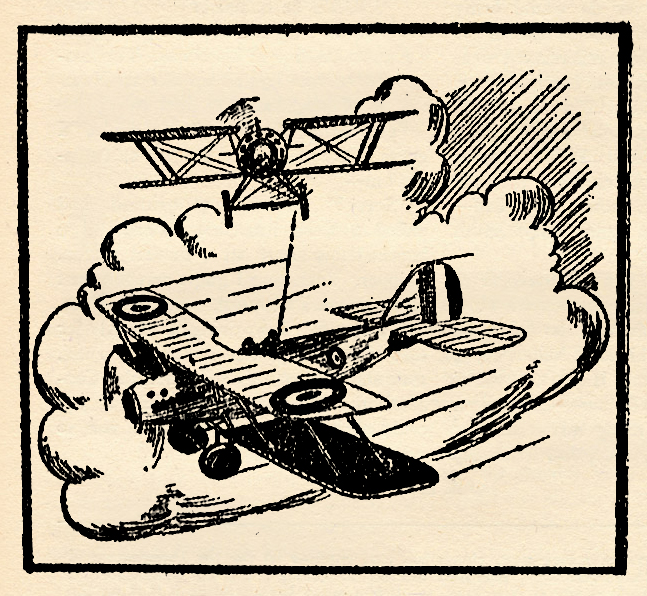
The maneuver executed by the pilot of the Bristol is quite appropriately termed audacious. With the Kondor on his tail, the Bristol pilot exposes himself and his observer to great apparent danger. As he fakes a dive, he hoiks the ship up and thunders before the German, directly in the line of a deadly fire. But the Spandau tracers cannot find a vital spot beneath the Bristol armor, and as the German pilot frantically fights for altitude, the Bristol observer, well in the German’s blind spot, lines up the best target he has ever seen through his Lewis sights.

As he trips the trigger, one burst of fire is emitted. The Kondor staggers, with prop spinning madly. The German plane levels off. Its nose begins to sink, and as it begins a long, wide, uncontrolled spiral, it sets itself to its last task—its last descent.

The Story of The Cover
Sky Birds, November 1934 by C.B. Mayshark
(Combat Maneuvers of War-Time Pilots: The Story Behind This Month’s Cover)

“Sky Finance” by Joe Archibald

Link - Posted by David on May 25, 2018 @ 6:00 am in

“Haw-w-w-w-w!” That sound can only mean one thing—that marvel from Boonetown, Iowa is back causing more trouble than he’s worth! That miscreant of Calamity manages believes he has a sure thing goin’, but overplays his hand andgets not only himself in hick, but practiaclly the whole of the Ninth including the Old Man! It’s a case of “cash-and-miscarry” ala Carbuncle in “Sky Finance” from the pages of the June 1936 Flying Aces!

Battling Casey, the Ninth’s famed ackemma, needed a fight trainer, so Phineas assumed the role—and he figured on assuming the roll of a couple of Limeys into the bargain. But when the leather pushers squared off, the Iowa Impresario found his man entered in the weight-lifting events. Moral: It’s easy to don the leather, but you can’t always push it.

“How The Aces Went West: Captain Lanoe George Hawker” by C.B. Mayshark

Link - Posted by David on May 23, 2018 @ 6:00 am in

THIS May we’re celebrating the genius that is C.B. Mayshark! Along with his cover duties for Sky Birds and Flying Aces in the mid-thirties, Mayshark also contributed some interior illustrations including a series he started in the April issue of Sky Birds that would run until the final issue that December—How The Aces Went West! It was an informative feature that spotlighted how famous Aces died. For the August 1935 issue of Sky Birds, Mayshark looks at how Captain Lanoe George Hawker “Went West!”

How The Aces Went West
“How The Aces Went West: Captain Lanoe George Hawker

by C.B. Mayshark (Sky Birds, August 1935)

“Sky Birds, October 1934″ by C.B. Mayshark

Link - Posted by David on May 21, 2018 @ 6:00 am in

THIS May we’re celebrating the genius that is C.B. Mayshark! Mayshark took over the covers duties for Sky Birds with the July 1934 and would paint all the remaining covers until it’s last issue in December 1935. At the start of his run, Sky Birds started featuring a different combat maneuver of the war-time pilots. The lower corner presenting a play-by-play of that month’s maneuver with the remainder of the cover illustrating it. For October 1934 issue Mayshark gives us “The Camera Crasher!”

Combat Maneuvers of War-Time Pilots:
The Camera Crasher

ONE of the most skilled, daring, th_SB_3410 and probably least appreciated members of tho air services during the war was the observer who happened to be capable of using an air camera. Actually, there were very few who could do this job well, in spite of the fact that all airmen were supposed to be trained in the use of the instrument. There was always one man in every squadron who was unlucky enough, right from the start, to be able to get good pictures. From that day on, he was marked.
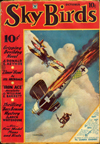
The air photographer had to be a strange combination of grim, fighting courage, cool, methodical cunning and unbelievable patience. In the first place, he had to be an observer, a man worthy of any one’s respect. Then he had to be a plodding soul who was game enough to keep his pilot on a straight course while he got strips of pictures to make up the innumerable mosaic maps that the Army seemed to consume with amazing rapidity. Next, he had to be a capable fighting man, in order to do two things at once—and do them both well. He had to be able to fight with one hand on his Lewis or Parabellum gun while with the other he was ramming the plates through the camera with, machinelike precision.

Try holding off two Huns with one hand, ramming the feed handle of the camera back and forth with the other, while you count slowly to eight between plate changes— and you get an idea what it was all about. If your pilot got “windy” during the spree and let his ship run slightly off line to dodge the crackling tracer, you arrived back to find that half your plates had been exposed over a section you had taken the day before. Then back you went again, to try it all over.

The photography proposition was a serious business in the war days. The areas involved had to be photographed regularly, and not just in single shots, as most air-story readers believe. You had to get eighteen plates in a row at a time. The single plate exposure of some particular pinpoint came now and again, but not often enough to make up for the hair-raising experiences getting the mosaic strips.

Then there was the other side of the photography game—the defense against it. This is where we got the idea for this month’s cover.

Here we see a German two-seater that has sneaked over the French lines and caught an important strip which may or may not have considerable bearing on a coming offensive. That ship must be stopped. It must never get back to Germany. But it has already nailed the picture, and there is but one thing to do.

To shoot it down might help, but you cannot be sure. You might kill both the pilot and the observer, and yet the camera plates might still be intact. Then, if they are recovered from the wreckage and developed, they can still do the damage the French feared.

It was to this end that several countries on the Allied side of tho line worked on the development of a cannon-plane, or a ship that was armed with a one-pounder for a particular purpose. That purpose was the same for which Buckingham ammunition was intended—destruction by fire. When a ship was shot down in flames, everything aboard, including cameras and plate boxes, was usually consumed by fire.

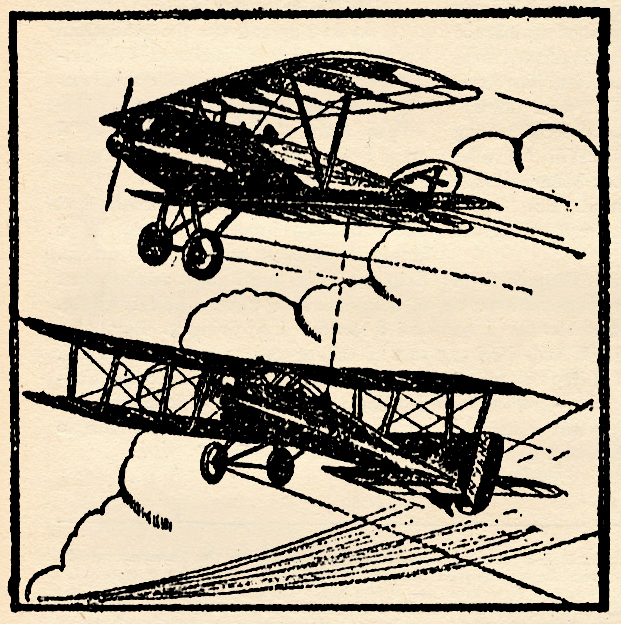
The Spad-Cannon is well known, mainly because it was used with fair effect by both Fonck and Guynemer. The real truth of the matter, however, is that the cannon-ship was actually developed for the purpose of destroying enemy camera ships by setting them on fire. The shell used was a graze-fuse incendiary missile. The Buggatti-Spad shown in the upper portion of this month’s cover was a special two-seater using a Buggatti motor, with barrel-type water and oil-cooling chambers shown beneath the nose. The gun used was a spring-recoil weapon fitted to fire through the propeller-shaft, which was hollow and geared to the two eight-cylinder crank shafts. How many of these ships were built and titled on the Front is not known, but we are presenting it to show just how these much-talked-of cannon-ships were employed.

The Albatros CV shown is also a 1918 type, fitted with a 225-h.p. B.W.F. motor. The upper wing had a span of 41 feet, 6 inches, and the lower a span of 40 feet, 4 inches. The strangely balanced ailerons should be noticed. The unfortunate observer-camera man has ripped his Parabellum out of the Gotha-type gun mounting, a steel post which swivels from a point in the center of the floor, and fits into holes or slots around the ring.

The Story of The Cover
Sky Birds, October 1934 by C.B. Mayshark
(Combat Maneuvers of War-Time Pilots: The Story Behind This Month’s Cover)


“The Camera Kid” by C.B. Mayshark

Link - Posted by David on May 18, 2018 @ 6:00 am in

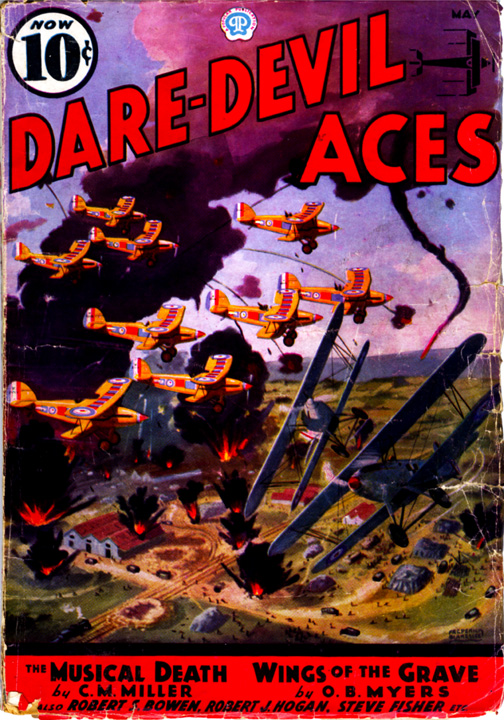
AS PART of our Mayshark Month posts we have a rare story C.B. Mayshark had in the May 1936 issue of Dare-Devil Aces! Known for his great covers and interior illustrations, Mayshark was apparently jut as adept with the typewriter. He gives us a crackin’ yarn of hell skies. A young observation photographer that’s a whiz with the camera unfortunately freezes when the bullets start flying by. His pilot has been able to successfully cover for the kid, until a figure from the kid’s past gets wind of his affliction and sets about to bring him down!

The Kid had an eye like a hungry eagle, and could snap a picture of a mosquito doing handsprings. But alone in the clouds with the Spandaus whistling past, the Kid’s guts froze in a lump. “Yellow I am,” he cursed himself. “And I wish that I could die.” Still one man keeps his faith with the Kid and vows to bring him through—leads him on to a smashing show down, as a boy becomes a man!

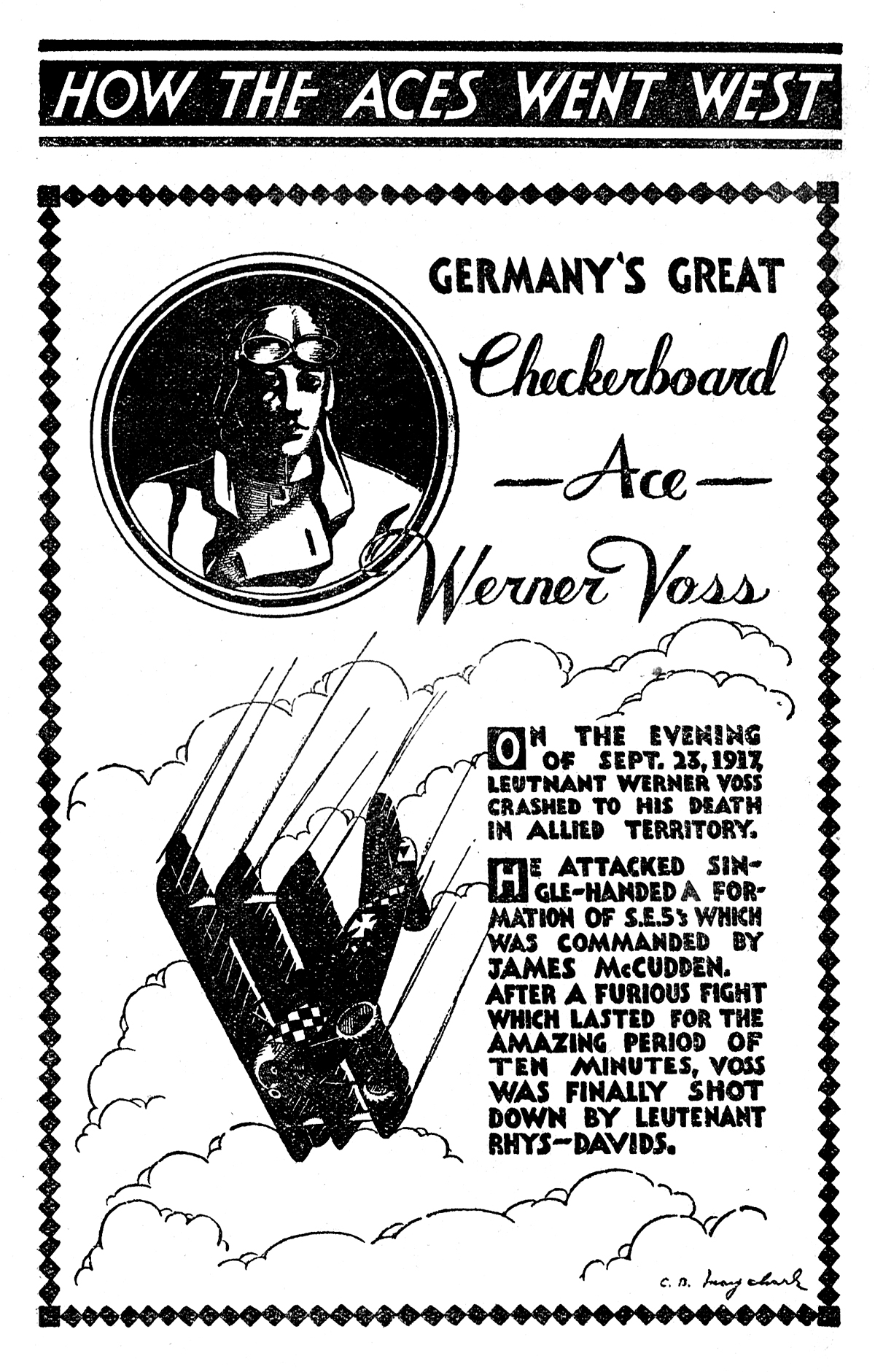
“How The Aces Went West: Werner Voss” by C.B. Mayshark

Link - Posted by David on May 16, 2018 @ 6:00 am in

THIS May we’re celebrating the genius that is C.B. Mayshark! Along with his cover duties for Sky Birds and Flying Aces in the mid-thirties, Mayshark also contributed some interior illustrations including a series he started in the April issue of Sky Birds that would run until the final issue that December—How The Aces Went West! It was an informative feature that spotlighted how famous Aces died. For the July 1935 issue of Sky Birds, Mayshark gives us “How Werner Voss Went West!”

How The Aces Went West
“How The Aces Went West: Werner Voss

by C.B. Mayshark (Sky Birds, July 1935)

“Sky Birds, September 1934″ by C.B. Mayshark

Link - Posted by David on May 14, 2018 @ 6:00 am in

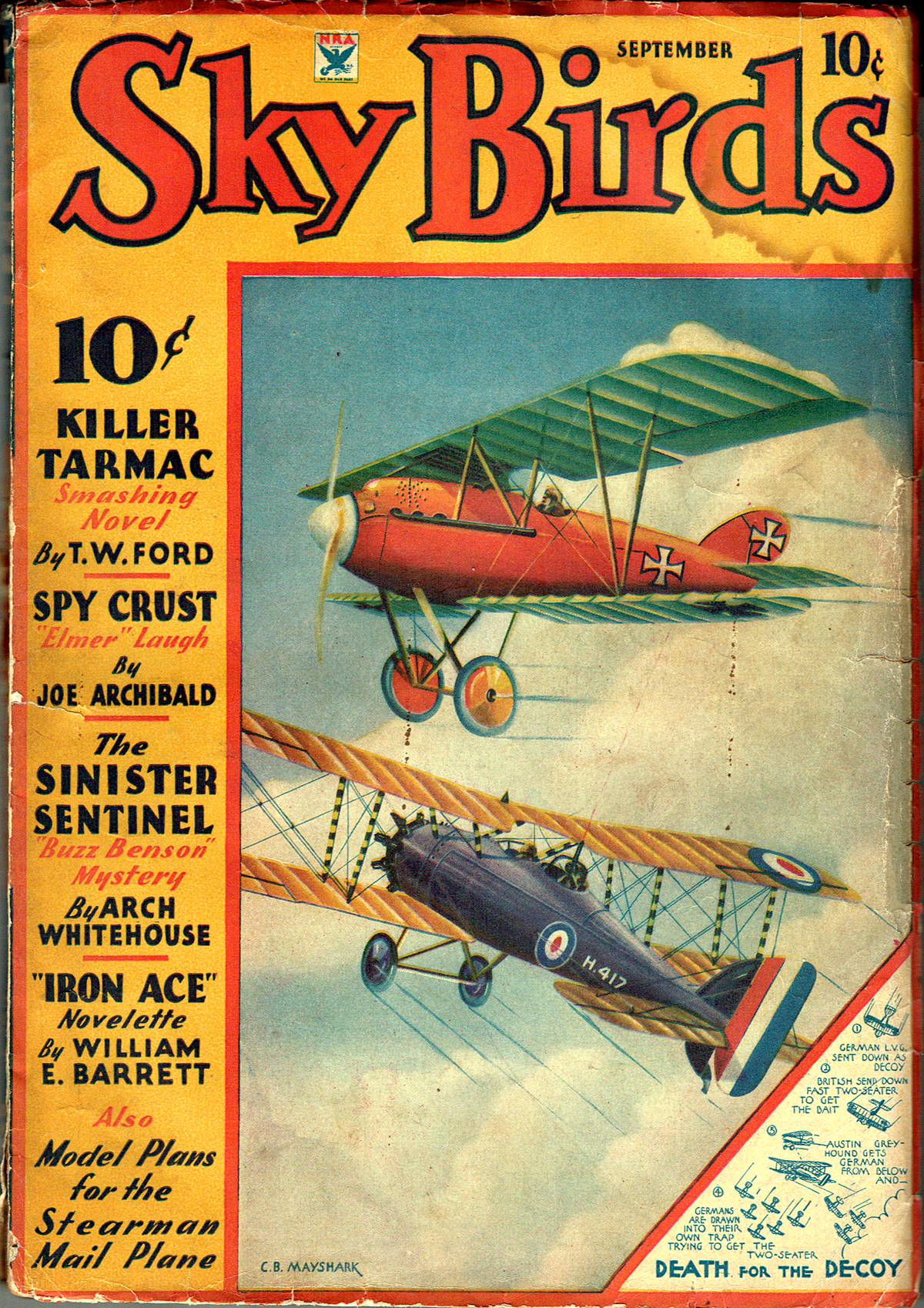
THIS May we’re celebrating the genius that is C.B. Mayshark! Mayshark took over the covers duties for Sky Birds with the July 1934 and would paint all the remaining covers until it’s last issue in December 1935. At the start of his run, Sky Birds started featuring a different combat maneuver of the war-time pilots. The lower corner presenting a play-by-play of that month’s maneuver with the remainder of the cover illustrating it. For September 1934 issue Mayshark gives us “Death For The Decoy!”

Combat Maneuvers of War-Time Pilots:
Death For The Decoy

THIS month our cover depicts a th_SB_3408 maneuver used many times during the latter months of the war, but not greatly exploited in story or illustration. It is not known who originated the decoy idea, but a defense for it was perfected by the British.

The painting shows two unusual ships, a German L.V.G. scout and the British Austin “Greyhound” two-seater fighter. It is improbable that either of these ships ever reached the Front and saw squadron service, but it is known that two or three were sent out and tried by the service-test pilots, whose duties were to flight-test new machines in actual combat, after they had been passed on construction, maneuverability and performance. The faults that lie hidden while ships are undergoing tests over friendly soil are usually brought out in the heat and flame of aerial warfare.

So, in order to give you new models to study, we show the British Austin “Greyhound” getting the D-type L.V.G. scout. We know of no better way of giving you accurate detail pictures, and at the same time explaining some of the intricate maneuvers used on the battlefront.

In this case, we have the original move of the German Staffel commander in sending down the unfortunate decoy. This ship was usually flown by a smart pilot who not only knew how to fake a “greenie” in the air, but was expected to be able to entice the Allied ships down and keep them occupied until the Staffel above could get down and come to his “rescue.” He not only had to be a game pilot, but he had to know every trick in the game. It was necessary that he know every inch of his Front, too, so that if his ship was damaged and he had to make a forced landing, he could cut into the bend in the line and be certain he was well inside his own territory.

This time, the British two-seater leader spots the move. It is possible that the lurking German scouts above have not made full use of the sun, or else they have been spotted as they tore through a hole in their cloud hideout. At any rate, the British commander gives his sub-leader a signal, and the pilot fires a red light, indicating that he is having engine trouble and wants to go back.

Instead of cutting into Allied territory, however, the decoy-destroyer cuts back at the first opportunity, slides into the L.V.G.’s blind spot and works his way into a position where the gunner can get in a terrible burst. If all goes well, the decoy is caught napping, or at least is made to fight, thus drawing the attention of the lurking Germans above.

Down they come, to protect their bait, not noticing the other two-seaters that have withdrawn to a suitable position beneath the Staffel. Once the big formation is on its way down, the British two-seater dives and reverses the role of decoy. The Germans go after him, but put themselves where the British can chop down on them before they have an opportunity to win back a better position. And, in 1918, two sets of guns against one was bad medicine.

The “Greyhound” is really an adaptation of the S.E.5 or the Nieuport Night-hawk in two-seater form. It had an A.B.C. Dragonfly radial engine of 320 h.p. and could do 130 m.p.h. at 10,000 feet. It landed at 45 m.p.h. and climbed to 10,000 feet in 11 minutes.

Little is known of the L.V.G. except that it used the 230-h.p. Benz, and had unusually clean lines. It probably had a speed of about 118 m.p.h.

The Story of The Cover
Sky Birds, September 1934 by C.B. Mayshark
(Combat Maneuvers of War-Time Pilots: The Story Behind This Month’s Cover)

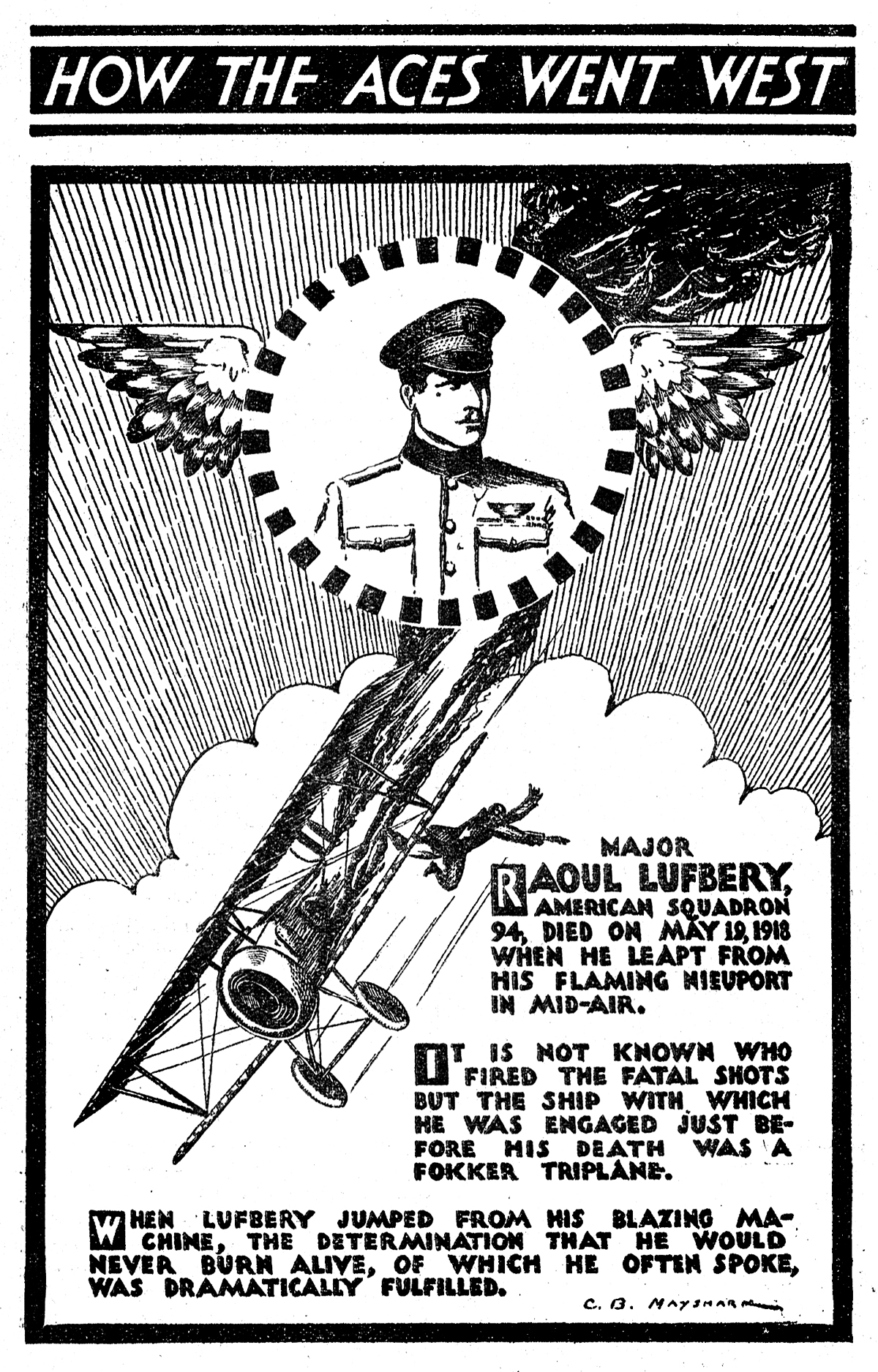
“How The Aces Went West: Major Raoul Lufbery” by C.B. Mayshark

Link - Posted by David on May 9, 2018 @ 6:00 am in

THIS May we’re celebrating the genius that is C.B. Mayshark! Along with his cover duties for Sky Birds and Flying Aces in the mid-thirties, Mayshark also contributed some interior illustrations including a series he started in the April issue of Sky Birds that would run until the final issue that December—How The Aces Went West! It was an informative feature that spotlighted how famous Aces died. For the June 1935 issue of Sky Birds, Mayshark gives us “How The Aces Went West: Major Raoul Lufbery!”

How The Aces Went West
“How The Aces Went West: Major Raoul Lufbery

by C.B. Mayshark (Sky Birds, June 1935)

“Sky Birds, August 1934″ by C.B. Mayshark

Link - Posted by David on May 7, 2018 @ 6:00 am in

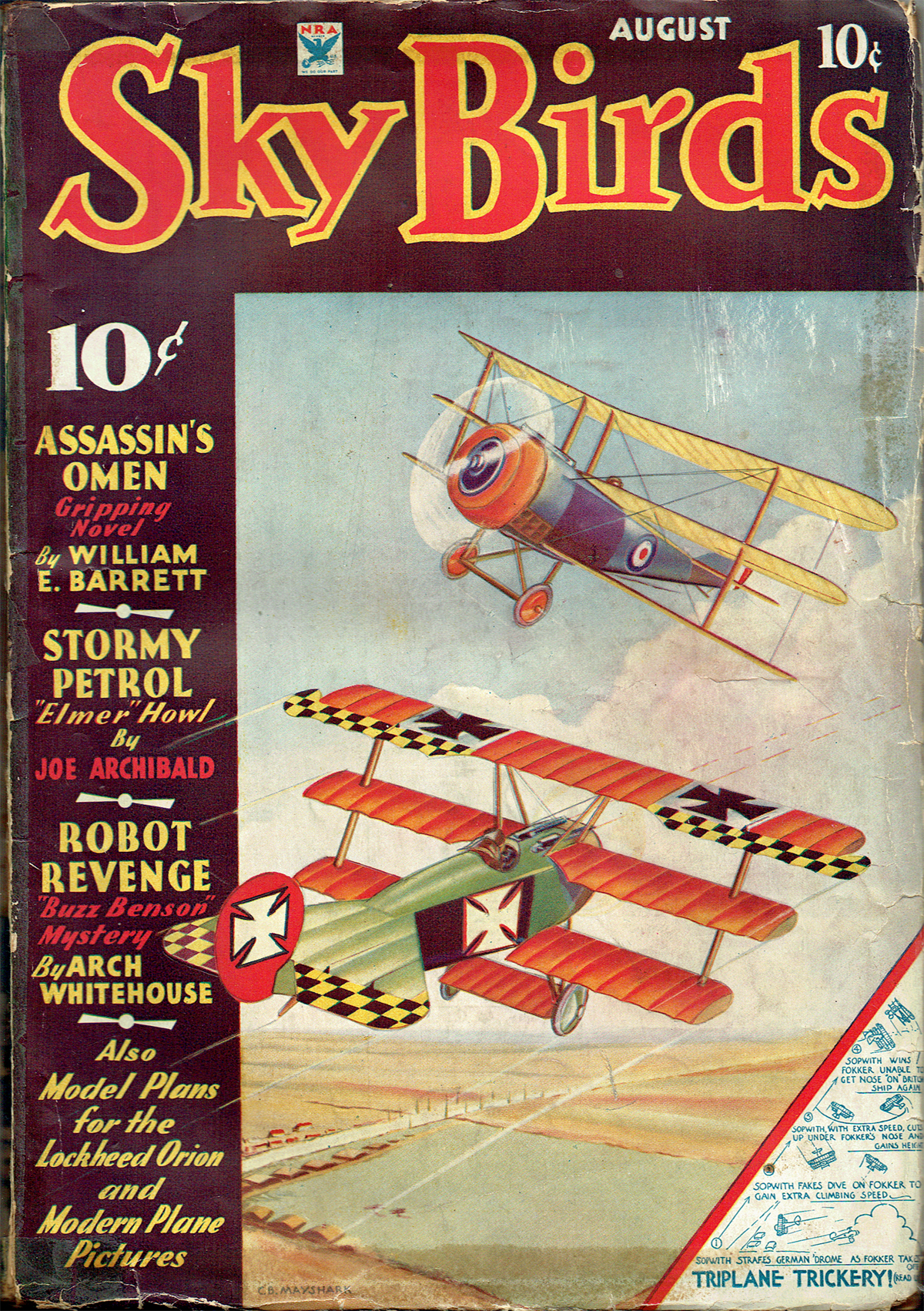
THIS May we’re celebrating the genius that is C.B. Mayshark! Mayshark took over the covers duties for Sky Birds with the July 1934 and would paint all the remaining covers until it’s last issue in December 1935. At the start of his run, Sky Birds started featuring a different combat maneuver of the war-time pilots. The lower corner presenting a play-by-play of that month’s maneuver with the remainder of the cover illustrating it. For August 1934 issue Mayshark gives us “Triplane Trickery!”

Combat Maneuvers of War-Time Pilots:
Triplane Trickery

PROBABLY no more interesting bit th_SB_3408 of air action could ever be seen on any front than that involving two triplanes, one a Sopwith, the other, of course, the much discussed Fokker. Both were fast on the controls, almost equally powered and remarkable climbing ships.

The most amazing feature about this triplane business is that even today, with all the publicity that has been given to World War planes, few realize that the greatest triplane on the Front was the Sopwith—not the Fokker.

The Fokker triplane has drawn an unusual amount of regard mainly because von Richthofen flew it for a considerable period. Voss, the great German sportsman, also won twenty-two victories in three weeks in a triplane. The German triplane has attracted attention also because of the garish designs that have been credited to various noted German Staffels. A German triplane decked out in fantastic colors and diced designs looks more offensive than a Sopwith which had to retain its factory colors. The triplanes used by Ray Collishaw and his Black Gang when they were ordered to keep every German observation plane out of the air over Messines, in 1917, were the only British ships used on the Front during the daytime which were daubed up with unorthodox coloring. Our readers will recall that they were all painted black.

The Sopwith triplane was finished and first delivered on May 28th, 1916. The Fokker triplane came out several months later, and had many of the interesting features of the British ship. Except for the Fokker cantilever wing, which made it a stronger ship than the Sopwith, the Fokker was generally considered a steal.

Be that as it may, both were fine ships. The Sopwith triplane was first used by the Royal Naval Air Service and did fine work, but after several months of front-line and coastal action, it was practically superseded by the Camel, which came out in December, 1916. The one fault with the Sopwith was its unusually high landing speed, which frankly made it unsuitable for the temporary airdromes in vogue in France in those days. For this reason, it was practically abandoned. However, when Ray Collishaw, given the unenviable job of clearing the air for a period of three months over Messines, was asked what ship he preferred for the work, he practically stunned everyone by stating that the Sopwith triplane would be his selection.

They gave him five and let him daub them up as he liked. He selected four other young hellions like himself and went to work clearing the air over Messines while the British sunk their memorable mine under the German lines. In two months Collishaw shot down 29 German planes. His Black Gang accounted for nearly forty, altogether, and eventually Messines went up without a German’s knowing what had been going on.

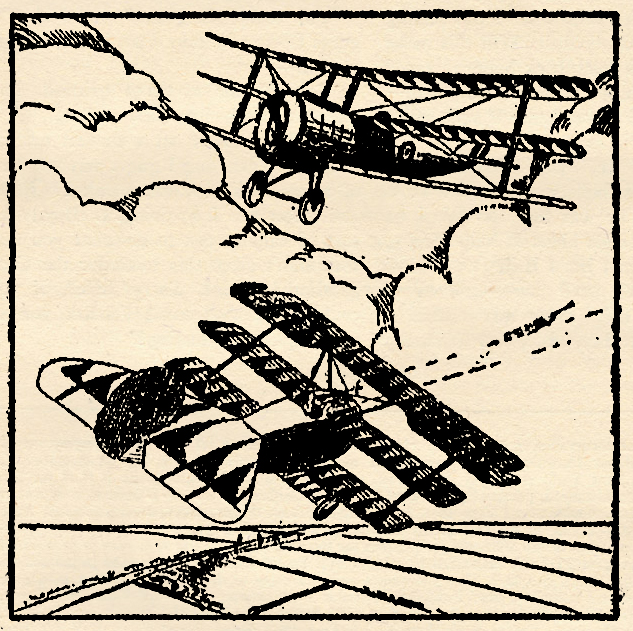
Where the British triplane had it all over the German was in climbing. In the first place, it was much lighter and better powered. In our cover drawing this month, we show a typical maneuver during a raid on a German drome. The British ship had broken out of a patrol to give a line of hangars a dose of Vickers. A German had been taking off just as the Sopwith pilot reached his lowest point. Naturally the Fokker had the early edge in height, but the Sopwith pilot was taught to fake a dive on his enemy at the first opportunity he got. If he hit, okay. If not, he continued on under the Fokker yanked up hard and, with this added momentum, the Sopwith shot into the sky like a high-speed elevator. From that point on, the Fokker was completely outclassed, for while a pilot is struggling to climb, he has little chance to get his nose on an enemy.

Of course, if the Sopwith had tried to out-dive the Hun—that would have been different. But these are the tricks of the triplanes.

The Story of The Cover
Sky Birds, August 1934 by C.B. Mayshark
(Combat Maneuvers of War-Time Pilots: The Story Behind This Month’s Cover)
« Previous PageNext Page »