Looking to buy? See our books on amazon.com Get Reading Now! Age of Aces Presents - free pulp PDFs

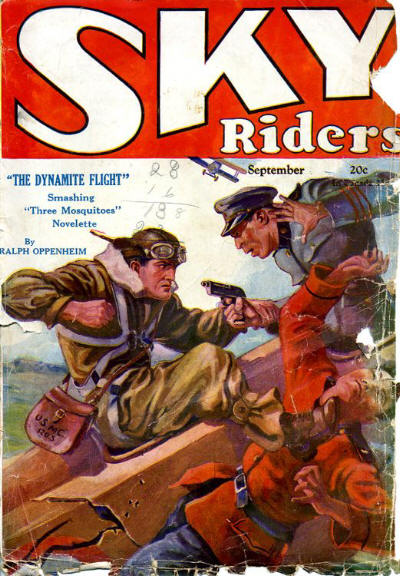
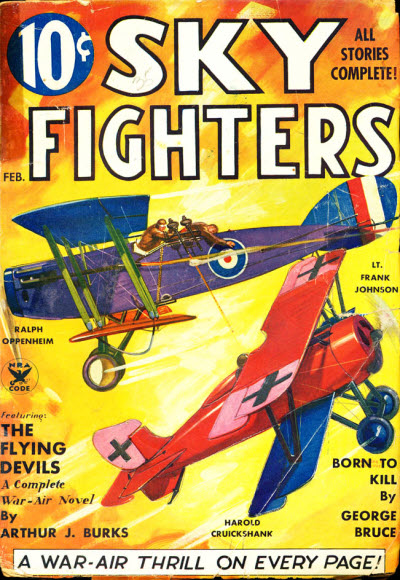
The Three Mosquitoes vs. “The Dynamite Flight” by Ralph Oppenheim

Link - Posted by David on March 1, 2019 @ 6:00 am in

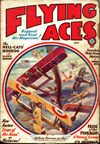
THEIR familiar war cry rings out—“Let’s Go!” The greatest fighting war-birds on the Western Front are once again roaring into action. The three Spads flying in a V formation so precise that they seemed as one. On their trim khaki fuselages, were three identical insignias—each a huge, black-painted picture of a grim-looking mosquito. In the cockpits sat the reckless, inseparable trio known as the “Three Mosquitoes.” Captain Kirby, their impetuous young leader, always flying point. On his right, “Shorty” Carn, the mild-eyed, corpulent little Mosquito, who loved his sleep. And on Kirby’s left, completing the V, the eldest and wisest of the trio—long-faced and taciturn Travis.

Yes! The Three Mosquitoes—the approach of spring has brought the Mosquitoes out of hibernation to help hurry on the warm summer months ahead. At Age of Aces dot net it’s our fifth annual Mosquito Month! We’ll be featuring that wiley trio in three early tales in the hell skies over the Western Front. And we’re starting things off with a bang! The Germans have developed a new super explosive they’ve called XXX—five time as powerful as the Allies’ most destructive explosives! A boast they demonstrate by wiping the 44th Squadron’s drome off the face of the map! The Three Mosquitoes concoct a perilous plan to sneak into the largest and most well-guarded German munitions plants where the XXX is being manufactured and blow it all to kingdom-come!

“Into the dugouts!” was the frantic order as that giant black Gotha hurled its death-dealing bombs down upon the airdrome. But Kirby, Carn and Travis crept across the blistering, bomb-torn tarmac toward their planes. For the grim mystery of that Gotha had to be solved. Smashing new “Three Mosquitoes” yarn.

If you enjoyed this tale of our intrepid trio, check out some of the other stories of The Three Mosquitoes we have posted by clicking the Three Mosquitoes tag or check out one of the three volumes we’ve published on our books page! And come back next Friday or another exciting tale.

“Famous Sky Fighters, July 1935″ by Terry Gilkison

Link - Posted by David on February 27, 2019 @ 6:00 am in

STARTING in the October 1933 issue of Sky Fighters and running almost 5 years, Terry Gilkison’s “Famous Sky Fighters” was a staple of the magazine. Each month Gilkison would illustrate in a two page spread different Aces that rose to fame during the Great War.

Although Gilkison was probably better known for his syndicated newspaper work, he also provided black and white story interior illustrations for pulp magazines. His work appeared in Clues, Thrilling Adventures, Texas Rangers, Thrilling Mystery, Thrilling Western, and Popular Western. Gilkison provided similar features in a few other Thrilling Publications—there was “Famous Soldiers of Fortune” and later “Adventure Thrills” in Thrilling Adventures, Famous Crimes” in Thrilling Detective, and the fully illustrated air adventure stories of Buck Barton “The Flying Devil” in The Lone Eagle! He signed most of this work with only his initials “T.G.” to maintain a low profile and preserve his reputation as a syndicated newspaper cartoon artist.

The July 1935 installment, from the pages of Sky Fighters, features Lt. Col Armand Pinsard, Capt. Roy Brown, Lt. Harold Nevins, and Major Edward Mannock!

Next time “Famous Sky Fighters” is jam packed! Terry Gilkison features Lt. Col Bill Thaw, Billy Bishop, Lt. Max Immelmann, and East Indian prince turned R.A.F. sky hellion—Sidor Malloc Singh! Don’t miss it!

“P.D.Q-Boat” by Joe Archibald

Link - Posted by David on February 22, 2019 @ 6:00 am in

“HAW-W-W-W-W!” That sound can only mean one thing—that Bachelor of Artifice, Knight of Calamity and an alumnus of Doctor Merlin’s Camelot College for Conjurors is back to vex not only the Germans, but the Americans—the Ninth Pursuit Squadron in particular—as well. Yes it’s the marvel from Boonetown, Iowa himself—Lieutenant Phineas Pinkham!

Deeds of extraordinary valor had made Phineas Pinkham a colonel. But one potent punch to the proud proboscis of a brigadier had amended that over zealous act on the part of the high cockalorums of the A.E.F. Everybody on the jittery front from the Channel to the Italian border breathed easier. But Lieutenant Pinkham had not forgotten a certain von Spieler. He was one Von whom Phineas had not been able to wash up completely and the Heinie’s name was written on the intrepid Yank’s books under the heading of “Unfinished Business.” From the February 1937 issue of Flying Ace, it’s Phineas Pinkham in “P.D.Q-Boat!”

Old Lady Fate had put through a mixed grill order, and it looked like the Krauts would bring home the bacon. Allied marine moguls got their ships mixed, Garrity got his signals mixed, and Goomer got his bottles mixed. All of which boiled down to the fact that Phineas was on the spot—only the M.P.’s didn’t know which spot.

“Luke Downs Three Balloons” by Paul Bissell

Link - Posted by David on February 18, 2019 @ 6:00 am in

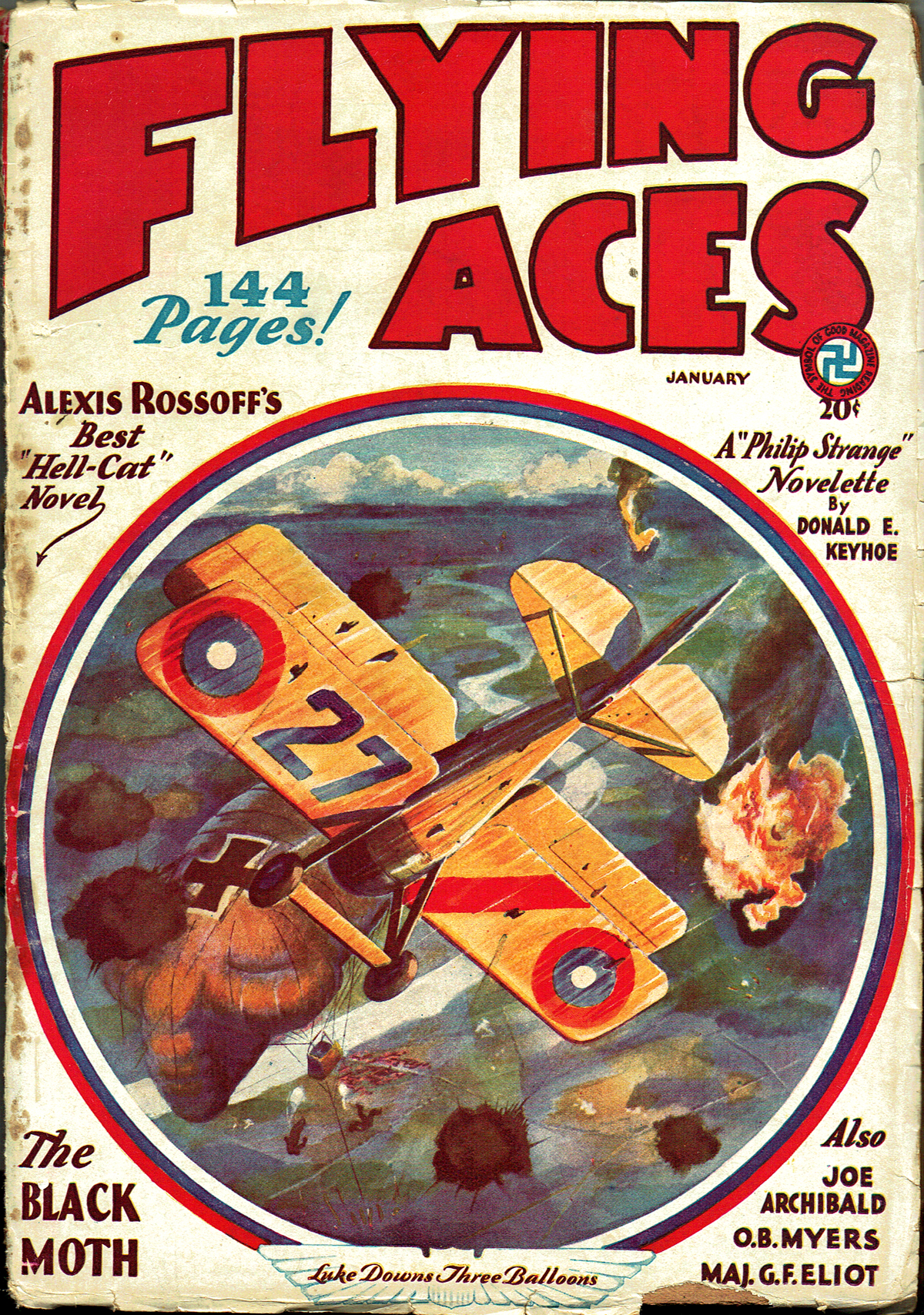
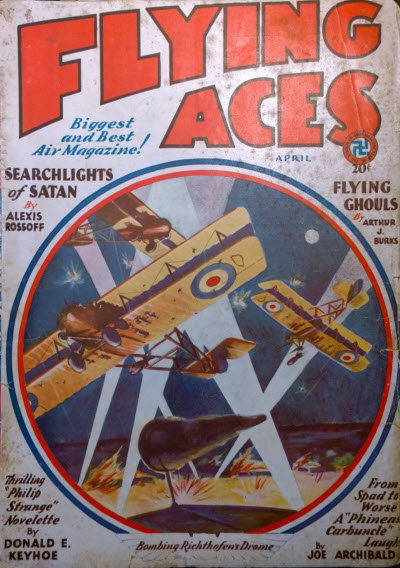
THIS week we present “Niebling’s Phenomenal Feat”—The story behind Paul Bissell’s April 1933 cover for Flying Aces! Bissell is mainly known for doing the covers of Flying Aces from 1931 through 1934 when C.B. Mayshark took over duties. For the January 1932 cover Bissell paints a tableau of Frank Luke in his trusty Spad 27 coming down on his third balloon in as many minutes on his last day in battle!

Luke Downs Three Balloons

th_FA_3201“MEIN GOTT! It is Herr Luke! Quick—down with the Drachen!”

In an instant all was confusion. Machine guns rattled and archies barked. Winches ground and turned as the Germans strove desperately to save their balloon, swaying gently in the dusk, two thousand feet above Milly.

The two balloon observers were already overboard. They knew that pilot! Thirteen balloons and five planes had fallen to Frank Luke’s attack in less than three weeks. Only ten days before, he had destroyed two balloons and three planes in less than fifteen minutes. And this afternoon, September 29, 1918, they had seen him destroy the balloon over Dun, fight his way through a squadron of Fokkers, destroy a second balloon over Briere Farm, and dive headlong at their own helpless bag—all in less than three minutes! Their bag was doomed—and overboard they went.

On came Luke’s Spad, through a hell of shrapnel and machine-gun fire,
 its motor wide open, and both guns spitting flame. Another instant and 
Luke would have crashed into the balloon, head on, but with a sudden zoom 
and bank, he pulled clear of the now fiercely burning Drachen. His third
 balloon was going down! That day—which proved to be his last, for a 
wound forced Luke down and he was found dead the next morning—was a
 fitting end to a glorious career, the career of one of America’s greatest 
airmen.

The Ships on The Cover
“Luke Downs Three Balloons”
Flying Aces, January 1932 by Paul J. Bissell

“A Fighting Man” by William E. Poindexter

Link - Posted by David on February 15, 2019 @ 6:00 am in

THIS week we have a story from William E. Poindexter. Poindexter’s work appeared frequently in the supporting pages of the air pulps of the 1930’s. Here, he gives us the tale of Little Ossie Timpkins—who asked nothing more than to be considered a fighting man. But due to his stature, found himself on terminal kitchen duty—until he thinks he found a way to prove to himself and the others that he truly is “A Fighting Man!” From the pages of the May 1932 Flying Aces.

Little Ossie Timpkins, K.P., asked for nothing more—to die in a blaze of glory—to ride flaming wings down the steep skies to a fiery grave! But they wouldn’t let him into the air—wouldn’t let him prove that he was even as every last one of them—a fighting man!

“Famous Sky Fighters, June 1935″ by Terry Gilkison

Link - Posted by David on February 13, 2019 @ 6:00 am in

STARTING in the October 1933 issue of Sky Fighters and running almost 5 years, Terry Gilkison’s “Famous Sky Fighters” was a staple of the magazine. Each month Gilkison would illustrate in a two page spread different Aces that rose to fame during the Great War.

Although Gilkison was probably better known for his syndicated newspaper work, he also provided black and white story interior illustrations for pulp magazines. His work appeared in Clues, Thrilling Adventures, Texas Rangers, Thrilling Mystery, Thrilling Western, and Popular Western. Gilkison provided similar features in a few other Thrilling Publications—there was “Famous Soldiers of Fortune” and later “Adventure Thrills” in Thrilling Adventures, Famous Crimes” in Thrilling Detective, and the fully illustrated air adventure stories of Buck Barton “The Flying Devil” in The Lone Eagle! He signed most of this work with only his initials “T.G.” to maintain a low profile and preserve his reputation as a syndicated newspaper cartoon artist.

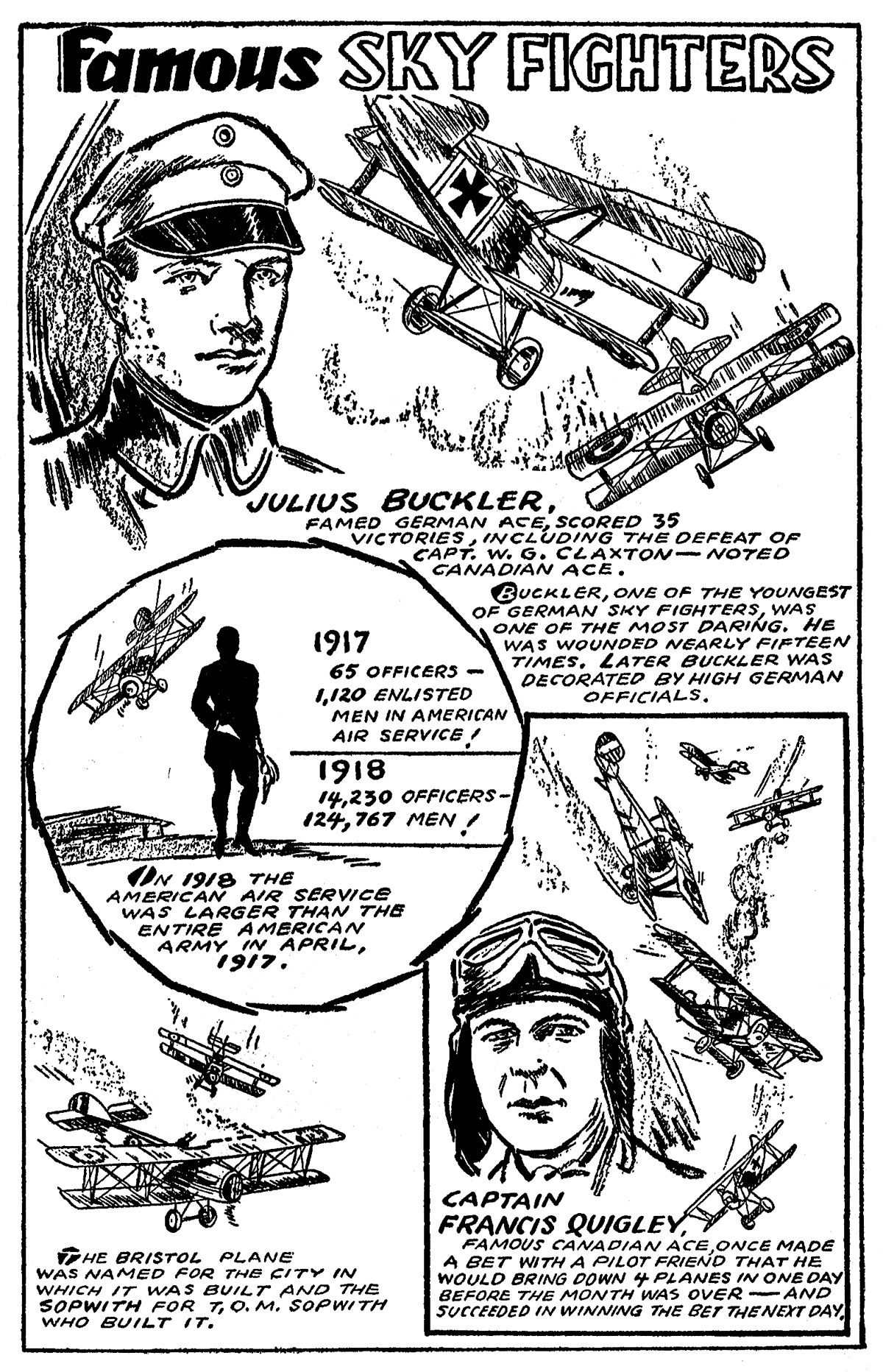
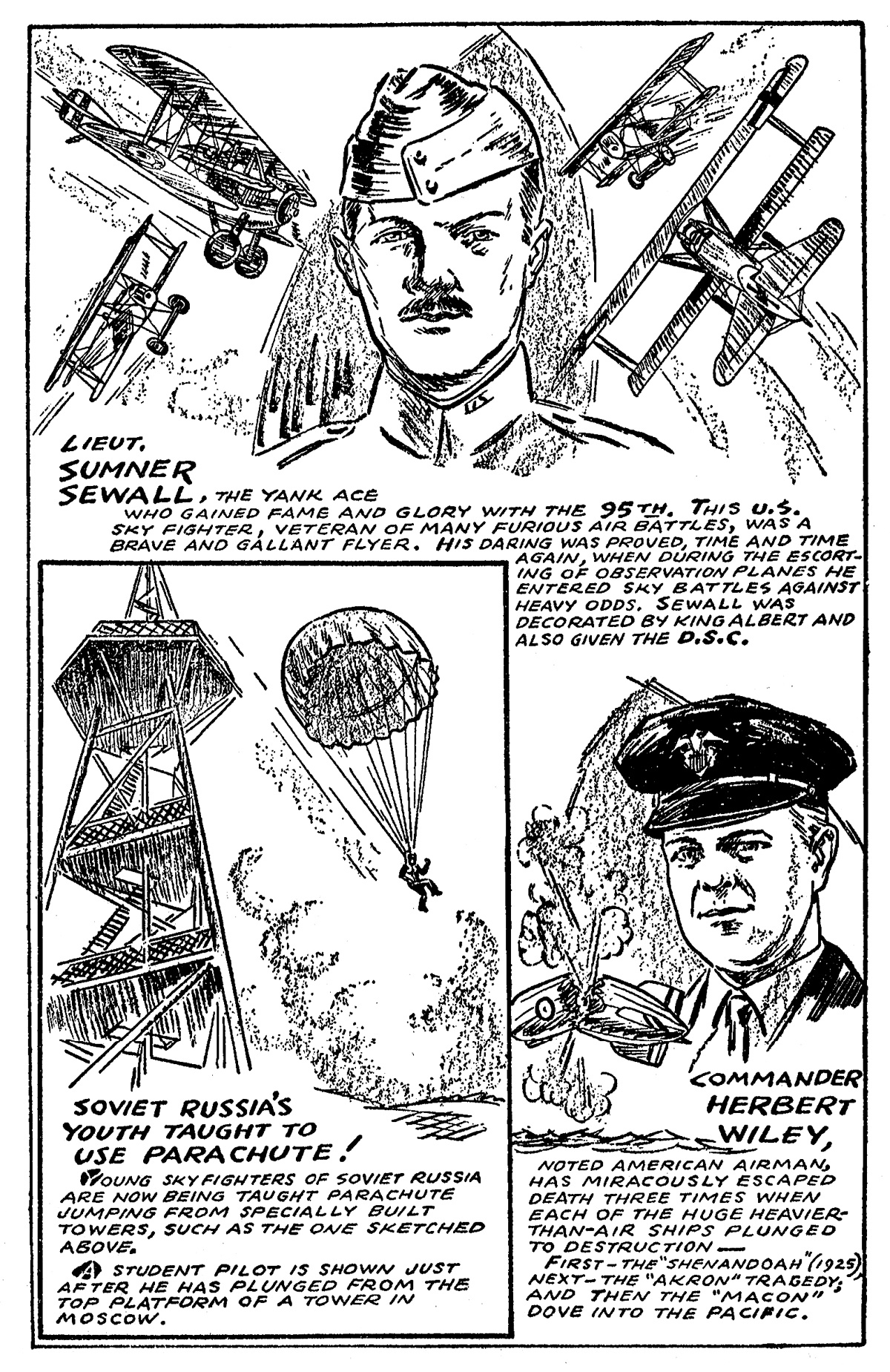
The June 1935 installment, from the pages of Sky Fighters, Features Julius Buckler, Capt. Francis Quigley, Lt. Sumner Sewall, and Commander Herbert Wiley!

Next time in “Famous Sky Fighters,” Terry Gilkison features Lt. Col Armand Pinsard, Capt. Roy Brown, Lt. Harold Nevins, and Major Edward Mannock! Don’t miss it!

Richard Knight in “Hell Hammers Harbin” by Donald E. Keyhoe

Link - Posted by David on February 8, 2019 @ 6:00 am in

THE prolific Donald E. Keyhoe had a story in a majority of the issue of Flying Aces from his first in January 1930 until he returned to the Navy in 1942. Starting in August 1931, they were stories featuring the weird World War I stories of Philip Strange. But in November 1936, he began alternating these with sometime equally weird present day tales of espionage Ace Richard Knight—code name Agent Q. After an accident in the Great War, Knight developed the uncanny ability to see in the dark. Aided by his skirt-chasing partner Larry Doyle, Knights adventures ranged from your basic between the wars espionage to lost valley civilizations and dinosaurs.

“Hell Hammers Harbin” from the pages of the March 1938 issue of Flying Aces is Keyhoe’s ninth story with the intrepid Q-Agent and his pal Larry Doyle.

North! North! And still farther northward over those bleak wastes of Asia flew Dick Knight. His course was uncharted—his destination unknown even to himself! Only a question mark—a cryptic crimson question mark emblazoned on a rough Manchurian map—offered a clue to the mystery of that mad flight. And that puny clue was destined to be his single weapon against—hideous meteors of murder!

“The Lone Eagle, August 1934″ by Eugene M. Frandzen

Link - Posted by David on February 4, 2019 @ 6:00 am in

Eugene M. Frandzen painted the covers of The Lone Eagle from its first issue in September 1933 until the June 1937 issue when Rudolph Belarski took over with the August issue of that year. At the start of the run, Frandzen painted covers of general air action much like his Sky Fighters covers. Here, for the August 1934 cover, Frandzen has a couple of S.V.A. biplanes and an Austrian Lohner flying boat!

The Story of the Cover

ITALY, a country producing no th_LE_3408 steel or coal and an insufficient amount of foodstuffs, took a mighty walloping from Austria for over two of her three years in the Great War. But during that time, in the face of defeat after defeat, they put up a mighty sweet scrap against the Austrians.

Caught without sufficient airplanes, they tore into the job and produced some of the finest made by any country. During the war they were even supplying their allies with engines and planes.

The Adriatic does not appear to be much of a puddle when compared to other seas and oceans but it took all the ingenuity and vigilance of every available Italian flyer to patrol it.

Lurking Perils

German and Austrian submarines were lurking beneath its surface, laying in wait for cargo ships laden with iron ore and coal enroute to Italy’s foundries. Austrian airplanes roared down on seacoast cities; left a trail of ruins in their wake. Brandenburg and Lohner flying boats were continually a menace.

Gradually the speed and reliability of the Italian airplanes, seaplanes and flying boats increased. Outstanding among these were the S.V.A. types of planes. One of these, the S.V.A. biplane fitted either with pontoons or wheels, was a flying killer which the Austrians dreaded to meet.

On the cover two S.V.A. biplanes have caught an Austrian Lohner flying boat as it has finished dumping its load of bombs into a cargo ship laden with coal bound for the Italian coast.

A Devastating Bomb

One after another the bombs slipped from their racks and smashed through the steamer’s deck, down into the hold. The crew were mowed down with machine-gun fire from the Lohner’s front cockpit. Fire, the dreaded foe of all at sea, burst through the shattered deck. Dense masses of greasy opaque smoke billowed upwards. A bomb had ripped plates from the side of the ship below the water-line.

The gunner in the Lohner grins, points to the listing, stricken ship. His pilot laughs, shrugs his shoulders and looks at his gas indicator. It is low, just enough to reach home. Still smiling, he kicks his ship around to scram.

No Smile Now

The smile of victory is wiped from his lips. He yanks at his controls like a novice, nearly pitching his gunner into the briny. Bearing down on the Lohner are two S.V.A.’s tearing across the skies at a hundred and thirty-five mile clip, their 220 h.p. motors roaring. With hardly enough gas to see him home the Austrian pilot is forced to fight. To try to escape with his slower ship would be suicide.

A hail of bullets blast at the Austrian plane. Up flips the flying boat’s nose. The gunner in the bow, crouching over his gun, sends a stream of lead back at the S.V.A. The range is great but a lucky shot damages an aileron control.

The other S.V.A. coming up from below rakes the gunner and pilot of the Lohner with deadly effect. The bulky flying boat flutters, noses over and dives straight into the Adriatic, carrying a dead crew and a heavy 300 h.p. Austro-Daimler engine to use as a sinker.

The Story of The Cover
The Lone Eagle, August 1934 by Eugene M. Frandzen
(The Story of The Cover Page)

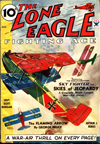
“The Flaming Arrow” by George Bruce

Link - Posted by David on February 1, 2019 @ 6:00 am in

THIS week we have a story from the highly prolific George Bruce. Bruce, a former pilot, began writing in the 1920’s and became noted for his aerial war stories—several publications even bore his name. In the 1930’s and ’40’s he transitioned into screenwriting for Hollywood action films and then into tv in the 1950’s and ’60’s.

Ace Avery had a reputation for getting the impossible done. Someone want a tough assignment carried out? Send for Avery. Some squarehead raising hell somewhere along the line? Telephone the field and borrow Avery. And now, they had given him an impossible assignment—one that no living man could hope to carry it out—but it had to be done! Read this tense, edge-of-your seat nail-biter through flaming hell skies in George Bruce’s “The Flaming Arrow” from the pages of the August 1934 issue of The Lone Eagle!

“Ace” Avery Whirls His Crate into a Maelstrom of Roaring Air Action!

“Famous Sky Fighters, May 1935″ by Terry Gilkison

Link - Posted by David on January 30, 2019 @ 6:00 am in

STARTING in the October 1933 issue of Sky Fighters and running almost 5 years, Terry Gilkison’s “Famous Sky Fighters” was a staple of the magazine. Each month Gilkison would illustrate in a two page spread different Aces that rose to fame during the Great War.

Although Gilkison was probably better known for his syndicated newspaper work, he also provided black and white story interior illustrations for pulp magazines. His work appeared in Clues, Thrilling Adventures, Texas Rangers, Thrilling Mystery, Thrilling Western, and Popular Western. Gilkison provided similar features in a few other Thrilling Publications—there was “Famous Soldiers of Fortune” and later “Adventure Thrills” in Thrilling Adventures, Famous Crimes” in Thrilling Detective, and the fully illustrated air adventure stories of Buck Barton “The Flying Devil” in The Lone Eagle! He signed most of this work with only his initials “T.G.” to maintain a low profile and preserve his reputation as a syndicated newspaper cartoon artist.

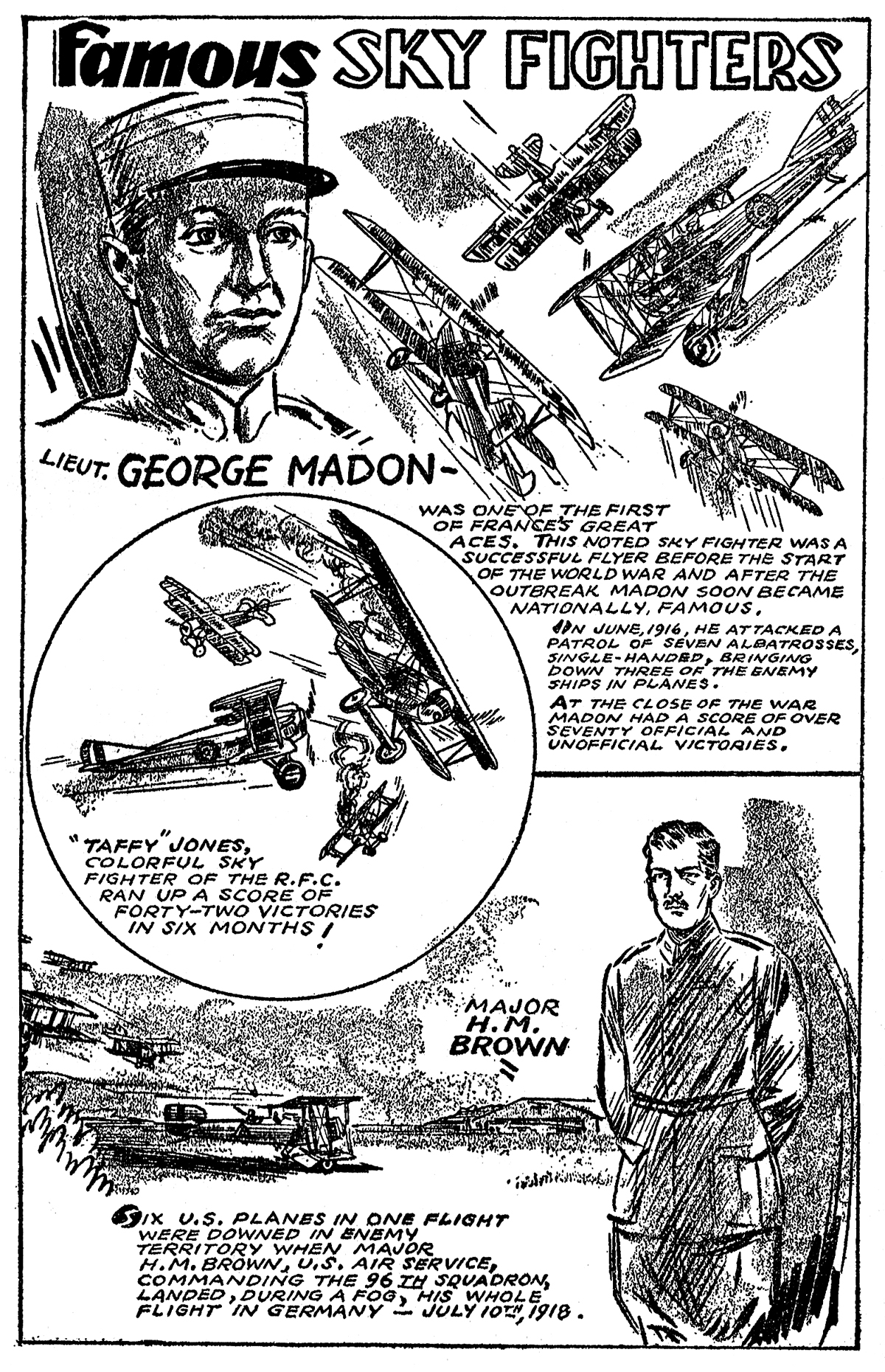
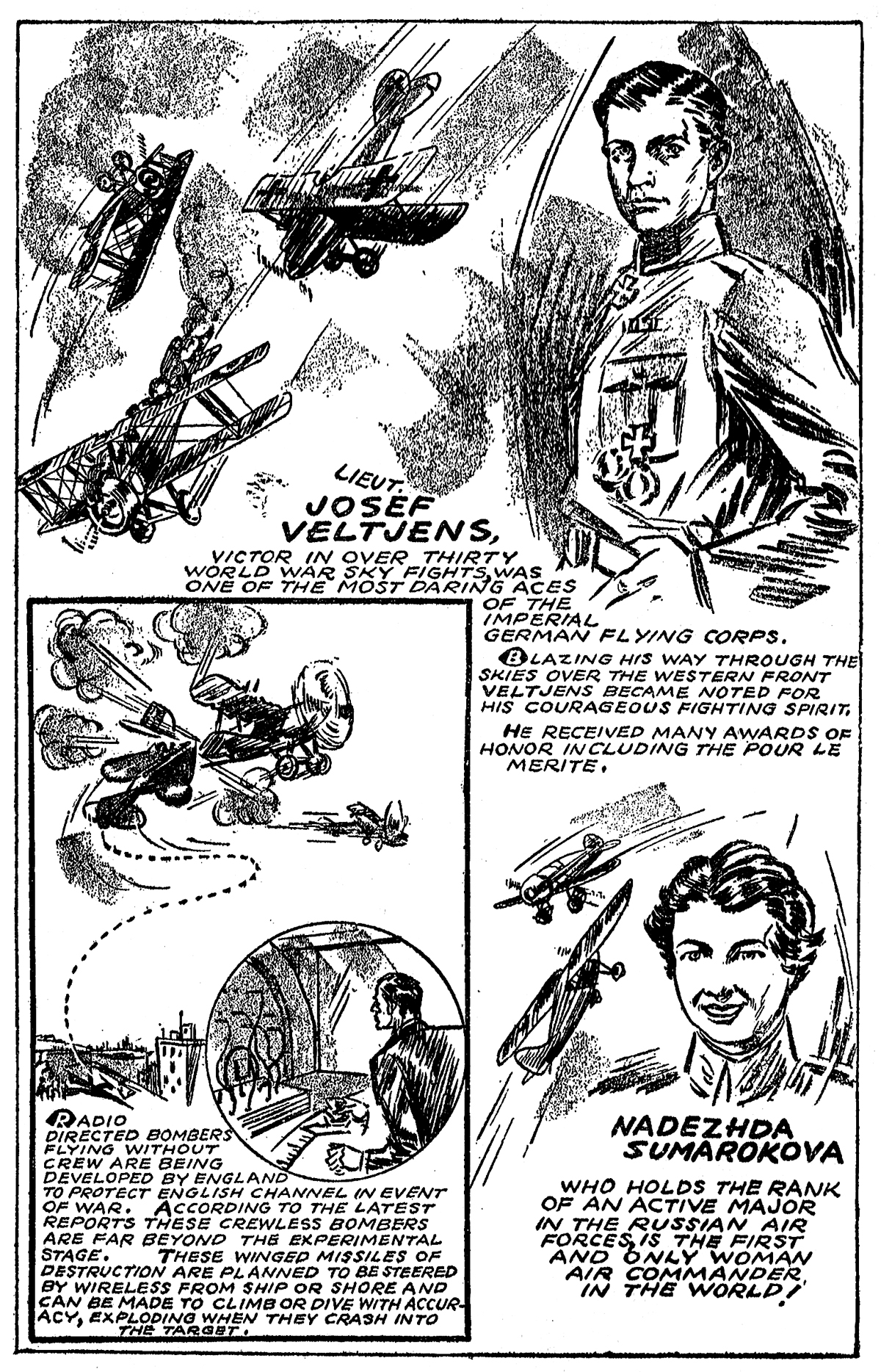
The May 1935 installment, from the pages of Sky Fighters, Features Lt. Georges Madon, Major H.M. Brown, Lt Josef Veltjens, and the world’s first air commander—Nadezhda Sumarokova!

Next time in “Famous Sky Fighters,” Terry Gilkison features Julius Buckler, Capt. Francis Quigley, Lt. Sumner Sewall, and Commander Herbert Wiley! Don’t miss it!

“Flight Opera” by Joe Archibald

Link - Posted by David on January 25, 2019 @ 6:00 am in

“HAW-W-W-W-W!” That sound can only mean one thing—it’s time to ring out the old year and ring in the new with that Bachelor of Artifice, Knight of Calamity and an alumnus of Doctor Merlin’s Camelot College for Conjurors—Phineas Pinkham.

History’s pages show us that very strange things have happened in wars. They tell us that Hannibal pushed a big herd of pachyderms over the Alps to stomp on the Roman legions. They tell us about the wooden hobby horse that the Greeks pushed through the gate of Troy and how the faces of the Trojan boys went red when they discovered that the jokers from Athens had not come in to open a restaurant. There is the tale about George Washington crossing the Delaware when it was filled with ice cakes and how his Continentals kicked the Hessians around because they had been drinking too much New Jersey corn. But the strangest thing that ever happened in any war took place in France in the year of our Lord Nineteen Hundred and Eighteen. Somebody made Lieutenant Phineas Pinkham a colonel!

From the pages of the January 1937 Flying Aces, it’s Joe Archibald’s “Flight Opera!”

That letter the War Department tossed across the Atlantic smack onto Garrity’s desk certainly had an innocent appearance. But when it was opened, the 9th Pursuit was turned upside down so fast that it looked like the 6th. For Phineas Pinkham had been made a COLONEL!

“Sky Fighters, May 1936″ by Eugene M. Frandzen

Link - Posted by David on January 21, 2019 @ 6:00 am in

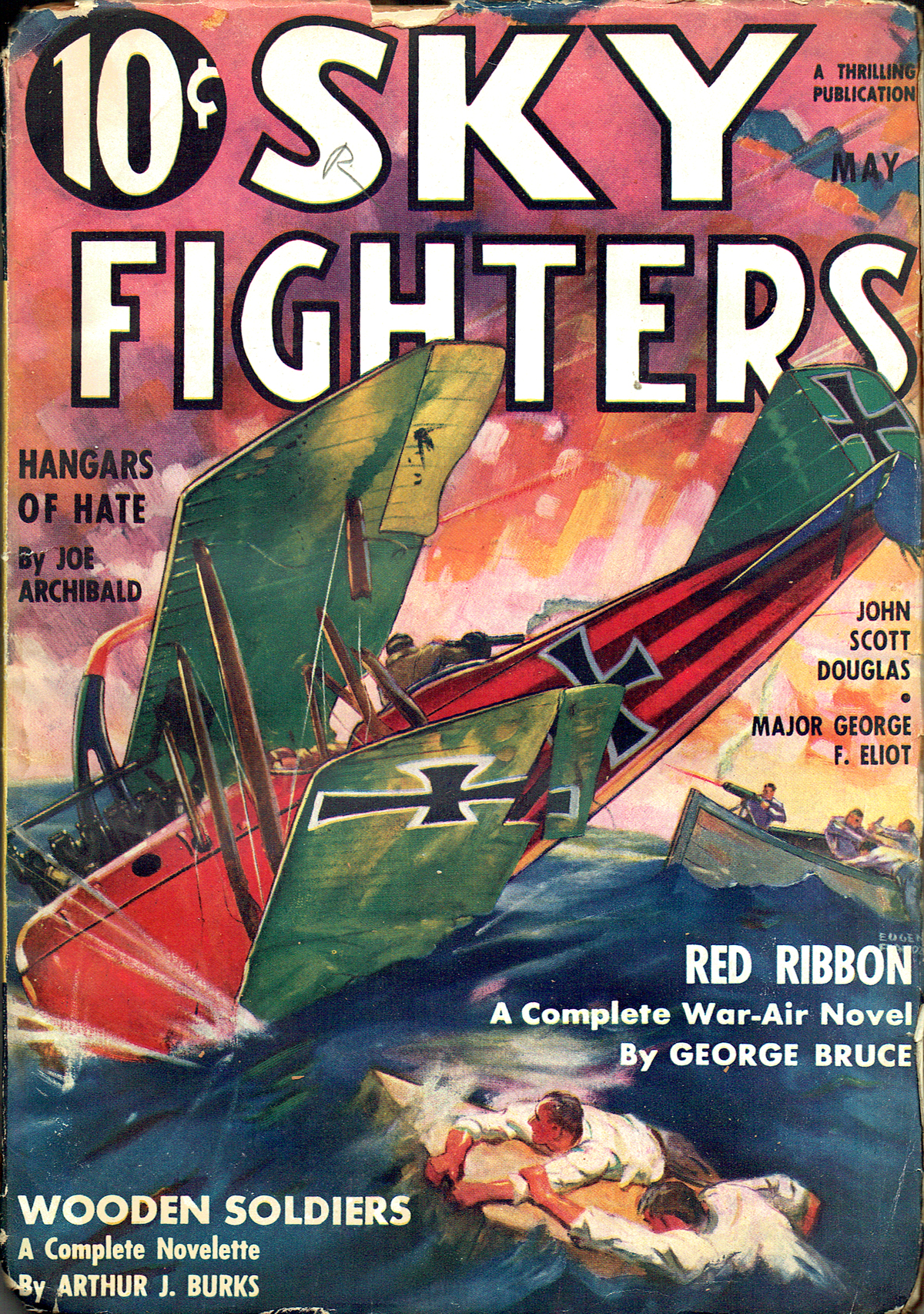
Eugene M. Frandzen painted the covers of Sky Fighters from its first issue in 1932 until he moved on from the pulps in 1939. At this point in the run, the covers were about the planes featured on the cover more than the story depicted. Mr. Frandzen features A.E.G. on the May 1936 cover!

The Ships on the Cover

BEFORE the World War airplanes th_SF_3605were more scoffed at than praised as a possible military weapon. Capitalists invariably put an extra knot in their purse strings when approached by optimistic promoters or inventors.
Firms that did any manufacturing to speak of were those who built airplanes as a side line, having large established plants already at their disposal. Such was the Allgemeine Elektricitats Gesellschaft, A.E.G. for short. This firm was one of Germany’s big electrical manufacturers. Their first entry into aircraft was naturally engines. They secured the option for building Wright motors and made some of their own design. Later when they branched into airplane design and manufacture they stuck rigidly to military planes principally of metal construction and some armour plating.
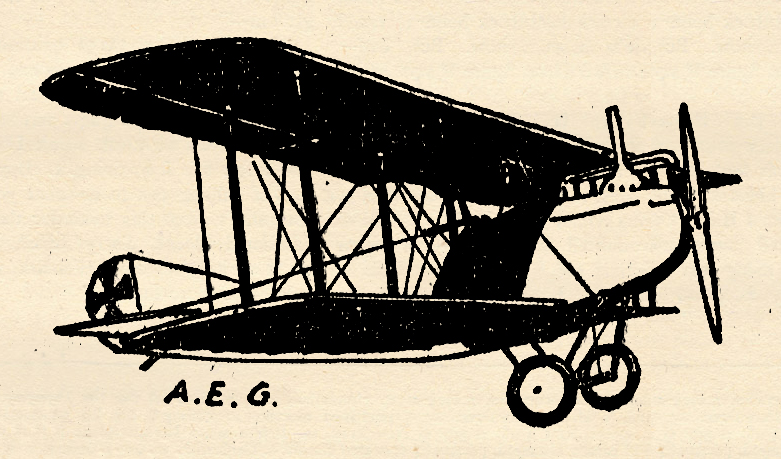
The ship on the cover smacking the water, is an A.E.G. of 1917 and ‘18 vintage. It has armour plating protecting the under-part of the fuselage and sides of the cockpits. But the A.E.G. firm was up against a tough proposition. Heavy armour plate protected the pilots perfectly but the engines were not fine enough to carry this added weight satisfactorily. Light armour had very little satisfactory results, but could be lifted okay. Therefore the pilots kidded themselves that they were pretty safe from enemy bullets with the light armour till a few rounds of Allied ammunition tore through and made more jagged wounds than a clean sharp bullet.

Used for Trench Strafing

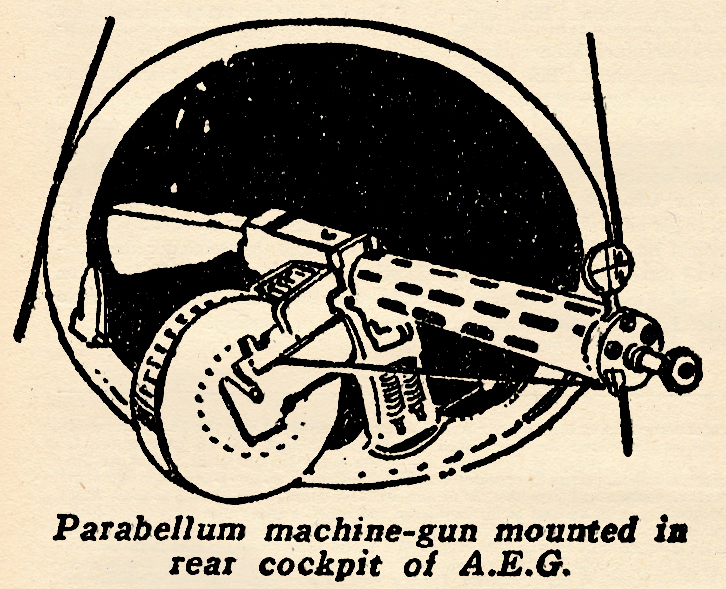
A Benz 200 h.p. motor was up front and managed to yank the ship along at around 100 m.p.h. with favorable wind conditions. Primarily used for trench strafing it was fairly successful if protected by fast scouts, but for any other type of work it couldn’t take any first prizes.

The German lines ran from a chicken wire fence backed up against Switzerland all the way to the North Sea. Now any place along that line the A.E.G. could have got in some good licks. But when it stuck its nose straight out over the water and ambitiously went about a little job of work in conjunction with a German submarine it just didn’t make the grade.

An Allied Freighter in Sight

Through a series of prisms a clear image of an Allied freighter loomed before the periscope observer in the submerged submarine. He ran his periscope up another foot, got a better view and barked the information into the stifling air. The commanding officer leaped to the instrument. He grinned in anticipation, as he saw thr flag of the merchantman. “Verdammter Amerikaner.”

Terse orders snapped to the crew. Engines whirred into added power, down to within a foot of the water came the protruding periscope. The sleek underwater raider slipped through the water toward its victim. Ten torpedo tubes were available to sink the plodding ship carrying supplies to the American forces. Grins wreathed the faces of the crew as they learned the freighter’s nationality. The U-Boat steadied, slowed up, pointed its nose then it flattened out. A shudder raced through the ship as a torpedo was shot by compressed air out through its tube. Another shudder of greater volume caught the undersea craft. A detonation shook the boat. A wreath of smoke hovered over the freighter’s 3-inch gun. It had made a direct hit.
hen the torpedo smashed into the Yank vessel. It listed and began to sink. Up came the sub, its wireless calling for help. The message picked up on the German shore was given to the A.E.G. crew. Up soared the plane, the only one available. “Kill all survivors of the freighter,” were their orders.

Wildcat, Do Your Stuff!

One Yank in the bow of the freighter’s lifeboat was a crack shot with anything from a bean shooter to a siege gun. He unhurriedly unlimbered a machine-gun. “Wildcat,” he crooned to his pet gun of guns, “do your stuff.”

He waited till the German plane had hailed them with bullets. And then at just the right moment “Wildcat” started spitting.

One burst was enough. It tore jagged holes through the thin protecting armour. The German pilot sagged, the plane nosed down and smacked the water. Armour plate in addition to the heavy Benz pulled the crate down into Davy Jones’ checkroom in fifteen seconds.

The Yank patted “Wildcat” affectionately. He looked longingly back at the spot where his 3-inch gun had sunk with the freighter.

“Cheer up,” chided one of his companions, “we’ll take up a purse and buy you a Skoda howitzer for your next birthday.”
The Ships on The Cover
Sky Fighters, May 1936 by Eugene M. Frandzen
(The Ships on The Cover Page)

“F.O.B. Berlin” by Robert J. Hogan

Link - Posted by David on January 18, 2019 @ 6:00 am in

THIS week we have a story from the prolific pen of Mr. Robert J. Hogan—the author of The Red Falcon, Smoke Wade and G-8 and his Battle Aces!
Colonel Brant leaves orders to not touch the new D.H.s while he’s gone—problem is he left that order with Captain MacRay who neglects to tell Major Nelson Wellington Van Parker Jones, who’s desire is to be the first to fly a D.H. over the lines. Unfortunately it’s right into the path of von Strohm’s Fokkers! From the pages of the April 1932 Flying Aces, it’s Robert J. Hogan’s “F.O.B. Berlin!”

One D.H., complete with brand-new Liberty motor, and one American major in good condition—delivered by hand at Germany’s door! Who says there isn’t such a thing as being too generous?

“Famous Sky Fighters, April 1935″ by Terry Gilkison

Link - Posted by David on January 16, 2019 @ 6:00 am in

STARTING in the October 1933 issue of Sky Fighters and running almost 5 years, Terry Gilkison’s “Famous Sky Fighters” was a staple of the magazine. Each month Gilkison would illustrate in a two page spread different Aces that rose to fame during the Great War.

Although Gilkison was probably better known for his syndicated newspaper work, he also provided black and white story interior illustrations for pulp magazines. His work appeared in Clues, Thrilling Adventures, Texas Rangers, Thrilling Mystery, Thrilling Western, and Popular Western. Gilkison provided similar features in a few other Thrilling Publications—there was “Famous Soldiers of Fortune” and later “Adventure Thrills” in Thrilling Adventures, Famous Crimes” in Thrilling Detective, and the fully illustrated air adventure stories of Buck Barton “The Flying Devil” in The Lone Eagle! He signed most of this work with only his initials “T.G.” to maintain a low profile and preserve his reputation as a syndicated newspaper cartoon artist.

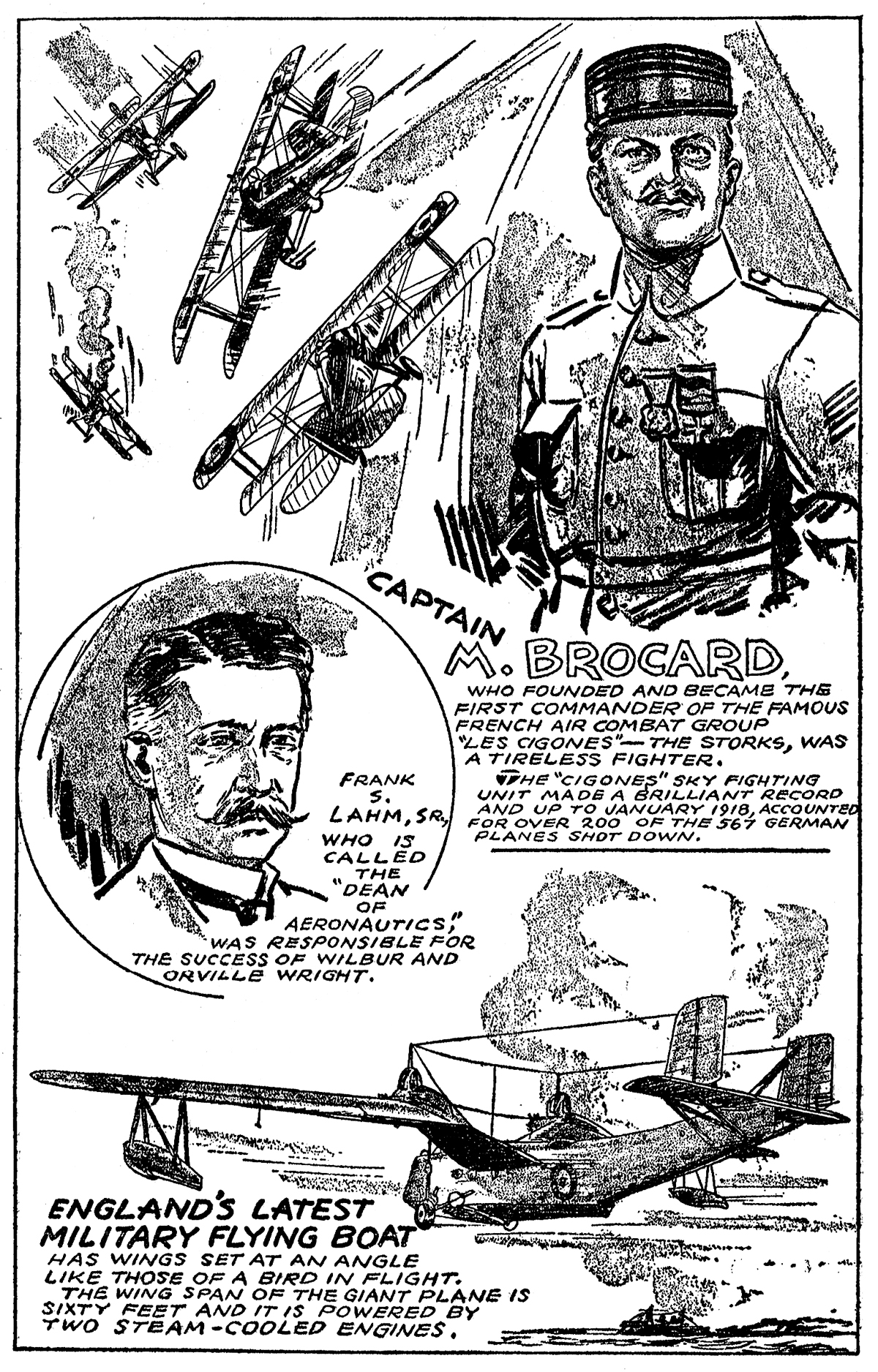
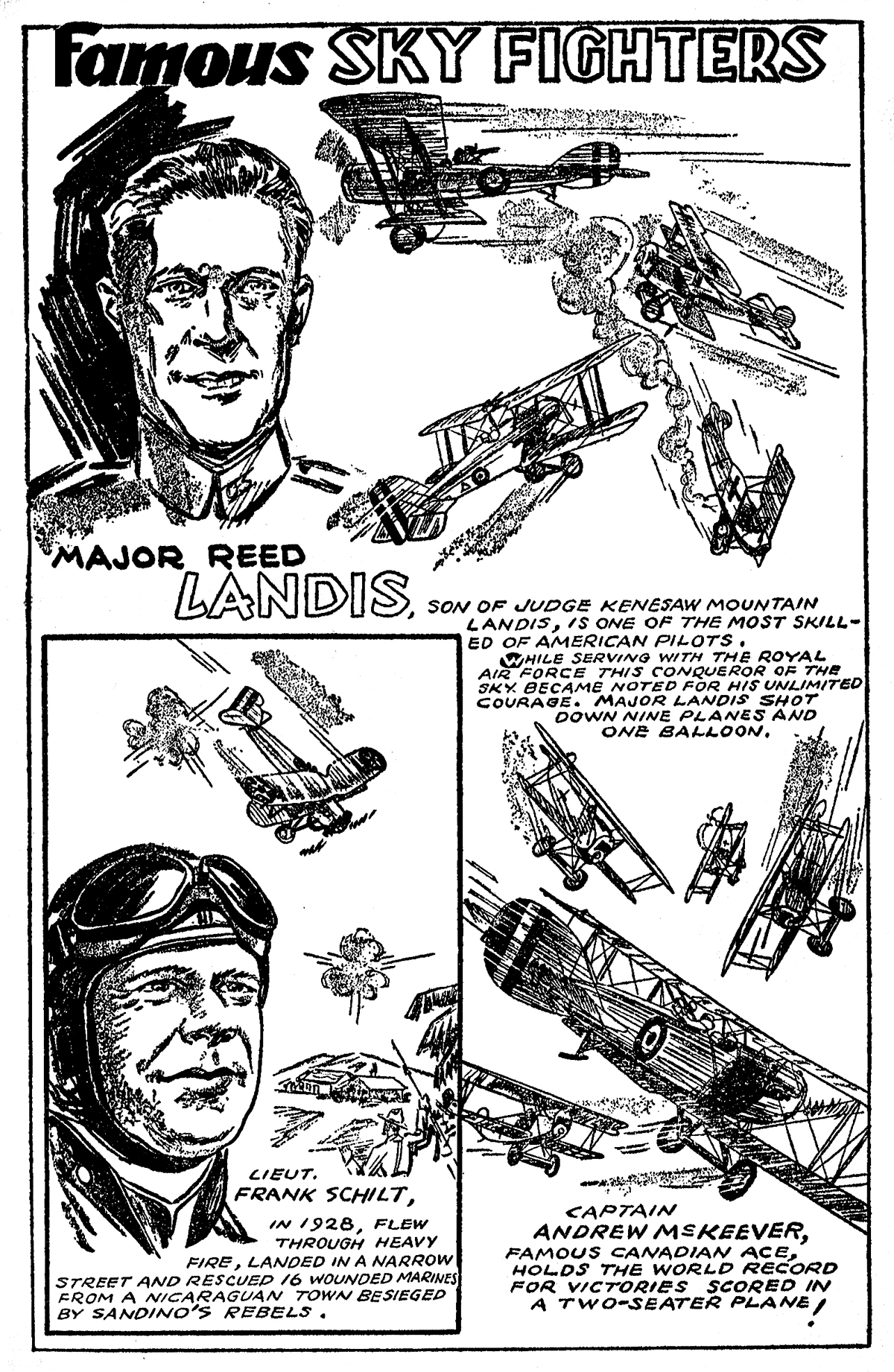
The April 1935 installment, from the pages of Sky Fighters, Features Major Reed Landis, Lt. Frank Schilt, Capt Andrew McKeever and Capt. M. Brocard!

Next time in “Famous Sky Fighters,” Terry Gilkison features Lt. Georges Madon, Major H.M. Brown, Lt Josef Veltjens, and the world’s first air commander—Nadezhda Sumarokova! Don’t miss it!

“Blackbird” by Lt. Frank Johnson

Link - Posted by David on January 11, 2019 @ 6:00 am in

ORTH is back! Silent Orth had made an enviable record, in the face of one of the worst beginnings—a beginning which had been so filled with boasting that his wingmates hadn’t been able to stand it. But Orth hadn’t thought of all his talk as boasting, because he had invariably made good on it. However, someone had brought home to him the fact that brave, efficient men were usually modest and really silent, and he had shut his mouth like a trap from that moment on.

Acclaimed the greatest of Allied fliers on both sides of the lines, Silent Orth had reached the end of his rope. The Germans knew it, all those who could see what was transpiring. And especially did Franz Kohl know it, as he sat on Orth’s tail in a bullet-swift Albatros and hammered relentlessly away at the battered and broken Spad of the American ace. The Americans on the ground who could see knew it and held their breaths, and their hearts were tight with sorrow. The Americans in the air who were held back from helping him by literal walls of wings, knew it. Everybody knew that Orth was doomed—with one solitary exception—Silent Orth! And he would not give up until one, or both of them, were dead! From the pages of the February 1935 Sky Fighters, it’s “Blackbird!”

Orth Was a Fighter that Just Wouldn’t Stay Dead—Not While a Single Hun Still Rode the Sky!

« Previous PageNext Page »