


Looking to buy? See our books on amazon.com Get Reading Now! Age of Aces Presents - free pulp PDFs

Blakeslee’s “Death Bomber”

Link - Posted by David on September 11, 2014 @ 12:00 pm in

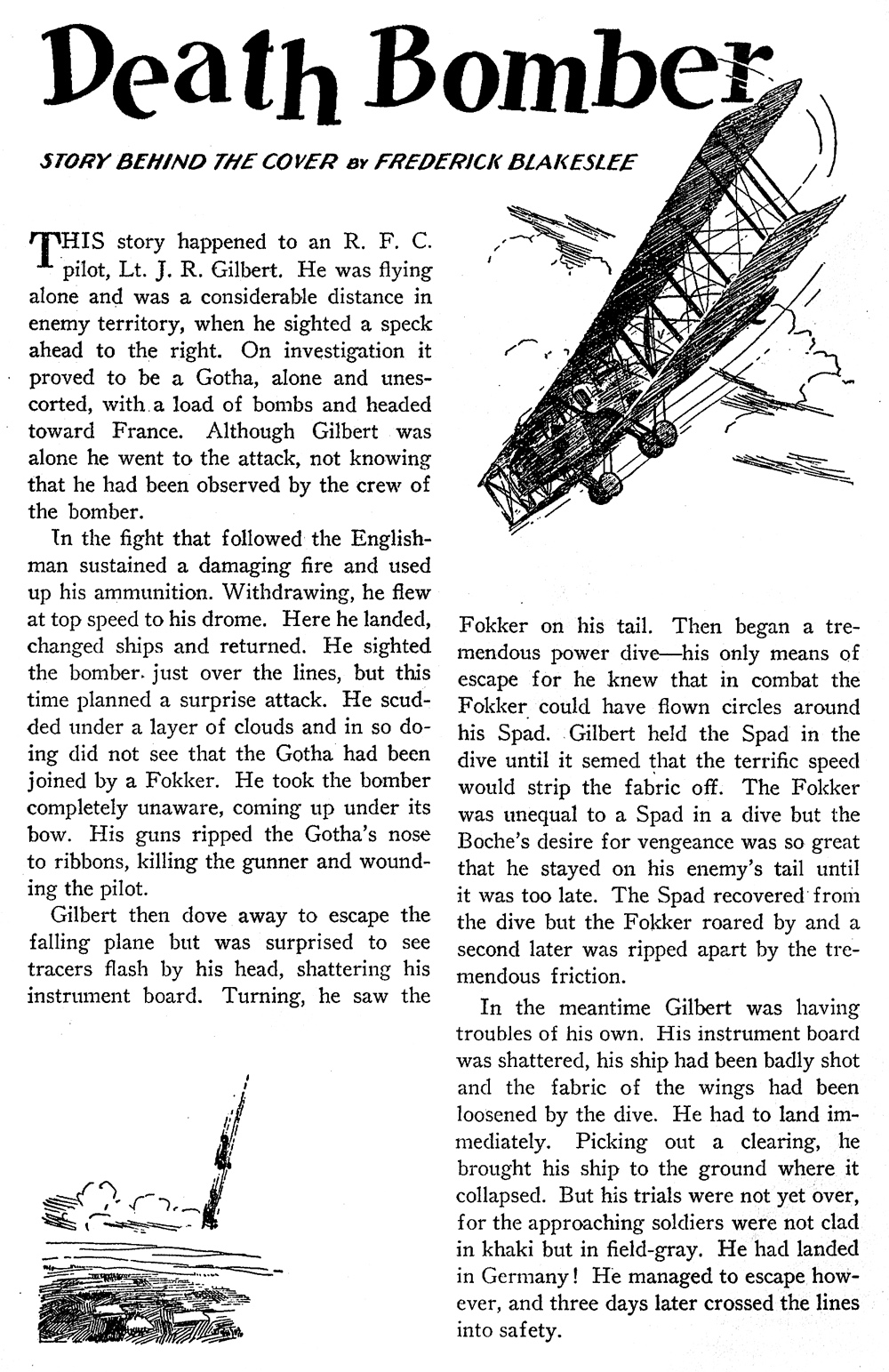
Frederick Blakeslee painted the covers for Dare-Devil Aces‘ entire fourteen year run. Every one of those covers told a story, and Blakeslee had a page with which to do so. We present Blakeslee’s cover for the January 1933 issue of Dare-Devil Aces and the story of R.F.C. pilot Lt. J.R. Gilbert as he happened upon the “Death Bomber”…
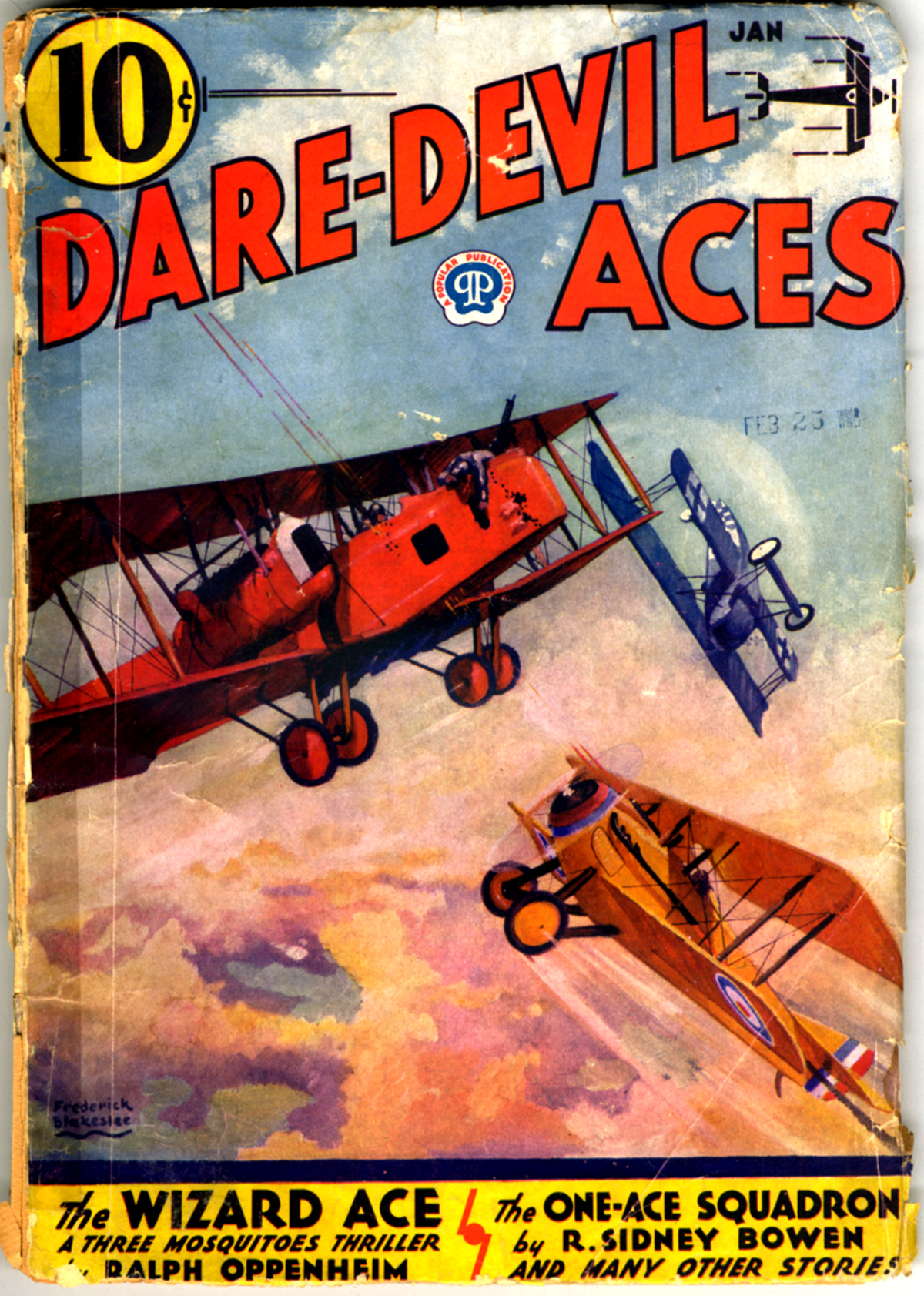
th_DDA_3301THIS story happened to an R.F.C. pilot, Lt. J.R. Gilbert. He was flying alone and was a considerable distance in enemy territory, when he sighted a speck ahead to the right. On investigation it proved to be a Gotha, alone and unescorted, with a load of bombs and headed toward France. Although Gilbert was alone he went to the attack, not knowing that he had been observed by the crew of the bomber.

In the fight that followed the Englishman sustained a damaging fire and used up his ammunition. Withdrawing, he flew at top speed to his drome. Here he landed, changed ships and returned. He sighted the bomber, just over the lines, but this time planned a surprise attack. He scudded under a layer of clouds and in so doing did not see that the Gotha had been joined by a Fokker. He took the bomber completely unaware, coming up under its bow. His guns ripped the Gotha’s nose to ribbons, killing the gunner and wounding the pilot.

Gilbert then dove away to escape the falling plane but was surprised to see tracers flash by his head, shattering his instrument board. Turning, he saw the Fokker on his tail. Then began a tremendous power dive—his only means of escape for he knew that in combat the Fokker could have flown circles around his Spad. Gilbert held the Spad in the dive until it semed that the terrific speed would strip the fabric off. The Fokker was unequal to a Spad in a dive but the Boche’s desire for vengeance was so great that he stayed on his enemy’s tail until it was too late. The Spad recovered from the dive but the Fokker roared by and a second later was ripped apart by the tremendous friction.

In the meantime Gilbert was having troubles of his own. His instrument board was shattered, his ship had been badly shot and the fabric of the wings had been loosened by the dive. He had to land immediately. Picking out a clearing, he brought his ship to the ground where it collapsed. But his trials were not yet over, for the approaching soldiers were not clad in khaki but in field-gray. He had landed in Germany! He managed to escape however, and three days later crossed the lines into safety.
The Story Behind The Cover
“Death Bomber: The Story Behind The Cover” by Frederick Blakeslee (January 1933)

Check back again. We will be presenting more of Blakeslee’s Stories behind his cover illustrations.
Airman’s Code

Link - Posted by David on September 4, 2014 @ 12:00 pm in

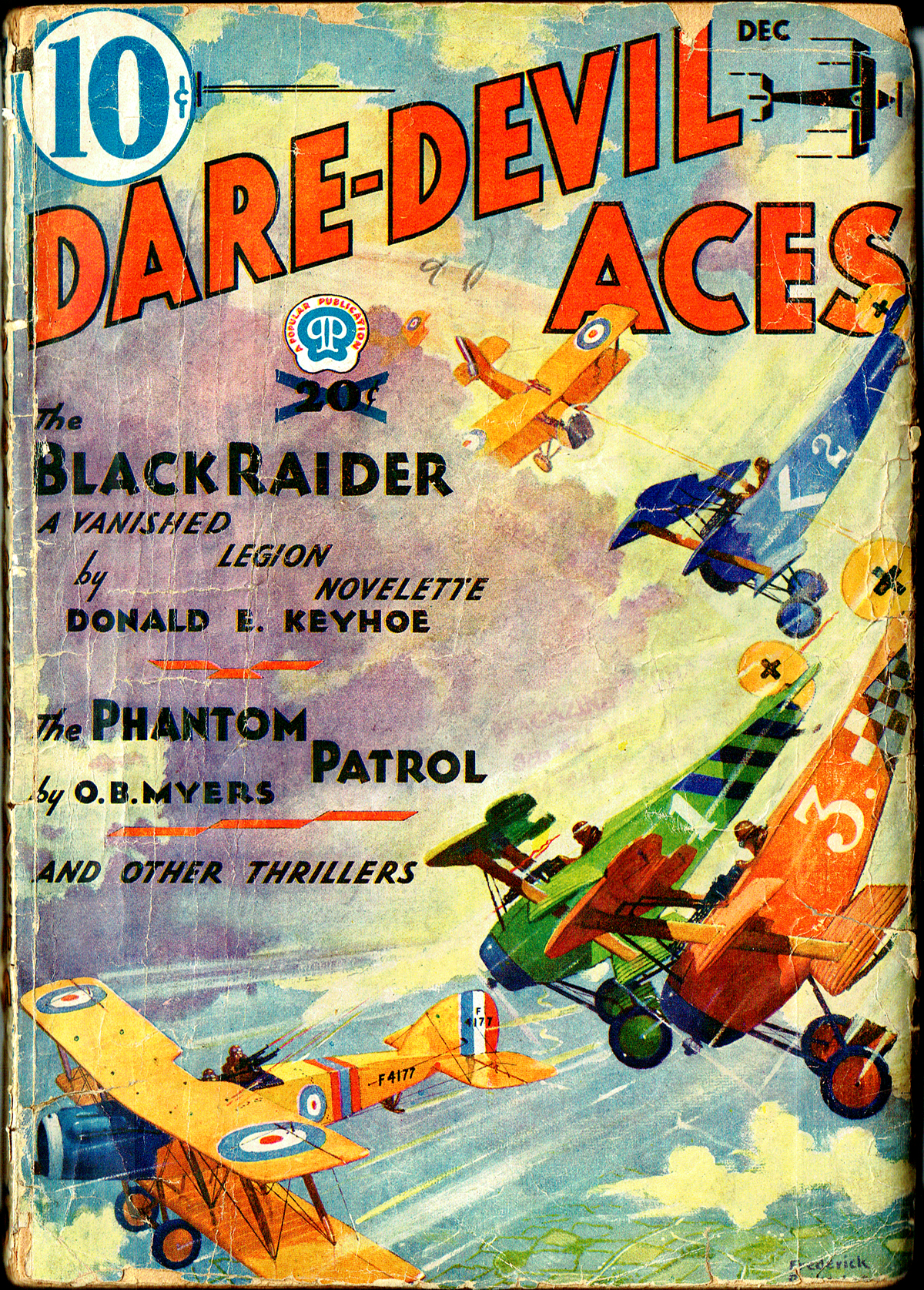
Frederick Blakeslee painted the covers for Dare-Devil Aces‘ entire fourteen year run. Every one of those covers told a story, and Blakeslee had a page with which to do so. We present Blakeslee’s cover for the December 1932 issue of Dare-Devil Aces—”Airman’s Code”…

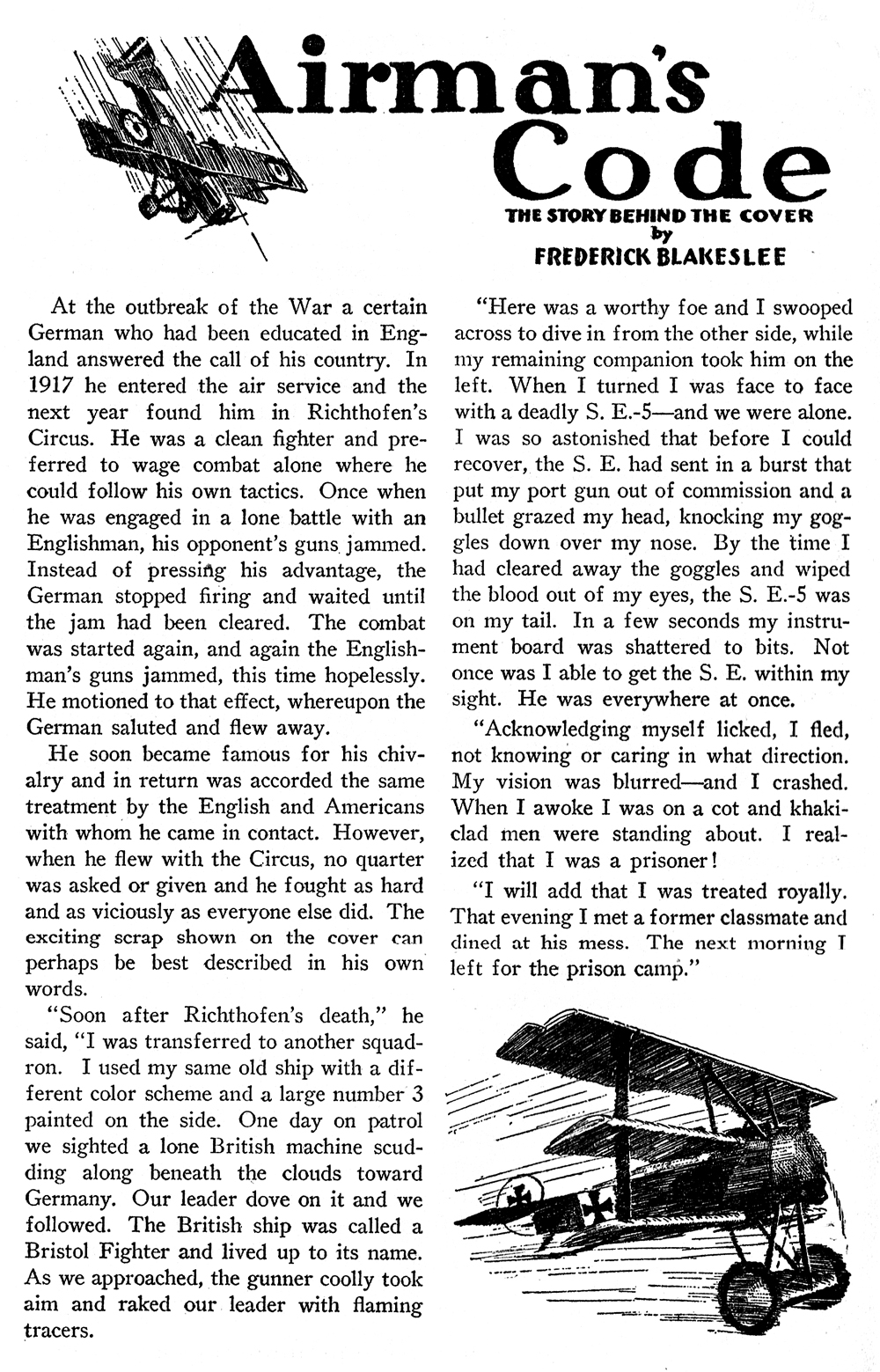
th_DDA_3212AT THE outbreak of the War a certain German who had been educated in England answered the call of his country. In 1917 he entered the air service and the next year found him in Richthofen’s Circus. He was a clean fighter and preferred to wage combat alone where he could follow his own tactics. Once when he was engaged in a lone battle with an Englishman, his opponent’s guns jammed. Instead of pressing his advantage, the German stopped firing and waited until the jam had been cleared. The combat was started again, and again the Englishman’s guns jammed, this time hopelessly. He motioned to that effect, whereupon the German saluted and flew away.

He soon became famous for his chivalry and in return was accorded the same treatment by the English and Americans with whom he came in contact. However, when he flew with the Circus, no quarter was asked or given and he fought as hard and as viciously as everyone else did. The exciting scrap shown on the cover can perhaps be best described in his own words.

“Soon after Richthofen’s death,” he said, “I was transferred to another squadron. I used my same old ship with a different color scheme and a large number 3 painted on the side. One day on patrol we sighted a lone British machine scudding along beneath the clouds toward Germany. Our leader dove on it and we followed. The British ship was called a Bristol Fighter and lived up to its name. As we approached, the gunner coolly took aim and raked our leader with flaming tracers.

“Here was a worthy foe and I swooped across to dive in from the other side, while my remaining companion took him on the left. When I turned I was face to face with a deadly S.E.-5—and we were alone. I was so astonished that before I could recover, the S.E. had sent in a burst that put my port gun out of commission and a bullet grazed my head, knocking my goggles down over my nose. By the time I had cleared away the goggles and wiped the blood out of my eyes, the S.E.-S was on my tail. In a few seconds my instrument board was shattered to bits. Not once was I able to get the S.E. within my sight. He was everywhere at once.

“Acknowledging myself licked, I fled, not knowing or caring in what direction. My vision was blurred—and I crashed. When I awoke I was on a cot and khaki-clad men were standing about. I realized that I was a prisoner!

“I will add that I was treated royally. That evening I met a former classmate and dined at his mess. The next morning I left for the prison camp.”

The Story Behind The Cover
“Airman’s Code: The Story Behind The Cover” by Frederick Blakeslee (December 1932)

Check back again. We will be presenting more of Blakeslee’s Stories behind his cover illustrations.
Frederick Blakeslee’s “The Giant Bomber”

Link - Posted by David on August 28, 2014 @ 12:00 pm in

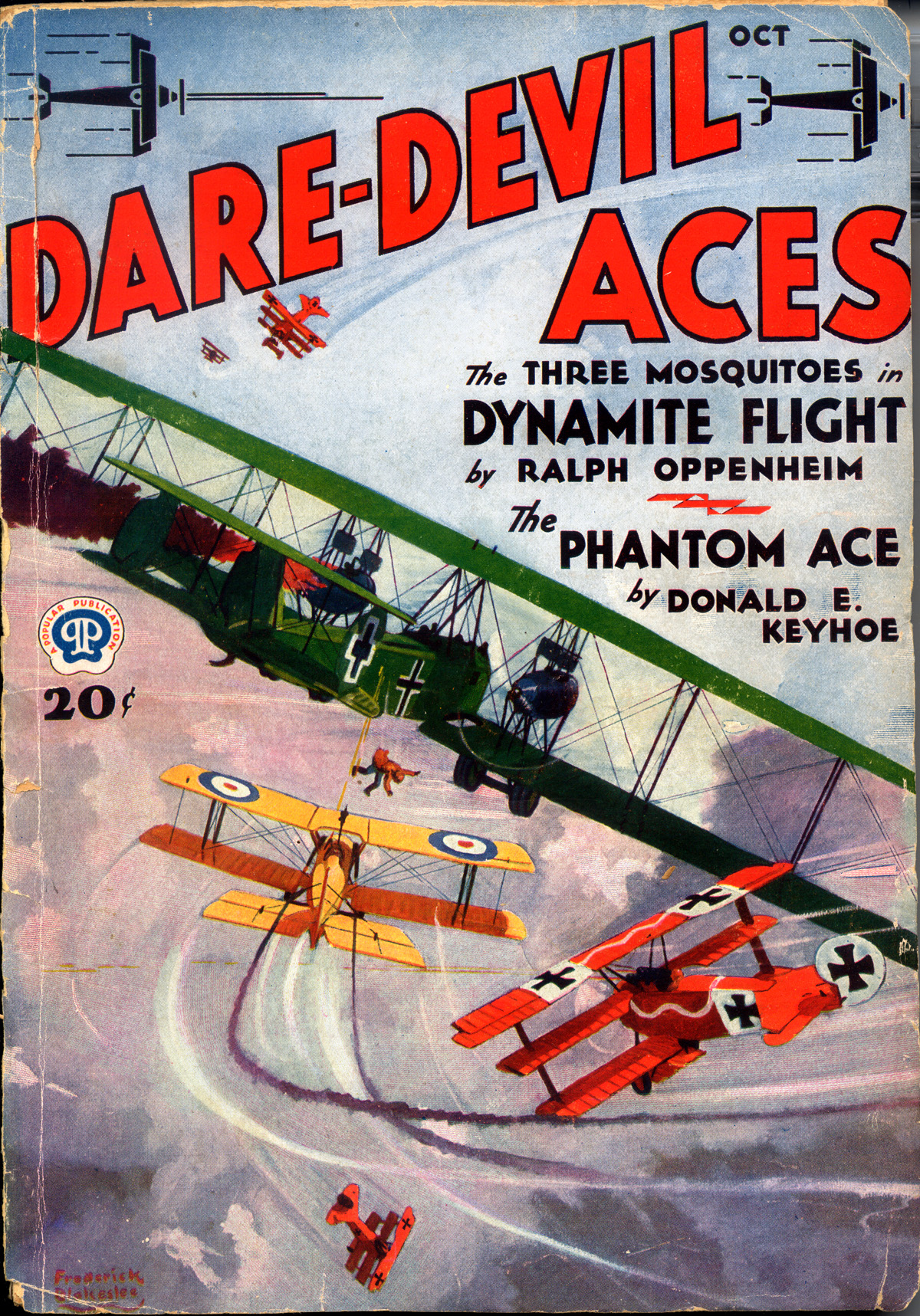
Back with another of Frederick Blakeslee’s “The Story Behind The Cover.” Each issue of Popular Publication’s Dare-Devil Aces had a fantastic scene of air combat gracing its cover. Frederick Blakeslee painted all 135 covers—and each had a story behind it. This is the story behind the cover of the October 1932 issue—”The Giant Bomber”…

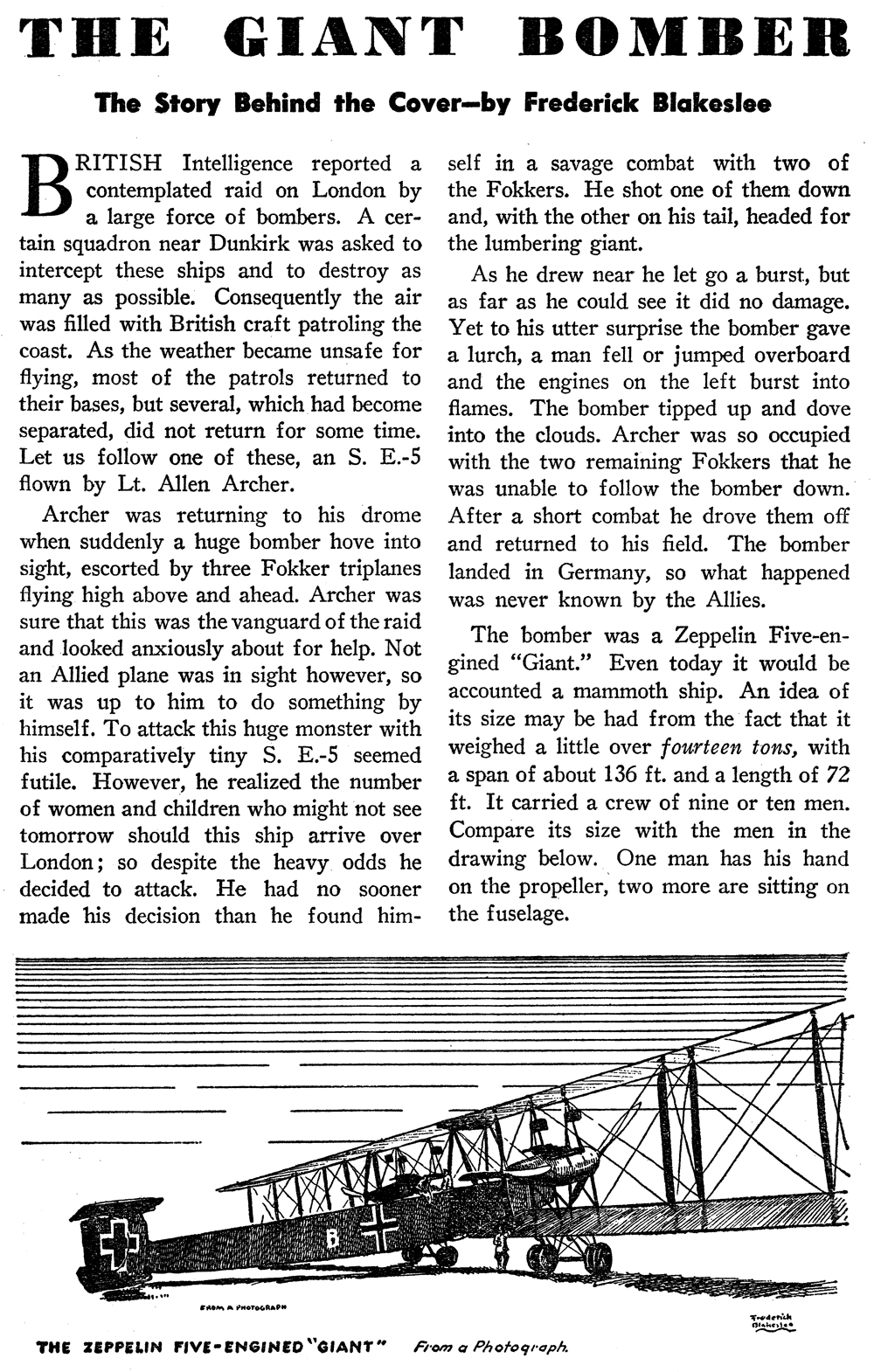
th_DDA_3210BRITISH Intelligence reported a contemplated raid on London by a large force of bombers. A certain squadron near Dunkirk was asked to intercept these ships and to destroy as many as possible. Consequently the air was filled with British craft patroling the coast. As the weather became unsafe for flying, most of the patrols returned to their bases, but several, which had become separated, did not return for some time. Let us follow one of these, an S.E.-5 flown by Lt. Allen Archer.

Archer was returning to his drome when suddenly a huge bomber hove into sight, escorted by three Fokker triplanes flying high above and ahead. Archer was sure that this was the vanguard of the raid and looked anxiously about for help. Not an Allied plane was in sight however, so it was up to him to do something by himself. To attack this huge monster with his comparatively tiny S.E.-5 seemed futile. However, he realized the number of women and children who might not see tomorrow should this ship arrive over London; so despite the heavy odds he decided to attack. He had no sooner made his decision than he found himself in a savage combat with two of the Fokkers. He shot one of them down and, with the other on his tail, headed for the lumbering giant.

As he drew near he let go a burst, but as far as he could see it did no damage. Yet to his utter surprise the bomber gave a lurch, a man fell or jumped overboard and the engines on the left burst into flames. The bomber tipped up and dove into the clouds. Archer was so occupied with the two remaining Fokkers that he was unable to follow the bomber down. After a short combat he drove them off and returned to his field. The bomber landed in Germany, so what happened was never known by the Allies.

The bomber was a Zeppelin Five-engined “Giant.” Even today it would be accounted a mammoth ship. An idea of its size may be had from the fact that it weighed a little over fourteen tons, with a span of about 136 ft. and a length of 72 ft. It carried a crew of nine or ten men. Compare its size with the men in the drawing below. One man has his hand on the propeller, two more are sitting on the fuselage.

The Story Behind The Cover
“The Giant Bomber: The Story Behind The Cover” by Frederick Blakeslee (October 1932)

Check back again. We will be presenting more of Blakeslee’s Stories behind his cover illustrations.
Frederick Blakeslee’s “Bombing of Zeebrugge”

Link - Posted by David on August 21, 2014 @ 12:00 pm in

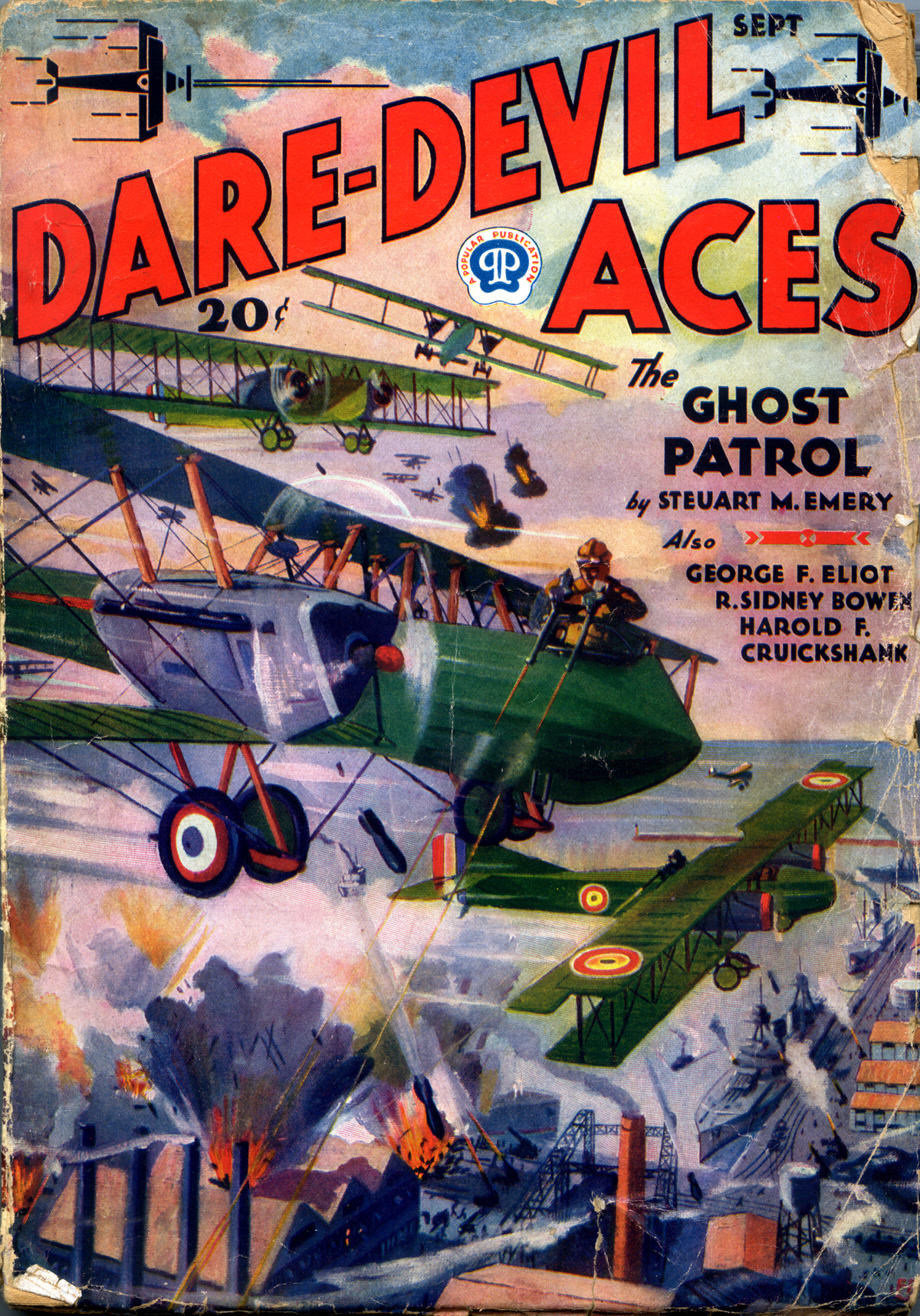
Back with another of Frederick Blakeslee’s “The Story Behind The Cover.” This time we’re featuring Blakeslee’s cover for the September 1932 issue of Dare-Devil Aces. It’s a great battle scene depicting a squdron of French Caudron bombers going about thier business. Here’s Frederick Blakeslee himself to tell you about the “Bombing of Zeebrugge,” The Story Behind the Cover…

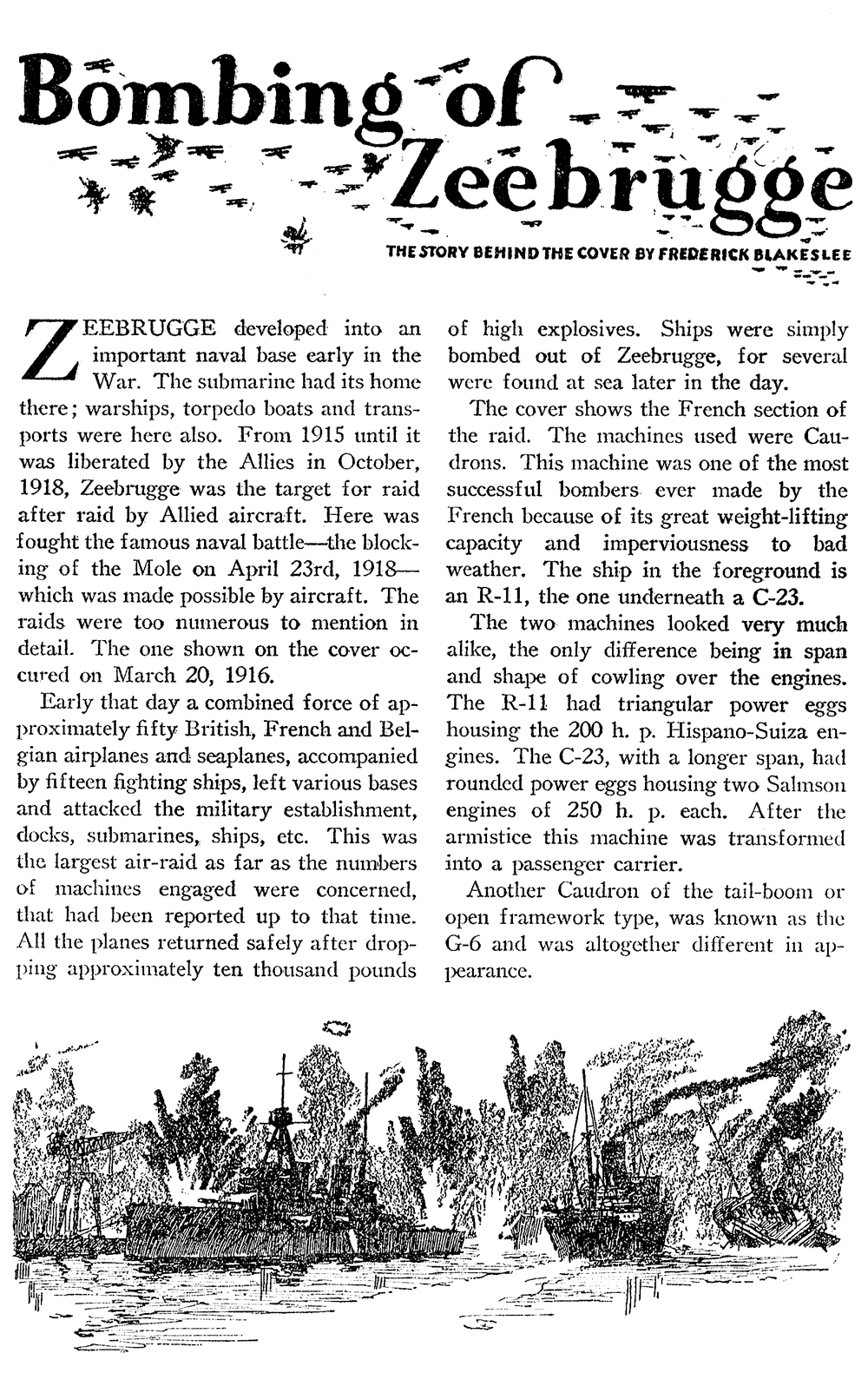
th_DDA_3209ZEEBRUGGE developed into an important naval base early in the War. The submarine had its home there; warships, torpedo boats and transports were here also. From 1915 until it was liberated by the Allies in October, 1918, Zeebrugge was the target for raid after raid by Allied aircraft. Here was fought the famous naval battle—the blocking of the Mole on April 23rd, 1918—which was made possible by aircraft. The raids were too numerous to mention in detail. The one shown on the cover occured on March 20, 1916.

Early that day a combined force of approximately fifty British, French and Belgian airplanes and seaplanes, accompanied by fifteen fighting ships, left various bases and attacked the military establishment, docks, submarines, ships, etc. This was the largest air-raid as far as the numbers of machines engaged were concerned, that had been reported up to that time. All the planes returned safely after dropping approximately ten thousand pounds of high explosives. Ships were simply bombed out of Zeebrugge, for several were found at sea later in the day.

The cover shows the French section of the raid. The machines used were Caudrons. This machine was one of the most successful bombers ever made by the French because of its great weight-lifting capacity and imperviousness to bad weather. The ship in the foreground is an R-ll, the one underneath a C-23.

The two machines looked very much alike, the only difference being in span and shape of cowling over the engines. The R-ll had triangular power eggs housing the 200 h.p. Hispano-Suiza engines. The C-23, with a longer span, had rounded power eggs housing two Salmson engines of 250 h.p. each. After the armistice this machine was transformed into a passenger carrier.

Another Caudron of the tail-boom or open framework type, was known as the G-6 and was altogether different in appearance.

The Story Behind The Cover
“Bombing of Zeebrugge: The Story Behind The Cover” by Frederick Blakeslee (September 1932)

Check back again. We will be presenting more of Blakeslee’s Stories behind his cover illustrations.
The Bridge Bombers

Link - Posted by David on August 18, 2013 @ 3:02 pm in

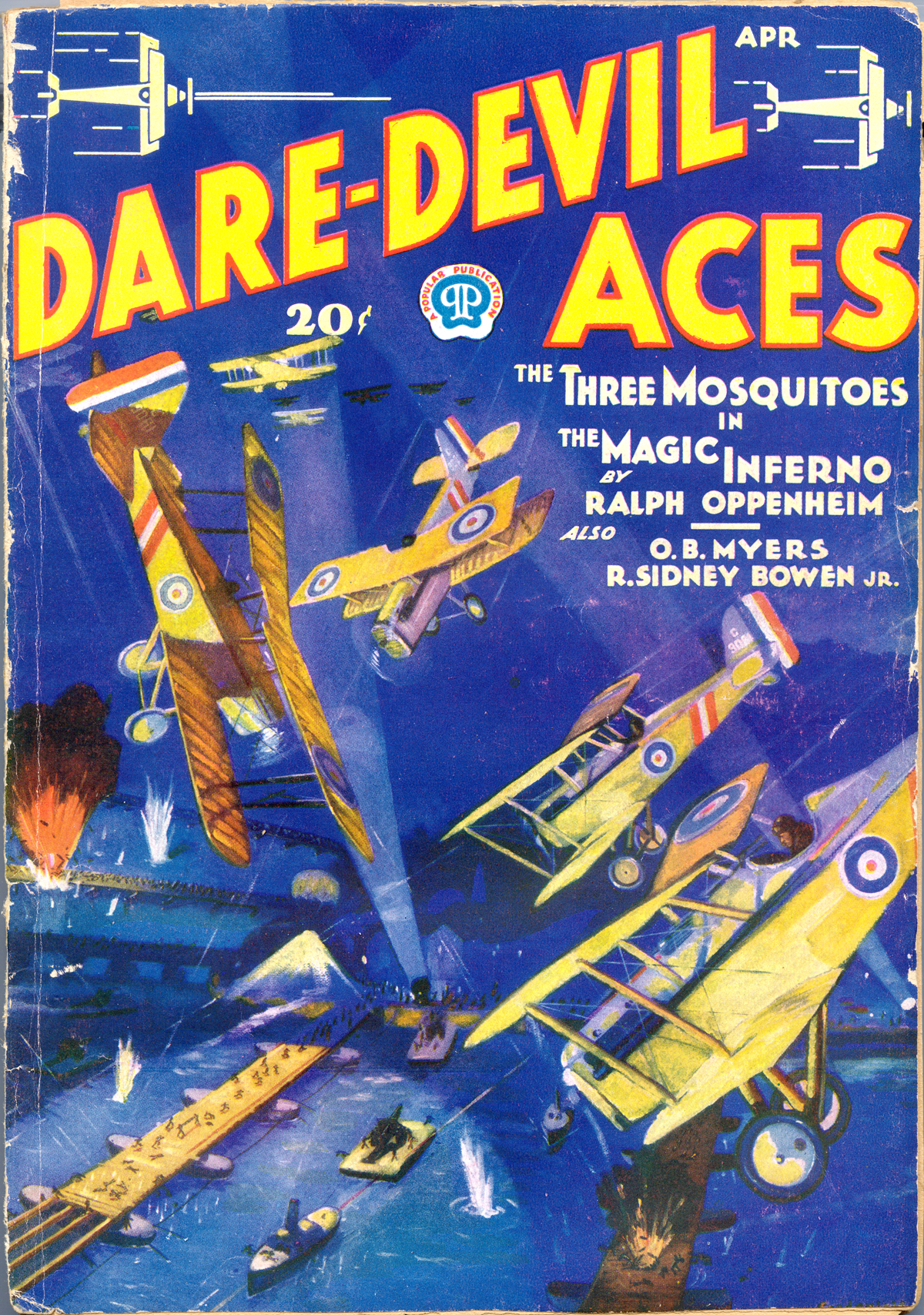
Back with another of Frederick Blakeslee’s “The Story Behind The Cover.” This time we’re featuring Blakeslee’s cover for the April 1932 issue of Dare-Devil Aces. Another of his nighttime covers that are so striking and only seem to appear in the first year of Dare-Devil Aces’ 15 year run. So, without further ado, “The Bridge Bombers” The Story Behind the Cover by Federick Blakeslee…

th_DDA_3204THERE is a river in northern France which a certain German army corps will never forget. Every bridge had been blown up and the French had made a strong resistance from the south bank for two days. German intelligence discovered a weak spot in the defense, however, and here they determined to cross at night.

Soon after dark Boche engineers began their work. Huge guns came out of concealment and were hurried to the riverside. The bridges, which were being built six at once, seemed to fairly leap across and as quickly as they were completed the troops started to march over them. It was then that things began to happen. The Germans became conscious of a pulsation which quickly became a rumble, then a roar, as two squadrons of fighting Scouts swept down upon them, spraying the bridges with lead and dropping small bombs. The Jerries broke and ran in both directions.

Then came the bombers, dropping high explosives, blowing men and bridges to kingdom come. In the meantime a hot ground fire started to drive back those Germans who had succeeded in reaching the south bank. As soon as the low-flying planes had gone, French artillery opened on the enemy who remained on the north bank. The damage by infantry, artillery and planes was terrific and all but annihilated a complete army corps.

The Germans eventually crossed the river, but at a tremendous price. Later they were to return to that river, as eager to get to the north bank as they had been to get to the south.

The Story Behind The Cover
“The Bridge Bombers: The Story Behind The Cover” by Frederick Blakeslee (April 1932)

Check back again. We will be presenting more of Blakeslee’s Stories behind his cover illustrations.
Blakeslee’s Bombing London

Link - Posted by David on August 9, 2013 @ 12:32 pm in

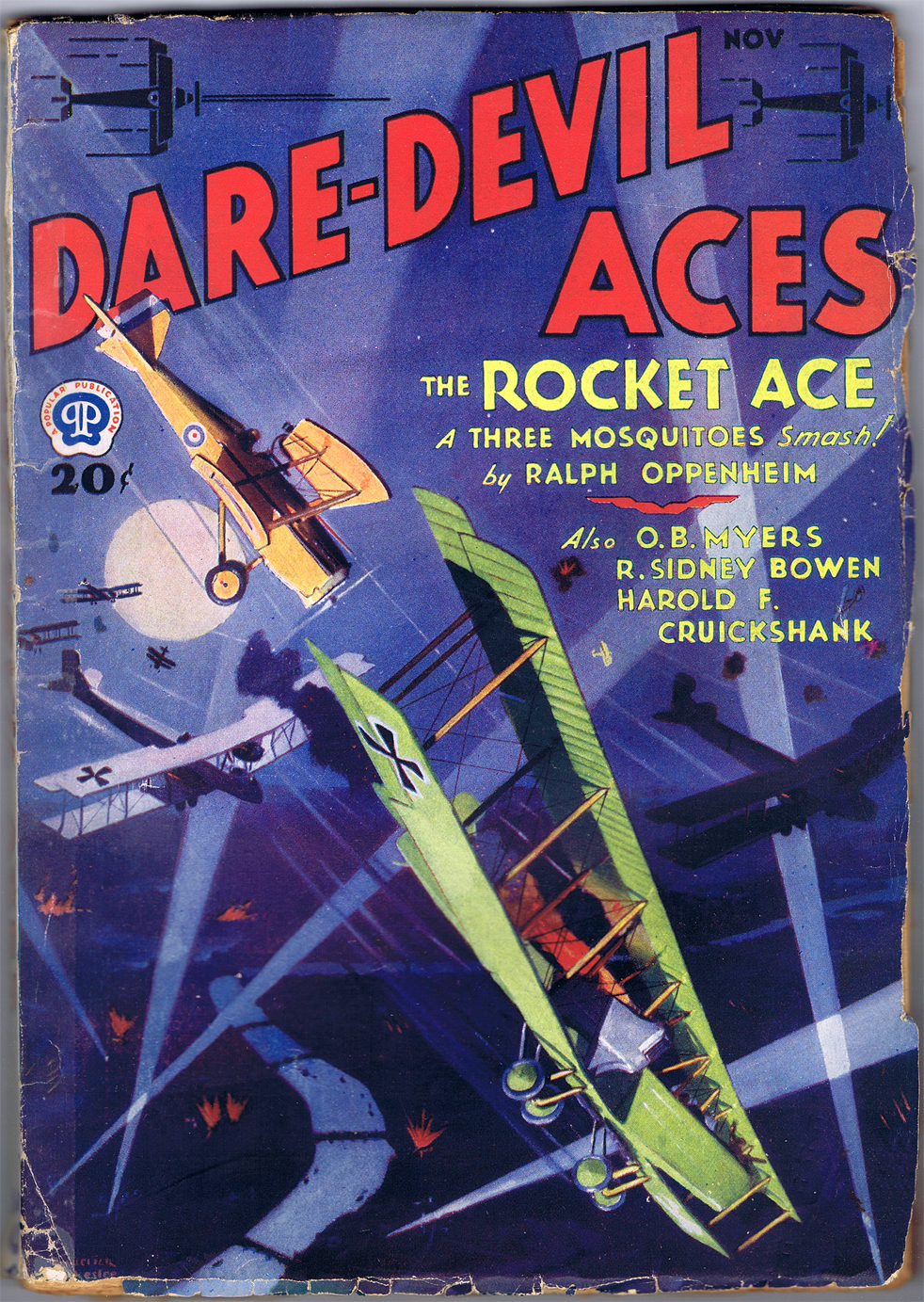
Frederick Blakeslee painted the covers for Dare-Devil Aces‘ entire fourteen year run. Every one of those covers told a story, and Blakeslee had a page with which to do so. We present Blakeslee’s cover for the November 1932 issue of Dare-Devil Aces—”Bombing London.”

th_DDA_3211THE COVER shows a night raid on London by a squadron of Gothas—one of the most cruel and useless gestures of the War. The Germans seem to have had the idea that these raids would break the morale of the English people. In that respect they utterly failed, for they made England fighting mad and stimulated recruiting as nothing else could have done. The average Englishman took the raids philosophically. Instead of flocking to the cellars a great many went to the roofs to watch the sport. The following anecdote shows their reaction. In a hotel where the people were on the verge of panic during a raid, one of the guests heard the banging of anti-aircraft guns, put down his paper and said in a loud voice, “Come in!” Everyone laughed and the tension was broken.

However, raids were not jokes. They were horrible, serving no useful military purpose and killing hundreds of non-combattants. Most of the raids were at night, although a few were carried out in broad daylight. One such raid killed 104 people and injured 423 in the congested area around the Liverpool St. Station.

The Germans sometimes paid for these “murder raids.” During one of them, perhaps the greatest that took place over London, forty Gotha machines were used. Six were brought down in combat by anti-aircraft and one as the result of engine trouble.

Because of the many failures of Zeppelins to return from raids on London, the Gotha was designed to take its place. It had a wing span of 77 ft. and was powered by two 260 h.p. Mercedes engines, which gave the ship a speed of 73 m.p.h.

The Story Behind The Cover
“Bombing London: The Story Behind The Cover” by Frederick M. Blakeslee (November 1932)

We published a small collection of 10 of Blakeslee’s “Story Behind The Cover” features in The Three Mosqitoes: The Thunderbolt Ace which can be ordered from Amazon. We will be presenting more of Blakeslee’s Stories behind his cover illustrations so check back again…

« Previous Page