Looking to buy? See our books on amazon.com Get Reading Now! Age of Aces Presents - free pulp PDFs

“Ring Around The Sky” by Ralph Oppenheim

Link - Posted by David on September 8, 2017 @ 6:00 am in

THIS week we have a story from the one and only creator of The Three Mosquitoes—Ralph Oppenheim! Mickey Rand trained pilots to be Aces using his infallible techniques of air combat. That is until it seemed the German Ace Kemmerer had found a way to beat these tricks, downing three of Mickey’s star pupils and he wasn’t about to let his latest protege, Jim Conway be next!

“Never Look Back!” That Was the Iron-Bound Rule of Micky Rand, Maker of Aces!

For more by Ralph Oppenheim:

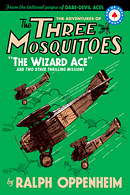
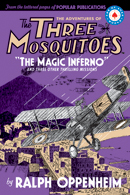
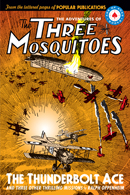
Pick up any of our collections of Ralph Oppenheim’s intrepid trio––The Three Mosquitoes! “LET’S GO!” Once more, The Three Mosquitoes familiar battle cry rings out over the western front and the three khaki Spads take to the air, each sporting the famous Mosquito insignia. In the cockpits sat three warriors who were known wherever men flew as the greatest and most hell raising trio of aces ever to blaze their way through overwhelming odds—always in front was Kirby, their impetuous young leader. Flanking him on either side were the mild-eyed and corpulent Shorty Carn, and lanky Travis, the eldest and wisest Mosquito.


The Wizard Ace


The Magic Inferno


The Thunderbolt Ace

Pick up your copy today at all the usual outlets—Adventure House, Mike Chomko Books and Amazon!

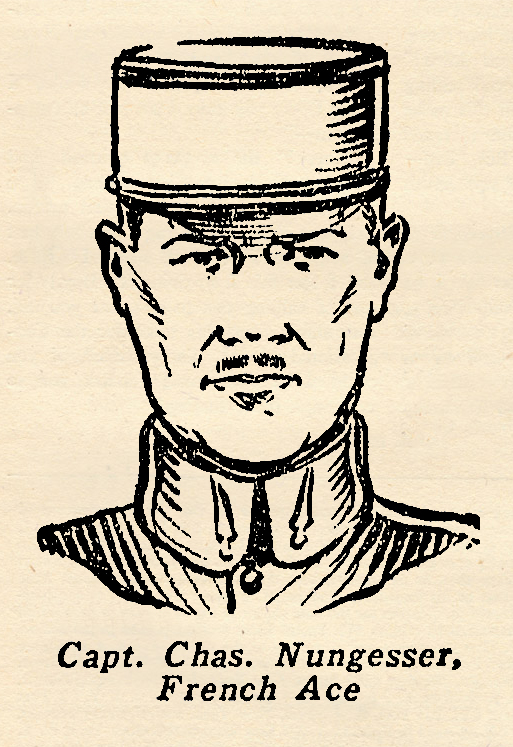
My Most Thrilling Sky Fight: Captain Charles Nungesser

Link - Posted by David on August 23, 2017 @ 6:00 am in

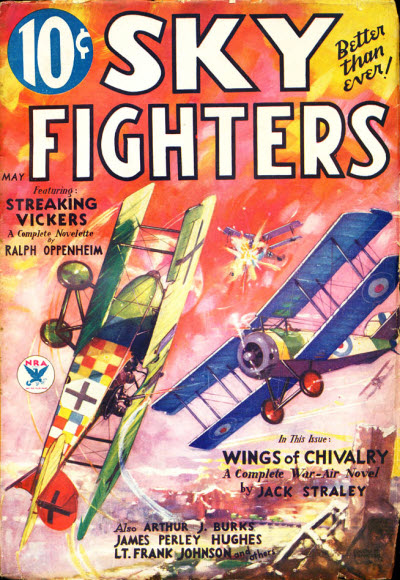
Amidst all the great pulp thrills and features in Sky Fighters, they ran a true story feature collected by Ace Williams wherein famous War Aces would tell actual true accounts of thrilling moments in their fighting lives! This time we have French Flyer Captain Charles Nungesser’s most thrilling sky fight!

Of all the great French Aces, none is more poignantly remembered than Charles Nungesser, who began his flaming war career as a Lieutenant of Hussars and was one of that famous lighting band of cavalrymen that stopped the German Uhlans at the gates of Paris. For his exploits in this heroic stand he was awarded the Medal Militaire, the highest combat award.

But horses were too slow for this daring, dashing young officer. He transferred to aviation and was trained as a bombardment pilot, after which he took part in thirty-eight bombing raids across the German lines, before his unusual flying ability was recognized and he was sent on to a chasse squadron—Nieuport 65.

Nungesser was wounded seventeen different times, but in between times in the hospital managed to run up a score of forty-one victories and was awarded every decoration possible.

Ten years after the war’s end, Nungesser, with a colleague, Major Coli, took off from Paris on an attempted non-stop flight to New York. His plane disappeared into the blue and no trace of either Nungesser, his colleague, or the wreckage of the plane has ever been found. Thus ended the flaming career of one of the greatest of all sky fighters. His own story of a thrilling battle as recorded by a French journalist, follows.


A STRANGE VICTORY

by Captain Charles Nungesser • Sky Fighters, June 1935

ALL duels du ciel are thrilling—some in one way, others in another. It is thrilling to down an enemy after pouring burst after burst into his avion. Many times I have done that, but I think it is even more thrilling, more exciting, and certainly more unique when one downs an enemy avion without firing a single shot. I have done that—in fact, I didn’t even have guns on my avion, let alone bullets. I shall tell you about that.

The motor of my avion had been acting up. The mechanic came to me when he had repaired it, and I said I would take it off for a test flight. I did, went way up into the blue above the clouds to 5,000 meters. The motor was splendid. I sailed around absent-mindedly enjoying the beautiful view, when lo and behold, a Boche avion breaks into the clear space beneath me.

Ready for Battle

It is a two-seater, less than thousand meters away. I dip and go for him, but he sees me before I reach firing range. The gunner in back stands up and swings his mitrailleuse on me. Tack-tack! He puffs a short burst. I slip under it and dive faster, my own fingers poised on the trigger trip—ready to give it to him when I get closer.

I get closer, close enough! The Boche is clear in my sight. I press the trigger— but nothing happens! Another burst from the Boche gunner flicks through my wings. My own gun is jammed, I think. I reach up to clear it, still holding on the Boche’s tail.

But Mon Dieu—I have no gun! The cradle is empty!

I am almost about to crash the other’s tail now. He has to dive to get away. I see the rear gunner standing up in his seat. He is fumbling with his gun. It has jammed. Terror is on his face. The Boche pilot dives and zig-zags to get out of my range. I keep pressing close on top, pushing him down in a long steep spiral.

Waiting for the End

The rear gunner gives up, folds his hands complacently and waits for my bursts to snuff his life out. Down and down we spiral, through the clouds, out underneath. The gunner fumbles at his mitrailleuse again, I decide to run my bluff, hoping that I can force them to land before the gunner clears.

Voila! I do. The Boche pilot spies a clear space and sets down. I circle and land beside them, but I am helpless when they set fire to their machine. I have no guns to prevent it.

Poilus surrounded the burning avion and took the two Boches prisoners. Both were very mad and swore profanely when they found out I had no guns on my avion. But it was another victory for me, the most unusual one! The armorer had removed my gun to clean, when my avion was laid up for repairs. I had neglected to see that it was in place before I took off.

“Heroes Die Hard” by Frederick C. Painton

Link - Posted by David on August 18, 2017 @ 6:00 am in

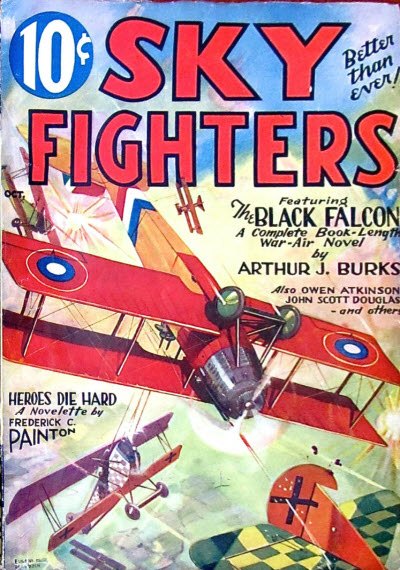
THIS week we have a story from the pen of a prolific pulp author and venerated newspaper man—Frederick C. Painton. In “Heroes Die Hard” Painton crafts a story of an immoral politician trying to use his carefully created war record to sweep him in to office when the war is over. The only problem is a man he wronged in the past who now stands in the way of his future! From the October 1933 issue of Sky Fighters, it’s “Heroes Die Hard!”

You’ll Thrill to this Gripping Drama of Fiendish Treachery and Grim Courage in the Air!

For more by Frederick C. Painton:

Pick up a copy of Squadron of the Dead! Eight classic Painton tales that ran in the pages of Sky Birds magazine in 1935! The Squadron of the Dead contained all the hellions of ten armies! Men without hope; men courting death; men who loved to kill; men who laughed and fought, drank and cursed, lived hard, and died harder. Americans, British, Russians—even Germans—made up their ranks, and only one bond held them together: Death lay ahead of them. They were assigned the grim missions no other squadron dared to take—for they had all been condemned to die!

Silent Orth Returns in “Single Action” by Lt. Frank Johnson

Link - Posted by David on August 11, 2017 @ 6:00 am in

IT’S been a few months, but Silent Orth is back! Silent Orth—ironically named for his penchant to boast, but blessed with the skills to carry out his promises—comes up against a trio of deadly marksmen who manage to take down their victims with but a single bullet! Orth must take down all three before fresh new recruits arrive the next day—The problem is, Orth has vowed to take each of them out with a single shot. From the July 1934 issue of Sky Fighters it’s Silent Orth in “Single Action!”

Silent Orth Goes Gunning for Three German Flyers Whose Diabolical Tactics Call for Quick Reprisal!

My Most Thrilling Sky Fight: Sergeant Take Engmann

Link - Posted by David on August 9, 2017 @ 6:00 am in

Amidst all the great pulp thrills and features in Sky Fighters, they ran a true story feature collected by Ace Williams wherein famous War Aces would tell actual true accounts of thrilling moments in their fighting lives! This time we have German Flying Corp Sergeant Take Engmann’s most thrilling sky fight!

All the great heroes of the war in the air did not fly single-seater fighting planes, and all of the heroes did not accomplish their missions single handed. Some of the great feats were accomplised by the pilots of the bigger, bulkier, clumsier, two and three-seater observation and bombing planes. Sergeant Engmann was one of the heroes of this latter class. Obscure, reticent, retiring by nature, his own part in the many successful missions accomplished by the greatest of all German observation aces, Captain Heydemarck, whose pilot he was, marks him as one of the outstanding flyers of the war.
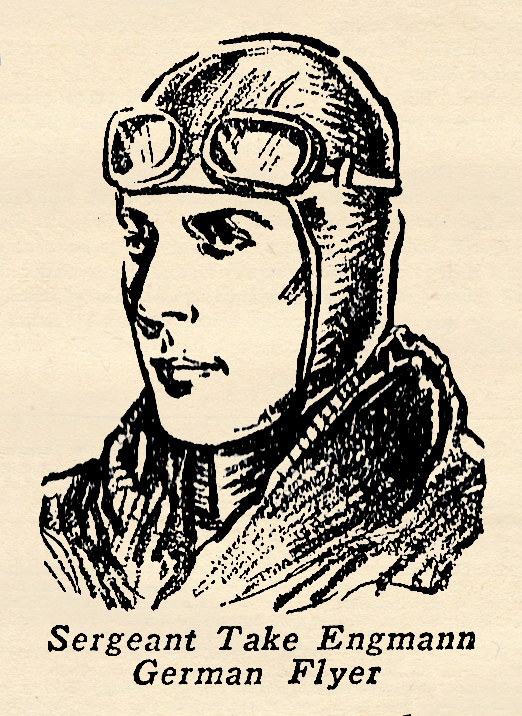
Between them, flying together, they accounted for over a dozen Allied Planes, despite the fact that destroying enemy aircraft was not their primary duty. The account below is from one of the few written records Engmann left.


AGAINST DESPERATE ODDS

by Sergeant Take Engmann • Sky Fighters, May 1935

CAPTAIN HEYDEMARCK was given the initial mission of photographing a Russian concentration camp in France and plotting it on our maps of the enemy terrain, so that our night bombers might attack it later. But we decided to do a little bombing of our own, so I loaded our plane to the limit with forty kilo bombs. The morning mists still lay on the hills and valleys of the Marne when we flew over the lines at 6 a.m.

By using the rising clouds as a mask for our entry, I managed to skip from one to another and keep concealed from enemy patrols. When we got over Mailly, the clouds had broken some, and the morning sun began to break through. The Russian camp lay beneath us.

I idled the motor and nosed down, leveled off when about 300 meters over the camp. Heydemarck snapped his pictures as I circled around. As soon as he had finished, I began dropping the bombs; one, two, three. They hit squarely in the center of the camp and set the barracks on fire. I headed for home.

But I had not gone far when I decided that the whole of the Allied air forces had been called on to intercept us. One after another French ships, Nieuports, Caudrons, Breguets, poked their noses through the rising mists to come hurtling at my Rumpler. I decided to make a bold show, so headed abruptly for the first Nieuport. Just as it commenced firing, I pulled into a swift turn, letting Heydemarck in the back seat take care of it, while I nosed up for the belly of another Nieuport.

Heydemarck’s guns and mine spoke at the same instant, two short bursts! My Nieuport slid off on one wing, turned over, and went spinning down through the clouds. Heydemarck had managed to set fire to the other’s gas tank.

More enemy planes pounced on me swiftly. Heydemarck got his guns in action, but an enemy burst clicked a right strut. Another snapped a flying wire. My left wing dragged. I zigzagged, plunged into a cloud. Saw ten more enemy planes in a group when I came out. They attacked from all sides.

I don’t know what happened for several seconds. We went around and around. Heydemarck kept firing. I fired short bursts, wary of using all my ammunition.

Back and forth, over and up. Then a fast dive, a quick turn. Somehow I found myself in another cloud. The enemy guns were silent. Heydemarck was smiling.

In another moment the enemy formation met us again, guns blazing. I wheeled swiftly, darted back into the cloud. When I broke free of the mists, I had lost the enemy far off to my left. I banked again, raced in a straight line for the trenches. I could see them below. The Nieuports raced after me.

When I skirted over the trenches I was not more than 100 feet off the ground and traveling with the speed of light. Our Archies and machine-guns protected me.

We landed safely at Attigny, our pictures still intact. Not a bullet had touched them! Heydemarck pointed at our one remaining bomb: “What if one of their bullets had hit that detonator?” he said.

I had forgotten to drop it in the excitement of the fight. “Yes, what if one had?” I replied.

My Most Thrilling Sky Flight: Lt. Waldo Heinrichs

Link - Posted by David on July 26, 2017 @ 6:00 am in

Amidst all the great pulp thrills and features in Sky Fighters, they ran a true story feature collected by Ace Williams wherein famous War Aces would tell actual true accounts of thrilling moments in their fighting lives! This time we have American Flyer First Lieutenant Waldo Heinrichs’ most thrilling sky fight!

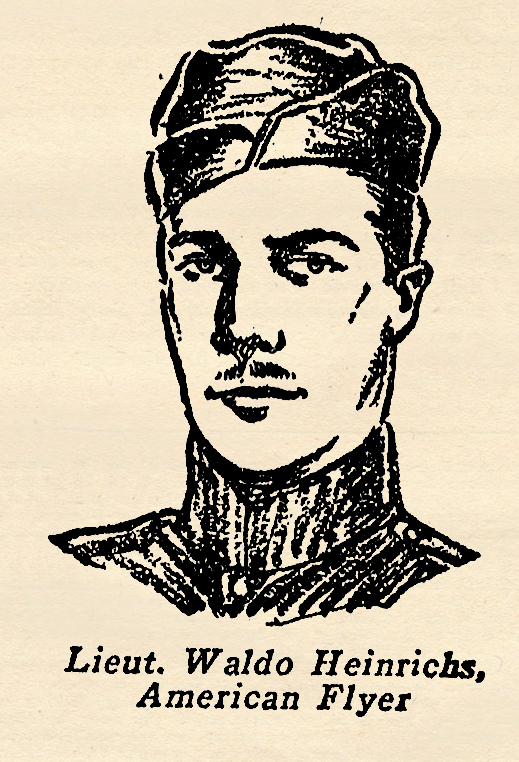
First Lieutenant Waldo Heinrichs was among the first contingent of flying cadets to be graduated from the air combat school at Issoudun, France, the great flying field established by the American Air Service on foreign soil after the United States entered the war. He was one of tho original members of the famous 95th Pursuit Squadron, the first American squadron to do actual front line duty with the American Army. Among his squadron mates in the 95th were Lieutenant Quentin Roosevelt and Lieutenant Sumner Sewell.
No other American flyer ever fought through the hail of bullet fire absorbed by Lieutenant Heinrichs and lived long enough afterward to tell about it in his own words. The account of his last flight as written in his diary is one of the most amazing records of the war. He was shot down and captured by the enemy soldiers on the 17th of September, 1918, after compiling a record of sheer courage second to none.


THE BULLET ABSORBER

by Lieutenant Waldo Heinrichs • Sky Fighters, April 1935

WITH six other pilots from the 95th, I encountered an enemy patrol of nine planes flying at 2,500 meters. Lieutenant Mitchell, the flight commander, signalled for an immediate attack and went down in a dive for the tail of the first German. His guns jammed in the first dive. I followed on the same Fokker he had picked, one of seven which had remained to fight after our attack.

But my guns jammed also, at the first burst!

While zooming up, trying to clear, I fell into a spin. All seven attacked me in my spinning Nieuport. I straightened, hurdled a burst from a forward attacking plane. But the Fokker behind me got in a burst at close range. An explosive bullet hit me in the left cheek, then shattered my windshield. I spit out teeth and blood (16 teeth, I found out afterward). I pulled into a swift renversement, came out beneath the attacker behind.

Two more explosive bullets hit me in the left arm, tearing through, breaking the elbow. Two more broke in my right hand, nearly tore off my little finger. Another hit in the left thigh. One in the left ankle. One in the right heel. Two more hit my leg.

I tried to yank the throttle wide to get more speed. No go! It would not work. The motor died. I saw my arm hanging broken at my side. The blood I spat out
splattered my goggles, blinded me, so I threw them up over my helmet, and dove for the ground. Pulled out just before I crashed into a wood, found a field in front of me, telephone poles. I dove under the wires, fearing they would crash me with a dead motor. The right wing crashed a telephone pole, broke it in two. The Nieuport landed, stopped five feet shy of the field’s edge—in enemy territory!

I broke the gas feed from the wing tank purposely. The gasoline filled the cockpit, sprayed over me. I reached for my matches in the side pocket, to fire the plane. But I was unable to hold anything. I tried to hold the box in my teeth, while I scratched the match, but my whole mouth was blown away.

I did not think to grasp the match box between my knees.

Sixty soldiers with rifles lined on me came running out of the woods. I loosed my belt. As I climbed over the cockpit I saw a pool of blood, my blood, swishing around in the bottom of the pit. I couldn’t run. I had no strength.

I surrendered, holding my right arm up with my left. The German soldiers gave me first aid, applying tourniquets to my left arm and left thigh. But they left me lying there on the field for two hours. Two stretcher bearers came along then and gathered me up. The war was over for me!

My Most Thrilling Sky Fight: Captain Ritter von Schleich

Link - Posted by David on July 12, 2017 @ 6:00 am in

Amidst all the great pulp thrills and features in Sky Fighters, they ran a true story feature collected by Ace Williams wherein famous War Aces would tell actual true accounts of thrilling moments in their fighting lives! This time we have German Flyer Ritter von Schleich’s most thrilling sky fight!

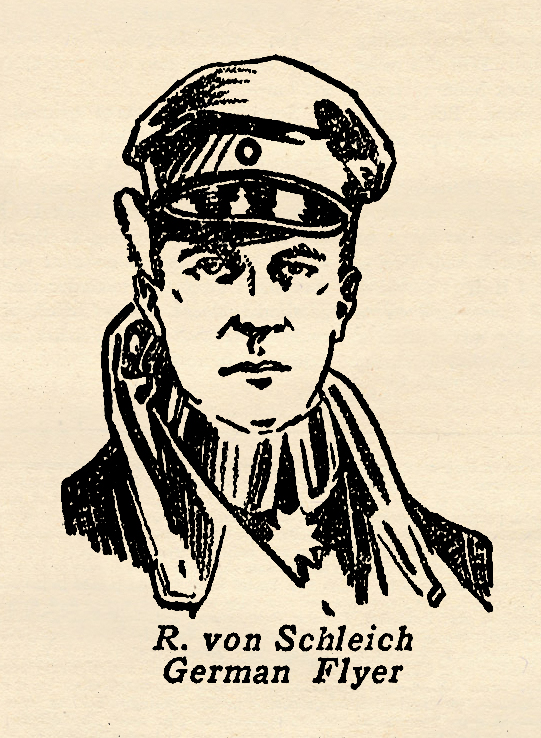
Hauptmann Ritter von Schleich was one of the least known, but nevertheless, one of the greatest and most successful of the German war birds. A nobleman by birth, he was educated for service in the army beginning with his early childhood. When the war broke out he was an officer in the Uhlans, the most aristocratic branch of the German Army. After transferring to the flying corps, he served some time as an observer, before learning to become a pilot himself; paralleling in that respect the career of Baron Manfred von Richthofen, who preceeded him as an officer of Uhlans.
War has its humorous moments as well as its many tragic ones. At least it would seem so after reading the account of the German flying captain, who took a captured Allied plane and rode the battle skies in company with an enemy patrol, the only instance upon record when it was known to be done.


A SKY TRICK

by Captain Ritter von Schleich, Imperial Flying Corps • Sky Fighters, July 1934

THE DAY before this, my most thrilling day in the air took place. My staffel had forced a young, inexperienced French pilot to land his latest model Spad pursuit plane intact behind our own lines.

After painting a black cross on it in the place of the circular cocarde of the Allies I decided it would be great fun to take it on a flight over the enemy lines. Fortunately, my staffel had forced it to land with almost a full supply of ammunition, so I had plenty of bullets for the Vickers guns. I phoned our anti-aircraft batteries and informed them of my plans so they would not bother me.

After taking off, I headed for Verdun. Our own Archies let me pass unmolested. When I slid across the lines, the Allied Archies did the same thing. I encountered a single enemy aircraft on patrol over Verdun, but he waved at me and passed on. I laughed and waved back, then swung about and headed for the Argonne. Over the Argonne I ran into the tail end of a formation of five Spads who were sweeping along parallel with the lines at 10,000 feet.

I goosed up my engine and took my place at their rear, flying along behind them and following the leader’s signals as well as I could. Suddenly they banked and flew over my own lines. I went in with them, still keeping my place in the formation.

As I flew along I wondered what would have happened if the leader really knew who it was tailing along at the rear of his flight. It was a sad thought, though. It certainly would have been curtains for me if those Spad pilots had suddenly turned and charged me.

We had gone about five miles behind our own lines when I decided that I was not
giving our Archie gunners any breaks at all. They had been directed not to fire at my plane, hence could not fire at the others in the formation without danger of getting me.

I banked off suddenly, went into a half roll, then dived to 6,000 feet. Our Archie gunners opened up then with a terrific barrage. The Spad pilots maneuvered then to escape it. The leader wheeled, saw me going down, caught sight of the black cross on my Spad for the first time, I guess, and came tearing down after me.

At 3,000 feet he let me have it—a heavy burst that forced me to duck swiftly. Now, that he had attacked me, I felt that I would not be taking advantage of my trick, so I maneuvered into shooting position and fired back.

We went at it hammer and tongs. I swept by him so close one time that I could see the angry expression on his face. We went round and round. Bullets nicked my Spad, but they did not come close to me. Out of the corner of my eye, I saw his mates up above come streaking down to join the fun. I knew I had to do something quick or be in an awful pickle. I zoomed, half rolled, came down at my opponent with both Vickers blazing. The burst was effective. He sagged in his pit. The Spad went floating down in an uneven spiral.

I followed down until it crashed, then went hedge hopping over the field for my staffel drome, with all of the speed I could get from my captured Spad. Our Archie gunners kept my pursuers so high they could not reach me.

It was my twentieth victory. I got official credit for it later. Yes, under the circumstances I am sure it was my most thrilling sky fight.

My Most Thrilling Sky Fight: Captain Ivan Kosakov

Link - Posted by David on June 28, 2017 @ 6:00 am in

Amidst all the great pulp thrills and features in Sky Fighters, they ran a true story feature collected by Ace Williams wherein famous War Aces would tell actual true accounts of thrilling moments in their fighting lives! This time we have Russian Imperial Flying Corps Ace Captain Ivan Kosakov’s most thrilling sky fight!

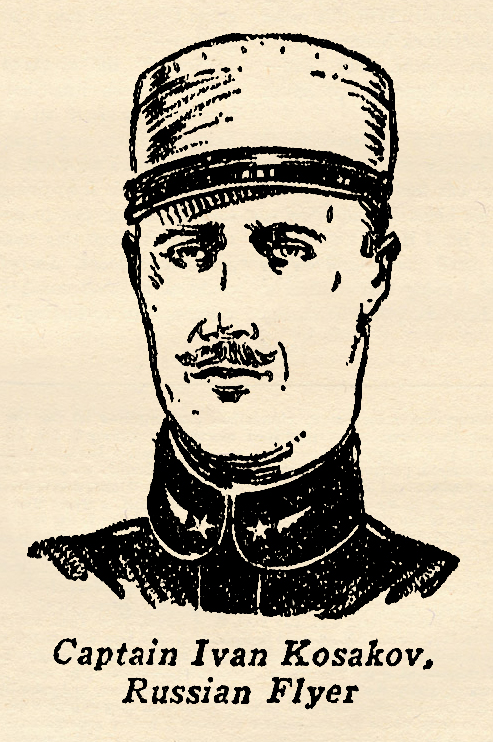
Captain Ivan Kosakov was already a great war hero when lie transferred from the cavalry to the flying corps. After a short course of just two weeks in flying school, he was sent up to the front again as a bombardment pilot. But flying heavy, unwieldy bombers was too slow and tedious work for him. He was transferred to a single-seater fighting squadron after two months with the bombers. It was then that his remarkable record began to grow.
Kosakov never stayed on his side of the lines and waited for the enemy planes to attack him. He flew far behind the Austrian lines and stalked them. It was on one of those long solo patrols into Austria that he and his plane disappeared. Whether he was killed in battle, captured by the enemy, or died in some obscure prison, has never been officially determined. At the time of his disappearance he had run up a score 23 victories, and at one time was the Russian ace of aces. The account below is from his diary.


TWO VICTORIES WITH ONE BURST

by Captain Ivan Kosakov, Russian Imperial Flying Corps • Sky Fighters, March 1935

I FEEL good today. I have now to my credit 6 official victories over the enemy. Today I got two and expended the very minimum of ammunition—17 bullets. But one of those two was due to good luck, nothing else. Or maybe, possibly, because I said my prayers faithfully last night?

It happened like this. With three others of my squadron mates I encountered a flight of Austrians at 2000 meters. The Austrian flight spread when we attacked. Three of my mates went after those that banked off to the right. That left me alone to battle the three that banked my way. The enemy took immediate advantage of my predicament. One came at me head-on. Another dove underneath, and the third charged at my rear.

Another Enemy Plane!

I had no time to figure strategy, so plunged blindly for my frontal attacker, the nearest one. Leveling my guns on his radiator I let go with a burst, hoping to damage his engine and put him out of the flight. That is, I pressed my triggers for a burst. But there wasn’t a burst. Sly guns jammed without firing a single shot.

At the same time bullets came clattering through my ship from beneath. I banked steeply, then dived and zoomed. At the top of the zoom I leveled off and cleared my guns. It wasn’t a bad jam, luckily. The three Austrians were still clinging to me, and my mates and the other Austrians had disappeared. I tell you it wasn’t a sweet feeling, but now that my guns were in order I vowed to give my attackers all I had.

I dived to shed an Austrian on my tail whose bullets were spotting holes in ray wings, then zoomed up abruptly, half turned, and found an Austrian plane dead in my sights. I let him have it. Tac-tac! Tac-tac.

No Time for Strategy

Another of the enemy planes swept past behind the one I was firing on at the same instant.

I held my triggers down for a short second or so.

The first plane began to wobble. I released my triggers. It wobbled some more, then slid off sideways, and tumbled into a spin. Then, of all things! I ruddered to chase the other plane. But it had burst into flames! It too, went spinning down, leaving a weaving black smoke trail behind.

I had got both of them with that single burst, in that split second when they lined up together in front of my guns. When I got home I counted the empty loops in my bandoliers. I had used but 17 bullets!

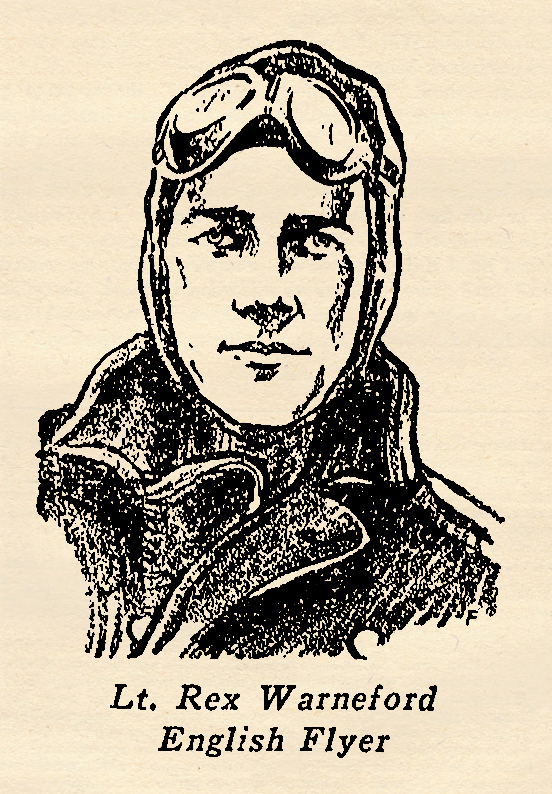
My Most Thrilling Sky Fight: Lieutenant Rex Warneford, R.F.C.

Link - Posted by David on June 14, 2017 @ 6:00 am in

Amidst all the great pulp thrills and features in Sky Fighters, they ran a true story feature collected by Ace Williams wherein famous War Aces would tell actual true accounts of thrilling moments in their fighting lives! This time we have Sub-Flight Lieutenant Rex Warneford’s most thrilling sky fight!

Sub-Flight Lieutenant Rex Warneford of the British Royal Flying Corps was the first airman to shoot down an enemy Zeppelin, likewise he was the first war pilot to win the coveted Victoria Cross. Previous to his epic fight with the raiding Zeppelin young Warneford was a comparatively obscure pilot. After this amazing and brilliant victory he leaped to the highest pinnacle of fame, he escaped from the German lines with his plane after being forced down fully five miles from his own territory. A troop of German cavalrymen rode up to take him prisoner, but using his machine-gun to the greatest advantage he managed to hold them off until he had completed temporary repairs on his plane. Then, amidst a continual hail of fire, he took off in flight, running the gauntlet of fire successfully, eventually to land within his own lines. Unhappily, two days after the V.C. had been conferred on him, he was killed in an air accident near Paris. In the account below he tells the story of this fight in his own words:
 

DOWNING A GERMAN ZEPPELIN

by Lieutenant Rex Warneford, R.F.C. • Sky Fighters, February 1935

I WAS cruising high over Belgium beyond Poelcapelle on a solo bombing mission when I chanced to glance above me and saw a huge moving shape parting the cloud reaches above me. At first I did not recognize it for what it was, but after swinging up on one wing to get a better view, saw immediately that it was a giant Zeppelin raider. It was far above me and flying in the opposite direction.

I decided immediately to go after it, so swung up in a steep climbing circle with the bright noonday sun at my back. The clouds served me in good stead, for they kept my movements somewhat masked. I managed to get within 500 yards of the big bag. Then a veritable hail of machine-gun fire began spouting at my plane. I was not nervous nor scared at the moment, but I recall that my hand shook uncontrollably on the control stick and my feet quivered against the rudder bar. The consequent erratic motion of my plane probably helped me to dodge the German bullets.

I was so thrilled that I shook all over. But after I had fired my first burst of retaliatory fire, self-command returned. I went about my task grimly, sliding in through the Zeppelin’s fire until I was immediately over the bag. I let loose then with my first bomb. It missed by several yards.

I whined back in a swift bank, climbing, came in again, nosed down swiftly, got over the bag again and let go with another bomb. The Zeppelin fire was terrific now. I heard the bullets crackling through my wings. One landing wire snapped. That second bomb missed, too.

I got mad, dived straight down with my gun blazing. The bullets poured through the big bag—but nothing happened. I dived underneath, climbed up on the other side to the rear and came in again haltingly. My motor had begun to falter. I pushed the nose down and dived head-on until within a few yards of the airship, then pulled up quickly in a stall and dropped my last bomb. It hit squarely.

The resultant concussion when the big bag exploded buffeted my plane severely. My motor was faltering badly and while I was struggling to right my ship it conked out completely. I had to go down in enemy territory, but I was not unhappy, for as I looked down below me I saw the giant Zeppelin break in two in the middle and go flaming earthwards in separate parts. I thought, as I went gliding down, of the old story of David and Goliath. The fact that I was soon to be taken prisoner did not sadden me.

The story of my escape from the Germans is a long one and will have to be told another time. That was certainly my lucky day and most thrilling fight!

“Von Satan’s Lair” by Harold F. Cruickshank

Link - Posted by David on June 2, 2017 @ 6:00 am in

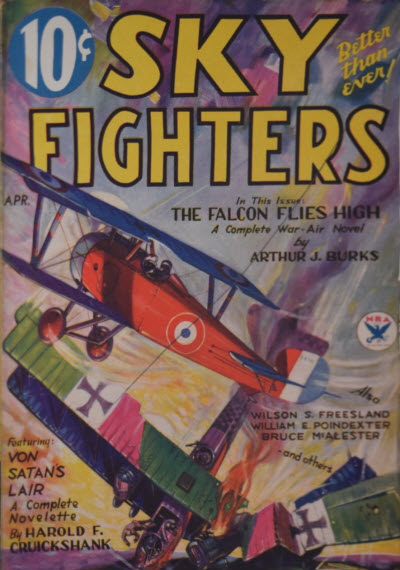
THIS week we have a story by another of our favorite authors—Harold F. Cruickshank! Cruickshank is popular in these parts for the thrilling exploits of The Sky Devil from the pages of Dare-Devil Aces, as well as those of The Sky Wolf in Battle Aces and The Red Eagle in Battle Birds. He wrote innumerable stories of war both on the ground and in the air. Here we have a tale of Captain Jack Malone, the last of his squadron not to be downed by the evil von Satan. Malone learns that his fellow flyers were not killed by von Satan, but captured and had their brains operated on to turn them against their countrymen! To save his pals, Malone must free them from “Von Satan’s Lair!” From the April 1934 Sky Fighters—
Captain Jack Malone Sails the Sky Lanes Grimly in this Gripping Drama of Sinister Secrets of Hun Hate!

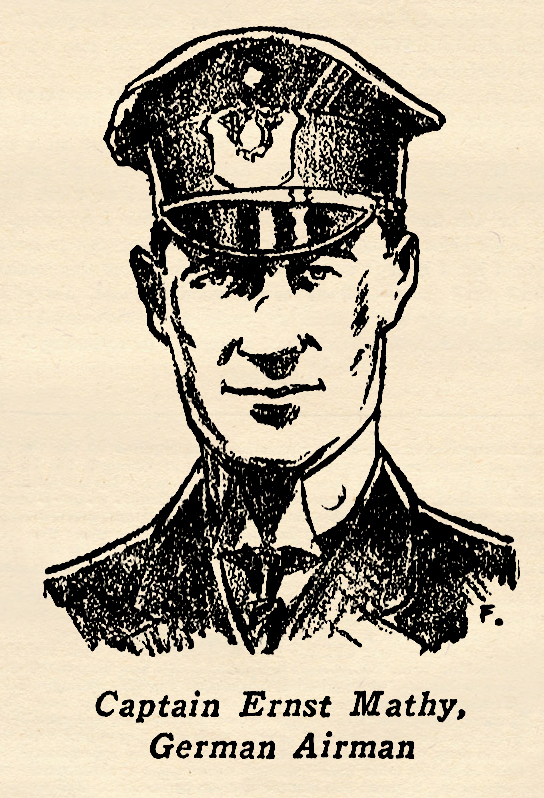
My Most Thrilling Sky Fight: Captain Ernst Mathy

Link - Posted by David on May 31, 2017 @ 6:00 am in

Amidst all the great pulp thrills and features in Sky Fighters, they ran a true story feature collected by Ace Williams wherein famous War Aces would tell actual true accounts of thrilling moments in their fighting lives! This time we have German Zeppelin Commander Captain Ernst Mathy’s most thrilling sky fight!

Very few stories of the Zeppelin raiders as told by the raiders themselves have come out of the Great War. Captain Ernst Mathy was one of the most famous of all wartime Zeppelin commanders, having made before he was killed in his final raid over London, six successful night raids over that well protected city, more than any other Zeppelin commander. It was Captain Mathy who developed and perfected most of the strategy of attack for the giant Zeppelins operated by the Imperial
 Flying Corps.
It is not generally known, but it was a fact that there were two divisions of Zeppelin raiders; those operated by the German navy and used for scouting of the British battle fleet on the North Sea, and those operated by the army and used for bombing raids on the capital cities of England and France. The last being, of course, the most spectacular and dangerous duty. Captain Mathy was the ace of aces of all Zeppelin commanders, and despite his army affiliation, his most thrilling fight in the air was with five submarines of the British navy. The story of this strange fight between the monsters of the sea and air as told in Captain Mathy’s own words, follow below.


SINKING A SUBMARINE

by Captain Ernst Mathy • Sky Fighters, January 1935

I HAD taken the L-31 over the North Sea, but was balked in my attempted raid on London by heavy rain and low-hanging storm clouds, so had to turn back. I did not want to return with a full load of bombs and without doing some damage, so I dropped down low and skirted the coast line in a northerly direction, looking for enemy surface craft as possible targets.

Upon coming out of a cloud I was surprised to spy a cluster of five enemy submarines floating on the surface. I circled back into the cloud and descended, coming out again at an altitude of about 2000 feet over the subs. They, of course, saw me then and went into immediate action with their deck guns. One shell put my forward starboard motor out of commission. I ruddered in against the window and dropped lower.

Shells were popping up now like spouting geysers and the subs were moving in ragged circles. I dropped a demolition bomb. It landed a hundred yards from the nearest sub. A shell exploded now in my port gas tanks, ripping the framework on that side to shreds, but happily causing no fire. I got still lower, then dropped another bomb. It missed, also, but only by a few yards.

The submarines began to submerge now and travel away from each other in tangential paths. I immediately loosed another bomb. There was a terrific explosion when it hit a huge fountain of water that hid the diving submarine from my vision temporarily. But when the cataract subsided, I saw the sub nosing slowly downward.

A few minutes later its stern lifted free from the water, a third of the hull exposed. In another minute it sank. Five minutes later it had disappeared completely, leaving nothing but an oily slick on the surface. The other subs by this time had managed to submerge and were rapidly running away. I could not pursue them because my gas balloonets were sieved full of holes and the L-31 was fast losing buoyancy.

I headed for home, just managed to make the German coast when I was forced to land with my badly crippled craft. There I discovered that one shell had missed severing my elevator and rudder controls by a single foot. If that one had been a foot closer, it would have been the submarine which would have been the victor. As it was, the L-31 had another successful mission to its credit.

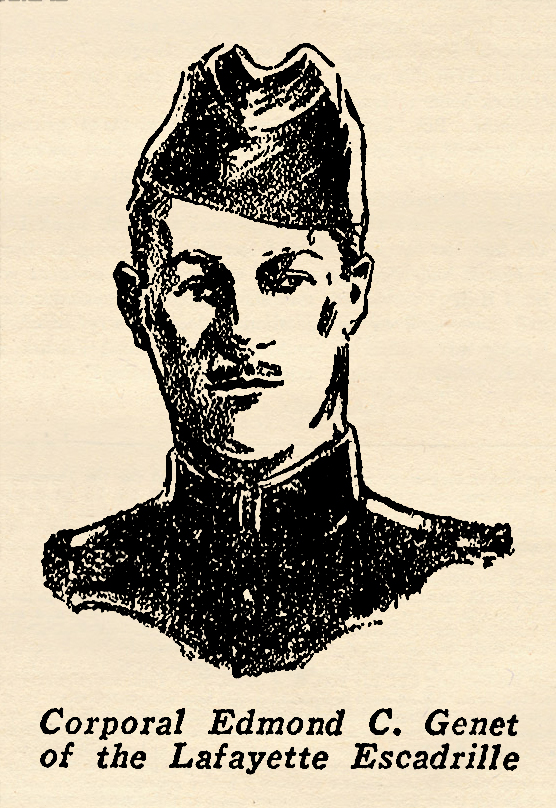
My Most Thrilling Sky Fight: Corporal Edmond C. Genet

Link - Posted by David on May 17, 2017 @ 6:00 am in

Amidst all the great pulp thrills and features in Sky Fighters, they ran a true story feature collected by Ace Williams wherein famous War Aces would tell actual true accounts of thrilling moments in their fighting lives! This time we have American Flyer Corporal Edmond C. Genet’s most thrilling sky fight!

The great-great-grandson of Citizen Genet, who served as the revolutionary ambassador from France during George Washington’s term as president, Edmond C. Genet had a distinguished heritage. Mild-mannered and handsome he was a typical soldier of fortune at heart, possessing an astonishing courage. At 10 he missed an appointment to Annapolis and immediately enlisted in the navy where he participated in the taking of Vera Cruz. A year later he was in battle in Haiti. Later on after the war in Europe broke out, he sailed for France to enlist in the Foreign Legion. He served for some years in the trenches as a simple poilu, then was transferred to aviation and assigned to Escadrille N-124, better known as the Lafayette, where he was the youngest American in a company of famous men. Genet’s flying time on the front was short. He was one of the few airplane pilots to be killed in the air by enemy shrapnel. He was the first American to die in action under the stars and stripes, his death occurring just ten days after America entered the war. The account below is from one of his letters home.
 

HOLDING THE HUNS AT BAY

by Corporal Edmond C. Genet • Sky Fighters, December 1934

I WAS flying along with McConnell at a very low altitude behind the German lines. Mac and I were making a survey of the enemy troop concentration. Intelligence had brought word that the Germans were preparing for a push in our area. We were to check on this, and as the country was hilly and wooded, we had to fly low to make the proper observations.

Being so engrossed with our ground work, both of us had neglected to watch the sky lanes. Suddenly we were jumped by a whole flight of Huns who took us completely by surprise! A burst of Spandau lead crackled through my plane from the rear! I glanced back, saw three Huns on me, throwing lead! At the same instant my right cheek began to sting and something scorched across my hip.

I swept up on one wing tip, whirled around. Two other Hun planes confronted me there. Their Spandaus were smoking. I looked over at McConnell, waved at him to go on with the mission while I attempted to hold off the Huns. I thought I could hold them off by making a bold, dashing frontal attack at first one, then the other. Mac banked off and swept down lower toward the ground.

I charged my first Hun with Vickers chattering. He turned aside and I plunged for the next. The second Hun clung to me and we began going round and round ineffectively. But a third Hun from above dived down, raked my turtleback with tracer. I was forced to pull out, but did not run away. I sneaked further inside the German lines drawing the Hun planes with me.

They had apparently forgotten Mac. Our strategy had been successful so far, but I wasn’t so sure that I was going to figure in the picture much longer. For the Huns had the speed on me and it was only a matter of minutes before I was entirely surrounded again. Bullets came from all directions at once. I was cornered. There was nothing to do but fight my way out boldly.

I dived for speed, then zoomed at my nearest antagonist. My tracer raked across his nose, puffed holes in his upper wing. He rolled off to one side to let me pass, for I was determined I would not turn out for him. That gave me an opening and I streaked through with the whole flight of Huns after me.

Presently I was rejoined by Mac, and what a relief! He was smiling, so I knew he had finished his mission successfully. We fought clear back to our lines where the Huns left us. I had just enough strength left to set down on the squadron drome safely, but my squadron mates had to lift me from my seat. It was a hot fight, but Mac and I got what we went out after—information that enabled our corps commander to forestall the German push!

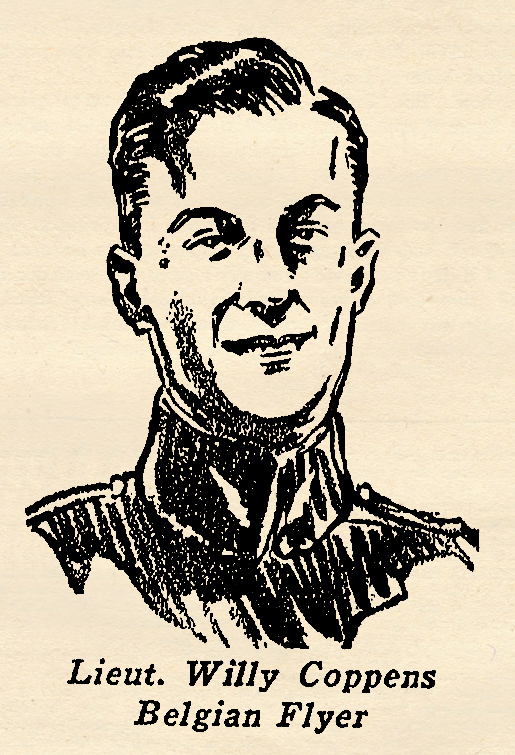
My Most Thrilling Sky Fight: Lieutenant Willy Coppens

Link - Posted by David on May 3, 2017 @ 6:00 am in

Amidst all the great pulp thrills and features in Sky Fighters, they ran a true story feature collected by Ace Williams wherein famous War Aces would tell actual true accounts of thrilling moments in their fighting lives! This time we have Belgian Ace, Lt. Willy Coppens’ most thrilling sky fight!

Willy Coppens was the Belgian Ace of Aces. He got his initial training as a soldier and officer in the cavalry division of the army. He transferred later on to the Flying Corps and began immediately to compile the record of victories that gained him top ranking among sky fighters.
Because the German armies had overrun all but a narrow strip of his own country, he did all of his flying from foreign bases, usually being stationed in the sectors in Flanders occupied by the British forces. Flying foreign machines from foreign bases, he nevertheless built up a remarkable record of successful combats. When his time on the front was ended, unhappily but gloriously, he was officially credited with 32 victories. The account below is from his diary.


TRUSTING TO FATE

by Lieutenant Willy Coppens • Sky Fighters, November 1934

FIGHTING great odds is not an uncommon thing. But today I felt for a time that, at last, I had run into a situation where the odds were too great for me.

I was cruising alone over La Chapelle on solo patrol at a very low altitude because of the low hanging clouds.

A full flight of Fokkers, six in all, came down at me like a lightning bolt. I was bottled up before I fully recovered from my first surprise.

I decided to open the attack myself and fight it out if I could. I dived for speed with throttle wide open, then banked swiftly, aiming for the Fokker below. I pressed both trigger trips, sent out a vicious double burst the instant I lined him. But he had pulled back and swept into a swirling vertical bank at the same instant. My burst passed harmlessly beneath the Fokker’s trucks. And instantly bullets began to clatter and zing through my instrument board. I glanced back up, saw one Fokker bearing down on me not more than 10 meters off my tail.

I jerked into a desperate loop, whined out with my attacker just ahead of me. Again I pressed my triggers. This time my bursts literally tore the Fokker to pieces. The vertical rudder shattered, sheared away. Only a quick maneuver on my part saved me from being hit by it. Next the whole tail seemed to disintegrate, and the following moment the Fokker nosed abruptly earthward. First blood was mine. It gave me confidence. But too soon!

When I looked up again, another Fokker was charging at me head on, both Spandaus yammering. The smoke streams parted my wings. Then a second stream of tracer rattled in from the rear. I was getting it fore and aft. I decided to plunge straight ahead.

I did so, gripping both trigger trips and sending out twin streams of tracer as I roared in toward the first Hun. Bullets from the following Hun still rattled around me. But I knew that if I held my ground, the oncoming Hun would have to swerve to escape being rammed in midair. But my senses would not stand the sight. I could not look at the Fokker charging at me, so I closed my eyes and decided to keep them closed until I counted off ten seconds. I kept my guns firing all the time, for the Fokker was centered directly in my sights.

I expected in be killed, and trusted only to fate. The seconds passed interminably in the darkness I had willed. Still I lived! At the count of ten I opened my eyes. The Hun who had been flying at me from in front was spiralling down toward the ground, his plane a mass of red flame and black smoke trails.

God had been with me I knew then. I had got that Hun with my eyes closed. My bullets had exploded his gas tank. Charged now with a renewed vigor and desire to live, I wheeled and attacked my pursuer. But the three remaining Fokker pilots did not stay to fight any longer. They ran for home. I would have chased them, but when I looked at my ammo supply, I saw that I had none, so I went home myself.

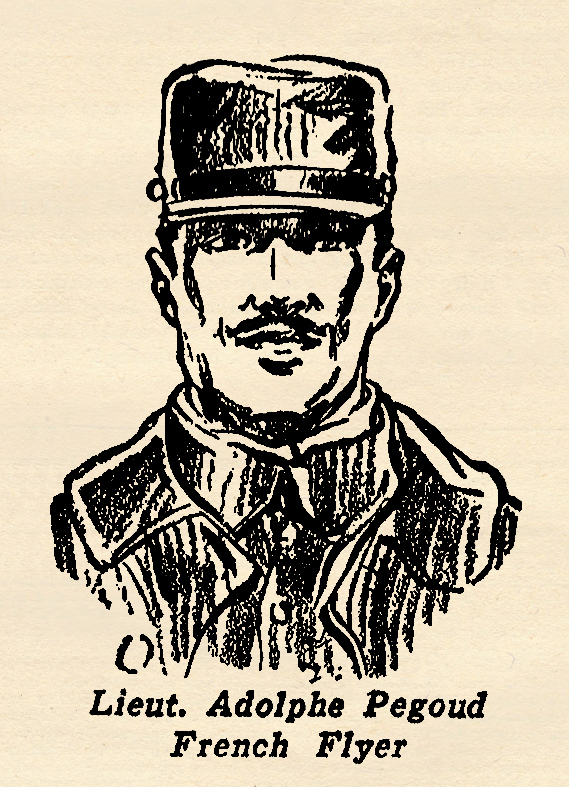
My Most Thrilling Sky Fight: Lieutenant Adolphe Pegoud

Link - Posted by David on April 19, 2017 @ 6:00 am in

Amidst all the great pulp thrills and features in Sky Fighters, they ran a true story feature collected by Ace Williams wherein famous War Aces would tell actual true accounts of thrilling moments in their fighting lives! This time we have Lt. Adolphe Pegoud of the French Flying Corp’s most thrilling sky fight!

Adolphe Pegoud was a famous flyer before the war began. In 1913, flying a tiny Bleriot monoplane, he astonished the world by doing a series of intricate air maneuvers. Later, he made an upside down landing, the first and to this day the only aviator deliberately to perform such a stunt.
With Pourpe, Garros, Vedrines, and several others, he made up the first French air squadron to see action in the World War. In those days planes, frail contraptions of wood, linen and wires, were not armed. The pilots usually carried a rifle or shotgun when going aloft, and sometimes darts and hand grenades. Plane to plane fighting was unknown. The crafts were used for scouting. Pegoud changed all this when ho initiated the first air battle. He tells about it in the account below.


THE FIRST AIR BATTLE

by Lieutenant Adolphe Pegoud • Sky Fighters, October 1934

WHILE I had always carried arms while on my trips over the Boche lines and many times had passed within fifty or a hundred meters of Taube pilots, I had never thought to try out my marksmanship on the flying targets. But on this day when I was ordered aloft, I decided that I would allow no more Taube pilots to pass me by so nonchalantly. At least, I was going to let them know that there was a war taking place.

And lucky for me, I encountered my first Taube the same day I was filled with that resolve. I met him just beyond the Fortress of Verdun. He was just a speck when I first glimpsed him off to my right, but I ruddered toward him, flying as fast as my machine would carry me. At one hundred meters distance, the Taube pilot stood up in his seat and waved at me. That fact made me mad. Here I had come to kill him (if possible) and he greeted me with that friendly gesture. I waved my Lebel in the air over my head and shouted at him in French to beware. Of course, he could not hear because of the noise of the engines.

He continued on past me and I swung around and followed him. This maneuver seemed to surprise him. I continued on, coaxing my machine to its greatest speed. Finally I was not more than ten meters to the rear of his. I shouted again, made faces, then put the rifle to my shoulder and fired a bullet over his head to let him know my intentions. Though I had firmly resolved to shoot at the pilot, I realized now that I could not, for he wan apparently unarmed and had been so friendly.

When I fired at him, he must have seen the smoke from my Lebel or saw it flash. He knew then that I was not fooling and tried to escape from my plane by streaking down toward the earth. But I followed intently, my mind occupied now, not on shooting the pilot, but damaging his machine so it would have to land, thus ha would be unable to accomplish his mission.

I stood up in the pit and fired two shots at his gas tank, but nothing happened. Then I had to sit down and maneuver my plane again. The Taube pilot was zigzagging. I got closer and stood up again. This time, he too, stood up, and hurled a hand grenade back at me. But his aim was wild. It hit on the ground far below and exploded there sending up a puff of blue smoke. I aimed my rifle and rapidly fired all my remaining shells at the gas tank again.

Now I saw that something had happened. The Taube began to wobble crazily. The Boche pilot seemed frantic. Finally the motor stopped turning. Then I saw what had happened. One of my bullets had cracked the propeller, and it had shattered, throwing the Taube into terrific vibration and forcing the pilot to cut his engine.

He had to go down. I wished then that I had not been so hasty, for as it was he landed inside his own lines. If I had waited, I could have captured him by forcing his landing on our side. A fresh Taube and its Boche pilot would have been a great trophy to take home and show my mates.

Silent Orth Returns in “Sunset Song” by Lt. Frank Johnson

Link - Posted by David on April 14, 2017 @ 6:00 am in

SILENT ORTH—ironically named for his penchant to boast, but blessed with the skills to carry out his promises—comes up against a trio of skilled acrobatic flyers that manage to elude the most skilled flyers while downing three enemy planes in every encounter, but Orth asks for one day to do the impossible and take down the trio! From the May 1934 issue of Sky Fighters it’s Silent Orth in “Sunset Song!”

Three Acrobatic Fokkers Work Havoc in the Air In This Zooming Yarn Packed With Thrills and Action!

« Previous PageNext Page »