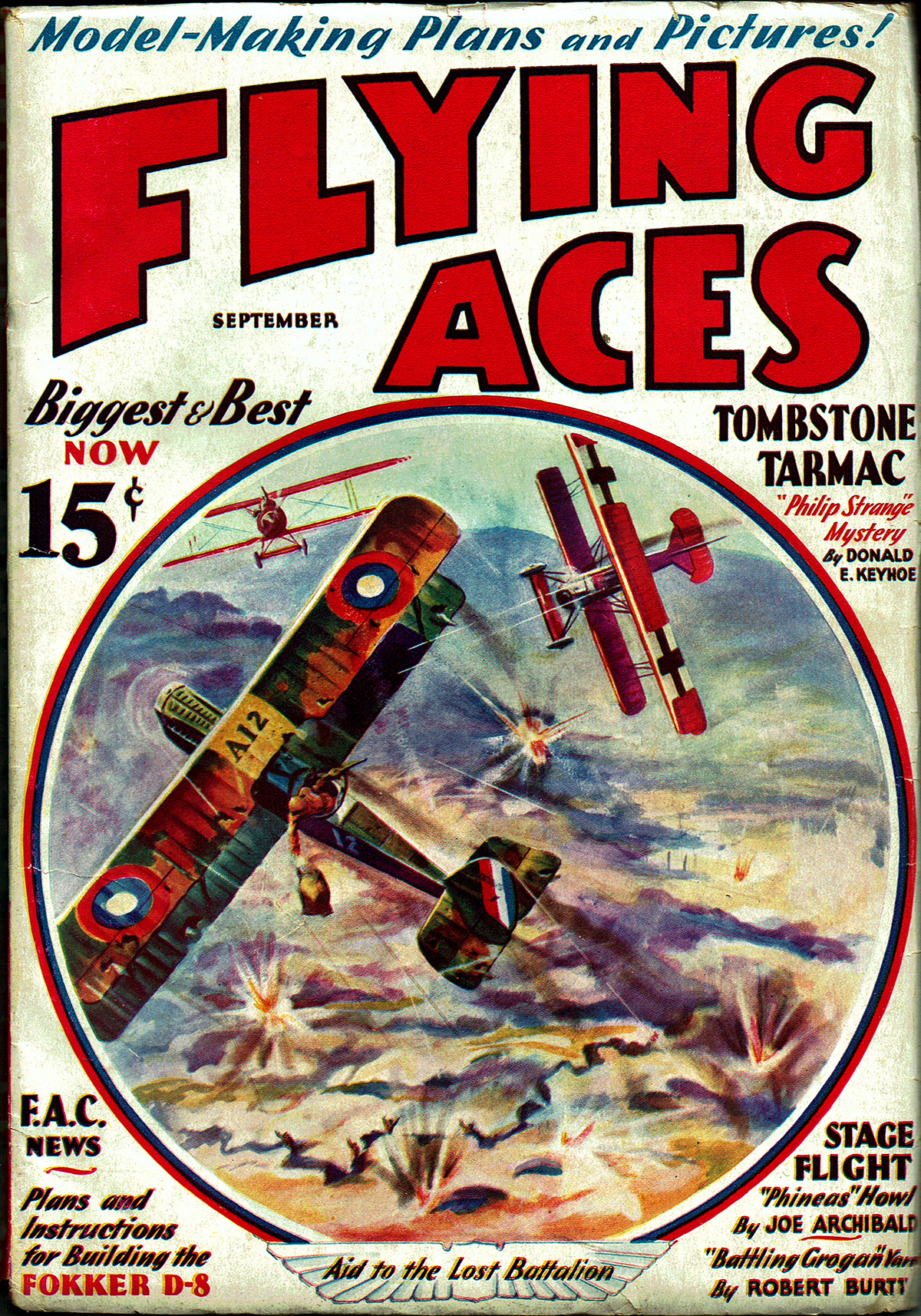
THIS week we present another of Paul Bissell’s covers for Flying Aces! Bissell is mainly known for doing the covers of Flying Aces from 1931 through 1934 when C.B. Mayshark took over duties. For the September 1933 cover Bissell put us right in the action as Lt’s Goettler and Bleckley try to get …
Aid to the Lost Battalion
 THE Congressional Medal of Honor is the highest decoration the United States can bestow upon its military heroes. Only four airmen of the World War received it — Captain Edward V. Rickenbacker, Lieutenant Frank Luke, and Lieutenants Harold Ernest Goettler and Erwin R. Bleckley. The first two, both aces, are well known, and most people know that Congress so honored them, even if a bit tardily in Rickenbacker’s case. But few know of Goettler and Bleckley and the glorious story of how they gave their lives, going “above and beyond the call of duty in action with the enemy†in an effort to save some of their countrymen.
On October 2, 1918, the 77th Division in the Argonne sector was ordered to advance, with directions to reach their objective, regardless of cost. In this movement was included the Second Battalion of the 308th Infantry, under command of Major Charles Whittlesey. The advance was made late in the afternoon. At the end of hours of terrific hand-to-hand fighting the battalion had advanced to its objective, the old Charlevaux Mill, near Binarville.
The troops on both sides of them, however, had been unable to hold their positions. This allowed the Germans to filter in from both ends and completely surround the Americans. For the next five days, this battalion of about 550 men, without food, supplies or ammunition, with scant water, and subjected to the most terrific fire, dug themselves in as best they could and refused repeated demands of the Germans to surrender.
They held a narrow ravine, the general location of which was known to our headquarters, but the exact location and the conditions existing among these men was unknown, since repeated efforts from both the battalion and the main division to establish contact had been unsuccessful. It was, however, definitely known that some of the battalion were still alive, and so, on October 6th, an order came over the wires which snapped every airdrome on that front to instant alertness. “Locate the battalion and get it food and supplies at any cost.â€
Every available ship of Squadron 50 was soon on the line. The powerful Liberty motors roared and the propellers bit into the heavy fog. This was no flying weather, but somewhere out there where the incessant bark of the big guns could be heard, were Americans surrounded and trapped by the enemy, suffering and dying, waiting for help from their comrades.
There was no small talk among the airmen. A dirty job lay ahead of them—a job that none of them wished for, yet none of them thought of shirking. The planes were loaded with iron rations—chocolate, bully beef, coffee, hard tack—bandages and official messages. Quietly the men climbed into their ships—an observer and pilot to each of the D.H.4s, and with Flight Commander Lieutenant Goettler leading, one after another the big planes took off into the mist.
An hour had passed when a ship came sliding out of the fog to a rough landing on the tarmac of Squadron 50. The mechanics rushed out, to find it was Goettler and Bleckley, his observer, returned from their search. The plane was riddled with bullet holes, and large pieces of fabric were missing from the fuselage.
The faces of the two airmen were grim. Goettler’s orders were curt. “Refuel the plane and put in another set of rations. Patch it up as best you can. We have found the Lost Battalion, and we’re going back in another fifteen minutes.â€
THE mechanics did not know until later all the details of the first flight—of how the battalion had at last been located at “Charleyvoo†Mill—how the big D.H.4 had waded through a storm of fire from the ground to get in a position to drop the much needed rations to the entrapped doughboys; how, although the two airmen had gone as near the ground as they dared, the lines of the Germans were so close to the Americans that when they had dropped the rations and messages overboard, the Germans had come out and seized them. All of this the mechanics later learned from their squadron commander, to whom Goettler had given a brief account of his effort while the plane was being refuelled.
All they now saw were the two grim-faced youngsters gravely shake hands and climb into their respective cockpits, and, in a ship already shot half to pieces, take off to carry aid to their fighting comrades.
Only too well the two lads knew what lay ahead of them. After their first unsuccessful trip it was evident to both of them that there was but one chance for success—to wing down through the terrific hail of lead from the ground, so low that with their wing tips almost touching the torn tree trunks of what had once been a forest, they could with accuracy drop the supplies to the doughboys dug in below.
Yes, this was possible if they could live through the terrific barrage they would meet. Anyway, it was their one chance, and there was no hesitation on the part of the two lads as Goettler piloted his plane directly to Charlevaux Mill. Soon it was below them, a pile of gray ruins, and Bleckley pointed out to “Dad†Goettler a khaki-clad figure waving feebly to attract their attention.
The big plane nosed over, swinging down in a spiral. The fire from below was now appalling. Machine-gun bullets were riddling the plane, while the impact from high explosives at short range tossed the ship around almost like a small boat in a rough sea.
Completely oblivious to this terrific punishment, the two airmen concentrated their entire attention on the job to be done. Goettler piloted his plane skilfully, while Bleckley leaned far over the side, holding a bag of rations ready to drop at the right instant. The trees were not fifty feet below them when Goettler leveled off slightly. Then, banking up, he let his wing tip almost touch the hillside to give Bleckley a better chance in his work.
Below, the doughboys crouched behind what shelter they had made for themselves, looking anxiously upward, waiting for the food and ammunition that they needed so desperately. They saw Bleckley release the bag and then lean over the side to see if his aim had been true. But this time the two aviators were never to know, for at that moment, up from the ground, death, in the shape of leaden bullets, reached for them.
The nose of the big D.H. yanked up suddenly, then dropped as if the hand that held the control had suddenly lost its strength. There was a sickening instant as the plane slipped off on a wing, then crashed, burying her heavy nose deep in the hillside over near the German trenches.
The next day, in an irresistible advance, the 77th Division pushed the Germans back and reached the “Lost Battalion.” Only 107 of them were left; and on the hillside were the remains of the D.H.4. Goettler had apparently been killed instantly, and Bleckley, hopelessly wounded, died before reaching a hospital. But their deed will live forever.
“Aid to the Lost Battalionâ€
Flying Aces, September 1933 by Paul J. Bissell




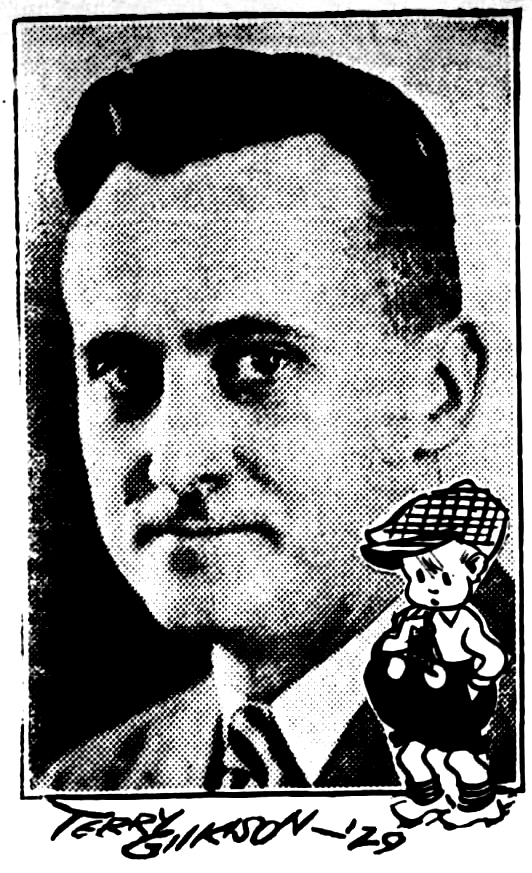 Gilkison had achieved some fame by the time the first episode appeared in the September 1933 issue. There were a couple short lived syndicated comic strips—”Home Sweet Home” and “Pinky Dinky”—as well as editorial cartoons syndicated by Autocaster and having his work published in the likes of Life, Judge, and Collier’s Magazine.
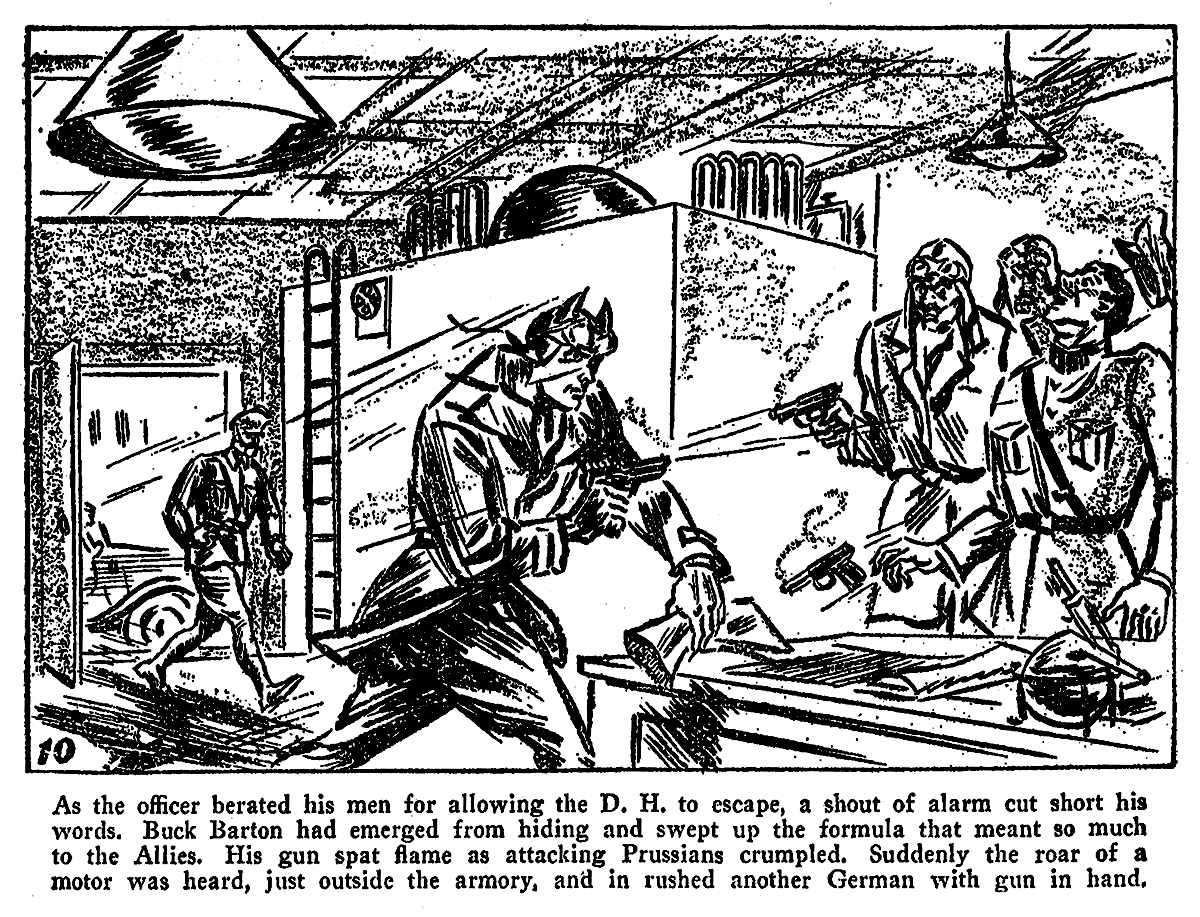
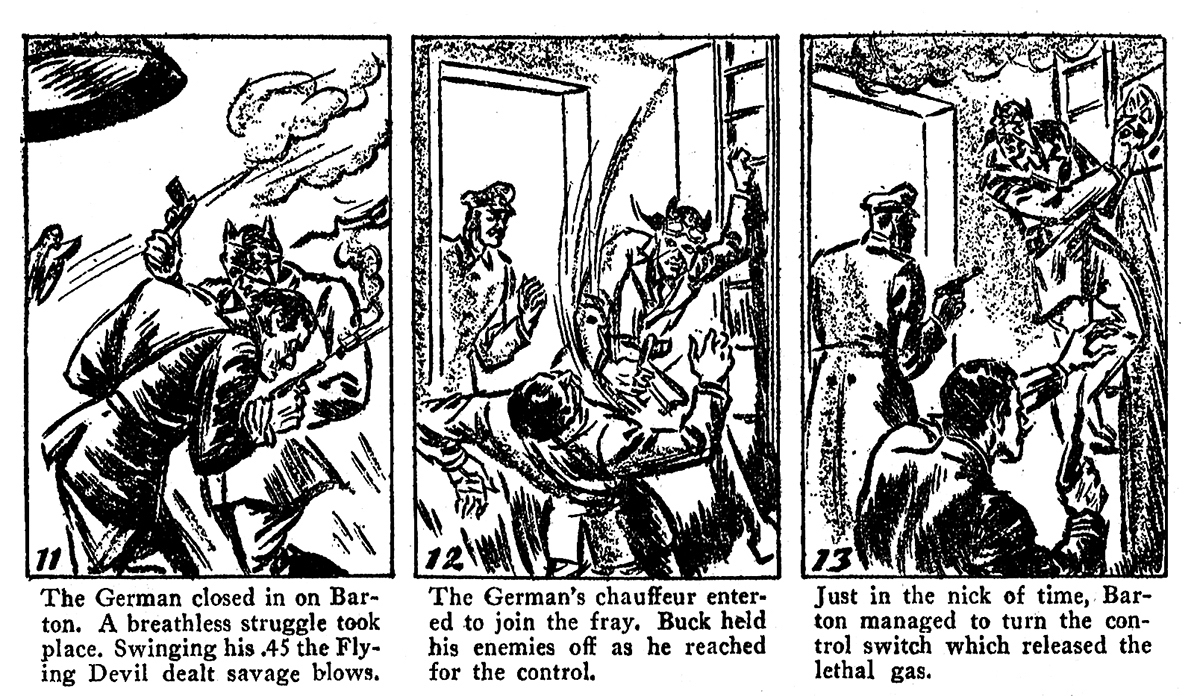
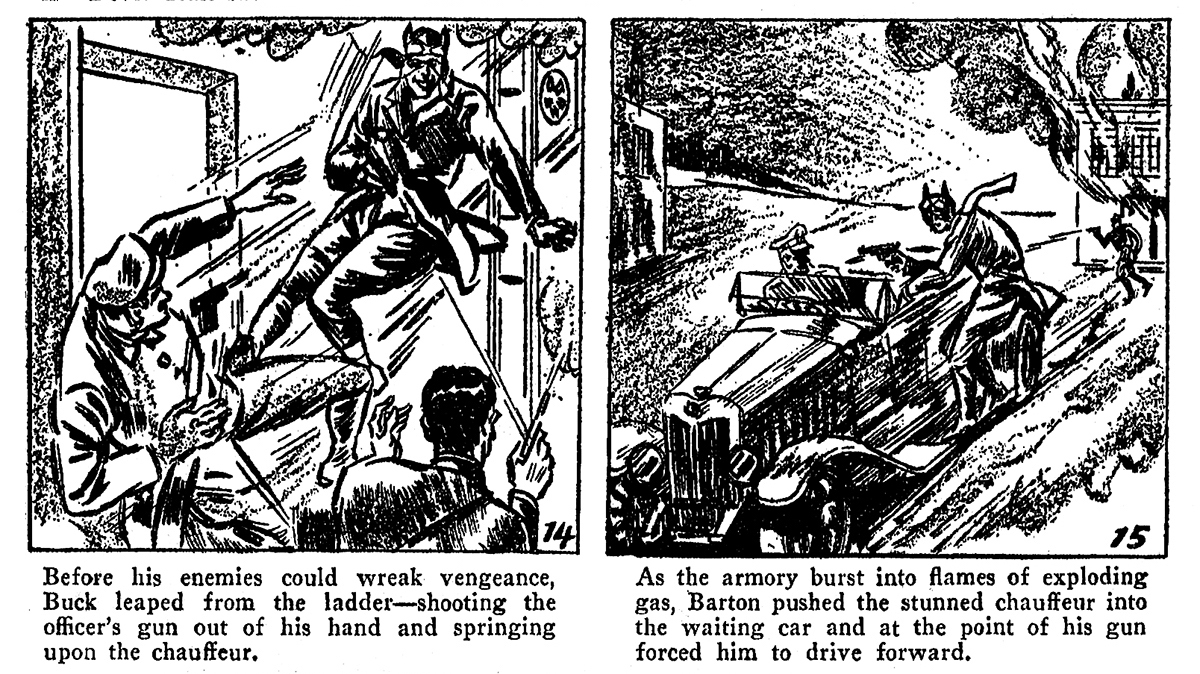
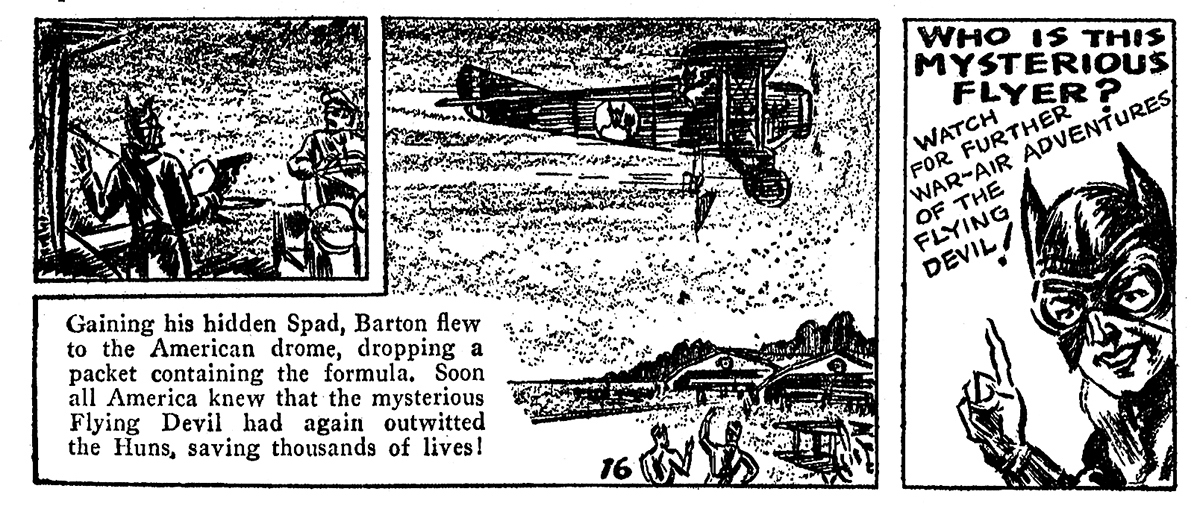
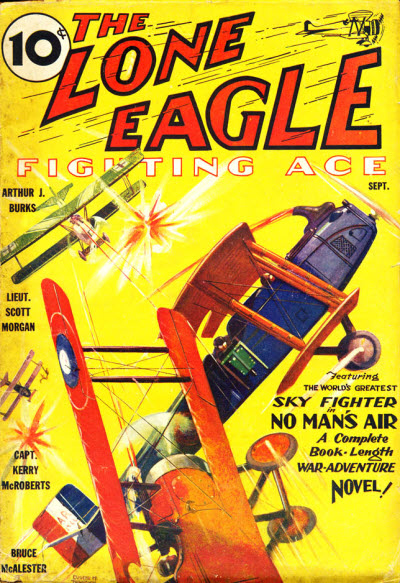 Terry Gilkison’s The Flying Devil premiered in the first issue of The Lone Eagle and would run installments in each of the first fifteen issues at which point it abruptly disappeared from the publication. This first adventure introduces us to Buck Barton, a.k.a. The Flying Devil. Barton flys a Spad with a devil on it’s fuselage and wears a flying helmet has been altered with the addition of horns to complete the impression of a flying devil (although the horns would dissapear from his headgear by the fifth adventure). He is presented in this first story as an independent agent working for the allies against the Germans.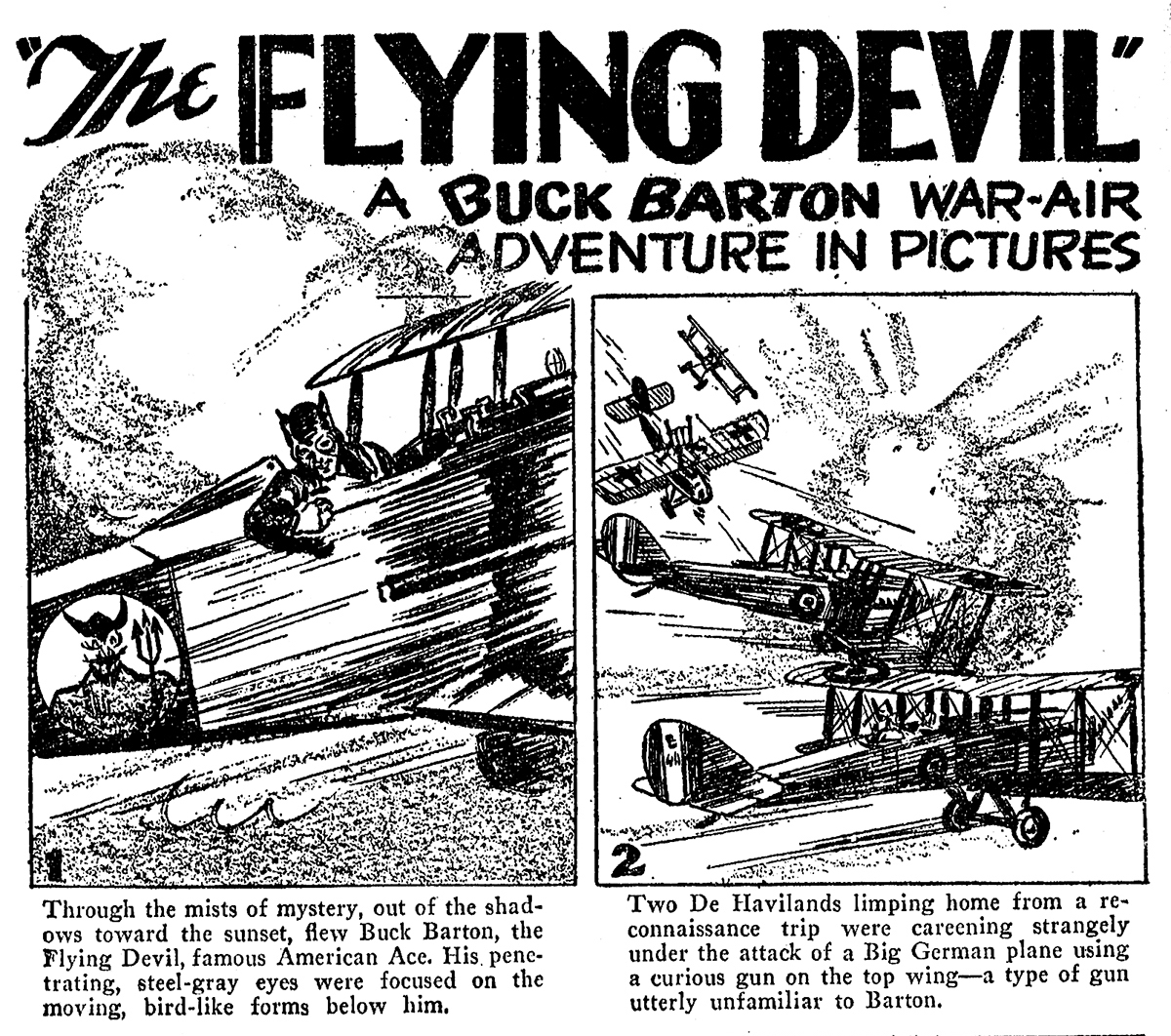
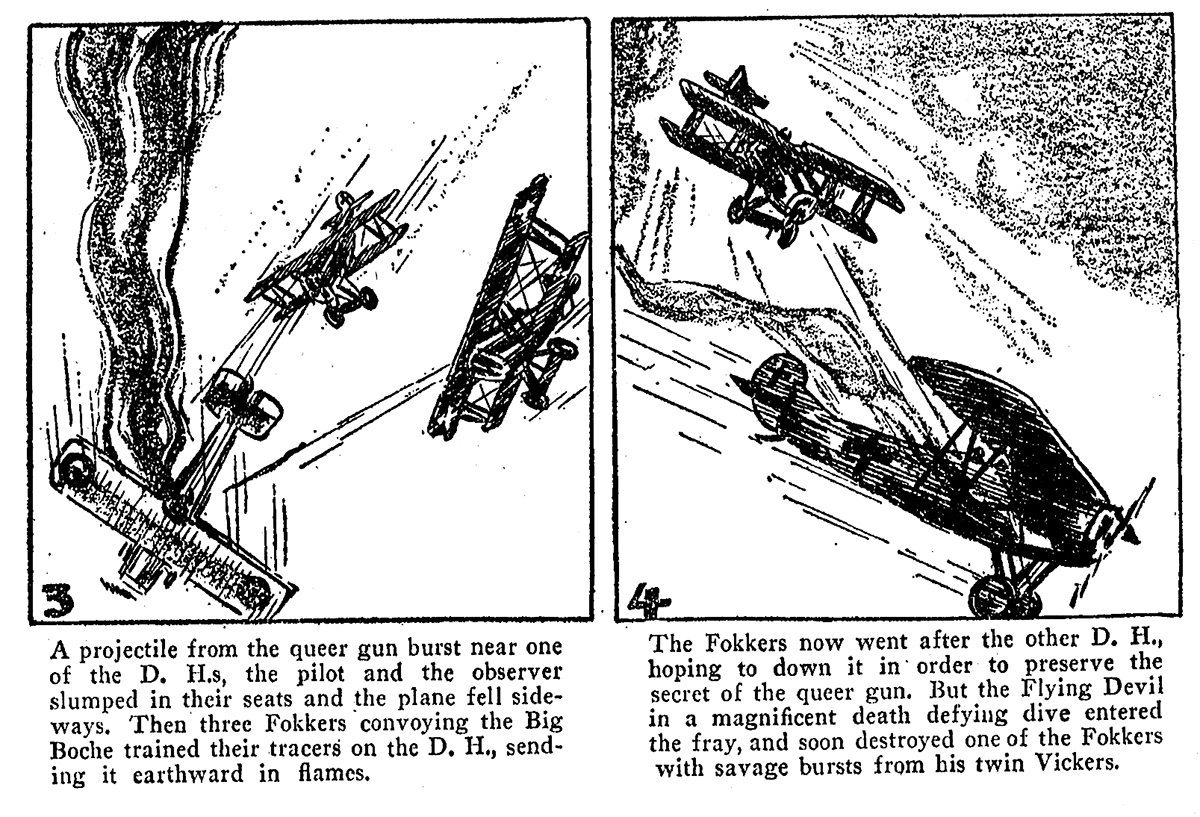
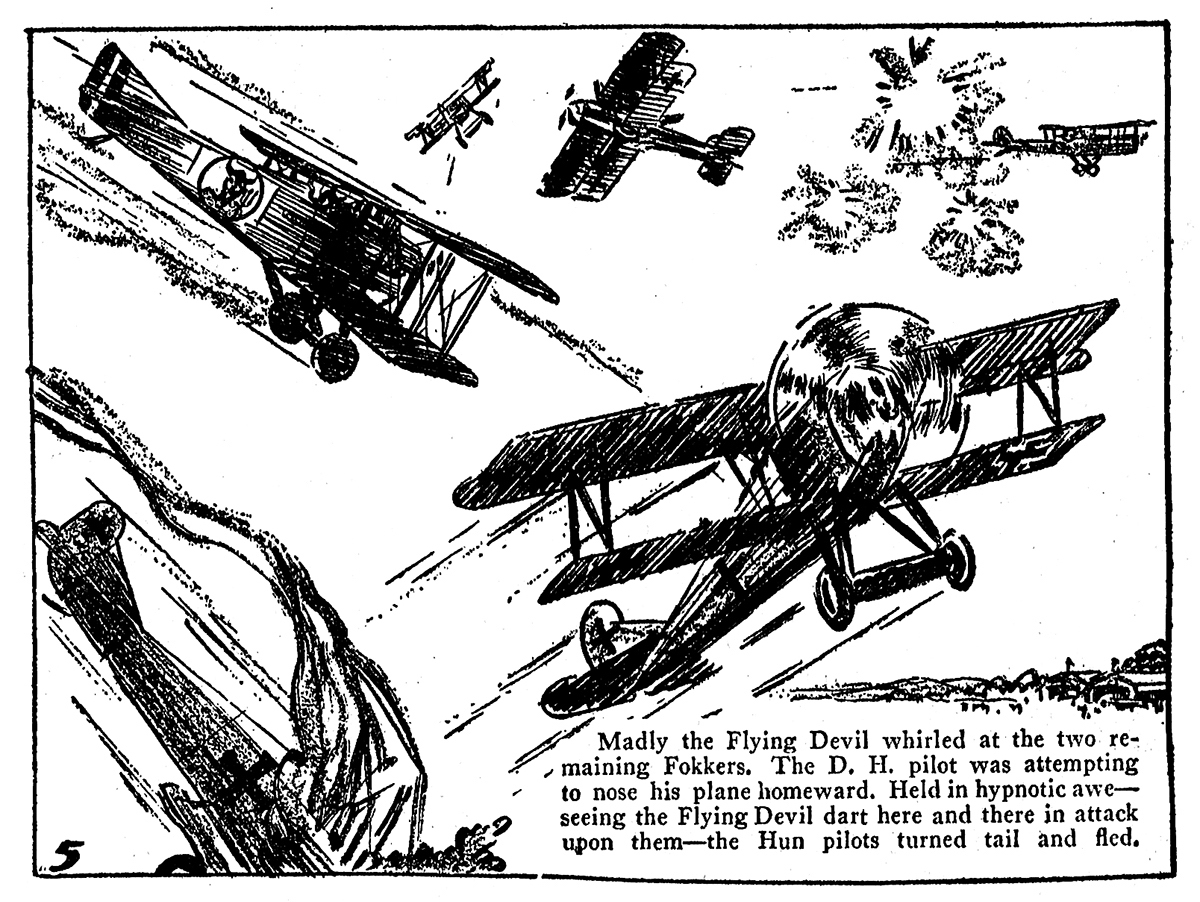
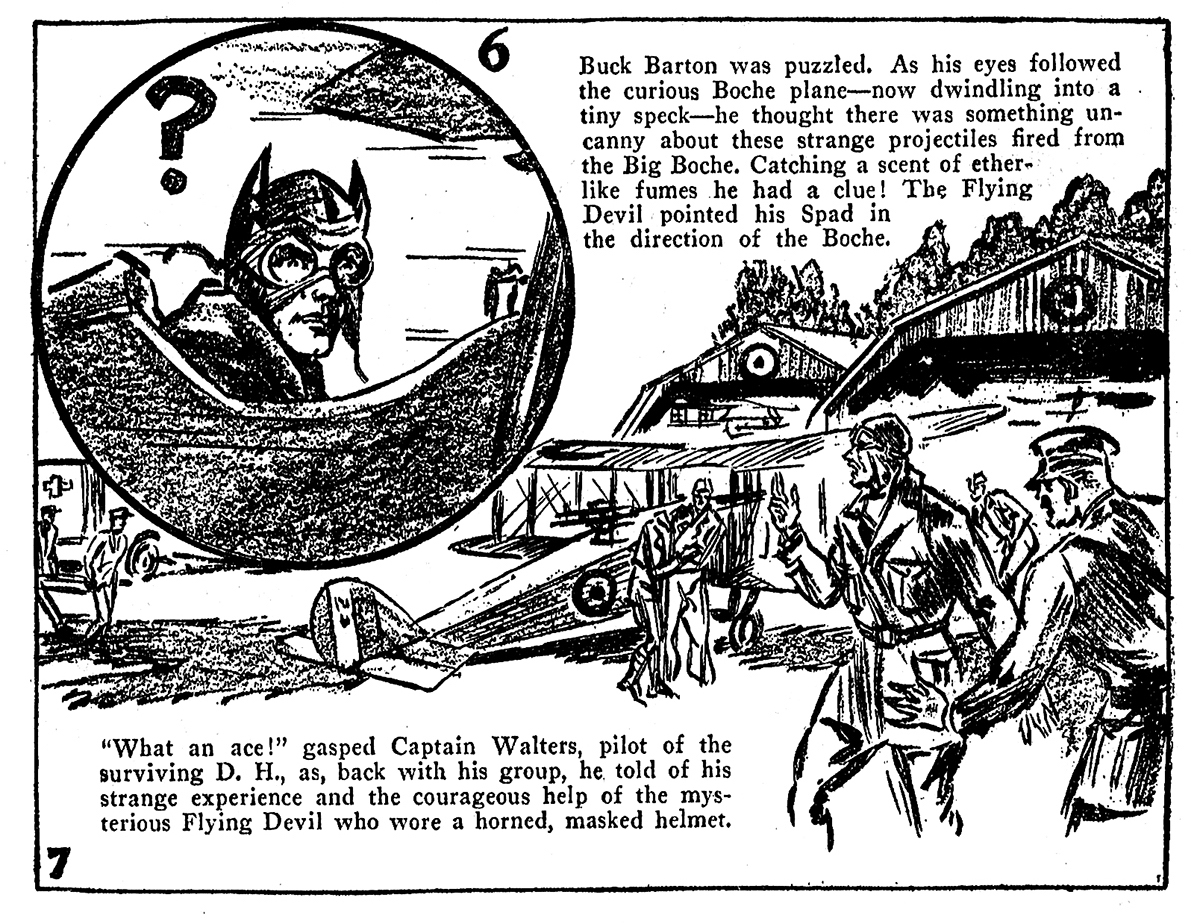
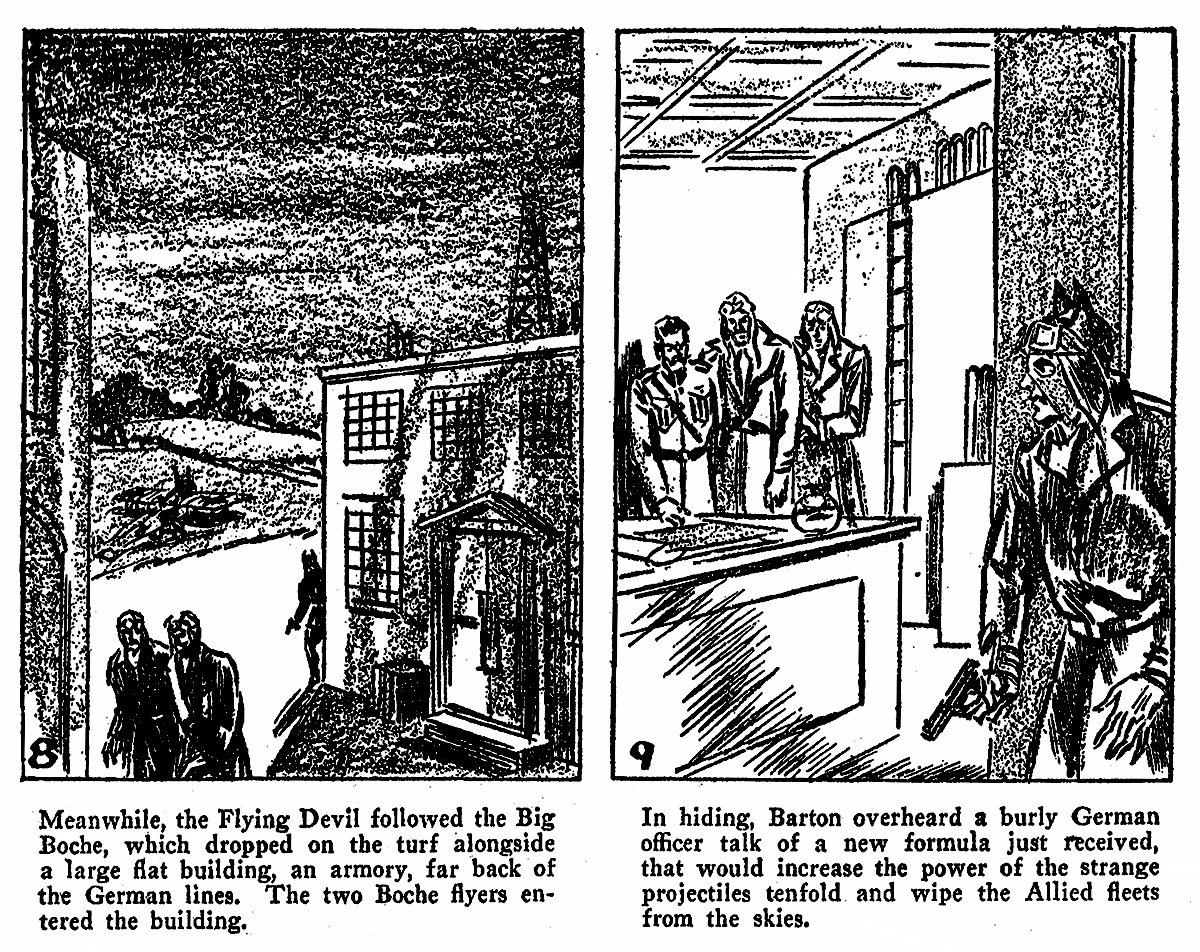
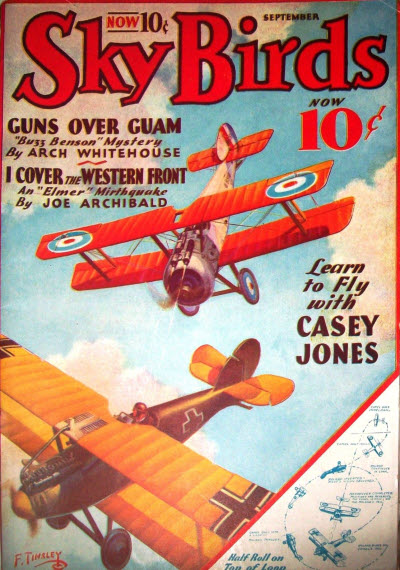 Franklin H. Martin. Not much is known about Martin aside from the fact he worked as a reporter on Newark newspapers. He had almost a hundred stories published in the pulps with roughly three quarters being detective or weird menace stories and the remaining quarter being air stories in the pages of Sky Birds, War Birds and Wings.


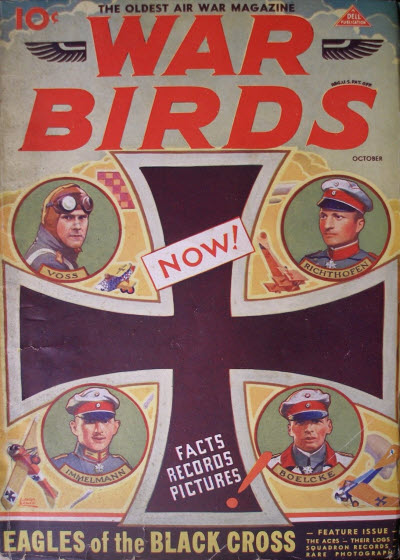 this month, the United States declared war on the Austro-Hungarian Empire. To mark the occasion, we’re posting Robert J. Hogan’s series of Abe Ginsberg stories that ran in the pages or War Birds magazine from 1932-1933.
 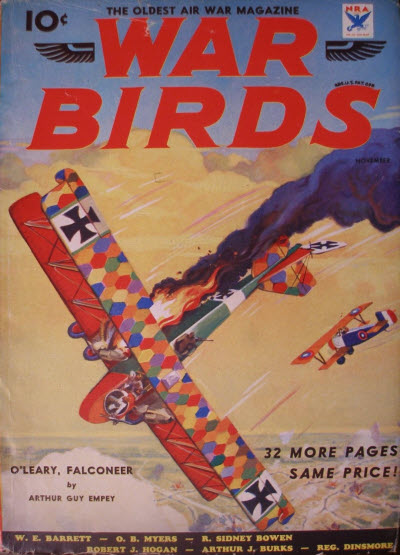 we have an additional tale of Abe Ginsberg from the pen of Robert J. Hogan. We had posted this back in 2010, but for those who missed it or would like to read it again or just have all five tales in a similar format, here is Abe Ginsberg’s final adventure from November 1933—”The Spy in the Ointment!”
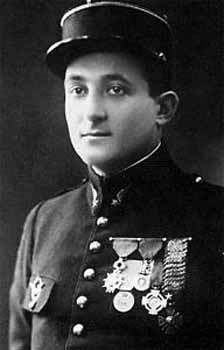 was one of the most famous of the French flying aces. Along with Guynemer, Navarro and Nungesser, he furnished the spectacular flying news that filled the newspapers in the early days of the World War. He was credited with forty-one victories—only the great Guynemer topped him in the list of French aces during his time on the battle front—and awarded the Legion d’Honneur, Medaile Militaire, and Croix de Guerre.